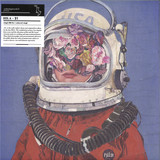
"21" is the well-crafted, sharp and original first album by the duo HILA, composed by American cellist Artyom Manukyan (who already worked with Kamasi Washington, Daedalus, Flying Lotus, Run DMC, Gretchen Parlato, Raphael Saadiq, Clive Lowe Mark...) and french producer Dawatile.
The combination of jazz, Los Angeles beat-scene and the vibrations of 80s and 90s Soviet Armenia make it a striking and unprecedented fusion. These kind of nostalgic and unconventional references forcefully shake the codes of mainstream culture to create a sincere, raw and intimate expression.
"HILA" was born from a spontaneous and intense creative impulse between Artyom Manukyan, a Los Angeles-based Armenian celloist and his partner in crime, David Kiledjian aka Dawatile, a French multi-instrumentist of Armenian descent. This project is proving to be a true master stroke given that it only took 21 days for the duo to make it a reality.
"HILA" was made in less a moon cycle but captivates and electrifies audiences upon its first outings. "H.I.L.A" colors the warmth of the Californian "High" with Armenian vibes. The artists chose this name for their creation since both have a close and valuable connection to these locales. This journey began in 2007, on the day Dawatile went to Yerevan, the capital of this small country in the Caucasus mountain to realize a first fusion project centered around local folkloric music genres.
There he was introduced to local musicians including the Armenian Navy Band, one of the country's foremost groups in which Artyom played the bass and cello. In this context, he also met many musicians such as Tigran Hamasyan and Norayr Kartashyan. This will be the beginning of connections between Lyon, Yerevan and Los Angeles. The following year, the two artists will be be seen performing next to Taylor Mc Ferrin at the Jazz à Vienne festival. More recently, they partnered up again when the cellist, who had freshly relocated in California, invited Dawatile to produce his album. As soon as the studio’s threshold was crossed, they decided to postpone this record and create a joint project: Hay (as the Armenians call themselves) / High In Los Angeles. HILA was born at the end of these 21 days of intense creation. The association of Artyom Manukyan and Dawatile is the combination of two visions, two versions of Armenia, two personalities, the reunion of the Eastern and Western blocs.
One grew up nurtured by the sounds of hip-hop and jazz in Europe and the other by art music and Russian-influenced 1980s Armenian folkloric music before moving to L. A., Ca. The cornerstone of it all, the glue that unites everything : Armenia and music. They generate a new identity synthesizing two perceptions, their complicity transcending these cultural discrepencies. To achieve this, they will scour through images of Artyom’s childhood, within the popular culture of Soviet Armenia. Together, they revisit this decidedly retro vibe, based on the work of Caucasian groups inspired by African American music. This background is rehashed and fused with ancestral Armenian sounds. The DNA of the album "21" is molded by these dear influences.
We can also hear the ancestral sounds of Armenia, a country at the edges of both Europe and Asia. The presence on two tracks of Armenian music Master Norayr Kartashyan, infuses the languor of past melodies and traditions. These purposeful anachronistic sounds offer a fantastic depth to this powerful opus. Listening to the album, one can appreciate the successful fusion of styles and influences. Those combinations, however, manage to preserve individual identities only to enhance the art through an adamant musical dialogue.
Being driven by the urge to transpose Armenian musical traditions into a unique universe, the daring artists, offer an innovative combination by blending, for the first time, these ancestral sounds with the world of Los Angeles beat-scene and jazz. An invention largely fueled by the magic strings of Artyom and maestro Miguel Atwood-Ferguson, a pillar of the genre in Los Angeles combined. These associations resonate with a triumphant equilibrium. HILA is musical uncharted territory in which Artyom's cello strings intertwine to ignite the harmonies of keyboards, the machines, the vocals and electronic layers Dawatile pieced together. HILA plays the soundtrack of an adventure set between Armenia around the end of the Soviet era and a mysterious near future.
Artyom Manukyan grew up in Armenia in the 90s. At the time, he studied Russian classical music while learning jazz with assistance by his father, a music journalist. Being an unconditional music lover, he went on to sharpen his skills at the prestigious Berkelee College of Music. Subsequently, he’s been lucky enough to travel the world touring with numerous acts and mainly with the Armenian Navy Band. The group has fostered alacritous success honored by a BBC Award as a crowning achievement. He moved on 10 years ago and made his way to L.A. with his cello on his back. In the City of Angels, he quickly became a popular figure of the jazz and hip-hop scenes thanks to his first album "Citizen". He’s accompanied prestigious musicians such as Kamasi Washington, Melody Gardot, Daedalus, Flying Lotus, Run DMC, Gretchen Parlato, Raphael Saadiq, Clive Lowe Mark, or Vulfpeck. He released his solo album on the cello, "Alone" in October 2019.
Dawatile is a bold producer and multi-instrumentist as well as a passionate and resolute musician molded by jazz. As a versatile artist, he handles and juggles the saxophone, the keys, the bass and composition. Simultaneously, Dawatile produces cross-over projects and soundtracks for the movie industry. He, as well, has had the opportunity to be a part of many tours, including with his electro hip-hop band, Fowatile and more recently with the "Future Kreyol" trio, Dowdelin. Being the ever workaholic, he has under his belt a string of prestigious collaborations with the likes of Talib Kweli, Foreign Beggars, Roy Ayers, Tigran Hamasyan, Mathieu Boogaerts, Voodoo Game and Piers Faccini. His taste for developing new musical recipes and his know-how in production make him a much sought-after album producer. In concert, the HILA duo offers a sober, precise and rhythmic performance. "21" is an aerial and lively album taking the audience on an at times joyous and sometimes melancholic dreamlike journey. The magic of "HILA" operates at the speed of light and positions it already as an avoidable group.
Поиск:cell out
Все
- A1: Glass Candy - The Possessed
- A2: Chromatics - Cherry
- A3: Symmetry - Bicycle
- A4: Mirage - Lady Operator
- A5: Symmetry - Wave Goodbye
- A6: Chromatics - Magazine
- A7: Symmetry - Memories Are Forever
- B1: Johnny Jewel - Digital Rain
- B2: Johnny Jewel - What If
- B3: Johnny Jewel - Street Lights
- B4: Johnny Jewel - Saline
- B5: Johnny Jewel - Dusk
- B6: Johnny Jewel - Death Valley
- B7: Chromatics - The River
Music From The Original Motion Picture Soundtrack. The music of Johnny Jewel, Glass Candy, Chromatics, Mirage, & Symmetry all articulate different visions for different moments — the pure ecstasy of a Saturday night out; unrestrained romantic devotion between vulnerable people; walks on wet streets on foggy nights; isolated twilight meditations. They make music for all moments, all feelings, all stories — in films & in life. Theirs is natural soundtrack music. Bruce Thierry Cheung brings their cinematic music to celluloid to tell the story of a family’s struggles in Don’t Come Back from the Moon, starring James Franco, Rashida Jones, & Jeffrey Wahlberg. The soundtrack mixes new & beloved work from the Italians family. Classic cuts such as Chromatics’ revered “Cherry” & “The River” (alongside the newer “Magazine”) & the disco-bliss of Mirage’s “Lady Operator” are alongside cues from Johnny’s instrumental solo album Digital Rain, all remastered to articulate the resonance of the visuals. Joining them is new music from Johnny & Symmetry. “Bicycle” finds Symmetry taking their Tangerine Dream and John Carpenter vibes into a haunting modern R&B space. Cues like “Street Lights” & “Dusk” use twinkling piano keys & glassy, minimal synthesizers to craft ambient electronic bliss. “Death Valley” is a foreboding & atmosphere track, laced with spectres of fading memories. Once you go to the moon with these songs, you’ll never want to come back.
Produced & Mixed By Johnny Jewel
Mastered By Mike Bozzi At Bernie Grundman Mastering
Cut By Bernie Grundman In Hollywood
Chicago-based contemporary electronic musician Steve Hauschildt has composed panoramas of synthesized sound for over a decade. First within his former band, Emeralds, an American touchstone of 2000s home-recorded psychedelic noise music, and later across a steady and critically-acclaimed stream of solo releases spanning ambient techno, arpeggiated electronica and post-kosmische styles utilizing synthesizers, computers, and digital processing. In 2018, he extended a collection of rich, visceral tracks titled Dissolvi, his first release on Ghostly International and his most collaborative work to date. Just a year later, Hauschildt returns with Nonlin, an album that's freer, leaner, and looser, both structurally and conceptually; less linear compared to its predecessor, but still captivating. Developed and recorded in several studios during and around the edges of tour - Chicago, Los Angeles, New York, Tbilisi, and Brussels - this material emulates an alienating encounter with a smattering of places, a replicant of culture shock, a solitary and stark experience with uncanny environments, melody and dissonance as oblique locales. Nonlin finds Hauschildt evolving his palette of tools, integrating modular and granular synthesis. The improvisatory and generative nature of modular systems, when paired with his signature grid-oriented and hand-played techniques, guides these compositions slightly out of line to hypnotic effect. Opener "Cloudloss" permeates the mix with an unsettling smog, which reappears and all but engulfs "A Planet Left Behind." On cuts like "Attractor B" and "Subtractive Skies," pockets of air rest between sequenced pulses, whose crumpling and flattening folds build into a restrained rapture of crisp frequencies and milky reverb-swallowed coruscations. The album's title track and centerpiece logs on to a foreign network, a fractured percussion signal that modulates and stutters into static amidst curious melodic sparkling in the hazy bandwidth. "Reverse Culture Music" casts an elegant and brooding stream of strings, pizzicato and churning bow from Chicago cellist Lia Kohl, against chiming minimalist synth frameworks. A surprising pattern emerges in the taciturn systems at work. Hauschildt continues to expand his already horizon-wide repertoire, here exploring the effects of corrupting coordinates; a flight subject to the collapsable abilities of time in remote spaces, a smearing of the axis to elegiac ends.
Dick Verdult, a.k.a Dick el Demasiado is the Philip K. Dick of multi-disciplinary art, the Moby Dick of “cumbia lunática”, and the Charles Dickens of literature and experimental cinema. He first fell in love with cumbia when he heard his nursemaid singing the classic “La pollera colorá”. From this moment on, he adopted the genre and reinvented it, in a perpetual degeneration called Cumbia Lunática, twisting up the elements of traditional cumbia, the “cumbia of the mucamas”, to create an anarchotropical vertebral rhythm, one which supports every moving part.
Celulitis Illuminati is the powerful debut of the anarchotropical gentleman knight of the abstract, Dick el Demasiado, eight dangerous tracks recorded for the first time on vinyl, songs that, upon listening, will liposuck all that grotesque accumulation of adipose tissue out of buttocks and brain. They interweave an amalgam of South American folklore and the cables of electronic music, the plugged-in Ranqueles indians, as in “Asi Que Los Que Sí” (“So That Those Who Yes”) on Side A, surrealist and lugubrious beats, poetry made song and “the dead man’s drool is good for painting watercolors”, as he sings in “Búho Sin Un Ratón” (“Owl With No Mouse”).Euphony that will abduct you away to a viscous street party with “Son Cosas De Hoy” (“They’re Things For Today”) and to an eclectic and excessive dimension with “pero bien bweno” (“but very proper”).
Side B is pure dynamite: “Mecha flan” (“Pudding Fuse”), “Sábado cultural” (“Cultural Saturday”) and “En la jeta” (“In the face”) represent the perfect blend of Lucho Argain (La Sonora Dinamita) and Muslimgauze (Bryn Jones). On top of this, the album includes an as-yet unheard gem, “Llama Mi Abogado” (“Call My Lawyer”), produced by Dick himself and Manuel Schaller, the telepathic mage of the Theremin. When the Dutchman stepped off the boat and onto the block, as well as offering us the TV set, the sculpture of a deranged English woman who devours islands like they were sandwiches, the synthesizer, the sound effect, the African drum, the maraca, the indigenous whistle, he obtained for us the song and the stanza, he provided us with the language and the poetry, the truthful, the epic of the ugly. Cellulite for mortals, cumbia lunática for the enlightened ones! Alfredo Padilla (Trans. Komurki)
- A1: Cold Sweat (1 50)
- A2: Unease (2 41)
- A3: Aftermath (1 45)
- A4: Isolation (2 34)
- A5: The Unknown (2 42)
- A6: The Manipulator (3 12)
- A7: Space Probe (2 50)
- B1: Psychosis (2 54)
- B2: At Risk (2 53)
- B3: At Risk (Link) (0 26)
- B4: Manhunt (3 00)
- B5: Flying Squad (2 40)
- B6: Dead End (1 11)
- B7: Collision Course (1 47)
- B8: Voodoo (1 13)
They Say: “A selection of suspense underscores and drama blackcloths which vary in intensity and cover a wide range of suspense and drama situations”.
We say: A breaky, funky library great masquerading as a horror score. Oh, and the cover art is amazing.
Breath Of Danger was originally released in 1974, and rounded up a killer ensemble cast of library legends including Alan Hawkshaw, Brian Bennett, Alan Parker, David Lindup, Kenny Salmon, Barry Morgan and Ray Cooper.
Lindup’s opener “Cold Sweat” sounds like hip-hop-friendly mode Axelrod and, indeed, was brilliantly sampled by Kool Keith for his Dr. Dooom project. Alan Hawkshaw and Brian Bennett’s “The Manipulator” sounds like it arrived straight out of the same sessions as their legendary Synthesizer & Percussion LP from the same year.
Over on the B-side Alan Parker’s “Psychosis” is a moving and beautifully restrained funk-guitar/cello/harp workout. Stunning. Kenny Salmon’s “Flying Squad” is a sleazy, flute-enhanced gem and the album closes with “Voodoo”, a seventy second riot of sound and colour from the dynamic drumming-percussion duo of Barry Morgan and Ray Cooper.
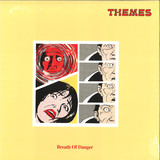
Sonically, there’s a widescreen vitality in all these tracks thanks to the driving rhythms, vibrant horn sections and blazing guitar work. It renders Breath Of Danger - 45 years old - truly ageless. The Themes series is known for having particularly striking sleeves, which was unusual for library records at the time, and Breath Of Danger’s scraps of comic-book crazy make for one of the most eye-catching.
As with all of our other Themes re-issues, the audio for Breath Of Danger comes from the original analogue tapes and has been remastered for vinyl by Be With regular Simon Francis. We’ve taken the same care with the sleeves, handing the reproduction duties over to Richard Robinson, the current custodian of KPM’s brand identity.
We wanted to make a promo text for this release, but then this message by Alphabets Heaven came thru:
Subtitles is my love letter to salsa. A torn, scribbled, badly translated love letter to an old address that the resident left years ago. But fuck it, it's still a love letter.
Every since I heard Larry Harlow's La Cartera about 12 years ago I've been trying to find out as much as I could about salsa. So much of it runs counter to everything I know about dance music, and yet it so clearly bangs. So on and off for the last 10 years I've been buying salsa, trying to work out how many imprints of Fania there were, trying to get my head round the horn arrangements, and generally having a great time with basically no contact with anyone who was actually a part of the culture in anyway. My Spanish is pretty bad as well, so all I really know is quite a few songs are about farmers.
Subtitles is my shot at salsa. My completely uneducated stab at something that's way too complex to just guess at. Not surprisingly, it sounds nothing like salsa. What's weird is that it sounds like pretty much everything else I listen to. I think in many ways it's the most honest thing I've ever made. By completely failing at making salsa I've managed to blend together all the club music, art music and everything else I've loved. You might hear some UK funky, or whatever the 2019 version of that is called. You might hear some minimalism. You might hear some psyched out shit. You also might hear a gigantic fucking mess. Subtitles is a translation to a film done so badly you find out more about the person who translated it than the film. I was trying to tell you about the film, but maybe you'll like the subtitles.
Shout to London Afrobeat Collective for the horns Memotone for the cello Deft for the Woos. Shout out to Scratcha DVA for being Scratcha DVA.
- A1: Chicks That Are Into Beefheart (& Jandek) (& Jandek)
- A2: Florida Bat Salad
- A3: Nightmare On Drucker Street
- A4: I Took Too Much Acid In 7Th Grade
- A5: Island Of Tragedy
- A6: Follow Me Down On Instagram
- A7: Seafood Special
- B1: My Mom Was A Hebrew School Teacher
- B2: Massachusetts Is A Magical Place
- B3: The Ridgewood Ripper
- B4: I Don't Want To Listen To Your Tape (Cellar Dweller) (Cellar Dweller)
All Music Written & Recorded by David Drucker at The Skinny Apartment in Ridgewood, Queens, 2017
Featuring Mike Green (Mezzanine Swimmers) on guitars on "I Took Too Much Acid in 7th Grade," Cop Funeral on
electronics on "Seafood Special," Chris “Mr Transylvania” Shields on background vocals on "Massachusetts Is a Magical
Place," Eva “Nighttime” Goodman on violin & backing vocals on "The Ridgewood Ripper"
Painted Faces is the long (strange/trip) running voyage of weirdo David Drucker, began in Florida in 2009 and decamped
to NYC in 2011. It has sometimes been a loose band in the past with a revolving lineup of outsiders and interlopers
(known as The Freak Band), but is usually a solo endeavor, and the bulk of the recordings have been done as such. PF
has always been a home recording solo project, one-man-band style heavy on psychOdelic/outsider
folk/noise/experimental vibes. He started self releasing CD-Rs in the early days and quickly jumped to tapes on a variety
of labels including Already Dead, Lava Church, J&C, Null Zone, Tall Tapes. A "legendary" CD compilation on Gulcher
Records and an LP from Already Dead and Almost Halloween Time in Italy brings us to the here and now. Tales from the
Skinny Apartment is somewhere around the 20th or so Painted Faces release...he has long lost count.
Drucker runs/curates gigs (and records at) the Skinny Apartment, his dwelling place in Ridgewood Queens,
which some folks have called the "realest DIY zone in NYC." He also rips in Dead River Company, Big Hiatus, Shecky,
Canyon River Blues and countless other unknown subterranean improv zoner outfits. "Ripping" involves keeping it
freaky and weird and ripping sets wherever/whenever, i.e. always being down to perform whether in a kitchen or a
packed ballroom....no diva bullshit, just plugging in (or going sans electricity) and playing...always giving it your
all...Ridgewood Rippers are the crew of artists that populate Ridgewood and the loose "scene" around the Skinny
Apartment...much of it is in jest, a self-inflated mythology of nonsense which is pervasive in all rock and roll "scene"
histories. As a student of rock/pop history, Drucker is fascinated by the loose associations that connect folks from
various zones together...i.e. Miles Davis and The Grateful Dead...it's all the same though, the labels and genre
distinctions are completely arbitrary. We're all in this together, now more than ever...to be a "ripper" is simply to
"rip"...no nonsense!
Painted Faces has toured all over the USA and Canada numerous times, spreading the ripper gospels, and is
gearing up for their second European tour. He is known for falling apart on "stage," with performances heavy on humor,
horror, stoned digressions, and cathartic bouts of therapy, part performance art/part standup comedy, eradicating the
lines between performer, performance, and audience one show at a time
Founded in 1990, Art of Dance has always been described by it’s founder, Kenny Larkin, as a “phantom label.”
“When I first started Art of Dance, I wanted to obviously release my own stuff, but I quickly learned I didn’t have the time or brain cells to run a label. So I instead licensed my music from my label to other labels. It existed, but it didn’t, in that sense, which is the reason I call it a “phantom label.” Given my low output of music projects, over the years, and my new found desire to put out quality tracks, I decided to relaunch the label, and use it as an outlet for my brother and I to build the Art of Dance brand, and most importantly, release great music!”
For his debut release, Kelvin presents what would be described not as “tech house”, but instead a blend between house and techno. Never straying far from his roots from Detroit, the title track of the single, Tell Me, samples “house diva” Loletta Holloway’s “Sweet Sensation.”
With the interplay between the techno inspired percussion style bassline, and Loletta’s perfectly placed soulful wails, Kelvin creates a beautifully powerful dance floor burner.
“The Force” is all Detroit. Kelvin gives a gentle nod to the past with this slow burner featuring classic 90’s style rolling snares, funky baseline, and horn stabs. This playful track is perfect for buildup for techno or house sets.
Time is Local is a project by Danish collective We like We and sound artist Jacob Kirkegaard built around a 12-hour live sound installation and performance at Thorvaldsen Museum in Copenhagen.
The piece was initiated and performed by the artists during the G((o))ng Tomorrow Festival in 2017. As they slowly wandered the halls and rooms of the museum for a whole day, they performed extended sound compositions for a visiting audience at each of the 12 chambers for a longer session - a haunting experience as the outside world disappeared and the focus was on quiet sonic moments unfolding in midst of the grand, reverberous space. For this album they have collected 12 fragments revolving around the chambers in the museum. Each chamber is being represented by its own handful of tones, instruments and voice. The statues within, depicted by neo-classicist sculptor Bertel Thorvaldsen get their own soundtrack of quiet emanating gusts. Barely heard frequencies reflect through the walls. The marble carved busts of Greek gods that line the museum hallways gaze eternally with a blank stare as decades pass and new audience arrives.
Although We like We should need no introduction to followers of the Sonic Pieces label, the Danish all female sound quartet consists of Katrine Grarup Elbo (violin), Josefine Opsahl (cello), Sara Nigard Rosendal (percussion) and Katinka Fogh Vindelev (voice). Together they have forged a dynamic and intuitional sound beyond genres through the last decade. Only two years ago they released the nordic neo-classical opus Next to the entire All. This time they emerge in collaboration with sound artist Jacob Kirkegaard. Jacob’s works are sonic reflections on complex aspects of the human civilisation, treating themes such as radioactivity, melting ice, border walls and tones emitted by the ears. Through the last decades he has released records and sound documents through labels such as Touch, Important Records and more. As a document of their 12h performance, Time is Local is a beautiful sonic evocation that shines as a bright line of sun through the cracks of a tomb.
In early 2018, Jas Shaw, one half of Simian Mobile Disco was diagnosed with a rare health condition – AL amyloidosis – a disorder of bone marrow cells. Having just completed SMD’s 7th studio album Murmurations and with a special show at the Barbican scheduled for April, things were thrown into confusion. At the time, no one, including Shaw, knew how the prognosis would pan out. Jas had to start chemotherapy almost immediately, which meant cancelling the tour. The duo decided to go ahead with the Barbican show in spite of Shaw’s illness, which was especially poignant as all involved knew it could potentially be SMD’s last ever live performance – in the end it turned out to be a tour-de-force. If this was SMD’s swansong, so be it.
In the year that followed, Jas spent months receiving weekly chemotherapy, learning to live with his condition, and when he felt well enough, spending hours in his studio making music.
The result of this was twofold, firstly a collaborative album with Derwin Dicker (Gold Panda), released as Selling – On Reflection, on City Slang Records Secondly, a growing archive of solo work, which is now ready for release. Entitled “The Exquisite Cops”, this 20+ track growing body of work will see the light of day via SMD’s Delicacies label – with a 2-track single released every fortnight /month and a limited
edition double LP scheduled for 27th September.
At the end of 2018 a difficult year was capped with hopeful news. With his condition in remission, able to stop chemotherapy Jas is able to start DJing and playing live again.
Jas: “The Exquisite Cops tracks seem to have made their own system for creation. Normally I record electronic music like a band would, as a take. So, it’s kind of surprising to me that that this batch of tracks wasn’t made this way. Instead of a single take that gets edited and developed these tracks were all made in bits, usually months apart. Some days I’d make a drum track, often editing it down so that it’s some sort of semblance of a structure; on other days I’d end up just making a synth sound or texture. This wasn’t something that I gave into reluctantly, it’s nice to be able to give a feedback based pad your whole attention rather than just set it up and only attend to it if it gets really out of hand.
The process of matching these misfits together was originally born out of laziness, rather than break open the synths to make something to develop an idea, what if I could just use something that I already had; slack. The interesting thing was that in pulling two takes together that were done months apart, they cast each other in a different light and though sometimes making them fit together was a hatchet job, sometimes they locked up together in an improbable way, making the rough structures that I’d improvised make a different sort of sense; often a more interesting sort of sense.
The more I did this the more it felt like this was not just a slacker’s way to use up offcuts, this resulted in combinations that I’d probably not have chosen if I’d done the tracks in one go. Also, and I know this isn’t something that’s important to everyone, there was a level of fastidious detail that I’d never have got if I’d had the textural and rhythmic elements playing together. It’s a longwinded process but it’s changed how I record and how I think about recordings I’ve made; plus I enjoy all parts of it so why cut it short?”
It seems KPM have long been fans of Smith and Mudd and, after being introduced to each other by mutual friend Andy Allday, the peerless Balearic maestros were invited to contribute to the library label’s digital-only “Album Shorts” project. The results are predictably wonderful.
With past projects under our belt working with everyone involved so far it made perfect sense for Be With to take on the vinyl release of this instant library classic. But why is it called “Tea With Holger”?
“Holger” is of course Holger Czukay and the whole LP is dedicated to Smith and Mudd’s time spent with him and Ursa Major at Can’s famous Inner Space Studio in Weilerswist, near Cologne.
When not recording it seems they spent a great deal of time sat around being entertained by Holger’s stories and drinking many cups of different sorts of tea from all over the world. These moments provide some their fondest memories of their visits:
“Looking back, it was pretty incredible that we spent part of our lives with Holger in one of the most magical places we’ve ever known, Inner Space Studio. We have our memories and, of course, the Bison album we made with him. But to honour the time we spent with him, we wanted to dedicate an album to him called ‘Tea With Holger’. The names of the tracks are about that time.”
The album was recorded over several years in London, Margate and Gorthleck, a small hamlet in the Scottish Highlands. Mike Piggott, who played with Bert Jansch, handled the strings and played violin whilst Sam Creer lent his virtuoso cello work to the proceedings. The sessions employed a key recording technique from their time with Holger: hit record and play. They wanted to capture magical improvisational moments live and not do the work later on in editing.
In their own words (and in classic library record sleeve style) these tracks are collectively described as “Balearic themes including breezy soul, sun-dappled melodies, warm pianos and sweeping strings”. You want to hear this, right?
The album is vintage Smith and Mudd. The gentle piano ushering in opening track “The Gardener” is soon joined by low, bubbling drums. When the time is just right, lush guitars glisten above a Welsh language vocal that floats like silk. Easy as a sea breeze. “Innerspace” is of course a nod to Can’s aforementioned studio. Dark, heavy piano meets rolling drums before warm chords and luscious strings take over, gliding over moody grooves to drive you home. Closing out side A, “Weilerswist” delivers more beautifully rolling piano and guitars over thumping cellos and building drums.
Side B opens with the full, string-enhanced version of “Away From Me”. This is Smith and Mudd’s prefered version and it’s only available here on this vinyl issue. For us it’s the standout on this all-highlight album. Tribal tones, piano and cello set a melodic staccato for violin to soar over while rolling piano lines and gospel organ chords descend into a drum drop that leads to a glorious vocal lead finale.
Distant synths introduce sun-drenched guitars and uplifting strings in “Kölner Street”, before a spacey Moog solo leads to a spellbinding, sci-fi drop. The sunshine returns before the track ends. The album closes with “Tea With Holger”. Airy vocal swells are punctuated by plucked cellos and picked guitars, all wonderfully warmed by a soulful piano.
Cut by Pete Norman and pressed in the Netherlands by Record Industry, “Tea With Holger” comes in a classic KPM green sleeve complete with track descriptions from Smith and Mudd themselves. The finishing visual touches come courtesy of Richard Robinson. We’ve given this record the same care and attention as we give to each our KPM re-issues, and it’s just as essential.
'There's a lot of serendipity involved in wrestling grooves out of these awkward machines', says Richards about the process behind the record. 'A large part of the composition is making the machines and the patches. They define the limitations of the pieces coming together. Then the performances are happy accidents - found using intuition and practice.'
Made up of two studio sessions and one live recording, PINK NOTHING reflects the unusual space Richards inhabits musically. It's partly informed by his background as a PhD student at Goldsmiths, where he re-imagined and built the Mini Oramics machine – a 'drawn sound' instrument first conceived by electronic music pioneer Daphne Oram, and finally realised by Richards in 2016.
But Richards is also an autodidact beat-maker, and much of the structures and sounds on PINK NOTHING derive from dance music, while his influences also include ritual trance, Ghanaian drum choir music, and the cellular rhythms of Steve Reich. 'It's polyrhythmic abstract electronica' – and he emphasises – 'listening music'.credits
J. Robbins has been the guitarist/singer and primary songwriter (or pushiest collaborator) in several bands since the early ’90s, including Jawbox, Burning Airlines, Channels, and Office of Future Plans. He has also played bass for Government Issue and the Vic Bondi project, Report Suspicious Activity.
For the bulk of that time, he has also been active as a recording engineer/producer, working with musicians from around the world at his Baltimore-based studio, the Magpie Cage.
J. started performing as a solo artist around 2010, making occasional low-key releases on Band- camp and contributing to two benefit compilations that were released on Germany’s Arctic Rodeo Records.
Un-Becoming -- which came together in short bursts of activity spread out over the long stretch between 2016 and 2019 -- is his first full-length solo record. On 11 of the LP’s 12 songs, J. is joined by Peter Moffett on drums, Brooks Harlan on bass, and Gordon Withers on cello and gui- tar.
C'est bas du front, ça fonce dans le tas, ça envoie du bas du front, puis ça remix deux de nos grands classiques à l'italienne (killervibez), en mode euh... bas du front ^^
C'est une photo d'asile "qu'on rêve d'acheter depuis des années près du mans"...
c'est commenté en français... c'est du françaikore sans bouts de tissus tricolore ! A part le drapeau hardcore...
Pochette imprimée (Visus by Hô), cellophanée (par Records Industry), gravé et masterisé (Par Simon The Exchange), distribué (par qui voudra nous en chopper).
Big up a tous les artistes... c'est vraiment un super disque
Alt-rock icon Josephine Wiggs is best known as bassist in The Breeders, rising to superstardom in the '90s and continuing to draw crowds and critical acclaim in the wake of their 2018 album All Nerve.
But over the years, Wiggs has released several of her own albums, all of which delightfully defy genre. Her new solo record, We Fall, is both a departure and a distillation of an enduring personal aesthetic: moody and spare but also melodic, at once contemporary and nostalgic.
Some influences are clear: We Fall is reminiscent of the experimentalism of Brian Eno's Another Green World and recalls the delicate, languid minimalism of Harold Budd. The album's classical inflections, sharpened by a dialog with electronic elements, evoke Alva Noto and Ryuichi Sakamoto. This is an album of juxtapositions: minimalist at moments, richly layered in others; ambient while also sharply focused; melancholy yet resolute.
There's something both dreamy and scientific about We Fall. Wiggs, an enthusiastic amateur mycologist, has an impressive collection of mushrooms she's photographed in her travels. We Fall could be the soundtrack to what can't be captured in a single photo—the growth and decay of miraculous creatures that a less astute and sensitive eye might overlook entirely.
Composed, performed and recorded by Wiggs, with drums and electronics by her longtime friend and collaborator Jon Mattock (Spacemen 3, Spirit , We Fall is a lyrical, bucolic album with an undercurrent of disquiet. Think of a wintertime walk in the woods as dusk falls too soon. True to the classic album form, the 10 almost entirely instrumental tracks on We Fall form a compelling whole: a crystalline meditation on paths not taken and words unspoken, an elegy for moments lost and last embraces.
JOSEPHINE WIGGS BIO
Josephine Wiggs grew up in an unconventional family north of London. Returning home from a summer holiday with a donkey riding in the back of the family's 1927 Rolls Royce was not considered at all bizarre. Wiggs studied cello as a child, segued from college in London to undertake a master's degree in Philosophy, and then, in a move few would have predicted, joined a rock band.
After making three albums with The Perfect Disaster (1987-1990), Wiggs left to join Kim Deal (Pixies), Tanya Donelly (Throwing Muses), and Britt Walford (Slint) in forming indie supergroup The Breeders, whose debut album Pod came out in 1990. Following a shift in line-up—with Kelley Deal on guitar and new drummer Jim Macpherson—The Breeders released Last Splash in 1993; with its hit single 'Cannonball' and 'Divine Hammer,' they became alternative rock superstars.
During the same period, Wiggs released two lower-key albums with Jon Mattock (Spacemen 3, Spiritualized): Nude Nudes (1992) under the name Honey Tongue, and Bon Bon Lifestyle (1996) using the moniker The Josephine Wiggs Experience. She also recorded and produced Klassics with a K (1996), the beloved and only album by the Kostars (Luscious Jackson's Jill Cunniff and Vivian Trimble). During a brief run of shows, Wiggs joined the band on drums, showing her range of musical ability.
In the late '90s Wiggs collaborated with Vivian Trimble as Dusty Trails, whose eponymous 2000 album is an homage to neo-noir soundtracks, spaghetti westerns, and Gallic pop. Time Out described it as 'one of the most subtly suggestive, understatedly elegant...things likely to have caressed your cochlea in years.'
Allusions in Dusty Trails to film music foreshadowed the next stage of Wiggs's career, writing scores for feature and documentary films—from Happy Accidents by Brad Anderson in 1999 to Appropriate Behaviour by Desiree Akhavan in 2014. Her new album We Fall began as a suite of short pieces for the documentary film Built on Narrow Land. Wiggs has also composed and recorded music to accompany live performance and short films by the acclaimed Brazilian choreographers chameckilerner.
In 2013, following the 20th anniversary of Last Splash, the classic lineup of The Breeders reunited for a world tour. Five years later in 2018 they released All Nerve, with Wiggs co-writing two songs and singing lead on the standout track 'Metagoth.' We Fall, Josephine Wiggs' third album of her own design and ninth album in a career spanning three decades, will be released on vinyl and available for download and streaming on April 12, 2019 by Sound of Sinners.
F-Dorm is a collaboration between Connor Camburn of Litüus (AVIAN), and visual artist Conor Ekstrom. Commune follows the first F Dorm cassette on Mazurka and presents the first LP by the project. Songs build upon unexpected repetition, wielding normally aggressive sounds into meditative loops with subtle textural evolutions. Bursts of tape saturation, controlled waves of feedback, and linear drum beats shift and weave together through rhythmic delays. Affected vocals speak low as if coaxing the listener further out into the nether regions of the mind. The strange cumulative mood of the record is difficult to describe: A transcendental state or a foul parallel from which the listener arises stronger or does not arise at all. mummies in civilian clothes -the master of the riddle-a DOLLMIND haunts me in the penitentiary -the puttyman, naked inside -a mind made of cream
Acclaimed UK producer, Cella Records label operator, and swiftly aspiring talent Turner has already stirred up the scene with quality shells more than once with his own acclaimed productions, receiving air-play from venerated key figures such as Mala or Youngsta. Laying down the law for its first three releases, it's time to showcase his undoubtedly equally effective A&R skill - welcoming none other than the Rochdale-based artist duo BFM (Bloodklart Fiyah Mandem) to the label roster. Consisting of JFO and Sativa, their collaborative output cuts through the noise - support from the likes of Grime veteran Slimzee and physical releases via Glassy Records and Hooded Up. Now stepping back on the controls to set the new year ablaze in style, BFM delivers a total of four extensively weighty cuts for Cella's fourth vinyl release. As the needle picks up the records' first grooves, 'Magic Carpet' sets path on a ride into a distant and barren territory - at once being enamored by its contemplative atmosphere. Unraveling its dynamic interplay of sound and silence, the authentic old-school instrumentation and lavishly saturated low-frequency surges keep us coming back for more. Catching a swift breath, 'Niyaz' lures us into spheres of droning reverberations - phasing in and out amidst vigorous square-wave leads and meticulously crafted foley effects - conveying its story with full force on a minimal platter. No exception to the rule, 'Shade Riddim' conjures another isomere of their signature ambience - wailing voices, enigmatic strings leading the way through dimly lit, high-pressure alleys. Droning along as conclusive proof of this releases' unquestionable intensity, 'Limitless' wraps up the madness - delivering a fourth, flawlessly executed bass-weight meditation. Timeless music on a twelve-inch platter.
For the twelfth output of Invite's Choice Records, the label returns to doing VA releases again!
'Genetic Disorder' by Dark Quadrant opens the EP with a loopy, bass driven industrial track. The monotonous nature of the track makes it a perfect tool track for transition mixing. Biemsix continues on the A-side with a hypnotising synth and snappy hats and shakers. The 90's style present and short kickdrum is the main focal point in 'Hold On, Hold On'! Dold opens the B-side with a four-to-the-floor loop-techno track dubbed 'Cellar', which describes the smothery atmosphere of this track quite well. Mike Storm is put on closing duties and delivers a dusty track which completely revolves around mind-paralysing EFX accompanied by hard hitting drum machine sounds.
- A1: Dim Grimm -Drivel To Balsam
- A2: Zimpel / Ziolek - Wrens
- A3: Tujiko Noriko - Tennisplayer Makes A Smile
- A4: Gerhard Zander - Wabi Sabi 35
- A5: A.p.a.t.t - Young Free & Parasite
- A6: Ssellf - Visitors
- B1: The Reboot Joy Confession - Enjoy Solitude
- B2: Merz Feat. Sartorius Drum Ensemble - The Hunting Owl (Julian Sartorius Drum & Vocal Rendition)
- B3: Helen Money - Mf
- B4: Oceaneer - The Sea
'For The Colleagues Of Ubu & Their Authorities' is the brainchild of Vienna based vinyl enthusiast, DJ & producer The Reboot Joy Confession. What once started as a series of mixes has been expanded into this compilation, on which he brings together diverse genres of music like electronica, modern minimalism, folk, post-rock, avant-garde or modular music, which also reflect his own versatile musical taste. 'As I stopped thinking in genres, my attempt was to merge my musical taste in the most fluent way possible onto one record. There are mesmerizing songs from some of my favourite contemporary artists - I feel a timelessness in their music, I can ´t get tired of. With the compilation I wanted to create a contemplative, fictitious, surreal world, merging those different styles together. Giving it that title, I wanted the listener to be able to imagine a tale that is building up with each song. I am really happy about the outcome of this compilation and hope that many other listeners can feel the magic.' The compilation includes the surreal work of Swiss producer Dim Grimm (also known as Dimlite), as well as a collaboration between Merz & Julian Sartorius Drum Ensemble who radically altered the original version of 'The Hunting Owl' into a monstrous percussive live version. Taken off the debut album from one of Poland ´s most interesting musicians at the moment, Waclaw Zimpel & Kuba Ziolek, 'Wrens' is a fusion of folk, jazz and modern minimal music. Experimental pop musician & filmmaker Tujiko Noriko appears with an emotional piece that challenges the paths between pop and avant-garde. Gerhard Zander, whose musical work started on the outskirts of experimental pop music in the early seventies in Germany, delivers a modular synth masterpiece with unique sounds, textures and a far-out synth choir. Rock and ambient influenced musician Helen Money (also known as Alison Chesley) is a Los Angeles based cellist and composer who appears with a massively dark post-rock song called 'MF', which was recorded at Steve Albini's Electrical Audio studio in Chicago in 2009. Often compared to Frank Zappa and known for their richness of ideas, Liverpool's a.P.A.t.T. contribute the hypnotic 'Young Free & Parasite', with references to British glam, post-punk or synth rock, but in a fresh and obscure sounding outfit. SSELLF, the moniker of New Zealand ´s Christoph El Truento, inspired by post-punk and noise. 'Visitors' is simple and simply in your face, with lo-fi drums, distorted synths and raw vocals by Christoph himself. After a few seclusive years, The Reboot Joy Confession returns with a new, crispy and soulful track. Cinematic strings written by Martin Riedler, arranged by Flip Phillip, and recorded at the established Vienna Konzerthaus, based on a properly arranged drum outfit and played by a villain named Gurlimu. Both strings and drums are guiding through the whole song and culminate in Glockenspiel and Rhodes melodies. Oceaneer aka Japanese pianist Oneechan Nanashi completes the compilation with her beautiful and profound composition 'The Sea, Forever'. She describes her music as 'improvised instrumental underwater music from the bottom of the Pacific Ocean, played with broken instruments, directed by the spirit of drowned people who are talking through the hands of the pianist. It's lonely and bleak music for the dead.'
Domestic Exile are proud to present the devastatingly deplorable and malevolent recordings (that are sure to corrode yet electrify your ears) by Glasgow's very own KLEFT.
KLEFT aka Vickie McDonald is rooted in and has actively propagated the underground DIY radical queer punk and feminist movement here in Glasgow. Their projects have included the skull crushing sludge doom of Cartilage, the unflinching and infamous multi- membered hard core stars that were DIVORCE and the sacrificial, druid drone glitch of MOURN. Alongside these projects they have uncompromisingly disrupted, motivated and facilitated collective endeavors to take down the capital power structure of the dominant system of patriarchal club venues and abhorrent fuckers in this town.
For this record 'H+ Sexualis', KLEFT explores the neo-modern space where flesh is left behind. Negotiating, analyzing and tearing to shreds the relationship and balance between flesh and technology. KLEFT's expansive and palpable sonic offerings delve into themes of transhumanism and body hacking and seep into our collective skin begging the question; can flesh ever be created digitally. Does a lack of physicality alienate human experience in a post transhumanism society Are we all destined to be skinless yet digitally connected Will the body become superfluous Toward "the utopian dream of the hope for a monstrous world without gender," as stated on Donna Haraway's essay ''A Cyborg Manifesto.'
From the opening track 'Ossein' the listener grasps a foreboding lethargic build up, lurking out of the spatial ritualistic shadows into a sea of suffocating nothingness. A void where there is no gravity. Skeletal and brittle shattering rhythms which echo DMZ / Skull Disco dubstep alongside the more frozen, glacial ominous explorations of grime are often felt proving KLEFT is an artist whose inspirations run deep and wide and generally exist in the darkest recesses of our subconscious. These fearful, disjointed rhythms are set against weightless atmospheric oscillated synths, as if roaming through bleakly opaque, claustrophobic narrow corridors on a first person survival horror video game such as Resident Evil.
Moving through to 'CMBR', KLEFT's dissonant, degrading soundscape ferociously ascends. The resilient kick drum is propulsive and pulverizing akin to 'ardcore tekno - or intense gabba if you have the guts to adjust the tempo up to +8 - aesthetics that overwhelm and agitate finally revealing it's grotesque biological / amorphous bio structure. Elevating the repetitive 4/4 kick to a destructive, distorted banger of a track as layers of converging atonal noise and sound design simultaneously further enhances the sense of imminent radioactive contamination.
Next is 'Writhe, Squirm, Broken' continuing the convulsive, nauseating permutations of the prior track but reconfigured like a mangled, gruesome Cronenberg-esque parasite that has infiltrated an open wound, excruciatingly feeding off of the inner anatomy of it's hosts body from within. Repulsively reformulating the shape and dimension. The intro is akin to a panic stricken bouncy ball contracting and expanding, the spring reverb building momentum and traveling further away in distance and speed.
'Hackfleisch Deluxe' is a muuurrderous stomper and is one of the more grime / bass orientated tracks that deconstructs and disrupts the tempo familiar to sub-low producers on Black Ops / Jon E Cash / DJ Dread D. The crawling, plummeting frequency of the synth is a nauseating rush of coagulating blood to the heed; a deep throbbing sensory depravation in sharp, paradoxical contrast with the driving harmony layered on top which proves to be infectiously addictive. Furthermore are splintering programmed vocal samples that gives a sense of artificial disorientation, mind over matter, a possible hint at our evolving sentient cognition within a nightmarish simulated, augmented reality
Second to last we have 'Keratin' which is filled with the near fatal dissolving thud of Djax-Up acid that gives the impression that you're a biologist peering through a microscope into a petrie dish and witnessing the rapid and furious genetic cellular replication of bacterial and viral organisms.
Culminating in 'Bruised and Bleeding Hands' where the squashed density of a deflated and depressurized helium filled balloon and elastic umbilical cords, barbed wire and copper wires grind n' coil around the lens of a zooming camera. Taking no prisoners, this is a punishing grime weapon. A phat, surgical kick drum bulldozes its way thru causing carnage, syncopated punching snares after every rave stab and dizzying third beat. It won't be long until ye hear this on Silver Drizzle's youtube channel in the near future.
This record transports us to the hyperkinetic mutation scene on the cult cyberpunk film Tetsuo The Iron Man where the organic flesh / mechanical rust of the Iron Man metamorphoses with the Metal Fetishist during the rebirth sequence and we say 'LONG LIVE THE NEW FLESH!''.