'Numbers' is a true lesson in 21st century soul as Eveson weaves haunting vocals and sci-fi atmospherics over a cavernous
bassline and skeletal half time beats.
'Life In The Balance' continues with the minimal approach but gently warms things up with soothing keys, rolling breaks and
hints of ghostly vocal. Lastly, Eveson revisits 'Life In The Balance' at 140 BPM with a melancholy, spaced out and stripped
back garage mix.
Cerca:channel 82
- 1
Goosey makes his Crosstown Rebels debut with ‘Wrapped Up In Your Love’, featuring remixes from Daniel Steinberg. Out on 10th April 2026, the Barcelona-based artist lands on Damian Lazarus’ imprint for the first time with a vocal-driven house cut backed by two reworks from Berlin mainstay Steinberg.
A vocal-led slice of modern house lands on Crosstown Rebels as UK DJ/producer Goosey makes his label debut with ‘Wrapped Up In Your Love’ on 10th April, a record that channels a classic touch through a contemporary lens. Built around slick drums, warm basslines, and an unmistakably uplifting vocal hook, the track leans into the nature of the dancefloor while keeping its groove firmly locked from start to finish.
The original mix leads the release with bright, feel-good energy, while the ‘Club Dub’ strips things back to the track’s rhythmic core, letting the drums, bass, and melodic touches breathe deeper into the groove. Berlin house mainstay and Arms & Legs co-owner Daniel Steinberg then steps in on remix duties, delivering two reinterpretations. His main remix sharpens the original’s hook with skippy percussion and rich M1 organ stabs, while his ‘6AM’ remix stretches the elements into deeper territory built for after-hours dancefloors.
Metallic Print Sleeve
Johnny Sais Quoi releases his debut release on Music From Memory - a 7-track LP entitled ‘Love On Ice.’ Channelling the spirit of Italo-pop and New Wave, ‘Love On Ice’ was crafted in the whirlwind of spontaneity and energy that changing circumstances often bring. Born from transition and exploring themes of leaving, arriving, coming together, and breaking up, ‘Love On Ice’ serves as an outlet to process, escape, and celebrate the challenges of a new life.
Johnny crafts exquisite dancefloor-focused pop—familiar yet unique, imbued with his own touch, a distinctive sensibility, and a knack for infectious hooks. The opener, ‘No Guilty Pleasures,’ sets the tone immediately as Johnny works his magic with a palette of synths, drum machines, picked guitar, and processed vocals. The title track, ‘Love On Ice,’ delivers a classic Italo-infused dancefloor bomb, featuring a driving synth bass line overlaid by hypnotic arpeggios. There is much here for the dancer, but ‘Love On Ice’ also ventures beyond the dance floor; the closing tracks ‘Ref 23’ and ‘Let's Find A Home’ are prime examples, both showcasing Johnny’s depth and range with their melancholic, mellow atmosphere.
- Hotel California
- New Kid In Town
- Life In The Fast Lane
- Wasted Time
- Wasted Time (Reprise)
- Victim Of Love
- Pretty Maids All In A Row
- Try And Love Again
- The Last Resort
The moment the instantly recognizable intertwined guitar passage on the title track to the Eagles' Hotel California begins, the record's genius becomes obvious all over again. Ranked the 118th Greatest Album of All Time by Rolling Stone, certified by RIAA as the third best-selling LP in history, and considered the foundation on which the Golden State's mid-‘70s music scene was built, the 1976 landmark is a music staple immune to shifts in trends, eras, and styles. Fearlessly addressing the chaos and consequences of American life, its songs remain strikingly prescient and gain creedence with each passing day.
Mastered from the original analogue master tapes, pressed on MoFi SuperVinyl, and limited to 17,500 numbered copies, Mobile Fidelity's UltraDisc One-Step 180g 45RPM 2LP vinyl box set ensures you will want to permanently check into and never leave this particular Hotel California. Up to the herculean task of standing head and shoulders above all prior reissues, this collectible edition plays with extreme clarity, organic richness, tube-like warmth, massive dynamics, and microscopic levels of detail. You'll be able to practically smell the colitas and feel the breeze in your hair. Songs come across with an epic sweep and feature immersive, front-to-back soundstages that allow the music unprecedented air, roominess, and separation. As for the noise floor? It's basically as invisible as the spirits that waft in the corridors of the unforgettable title song.
Aesthetically, the premium packaging and presentation of the UD1S Hotel California pressing befit its esteemed status. Housed in a deluxe box, it features gorgeous foil-stamped jackets and faithful-to-the-original graphics that illuminate the splendour of the recording. From every angle, this UD1S reissue exists as a curatorial artefact meant to be preserved, touched, and examined. It is made for discerning listeners that prize sound quality and production, and who desire to fully immerse themselves in the art – and everything involved with the album, from the renowned cover art to the meticulous finishes.
Indeed, the opportunity to zero in on all the particulars of the 26-million-selling Eagles record dubbed "a legitimate rock masterpiece" by vaunted Los Angeles Times scribe Robert Hilburn has never been better. A global phenomenon that marked the band debut of guitarist-singer Joe Walsh, Hotel California continues to resonate and connect with listeners of all generations taken by its narrative depth, stark directness, picturesque melodies, daring majesty, and ardent emotionalism. Adorned with a breathtaking exterior photograph of the Beverly Hills Hotel that serves as the simultaneously haunting and alluring cover art, and rounded out by a rear-cover shot of the Lido Hotel lobby that reinforces a notion that teeters between permanence and transience, Hotel California is brilliantly tied to a specific place that functions as a universally understood metaphor for the American Dream.
Confronting the darker undercurrents and oft-ignored constructs attached to that romantic notion, the record's songs revolve around a host of shared themes: excess, mobility, stability, illusion, fame, destruction, and idealism included. Notably, Hotel California appeared at a crucial junction in American history: During the country's bicentennial and amid escalating controversies related to the Vietnam War, energy crisis, and governmental corruption. That the Eagles manage to channel such cultural, social, and economical matters into a cohesive, stately, big-picture statement is alone a stupendous feat. That the album's reach, boldness, vitality, accessibility, and understated intensity have never waned make it a marvel.
Reflecting on Hotel California 40 years after its original release, and indirectly explaining its enduring appeal and increasing relevance, singer-songwriter Don Henley confirmed the record pertains to the "loss of innocence, the cost of naiveté...the difficulties of balancing loving relationships and work, trying to square the conflicting relationship between business and art; the corruption in politics, the fading away of the Sixties dream of ‘peace, love and understanding.'"
It can be argued that Henley and company squarely hit on and drove home those ideas in the surreal title track, chart-topping "Life in the Fast Lane," and grand "The Last Resort" alone. But that would miss the forest for the trees. Experienced as an unbroken whole, complete with the pristinely shot imagery and physical grooves, Hotel California unfolds like a geography-conscious saga by James Michener and plays like colour-saturated movie shot on 70mm film by Martin Scorsese. It's about our collective and individual decisions – and the shape of our past, present, and future. And, just like that conjured by our imaginations, Hotel California continues to take on a life of its own.
More About Mobile Fidelity UltraDisc One-Step and Why It Is Superior
Mobile Fidelity Sound Lab's UltraDisc One-Step (UD1S) technique bypasses generational losses inherent to the traditional three-step plating process by removing two steps: the production of father and mother plates, which are created to yield numerous stampers from each lacquer that is cut. For UD1S plating, stampers (also called "converts") are made directly from the lacquers. Since each lacquer yields only one stamper, multiple lacquers need to be cut. Mobile Fidelity's UD1S process produces a final LP with the lowest-possible noise floor. The removal of two steps of the plating process also reveals musical details and dynamics that would otherwise be lost due to the standard multi-step process. With UD1S, every aspect of vinyl production is optimized to produce the best-sounding vinyl album available today.
MoFi SuperVinyl
Developed by NEOTECH and RTI, MoFi SuperVinyl is the most exacting-to-specification vinyl compound ever devised. Analogue lovers have never seen (or heard) anything like it. Extraordinarily expensive and extremely painstaking to produce, the special proprietary compound addresses two specific areas of improvement: noise floor reduction and enhanced groove definition. The vinyl composition features a new carbonless dye (hold the disc up to the light and see) and produces the world's quietest surfaces. This high-definition formula also allows for the creation of cleaner grooves that are indistinguishable from the original lacquer. MoFi SuperVinyl provides the closest approximation of what the label's engineers hear in the mastering lab.
- A1: Cloud Nine
- A2: I Heard It Through The Grapevine
- B1: Run Away Child, Running Wild
- C1: Love Is A Hurtin’ Thing
- C2: Hey Girl
- C3: Why Did She Have To Leave Me (Why Did She Have To Go)
- C4: I Need Your Lovin’
- D1: Don’t Let Him Take Your Love From Me
- D2: I Gotta Find A Way (To Get You Back)
- D3: Gonna Keep On Tryin’ Till I Win Your Love
The Temptations Get High on Psychedelic Soul: Cloud Nine Soars with Ambitious Arrangements and Production, Features Standout Vocal Performances and Instrumentation by the Funk Brothers
The Temptations’ Cloud Nine announced that Motown — and “The Sound of Young America” — would never be the same. Influenced by the emergence of cutting-edge rock and pop currents, as well as increasing sociopolitical turmoil, the album broke down barriers between rock, psychedelia, and soul while heralding the arrival of visionary arrangements and production techniques. Bookended by traditional R&B numbers, the 1969 record sent the Temptations in bold new directions and signaled the advent of psychedelic soul.
Sourced from the original master tapes, strictly limited to 3,000 numbered copies, pressed at Fidelity Record Pressing, and housed in a Stoughton gatefold jacket, Mobile Fidelity’s 180g 45PM 2LP set presents Cloud Nine in audiophile sound for the first time on a domestic pressing. This collectible reissue bestows Norman Whitfield’s extraordinary production with the grand-scale dynamics, natural tonality, expansive openness, and low-end weight it deserves. The timbre of each of the five members’ voices is readily identifiable — even within the group harmonies — bestowing a realism never experienced outside the recording studio.
Making its debut on 45RPM, the album further benefits from the wide groove space by playing with greater separation and more realistic presence than prior editions. Everything from the brassiness of the horns to the dry snap of the snare comes across with reference-grade clarity and positioning. And since Motown’s renowned Funk Brothers backing band plays on many of the cuts, you’ll want to savor every note. The imaging, soundstaging, and organic bloom-and-decay of the notes make that possible.
Amid Cloud Nine, the instrumentation and architecture stand out as much as any element. Never before had a Motown album contained such ambitious patterns and complex passages. Seemingly conscientious of the departure from their past methods, the Temptations and Whitfield bunched together the tracks that mark a deep dive into psychedelic territory and counterbalance them with seven sterling soul cuts that dovetail with Motown tradition drenched with heartfelt vocals, swelling strings, and finger-snapping beats.
On the original 33RPM release, traditional Motown soul — laden with heartfelt vocals, swelling strings, and finger-snapping beats — occupies Side Two. These songs reveal an ensemble still very much on top of delivering pristine pop-soul material graced with romantic sweetness, persuasive insistent, and soaring highs. Re-energized after the departure of lead singer David Ruffin, who was fired for a variety of reasons in June 1968, the Temptations seamlessly meld with his replacement, Dennis Edwards, on one melodic gem after another.
The collective tackles five songs co-written by the legendary Motown team of Barrett Strong and Whitfield. Not the least of which are the smooth, shuffling “Why Did She Have to Leave Me (Why Did She Have to Go)” and deceptively simple, horn-spiked “Gonna Keep on Tryin’ till I Win Your Love.” On these tracks, as well as on a lush rendition of the ballad “Love Is a Hurtin’ Thing” and pleading, tender send-up of the Gerry Goffin-Carole King classic “Hey Girl,” Edwards and Paul Williams take turns on the lead with the estimable Eddie Kendricks, Melvin Franklin, and Otis Williams providing backing support.
All five vocalists trade-off leads on the simmering title track, a groundbreaking composition shot through with wah-wah-pedal effects, liquid funk, deep bass lines, Cuban percussion, saturated reverb, and gang choruses. Whitfield mines each member’s natural vocal range with spectacular results, keeps time with cymbals, and channels both the heated temperatures and escapist desires of a society embroiled in war, conflict, and experimental drugs.
Amazingly, the Temptations top themselves on the similarly revealing “Run Away Child, Running Wild.” Nearly 10 minutes in length, the song explodes R&B parameters and harbors a cinematic scope. Urgent pianos, distorted guitars, stripped-down percussion, steamy Hammond organs, minimal bass motifs, five distinct voices narrating the tale of a boy who fled home and now finds himself amid the scary, unforgiving external world: They combine to give the urgent tune a walls-closing-in atmosphere where fear and desperation reign. Bolstered by an extended instrumental section that precedes a climactic return of the singers’ voices, “Run Away Child, Running Wild” equaled the success of the record’s title track, with both reaching No. 6 on the pop charts.
- A1: Secret Knock
- A2: Checkers
- A3: Movie Night
- A4: Ewr - Terminal A, Gate 20
- A5: 1010Wins (Feat Armand Hammer)
- B1: So Be It (Feat Open Mike Eagle)
- B2: Send Help
- B3: John Something
- B4: Ice Sold Here
- B5: Costco
- C1: Bird School
- C2: Snail Zero
- C3: Charlie Horse (Feat Lupe Fiasco & Homeboy Sandman)
- C4: Steel Wool
- D1: Black Plums
- D2: The Red Phone
- D3: Himalayan Yak Chew
- D4: Unbelievable Shenanigans (Feat Hanni El Khatib)
Cassette[14,08 €]
Black Hole Superette, the latest album from Aesop Rock, delves into the invisible forces that shape our lives and psyches. It's about the small, often overlooked moments_the everyday experiences that blur the lines between the real and the unreal, waking and sleeping. Aesop's signature gift for transforming the mundane into something dreamlike gives the album a surreal quality, leaving listeners questioning what's truly real as they navigate its vivid, half-remembered imagery. Entirely self-produced, Black Hole Superette is one of Aesop Rock's most technically accomplished works to date. The album's intricate beats and complex structures provide the perfect backdrop for his expansive lyricism, balancing cerebral exploration with emotional depth. From the reflective 'Movie Night' and the eccentric 'Send Help' to the wistful 'Black Plums,' Aesop channels the spirit of a mad scientist, experimenting with sound and concept in ways that defy the ordinary. With a stellar lineup of collaborators that includes Lupe Fiasco, Armand Hammer, Hanni El Khatib, Open Mike Eagle and Homeboy Sandman, Black Hole Superette is dense and kinetic, an album that deftly navigates between complexity and instinct. It's clear this project stands as one of Aesop Rock's most multifaceted and ambitious works yet.
For the third in its fifth anniversary release series, Stroboscopic Artefacts brings together tracks from Xhin, Tommy Four Seven, Kangding Ray and Dsrcd. Xhin's Blade Moth', previously released digitally by Meerestief, finds today new (and remastered) life on SA. It is deep and propulsive, with scattershot percussion reverberating around finely tuned kicks and sci-fi oscillations. The detailed sound design and experimental quirks are typical of the producer; they made for a stunning debut album on SA in 2011, and here elevate the functional 4x4 skeleton into a fantastically ethereal piece of dance music. On 'FFFFF', an incessant bass groove channels pounding kicks and high-end distortion into powerful form. Tommy Four Seven's experience in the DJ booth informs the less-is-more approach, as carefully selected elements roll dynamically and to gripping effect. Flip the record over and Kangding Ray provides the most dramatic offering in 'Luna'. Warehouse-style synths slide from behind drums and throbbing pulses of sub bass, driving the track forward with vigour. 'Luna' closes with an extended and euphoric outro, it heightens the peak-time force and lends itself to spellbinding mixes. Parisian act Dscrd end the EP with slow, grinding techno cut 'Apparition Hill'. It opts for tension over release, ebbing and flowing with restrained arrangement and masterful guile. Illusory vocal samples and washes of noise rise from the murky atmosphere, filling the mid-range with harsh textures. Dscrd's contribution offers something slower and more heady, finishing a special record with finesse.
- A1: Introducing Dames Brown (With Amp Fiddler)
- A2: What Would You Do? (Ft. Andrés & Amp Fiddler)
- A3: You're The One For Me
- B1: Glory (Ft. Waajeed)
- B2: Take Me As I Am (With Amp Fiddler)
- B3: What Up Doe (With Amp Fiddler)
- B4: Do It (With Eddie Fowlkes)
- C1: Who Do You (Think You Are)? (With Amp Fiddler)
- C2: Provider (With Amp Fiddler)
- C3: Introducing Pt. Ii (Dirty Hips) (With Amp Fiddler)
- C4: Sweat
- D1: This Time (With Amp Fiddler)
- D2: Why You Got Me Crazy (Walk Away) (With Amp Fiddler)
- D3: Ova (With Amp Fiddler)
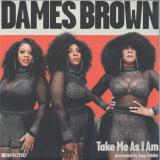
Detroit powerhouse vocal trio Dames Brown make their long-awaited debut with ‘Take Me As I Am’, a bold, soulful celebration of the Motor City’s sound and a heartfelt tribute to their late mentor, Amp Fiddler.
Crafted at Amp’s legendary home studio, the album captures the essence of Detroit through rich instrumentation, gospel-infused harmonies, and unfiltered soul. Blending house, funk, techno, and 70s groove, Take Me As I Am embodies the city’s spirit; timeless, raw, and full of life.
Featuring collaborations with Detroit icons Andrés, Eddie Fowlkes, and Waajeed, standout tracks like ‘You’re The One For Me’, ‘Glory’, and ‘What Would You Do’ showcase the trio’s unmatched energy and vocal chemistry.
Across fourteen tracks, Athena Johnson, Teresa Marbury, and LaRae Starr channel the soul of Motown, the groove of Parliament Funkadelic, and the power of Aretha Franklin, uniting their influences into one authentic, uplifting sound.
With nearly a decade of releases on Defected and its sub-labels, including collaborations with Sophie Lloyd, The Vision, Floorplan, and Horse Meat Disco, Dames Brown continue to shine as one of Detroit’s most dynamic vocal collectives.
‘Take Me As I Am’ is more than an album… it’s a declaration of love, legacy, and Detroit soul.
- Mean Street
- Dirty Movies
- Sinners Swing!
- Hear About It Later
- Unchained
- Push Comes To Shove
- So This Is Love?
- Sunday Afternoon In The Park
- One Foot Out The Door
The song titles on Van Halen's aptly titled Fair Warning don't lie. The likes of "Unchained," "Mean Street," "Push Comes to Shove," "One Foot Out the Door," and more indicate the mood the band channels on its double-platinum 1981 record — the nastiest, darkest, and fiercest album of the group's storied career. For the fourth time in four years, Van Halen throws down the gauntlet to all challengers and emerges victorious.
Sourced from the original analog tapes, pressed on MoFi SuperVinyl at Fidelity Record Pressing, and strictly limited to 5,000 numbered copies, Mobile Fidelity's UltraDisc One-Step 180g 45RPM 2LP set plays with unfettered clarity, dynamics, and immediacy. Benefitting from superb groove definition, an ultra-low noise floor, and dead-quiet surfaces, this vinyl edition captures what went down in the studio with tremendous realism and involving presence.
Taking a more controlled approach in the studio and still completing everything in less than two weeks, Van Halen and producer Ted Templeman relied on studio amplifiers to direct the sound. Further diverging from the live-on-the-floor approach of its earlier albums, the ensemble also employed overdubs to great effect. The result: Dense, stacked architecture that underlines the hard-hitting tenor of the songs — and which comes alive like never before on this reference edition that looks as good as it sounds.
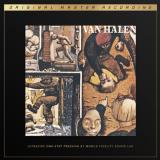
The premium packaging and gorgeous presentation befit the reissue's select status. Housed in a deluxe slipcase, it features special foil-stamped jackets and faithful-to-the-original graphics that illuminate the splendor of the recording. Aurally and visually, it is made for listeners who want to immerse themselves in everything involved with the album, including the iconic cover art adopted from William Kurelek's haunting painting, "The Maze."
Isolated frames from Kurelek's childhood-inspired work — including a man bashing his head into a brick wall, a guy pinning down an adversary as he delivers bare-fist blows to his face and others watch with apparent glee, a boy tied down on a conveyer belt and being sent through the equivalent of a meat saw — adorn the front and back covers. The sunnier visual disposition of Van Halen's prior efforts gives way to something sinister and tortured, traits reflective of the music within. The band members, too, are visually depicted not in glamorous shots but in a serious black-and-white portrait in which the quartet is clad in black leather jackets.
Tough, aggressive, stark: Fair Warning comes on like a series of bare-knuckled punches to the solar plexus and boasts lyrical narratives to match. Though not a concept record, the concise album revolves around themes of roughing it on the streets and struggling to survive amid dim prospects. Singer David Lee Roth reportedly penned many of the initial lyrics after traveling to Haiti and observing extreme poverty. The characters and situations populating Fair Warning reflect hardscrabble existence, last-chance desperation, and underlying danger.
Witness the crazies, poor folks, and hunters of “Mean Street”; the former prom queen turned pornographic actress on “Dirty Movies”; the menace and vice of “Sinners Swing!”; the streetwise hustle of “Unchained”; the isolation and alienation of “Push Comes to Shove”; the desire for escape on “One Foot Out the Door”: A carefree California beach party Fair Warning is not.
Having said he felt angry and frustrated during the sessions, guitarist Eddie Van Halen uses the forceful arrangements as a playground for his seemingly unlimited arsenal. Supported by a crack rhythm section and a hyped-up Roth, he performs with an almost impossible combination of punk-like intensity, technical finesse, lyrical fluidity, and unbridled emotion. The virtuoso was increasingly butting heads with Templeton and seeking a freedom in the studio he believed denied him.
No wonder he plays like a bat out of hell. Listen to the rapid-fire manner in which he slaps the high and low E strings on the 12th fret of his instrument on “Mean Street,” instilling the tune with funk flair and metal-spiked sharpness. For the pouty strut of “Dirty Movies,” Eddie Van Halen contributes slide guitar magic made possible after he sawed off the lower portion of a Gibson SG so he could reach further down the fretboard.
Related intensity, urgency, and daredevil momentum punctuate the surging “Sinner’s Swing!” A heavily flanged, delicately melodic introduction frames the attitudinal “Hear About It Later,” among the most creative arrangements of Van Halen’s career. And do riffs come any bigger or magnetic than those on the high-wire kick of “Unchained”? As for the out-of-left-field “Sunday in the Park,” an instrumental composed on an Electro-Harmonix micro-synthesizer: Who but Eddie Van Halen to supply creep factor in such an ingenious way?
Despite selling fewer quantities than Van Halen’s prior efforts, Fair Warning remains for many diehards the record that epitomizes all of the band’s immense strengths —Roth’s manic energy and tongue-wagging humor, Alex Van Halen’s rhythmic heartbeat-in-your-chest bombast, and Michael Anthony’s lucid bass lines included. Arriving when the New Wave of British Heavy Metal and new-wave movements were taking flight, it signaled a shot across the bow from a band determined to stay a step ahead and provide proof nobody could touch what it delivered.
More than four decades later, Fair Warning still sounds that alarm.
- A1: Jah Golden Throne Dub (3:13)
- A2: Strictly Rodigan Style (2:51)
- A3: Straight To Black Echoes Head (3:07)
- A4: Tribute To Moa Ambassa (2:53)
- A5: Danny Allen Style (3:22)
- B1: Tribute To Penny Reel (4:08)
- B2: Sir Covin Meets Sir Ansil (3:56)
- B3: Straight To Thatchers Head (2:53)
- B4: Raasclaat Dub (3:32)
- B5: Tribute To King Shaka (3:44)
Two titanic forces in reggae history — Roots Radics and The Mighty Revolutionaires — unite for a powerful dubwise journey on Outernational Riddim. This long-anticipated collaboration blends heavyweight rhythms, militant drum patterns, and deep, atmospheric dubs that channel the essence of Jamaican roots music with a forward-thinking production style.
The Roots Radics, known for backing icons like Gregory Isaacs, Barrington Levy, and Israel Vibration, bring their unmistakable heavyweight style to this session. Meanwhile, The Revolutionaires, studio legends behind countless Channel One classics, lace the tracks with their tight arrangements and classic rockers grooves.
Produced and mixed in true dubwise tradition, Outernational Riddim delivers:
Authentic Studio Vibes – Mixed on analog boards with vintage effects and tape echo for that raw, immersive sound.
Alanis Morissette Delivers the Equivalent of a Spiritual Awakening on Supposed Former Infatuation Junkie:
Introspective Themes and Compassionate Emotions on Eastern-Tinged Album Have Grown More Relevant
1998 Smash Plays with Enhanced Detail, Rich Textures, and Sharp Focus on Mobile Fidelity’s 180g 33RPM 2LP Set:
First-Ever Audiophile Edition Strictly Limited to 3,000 Numbered Copies
1/2" / 30 IPS analogue master to DSD 256 to analogue console to lathe
Alanis Morissette refuses to adhere to convention on Supposed Former Infatuation Junkie. While most artists follow-up their breakthrough with an album that closely parallels the approaches that helped make them famous, the maverick singer-songwriter stayed true to herself and drew inspiration from travel to India before she began the recording sessions. As much as the preceding Jagged Little Pill put her on the global radar, Supposed Former Infatuation Junkie confirmed her role as a vital generational voice — and proved her blockbuster success was no fluke. Having set a mark for most sales of an LP in its debut week by a female artist, the 1998 smash remains a pop-rock staple.
Sourced from the original master tapes, strictly limited to 3,000 numbered copies, housed in a Stoughton jacket, and pressed at Fidelity Record Pressing, Mobile Fidelity’s 180g 33RPM 2LP set of Supposed Former Infatuation Junkie presents the triple-platinum LP in audiophile sound for the first time. Benefitting from defined grooves that befit the album’s nearly 72-minute length, this pressing plays with enhanced detail, refined clarity, sharper focus, and broader dynamics than prior versions.
Those traits are key given Morissette’s use of more textured and atmospheric soundscapes, not to mention her evolution into a more nuanced and controlled singer. Similarly, the scale and reach of David Campbell’s string arrangements come across as orchestrations should. Ditto the synth-based architecture shaped by producer and principal Morissette collaborator Glen Ballard. All in all, Mobile Fidelity’s collectible edition simply delivers more information via transparent means.
Notable for its balance, sophistication, and richness, Supposed Former Infatuation Junkie at heart finds Morissette pausing, taking a breath, and learning how to navigate life in a healthy manner after enduring one of the most exhausting and rocket-to-fame stretches any musician ever experienced. It’s the sonic equivalent of a spiritual awakening, a call to betterment, a brave assessment of the self and humanity as a whole. As such, the tunes on her second international (and fourth Canadian) release teem with gratitude, compassion, love, empathy — emotions that lend themselves to the largely mellow, contoured scope and Eastern-tinged melodies of the songs themselves.
“How ‘bout how good it feels to finally forgive you,” Morissette sings on the lead single “Thank U.” “How ‘bout grieving it all one at a time.” Those sentiments, and the vocalist’s embrace of concepts such as divinity and acceptance, not only provide a foundation on which Supposed Former Infatuation Junkie rests. They also reflect the personal maturation she gained from her embrace of Buddhist culture in India and a mindset bent toward notions of reconciliation, peace, and sensuality that were nearly absent in popular music in the late ‘90s.
Those themes continue on “That I Would Be Good,” a confident reflection that takes stock of one’s mental, physical, and emotional state in the face of both changing and unpleasant circumstances — and concludes with Morissette performing a flute solo, further exposing the raw intimacy of the introspective tune. She channels relatable simplicity and joy on “So Pure,” with her invocations of “dance” and “freestyle” speaking to the freedom of expression that courses throughout Supposed Former Infatuation Junkie. And perhaps no song finds Morissette showcasing her refreshed attitude toward life and opening up more than the relationship-themed “Unsent,” whose unconventional structures and lack of a chorus only add to its directness.
Akin to many albums that were ahead of their time, and despite the critical and commercial accolades afforded it upon release, Supposed Former Infatuation Junkie attracted new appreciation and perspective as it got older. Issued during an era where its ideas of serenity, absolution, tranquility, and contentment seemed largely alien, the record — akin to the ways its predecessor foreshadowed a movement — now functions as a visionary beacon that foretells of way to maintain sanity, dignity, and goodness amid a contemporary landscape filled with constant distractions, polarizing views, and incessant calls to purchase, promote, and produce without questioning the what-for purpose.
Supposed Former Infatuation Junkie dares to ask the questions and, at its best, supplies meaningful answers and alternatives that lead to longed-for enlightenment, healing, and laughter. For these reasons alone, it’s a record that never goes out of style.
- A1: Secret Knock
- A2: Checkers
- A3: Movie Night
- A4: Ewr - Terminal A, Gate 20
- A5: 1010Wins (Feat Armand Hammer)
- A6: So Be It (Feat Open Mike Eagle)
- A7: Send Help
- A8: John Something
- A9: Ice Sold Here
- A10: Costco
- B1: Bird School
- B2: Snail Zero
- B3: Charlie Horse (Feat Lupe Fiasco & Homeboy Sandman)
- B4: Steel Wool
- B5: Black Plums
- B6: The Red Phone
- B7: Himalayan Yak Chew
- B8: Unbelievable Shenanigans (Feat Hanni El Khatib)
BLACK ICE VINYL[32,35 €]
Black Hole Superette, the latest album from Aesop Rock, delves into the invisible forces that shape our lives and psyches. It's about the small, often overlooked moments_the everyday experiences that blur the lines between the real and the unreal, waking and sleeping. Aesop's signature gift for transforming the mundane into something dreamlike gives the album a surreal quality, leaving listeners questioning what's truly real as they navigate its vivid, half-remembered imagery. Entirely self-produced, Black Hole Superette is one of Aesop Rock's most technically accomplished works to date. The album's intricate beats and complex structures provide the perfect backdrop for his expansive lyricism, balancing cerebral exploration with emotional depth. From the reflective 'Movie Night' and the eccentric 'Send Help' to the wistful 'Black Plums,' Aesop channels the spirit of a mad scientist, experimenting with sound and concept in ways that defy the ordinary. With a stellar lineup of collaborators that includes Lupe Fiasco, Armand Hammer, Hanni El Khatib, Open Mike Eagle and Homeboy Sandman, Black Hole Superette is dense and kinetic, an album that deftly navigates between complexity and instinct. It's clear this project stands as one of Aesop Rock's most multifaceted and ambitious works yet.
California mail-order mystic Master Wilburn Burchette was first known from his ads, hidden in the back pages of Fate Magazine, Beyond Reality, and Gnostica News. On his 1972 sophomore album, Burchette channels dreamy early music, druid folk, electric fingerstyle, psychedelic balladry, and new age ontology to create a visionary guitar technique all his own. This faithful reproduction includes the original 12-page full color instruction book for the secret method of piercing the psychic heart.
Born from a desire to explore her background in film composing to create a music film, Hannah Holland’s upcoming album 'Last Exit On Bethnal’ is set for release via PRAH Recordings on 18th July. Together with director Lydia Garnett, the multi-faceted London producer shaped ideas born out of images the pair weren’t finding in film, inspired by queer icon filmmakers like Kenneth Anger and Derek Jarman. “We wanted to craft something unapologetically for dykes: a poetic, surreal exploration of dyke power and sexuality set in a fantasy underworld,” explains Holland. Once the film was shot, she channelled its stunning imagery and the energy of the cast into making the record. Seductive and bass-driven, its nine tracks merge sleazy guitars with 707 machine drums, beautiful evolving arps, and surreal moments of Lynchian dreaminess and Aphex Twin-inspired atmospherics. "It was a really amazing collaborative experience and coming together of a community to make something totally unique….and hot!” she continues. The first single ‘Biker’ features a filthy synth hook atop Hannah’s signature bass-guitar, perfectly capturing the raw and sexy energy of the album and its visual centrepiece. You can listen to it here. The film will be screened at a one-off club night at London’s ICA on 11th April in association with Culture Divided, Somesuch and Bala Project.
Hannah Holland has played a pivotal role in London’s alternative and queer London club scene since the mid-noughties. Rooted deeply in London’s fertile musical community, musical exploration and the transcendent potential of dancefloor have always been her biggest inspiration. Her recent delve into experimental theatre, film and TV scores has proved a future further artistic voyage to explore her creative vision. Holland first arrived on dancefloors sharing electro-tinged techno, with equal inspiration taken from the sounds of DnB and jungle heard at legendary parties such as Metalheadz, which she had frequented in her early teens. Having already been “borrowing” (and perhaps never since returning) Kraftwerk, Grace Jones and Talking Heads records from her parents, the influence of this metropolitan musical soup ensured that Holland emerged on the decks with a unique musical character and diverse taste, hallmarks of her sound that she has not lost since. This has been reinforced with trusted residencies at iconic parties such as Trailer Trash, Adonis, Glastonbury’s NYC Downlow, or undertaking far-reaching marathon sets at Berlin’s Panorama Bar. In 2006 Hannah started Batty Bass with vocalist Mama. Immediately a roadblock party and then a record label with releases from Josh Caffe and The Carry Nation sitting in its discography, Batty Bass explores the disparate strains of electro, acid, techno and house. Hannah also released her own music on the label including the ever-anthemic Paris’ Acid Ball.
A steady stream of releases have followed on Shall Not Fade, Super Rhythm Trax, Crosstown Rebels, Classic, Nervous, as well as remixes for Blessed Madonna ft. Kylie Minogue, Planningtorock, The Knife and Goldfrapp among others. Hannah also finds the time to play bass in several bands including Black Gold Buffalo whose debut album she also co-wrote. Her much-anticipated debut album, Tectonic, came out on PRAH Recordings in 2021, with a second on the way. Hannah’s latest venture into the world of film scores have included queer icon Bruce LaBruce’s ‘The Visitor,’ Channel 4 series Adult Material and award-winning indie feature Electrician.
Hannah Holland continues to push the boundaries of electronic and live music, telling stories and carving her own path in the deeper frequencies.
On the Mixbone EP, two tracks from Eric Copeland’s 2017 record Goofballs get reworked by five of leftfield electronic music’s heaviest hitters. The Goofballs LP finds the Black Dice founding member conducting hectic, dancefloor-oriented experiments; The Vinyl Factory called it a “mangled, spangled journey into the fringes of industrial disco and hallucinatory club tackle.” Mixbone capitalizes on this direction with remixes that recontextualize and reshape the propulsive energy of the original songs into wholly different forms.
New York techno powerhouse and Allergy Season boss Physical Therapy contributes two aptly named takes on “Mixer Shredder” – the “Tegel Mix” churns with industrial EBM low-end, and the breakbeat and wubby bassline make the “Gatwick Mix” unmistakably English. NHK yx Koyxen remixes Eric for the second time, with a jittery and woozy electro interpretation of “Neckbone.” Cooper Saver, best known for his Far Away parties in Los Angeles, turns in one of the most unexpected remixes, keeping it 4/4 and creating what sounds like Shep Pettibone making acid house.
Coming off of her 2017 EP on Technicolour/Ninja Tune, Machine Woman decided to remix both tracks. With “Neckbone,” she adds a barely-discernible robotic narrative vocal, allegedly about Ryan Gosling. “Mixer Shredder,” on the other hand, travels from hissy lo-fi techno into something quite tranquil and beautiful. And with previous releases on 1080p, Freakout Cult, and Wania, Vancouver’s LNS channels the melodic electro tones of classic Bleep-era Warp, like a lost track from LFO or Drexciya.
“Danceable” might not be the first word one thinks of when describing Eric Copeland’s solo releases. But in a manner not dissimilar to the way Black Dice shaped the parameters of experimental music, the remixes here expand the limits of what the club can and should look like.
NEW ORDER continue the series of Definitive boxsets, with the band's 1986 album Brotherhood. The boxset will include the original album remastered on CD and 180g LP, plus an Extras CD with previously unreleased demos and rarities, as well as two DVDs featuring the band's performances at Festival of the Tenth at the GMex, Manchester 1986 and Live in Brixton, 1987 in support of World AIDS Day. The DVDs will additionally include live TV performances, interviews and rare band footage. The extensive hardback book will include contemporary articles and liner notes by Irish radio DJ Dave Fanning.
CD Tracks:
1. Paradise
2. Weirdo
3. As It Is When It Was
4. Broken Promise
5. Way of Life
6. Bizarre Love Triangle
7. All Day Long
8. Angel Dust
9. Every Little Counts
10. State of the Nation
CD2
1. Shellshock (AOR Version) *
2. State Of The Nation (Japan Demo) *
3. Paradise (Robert Racic Remix)
4. As It Is When It Was (Japan Demo) *
5. Broken Promise (Instrumental) *
6. Bizarre Love Triangle (Stephen Hague 12” Remix) *
7. All Day Long (Instrumental) *
8. Evil Dust
9. Every Little Counts (Full Length) *
10. Salvation Theme
11. Skullcrusher (Full Length) *
12. Touched By The Hand Of God (Salvation Version)
13. Let's Go (Salvation Version)
14. Sputnik
15. Blue Monday 1988 (Michael Johnson 12” Remix) *
(* previously unreleased)
DVD1
Live at the Academy Brixton, 1987
1. Bizarre Love Triangle
2. The Perfect Kiss
3. Ceremony
4. Dreams Never End
5. Love Vigilantes
6. Confusion
7. Age Of Consent
8. Temptation
TV Appearances
BBC Northern Ireland – Channel One 1986.
Ceremony
Love Will Tear Us Apart
The Tube 1986.
State Of The Nation
Broken Promise
Top of the Pops 1987.
True Faith
Les Enfants du Rock, Rockline 1987.
Paradise
Bizarre Love Triangle
The Roxy, 1987.
True Faith
11pm, 1987.
Bizarre Love Triangle
Extra Material
Stephen’s Fly On The Wall Documentary 1985.
Recording 'As It Is' and ‘Shame of the Nation’ at Denon Studios, Tokyo (May 1985).
DVD2
Live at the G-Mex, Manchester, 19/07/86.
1. Elegia
2. Shellshock
3. Paradise
4. Bizarre Love Triangle
5. Way Of Life
6. State Of The Nation
7. Face Up
8. The Perfect Kiss
9. Ceremony
10. Temptation
Live Extra Material
Glastonbury, 1987.
True Faith
Sister Ray
San Giovanni, 1986.
Dreams Never End
Pier 84, New York, 1987.
All Day Long
Angel Dust
Shellshock
Weirdo
Rapido, Paris 1987.
True Faith
G-Mex, Manchester, 1988.
Touched By the Hand of God
Every Little Counts
- A1: Love Is Ft. Kameelah Waheed
- A2: Love Is A State Of Mind Ft. Ramona Renea
- A3: It's Quiet Now Ft. Dope Earth Alien
- B1: Downtown Ft. Anette Bowen & Nikki-O
- B2: Drama Ft. Rimarkable & Dope Earth Alien
- C1: Stand Ft. Cor.ece
- C2: In The Club Ft. Eve
- D1: Not About You Ft. Hadiya George
- D2: Everybody Ft. Pablo Vittar & Urias
- E1: Show Me Some Love Ft. Channel Tres
- E2: Don't Be Afraid Ft. Latashá
- E3: Work Ft. Dave Giles Ii, Cor.ece & Mike Dunn
- F1: C's Up Ft. Mike Dunn
- F2: La Femme Fantastique Ft. Josh Caffe
- F3: Love Me Like You Care Ft. Hadiya George
repressed !
Classic Music Company are proud to present Black Girl Magic, the highly anticipated sophomore album from the inimitable Honey Dijon. An artist in every sense of the word, across 15 tracks of attitude, energy, heart and community, Honey demonstrates a broad range of disciplines and influences, enlisting A-List collaborators such as Channel Tres, Eve, Pablo Vittar, Josh Caffe, Mike Dunn and more for an unmissable, boundary-pushing LP.
Redefining what it is to be a DJ in 2022, this year Honey’s production capabilities have been enlisted by the upper echelon of musicians. Producing two records for Beyonce’s chart-topping album Renaissance and remixing lead single ‘Break My Soul’, as well as working in the studio with Madonna on new material. Now unapologetically expressing her own sound on Black Girl Magic, she unveils the next chapter of her development as a producer and songwriter.
Since the first teaser of the album, the BBC Radio 1 playlisted collaboration with Atlanta singer-songwriter Hadiya George ‘Not About You’, to the most recent single ‘Show Me Some Love’ featuring Compton royalty Channel Tres, the Black Girl Magic project has consistently illustrated Honey’s dedication to profiling diverse vocal talent. Shining a spotlight on a new generation of queer people and people of colour, Honey’s intentions to “keep this culture in the conversation,” are demonstrated with the featured artists on the LP.
Behind the scenes Honey has worked closely with Classic Music Company founder and close friend Luke Solomon, as well as regular collaborator Chris Penny on the production of the album. Her most adventurous and explorative output yet with a diverse range of influences, Honey’s Chicago musical upbringing is a driving force behind the LP, with her sights set on demonstrating how she first experienced the music of her hometown felt deeply across the record.
Working with British sculptor Jam Sutton, an artist who explores the relationship between technology and antiquity, 3D sculptural digital renderings of Honey have formed the artwork for all preceding singles leading into Black Girl Magic. Exploring identity, form, technology and classical portraiture, the artwork for the album comes as the final piece in the series of bespoke displays of Honey.
From her stratospheric DJ career, to her fashion line with COMME des GARÇONS: Honey Fucking Dijon, to soundtracking some of the most iconic fashion shows of the 21st century, Honey’s influence is felt far and wide across the worlds of music, fashion and art, with Black Girl Magic a powerful physical statement of her interdisciplinary artistic impact.
Opaque Red Vinyl. California mail-order mystic Master Wilburn Burchette was first known from his ads, hidden in the back pages of Fate Magazine, Beyond Reality, and Gnostica News. On his 1972 sophomore album, Burchette channels dreamy early music, druid folk, electric fingerstyle, psychedelic balladry, and new age ontology to create a visionary guitar technique all his own. This faithful reproduction includes the original 12-page full color instruction book for the secret method of piercing the psychic heart.
With words as weapons and public infrastructure as his blank slate, John Fekner's City Squad are always questing for the ineffable, even as they yearn for concrete change - Make no mistake, Idioblast is a serious party where everyone is welcome.
Released in 1984, Idioblast is a lost classic, a future shock narrative ahead of its time, and yet completely of its era, like few artifacts before or since. The cover tips you off from the jump--a crude but effective collage featuring classic Fekner slogans like Toxic Junkie, Growth Decay and Soft Brains Watch The Screen And Buy The Jeans. In an uncanny and tragic coincidence, the very first lyric on the album--"The place to be is on the space shuttle/if you're brave enough to get on it"--seems to anticipate the Challenger disaster just two years later.
But for the most part, the tracks on Idioblast directly reference the concepts that inspired Fekner's visual art. Musically, "Rapicasso" utilizes pneumatic pounding with an industrial edge as Fekner equates the great and controversial painter with risk-taking graffiti kids bombing trains and billboards across the city. Art is in a constant state of exploding--forms, paradigms, outdated ideas.
Splitting the difference between hip-hop and new wave, the Santaniello-sung "The Beat" is like Thomas Dolby meets Run-DMC and should've been a radio staple for at least one sticky summer. It could soundtrack either a couples roller skate or a drug-fueled evening out. Channeling Fekner's slogan-stencil aesthetic, "Travelogue The 80's" is a tour de force reminiscent of Negativland's experiments in audio culture jamming. As Fekner details, "I grabbed all of the sounds via a shortwave radio picking up transmissions from LaGuardia airport and the TV. I recorded and edited on a Sony Pro Walkman and an Aiwa dual cassette deck."
Freerange welcomes Italian via Berlin producer/DJ/label boss Enzo Elia for his debut on the label entitled The Lost Guitar Tapes. Enzo is someone who has been releasing consistently great music for many years, although
often hidden behind a myriad of pseudonyms and underground imprints. For starters he's responsible for a mysterious yet established and very excellent edits label as well as being a member of Balearic Gabba Sound System alongside Bjorn Torske amongst others. Following the philosophy of this collective, Enzo is also producing lovingly and respectfully created re-edits of long lost techno and house tracks as well as many new tunes
for influential labels including Golf Channel and Compost.
But for now we turn to The Lost Guitar Tapes and specifically the original mix of Drifting which opens up the release with a brilliant tension builder. A rolling bassline, crisp minimal drums and a subtly Middle Eastern-influenced melodic line give just a hint of mysticism to this jewel of a track.
For the remix we have none other than the Tel Aviv via Berlin producer Moscoman, fresh from his brilliant debut LP on ESP Institute and releases on Eskimo and his own Disco Halal label. Moscoman's organic, percussion- heavy sound and Middle Eastern roots make him the perfect choice to take
on Drifting and we couldn't have wished for a better outcome. He manages to inject his own identity to the track with newly recorded live guitar and bass parts and taking in elements of techno, new wave and house, he's created a sublime piece of dancefloor drama. Finally we have an alternate Dub version which lays down a firmer four on the floor, extra percussion and dubby stabs for a more driving atmospheric club tool.
A tribute to one of the greatest songwriters & artists of our time! Features newly recorded covers from Keith Richards, Joan Jett and the Blackhearts, Rufus Wainwright, Lucinda Williams, Maxim Ludwig & Angel Olsen, Rickie Lee Jones, Mary Gauthier, Bobby Rush, Automatic, The Afghan Whigs, and Rosanne Cash. Special Record Store Day Edition pressed on Silver Nugget vinyl and housed in a silver laminated jacket Booklet features liner notes by compilation producer & former Lou Reed publicist Bill Bentley, featuring photos by Mick Rock and Timothy Greenfield-Sanders. "To me, Lou stood out. The real deal! Something important to American music and to ALL MUSIC! I miss him and his dog." - Keith Richards "Lou seemed fearless to me, like he'd rather die than be a people-pleaser. I took inspiration from that." - Rosanne Cash "Lou Reed is my earliest influence, my introduction to punk rock, and the soundtrack to the beginning of my romance with Maxim." - Angel Olsen "Lou Reed has been gone now for many years. He's one of the few people whom I miss as much now as when he left. There are so many instances where I wonder what he would say or what he would think. His general aura would always lend something really unique to the room. Thank God he left his great music and recordings. His personality is sorely missed. Love you, Lou." - Rufus Wainwright // It goes without saying that the legendary Lou Reed was a true rock 'n' roll pioneer. From The Velvet Underground's debut in 1967 all the way through the end of his days, Reed sang truth from his heart. He lived life to the limit-and then some. The Power of the Heart is a tribute to Reed's freedom of expression with covers spanning his ground-breaking years with the Velvets into his majestic solo career. Each track is a glorious extension of the Rock 'n' Roll Animal's soul, ever adventurous and avant-garde. The Power of the Heart: A Tribute to Lou Reed kicks off with a legend in his own right, Keith Richards, reimagining the Velvets' classic, "I'm Waiting for the Man." Richards' rendition instantly invites you on board this unforgettable ride. In stark contrast, "Perfect Day" is somehow even more melancholy than the original given the Rufus Wainwright treatment, featuring sparse fingerpicking and gentle harmonies. Joan Jett and the Blackhearts deliver a version of "I'm So Free" that would have even Lou rockin' in his grave. It's thrilling to hear these songs reinterpreted and sung by such heavyweights; you can even hear as Lucinda Williams channels the spirit of Lou with her take on "Legendary Hearts." Other notable tracks include a punk-drunk, loved-up duet by real-life lovers Angel Olsen & Maxim Ludwig with "I Can't Stand It," and Rickie Lee Jones' reimagining of "Walk on the Wild Side," both whimsical and enticing with her whispery vocals, stripped-down percussion, and a piano fit for a late-night lounge. This tribute album truly defies genre, but its throughline, in the end, is its heart: a deeply thoughtful collection of songs that shaped a generation, each paying homage to a man whose body of work still sings.
Recorded across three sessions over the last three years, ‘Behold’ is a testament to Parsnip at their most creative, catchy and collaborative. This album showcases the multi-talents of all four members, with spirited performances adding dazzle to the thirteen tracks.
Paris Richens lets the bass playfully roam. Carolyn Hawkins tumbles feeling into the drum rumble. Stella Rennex’s guitar soars alongside her saxophone work, whilst a sprightly keyboard is tenderly attended by Rebecca Liston. Everyone sings amidst this lush canopy.
Patience, environmental cues and internal signals are integral for a garden to flourish. The same can be said of the conditions necessary for ‘Behold’ to emerge. It is an album gleeful in reassessment, changed priorities and anticipation. The roots are deeply anchored to mystery, drinking up a hidden wonderment that lies within. ‘Monument’ is a twist of melody and mania, “For what am I? But a channel of light” they attest amongst the whoops and hollers. ‘The Babble’ sounds like Ray Davies playing Wordle for enlightenment. In fact most of these songs are pointing the way towards growth and understanding. ‘Turn to Love’ is mesmeric and timeless, thoroughly serene and perfectly judged. Parsnip write songs as a form of communion with the intangible in our increasingly delusory world, but there is always a gentle reminder; don’t take anything too seriously! “My head is gonna split in two, fix it with flour and glue” they demand on ultimate bop ‘Papier-Mâché’, this juxtaposition of mature resolve with childlike astonishment packs a more powerful punch.
On ‘Behold’, Parsnip explore both the inner and outer realms of consciousness with quick wits and some seriously quality jangle and jolt. ‘The Light’ is a whip smart workout, sprouting naturally from the propulsive nature of their debut album ‘When the Tree Bears Fruit’ (2019). ‘Placeholder’ is also devastatingly honest and channels The Field Mice as it buries itself like an arrow into your heart.
Anti Fade Records and Upset The Rhythm proudly present Parsnip’s first album in five years, ‘Behold’. Available in all good record stores April 26th.
Miles Davis created just one studio album with his original sextet: Milestones. And he made every moment count. Pairing with Cannonball Adderley, John Coltrane, Red Garland, Paul Chambers, and Philly Joe Jones, Davis not only laid the groundwork for the modalism that immediately followed but tailored a genuine modern-jazz masterwork laden with performances among the most explosive of his distinguished career. Sandwiched between the more famous 'Round About Midnight and the epochal Kind of Blue, Milestones remains a seminal work of art.
Sourced from the original master tapes and pressed on dead-quiet SuperVinyl, Mobile Fidelity's numbered-edition 180g LP grants each musician their own space amid broad soundstages. Afforded the benefits of a nearly non-existent noise floor and supreme groove definition, this vinyl reissue doubles as a time machine back to the February-March 1958 recording sessions.
Colors, shapes, and dimensions appear in the manner that resembles what you'd glean from behind a studio control room's window. Davis' burnished trumpet is rendered in three-dimensional perspective and seemingly coaxes the band to play with unburdened zest. Coltrane's trademark saxophone teems with lifelike tonality and images with specificity; his solos work in tandem with and against the driving rhythms. Garland's swaggering piano lines? Visualize the keys as he hits full stride, the chords and fills slithering around skeletal frameworks.
Inducted into the Grammy Hall of Fame and selected as a "Core Collection" record by the Penguin Guide to Jazz, Milestones is as famous for its title track – widely considered ground zero for modalism and bolstered by Jones' hallmark "Philly Lick" rim shot – as the players that produced it. The launching pad for many of Davis' improvisational flights, the album teases the explorations Coltrane would soon chase. Davis' own solo work broaches territories that far exceed what he had done in his bop-rooted past. Every song is a highlight.
Take the bravado "Dr. Jackle," featuring a hot-foot pace and bebop strains, or "Sid's Ahead," which continues the album's blues theme while juggling edgy harmonics and inside-out structures. On "Billy Boy," distinguished with an arco bass solo from Chambers, Garland gets a turn in the spotlight and channels the openness practised by one of his heroes, Ahmad Jamal. Even more instructive is the band's reading of Dizzy Gillespie's "Two Bass Hit." Three years removed from the version Davis and company recorded for the trumpeter's Columbia debut, this interpretation demonstrates the extent to which the group had jelled in a relatively short amount of time.
Then there's "Straight, No Chaser," the definitive rendition of Thelonious Monk's signature piece. Coltrane's marbled playing pulls at the tune's borders, Adderley takes liberty with solos, and Davis dances around his mates, at one point quoting "When the Saints Go Marching In" while demonstrating his knowledge of tradition and casting an eye towards the future.
About that future. Garland already had one foot out the door during the Milestones sessions to the extent Davis spells him on "Sid's Ahead." Jones would stick around for a bit longer but soon plot his exit. History proves Davis navigated the changes with visionary aplomb. Yet the chemistry, excitement, and beauty the sextet achieves on Milestones cannot be overstated. This reissue helps put the album in proper perspective – and presents the music the fidelity it deserves.
For the five members of Punchlove - multi-instrumentalists Jillian Olesen, Ethan Williams, Joey Machina, Ian Lange-McPherson, and visual artist Viz Wel - moving into a maze of a house in Brooklyn together was the transition that created the album they had been writing their whole lives. Quietly evolving from a bedroom project to a headlining live phenom, Punchlove has geared up a densely layered bed of emotionally serrated pain-pop songs that coalesce around a digitally-stimulated, emotional brand of modern neoshoegaze. Channels, out March 1st on Kanine Records, is an album of deeply prepared sounds, sharply honed instrumentals, and a band performing them that knows each other all the way through. Having met studying music technology in college, multiple members of Punchlove work mixing live bands at prominent NYC venues and in the studio. Using that expertise, the inhouse production, mixing, and recording is a palpable highlight; mastered by 2000s shoegaze stalwart Kurt Feldman (The Depreciation Guild), the record melds DIY recording and experimental sonic visions with studio quality. Punchlove is dedicated to pushing the envelope of experimental sonic practices in live performances, where they can be seen performing with real-time audio reactive analog visuals, executing real-time sampling and looping, self-mixing onstage, running radios and tape loops through effects, improvising, and playing guitar with everything from double bass bows to vibrators. In their home recording environment, experimentation is at the core of their creative process, where they integrate self-programmed digital signal processing systems, psychoacoustic phenomena, tailored feedback, elements of 3D audio, immersive field recording soundscapes, early electronic instruments, and experimental recording and mixing techniques into the greater backdrop of pop songwriting. FOR FANS OF: Radiohead, Wednesday, Hum, DIIV, my bloody valentine, The Smashing Pumpkins, bdrmm, A Place to Bury Strangers
Steeped deep in the waters of memory, Privacy dreams up visions of electro music's past, present and future on his inaugural EP for TRUST. The revered Australian producer (of Klakson and Klasse Wrecks fame, half of Negroni Nails with Steffi) channels the energy of his genre-busting DJ sets into four tracks that straddle a set of influences as diverse as discoid techno, West Coast electro, and far fiction dubstep in deliriously asynchronous fashion.
#40 ON ROLLING STONE'S 500 GREATEST ALBUMS OF ALL TIME: ANTICIPATES LATE 1960S TURBULENCE VIA PROPHETIC SONGS AND DARK THEMES
1/4" / 15 IPS analogue master to DSD 256 to analogue console to lathe
Any discussion about the finest psychedelic rock record ever recorded is incomplete if it doesn't grant consideration to Love's Forever Changes. Ranked by Rolling Stone as the 40th greatest album ever made, and named by Mojo the second-greatest psychedelic set in history, the effort is an internationally recognized seminal work of art. Transcending language and convention, its magnitude and magnificence need to be heard again and again. For here is an effort whose mind-boggling acoustic complexities and kaleidoscopic nuances are tailored for high-fidelity playback.
Nearly unlimited headroom, vast instrumental separation, transparent clarity, artifact-free atmospherics, and faithful balances appear out of jet-black backgrounds. Turn it up as loud as you want; the sole limitation will be your system's potential.
Commercially ignored upon release in November 1967, Forever Changes confronts the alienation, paranoia, violence, and strife that would soon plague the countercultural movement and send the Summer of Love into a tailspin. Apart from its lyrical themes and prescient malaise, the record's enduring nature equally owes to intertwined arrangements sewn together with Latin guitar-picked lines, finessed folk harmonies, mariachi-inspired horn charts, and subdued strings.
The seemingly opposing combination – ominous, dark reflections situated amidst lush, light melodic beds – affords Forever Changes a distinguished tension of claustrophobia and openness, dourness and ecstasy, ugliness and elegance enjoyed by no other record in the rock canon. Much of the contrast owes to leader Arthur Lee's mental state and pertinent observations. Lee, whose suppressed romanticism often surfaces even amidst the blackest shadows and most cynical moments, believed he would soon die, and hence channeled everything from lasting hopes to acid-addled decay to the chilling testimony of a Vietnam veteran in his narratives.
Alternatively sad and beautiful, the album-opening and flamenco-inspired "Alone Again Or" establishes the mood for what follows. Vocals overlap and soar; tempos rise and fall; surrealism trades places with reality.Forever Changes thrives both because of and in spite of a surfeit of labyrinthine chords and difficult notes that never repeat. Its ambitious construction almost forced the already fractured band to cede responsibilities to session musicians, which appear on two tracks. The quintet's resolve to not only complete the album, but to do so with such poignancy and curiosity, further enhances Forever Changes' standing.
No wonder that, in the twilight of his troubled career, Lee performed the record in its entirely during concerts met with overwhelming critical acclaim. It was, and will always be, a personal manifesto of timeless relevance and appeal.
Underground house and disco maestro Mark E makes a welcome return to Delusions following hot on the heels of last years Leaning Into The Light EP. The revered producer has been steadily doing his thing for almost two
decades now, racking up releases on Running Back, Golf Channel and Spectral Sound to name just a few. His sound is a unique, sublime vision of US deep house which transcends the dance floor and he proves his salt once again on the four new tracks that make up this stunning EP.
Title track Enchantment Under The Sea sets the mood with a minimal, low slung drum machine groove laying the foundation for layers of Rhodes and synth chords conjuring up images of a sub-aquatic vision of depth and beauty. Up next we have Zone Tonight, the epitome of a late night city scape driving track utilising heavily saturated drums, subtle acid line, distant piano melody and moody Detroit pads to draw you into its deep confines.
Flipping over we have Vertigo which treads a similar sonic path as Mark effortlessly fuses rich harmonies and entrancing melodies, inviting listeners to lose themselves in its depths. Closing out this blissful journey we have Bodymap which drops the BPM a little more with simple understated drums, melancholic string line and pulsating bassline.
The Zone Tonight EP is a testament to Mark E's unparalleled prowess in crafting immersive, uncompromising and emotive soundscapes for your aural pleasure. He also created the original artwork for this release.
- 1: One Step Ahead Sugar Minott
- 2: If You Ask Me To Leon Dinero
- 3: Whatcha Doing (To Me) Charles Bradley
- 4: Icanbecool • Bob & Gene
- 5: Lover Like Me Binky Griptite
- 6: I’d Rather Go Blind The Frightnrs
- 7: I Can’t Stand These Lonely Nights Bob & Gene
- 8: It’s Not What You Know (It’s Who You Know) Bob & Gene
- 9: How Long Do I Have To Wait For You Sharon Jones
- 10: Conscience Is Heavy The Inversions
If youʼre a fan of Daptone Records, chances are youʼve read or heard the name Victor Axelrod, and even if you havenʼt, youʼve heard music from his hand. As a producer, arranger, recording and mixing engineer, and keyboardist, his creativity has extended across more than two decades of the labelʼs releases, even dating to its prehistory with Desco Records.
If You Ask Me To..., the first LP under his name for the label, is a collection of singles released between 2007-2023 as well as unreleased tracks from Sugar Minott and Binky Griptite. The genesis of which came via an 11th hour request from Daptone for a Sharon Jones remix (2007) that resulted in the reggae version of “How Long Do I Have To Wait For You?” found here.
This opened the door to additional explorations of reggae/soul synergies within the catalog, affirming the musical and cultural link between Daptoneʼs core soul sound and Axelrodʼs passion for Jamaican music. While previous projects like Ticklah Vs. Axelrod and Roots Combination (produced under the alias Ticklah) were inspired by the Jamaica of the 1970s and 80s, this set specifically channels an earlier period in the 1960s when Jamaica was both strikingly original in its continuum of genres but also closely and empathetically attuned to Black American music.
Through Axelrodʼs exceptional taste and the notable contributions of guitarist To
Miles Davis created just one studio album with his original sextet: Milestones. And he made every moment count. Pairing with Cannonball Adderley, John Coltrane, Red Garland, Paul Chambers, and Philly Joe Jones, Davis not only laid the groundwork for the modalism that immediately followed but tailored a genuine modern-jazz masterwork laden with performances among the most explosive of his distinguished career. Sandwiched between the more famous 'Round About Midnight and the epochal Kind of Blue, Milestones remains a seminal work of art.
Sourced from the original master tapes and pressed on dead-quiet SuperVinyl, Mobile Fidelity's numbered-edition 180g LP grants each musician their own space amid broad soundstages. Afforded the benefits of a nearly non-existent noise floor and supreme groove definition, this vinyl reissue doubles as a time machine back to the February-March 1958 recording sessions.
Colors, shapes, and dimensions appear in the manner that resembles what you'd glean from behind a studio control room's window. Davis' burnished trumpet is rendered in three-dimensional perspective and seemingly coaxes the band to play with unburdened zest. Coltrane's trademark saxophone teems with lifelike tonality and images with specificity; his solos work in tandem with and against the driving rhythms. Garland's swaggering piano lines? Visualize the keys as he hits full stride, the chords and fills slithering around skeletal frameworks.
Inducted into the Grammy Hall of Fame and selected as a "Core Collection" record by the Penguin Guide to Jazz, Milestones is as famous for its title track – widely considered ground zero for modalism and bolstered by Jones' hallmark "Philly Lick" rim shot – as the players that produced it. The launching pad for many of Davis' improvisational flights, the album teases the explorations Coltrane would soon chase. Davis' own solo work broaches territories that far exceed what he had done in his bop-rooted past. Every song is a highlight.
Take the bravado "Dr. Jackle," featuring a hot-foot pace and bebop strains, or "Sid's Ahead," which continues the album's blues theme while juggling edgy harmonics and inside-out structures. On "Billy Boy," distinguished with an arco bass solo from Chambers, Garland gets a turn in the spotlight and channels the openness practised by one of his heroes, Ahmad Jamal. Even more instructive is the band's reading of Dizzy Gillespie's "Two Bass Hit." Three years removed from the version Davis and company recorded for the trumpeter's Columbia debut, this interpretation demonstrates the extent to which the group had jelled in a relatively short amount of time.
Then there's "Straight, No Chaser," the definitive rendition of Thelonious Monk's signature piece. Coltrane's marbled playing pulls at the tune's borders, Adderley takes liberty with solos, and Davis dances around his mates, at one point quoting "When the Saints Go Marching In" while demonstrating his knowledge of tradition and casting an eye towards the future.
About that future. Garland already had one foot out the door during the Milestones sessions to the extent Davis spells him on "Sid's Ahead." Jones would stick around for a bit longer but soon plot his exit. History proves Davis navigated the changes with visionary aplomb. Yet the chemistry, excitement, and beauty the sextet achieves on Milestones cannot be overstated. This reissue helps put the album in proper perspective – and presents the music the fidelity it deserves.
- A1: I Wanna Dance With Somebody (Who Loves Me) (Who Loves Me)
- A2: Just The Lonely Talking Again
- A3: Love Will Save The Day
- A4: Didn't We Almost Have It All
- A5: So Emotional
- B1: Where You Are
- B2: Love Is A Contact Sport
- B3: You're Still My Man
- B4: For The Love Of You
- B5: Where Do Broken Hearts Go
- B6: I Know Him So Well
Whitney did more than turn Whitney Houston into a pioneering sensation known around the world by her first name. Originally released in June 1987, the singer's blockbuster sophomore record became the first album by a female artist to debut at No. 1 on the Billboard 200 chart — a position it claimed for a total of 11 weeks en route to selling more than 10 million copies in the U.S. The Diamond platinum effort also contains four No. 1 Hot 100 hits that, when combined with the three chart toppers from her 1985 debut, gave her seven consecutive No. 1 singles — an accomplishment that no other artist has accomplished. Commercially and creatively, Whitney stands on hallowed ground — especially now that the record plays with a sound that puts into perspective just how extraordinary, engaging, and vital Houston's music remains.
Mastered from the original master tapes and pressed on MoFi SuperVinyl at RTI, Mobile Fidelity's 180g 33RPM SuperVinyl LP of Whitney invites listeners to experience the Rock & Roll Hall of Fame inductee's pivotal album in audiophile quality for the very first time. Free of the dynamic limitations and tonal flatness prevalent on prior vinyl and CD pressings, it lets the music breathe and reveals the copious detail, nuance, and texture within the immaculately produced songs. MoFi's SuperVinyl profile offers further advantages in the forms of a nearly inaudible noise floor, dead-quiet surfaces, and superb groove definition.
In addition to featuring extreme clarity and immediacy, this numbered-edition reissue does wonders for the attribute that inspired more than 20 million people around the globe to add Whitney to their record collections: that inimitable voice. Houston's trademark mezzo-soprano — an acrobatic instrument equally capable of taking off on fantastic flights and unwinding for hushed meditations — benefits from the fantastic airiness and transparency afforded by this meticulously restored edition. Whitney has never sounded or looked better. The crossover landmark deserves nothing less.
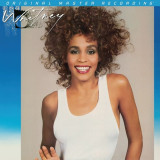
Issued just two years after Houston's breakthrough debut, Whitney immediately signalled the genre-defying singer's intent to continue to push ahead and expand her palette. Shot by photographer Richard Avedon, the album cover depicts an iconic image of Houston — captured with a gleaming smile, bright eyes, teased-out afro, toned arms, and a right hand that appears to wave a friendly hello — whose active, athletic profile stands in contrast to the extremely formal sit-down shot of her that graces her '85 record. The change is telling: Whitney overflows with unfettered joy, rhythmic vibes, and deep-seated emotions that forever endeared her to the hearts and minds of countless listeners — and which set the standard for the wave after wave of divas that followed in her footsteps.
It's no coincidence that the first track on Whitney is the declarative "I Wanna Dance with Somebody (Who Loves Me)." Like Michael Jackson's "Billie Jean" and Madonna's "Material Girl," the feel-good smash is one of the quintessential '80s gems — a lithe, melodic, celebratory release of pent-up energy and loneliness that glides across club floors, shouts to the rooftops, and shrugs off any concerns about vulnerability or embarrassment. Houston's swooping voice moves in sync with the sleek beats and dipping-and-diving synths. She practically takes her fellow musicians by their hand and leads them in a blissful dance that nobody would dare sidestep. Focusing on Houston's singing — a task made challenging only because of the impossible-to-ignore hooks and grooves — showcases the virtuosic facets of not only her register but her control, discipline, smoothness, and warmth.
That she replicates those feats for the entirety of the nearly 53-minute-long album makes Whitney that much more special. Houston reaches back and channels her childhood gospel training on the R&B-flared "So Emotional"; effortlessly slips into Quiet Storm mode on the duet with her mother, gospel great Cissy Houston, on "I Know Him So Well"; flirts with smooth jazz and collaborates with tenor saxophonist Kenny G on the lush "Just the Lonely Talking Again"; conjures dreamscapes and shadow-boxes with supple funk on a romantic cover of the Isley Brothers' "For the Love of You"; and, for the majestic power ballad "Didn't We Almost Have It All," displays the sky-scraping reach of her vocals amid a grand arrangement made even bigger by Houston's sweeping performance and triumphant finish.
Houston's once-in-a-generation talents weren't lost on the adoring public, radio deejays, or industry experts. In addition to harbouring four No. 1 hits and receiving nominations for four Grammy Awards, Whitney generated another Top 10 success in the guise of the Afro-Cuban-leaning "Love Will Save the Day." The album also netted Houston four American Music Awards; two Billboard Music Awards; back-to-back People's Choice Awards; a Soul Train Award; and various other accolades. It all makes the crux of the Washington Post's July '87 review of the album appear prophetic: "Her voice sounds stronger still and the songs are varied but so consistent she could garner 10 Top 10s out of a field of 11."
That claim still holds true. A brilliant fusion of pop, R&B, smooth jazz, and soul, Whitney is a showstopper – and one of the key reasons Houston is the most-awarded female artist of all time.
- A1: Honey Dijon & Channel Tres Ft. Sadie Walker - Show Me Some Love (Shake The Earth Remix)
- A2: Honey Dijon Ft. Mike Dunn & Ric Wilson - C's Up (The Southside Remix)
- B1: Honey Dijon Ft. Dope Earth Alien - Its Quiet Now (The Sunlight Remix)
- B2: Honey Dijon Ft. Hadiya George - Not About You (Set You Free Remix)
Critically acclaimed songwriter, fashion mogul and electronic artist Honey Dijon is back with a vinyl package of exclusive remixes from her sophomore album ‘Black Girl Magic’, which saw the trailblazer receive recognition from major international outlets, cementing her as a globally relevant superstar. ‘Slap! EP’ features remixes produced by Honey in collaboration with Classic label boss Luke Solomon; the two previously collaborated on Beyoncé’s chart-topping album ‘Renaissance’, receiving GRAMMY Awards for their musical contributions. Four tracks from ‘Black Girl Magic’ are revisited with a tougher, club-ready approach, adding a hefty weight to the already driving releases; ‘Show Me Some Love’ with Channel Tres featuring Sadie Walker gets a treatment that is sure to Shake The Earth, while Honey’s collaboration with Mike Dunn & Ric Wilson ‘C’s Up’ shows off the sound of The Southside, Chicago, in one pounding re-edit. ‘It’s Quiet Now’, featuring 90s RnB-inspired vocals from Dope Earth Alien, receives a chugging Sunlight Remix while ‘Not About You’ gets a Set You Free Remix, liberating the mind with a relentless four on the floor kick. Made with the club in mind, Honey Dijon and Luke Solomon prove again they are a pairing that can’t be beat.
Santana's self-titled debut album announces the arrival of a new Guitar God. Made during the legendary bandleader's most fruitful and creative period, the classic 1969 set functions as an accessible entry point into the tangy worlds of Latin music by way of an intoxicating blend of Afro-Cuban percussion, jazzy tempos, exotic leads, bluesy riffs, and psychedelic accents.
Indeed, separation between Carlos Santana's fluid fills, spicy solos, and broiling grooves and pianist Gregg Rolie's soulful Hammond organ runs allows the music to come alive with a newfound freshness and radiance. Songs simmer, with each passage bursting forth with vibrant colour. Just like the equally essential follow-up Abraxas, Santana also lays claim to one of the biggest (and unfortunate) production gaffes in music history.
For nearly four decades, copies were produced with the left and right channels reversed, meaning that everything was placed in a backwards manner. This even extended to compilations on which individual songs from Santana were included. Rest assured that, in addition to boasting reference audiophile sonics, this 180g 45RPM 2LP set gets all the specifications exactly right. And with a record of this magnitude, you want everything to be perfect.
Bound by natural chemistry and earthy spirituality, the record's innovative synthesis of myriad styles goes beyond anything that came before – as well as nearly everything that's followed. Playing with the finest band that the iconic guitarist ever had, Santana doesn't water down any exotic roots or simply incorporate mainstream Western styles into a Latin framework. This is a true hybrid, responsible for opening up borders, transcending cultural divides, and, most importantly, exhilarating the senses.
Released just weeks after the band blew minds at Woodstock, the groundbreaking record stands alongside Miles Davis' Bitches Brew and Jeff Beck's Beck-Ola as a pillar of rock fusion. Featuring the Top Ten radio smash "Evil Ways" and jam favorite "Soul Sacrifice," it hasn't aged a day. Hear like never before why Rolling Stone says Santana is #149 on its list of the Greatest Albums of All Time.
"Hungarian guitarist Gabor Szabo (1936-82) issued only three live recordings during his lifetime. Significantly, the first of these, The Sorcerer (1967), remains the most popular album in the guitarist’s all-too abbreviated discography. But there were also More Sorcery (1968) and Gabor Szabo Live with Charles Lloyd (1974), offering Szabo totally in his element and at his bewitching best.
Several more of Szabo’s concert recordings have surfaced in the intervening years, including this one, superbly captured for radio broadcast live in 1976 at the 600-seat Agora Ballroom in Cleveland, Ohio. It is a revelation. There is a sense here that concert patrons may have been hearing an altogether different Gabor Szabo than record buyers.
For one thing, Szabo is heard fronting what is likely his own group, rather than an army of studio musicians. In 1976, Szabo was leading a tremendous quartet with George Cables (or Joanne Grauer) on piano, Tony Dumas on bass and Sherman Ferguson on drums. Szabo had not had a band with this much jazz clout since his famed quartet with Jimmy Stewart in 1967-68 – and it is a union worth savoring: Szabo’s records during this period were light, at best, on jazz.
It’s unclear if any of these musicians are on the Agora date, but as Dumas’s “It Happens” opens the program, it’s a good bet, at least, that the bassist is on board here. But as Szabo’s ’76 quartet is not known to have recorded a studio record, Live in Cleveland is the closest thing to what a mid-seventies Szabo jazz album would sound like.
Gone, are the strings, vocals and concessions to commercial consideration so prevalent on so many of Szabo’s studio records at the time. What is present, though, is fine craftsmanship, tremendous interplay, and the exciting improvisation that good jazz always yields.
This particular concert was part of Sansui’s “New World of Jazz,” a series of 13 hour-long jazz concerts recorded at Cleveland’s iconic Agora Ballroom and broadcast over 40 FM radio stations. The series was sponsored by Sansui Electronics, a Japanese manufacturer of audio and video equipment, which previously sponsored a similar series of rock concerts recorded at the Agora as well.
Sansui was promoting its matrix QS 4-channel sound system – offering, what was considered at the time, superior diagonal separation and stereo compatibility. The firm, partnering with Agora Ballroom and Agency Recording Studio owner Hank LoConti (1929-2014), was looking to take advantage of what they rightly felt was the then-current jazz renaissance.
Each show’s 16-track master tape was mixed through the Sansui QS 4-channel encoder,” according to an August 1976 Billboard article detailing the arrangement, “for distribution to the 40 FM stations throughout the United States that bought the series” – allowing for three commercial spots for local dealers to advertise."
The recording is available for the first time on CD and VINYL. Mastering by grammy-nominated Jessica Thompson.
Atlanta native Tha God Fahim has emerged as a leading figure in hip-hop’s thriving modern underground, captivating listeners with masterful street soliloquies and timeless production. Uninterested in the flashy trappings of the modern rap game, Fahim has channelled his energy into building a phenomenal catalog, blending soulful aesthetics with hard-edged rhymes. Now, the talented emcee is taking a break from his dizzying mixtape schedule to unveil the new studio album "Iron Bull".
Highlighting the power of relentless determination, the collection finds Tha God Fahim stronger than ever, elevating beyond adversity while remaining true to self. "Iron Bull" includes guest appearances by Mach-Hommy, Your Old Droog, and Jay NiCE, along with hypnotic production by Nicholas Craven, SadhuGold, Camoflauge Monk, and Fahim himself.
In an age where most contemporary bluesmen strive to mimic the past and pattern their music after the greats, Keb' Mo' is content to be himself. Original, charismatic, and immensely gifted, the guitarist/vocalist (born Kevin Moore) brings country blues in the late 20th century on his stunning self-titled Epic debut, which quickly climbed the charts and turned the former backing instrumentalist into a household name. Replete with gritty textures, close-up vocals, and resplendent acoustics, Mobile Fidelity's scintillating version of this 1994 set finally possesses the fidelity that brings Mo's Delta strains out of the backwoods and onto a lively back porch.
Half-speed mastered from the original tapes, this numbered edition 180g LP represents the very first time that Mo's watershed album has been given a much-needed sonic facelift. Gone are the hazes that obscured his singing, artificial ceilings that blunted the highs, and digital fog that interfered with the multitude of illuminating tones, details, and notes. What's revealed is startling intimacy and soothing emotion, Mo's gorgeous vocal timbres and inflections given equal space with his guitar, harmonica, and pace. Finally, a great-sounding contemporary blues record that doesn't resort to derivative recycling and bland revivalism.
The son of Southern parents, Mo' channels his heritage via a batch of superb folksy songs that relax, refresh, and regale. While he's since traveled in a more commercialized pop-oriented direction, Mo's initial salvo is nothing but raw, pure blues played with unbridled passion, tremendous conviction, and what is best deemed the essence of heart and soul. Keb' Mo' engages with a compelling mix of tradition and modernity, the headliner refraining from any attempt at assuming an artificial personality and instead basing his reputation on quality songs. As such, Mo's material resonates with deep, mellow vibes and extraordinary National steel guitar work, which complements his fluid, acoustic finger-picking and soulful strumming.
Mo' occasionally teams with an ensemble. But this record is mostly all about the basics: guitar, voice, and harmonica. Tunes such as "Victims of Comfort" and "Angelina" testify on behalf of his phenomenal country-blues songwriting; his covers of Robert Johnson's "Come On In My Kitchen" and "Kindhearted Woman Blues" speak to his reverence for the past. Shuffles, ballads, dance songs – Mo nails them all.
Keb' Mo' remains one of the finest blues albums made in the post-Stevie Ray Vaughan era. Don't miss this American gem that so many have since tried to copy.
James Taylor's best-selling record since 1970's hallmark Sweet Baby James, the triple-platinum JT takes its permanent place as one of the singer's most enduring albums — an affair that gorges on country, blues, and rock styles as well as incisive songwriting. As the pre-eminent singer-songwriter's Columbia debut, it catapulted Taylor back into the limelight and re-established his place as the era's leading-edge folk-rock troubadour.
Sourced from the original analog master tapes and pressed at RTI, Mobile Fidelity's numbered-edition 180g LP possesses a warmth, immediacy, and intimacy absent from other pressings. The singer's comforting voice, breath control, and enchanting guitar lines sound as if they pour right out of the studio control room. Similarly, the splendid array of backing instrumentation is balanced, vivid, and dynamic. Taylor should always sound this realistic, warm, and lively.
More than any other of his records, JT features all sides of Taylor's lyrical persona. Optimistic, content material fills half of the 1977 set while Taylor reveals a darker, moodier identity on a number of songs that keep the 12-track set alternating between shade and light, shadow and sun. He turns romantic and blissful on the touching ballad "There We Are," praises the power of love on "Your Smiling Face," and enchants with the graceful "Secret O'Life."
In addition to channeling domestic bliss, Taylor expresses surprise and cynicism on "Honey Don't Leave L.A.," delves into despair on "Another Grey Morning," and invites sardonic tones on "Bartender's Blues." The result is a complete picture of an extraordinary songwriter and an accurate sketch of the mixed emotions many of us feel when it comes to romance. Taylor's ability to capture deep-seated feelings and set them to lyrical and musical poetry explains why we relate to him on such a meta-level. It's also why his music, including JT, remains timeless.
Taylor doesn't do it all alone. JT benefits from an all-star support cast. Carly Simon and Linda Ronstadt supply background vocals, saxophone great David Sanborn plays the horn, Russ Kunkel mans the percussion, and arranger David Campbell oversees the strings and woodwinds. It's no wonder why many fans consider this gorgeous collection of Laurel Canyon pop-rock Taylor's finest.
Whether you've never heard this record or know it inside and out, this reissue will open your ears to previously hidden details ranging from pedal-steel guitar accents to honky-tonk tonalities. Taylor's funky rhythms, too, gain in stature, as does his command of pace and tempo.
Hailing from a city known for club anthems, Tha God Fahim has taken the road less traveled, channeling hip-hop’s grimy roots with complex, street-level lyricism and dusty, sample-heavy production. In the midst of his meteoric rise, the Atlanta artist released "Wide Berth", a rugged masterpiece executive produced by mysterious rap phenom Mach-Hommy. Featuring production by Camoflauge Monk along with Fahim himself, this 2018 classic is now available on vinyl for the first time ever, complete with new artwork.
‘4-Vesta’ is the brightest asteroid visible from Earth. Measuring around 500km in diameter, it’s one of the four largest objects in the asteroid belt between Jupiter and Mars. Fragments of Vesta have been found on Earth, as meteorites that were ejected into space after two collisions that left huge craters on its surface. These fragments show that Vesta was probably once a planet itself, made of the same material as the four terrestrial planets (Mercury, Venus, Earth and Mars).
It was an encounter with one of these fragments that inspired the name for Azu Tiwaline’s latest EP for I.O.T Records, ‘Vesta’, which features tracks that were written and recorded around the same time as ‘Magnetic Service’, her break-through EP for Livity Sound. Holding a piece of Vesta that had been found in the Saharan Desert - already a place of deep significance for her - she felt a sense of wonder, on a cosmic scale. In her hands, was an object so apparently familiar, of the same age and made of the same fundamental materials as the Earth on which she stood, yet from somewhere else entirely. A perfect name for the four tracks that make up ‘Vesta’. And also the perfect source material for the EP’s cover, an electron microscope image of a razor-thin slice of that same cosmic fragment that Azu held in her hand.
‘Vesta’ is familiar, yet distinct. It’s recognisably Azu Tiwaline from the very start, yet the unexpected always finds a way in. A booming, echoing kick opens ‘Low’, followed by the rattling, shivering sound of a tanbur hand-drum, courtesy of his regular collaborator, Franco-Iranian percussionist and producer Cinna Peyghamy. But then, tentatively at first, a jazzy synth line emerges, and disappears again, only to reappear later. An another colour to add to Azu Tiwaline’s already rich palette?
Azu Tiwaline’s music has always explored the dynamics between space and depth, and the contrasts between light and density. ‘Vesta’ often feels like a high-wire act, an exercise in finding space even as the air fills with drum patterns and synth lines. ‘Medium Time’ builds from a chorus of buzzing insects into a thick percussive track across eight minutes, without ever losing that initial wide-open sound of the dusk. ‘Into The Void’ pays homage to her well-worn collection of Rhythm & Sound and Basic Channel 12-inch singles, all swaying dub echoes and languid kick drums. Then mid-track, it pivots in intensity, each element suddenly expanded and magnified: a psychedelic shift. Those who’ve had the chance to see Azu Tiwaline perform in the past few years might get a few flashbacks - it’s been a key part of her live set.
But it’s the final track ‘Deep Theko’ that best fits the EP’s cosmic title. A shape-shifting ‘ambient’ track that never seems to settle, it drifts restlessly, sporadic percussion and synth washes injecting random bursts of activity. A sonic representation of planetary debris floating through space? Here, as with the airless void of space, emptiness enables a certain perspective. If the distances between the stars weren’t so enormous, we wouldn’t be able to gaze upon them in their entirety, after all.
On his 2000 debut, Da Abtomatic Meisterzinger Mambo Chic, Megira channels the optimism of post-war America, narcoleptic surf, and the Twin Peaks soundtrack into a lo-fi masterpiece all his own. Sung in both Hebrew and English, Mambo Chic moves at a deliberate pace, unconcerned by the traffic of the modern world and wrapped in a blanket of Tascam 4-track hiss. On “Tomorrow’s Gone” Megira
achieves the feat of being so far back in time that he’s somehow living in the future and waiting for the rest of us to arrive.
On his 2000 debut, Da Abtomatic Meisterzinger Mambo Chic, Megira channels the optimism of post-war America, narcoleptic surf, and the Twin Peaks soundtrack into a lo-fi masterpiece all his own. Sung in both Hebrew and English, Mambo Chic moves at a deliberate pace, unconcerned by the traffic of the modern world and wrapped in a blanket of Tascam 4-track hiss. On “Tomorrow’s Gone” Megira
achieves the feat of being so far back in time that he’s somehow living in the future and waiting for the rest of us to arrive.
Hailing from Sydney, Australia, prolific producer Cabu (860K Monthly Listeners and more than 90M cumulative streams on Spotify alone) has come a long way; from his successful remix work – from Joe Hurtz's "Stay Lost" edit (37M Spotify-streams) to Big Wild's "Empty Room" flip (20M Spotify-streams) – to his consistently catchy original productions, Cabu's only getting started. He keeps this momentum alive with the EP "So Far To Go", his first to be released by Ta-ku & Jakarta Records' sublabel 823 Records.
823 is a perfect place for Cabu's bouncy, hypnotic grooves and is a return to form for what "Cabu" represents: a driving force in the pursuit of happiness through sound. It's a well-timed collaboration, as Cabu's fanbase has continuously grown over the past few years through features on Australia's Triple J, DJ Complexion's Future Beats Radio, Soundistyle, The South East Grind, Mutual Friends, ThisSongIsSick, Majestic Casual, Soulection Radio, BBC 1xtra, Pilerats, Maison Kitsune and more. To that end, "So Far To Go" features some of the most talented artists to come out of the Pacific continent, such as Milan Ring (95K monthly Spotify listeners) – coined "Australia's R&B Princess" by Apple Music – Brisbane native hit-maker Young Franco (1M+ monthly Spotify listeners), Kamaliza (123K monthly Spotify listeners), NOÉ, Gabby Nacua, Pastel and of course label-head Ta-ku himself.
1st single, "Process" featuring Ta-ku & Milan Ring was released on November 3rd. Hypnotically bouncy, with heavenly synth pads, crisp percussive elements combined with the ethereal voices of Ta-ku and Milan harmonically push the sonic envelope to make this track an infallible groovy knockout. As Cabu says, "Process" is "the dream-like state in which you take gratitude in your current situation whilst being hopeful in the future." The track provides a perfect taste of these artistic and creative powerhouses. The stunningly beautiful music video – directed by Sydney based Redscope Films and premiered on The Sound You Need – is the perfect accompaniment.
2nd single, "Sun & Moon" featuring Young Franco & NOÉ is set to be released on December 10th along with an announcement of the EP and pre-order. The song is a contagiously bouncy bop, with the different vocal harmonies and synth chords giving the track an almost prime 00's throwback, it's the perfect year-end anthem to keep dancing and growing through the good and bad.
The album's focus track, "About U" featuring Kamaliza will be released along with the EP release on January 28th, 2022. The song perfectly blends electronic elements within an R&B / Soul aesthetic, and is all about moving forward with intention, from the lyrics to the groove, making you feel tipsy on life.
All singles off the EP will be accompanied with custom visualizers by Perth-based design / creative firm Gesture Systems. The album's single-releases and videos will be promoted in-house via the artist's and the label's social media channels in Germany and Australia.
The 823 label represents the appreciation for the people, ideas and places that inspire and push their protagonists forward. "823 celebrates the simple beauty of everyday life and the people in it that inspire us." (Regan Matthews aka Ta-ku)
Marcus Schmickler's music is designed for multi-channel sound projections and references German electronic music tradition, spectral music, experimentalism as well as 1990s club music. His artistic practice explores avant-garde trajectories in electronic music composition, formal systems, sonification and psychoacoustics. EMEGO 296 features two new major works from this audacious sound explorer.
Sky Dice / Mapping the Studio premiered at Donaueschinger Tage fur Neue Musik 10.20.2018 having being commissioned by SWR and realized at the Experimentalstudio (EXP) in Freiburg. This is a work for ARP 2500, Publison DHM89B, Publison Infernal Machine and Computer. Taking cues from Bruce Nauman's Mapping the Studio I (Fat Chance John Cage) (2001) the piece draws a fragmented acoustic map of the SWR facility itself; the studio serves as a source-model for the sonic display of historical signal flow graphs. Various acoustic and psychoacoustic effects come into play including the Larsen effect, as well as Style Transfer and Topological Sonification. The result is a daring and dizzying display of disorientating audio. Sound moves in most unusual ways, rising and falling simultaneously, appearing and disappearing like apparitions, nothing here behaves in expected ways. To paraphrase Albert Einstein's now famous quote regarding quantum mechanics, this is spooky audio at a distance.
Fortuna Ribbon is a selection of sonic material that emerged from a research based on how DPOAEs (Distortion Product Otoacoustic Emission) can be designed in the context of musical frameworks, augmenting the compositional pallets in regard to spatial hearing. In this manifestation, the materials are presented without context. The resulting emissions from the ear that are excited in varying ways from the 6 examples on display here. Playback in undisturbed acoustic environments is recommended at >82 dB/A.
Schmickler's ongoing investigation of sound matter conjures impossible audio that delight's in the extremity of form and resulting effects on the listener. Schmickler's audio invocations explore the capabilities of contemporary technology resulting in dizzying new worlds of sound.
Thanks to the Experimentalstudio crew, Detlef Heusinger, Björn Gottstein, Julian Rohrhuber and Peter Rehberg.
- A1: Noriko Miyamoto - Arrows & Eyes
- A2: Mishio Ogawa - Hikari No Ito Kin No Ito
- A3: Yoshio Ojima - Days Man
- B1: Mkwaju Ensemble - Tira-Rin
- B2: Rna-Organism - Weimar 22
- B3: Naoki Asai - Yakan Hikou
- B4: Takami Hasegawa - Koneko To Watashi
- C1: Mammy - Mizu No Naka No Himitsu
- C2: Dip In The Pool - Hasu No Enishi
- C3: Wha Ha Ha - Akatere
- D1: D-Day - Sweet Sultan
- D2: Perfect Mother - Dark Disco-Da Da Da Da Run
- D3: Neo Museum - Area
- D4: Sonoko - Wedding With God (A Nijinski) (A Nijinski)
Somewhere Between: Mutant Pop, Electronic Minimalism & Shadow Sounds of Japan 1980–1988 hovers vibe–wise between two distinct poles within Light In The Attic’s acclaimed Japan Archival Series—Kankyō Ongaku: Japanese Ambient, Environmental & New Age Music 1980–1990 and Pacific Breeze: Japanese City Pop, AOR & Boogie 1976–1986. All three albums showcase recordings produced during Japan’s soaring bubble economy of the 1980s, an era in which aesthetic visions and consumerism merged. Music echoed the nation’s prosperity and with financial abundance came the luxury to dream.
Sonically, Somewhere Between mines the midpoint between Kankyō Ongaku’s sparkling atmospherics and Pacific Breeze’s metropolitan boogie. The compilation encompasses ambient pop, underground electronics, liminal minimalism and shadow sounds—all descriptors emphasizing the hazy nature of the nebula. Out–of–focus rhythms wear ethereal accoutrements, ballads are shrouded in static, and angular drums snake skyward on transcendent tones. From the Avant–minimalism of Mkwaju Ensemble and Yoshio Ojima, to the leftfield techno-pop of Mishio Ogawa and Noriko Miyamoto (featuring members of YMO), and highlights from the groundbreaking Osaka underground label Vanity Records, these are blurry constellations defying collective categorization.
These tracks also exist in a space of transition when the major label grip on the Japanese recording market began to give way to the escalation of independents. Thanks to the idyllic economic climate and innovations in domestically–manufactured music gear, creators on the edges were empowered to focus on satisfying their artistic visions in the open headspace of home studios. While labels like Warner Music and Nippon Columbia explored new sounds through traditional channels, it was possible for Vanity, Balcony and other indie labels, not to mention self–released artists like Ojima and Naoki Asai, to publish their work via affordable media such as cassettes, 7" vinyl, and flexi–discs.
Expertly curated by Yosuke Kitazawa and Mark “Frosty” McNeill (dublab), Somewhere Between is a collection of music, much of it released for the first time outside Japan, that is bound more by energetic vibration than shared history, genre or scene. They are the sounds of transition and searching—a celebration of the freedom found in floating.
Note: The track “Days Man” by Yoshio Ojima is only available on the LP and Cassette versions.
There's a myth about music critics that says we are frustrated, wannabe performers. Evidence to the contrary: Vivien Goldman. Ever since she migrated from pitching editors on the little-known music of Robert Nesta Marley to becoming one of the foremost chroniclers of the perfect storm of reggae, punk, hiphop and Afro-Beat, the London-born, New York-based Goldman has made documenting music her primary life work. But between 1979-82, Goldman was also a working musician, creating songs that, years later, would be sampled by The Roots and Madlib. These rare girl grooves are now collected for the first time on Resolutionary, courtesy of Staubgold Records.
Resolutionary takes us through Vivien's first three musical formations: first as a member of experimental British New Wavers The Flying Lizards; next as a solo artist, with her single 'Launderette,' featuring postpunk luminaries; and then as half of the Parisian duo Chantage, with Afro-Parisian chanteuse Eve Blouin. Goldman's synthesis of post-colonial rhythms and experimental sounds are threaded together by her canary vocal tones and womanist themes. Her eclectic musical crew included PiL's John Lydon, Keith Levene and Bruce Smith; avant- gardists Steve Beresford and David Toop; The Raincoats' Vicky Aspinall; the mighty Robert Wyatt; Zaire's Jerry Malekani; Manu Dibango's guitarist; and Viv Albertine, then of her good friends, the Slits. The majority of the tracks were produced by dubmaster Adrian Sherwood, and Resolutionary channels the history of a time when the bon-vivant voice of music was in the air, and Vivien Goldman was its eyes, ears, and mouth.
Beautifully Designed 1LP, 180g Vinyl Press kit: Following his Extended Play EP on Other People last year, Jream House is the turbulent and spiritual debut LP of Mark Hurst aka A Pleasure. Blending mathematical composition with an unrestrained studio experimentalism, the sound of A Pleasure charts a space where formative influences confront the most immediate performative impulse. Using a process of numerical transposition, the names of personally significant bands and composers are converted into drum patterns. He then lets loose, improvising around these structures with a variety of traditional and unorthodox instruments: bass and guitar, bowed cymbals, drum machines juggled like turntables, blowtorch on aluminium, to name but a few. With his influences as start-points, he builds rhythmic structures literally in their namesake, blasting their hulls with walls of noise, monolithic basslines and any other jam-yielded shrapnel. Despite the chaos and complexity of the process, the results sound neither clinical, nor garbled. The tracks always find their way to an emotive melody or strong groove. Lush guitar strums and yearning keys ride the high-speed beat of Slow Channel", which seems to soar through cloud-cover as one snaking mass. The Order of Things' folds a cosmic guitar-part into a backdrop of heavily side-chained noise. Arthur Russell' features a neck-snapping rim-shot and crushed snare that splash up the bits of an elegiac vocal part. Through violent and idyllic atmospheres, Jream House jettisons its inspirations like landing shuttles, always in search of new ground. These are songs, not just experiments.
French heavy weight producer and long time friend of the label, Rocco, is now back on Colourful Recordings! Going back to his techno roots sporting a gritty Lyon sound, A-side Viana, is building around a funky hook and housy beats. B-side sees Rocco picking it up a notch with a techno groover Basic Channel-esque style. On remix duty, romanian Marcman steps up to deliver an almost toolish remix of Viana that's been hammering the dance floors during the summer. Mastering by Andreas at Schnittstelle.
- 1