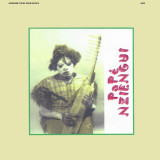
Kadi Yombo, published in 1989, is the most successful album in the quest for a fusion between tradition and modernity in Bwiti harp music of the Tsogho people of Gabon. Combining beating rattles with a layer of synthesizers, Papé Nziengui blends in a contrapuntal dialogue characteristic of harp playing: male song in appeal and female choir in response, male voice of the musical arc and rhythms of female worship. But above all it’s Tsogho ritual music and modern studio orchestration. The result is an initiatory itinerary of 10 musical pieces which are all milestones likely to be simultaneously listened to, danced, meditated on, and soon acclaimed. In the years since, Nziengui has traveled he world from Lagos to Paris, from Tokyo to Cordoba, from Brussels to Mexico City to become a true icon, the emblem of Gabonese music.
Like Bob Dylan, "electrifying" folk and Bob Marley mixing rock with reggae, some purists have criticized Nziengui for having distorted the music of harp by imposing a cross with modern instruments. They even went so far as to claim that Nziengui was just an average harpist covering his shortcomings with stunts that were only good for impressing neophytes; like playing a harp placed upside down behind his back or playing two or three harps simultaneously. Sincere convictions or venomous defamations, in any case, Nziengui never gave in to such attacks, imposing himself on the contrary to pay homage to the elders (Yves Mouenga, Jean Honoré Miabé, Vickoss Ekondo) while instructing the maximum of young people. He is thus the promoter of many young talents, the most prominent of which is certainly his nephew Jean Pierre Mingongué. In a conservative society where the sacred is confused with secrecy, exposing the mysteries of Bwiti in broad daylight can be punished by exclusion or even execution.
Papé Nziengui has always claimed that he faces such risks because he never felt enslaved to a community that governs his life, that regulates his conduct, that has a right of censorship over his activities. Like Ravi Shankar, the famous sitarist, Papé Nziengui is a man of rupture but also of openness, a transmitter of culture. As proof, he has established himself in Libreville, Gabo’s capital, as the main harpist for sessions and concerts, accompanying the greatest national artists (Akendengué, Rompavè, Annie-Flore Batchiellilys, Les Champs sur la Lowé, etc.) as well as foreign artists (Papa Wemba, Manu Dibango, Kassav', Toups Bebey, etc.). In 1988, he was the first harpist to release an album in the form of a cassette produced by the French Cultural Center (Papé Nziengui, Chants et Musiques Tsogho). At the same time, he created his own group (Bovenga), combining traditional music instruments (musical bow, drums, various percussion instruments, etc.) in the framework of a true national orchestra, which gave the first concert and the first tours of a traditional music that was both modern and dynamic, thus "democratizing" the harp, to the dismay of certain purists.
On the other hand, in modern music, dominated by the logic of profit or even commercialism, artistic creation must often be adjusted for a specific audience based on reason rather than heart. But instead of allowing himself to be distorted, Papé Nziengui has always tried to produce music that is not a caricature, worthy in its expression as in its content, of the sacredness and transcendence of the music of the Origins. This is what makes Nziengui not only the musician, but the man someone whose age hasn’t altered any of his freshness or authenticity
quête:character
- A1: Down The Rabbit Hole
- A2: Digital Rain
- A3: Earth That Was
- A4: Victim Of The Modern Age
- B1: Human See, Human Do
- B2 24: Hours
- B3: Cassandra Complex
- B4: It’s Alive, She’s Alive, We’re Alive
- C1: It All Ends Here
- C2: As The Crow Dies
- C3: Two Plus Two Equals Five
- D1: Lastday
- D2: Closer To The Stars
- D3: Knife Edge
- CD1 1: Down The Rabbit Hole
- 2: Digital Rain
- 3: Earth That Was
- 4: Victim Of The Modern Age
- 5: Human See, Human Do
- 6 24: Hours
- 7: Cassandra Complex
- 8: It’s Alive, She’s Alive, We’re Alive
- 9: It All Ends Here
- CD2 1: As The Crow Dies
- 2: Two Plus Two Equals Five
- 3: Lastday
- 4: Closer To The Stars
- 5: Knife Edge
In a career spanning more than three decades, composer and multi-instrumentalist Arjen Lucassen has established himself worldwide as a driving force in progressive rock. The multi-talented Dutchman is best known for his rock opera project Ayreon, but also regularly devotes himself to musical side projects that explore all different aspects of his musical personality
Lucassen is committed to maintaining a consistent vocalist lineup on Star One. For "Victims of the Modern Age," he reunited the high-powered cast of lead singers from the first album, "Space Metal" (2002): Russell Allen (Symphony X), Damian Wilson (Headspace, Threshold), Floor Jansen (ReVamp, ex-After Forever), and Dan Swanö (Nightingale, Second Sky, ex-Edge Of Sanity). The different vocal styles of these great vocalists, ranging from soaring power vocals to haunting melodic passages to brutal growls, give each song a stunning variety of vocal textures
As for the instruments, the Dutchman recorded the rhythm guitars, Hammond organ, Mellotron, Solina strings and analog synthesizers himself and invited drummer Ed Warby (Ayreon, Hail of Bullets, Gorefest) and bassist Peter Vink to provide the powerful rhythm tracks. He also enlisted the intimidating solo skills of former After Forever keyboardist Joost van den Broek and guitarist Gary Wehrkamp (Shadow Gallery), both of whom contributed characteristically blistering solos. In addition to this formidable lineup, Lucassen recruited three other vocalists - Mike Andersson (Cloudscape, Full Force, Silent Memorial), Rodney Blaze and former Black Sabbath frontman Tony Martin - for several bonus tracks on the album
For the first time, "Victims of the Modern Age" is available on vinyl as a gatefold 2LP+2CD & LP booklet, as well as a Ltd. 2CD digipack.
- A1: Steady Eddie Steady
- A2: Killing Time
- A3: Citinite
- A4: Wastelife
- A5: Silver Blades
- B1: Silver Blades A Deeper Cut
- B2: Sodium Pentathol Negative
- B3: (The) Innocent (The)
- B4: Red, Green & Gold
- B5: Fiction Factory
- C1: Do It In The Dark
- C2: Steady Eddie Steady
- C3: Emotional Blackmail
- C4: Bad Move
- C5: Let Go
- D1: Don't Take Drugs, I Don't Tell Lies
- D2: We're The Fashion
- D3: Small People
- D4: Bike Boys
- D5: The Naff All Tango
- D6: Killing Time
During 1978 to 1980, Fashion released one album and a handful of indie club hit singles mixing Punk & Reggae vibes. They toured the US extensively supporting The Police in 1979. Limited Edition of 800 copies 2LP set with printed inner bags. All tracks completely remastered. Contains every studio recording of the first lineup of Fashion including US singles. Includes unreleased tracks. Liner notes from lead singer & Guitarist Luke Sky. Fashion went through several line-up overhauls during its initial existence between 1978 and 1984. John Mulligan (synthesiser, bass) and Dik Davis' (drums) were constants, but the band's frontman changed with each of the band's three albums. Post-punk years: Fàshiön Music Fashion was formed originally as Fàshiön Music, in Birmingham, England, in 1978, and consisted of John Mulligan (bass, synthesizer), Dik Davis (drums), and Al James (vocals, guitar). James became known as Luke Sky, or simply Luke or Lûke (short for "Luke Skyscraper" - a reference to the Star Wars character Luke Skywalker and the fact that James was tall and thin), while John Mulligan was known simply as Mulligan and Dik Davis simply as Dïk (or "Dik Mamba" on their debut single). In 1978, they also founded their own Fàshiön Music label; from this point forward, the band was generally (though not completely consistently) identified as Fashion, as distinct from the name of their self-owned label. Fashion released their first two singles ("Steady Eddie Steady" and "Citinite") as independent issues on the UK in November 1978 and June 1979 respectively. The group was quickly picked up by I.R.S., who put out a third single in the US in September 1979, "The Innocent". Their sound was varied, playing punk, post-punk and indie repertoire, although Mulligan at that time also had a synthesizer which later characterized the future synthpop years of the band. Still signed to I.R.S., in 1979 they recorded and released their first album, Product Perfect. All three members were credited as having written the songs collectively. Between 1978 and 1980, Fashion played shows with performers such as Toyah Willcox, UB40, Hazel O'Connor, & Billy Idol, who later became well known. A then-recently formed Duran Duran opened their shows; they toured the UK with U2, both the UK and US with The Police, and opened for The B-52's on their first British tour. In March 1980, no longer associated with I.R.S., Fashion released their "Silver Blades" single, again on their own Fàshiön Music label. Later in 1980 they also released one more song, "Let Go", on a Birmingham bands compilation called Bouncing in the Red (EMI). In June 1980, after a last gig in London with U2, Luke James left the band, and later moved to the United States.
Old Souls Carnival is the most accomplished Medline's album so far, presenting his new direction in composition and his multi-instrumentalist approach. The project is driven by a strong spiritual background with a deep 70's soul jazz fusion influence, raised into a movie soundtrack dimension.
Each piece reveals a facet of Medline's music, origins, tastes and character. Playing with shamanic and exotic harmonies, hybridized with distorded psych funk sound and solidely pulsed by unique polyrythmic drum beats.
The natural flows of his expression speaks deeply and truely to the senses, traducing 6 months of gathering emotions, traducing feelings, during meditative recordings sessions on the world evolution and reality. The entire album was produced, mixed and mastered by Medline at the family's house, in Messac, offering a perfect immersion in his spiritual and material universe.
The fabulous and mysterious handmade drawings of Stéphane Carricondo, are the perfect rendition of Medline's mestized artwork. Rich with a wide variety of colors and influences, channeled by Medline's own hands, this first 12" record released on his label My Bags lives up to expectation. This French-Chilean producer always works outside of boundaries and styles frames, and with this LP shows that extraordinary projects can be expected from him for years to come.
Straight from the melting pot of Berlin, Luca Musto serves up a solid and fresh house dish in his first album on Moodfamily.
The songs stretch the imagination and touch the borders of hip hop and electronic beats. He intertwines his own musical journey with the sounds of his hometown. It is also the attempt at a new genre by blending hip hop elements with electronic music to create something unique.
This funky fusion expresses itself in three original tracks. “What We Witness” introduces us into the rhythmic exploration of the record. It adds some spicy P-Funk vibes and blurs your senses with drowsy horns, served on a velvet platter. "Toledo" - the first single of the EP - gives a thrilling continuation to the EP. This one is sure to cause a ruckus on the dance floor. Finally, “Keep Rollin” further defines the genre-blending character of this project, and gives a slight nod to the West coast of the US.
Xinobi (Lisbon, Portugal / Discotexas) and Mosley Jr. (Gent, Belgium / Moodfamily) deliver some exciting remixes to the EP, both with their unique signature spin.
- “This shit’s gonna break the rules.
Early support from Support Super Flu, Audiofly, Acid Pauli, Florian Rietze, Maxim Lany, Be Svendsen, Maga, Iorie, Stavroz, Paco Osuna, …
- A1: A Gente Acaba (Vento Em Rosa) (Vento Em Rosa)
- A2: Don't Forget You're Precious
- A3: Fucking Let Them
- A4: The World Is Mine
- A5: The Sound Of My Feet On This Earth Is A Song To Your Spirit
- B1: I'm Gonna Say Seven
- B2: Do You Know A Human Being When You See One?
- B3: Visitors Yt15B - Jerusalem, Palestine
- B4: I'm Good At Not Crying
- B5: Now (Stars Are Lit) (Stars Are Lit)
- B6: Again (Feat Falle Nioke)
- C1: Mrs Calamari
- C2: People What's The Difference?
- C3: Visitors Xt8B - Oak
- C4: Who Is A Fool
- C5: I Will Not Be Safe
- D1: Visitors Yt15 - Krupp Steel Condition Pivot
- D2: Broken Like
- D3: Now (Pink Triangle, Blue Valley) (Pink Triangle, Blue Valley)
LA FAMILIA AUFLAGE!!!
GOLD, the follow-up to Alabaster DePlume's widely-acclaimed, 2020-
released cinematic instrumental LP To Cy & Lee: Instrumentals Vol. 1,
introduces the world to the artist’s truest self.
That is... though DePlume’s now known across the globe as the saxophonist who created that collection of wonderful, wordless music, he’s most known to fervent fans in his home zone of London, UK, as an outspoken poet and orator, beloved for his inspiring words of encouragement and sing-a-long-able songs about vulnerability, humanity, and courage. GOLD is a sprawling double album that finds DePlume expressing both sides of his artistic character beautifully: (1) an articulate singer and songwriter who invokes the melodious crooning of Donovan as much as Devendra Banhart or Syd Barrett, whose tunes are almost like mini-sermons, full of existential comedy and spiritual enlightenment; and (2) a brilliant composer of simple, soothing, and viscerally nourishing instrumental melodies, with a gift for expanding them into intrepid collective improvisations, led by a delicate and distinguished saxophone tone that conjures the fluttery sweetness of the great Ethiopique Getatchew Mekurya.
Packaging specs: Black & 'Eye of the Sun' coloured Vinyl 2xLP in Heavyweight Gatefold Jacket with Gold-Foil Stamp over Reverse-Board print, with Insert Sheet, IA OBI Strip and Dome-Pattern Inner Sleeves
Stripped down to the core duo of Robert Görl and
Gabi Delgado and with Conny Plank again behind
the boards with crisp, focused production, with
‘Alles ist Gut (Everything Is Fine)’ DAF turned into
an honest-to-goodness German hit machine.
Even more important and impressive was how
they did it - keeping the electronic brutality that
characterized them, but stripped down to nothing
but Görl’s massive drumming, electronic bass and
synth tones, and Delgado's deep, commanding
singing. The result was and remains massively
influential. A must have for all fans of electronic
music.
Last copies of ultra limited version on half & half black/red vinyl. Only around a 100 available!
“I learned long ago, never to wrestle with a pig” reasoned George Bernard Shaw. “You get dirty, and besides, the pig likes it.” True to form, Pigs Pigs Pigs Pigs Pigs Pigs Pigs have left the wiser of us aware that they are no band to be messed with. This is made manifest on ‘Viscerals’, their third proper, and an enormous leap forward in confidence, adventure and sheer intensity even from their 2018 breakthrough ‘King Of Cowards’.
Incisive in its riff-driven attack, infectiously catchy in its songcraft and more intrepid than ever in its experimental approach, ‘Viscerals’ is the sound of a leaner, more vicious Pigs, and one with their controls set way beyond the pulverising one-riff workouts of their early days. Yet Pigsx7 have effortlessly broadened their horizons and dealt with all these new avenues without sacrificing one iota of their trademark eccentricity, and the personality of this band has never been stronger, whether on the Sabbathian and philosophical warcry of ‘Reducer’, the debauched, Jane’s Addiction-tinged swagger of ‘Rubbernecker’, the Melvins vs Sonic Youth demoltion derby of ‘New Body’ or even the demented MBV-meets-Twisted-Sister party-banger from hell that is ‘Crazy In Blood’.
“We’re a peculiar bunch of people - a precarious balance of passion, intensity and the absurd” notes vocalist Matt Baty. Such is the unstoppable character of this unique and ever-porcine outfit; still the hungriest animals at the rock trough.
If you’re going to listen to one Damata album this year, why not listen to the only one? ‘What’s Damata’ is the debut album of this Guitar Trio, and is a compilation of compositions and excerpts from improvisations recorded in January 2019. The albums attitude, while handled with a lot of caution, suggests that everything is allowed in this music, which points towards the prudence of Brian Eno and Maria Kannegaard, the freedom of Supersilent and the harmonies of Aphex Twin and Olivier Messiaen. A lot of the music has a cinematic character to it, and may at times sound like a homage to Ambient Music, Drum’n’Bass and Scandinavian Jazz and Jazz-Rock, all while preserving the organic sound from the guitar trio format and the playfulness found in improvised music. This playfulness has also planted its seeds in the mixing process; a tune might suddenly accelerate or the drums might be replaced with drum machines. The titles on the album is no exception, which one can read from titles like ‘Oslo, 32. August’, ‘Her Piece’ and ‘I Say Damata, You Say Matoma’. Further, the order of the tunes is different from each format, meaning that the vinyl track order is different than the track order on streaming services. ‘What’s Damata’ is available on vinyl, CD and streaming services through the Oslo label Dugnad Rec.
Last October, when Bernard Allison returned to his old haunt of Bessie Blue Studios, Tennessee, to be greeted by fabled producer and career- long collaborator Jim Gaines, it felt like coming home. And when Allison fired up the amps, counted in the band and embarked upon his latest studio album, Highs And Lows, everything felt right with the world. “Just to be able to create music again after the pandemic,” he says of that long-awaited rebirth, “was incredible.”
For 56 years, music has been Bernard Allison’s essence. As the youngest son of the much- missed Chicago bandleader Luther Allison, he was a bluesman from birth. One week after graduating high school, Bernard cut his teeth on the road with Koko Taylor’s Blues Machine lineup – and ended up staying for most of the ’80s. By the close of the decade, however, he assumed a twin identity, leading and
writing for his father’s band, while forging a solo career that exploded in Europe off the back of early albums like The Next Generation (1990), No Mercy (1994) and Funkifino (1995).Now, released in February 2022 on Ruf Records, Highs And Lows sees Bernard acknowledge his lineage through two classic songs by his
father – Gave It All and Now You Got It – while offering nine originals. Try the irresistible groove of Hustler: a funk gem written by Bernard with Andrew Thomas, whose horn-and-harp groove evokes the strut of the title character. Or the masterful Last Night, which shifts tempo from an upbeat chop to a weeping slow- blues, capturing the changing moods of a man chasing his runaround woman. As for the title track, Bernard says it speaks for anyone left bemused by life’s rollercoaster: “It’s a part of life, the ups and downs that everyone deals with.”Right now, with a new album of stellar material to take out on his New Year tour, Bernard Allison is back in the ascendency – and the man can’t wait to return to his natural habitat. “The song So Excited is basically about the excitement of being able to be back on the road again,” he says. “I think everyone can relate to that.”
With ‘Love on My Mind’ - the six-song mini-album, mixed by Claudius
Mittendorfer (Tennis, Parquet Courts, Johnny Marr) - Bambara condense all the energy and darkness that have made them so compelling and rearrange it into something defiantly new.
Opening track, ‘Slither in the Rain’, all hissing high-hat and spectral
synthlines, is a true statement of intent. It’s minimal and atmospheric,
foregrounding Bateh’s raw vocals as he introduces one of ‘Love on My Mind’s main characters years after the events of the album are over, a lonely man who throws bottles at airplanes and dances a two-step in the pattern of a figure-8. While Bateh has always been adept at character sketches, tracks like ‘Slither’ introduce a newfound vulnerability that runs true through the entire album and cause the songs to hit on a more human level.
Similarly, ‘Point And Shoot’ - in which each stanza describes the louche, lawless scenes of “rooftop girls / standing shoulder-to-shoulder, naked figures with their hips / cocked,” busted up jaws, and couches full of burnholes captured by the snapshots of ‘Love on My Mind’s female lead - displays an autobiographical intimacy that is not as apparent in Bambara’s previous releases. This tenderness is echoed on ‘Birds’, a rare love song (from which the EP’s title is derived), and album closer ‘Little Wars’, a gripping finale of loneliness and isolation.
But while these songs may display a softer side of Bambara, it’s important to note that they haven’t lost the thrill of what attracted so many people to them in the first place. ‘Mythic Love’ (featuring vocals from Bria Salmena), with its driving bassline and ricocheting guitar lines, brings to mind past rave-ups like ‘Serafina’ and ‘Sunbleached Skulls’ but obliterates them in the process, while ‘Feelin’ Like A Funeral’ - a dangerously oscillating tale of a city knifing - is probably the most thrillingly anthemic song the band have ever recorded.
Taken together, ‘Love on My Mind’ amounts to another massive step forward for Bambara - the boldest thing they’ve ever done - and the sound of yet another breakthrough.
“Engrossing, dark and irresistible… an adventurous group, who just keep getting better all the time.” - CLASH
“Never anything less than captivating.” - Upset
“What Athens, Georgia bunch Bambara do, they do very well… the trio’s commitment to the dark side is never in question.” - DIY
“Bambara are ice cold and sharp as a knife’s edge.” - Loud & Quiet
“Brooklyn based doom-mongers delight… the trio go further than most in their quest to rattle.” - Q (4/5)
For fans of Daughters, Protomartyr, IDLES, King Krule, Ice Age.
Previous album released on Dead Oceans. Previous album was a collaboration with Brian Eno. Past press coverage from Pitchfork, SPIN, The Guardian, Drowned in Sound, Dusted, The Quietus, and many more. Since the release of his last album 2017’s Finding Shore, a collaboration with Brian Eno pianist and singer-songwriter Tom Rogerson’s life has undergone a number of dramatic transformations. While writing his new album Retreat to Bliss, Rogerson had a child, lost a parent, and received his own diagnosis of a rare form of blood cancer. The new decade brought him from Berlin to the Suffolk of his childhood, composing profound pieces of minimal songwriting in the church next to his parents’ home. Rogerson studied composition at the Royal Academy of Music under mentors like Harrison Birtwistle, and he made his live debut as an improvising pianist in 2002, before releasing an improvised record with Reid Anderson (Bad Plus) and Mike Lewis (Happy Apple, Bon Iver) in 2004. He formed the band Three Trapped Tigers in 2007, expertly blending elements of electronic, jazz and noise rock into a cohesive whole. The band earned a reputation for innovative live shows and went on to perform and collaborate with artists like Brian Eno, Deftones, and the Dillinger Escape Plan. It was working with Eno, another Suffolk native, that eventually led Rogerson back to his roots and back to a place where he could write Retreat to Bliss, his solo debut album. “All my life, the piano has been my constant companion, my confessor, my best friend, and my worst enemy,” Rogerson explains. “I’ve always written music on and for the piano, but it felt too personal, too private to release.” Indeed, listening to Retreat to Bliss feels almost like eavesdropping, as though you’re crouched in the belfry of a Suffolk church, bearing witness to a form of musical bloodletting. For the first time in his noteworthy career, Rogerson has combined masterful piano playing and subtle electronics with the texture of his own voice, an attempt to express deeply private emotions that were difficult to articulate using instrumental music alone. “The last few years have brought some struggle, some joy, and a lot of change. My response has been to retreat to what I trust the most: the piano, my voice, and the landscape I grew up in. That’s how the album got its title, and how I came to be ready finally to release a solo record.” The eleven tracks that make up Retreat to Bliss were recorded by Leo Abrahams (Brian Eno, David Byrne, Grace Jones) over the course of just a few days, a process that emphasized spontaneity and the artist’s own commitment to improvisation. Secular yet devotional, intensely personal yet profound, the experience of listening to Retreat to Bliss seems to evade characterization. It’s physical and emotional, a glimpse into the mind of an artist who has chosen exposure over withdrawal, who uses his command of the piano to chart an unflinching path forward, never looking back. UK press campaign by Someone Great. Press Quotes "A meeting of minds that is full of rewarding surprises, challenging and surprising one another, and their listeners, with music that feels alive and wondrous…” Pitchfork // "Both mournful and dazzlingly optimistic, a taste of the conflict found so ofen in nature and reflected so elegantly across the course of the record.” The Line of Best Fit // "Many avant-garde instrumental albums exist to craf a mood; Rogerson and Eno merge these moods, sounds and themes together efortlessly and radiantly on Finding Shore” Exclaim // Track List 01 Descent 02 Oath 03 Buried Deep 04 Toumani 05 Drone Finder part 2 06 Chant 07 Rapture 1 08 Open Out Span Wide View 09 A Clearing 10 Retreat To 11 Coda
- 01: Through The Timehole
- 02: Distant Reflections
- 03: Tribal Call
- 04: The Turning Point
- 05: Mutated Perception
- 06: Untrodden Pesonance
- 07: Elemental Waveshore
- 08: Glittering Embalming
- 09: Squirlich Stroll
- 10: Return Of The Mystic Channeler
- 11: Chosen Ones
- 12: The Field Of Draflinis
- 13: Forgotten Valley
- 14: Cavern Of Morphing Stones
- 15: Hovering Over The Magnetic Ground
- 16: New Dawn - Return
Following the release of Collision and Coalescence, Slovakian label mappa commits to the duo Grykë Pyje, releasing their third LP "Squirlich Stroll". Maintaining the fabled tone of their debut on the label, Jani Hirvonen (Uton) and Johannes Schebler (Baldruin) dig deeper into the sonic vein of myth and fabric of yonder. The music in "Squirlich Stroll" unravels as a yarn brought back from a wild voyage.
On uncharted areas of medieval maps where potential dangers were thought to exist, the inscription "Here be dragons" was used to warn as much as to tempt explorers willing to cross limits. Myth awaited them as a blank page of dormant territory, yet also to be proved unlike and reinvented. In such pliable borders, wonder had the favorable conditions to blend experience and imagination, crafting creatures with an eye instead of a bellybutton, arms instead of ears and ears instead of fingers, hypnotizing spirals where a mouth should have been. These chimeras, though fictitious, allowed explorers to express their delusions along with their fears. "Here be dreams", we hear nightmares. Here be mushrooms the size of pyramids that sing lullabies for mountains. Here be talking roads that lead to volcanoes throats and spit you back to flight. Here be art of bending trees into braided bridges like in Meghalaya, and the time gap between seed and living ruins.
Let that be the compass, the astrolabe. Yet, the music in Squirlich Stroll comes with these journeys already embraced, unraveling as a story told by wanderers visiting town, nourishing fantasy. The sonic language and diction employed here are crystal clear. Sounds are sharp and pure. Growls, howls, shrieks, tingles, rattles, moans, excretions and even hymns sung by landscape and creatures alike do not run over each other. There is no chaos, but ambience, cohabitation. The duo masters dramaturgy, providing every voice with focused turns and character, guarding their parley with caution and care, convoking them mainly through soothing synth melodies that enable an analgesic, sedative mood. Clusters of sounds gathered are articulated through the album with the inherent luminosity and required stability to accomplish what peaks in, as the title of the final track reads, a new dawn.
For more than a decade now, Fleck E.S.C. has marked himself out as one of the most playful and prolific producers in the electro game. Across dozens of releases for labels including Bass Agenda and Science Cult, the France-born, Japan-based artist has made his name through a production style which balances limber beats with exploratory textural work.
Fleck E.S.C. debuted on Central Processing Unit in 2018 with the Discrete Opinion EP. Now, after stopping by the Sheffield label last year on a Silicon Scally remix job, Fleck E.S.C. delivers his second EP for CPU in the form of Rough Silk. The record's intriguing title proves an apt introduction to this four-track affair. These cuts are at once sleek and abrasive, anchored by robotechnic machine-funk grooves yet also full of strange, shifting shapes.
The opening title-track expertly sets out Rough Silk's stall. Heralded by gurgling synths and all manner of whirring percussive tones, 'Rough Silk' blossoms around the minute mark with the introduction of a wickedly buoyant lead synth. This is music at once visceral and full of mystery, the sound of wending through the back alleys, and the feeling carries through to the following cut 'Hat in the Cat' - as the synth pads spool out overhead, the machine-funk snap of the beat has an almost aquatic quality that links it back to Drexciya.
Much like 'Rough Silk', the record's first B-side 'Faking Sweet' also shifts gears. The opening strains of the track seem to be preparing for another insistent, expansive broken-beat pulse, but it stiffens its neck around ninety seconds in. Programmed drums whirr around a jittery machine-gun bass while discordant synths pull at the edges of the track, all of which brings a strong dystopian energy that increases further as the percussion sounds become increasingly bug-eyed.
After so much excitement, 'Digger Play' closes out the EP with a softer touch. There's still plenty of low-slung bounce to the beat, but the track runs a little slower, and there's a warm wistfulness in the synths which gives 'Digger Play' a painterly, almost poetic feel. However, while it may take its foot off the gas, the production here is as deft as it is everywhere else on Rough Silk.
With new EP Rough Silk, electro whizz Fleck E.S.C. brings the sort of casual mastery to proceedings that has characterised his career to date.
RIYL: Silicon Scally, Jensen Interceptor, Annie Hall
Following his debut Third Ear release, the Shonky ep in 2018, Third Ear follow up with 8 more Shonky dance floor bombs. Shonky has a signature hypnotic, hard grooving sound, characterised by punishing beats laced with detailed polyrhythms and elusive motifs. On The Run is Shonky's debut album.
- A1: Opening Titles
- A2: The Painting
- A3: High King And Queen Of Narnia
- A4: Reepicheep
- A5: Land Ahoy
- A6: The Lone Island
- A7: Lord Bern
- A8: The Green Mist
- A9: Market Forces
- A10: 1St Sword
- A11: Eustace On Deck
- B1: Duel
- B2: The Magician’s Island
- B3: Lucy And The Invisible
- B4: Coriakin And The Map
- B5: Temptation Of Lucy
- B6: Aslan Appears
- B7: The Golden Cavern
- C1: Temptation Of Edmund
- C2: Dragon’s Treasure
- C3: Dragon Attack
- C4: Under The Stars
- C5: Blue Star
- C6: Aslan’s Table
- D1: Into Battle
- D2: Sweet Water
- D3: Ship To Shore
- D4: Time To Go Home
- C7: Liliandil And Dark Island
- C8: The Calm Before The Storm
The Chronicles of Narnia: The Voyage of the Dawn Treader is a 2010 fantasy-adventure film based on The Voyage of the Dawn Treader (1952), the third novel in C. S. Lewis’ fantasy series The Chronicles of Narnia. It is also the third and final installment in the original Chronicles of Narnia film series. Set three years after the events of Prince Caspian, the film follows the two youngest Pevensie children, Edmund and Lucy, as they return to Narnia to join the new king Caspian in his quest to rescue seven lost lords and to save Narnia from a corrupting evil that resides on a dark island.
Composer David Arnold scored the film, with themes composed by Harry Gregson-Williams (who scored the first two films). It was Arnold’s fourth collaboration with director Michael Apted. He created specific themes for the characters The Dawn Treader and Reepicheep, and used themes from the previous films for the opening and closing scenes as well as recurring characters, to ensure that the film is consistent with the franchise. The score was performed by an 87-piece orchestra and a 40-piece choir, resulting in an epic soundtrack with just the right magical touch to compliment this film.
The Original Soundtrack to The Chronicles of Narnia: The Voyage Of The Dawn Treader is available on black vinyl and includes an insert.
“Whether it is traditional or contemporary, we need to be authentic,” says Gözen Atila who performs as Anadol. “I don't claim that I am authentic, but this is what I want to achieve.”
A sense of authentic exploration, introspection and celebration coats every inch of Anadol’s latest album. After 2019’s Uzun Havalar, the Turkish artist returns with an album that continues to explore a variety of deeply embedded musical traditions while also hurtling into new terrain.
The music and influences - as well as the history, culture and geography behind them - that make up Atila as an artist all coalesce to create something entirely new. The result is something that is simultaneously exploring history and tradition, while harnessing innovative modern sounds and techniques. “If there is any tradition I am somehow connected to, or influenced by, then it’s multi- genres,” she says. “Such as Turkish Pop and Arabesk music from this country where I grew up. There is a connection to Folk and also French pop or Flamenco, Middle Eastern melodies and orchestration, Greek adaptations, Kenny G. solos, American guitars.”
This can be heard on Felicita, not in as much as you can link up the influences directly but in the way it glides across genres, eschewing convention and predictability along the way, to result in a kaleidoscopic experience. For the album, Atila found a talented roster of Jazz musicians in Istanbul who she recorded on top of her synth productions and field recordings. Soon enough saxophone, drums and strings began to stack up against preset drum loops from vintage organs. It’s a record where woozy psychedelic excursions bleed into dreamy synth lines, immersive ambience and the occasionally disconcerting yet incredibly tactile use of field recordings.
If it’s an album that feels like it travels through a variety of feelings, then it’s because the concept is loosely rooted in such a journey. Felicita translates as “happiness” and this album is something that explores the complexities of such an emotion. “I did not name the album like this because I just wanted to call it happiness,” Atila says. “A song like ‘Felicita Lale’ is a sad and confused song about a female character who can't get out of bed. It’s a funny rumination, in her thoughts, saying to get up and lie down repeatedly. At some point the lyrics say: "hep agla, felicita", meaning: "Cry all the time, Felicita". Like she is talking to happiness itself and telling it to cry. So it is not about happiness, it is more about the concept of happiness which can be very sad.”
International musicgroup SexJudas feat.Ricky returns to Optimo Music this Winter with a new album: Night Songs. The eight track LP draws inspiration from the night and features Malian percussionist Sidiki Camara,jazz clarinetist Andreas Røysum and noise rocker Linn Nystadnes. Making their own blend of disco, post punk and African music.
“It’s the return of Sex Judas feat.Ricky, this time as a six piece in fully fledged band mode. We’re here to take you on a journey through suburban psychedelia, forming our own brew of postpunk, disco and electronic, as well as traditional music from Mali. Night Songs is a meditation on the night time. The excess, the dreams, the highs and lows of night time activity.”-Sex Judas feat. Ricky.
“Black Cat In A Black Room” begins proceedings, taking the form of a psychedelic six-minute offering packed full of tribal drums and desert-like percussion. “A Man Without Purpose” comes next with its African-inspired vocal, before “Hab Mich Lieb” soon arrives. The six-minute cut is hypnotic, trippy and relaxing all in one, as is “Slow Down” feat. Linn Nystadnes. Taking on more of a funk-rock feel, there’s plenty of groove in the guitar-laced bassline, whilst in “Cold Clementine”, Sex Judas tells the sad tale of rave casualty over a dark and funky groove.
We’re taken down a spiritual path on The Light You Saw Was Not For Real, as Andreas Røysum’s clarinet solos sit underneath shamanic vocal offerings that open neatly into The Night Within The Night. Aslow-burning cut, riffs and hats serenade us before When You Wake Up Everything Will Be Fine brings proceedings to a close. Dream-like chords wrap us in a warm and glowing hue, with the harp-like sounds from Sidiki’s Ngoni, leaving us in a starry-eyed state to finish.
The calming nature of the album is a nod to the band’s influences: they were inspired by the great meditative records of the past, setting off on a musical trip that saw them record the whole release at legendary Norwegian studio Athletic Sound. This happened during lockdown and whilst the LP was never meant to be comment on the pandemic, there remains a brooding intensity to each track because of it. Sex Judas feat. Ricky originally began life as the solo project of Tore Gjedrem (from electronic duo Ost & Kjex), but has since grown into a steady six piece involving the talents of Sidiki Camara (djembe/ngoni/balafon), Ivar Winther (guitar/keys), Tracee Meyn (vocals), Tore Brevik (drums/percussion) and Kristian Edvardsen (bass). Centre stage is also illustrator and comic artist Sindre Goksøyr, this time portraying each character as they paddle their way into the sunset and uncharted territories.
Malian-born, Norwegian-based percussionist Sidiki Camara has played a pivotal role in promoting “Night Songs” to world music circles. Having lived in Norway since 2006, he has helped bring WestAfrican rhythms into the country’s wider jazz scene.
Fiat Lux is the debut album by Tarta Relena, a Barcelona-based project featuring Marta Torrella and Helena Ros. The group approaches the oral traditions of the Mediterranean from a contemporary perspective using a unique combination of ancient vocal melodies and subtle electronic textures.
Tarta Relena’s inspiration for Fiat Lux comes from historical characters, such as the Virgin Mary and Hildegard of Bingen, and timeless verses that deal with the cyclic nature of the human experience: “E suïcidi i el cant” (1) is an adaptation of a traditional poem by Pashtun women in Afghanistan; “Esta montanya d’enfrente” (3) is a traditional Sephardic song; “Safo” (9) is based on the love poems by Sappho of Lesbos.
Singing in Catalan, Spanish, Greek, Latin, English, and even Sephardi, the language of Hispanic jews, Tarta Relena explore a complex array of Latin cultures through the simplicity of voice. They draw from vocal techniques that range from flamenco to jazz, introducing elements of electronic music to redefine the melodies.
In January 2019, Tarta Relena released their first EP, Ora Pro Nobis: eight a cappella songs with minimal electronics. In April 2020, they released their second EP, Intercede Pro Nobis: a five-song dialogue between voice and electronics.
Fiat Lux expands on past experimentations, moving away from organic harmonies to embrace digital textures and distortions. The musical production of Juan Luis Batalla and Òscar Garrobé is remnant of Holly Herndon or Eartheater.
Tarta Relena have perhaps been best described by Pitchfork in their review of Pack Pro Nobis: “Tarta Relena is a celebration of musical exchange. At a time of rising nationalisms across Europe, Tarta Relena’s songs are a testament both to the porousness of borders and the ideas that unite disparate cultures, running beneath the centuries like a pedal tone”.
2001’s »Anima« was the third album released by Sasu Ripatti under his Vladislav Delay moniker and marked a turning point in the stylistic development of the prolific producer. Clocking in at roughly 62 minutes, the single piece draws on dub aesthetics while working with Musique concrète-like methods through the liberal use of samples to create a dreamlike logic. Muffled voices, lush chords, subtle rhythms and indefinable sound events are not so much integrated into a composition with a predetermined outcome but rather engage with each other freely in a constant sonic flow, forming constellations in one moment before moving on to connect with other elements in the next one. »Anima« marked the first time Ripatti was using a DAW in his working process, creating a piece constantly in motion that subtly evolves over time. This vinyl reissue on the German Keplar label follows up on the 20th anniversary edition of 2000’s »Multila« and will be complemented by a ten-minute long version of the original piece, previously only available on the CD version released by the artist on his own Huume label in 2008.
After the release of his »Ele« and »Entain« albums in 1999 and 2000, respectively, Ripatti took the 1998 independent movie »Hurlyburly« as a conceptual starting point to experiment with different gear and production methods. »Until then I had worked with an old MSQ-700 MIDI sequencer and an Ensonic EPS16 sampler/sequencer that had one or two MB of sampling memory and mixed the music live on a Mackie, which was very limiting arrangement-wise,« says Ripatti. Loading a slightly shortened version of the film into his DAW however allowed him to play along to it with the DrumKAT MIDI controller, triggering and playing all the sounds that can be heard on »Anima« while also contributing synths, bass and other sounds during repeated playthroughs before mixing a total of six stereo tracks together. »This way, after I had edited out most of the few parts that had music in them, I was in the movie; almost like an extra character playing music,« explains Ripatti. »This was certainly the most organic way in which I have ever made music, and I have never again approached another record like this.«
While »Anima« sounded like an unusual Vladislav Delay record at the time of its release, it also prefigured many of the developments Ripatti would go through in the course of his long career. Combining visceral immediacy with a sense of abstraction, it is far more than a mere missing link in his discography but rather a conceptually and musically outstanding piece of work that remains as engaging as it was 21 years ago.
All tracks composed and recorded by Vladislav Delay.
Originally released on Mille Plateaux in 2001.
Remaster and cut by Kassian Troyer @ D&M.
Art direction and design by Marc Hohmann.
Text by Kristoffer Cornils.