Il Quadro di Troisi presents La Commedia
Everything changes, all things evolve: four years after their eponymous debut, Il Quadro di Troisi return with a new album and a new line-up.
The perfect circle traced by Eva Geist (aka Andrea Noce) and Donato Dozzy (aka Donato Scaramuzzi) becomes a triangle with the permanent addition of Pietro Micioni, who collaborated in the previous recordings and had been part of ll Quadro’s live set.
Nothing stays the same, and the world is a lot different from what it was in 2020. The global crisis generated by the constant escalation of conflict and by the pandemic was mirrored by a time of individual crisis and personal, often irreversible transformation that underscored the entire period of the album’s composition.
The influence of these turbulent times is felt in the writing: La Commedia is about turning a crisis into an opportunity and using change as a catalyst for rebirth. Much like the characters in classic Italian comedies, who are masters in using irony to face life’s hardships, Il Quadro di Troisi explores the vast and unpredictable terrain between the lighter and darker sides of the human experience, matching the magical with the mundane.
La Commedia is about the many facets of life: each song is named after an archetype (e.g. the truth, the night, the Earth, the prophet), as though our existence were a tarot deck and its reading an exercise in collective consciousness.
La Commedia marks the band’s embrace of a more traditional song form, shaped by a very personal and distinctive musical style. The distinguishing elements of Il Quadro di Troisi’s music – classic Italian songwriting with an electronic spin – meld into a unique mix that is both seductive and eerie, elegant and earthy, contemporary and timeless. La Commedia celebrates the band’s cultural roots while constantly moving into new territory, balancing nostalgia with a forward-thinking approach.
La Commedia is a rare gem that confirms Il Quadro di Troisi’s relevance in the international music scene, as demonstrated by the number of top-level artists featured on the album: from Suzanne Ciani, a legend and a pioneer of independent music with a career spanning five decades, to Aimee Portioli, aka Grand River, a Dutch-Italian musician, composer and sound designer based in Berlin, along with Francesca Colombo’s eclectic violin (the de facto “fourth angle” of Il Quadro di Troisi’s frame), Fiona Brice’s strings, cultural agitator and icon of the Roman underground scene Stefano Di Trapani (aka Demented Burrocacao and a member of Trapcoustic and System Hardware Abnormal, among other projects), Maestro Daniele Di Gregorio, an excellent musician and a longtime collaboration of songwriting legend Paolo Conte, and Tommaso Cappellato, whose professional description goes well beyond “drummer” and who has been working with artists like Rabih Beaini and Maurice Louca.
The cover of the album, as well as those of the singles, was designed by Francesco Messina, another icon of Italian music. Messina is a longtime Franco Battiato collaborator and co-author, a cult musician (his Prati Bagnati del Monte Analogo, made in collaboration with Roul Lovisoni, is considered a seminal record by the alternative Italian music scene), as well as a photographer, visual artist and the author of legendary record covers.
Search:character
- A1: Tides 00 05:31
- A2: We Don't Know Feat Sea Change 00 04:58
- A3: Leaves Clap Their Hands On Every Tree 00 05:41
- A4: Forget About It 00 06:38
- A5: In Case You Wondered What I've Been Doing 00 05:56
- B1: Outgrowth 00 03:24
- B2: What If It Doesn't Work 00 06:09
- B3: Infinite 00 05:41
- B4: Right Here 00 06:23
- B5: Drops Of Colorwater 00 04:22
Everything flows. Arutani's third album is a very personal note on change and life. The stories we see and create, the balance of hope and melancholia that accompanies every step we take. Calm, light, modest and mindful as the artist himself, with a glimpse of light in every aspect. Minimal in character and rich in detail. Luise is once again oh so happy to give a home to this masterpiece.
Whitney Houston’s self-titled debut album has few parallels. Viewed solely through the lens of sales numbers, Whitney Houston is a watershed statement on par with the most commercially successful and culturally dominant LPs ever released. Having sold more than 14 million copies in the U.S. and upwards of 25 million units worldwide, the 1985 LP became the equivalent of the television show or blockbuster film that everyone collectively experiences and discusses. Nearly four decades later, it’s lost none of its appeal or magnetism — and its artistic significance and historical import have only grown.
Sourced from the original master tapes, pressed at RTI on MoFi SuperVinyl, and strictly limited to 4,000 numbered copies, Mobile Fidelity's 180g SuperVinyl LP of Whitney Houston presents the breakthrough in audiophile sound for the first time. The signature traits Houston exhibits on every song — her three-octave range, radiant warmth, personal conviction, impossibly controlled register — come across with exceptional clarity, focus, and presence. Free of artificial ceilings and constricted dynamics, this reissue plays with an openness, airiness, and balance that put the singer’s once-in-a-lifetime instrument and immortal artistry into proper perspective.
It does the same for the songs’ cascading melodies and captivating arrangements. Individually produced by one of four renowned industry veterans — Kashif, Micheal Masser, Jermaine Jackson, and Narada Michael Walden — each composition feels grander, closer, more genuine. A vocal spectacular, Whitney Houston benefits from the high-end characteristics of SuperVinyl, which include a nearly inaudible noise floor, superb groove definition, and dead-quiet surfaces. This is how an album that changed the direction of popular music — opening previously inaccessible doors for Black artists; bringing smooth-singing vocalists back into the mainstream; kickstarting a movement that soon included several “divas” who would command the charts through the early 21st century — should look and sound.
Though Houston’s seemingly effortless performances suggest otherwise, creating the record Rolling Stone ranks as the 257th Greatest Album of All Time wasn’t easy. Nearly 18 months were required to identify songs suitable for a still-unknown singer who did not fit into the conventional frameworks of the mid ‘80s. Confident, powerful, and prodigiously talented, Houston would forge her own parameters with Whitney Houston. In the process, she obliterated the stubborn lines between R&B and pop, Black and white radio. She dared to reimagine who could be a superstar and then went out and defined the role. Recorded for nearly $400,000 and released on Valentine’s Day, the LP exceeded the wildest expectations of those most closely associated with it — save for Houston and her family.
Having made her first public appearance at the age of 11 singing at a Baptist church, Houston understood pressure and knew her way around, inside, and through a song. The invaluable guidance and support she received from her mother, Cissy, an accomplished gospel vocalist who backed Aretha Franklin and Elvis Presley, are on display throughout Whitney Houston. They arrive in the types of authoritativeness, discipline, and diction rare for even most seasoned veterans — and unheard-of for a 21-year-old newcomer. Houston brings a soulful elegance, understated glamour, and in-the-moment rapture to every note. Moving up, down, or staying in the middle of the vocal ladder; channelling softness or sweetness; showing restraint or increasing the volume, she is a marvel of emotionalism, a dynamo who can seamlessly transition from one mood to another within a verse.
Though the 10-track LP largely concerns itself with the ballad tradition, Houston covers the bases, getting into an R&B groove on the fleet “Thinking About You,” turning up the heat on the duet “Take Good Care of My Heart,” and investing the contagious dance-pop confection “How Will I Know” with all the anxiety, hope, energy, and enthusiasm its lyrics demand. Featuring her mom on background vocals and Houston’s pitch-perfect tone, uncanny precision, and skyscraper highs (no AutoTune here, friends), the synth-based anthem propelled Whitney Houston into the stratosphere, the vocalist into regular MTV rotation, and the term “crossover” into popular parlance. The double-platinum single reached No. 1 on the Hot 100, Hot R&B, and Adult Contemporary charts — a trifecta that foreshadowed accomplishments that would ultimately crown Houston as the most-awarded female artist of all time.
Whitney Houston became the first album by a Black female performer to top the Billboard charts. It remained there for 14 non-consecutive weeks en route to claiming the title of the best-selling LP of 1986. It stands as the first debut and first album by a solo female artist to spawn three No. Hits, as well as the first album by a Black female artist to top the year-end charts in Australia and Canada. These are just a handful of the accolades — along with four Grammy nominations — that surround a set that also contains the unforgettable ballad “Saving All My Love,” string-accompanied “Greatest Love of All,” and sensual “You Give Good Love.”
As TIME observed in an article written two years after the album took the world by storm: “This is infectious, can't-sit-down music, and her performance dares the listener not to smile right back.” We’re still smiling.
- John Conquest
- Sacramento & Polk
- Bury Me
- Everybody Loves Me
- Too Many Tears
- Castanuelas
- Outside Your Door
- Sensitive Boys
- Thought I D Let You Know
- Swallows Of San Juan
- Last To Know
- Mc Overload
- Inside This Dance
- Wave
- John Conquest
- Sacramento & Polk
- Bury Me
- Everybody Loves Me
- Too Many Tears
- Castanuelas
- Outside Your Door
- Sensitive Boys
- Thought I D Let You Know
- Swallows Of San Juan
- Last To Know
- Mc Overload
- Inside This Dance
- Wave
“This record breathes a second life into these songs,” says Alejandro Escovedo of Echo Dancing, the Americana pioneer’s new album where he reconceptualizes the songs of his storied career. The variety of songs range from his short-lived rock quartet Buick MacKane, rarities from his ‘80s alt-country outfit The True Believers, to the celebrated songs of his solo discography from his debut album all the way to his most recent sprawling masterpiece, The Crossing. Highlights include a reimagined trip-hop-funk hybrid of Escovedo’s “Castanets” (retitled here as “Castañuelas''), a blistering version of “Bury Me” that finds that songwriter now older than the characters he was singing about, as well as songs co-written with trailblazers such as Chuck Prophet, Peter Buck, Scott McCaughey and J. Steven Soles. At age 73, Escovedo continues to reshape his ever-changing sound and experiment with the boundaries of Americana music. The 2xLP vinyl edition of Echo Dancing is pressed on gold vinyl and arrives in a gatefold jacket.
Echo Dancing by Alejandro Escovedo, released 29 March 2024, includes the following tracks: "Bury Me", "Too Many Tears", "Outside Your Door", "Thought I’d Let You Know" and more.
This version of Echo Dancing comes as a 1xCD.
Hua Li has often worked the fruitful tension between opposing forces, whether being mixed-race, bisexual, or overtly political and softly vulnerable. Now the “half-Chinese, half-militant, half-rapper of your heart” is back with "ripe fruit falls but not in your mouth", her most ambitious and personal record to date. Playing between hazy R&B, hip-hop, jazz and electronic, Hua Li’s sophomore LP takes the imaginary garden as a proxy for cultivating home. With complex vocal arrangements, lush production by Alex Thibault (aka Gloze), and big, vibrant mixing by TNGHT’s Lunice, ripe fruit is a private confessional on a loud-ass record.
Following 2019’s Dynasty and 2020’s critically acclaimed Yellow Crane EP, "ripe fruit" is characteristically libertine. Textured and sensual, the Montreal multi-hyphenate balances her rich, waveforming tone with danceable, electronic signatures. The rapper is fierce and frequently funny, erupting from gauzy runs to deliver a quick uppercut that stings. With hooky, addictive features by Ambrose Getz and Darkus Millon, ripe fruit is an intimate record of healing, with Montreal’s nightlife at its heart. An artful collaborator, Hua Li co-wrote and performed on Gayance's 2023 Polaris short-listed album, Masquerade, and is the touring DJ for Inuk electro-pop throat singer, Riit.
Her charismatic stage show has taken her around the world, including tours with Cadence Weapon and Fat Tony (serving as the former’s touring DJ), to Reykjavik’s Secret Solstice Festival, the Montreal International Jazz Festival, and Pride Toronto. Luminous and compelling, Hua Li shows it takes tenderness to let things ripen, and guts to let things die. In-between is a kind of rapture that begs to be savoured.
For Fans Of: Gayance, Tirzah, FKA Twigs, Heems, Tkay Maidza
The Loch Ness Mouse was started in 1992 by the brothers Ole Johannes and Jørn Åleskjær and has since the beginning been a band constantly moving forward with radically changing style expression from record to record. From the 60's jangly psychedelic debut "Flair for Darjeeling" via the more classic pop oriented "Key West" to the more soul, R&B and jazz inspired expression that characterized their album "11-22". "New Graffiti", is probably The Loch Ness Mouse's sharpest and softest record at the same time. It swings in moods and incorporates everything from organic band-played R&B to electric jazz, pop soul and rock. The band also has some strong guest appearances on the record, including soul singer Myrna Braza and rapper Stella Mwangi who contribute on the album's title track, which also was a single heavily rotated on Norwegian radio. The album is now beautifully remastered and available on vinyl for the first time,
“Black Ark in Dub” is an album that belongs to Lee Perry’s series of dub albums, showcasing his innovative sound experiments. Particularly notable for its creative use of sound effects, echoes, and studio manipulations characteristic of dub aesthetics, “Black Ark in Dub” has often been praised for its creativity and influence on the dub genre. The album bears witness to Lee Perry’s experimental genius and his ability to push the boundaries of music production. Unavailable for many years, it is now released in a limited edition on SILVER vinyl.
The vinyl is pressed as a silver disc.
Les yeux grands fermés is a spontaneous new EP that is an ode to freedom, both in the creative process and in everyday life. This opus depicts the rather raw feelings of a young artist who had a tough time of it when he was starting out, and who is now finally experiencing the success he had been hoping for. More liberated, the protagonist is now enjoying a new life: a more freestyle lifestyle full of surprises and lightness, with days governed by studio sessions, parties and carnal relations... all the while keeping his feet firmly on the ground and his goals firmly in mind! In terms of songwriting and production, Les yeux grands fermés is an improved blend of ABSOLEM's last two projects, Leur dire and Balle d'Argent, featuring both their introspective songwriting, here even more touching, and their arrogant, second-rate side. ABSOLEM continues the journey begun on Balle d'Argent, a project in which the rapper discovered himself to be more than ever in harmony with his music (spontaneity, introspection, fluidity of text) and less concerned by all the external factors (industry, the race for numbers, social networks, pressure, etc.), social networks, pressure, etc.).
Produced in a very short space of time, Les yeux grands fermés is a highly intuitive and spontaneous project with some tracks created from scratch in just a few hours.
Entirely produced, recorded and mixed by Dee Eye in their cellar-home studio, the project retains the 'live' touch. studio, the project retains the 'home-made' touch that characterises the duo and which they are constantly perfecting. The featuring with JeanJass, who is very close to the duo, was just as natural, having worked with with Dee Eye and advises them on the creation of their projects. projects. The result is a track with a very intimate theme (esotericism and introspection), which takes the form of an astral journey.
Project after project, the chemistry between ABSOLEM and Dee Eye grew stronger and stronger and the main objective remains the same: to break new ground in every area production, writing, interpretation, mixing and mastering). Continuing to continue to work on a number of projects on their own, Dee Eye continues to progress experience and a keen eye in the artistic direction of ABSOLEM's projects. projects. With quality, consistency and efficiency always in mind and efficiency, ABSOLEM and Dee Eye are increasingly asserting their desire to create their own musical colour, a sort of hybrid between Slowthai and Asap Rocky with and Asap Rocky, with innovative production and flows, featuring rap lyrics.
Causa Sui's three volumes of Summer Sessions are back in print! This time on the band's own label, on individual LPs for the first time since they were first released in 2008 and 2009. Re-packaged in El Paraiso's signature style. Originally the Summer Sessions were intended as a side project for the band - a chance to explore their love for other genres such as American free jazz, krautrock, 1970s soundtracks, as well as the psychedelia and detuned stoner-rock that characterized Causa Sui's first two albums. But these three albums came to define the band, and have become modern classics of psychedelia and progressive rock since their initial release ten years ago. In a scene often characterized by loyalty to a specific period, there's something refreshing about Causa Sui's eclectic approach. With several guest appearances by Coltrane-devotee Johan Riedenlow on sax and electronics wiz Rasmus Rasmussen, Causa Sui venture far beyond stoner-rock platitudes. Take the grandiose opening statement for example - the 24 minute "Visions of Summer" taking up the entire A-side: here new and old sounds dissolve in a mindbending excursion that recalls Future Days-era Can, breezy tropicalia or Herbie Hancocks Mwandishi group, as much as it sparks associations to Kyuss or Hendrix. Other tracks, such as the frenetic Rip Tide (vol. 2), heads into straight up free jazz territory with Riedenlow going absolutely bonkers on the sax. But this set also allows plenty of room for atmospheric pieces such as the sun-drenched "Venice by the Sea" (vol. 3) or the Morricone-esque "Cinecitta" (vol. 2).
FRN Dancehall might have emerged in Jamaica, but over the last few decades the popular genre's tendrils have stretched out across the globe. In Kampala, Ratigan Era is adding a distinct Ugandan twist to dancehall, fusing it with East African humor and hyper-melodic afrobeats elements imported from Ghana and Nigeria. The versatile MC grew up listening to Jamaican music like Vybz Kartel, Busy Signal and Mavado - in his hometown of Kawempe there was almost no way to avoid it - and it blurred into the background, blending with local church music, US hip-hop and radio pop. He developed this diverse range of influences into a completely unique Afro-dancehall flow that simmers between Luganda, patois, Spanish and English, reflecting the melting pot of cultures and dialects that characterizes contemporary Africa. Ratigan broke out with a memorable feature on Pallaso's Ugandan hit 'Nsaba', a track that echoed throughout the country booming from nightclubs, motorcycle loudspeakers or from convenience stores. Now he's assembled his first album "Era", a furiously inventive interweaving of rubbery vocals and memorable chants backed by futuristic beats from Hakuna Kulala's most boundary-pushing producers. Congolese producer Chrisman takes the reins on 'Gorilla Attack', providing a downtempo groove that echoes recent Jamaican chop deployments from breakthrough artists like Skillibeng and Skeng. For his part, Ratigan ducks and dives between Chrisman's gqom-inspired low end womps and corrosive synths, commanding attention with his smart, dextrous flow and tongue-twisting lyrics.The Modern Institute and Golden Teacher's Richard McMaster handles 'Top Strike Force' leaving space in his wiry, minimal beats for Ratigan to flit between anthemic repetitions and ice-cold AutoTuned wails. On stand-out track 'Badman Style', Ratigan's guttural patois is measured against a dizzy trap-dancehall hybrid beat from HHY & The Kampala Unit's Jonathan Uliel Saldanha, aka Lithium Beats, while on the surreal 'Drop it Down', Japanese mad scientist Scotch Rolex brings out Ratigan's cheeky sense of humor with toytown bleeps and laser zaps. MC Yallah collaborator Debmaster appears on 'Gan Dem', meeting Ratigan's double-time raps with soundsystem destroying rolling subs, and veteran US noisemaker Kush Aurora sprinkles magic dust on 'Cool and Deadly', galvanizing the link between global bass mutations, Jamaica and East Africa.And despite the grab-bag of producers and inspirations, "Ratigan" is a strikingly coherent listening experience that accurately snapshots Kampala's colorful froth of sounds and phrases. Ratigan's outsized personality is welcoming and captivating, providing the sights, sounds and smells of the city with a frenetic rhythm that's as intimate and local as it is far-reaching. It might just be the future we so desperately need.
Code: Selfish is a 1992 LP by British rock band The Fall. Their 14th full-length studio album, it entered the UK chart at number 21, although it spent only one week on the chart.
The album is characterised by its harsher sound in relation to the previous year's Shift-Work, and is influenced by techno music (techno fan Dave Bush had been added on keyboards and computers).7 Despite this, the album also has some notably mellow moments, with "Time Enough At Last" (named after an episode of The Twilight Zone) and "Gentlemen's Agreement" being at odds with the overall sound of the album.
Largely recorded in a converted church in Glasgow, Code: Selfish features the group's only self-penned Top 40 single, "Free Range". The album would prove to be their last for the Phonogram label, as the group were dropped following the release of the Ed's Babe EP later in 1992. Simon Ford reports in his Fall biography Hip Priest that Phonogram had to compensate the band for the early termination of their five-album deal and that these funds were used to record what became The Infotainment Scan.
The album was re-released by Voiceprint in 2002 under licence from Phonogram, and also appeared in a double-CD set coupled with an edition of Shift-Work on the same label in 2003. This edition added "Ed's Babe" and "Free Ranger" to the track listing. It was reissued again in expanded and remastered form by Universal in May 2007.
People Museum's full length album Relic was written and demoed shortly after hurricane Ida displaced our community for many weeks in the late summer of 2021. The first three days of work brought 3 of the album's core songs, including the title track of the record - Relic. Each song on the record contains layers of storytelling that speak to our city while also speaking to personal stories of love, loss, the unknown, catharsis, persistence. Living in New Orleans, we often take for granted the unique magic that is our community, something that the uncertainty of a natural disaster placed in the forefront of our minds. Relic is an attempt to bottle our collective histories, our memories and experiences, our love for our city. A way to hold tightly to the gift we have while we have it. The album uses New Orleans as a character - a lover who nourishes us and breaks our heart. A friend - ever contradictory but always worth fighting for, and someone who will inevitably leave an imprint on your heart.
- Diamonds Are A Girl S Best Friend
- When Love Goes Wrong (With Jane Russell)
- Two Little Girls From Little Rock (With Jane Russell)
- Bye Bye Baby
- Ladies Of The Chorus
- Every Baby Needs A Da Da Daddy
- Anyone Can See I Love You
- Kiss
- One Silver Dollar
- Down In The Meadow
- The River Of No Return
- Im Gonna File My Claim
- I Wanna Be Loved By You
- I M Through With Love
- Runnin Wild
- Some Like It Hot
- She Acts Like A Woman Should
- You D Be Surprised
- Do It Again
- A Fine Romance
- After You Get What You Want, You Don T Want It
- Heat Wave
- A Man Chases A Girl (With Donald O Connor)
- Lazy
- That Old Black Magic
- I Found A Dream (With Laurence Olivier)
- My Heart Belongs To Daddy
- Let S Make Love (With Yves Montand & Frankie Vaughan)
- Incurably Romantic (With Yves Montand)
- Incurably Romantic (With Frankie Vaughan)
- Specialization
- Rachmaninov" & "Chopsticks" (With Tom Ewell)
- Happy Birthday (For President Kennedy); Thanks For The Memory
Marilyn Monroe (born June 1, 1926, Los Angeles, California, U.S.—died August 5, 1962, Los Angeles). Known for playing comic "blonde bombshell" characters, she became one of the most popular sex symbols of the 1950s and early 1960s, as well as an emblem of the era's sexual revolution. She had a good voice that matched her seductive visual appeal, and her limited catalog includes effective interpretations of the work of such songwriters as Harold Adamson and Hoagy Carmichael, Harold Arlen and Johnny Mercer; Irving Berlin, Sammy Cahn and Cole Porter. Marilyn Monroe's singing constitutes a significant part of her overall appeal as a performer. On this album “Diamonds Are A Girl's Best Friend”," I Wanna Be Loved By You", “Happy Birthday (For President Kennedy) ”, “The River of No Return ”, “Two Little Girls From Little Rock (ft. Jane Russell)”. a.o. Limited Edition on Blue Transparent coloured vinyl.
With two critically acclaimed albums and a swathe of award-winning production turns under their belt, Ana Frango Elétrico present their most confident and accomplished work to date: Me Chama De Gato Que Eu Sou Sua / Call Me They That I’m Yours. Gesturing to a tradition of Brazilian boogie music, but bouncing with modern pop ebullience, the album sees the Rio artist evolve from a captivating upstart into a surefooted scene leader in full stride.
At just 25, the prolific artist and producer has already garnered worldwide admirers. Ana’s sophomore Little Electric Chicken Heart was nominated at the 2020 Latin Grammys. Since then, standalone singles have received the WME ‘Best Music Producer’ Award, recognising Ana’s deep passion for music production – a passion which has led to collaborations with nascent Brazilian stars Dora Morelenbaum, Illy and Sophia Chablau. Most recently, Ana was hailed for their co-production of Bala Desejo’s 2022 Latin Grammy-winning album Sim Sim Sim.
The new album finds Ana at their most assured and full voiced. Album opener “Electric Fish”, with funky bass and shimmering backing vocals, sets a buoyant tone. “Boy of Stranger Things” is its bombastic counterpart. It’s the grooviest Ana has ever sounded. And the most brazen. Lyrically, where Ana was once oblique on personal matters, they are now forthright – lucidly exploring their gender identity, citing accessible cultural references, and often singing in English.
“I started this album in 2021 with the intention of showing, in means of sound, understandings and feelings about queer love, subjectively exposing myself,” the non-binary artist states – before qualifying that though “feeling was its driving force, the album is really about musical production.”
“There’s so many references to different decades,” Ana explains. “Seventies drums with eighties processing … Going back, getting beyond … Testing the limits of organic sounds”. Characteristically playful, on Me Chama, Ana takes vivid and rewarding detours through funk-inflected R&B (“Dela”) and art pop (“Dr. Sabe Tudo”). “Nuvem Vermelha” is a cinematic chanson with lush strings that recalls Arthur Verocai. Then, “Coisa Maluca” loafs with the indie insouciance of Canadian slacker Mac Demarco. Later, “Let's Go Before Again”, is a full-on drum machine workout evocative of Stereolab.
“Even if people don't find my own references here, they'll find theirs,” observes Ana. “Maybe that’s this record’s biggest goal.”
Red Vinyl[12,82 €]
Immerse yourself in the enchanting world of 'Perfections', Koralle's new EP, now available on Little Beat More!
Koralle, aKa Lorenzo Nada, musician, beatmaker and producer, formerly an underground legend under the moniker Godblesscomputers, returns to put his 'hands in the dough' a few months after the release of his third album 'Insomnia', fusing jazz vibes with the elements that characterise the deep roots of hip-hop in four stylish pearls that capture body and soul in an increasingly intimate dimension.
Listening begins with the EP's title track, "Perfections," a perfect chill awakening, accompanied by fleeting piano notes and a bass drum and snare rhythm in the tradition of the beatmaking masters.
The second track, "Leaf," hints at melancholic and mysterious nostalgic undertones, to be followed by the single "From the Heart," which features the extraordinary participation of Brooklyn lyricist Awon, a mainstay of American jazzrap, who fits in perfectly with Koralle's eclectic sound world.
Finally, the fourth track, 'Come Back to Me Baby,' is a homage to the blues and black music roots of the 1950s, an invitation to rewind the tape and listen to the album all over again.
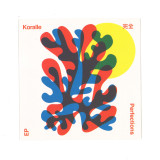
The EP is enriched by the art of Bernardo "Beerbo" Raspanti: a brightly coloured and variegated coral that tells of the different influences that come together in the artist's work and of a profound and engaging musical experience that will enchant connoisseurs and fans of the noble art of beatmaking.
Black Vinyl[11,72 €]
Immerse yourself in the enchanting world of 'Perfections', Koralle's new EP, now available on Little Beat More!
Koralle, aKa Lorenzo Nada, musician, beatmaker and producer, formerly an underground legend under the moniker Godblesscomputers, returns to put his 'hands in the dough' a few months after the release of his third album 'Insomnia', fusing jazz vibes with the elements that characterise the deep roots of hip-hop in four stylish pearls that capture body and soul in an increasingly intimate dimension.
Listening begins with the EP's title track, "Perfections," a perfect chill awakening, accompanied by fleeting piano notes and a bass drum and snare rhythm in the tradition of the beatmaking masters.
The second track, "Leaf," hints at melancholic and mysterious nostalgic undertones, to be followed by the single "From the Heart," which features the extraordinary participation of Brooklyn lyricist Awon, a mainstay of American jazzrap, who fits in perfectly with Koralle's eclectic sound world.
Finally, the fourth track, 'Come Back to Me Baby,' is a homage to the blues and black music roots of the 1950s, an invitation to rewind the tape and listen to the album all over again.
The EP is enriched by the art of Bernardo "Beerbo" Raspanti: a brightly coloured and variegated coral that tells of the different influences that come together in the artist's work and of a profound and engaging musical experience that will enchant connoisseurs and fans of the noble art of beatmaking.
Belgium based Boskat is a super-energetic duo that seamlessly blends seriously impressive riffs reminiscent of Rage Against The Machine and Billy Talent with a crushingly virtuosic live show and a great sense of humor. Now, it's time for their debut album 'Welcome to Planet Urmit,' set to release on March 15, 2024 on Suburban Records.
Although known for their energetic virtuoso rock duo performances, their first full-length album also explores various vibes and genres. "The goal was to create a record that doesn’t get boring - I think we succeeded! You can hear characteristics from (post)grunge, hip-hop, nu-metal, punk rock, prog rock… and more. There are Easter eggs for every rock fan!" frontman Vincent explains.
John Coltrane's landmark 1961 jazz album My Favorite Things was born of the same recording sessions that yielded a majority of the albums Coltrane Plays the Blues (1962), Coltrane's Sound (1964), and Coltrane Legacy. That My Favorite Things was recorded in less than three days was in itself, remarkable. This record marked a significant turning point in Coltrane's career and showcased his distinctive playing style, which continues to inspire and influence musicians to this day. Coltrane's playing on My Favorite Things can be described as innovative, exploratory, and deeply emotive. The unforced, practically casual soloing styles of the assembled quartet — which includes Coltrane (soprano/tenor sax), McCoy Tyner (piano), Steve Davis (bass), and Elvin Jones (drums) — allow for tastefully executed passages à la the Miles Davis Quintet, a trait Coltrane no doubt honed during his tenure in that band, notes AllMusic. Coltrane was known for pushing the boundaries of jazz and expanding the possibilities of the saxophone as an instrument. Throughout the album, Coltrane's improvisations are characterized by their intensity, virtuosity, and sheer creativity. The title track is a modal rendition of the Rodgers and Hammerstein song "My Favorite Things" from The Sound of Music. Coltrane's use of modal playing made him a pioneer — modal jazz emphasizes improvisation over specific chord progressions. Coltrane's modal approach allowed him to explore a broader range of tonal colors and to create more open and expansive musical landscapes. Each track of this album is a joy to revisit. The ultimate listenability may reside in this quartet's capacity to not be overwhelmed by the soloist. As a soloist, the definitive soprano sax runs during the Cole Porter standard "Everytime We Say Goodbye" and tenor solos on "But Not for Me" easily establish Coltrane as a pioneer of both instruments. In 1998, My Favorite Things received the Grammy Hall of Fame award. The album attained gold record certified status in 2018, having sold 500,000 copies. We've given this definitive reissue of such a landmark album the presentation it deserves: Mastered directly from the original master tape by Ryan K. Smith at Sterling Sound and cut at 45 RPM. Pressed on 180-gram vinyl at Quality Record Pressings, and housed in tip-on old style gatefold double pocket jackets with film lamination by Stoughton Printing.
Most audiophiles know Alan Parsons Project's I Robot by heart. Engineered by Parsons after he performed the same duties on Pink Floyd's Dark Side of the Moon, the 1977 record reigns as a disc whose taut bass, crisp highs, clean production, and seemingly limitless dynamic range are matched only by the sensational prog-rock fare helmed by the keyboardist and his creative partner, Eric Woolfson. Not surprisingly, it's been issued myriad times. Can it be improved? Relish Mobile Fidelity's stupendous UltraDisc One-Step 180g 33RPM box set and the question becomes moot.
Mastered from the original master tapes and pressed at RTI on MoFi SuperVinyl, I Robot comes to life with reference-setting realism on this numbered, limited-edition reissue. Boasting immaculate highs and lows, generous spaciousness, and see-through transparency that takes you into the studio with Parsons and Woolfson at Abbey Road, this definitive edition is designed to demonstrate the full-range capabilities of the world's best stereo systems while offering listeners the convenience of having all the music on one LP.
Featuring a nearly inaudible noise floor, this transcendent UD1S edition functions as a repeat invitation to savor reference-grade soundstages, immersive smoothness, sought-after instrumental separation, three-dimensional imaging, and consummate tonal balances. Able to be played back at high volumes without compromise or fatigue, it is a demonstration record for the ages – the likes of which are no longer being made. This is the very reason you own and invest in high-end audio gear.
The special characteristics of this UD1S version extend to the premium packaging. Housed in an elegant slipcase, the reissue features special foil-stamped jackets and faithful-to-the-original graphics. Aurally and visually, it is made for discerning listeners who prize sound quality and production, and who desire to fully immerse themselves in everything about this conceptual landmark. The Alan Parsons Project's most famous record deserves nothing less.
Inspired by and loosely based around the Isaac Asimov stories of the same name, I Robot delves into themes of artificial intelligence and technological dominance that make the record extremely relevant in the 21st century. Indeed, Parsons and Woolfson's pinnacle creation dovetailed with the ascendency of Star Wars, which itself is experiencing a rebirth in an age of self-driving cars, smart devices, and mindless automation. Lyrically, songs such as "The Voice" call into question human behavior – and their relationship to increasing robotic supremacy – in everyday life. Parsons and Woolfson reflect the associated paranoia, dichotomy, and transformation via shifting sci-fi arrangements steeped in drama and moodiness.
The absorbing tunes on I Robot also continue to fascinate due to their perfectionism and innovation. Borrowing from Pink Floyd's strategies, Parsons and Woolfson utilize a looped sequence on the title track to create new downbeats. "Some Other Time" employs two different lead vocalists and yet gives the illusion that only one is involved. Captivating strings, a piccolo trumpet, and bona fide pipe organ grace "Don't Let It Show." The origins of "Nucleus" stem from a unique analog keyboard concoction dubbed "the Projectron," devised by Parsons and electronic engineer Keith Johnson. Andrew Powell's orchestral and choral arrangements top it all off, with "Total Eclipse" arriving as a frightening track that presages the climactic "Genesis Ch. 1 V. 32."
Does man or machine win in the end? Decide as you get lost in Mobile Fidelity's UltraDisc 180g 33RPM LP pressing. Secure your numbered copy today!
More About Mobile Fidelity UltraDisc One-Step and Why It Is Superior
Mobile Fidelity Sound Lab's UltraDisc One-Step (UD1S) technique bypasses generational losses inherent to the traditional three-step plating process by removing two steps: the production of father and mother plates, which are created to yield numerous stampers from each lacquer that is cut. For UD1S plating, stampers (also called "converts") are made directly from the lacquers. Since each lacquer yields only one stamper, multiple lacquers need to be cut. Mobile Fidelity's UD1S process produces a final LP with the lowest-possible noise floor. The removal of two steps of the plating process also reveals musical details and dynamics that would otherwise be lost due to the standard multi-step process. With UD1S, every aspect of vinyl production is optimized to produce the best-sounding vinyl album available today.
MoFi SuperVinyl
Developed by NEOTECH and RTI, MoFi SuperVinyl is the most exacting-to-specification vinyl compound ever devised. Analogue lovers have never seen (or heard) anything like it. Extraordinarily expensive and extremely painstaking to produce, the special proprietary compound addresses two specific areas of improvement: noise floor reduction and enhanced groove definition. The vinyl composition features a new carbonless dye (hold the disc up to the light and see) and produces the world's quietest surfaces. This high-definition formula also allows for the creation of cleaner grooves that are indistinguishable from the original lacquer. MoFi SuperVinyl provides the closest approximation of what the label's engineers hear in the mastering lab.
For a few years Leo Robinson was the sort of hidden secret you sometimes come across in local music scenes. First in Manchester and now in Glasgow, he’d pop up regularly on DIY bills or as local support to a touring act, quietly blowing them off stage with his rich baritone vocal and homespun lo-fi tales of folklore and animism. With The Temple – his debut on PRAH Recordings – he looks set to cross over from being a cult concern.
“There's a spectrum within the album between fully mythologising or symbolising my lived experience, and just stating it in very matter of fact terms - that push and pull between the need to abstract and the need to break through the abstraction and have an honest moment with oneself” he explains. “This is one of the themes of the album as well as part of the process. The aim was to take all these anecdotal or symbolic elements and merge them into one narrative and one world, in a way that you can find your way through the record as if it were a landscape or language with its own logic.”
The record takes on a pastoral, slightly baroque nature that Robinson partly attributes to a friend screening a lot of ‘70s BBC material in his book shop that they used to hang out at. There are also elements of jazz, flickering to life in “The Spring”’s piano-led finale and coda.
Thematically, Robinson likens it to a Jungian ‘Hero's Journey’, his voice possessing a character who goes through several defined stages of consciousness. From conception and the beginning of an earthly life, the first half of the album recognises the development of the protagonist’s narrative and identity, before “The Pink Light”’s freeform departure from the hitherto more song-based suite devastatingly shatters this. The second half of the album then sees the protagonist witness “the uncontainable” water; learning that true divinity lies not in the individual self or lofty notions of gods and temples, but in the unremarkable nettles, insects and dogs on the roadside riverbank - referenced on tracks “The Cormorant” and “The Spring”.
Although now residing north of the border, The Temple was written while Robinson was finding his feet in Manchester, having moved there to go to art school as a teenager (as a visual artist, he has exhibited at the Tiwani Contemporary in London and Cardiff’s Chapter Arts Centre). As a result, many of the tracks bear out the shadows of his experiences in the northern city – at their most visible and explicit on the beautifully fragile storytelling of “The Pavement”. Written the day after the Manchester Arena Bombings, it recalls Robinson waking up to go to work on a hot summer’s day to discover that his street had been blocked off for terrorism investigations; it then progresses through the rest of his day, amidst the grimly surreal aftermath of the previous night.
Having written the chords, melodies and lyrics to the album, Robinson fleshed out the tunes by scoring out parts for the additional instrumentation, but it was only when a friend sent a demo to PRAH that he was able to fund its full recording. Guitars, vocals, piano and French Horn (the latter recorded by Lauren Reeve-Rawlings) were put down at Green Door Studios in Glasgow. Microphones were placed around the room and the sound of the musicians stepping on creaky floorboards and opening creaky doors were left audible to further the record’s live feel. The harpsichord heard on “The Serpent”, meanwhile, came from University of Glasgow lecturer David McGuinness. Strings were then recorded at PRAH Studios by Francesca Ter-Berg and Raven Bush, the Social Singing Choir adding their choral vocals to “Temple II”.
The result is an album that feels both luscious and yet intimately raw; as grand as Richard Dawson at his most panoramic but containing the rough edges and skeletal looseness of a Calvin Johnson work. At times Robinson lyrically moves towards the surreal, but ultimately this is a record grounded in reality; a true showcase of Robinson’s skill as a lyricist and songwriter.