ZOOM SUR LES ARTISTES DE LA SEPTIÈME ET NOUVELLE COMPILE VINYLE STAR WAX, CETTE FOIS EN PARTENARIAT AVEC MID, UNE MAISON EN CHARGE NOTAMMENT DE LA DISTRIBUTION EN FRANCE DE VOID, HH, ECLER… LES SIX TITRES SONT SEULEMENT DISPONIBLES EN FORMAT VINYLE EN ÉDITION LIMITÉE ET LA MAJORITÉ DES ARTISTES PLAYLISTÉS SORTENT LEUR MUSIQUE EN FORMAT PHYSIQUE POUR LA PREMIÈRE FOIS.
Search:chez d
Repress!
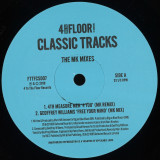
4 To The Floor continues to champion heritage tracks with Volume 6 of the Classics 12” series, ‘The MK Mixes’. As one of the most in demand producers of the halcyon period of house in the early 90s, this special delivery features three gems from MK’s impressive catalogue of remixes.
Kicking off the A-Side MK remixes 4th Measure Men’s ‘4 You’, as his signature 90s-era bumping bassline, sax accents and vocal chop come into play, features typical of all his very best work. Up next the trademark MK sounds continue, as his deep and grooving mix of ‘Free Your Mind’ by Geoffrey Williams powers through the speakers.
On the flip MK’s Club Mix of ‘I Never Knew Love’ by house legend Chez Damier rounds off the release, as this 12” package offers a masterclass in remixing from one of dance music’s most loved artists.
"L'idée nous est venu lors d'une conversation un peu arrosée dans un pub du sud de Londres avec Philippe du label Tapeworm" dixit François Kirmann Gamaury alias Franz Kirmann alias Dj Salinger – producteur français établi à Londres depuis plus d'une vingtaine d'années.
"Voyage voyage voyage" est une mixtape. Mais pas dans le sens traditionnelle du terme. Kirmann l'appelle une mixtape subjective, où les morceaux ne sont pas joués tels quels mais présentés tels qu'ils sont ressentis par l'artiste.
Un peu comme le DJ Vladimir Ivkovic qui ralentit certain morceaux sur ses platines pour en révéler un autre aspect, Kirmann zoom dans l'étoffe même des enregistrements, étire les notes et les sons à l'infini, pour en mettre à jour un sens caché, altérer notre perception de ces chansons qui peuvent parfois sembler un peu désuètes. Ici elles sont transformées en nappes fantomatiques et envoutantes qui évoquent un souvenir d'une période de sa vie, une trace sonore d'une époque un peu naive, qui revient aujourd'hui sous forme d'echo, une musique nostalgique trempée dans la reverb et la distortion.
Kirmann a grandit au Sénégal pendant les années 80 et il se souvient des étés de son enfance passé chez ses grand parents, les chansons à la radio, dans le bus du centre aéré, dans un Prisunic en Dordogne, où une fête de camping en Alsace: Catherine Lara, Elsa, Veronique Jeannot et bien sûr Desireless et son fameux tube "Voyage voyage".
Les chansons sélectionnées pour la cassette ont toutes en commun une incitation au départ, une recherche de l'ailleurs, un amour perdu, un souvenir, les thèmes de predilection d'une certaine pop française que l'on nommait variété.
Ces idées d'évasion sont accentuées ici par le traitement sonore qui leur est appliqué. Les chansons sont paralysés dans le temps, figées dans le son, comme si l'on avait souligné certain passages dans un roman pour les détacher du texte intégral.
Distortion, écho, réverbération et autres effets sont appliqués et donnent à la musique et au son une qualité rêveuse et distante. Certains passages reconnaissables se dévoilent et sortent de la brume sonore, ils se révèlent plus net, d'autres sont noyés dans un brouillard imprécis, une musique proche de l'ambient qui enveloppe l'auditeur.
Kirmann: "Chaque track est basé sur une chanson de variété française des années 80, je voulais re-créer une impression de distance, quelque chose de lointain. Les morceaux deviennent des sortes de tapisseries sonores mais dont l'essence de la chanson originelle est toujours présente. Il y'a un roman de Patrick Modiano où les personnages lancent des avis de recherche pour la France à partir d'une station de radio d'un pays lointain. Le son est brouillé, les voix étouffées. J'avais un peu cette idée en tête de faire quelque chose de similaire, comme si les chansons étaient entendus sur un vieux poste de radio mais émises d'une station lointaine et d'un autre temps."
Le résultat est un voyage nostalgique, une musique ambient et nébuleuse façonnée à partir de tubes synthétiques 80's. Imaginez Fennesz ou My Bloody Valentine jouant des reprises de Laurent Voulzy et vous y êtes presque…
Loveless non, Desireless oui!
DJ Salinger. Voyage Voyage Voyage – Disponible en cassette uniquement. 100 exemplaires sur le label Tapeworm.
—
Franz Kirmann is a French music producer living in London. He has made albums for various labels including Denovali, Bytes, Mercury KX. He also writes music for film and TV and is a lecturer in music production at Point Blank Music school.
Brasilian Producer Apoena kicks off 2024 in style for Hudd Traxx following an impressive back catalogue of releases on labels like Jimpster's Freerange and Jus Ed's Underground Quality.
Pure Feeling opens up proceedings in a deep and hypnotic style reminiscent of Ron Trent and Chez Damier's early releases on Prescription. Rico Balanço follows in a similar vain oozing with raw Berlin vibes, which is where Apoena currently resides.
The B side features In between the beat and the title track Mystic which are melodic trippy groovers for early hour vibes. 2024 is shaping up to be a big year for Hudd Traxx keep em' peeled.
- A1: Triston Palma - Get Weary
- A2: Al Campbell - Jah Love Conquers All
- A3: Solo Banton - Dem Gone
- A4: Eek-A-Mouse & King Kong - Wake Up The Town
- A5: Chezidek - It’s Time
- A6: General Levy - Don Dada
- B1: Barrington Levy - Like A Soldier
- B2: Linval Thompson - Get Ready
- B3: Chezidek & Stinging Ray - Mount Zion
- B4: King Kong & Burro Banton & Pinchers - Old School
- B5: Luciano - Hammer
- B6: Joe Yorke - Time
In the realm of modern reggae music, few labels have left an indelible mark quite like Irie Ites. With more than two decades of relentless dedication to the genre, they have steadily climbed the ranks to become one of the leading international record labels. Their latest offering, "Cream of the Crop 2023" is not just an album; it's a testament to their legacy of excellence.
- A1: Grana
- A2: Vorsichtig - Mutiger - Verloren
- A3: The Idea Of A Horizon
- A4: View From My Parents House
- B1: Folie
- B2: X-Pulse
- B3: Ungeheuer Ist Vieles
- B4: Seance
- B5: Nexus Ii On The Beach
- B6: Langsame Bewegung
- B7: Zwischen Luft
- C1: Chez Charles
- C2: P-Analyse
- C3: La Caduta Degli Dei
- C4: Aavikon (No Water)
- C5: Что Такое Человек
- D1: Dark Matter Art Cabinet
- D2: Hatch On A Hunch
- D3: Theban Constitutional
- D4: Kismet
- D5: No Noosphere
ESP Institute artist Bartellow, one third of the project Tambien and otherwise known in the Contemporary Classical sphere as Beni Brachtel, returns to the label with his second full-length release, Noosphere. While currently heading the SVS label and residency series out of Munich, Beni’s resume expands well beyond electronic music to include immersive sound installations such as The Adven- ture Of The Empty House (solo live performance across seven floors of Walter Henn’s Deckelbau building), a slew of compositions for the Bavarian State Opera (for which he doubled as conductor), and a prolific career of over twenty-five theater scores for institutions such as the Münchner Kammerspiele, Schauspiel Basel, Maxim Gorki Theater Berlin, Berliner Ensemble, Schauspiel Köln, Schaus- piel Graz and with directors Ersan Mondtag, Alexander Eisenach, Jessica Glause and Tobias Staab among others.
Noosphere is a compendium excerpting from theatrical scores WUT (Elfriede Jelinek, at Schauspielhaus Köln, directed by Ersan Mondtag, 2020), Ödipus and Antigone (Maxim Gorki Theatre Berlin, directed by Ersan Mondtag, 2017), Der Zauberberg (Thomas Mann, Schauspiel Graz, directed by Alexander Eisenach, 2017), Hass Tryptichon (Sybille Berg, Wiener Festwochen / Maxim Gorki Theatre, directed by Ersan Mondtag, 2019), Wonderland Ave. (Sibylle Berg, Schauspielhaus Köln, directed by Ersan Mondtag, 2018), Die Verdammten (after Visconti ́s film, Schauspielhaus Köln, directed by Ersan Mondtag, 2019) and Roi Ubu (Alfred Jarry, Theater Neumarkt, Zurich, directed by Alexander Eisenach, 2018).
The work traverses homages, infusing everything from Baroque to Impressionism, and while these types of references are certainly built into the canon of Theatre as a discipline, here we gather histor- ic layers in an even wider net. Under the self-referential thumb of Contemporary Classical music, this sort of "hindsight" approach has been largely avoided, however, in today’s all-access arena, the constant stream of historic causal-chained events has opened a delta where anything is possible. This defines Bartellow’s stance among his colleagues as well as his cultural position as a composer.
Beni considers beauty a fleeting objective in the arts, that expression is often expected to follow notions of Destructivism or the unfulfilled. Art will pore over wounds, collective angst, mourn- ing a loss of natural habitat or a fear of technological invasion, yet there is a bitter irreverence for the friction or salvation in beauty itself. Acknowledging this subjectivity — what one audience considers superficial pleasure may be deeply profound to another — he leans into musical instinct as if composing via divine conduit.
Noosphere conjures a array of suspense, ecstasy, melancholy, and dread, but in isolating the work from its theatrical component, Brachtel directs our focus toward formal qualities, clearing unim- peded space to conceive fresh narratives and examine dynamism and interconnectivity. In sympathy with often difficult theatre pieces, the passages can be dark and transgressive, but more importantly they remain relative to Brachtel’s circumstances at their time of creation. The title Noosphere speaks to the evolution of human thought and knowledge, opening a door to subjective points-of-view. For example, Nexus II On The Beach refers to both Roberto Musci’s Water Messages On Desert Sand as well as the film Bladerunner, invoking the image of an android enjoying the sunset, but whether or not this abstraction may be considered beautiful depends the listener’s cumulative life experience and perspective.
This is hybrid chamber music, augmented by electro-acoustic layers, juxtaposing various periods and successively processing their residual themes into a trans-generational rendering of “now.”
Contradictory accounts of Miles Davis’ creation of the soundtrack to Louis Malle’s film noir Ascenseur pour l'Échafaud have all become part of its legend. Rarely has a soundtrack been so decisive. Nearly seventy years on, beyond the myth, this taut, feverish recording, imbued with extreme dramatic tension, remains one of the Miles’ finest records. The basic outline remains: Jean-Paul Rappeneau suggested to Malle asking Miles Davis to create the film's soundtrack who agreed to record the music after attending a private screening. Davis was performing at the Club Saint-Germain in Paris in November 1957 and on December 4, he brought his four sidemen to the recording studio without having had them prepare anything. Davis only gave the musicians a few rudimentary harmonic sequences he had assembled in his hotel room, and, once the plot was explained, the band improvised without any precomposed theme, while edited loops of the musically relevant film sequences were projected in the background. Bassist Pierre Michelot recalled in 1988 that “Miles just asked us to play two chords, D minor and C7, 4 bars of each, ad lib.” Typically, Miles planned very little but know exactly what he wanted. François Leterrier, the film’s Second Assistant Director picks up the story: “The session started at around ten o’clock and went on until dawn. The screen in the auditorium was showing the scenes for which Miles had devised some harmonies, and they were edited into a loop. And that’s what makes this music unique: it was entirely improvised in conditions that went back to the days of silent films, while watching frames shot in black and white by cinematographer Henri Decaë: tracking shots of Jeanne Moreau wandering down the Champs-Elysées at night, passing in front of lit window displays or going into bars, while looking for her lover/murderer alias Maurice Ronet … All of us there in the dark auditorium were aware that something extraordinary was taking place, something that had definitely never happened before. … In the small hours we all met up again at the Pied de Cochon in Les Halles, and Louis was looking at Miles with the disbelieving eyes of a child … as if he couldn’t believe the gift he’d just received. Even in his wildest dreams he had probably never imagined what his film would be like once it had been as if illuminated by the trumpet of Miles, incisive or wrapped softly in cotton.” The music was released on 10” by Fontana and received the Grand Prix from France’s Académie Charles Cros. It was released in the USA on Columbia as the A-side of the 12” LP Jazz Track, which received a 1960 Grammy nomination for Best Jazz Performance, Solo or Small Group. This beautiful re-issue of the original recording is pressed on 180g vinyl at GZ, and packaged in a deluxe gatefold tip-on jacket with Boris Vian’s original liner notes and Jean-Pierre Leloir’s iconic studio photo of Miles and Jeanne Moreau, and an essay on the circumstances that led to this out-of-the ordinary music by Franck Bergerot.
Dub-Stuy’s riddim series is a nod to tradition with a modern twist, with the label teaming up a producer with different vocalists to voice a single riddim.
The latest entry in the series comes from French producer Von D who crafted the Saga riddim exclusively for this occasion, a weighty steppers piece featuring guitar, keys, and horns. The riddim is paired with vocal turns from reggae singers Chukki Starr, Chezidek, and Jah Mason who each bring their own unique stylings to the riddim, riffing on uplifting messages of unity in the face of oppression.
As always the release includes the instrumental version, this time with a dub twist from Von D. Mastered by Bristol legend Joker.
Ed Nine returns to Chez Damier’s Inner Balance label with the third part in his The Journey series, as ever foregrounding the most classic of house sounds. Chicago from his head to his toes, Ed’s signature nods to the Windy City greats while pushing things forwards with fresh sound design and his innate musicality. From the bright and sunny melodies on ‘Nostalgia’ and ‘Time Will Tell’ to the driving bump and groove of ‘Not On The Radio’ and ‘There’s Always A Chance’, Ed establishes his credentials alongside the best of them.
2023 Reissue
After releasing Undefined, Kazufumi Kodama and Babe Roots, the 4th release from a Japanese experimental dub label newdubhall welcomes the ever-evolving pioneer of minimal dub and dub techno Deadbeat, a solo project of Scott Monteith hailing from Canada. Side A 'Things Fall Apart' will feature a beatless dub ambient which shares a perspective of free jazz and 'Adieu Chez Cherie,’ an absolute knockdown four on the floor dub techno on the flip side. Though simple, both sides are layered with complexity, let yourself experience the profundity of newdubhall with this masterpiece.
Courtesy of Balance is the Balance sister label run by Frenchman Brawther, who Chicago house great Chez Damier credits with getting him back in the game several years ago, after he had taken a step away.
This is another super smooth and seductive deep house sound, with Grant & Finnoh laying down warm, rolling beats, dubbed-out chords and heady vocal whispers. Brawther brings out the jazziness with his slightly more up-tempo remix and finally, Zansika sinks you into a late-night reverie with his dreamy and loved-up remix.
'22 years after "2", Florent Pagny signs his return with the album called "2bis", where he performs duets of his own hits and standards of French song. “savoir Aimer”, “Bienvenue Chez Moi”, “Chanter”, “Je Te Promets”, “Jolie Môme...”, this opus is like a large table, where friends are invited, from Slimane to Patrick Bruel and Pascal Obispo, from Anne Sila to Amel Bent and Zazie. 20 titles all duets, beautifully reinterpreted.Reviews and Ads – R2, Mojo and London Macadam
At the end of the 60s and early 70s Brazil was a dream. It was fashionable everywhere in Europe and therefore in France too. One thinks of 'Samba Saravah' from the Un homme et une femme OST, Françoise Hardy and her record produced by Tuca, Isabelle Aubret and her 'Casa Forte' or France Gall with 'Zozoi'. Three Brazilian musicians exiled in France, Edson Lobo (bass), Fernando Martins (piano) and Nelson Serra (drums) form the Trio Camara. They met a group of friends who loved Brazilian music, all professional musicians, but who wanted to remain anonymous, hence the name of the band : Les Masques (The Masks)…
Claude Germain (Les double six), José Bartel, Marie Vassiliu, Pierre Vassiliu … Indeed the singers forming Les Masques are from being unknown. In 1969 they entered Studio Davout with le Trio Camara to record "Brasilian Sound". Composed of 11 tracks, it is a superb album, masterfully produced and recorded, a gripping record to listen in one go and transports us in atmospheres both dreamy and naïve which belong to that period. Produced in 500 copies on CBS, 'Brazilian Sound' was not, unfortunately, a success and it is today impossible to find the original French pressing (which sounds much better than the Canadian pressing released at the same time). This reissue on Le Très Groove Club is welcome, so that 50 years after its release, a larger audience can discover this beautiful record, echo of a once and for all past era.
Eddie Leader has had his most productive year since releasing his first record under the Slum Science alias in 2004. Leader has delivered music on labels like Jovonn’s Body n’ Deep, Doorly’s Reptile Dysfunction, the iconic Hard Times label and his own Hudd Traxx in the past 12 months, most recently collaborating with Chez Damier on ‘Pressure’. This record is by far the deepest of them all. ‘Lost in…’ kicks things off and takes you on a deep hypnotic journey along the house spectrum. ‘The Unknown’ has a raw and underground vibe with a heavy bass line and takes inspiration from both Chicago & Detroit. The Tribal Manifestation Mix of ‘The Unknown' picks up the tempo on the B side for a peak time dancefloor rework. Eddie closes out the EP with ‘You’, which is a smooth vocal infused early hours future classic. Hudd Traxx have also had a very productive year and there’s still more to come in 2023.
The Skankin' Monks featuring Kenyatta Hill making a big tribute to his father, the legendary Culture vocalist, Mr. Joseph Hill. Babylon's Big Dog is a rearranged remake of the Culture classic from 1982's Lion Rock LP.
The Skankin' Monks are a reggae formation from Amsterdam that gets inspiration from several styles. In 2013, they had a big hit with singer 'CHEZIDEK's "ALL MY LIFE" - Since then they collaborated with artists like Eek-A-Mouse, Meta Dia, Kenyatta Hill & Christos DC etc.. The Monks meditate on the music they're creating & they have only one goal; to let everyone enjoy the musical zen in unity.
Sideshows neues Projekt 2MM DON'T JUST STAND THERE! wird über 10k veröffentlicht, dem Label des New Yorker Rapper/Produzenten MIKE, und folgt auf Kollaborationen mit Leuten wie The Alchemist, Boldy James, MIKE, Jadasea und NAPPYNAPPA. Produziert u.a. von Alexander Spit, Popstar Benny, AYOCHILLMAN und Sideshow selbst, reichen die Themen von Abenteuern auf Tour über den Kämpfen des täglichen Lebens in der DMV bis zu den andauernden Konflikten gegen Sideshows Leute in seiner Heimat Tigray.
Habibi Funk is excited to share “Marzipan” - our first full length contemporary release courtesy of Beirut’s multi-instrumental phenom Charif Megarbane, also known as the man behind prolific Cosmic Analog Ensemble. The LP is a journey into Charif’s styling, one he terms “Lebrary”: a vision of Lebanon + Mediterranean expressed through the kaleidoscopic sonics of library music. Drawing from artists that encapsulates the HF sound, such as Ziad Rahbani, Ahmed Malek and Issam Hajali, Charif translates these influences into an LP that is equally at home in ’23. We always wondered why Charif’s music stayed under the radar for so long, that all changes with “Marzipan”.
Charif Megarbane, the staggeringly prolific producer, instrumentalist, and all-around musical mastermind returns with full LP “Marzipan.” Following his previous release of EP “Tayara Warak” in 2022, “Marzipan” is a sonic journey that seeks to capture the full scope of Megarbane’s habitus. As a composer and producer, Megarbane touts hugely versatile, sometimes volatile musicianship — his 100+ catalogue of projects (including legendary groups like the Cosmic Analog Ensemble, Free Association Syndicate, Monumental Detail, etc.) features a huge domain of sonic direction. This collection was previously developed in Megarbane’s own Hisstology label which hosts a wealth of collaborative efforts. Now, Habibi Funk represents Megarbane under his own name. Megarbane finds a sonic through-line in his surrounding soundscapes as he draws on the chaotic energy of the crowded Beirut metropolis (“Souk El Ahad”), the warm atmosphere of the Lebanese countryside (“Chez Mounir”), or the lushness of a Mediterranean beach resort (“Portemilio”). Reflecting the aural composition of his direct surroundings into kaleidoscopic instrumentation provides a unique insight into how one musical phenomenon transposes sight into sound. Habibi Funk is thrilled to share “Marzipan” and finally throttle this under-theradar phenomenon into the solo spotlight. Despite the magnitude of his catalog, Megarbane’s LP sounds as fresh—as resolutely inspired—as a debut record. “Marzipan” continues down the winding path he trod on EP “Tayyara Warak” (released Decmber, 2022) which features solid footing in the hectic city sounds Megarbane hears as home. Despite his obvious musical acumen, Megarbane’s greatest talent seems to be his open ears. In many ways, “Marzipan” is a cartographic feat — it travels and traces a journey across many dimensions (both sonic and physical). Megarbane’s instrumental catalogue is vast: toy glockenspiel, harpsichord, pedal steel, a classic Wurlitzer, et al are used liberally on the record. The resultant sound is as sprawling as the musician’s instrumental dexterity. “Marzipan’s” closing track “Bala 3anouan” can be translated loosely to “without address” — a fitting final word. Despite the entire record being a sincere testament to Megarbane’s environmental approach to music-making, the record is not bound to any particular coordinates, or any particular sound for that matter. The vastness of his influences — beloved artists like Ahmed Malek and Issam Hajali (both Habibi Funk veterans); West African funk deep cuts; European cinematic scores; et al — result in a record of somewhat unparalleled expansiveness. Floating melodies and frantic rhythmic interludes both find natural homes across “Marzipan.” The record is tinged with psychedelic elements—fuzz-drenched guitar, sliding microtonal interludes, hypnotic rhythmic breakdowns. Reflecting on his creative process, Megarbane cites a stream of consciousness approach: “It’s a very spontaneous, playful, and diary-like approach and workflow…I trust my instinct because instinct is based on experience.” Lead single “Souk El Ahad” opens the roll-out with a raucous energy, out June 12. Megarbane abstracts busy city sounds into a psychedelic framework, casting technicolor hues on everyday experience. Following is second single “Pas de Dialogue” out June 23. The track jerks the listener towards a more meditative state with lulling harpsichord and expanding, cinematic sound. “Marzipan” will be available physically and digitally everywhere on July 14, 2023. Be sure to listen for focus track “Chez Mounir” that captures the warmth of community in a joyful, laidback groove.
Uncover greater insight into the world of Charif Megarbane in the booklet accompanying the LP
40th Anniversary Edition - newly remastered from the master tapes, with an additional bonus LP of instrumentals and the previously unreleased "Narration Theme."
Daytime Viewing (1979-80) is an extended narrative song, based on a casual analysis of daytime television drama and the audience phenomena such programming addresses. The piece explores the use of fantasy as a survival mechanism against loneliness, illustrating the human compulsion to inflate the mundane to mythological proportions. A central female character weaves tales, using threads of personal experience and the idea of TV as friend, as mantra, and as transformational window between imagined spectacle and the pedestrian plane.
Originally released as a private cassette edition recorded, 1982; Chez Hum-Boom release, 1983 documenting the collaborative performance piece of the same name by Jacqueline Humbert g David Rosenboom. This heady, thoroughly enjoyable work was first made available on CD and LP in 2013 by Unseen Worlds. Jacqueline Humbert (aka J. Jasmine) is a songwriter of brains and wit on
par with Robert Ashley, with whom she's worked extensively. David Rosenboom's complex, harmonic electronic arrangements are accentuated brilliantly by percussion from William Winant. Daytime Viewing can happily be added.