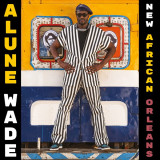
In his sixth and latest album “New African Orleans”, released by ENJA and Yellow Bird, bass guitarist and composer Alune Wade explores the multiple junctions between his native West African rhythms, the Afrobeat and juju rhythms from Lagos and the brass band repertoire immortalized in New Orleans. “I’m exploring a world that goes from my roots to the lost branches on the other side of the Atlantic,” explains the musician from Senegal. He has whittled down around 50 compositions – both original and standards - to a dozen which Alune recorded in Paris, Dakar, Lagos and New Orleans. “The idea first came to me during the Jazz à Gorée festival I organized back in 2014,” he explains. “It had me reflect on the notion of reversing the musical trip most people take from the United States to the African continent. I wanted to set out westward and begin a musical conversation with the best artists, both in Nigeria and the US.”
To achieve this, Wade has invited top artists from both sides of the Atlantic, including the Nigerian talking drummer Olaore Muyiwa Ayandeji, the percussionist Weedie Braimah and the jazz drummer Herlin Riley from New Orleans. The musical inspirations are equally transatlantic, ranging from Dr. John to Manu Dibango and Charlie Parker. But the 45-year-old also pays homage to his father who was a brass band star in his native Senegal back in the Sixties.
BACKGROUND
We only have a partial idea of the birth and remarkable development of the music born of the transatlantic slave trade. From Malinke ballads to Cuban son, from call-and-response patterns to field hollers and hip-hop, Yoruba rhythms to Argentinian tango, from Angolan percussions to the New Orleans brass band sounds… all have roots in Africa and a shackled migration that lasted four centuries. No more so than Congo Square in the Louisiana capital. In 2024, we mark the 300th anniversary of the implementation of the Code Noir which “gave enslaved Africans Sundays off to dance”. A drop in the ocean, but one which shows the importance of culture as a lifebuoy against this barbaric trade. As the Guadeloupian writer Daniel Maximin once claimed: “Our music guided us from the scream to the song, from dragging our chains to dancing.”
Buscar:chi
Girls At Our Best! were one of the greatest and most influential bands to emerge in the early 1980s as part of a new wave of independent acts. DJ John Peel championed them, playing their singles repeatedly and inviting them to record a session for his programme. Wry vocalist Judy Evans and brutal yet melodic guitarist James Alan who’d met at art college in Leeds fronted Girls At Our Best!, the proto-Indie band that formed from the ashes of Alan’s 1977 punk band SOS! Pleasure, the sole album, reached number two in the Indie Chart. It was an album so different from the rest of the post-punk indie pack that you can still play it now and completely baffle new listeners. As John Peel said about Roxy Music, it just doesn’t seem to relate to anything else.
- A1: Blue Swede - Hooked On A Feeling
- A2: Raspberries - Go All The Way
- A3: Norman Greenbaum - Spirit In The Sky
- A4: David Bowie - Moonage Daydream
- A5: Elvin Bishop - Fooled Around And Fell In Love
- A6: The Jackson 5 - I Want You Back
- B1 10: Cc - I'm Not In Love
- B2: Redbone - Come And Get Your Love
- B3: The Runaways - Cherry Bomb
- B4: Rupert Holmes - Escape (The Piña Colada Song)
- B5: The Five Stairsteps - O-O-H Child
- B6: Marvin Gaye And Tammi Terrell - Ain't No Mountain High Enough
- C1: Tyler Bates - The Final Battle B
- C2: Tyler Bates - Morag
- C3: Tyler Bates - Everyone's An Idiot
- C4: Tyler Bates - What A Bunch Of A-Holes
- C5: Tyler Bates - Sanctuary
- C6: Tyler Bates - The New Meat
- C7: Tyler Bates - The Pod Chase
- C8: Tyler Bates - Don't Mess With My Walkman
- C9: Tyler Bates - Losers (Bonus Track)
- D1: Tyler Bates - The Ballad Of The Nova Corps. (Instrumental)
- D2: Tyler Bates - The Klyn Escape
- D3: Tyler Bates - Groot Spores
- D6: Tyler Bates - Black Tears
- D7: Tyler Bates - A Nova Upgrade
- D4: Tyler Bates - Guardians United
- D5: Tyler Bates - The Big Blast
Girls At Our Best! were one of the greatest and most influential bands to emerge in the early 1980s as part of a new wave of independent acts. DJ John Peel championed them, playing their singles repeatedly and inviting them to record a session for his programme. Wry vocalist Judy Evans and brutal yet melodic guitarist James Alan who’d met at art college in Leeds fronted Girls At Our Best!, the proto-Indie band that formed from the ashes of Alan’s 1977 punk band SOS! Pleasure, the sole album, reached number two in the Indie Chart. It was an album so different from the rest of the post-punk indie pack that you can still play it now and completely baffle new listeners. As John Peel said about Roxy Music, it just doesn’t seem to relate to anything else.
- 1: The Sheik Of Araby
- 2: Sans Toi Je N'ai Plus Rien (Bei Dir War Es Immer So Schon)
- 3: Suite Hongroise
- 4: Manege
- 5: Souvenir De Toronto/Frischka
- 6: Charleston
- 7: Valse Des Ecoliers
- 8: La Manouche
- 9: Suite Roumaine : Babouchka/Sirba Din Dolj
- 10: Hopla
- 11: Le Vase
- 12: Cousin Django
Angelo Debarre's extraordinary guitar technique has long been the tree that hid the forest of his profound musicality and above all, his talent as a composer. Belonging to the family of Django Reinhardt's heirs, Debarre has become a legend among Gypsy Jazz fans, one of those rare musicians, who can enchant a room and make hearts beat in unison.
The New Dictionary of Jazz (Nouveau Dictionnaire du Jazz) describes Angelo Debarre as supersonic, and indeed, he is with mad virtuosity. His left hand moves up and down the fine neck of his gypsy guitar, with speed but always with musicality. But it would be an understatement to speak only of his dexterity; he has a marvellous ability to play with subtlety, and his improvisational possibilities seem endless; all done with great ease and apparent composure. Solos, counterpoint, he's everywhere.
A child from the gypsy community, Angelo started playing guitar with his family at the age of eight. In 1984, he formed the first "Angelo Jazz Quintet". In 1985, he became one of the pillars of the famous Parisian cabaret, "La Roue Fleurie" and participated in numerous tours and recordings, including the famous Gypsy Guitars, a reference album of the genre.
Very comfortable in several gypsy styles, Debarre can be found alongside fellow guitarist Petro Ivanovitch and singer and balalaika player Raya from the group Arbat. As a guest, DeBarre can be heard with the band Bratsch, in dialogue with the pianist Bojan Z, percussionist Xavier Desandre-Navarre, the violinist Florin Niculescu and other leading figures of the gypsy guitar.
Angelo Debarre: guitar
Serge Camps: guitar
Frank Anastasio: bass
- A1: Citizen Kane
- A2: Remembrance Day
- A3: Polar Opposites
- A4: Marilyn Dreams
- A5: Ice
- B1: La Lune Lunatique
- B2: All Fall Down
- B3: Nowhere Girl
- B4: Crowds
- B5: Beginning To Fade
In May 1981 B-Movie and Soft Cell went into Advision Studios in London with the same producer, Mike Thorne (Wire, Bronski Beat, China Crisis, The Communards) to record singles for the label they were both signed to. Phonogram had really wanted to sign B-Movie but had also committed to Soft Cell, having been coerced into it by Stev0, who managed both artists and wouldn’t let them have one without the other. B-Movie commenced recording the dark moody anti-fame anthem ‘Marilyn Dreams’, whilst Soft Cell got underway on a cover of an obscure Northern Soul classic. When both songs were released in July 1981, ‘Tainted Love’ became a worldwide hit and shot Soft Cell to international fame, making them the biggest stars of 1981. B-Movie had formed in 1979, in Mansfield, a typical northern town in the middle of the Nottinghamshire coalfield. Originally a three piece featuring, vocal / bass, guitar and drums, they expanded by adding a keyboard player to broaden their initial post punk sound. Local Lincoln independent record label, Dead Good Records, firstly put them on the compilation LP ‘East’, followed by 7" inch EP and then a mini-album releases, which led to an appearance on the legendary Some Bizarre label (alongside the likes of Blancmange, Depeche Mode, Soft Cell and The The)
Major label interest followed, from which came the deal with Phonogram, B-Movie initially re-recording the track ‘Remembrance Day’, which reached No61 in the UK chart in early 1981 and, more importantly, was played by BBC Radio 1 DJ John Peel, and appearing in his Festive 50 for that year. All of the recordings the band made during their Phonogram period have been consigned to the Universal Music vault for several decades, with the band finally managing to have these returned in 2024. The various tapes have been digitised and restored, resulting in the creation of what would have been their 1982 debut LP ‘that never was’. Ten tracks including the three singles plus seven previously unreleased recordings. The CD version contains a further seven recordings including the 12” versions, single B-sides and the track “Moles’” from the Some Bizarre compilation.So “Hidden Treasures” from B-Movie, is only four decades late but still able to sit seamlessly alongside contemporaries like The Chameleons and The Sound. The LP is a darker, more brooding and psychedelic affair, more akin to the gothic elements of the Bunnymen or Joy Division, than the ‘pop sensations’ Phonogram wanted them to become. By both opening and closing this chapter of B-Movie, it puts them firmly in the same bracket as their new wave and post-punk contemporaries, which is the least they deserve, as one of the great ‘lost’ bands of the early 1980’s. "It’s nice to hear B-Movie are finally getting a chance to release their forgotten gems’” Matt Johnson (The The) Vinyl
- A1: Alternative Tv ‘Never Went To Art School’
- A2: Nick Mott ‘Insect Totems, Parts 1 And 2’
- A3: Bass Communion ‘The Ship Now Underwater’
- B1: Sion Orgon ‘King Karma’
- B2: Theme ‘Blood Rivers’
- B3: Final ‘Lost In Your Maze’
- C1: Edward Ka-Spel ‘The Human Cannonball’
- C2: Ashtray Navigations ‘The Isn’t Meets The There’
- C3: Band Of Pain ‘The Hyperdeldric Afterglow’
- D1: Senestra ‘False Dawn’
- D2: Kleistwahr ‘The Harrow And The Harshness’
- D3: Splintered ‘The Horrors Of Linden (Edit)’
A limited double-LP collection of artists who've been on either Fourth Dimension Records or Lumberton Trading Company (or both). The title, based on the name of a childhood '50s sci-fi film favourite, also not only reflects the bringing together of these two labels but also the fact that most of the artists they are concerned with tend to navigate a wide range of ideas and approaches in their sound. The 2LP also began as a reflection of the two labels coming together on 18 May 2024 at London's Cafe OTO for an event featuring Alternative TV, Splintered, Edward Ka-Spel and Bass Communion.The 2LP, beautifully packaged in a Puppy38 designed sleeve.
Horizon is a new collaborative album by Resavoir and Matt Gold. Across the 10 tracks the two Chicago-based producers combine their distinct sensibilities to create a hypnotic and inviting love letter to their shared admiration for "60s and "70s Brazilian music. Resavoir leading man Will Miller - the acclaimed trumpeter, composer, and producer who"s worked with SZA, Whitney, and more-makes room at the table for Gold - a seasoned multi-instrumentalist and accomplished guitarist who has collaborated with the likes of Makaya McCraven and Greg Ward - and the results are distinctly new for both of them. The sunny and expansive tunes on Horizon are as immersive as they are endlessly replayable, a dynamic and joyous body of work.
Stereogum: »Here’s a cool new musical project that feels both out-there and extremely mundane. In 2022, the great Colorado experimentalist M. Sage teamed up with Lieven Martens (Dolphins into the Future) under the name Sage Martens. Their album, »Riding Fences«, was an ambient classical exercise designed to explore the idea of ›Western‹ music. They’re back this year with another conceptual offering (...)«
»Chamber Music for Lawn Mowers« is the second album by Sage Martens. This time, Matthew Sage (RVNG, Fuubutsushi) and Lieven Martens (Edições CN, Dolphins into the Future) sing the lawn.
Did you know a clean-cut lawn is a desire we inherited from the British?
Yes, the British dumped this pleasure into our collective consciousness. Those humorless Victorians who enjoyed having their black pudding on the lawn. They came to this uninspired impression while mis-looking at Italian paintings. Yes indeed, while gazing at these paintings they mistook green lanes for green lawns. Thus it became hip. Every stuffed truffle commanded his gardener to cut the grass.
As a result, this Victorian lust for sterile gardens with pretty green lawns nudged our world into water spillage and pesticide clouds. This new priority produced exhaust clouds and prudish monocultural landscapes. Just by looking at Italian paintings.
As with most of Western history, the practice was exported to America and then turbocharged. By shearing clear the prolific brush of pastures, prairies, forests and glens, biodiversity becomes an aesthetic casualty with long-suffering ecological ripples. An inherited practice narrows the bandwidth of experience.
And so, the childhood habit of humming along in key to the drone of a gas-powered mower while trimming a suburban lawn extrapolates into something expanded — an unanswered question about the harmonics of landscape practices.
M. Sage: Bb clarinet, alto saxophone, sine wave, lawn mowing, processing L. Martens: computer, analog synthesis, digital processing With W. Van Gils: lawn mowing
This one-off Belgian New Beat project from The Zodiacs at first glance seems like standard fare from this time and place in dance music history - even with call to action, commanding listeners to ‘Move & Dance To The New Beat!’ that could well have earned a place at one of the slogans of the entire movement in an alternative universe where this record was a hit. However, a hit it was not - what we have here is an obscure piece of music shrouded in mystery, previously released only on 7 inch, and its enigmatic nature only adds to eerie quality of the children’s voices throughout the record. This, alongside its higher tempo not usually associated with New Beat as a musical form, come together to bring forth a bizarre oddity of the genre that also has the potency of a modern, peak time weapon. Anatolian Weapons on remix duties takes the material and reduces the speed but increases the malevolence and is a testament to his skills as one of the great producers working today!
If this LP exists it is thanks to the vision, energies, work and perseverance of Thomas M. Lopez, aka Meatball Fulton. He is the president and one of the founding members of the ZBS Foundation (ZBS stands for Zero Bullshit), where the audio dramas written by Lopez himself were born. Dramatic programs with stories that blended noir, comedy and science-fiction genres such as Ruby The Galactic Gumshoe or Jack Flanders were produced to critic and public acclaim. It was in Ruby The Galactic Gumshoe that the Android Sisters, who would later have their own spin-off series, first appeared. The characters represent two robotic siblings that Tom Lopez created under big influence from Do Androids Dream of Electric Sheep?, the Philip K. Dick novel that was taken to cinema by Ridley Scott in Blade Runner. The Androids were performed by actresses Ruth Maleczech and Valeria Wasilewski.
The big success of these “cosmic and comic” sci-fi series, as they are described in the ZBS Foundations website, led to the releasing of cassette tapes, CDs, USBs and podcasting of the stories. Along with these, several music albums were also released in different formats. One of them is Songs Of Electric Despair, the first of two released by the Android Sisters. The songs contained are written by Tom Lopez and his long time collaborator experimental musician Tim Clark.
The Android Sisters Songs Of Electronic Despair LP was originally released as a ZBS Foundation cassette and also as a vinyl LP on Vanguard in 1984. It featured 11 compositions (two bonus tracks not on the original LP have been added to the Wah Wah reissue) on which the experimental synthesizer music of Tim Clark finds a perfect counterpoint in the deliciously surrealistic, cosmic social satire of Tom Lopez’s texts, magically performed by the robotic, yet sensual voices of the Android Sisters as performed by Maleczech and Wasilewski. Clark composed and performed the backing tracks on the Synclavier II synthesizer.
The Wah Wah reissue comes with two bonus tracks not on the original 1984 LP, respects the beautiful original album artwork and enhances it with a 4 pages full colour insert with notes and lyrics of the songs.
BARBARELLA MEETS PHILLIP K. DICK!
RIYL : SYNTH POP CYBERPUNK with DEVO’s sense of humor, LOGIC SYSTEM, FRANK CHICKENS or even some 1990s things to come such as LIKE A TIM or ARPANET.
If this LP exists it is thanks to the vision, energies, work and perseverance of Thomas M. Lopez, aka Meatball Fulton. He is the president and one of the founding members of the ZBS Foundation (ZBS stands for Zero Bullshit), where the audio dramas written by Lopez himself were born. Dramatic programs with stories that blended noir, comedy and science-fiction genres such as Ruby The Galactic Gumshoe or Jack Flanders were produced to critic and public acclaim. It was in Ruby The Galactic Gumshoe that the Android Sisters, who would later have their own spin-off series, first appeared. The characters represent two robotic siblings that Tom Lopez created under big influence from Do Androids Dream of Electric Sheep?, the Philip K. Dick novel that was taken to cinema by Ridley Scott in Blade Runner. The Androids were performed by actresses Ruth Maleczech and Valeria Wasilewski.
The big success of these “cosmic and comic” sci-fi series, as they are described in the ZBS Foundations website, led to the releasing of cassette tapes, CDs, USBs and podcasting of the stories. Along with these, several music albums were also released in different formats. One of them is Songs Of Electric Despair, the first of two released by the Android Sisters. The songs contained are written by Tom Lopez and his long time collaborator experimental musician Tim Clark.
The Android Sisters Songs Of Electronic Despair LP was originally released as a ZBS Foundation cassette and also as a vinyl LP on Vanguard in 1984. It featured 11 compositions (two bonus tracks not on the original LP have been added to the Wah Wah reissue) on which the experimental synthesizer music of Tim Clark finds a perfect counterpoint in the deliciously surrealistic, cosmic social satire of Tom Lopez’s texts, magically performed by the robotic, yet sensual voices of the Android Sisters as performed by Maleczech and Wasilewski. Clark composed and performed the backing tracks on the Synclavier II synthesizer.
The Wah Wah reissue comes with two bonus tracks not on the original 1984 LP, respects the beautiful original album artwork and enhances it with a 4 pages full colour insert with notes and lyrics of the songs.
BARBARELLA MEETS PHILLIP K. DICK!
RIYL : SYNTH POP CYBERPUNK with DEVO’s sense of humor, LOGIC SYSTEM, FRANK CHICKENS or even some 1990s things to come such as LIKE A TIM or ARPANET.
- A1: Blue Swede - Hooked On A Feeling
- A2: Raspberries - Go All The Way
- A3: Norman Greenbaum - Spirit In The Sky
- A4: David Bowie - Moonage Daydream
- A5: Elvin Bishop - Fooled Around And Fell In Love
- A6: The Jackson 5 - I Want You Back
- B1: 10Cc - I'm Not In Love
- B2: Redbone - Come And Get Your Love
- B3: The Runaways - Cherry Bomb
- B4: Rupert Holmes - Escape (The Piña Colada Song)
- B5: Five Stairsteps - O•O•H Child
- B6: Marvin Gaye & Tammi Terrell - Ain't No Mountain High Enough
Brooklyn’s Broad Channel drops its first-ever collaborative release, “Intercity Relations Guide – Volume 1”. This special 4-track EP bridges vibrant underground scenes from NYC, Chicago, Detroit, and Japan, featuring tracks from Mark Grusane, Deon Jamar, DJ Monchan & Aota, and Derek Russo & Thomas Xu. Born out of a moment of inspiration in the fall of 2024 after returning from Japan, label founder Derek Russo envisioned this release as a bridge – linking the warm relationships built at home & abroad that were nurtured over years of DJing, producing, and hosting underground parties like Xoloft in
Brooklyn. The EP flows across a chugging tempo range, between 113 and 120 BPM, It’s a reflection of the label’s core ethos and catalog to date: genre-blurring and always rooted in the dancefloor.
- A1: Movin’ In
- A2: The Road
- A3: Poem For The People
- A4: In The Country
- B1: Wake Up Sunshine
- B2: Make Me Smile
- B3: So Much To Say, So Much To Give
- B4: Anxiety’s Moment
- B5: West Virginia Fantasies
- B6: Colour My World
- B7: To Be Free
- B8: Now More Than Ever
- C1: Fancy Colours
- C2: 25 Or 6 To
- C3: Prelude
- C4: A.m. Mourning
- C5: P.m. Mourning
- C6: Memories Of Love
- D1: 1St Movement
- D2: 2Nd Movement
- D3: 3Rd Movement
- D4: 4Th Movement
- D5: Where Do We Go From Here
Chicagos zweites Multi-Platin-Album wurde von Steven Wilson von den originalen 16-Spur-Masterbändern neu gemastert. Enthalten sind die Lieblingstitel der Fans „25 or 6 to 4“, „Ballet for a Girl in Buchannon“ und viele mehr!
- Hang Em High
- Two Seven
- Bitter
- 4: Priest Hunter
- Little Paths
- Rumble Shake
- Black Asphalt
- Black Man's Gold
- Jessie Mae* (Written By Ray Wylie Hubbard)
- Sit With Satan
Das zweite Album des irischen Bluesrock-Trio jetzt auf Vinyl! 2014 stieg es auf Position 12 in die irischen Albumcharts ein und ist eine brillante Reise voller Blues-Rock Power! Als Nachfolger zu dem 2012 veröffentlichten und von Kritikern vielbeachteten Debüt "Electric Soup"baut das zweite Album der Band, "Rumble Shake" auf diesem Erfolg auf und liefert 10 Bluesrock-Songs aus dem tiefen Süden Irlands. Wahre Geschichten und sündhaft gute Musik mit Gästen wie zum Beispiel der texanischen Legende RAY WYLIE HUBBARD. Aufgenommen wurde das Album in den Westland Studios in Dublin, während das Trio die Historie des Ortes in sich einsog - denn in diesem Studio haben schon Größen wie BOB DYLAN, HORSLIPS und THIN LIZZY ihre Platten machen lassen - und abgemischt in Texas von George Reiff (TEDESCHI TRUCKS BAND, THE BAND OF HEATHENS, RAY WYLIE HUBBARD). Christy O'Hanlon (Gitarre, Vocals), Stephen McGrath (Bass) und Gev Barrett (Drums, Background-Gesang, Perkussion) schrieben bis auf "Jessie Mae" (RAY WYLIE HUBBARD) alle Songs selbst und lassen den Bluesrock weiter Unvergänglichkeit atmen, ohne ihn dabei verstaubt klingen zu lassen.
- A1: Ska Boo Da Ba- The Skatalites
- A2: Confucious- Don Drummond & The Skatalites
- A3: Storm Warning- Lyn Taitt & The Boys
- A4: Alley Cat Ska- Tommy Mc Cook & His Ska-Talites
- A5: Trench Town People- Theophilus Beckford
- A6: Walking Down King Street- Theophilius Beckford
- A7: South China Sea-Johnny 'Dizzy'moore
- B1: Ringo- The Skatalites
- B2: Nuclear Weapon- Roland Alphonso & His Ska Talites
- B3: Magnificent Ska-Lyn Taitt &The Baba Brooks Band
- B4: Come On My People-Daniel Johnson
- B5: Hit You Let You Feel It-The Tenor Twins
- B6: The Re-Burialdon Drummond @ The Skatalites
- B7: Love Me Or Leave Me-Lloyd Clarke
'Ska never stopped you know! From its Jamaican music if the piano's not playing ska or the guitar....any music you have...Reggae...even the computer music..the piano's playing Ska Ska Ska...it leads the music so Ska is still the backbone of Jamaica music, Right'..Bunny Lee
The music of Jamaica has had a profound and lasting influence all around the world and Reggae is the name by which it has become universally known.
Although the term Ska is often used to describe all Jamaican music before Dub,Dee Jays and Dread in the mid 70's the real Jamaican Ska was made in Kingston between 1961/62 to 1966.


