Jesse B Weaver, since christened Schoolly D, is one of the most iconic
figures in rap music.
Within the hip-hop industry, Schoolly is considered to be the creator of
gangster rap via his globally acclaimed singles 'P.S.K.' and 'Gucci Time'
Schoolly D has transcended the boundaries of genre and created "rap" music that
has been integrated in films, animated series and sampled by some of the most
prolific acts in music including Beastie Boys, Siouxsie & The Banshees, Lil Wayne
and The Chemical Brothers.
Deemed a "pioneer" by Jay-Z (Decoded, 09) and credited by Ice-T as releasing the
first gangsta rap record (Props Magazine), Schoolly D's career has given
inspiration to countless musicians and fans alike. Songs like 'Gucci Time',
'Saturday Night' and 'P.S.K. What Does It Mean?' have become classics and
illustrate the uncompromising narrative that has become synonymous with the
hardcore gangsta rap of the eighties. His true-to-life lyrics give a snapshot of the
streets of his hometown, Philadelphia, and the influences that drugs and gang life
had on him as a young man. Today, Schoolly D has an almost cult-like following,
as his music continues to be referential. Even younger generations have been
turned onto him thanks to his work with Aqua Teen Hunger Force.
This release is Schoolly's 2021 album 'Cuz Schoolly D Is Crazy' and features a
remake of his classic 'P.S.K.' with appearances by B-Real from Cypress Hill and
Too Short. The album also features appearances by Chuck D and Ice- T. The
album was recorded using the same studio and production of his legendary first
three albums. It's reminiscent of his early work and showcases his rhythmic raps,
mastery of beats and sometimes-explicit lyrics, proving the lasting power of one
of rap's legendary b-boys.
Suche:chris rhythm
Kerri Chandler’s Kaoz Theory kicks off 2022 with Mr. ID’s Language Of Jazz EP, featuring two remixes from the label boss himself alongside two original cuts.
2021 saw Kerri Chandler’s Kaoz Theory continue to move from strength to strength, unveiling material from the likes of Dutch rising star Chris Stussy and of course Kerri himself, here we see the imprint wrap things up with a new addition to the roster, Casablanca, Morocco-based artist Mr. ID.
Up first on the release is ‘Track ID1’, a collaboration between Mr. ID and Youssef Grirane featuring Rita Mdn. It’s a unique six-minute journey through jazzy pianos and organ licks, intricate organic percussion and mesmeric, textural atmospheres. Kerri gives it the remix treatment in style extracting all of the jazziness of the original and retwisting things with the classic Chandler authentic house feel. Next, Chandler employs his revered 623 alias for the ‘623 Again Mix’ version which strips things back to low-slung drums, bumpy stabs and emotive piano lines.
The flip side houses ‘Track ID1’ in all its original glory before ‘Track ID2’ closes out proceedings seeing Mr. ID join forces with Younes Akhraz, rhythmically shifting to a jazzy 4/4 drum groove while wandering keys and warm subs fuel the mystical vibe.
DJ Feedback:
Sasha – Tasty
Laurent Garnier – Love the whole EP
Jimpster – Jazzed up piano house heaven! Love It!
Lea Lisa – Lovely remix by Kerri
Mr. V – Kerri delivers the goods once again!!!
Anja Schneider – Great. Love It.
Archie Hamilton – Nice
Andrew Treagust - Man that's some crazy production – really like it!
Mike W - absolutely classic release. how on earth could you go wrong? the world needs more piano!
Fish Go Deep - All tracks sounding great here. ID1 is a lovely warm groove and Kerri's remixes inject a little dancefloor bump to proceedings.
Daniel Troberg – incredible music
Kiki Navarro – excellent single, loving all the mixes special ID1 and the Kerri Chandler Main Remix
Ben Lovett – Remix mastery from Chandler – wonderful meeting of piano and drum – fire.
Sergio – Excellent example of classic house with personality
Hector Samper – Amazing EP!!!
How can one explain the lasting popularity of the bass clarinet in musical circles from Vienna to Brussels? Perhaps because its frequency range articulates an alternative to conventions of popular music, where "bass" is reserved primarily for rhythmic impulses and the very foundation of the music. Viennese bass clarinetist Susanna Gartmayer's playing can by no means be reduced to just this, rather, it scutinizes the entire sound universe: she can do rhythm and drone, not to mention melody and noise, often all at once. Who would be a more fitting collaborator than Stefan Schneider, with his minimalist rhythms and subtle cosmic exploration?
Together, Schneider and Gartmayer form the project So Sner, which owes its existence to a concert in 2015 at the Approximation Festival in Düsseldorf. Gartmayer's bass clarinet polyphonies so impressed Schneider that he quickly suggested a collaboration. That same year, they began recording the album "Reime" in Kraftwerk's former Kling Klang studio, which in 2015 became workspace and concert venue simply called Elektro Müller. The second part was recorded in the summer of 2020 in Düsseldorf-Kaiserswerth at Stammhaus church, whose interior wood paneling facilitated organic acoustics.
Susanna Gartmayer has been active as a musician and composer in various realms between experimental rock music, improvisation and multimedia sound performance since the early 2000s, releasing the album "Smaller Sad" with Christof Kurzmann and "Black Burst Sound Generator" with Brigitta Bödenauer in 2020. In addition to his solo project Mapstation, Düsseldorf-based musician and producer Stefan Schneider has been pursuing new avenues of experimental music in the here and now for over 20 years, in numerous collaborations with Sofia Jernberg, Krautrock pioneer Hans-Joachim Roedelius, or visual artist Katharina Grosse among others.
So Sner's sound is equally oriented towards experiment and tradition, whose roots can be traced back to the UK of the early 80s: an era in which soul and synth, jazz and industrial, avant-garde and polyrhythm were blended with the help of intellectualism and punk attitude in such a way that manifold sketches of possible music emerged which are only being colorized today. Like So Sner - from the very first stomp to the very last drop.
Olaf Karnik, Cologne, October 2021
CELESTE have been breaking the outer boundaries of heavy music for over fifteen years. When they first evolved from the Lyon hardcore punk scene, they were absolutely brutal and entirely unique, delivering extremity on their own terms that they pushed further and further with each successive album. “We just wanted to get darker and more violent,” says drummer Antoine Royer, until 2017’s Infidèle(s) saw the incorporation of a more melodic streak. Their most focussed record yet, it was tremendously received, critically adored, and backed with the band’s biggest shows to date.
Its follow-up was always going to be something radical. Even by their own inordinately high standards, however, new record Assassine(s) is one hell of a step forward. Even if this album still contains cyclonic walls of guitar, of battering rhythm, and passages of blissful, rushing release. it’s unlike anything the band have ever released; embracing a modern and forward-thinking production, they're just as complex but more direct, diverse and accessible than before. “Our leitmotif here was to open our minds,” says guitarist Sébastien Ducotté. “We made a real effort to think outside of our box.”
During lockdown CELESTE’s members were forced to each write individually. “We each went further into our personal, inner views of what the songs were,” says bassist and vocalist Johan Girardeau. When eventually they began sessions under producer Chris Edrich, it was gruelling. “We ended up exhausted, physically and mentally” says Johan. “There was no break in two weeks. We didn’t see the sun at all during that time. Every night we were so tired that we didn’t enjoy being together as much as we’re used to.” Nevertheless, in the same way the hardships of isolation led to richer and more complex songwriting, it’s that relentlessness that led to the record’s razor-sharp edges.
Above all else, CELESTE are innovators. Whether by pioneering French avant-garde metal when they formed at the turn of the millennium, by making their boldest leaps despite being seven albums deep into their career, or using two years away from live shows to tightly finetune their stagecraft, they refuse at all costs to rest on their laurels. There can be consequences to this instinct – fans of the band’s older work might be thrown off by their constant shifts of pace – but they’re throwing caution to the wind. A bit of backlash “would be a good thing, because it would mean that we’ve really changed,” says Guillaume . “It's not disrespectful, it's just that we never made music to please people, but just to enjoy what we're doing.” In the end, CELESTE are a band so forward-thinking that they can only be judged on the strength of their latest work. And when it comes to a record as bold as Assassine(s), they’ve hit a whole new peak entirely.
- 1: Apocalypse Whenever
- 2: Summer Lightning
- 3: Baby Blue Shades
- 4: Peachy
- 5: When The World Was Mine
- 6: Wishing Fountains
- 7: Electric Circus
- 8: Nightclub (Waiting For You)
- 9: Life Was Easier When I Only Cared About Me
- 10: Heaven Is A Place In My Head
- 11: Silently Screaming
- 12: Grace (I Think I'm In Love Again)
- 13: Symphony Of Lights
Bad Suns sound – dreamy '80s pastiche fanked by Stratocasters through
cranked Vox amps, pulsing synths, and palpable rhythmic energy – that
endeared listeners to the band in the frst place, and their fourth LP,
Apocalypse Whenever, uses that musical foundation as the jumping-off
point for their next evolution
Conceived as "the soundtrack to a movie that doesn't yet exist," the 13- track
album, helmed by longtime producer Eric Palmquist (MUTEMATH, Thrice) at his
Palmquist Studios and the band's North Hollywood rehearsal spot, is more
conceptually rigorous than anything they've ever attempted – but no less
compelling or accessible. "We also knew we wanted the album to have a throughline, a story from beginning to end,"frontman Christo Bowman explains, so the
band did what any good directors would: They assembled a mood board, fltering
their neo-noir version of Los Angeles through the dreamlike haziness of author
Haruki Murakami, the futuristic fair of Terminator 2: Judgment Day and Blade
Runner, and the lifted cinematography of Spike Jonze's HER.
These disparate infuences don't just offer Apocalypse Whenever an expanded
palette of sonic choices to color Bad Suns' airtight hooks – they help give the
songs an emotional complexity that works on a multitude of levels depending on
how listeners choose to receive them.
The Lauded Krautrocking, Global Groove Ensemble’s First Album On Maverick Producer Madlib’s Label. The late Christian Burchard, who founded the Embryo ensemble in 1969, loved the slogan Auf Auf, German for Up, Up, or Keep On Going. Anyone with anything more than a passing interest in the German Krautock scene of the 1970s and 1980s knows that Burchard followed that intent, all around the world, tirelessly seeking out new sounds and inspirations and creating a catalog of music unlike most anything else the world has ever heard. Madlib has often said Embryo is his favorite rock band. Of course the hip-hop-producer-with-the-deepest-musical-knowledge knows Embryo is more than just a rock band – but, for the purposes of these notes, let’s keep it simple. When Marja Burchard, Christan’s daughter, who grew up with Embryo and toured with them for years, took the reins of the ensemble after Christian’s death in 2018, she started recording what would become this album, over the course of two years, finishing it in the throes of the Covid pandemic in 2020. She approached Madlib and Egon, who had, years back, visited and jammed with Christian Burchard, and Embryo musicians Uve Mullrich, Roman Bunka and Jan Weissenfeldt, in a Bavarian wine cellar, with the idea to issue Auf Auf on Madlib Invazion. The reply was a resounding, definitive “yes.” So here is Marja’s take on the Embryo ethos, continuing with her father’s intrepid style, and leading the band in her own style. Auf Auf ranges from the deep, free-form jazz of “Alphorn Prayer” to modal music from Afghanistan on “Baran” to psychedelic-tinged jazz-rock of the title track Joining Marja are those like Embryo veterans Bunka, on oud and guitar, and Karl Hector and the Malcouns/Whitefield Brothers/Poets of Rhythm producer and guitarist Jan Weissenfeldt and others, including important players on the global scene from Afghanistan and Morocco
‘Expressions of Interest’ is the debut album from Melbourne/Naarm post-punk group screensaver.
Sonically, the 10 track album is rich and detailed, and pays homage to its era of inspiration (late 70s-mid 80s post-punk and new wave) with gripping vocals, dissonant guitar, melodic basslines, washes of synths and motorik drumming. Engineered by Julian Cue alongside band member Chris Stephenson and recorded over multiple studio sessions between 2020-2021
The album opens with the ominously titled ‘Body Parts’, an immediately arresting song that showcases the bands penchant for blending classic post-punk elements, leaning into a sound somewhere between the Banshees and Protomartyr.
Maynard doubles down on these themes in the frenetic second track, ‘No Movement’. Guttural organ tones swim under overdriven guitar, jagged and intense. Additional textures and sound effects are used percussively to embellish the dynamics, creating a feverish atmosphere with some Martin Hannett like flourishes.
The album takes a surprising turn into electronic driven krautrock on track three with 'Buy, Sell, Trade' - a rollicking piece of danceable ephemera, dominated by swirling synth sounds and punctuated with electronics reminiscent of Sparks/Moroder collaborations. Chris Stephenson's masterful guitar work begins with Greg Sage-esque determination before a crescendo into a lush Frippertronics outro.
'MEDS' transports us back to the foundation established on 'Body Parts', a gothy piece, full of tribal toms and dirge-y synths. Industrial punk rock nearly swallowed whole by the keys in the middle and slowly building back to complimentary guitar and vocal hooks.
It's from this point in the album that the band let's their other influences rise to the surface, as they explore touches of EDM on 'Static State' - a brutal, death-disco style track, Krystal Maynard's lead synth and gloomy vocal complimenting the pounding drums and dub-esque bass line culminating in a track worthy of the dancefloor.
Opening side two we have 'Skin', beginning with a solid and simple backbeat, James Beck’s post-punk percussion provides a steady and minimal framework for the rest of the band to colour in with great depth and detail. Giles Fielke’s bass guitar wobbles brilliantly leading the verse melody, whilst Chris Stephenson’s guitar drives the chorus that folds neatly in on itself.
In ‘Attention Economy’, Krystal Maynard is flexible with her lyrical style, and knows how and when to lend her voice to the greater backdrop of the composition. ‘Attention Economy’ has an almost Kraftwerkian structure - repetitious, but engaging with its constant tom driven beat, lush synth lines and minimal bass tones.
Just when you thought things had slowed down, screensaver ramp things right back up again with ‘Overnight Low’ - a no holds barred thumper. Giles Fielke underpins the hard-edged sound with his bassline, keeping things smooth and tight. It brings to mind a hybrid of PiL’s ‘Annalisa’ and Wire’s ‘Two People In a Room.’
Before you can catch your breath, we have ‘Regular Hours’ - another industrial track, and perhaps the sister song to ‘Static State’ heard earlier on side one. Seething electronic drum samples cut through an abyss of growling synths, Giles Fielke hanging up the bass temporarily to accompany Krystal Maynard on synth duties.
The album closes with the fittingly titled ‘Soft Landing’, literally bringing the listener back down...softly. The song is heavy on atmos, and resembles the aesthetics previously encountered on ‘Attention Economy’ a few tracks earlier.
‘Expressions of Interest” was recorded at various locations across Melbourne, with a handful of songs being captured before the start of the Covid pandemic in January 2020. With the recording timeline being drastically altered, the band shifted focus to work on what would become their first single ‘Strange Anxiety’, throughout the first months of the Melbourne 2020 lockdown.
Color Vinyl
'This is the story of a man, marked by an image from his
childhood.' Thus begins, with deceptive simplicity, Chris
Marker's La Jetée (1962). The film, by far Marker's bestknown
work, synthesizes many of the elusive filmmaker's
central preoccupations - time and memory, power and resistance,
the ephemerality and resilience of love - yet it also
undermines the very idea of film. Composed almost entirely
of still photographs, La Jetée quite literally pieces together
the tale of an unnamed, forsaken protagonist, drafted into a
series of time travel experiments in post-apocalyptic Paris.
While Marker creates some of the most hauntingly beautiful
imagery in cinema, what animates La Jetée's frozen
pictures is its sparse and unsettling soundscape. Whispers,
breaths and heartbeats offer an unnerving reminder of
bodily rhythms that, inside the film and out, will inevitably
cease. Fragments of symphonic music at once capture a
love affair and underscore the tragedy awaiting it. The poetic
momentum of the narrator's voice, our only guide: 'On
the tenth day, images begin to ooze, like confessions.'
Superior Viaduct is honored to present the first-time release
of the soundtrack from La Jetée. This vinyl album
features both French and English voiceover narrations,
along with organic textures and Trevor Duncan's impressionistic
score. More than half a century has passed since
La Jetée's theatrical release - now is the time to travel back
to the 'sudden roar' of this masterpiece in a completely
different light.
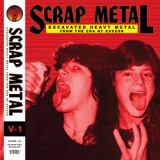
By now you’re probably familiar with our wildly popular Brown Acid series of rare, lost and unreleased proto-metal and stoner rock singles from the 60s-70s. In the endless pursuit of those glorious gems, we often uncover equally brilliant rarities from the late-70s to late-80s Golden Age of Heavy Metal that also just must be heard, but they don’t fit the series’ aesthetic. Scrap Metal, Volume 1 collects some of the greatest unknown and lost Heavy Metal tracks, long buried beneath the avalanche of the era’s classic output.
We all know the old adage that history is told by the winners. But sometimes the losers tell the best stories. And while none of these bands found fame and fortune, this artifact and the volumes to come are testament to the enduring power of heavy music. You can hear the blood, sweat and beers that went into each of these singles. The recordings may be low budget, but the inspiration and talent is immutable. Not only are the amps turned up to 11, the boyish sexual innuendo is cranked to 69. You can hear the convergence of influences — NWOBHM, thrash, glam metal, doom, etc — colliding at once as the era birthed a wellspring of subgenres.
Many of these singles are self-released and were thus limited to a small run of copies. Those that remain are hoarded by collectors and sold for exorbitant amounts. We’ve collected the best of the best for you here. As with Brown Acid, all of these tracks are licensed legitimately and the artists all get paid. Because it’s the right thing to do.
LINER NOTES:
Rapid Tears launch this series with the perfect christening. The Toronto, ON quintet’s 1981 single “Headbang” is such the pinnacle of heavy metal madness that it almost sounds like a spoof. There’s also enough of the rapid-fire sputum that inspired Metallica to bang the head that doesn’t, as such, engage in said practice, to be found on the band’s sole full length Honestly. But “Headbang” is a straightforward glammy anthem for the ages.
Air Raid’s “69 In A 55” may be lyrically so sophomoric that it’s actually pretty clever, but this 1983 Bay Area power metal single is loaded with sleek Judas Priest riffs and interwoven melodies that are downright sublime. The band’s sole release, the 2-song Rock Force 7” features a curious band photo in which 3 band members — dolled up in Crüe makeup and leather — are sexually menacing the lead singer/guitarist tied to a bed. Another low budget highlight is when singer/guitarist Tommy “Thrasher” Merry imitates a delay effect on his vocals as he sings, “tonight!...tonight...night.”
Hades’ “Girls Will Be Girls” has a real demo cassette feel to its vastly uneven mix, but the energy to the performance makes this an undeniable keeper. The long running Paramus, NJ quintet’s 1982 2- song debut 7” titled Deliver Us From Evil features this blistering thrasher dominated by shimmering leads and confident vocals that show why the band went on to near-fame on Metal Blade Records.
Resless don’t need no T to prove that they’ve got “The Power” with this 1984 driving mid-tempo rocker in the vein of Mötley Crüe and Ratt. The River Vale, NJ quartet’s tight crunch wails all over Bon Jovi posers but it’s the band’s unique and subtle deployment of background vocals that gives this rager its staying power.
Pittsburgh, the Steel City, is home to Don Cappa, a band that pays tribute to the burgh, the metal, and the awesomeness of both with “Steel City Metal.” Their lone single, issued in 1987 with only 300 copies released, sounds like the work of some serious steel driving men, with a drummer who might’ve forgotten to wear a hard hat one too many times on the construction site.
The Beast has more of a punk feel to their aggressive “Enemy Ace” track from the 4-song Power Metal EP from 1983 — something like Dr. Know meets D.O.A. But their look, artwork and lyrics all prove that Heavy Metal is where their hearts lie. And this hook filled monster delivers repeated lines like, “I command them all in my lofty realm,” with commendable conviction.
Dead Silence from Denver, Colorado, debuting in 1984 is not to be confused with Dead Silence from Denver, Colorado, who also debuted in 1984. The former a workman’s hard rock bar band, the latter a political peace punk band and neither knowing of the other’s existence throughout their tenure. The pre-internet days were a marvel, indeed.This Dead Silence spits out a slick, Nugent tinged rocker called “Can’t Stop” about life on the road.
The Danger Zone is, by all accounts, not the place to be. And, Hazardous Waste of Boston, MA saw fit to add their two cents on the matter with this 1986 single that combines Van Halen’s flashy musicianship with NWOBHM aggression that sounds so awesome it teeters on itself entering the “Danger Zone.”
Czar’s heavy, doomy “Iron Curtain” single from 1982 hearkens to the sleazy sounds of Saint Vitus and Pentagram with its cranked up DOD Distortion pedal in a Peavey combo amp guitar tone and meaty, barking vocals. The upstate NY quintet only issued this 2-song single, but its driving rhythm, nosedive whammy-bar guitar solos and comparatively mature Cold War subject matter show they had real potential.
Not much is known about Real Steel’s majestic “Viking Queen” from 1987, other than it rocks hard and the 7” 45 sells for upwards of a grand on the collectors market. The Flint, Michigan band recorded at the home studio of local radio personality Bill Lamb, who primarily released Christian Gospel recordings. So, perhaps the band was struck down by a bolt of lightning shortly after this rare single’s release. Whatever the case may be, it’s a must have for fans of classic metal mayhem.
In November 1976, Jef Gilson’s phone rang. What a surprise! It was Serge Rahoerson, one of the musicians he had met in Madagascar at the end of the 60s and who had played on his first album “Malagasy”. Rahoerson announced that he was in Paris for a few days.
Immediately, Jef wanted to organise a recording session, starting the next day. He thought of a trio including Serge, Eddy Louiss on organ and cellist Jean-Charles Capon, who had also been on one of the trips to Tananarive and so had also known Rahoerson there. Unfortunately, Eddy Louiss –who had already played with Gilson and Capon on the album “Bill Coleman Sings And Plays 12 Negro Spirituals” in 1968- had to drop out at the last minute: he was delayed by a session with Claude Nougaro. Jean-Charles Capon had also become a sought-after studio musician since his trip to Madagascar in 1969. He appeared on several key albums on the Saravah label including the now famous “Comme À La Radio” by Brigitte Fontaine, “Un Beau Matin” by Areski and “Chorus” by Michel Roques, without mentioning the album by his own Baroque Jazz Trio. He was also to be found with Jef Gilson for his album on Vogue with the ex-drummer from Miles Davis’ first great quintet, Philly Joe Jones, or also in the orchestra led by Jean-Claude Vannier for the album “Nino Ferrer & Leggs”. He also played regularly on albums by Georges Moustaki.
Jean-Charles Capon and Serge Rahoerson found themselves thus in the studio, with Jef at the controls. He had decided to record the rhythmic structure right away. He would find the soloists later, that didn’t worry him. Serge Rahoerson was on drums. Though a saxophonist by training, Jef remembered that Serge was also capable of great things behind a drum kit: he was the improvised drummer on their cover of “The Creator Has A Master Plan” on the album “Malagasy”... The great memories came flooding back (the nod on the title “Orly - Ivato”), and the old magic worked again.
Brought in momentarily from Europamerica, Gilson’s new big band, in which JC Capon also played, the saxophonists Philippe Maté, from France (another Saravah stablemate) and the American Butch Morris (soon to be a key member of David Murray’s band) were invited to record their parts later and Gilson mixed it all as if it had been one single session (as he had already done on other albums, with the tracks by Christian Vander recorded before the creation and success of Magma).
The album would not appear until 1977, on Palm, Jef’s own label, and was dedicated to the memory of Georges Rahoerson, Serge’s father, who had also played on the album “Malagasy” and who had died prematurely at the age of 51 in 1974.
“I only received my own copy of the album in 1981 when I came to live in France definitively”, a still-moved Serge Rahoerson told us in 2013. “I was playing in a club one night and Jef turned up by surprise with a copy of the album for me, I was so pleased to see him again. When I arrived in France, I told everyone that I had played with Jef Gilson a few years previously, and I was surprised to learn that so few people knew of him. For us, he was of one of the great jazz visionaries.” (Jérôme "Kalcha" Simonneau)
Sistrum ventures ever deeper into the cold, dark nights of winter, conjuring the hidden warmth that lies within each waveform. Genesis Tracks showcases a collection of deep techno talents who aren't afraid to stand their ground for purity of sound.
Track 1 - Modular One - Quasar
Chris Mitchell teams up with label boss, Patrice Scott for a lush, hypnotic groove of classic proportions. Warm square wave tones pulsate and crisp chord stabs shimmer as they punctuate the atmosphere. Sistrum sound, through and through.
Track 2 - Johannes Volk - Steam
Johannes Volk ups the tempo a bit to create a dirty, driving dancefloor number with Steam. Maintaining the Sistrum tradition of raw, no-nonsense techno music with depth, texture and soul, Johannes Volk makes his case eloquently through the use of rolling bass and slowly modulated chords.
Track 3 - Marco Zenker - Second Sight
Deeper yet we go, as Marco Zenker proceeds into the darkness with the booming, reverbed kicks of Second Sight. Slowly evolving synth textures rise and undulate, meshing with the rugged rhythm section to form a powerful groove that can only be defined as 'techno soul.'
Track 4 - Sharif Anderson - Future Acid Test
Closing the EP, Sharif Anderson offers his forward thinking take on the traditional acid motif. As the title implies, the sound is futuristic, but still retains the simple subtleties of yore. Give this track a proper sound system and watch it come alive before your ears.
- A1: The Mebusas Good Bye Friends
- A2: Georges Happi Hello Friends
- A3: Black Reggae Darling I'm So Proud Of You
- A4: Christy Essien I'll Be Your Man
- A5: The Lijadu Sisters Bobby
- B1: Tala Andre Marie Hop Sy Trong
- B2: Essama Bikoula I'll Cry
- B3: Carlos And Miki All This Nonsense
- B4: Pasteur Lappe Babette D'o (Rastawoman)
On 18th April, 1980, after decades of anti colonial struggle, the Zimbabweian flag was finally raised at midnight at the Rufaro Stadium in Harare. Not long after, the words "Ladies and Gentlemen, Bob Marley and The Wailers!" rang out, and Zimbabwe's independent future began.
In the years that followed, Africa was to produce it's own reggae superstars, as the likes of Alpha Blondy, Majek Fashek and Lucky Dube swept across the continent and beyond, and there's no doubting Bob Marley's explosive impact on this particular narrative.
Marley's unswerving commitment to liberation and unity ranged from the sweeping spiritual sentiments of iconic hits such One Love and Redemption Song to the galvanising, focused tone of 1979's 'Zimbabwe', and his status as global superstar ensured that his (self funded) part in the countries' epochal celebrations meant that the history of reggae in Africa would always be viewed through the prism of his influence ( Wiki/African Reggae : "In 1980, world-famous Jamaican reggae musician Bob Marley performed in Harare, Zimbabwe, and that concert is often credited as marking the beginning of reggae in Africa")
But in fact, the recorded history of reggae produced in Africa stretches back over a decade before Marley's arrival on the continent, and showcases broad pan - diasporic interflows between the Carribean and Africa, with the UK and the US communities playing influential supporting roles, all helping shape the evolution and development of the genre in Africa from late 60's inception to Marley's arrival in 1980, and then well beyond.
Reggae Africa : Roots and Culture, 1972 - 1981 tries to capture a sense of that evolution, starting in 1972 as Mebussa's ultra rare 'Good Bye Friends' effortlessly captures triangular, transatlantic cultural interflows, with the short lived Nigerian group's bitter sweet chords echoing classic US soul, but laid over a gritty, skanking Jimmy Cliff - esque proto reggae rhythm.
Trying to work out the precise provenance of Black Reggae's 'Darling I'm So Proud of You' (1975) isn't easy, but involves Paris based / African focused label Fiesta, some proper OG co-branding exercise with Bols Brandy ( "Bols Brandy presents Black Reggae") - and deeply infectious, lilting Rocksteady.
By 1976, glorious Nigerian sister duo Lijadu Sisters are echoing the chunky roots of a Dennis Brown or U Roy on 'Bobby', and in 1977, bespoke Nigerian drummer Georges Happi is introing 'Hello Friends' with the soon to be universal signature reggae tom roll intro, before veering leftfield with snatches of spoken Afro - English vocal in between the hooky choruses.
Nigerian giant Chrissy Essien's 'I'll Be You Man' (1979) combines floaty Lovers vibes with catchy ska shuffle, and in the same year, Cameroonian afro-funk/disco heavyweight Pasteur Lappe' drifts seamlessly into skanking, Lovers infected reggae on 'Babbette D.O. ( Rastawoman )' (before a sprawling electric guitar solo reminds us how unselfconsiously eclectic so much African music of the era was.)
And finally bookending the compilation, in chronological terms, fellow Cameroonian Tala AM also swaps his funk and soul for the rootsy and infectious 'Hop Sy Trong' (1981), again highlighting the diverse and eclectic approach to this timeless Carribean musical genre taken by African musicians in the years before that Bob Marley year zero event in Zimbabwe.
Clear Vinyl
Perc returns to Perc Trax with an EP designed to capture the energy and chaos of rave without relying on the same classic sounds that have been in constant use since the early 90's. 'Greed Dance' is Perc's first full EP in 14 months, following 'Fire In Negative' on Perc Trax back in September 2020. Since then Perc has pushed through lockdown with an intense production regime resulting in tracks being signed to Lebendig, Possession, RAW and Rote Sonne, as well as this EP for Perc Trax.
Originally started at Christmas last year, lead track 'Greed Dance' started life as an anger fueled full vocal track aimed squarely at the hypocrisy of certain sections of the dance music industry, but over time has been stripped down to a tight rhythm track with sparse vocal elements reflecting a change of mood as the UK's clubs and events were finally allowed to open again this summer.
B1 ' Resistor' takes a similar approach as previous Perc release 'Toxic NRG', looking to squeeze maximum dance floor drama out of a small group of continually tweaked sounds. Finally B2 track '240 Volts' layers rapid fire organ arpeggios over a rock solid kick & bass foundation to create something fresh for both Perc and techno in general.
'Greed Dance' will be released on limited edition cola bottle green 12" vinyl, packaged in a full colour double-sided sleeve designed by regular Perc Trax design crew Adult Art Club. The EP was written & produced by Perc at his home studio and mixed down by Perc at MAP Studios in London. The EP was
mastered by Matt Colton at Metropolis, London
Nair Mirabrat is a Uruguayan ensemble led by the composer Martín Ibarra. The candomberos of Montevideo are dressed in the infinite colors of the world and they immerse themselves in the world of song and dance, building bridges between the inside and the outside. "Juntos ahora" is built based on the myth of the hero and his journey through the symbolic labyrinth. Death, time and place are the themes where the lyrics wander. DESCRIPTION Martín Ibarra and his Nair Mirabrat ensemble bring a garden variety of electrifying rhythms with "Juntos ahora", fusing together elements of candombe fusion, jazz, and pop. Deep in the Montevideo music scene, Nair Mirabrat effortlessly transcends genres and local tradition bringing forth a new era of influence as they revel in the bliss of Ibarra's soaring vocals over tropical rhythms. Ibarra and crew are a modern-day mixture of Jaime Roos, OPA, Hugo Fattoruso and Eduardo Mateo with their explorative, forward-thinking passion of keeping it 100% Uruguay. Chris J. Morris
- A1: Botafogo Blue (Feat The Bbc National Orchestra Of Wales)
- A2: Olá! (Feat The Bbc National Orchestra Of Wales)
- A3: Y Bywyd Llonydd (Feat The Bbc National Orchestra Of Wales)
- A4: Açai (Feat The Bbc National Orchestra Of Wales)
- A5: Cariad, Cariad (Feat The Bbc National Orchestra Of Wales)
- B1: Tristwch 20 (Feat The Bbc National Orchestra Of Wales)
- B2: Ynys Aur (Feat The Bbc National Orchestra Of Wales)
- B3: Y Ferch Ar Y Cei (Feat The Bbc National Orchestra Of Wales &Amp; Nina Miranda)
- B4: Arpoador (Feat The Bbc National Orchestra Of Wales)
- B5: Ble Aeth Yr Amser (Feat The Bbc National Orchestra Of Wales)
Carwyn Ellis from Cardiff/Wales is a singer, songwriter, composer, arranger, multi-instrumentalist and record producer. He fronts Colorama, formed the Welsh folk group Bendith and hosts a regular themed radio show on Soho Radio. In 2019, Ellis embarked on the first project under his own name, Carwyn Ellis & Rio 18. Sung in Welsh and recorded mainly in Rio de Janeiro, the album, "Joia!" was nominated for the Welsh Music Prize and followed by "Mas" in early 2020. The new album "Yn Rio" is a collection of new songs recorded in Cardiff together with The BBC National Orchestra Of Wales.
In 2017 Carwyn Ellis joined the touring line-up of The Pretenders. For Ellis, a record collector and fan of Brazilian music, the opportunity to tour South America would present opportunities he couldn't have possibly imagined when he accepted Chrissie Hynde's invitation. "The first place we went to was Rio and by the time I met Chrissie for breakfast the day after our gig, I already had a bag of albums I'd just bought. I'm sitting with her and she says, 'You should meet my mates, and do something in Welsh with them! Nobody's done a Welsh language album with Brazilian musicians?"
In 2018, when Alexandre Kassin, a leading light in that Brazilian scene announced a show in London, Hynde suggested that they see it. "I met him afterwards," Ellis recalls, "and we hit it off straight away." Within weeks, Ellis was on a plane to Rio with songs that would form the basis of the first album. This creative purple patch extended into another album released early in 2021 with Carwyn working once again with Kassin plus long-time friend Shawn Lee. The songs on "Mas" drew on the environmental threats that face both Wales and South America, spidering out around the central theme of water ("rains, no rain, droughts, rising seas and flooded valleys for corporate gain. We're screwed without it and screwed if there's too much").
With "Mas" recorded but weeks away from release, Ellis received a call from Gareth Iwan Jones, head producer of BBC Radio Cymru, offering a third album to be performed in March 2021. Ellis started to reflect upon the life-changing events triggered by his South American adventures. The Welsh word 'hiraeth' which describes the longing that Welsh people feel when they're far from home, was something that he was now beginning to feel for Rio de Janeiro: "'Yn Rio' is based around a day in Rio," he explains. "The events of 2020 influenced the record inasmuch as I wanted it to be a complete antidote to what was going on. If you couldn't go on holiday in real life, you could at least put this record on."
The first single "Olá!", incorporating Jorge Ben's spirit in the chorus and rhythmic breakdown, manages to sound languorous and euphoric. "Cariad, Cariad" was a Portuguese folk poem brought to Ellis' attention by Sonya from Quarteto em Cy and arranged by Christiaan Oyens. "Tristwch 20" is a nod to "Foot and Mouth 68" by Gorkys Zygotic Mynci from "The Blue Trees", 'one of the most beautiful albums of all time', while "Ynys Aur" is named after a 1929 book by Welsh missionary J. Luther Thomas written on returning from his travels to Papua New Guinea. With Kassin unable to participate, Ellis thanks him by translating his "A Paisagem Morta" to create "Y Bywyd Llonyd". For Carwyn Ellis "Yn Rio" is an extraordinary memorial to extraordinary times."There are some days so idyllic you just want tobe able to jump back into them at the touch of a button. That's what I was searching for when I was writing these songs."
Over the past decade or so, Chris Forsyth has produced a series of perennially year-end list haunting studio albums of expansive art-rock, from 2013’s Solar Motel to 2019’s All TimePresent , in the process becoming one of the leading lights of the so-called “indie jam” scene, musicians combining omnivorous influences with post-Dead sprawl.
These critically lauded albums have established Forsyth as one of today’s most unique and acclaimed guitar player/composers - a forward thinking classicist synthesizing cinematic expansiveness with a pithy lyricism and rhythmic directness that makes even his 20-minute workouts feel as clear, direct, and memorable as a 4-minute song.
Pitchfork has called his music “a near-perfect balance between 70s rock tradition and present day experimentation,” NPR Music named Forsyth “one of rock’s most lyrical guitar improvisors,” and the New York Times calls him “a scrappy and mystical historian… His music humanizes the element of control in rock classicism (and) turns it into a woolly but disciplined ritual.”
But the studio records are just the tip of the iceberg.
You see, in a live setting Forsyth’s music is never really finished.
He hasn’t had a fixed band in years and plays with a rotating cast of characters. Regulars in Forsyth’s bands have included bassists Doug McCombs (Tortoise) and Peter Kerlin (Sunwatchers), and drummer Ryan Jewell (Ryley Walker, too many others to mention), among others - basically, whoever is available for the given gig or tour.
These are not groups that rehearse, exactly. Operating more like a jazz band, Forsyth and his players treat the songs as frameworks that remain identifieable but morph based on who’s playing them, like weather to a landscape.
Embracing this flux has become a cornerstone of Forsyth’s live sets, rendering every performance special and thereby catching the attention of tapers from his home base in Philly to New York City, Chicago, and Minneapolis. In fact, most of his live performances over the last few years are recorded and posted on the Live Music Archive site.
But the taper recordings, though many are high quality and full of character, are not professionally recorded and mixed multi-tracks.
Which brings us to Peoples Motel Band , the new live LP culled from a set that Forsyth played with NY-based group Garcia Peoples as his band, and is self-releasing on his own Algorithm Free label in a limited pressing of 500 copies.
Recorded September 14, 2019 before a packed and enthusiastic hometown crowd at Johnny Brenda’s in Philadelphia, Peoples Motel Band catches Forsyth and Garcia Peoples (plus ubiquitous drummer Ryan Jewell) re-imagining songs from Forsyth’s last couple studio albums with improvisatory flair.
Forsyth and Garcia Peoples played a number of 2019 shows together, beginning with a semi-legendary jam set at Nublu in NYC in March, through a couple dates on Forsyth’s month-long weekly residency at Nublu in September and concluding with a five-date tour of the Northeast in December. The chemistry between the players is tangible.
As is often the case with Forsyth shows, the gloves come off quickly and the players attack the material - much of it so well-manicured and cleanly produced in the studio - like a bunch of racoons let loose in a Philadelphia pretzel factory.
Recorded and mixed with clarity by Forsyth’s longtime studio collaborator, engineer/producer Jeff Zeigler, the record puts the listener right in the sweaty club, highlighted by an incredible side-long take of the chooglin’ title track from 2017’s Dreaming in The Non-Dream LP (note multiple climaxes eliciting wild shouts and ecstatic screams from the assembled).
This is not the new Chris Forsyth album, exactly, but then again, it kinda is because whenever he sits down to play, something new comes out.
Horace Tapscott's Pan-Afrikan Peoples Arkestra (P.A.P.A.) was one of the most transformative, forward-thinking and straight-up heavy big bands to have played jazz in the 1960s and 1970s. If P.A.P.A. doesn't have the interstellar rep of that other famous Arkestra, and if the name Tapscott doesn't ring bells like Monk or Tyner, there's a reason why: in an industry dominated by record labels, a band that doesn't record doesn't count. And the Pan-Afrikan Peoples Arkestra didn't record for nearly twenty years. But recording success was never their concern -- they weren't about that. First formed as the Underground Musicians Association in the early 1960s, Tapscott always wanted his group to be a community project.
From their base in Watts, UGMA got down at the grassroots. The group was renamed the Pan-Afrikan Peoples Arkestra in 1971, and soon after they established a monthly residency at the Immanuel United Church of Christ which ran for over a decade, while still playing all over LA and beyond. But they never released a note of music. It was the intervention of fan Tom Albach that finally got them on wax. Determined that their work should be documented, Albach founded Nimbus Records specifically to release the music of Tapscott, the Arkestra, and the individuals that comprised it. The first recording sessions in early 1978 yielded enough material for two albums, and the first release was Flight 17. The album commences with the magnificent title track. It is effectively in three parts. It begins with unaccompanied pianos. Then the ensemble embark on a dense, circular and mechanical movement, a platform for horns and pianos to swoop and dive. We return to Earth with a beautiful solitary flute. The second track, the piano-centric, ‘Breeze’ is different to ‘Flight 17’ in intensity and also brevity but it is quietly as daring as the title track. It concludes with a moving lush wash from the full Arkestra, which sound almost like strings only more substantial. These first two tracks take full advantage of the texture of the unusual mix of the various instruments. Next though, it’s a significant change with ‘Horacio’, which is an exuberant Latin infused jingle. It’s unlike anything else on the album. I like to think it was named after the conductor’s Cuban alter-ego! ‘Clarisse’ gracefully switches between slow blues and bop and is bookended with a grand vaguely East Asian theme. The busy bass line introduces ‘Maui’. As with the previous track, it moves between a number of contrasting melody lines and rhythms but there’s still space for a tuneful sax solo.
This is a must-have album. I think the first two tracks on their own make this release essential. Kevin Ward/UK Vibe/Boomkat
How Beautiful Life Can Be, recorded at Parr Street Studios, Liverpool. In the company of producers, James Skelly and Chris Taylor, pushes The Lathums’ remarkable story into the next, even more exciting phase! It was only in the summer 2019 that the band’s fuse was lit by Tim Burgess, who offering them a late slot at Kendal Calling where, inside 24 hours, social media chatter caused their audience to spill into the field beyond their tent. A year later they had achieved their first UK Album Chart Top 20 for vinyl-only EP compilation, The Memories We Make, recorded their debut appearance for Later… With Jools Holland and joined the BBC Sound Poll 2021 list of tipped acts . Hailing from Wigan on the overlooked fringes of Greater Manchester, The Lathums are Alex Moore, casting a new outline of the modern frontman, singing alongside student of the Marr-esque jangle guitar, Scott Concepcion, rapid-fire, wise-cracking bassist, Jonny Cunliffe (aka: Bass Mon Jon) and the steady, rhythmic, wise head, Ryan Durrans on drums. Pithily described by those closest as ‘like The Inbetweeners in a Shane Meadows film’, they are four bright, wild flowers growing between grey paving stones.
Ben Bertrand weaves transverse waves into otherworldly compositions. He embodies the singular motion of these melodic and harmonic forms in order to draft new sonic possibilities freed from the laws of the physical plane. Pulsating at the kernel of Ben Bertrand’s musical universe are vivid dreams generating the fabric of these tapestries. Dokkaebi is deeply familiar yet refreshingly unknown, like a comforting whisper from your subconscious. It gently drifts into perception, glistening like the sun sparkling off a glacier gliding along the edge of your vision.
Deep listening to these tonal sculptures is enriching. By opening oneself to their deliberate unfolding, you will discover new principles for sound organization far afield from common modes of operation. The gradual, rhythmic progression of his compositions are ever-shifting grains, which upon thoughtful contemplation, reveal astonishing worlds. Bertrand’s music is constructed from blueprints drafted with honest intentions aspiring to bring humans closer to a sense of wonder.
Ben Bertrand welcomes each listener to discover his music anew from their own perspectives. It is infinitely in time with your time. These are the ripples in the wake of successive revolutions of universal evolution. Dokkaebi is an example of musical expressions adapting to the contours of the human psyche through gentle reflection of multiplicity. They are sounds reshaping themselves to suit the contours of each individual’s subconscious—sonic entities projected simultaneously as molecular and holistic.
Dokkaebi is an oceanic expression softly set in motion by honest aims that echo and grow. Ben Bertrand beckons you to listen up and look in. There is great reward in this generous flow.
Ben Bertrand was accompanied by Christina Vantzou, Geoffrey Burton, Indré Jurgeleviciuté, Echo Collective: Margaret Hermant & Neil Leiter, Otto Lindholm.