New Pagans create music that's not only vivid and engaging but also home to massive riffs and rare dynamics. The bands audible influences range from PJ Harvey to Sonic Youth while lyrically the band deliver protest songs, songs about women, songs about mothers and songs about conversations overheard on Belfast's public transport systems. Their live shows are also something to behold and have just been the recipients of the best live act at The Northern Island Music Prize 2020. Music is the focus and an important vehicle for the healthy message the band promotes. New Pagans is a proud advocate for women’s rights, visibility and inclusion in the global music industry – an industry dogged with a history of stark gender inequality. The arts community and media have responded to the bands refreshing social and historical lyrical stance which includes protest songs, songs of suffrage and an ode to Lily Yeats, the often overlooked sister of Jack and William B and a key mover in the world of Irish arts and crafts back in the day along with her younger sister, Elizabeth. New Pagans have headlined events as part of Women’s Work and Lyndsey McDougall has proudly embraced the demands of live performance and recording whilst pregnant twice!. The band are committed to promoting honest inclusion, demonstrating the female force and showing that you can be born as or identify as female, raise a family and have your place as a career musician. Young women, young mothers see Lyndsey as a symbol of strength and hope in her fearless and forthright attitude to motherhood whilst fronting a band. A lot of young mothers feel the need to hide that aspect of their personal life for fear of how people may perceive it as a limit in achieving creative breakthroughs. New Pagans are that breakthrough, a visible work in motion
Suche:chris young
- A1: Wolfwalkers Theme
- A2: Wolves
- A3: Running With The Wolves (Wolfwalkers Version)
- A4: Mechanical
- A5: Wolf Or Girl
- A6: I'm A Wolfwalker
- A7: Howls The Wolf (Moll's Song Wolf Run Free) (Moll's Song Wolf Run Free)
- A8: Our Forest
- B1: What Are You Doing Here?
- B2: This Is Intolerable
- B3: Please Mummy
- B4: My Little Wolf
- B5: Our Victory
- B6: Follow Me
- B7: Mebh's Tune
- B8: Robyn's Tune
In the cinema, the composer must go to meet the filmmakers, enter their world, but without giving up his own. This is the difficulty or the paradox of music for the image. By collaborating with directors from a wide variety of backgrounds, I think I have indirectly discovered a lot about myself. It helped me to progress, to explore territories that were not naturally mine. Cinema is a laboratory where I have sought to construct original orchestral formulas combining Corsican polyphonies, musicians from jazz, variety, classical, or even rappers. Like the world today, a fragmented world where all cultures mingle. So said Bruno Coulais, one of the most innovative composers of contemporary cinema, during the tribute paid to him in 2011 at the Cinémathèque de Paris
In 1978, Bruno Coulais, a young composer of concert works, discovered in film music a new means of expression, a way of bringing the demands of his writing to the masses. François Reichenbach, then Josée Dayan, Jacques Davila, Souleymane Cissé or Laurent Heynemann, first on television and then in the cinema, lead him of his own accord in the discovery of this new world.
In 1995, he composed the music for Microcosmos. This centimeter-scale initiatory journey offers him the opportunity to reveal the full dimension of his writing. He injects into his score a strange lyricism, between wonder and fantasy, confirming the lesson learned from François Reichenbach: "to any documentary image, music brings a part of fiction".
The success of Microcosmos established the musician and made him the indispensable composer of other natural tales, notably alongside Jacques Perrin (Le Peuple migrateur, Oceans, Les Saisons, etc.). Other long-term relationships will be forged, in particular with Benoît Jacquot, with whom he has worked for more than a decade, not to mention Frédéric Schoendoerffer, James Huth or Jean-Paul Salomé.
In addition to great popular successes such as Les Choristes, Brice de Nice or Sur La Piste Du Marsipulami, it is hardly surprising that this insatiable curiosity has found in the animated cinema the most inspiring playgrounds, in particular through his collaboration with two exceptional designers, Henry Selick and Tomm Moore.
The first, American director of The Nightmare Before Christmas produced by Tim Burton, invites Bruno Coulais to sign in 2009 the magnificent score of Coraline (film nominated for the Oscars). 10 years later, he is about to find him for a new and beautiful Wendell & Wild adventure. For Irishman Tomm Moore, Bruno Coulais has already composed the music for two Oscar-nominated films, The Secret of Kells (2009) and Song Of the Sea (2014), and in 2020 he will sign the score for Wolfwalkers.
Whether it is about author's films or more mainstream films, Bruno Coulais maintains the same standards, always considering his art as a window open to the world. Much less wise than it seems, he reveals in it a gift of a modern alchemist and a very personal way of mixing the most diverse cultures in universal harmony at work.
- A1: The Wessel Ilcken Combo - Waiting For Weelink
- A2: The Frans Elsen Quartet - Dufti Chris
- A3: The Wessel Ilcken Combo With Rita Reys - I Should Care
- A4: The Rob Madna Trio - Second Date
- A5: The Herman Schoonderwalt Septet - Nowhere
- A6: The Frans Elsen Quartet - Mops
- A7: Tony Vos Quartet - A Rainy Holiday
- A8: The Rob Madna Trio - Stan The Wailer
- B1: The Wessel Ilcken Combo With Rita Reys - There’ll Never Be Another You
- B2: The Frans Elsen Quartet- Autumn In New -York
- B3: Tony Vos Quartet - Young Peter
- B4: The Rob Madna Trio - Papernote
- B5: The Wessel Ilcken Combo - For Minors Only
- B6: The Frans Elsen Quartet - All Things You Are
- B7: The Rob Madna Trio - The Universe
- B8: The Herman Schoonderwalt Septet - Herman’s Hanky
Jazz Behind the Dikes Vol 2 is the second installment in the Jazz Behind The Dikes series, which highlights some of the greatest Dutch jazzmen under ideal conditions: in their own combo’s and playing the music of their own choice in complete freedom. The result is straightforward modern jazz by renowned Dutch jazz musicians such as Rob Madna Trio, Tony Vos Quartet and Frans Elsen Quartet.
This second volume of the series is available as a limited edition of 500 individually numbered copies on white vinyl. The third and last volume in this series will be released later.
- A1: Armin Van Buuren Vs Sophie Ellis-Bextor - Desiderium 207 (Feat Susana)
- A2: Armin Van Buuren Vs Ferry Corsten - Mirage
- A3: This Light Between Us (Feat Christian Burns)
- A4: Not Growing Up On Love
- B1: I Don't Own You
- B2: Full Focus
- B3: Take A Moment (Feat Winter Kills)
- B4: Feels So Good (Feat Nadia Ali)
- C1: Virtual Friend (Feat Sophie)
- C2: Drowning (Feat Laura V)
- C3: Down To Love (Feat Ana Criado)
- C4: Coming Home
- D1: The Silent Hearts (Feat Bt)
- D2: Ordion
- D3: Minache
- D4: Youtopia (Feat Adam Young)
Originally released in 2010, Mirage is the fourth studio album by renowned Dutch trance DJ and producer Armin van Buuren. Widely regarded as a astaple in Van Buurens impressive career, Mirage peaked at number 3 in the Dutch Album Top 100, as well as reaching the top 5 of the US Top Dance/Electronic Albums. It contains the popular single ‘Not Giving Up On Love’, featuring British singer Sophie Ellis-Bextor. As the record lasts nearly 80 minutes total, it is released as a double LP. It is pressed on red coloured 180 gram audiophile vinyl. The package includes a gatefold with spot varnish and lyrics, as well as an insert with pictures and credits.
Medicine At Midnight is the new album from Foo Fighters, packing nine new songs into a tight ass 37 minutes. This collection includes the smoldering new single, "Shame Shame." Medicine At Midnight is produced by Greg Kurstin and Foo Fighters and is the band's 10th album. Foo Fighters are Dave Grohl, Taylor Hawkins, Nate Mendel, Chris Shiflett, Pat Smear, and Rami Jaffee.
1 vinyl disc, 140 Gram in heavyweight standard jacket, printed sleeve and 12”x 12” insert
- A1: How Sad
- A2 4: 3 2 1
- A3: Chinese Takeaway
- A4: Johnny Was A Soldier
- A5: Disco
- A6: Eyes In The Back Of Your Head
- A7: You'll Never Walk Alone
- A8: Too Young
- B1: Joker In The Pack
- B2: Lullaby
- B3: My Baby Got Run Over By A Steamroller
- B4: A Man's Gotta Do
- B5: Let's Go
- B6: Easy Way Out
- B7: Shake Rattle, Bang Your Head
- A8: I Wanna Be Sedated
- A9: Bad Boy (Single Version)
- A10: Tokyo (Single Version)
Originally released in November 1982, ‘Sound of Music’ was the second album from ‘Clockwork punks’ the ADICTS. Preceded by the release of the three track “Chinese Takeaway” EP, which also featured “Too Young” and “You’ll Never Walk Alone” - both included here as bonus tracks along with their subsequent hits ‘Bad Boy’ and ‘Tokyo’ and an unreleased version of Ramones’ classic ‘I wanna be sedated’ - the album was widely praised in the music press of the day with ‘Sounds’ saying “thank Christ for The Adicts. In this often grey and depressing world they entertain us, uplift us and unify us”.
Thirteen slices of punk/Oi! fun that made history, in a luxurious one-time GATEFOLD edition with poster, including liner notes by Mark Brennan and a total of 5 bonus tracks!
Mosey was listed on the 2019 XXL Freshman Class list. His sound is often described as mumble rap and he was one of the breakout artists of the soundcloud rap phenomenon in the US. Certified Hitmaker' has been streamed 403 million times already. Whereas his previous album is not far off a massive 2 billion global streams across DSPs. Lil Mosey's single Blueberry Faygo is now platinum in the UK. In 2019 Lil Mosey became the youngest artist to successfully launch a music festival, Northsbest Fest, in his hometown. The album also features collaborations with Gunna, Chris Brown and AJ Tracey.
Following the 2020 release of RoundAgain, Nonesuch reissues on vinyl Joshua Redman's first album with his own band — pianist Brad Mehldau, bassist Christian McBride, and drummer Brian Blade — originally released in 1994. MoodSwing was Redman’s third recording as a band leader and his first featuring all-original compositions. The young saxophonist sought to change what he believed to be the public perception of jazz — a largely academic and overly intellectualized form of music devoid of the emotional themes that drive many other genres. As he explains in the original liner notes, jazz was seen as, “an elite art form, reserved for a sophisticated intelligentsia who rendezvous in secret.” With MoodSwing, Redman makes the case that jazz can be an accessible musical medium that could evoke basic and visceral emotional reactions.
From the playfully coy ‘Chill’ to the urgent energy of ‘Rejoice’, Redman offers up a communicative and inspired record ofemotional diversity. Joining him in this task was a young band of his peers, all of whom have since become established and esteemed figures in jazz. MoodSwing was one of the first exposures the jazz community had to young pianist Brad Mehldau, then beginning his career in Redman’s quartet. Mehldau anchors these compositions behind Redman’s lyrical playing, occasionally stepping out front to show his talents in ‘The Oneness of Two (In Three)’ and ‘Past in the Present’. The band’s rhythm section has since been recognized as one of jazz’s best, with Christian McBride on bass, and then little-known Brian Blade on the drums.
As the follow-up to his breakout Wish, MoodSwing was universally praised by critics and enjoyed commercial success, selling over 300,000 units worldwide. Entertainment Weekly wrote, ‘saxist Redman finds ingenious ways of creating a modeof acoustic jazz that is both entertaining and enlightening.’ This record continues to provide a cornerstone for Redman’s currentcareer; many of these compositions are still featured in the saxophonist’s live sets today.
Redman’s previously announced European summer 2020 tour dates with Mehldau, McBride and Blade have been rescheduled for 2021, including London’s Barbican, now on July 11.
A folk/bluegrass troubadour from Vermont who delves into shape-note traditions and Appalachian ballads and makes it all beguilingly his own. His guitar lines have the fancy fingerwork of a crack banjo player and his banjo lines have the tugging suspensions of a jazzer.’ – Guardian
‘Amidon is a rare Americana artist whose … signature banjo-strewn style … and disparate mix of influences play into a sound that is at once archaically rootsy and savvily refined.’ – Wall Street Journal
Sam Amidon considers his new self-titled album the fullest realization to date of his artistic vision. It comprises his radical reworkings of nine mostly traditional folk songs, performed with his band of longtime friends and collaborators. Amidon produced the record, applying the sonic universe of his 2017 The Following Mountain to these beloved tunes, many of which he first learned as a child. ‘Pretty Polly,’ for example, was one of the first traditional tunes he learned to play, and ‘Time Has Made A Change’ is a song that his parents – singers who were on the 1977 Nonesuch recording Rivers of Delight with the Word of Mouth Chorus – sang around the house when he was young. Amidon will perform two concerts at Kings Place in London on October 3. A limited number of tickets will be available in the venue, as well as tickets to stream the event from home. Further details are available here.
Amidon and his frequent band of multi-instrumentalist Shahzad Ismaily and drummer Chris Vatalaro were joined in the studio by Belgian guitarist Bert Cools (who played on his last EP), as well as Amidon’s wife, Beth Orton, who adds vocals on three songs. Acoustic bassist Ruth Goller and saxophonist and labelmate Sam Gendel also play on the album, which was mixed by Leo Abrahams. Sam Amidon was mostly recorded live in the studio. Amidon arranged the songs, which are traditional tunes, with the exception of Taj Mahal’s ‘Light Rain Blues’, Harkins Frye’s ‘Time Has Made A Change’, and ‘Hallelujah’, which is an 1835 William Walker shape-note tune using earlier words by Charles Wesley, found in the Sacred Harp collection of early American folk-hymns.
Sam Amidon is Amidon’s fifth recording on Nonesuch and follows the 2019 EP Fatal Flower Garden (A Tribute to Harry Smith). Additional recordings include his 2017 album The Following Mountain and Kronos Quartet’s Folk Songs the same year, on which he was a featured singer along with Rhiannon Giddens, Natalie Merchant, and Olivia Chaney; Lily-O in 2014; and his label debut, Bright Sunny South, in 2013.
Icelandic composer ?lafur Arnalds set to release his first Hollywood film score. ?lafur Arnalds' original motion picture soundtrack for Sam Levinson's feature film debut 'Another Happy Day', starring Ellen Barkin and Demi Moore, will see a worldwide release via UK modern classical label Erased Tapes Records on February 27, 2012. In his own words: 'In mid-December 2010 I was on a holiday in China when I received an email from Sam Levinson about the film. We got on the phone at like 4 in the morning Beijing time and ended up talking all through the night, instantly connecting. He told me that they had been listening to my music while making the film, so the film was already very influenced by my music. However, it was not until Ellen Barkin ? the beautiful force that she is ? had pestered the producers for a week, calling them every day about how I am the right one for this film, that they finally gave in. The only catch was that it had to be done two weeks later, in the first week of January. So I ended up scoring nonstop all throughout Christmas, making my mother mad in the process.' ? ?lafur Arnalds Born in the suburban Icelandic town of Mosfellsb?r, a few kilometers outside of Reykjav?k, the 24-year old composer has always enjoyed pushing boundaries with both his studio work and his live-shows. Through relentless touring and determination this young artist has steadily gained recognition worldwide since his 2007 debut Eulogy for Evolution. ?lafur Arnalds' second full-length album ...and they have escaped the weight of darkness, continues his mission to lure an indie-generation of pop and rock fans into an emotive world of beguiling electronic chamber music and delicate classical arrangements. After recently having supported Ryuichi Sakamoto throughout Germany, ?lafur will return with a European 'Trio Tour' in spring 2012.
Unbegrenzt is the third in an ongoing series of archival records of the unheard music of Swedish composer Catherine Christer Hennix, co-released by Blank Forms Editions and Empty Editions. It follows Selected Early Keyboard Works and Selections from 100 Models of Hegikan Roku (named the #1 archival release of 2019 by The Wire), in addition to a two-volume collection of Hennix’s writing titled Poësy Matters and Other Matters.
Recorded in February of 1974 and featuring Catherine Christer Hennix (recitation, percussion, and electronics) and Hans Isgren (bowed gong), Hennix’s realization of Karlheinz Stockhausen’s “Unbegrenzt” (German for “unlimited”) from Aus den Sieben Tagen is an elaboration both rigorous and radically different from the canonical 1969 recording issued by Shandar. The collection of 15 text pieces written in Paris during May of 1968, Aus den Sieben Tagen, denies its performers notated direction and instead provides poetic cues that hinge upon Stockhausen’s conception of “intuitive music,” a Eurocentric perspective on improvisation antithetical to the vernacular forms Hennix had engaged with as a young drummer performing in Stockholm jazz clubs with musicians like Bill Barron, Cam Brown, Hans Isgren, Lalle Svenson, Allan Vajda, Bo Wärmell, and many others. While both Hennix and Isgren saw the formal prospect of Aus den Sieben Tagen as a productive development of and beyond La Monte Young’s event scores, she here steadfastly counters his rationalization of intuition with the Principle of Sufficient Reason. (Cf. Brouwer’s Lattice.) Eschewing the busy, conservatory-addled lapses into idiomatic citation of Stockhausen’s 1969 recording, Hennix’s alternative realization of the “Unbegrenzt” score’s instructions to “play a sound with the certainty that you have an infinite amount of time and space” is based on her concept of Infinitary Compositions, the trademark of her ensemble The Deontic Miracle which, at one time, considered adding Stockhausen, La Monte Young and Terry Jennings scores to its repertoire. Taking a mature, minimal iteration of Stockhausen’s compositional method of “moment-forming” to heart, her version’s dark, controlled feedback and amplified bowed gong subtly shift through an immanent sequence of formative moments, step by step. Its bubbling computer noise, percussion, and repeated ominous transient sounds of temple blocks over the bowed gong terminate with the integrated recitation of exotic text fragments from Hevajra Tantra which faithfully take Stockhausen’s score into deeper vistas of the unconscious and a more devastating opening to the unlimited time and space of a dreaming mind.
Audio restoration and mastering by Stephan Mathieu, with an essay by Bill Dietz.
Catherine Christer Hennix (b. 1948) started her creative life playing drums with her older brother Peter, growing up in Sweden where she heard jazz luminaries, such as John Coltrane, Eric Dolphy, Dexter Gordon, Archie Shepp, and Cecil Taylor perform from 1960 to 1967. Directly after high school, Hennix went to work at Stockholm’s pioneering Elektronmusikstudion (EMS), where she developed early tape music, incorporating computer generated speech done at the Royal Technological University (KTH), where she was an undergraduate student. After traveling to New York In 1968, she met artists Dick Higgins and Alison Knowles who invited her to stay at the Something Else Press Town House where she had the opportunity to meet, among others, composers John Cage, James Tenney, and Phil Corner. During the following years she developed fruitful collaborative relationships with many composers in the burgeoning American avant-garde, including, most significantly, Henry Flynt and La Monte Young. Young introduced Hennix to Hindustani raga master Pandit Pran Nath and she would later study intensively under him as his first European disciple. While Hennix continued to make music performing alongside Arthur Russell, Marc Johnson, Henry Flynt, and Arthur Rhames, she also served as a professor of Mathematics and Computer Science at SUNY New Paltz and as a visiting Professor of Logic (at Marvin Minsky’s invitation) at MIT’s Artificial Intelligence Laboratory. In recent years Hennix has led the just-intonation ensemble the Chora(s)san Time-Court Mirage, which has featured musicians Amelia Cuni, Amirtha Kidambi, Chiyoku Szlavnics, Hilary Jeffrey, Amir El-Saffar, Benjamin Duboc and Rozemarie Heggen. She currently resides in Istanbul, Turkey pursuing studies in classical Arabic and Turkish makam.
The Fall is a deconstruction of November by Dennis Johnson.
Written for solo piano in 1959, November is the first example of minimalist music composition and was the inspiration for La Monte Young's The Well-Tuned Piano (1964). The 66 minute piece is a collaboration between legendary artist Lustmord and renowned classical pianist Nicolas Horvath, in which they reduces Johnson's original November to its core element and place it in a landscape of complimentary sound. The Fall echo's November but with further resonance.
Recorded in May-June 2019 in Los Angeles, and Misy-sur-Yonne, France.
Lustmord
Active since 1980, born of the original 'industrial' scene of the period. With its own distinctive approach, blurring the line between music and sound design Lustmord's work has featured in 45 motion pictures including The Crow and Underworld and also in video games, television and commercials. Recently Lustmord scored the music for Paul Schrader's movie First Reformed. While Lustmord is often credited for creating the 'dark ambient' genre there is much more nuance to its work than what that label implies. The music is not dark, but is a light that shines into and upon the darkness. Notable collaborations amongst many include Tool, Melvins, Jarboe, John Balance of Coil, Clock DVA, Chris & Cosey, Paul Haslinger, Karin Park and Robert Rich.
Nicolas Horvath
An unusual artist with an unconventional résumé, pianist and electroacoustic composer Nicolas Horvath is known for his boundariesless musical explorations. Horvath is both an enthusiastic promoter of contemporary music - he has commissioned numerous works (including no fewer than 120 as part of his Homages to Philip Glass project in 2014) and collaborated with leading contemporary composers from around the world, including Alvin Lucier, Mamoru Fujieda, Jaan Rääts, Alvin Curran and Valentyn Silvestrov - and a rediscoverer of forgotten or neglected composers such as Moondog, Nobuo Uematsu, Germaine Tailleferre, François-Adrien Boieldieu, Hélène de Montgeroult, Jean Catoire, Karl August Hermann.
Rocksteady and Reggae have long been a part of the rare soul scene, since its inception in the early Sixties. It’s easy to hear the influence of early American R&B in the development of ‘Ska’ and as ‘Soul’ music took over as “the sound of young America”, in the mid-Sixties, it too tinged the sound of Jamaica. No more so than our dance floor anthem “I Feel So Bad” by the legendary JACKIE EDWARDS.
Edwards was born Wilfred Gerald Edwards in Jamaica in 1938 and by the age of 22 had already scored a No.1 record on the island. He’d had four chart-topping hits before signing to Chris Blackwell’s new ‘Island’ imprint in 1962. He became an integral part of Island Records, as a prolific artist, songwriter, producer and general helper. He wrote “Keep On Running” and “Somebody Help Me” for the British R&B band The Spencer Davis Group, both of which went to No.1 on the U.K. pop charts.
“I Feel So Bad” was released on the distinctive ‘red and white’ Island logo in 1967 and was adopted by the burgeoning U.K. underground soul scene, most notably at the Twisted Wheel club in Manchester. It has been played on the ever evolving Northern Soul scene ever since and, a half-century on, commands a price tag of £700+ for a mint original. Fortunately our devastingly good-looking “official” reissue can be bought for a more modest sum.
Jackie Edwards is also responsible for our flip-side “Baby Don’t Wake Me” which he wrote and produced for reggae singer DEL DAVIS at the turn of the Seventies. The combination of Jackie’s well-honed soul-induced musicianship and Davis’ gravelly soulful vocals create the perfect Northern/Crossover dancer.
Two fabulous reasons to make this one of the top reissue 45s of 2020!
Conceived as a loosely-based concept album around the idea of crushes and young love, that dog’s sophomore album Totally Crushed Out! is a touchstone underrated classic in line with of-the-era releases like the Breeders Last Splash and Liz Phair’s Exile in Guyville.
From the Sweet Valley High reminiscent illustrated album cover, to the A minus rating given by the dean Robert Christgau, to the Jenni Konner songwriting credit (long before she was the showrunner for HBO’s Girls) this album is quirky, smart, well-written and most of all...enjoyable.
that dog’s touring behind Totally Crushed Out! found them sharing stages with Foo Fighters, Weezer and Teenage Fanclub, their songs being covered live by Pearl Jam, collaborating with Beck, and the vid for “He’s Kissing Christian” achieving sub-Buzz Bin status on MTV.
This 25th anniversary reissue marks the first EVER vinyl appearance for this album. Showing their attention to detail, Third Man Records sleuths got their hands on the original oil painting used for the front cover art and worked directly from that for all relevant artwork needs.
The founder of Modern Obscure Music (MOM) presents this release which culminates a creative process that has led him to work during years with labels as respect- ed as Hivern Discs of John Talabot to Mathematics Recordings of Hieroglyphic Being.
Pedro Vian surprises us with a an album that is impossible to categorize into a single musical style. This LP guides its audience through musical scenes typically attributed to the artist, with atmopheric tracks like Pandora or Paradiso (available on the digital version). But it also travels through abstract, sonic labyrinths in songs like Maia or Nine is Nine, accentuates the rhythm with techno tracks such as Le Fou, Invisible Objects or Indian Strings, and even submerges us into the depths of pop with 801 Nite, where Pedro Vian collaborates with the young and talented singer of Mourn (Captured Tracks/USA) Carla Pe´rez Vas. Another cut that resonates is the influence of the Cocteau Twins.
Beautiful Things You Left Us For Memories is the most mature work signed by Pedro Vian, where he clearly manifests all of his influences and distances himself from the introspection prominent in his last EP’s, where he collaborated with artists like Inga Copeland from the Hype Williams Duet, or Pye Corner Audio. This is a bold move forward on an international trajectory that has received robust recognition from specialized, international critics.The new project will be published through a digital version with twelve originals; and through a reduced vinyl version where photographers Adria Can~ameras, artist Irene Royo and graphic designer Marc Monguilod have collaborated, and audio engineer Josh Bonati has mastered the sound. This is a kaleido- scopic work, adamantly supported by artists like Gold Panda, Laurel Halo, Barnt, bRUNA, and the north-american producer Chris Taylor (Grizzly Bear) among others
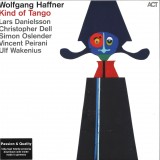
‘Kind of Tango’ is a kaleidoscope of shifting emotions. Wolfgang Haffner’s conception of tango has drama and propulsion in it but also melancholy and longing, with room for frenetic outbursts too. All this is unified by his inimitable groove and feel that commentators have called “an absolute dream,” “magical” and “profoundly relaxed.” Alongside trusted co-protagonists Christopher Dell and Lars Danielsson, he has two guests with him who defy all the clichés associated with tango: guitarist Ulf Wakenius cut his teeth musically in Oscar Peterson’s band and his Swedish heritage always shines through in his playing; Vincent Peirani is one of the leading innovators on the accordion and he finds new ways to define the instrument’s role in the tango. Also, young pianist Simon Oslender makes a first appearance with the band. Jazz and tango find a natural yet constantly shifting equilibrium - to be heard particularly effectively on ‘Close Your Eyes And Listen’ by Astor Piazzolla. In addition to compositions by Haffner himself and by his band members, pieces by the celebrated Argentinian bandoneon player and composer are the focal point of the album. Piazzolla’s innovations with the tango, such as bringing jazz into it, date from around 1955. Haffner and the tango
seem perfectly matched to each other. Tango is no longer a fixed style nowadays, it is above all an attitude to playing and an attitude to life. Wolfgang Haffner’s approach to tango is both authentic and new. It is his and his alone and it is irresistible.
- A1: Bigger Than Me
- A2: Fun
- A3: Really (Feat Yo Gotti, 2 Chainz, Soulja Boy & Ti)
- A4: Fuck Yo Feelings (Feat Lil Wayne & Chris Brown)
- B1: On One (Feat Ty Dolla Sign & King Marie)
- B2: Married To The Game (Feat French Montana, Sam Hook & Dubb)
- B3: The Purge (Feat Stacy Barth)
- B4: Trouble On My Mind (Feat Dubb Jake & Papa)
- C1: Cellphone (Feat Dubb)
- C2: Best Head Ever (Feat Tyga & Eric Bellinger)
- C3: Or Nah (Feat Too $Hort, Problem, Av & Eric Bellinger)
- C4: Take That (Feat Tyga & Pharaoh Prophet)
- D1: Food For My Stomach (Feat Dubb & Skeme)
- D2: Hit Em Hard (Feat Bobby Shmurda, Skeme & Freddie Gibbs)
- D3: Black On Black (Feat Young Jeezy & Kevin Gates)
The Bees are a textbook case of the chew and spit cycle that was the late 80’s South African music industry. Although their unknown story is likely unique, it is just as likely that it is no different to that of many other young artists who dreamed of getting their music heard at the time.
By 1988, the independent record label was no longer as uncommon as it had been at the beginning of the decade. As the 80s went on, more seasoned A&R reps and Producers that had gained experience and connections from their work under major labels would be trying to cash in on a market they helped create. Without the need of big rooms or expensive recording equipment, the digital advancements allowed many Producers to open or work in smaller studios and promote unknown artists under their own imprints. They would then have their catalogs marketed and distributed by the same major labels they had been working for just years prior. This would open up the possibility of a new era of stars as potential talent no longer had to be pitched to major labels in hopes of them taking a chance on a new signee over their already established artists. With the market growing and a struggle to keep up with the demand for new sounds this agreement would allow the major labels to put new emerging artists or groups on their catalog with little investment and high reward if it happened to be a hit.
ON Records was just one of the independent players at the time. Ronnie Robot had just signed the unlikely trio The Bees in hopes of adding a hit group to his label roster that consisted of solo acts. Despite the debut’s fresh house inspired sound, it failed to catch on was outsold by the bubblegum disco the label was known for. Over the years unsold back stock and promos would build up with the distributor. Luckily this allowed sealed copies from the label’s catalog to survive into the 90s when the distributor’s stock was unloaded and picked up by legendary Johannesburg jazz shop Kohinoor. Here sealed copies of the Bees first attempt sat under appreciated for over 20 years before becoming a hot title after they started circulating online and became club staples. This is how the first album of an unknown group with no success was able to become a collectors item and earn a reissue over 25 years later.
With their first record behind them The Bees were ready move forward and get back into the studio. A suggestion from producers had the trio change camps and go work with the newly formed Creative Sound Recordings, the label that promised “Music for the Future” and ended up being an essential studio in the early years of Kwaito. They would work with producer Chris Ghelakis and guitarist George Vardas, while a young Marvin Moses sat behind the desk. Musically the sophomore album was as good as a follow up as you could get. Building on the first album, Mashonisa delivers catchy melodies backed by heavy drum programming that would score points with any Pantsula. The Black Box inspired “ Never Give Up” was one of two tracks chosen to be pressed as the promo for the album, hoping to trick listeners with their catchy version of the hit( A year later the label would release their first volume of Black Box covers sang by neo soul diva BB, it would be a great seller). The label printed up an unknown amount of these in a last attempt to push the release in Shabeens and on Radio. The cheaper route of flooding the market with promo copies would only pay off 25 years later when unplayed copies started being rediscovered and had survived the years in a quantity that original run of the full album could not. Once again it was clear that with no mainstream appeal, the quality of the music on its own was not enough to garner any success at the time. The album flopped worse than their first and failed to make it past it’s initial run, making it one of the harder titles to get from the CSR catalog.
Mashonisa would be the last attempt from the Bees. They would disappear from the scene as quickly as they appeared. Of the three members it is only known that lead Singer Solomon Phiri continued in music fronting a wave dance group before he mysteriously vanished in 1993, never to be heard from again. Through a combination of luck and circumstance the group, which is unknown in South Africa to even the most plugged in musicians, producers and radio hosts of the time, managed to finally get some of the recognition they deserved 30 years later. Unfortunately this small blip of fame would happen with none of the band members present to give their side of the story, or even aware of how their two albums became popular enough to be printed on different continents in a new millennia. The Bees suffered the same fate as countless other artists of the time, who thanks to emerging independent labels and willing producers were given an opportunity to have a short career, only to be replaced by the meat grinder of the music industry when they failed to produce a hit.
Mameen 3 are soFa and Cheb Runner from Brussels. Both versatile players in the rather niche scene of oriental electronic music in the European capital, they only ran into each other at the Nyege Nyege Festival in Uganda two years ago. They clicked and after a first jam session they immediately launched Mameen 3.
Cheb Runner is the young Moroccan producer previously known as Gan Gah, now focussing on giving a modern outfit to various MENA music traditions. soFa is a true digger between all crates (his Pingipung Podcast is a gem!), as well as the curator behind the highly recommended Elsewhere vinyl compilations, released on labels such as Emotional Response or Music For Dreams. Following the Mameen 3 debut singles on Bongo Joe with excellent spaced out reggae- disco hybrids, Pingipung proudly unearths the Collapse EP featuring two collabs with legendary musicians.
A side: "Impostrazione" is a collaboration with Claudia Radulescu and Walter Hus. Radulescu is a Romanian visual artist who has written the lyrics for the song, boldly interpreted by the legendary Walter Hus on the occasion of her exhibition 'Hit' in Kanal - Centre Pompidou Brussels in 2019. Hus gained international reputation as a pianist in the 1980s and works as an avantgarde composer today, among many projects he created an opera for the graphic novel “Lint” by Chris Ware. Walter Hus performs an effusive vocal style accompanied by his modified Decap organ which became his trademark sound in the past decade. This jam delivered the material which Mameen 3 subsequently transformed into a hypnotic oriental slow-mo banger.
B side: "Wireless C" features another music veteran, Rodion GA, who describes himself as „Romania’s first one man band". He produced a remarkable electro-prog output in the 1970s and 80s. “Rodion GA sounds like he learned about music from hearing someone describe it in their second language, drunk. It sounds like nothing else: wrong in all the right ways,“ says The Guardian about his music. His collab with Mameen 3 turns out as a balearic, space reggae trip, with dreamy vocals by Rodion and solid bass, definitely a hymn in this year’s festival season, if only there was one...
2LÄRM UND STAHL 2" is a new worldwide radiography of the actual “hidden” scene in dark electronics offering sharp- and crude minimal industrial beats as it's best; the featured bands are 89’s† from Mexico, S.A.D from UK, PALMARIELLO from Argentina & CHRIS SHAPE from Italy. All tracks have been specially remastered for LONG CUT Vinyl by Daniel Hallhuber at Young & Cold Studios!
Born in Paris, raised in Vienna, resident in Ibiza, saxophonist and composer Muriel Grossmann embodies the borderless, pan-continental energies of contemporary European jazz. Her music emerges from the lineage of European jazz that's absorbed the progressive music of Coltrane, Dolphy and Sanders. Today, she cites players such as Illinois Jacquet and Lester Young in the same breath as the masters of the avant-garde, and her playing marries the directness and eloquence of the older generation with the questing, spiritualised playing epitomised by Coltrane. The roster of musicians she has played with is long, and includes veteran European avant-gardists including Joachim and Rolf Kühn, Wolfgang Reisinger and Thomas Heidepriem, and she works tirelessly with contemporary groups and big bands across the continent.
Since her first recordings in the early 2000s, Grossmann has released a dozen albums as leader, featuring sounds ranging from hard-swinging modernist jams to free improvisation, expansive spiritual work to rhythm-focussed Afrocentrism. But at the centre of her work is a thread of pure and heartfelt spiritual music in the modal tradition defined by Coltrane and close collaborators like Pharoah Sanders and Alice Coltrane. You can't play this music successfully if you don't mean it – like the music of her contemporary Nat Birchall, Grossmann's engagement with the Coltrane tradition is sincere and deep. Her music resonates within the tradition – more than just a style, it adds a new chapter to the story of modal and spiritual jazz in Europe.
This Jazzman set draws a selection from her 2016 album Natural Time ('Your Pace', 'Peace For All') and from 2017's Momentum ('Elevation', 'Chant' and 'Rising'). Featuring her regular quartet of Radomir Milojkovic (guitar) Uros Stamenkovic (drums) and Gina Schwarz (bass), the music on Elevation is pure sound, soul and spirit!
- LP only with thick tip on sleeve- Download card included inside
"Timeless and innovative... a musical genius" Mike Gates, UK Vibe
"A listening experience akin to transcendence" Andrew Jones, Down Beat
"Vibrant, passionate, exhilarating. A monument of spiritual jazz" Mark Sarazzy, Impro Jazz
"A journey that takes off like missile, passes through meditation, reaches nirvana and ends with thanksgiving" Elliot Simon, NYC jazz records
"Timelessly beautiful" Christian Bakonyi, Concerto
For Patrick Flegel, Cindy Lee is more than just a recording music project. It is the culmination of a lifelong exploration of art, the electric guitar, queer identity and gender expression. "Singers like Patsy Cline and The Supremes carried me through the hardest times of my life," explains Flegel, "and also provided the soundtrack to the best times."
Following the dissolution of Canadian experimental indie band Women, Flegel would delve deeper into songwriting that bends further toward high atmospherics and bracing melodies – a unique space where splendor naturally collides with experimentation. Delivering moments of sheer beauty through somber reflections on longing and loneliness, Cindy Lee is something to hold onto in a world of disorder.
What's Tonight To Eternity, Cindy Lee's fifth long-form offering, showcases the project's most entrancing strengths: ethereal snowdrift pop and sly nods toward classic girl-group motifs. Recorded at Flegel's Realistik Studios in Toronto and featuring younger brother Andrew Flegel on drums, the album travels hand in hand with a spectral guide.
Flegel found inspiration for Cindy Lee in the form of Karen Carpenter, drawing on the singer / drummer's early recordings as well as her look and style. "I found a deep interest and comfort in Karen's story, which is a cautionary tale about the monstrosity of show business, stardom at a young age and being a misfit looking for connection. The darkness and victimizing tabloid sensationalism she suffered is easily tempered and overwhelmed by her earnest output, her artistry, her tireless work ethic. Something utterly unique and magical takes shape in the negative space, out of exclusion. What I relate to in her has to do with what is hidden, what is unknown."
What's Tonight To Eternity remains a mix of pop culture indoctrination, pain and suffering, hopes and dreams, fierce confrontations and wide-open confessional blurs. Closing with the song "Heavy Metal" (dedicated to the memory of former Women bandmate Chris Reimer) and adorned by Andrea Lukic's Journal of Smack artwork, the album continues the bold and rewarding path on which Cindy Lee has embarked.
Pacific Express emerged from Cape Town, South Africa in the 1970s. The band were from the so called "Coloured" community and were ground breakers in both musical and political arenas. The founder members Paul Abrahams (Bass), Jack Momple (Drums) and Issy Ariefdien (Guitar) were joined by Chris Schilder (Piano), Vic Higgins (Pecussion), Barney Rachabane (Alto Sax), Stompie Manana (Trumpet) and Zayn Adams & Kitty Tshikana on vocals for their second album "On Time" in 1978.
On several occasions the group fell foul of Apartheid laws and discrimination by the state broadcaster, SABC. On one occasion they were asked to leave the stage of an international tour by Australian act John Paul Young, because the law forbade racially mixed performers on the same stage. The promoter, management and band members all resisted and once he incident made the Australian newspapers the authorities had little choice and turned a blind eye.
And so to the music. The most important thing. The LP opens up with the slick jazz-boogie funk of "We Got A Good Thing Going On", a perfect vehicle for the vocals of Zayn and the statement-of-intent, on-point musicianship of the band.
"I Hear Music" is the first of three smooth sweet string-laden ballads to feature on the LP. The majority of the songs on the LP were written by keyboard player Chris Schilder. As well as high-craft songwriting Chris also contributes layers of effortless musicality with his Rhodes and piano. "Good Old Days" (the only cover on the LP) is next and its smooth-rock grooves swing effortlessly to the fore. The A-Side of the vinyl closes with the instrumental jazz funk of "Saturday Night".
The flip side of the album opens with the bands biggest commercial success. A sweet soul ballad penned "Give a Little Love". Stepping outside their usual sound. This hit however was not without controversy as the video was removed from the TV airways after the South Africa Broadcasting Corp realised that the group were of mixed race, which was against rules for so called local artists in public performance at the time.
"Dream" follows on with the driving jazz rock and travelling keyboard solos. "Reaching Out For Love" is a power-pop boogie groover powered by guest vocalists Erica Lundy and Kitty.
"Say The Last Goodbye" is the last of the trio of ballads. A smooth style moment sounding all the bit like a 70's US TV drama closing theme. The LP features with a funky workout where the band show off their chops and slick level of musicianship.
Besides the success in southern Africa this album became a regional hit as a pirated music cassette in Nigeria. It was also released in France and Japan.
The band would go on to record one further LP in 1979 and a single in 1981. They carried on performing however well pass that. Throughout their years together the band acted as central hub for Jazz musicians within the Cape Town area. Players as Tony Cedras, Jonathan Butler and Alvin Dyers gaining experience alongside established names such as trumpeter Stompie Manana and alto saxman Barney Rachabane.
Here at World Seven we are ever so pleased to be re-releasing what we consider the bands finest album moment.
The hyper talneted Stellar Om Source (NOT NOT FUN, RVNG, NO 'LABEL) blowing up new styles on this one!
"If there is one thing that leaps out from Stellar OM Source’s music, it is the sense of a highly active mind at work. There is an indivisible feeling that a real person is behind this dynamic flurry of tones, waves, vibrations and modulations. On I See Through You, the first full Stellar OM Source release in over four years, the spark that first LP piqued the interest of so many listeners is glowing stronger than ever.
In the 2010's, Christelle Gualdi carved a name as one of the most essential live electronic musicians around, dazzling dancers and home listeners in kind with her bombastic, acidic hardware jams. Circumstances outside her control forced a stop for the Stellar OM Source project. It was touring, including two shows in the summer of 2019 at Dekmantel Festival and Listen! that Gualdi credits as year highlights, which proved to be the integral jump-start to the engine.
Inspiration came rushing back thanks to the human connection of performing. Seeing a younger generation connect with her put fresh charge into the circuitry of her gear. All this accrued into new material on the road, and thus I See Through You was born.
The spirit of 2013’s cult favourite Joy One Mile is alive and well on I See Through You. There is once again immediacy, urgency and lust. But Stellar OM Source stepping into a comparatively more poppy and playful mode on these four tracks could also throw some. Fundamentally she says, it comes from a similar place, and ends with an enmeshed and positive outcome. Gualdi credits both “1995 rave” and “the clarity, bass and breath” of hi-def hip-hop productions as being twin northern stars for her to follow.
The artwork comes from friend and highly respected photographer & director Pierre Debusschere, whose work similarly flits between arresting close-ups and, well, the widescreen luxe of Beyoncé videos. “I’m definitely not a purist anymore,” Gualdi laughs – and with club-ready impact meeting human warmth, this shows in abundance.
“Night Alone” wastes no time in getting the listener up to speed. Is that an LFO sample running through “Night Alone”? Is this a lost Metro Area classic? Is that Stellar OM Source taking a diversion into searching Ibiza-rousing vocal for a moment, or did we imagine that in a heat haze? Where are the kicks? Oh there they are. How many elements are buried and revived within just over five minutes?
It’s hard to tell. Before we know it, “Lost Codes” is up and away, keeping pulses racing. A pitter-patter of baby kicks feel like a pre-tremor before a welting electro-Italo lead crashes into play. With fizzing energy, rasping synths and a frisson of danger, fans of Unit Moebius and The Hacker will be doing somersaults of joy.
“White Echoes” wastes kicks off the flip side with low gurgles descending briefly like a UFO reverse parking into the spot SOS had vacated. Soon, 303s are twisting like Chinese burns while warm chords offer a salve. The mood maintains on “Wild Palms”, the only song on this record not to feature additional mixing work from Peaking Lights’ dub-wise sensei Aaron Coyes.
True to form, the B2 is all Stellar: elements switching up and out, with all the fun and frenzy of capital-L Live action. Kick drums and bassline darting back and forth like a synchronised swimming routine, all elements in concert. The momentum of a runaway mine cart that you can’t help but strap yourself to. I See Through You is one for the dancers who have given Stellar OM Source the motive to move forward once again."
“Osondi owendi. What is cherished by some is despised by others. One man’s meat is another man’s poison. Different strokes for different folks. To each their own. Osondi owendi.
It’s a conventional aphorism in the Igbo language but if you utter the word “osondi owendi” in Nigeria today, the first thing that comes to anybody’s mind is the cucumber-cool highlife music maestro Chief Stephen Osita Osadebe and his legendary album that takes its name from the adage. Released in 1984, Osondi Owendi was instantly received as Osadebe’s magnum opus, the crowning event of an exalted career stretching back to the early years of highlife’s emergence as Nigeria’s predominant popular music.
Stephen Osadebe first appeared on the music scene in 1958 as a spry, twenty-two year-old vocalist in the Empire Rhythm Skies Orchestra, directed by bandleader Steven Amechi. With his dapper suits, urbane Nat King Cole-influenced vocal stylings and jaunty, uptempo, calypso-scented dance tunes, he personified the frisky spirit and anxious aspirations of a young, educated generation that had come of age in the wake of the Second World War, in a Nigeria that was rapidly shaking off British colonization and marching towards an independent future. 1959 would be the year that he truly made his mark in the business with his debut solo single “Lagos Life Na So So Enjoyment.” A giddy exhortation of the music, sex, fun and freedom availed by life in the big city, the song became a sensation and an anthem, and Stephen Osadebe became the leader of his own popular dance band, the Nigerian Sound Makers.
Osadebe would ride this wave of acclaim through most of the nineteen sixties, but a change in direction would be called for at the dawn of the seventies. As Nigeria emerged from a devastating civil war, so did a new generation of youth inspired by rock and funk, confrontational sounds reflective of a more violent, less idealistic era. All of the sudden, the idioms of the post-WWII dance orchestras that nurtured Osadebe’s cohort seemed quaint, the stuff of nostalgia. Osadebe needed to evolve to respond to the new tumultuous, turned-up times.
His response? He cooled it down.
Abetted by a new crop of fire-blooded young players, Osadebe slowed his music to a mellow, meditative tempo, brought forward the lumbering, Afro Cuban-accented bass and percussion, from the rockers he borrowed searing lead lines on the electric guitar. Over this musical bedrock, doesn’t so much as sing as he dreamily muses, coos, sighs aphorisms, words of wisdom and inspiration. “When one listens to my music, all I say appears meaningful,” Osadebe explained his lyrical approach, “at times they are in the form of proverbs which provoke much thought afterwards.” The result is a blend that is both rollicking and soothingly languid. Osadebe christened the style Oyolima—a tranquil, otherworldly state of total relaxation and pleasure. Osondi Owendi represents oyolima at its finest, and possibly Nigerian highlife in epitome.
Osondi owendi. What is cherished by some is despised by others. In some way, the album’s title constitutes a paradox. Because Osondi Owendi is a record that it’s almost impossible to imagine being despised by anybody."
WRWTFWW Records is beyond thrilled to announce the first ever vinyl maxi-single release for "Raum", Grauzone's best-kept secret and underground mega-gem from 1980. The four-track affair includes the full title track sourced from the original reels, as well as a club-ready rework by Naum Gabo (Jonnie Wilkes of Optimo and James Savage) with help from Dennis Young of Liquid Liquid, and an extended edit by legendary Frankfurt DJ Ata (Robert-Johnson club, Playhouse/Klang/Ongaku labels). The 12 inch vinyl is cut at 45rpm and comes with a never-seen cover art by band member Stephan Eicher and a handmade Xerox hype sticker.
Initally released almost 40 years ago on the beloved compilation Swiss Wave - The Album (Off Course Records) alongside the band's massive hit "Eisbär", "Raum" is the biggest Grauzone track people have yet to discover. An über-infectious New York style bassline played by Christian "GT" Trüssel and frantic drumming by Marco Repetto blend with Martin Eicher's hauntingly hopeless lyrics and Claudine Chirac's saxophone escapades to personify post-punk heaven and all its wonderful anomalies. It's disco with an edge, pop filled with fear, it's The Cure infused with proto-techno and Swiss art chic. Or maybe, it's simply one hell of a song that will make you dance and shout. It's good!
When acclaimed South African musician Guy Buttery first sought out Dr. Kanada Narahari in late 2016, it was as his patient.
“It was a dark time.” Buttery recalls, “I had been bedridden for months and had been suffering from debilitating bouts of fatigue which no diagnosis or medication could help me get to the bottom of. When I first met Kanada, I was at the stage where even picking up my guitar to make music had become a joyless and taxing exercise.”
As Buttery’s searched for a cure, a family member recommended he see Kanada an Ayurvedic doctor who had relocated to South Africa from India and set up a practice in Durban. It was during this consultation, that the musician first experienced how Narahari infused the healing properties of Indian Classical music into his practice. Rather than treating him with a smorgasbord of pharmaceuticals, Narahari played his sitar and set Buttery on a strict daily diet of Raga’s to fast track his recovery.
Buttery was not only struck by his doctor’s musical talents but by the powerful healing properties inherent in his sitar compositions. When he left Narahari’s doctors room that afternoon, he asserts he was feeling decidedly clearer, lighter and stronger.
“Diving into Kanada’s music was definitely one of the reasons I'm still here today.” he admits. “The consistent tonal centre at the heart of Indian Classical Music, literally became my support pillar over this period. A central core of sorts in which to fall back on, strengthen and discover.”
Narahari as it turned out, was not only a prominent music therapist (and one of the only Ayurvedic doctors practicing in South Africa) but like Buttery, a highly accomplished musician with a devoted following back in his homeland.
Born in a small village along the Western Ghats in Karnataka, India, Narahari, at the age of nine, had enrolled to study Carnatic classical vocal and developed an interest in Hindustani Classical music with a particular passion for the sitar. While Buttery had secured his reputation as one of South Africa’s musical treasures, a multi-instrumentalist who commands sold-out performances both locally and internationally and more recently had been awarded the prestigious 2018 Standard Bank Young Artist for Music.
From this consultation, a friendship developed between the two musicians with Buttery soon inviting Narahari to join him in his studio. But it wasn’t all plain sailing in the beginning. While Buttery and Narahari’s sensibilities were very much aligned, there were a range of cultural and musical influences, nuances and inflections that first needed to be navigated and understood.
“I suppose we had to find a common ground.” Buttery says, before adding, “Which in the end turned out to be pretty "uncommon ground" for the both of us.”
It was after a few intensive sessions together that something exhilarating began to emerge. What began as a few idle improvisations soon evolved into feverish and lengthier jams. Whenever time permitted, the musicians would meet, descending deeper into the emerging sounds, while reimagining the realms that existed between their African and Indian heritages.
Over the next few months, the duo would rack up over fifteen hours of recordings in studio, and it was up to Buttery to shape the material into an album which they collectively titled Nāḍī, which Narahari translates from the Sanskrit as "The Channel" or "An Internal River".
During this period, Narahari bestowed upon Buttery, the moniker Guruji while Guy would refer to him, in affectionate return, as Panditji. Each time the musicians would meet, the studio space would be cleared by an impromptu ritual, with Guruji burning African Imphepho while Panditji would chant a Sanskrit mantra dusting Indian Agarbatti clouds over their instruments.
Once the room had been made hazy with this aromatic alchemy (with the ancestors welcomed in) the musicians would pick up their instruments and plunge into shimmering tides of sound. Reflecting on these sessions, Narahari recalls the immense creative freedom he felt throughout: “Guy and I tried to wander as much as possible, without any speculative, preoccupied ideologies or limitations. Love remained at the forefront of our journey together.”
“Those evenings we spent together in the studio” adds Buttery, “felt incredibly rich with purpose and a profound sense of freedom. While improvising, anything could happen and mostly did.”
On a first listen, the tracks on Nāḍī emerge as salty, humid invocations to the inscrutable depths and misty myths of the Indian ocean-- that vast body of water that stretches between, and laps the shorelines, of the artists’ respective homelands.
When asked to describe the sound him and Narahari refined, Buttery prefers to relay a series of evocative images.
“For me” he explains, “Nāḍī is a lighthouse, a beacon that resides at the bottom of the ocean.” As Buttery envisions it, “what once offered light to guide ships to safety, has been submerged and re-purposed by marine life as a coral-reef temple. Similarly, this sunken lighthouse exists as a concealed cenotaph, memorializing the ancient sea-routes and passages that once connected the two distant lands.”
On paper this may sound obscure but listening to the songs, it serves as an apt metaphor.
Across each meditative movement, listeners are able to relive the journey, immersing themselves in a series of incantations, replete with high dynamics, delicate African-Indian inflections and virtuoso string playing of an entirely new order. Further complimenting the fusion of musical dialects are a range of guest artists including Shane Cooper on bass, Thandi Ntuli on vocals, Chris Letcher on organ, Ronan Skillen on tabla and percussion and Julian Redpath on guitar, synth and backing vocals.
Now like the submerged lighthouse, the recordings stand as a monument, a marker and snapshot of this fortuitous meeting, a tribute to the healing gifts of Guruji and Panditji in performance. It’s a process that already, both musicians look back on with reverence and nostalgia.
Buttery ruminates in closing, that when he first met Kanada his illness correlated with the biggest drought South Africa had experienced in many years “…for whatever reason, whenever we would connect and make music together, the sky would tend to open. Even if it was just a few drops. This went on for months, until finally the drought dissipated and my health had been restored.”
By the time the heavens did open across the East Coast, a deep friendship had been forged and with it abundant musical offerings poured down. A treasured sample of which we able to share in every time we press play and immerse ourselves in the sacrosanct musical universe that is Nāḍī.
Lokalophon is the newly established sub-label of Philophon, which is designed to release local specialities from potentially all around the world. The first 7" is by Ghanaian Frafra-Gospel singer Chris De Wise Shepherd.
Born in Bolgatanga, he moved as a young man from the rural north of Ghana to its coastal capital Accra. Consequentially, his style became more urban. That you can clearly hear on his 2012 release Nera Wo'o Soke, which sounds in some ways as if Grandmaster Flash himself were operating the production knobs. Atune Anya'alima on the other hand is pure Frafra-Gospel as it is usually performed in Northern Ghana.
Recital publish the newest record by Canadian composer Sarah Davachi. Currently working on her PhD in Musicology at UCLA, her trajectory has been unorthodox. Hailing from Calgary, Alberta, which, if you've never been there, doesn't really scream "Avant-Garde" (Calgary is the rodeo capital of the world). From a young age, Sarah was a driven pianist (and figure-skater, although that's a story for a different time). It is important and interesting that she chose to study esoteric music; as Sarah could have easily been a cowgirl or a concert pianist had her ingrained love of synthesis and sonic phenomenology not taken the wheel.
Sarah is a considered person. I find few people that have the diligence and resolve to take their time with music... especially in a live context. I respect that about her. The first time I saw Sarah perform, I presumptuously told her that her music reminded me of my favorite Mirror albums (the exceptional project of Andrew Chalk and Christoph Heemann). Sarah was not familiar with Mirror, so the compliment was initially lost on her. Years back I was in the same situation when a review compared my music to Andrew Chalk, who was unknown to me at the time. So I felt a kinship in our magnetic drift towards unspoken and clustered beauty.
Let Night Come On Bells End The Day follows the release of her "sound-wheel" LP All My Circles Run, which examines the isolation of different instruments. Let Night Come On..., recorded mainly with a Mellotron and electronic organ, feels like a return to the nest. Burrowed in the studio, Davachi was the only performer on this album. She both splays her compositional architecture and re-contextualizes the essence of her early output. She chiseled careful and shadowed hymns; anchors of emotion.
Two pillars of this album are "Mordents", which to my ears drops hints of her love for Progressive rock music - and "Buhrstone," comparable to a sombre funeral march of piano and flutes. These two examine punctuations of early music, gently plucking melodies and movements. The three other compositions are tonal works, blowing slow jets of lapping harmonics.
Writing this description now, I find it hard to separate "At Hand" from filmmaker Paul Clipson, who made a melancholic film for this piece of Sarah's. A fitting title for Sarah and Paul's relationship - frequently working in orbit of each other, meticulous and tactile. I cherish this track as a memory of Paul.
This is a lovely album to fill an evening living room with. A blanket, a cup of wine, a dim bulb, a wide window.
Three beautiful photo-prints by Davachi are included with Let Night Come On Bells End The Day. Frames are not included.
- Sean McCann
One of the greatest enigmas of the music scene in mid to late 1970s Harare was The New Tutenkhamen, a band which played an eclectic brand of Zimbabwean township music combining
traditional rhythms and western influences. The band included some luminaries of Zimbabwean township music. Elisha Josamu was an alumnus of the fabulously-named Hallelujah Chicken Run Band (alongside Thomas Mapfumo), and Green Jangano’s long-running Harare Mambos, and would later form Two Plus Two with bassist Christopher “Chex” Tavengwa. Jethro Shasha played the drums, and would arguably become the New Tutenkhamen’s most famous export, making continental waves working with likes of Salif Keita. Paul Sekerani played the rhythm guitar, with Amos Chatyoka on the organ, while the enigmatic Maggie Mbuli provided vocals and F. Manda played the sax. The New Tutenkhamen recorded I Wish You Were Mine at Teal Records, produced by Crispen Matema, a talented jazz drummer in his own right who had played drums on the all-time classic Skokiaan, and had backed Louis Armstrong on his 1960 Rhodesia visit. Combining the
heavyweight producing talents of Matema and the writing chops of Josamu, The New Tutenkhamen band created an album howcasing various musical styles popular at the time. From the afro-jazz jam session aesthetics of “Tutenkhamen Theme”, “Big Brother alcom” and “Forever Together”, to the almost Van Morrison-sounding “Sunday Morning”; from the upbeat rock ballad “True Love”, to the funk-infused dance song “Togetherness”; from the bouncy jazz
exhortations to work hard in “Ane Nungo”, to the brassy, raunchy foot-stomper “Me & Dolly”. The title track “I Wish You Were Mine” is a ska-infused ballad that wouldn’t be out of place in post-war
Birmingham, while the star of the show is “Joburg Bound”, itself a fast-paced rock piece with Motown undertones and funky guitar lines. As a collective effort, I Wish You Were Mine provides a fascinating insight into a fraught time in Zimbabwe’s history, and the bands plying their trade through the turmoil, making music for young people, by young people.
- A1: Sceechie Dan - We A Don
- A2: Lone Ranger - My Number
- A3: Dennis Alcapone - Riddle I This
- A4: Kentrus - It A Fi Bun
- A5: Lone Ranger - Apprentice Dentist
- B1: King Sporty - Dj Special
- B2: Prince Jazzbo - Little Joe
- B3: Jim Brown - Ragga Muffin
- B4: Mad Roy - Universal Love
- B5: King Sporty - Choice Of Music
- C1: King Stitt - Rhyming Time
- C2: Prince Jazzbo - Fire Coal Version
- C3: Dillinger - Fountain On The Mountain
- C4: Michigan & Smiley - Thank You Jah
- D1: Prince Garthie - Raindrops
- D2: Jah Buzz - Automatic Clapping
- D3: Dennis Alcapone - El Paso
- D4: Big Joe - Nanny Version Skank
Featuring Prince Jazzbo, Dillinger, Dennis Alcapone, Lone Ranger, Michigan & Smiley and many more. Soul Jazz Records’ new Studio One DJ Party is the latest installation from the mighty Studio One Records catalogue, a wicked new collection of the finest DJs and toasters ever to inhabit the world of reggae – seminal Jamaican artists including Prince Jazzbo, Dillinger, Dennis Alcapone, Michigan & Smiley, Lone Ranger as well as a host of lesser known artists and rare cuts from Studio One. From the earliest days when Clement ‘Sir Coxsone’ Dodd ran his Downbeat soundsystem up and down the length of Jamaica, DJs and toasters such as King Stitt and Count Machukie were always a part of the sound of Studio One, introducing new records and exciting audiences with catchphrase lines such as: “No matter what the people say these sounds lead the way It's the order of the day from your boss deejay” King Stitt So when DJ emerged as a distinct reggae style at the start of the 1970s, Studio One was, as always, way ahead of their competitors. Legendary artists of the calibre of Dillinger, Dennis Alcapone and Prince Jazzbo all queued up to record for the equally legendary label. At the end of the 1970s, as dancehall exploded onto the island, Clement Dodd was once again able to maintain Studio One’s position on the throne as the number one sound in the Jamaica, fighting off upstart competitors such as Channel One and Joe Gibbs who tried to replicate Studio One’s unique sound. During this period Clement Dodd released a series of stunning dancehall releases from young DJ/dancehall artists at the label including Lone Ranger and Michigan & Smiley. This selection spans the early 70s up until the mid-1980s, from the earliest days of deejay toasting right up until digital dancehall, ground-breaking tracks over the finest selection of the ultimate Studio One rhythms and tracks. Who could ask for more? Studio One DJ Party includes specially commissioned sleevenotes by Chris Lane, founder of the legendary British reggae label Fashion Records, as well as fantastic original artwork commissioned by the illustrator Ski Williams. The album is released as double heavyweight vinyl (+download code), and distinctive Soul Jazz Records CD with slipcase
DJ Richard's first release of 2019 sees him drop four invigorating electro tracks on Flexxseal titled "Eraser".
Emerging from the Providence noise scene, DJ Richard forges a path of disciplined selectiveness as a producer and DJ with his idiosyncratic style allowing him to make impressive, self-assured connections between 80s EBM, new beat and Italo disco, electro, techno and "post-minimalist" house. DJ Richard's feral approach evolved from the roots of his White Material imprint which quickly achieved cult status after early releases from himself and co-founders Galcher Lustwerk and Young Male.
As a solo artist, DJ Richard continues to push the boundaries of his talent and influences reflected in his two utterly distinctive and bewitching albums released in alliance with influential German electronic label, Dial. "Eraser" sees him join up with fellow American Christopher Joseph and his Flexxseal imprint as DJ Richard masterfully maintains his skill in propagating ephemeral and raw sounds with his aptitude for electronic body control.
"Critical Damage" kicks things off with resilient oscillations fused beautifully with angelic leads and thudding percussion reflecting a post-punk aesthetic while "Eraser" delivers tough, acidic swirls undulating beneath sharp, broken grooves and growling undertones.
On the flip, a slow, chugging drum sequence balanced with haunting modulations and machine-like vibrations that echo throughout take the focus in "His Threshing Floor" before "Casca's Theme" concludes the EP with meandering, robotic synth flutters and distorted bass resonations driven by hypnotic rhythms and world-ending atmospheres in this powerful electro cut.
Death & Leisure is proud to announce the sophomore album from the very special Autumns.
6 tracks of raw sneering electronics. Coming out in spring.
Autumns is the solo project of Christian Donaghey, From Derry, Ireland, an outlet for electronic post-punk with a lethal pulse. After a brace of rough demos without preliminary hype, the project emerged fully formed on Karl O’Connor’s (aka Regis) illustrious label Downwards back in 2014, the youngest act in a new vanguard of artists that included the likes of Tropic of Cancer, DVA DAMAS and The Kvb.
– Extended Autumns biography here-
Autumns is the solo project of Christian Donaghey, From Derry, Ireland, an outlet for electronic post-punk with a lethal pulse. After a brace of rough demos without preliminary hype, the project emerged fully formed on Karl O’Connor’s (aka Regis) illustrious label Downwards back in 2014, the youngest act in a new vanguard of artists that included the likes of Tropic of Cancer, DVA DAMAS and The Kvb.
Preceding releases for Clan Destine Records, iDEAL Recordings and DKA Records have seen the project engaged in a rough trade of transgressive noise, dysfunctional metal dance and DIY punk angst, yet each of these milestones has represented a different proposition. 2016’s ‘A Product of 30 Years of Violence’ saw the project moving into vast glacial spaces after propulsive post-punk discord of 2015’s ‘Das Nichts’. 2017 presented a further progression into Autumns’ journey from his post-punk beginnings to producing some of the tautest and no bullshite electronic music around with the release of his debut album ‘Suffocating Brothers’ on Clan Destine Records. Gaining radio play from selectors like Trevor Jackson, Regis, Debonair and Giant Swan.
Alongside progressive appearances on cult labels the project has developed a notorious high-intensity live show, having played and toured with artists such as Silent Servant, Veronica Vasicka and Wire, performing to audiences from Los Angeles to Beirut, and Moscow to Berlin. Autumns’ has also ventured outside the typical music world by taking up projects such as performing alongside Samuel Kerridge at the 2016 edition of Paris Fashion Week for Downwards, creating a sound installation at Void Gallery, and improvising a desolate live score to David Lynch’s ‘Twin Peaks: Fire Walk With Me’. Earning Autumns a fierce reputation not only as a live act, but as a multi-disciplinary artist.
Following contributions to labels such as Amok Tapes, Touch Sensitive, Veyl (Maenad Veyl) and Earwiggle (Sunil Sharpe), as well as remixes for Strange Therapy, Infidel Bodies, and Clan Destine Records. 2019 see’s Autumns’ experimentation in the studio go much deeper, with the release of his sophomore album ‘Shortly After Nothing’ on Oliver Ho’s (aka Broken English Club) innovative ‘Death & Leisure’ label, alongside a heavy touring schedule, a collaboration with post-punk legend Eric Random, the launch of his radio show ‘Dyslexia Tracks’ on Dublin Digital Radio and more upcoming releases to surface throughout the year.
Available on vinyl for the first time in 40 years, Outernational Sounds proudly presents a cornerstone document from the Los Angeles jazz underground, Flight 17 – the first appearance on record of the legendary Pan-Afrikan Peoples Arkestra, led by their founder and mastermind, Horace Tapscott.
"The Arkestra would allow the creativity in the community to come together, would allow people to recognize each other as one people and ask, “Now what can we do to make this community better? What can we do for this community together?”...That’s how the Pan-Afrikan Peoples Arkestra – the Ark – began, with the knowledge that we wanted to preserve the black arts in the community."
Horace Tapscott
Horace Tapscott’s Pan-Afrikan Peoples Arkestra (P.A.P.A.) was one of the most transformative, forward-thinking and straight-up heavy big bands to have played jazz in the 1960s and 1970s. Countless musicians passed through its ranks, and in Tapscott it was led by a musical visionary who should be ranked with the very greatest names in the music. If P.A.P.A. doesn’t have the interstellar rep of that other famous Arkestra, and if the name Tapscott doesn’t ring bells like Monk or Tyner, there’s a reason why: in an industry dominated by record labels, a band that doesn’t record doesn’t count. And the Pan-Afrikan Peoples Arkestra didn’t record for nearly twenty years. But recording success was never their concern – they weren’t about that.
First formed as the Underground Musicians Association in the early 1960s, Tapscott always wanted his group to be a community project. From their base in Watts, UGMA got down at the grassroots. They played for the people, organising fundraisers in parks and coffee houses, hosting teach-ins and workshops for young and old, and mixing it with radical theatre groups, firebrand poets, political radicals, Black separatists, community groups and churches. They lived communally, supporting each other and their people, and built an ark for the Black arts in the heart of the city. The group was renamed the Pan-Afrikan Peoples Arkestra in 1971, and soon after they established a monthly residency at the Immanuel United Church of Christ which ran for over a decade, while still playing all over LA and beyond. But through all this, they never released a note of music.
It was the intervention of Tom Albach, a fan of Tapscott and the group, that finally got them on wax. Determined that their work should be documented, Albach founded Nimbus Records specifically to release the music of Tapscott, the Arkestra, and the individuals that comprised it. The first recording sessions in early 1978 yielded enough material for two albums, and the first release was Flight 17. From the surging avant-gardism of Herbie Baker’s title track to the laid- back summertime groove of Kamonta Lawrence Polk’s ‘Maui’, or Roberto Miranda’s uptempo Latin jam ‘Horacio’, Flight 17 showcased the radical voices of the Arkestra’s members. Led out by Tapscott’s hard-swinging piano, this is the first flight on wax of the West Coasts’ foundational community big band – energised, hip and together. Open up the gates and prepare for departure!
This edition of Flight 17 contains two tracks previously only available on the 1997 CD edition: ‘Coltrane Medley’ and ‘Village Dance’, recorded live at the Immanuel United Church of Christ. It is released as a limited vinyl-only edition on a 180g pressing by Pallas. Fully licensed from Nimbus West founder Tom Albach.
Available on vinyl for the first time in 40 years, Outernational Sounds is proud to present a masterpiece from the Los Angeles jazz underground - Horace Tapscott's burning, spiritualised 1978 set, The Call.
One of the unsung giants of jazz music, the composer, bandleader, arranger, pianist and community activist Horace Tapscott was the undisputed keystone in the grassroots Los Angeles jazz scene. Throughout the 1960s and 1970s, his radical community arts and music formations the UGMA (Underground Musicians Association, later changed to UGMAA - Union of God's Musicians and Artists Ascension), and his protean big band, the Pan Afrikan Peoples Arkestra, were at the epicentre of music, culture and politics in the Los Angeles area.
From their 1960s base at the Watt's Happening Coffee House on 103rd St, to their decade-plus- long 1970s residency at the Immanuel United Church of Christ on 85thE St and Holmes Ave, Tapscott's groups were the beating heart of underground music in LA. Hundreds of musicians passed through and played their part. Major figures in LA jazz such as Arthur Blythe, Azar Lawrence, Jimmy Woods, John Carter, Bobby Bradford, Sonny Criss, Ndugu Chancler and dozens of others all paid dues or just got down with Tapscott, not to mention the core Arkestra regulars who have since become celebrated names - Nate Morgan, Jesse Sharps, Adele Sebastian, Dadisi Komolafe, Gary Bias, to mention only a few.
Tapscott and the Arkestra were down on the ground - playing fundraisers in park and street, organising teach-ins and workshops for young and old, mixing it with radical theatre groups, firebrand poets, political radicals, Black separatists, community groups and churches. They lived communally, and built an ark for the Black arts in the heart of the city. But as a result of this grassroots community focus and Tapscott's antipathy to the music industry, the Arkestra didn't record for nearly two decades. That only changed when long-time jazz fan Tom Albach started Nimbus Records. The label was initiated specifically in order to document Tapscott and his circle, and the first three records showcased Horace and the Arkestra.
The Call was put together from two studio sessions in April 1978, one at Hollywood Sage and Sound, one at United Western - the latter session had the addition of a string section, who can be heard on the moody Cal Massey composition 'Nakatini Suite' and Jesse Sharps' swinging modal trip, 'Peyote Song No. III', with its swirling soprano solo. In keeping with the communal nature of the Arkestra, the other two compositions, 'The Call' and 'Quagmire Manor at Five A.M.' are also by Arkestra members. But at the centre of the music is the builder of the Ark, the visionary whose original call to action started a movement whose legacy continues to this day - Horace Tapscott.
Heed The Call!
- A1: Eets - Savage
- A2: Jeremiah - Jae Tell Me
- A3: Father - Cruel
- A4: Max B - Flash Dance
- A5: Caleb Stone - Slayer Cake
- A6: Budgie - On My Shit
- B1: Jayallday - 1-800 Killer Whale
- B2: Jonwayne - Welchs Grape
- B3: Lovibe - Gd
- B4: Prince Naeem - Shiraz
- B5: Mndsgn - Noodles
- B6: Fifth - And I Swear
- B5: Manchild - Cold Blooded
- B8: Nahh G - Moma
- C1: Kaytranada - Well I Bet Ya
- C2: Kojaque - Whitney
- C3: House Shoes - Intergalactic
- C4: Quelle Christopher - Brain Of The Ape
- C5: Chester Watson - Time Moves Slower Here
- C6: Blu - Hip Hop
- C7: Dream Panther - Kcrw
- D1: Oh No Madlib - Big Whips
- D2: Onra - Cant Buy Luv
- D3: Maze Mountain - The Powers Of Your Mind
- D4: Your Old Droog - Ugly Truth
- D5: Defari - Ackknowledgement
- D6: Softest Hard - Sincerely
Imagine if you could put together a dream line-up of MCs and producers from all four corners of the rap world
That's what artist and illustrator Gangster Doodles set out to do when he put together a stellar collection of tracks by the rappers and talent that inspire his work.
The all-star line-up features everyone from hotly-tipped emerging producers like Eets, Caleb Stone, Maze Mountain and LoVibe next to underground perennials like Onra, Mndsgn and Jon Wayne all the way up to top flight producer Kaytranada and established rap vets like Madlib, Oh No, Blu and Defari.
This second collaboration between All City Records and Gangster Doodles is a jam-packed sonic adventure featuring 27 killer tracks from some of the finest creators out there. Doodles had the idea for a comp two years ago. Hyped after partnering with All City for Knxwledge's "Wraptaypes" project back in 2015, they initially set out to put together an EP but as the tracks kept coming in it exploded into the sprawling double LP of low-slung grooves and bangers from the best in the business.
With everyone on the record being a friend or friend of a friend, the comp just kept growing as GD went to work with the hustle he has learned from penning his post-it sketches day in day out for the last decade.
Word spread fast and soon he was being sent beats from all over, even reaching behind the prison walls of Bergen County Jail, New Jersey and securing a track from former Dipset affiliate Max B.
The last few years have been busy for Marlon "Gangster Doodles" Sassy. He released his acclaimed Gangster Doodles (The Book) alongside an ever-expanding array of prints, original works, apparel and exhibitions across the globe. Topping that off with animation projects, a graphic novel in the works and now, with this LP titled " Gang$ter Music Vol 1", he is about to debut his first ever music compilation.
He says himself: 'Every time a new track came in it was like running down the stairs on Christmas morning to open a present. What started as a slow trickle of work coming in soon turned into a tsunami with some of my heroes like Onra, House Shoes, Blu, Jeremiah Jae joining up with young guns Kojaque, Kean Kavanagh, Dream Panther and others to beef up the record'
'When an email pinged through with a track from brothers Oh No and Madlib it felt like the final gift and Gang$ter Music Vol. 1 was complete.'
After the 002 from Christian Lisco we are super excited to present you two young talent, Dj Lettuce and Dj Unrefined.
They have already had the opportunity to show themselves to the public by releasing on labels like Quality Vibe Records, Chineurs De House, Howl.
- A1: Dim Grimm -Drivel To Balsam
- A2: Zimpel / Ziolek - Wrens
- A3: Tujiko Noriko - Tennisplayer Makes A Smile
- A4: Gerhard Zander - Wabi Sabi 35
- A5: A.p.a.t.t - Young Free & Parasite
- A6: Ssellf - Visitors
- B1: The Reboot Joy Confession - Enjoy Solitude
- B2: Merz Feat. Sartorius Drum Ensemble - The Hunting Owl (Julian Sartorius Drum & Vocal Rendition)
- B3: Helen Money - Mf
- B4: Oceaneer - The Sea
'For The Colleagues Of Ubu & Their Authorities' is the brainchild of Vienna based vinyl enthusiast, DJ & producer The Reboot Joy Confession. What once started as a series of mixes has been expanded into this compilation, on which he brings together diverse genres of music like electronica, modern minimalism, folk, post-rock, avant-garde or modular music, which also reflect his own versatile musical taste. 'As I stopped thinking in genres, my attempt was to merge my musical taste in the most fluent way possible onto one record. There are mesmerizing songs from some of my favourite contemporary artists - I feel a timelessness in their music, I can ´t get tired of. With the compilation I wanted to create a contemplative, fictitious, surreal world, merging those different styles together. Giving it that title, I wanted the listener to be able to imagine a tale that is building up with each song. I am really happy about the outcome of this compilation and hope that many other listeners can feel the magic.' The compilation includes the surreal work of Swiss producer Dim Grimm (also known as Dimlite), as well as a collaboration between Merz & Julian Sartorius Drum Ensemble who radically altered the original version of 'The Hunting Owl' into a monstrous percussive live version. Taken off the debut album from one of Poland ´s most interesting musicians at the moment, Waclaw Zimpel & Kuba Ziolek, 'Wrens' is a fusion of folk, jazz and modern minimal music. Experimental pop musician & filmmaker Tujiko Noriko appears with an emotional piece that challenges the paths between pop and avant-garde. Gerhard Zander, whose musical work started on the outskirts of experimental pop music in the early seventies in Germany, delivers a modular synth masterpiece with unique sounds, textures and a far-out synth choir. Rock and ambient influenced musician Helen Money (also known as Alison Chesley) is a Los Angeles based cellist and composer who appears with a massively dark post-rock song called 'MF', which was recorded at Steve Albini's Electrical Audio studio in Chicago in 2009. Often compared to Frank Zappa and known for their richness of ideas, Liverpool's a.P.A.t.T. contribute the hypnotic 'Young Free & Parasite', with references to British glam, post-punk or synth rock, but in a fresh and obscure sounding outfit. SSELLF, the moniker of New Zealand ´s Christoph El Truento, inspired by post-punk and noise. 'Visitors' is simple and simply in your face, with lo-fi drums, distorted synths and raw vocals by Christoph himself. After a few seclusive years, The Reboot Joy Confession returns with a new, crispy and soulful track. Cinematic strings written by Martin Riedler, arranged by Flip Phillip, and recorded at the established Vienna Konzerthaus, based on a properly arranged drum outfit and played by a villain named Gurlimu. Both strings and drums are guiding through the whole song and culminate in Glockenspiel and Rhodes melodies. Oceaneer aka Japanese pianist Oneechan Nanashi completes the compilation with her beautiful and profound composition 'The Sea, Forever'. She describes her music as 'improvised instrumental underwater music from the bottom of the Pacific Ocean, played with broken instruments, directed by the spirit of drowned people who are talking through the hands of the pianist. It's lonely and bleak music for the dead.'
After the solo album Paths Of The Errant Gaze in 2016 Reinier van Houdt returns to Hallow Ground with Igitur Carbon Copies - an album based on the unfinished gothic tale Igitur, a collection of texts that eventually was abandoned by its author Stéphane Mallarmé in 1869.
Connecting with Mallarmé's obsessions about chance and destiny, Igitur Carbon Copies is the fragmentation of all the roots that ran under its predecessor Paths Of The Errant Gaze and brings these to a provisional close: guided by David Tibet's voice reading the reworked text we descend through spheres of deserted anthems, disembodied voices, morse signals, crank calls, corroded tapes, radio statics, stones, while doing counting games. Here the acoustical spaces are manifold, blended or shifted in a heartbeat, where far and near, up and down are relative, where Riemann's god is pointless and angels are enjoying their space. Here perception is a vice that constantly hallucinates realities.
Reinier van Houdt started experimenting with taperecorders, radio's and objects at a young age. Later he studied piano at the Liszt Academy in Budapest and the Royal Conservatory in The Hague. He developed a fascination for all matters that defy notation: sound, timing, space, physicality, memory, noise, environment - points beyond composition, interpretation and improvisation. He has built himself an unusual repertoire that consistently resulted from personal quests; from composing with non-musical sources, from collaborations with composers and musicians, from research in archives or from unorthodox studies of classical music. He has collaborated with artists like Francisco López, Maria de Alvear, Robert Ashley, Luc Ferrari, Annea Lockwood, Alvin Curran, John Cage, Christian Marclay, Walter Marchetti, Charlemagne Palestine and joined the legendary outsider-collective Current 93 in 2012.
On her deeply moving debut album At Weddings, Sarah Beth Tomberlin writes with the clarity and wisdom of an artist well beyond her years. Immeasurable space circulates within the album's ten songs, which set Tomberlin's searching voice against lush backdrops of piano and guitar. Like Julien Baker and Sufjan Stevens, she has a knack for transforming the personal into parable. Like Grouper, she has a feel for the transcendent within the ordinary.
Born in Jacksonville, Florida, and now based in Louisville, Kentucky, Tomberlin wrote most of At Weddings while living with her family in southern Illinois during her late teens and early twenties. At 16, she finished her homeschooling curriculum and went to college at a private Christian school she describes, only half-jokingly, as a "cult." By 17, she had dropped out of school, returned home, and begun to face a period of difficult transition in her life. The daughter of a Baptist pastor, Tomberlin found herself questioning not only her faith, but her identity, her purpose, and her place in the world.
"I was working, going to school, and experiencing heavy isolation," Tomberlin says of the time when she first began writing the songs on At Weddings. "It felt monotonous, like endless nothingness. It was a means to get through to the next step of life." In songwriting, Tomberlin found relief and lucidity she had trouble articulating otherwise. When she was 19, she wrote "Tornado" on her parents' piano, and began to develop confidence in her music. A year later, she had written enough songs to fill an album.
Throughout At Weddings, Tomberlin's lyrics yearn for stability and belonging, a near-universal desire among young people learning to define themselves on their own terms for the first time. "I am a tornado with big green eyes and a heartbeat," she sings on "Tornado," her voice stretching to the top of her range. Rich, idiosyncratic imagery — a fly killed with a self-help book, brown paper bags slashed violently open, clouds that weep over a lost love — sidle up to profound realizations about learning to be alive in this world. "To be a woman is to be in pain," Tomberlin notes on "I'm Not Scared." On "A Video Game," she muses, "I wish I was a hero with something beautiful to say."
Tomberlin cites the hymns she grew up singing in church as her greatest musical influence, and while At Weddings in many ways documents the unlearning of her childhood faith, it's easy to hear the reverential quality of sacred music in her songs. "A lot of hymns talk about really crazy stuff — being saved from the depths and the mire, judgment. When you actually realize what you're singing, it becomes really overwhelming," Tomberlin says. "I grew up singing in church. I was still helping to lead worship when I started coming to terms with the realization that I didn't know if I believed. I felt nauseous and shaky reading these words I was singing and feeling their intensity. If I did believe this, how could I sing these words without being scared out of my mind That's what's influenced how I write."
At Weddings is laden with reverence for music itself, for the power it has to heal others and help people navigate their lives. It is a record about learning to love oneself and others without reservation, from a place of deep sincerity — a lifelong challenge whose tribulations Tomberlin articulates beautifully. "My number one goal with my music is for honesty and transparency that helps other people find ways to exist," she says. With At Weddings, this remarkable young songwriter offers up comfort and wonder in equal measure.
a1 | Any Other Way
a2 | Untitled 1
a3 | Tornado
a4 | You Are Here
a5 | A Video Game
b1 | I'm Not Scared
b2 | Seventeen
b3 | Self Help
b4 | Untitled 2
b5 | February