Once again DJ Click will make you travel ! A Dancefloor post-world music killer, melting with House and Electro, keeping the spirit of the original styles alive ! Fat & Crazy stuff !!
quête:click here
Building upon the striking elegance of their first collaboration, Tobias Freund and Shun Watanabe reunite as Tobias. Doltz. for another extended excursion into designer electronica with a warm, dubby glow at its centre. Their first album Versus arrived on Delsin in early 2025 as a result of a chance meeting at Eden Festival the year before. The spark of inspiration led quickly to a complete and coherent first body of work, and the same can be said for its prompt, equally inspired follow-up. Dealing in the gentle hum of digitally sculpted ambience and needlepoint micro-pulses, Freund and Watanabe evoke the experimental spirit and mellow immersion of golden-era clicks n' cuts techno. While that early 00s phenomenon sometimes cracked around the edges of its DSP limitations, here a rich and porous sound world blooms out from the crisply defined structure of each track. At times the palette opens up to more organic sound matter, and there is ample space for full-bodied synths to ratchet down the rhythm, but a strong digital core of granular processing and exacting sound design form the bedrock of the album's subtle, sublime sound. Even though its calm demeanour radiates an instant charm, like all great electronica Frontiers Of Science is an album of hidden depths to be absorbed steadily over subsequent trips.
- A1: Santrax - Come & Get It
- A2: Marini - Let’s Get It On
- A3: Time Unlimited - Back Fire
- B1: Venus Dodson - Shoot Me (With Your Love) (With Your Love)
- B2: Wings Of Light - He Loves You
- B3: Ship Of The Desert - Count Of Monte Thisgo
- B4: Frank Hatchett Dance Explosion - Super Hero
- C1: Cherish - For You
- C2: Jaze - Wanna Get Down With You
- C3: The 21St Century - One Of These Days
- C4: Porno Disco - Go Down Moses
- D1: Cousin Ice - Catch Your Glow (Feat Zack Sanders)
- D2: Boobie Knight - Juicy Fruit My Love
- D3: John Lamkin - Ticket
Represss!
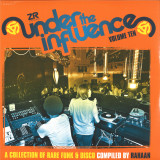
Z Records continues its commitment to unearthing the obscure and
long forgotten tracks from the last 40 years through the ever-popular
Under The Influence series. Following on from Red Greg, Nick The
Record, Sean P, Faze Action, and last years Alena Arpels. It’s now the
turn of one of the scene’s most impressive collectors & DJs; Rahaan
Hailing from Chicago his love affair with muzik started in the late 70’s early 80’s, listening to muzik on the radio combined with his mom and dad playing their records every weekend. In the early 80’s on the South side of Chicago, he started hearing something a bit different, what they called ‘house muzik’. A combination of Disco, Jazz, Soul Funk, New Wave and Italo Disco. Here Rahaan digs deep into his impressive record collection that he has collected, built up and crafted over his many years of travelling, networking and DJin to showcase 22 of his finest and rarest cuts. Many of the tracks on the album would cost hundreds and that’s if you were even able to find the originals! As always with ZR compilations a lot of time and effort has been spent on creating these masters from the original vinyl, cleaning them up, removing all the clicks and pops resulting in the cleanest sounding copy possible.
Solid Red Vinyl Edition - 10@ Mini album. Originally release in 2025 in a painfully limited 2x7" + Book edition.
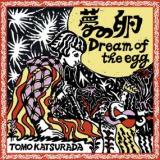
"Dream of the Egg" is the debut solo album by Tomo Katsurada, known for his work with the Japanese psychedelic band Kikagaku Moyo. This project is a unique fusion of music and visual art, inspired by the Japanese 1920s children's book “Yume No Tamago (Dream of the Egg)”. It reveals a deeply personal journey, reflecting Tomo's dreams and the numerous rebirths experienced in 2024—a year marked by profound new beginnings in every facet of his life.
This mini album was driven by a passion for raw and immediate expression. Every song was crafted and recorded with only the materials available to him at the time, embracing an organic and handmade atmosphere. By eschewing rhythm clicks and standard instrumental tunings, a spontaneous sound emerged, capturing the essence of both uncertainty and immediacy. Adding to this distinctive sonic landscape, guest musician Jonny Nash (UK) contributed ethereal guitar sounds on the first and final tracks, enriching the record's dream-like quality.
The journey begins with the opening track, "Moshimo," which means "If..." in Japanese. Here, Jonny's guitar weaves seamlessly with the vocal melody, creating a harmonious dialogue. The first half of the album concludes with "Zen Bungalow" a cover of Gabriel Yared's “Bungalow Zen” from the soundtrack of the film “Betty Blue 37°2 Le Matin”. This particular track is his partner’s favourite song to listen to every morning and left a profound impression on him. One day, he heard a song in his dream that combined both of these tracks and loved how they blended together. This experience inspired him to create a new arrangement, "Zen Bungalow," which has become a central piece of the “Dream of the Egg” album.
The third track serves as an interlude, printed on a flexi disk attached to the middle of a picture book. This interlude transitions the listener into"Inner Garden," a bittersweet folk song that explores themes of love. The EP's narrative spans 20 minutes, culminating in the final title track “Dream of the Egg”. This piece features a delicate session between Tomo & Jonny, combining cello and guitar to create a spectrum of tones that evoke the imagery of a rainbow. The focus on smooth dynamics and meticulous play reflects an intent to convey a sense of physical trembling. This track sounds like the beginning of a new dream; as if the egg of one’s dream is about to hatch, bringing a sense of anticipation and wonder to the listener. Throughout the album, a variety of instruments come into play, drifting between notes and embracing the beauty of imperfection. By incorporating free-form sounds in a highly technological age, the record aims to reconnect listeners with the tangible, human-made quality of sound.
Special Thanks
Jonny Nash – Guitar
Acclaimed producer, DJ, and dancefloor healer Octo Octa (Maya Bouldry-Morrison) announces her fourth full-length album, Sigils For Survival. Following 2013's Between Two Selves, 2017's Where Are We Going?, and 2019's Resonant Body, the new record marks a decade since Maya publicly came out as transgender in November 2015. ''As an autobiographical artist, I set out to write an album that would be a milestone for this past decade of joy and sorrow,'' Maya explains. ''Sigils For Survival is my attempt to encapsulate the intentions and techniques that I used to move through life into a spell.'' For each of the record's eight tracks, Maya drew a sigil. Each is a personal symbol intended to ''bind magic to the song and seal its intention.'' These drawings appear throughout the physical edition's design. Maya's sister, New York artist Hope Morrison, incorporated each sigil into her original paintings, which comprise the album's vivid artwork. Hope Morrison, whose imagery translates the sigils' energy into vivid form; the layout was designed by Jo?o Ervedosa. Created entirely on hardware instruments and later mixed in Logic, Sigils For Survival captures the tactile immediacy of live performance. Maya preserved the feel of MIDI-clock drift and off-grid recording, letting her machines interact in the rhythmic pocket, rather than confirming them to a click. Alongside her signature deep, ecstatic electronics, the album features hand-played dulcimer, hand-pan, and recorder. Her voice also returns, carrying spells of love, protection, and transformation. Across Sigils For Survival, Octo Octa channels the ecstatic house lineage into an intimate ritual space. The music speaks of immediacy, play, and communion -- of magic as method, love as survival, and sound as spellcraft. Sigils For Survival is both a document of ten years lived fully and an invocation for the next chapter -- a glowing testament to music's power to protect, transform, and set the spirit free.
- A1: A Long Distance Call
- A2: The Book Of Self Doubt
- A3: In A Rut Ft Sydney Spann
- A4: Score Ft Anysia Kym
- A5: Seems Like I A6. Flatline Ft Miho Hatori
- B1: Peak Again Ft Alan Sparhawk
- B2: Habits And Patterns Ft Tirzah
- B3: Wish I Was Like U
- B4: Ending Us All Ft Le3 Black X Fyn Dobson
- B5: Forever Still (Steel)
- B6: See Through
Forged from the fire of internal struggles, Loraine James was wrestling with confidence and a desire for change when she embarked on “Detached From The Rest Of You”. A guiding hand came through producing 2025's “Clandestine” EP with singer Anysia Kym, which gave her the experience of a more 'pop' setting and the tools and insight to work her instrumentals into more conventional shapes; a shift from club driven sounds and winding instrumentals into more precise song forms.
Loraine’s production is stripped to the bone, soundscapes of clicks and glitches inspired by Aoki Takamasa, Ryoji Ikeda, and the early-00s Clicks & Cuts school. Here, often with not much more than sparse keyboard chords to fill in with subtle colouring, she uses the space around the sounds and vocals to draw the listener in to a succinct and direct album, her most confident yet.
Guest contributors include vocalist Sydney Spann on “In a Rut”, Alan Sparkhawk (Low) on downcast anthem “Peak Again”, Miho Hatori (Cibo Matto) on “Flatline”, Anysia Kim on “Score”, and Tirzah on “Habits and Patterns”. Finally her old spar, the rapper Le3 bLACK returns to spit fire with the jazz-indebted track “Ending Us All” with Fyn Dobson backing on tumbling drums.
- 1: Born To Kill
- 2: No Way Out
- 3: The Way Things Were
- 4: Tonight
- 5: Partners In Crime
- 6: Crazy Dreamer
- 7: Wicked Game
- 8: Walk Away (Don't Look Back)
- 9: Never Goin' Back Again
- 10: Don't Keep Me Hanging On
- 11: Over You
Politics. Hatred. Endless war. We doomscroll as our rights are stripped away. Bombings. Kidnappings. Mass shootings. The nightly news is a litany of brutality. Assassination. Subjugation. Deportation. We argue with each other while the rich get richer and cruelty is normalized. These are just a few of the reasons why the title of The Casualties" new album is Detonate. Detonate is the second chapter in a new epoch for The Casualties. As their second album with David Rodriguez at the mic, it solidifies the vocalist"s partnership with drummer Marc "Meggers" Eggers and guitarist Jake Kolatis . "It"s like a new era for the band," Meggers says. "It solidifies that Dave is here to stay." As the follow-up to 2018"s Written in Blood and their first record for Hellcat Records- the Epitaph subsidiary curated by Tim Armstrong of Rancid-Detonate sees this new version of The Casualties locking into place. "We were in the studio for Written in Blood about eight months after I joined," Rodriguez says. "With this new record, we really grew together. For me, it"s the proud moment where we clicked the three Legos together."
This is the story of an artist in search of sound and breath: an artist who dares to question the rhythm of silence—an invitation to rethink music, sound, and musical collaboration. This is the story of a journey that, after opening countless paths, has finally found its vessel—and its messengers. Three artists of profound musical truth and radical freedom, merging into an exceptional trio that crosses genres and transcends words in a journey toward pure emotion.
Le Rythme du Silence is the culmination of this long search. Yom delivers it here with violinist Théo Ceccaldi and cellist Valentin Ceccaldi—kindred spirits in sound. “I’ve been working on this idea of the ‘rhythm of silence’ for years,” Yom explains. “I first heard the phrase from a Sufi master, describing the foundation of meditation. It struck something deep in me. I’ve practiced meditation for a long time, and we often think of it as a kind of stillness—opposed to noise and life. But in truth, the rhythm of silence enables meditation. It means accepting that the world continues to move and live around you, even as you try to be still. I wanted to compose from that place. To imagine sound as vibratory matter—the primal substance of creation. That required letting go of fixed structures: forgetting melodies, abandoning the idea of a constructed solo. I needed to leave behind music as a system, and touch sound as a living, breathing entity. It took years. Many projects led me elsewhere. But with the Ceccaldi brothers, I finally found the right resonance. Working with them was simply obvious—it was indredibly powerful.”
Yom first rose to prominence reimagining Jewish traditional music with his 2008 debut New King of Klezmer Clarinet. Since then, his path has led through rock (With Love, 2011; You Will Never Die, 2018), electronic utopias (The Empire of Love, 2013), meditative and sacred soundscapes (Prière, 2018), and countless unclassifiable hybrids (Unue, 2009; Green Apocalypse, 2010). It was inevitable that he would eventually cross paths with the free-spirited Théo and Valentin Ceccaldi—two artists who also place collaboration and genre-blurring at the heart of their artistic development. Their projects are always bold, demanding, and full of life (Kutu, Tricollectif, ONJ, Velvet Revolution, Grand Orchestre du Tricot, Lagon Noir, Constantine, etc.). And so, when the three met within the iXi string quartet, something clicked.
“I was seated between the two of them in the quartet,” Yom recalls, “and I could feel their energy flowing from both sides—it was wild! They’re so tuned into each other, they don’t need words. It’s like they’re connected by musical Wi-Fi. The groove happens instantly. They’re precise when they want to be—thanks to their experience in pop-influenced projects —but they can also let go completely, diving into pure sound. That’s exactly what this project needed.”
Without a single rehearsal, the trio formed instinctively. They began performing Yom’s compositions live, unfolding them into a single continuous piece, where clarinet and strings stretch the limits of sound and breath.
Bowed, plucked, or prepared with clothespins, the Ceccaldi strings engage in a playful and intense dialogue with Yom’s custom B-flat clarinet. Through their imaginative listening and fearless invention, air and space open into a vast new soundscape—one that lies somewhere between meditation and healing music.
“When Yom shared the concept of the rhythm of silence, we were immediately drawn in,” says cellist Valentin Ceccaldi. “There’s a deep intensity and spiritual commitment in his music that really spoke to me. With this trio, we’re trying to dive into the core of sound—but also to create a kind of communion with the audience. It’s like gradually turning up the volume on silence, and realizing it’s made of countless tiny sounds—the music of particles in motion" This stripped-down intensity demands full presence—body and mind—of these three musicians, vibrationally connected in a state close to trance. With them, we enter a journey - not religious, but sacred nonetheless.
The Rhythm of Silence becomes an echo of our most intimate, most distant inner landscapes.
An album—and a trio—to return to without end.
Tresor resident DJs LNS and DJ Sotofett have for some years been developing a style at the club‘s Globus floor, and their new EP is a die cut of exactly the classic techno, electro, and house music they play.
Here are no productions drenched in reverb, no hi-fi obsessions or generic algorithmic patterns – this is Globus Trax, the duo's third release on Tresor Records, four tracks consisting of real TR-909 workouts, rude and driving basslines, live runs through the mixing desk, and a Blake Baxter cover version with LNS on vocals.
LNS & DJ Sotofett programmed an EP to perfectly fit their warehouse style of DJing, bringing out colour and variation in a spectrum more similar to a club compilation than a dogmatically reduced concept. With a single repeated vocal sample, Globus Trax opens bombastically with ClickClickClick, a dub -infused UK garage house track anyone in the world can easily describe in the course of a second.
Following this comes Gearbox which is a hefty slab of big room electro featuring a centerpiece arpeggio and the warmest harmonic pads on the EP's four tracks, which not-so-subtly makes reference to the pioneering band that shares a name with Globus and Tresor's home, the Kraftwerk.
The house vibe returns on Destination 909, which is nothing but a manifesto for the TR-909, where the beloved drum machine's jacking beats meet galactic strings and synthetic bass, only to be ripped apart in a slamming break that sees the machine take centre stage as it cuts in-and-out of the mix, again a clear nod to the duo’s sets in the club.
LNS steps up on vocal duties and DJ Sotofett keeps the 909 running for their final cut, taking a deeper dive into the realms of classic techno and paying tribute to “The Prince of Techno” Blake Baxter by covering his Reach Out originally released on Tresor Records in 1995.
The 12” was cut by DJ Sotofett himself at Manmade Mastering, where he resurrects the lost art of late-90s loud cuts with sonic presence and punch, optimal for the club-focused 12” format, and is the first to come in the new Tresor Sleeve, boasting an embossed logo on either side.
Oversized custom cut LP jackets (13” / 33.02 cm width)
Silkscreened with bespoke iridescent citrus green ink by Mark Rice
Short story by Natalia Zuluaga
Flexi 7”:
steaming mescaline (extended mix by bad lsd trips)
Citrus green metallic foil stamp
Pressed in full stereo
Edition of 150
I.
bad lsd trips is the collaborative duo of makers doris dana and domingo castillo flores. Respectively the two have fostered practices that have sprawled out through various approaches and, whether in the lanes of the musical or the contemporary arts, the phenomenology of the social and inclusive prevails. On ultrafest, this motif continues through the psychedelia of its eight time-defying recordings, welcoming the listener into an open temporal architecture of the stereo field as a signifier of environment. It is worth noting that the group began collaborating in Miami, Florida with longer form improvisations recorded to a stereo cassette deck. In these recordings, the paved geographical sprawl and oceanic view permeated the approach to amassing long swaths of sound material. Listening back on that work at the time of this writing, each track feels as though one is walking into an active space, arriving to an event already in full swing and finding your place inside of it. On ultrafest (this album) something different occurs. The space and events are built around you as you move through the record.
II.
The name of the album is ultrafest, which should effectively provoke your mind's eye the imagery of young people dancing, salivating, grinding, and imbibing chemical compounds to the perversely formalized musical genres of “Electronic Dance Music” and latter-era Dubstep often heard in European Uber rides and energy drink commercials. A far distance from the icy and machinic reverie of Techno’s finest rave eras or the notable historical contributions of Miami’s cerebral producers to IDM’s global output, ultrafest is a libidinal catharsis as festival scaled to a multinational corporation of hedonistic excess. The festival has been a hallmark of Miami cultural industry production and optical enticement for tourism, purportedly bringing in nearly a billion dollars in revenue to the city since 2012. Scores of documentation exist wherein this decadent escapism leaves the concertgoer, usually in some neon garment on a near nude body potentially adorned with fluffy faux fur leg warmers, facing a comedown from the combination of volume, sun, dehydration, and methylenedioxy-methylamphetamine. This MDMA experience characterizes an aspect of the way bad lsd trips employs vocals and pitch on this album. The detached, high octaved longing of a high pitched vocal is decoupled from its typical auditory body of song. High-pass clicks and pops touch the (h)air on the back of the neck, promising goosebumps and teasing towards euphoric rushes of dopamine, yet also exist decoupled from the body of song. As the dopamine depletes and the sun imposes itself, Miami’s downtown of skeleton real estate is your company as you meander towards your parked vehicle to rest your fatigued senses, elevated heart rate, and quench the need for air conditioning on your skin. The immediacy of bombastic social immersion to architectural alienation palpable here.
III...
- Nick Klein
- A1: You Don't Have To Wait W/Cubicolour
- A2: Revision Ft. Giovanni
- A3: Go Back Ft. Desire
- B1: Wervik
- B2: Hooligan Plex
- C1: All Night (Garage Verson) Ft. Oscar And The Wolf
- C2: You're My Desire Ft. Mystic Bill
- D1: Serpent Jazz W/ Avnu
- D2: Get Out Of Here Ft. Perry Farrell
- D3: Just You And I
- E1: Clickbait (This Ain't Hollywood) W/ Avnu
- E2: Shine On & On (Orbital Tribute)
- F1: Nasty W/ Tyler Hill
- F2: Stop That
- F3: Moon Sky (House Version) Ft. Ishi
Renowned US producer Maceo Plex releases his highly anticipated third album, ‘’93', a homage to his three-decade journey through the realms of electronic music. Marking both a passion and a prolific career, the maestro presents a tantalising body of work that masterfully blends House, Hip Hop, Global Bass, Techno, Breaks, and Electronica. This audacious fusion delves into historic and modern influences, crafting an audio journey that transcends time, rich in history yet boldly future-facing.
‘’93' is a cross-genre exploration, seamlessly balancing emotion with hard-hitting beats. Maceo Plex collaborates with a stellar lineup of artists, including Diplo for his contribution on ‘You Don’t Have To Wait’ with Cubicolor, Oscar and the Wolf, Perry Farrell (Jane’s Addiction), Johnny Jewel and Desire, Kirsty Hawkshaw, Mystic Bill, AVNU, Giovanni, Ishi, and Tyler Hill, resulting in a diverse and dynamic musical affair.
This album narrates the story of a highly esteemed artist at a pivotal juncture in his career, consistently evolving towards new directions. Departing from the early deeper house sound that initially defined him, Maceo Plex intentionally ventures into new territory, steering away from his famed melodic and techno direction in recent years. Nevertheless, '93' retains the essence of Maceo Plex's signature style, transcending various sounds and genres in a manner reminiscent of his electrifying DJ sets, meticulously curated for the dancefloor and the crowds.
‘93’ vinyl LP by Maceo Plex is available on Lone Romantic from 17th May 2024.
Key Feedback Quotes:
Pete Tong - Maceo is such a talented producer. A sonic juganaut. An inspiration to so many aspiring music makers. He's a master of analogue and digital in the studio. He's a total 'one of'.
Kolsch - Incredible album!!!!
Artbat - “Very cooooool album!
Gregor Tresher - Wow, now this is what I call an album! Extraordinary stuff, I love it! Big up, Eric!
Hot Since 82 - Nothing short of sensational. My fav producer and DJ who consistantly sets the bar far too high and we all play catch up. Love it.
Rodriguez Jr - Awesome album. LOVE IT. Such a wide spectrum of influences here. Respect!
Laurent Garnier - Very cool. Will play these
Hernan Cattaneo - This is a really good album!
Wehbba - happy to finally see the album coming out, lots of gems, Nasty, Just You and I, Get out Of Here and You're My Desire are my main picks.
Eelke Kleijn - Already listened to the whole album on Spotify. Fantastic. Miles ahead of everyone else. Thanks for sending this, will play many of these for sure.
AFFKT - all tracks are amazing
Ida Engberg - Loooove this release! Stop that and Serpent jazz for me, can't wait to play them. Lone Romantic killing it!
Victor Ruiz - Honestly, you’re a genius! 10/10 productions always.
Pig&Dan - Great to hear new tunes from one of my favorite producers out there
Oliver Huntemann - some real gems on here
Fideles - wow, love it all
Peter Kruder - Love 'em all! Thanks for sending my way!
Yotto - Sick Sick Sick work!
Jody Wisternoff - Insane tracks from Maceo!!!
Terr - Amazing music as always, thx!
Nicolas Masseyeff - Solid release! Full Support!
Paige - Nasty is an absolutely mind-blowing track!!
Braxton - Incredible Album. .
Dense & Pika - Wicked stuff from Maceo.
Eli Brown - Always great music from Maceo Plex.
Anden - Congrats on the album! Love it!
Sergio Muñoz / Fur Coat - Great work from Eric! Congratulations.
La Fleur - So many gems in there, looking forward to having a proper listen from start to end! Thx
Captain Mustache - Big work here from Maceo, congratz!
Alex Kennon - This is a masterpiece!
Timo Maas - Clickbait is a cool track, I like the deep funk.
Martin Eyerer - This is a great album!! I love nasty most, but all great.
Nick Warren - This is such a great album.
Laurent Garnier - Very cool EP. Will play these.
Jonas Rathsman - Stop That sounds interesting
I Talk To Water, the fifth album for Kompakt by Danish producer Kölsch, is the artist’s most personal statement yet. While all the trademarks that make his music so popular and powerful are still present – lush, melodic techno; swooping, trance-like figures; sensuous, shivery texturology – I Talk To Water is also a deep and intimate rapprochement with family and history, a beautiful, finely detailed document of loss and memory, and a tracing of the long, unbroken thread of grief that runs through our lives once we’ve lost those we loved.
The emotional core of I Talk To Water, then, is a cache of recordings by Kölsch’s father, Patrick Reilly, who passed away in 2003 from brain cancer. With time rendered elastic by the pandemic and its associated lockdowns, its sudden, alienating shifts in everyday living, Kölsch found himself reflecting on his father’s passing and ongoing spiritual presence, thinking about how best to memorialise such a significant figure in his own life. Those recordings opened a gateway, of sorts, for Kölsch to move through – a way to bring past and present together and entwine them in a sensitive, poetic manner.
Kölsch’s father was a musician – “touring in the sixties and seventies, in the Middle East especially, he was doing the whole hippy trail, playing guitar, and wrote some songs over the years,” he recalls. “But all in all, he decided to focus on family rather than pursue a musical career.” Reilly kept playing and writing music over the years, though Kölsch hadn’t listened to the material for some time: “I’d never had the guts to listen to it, because I just felt too fragile listening to his voice. It’s such a tough thing to go through.”
During the pandemic, though, Kölsch listened through the fragmented body of work that his father had produced over the years. “I decided I’m gonna finally release my dad’s music twenty years after his passing,” he reflects. “This whole album is about the process of loss, and for me it’s been one of my main driving forces in my musical life, the whole emotional aspect of whatever I’ve done has been based in that feeling that he’s not there anymore.”
Recordings of Reilly appear on three songs across I Talk To Water. His guitars drift pensively across “Grape”, offering a lush thread of melody that Kölsch wraps with clicking, driftwood rhythms and droning, melancholy bass. “Tell Me” is a lovely three-minute art song, a sadly beautiful reflection, minimally adorned with gentle keys and a muted pulse. And on the closing “It Ends Where It Began”, Kölsch lets his father’s acoustic guitar take centre stage for a lament that’s unexpectedly folksy, a guitar soli dream, which Reilly originally recorded in 1996. “He actually recorded it for my first album that never came out,” Kölsch reveals, “and I had it sitting around forever. That is purely him.”
These three imagined collaborations between father and son are poised and delicate. But their relationship also marks the gorgeous music Kölsch has made across the rest of I Talk To Water, from the itchy yet lush “Pet Sound” (titled in tribute to one of Reilly’s favourite albums), the flickering synths and yearning vocal samples that slide through “Khenpo”, the ecstatic shuddering that marks “Only Get Better”, or “Implant”’s slow-motion pans and subtle reveals.
There’s also the title song, where Kölsch is joined by guest Perry Farrell (Jane’s Addiction, Porno For Pyros), singing a mantra for internal reflection: “I talk to water / Searching for myself / Looking for answers / Oceans of you.” Farrell’s appearance brings another timbre, another spirit to the album, aligning neatly with his recent interest in electronic music. “He was completely taken by this idea of talking to water,” Kölsch says, thinking about the ways we collectively lean towards the natural world as a comfort and a listener, a guide through mourning, a way to map out the terrain of the heart. This mapping is something that Kölsch has proven remarkably adept at through the years; dance music for both body and mind, but also both for the here-and-now, and for the hereafter.
“I Talk To Water”, das fünfte Album des dänischen Produzenten Kölsch für Kompakt, ist zweifellos das persönlichste Statement des Künstlers bislang. Während alle Markenzeichen, die seine Musik so beliebt und kraftvoll machen, immer noch präsent sind – üppige, melodische Techno-Tracks; schwebende, tranceartige Elemente; sinnliche, fiebrige Texturen – ist “I Talk To Water” auch eine tiefe und intime Annäherung an Familie und Geschichte. Es ist ein wunderschönes, fein ausgearbeitetes Dokument des Verlusts und der Erinnerung, und es verfolgt den langen, ungebrochenen Faden der Trauer, der durch unser Leben läuft, sobald wir diejenigen verloren haben, die wir liebten.
Der emotionale Kern von “I Talk To Water” besteht aus Aufnahmen von Kölschs Vater, Patrick Reilly, der 2003 an Hirnkrebs verstarb. Durch die Pandemie und ihre damit verbundenen Lockdowns, die plötzlichen, entfremdenden Veränderungen im Alltag, fand Kölsch sich in Gedanken an den Tod seines Vaters und seine fortwährende spirituelle Präsenz wieder. Er überlegte, wie er eine so bedeutende Figur in seinem eigenen Leben am besten verewigen könnte. Diese Aufnahmen öffneten ihm sozusagen ein Portal, um Vergangenheit und Gegenwart miteinander zu verbinden und sie auf sensible und poetische Weise zu verweben.
Kölschs Vater war Musiker – “er tourte in den sechziger und siebziger Jahren, vor allem im Nahen Osten, auf dem Hippie Trail, spielte Gitarre und schrieb im Laufe der Jahre einige Songs”, erinnert sich Kölsch. “Aber alles in allem entschied er sich, sich auf die Familie zu konzentrieren, anstatt eine musikalische Karriere zu verfolgen.” Reilly spielte und schrieb jedoch im Laufe der Jahre weiterhin Musik, obwohl Kölsch das Material lange Zeit nicht angehört hatte: “Ich hatte nie den Mut, es anzuhören, weil ich mich einfach zu zerbrechlich fühlte, seine Stimme anzuhören. Es ist so schwer, das durchzustehen.”
Während der Pandemie hörte sich Kölsch jedoch durch das fragmentierte Werk, das sein Vater im Laufe der Jahre produziert hatte. “Ich beschloss, die Musik meines Vaters zwanzig Jahre nach seinem Tod endlich zu veröffentlichen”, reflektiert er. “Dieses ganze Album handelt von dem Verlustprozess, welcher für mich generell eine der Hauptantriebskräfte in meinem musikalischen Leben ist. Der ganze emotionale Aspekt von dem, was ich getan habe, basierte auf dem Gefühl, dass er nicht mehr da ist.”
Auf “I Talk To Water” sind Aufnahmen von Reilly in drei Songs zu hören. Seine Gitarren ziehen nachdenklich durch “Grape”, bieten einen üppigen Melodiefaden, den Kölsch mit klickenden, treibenden Rhythmen und dröhnendem, melancholischem Bass umwickelt. “Tell Me” ist ein schönes dreiminütiges Kunstlied, eine traurig-schöne Reflexion, minimal geschmückt mit sanften Tasten und einem gedämpften Puls. Und auf dem Abschlusstrack “It Ends Where It Began” lässt Kölsch die akustische Gitarre seines Vaters im Mittelpunkt stehen, ein überraschend folkiger Klagegesang, den Reilly ursprünglich 1996 aufgenommen hatte. “Er hat es tatsächlich für mein erstes Album aufgenommen, das nie veröffentlicht wurde”, enthüllt Kölsch, “und ich hatte es ewig liegen.”
Diese drei erdachten Kollaborationen zwischen Vater und Sohn sind ausgewogen und zart. Aber ihre Beziehung prägt auch die wunderschöne Musik, die Kölsch im Rest von “I Talk To Water” geschaffen hat, angefangen bei dem nervösen, aber üppigen “Pet Sound” (benannt als Hommage an eines von Reillys Lieblingsalben), den flimmernden Synthesizern und sehnsüchtigen Vocal-Samples in “Khenpo”, den ekstatischen Erschütterungen in “Only Get Better” oder den langsamen Schwenks und subtilen Enthüllungen in “Implant”.
Es gibt auch den Titelsong, in dem Kölsch von Gast Perry Farrell (Jane’s Addiction, Porno For Pyros) begleitet wird, der ein Mantra für die innere Reflexion singt: “I talk to water / Searching for myself / Looking for answers / Oceans of you.” Farrells Auftritt bringt eine weitere Klangfarbe, einen weiteren Geist in das Album, der gut zu seinem jüngsten Interesse an elektronischer Musik passt. “Er war völlig fasziniert von der Idee, mit Wasser zu sprechen”, sagt Kölsch und denkt darüber nach, wie wir kollektiv zur Natur als Trost, Zuhörer, Führer durch die Trauer neigen, um die Gelände des Herzens zu kartieren. Diese Kartierung ist etwas, in dem Kölsch im Laufe der Jahre erstaunlich geschickt war; Tanzmusik für Körper und Geist, sowohl für das Hier und Jetzt, als auch für das Leben danach.
- Desire
- Loner
- Haha
- Drip Drop
- Month
- Disappear
- Flood
- Letter
- Nobody
- No Time
- Moonlight
- Apart
- Flying
"I want nothing more than to be a loner," Emily Kempf sings early on Flower of Devotion, the new album by Chicago trio Dehd. It's a startling admission coming from a songwriter who, just a year ago on Dehd's critically acclaimed Water, wrote eloquently about the joys and pains _ more than anything, the necessity _ of love, compassion, and companionship. But then, "admission" isn't really the right word here, given the stridency of Kempf's tone. "Loner" is a declaration. The record ups the ante on Dehd's sound & filters in just enough polish to bring out the shining and melancholy undertones in Jason Balla and Emily Kempf's songwriting, even as it captures them at their most strident. Balla's guitar lines at times flirt with ticklish cosmic country, while at others they reflect the dark marble sounds of Broadcast. Kempf, meanwhile, establishes herself as a singer of incredible expressive range, pinching into a high lonesome wail, letting loose a chirping "ooh!," pushing her voice below its breaking point and letting it swing down there. When she and Balla bounce descending counter-melodies off one another over McGrady's one-two thumps, or skitter off over a programmed drum pad, they sound like The B-52s shaking off heartache. What makes Flower of Devotion so impressive is how its creation seems to have strengthened its creators, both as individuals and as a unit, even as they've stared down their own limitations. It's also striking just how much fun they seem to be having in the process. "It's okay to be lighthearted in the face of despair," Kempf says. It's a theme that runs through the album, from the opening back-and-forth build of "Desire" to the click-clacking chorus of "Haha," which finds them deflating their own history. Flower of Devotion was recorded in April and August of 2019 in Chicago. It will be released on Fire Talk Records on July 17th 2020.
- A1: Mad Rooter
- B1: Ghost Ride
Sydney punks Party Dozen (Kirsty Tickle and Jonathan Boulet) return with new single "Mad Rooter', taken from their upcoming AA-single 7" 'Mad Rooter / Ghost Rider' out Dec 5th via City Slang. The duo will be touring throughout the UK this November with shows in London, Brighton, Leeds, Bristol, Manchester and Glasgow.
On the new track, the band said, "It doesn’t always happen, but sometimes it’s your night. You feel like the maddest rooter. Every step you take is a step closer to glory. No f*cks left to give, the charisma of Jon Hamm. 'Mad Rooter' is 10 feet tall and can walk through a wall. Stuck here with all you rookies eating fortune cookies."
They added, "We didn’t record it with a click, so it has this sort of off-grid pull and push that gives it swagger. There’s a sax solo that’s giving David Letterman opening sequence. We recorded the sample with Jon’s guitar, which is old and barely hanging on. The electronics are shot, it’s missing strings, and it’s been sort of half-modified then given up on."
MAL welcomes Hiroshi Takakura aka Element & co-owner of Riddim Chango Records with a heavyweight session of deep roots mutations and dynamic steppers.
A truly unique and well loved character, Hiroshi is one of Japan’s key figures for dub wise experimentation and this release presents a decade of influence distilled into a selection that bridges Jamaican and UK lineages with a very personal slant.
The centrepiece, ‘Longest Summer Pt.1 & 2’, is a radical remake of the theme from Fruit Chan’s Hong Kong cult film. He flips the wistful, naïve melancholy of the original alongside deep bass weight and syncopated hats with a slink and roll that feels as well suited to the steaming tarmac of LA as any smoke laced, late night Blues dance.
Born from the momentum of live set preparation, the raw sketches that make up the ep were shaped into full-blown dancefloor weapons, particularly the percussion-heavy, tribal mayhem of the title track, ‘Motion Exchange’.
All in all the release captures a snapshot of heady obsessions: UK roots and dub pressure channeling echoes of Jah Shaka, Jamaican dancehall’s roughneck energy, and a wide selection of experimental electronic influences from the early 80’s to the present day.
Motion Exchange delivers a weighty steppers sound that honours its roots while pushing into bold, forward-thinking territory.
Like Element’s sets, this is music for the rig but has layers of detail that reveal themselves on repeat listens and in selector tradition, the EP offers multiple versions for extended play.
A further milestone in MAL’s journey, with Takakura charting heavy new territories in modern dub. RIYL 5 Gate Temple / Bokeh Versions / Lord Tusk / Seln etc.
Click here to see our current stocklist
You received this email because you requested to be added to our wholesale mailing list.
Our mailing address is:
Rubadub ltd
Unit 4, Carberry Court
28 Queen Elizabeth Ave
Glasgow, Scotland G52 4NQ
United Kingdom
Want to change how you receive these emails?
You can update your preferences or unsubscribe from this list.
Originally conceived as a compilation of outtakes and live recordings from The Shadow Ring's 1995 stateside tour, Wax-Work Echoes takes its name from the first line of "Put the Music in Its Coffin," the title track of the group's breakthrough release. Lambkin abandons the bitsand- bobs approach, advancing the Shadow Ring concept with entirely original material that builds on the unit's self-mythologizing lyrics, celebrates the clicking of horse hooves, ponders on the sociability of rats and mice, and warns of the dangers of poultry. The first Shadow Ring album to officially include Tim Goss in the main lineup, Wax- Work Echoes reveals the group in its final and lasting form, awash in the outer bounds of atmospheric exploration, with Lambkin's familiar wry and morbid lyricism and the stripped-down angularity of amateurishly detuned guitars fully intact. While Klaus Canterbury and Tony Clark seem all but forgotten, and the shrugged off S. Fritz is listed on the liner notes as performing only "when required," Lambkin did solicit contributions from outside the inner circle. A bit of "Mambo Twist," lifted from a tape of unreleased Vitamin B12 material sent to Lambkin by Alasdair Willis, found its way into "V.E.R.M.I.N.," while an extended epistle contribution from Richard Youngs (and, technically, Brian Lavelle) would be employed in the second half of "Catching Sight/Of Passing Things." Released on CD in 1996 for Bruce Russell's newly minted Corpus Hermeticum, Wax-Work Echoes was recorded concurrently with intense rehearsal periods, in anticipation of the forthcoming "Rose Watson Tour," and was supported by a celebratory fanzine media blitz. The album seemingly absorbs the frenetic excess of the band's transatlantic travels; Wax-Work Echoes channels the trio's wilder instincts into an unresolved catharsis, not yet free of frustration or restlessness. Out of print for almost three decades and available here for the first time ever on long-playing disc, Wax-Work Echoes is a classic from the outer eddies of The Shadow Ring's sound, a must-have for any aficionado's collection: "A window slides, glass slips from frame / And canvas carcass breathes again." Throughout their legendary, decade-long run, the Shadow Ring were an enigmatic force on the international musical sub-underground. Before their disbandment in 2002, this shambolic rock outfit, formed by a group of rowdy teenagers in southeast England, left behind a mighty run of eight LPs, a handful of 7"s, and a spate of raucous live shows and cryptic zine appearances on both sides of the Atlantic, all which have bolstered their enduring word-of-mouth mystique. Beginning in 2023 with the first-ever vinyl pressing of the self-released pre-Shadow Ring tape The Cat & Bells Club (1992), Blank Forms Editions has been conducting a systematic retrospective of the storied group. Wax-Work Echoes and Hold Onto I.D. are the latest releases in a multiyear reissue effort that includes several LPs, a comprehensive CD box set, and a nearly five-hundred-page book.
- A1: My Lowville (2025 Remaster) 10 54
- A2: Auto Show Day Of The Dead (2025 Remaster) 07 11
- A3: Fucking Milwaukee's Been Hesher Forever (Part 1) (2025 Remaster) 03 50
- B1: Fucking Milwaukee's Been Hesher Forever (Part2) (2025 Remaster) 05 34
- B2: Re We're Again Buried Under (2025 Remaster) 07:026
- B3: The Surge Is Working (2025 Remaster) 08 14
'the fun years', comprised of multi-instrumentalists Ben Recht and Isaac Sparks, have been making music together since the turn of the century, producing intriguing interrogations of ambient, drone, post-rock, and turntablism. Originally released in 2008 on the now-defunct Barge Recordings, 'baby it’s cold inside' is perhaps the high watermark of their discography. Equally concerned with microtonal nuance and harmonic intensity, it is both a product of its time and something well past it. The chief protagonist is surely the turntable, deployed to create woolly, evocative loops from unidentifiable source material that recall, at times, the work of Philip Jeck or Jan Jelinek—churning, roiling, hissing, atrophied textures further articulated with nuanced processing and buoyed by baritone guitar drones and anti-riffing.
The title of opener "my lowville" feels like a wink to the famed slowcore duo, with spare post-rock motifs hovering in a dusty ether, slowly consumed by distorted washes of rich, harmonic sound. One of the most satisfying aspects of the album is that despite the recumbent nature of most of their sound design choices and compositional proclivities, Recht and Sparks are loath to sit still. "auto show of the dead" is a serpentine piano/guitar exploration full of subtle detail, preceding the immaculately titled "fucking milwaukee’s been hesher forever," in which the tactile delights of clicks+cuts are liberated from the laboratory and allowed to slum it in the world of tape gunk and '90s plate reverb. Later, "re: we’re again buried under" presents an inky black ambience that feels truly expansive and almost overwhelming, and closer “The Surge is Working” tears apart an anthemic shoegaze dirge at the seams, leaving only billowing filtered noise and negative space in its wake.
Presented here with a brilliant remaster by LUPO, 'baby it’s cold Inside should be considered alongside records like Belong’s October Language and Polmo Polpo’s Like Hearts Swelling—an arresting early aughts ambient marvel that warrants ongoing investigation.
Spincycle records presents the second imprint on their label – a two track split EP from Neil E & Big City Bill on 180g heavyweight vinyl.
Bill and Neil met deep in the mountains 20 years ago.
With work drying up in the mountains, they tobogganed into the city to find their calling.
For years in dim garages, they studied with diligence strange hieroglyphs projected on the wall by the reflection of fluorescent lamps through emptied vessels.
At first, none of it made sense. All they knew was that it was important.
They began posting their findings online, and after a time of thinking they may have gone crazy, they began to receive anonymous messages: “Click here to join a guild of amazing artists: link redacted.”; “Follow me, and I’ll follow you back. Let’s grow together!”; “Do you want 10k+ follows? We can help!”
This was the encouragement they had been waiting so eagerly for. And so on they went. They joined a few guilds and continued to hone their practice, mining their depths, searching for that ineffable thing, whatever it was, wherever it was locked away.
After years of deep contemplation, the breaking of sacred tools, fiddling around, and the collection of various bevelled talismans, a revelation struck.
Two fantastic thoughts struck them both simultaneously.
These are those thoughts.
“Music is my forever cove,” writes Portland, Oregon’s Luke Wyland of the ideas that give shape to Kuma Cove, his latest album under his own name. Though named after a real place on the Oregon coast, Kuma Cove casts its gaze far beyond the sightseer’s line of vision. Recorded live in the studio and blurring obvious lines between computer-based composition and electro-acoustic instrumentation, it is an album about flow, borders, transitory states, and shelter. Composed of discontinuous ripples and repetitions (“I’m forever searching for a better descriptor than looping, which feels too simple and flattened by overuse,” Wyland says), shaped into richly emotive arcs, and informed by his experience as a person who stutters, it is also an album about identity, self-expression, and the energies that sluice through and across what we perceive as linear time—like floodwaters seeking an exit, like streams running into the sea.
Artist’s Statement:
I made this record while spending significant time in the woods by the Sandy River in Corbett, Oregon,
where I've had my studio for the last five years. It is a diary of spontaneous live recordings edited to highlight the moments of clarity that emerge from long-form improvisations. These compositions express a slowing internal rhythm. An unwinding. A somatic recalibration as I enter middle age. A newly empowered vulnerability.
Here are the internalized cadences of my stutter, flowing freely from my fingers. The musicality of my disfluency is revealed in its frictions, elongations, and foreshortenings. Disruptions in linear time, where the bubbling cadences of my stutter find unexpected pathways, reveal the elasticity of the present moment. This is my idiosyncratic language, shaped and inspired by my disability. Subliminally mirroring internal processes, neural firings, cognitive entanglements...
The title, Kuma Cove, refers to a beloved cove on the coast of Oregon my wife and I return to yearly. There has always been something so magnetic about coves. The way they cradle one from the overwhelming enormity of the ocean beyond, muting a primordial fear. I experience these improvisations as ecosystems I'm able to inhabit for stretches of time, embodying the particular rhythms and sensorial textures within each. Music is my forever cove. Everything you hear is created live in Ableton on a setup I've been honing for 15 years. I celebrate MIDI and computer music as an extension of self and strive to make it as expressive as any analog instrument. I was a visual artist for the first half of my life and quickly adapted those skills to composing and producing on a computer. The transition felt natural within the landscape of DAW's interfaces, especially as a synesthete. Ableton and its community of Max creators continue to surprise me with its expansiveness.
I'm forever searching for a better descriptor than looping, which feels too simple and flattened by overuse. I envision sonic loops as tangled masses of time, three-dimensional knots spinning on tilted axes, or overlapping wreaths refracting out a myriad of colors. My practice is continually refocusing my ear to what is revealed in the repetitions, searching for the fingerprint of each. I find it incredible how technology lets us manipulate time like this. Nothing on this record is quantized or locked to a universal bpm. Experiencing numerous tempos at once feels important. Recordings as mirrors. Freedom from expected (conversational) flow as we hold time for each other.
-Luke Wyland, August 2024
Artist Bio:
Luke Wyland is an interdisciplinary artist, composer, and performer based in Portland, OR (USA). Wyland has been releasing critically acclaimed records for the past 20 years in the groups AU and Methods Body, as LWW, and under his own name, working with such labels as New Amsterdam, Beacon Sound, Balmat, The Leaf Label, and Aagoo Records. As a person who stutters, Wyland’s approach to music is informed by his idiosyncratic relationship with language. Wyland believes deeply in the cathartic power of live performance as a means for collective healing. Through an interdisciplinary art practice that focuses on improvisation, somatic embodiment, bespoke tuning systems, the cadences of disfluent speech, and time manipulation technologies, he’s collaborated with choreographers, high-school choirs, filmmakers, sound designers, and renowned musicians such as John Niekrasz, Holland Andrews, Colin Stetson, and Abraham Gomez-Delgado. He’s also the co-creator of the “It’s A Fucking Miracle” dance class with Tahni Holt.
Wyland has toured nationally and internationally and performed at the Whitney Museum, Ecstatic Music Festival, Issue Project Room, PICA’s Time-Based Arts Festival, End of the Road Festival, and Les Nuits Botanique, among others.
Before you ancients out there turn your heads and scoff at the premise of a twenty-something rock-and-roll goofball calling himself an old-anything, consider this: Mac DeMarco has spent the better part of his time thus far writing, recording, and releasing an album of his own music pretty much every calendar flip. This Old Dog makes for his fifth in just over half a decade_bringing the total to 3 LPs and 2 EPs. According to the DMV, DeMarco is 26. But in working-dog years, ol' Mac here could easily qualify for social security. To stay gold, turns out all he needed was some new tricks. It was a little space_in time, location, and method_that inspired DeMarco while making the record. Moving from his isolated Queens home to a house in Los Angeles helped give the somewhat transient Canada-native a base, and a few more months on his calendar to create did their job as well. Arriving in California with a grip of demos he'd written in New York, he realized after a few months of setting up his new shop_complete with a few new toys_that the gap was giving him perspective (insert tooth joke here). Right off the bat, from the pops and clicks of the CR-78 drum machine and acoustic strums on the album-opening "My Old Man," the synth-drenched beauty of the second track, "This Old Dog," it's clear that DeMarco's bag is filled with new tricks indeed. This Old Dog is rooted more in a synth-base than any of his previous releases, but he is careful not to let that tactic overshadow the other instruments and overall "unplugged" mood of the work: "This is my acoustic album, but it's not really an acoustic album at all. That's just what it feels like, mostly," says DeMarco. Despite the changes considered during the creation of This Old Dog, Mac DeMarco's mid-twenties masterpiece, it's clear that the engine that motors him is in no danger of slowing down.
Deeper States Volume 2 is another installment of fresh sounds from producers who have come through a competition that set them to making proper deep hose with a specified sample library. Across four sides of wax, there are some mighty fine cuts here such as the deep garage inflections of Enrico Dragoni, some Motor City vibes from Scott Andrews, the deepest of dub techno workouts from Montreal courtesy of Dealin', soul-drenched late-night cruisers from Khalid Ali on 'Elevate' and some nice bubbly vocal vibes from Dublin don Oscide with his 'Free Your Mind.' This is another hugely effective and stylish EP from the Interweaved community.
Dawson’s latest offering, The Tinnitus Chorus, is an album of wide-eyed collaborations. He is joined by an inspired cast of revered friends and kindred strangers including Suso Saiz, M. Sage (Fuubutsushi), Eli Winter, K. Freund, (Trouble Books / Lemon Quartet), Dasom Baek, Lina Langendorf (Langendorf United), Vumbi Dekula, Jairus Sharif, Yutaka Hirasaka, and his bandmates in Peace Flag Ensemble. The collection is bookended by two pieces with Michael Grigoni. From birdsong and decaying tape to Western sprawl, each of Dawson’s previous solo records have moved in a singular direction but here he approaches things through a kaleidoscopic lens. While his weathered ambient sketches serve as a through line, they are woven with all manner of instrumentation from clarinet and modular synth to steel guitars and flugelhorn. Improvised Congolese guitar nuzzles next to American experimental folk. Handmade electronics give way to spiritual sax. M. Sage contributes something referred to as a “mystic music box”. The result is a strange and beautiful journey that feels lost between genres and yet wholly unified. Dawson reflects on the genesis of album with a smirk and a shrug. He has been marred by ear troubles in recent years and had been struggling to complete an album of solo material. The clicks, ringing tones, and hiss in his ears had been drowning out the ringing tones, clicks, and hiss in his studio. When he reached out to We Are Busy Bodies to provide an update on the record he was met with an unsuspecting proposal that perhaps he shift focus to an album of collaborations. The truth is he had been ruminating on the idea for years and the nudge from WABB proved to be the motivation he needed to shelve his insecurities and invite artists he admires to join him for The Tinnitus Chorus.
Resonance is one of the most powerful forces this world has,
simply because there is no way to stop it. A drop of
condensed water separates itself from the concrete ceiling.
Propelled only by its own weight, it plummets down towards
a cacophony of naked bodies and §ailing arms to shatter on
a the forehead of an ecstatic dancer. And while all this is
happening, a voice resonates through the entire room,
making the walls shake and the crowd lose themselves even
further : “Move Your Body, Move Your Soul”. Narciss emerges
from a grimey basement in Berlin to bring us two heavy
utility dance§oor cuts on Actions Speak Louder Than Words,
his ¦rst Solo EP on Seelen. The title track is truly something
to behold. With a breakneck tempo, hard hitting percussions
and a legendary house vocal, it wields an absolutely
hypnotizing power that, before you know it, will make
everyone in attendance grind and juke till the early morning
hours. There is a palpapable vibe of mid 90s Detroit-Techno
but still it manages to cut out an identity for its own, with
razor sharp sound-design and a very uplifting attitude for its
genre. And while the tracks arrangement and sound-design is
very minimal, it is on Brennpunkt that Narciss really §exes
his trademark way of building tension with remarkably few
elements. Everything here is stripped down to its most
functional core. The synth-lead is simple yet menacing, the
kick-drum hits like a boxer, and you can be pretty sure that
the hihats will leave burns if you get too close to the record.
As is custom on this label, the B-side is dedicated to thereconstructive efforts of friends or family. This time the
mastermind of Manhigh and Grounded Theory, Mr. Henning
Baer, and Seelen’s very own Shaleen have both let their
actions speak. Henning Baer has taken on the title track in
his Remix and has transformed it into a true vintage electro
cut. A distorted synth and pad add heavy grit to the original’s
vocal, and the warehouse sized kickdrum will knock anyone
unprepared off their feet. Meanwhile Shaleen’s reinterpretation of Brennpunkt strips it down even further,
swirling the original’s elements into a groovy maelstrom.
This version rumbles, clicks and sneers, with sampled voices
from a Shakespeare play giving the whole ordeal a truly
macabre feeling. This is a tool for only the most darkest of
warehouses when the night is at its peak. So now, to
summarize this record : it is a call to action. And because of
this, it continues to resonate, even when the last track has
been played. And a resonance can never be stopped.
First reissue since its original release in 2014. Features by Sean Price, Guilty Simpson, Blu with production from DJ Premier, Illmind, Black Milk, Oh No & more.
The collaboration album from Brooklyn MCs Skyzoo and Torae is available once again after its original debut in 2014.
For years, fans of both Skyzoo and Torae asked the two to collaborate on a full-length LP, following the multiple singles they released together over the years. Classics such as the DJ Premier-produced "Get It Done" and "Click," and the !llmind-produced "Barrel Brothers" off Skyzoo's 2010 "Live from the Tape Deck" have been highly anticipated by their followers since 2006. The idea behind "Barrel Brothers" is what the people have asked for and come to know: the two wordsmiths for pure lyricism.
Skyzoo, known for his picturesque storytelling and jazz/orchestral background, and Torae, known for his gritty Coney Island depictions of life with a vintage yet modern lyrical approach, have briefly put their normal fortes to the side and crafted this album with one game plan in mind: lyrical exercise over hard New York City soundscapes. The current resurgence of NYC hip hop is the perfect grounds for two of its premier flag holders to continue doing what they never stopped doing in the first place: representing the city.
idal Perspectives is an album by Giovanni Di Domenico, Pak Yan Lau, and John Also Bennett. Recorded across a single afternoon in Brussels, Belgium, the album’s four parts are a rippling alchemy of processed Rhodes piano, sizzling ceramics, and liquified bass flute, a rare meeting of three unique voices from the contemporary music landscape that manages to flow with the effortless inevitability of the oceanic tides.
Giovanni Di Domenico, an accomplished composer and prolific collaborator who has released albums with Jim O’Rourke, Eiko Ishibashi and Akira Sakata, among many others, initiated the collaboration with Bennett after the two met at a record fair in Saint-Gilles, Belgium and bonded over a shared inquisitiveness for unconventional sonic combinations. Along with Pak Yan Lau, a Belgian-born sound artist and improviser who has developed her own rich and unique sonic footprint, the trio entered the studio with little, if any, discussion beforehand, jumping right into playing without preconceived structures. The resulting recordings had a depth of sound and emotional resonance surprising even them, with finished pieces emerging from single live takes and minor edits.
Bennett, known for his solo work as well as his collaborations with Christina Vantzou as CV & JAB, gives us here a taste of his bass flute in free flowing form. Unconstricted by concept, joyfully and lazily bouncing off the melodic shimmers of Di Domenico’s Rhodes, Bennett uses his flute’s pitch information to trigger long tones that emerge like rays of light piercing through low hanging clouds - moments of clarity among a clicking world of sonic stimuli. Meanwhile, Lau’s crackling and sometimes dissonant contributions on prepared piano, live hydrophone, and custom ceramic sound objects balance out the triangle, adding a sense of microcosmic intrigue that allows the music to seamlessly ebb and flow between moments of comfort and foggy uncertainty.
The album’s title track and climax, the eighteen minute “Tidal Perspectives”, drifts in with some kind of clarity, Lau’s glinting tonal waves edging in just beyond the horizon lines drawn by Di Domenico’s Rhodes and Bennett’s bass flute. But like the tidal flows of the Atlantic that inspired its title, just as you begin to perceive what’s happening, the currents have already taken you out to sea. Tidal Perspectives will be released on June 14th, 2024, in a limited edition of 300 LPs by Editions Basilic.
Killer roots on both sides, perfect companion to his "Sings Songs..." album !
.
Double sided heavyweight roots 10" from the late Gladdy Anderson. Made around the same time as his killer "Sings Songs For Today and Tomorrow" LP (now back in stock, click here!), here again are two killer tracks with Gladdy's sweet vocals over hard riddims from his band the Roots Radics. The A-side made the rounds as a dubplate first, then the vocal and dub ended up on different albums, while the B-side saw release as a single and an album track in extended format.
Watch Out! Here comes the third strike from Bremen's noise post-punkers. Bulky here, catchy there... and then another weird surprise comes around the corner and smashes into your ear canals...11 tracks & the record spins at 45 RPM! Defekt Defekt are a UK/DE trio that play music influenced by early 80s british punk rock or post punk. They have released 3 LPs and have toured the U.K., France, Belgium ,Holland and Germany. They have been requested (by the bands) as a supporting act for Jello biafra a.t.g.s.m, Slime, The Briefs and the Subhumans. Band members have played in many other bands as founder members or stand in players including The Smart Pils , Zygote ,The Moorat Fingers ,Chung ,Cross Stitched Eyes,M.O.T.O and The Sonny Vincent band and various other acts aswell as working with members of The Circle jerks,Hawkwind,Amebix, and various others.
Circular patterns morphing through time, loop and ritual form the fabric of Proserpine, the latest work by Leeds-based musician, Teresa Winter. Recorded from a summer to a winter through 2021 and 2022, Proserpine is Winter's most cohesive, focused music to date: confidently revelling in space, fixating on isolated sounds and giving way to satisfying, swirling waves of vocal and electronic buzz. Proserpine is Teresa Winter's debut recording for Glasgow-based label, Night School.
On Proserpine, musical patterns revolve and intersect with each other, transmogrifying the music's narrative. Over-arching themes emerge: continual change, elusiveness. Insubstantiality emerges into concrete reality in the form of recognisable field recordings: the purring of a pet cat, the hum of a live cable. The loops and patterns are sometimes just out of sight, the click and whirl on Child Of Nature is the backdrop to hymnal vocalisations by Winter, who intones spell-like text in conversation with herself. On opener Circles, Winter's vocal is pre-linguistic, detached syllables falling into flowing streams, before Plume's field recordings seem to juxtapose nocturnal and diurnal wildlife. "You said I was a Flower Of The Mountain" sings Winter, as James Joyce's Molly Bloom does but the carpe diem desire in Ulysses is dissipated here, spread out by gauzy, droning organs. Here desire is blown up and out, changed into something undefinable but no less powerful.
Change is at the heart of the album. The Roman goddess Proserpine, herself a reimagined version of the earlier Greek goddess Persephone, is always between: between summer and winter, the land of the living and the underworld, constantly emerging into new states of being. It's a fitting metaphor for Winter's work. Like an Apple feels like it soundtracks this in-between state, long, trailing reverb smudging synth keys and Winter's achingly beautiful vocal performance. The effect is stirring but flitting in and out of perception, sometimes Winter's presence feels of this world, of musical instruments and practises and at others it feels like the music is about to phase into a different plane, a different universe.
While Proserpine references the myths and cults of the classical, pre-Christian era, Winter's restless preoccupation with the mechanics of religion informs the album in other ways. Ritual is present through out, either in the mantra-like vocalisations or even the private rituals we are invited to witness: on Fireworks the listener eave drops into the protagonist's private bonfire. On the stunning Lamento, layers of Choral vocal interlock in celestial patterns that recall catholic mass: it's an overt effect that simulates the ecstasy of religious fervour and also reminds the listener of the use of vocal that runs through Proserpine. Winter's vocals often echo with the euphoria of obliteration, of disintegrating in an awful bliss. It's an effect achieved with finality by the closer New Water as the piece begins with voice before burning up in the atmosphere of elegiac violins and enveloping undertows of whirring synth patterns and ghostly pads. Proserpine is forever turning, changing, always elusive and quietly revelatory.
Welcome to Masters Series - for people who understand that some things just can't be tamed. (Read: these are scratchy, poppy, and rough recordings from busted acetates. Click the listen tab to preview quality. These are cleaned up as best we can get them - if that's not going to work for you, don't order!)
For the third installment of our Master Series we present This Is Me by Mark Bluford. A heavy slice of early 70s Psychedelic Deep Funk from the Bay Area. Hard to miss the massive wah-wah guitar leads, but the arrangement is pretty complex with piano, bass, and strings backing the earnest vocals.
There are breaks on both sides, parts one and two. The first break is a string break, very unique to a Funk record. But, somehow this fits for a Bay Area Funk record. The break in part two is one of the heaviest drum breaks no one has heard in 50 years.
A very limited special upgrade option for this release: choose to get MS-003 in a one of a kind, hand-painted sleeve by the legendary McBoing Boing. Only 12 completely unique sleeves were hand painted by the man himself, and one of those 12 is staying right here in our HQ. So there are now only 11 out there! (Yes, the vinyl comes with the sleeve.)
Big thanks to Dr. Scott Bulleit for digging this acetate out of a flea market and contributing it to the Preservation Project! This is a sure shot, don't miss out on this limited run!
The story behind The Masters Series
In our hunt for unreleased soul, we occasionally find some incredible gems that are just a bit too beaten to restore to the ears of the general public. Rather than return them to the moldy basements from whence they came, we press them in small batches to share with those who love to share.
Everything clicks on Safe to Run, the fourth album from singer, songwriter Esther Rose - It's the quiet culmination of years spent fully immersed in a developing artistry, and presents Rose's always vividly detailed emotional scenes with new levels of clarity and control As with previous work, her songwriting transfigures the chaos and uncertainty of a life in progress, but here she introduces a newfound pop element that attaches unshakably catchy hooks to even the darkest stretches of the journey. Rose takes an unblinking look at her own vulnerabilities as well as more universal concerns, somehow never taking herself too seriously in the process. This manifests as a critique of the insidious sexism of the music industry on "Dream Girl," but quickly melts into a hazy memoryscape of the dive bar drama and suspended hovering of her early 20s on "Chet Baker." The song "Safe to Run" (a gorgeous duet with Hurray for the Riff Raff's Alynda Segarra) directly merges the personal with the global, superimposing feelings of spiritual displacement onto the larger, looming dread of climate grief. Rose breathes in the ecstasy of the natural world in one line and makes fun of herself a few bars later. There are ghosts in the room for most of her songs, but she's invited them in and is cracking jokes with them over a drink or two. Ultimately all of these new advancements become twinkles of light in the background as they fold into the big picture impact of the songs themselves. Esther Rose translates her world into eleven curious and captivating scenes. While the songs are stunning one by one, absorbing Safe to Run as a whole feels like witnessing something taking shape, experiencing the headspins of the elevation and the slow return to equilibrium as the clouds start clearing
KOU is the new project by Apolline Schöser (half of Nina Harker) & Thomas Coquelet.
Apolline & Thomas have been performing since 2022 under the KOU guise with 24 electronic harmoniums. Producing dense layers of tones & overtones. On their debut album KOU steers in another direction. The harmonium appears occasionally, but more prominent are delicate guitar pluckings, distant vocal effects, synths, flutes, piano strokes, a touch of musical magic and Apolline’s jazz not jazz vocals.
As soon as the needle drops it’s clear we are jump-cutting straight to the other side of the mirror. Cats purr, a woman sings as if asleep, drum machines stutter and warp and Alvin Lucier is not 'sitting in a room that is not different to the one you are not in now’. If you’re already confused, join the club. But, it’s the good kind of confused, a bewildering experience akin to the first time hearing the Faust Tapes or watching Inland Empire. Wait though, as pigeons coo and the tape machine clunk-clicks a gorgeous weirdo version of Roger's and Hart’s Blue Moon emerges to let you know this isn’t just dada splurge, there’s a genius pop sensibility at work here too. Side two takes us further into the murk with mournful detuned brass, stoned Joan La Barbara-esque vocalese and a droning Farfisa hymn, before ending with another too-tempting snatch of DIY pop. Some of the references are recognisable. All kinds of 70s/80s European art prog - think early Battiato, Pierot Lunaire’s Gudrun, Lucia Bosè and Gregorio Paniagua's Io Pomodoro etc etc. There’s a strong whiff of 90s us goof-off surrealism too- Bongwater, Siltbreeze, Royal Trux’s Twin infinitives, the damaged folkier side of Alastair Galbraith, Half-Japanese, early Beck even all feel relevant.
Like an oddball group of friends you might meet by chance and end up weirding-out with for days, the minds behind this deliciously odd music allow you to stay for a while in their strange subcultural world. You might not want to live here forever but a short trip, while it lasts, rewires your brain for the better.
Everything clicks on Safe to Run, the fourth album from singer, songwriter Esther Rose. It’s the quiet culmination of years spent fully immersed in a developing artistry, and presents Rose’s always vividly detailed emotional scenes with new levels of clarity and control. As with previous work, her songwriting transfigures the chaos and uncertainty of a life in progress, but here she introduces a newfound pop element that attaches unshakably catchy hooks to even the darkest stretches of the journey. Rose takes an unblinking look at her own vulnerabilities as well as more universal concerns, somehow never taking herself too seriously in the process. This manifests as a critique of the insidious sexism of the music industry on “Dream Girl,” but quickly melts into a hazy memoryscape of the dive bar drama and suspended hovering of her early 20s on “Chet Baker.” The song “Safe to Run” (a gorgeous duet with Hurray for the Riff Raff’s Alynda Segarra) directly merges the personal with the global, superimposing feelings of spiritual displacement onto the larger, looming dread of climate grief. Rose breathes in the ecstasy of the natural world in one line and makes fun of herself a few bars later. There are ghosts in the room for most of her songs, but she’s invited them in and is cracking jokes with them over a drink or two. Ultimately all of these new advancements become twinkles of light in the background as they fold into the big picture impact of the songs themselves. Esther Rose translates her world into eleven curious and captivating scenes. While the songs are stunning one by one, absorbing Safe to Run as a whole feels like witnessing something taking shape, experiencing the headspins of the elevation and the slow return to equilibrium as the clouds start clearing.
The last twelve months have been a whirlwind for Henry Counsell and Louis Curran, the men who make up Joy (Anonymous). Having established themselves during the Covid-19 era by playing impromptu meet-ups on London’s South Bank, they have graduated to bigger venues, travelled to far-flung locales and recorded their second album, Cult Classics, while maintaining the spontaneous energy and irrepressible joy that made their name. Their music revels in the euphoria of being alive and all the feelings, good or bad, that come with it. It invites us into a community, draws us close and promises the night of our lives.
Recorded over the course of a year, the blueprint for Cult Classics was laid down over a two-week span at Imogen Heap’s Round House in east London. Joy (Anonymous) invited friends old and new to visit - they’d record live instruments in jam sessions upstairs and then retreat to a second room to flip and loop and generally mess with the sounds, moulding them into sizzling dance tracks. “Loads of people were coming up to me like ‘I thought this was going to be a dance record?’” Louis says, remembering the quietly beautiful music they’d be recording. “I’d be like, don’t worry about that, just keep playing.” He’d send it back to people later and they’d be floored - “That was my bit and you’ve made it... jungle!”
It was an organic and creatively fulfilling approach, one that didn’t allow any of the music to get stale or stagnate. As they built the tracks from the sounds they’d collected, Joy (Anonymous) would weave the new songs into their famously improvised live sets, testing them, refining them, taking note of the audiences’ reactions. In a year punctuated by a lot of travel, they’d also incorporate the voices of people they met along the way - “Beazley’s Poem”, which opens the record, features the words of a man who was working security at a Fred Again show at New York’s Terminal Five. “He was basically doing the opposite of his job and being a hype man, climbing on the fence and ramping up the crowd - we ended up hanging out with him - like, who’s this legend?” Louis explains. “He just speaks really amazingly about his life, all these amazing thoughts and opinions - he started jumping on the mic when we were playing, preaching these amazing messages to the crowd, like that we all need to be nicer to each other. The first time we played the record in its entirety, he introduced us and that’s the recording we’ve used.”
Joy (Anonymous) remain dedicated to the spirit of spontaneity. They shut a street down with a surprise waterside party in New York. On a trip to Copenhagen they played an impromptu set in a cafe, which turned into a house party and a night-long good time. In Lithuania, they ended up playing in a decommissioned prison. It’s harder, perhaps, to keep that spirit alive now that they are operating more within the confines of the music industry but they will keep lugging their kit to wherever the party calls for as long as they can. “I think if we lose that, we’ve kind of lost what makes us us,” Henry says.
Bursting with multi-genre reference points and disparate influences, Cult Classics is very much a dance album. The samples we made ourselves or we took from music that is quite different to dance music, but we definitely wanted to shout out a lot of the dance influences that we love,” Henry says. They listened to a lot of Daft Punk and Basement Jaxx as well as The Prodigy (“more rage stuff”), taking songwriting tips from their dance forebears, but also recording bits that felt more like jazz and motown (see: A Place I Belong and the lovely album closer, You’re In Or You’re Out). Emir Taha’s gentle classical guitar runs like a thread throughout Cult Classics, washing into the undertones of the record, tying it all together.
The album follows the beat of a night out, from frenetic, sweaty movement to the gentler winding down as the dawn breaks. At times it is euphoric, celebratory and pure, whirling fun, at others it seeks the joy in the darker emotions that life throws our way. 404 is designed to encapsulate everything about the Joy (Anonymous) journey so far. Skittering beats and ghostly vocals give way to vibrating house chords: sirens blare as we approach a dubstep drop. It’s dramatic and wild, ratcheting up, seeming to settle then hitting you with an intense and frantic breakdown before the ghostly vocal returns to lull us back into the world. It has the feel of a hungry cat playing with a mouse, toying with it before letting it get away.
What sounds like someone playing the spoons on playful, housey How We End Up Here is actually Louis’ restless habit of clicking his rings on everything, one of a myriad of calling cards and easter eggs that day one fans will recognise. They rework Miley Cyrus and Swae Lee’s Party Up The Street into a French-electro-inspired future classic, adding a note of melancholy to a tune that you can imagine hearing blaring from every car on a summer drive. The lyrics on Cult Classic are generally reassuring, inspirational, originally drawn from Henry in stream-of-consciousness freestyles. You’re fine the way you are, they seem to say - the repeated “No need to try” of A Place I Belong, the assurance that “It’s in me all the time” on In Me All The Time. Even the summery but regretful Did You Wrong hints at the growth that is possible from less than ideal behaviour. For Joy (Anonymous), joy isn’t about just being “happy” all the time - it’s about relishing every element of your being.
The name ‘Joy (Anonymous)’ is taken from the work Henry did with Alcoholics Anonymous groups: it is a way to build a community around sharing joy. Their impromptu live sets are known as ‘meetings’; they encourage fans to share moments of joy to their website. They care deeply about the scene they’ve come up in and are determined not to leave it behind. Every show is another chance to reach out and connect with people who love to come together and revel in music as loud as it can go.
Support slots for Fred Again and The Streets, wild B2Bs with Fred and Skrillex, and a set at Four Tet’s Finsbury Park all-dayer this summer have given the duo the opportunity to live out childhood dreams and introduced their infectious live shows to new audiences at huge venues.
With an album as assured and joyful as Cult Classics on the horizon (and a killer collab with The Blessed Madonna coming up), they’re only going to reach higher heights. But the essence of Joy (Anonymous) remains on the South Bank. Between shows at Ally Pally in September, they dragged their camping chairs and gear back down to the banks of the Thames: and it just felt right.
A kind of hush pervades throughout Standards Vol VI, the latest release by The National Jazz Trio of Scotland, the ironically named project helmed by Falkirk’s musical polymath, Bill Wells, that is neither a trio, nor a jazz band. If this collection of ten covers probably comes closest to the latter in its late night renditions of actual standards, the presence of long-term NJToS member and collaborator Aby Vulliamy as the record’s lone vocalist adds to its solitary air. This follows Standards Vol IV (2018), which featured fellow NJToS co-founder Kate Sugden as primary vocalist, while Gerard Black, a member of the group since 2016, took centre stage in similar fashion on Standards Vol V (2019). Wells has long been a fan of Vulliamy, both of her work as a viola player with numerous collaborators, and as a singer.
Vulliamy played viola on Everything’s Getting Older, Wells’ 2011 collaboration with Arab Strap vocalist Aidan Moffat. Wells went on to play melodica on Vulliamy’s solo record, Spin Cycle, released on Karaoke Kalk in 2018. With the intent of producing the saddest heartbreak record ever made, Wells sourced a back catalogue of miniature epics, reinterpreting each tale of everyday yearning to make a canon of melancholy loungecore designed for nights in alone, if not always lonely. Beyond the concept of isolation behind Standards Vol VI, practical concerns added to the affair, with Wells recording backing tracks at home in Glasgow, while Vulliamy added her voice from her home in Yorkshire. The result on Standards Vol VI is a thing of quiet beauty that sees Wells and Vulliamy reimagine a panoply of pop classics in their own aloof sounding image.
Shades of Margo Guryan and Claudine Longet abound in Vulliamy’s delivery over Wells’ woozy, low-slung guitar and piano, with samples culled from a session with Teenage Fanclub’s Norman Blake. Little electronic percussive clicks and hisses lend things an even more otherworldly air on a record bookended by opener, Donovan’s proto hippy classic, Catch the Wind, and Dixieland miniature, Careless Love. The eight points in between take in a first half led by The Beatles’ normally jaunty We Can Work it Out, flipping the loveable mop-tops’ perky optimism for something more soul searching. This is followed by I Wish You Love, Albert Beach’s English language version of French songwriter Charles Trenet’s evergreen, Que reste-t-il de nos amours. The Bee Gees lost classic, To Love Somebody, is up next, with more impossible to answer questions coming in Why Can’t I?
The latter is a Rodgers and Hart composition that first appeared in the duo’s 1930 Broadway musical, Spring is Here, in which the show’s two heroines commiserate each other over their shared loneliness. Wells stumbled on the song in a tatty Rodgers and Hart songbook, which, like its subjects, had been left on the shelf before he and Vulliamy brought it in from the cold. The second half of Standards Vol VI leads with Matchmaker, Matchmaker, Jerry Bock and Sheldon Harnick’s much covered evocation of a pre dating app era from their 1964 hit musical, Fiddler on the Roof. This is followed by Billy Rose and Dave Dreyer’s showbiz staple (with Al Jolson also taking a credit), Me and My Shadow. While made famous by showbiz double acts ranging from Frank and Sammy to Robbie and Jonathan, here it flies decidedly solo. Johnny Mercer and Hoagy Carmichael’s Skylark comes next, a song inspired by Mercer’s yearning for Judy Garland. We hear ya, bub. The most downbeat take on Bacharach and David’s The Look of Love you’re ever likely to hear comes next, ushering in the short farewell of Careless Love, before the lights are turned out forever. Yeah, well. Whatever gets you through the night…
Politics Of Dancing once again gets our vote here with some balmy deep house propositions from the eponymous production team working alongside French stylist Djebali. 'Close To Gate' layers balmy pads and smeared chords over punchy and dynamic drums with plenty of cosmic effects up top. There is a little more urgency to 'Soul Brothers' which skates and skips along nicely beneath shimmering vocals sounds and wispy melodies. 'Simple Minds' brings more physical drum work and infectious finger clicks while the Franco Cinelli remix gets things on more of a breezy and rolling tip. A useful, heartwarming EP of modern deep house music.
When it comes to horrorcore you should be familar with the name Lil' Gain. His album 'Big Time Playaz' is a blueprint of this genre with plenty of satanic and bloody tracks. He comes along with features like Blackout, Terror, Lil' Slim and a lot more. Here's his only record to the rap world for the ¦rst time on vinyl!
- A1: Model | Minority (Live From Unlimited Nation Summer 2020)
- A2: Wake Up Thoughts
- B1: Lust In The Times Of Love
- C1: The Cliff Of Cancun (Live From Unlimited Nation Summer 2020)
- C2: Lando’s Revenge (Try Me)
- D1: End Of Times
- D2: Tandem Beat 2
- E1: Black Poetry
- E2: Sweet Children (Live From Unlimited Nation Summer 2020)
- E3: Southside Sue
- F1: Shake Ya Body *Cover*
- F2: The Savage Lurks
- G1: Lend Me An Ear
- G2: 1000 Truths
- H1: Little Kenny Broooke
- H2: The Things We Do For Affection
4x LP and Zine (ft. photos, historical text and track narrations by the artist) set. Nation bring it.
An essential delve in to the retrospective works of SSPS. Limited edition. No repress. HUGE TIP ON THIS!
" You can't fake the funk, as they say and SSPS is pure funk embodied in all he does, the man oozes the funk 24-7!
One of my earliest encounters with SSPS was at one of the infamous Rubulad parties out in Brooklyn....
the man was decked out extravagantly...a cross between Blowfly and some futuristic being zapped
down to earth directly from the P-Funk mothership. Who was this masked man?
The disco vampire, was beating fast disco tracks relentlessly while slamming in his 707 over the records in real time...
not an easy feat, the beauty of the imperfections making it that much more exciting hearing the gallop and wild energy
he was bringing to the crowd, we were eating it up. This is SSPS, fearless in his approach and execution,
a modernist looking to the future but rooted in the past, an artist committed to his art...
all presented with unhinged emotion. It's all or nothing...everything on the table....do or die...the true epitome of style!!!!
Declaring someone a "cult figure" or a "legend" is a huge weight to carry and is often a term that is carelessly thrown around,
but those of us who have dwelled in this "underground" over the last 30 years can say with confidence that SSPS is just that
to many of us, no questions asked, it's not up for debate.
Now, many years later we see the culmination of his electronic works from 2002-2021 committed to record in this 4xlp,
16 track boxed set (plus 45 page booklet) titled SSPS, "The Life and Times of GiGi Black" thus solidifying
Mr. Nicholson's place in the secret world of dance not dance music.
The only way to describe this offering is "full spectrum electronic musical madness" not to be categorized,
never to be pigeonholed, full of surprises and straight from the gut with a direct hit to the heart.
We could go on about the production processes, about his Furr City studio space or his cross country excursions
for work with a truck packed with paintings (but also his music equipment) plugging in and recording during his
pit stops in Motel 6's across the US. But again it doesn't do justice to simply have a small peek inside the man's mind...
the music is beyond the mind. The process is the process and nothing has or can stand in the way of what the SSPS
has done in his long musical life. Punk Rock, Hardcore, House, No-Wave, Industrial, Jakbeat/Slow-Beat and Noise.
it's all there for the taking, it's all intertwined. If you want it, you will find it within SSPS's works.
Nicholson's path is the embodiment of true culture within "dance music" cultivated from years of learning, experimenting,
and pushing the limits with total commitment and immersion. "The Life and Times of GiGi Black" is true life experience,
it is a reflection of someone delving deep into his craft and presenting it with care in opposition to the fast, disposable,
self gratifying click bait culture we see dominating the pages today. The proof is here, drop the needle, enter the world of SSPS.
n G2 1000 Truths Balearic Inaugural Mix
- A1: Suahn - Glowsticks 03 23
- A2: Chark - Athame 04 57
- A3: Kryptt - Fourfold (Berserk) 03 09
- A4: Phydra & Tobacco Rat - Rabid 03 14
- A5: Flix - Click Clack 03 14
- A6: Moniker - Solitude 03 13
- B1: Styl & Niceotope - Demolition 03 24
- B2: Low Poly - Whiplash 02 51
- B3: Unitled
- B4: Mahsiv - Coast 03 09
- B5: Dead End - Grind 03 39
- B6: Subtle - Don't Play 02 28
HALFTONE The future of heavy bass music has always found its portal via SATURATE! Records, and now alongside WAVECRAFT, we have another glimpse into infinity in the form of HALFTONE! From the onset of this compilation, you can feel the ominous bass ballast even before it first hits you…. Swelling up like a tsunami to engulf your brain with grinding terror. The heaviness is abundant across these tracks, with contributions from synth destroyers like Suahn, Kryptt and Low Poly melting your speakers and eardrums alike. Dark atmospherics rule the day here, which effectively sets the tone for the rabid roughness on display when the bass morphology takes hold of each track so mercilessly. Slow knuckle draggers and upbeat head bangers both hold dominion in this realm, leaving no sonic stone unturned. Always at the crest of the future music wave, HALFTONE shows you just how deep this rabbit hole can get.