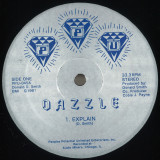
Dazzle rolled deep. Very deep. In the 1980s, it wasn't unusual for the Milwaukee-based group to show up at various Midwest night clubs in a caravan of 30-40 cars and vans. Their live following was hard won over a career that spanned 20+ years, many line up changes, and a handful of project names. Friends, family, and fans made the journey with them weekend after weekend, a testimony to both the musical prowess of the group and the tight-knit community that they emerged from.
Donald Smith, band leader, was there the whole time - joined by many of his siblings and friends - first as founder of the Ghetto Players, a early 70's nine-piece which also included siblings Michael, Ronald, and Charles. They played hard funk in the style of early Kool and the Gang, and although they sadly left no recordings, the strength of their live act managed to catch the eye of local Milwaukee R&B music entrepreneur Cobie Joe Payne. Cobie had made a couple of records locally in the early/mid 70s as a singer, including the impossibly weird and amazing rare afro-blues-funk 45 "Sweet Thing", but had never enjoyed national success. When the Ghetto Players disbanded in the early-mid 70s, Donald soon put together a new group, C on the Funk (the 'C' referring to lead vocalist and sibling Charles), under Payne's tutelage. Sister Lorrie Smith came in as the drummer, the line-up being fleshed out by brothers David and Melvin Johnson, and friend Robert Mitchell. After a few years as a strictly live attraction, they drove to Chicago and produced a single, "In the Disco" / "A Place" for Payne's small record label Sweet Thang Records in 1980. Lacking the financial backing needed to supply the local R&B disk jockey's "promotional fees" , this single sadly languished in obscurity, gathering dust inside the local tavern jukeboxes and manilla promo envelopes that comprised Payne's DIY distribution network.
C on the Funk were traveling the Mid West extensively at this point, and making some important friends on the road. Ike Wiley Jr. of the Dazz Band/Kinsman Dazz took particular interest and the band was re-christened Dazzle, partially as a tie-in with Dazz, partially to embrace the new sounds that would distinguish the 70s disco scene from what record collectors and DJs would now refer to as the "Boogie" era. There no doubt was a stigma attached to the word "Disco" as the eighties began, and as we see in this collection C On the Funk's "In the Disco" is remixed and transformed into the psychedelic synth instrumental of Dazzle's "Disco's Out", a title which embodies both the next-step approach Smith and company were pushing for, and humorously comments on the state of black dance music in the early 1980s. The Dazzle recording, done in Chicago in 1982, updated the sound and featured an expanded line up, most notably a second synth player (Charles Washington), and a percussionist/second lead vocalist (Greg McDonald). The added synth textures and deep percussive grooves give the Dazzle recordings an elegant late night vibe that resonate just as well in a good pair of headphones as they do on the dance floor. The trance inducing cough syrup-warble of "Explain" may best exemplify this here. Sadly, a pressing flaw in the 12" halted production and promotion, and the EP and the songs within were lost to the ages. The group, having done a much better line in the live music business, followed that path instead all the way to the early 90s. --bio provided by andy noble
Buscar:clu
4th Press - 600 copies only
It didn't take long for Błoto to become a thing, shrouded by underground secrecy. First, there was the gig during Spring Break 2019 in Poznań where the Blue Note club was packed to the brim. That event gave momentum to 4 more performances in Warsaw and Wrocław, with no music released at that time. Then, the first pressing of the vinyl was sold out within 24 hours without any single nor cover revealed.
The word about Błoto has spread, increasingly gaining ground, reaching Japan, where the album will also be available on CD. No one expected such a turn of events. In fact, neither did the band itself; after all, Błoto came to being accidentally, yet naturally, like a puddle after a rainy day.
It all started in the summer of 2018 when EABS was touring and the band had a day off. As they were approaching Tricity, people were getting off and eventually there were only four musicians. An evening off, a well-tuned rhythm section on the road, harmonious as can be, and a great deal of creative potential within the members of Błoto band forming at that very moment stirred up common enthusiasm. The album was created without much deliberation, stemming from the need of the heart and the joy of making music together. As a result, 90 minutes of music was recorded of which about 40 made it to “Erozje”.
The music is deeply rooted in brutal hip-hop grooves, referring to the sound of 90’s New York. Dirty and uncompromising, this music’s strength lies in the drums and bass as its sound refers to classics such as Wu-Tang Clan and Company Flow. Radical in a sense, it also captures the atmosphere of the times in which it is created. The times of the planet on the verge of disaster, distinct social divisions, hate speech, growing nationalism, police brutality, nepotism, and various political deals. All this is happening before our eyes. The soil of the world as we know it is eroding right now.
Ethyos 440’s Electrifying Fusion Blends Genres in New EP «Aquila Rift“.
Prepare to embark on a musical journey like no other as Ethyos 440 introduces their exciting and awaited 2nd EP «Aquila Rift,» set to release on Stone Pixels on the 3rd of October. Blending elements of electronic music, trough Dj Laxxiste A. ́s radical and incisive approach to production with L’Eclair’s love for cinematic soundscapes and ethereal melodies, Ethyos 440 has created a captivating fusion that questions the boundaries of the electronic scene, seamlessly merging the worlds of house music and rock’n’roll.
The EP opens with the pulsating energy of the first single due on September 6th «Escape from 440» before entering the dystopian dub trip of «Fattuale». The Madchester trance-hit that is “Tobisha“ follows and takes you directly to the Paradise Anthem outro of EP closer «Mos Eisley».
Ethyos 440 has crafted a collection of bangers that will ignite any club settings. «Aquila Rift» is not just for the dance floor. It is a psychedelic expedition for expert listeners, with layers of complexity that reveal themselves with each listen. The multidimensional sonic experience crafted by the band’s use of heavy cross-fading breakbeats, never-ending fat bass lines mixed with crunchy wah-wah’s and sci-fi like synthesizers aims to transport their audience into the depths of their own mind.
In Celtic mythology, Clota was the patron Goddess of the River Clyde. "Almost all the rivers of Scotland were abodes of goddesses, but about many of them there are no surviving stories. The goddess of the Clyde was ‘the purifying one’.. " Donald MacKenzie 'Wonder Tales from Scottish Myth and Legend' (1917) Following the warmly received 'An Garradh', and 'Tarbolton Bachelors Club', Steven Anderson (Letters From Mouse) returns to Subexotic with another emotionally inquisitive, fascinating psycho-geographical work. Although very little is known about the goddess Clota, Anderson intuitively understands the River Clyde provides a rich landscape to explore her legacy. Dominating its environment, and steeped in ancient and modern historical significance, 'Clota' simultaneously reflects on what is, and what has been. Through deft application of modular synthesis, Anderson's trademark ability to weave extraordinary musical dialogues with time and place, conjures new life into this long-forgotten deity.
The Classic electronic funk Classic by the DETROIT TECHNO BASS INNOVATORS AUX88. “Direct Drive” is the track that defines Detroit, Detroit radio and the jam that still plays hard in any club or mix show. Aux88 show why they were indeed born to make beats. And create the precise floor filler dance tracks
A favorite of the likes of Juan Atkins, Carl Cox, Egyptian Lover, and the Unknown dj from the Xmen. The Repress is finally out.
*"AUX EXPRESS "(Dj K-1 Mix)*
Is a minimal bonus beat mix created by DJ K-1 in the dark dungeons of the original Aux88 studios in the 90’s where the group assembled beats effortlessly in two studios between four members. Aux Express shows a more 80s extended beat that Dj k-1 used to play acapellas over.
*"BYTES"*
Early on the group knew there were a lot of djs playing their music and they created acapellas bytes of their voices so that the world could have access to play them anywhere
Bô'vels Streetsoul-Hymne 'Check 4 U' (1996) ist einer der unbestreitbarsten Underground-Klassiker der Mitt-1990er Piratenradio-Ära, der britische Soundsystem-Kultur, den Clubsound der Manchester-Streetsoul-Szene, Dub-Hip-Hop der Bristol-Bewegung und Reggae-Soundsystem-Bässe miteinander vereint. Nun erscheint mit CHANGES ein Sampler von 'Manchesters beliebtester Soul-Diva' mit diesem Kulttrack und neun weiteren unveröffentlichten Raritäten aus der ungefähren Schaffensperiode 1997-2008, die von Streetsoul über Reggae und Breakbeat bis Downtempo reichen.
As a renowned Italian DJ and producer, Mario Piu achieved his breakthrough in 1999 thanks to the groundbreaking single „Communication“. Now his greatest hits are available on coloured vinyl! Enjoy and get down to selected mixes in the extra-long club versions of „Your Love“, „Techno Harmony“, „Elixir“ and many more!
Bassline technicality and production prowess by Fader Cap on his return to Craigie Knowes. 4 tracks that combine club-sensibilities with width and melody to transcend dancefloors to the outer realms. Echo Chamber provides DJs with a mix of club-focussed beats for all times of the night, strap in.
Orchestral Manoeuvres In The Dark (OMD) return with their 14th studio album Bauhaus Staircase, over six years after the triumph of their Top 4-charting record The Punishment of Luxury. The album was born from the impetus to kickstart new explorations during lockdown when as Andy McCluskey admits: “I rediscovered the creative power of total boredom.”
The album’s first offering as a single is the title track which serves as a nod both to Andy McCluskey’s love of the Bauhaus era & the power of protest art. “I am a huge lover of visual arts especially mid 20th century movements” Andy comments. “The song is a metaphor for strength and artist passion in the face of criticism and adversity. When times are hard there is a tendency for Governments to look at cutting funding for creativity just at the moment when the arts are most needed to nourish our souls. It seems appropriate that the song and its eponymous album were created during Covid Lockdown.”
Ranging further from the beautiful film noir ballad of ‘Veruschka’ and the dance stylings of ‘Anthropocene’ - a term for the current epoch in Earth’s evolution to the sinister ‘Evolution Of Species’ and the hectic ‘Kleptocracy’ - OMD’s greatest straight-up protest song - the new album is a broad electronic sonic masterpiece that lyrically tackles the topics of the future. The record closes on ‘Healing’ - a moment of reflective calm.
By rights OMD should be in semi-retirement performing classics like Enola Gay and Maid Of Orleans on the nostalgia festival circuit like so many peers. Instead they’ve created a landmark album worthy of their finest work. Bauhaus Staircase remains unmistakably the work of a duo who are still perfectly in sync 45 years after their first gig at legendary Liverpool club Eric’s.
“I’m very happy with what we’ve done on this record" McCluskey summarises. “I’m comfortable if this is OMD’s last statement.”
- A1: Seatbelts & Mai Yamane - The Real Folk Blues - 6:15
- A2: Seatbelts & Reynada Hil - Cosmic Dare (Pretty With A Pistol) - 4:24
- A3: Seatbelts & Pierre Bensusan - Elm - 5:04
- A4: Seatbelts - Clutch - 5:15
- B1: Seatbelts & Steve Conte - Call Me Call Me - 4:43
- B2: Seatbelts & Scott Mathews - Is It Real? - 4:40
- B3: Seatbelts & Aoi Tada - Wo Qui Non Coin - 3:41
- B4: Seatbelts - Forever Broke - 3:14
- B5: Seatbelts - Spy - 2:03
- B6: Seatbelts - Time To Know~Be Waltz - 3:49
- C1: Seatbelts - Gotta Knock A Little Harder - 5:20
- C2: Seatbelts & Carla Vallet - Fantaisie Sign - 5:20
- C3: Seatbelts & Tulivu-Donna Cumberbatch - The Singing Sea - 4:40
- C4: Seatbelts - Hamduche - 1:49
- C5: Seatbelts & Mai Yamane - Blue - 5:01
- D1: Seatbelts & Aoi Tada - Theme From Cowboy Bebop - 3:17
- D2: Seatbelts & Gabriela Robin - Cats On Mars - 2:45
- D3: Seatbelts - Waltz In High Socks - 1:34
- D4: Seatbelts - The Fate Of Three - 2:32
- D5: Seatbelts - The Adventures Of Losers - 2:41
- D6: Seatbelts - Piano Solo
- 7:51
Zum 25-jährigen Jubiläum des Kult-Animes "Cowboy Bebop" erscheint die Doppel-Vinyl "COWBOY BEBOP: The Real Folk Blues Legends" mit liebevollem Design von Icon Toshiaki Uesugi. Die Musik kommt von der Originalkomponistin des Animes Yoko Kanno und enthält Titel aus der gesamtem Cowboy Bebop-Reihe wie Blue, No Disc und Knocking on Heaven's Door, mit dem kultigen "The Real Folk Blues". Mit diesem Release werden erstmals Klassiker wie "Call Me Call Me" und "Blue" auf der Vinyl zu hören sein - ein einzigartiges Klangerlebnis für Fans!Dieses Vinyl-Set umfasst zwei rosa-dunkelblau marmorierte Deluxe-LP Discs, ein Einlegeblatt mit der Tracklist, Song-Credits sowie ein ausführliches Booklet mit Interviews zu Yoko Kanno.
After Releasing Amazing Music on Labels Such as Skylax, Amsem, Kitsune or Hard Fist, Through an Exploration of a Wide Range of Electronic Sounds, Joe Lewandoski Delivers a New Ep Full of His Eclecticism and Sharpness. We Are Very Happy at Friendsome Records to Join Force With Him to Deliver a Beautiful 4 Tracker That Will Make You Travel ! This Ep Is the Perfect Demonstration of Joe’s Ambivalence as a Producer. That’s Why We Divided It in Two Distinct Sides, Clair & Obscur, Reflecting on Side One a Club Driven Housy and Acid Vibe to Make Dancefloors Sweat. Cosmic & Acid Nap Are Two Tracks Driven by Lewandowski’s Capacity to Get Things Straight Forward, Bangy and Dreamy, Made for a Pictime Crowd. on Side Two Where Joe Explores a More Dark and Intimate Approach to His Music, as Well as Where He Comes From, You Will Find Nick and Play the Game. They Are Much More Dark Disco and Rock Inspired, Full of Heavy Basses and Guitar Riffs, Perfect to Get to the Bottom of It !...
Contradictory accounts of Miles Davis’ creation of the soundtrack to Louis Malle’s film noir Ascenseur pour l'Échafaud have all become part of its legend. Rarely has a soundtrack been so decisive. Nearly seventy years on, beyond the myth, this taut, feverish recording, imbued with extreme dramatic tension, remains one of the Miles’ finest records. The basic outline remains: Jean-Paul Rappeneau suggested to Malle asking Miles Davis to create the film's soundtrack who agreed to record the music after attending a private screening. Davis was performing at the Club Saint-Germain in Paris in November 1957 and on December 4, he brought his four sidemen to the recording studio without having had them prepare anything. Davis only gave the musicians a few rudimentary harmonic sequences he had assembled in his hotel room, and, once the plot was explained, the band improvised without any precomposed theme, while edited loops of the musically relevant film sequences were projected in the background. Bassist Pierre Michelot recalled in 1988 that “Miles just asked us to play two chords, D minor and C7, 4 bars of each, ad lib.” Typically, Miles planned very little but know exactly what he wanted. François Leterrier, the film’s Second Assistant Director picks up the story: “The session started at around ten o’clock and went on until dawn. The screen in the auditorium was showing the scenes for which Miles had devised some harmonies, and they were edited into a loop. And that’s what makes this music unique: it was entirely improvised in conditions that went back to the days of silent films, while watching frames shot in black and white by cinematographer Henri Decaë: tracking shots of Jeanne Moreau wandering down the Champs-Elysées at night, passing in front of lit window displays or going into bars, while looking for her lover/murderer alias Maurice Ronet … All of us there in the dark auditorium were aware that something extraordinary was taking place, something that had definitely never happened before. … In the small hours we all met up again at the Pied de Cochon in Les Halles, and Louis was looking at Miles with the disbelieving eyes of a child … as if he couldn’t believe the gift he’d just received. Even in his wildest dreams he had probably never imagined what his film would be like once it had been as if illuminated by the trumpet of Miles, incisive or wrapped softly in cotton.” The music was released on 10” by Fontana and received the Grand Prix from France’s Académie Charles Cros. It was released in the USA on Columbia as the A-side of the 12” LP Jazz Track, which received a 1960 Grammy nomination for Best Jazz Performance, Solo or Small Group. This beautiful re-issue of the original recording is pressed on 180g vinyl at GZ, and packaged in a deluxe gatefold tip-on jacket with Boris Vian’s original liner notes and Jean-Pierre Leloir’s iconic studio photo of Miles and Jeanne Moreau, and an essay on the circumstances that led to this out-of-the ordinary music by Franck Bergerot.
Two sublime unreleased scores from Basil Kirchin. Need we say more.
So here we are. The next Trunk / Kirchin assignment. Basically some more unreleased music from the unpredictable and slightly chaotic Kirchin Tape Archive.
Very Limited Black Vinyl.
These tapes were labelled up as follows:
Assignment K (with lots of pencil scribbles everywhere). The Strange Affair (with lots of pen scribbles everywhere).
As usual with Basil tapes / things there is little else to go on, no tracklist, no list of musicians, no singer names, no dates or anything. I have actually tried to establish the name of the singer on the song from Side One (we have called it “Love Is To Walk Away “ as it is unnamed) but having played it to a handful of knowledgeable collectors and enthusiasts who I would count as experts in this field, no one has a clue who it might be. If you think you know please get in touch. We know who it isn’t.
We can tell you that Assignment K dates from 1968, was a film about a toy maker who has a double life as an international spy. It was directed by Val Guest, who’d just finished trying to rescue the cinematic hotchpotch that was Casino Royale - he had been brought in by the Bond producers after Peter Sellers had walked off the movie. We imagine Assignment K may have been a slightly less stressful few months of shooting. As for the Kirchin score that we have here, we can tell you very little indeed, apart from the fact that the bass player was Ron Prentice (an ex blacksmith turned musician and craftsman) who worked on several Bond scores, but we know little else. And we only know this because it says so in the academic tome “Jazz On The Screen” by David Meeker.
The Strange Affair is also from 1968, and was not only controversial but also a reasonably unsuccessful movie. Directed by David Greene who also directed, amongst other films, I Start Counting and the quite brilliant Sebastian. In this rather grubby flick a policeman called Peter Strange (played by Michael York) falls for an underage girl (played by Susan George), finds himself compromised by a pair of pornographers and gets lured into an errand for a smack gang. We can tell you little else because I have no more information about it all.
But we do know that this music has all the classic Kirchin mid-period sonic hallmarks that have always set him apart.
Repress!
Melbourne's Sgt Slick returns with another 4 superb re-edits for his Recuts imprint. 20 years deep in the game, accolades aplenty, collabs with some the finest out there and a serious string of his own productions, Sgt Slick knows what works on the dancefloor and these edits showcase that to a T. Some out and out classics, reworked with the club clearly in mind.
- A1: Open Space
- A2: Green Valley
- A3: Caretera Pnamericana
- A4: Goodmorning Sun
- A5: To-Day's Sound
- A6: Free Dimension
- B1: Truck Driver
- B2: Blue Lagoon
- B3: Wanderer
- B4: Lady Magnolia
- B5: Pretty
- C1: Railroad
- C2: Country Town
- C3: Bus Stop
- C4: Cotton Road
- C5: Nocturne
- D1: Exploration
- D2: Tropical River
- D3: Coast To Coast
- D4-: Safari Club
- D5: Music On The Road
PRESSING OF 500 COPIES WORLDWIDE. INCLUDES POSTER.
The sound of today. A very strong statement. Yet, fifty years later, it remains undisputed. Today’s sound is Piero Umiliani's manifesto, his will to demonstrate to the world that he always has his finger on the pulsating vein of the world, ready to embrace the heartbeat of the future.
In the summer of 1973, Piero Umiliani, in his futuristic recording studio in Rome, much like Miles Davis for his 'Bitches Brew,' gathered an extraordinary collective of musicians, both old and new guard to measure themselves against some of his compositions.
Besides strongly emphasizing the backbeat, what stands out the most is the timbre provided by his 'electronic instruments,' as he liked to call them. Minimoog, Arp 2600, Fender Rhodes, EMS VCS3, Clavinet, Lowrey organ, Space Echo, self-built envelope filters—machines impossible to see all together in an Italian recording studio at the time and made available to the musicians.
The line-up is stellar; under the name 'Sound Workshoppers,' the 'Wrecking Crew all'Amatriciana' is hidden an impossible mix where Marc 4, Gres and Perigeo are blended, along with a brass section of veterans and pioneers of Italian jazz, all members of the RAI Symphonic Rhythm Orchestra.
Comparing the recordings from the original scores, one can also understand the space left by Piero Umiliani for his musicians. They are free to move, to contribute solutions, to enrich the maestro's music.
The perfectly preserved original masters, once transferred at the maximum possible sampling frequency, allowed for the recovery of many lost frequencies, restoring brilliance and the remarkable low end expertly captured in recording by engineer Claudio Budassi.
Today’s sound was extremely difficult to control and fully render with the mastering technology of that time.
Paradoxically, Today's sound could not sound as I have managed to make it sound today: urgent, majestic, more alive than ever.
Studio One was founded by Clement "Coxsone" Dodd1 in 1954, and the first recordings were cut in 1963 on Brentford Road in Kingston.1[2] Amongst its earliest records were "Easy Snappin" by Theophilus Beckford, backed by Clue J & His Blues Blasters, and "This Man is Back" by trombonist Don Drummond. Dodd had previously issued music on a series of other labels, including World Disc, and had run Sir Coxsone the Downbeat, one of the largest and most reputable sound systems in the Kingston ghettos.
In the early 1960s, the house band providing backing for the vocalists were the Skatalites[3] (1964–65), whose members (including Roland Alphonso, Don Drummond, Tommy McCook, Jackie Mittoo, Lester Sterling and Lloyd Brevett) were recruited from the Kingston jazz scene by Dodd. The Skatalites split up in 1965 after Drummond was jailed for murder, and Dodd formed new house band the Soul Brothers (1965–66), later named the Soul Vendors (1967) and Sound Dimension (1967-). From 1965 to 1968 they played 9 a.m. to 5 p.m., 5 days a week, 12 rhythms a day (about 60 rhythms a week) with Jackie Mittoo as music director, Brian Atkinson (1965–1968) on bass, Hux Brown on guitar, Harry Haughton (guitar), Joe Isaacs on drums (1966–1968), Denzel Laing on percussion, and on horns (some initially and some throughout): Roland Alphonso, Dennis 'Ska' Campbell, Bobby Ellis, Lester Sterling, among others on horns during the era of Rock Steady. Headley Bennett, Ernest Ranglin, Vin Gordon and Leroy Sibbles were included among a fluid line-up, to record tracks directed by Jackie Mittoo at Studio One from 1966-1968.
During the night hours at Studio One from 1965-1968, singers like Bob Marley, Burning Spear, The Heptones, The Ethiopians, Ken Boothe, Rita Marley, Marcia Griffiths, Judy Mowatt, Alton Ellis, Delroy Wilson, Bunny Wailer[4] and Johnny Nash, among others, would put on headphones to sing lyrics to original tracks recorded by the Soul Brothers earlier each day. These seminal recordings included "Real Rock" (by Sound Dimension), "Heavy Rock", "Jamaica Underground", "Wakie Wakie", "Lemon Tree", "Hot Shot", "I'm Still In Love With You", "Dancing Mood", and "Creation Rebel".
Jackie Mittoo, Joe Isaacs, and Brian Atkinson left Studio One in 1968, recorded drums and bass for Desmond Dekker's and Toots' biggest hits at other Kingston studios, then moved to Canada. Hux Brown stayed in Jamaica to record on the soundtrack The Harder They Come, The Harder They Fall, and toured in Nigeria with Toots and the Maytals and Fela Kuti. The Soul Brothers (a.k.a. Sound Dimension) formed the basis of reggae music in the late 1960s, being versioned and re-versioned time after time over decades by musicians like Shaggy, Sean Paul, Snoop Lion, The Clash, String Cheese Incident, UB40, Sublime, and countless other Billboard originals and remakes trying to emulate their original Rock Steady sound at Coxsone's Studio One.
The label and studio were closed when Dodd relocated to New York City in the 1980s.
Studio One was founded by Clement "Coxsone" Dodd1 in 1954, and the first recordings were cut in 1963 on Brentford Road in Kingston.1[2] Amongst its earliest records were "Easy Snappin" by Theophilus Beckford, backed by Clue J & His Blues Blasters, and "This Man is Back" by trombonist Don Drummond. Dodd had previously issued music on a series of other labels, including World Disc, and had run Sir Coxsone the Downbeat, one of the largest and most reputable sound systems in the Kingston ghettos.
In the early 1960s, the house band providing backing for the vocalists were the Skatalites[3] (1964–65), whose members (including Roland Alphonso, Don Drummond, Tommy McCook, Jackie Mittoo, Lester Sterling and Lloyd Brevett) were recruited from the Kingston jazz scene by Dodd. The Skatalites split up in 1965 after Drummond was jailed for murder, and Dodd formed new house band the Soul Brothers (1965–66), later named the Soul Vendors (1967) and Sound Dimension (1967-). From 1965 to 1968 they played 9 a.m. to 5 p.m., 5 days a week, 12 rhythms a day (about 60 rhythms a week) with Jackie Mittoo as music director, Brian Atkinson (1965–1968) on bass, Hux Brown on guitar, Harry Haughton (guitar), Joe Isaacs on drums (1966–1968), Denzel Laing on percussion, and on horns (some initially and some throughout): Roland Alphonso, Dennis 'Ska' Campbell, Bobby Ellis, Lester Sterling, among others on horns during the era of Rock Steady. Headley Bennett, Ernest Ranglin, Vin Gordon and Leroy Sibbles were included among a fluid line-up, to record tracks directed by Jackie Mittoo at Studio One from 1966-1968.
During the night hours at Studio One from 1965-1968, singers like Bob Marley, Burning Spear, The Heptones, The Ethiopians, Ken Boothe, Rita Marley, Marcia Griffiths, Judy Mowatt, Alton Ellis, Delroy Wilson, Bunny Wailer[4] and Johnny Nash, among others, would put on headphones to sing lyrics to original tracks recorded by the Soul Brothers earlier each day. These seminal recordings included "Real Rock" (by Sound Dimension), "Heavy Rock", "Jamaica Underground", "Wakie Wakie", "Lemon Tree", "Hot Shot", "I'm Still In Love With You", "Dancing Mood", and "Creation Rebel".
Jackie Mittoo, Joe Isaacs, and Brian Atkinson left Studio One in 1968, recorded drums and bass for Desmond Dekker's and Toots' biggest hits at other Kingston studios, then moved to Canada. Hux Brown stayed in Jamaica to record on the soundtrack The Harder They Come, The Harder They Fall, and toured in Nigeria with Toots and the Maytals and Fela Kuti. The Soul Brothers (a.k.a. Sound Dimension) formed the basis of reggae music in the late 1960s, being versioned and re-versioned time after time over decades by musicians like Shaggy, Sean Paul, Snoop Lion, The Clash, String Cheese Incident, UB40, Sublime, and countless other Billboard originals and remakes trying to emulate their original Rock Steady sound at Coxsone's Studio One.
The label and studio were closed when Dodd relocated to New York City in the 1980s.
"Known for their unique blend of punk rock, post-punk, folk, alternative rock and all kinds of musical sub-cultures, New Model Army refuses to belong to any club or style. Formed in Bradford in 1980, the band's lineup has changed over the years, with Justin Sullivan being the constant and central figure. They have released numerous albums and continue to tour and record music, maintaining a dedicated fanbase. Their music often addresses themes related to social and political issues, personal struggles, and the human condition, making them a significant presence in the alternative rock and post-punk music scenes. The 2019 studio album “From Here” ranked # 13 in the UK Album charts, and the 2023 live album “Sinfonia” hit #1 in the UK Music Video-Charts, making it the highest charting album in the band’s history.
Described as ""Dark Motown"" by Justin himself, “Unbroken” features a diverse collection of tracks that touch on topics ranging from social and political commentary to deeply personal reflections. The album is a powerful and emotionally intense body of work ranging from rebellious tracks as “I Did Nothing Wrong”, to contemplative songs like “First Summer After”. With this album, the band continues to push the boundaries of their signature sound while staying true to the themes that have made them a force to be reckoned with in the music world. “Unbroken” is the first studio album since 2019’s long-player “From Here” and the 16th studio album of the band. It will is available in as a CD Hardcover Mediabook, Heavyweight Black LP Gatefold"