
- 1: A Quiet Bay
- 2: Arp Interlude
- 3: Not Swimming
- 4: Snow Drift
- 5: Honduras
- 6: Enhancer
- 7: Hills Of Denham
- 8: Clusters
- 9: Everything
- 10: Solina
- 11: There Is Not Enough Time
pré-commande27.02.2026
il devrait être publié sur 27.02.2026
21,81 €
il devrait être publié sur 27.02.2026
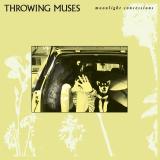
‘Moonlight Concessions’ goes back to basics, a return for Throwing Muses to their esoteric off-kilter best courtesy of Kristin’s pin-sharp sketches and their suitably abrasive musical arrangements. The album follows their acclaimed ‘Sun Racket’ from 2020, a heady set filled with tough and tender tales spiked with surreal imagery. Produced by Kristin Hersh at Steve Rizzo's Stable Sound Studio in Portsmouth, Rhode Island, ‘Moonlight Concessions’ is a collection of snippets from everyday life writ large - think Raymond Carver Short Cuts, overheard conversations, recounted happenings and telling one-liners, all sewed together to illustrate the times as they slowly mature, fully peppered with original Muses’ vim and vigour. ‘Drugstore Drastic’ is a kerbside soliloquy caught en route to a more alluring rendezvous. Built on a brisk acoustic strum with a guitar sub-melody underpinning proceedings, it’s an unfolding tale of social awareness from a blurred sub-conscious. ‘Summer Of Love’ began as a bet with a guy for a dollar that revolved around the idea that the seasons don’t change us. The album opener, it’s a haunting baroque overture, bowed and brooding. ‘Libretto’s strings offset the acoustic ambience, the hot and cold of longing at the very heart of it, a thematic driver filed with warmth in a safe haven lubricated by tequila. Written in the differing South Coast environs of The Gulf Of Mexico and Southern California, ‘Moonlight Concessions’ pulls from the star clusters that light both, generating optimism and hope in varying degrees. Hersh explains, “In New Orleans the stars look greenish-blue, as it’s below sea level and swamp-lit. But on Moonlight Beach, they glow icy white. All these songs were written in these two glowy places, which helped our sonic technique find itself.”
il devrait être publié sur 20.02.2026

Was ist Krautrock? Genre, Provokation oder Mythos? Diese Compilation liefert keine endgültige Antwort - aber zwölf ausgewählte Tracks aus fünf Jahrzehnten musikalischer Grenzüberschreitung. In Zusammenarbeit mit Bureau B entstanden, versammelt diese Platte Highlights aus einer größeren, kommentierten Diskografie. Kein Kanon, sondern ein Impuls: zum Wiederhören, Weiterdenken, Diskutieren. Krautrock bleibt Streitfall - und genau das macht ihn lebendig. Jetzt auf transparentem Vinyl - limitiert und unverzichtbar.
Commandez maintenant et nous commanderons l'article pour vous chez notre fournisseur.
For over six decades, Charlemagne Palestine (b. 1947, New York) has been a pioneering composer, performer, and multimedia artist, celebrated for his ecstatic sonic explorations and ritualistic, metaphysical performances. Emerging from the cross-disciplinary New York art scene of the 1960s and ’70s, he helped shape a heretical edge of minimalism alongside figures like Conrad, Riley, Niblock, and Glass. Trained as a Jewish cantor and later as the carillonneur at St. Thomas Church, Palestine cultivated a deep fascination with resonance and overtone—an obsession that evolved through his use of percussion, early synthesizers, and monumental piano works, influencing artists from John Cale to Nick Cave.
Animated by a spirit of ecstatic play and what he calls his »meschugge« (Yiddish for »crazy«) sensibility, Palestine’s universe blends the sacred and the absurd, filled with soft toys, ritual gestures, and immersive sound environments. Rejecting the »minimalist« label in favor of a maximalist, »spontanimalist« approach, he creates long-form, resonant performances that transform spaces into vibrating, living organisms—opening portals into the nature of time, sound, and devotion.
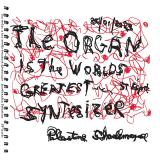
In the same vein, the aptly titled live record »The Organ is the World’s Greatest Synthesizer« – performed during the Sonic Acts Festival at Amsterdam’s Oude Kerk in 2025, and taking its title and cover art from a drawing realized by Palestine himself during the concert – adds to his opaque yet vibrant personal mythology and intimate transcendence, marking a return to the Staalplaat catalog after »Fffroggssichorddd« (2020) and »Music for Big Ears« (2001).
Beginning with a resonating bell and his falsetto overtone singing, then surrendering to the endless, wild soundscapes of tone-feeling and beat frequencies generated by the church’s organ, across 40+ minutes, single sound sources evolve into clusters, entangle fully with one another, and establish their own spatial existence and aural architectures. We witness the traces of something that can be described as a perpetual performance, a test for the ever-changing interaction between artist, instrument, space and, ultimately, us.
Since Palestine has always defined his execution as a form of anti-composition - of simply »being in the music« as if inhabiting a space - the true power of »The Organ is the World’s Greatest Synthesizer« lies in encapsulating a moment of Palestine’s practice in its most authentic, live dimension. Sound becomes at once subtle substance and strange telluric force, animating physical forms from some unknown channel beyond and within, accessible only through our sensorium. The point in this liminal temple of tone, timbre and frequency is not to learn anything but to simply enter. Palestine earns once again his self-given title of contemporary shaman by keeping this sonic portal open, allowing us to witness and make it last.
»I have always felt and heard and mixed the sounds in my world as liquids not as solids. Sonic liquids are material that is endlessly transformable. But I’m not crazy about people who go around defining stuff.«
il devrait être publié sur 23.01.2026

“Godzilla just walked into the room. People just stood there with their eyes and mouths wide open.” To hear Randy Holden describe the audience’s reaction in 1969 to his solo debut performing with a teeth-rattling phalanx of 16 (sixteen!) 200 watt Sunn amps is about as close as one will get to truly experience the moment heavy metal music morphed into existence. However, at last Riding Easy have unearthed the proper fossil record. Population II, the now legendary, extremely rare album by guitarist / vocalist Holden and drummer / keyboardist Chris Lockheed is considered to be one of the earliest examples of doom metal.
Though its original release was a very limited in number and distribution, like all great records, its impact over time has continued to grow. In 1969, Holden, fresh off his tenure with proto-metal pioneers Blue Cheer (appearing on one side of the New! Improved! Blue Cheer album and touring for the better part of a year in the group), aimed for more control over his band. Thus, Randy Holden - Population II was born, the duo naming itself after the astronomical term for a particular star cluster with heavy metals present. “I wanted to do something that hadn’t been done before,” Holden explains. “I was interested in discordant sounds that could be melodic but gigantically huge. I rented an Opera house for rehearsal, set up with 16 Sunn amps. That’s what I was going for, way over the top.” And over the top it is. The six-song album delves into leaden sludge, lumbering doom and epic soaring riffs that sound free from all constraints of the era. It’s incredibly heavy, but infused with a melodic, albeit mechanistic, sensibility.
Troubles with the album’s release bankrupted Holden, who subsequently left music for over two decades. It was bootlegged several times over the years, but until now hasn’t seen a proper remaster and has yet to be available on digital platforms. “The original mastering just destroyed the dynamics of it,” Holden says. “They flattened it out. Now we got a really nice remaster that should be the closest thing to the original recording.”
il devrait être publié sur 19.12.2025
SPFDJ steps up for her long-awaited debut EP, Heel Thyself, out Friday 7th November on Intrepid Skin.
A core figure in grassroots techno circuits, and an internationally lauded DJ, SPFDJ's ascent reflects a passion for music governed by love and grit in equal measure. At once providing a gleefully chaotic two-fingers to dance music's self-serious establishment, whilst also flexing an ever-expanding knowledge of its roots and potentials, her musical armoury is renowned the world over for inspiring debauchery and sweat-soaked hedonism.
As an artist whose journey has been defined by challenging the norms of electronic music, SPFDJ's rebel spirit is recognised locally and globally, but guiding this attitude is a vulnerability to the realities of the music industry, and the rise of conservatism that permeates every aspect of life. And whilst sensitive to the use of buzzwords like community, it's ultimately a respect for the people who keep these scenes alive that motivates her artistry.
In releasing this EP, she taps into a more vulnerable side. The title - a nod to internal healing processes, and a play on words to motivate queers and women to 'boot up for battle' against increasingly oppressive structures - shines a light on some of the values she holds up to electronic music culture. At once playfully chaotic and deeply energising, Heel Thyself spins us through a cyclone of kicks, punches, and noise.
Opener 'Cluster B Intro' is a tempo-twisting barrage of gabber led by a robotic vocal command, setting the scene for pretty much anything to happen. 'That Stiletto Track' kicks in like a tweaked out distortion of 90s trance before spiralling upwards into a storm of heavy breaks. 'F*ckboi' is hot n heavy electro - classic in its structure, but with the added industrial touch of hammerdrill synths and razor sharp percussion. Swinging into a bouncier state, 'The Hot in Psychotic' flings ricocheting rhythms through frantic claps, with a donk to keep things moving. Rounding things off, 'Mindless Counting' flies higher with pummeling drums lifted by a touch of euphoria.
A debut laced with both defiance and self-reckoning, Heel Thyself finds the rebel looking inwards - vulnerable, but sharpened and ready.
Commandez maintenant et nous commanderons l'article pour vous chez notre fournisseur.
The Vibracid operation has cracked the code. With control systems collapsing, the third transmission pierces the very fabric of reality, unleashing patterns that overflow any known algorithm.
From Earth to the far reaches of the interplanetary galactic network, six architects of sound unite to chart routes beyond logic: corrosive FM sequences, blasts of mutant acid, haunting vocoders, and electromagnetic pulses engineered to infiltrate both bodies and machines.
Each track is a node in the insurgent network, an access point to the domain where matter, music, and mind can no longer be separated.
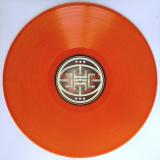
Careful sound and mastering, and exceptional design for a limited edition of 150 copies solid orange vinyl.
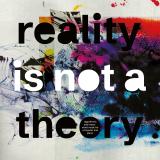
Recorded in concert at the University of Sheffield in March 2025, Reality Is Not A Theory is the first collaboration between Mark Fell and Pat Thomas. Major figures in British experimental music since the 1990s, Fell and Thomas have developed their rigorous practices from radically different backgrounds and perspectives: where Fell’s singular take on synthetic abstraction emerged from Sheffield’s electronic underground, Thomas is a virtuoso improvising pianist steeped in jazz and modernist art music who has simultaneously worked with sampler-based electronics for decades. As the record’s wonderfully academic subtitle explains, we are presented here with two sides of ‘algorithmic and improvised music for computer and piano’, exemplifying both players’ insatiable search for new (and sometimes uncomfortable) playing situations.
The performance begins with Fell’s electronics close to the timbres of acoustic percussion, attacks that suggest wood, metal or glass threaded along a rapid pulse while Thomas focuses on the lowest registers of the piano, deadening the strings. As Fell’s electronics start to ring out and occupy more harmonic space, Thomas turns to wide, repeated clusters, which slowly expand into patterns of chords. Like in his recent solo recordings and his trio work with Joel Grip and Anton Gerbal, Thomas’ playing combines extreme dissonance with a deep lyrical sense. Fell’s work gradually shifts its focus toward drum sounds, drawing on the microtemporal processes that have characterized his practice in recent decades. Heard together with Thomas’ probing piano, the computer sounds call up unexpected associations with the klangfarben antics of improv drummers like Paul Lovens or Tony Oxley. Throughout its second half, the music grows increasingly frenetic, as Thomas sounds out rapid, irregularly repeated figures and beautifully sour chords in the upper register, while Fell’s percussion develops into angular pan-pipe-like feedback and waves of glissandi.
With great confidence and patience, Fell and Thomas often let their individual contributions remain rhythmically distinct and unsynchronised, allowing unexpected correspondence and coincidence to guide the music’s development. Recorded in a hall named after Sheffield steel manufacturer and Master Cutler Mark Firth, the location might suggest a model for understanding how Fell and Thomas interact here: two workers in the same workshop, each immersed in their own part of the production process. Arriving in a striking sleeve designed by Mark Fell, with liner notes by Francis Plagne, Reality Is Not A Theory is an invigorating document of the meeting of two mavericks of contemporary music.
il devrait être publié sur 21.11.2025

In between the folds of ceremony and commonality lies a perennial spring of musical expression.
A statement along the time continuum, or a testament to the resilient resourcefulness embedded in that truth, forms the philosophical approach of this album – the first outing of Dídac.
Studying an extensive archive of instruments, artifacts, and field recordings at the Musée d’ethnographie de Genève—a space steeped in folkloric gesture – Dídac encountered a cosmos of liturgical music and folk song. Anchored in reverance for tradition and transformation alike, this album navigates the old-world Mediterranean lore through a post-modern ambient lens, threading drone, gentle rhythm, electroacoustic textures and the crude tactility of archival material into one woven tapestry.
Under the guidance of Dr. Madeleine Leclair, Dídac was invited to work within one of the world’s most extensive ethno- musicological archives—L’AIMP. In the saturated basements and tape-lined backrooms of the museum, he submerged himself in the sounds of ritual and rural life: wax cylinders from the Eastern Mediterranean, tapes of liturgical hymn, the worn edges of communal song.
In a makeshift studio on the fourth floor of the museum, he sifted through the hours of material he collected, gradually discovering that the archive was no static source – It did not dictate; rather, it served as a companion—offering not answers, but questions. Not a beaten track, but a cluster of sonic clues and riddles. Samples do appear occasionally, tenderly interwoven into the dialogue of the songs. In Dídac’s self-titled debut, the past is not worn as ornament or kitsch; it is listened to and responded to. The museum, its archives, and the visit to Geneva became a foundational culisse of sorts, igniting a myriad of rough cuts and improvisational outtakes.
Dídac, or Diego Ocejo Muñoz, was born in Madrid in 1994 to a family of both Catalan and Castilian origin.
Brought up in a religious household, the influence of the Catholic Church innately shaped the social fabric, schooling and daily life. This lingering dominance led the adolescent Diego into a path of rejection of everything sacramental, promptly resorting to subversion in the shape of grafitti, skateboarding and underground music. Only later in life, after a rigorous venture as an acid and electro producer, the Church re-emerged before him in new light, invoking a deep fascination for its mysticism, iconography and choral tradition.
Spain in general and Catalonia in particular, has long served as a crossroads of the eastern–western Mediterranean continuum, with many of its cultures sharing aspects of way of life and ceremony. At the MEG, Diego found himself puzzled with this realization, resulting in a sonic amalgamation that reaches farther away from the rugged mountains of Catalonia than you might perceive at first encounter.
The deeply embedded memory of rite and public ceremony, religious hymn and landscape—sieved through the undercurrent of personal re-emergence, forms the emotional topography of this album. The record does not trace this landscape; it inhabits it. Its repetitive mysticism and ambient, wide-eyed gaze could possibly evoke (perhaps redundant) comparisons to artists such as Dimitris Petsetakis, or Popol Vuh’s late 70’s cinema scores.
The delicate lines between the sacred and the secular – between memory and re-invention – serve as a cipher to understanding this album in its entirety. Titles like Malpàs Mines or Pantocrator’s Portal Outro nudge toward a folkloric and devotional bedrock—places where labor and spirituality coexist, where names preserve both dust and veneration.
Nevertheless, this is far from mere nostalgia. It is a reclamation — singing alongside the spirits of the past, nurturing what still hums beneath the soil. It is an intimate reflection on tradition, rebellion, adolescence, ceremony and fantasy – a pastoral contemplation on what once was and what is to be.
Commandez maintenant et nous commanderons l'article pour vous chez notre fournisseur.

il devrait être publié sur 31.10.2025

The Sator Arepo, or Sator Square, is an ancient word puzzle comprising five palindromes that's etched on various historical sites throughout the Western world. Its origins are unknown, but the square has long been thought to hold magical properties, used as a charm against illness and evil, to cure insanity or to determine whether someone was guilty of witchcraft. Self-styled "punk ethnomusicologist", acoustician and musician Julien Hairon uses this mystical symbol as the starting point for his debut Judgitzu album in an attempt to reconnect with his Celtic heritage, exploring how its hallowed messages might harmonize with contemporary Tanzanian dance music.Hairon has been traveling across the world for over a decade, collecting field recordings from countries such as Indonesia, Australia, Cambodia, China and Bangladesh, and presenting them on his Les Cartes Postales Sonores label, re-issuing any curious cassettes and CDs he came across on the PetPets' TAPES imprint. It was during this time that he became fascinated by rituals that involved spirits, prompting him to examine his own ancestry when he returned to Brittany. "Many artifacts in the landscape remain," Hairon explains, "and the power of spirits is still palpable." He represents this Celtic mysticism on 'Sator Arepo' with murky drones and magickal synth tones, using xenharmonic scales (tuning outside of standard 12-tone equal temperament) that reach back to the ancient world. These sounds are augmented with fast-paced, sci-fi rhythms informed by his time in Tanzania; "Singeli has contaminated me," admits the producer.The most astonishing example of this is 'Miracle', a thrusting soundsystem experiment that layers serpentine, bagpipe-esque electronic wails over extravagant clusters of blocky percussion. Driven by the frenetic 175BPM pulse that echoes through the streets of Dar Es Salaam - popularized globally by forward-thinking producers like Sisso, Duke and Jay Mitta - Hairon opens up a rare conversation, seeking to draw parallels between today's most urgent dance forms and the archaic rituals of antiquity. On 'Vitalimetre', Hairon drives his sonic palette into the red, harmonizing with Dutch hardstyle and gabber, and splaying distorted drones over maddeningly blown-out kicks and ratcheting percussion. 'L'or Des Fous' takes a more meditative route, prioritizing Hairon's eccentric tonality with expressive sheets of pitch-warped sound that ghost walk across energized, rattling beats.If you heard Hairon's last Judgitzu release 'Umeme / Kelele', described by Boomkat as "one of 2019's deadliest dancefloor sessions," then you'll know how mindboggling this material can be. And with 'Sator Arepo', the French producer deepens his reach, grasping a world that we've almost forgotten and juxtaposing it with a landscape most of us barely comprehend.
Commandez maintenant et nous commanderons l'article pour vous chez notre fournisseur.

On Biotope, Valentino Mora ventures even further from the dancefloor, delving into a rich, psychoacoustic realm shaped by modular and spectral synthesis. Built primarily around the Rossum Panharmonium, a module that analyzes and re-synthesizes audio into evolving harmonic clusters in real time, the album conjures an imagined ecosystem, where sound behaves with the logic and fluidity of organic life. Eschewing traditional field recordings, Mora instead sculpts textures and gestures that feel deeply natural yet are entirely synthetic. Inspired by elements such as soil composition, air, humidity, light, temperature, and the chemical properties of both land and aquatic environments and the living creatures that inhabit them, the soundscapes emerge as a kind of sonic biology. The result is a collection of slow-moving, tension-laden compositions that blur the boundaries between physical sensation and abstract design. Biotope unfolds like a closed ecosystem: modular synthesis treated as a breathing entity, shaped by resonance, friction, and organic motion. It embodies a kind of mystical biology, where textures mimic living forms, and frequencies pulse with intent. This is music to be felt as much as heard, Biotope invites you to listen with your skin, not just your ears.
Commandez maintenant et nous commanderons l'article pour vous chez notre fournisseur.

Strut Records proudly presents the official reissue of Hidden Fire Volumes 1 & 2, the final album released by Sun Ra on his El Saturn label in 1988.
Captured live over three nights at the Knitting Factory in New York City, these performances mark the closing chapter of a 33-year odyssey of radical, independent music-making. Originally issued in tiny quantities with minimal packaging and cryptic artwork—often featuring hand-written labels or Ra’s own handmade designs—Hidden Fire was among the most elusive entries in Sun Ra’s vast discography.
Musically, these recordings stand apart from Ra’s other '80s compositions. Here, Hidden Fire plunges into darker, more dissonant territory. Ra performs exclusively on the Yamaha DX7 synthesiser, pushing its digital sound palette into alien dimensions. The Arkestra lineup is uniquely configured, featuring a rare and heavy string section with three violins, including the legendary Billy Bang, and the singular space vocalist Art Jenkins, whose eerie textures and vocalisations had not been heard so prominently since the early 1960s Choreographers Workshop sessions. The music is raw, unsettled, and often overwhelming.
“Retrospect / This World Is Not My Home” opens with a palindromic riff that evokes Ellington before unraveling into a stark sermon from Ra, warning of death’s dominion over Earth-bound minds. “Hidden Fire Improvisation” is a furious explosion of tone science, with Marshall Allen, Billy Bang, and John Gilmore delivering fire-breathing solos over relentless drumming and Ra’s cascading synth clusters. “Hidden Fire Blues” offers a warped, electrified version of Ra’s familiar blues feature, led by Bruce Edwards on guitar and Rollo Radford on electric bass, transformed through the haze of DX7 textures. “My Brothers The Wind And Sun #9” evokes the experimental weight of The Heliocentric Worlds with its crashing percussion, pulsing synth-vocal duets, and string- driven chaos that seems to spiral into oblivion.
Even the quieter moments—such as “Hidden Fire II,” a duet between Ra and Art Jenkins—feel thick with unease and shadowy beauty. These performances represent a Sun Ra less concerned with cosmic joy or outer-space swing, and more focused on conjuring portals to the unknown.
Remastered from original sources and presented with archival photos, new liner notes by Paul Griffiths, and restored artwork inspired by the original Saturn editions, this reissue offers a definitive window into the last creative surge of one of music’s most visionary figures across two Vinyl LP’s.
il devrait être publié sur 19.09.2025

Russell Haswell and Florian Hecker have both a long history with Mego/Editions Mego. Individual releases have peppered the Mego catalogue since Haswell’s Live Salvage 1997->2000 cd release (MEGO 012) in 2001 and the debut Hecker release IT ISO161975 (MEGO 014) in 1998.
The individual exploration of sonic phenomena by these two practitioners has resulted in both being highly regarded for their uncompromising approach to sound as matter. Russell Haswell and Florian Hecker came together as a collaborative duo with the now-legendary record Blackest Ever Black, somewhat inexplicably, on the classical imprint of Warner Brothers.
In 2025, Hecker and Haswell return with a new album featuring the two-channel edit produced initially for their UPIC DIFFUSION SESSION #23, performed as a live diffusion across 8-channels at the X100 Festival, Berlin, 2023, celebrating the 100th anniversary of Xenakis' birth.
This record furthers the duo's exploration of Xenakis's UPIC system as the sole instrument. The UPIC is a computer music system that generates sound from visual input. The original intention of the system developed by Xenakis was to make a utopian tool for producing new sounds accessible to all, independent of formal training. One can locate footage of Xenakis and a group of children making drawings for the system in the 70's.
The duo set off experimenting with a diverse array of hand-drawn images to feed the UPIC system including news photographs of disasters and atrocities, "food porn" through to depictions of the natural world and microscopic images of molecular structures (including 'the blackest ever black'). The resulting eccentric audio from these images is claimed by the artists to heighten synaesthesia and is as mysterious as it is baffling.
Throughout UPIC DIFFUSION SESSION #23 frequency clusters move and morph in the most unusual manner, shifting and stretching into shapes that hint at some kind of magical process. What starts out deceptively simple soon unravels into a large array of sonic mayhem. Symbolic jet planes are shredded by a swarm of insects, a metal bowl howls into the void, a tiny tin toy crawls into a thicket with the resolute aura of a black hole. A burning geyser of laser forms liquid shrapnel. This is sound as an alchemical process, a constant chimerical flow into the netherworld and is the net result of the decades long radical investigations by the two artists involved. UPIC DIFFUSION SESSION #23 is a direct, rich and rewarding listen for those willing to invest time into the outer limits.
Commandez maintenant et nous commanderons l'article pour vous chez notre fournisseur.

“I can honestly say I’ve never heard anything he’s played” - Liam Gallagher
“The only other keyboard virtuoso who can hold a candle to Christaian wears a cape and performs on ice sometimes, he’s great but I’d go for this chap every time personally” - Marc Riley
‘Shinbone’s Revenge’ is the follow up to Christian’s last album “Whatever Best Serves’ released in 2023. Christian is the founder member of The Earlies, has been Liam Gallaghers keyboard player and is currently the keyboard player in the newly reformed Oasis. Again Christian is joined by ‘The Enemy Chorus’ an ensemble of friends and cohorts this time including Little Barrie (Primal Scream/The The/Liam Gallagher/John Squire) The album is scorched with the psychedelic funk rock heat of Booker T and Brian Auger, the punchy brass arrangements of Chicago Transit Authority and Tower of Power, and the kosmische motorik wonders of Can, Cluster and Harmonia
il devrait être publié sur 29.08.2025

Im Schatten der nuklearen Katastrophe von Fukushima im Jahr 2011 fanden sich die japanische Musikerin Phew, die Künstlerin Erika Kobayashi und der deutsche Elektronik-Pionier Dieter Moebius (Cluster, Harmonia) zu einem außergewöhnlichen Projekt zusammen. Gemeinsam entwickelten sie das Konzeptalbum "Radium Girls 2011", das sie 2012 unter dem Projektnamen Project UNDARK veröffentlichten - 114 Jahre nach der Entdeckung des Radiums durch Marie und Pierre Curie. Das Album ist den sogenannten Radium Girls gewidmet, Fabrikarbeiterinnen in den USA der 1920er Jahre, die Ziffernblätter mit radioaktiver Leuchtfarbe bemalten und schwere gesundheitliche Schäden durch Radiumvergiftungen erlitten. Anlässlich des 80. Jahrestags der Atombombenabwürfe auf Hiroshima und Nagasaki macht das Label Bureau B "Radium Girls" wieder zugänglich - erstmals auch auf Vinyl.
il devrait être publié sur 08.08.2025
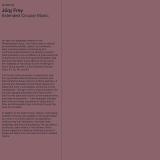
Since its founding back in 2014, Blume has carved a unique place in cultural landscape, issuing free-standing works, spanning the historical and contemporary, that represent singular gestures of creativity within the field of experimental sound. Joining their broad efforts in building networks of context and understanding that already includes the works by Werner Durand, Sarah Hennies, Bruce Nauman, John Butcher, Jocy de Oliveira, Mary Jane Leach, Valentina Magaletti, Alvin Curran, Julius Eastman, Alvin Lucier, and following the first ever vinyl release to attend to James Tenney's legendary Postal Pieces, the label now presents the first LP published by the visionary Swiss composer Jürg Frey. Drawing from the transformative power of breath and resonance, this release represents one of the most profound explorations of musical metamorphosis to emerge from the contemporary experimental landscape.
The completed work represents a "conjunction of these two artists" that has "activated a transformative form of experimentalism." These renderings "dance with an airy lightness, humour, and play, imbuing them with a beauty and emotiveness that can be rare within experimental music." They exist as "breaths, carrying the curiosities of life, belonging to no time and all time, to no one and everyone: a human music to be inhaled and pondered, for which the outcome remains unknown." In this liminal space between composition and interpretation, between breath and resonance, Zurria and Frey have created something that transcends the boundaries of experimental music itself, offering what might be called a metaphysical cartography of sound in its most essential form. As Bradford Bailey observes in his penetrating liner notes, "music is rarely a fixed entity," existing instead in a state of perpetual flux, "taking on the influences of its interpreters and performers." This fundamental truth finds its most eloquent expression in the transformative collaboration between Italian flutist Manuel Zurria and Frey, longtime member of the Wandelweiser Group. Where conventional recordings might preserve a definitive version, this release activates what Bailey calls "states of unknowing and continued experimentation," allowing Frey's compositions to evolve into entirely new dimensional territories. The original string quartet and piano works dissolve into breath-carried architectures of sound, where "the original remains in a constant dialogue with its transformation." This is not mere arrangement but ontological metamorphosis - an alchemical process through which crystalline harmonies are reborn as atmospheric phenomena.
The metaphysical dimensions of this transformation become clear through detailed analysis of the musical result. Where Frey's original compositions operate through what he calls "basic confidence in the clear and restricted material," Zurria's interpretation activates entirely new perceptual territories. Space holds almost atomic sense of weight against the airy punctuations of timbres, textures, and tones, creating "suspensions of time within which questions and identities posed by instrumentation fade." The Extended Circular Music pieces - each comprising "a small number of bars to be repeated an undetermined number of times" - become organizations of sound that defy being definitive or fixed. Originally scored for different combinations of violin, viola, cello, and piano, these works now exist as pure phenomena of breath and resonance, where "hanging, breath-length utterances dance and intertwine amongst complex harmonic clusters and conjunctions."
The philosophical implications of this transformation illuminate a lineage of composers who have moved "away from abstraction and responding to the need to create" something beyond mere technique. Drawing parallels to Morton Feldman's understanding of non-functional harmony, Zurria's approach represents "a transformative form of experimentalism" that activates what Frey calls the "thaumaturgic power" of music - its capacity to heal and transform consciousness itself. The result is "a radical reimagining of ambience: sprawling sonorities and resonances adrift in space, carrying the liberated traces of the work's former incarnations and their truths." In Zurria's interpretation, Frey's String Quartet n.3 becomes something approaching "an organ played in slow motion, its seals leaking," while the Extended Circular Music pieces transform into "glacial chords from a diverse palette of voicings, harmonies, timbres, and tones."
Performed by Manuel Zurria. Recorded and mixed by Zurria at BigCardo, Catania between 2022-2024, with mastering by Bruno Germano at Vacuumstudio, Bologna, this Blume release represents a profound exploration of musical transformation.
il devrait être publié sur 01.08.2025

Massi NPL’s EP debut on House on the Strand’s label 'Herah' is a wonderful cluster of ambient club adjacent works
Producer and sound artist Massi NPL has spent close to a decade honing his craft as a producer with an impressive growing list of accolades that have seen him try his hand at everything from scoring award winning video games and theatre productions at the Zurich theater to DJ at events and radio stations around the globe.
While the producer’s output may be slim it is considered and precise. His new Fragments EP is a deeply personal project that is the product of years of work.
These select 3 pieces are crafted from a series of field recordings spanning 3 cities that have shaped much of the producers life. These ambient club adjacent works are equally promising at decibel sound system shaking volumes as they are within tucked away headphone and home listening environments. They exude expansive soundscapes, featuring a rich array of washed out synth backdrops and percussions.
As featured on Alex Ruder’s Pacific Notions on KEXP
Mastered by artist engineer Adam Badí Donova (ulla, mu-tate, dj lostboi, Torus)
il devrait être publié sur 25.07.2025

Genre please! `A .... few ́ moments of worldwide swirling. Four tracks of class-sensitive sonic expression, spiritual punk, and cosmic cure-work taken from Kundan’s multilayered album „A vantage granted but to few“. Field recordings and samples cluster around all kinds of instrumentation. Styles collide and never settle. Information hunts — and sometimes hurts. Expect Highlife on a Tresillo groove with an eco twist (TERRAR), a creepy tango warped by wartime novelty (VIVAN), Anatolian disco dub featuring Robert Beckmann on violin (NAHIN), and confessions from the voodoo backyard by deprived residents of Rostock ‘ganz unten’ (ES GIBT NICHTS).
Commandez maintenant et nous commanderons l'article pour vous chez notre fournisseur.

Underground Pacific is back with a new double vinyl compilation titled ‘The Only Good Wave is a Dead One’ that confirms, once again, its uncompromising taste for bold electronic music, psychedelic textures, and raw, electrified rock ‘n roll. This release brings together a varied group of artists, each of them adding something special to the journey.
The trip begins with “Excursions” by Gregory Moore, a piece that floats into a humid sonic world, between the nostalgic tones of vintage video game soundtracks, the Fourth World atmospheres of Jon Hassell, and the shimmering calm of ’90s Japanese ambient à la Takashi Kokubo.
Next comes Talee, the Rotterdam-based regular of the label, with “Makes Me Wonder”. Here, grunge-soaked vocals meet a tight dark disco groove, pierced by crystalline guitar chords that shimmer at the track’s heart. A song with its soul in the past and its feet in the club.
Label founder Cantor teams up once again with German duo New Hook on “Achtung! Achtung!”, an homage to the eponymous track by Italian producer Black Saagan. Fueled by vintage drum machines, punk-infused vocals, and melodies echoing the krautrock minimalism of Cluster, the track channels pure Cold War disco energy.
On “Scavengers”, Berlin based World Wild Web and Rasp Thorne deliver a pure mix of electro-rock noir – Suicide by way of David Lynch. Picture a never seen before episode of the series where Martin Rev and Alan Vega are playing live at the Roadhouse in Twin Peaks, while Laura Palmer slowly moves her head to the music, with a devilish smile on her face.
All the way from Grenoble to Berlin, H.L.M. deliver a dirty bass-driven anthem called ‘Fronde’. French spoken vocals spitfire over layers of distorted drones and hypnotic rhythms. The result is rough, hypnotic, and brings to mind the grooves of Death in Vegas.
New Hook return, this time solo, with ‘Unity’: a blend of groovy downtempo percussions, melancholic guitar riffs, and their signature brand of spoken word, a style that’s quickly become their sonic fingerprint.
Then it’s the turn of mexican-wave exponents Montessori featuring Vongold on “Ad Libitum”: a techy sunrise piece with soft pads, subtle build-ups, and an ecstatic sense of endlessness. After-party music for vast, open spaces.
Next up are SX2 from Ireland with their ‘Buttons’, offering a rolling tech-house banger laced with desert guitars. Psychedelic FX’s and whispered vocals drenched in delay slow the pace in a breakdown full of tension, preparing the floor to an euphoric release.
A dream from the pandemic era reappears: Cantor’s “Hannett’s Dream”, originally released in 2020 by Modular’s Project’s imprint ‘Nothing Is Real’ together with their own reworked version present also in two very limited vinyl-collector editions released by Underground Pacific. The introspection and hypnotic structure of the original cut here is replaced by a more stripped down arrangement, with a four-to-the-floor groove that is perfectly crafted for peak-time ignition.
Closing out the release is “Carissima” by the man behind iconic label Wonder Stories, Aimes – a Moroder-esque bassline and sensual vocals play on top of a warm groove that suddenly fractures into jazz-tinged, breakbeat mood, in the style of early Warp Records, just in time to get back into its disco-ish swing.
Contrary to what the title of this release might suggest, the wave isn’t dead at all. It’s well alive in the underground, reanimated by labels like Underground Pacific who are always ready to welcome artists who aren’t afraid to crash genres together and, above all, who are driven by the desire to make free-form, inspired pieces of music.
Commandez maintenant et nous commanderons l'article pour vous chez notre fournisseur.
