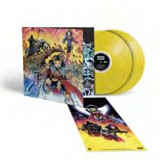
YELLOW VINYL
A taste from his upcoming debut album, Biesmans’ ‘Cold Void’ EP is brilliantly wistful and nostalgic, traversing indie dance, rock, electro and pop-tinged cuts.
Released in February, the artist’s ‘Planes, Trains & Automobiles’ EP laid the retro groundwork, taking inspiration from ‘80s video games. ‘Cold Void’ takes the baton and runs with it. The title track sees
Biesmans team up with guitarist Boi Wonder and Tom The Bomb, front man of Belgian rock outfit The Guru Guru. The resulting track is driven by steel blue synths, a massive guitar riff and memorable vocal
hook. A certified gem.
Disco Halal label founder Moscoman links up with emerging Ukrainian producer Komilev to beef up ‘Cold Void’s’ bottom end, adding ascendent pads and lush melodies, shifting the vibe into punchier dancefloor territory. ‘When Will It Stop’ is a woozy indie dream, propelled by robotic vocals and ‘80s piano chords. A handy radio edit of Moscoman & Komilev’s remix rounds out the package, promising broad appeal.
Buscar:cold end
Straight out from the green hills of the Welsh countryside comes Jeb Loy Nichols, the newest sensation in Timmion's growing roster of soul-fuelled vocalists. And we certainly have a double sider of the highest calibre on offer. A seasoned and versatile music scene veteran with a major label past, Jeb has everything it takes to polish Cold Diamond & Mink's rough grooves into shining gems.
The A side gives us a rolling southern-style soul banger, which the Wyoming-born singer attacks effortlessly with his praise for an honest dance. Jeb's talent for clever song writing shines through in the lyrics which connect to our current reality, where truth has become an endangered species. The slower flip side kicks off with a Sunday afternoon worthy duo of organ and acoustic guitar before Jeb shows us how a story is weaved from minimalistic ingredients. From the rural beginnings to pastoral hardships, he lays it all bare for the listener.
In addition to this single, Jeb and Cold Diamond & Mink have a whole album of soulful gold dropping later this year. Make sure to be there to catch it when it drops.
Following recent super-deluxe editions and multi-format releases of classic Who albums – ‘My Generation’, ‘Tommy’ and ‘Quadrophenia’, and the success of ‘Live at Fillmore’, we follow with The Who Sell Out – this set shaping up to be the most superlative of all…!!
Released in December 1967 – the album reflected a remarkable year in popular culture. As well as being forever immortalised as the moment when the counterculture and the ‘Love Generation’ went global, 1967 produced tremendous musical upheavals as “pop” metamorphosed to “rock”.
Originally planned by Pete Townshend and the band’s managers, as a loose concept album including jingles and commercials linking the songs styled as a Radio London broadcast – born out of necessity as the band’s managers wanted a new album and there weren’t enough songs.
The original plan was to sell advertising space on the album – Jaguar cars, Coca-Cola etc. The jingles pay tribute to the pirate radio stations and expose the myths of ‘pop-culture’ and mock consumer society – way ahead of their time…
The homage to pop-art is evident in both the advertising jingles and the iconic sleeve design – created by David King (art director at the Sunday Times) and Roger Law (who invented Spitting Image) producing four giant images for each band member – Odorono deodorant, Medac spot cream, Charles Atlas and Heinz baked beans (Roger apparently caught pneumonia from sitting in the cold beans for too long).
Photography by renowned portrait photographer David Montgomery (rare out-takes included)
The album is a bold depiction of the period in which it was made – the tail-end of the ‘swinging-60s’ meets pop-art mixed with psychedelia and straight-ahead pop craft. It’s glorious blend of classic powerful Who instrumentation, melodic harmonies, satirical lyrical imagery crystallised for what was only the group’s third album – the ambition and scope is unrivalled by the Who, or any others from that period.
Within the bold concept, were a batch of fabulous and diverse songs – I Can See for Miles (a Top Ten hit) is a Who classic, Rael, a Townshend ‘mini-opera’ with musical motifs that reappeared in Tommy and the psychedelic blast of Armenia City in the Sky and Relax are among the very best material of the 1960s.
One of the most extraordinary albums of any era – it’s The Who’s last ‘pop’ album. Two years later came Tommy – a double concept album about a deaf, dumb and blind kid…
“We were hoping to get free Jaguars. We got fifty tins of free Baked Beans”
Pete Townshend
Master craftsman James Welburn’s new LP, Sleeper in the Void, marks the 50th Miasmah release.The six years after his monumental debut have bred six tracks Welburn brings to fruition with the help of past co-conspirators from the Norwegian underground scene - Tomas Järmyr (Motorpsycho, Zu, Barchan), Hilde Marie Holsen (Hubro Records), and vocal artist Juliana Venter (W/V, Phil Winter).
On Sleeper in the Void, Welburn expands the domain of his sound, unveiling surprises until the very end of the album’s 36 minute playtime. While the character of the record is unmistakably his own, the tracks veer into many different territories, including a banging foray to the dancefloor.
The LP begins slowly with Raze, where Järmyr’s ritualistic cymbals introduce layers of Welburn’s signature sculpted bass drones and noise, building into a heart-wrenching epic of a track. This is perhaps the closest we ever get to Hold - Welburn’s previous LP. Falling from Time immediately surprises with it’s subdued mechanical techno beat, stark and cold as a glacier. Welburn’s texture-work is the star of the show, creating curious nooks and crannies of drone adorned with eerie melodies straight out of oblivion. This sense of wonder shines through to the album’s title track as well, where Welburn and Järmyr build another patient, echoing, and deeply cinematic piece, the drum patterns slowly shifting around a metallic hum that evokes the vision of church bells, ringing out under tonnes of seawater.
Sleeper in the Void feels like a story in two parts, rising lethargically, but with gargantuan power. The second begins with the momentous In and out of Blue, where Juliana Venter’s disembodied, spectral dirge takes center stage among the furious drums and bassy riffs, reaching a full crescendo with seconds to go. Parallel marks a release - Hilde Marie Holsen’s nostalgic soundscapes, pristine as glass, meeting the distant thunder of Welburn’s strings on the horizon. And finally, Fast Moon ends the record in a most surprising way - a tribal industrialized banger, complete with vile distorted beats and every other spice in demand on a blackened dancefloor.
Welburn’s Sleeper in the Void is a generous shapeshifter. Every inch of its soundwave breathes emotion and imagery - an invitation to take a dive and linger.
Keith Tucker and Gerald Donald of Dopplereffekt did it......They finally got together two of the originators from the monumental Detroit electronic groups Aux88 and Drexciya. The combination of these two musicians has created a retro bombardment of funk as only Keith Tucker and Gerald Donald can bring.
That unearthly eerie funk and strings from other worlds. This release gives a sense of a melding of Cybotron and Kraftwerk....That snappy intelligent funk that Detroit so heavily influenced and unleashed to the universe
1) "Star Gazing"- Is reminiscent of Cybotrons eclectic funk style with Tucker unmistakable electronic vocals and electronic beats slapping you in the face.
2) "Telescope Array"- Is an extension of Gerald Donald legendary aliases that give listeners that cold minimal drum and beautiful arps that hypnotize. Thumping bass line and .....bonus vocal interlude at the end of this interstellar track
The NE-21 return to She Lost Kontrol after their first pitch-perfect 80s dark wave release in 2016. After releasing a collaboration with Donato Dozzy with the project ‘Men with Secrets’ at the beginning of the year, the duo lands on the label with their new work “In The Realm of Electricity”. The album is a collection of 8 tracks composed and recorded between 2012 and 2020 at the Sy6 studio in Boscoreale. The outcome is a perfect blend of synth pop and minimal wave, filled with icy synths, shuddering bass, and anthemic vocals, ranging from mumbled vocoder to arch talk-singing. While diverse in atmospheric scope, swells of ghostly synths circle the driving beat throughout, producing a haunting totality drenched in an ethereal midnight trance; the submerge of cold, spectral vocals sing within the darkest depths of a starry soundscape – the gloomy romanticism of low, distant vocals bursting with post-punk melancholia. The track’s unease between purpose and utility create a discrete synthesis, and, like a piece of speculative fiction, the memory of the body and its coalescence with the future become prime motives for this liquid age. Akin to Ballard or Philipp K. Dick, the workis not only dreamlike and surreal, but vocally sinister, as if this spectrum of lush new wave ‘80s pop and Almond-style weirdness hides a truth waiting to be grasped. The album in essence sounds unashamedly distinctive, unique and charming. Whether you fall in love with the whole act or you’re just stunned by the bizarreness of it all, one thing’s for sure – you’ll be compelled and gripped right to the infectiously smutty end. Composed, recorded and mixed by Nicola Buono & Lino Monaco at Sy6 Studio. Vocals and lyrics by Lino Monaco. Mastering by Joshua Eustis, Los Angeles. Design By Michelangelo Greco She Lost Kontrol Records 2021
Orions Belte: «Villa Amorini» Jansen Records 2021 Do you remember the time the doorman ran after some drunken kids around the lake outside the club? As he dives into the lake, he scrapes his stomach on a sharp object in the water, but catches up and returns with one youth under each arm. At the same time the singer from the band playing inside, jumps from the loft hoping that the chandelier he grabs will hold him. It doesn’t. Endless afterparties and constantly trying to avoid visits from the police or the liquor control. Still nothing? This was the 90’s club scene in Bergen, and Villa Amorini was the place where everything happened. Starting as an 80’s fine dining spot, it evolved into an extravagant club with tons of artists and DJ’s in screaming shirts and oversized sunglasses. This sets the scene for Orions Belte’s second album. Still a mix of all the sounds they like, reminiscing eras they haven’t experienced, trying to navigate in their own musical atmosphere. Chaotic and calm at the same time. Villa Amorini is recorded at Norsk Riksstudio by engineer Njål Paulsberg, making sure the sounds were on point while leaving the band alone to play together for hours upon hours, chiseling out the base for the album. Where the debut was summery and a bit brighter, this album tends to lean a bit more towards the big city, night life and leftover food from the fridge. Mixed as always by the magnificent Matias Tellez.
Reuben Sawyer is nothing if not prolific. He's also a man of many talents - his various projects have included the coldwave sounds of The Column, Hollow Sunshine's blown-out psych-noise, Anytime Cowboy's take on countrified weirdo-pop, and even ambient house courtesy of Rose. Oh, and he's a visual artist too, of course. Pfft, who needs an attention span anyway? One thing he's also dabbled in, however, is post-punk. Human Trophy is firmly in line with that tradition, but pulling from multiple directions at once - one minute this album rattles along like Big Black with the tempo down and the textures dialled up, the next we're firmly in Christian Death territory. The twisting guitar lines and pummelling bass of 'Forming Horrors' even call to mind his blackened punk project Dry Insides, but with less velocity and a helluva lot more menace. Is 'Corpse Dream' a goth record? Possibly. Whether goth is a lifestyle choice for Sawyer or not, he's certainly adept at immersing himself in sounds and making them feel like a comfortable fit. As with all his projects, it feels like another effortless facet of Reuben Sawyer - and in keeping with the rest of his output, it's absolutely packed with songs you'll wanna play again and again. Penultimate track 'The Roads' is built on a none-more gloomy pile-up of darkly portentous rhythms and a firm sense of disquiet, but once you're locked into its circular riffage you'll feel an urge to keep the loop going endlessly. Then there's the closer 'Blood Apex', a dual-vocal nightmare set to music which draws you back in even as it attempts to push you away. Yeah, it's pretty great.
"To The End" is a tremendous demonstration of power that impressively unites all elements of its predecessors and paints a frightening picture of war, death and destruction at the end of which nothing remains but ashes and the realization of a masterpiece. It is the beginning of a new era. Since early October 2020, smoke is laying over Northampton near London. The machinery is well-oiled, the plan excellent - MEMORIAM have recorded their fourth studio album! The speed the British machinery has been working at since their early days is just enormous and equally amazing. Only back in 2016 the band inaugurated the public about their existence. Since those days the machines never stood still. The British Death Lead Commando caused a big rumble shortly after the first rumors about where the journey would go. "The Hellfire Demos" hit the worldwide scene with their old school Death Metal and left speechlessly torn open mouths which are still raving about the enthusiasm of this achievement today. When "For The Fallen", the debut album, is unleashed on mankind via Nuclear Blast Records in 2017, the impression is even more powerful – Truly an historic act for metal history. But as mentioned, there is no stand still in MEMORIAM. Meanwhile emancipated from other bands, they write their very own piece of history. While the first album was still heavy, oppressive and marked by grief, the second album "The Silent Vigil" (2018) showed a more merciless and aggressive side. The same applies to the third strike "Requiem For Mankind", which stands unmistakably in the short but impressive tradition of all previous MEMORIAM works. After this concentrated Death Metal trilogy, all signs were pointing to upheaval. As if the band wanted to completely break away from their old roots, they looked for a new home and signed a worldwide record deal with the upcoming label Reaper Entertainment Europe. While drummer Andy Whale had to take a forced break due to health reasons, Spike T Smith - a close friend of the band - took over the job in the rhythm section. Nevertheless "To The End" follows the tradition of its predecessors without leaving any doubt that one of the strongest albums of 2021 lurks here. Once again the groove is monstrous, the riffs deadly merciless and the atmosphere oppressive, paralyzing, even overwhelming. Willett's aggressive vocals give the sound the proverbial icing on the cake.
A plethora of different dancefloor flavours from Frankfurt's Chris Geschwidner, across four tracks, that take in the warmth and soul of house and the cold steel beauty of techno and bound them up into something fresh and altogether new. 'Corroded' has the colliding drum machines and handclaps of vintage techno or even electro, but welded to a skippy, playful beat that is a definite mood lifter, while dreamy synths seductively cut a swathe around the metronomic hypnotism. 'Pass Over' is smoother, sleeker and combines a bleep techno approach to the soundscape with a bed of comforting Detroit-style synths and strings. 'Viktrak' has more classic Motor City influences but a more classic garage-slanted beat regime - imagine Derrick May's 'Nude Photo' overhauled by Roy Davis Jr. 'The Free' ends the set off with simple but effective electro funk flourishes and a sense of sunny optimism, bringing this lively, accessible but deep affair to a close.
- A1: The Only Way Is Up
- B1: Messing With My Mind
The Only Way Is Up” has long been regarded as a dance floor anthem and with its uplifiting lyric couldn’t be more appropriate as the soundtrack to current times as we slowly return to a more normal way of life. It has taken 40 years for this magnificent, original version of the song to finally see a reissue and our thanks go to Otis Clay’s daughter, Ronda, for helping to make this possible.
The song was written by George Jackson and Johnny Henderson and originally recorded by Otis Clay in 1980 on his own ‘Echo’ imprint. Incredibly it was a non-hit at the time and came towards the end of a long and prolific career for the Chicago R&B singer. Clay had previously recorded for the Leaner brothers at ‘One-derful!’ before moving on to ‘Cotillion’, ‘Atlantic’ and ‘Hi’ (amongst others). George Jackson also worked as a staff writer for ‘Hi’, after a successful run at Goldwax, but it was while he was with the Muscle Shoals Sound Studio that he wrote “The Only Way Is Up” for Clay.
In 1988 Jackson hit paydirt when his song was reinveted by the dance duo Coldcut for Yazz and the Plastic Machine. It was an immediate hit and spent five weeks at the top of the U.K. pop charts. It also became a No.1 hit across Europe although barely scraped into the Hot 100 in the U.S.A. In recent times it has been used as the theme to the popular TV show The Only Way Is Essex.
But, of course, it is Otis’ ‘soulful’ original that we all want to hear and it is still packing the dancefloors across the country as witnessed at last years fabulous ‘International Soul Festival’ at the Blackpool Winter Gardens! With prices in 3-figures and rising its time to grab a bargain… “the only way is up”!
Dream Violence, Michael Beach’s fourth full-length, is an epic album that explores the duality of the human condition. Or, as Beach himself puts it, the album is about “human futility, passion, desire, anger, frustration, and the struggle to maintain hope in a somewhat hopeless time.” Dream Violence, then, addresses the existential crisis of being an artist in 2020.
Known for his work touring with the Australian guitar pop band Thigh Master and the late, brilliantly eccentric Israeli guitarist Charlie Megira, currently the focus of a number of reissues by the Numero Group, Beach is the architect of a sound that is both well-built and ramshackle, straightforward and indeterminably complex, out of the norm yet familiar in all the best ways.
Dream Violence unfolds like a revelation, filled with sonic tumbleweeds that reference Neil Young’s On the Beach, Bruce Springsteen’s Nebraska, the Velvet Underground’s Loaded, and the Go Betweens’ Before Hollywood. Influences ranging from the enigmatic outlier Megira to Glenn Branca to the Oblivians are combined to create a new, exhilarating sound, part of the path that Beach has been on since 2008’s Blood Courses. A veteran of year-end indie rock round ups beginning with Golden Theft in 2013 and continuing with Gravity/Repulsion, released in 2017, Beach distills the best of those early albums and adds sharpened intent.
Dream Violence works beautifully as a start-to-finish album. There are magnificent stand-alone moments: “Spring,” a raggedly building ballad that perfectly captures the ennui attached to new beginnings; “De Facto Blues,” a born-to-lose anthem that, says Beach, “is the sound of people totally at their wits end;” “Curtain of Night,” a simultaneously derelict and bright tribute to the late Megira, which sounds like it could’ve been cut at Muscle Shoals Sound Studio after the Rolling Stones wrapped up sessions for Sticky Fingers; and the delicately vulnerable “You Found Me Out,” which evokes equal parts Lou Reed and Joni Mitchell. On the latter, the lyrics “You found me out, on a ship at sea, you pulled me in, made a wreck of me,” encapsulate “the aimless of a modern world view in a future without hope and the draw/dependence of love in those times,” Beach explains.
Through music, Beach strives to convey both passion and compassion, energy and action. “My hope is that something gets communicated that makes people think outside of themselves or their surroundings,” he says. “To ask questions, and consider the effects of their decisions. To communicate some essential part of the human spirit that understands intuitively how to feel connected to each other rather than divide, exploit, separate, ignore, and all the other heinous shit we have the ability to do with each other.”
Recorded on two continents, Dream Violence documents Beach’s move from Oakland, California to Melbourne, Australia as he navigated a new music scene, plenty of bureaucratic red tape, and, ultimately, citizenship. Parts of the album were recorded and mixed at Tiny Telephone Recording in Oakland, at the end of a 2019 tour with Kelley Stoltz producing. Other tracks were recorded at Beach’s new home in Melbourne, where he could be “relaxed and sloppy in all the right ways,” and partially remixed at Phaedra Studios.
At the Memphis-based Goner label, Beach joins an increasingly unique roster of international musicians that reaches far beyond garage or indie rock to encompass artists like gospel singer Rev. John Wilkins, Kentucky rockers Archaeas, New Orleans iconoclasts Quintron and Miss Pussycat, and no-wavers Optic Sink.
Andrew Kötting is one of the UK’s most highly regarded film makers, having worked on films such as ‘Gallivant’ (1996), ‘Swansdown’ (2012), ‘Edith Walks’ (2017) and many more. His new film, ‘The Whalebone Box’, was released in 2019. The soundtrack is composed by Andrew Kötting, Riz Maslen (Grand Theft Auto, Neotropic, Small Fish With Spine) and Oliver Cherer (Gilroy Mere, Dollboy).
For the soundtrack to ‘The Whalebone Box’, Kötting used various pieces of music by Dollboy,
The Assistant and musician Riz Maslen among others. Kötting chopped, processed and repurposed the songs for the film’s soundtrack, described as “a gentle, savage, unnerving warm bath of noise, music and references that is an integral part of the film and as much Andrew as it is the original tracks.”
The tracks were then remixed again by Cherer and Maslen for this 2LP release on Invada Records.
Pressed on ‘One Disc Green, One Disc Blue’ coloured vinyl and housed in a deluxe spinedsleeve with printed insert included.
Brainstory is back with a pairing of tunes that the world's top sommelier couldn't hold a candle to. This gorgeous two-sider features the two vocal songs from their otherwise instrumental forthcoming EP, Ripe. On Side A, Seasons showcase Brainstory's sunny California soul and mixes in a touch of Roy Ayers east coast energy. The result is an infectious and uplifting tune penned at the beginning of quarantine with the hope of finding a brightside in the trouble the world is facing. Sibe B, Bye Bye, is another stone cold B side ballad from the group that gave us Dead End. The Darling Dears of Rialto have recorded what is sure to become another staple in sweet soul sets around the globe. But, in true Brainstory fashion this tune is uniquely theirs. Elements of psych, hip hop and jazz distance it from their soul-loving peers.
Hot on the heels of our tentacular project "The Most Famous Unknown", Planet Phuture is proud to welcome rising French talent Cuften to the fold. A most fitting match for PP's phuture-facing vision, Damien Peltier has been pushing some of the finest techno around over the last couple of years, landing a handful memorable cuts via the likes of Parisian label Tripalium and his own imprint, Purusu. Cloaked in dim-lit atmospheres and open-ended post-apocalyptic narratives, his debut solo 12" blends in all of the elements that made his sound stand out from the crowd of releases coming up these days - traversed by dogged primitive rhythms and reassessed 303-infused Detroit'isms, but also stamped with his signature no-frills rave elegance.
Speeding up the cosmic highway like Deckard roams San Fran's neon-splattered alleys on the hunt for replicants, Cuften takes us on a full-immersion journey into dystopian electronic soundscapes. Full-beam on, "Solar Ashes" has us drifting amidst ruins of a devastated city - its lysergic bass languidly threading its way across brutalist concrete facades and cold ember set for reignition. A more martial affair, "The Black Rain Order" pulls out the rattling drums, slo-boiling arpeggios and moebius-strips of wistful acid to score a supremely tense crescendo, both optimally tasted on and off the dance floor.
Moving up closer to the free-spirited vibe of the '90s open-air raves, "Rise Of The Neo-Humans" unleashes a baroque firestorm of sucker-punchy toms and hyperventilating shuffle, woven against an endlessly expanding corolla of hallucinogenic shapes and fluttering harmonics. Sinking further deep into all-dark dubby grounds, "Lasttt Batttle" extrudes its obsessive melody out a thick gangue of squelchy chords and bleepin' engineering to form the kind of brain-washing hybrid pumper that'll roast your last remaining neurones. Trouble-brewing isn't over though and the droney "Kjhfskjoize" shall take you to places unknown through eleven minutes of envelope-shifting shamanism, thinking noise bake-off and gravity-defying arrangements. Bend your mind.
Philipp Otterbach’s psychedelic music never been a sunshine pleasure pill. But yet, the souls of his notes are deeply gentle. With “Everything Else Matters” the Berlin based DJ and producer now introduces his debut album, that follows a long introduction. Already since a while he devotes himself with endurance to music. He was an early resident at Düsseldorf’s shrine for outernational grooves Salon Des Amateurs. Since 2014 he releases music under his given name or as Grand Optimist on labels like Grokenberger Records, Knekelhuis or Themes For Great Cities and leaves marks as a remixer for artists like DJ Normal 4, Brainwaltzera, Wolf Müller and Niklas Wandt on labels like Growing Bin Records or Second Circle. His long DJ nights and already released music prefigures the spirits, that he now bunched on his first album. It’s a record, that does not want to pursue a straight categorization. It rather aims to spellbound with an atmosphere, that is made for moments in the absence of hysteria. Tribalistic, trip-hopping rhythms, menacing sounds, cold cool vocal passages, drone chants, morbid goth-ambient spheres, Indie rock indications: its many facets meld into some kind of black highway sound for thoughtful night prowlers in a dissociative state of mind. In context all particles achieve delicate sculptural effects that operate like the surprising architecture of a dream. A forward- thinking dream, that bundles something otherworldly, something unspeakable, that lives hauntingly between the sounds, rhythms and suggested melodies.
"Who is this guy? Who is this insane fucking guy? A guy who produced Trap tracks on his last EP and is now paying homage to Neue Deutsche Welle, as if he has never done anything else before and in a way that we never want to hear anything else ever again? To whom the crowds are devoted to in Paris, a guy who sleeps naked in the woods in the middle of Germany, who sings of the shimmering
girls („Schimmerndes Mädchen") and who doesn’t only embrace sadness but takes it to the club and goes wild with it?
I am telling you: It’s the guy who we desperately need right now: He is making music for, as he is putting it „young hipsters with Apple AirPods who wear big white sneakers but also for the 40 year old Goths who are still listening to El Deux“. He is making music for you, you and for you, too. He makes music for German Schlager fans, for the raver descending into the endless night and for next Sunday afternoon’s come down.
Luis Ake is the guy, and he is from Stuttgart of all places, where Germany basically invented its Germanness. And he is releasing this album that's as cold as the winter in which he recorded it. Of course „Bitte Lass Mich Frei“ was born in winter, in a backyard without heating – how could it be any different? Who needs? heating when your heart is broken, shattered even? Yes, the album was written
after a breakup. Obviously it was. And so it describes all forms of that special kind of insanity that comes with a broken heart: Loneliness, shallow sex, blame, longing, all of that, and more.
Vinyl tastes better ...
The 4th release on Sofia by KiNK is all about warmth. The harmonies are deep, the instruments are muffled, the rhythms are humanised. Even when some of the tracks are getting a bit aggressive, they are not hurting, but giving the right amount of energy and surprise. This record is built from some of the live streams Strahil was doing during the pandemic lockdown in April. "101 Reasons" is a track with disco epic-ness and techno attitude. It captures KiNK's dream of being on the sweaty floor again, surrounded by dancers, one big family, like it used to be. "Dreamer" is low key house music, with melodies, leaking between the notes and the rhythms are somehow derailing, but instead of chaos, you get that dreamy feeling like if you watch a ribbon in the sky. The phenomenal Dutch artist Frits Wentink delivers a tighter version of the track with his unique swing on the drums and extra chords, which uplift the track with new energy. The closing song "Set The Mood Right" is recorded with his usual collaborator Rachel Row on the vocals. It's a very relaxed downtempo track, which takes an unexpected turn and it's a perfect open end for the record. A warm record for the cold days.
Having previously released a slew of tapes on labels such as Clan Destine Records and Live Adult Entertainment, Penelope’s Fiancé lands on Hypermedium for his vinyl debut. Hailing from Stavroupoli, Thessaloniki, Penelope’s Fiancé has been keeping over the past few years a fast pace of work, constantly producing tracks and releasing new music, having shaped a unique sound that drifts across the borders of lo-fi, post-industrial and fuzzy techno. The Cutting Edge Of A Knife is the culmination of all these previous excursions, a solid display of his ability to craft emotionally intense tracks, merging a ghostly, gloomy grandeur with squelching percussive patterns. Opener ‘Lethe’ emerges from the haze with its cryptic atmosphere, moulded in lethargic drones, scattered vocalisms and sparse yet piercing beats and rhythmic build-ups. A panic-fuelled, 160bpm ravey epic, ‘Futile Endevours’ brandishes an ecstatic, pumelling rhythm over recurring trance- flavored melodic phrases and unnerving vocal samples. ‘I Wasn’t Always There’ is a seductive, dark elegy whose melancholic and lush synth melodies wash over chopping kicks and ice-cold hi-hats. ‘Anxiety’ sounds like a slow techno roller, where frozen metallic percussion meets a cavernous bass, right before the off-kilter, cacophonous buzz of ‘The Lie Closest To The Truth’. Closing track ‘The Cutting Edge Of A Knife’ is an intoxicated oriental-stepper, soaked in vaporous middle-eastern percussion and muezzin-like chants.
- A1: Infinite Stress/Stress Infinito (From 'Spasmo')
- A2: First Nebula/Nebulosa Prima (From 'The Seecret/Il Segreto')
- A3: 1970 (From 'The Cat O' Nine Tails/Il Gatto A Nove Code')
- B1: Disgust/Raccapriccio (From 'What Have You Done To Solange?/Cosa Avete Fatto A Solange?')
- B2: Followed/Seguita (From 'Cold Eyes Of Fear/Gli Occhi Freddi Della Paura')
- B3: Lemon Obstinacy/Ostinazione Al Limone (From 'What Have You Done To Solange?/Cosa Avete Fatto A Solange?')
- B4: Glass Dolls/Bambole Di Vetro (From 'Short Night Of Glass Dolls/La Corta Notte Delle Bambole Di Vetro')
- B5: Foolish Suspension/Sospensione Folle (From 'Without Apparent Motive/Senza Movente')
- C1: The Serpent/Il Serpente (From 'Night Flight From Moscow/Il Serpente')
- C2: Infinite Stress/Stress Infinito (#4 - From 'Spasmo')
- C3: Solange's End/Fine Di Solange (From 'What Have You Done To Solange?/Cosa Avete Fatto A Solange?')
- C4: Evanescent/Evanescente (From 'Cold Eyes Of Fear/Gli Occhi Freddi Della Paura')
- C5: Emmetrentatre (From 'Short Night Of Glass Dolls/La Corta Notte Delle Bambole Di Vetro')
- D1: Night Walk/Passeggiata Notturna (From 'The Cat O' Nine Tails/Il Gatto A Nove Code')
- D2: In The Middle Of The Chest/In Pieno Petto (From 'Without Apparent Motive/Senza Movente')
- D3: In The Void/Nel Vuoto (From 'Forbidden Photos Of A Lady Above Suspicion/Le Foto Proibite Di Una Signora Per Bene')
Giallo is the fourth in a series of five double vinyl releases that bring together some of Ennio Morricone’s greatest soundtrack music. Each collection centres on a different movie genre, together they allow the listener to rediscover the unmatched genius of the greatest movie composer of all time. The Maestro. This collection was announced before Ennio Morricone passed away on July 6, 2020. We’ll continue to release the series to honour this great composer.
When we think of 1960’s Italian pulp cinema, the spaghetti western is the genre that comes to mind. However, Italy was responsible for another classic cinematic exploitation movement around the same time, one that is equally as compelling, but less widely recognised. Giallo…
Giallo, meaning ‘yellow’, is the Italian term for crime fiction, it was named after the bright yellow colours of early pulp fiction paperbacks. Film audiences adopted it as the name for a peculiarly Italian sub-genre of thriller cinema that had its heyday in the 1970’s - just as the Spaghetti Western movement was waning. The Giallo can be difficult to define, but essentially it is an Italian crime film that draws from a pool of common themes: stylized murders, amateur sleuths, sleazy glamour, psychological crimes, enigmatic titles and all these themes are underpinned by creepily atmospheric Ennio Morricone music scores. Starting 70 years ago as an arranger for the piece Mamma Bianca, Ennio Morricone is the emperor of scores and soundtracks. Morricone has always been a huge influence for the likes of Hans Zimmer, Danger Mouse, Muse, Metallica and many more musicians. He was one of the most successful composers of all-time, selling over 70 million records and winning dozens of awards.
Giallo is available as a limited edition of 3000 individually numbered copies on “giallo and black marbled” (clear, yellow and black mixed) vinyl. The package includes a 4-page insert with liner notes written by Claudio Fuiano. The gatefold sleeve contains a silver foil spot varnish on the outside and images of iconic movie posters on the inside.
Mariah Careys 30-jähriges Karrierejubiläum geht weiter! Nach der Veröffentlichung der Doppel-CD "The Rarities" am 2. Oktober erscheinen am 6. November ihre Alben "Emotions", "Music Box", "MTV Unplugged EP" (erstmals auf Vinyl), "Daydream", "Butterfly" und "Rainbow" - neu gemastert - auf schwarzem Vinyl.
Birds are singing, a soft female voice embraces the stars, then the funk hits the fan: the second album of mysterious Japanese singer Nadja haunts immediately and marks one of the most exquisite reissues in the ever-growing catalogue of Studio Mule. Originally released in 1989 as promo only CD on the Japanese label Polystar, the album features some of the finest eighties pop funk fusion arrangements of the era. A deeply enchanting lost gem, that gets listeners instantly into heavy repeat addiction.
All ten songs are arranged by a group of grandmasters of their art. Japanese saxophonist, composer and music producer Yasuaki Shimizu, man behind the electronic ambient fusion classic “Kakashi”, was in charge for tunes like “Wac-Wack”, a neon light funk pop song, full of soft big city eroticism, ultra-slick synth lines and real funkateer explosions. It’s followed by “夢のとりこ”, the most stirring pop tune on the album, that originally was written by French composer, multi-instrumentalist, actor and singer Areski Belkacem, known for his and long-time collaborations with French avantgarde singer Brigitte Fontaine. Shimizu transformed the song into a low hanging funk jewel, with a cool rolling bassline, dub depth and synths that cry for cosmic help. Above all Nadja signs with a sexy chill, that somehow could only emerge in the 1980ees, when the cold war even made pop music real cool. The follow up is named “真珠のように”, features again music by Belkacem, this time transformed by Shimizu into electronic erotic pop - dreamy, witchy and precisely musical composed.
The B-Side opens with “Velvet Rain”, a funky urban boogie composition by Japanese keyboard player, composer and producer Akira Inoue, enlarged with glimmer camp kitsch, that immediately puts a smile on the listeners faces. It gets followed by “Paradise Catcher”, a soft pop tune with longing string and horn sections, arranged by legendary Jamaican rhythm and production duo Sly & Robbie. It somehow marks one of the strangest songs in their longstanding career, as it is largely minimal orchestral but yet super tight when it comes down to the rhythmic magnitudes. The next tune, “Private Tripper”, also stays soulful, funky and horn driven. Always pleasing the super tight, yet feathery voice of Nadja, that is dancing about boogie grooves and illuminating melodies with a seducing tragical coolness. Finally the album ends with a stylistic break in the overall musical atmosphere. It comes from Japanese musician Hiroaki Goto, it’s called “地図をずっと南へ”and features Afro-Brasilian voodoo rhythms, pan flutes, cosmic piano notes and Nadja, singing like a rain forest sorceress from outer space.
Ten arrangements by a bunch of high-grade arrangers, that all left Nadja’s voice enough space to widespread her talent as a supremely seducing singer, who wrote all lyrics, vocals and chorus by herself in order to present her touching vocal class in a vivid, bewitching timeless style. Come in and get ensnared!
Libreville Records is proud to present a focus on legendary electronic swiss project Mega Wave Orchestra in the form of a compilation LP including unreleased material.Originally released privately in Geneva in 1988 as a box set containing five LPs by The Mega Wave Orchestra and five prints by the artist H. Richard Reimann. The Mega Wave Orchestra, the brain-child of musician, mathematician and composer Christian Oestreicher, was conceived as an multi-media electronic music big-band. It was comprised of seven multi-instrumentalists Christine Schaller, Vincent Barras, Jacques Demierre, Olivier Rogg, Rainer Boesch, Roger Baudet, and Benoit Corboz, with Oestreicher as arranger and producer.The Mega Wave Orchestra created a new hybrid music. It was a music with roots in the jazz and classical traditions, but one which also drew on the sonic freedom of musique concrete and the kind of total experience offered by psychedelia. The diverse backgrounds and specialisms of each of the band leaders/writers resulted in a wide variety of music across the five discs: from austere drones and granular aural detail to warm oddball fusion and gorgeous but cracked vocal jazz. There are useful contemporary comparisons to be made: zoned synth jazz like the Azimuth LP on ECM or Karin Krog’s Freestyle; Larry Heard’s sequencer dreamtime; the Valium minimalism of Pep Llopis or Jun Fukamaki; Dexter Wansel’s shimmering arrangements for Loose Ends, or even the FM sheen meets cold war threat of Donald Fagen’s Night Fly. Here, too, is the sound of music technology about to snowball and define its own aesthetic, unknowingly prefiguring auteurish bedroom producers like Black Dog or The Detroit Escalator Company.Lovely crafted tip-on sleeve. Remastered from Master tapes. 600 copies.
The wide-spread admiration for Uijui’s production chops has been imminent for several years now, only stalled by the instant gratification of endless night outs, snooker and one or two shattered computer hard disks. He’s been crafting discreet and thoughtful, yet effective midnight sun house and heartfelt techno over the years concluding in a 3-track EP for Cold Blow.
Counterchange presents 'Eigenlicht' by Portuguese-German multi-instrumentalist, producer and award-winning film composer John Gürtler.
Gently teetering between krautrock-influenced synth mantras and saxophone improvisations, down-tempo electronica, sound design experiments and moments of rich ambience, 'Eigenlicht' is a diverse album of electro-acoustic music. The 11 tracks were recorded between two studios and on location at Berlin's infamous Teufelsberg, the abandoned Cold War era US spy-radio and radar outpost named 'Field Station Berlin', surrounded by forest to the west of the city.
A document of Gürtler's development, many of the pieces here were first laid down in his bunker-like former basement studios at Drontheimer Straße in north Berlin, before he eventually elevated above ground - both physically and musically - building his current Paradox Paradise studio and becoming an established film music composer. In 2019 John won the European Film Academy Award for Best Score, for his soundtrack for Nora Fingscheidt's debut feature 'Systemsprenger' (System Crasher).
In recent years John collaborated on a number of projects with acclaimed German producer and composer Phillip Sollmann aka Efdemin, performing live and releasing the 'Gegen Die Zeit' EP on Sky Walking, a subsidiary of Dial records where he also remixed Efdemin's 'Parallaxis' under the moniker The Borderland State.
In part an ode to the Macbeth Systems M5 modular synthesizer, with its three oscillators, much of the album features the towering instrument, whose uniquely rich tone and rumbling, pure bass end characterises tracks like 'Eigenlicht', 'M5', 'Synthetics' and 'Five Voice'.
"The M5's built in spring reverb and huge sliders and faders - as opposed to all the tiny knobs on Eurorack synths - make it as playable as any acoustic instrument."
John's primary background is in acoustic music, coming from woodwind and keyboard instruments, improvisation and composition. The leap into working with computers and electronic instruments found him exploring ways to make synths and samplers sound as organic as possible.
- A1: L'aventurier (Feat Helena Noguerra & Louis Ronan Choisy)
- A2: Putain Putain (Feat Camille)
- A3: Marcia Balla (Feat Adrienne Pauly)
- A4: Sandy Sandy (Feat Soko)
- A5: Ou Veux-Tu Qu'je R'garde (Feat Emily Loizeau)
- A6: Two People In A Room (Feat Cocoon)
- A7: Dereglee (Feat Melanie Pain)
- A8: Oublions L'amerique (Feat Nadeah Miranda)
- B1: Voila Les Anges (Feat Coeur De Pirate)
- B2: Week-End A Rome (Feat Vanessa Paradis)
- B3: Mala Vida (Feat Olivia Ruiz)
- B4: Anne Cherchait L'amour (Feat Julien Dore)
- B5: Ophelie (Feat Yelle)
- B6: Amoureux Solitaires (Feat Hugh Coltman)
- B7: So Young But So Cold (Feat Charlie Winston)
- B8: Je Suis Deja Parti (Feat Coralie Clement)
The 80s owed everything to the punk revolution ... and betrayed it time and again.
ln 76-77, the incredible explosion of English-speaking bands focused the energies of a whole generation of Western youth - rebels ready to pick up a guitar and use it like a weapon. Yet more than punk music itself, it was the creative burst it triggered that radically shaped 80s pop and heralded an unending stream of inspired performers.
Although we often speak of the British and American golden age of post-punk from 78 to 84, with artists that included Talking Heads, Joy Division, PIL and Devo, France (together with Switzerland and Belgium) joined the movement too. Today, on a new album, the group Nouvelle Vague have paid tribute to this sumptuous "Frenchy" period clothed in the nihilism of punk, along with bitterness fuelled by the economic crisis and, paradoxically, the bewitching spirit of pop.
lts title, Couleurs sur Paris (Colours on Paris) is based on both a famous postcard collection and Oberkampf's 1981 punk anthem, and reflects the period, which oscillated between elation and despair. Written by artists sometimes known as "the modern young people" and including faux naïf electropop nursery rhymes by Elli & Jacno ("Anne cherchait l'amour", 1979), Lio ("Amoureux solitaires" , 1980)
and Etienne Daho ("Week-end à Rome", 1984), along with Lili Drop ("Sur ma mob", 1979) and Taxi Girl ("Je suis déjà parti", 1986), the songs clearly express the hopes and disappointments of the day.
The sense of melancholy suggested by the disenchanted lyrics of "Déréglée" - performed in 1977 by Marie-France, an icon of Paris nightlife - is even more noticeable on the 1981 hit by The Civils, who cynically sang, "Tonight, they're dying in Chad, but l'm buying my dream Walkman" before taking it to the chorus: "The economic crisis is fantastic, decadence is the right feel".
The punk shockwave con also be felt in the music of bands who radically shaped French culture and song. Like Rouen, with Les Dogs ("Sandy, Sandy", 1982), every provincial town and city in France began to produce bands at the end of the 70s and the start of the 80s. Wunderbach's 1983 punk pamphlet "Oublions l'Amérique" was a foretaste of what is now called alternative punk, a genre that won acclaim in 1988 with Mano Negra's "Mala Vida". Indochine, French pop legends for the last thirty years, also encouraged the trend in the summer of 1983 with "L'aventurier", after a first single brimming with the spirit of rebellion, "Dizzidence Politik".
Rita Mitsouko, the duo that emerged from the underground Parisian punk scene of the late 70s, rocketed to stardom in 1984 with "Marcia Baïla". Equally baroque, TC Matic - the first band fronted by Belgian singer Arno - released an ironic, political underground hit in 1983: "Putain, putain". Other artists fuelled a post-punk movement that explored the romanticism of machines and the darkness of new wave, including the cult, much-neglected duo from Nancy, Kas Product ("So Young but so Cold", 1982) and Switzerland's Stephan Eicher, whose "Two People ln A Room" (1985) followed on from "Eisbaer", a hit in a more underground style written with Grauzone in 1981. However, the genre's most influential practitioners were certainly Noir Désir. From their first single in 1987 ("Où veux-tu qu' je r'garde?"), they won mainstream success with their unique fusion of 80s gloom and power rock. Beyond from the meteoric success of Bordeaux's Gamine ("Voilà les anges", 1988) and the subversive spirit of Jad Wio ("Ophélie", 1989), French post-punk reached its climax with the success of Noir Désir, Rita Mitsouko, Stephan Eicher and Manu Chao, whose albums reigned supreme in the 90s French charts. From the underground scene to gold records: the eternal story of pop.
This is the 2nd pressing.
The blues roots grow surprisingly deep in the Finnish music scene. From this fertile ground rises singer Emilia Sisco, who debuts on Timmion with her phenomenal single "Don't Believe You Like That". With her strong background in fusing blues, r&b and jazz, Emilia apparently slips also nicely into the dark soulful grooves of Cold Diamond & Mink.
In "Don't Believe You Like That" Emilia sets herself into the role of a mistreated lover, who still tries to see a speck of hope in the doomed relationship. By dubbing herself, and accompanying the lyric with graceful harmonies, she succeeds in building a powerful beat ballad, that should appeal to the darker end of the dance floor.
There's a special lane in history for soul music this understated. It's cool and intimate at the same time, like there's something dangerous lurking under the surface. So roll up something nice, if that's your thing, and hop along for the ride.
Sublime, unique, sexy and peculiar unreleased scores by electronic and jazz pioneer Ron Geesin, made for the sublime, unique, sexy and peculiar films by maverick director Stephen Dwoskin. There. we’ve said it. And if you have not heard of one or either of these two dudes it doesn’t really matter. Geesin made great music and worked with Pink Floyd. Dwoskin made odd films, most of them are in the BFI permanent collection. They are great and a bit strange.
These superb unreleased soundtracks come from a fascinating, progressive and important period in British film history. They represent an intriguing collaboration between the lively Ron Geesin from Scotland and the American Stephen Dwoskin, who both met in London.
Musically they are minimal, charismatic and quite groundbreaking. Here is the story…
HISTORY:
Steve Dwoskin arrived in London in 1964, aged 25, with several 16mm films in his trunk, shot in the cold-water flats of Greenwich Village. He had been on the fringe of the Factory scene, and some of his films starred Beverly Grant, ‘the queen of the underground’. But they had scarcely been seen, and they didn’t have soundtracks. For almost a year they stayed in the trunk, and stayed silent. Then he met Ron Geesin, somewhere around Portobello Road.
‘Slept last night, completely dressed after working over 12 hours on sound tracks at Ron’s,’ wrote Dwoskin in his diary for 29 July 1965. ‘My films are not anywhere near being anything. I need more energy, more concise and positive ideas and less inhibition. And of course space, money and people.’ Dwoskin, who taught and practised graphic design by day, had recently decided to stay in London beyond the term of the Fulbright scholarship that had brought him there.
Ron, living with Frankie in a basement flat in Elgin Crescent – they would marry the next year, with Dwoskin as best man – was about to leave the Original Downtown Syncopators, the trad jazz band he had joined aged seventeen-and-a-half, and was trying to go solo. On stage he would make vigorous use of piano and banjo; at home Frankie had bought him a new kind of instrument – a tape recorder. ‘Soon I had one tape recorder, two tape recorders, three tape recorders.’
Ron, wrote Dwoskin in his unpublished autobiography, ‘loved to record, and to cut and splice the quarter-inch recording tape to make new sounds. This triggered in me the idea of getting back to my films and finishing them’. Soon he was living in a dank basement in Denbigh Road, a few minutes’ walk from Elgin Crescent. Ron’s soundtracks for Dwoskin’ films, recorded in the Geesins’ flat, encompassed Ron’s very eclectic range of styles – madcap piano and fretted banjo as well as tape manipulation.
Aside from Ron’s soundtracks, some of which belong to films that no longer exist (including Pot Boiler), Frankie would act in one of the films that Dwoskin either lost or never finished during these years. He was disabled, having contracted polio as a child, and Ron and Frankie were both carers and collaborators; Ron had met him when he was struggling into his car.
There was no London equivalent to the underground film scene that Dwoskin had known in New York, and his films remained unseen until such a scene began to come into being, in the autumn of 1966. Some of them made their debut at the Mercury Theatre, near Notting Hill Gate, that September. Dwoskin wrote that Alone, starring Zelda Nelson (from Ron Rice’s Chumlum), and Chinese Checkers, with Beverly Grant and Dwoskin’s friend Joan Adler, went over best.
Soon both Dwoskin and Geesin became involved in the nascent London Film-Makers’ Co-op, which put on screenings in Better Books on Charing Cross Road – ‘if you can call them screenings,’ Ron recalls; ‘I’d call it fifteen blokes in various stages of disarray, peering through the smoke’. One or more of the films had been ‘striped’ with magnetic audiotape; with others ‘we had no means of direct syncing to the picture, so he started the film and I started the tape recorder’.
In the same autumn, Dwoskin moved into a flat almost opposite the Geesins on Elgin Crescent. More collaborations followed, including Naissant, on which Gavin Bryars, whom Geesin had met during a stint on the northern club circuit with novelty act Dr Crock and His Crackpots, played double bass.
Around the end of 1967 Geesin released his first solo LP, A Raise of Eyebrows, and Dwoskin won recognition the Fourth Experimental Film Competition, aka EXPRMNTL 4, an occasional film festival staged at Knokke-le-Zoute in Belgium. By now the films had optical soundtracks.
It was only after this that Dwoskin completed his first ‘British’ films, including Me Myself and I, with Barbara Gladstone, an American dancer who had appeared in Barbara Rubin’s Christmas on Earth, and with whom Dwoskin and Geesin had at one point devised a stage show, never produced. For Moment, a single-shot film, Geesin provided his most experimental score yet. At the time of its debut in 1970, Dwoskin and the Geesins were sharing a house in Ladbroke Grove.
By then, Ron was working with Pink Floyd, and soon afterwards he and Frankie moved out to the country, to be replaced by Bryars both in the house and as Dwoskin’s principal collaborator.
Until now these scores have remained part of the Geesin Archive and have never been issued.
Wrapping up the single release series from Carlton Jumel Smith's album "1634 Lexington Ave.", comes the deep beat ballad "Help Me (Save Me From Myself)". Progressing from moody minor keys towards the bittersweet hopefulness of the chorus, the track sounds like fell from Menahan Street Band's debut sessions with Charles Bradley and flew across the pond to soggy Helsinki, where Cold Diamond & Mink nurtured it to it's current glory.
The track starts up in classic hip hop soul style, with open drums and cinematic Rocky horns. But after the intro, when the ghost-like piano notes hit, is when the song really gets going. Carlton delivers one of his best dark-end-of-the-street vocals, matching his Timmion debut "I Can't Love You Any More". Tuomo "Pratt" Prättälä's haunting background vocals seal the deal, lifting the chorus to seventh group soul heaven.
Whether you're completing your Carlton single series with this gem or just getting your first whiff of this contemporary soul master, we salute you.
The Oystercatcher is the first collaborative LP from Cucina Povera (Maria Rossi) and ELS (Edward Simpson)
Recorded in London over two days, hours' worth of improvisations have been edited down to form these six tracks.
A fragile interplay is at work between Maria's drifting vocals and the ominous churn of Edward's modular synth. Each sonic element takes a turn at leading the way.
The opening track 'Mantle' is formed from sparse, monolithic electronics, woven gently with a thread of vocals. In the closing track 'Eon' Maria's voice shepherds spontaneous bursts of sounds, almost Rave-like if order were imposed, through 15 minutes of turmoil and resplendent until the end.
Maria's vocals make their own trails amongst the noise, bringing to mind the the exploratory language from Ursula K. Le Guin's album 'Music and Poetry from the Kesh', recalling the same understated mystery.
The overall effect of this collaboration is a completely unique creation albeit within a recognisable lineage of predecessors.
The artwork reflects the vision of these two artists, collaged together. Both images are from a trip to Helsinki. Edward's photograph of Tulips caught after dark are reviled by a flash. Maria's seemingly abstract drawing is a graphite rubbing taken from a granite slab of a pavement somewhere in Kallio. Together the two images represent two different methods for capturing a city's haptic landscape.
The album moves with a feeling of transience, which is no surprise given that the idea to collaborate was formed in Helsinki, realised in London and edited together in Rotterdam.
The Oystercatcher tells a fragile tale, one that spins out into the unknown. A cold union of voice and machine, still tentative and probing, learning to co-exist. A kind of fundamental shift whereby shared moments have been turned to sound.
The Oystercatcher is a bird that can freely travel between the earth, sea and sky. The motif is taken from a Tove Jansson short story. A dead bird washes ashore, two different versions of events are presented to how the bird came to die. The album feels like two different stories being presented on top of one another but ultimately coming to the same tragic conclusion.
Cucina Povera is Maria Rossi - Vocals
ELS is Edward Simpson - Synthesisers
Recorded in London across two days during the Summer of 2019
Mastered by Russell Haswell
- A1: Keep Yourself Alive
- A2: Doing All Right
- A3: Great King Rat
- A4: My Fairy King
- B1: Liar
- B2: The Night Comes Down
- B3: Modern Times Rock'n'roll
- B4: Son And Daughter
- B5: Jesus
- B6: Seven Seas Of Rhye
- C1: Procession
- C2: Father To Son
- C3: White Queen (As It Began)
- C4: Some Day One Day
- C5: The Loser In The End
- D1: Ogre Battle
- D2: The Fairy Feller's Master Stroke
- D3: Nevermore
- D4: The March Of The Black Queen
- D5: Funny How Love Is
- D6: Seven Seas Of Rhye
- E1: Brighton Rock
- E2: Killer Queen
- E3: Tenement Funster
- E4: Flick Of The Wrist
- E5: Lily Of The Valley
- E6: Now I'm Here
- F1: In The Lap Of The Gods
- F2: Stone Cold Crazy
- F3: Dear Friends
- F4: Misfire
- F5: Bring Back That Leroy Brown
- F6: She Makes Me (Stormtrooper In Stilettos)
- F7: In The Lap Of The Gods...revisited
- G1: Death On Two Legs (Dedicated To
- G2: Lazing On A Sunday Afternoon
- G3: I'm In Love With My Car
- G4: You're My Best Friend
- G5: 39
- G6: Sweet Lady
- G7: Seaside Rendezvous
- H1: The Prophet's Song
- H2: Love Of My Life
- H3: Good Company
- H4: Bohemian Rhapsody
- H5: God Save The Queen
- I1: Tie Your Mother Down
- I2: You Take My Breath Away
- I3: Long Away
- I4: The Millionaire Waltz
- I5: You And I
Universal Music are proud to release all hit Queen studio albums sourced from the original master tapes mastered by Bob Ludwig. This 18 vinyl LP box set comes with a lavishly illustrated 12 x 12 inch 108 page hardback book which features introductions to each album, quotes from Queen themselves, hand-written lyrics, rare photograhs, memorabilia, and information on singles and videos. *Re-press
Jori Hulkkonen was born and raised in a small town named Kemi with a population of 20,000, in the north of Finland. Since the early 80s, his musical influences have been on the side of electronic music, quite eclectic style for a 10-year-old boy who grew up in this period still marked by the seal of the Cold War. At the end of the 1980s, Jori's passion for electronic music was reinforced when he discovered its most abstract and minimal part: techno from Detroit and House Music from Chicago. Excellent DJ, he played in the best clubs and festivals in Europe. Jori Hulkkonen is an artist well known and extremely respected in the Nordic countries for his pioneering status, with his love of music and his involvement in making it known.
It's no big secret: The elements of trance music have always played a vital part in the music of Prins Thomas. In fact, there are scholars who argue that these stylistic attributes were the ramp that shot his disco into space. But let's not pour hot coffee onto the cold one. When the king they call Prins sent a loose bunch of tracks to Gerd Janson to get some sort of feedback, it was like an epiphany: the calling for the missing link between "Logic Trance" compilations of yesteryear and the honey for the strobe light bees of today has finally been answered. Naturally, it's not all ice cannons and glow sticks, endorphins and euphoria. The private and poetic Prins stands just one step behind the sweaty one - in alphanumeric track list order. If there has ever been something like thinking-(wo)mans-trance, this is the album for it.
Optimo Music presents “Vanessa 77” the debut album from New Zealander Vanessa Worm. Originally due in May it was rescheduled due to the lockdown but we couldn’t wait any longer to get it out into the world, so here it is, on vinyl and digital.
After entrusting us to release 3 much loved singles it seemed right to let Vanessa stretch out across an album and show the world what she is about and how talented she is. Vanessa is exactly the kind of artist Optimo Music dreams of finding; her music fits in with no genre and no scene – it is its own genre and its own scene. Musically free and anarchic, Vanessa conforms to nobody’s dogma. Before lockdown Vanessa played a series of Southern Hemisphere live shows that entranced all who saw them. Hopefully next year she can come and do the same in the Northern Hemisphere.
We asked her for a few thoughts about her album. Vanessa says – “Vanessa 77, like most creative endeavours is a journey of self discovery. Mentally, emotionally and creatively. I spent most of my time alone in winter 2019 – focused solely on personal development & self realisation via the creation of this album. It was a way for me to put my mental state onto a plate – the joys, the fears, the epiphanies, and so on. I so desperately wanted to share what I was learning with the world too – I intended for Vanessa 77 to help others to heal, self-realise and alchemise. It was a 9 month process of death and a re-birth from the old into the new. Much like the world is experiencing now entering 2020, I hope this album can provide some form of healing, soothing, celebration and act as a sub-conscious guide for us as we enter into this New Earth. Thank you to all who listens, enjoy!”
NYC's legendary West End record label has contributed a fair few classics to the disco cannon and continues to influence dance music today with it's forward looking releases. 'When you touch me' is no exception, recorded and released in the golden year of 1979 and featuring the breathy, sensual vocals of a young Tanaa Gardner who had previously worked as a backing vocalist for numerous other projects until the label released her (other) stone cold solo classic 'Work that body' the same year on 12".
Both cuts featured on her self titled debut LP and boasted the combined production and studio talents of Kenton Nix, Bob Blank and of course - Larry Levan. Now, that's a serious line-up to have behind the boards (& in the clubs!) and of course 'When you touch me' was a classic with it's slow, elongated intro that calls to mind a sleazier version of Donna Summer's 'Love hangover' before launching into a full-on disco assault that you won't forget in a hurry! Yes, the record surprises you, Tanaa leads us into a false sense of a 'slow jam' and then - Boom - We're off!
Backed with the incredible instrumental version the 12" is repressed here in it's original 1979 glory, an essential classic that has stood the test of time for the last 30+ years & is now available again, remastered & repressed for 2017 in conjunction with West End Records, NYC.
New technologies have affected the way we discover music. As much as I love crate digging, it was while browsing Bandcamp that I stumbled upon Baby Bye. The song caught my attention and as soon as I finished listening to it, I listened again and again, in what seemed to be an endless loop.
In my living room, images of a fireplace came to my mind, I was cozy while outside progressively turned into the landscape of Siberia. The unforgiving winter with its cold and darkness surrounded me, but I felt wrapped up in warmth and light.
I contacted Chikiss and invited her to play live at a STAUB. When I asked her if I could release her music, she offered to rerelease Baby Bye.
Being so in love with the song, I accepted instantly. When we started to work on the record, I realized I wanted to add something more, not just reissue a track. I feel sometimes we do not treat the things we love with enough respect. I feel fortunate to be given the chance to treat her music with the attention I thought she deserved in the first place.
That is why I asked Stanislav to remix the song. It may seem like an odd choice, but by doing so I brought together two of my favorite artists. This record means a lot to me and I sincerely hope you will appreciate it.
Composite Profuse (Bunker Records, Minimal Rome) guides you through the fog on his new EP “North Electric Mist” on Onrijn Records.
The A-side gives you a trilogy of cold, melancholic and haunting electronic tracks that completes a musical journey through the Mist that plays in your head.
On the flip side, we have Animistic Beliefs that delivers a fantastic remix of “North Electric Mist”. Their snappy baseline in combination with the aggressive synth lets every club visitor be on his toes and wanting for more.
The EP ends with “A Blink of Hope into the Fog” and that's exactly what it sounds like. A feel-good ambient piece which is the perfect conclusion to this EP.
**LP FORMAT IS VERY LIMITED - PLEASE BE AWARE THAT UNFORTUNATELY THERE MAY BE CUTS TO ORDERS**
For Los Angeles' The Black Queen, the depths of isolation and loss have always functioned as a gateway to being born anew. Much has transpired since the band released their cold, cutting debut album Fever Daydream (a record that Revolver described as 'a haunting exploration of the darker side of pop music'). But throughout it all, the trio of Greg Puciato (former frontman of the now-defunct The Dillinger Escape Plan), Joshua Eustis (of Telefon Tel Aviv, Puscifer, and Nine Inch Nails), and Steven Alexander (a tech member for Nine Inch Nails, Ke$ha, and A Perfect Circle) have emerged as triumphant and intense as ever, documenting their journey via the synth-streaked industrial anthems of their sophomore release, Infinite Games.Formed in 2011 after a chance meeting between Puciato and Eustis backstage at a Dillinger show in which they both realized they were huge fansof each other's work, The Black Queen became a labor of love for its members to explore sounds and emotions that they couldn't quite fit into their full-time projects. Injecting a pained, twilit edge into slick new-wave tracks as fit for the dance floor as they are for some imagined dystopian skyline, the trio have managed to channel their scattered, eclectic influences into a surprisingly cohesive vision. 'We've got a pretty weird cross section,' Puciato says of the band's musical chemistry. 'We can go out for food and listen to Power Trip on the way there, then Baltimore club music on the way back, and then talk about how killer Maxwell's Embrya album was, and then get sidetracked and talk about the Celeste video game soundtrack, then all have to be quiet so that we can grab a voice recording of some weird sounding radio interference. It's all over the place and unusually far reaching,and there's a lot of passion for discovery.'After releasing their 2016 debut album Fever Daydream to critical acclaim however, the trio underwent several major upheavals that cast the project in a completely new light. Puciato's main project The Dillinger Escape Plan disbanded. Chris Cornell of Soundgarden killed himself while Puciato was on tour with him. Eustis put out music under his beloved Telefon Tel Aviv monikerfor the first time since his former bandmate Charles Cooper died in 2009. Thetrio's storage space was robbed. Puciato suffered a relapse into crippling anxiety and paranoia. Once again, in the face of tragedy, The Black Queen had to rebuild everything from the ground up.The first step was acquiring a new studio space, which immensely helped the band get back into the rhythm of freely collaborating with one another, and experimenting with sounds for as long (and as loud) as they wanted. The resulting album, Infinite Games, marks a massive leap forward for The Black Queen. Not only are the band's icy R&B instincts more sharply pronounced; they've also rendered their morbid electronics in more lush detail than ever before, filling out the corners of their songs with chilling ambient passages
that create a wide-screen backdrop for Puciato's eerie, tortured vocals. 'I think this album is actually hookier, but more insidious in that it reveals itself over time,' Puciato says about Infinite Games. His choice of words says something about the album's creeping, pitch-black approach to pop music.With this release, the group have also announced a new undertaking in the form of their new label, Federal Prisoner. Resisting the more marketing-centricapproach that feels standard at this point for the record label game, the goal of Federal Prisoner is to provide an outlet for projects that emerge naturally from The Black Queen's own creative endeavors and collaborations with otherartists. In a way, Federal Prisoner solidifies TBQ's commitment to creating music on their own terms, following the same organic sense of inspiration that led them to forming in the first place. As Puciato puts it, 'It's just an expression of passion and individualism in a way that opens more doors for us to create and to own what we create with minimal compromise. It's as much an act of refusal as it is a statement of intent.'Infinite Games, the second album from experimental Los Angeles synth-pop trio The Black Queen, comes out on September 28th
METAL HAMMER - 8/10 review (October issue) "A genuine album of the year contender...Okkultokrati have blown all notions of what Scando-punk is clear across the Barents Sea. The caustic Hidden Future harks back to their roots, yet its the rousing Ocular Violence - which wouldn't sound out of place on Killing Joke's Brigher Than A Thousand Suns - that proves the real highlight in a LP full of them. Stunning."
ZERO TOLERANCE - 4.5/6 review (Nov/Dec issue) "Like Venom meeting Warfare...Equally rocking and experimental - a rather brilliant balance to strike."
‘Okkultokrati has always been more than being a band, making music, touring and making music. Striving to be something beyond the mundane and trivial. It's an attitude. In defiance. To everyone and everything. To not chase after trends. To seek truth in music wherever it takes you. To be an outsider and an outlaw, even though it makes you a freak. La Ilden Lyse is music for the misguided, the conspiratorial, the unappreciated and unwanted. It's black outlaw metal. It's a beacon in the dark, for desperate times.’ - Dionysiac
La Ilden Lyse is an album of pure, cold, grim rawness. Themes of enduring life, transcending death, worshipping the moon, and triumphant, satanic darkness are all at play here, and the album sounds harder, faster, and more nasty than ever.
No more messing around. Keep it black, keep it metal, all the time.
Substance, the second album by producer Moisture, sets out to deliver an immersive tech-noir fantasy of emotional and physical deconstruction. Inspired in part by William S. Burroughs 1959 novel Naked Lunch, the conceptual narrative of the album follows a humanoid subject through an urban landscape and the exploration of its depravations.
Sampling and filtering sounds from other music, movies and own field recordings, the tapestry of Substance is a three-dimensional world of hard industrial spaces and fluid organic matter. While it's conception is rooted equally in literature and film as well as music, one can draw comparisons in particular to Barry Adamsons 1989 album Moss Side Story, in that it also works as a chronological narrative; the tracks aligning to make a world of its own.
And while Adamson was aiming to create an imaginary soundscape of his native Manchester, the geography of Substance is based on the city of Malmö. Using field recordings from it's city streets, the album paints a rain soaked, neon-clad portrait of the city's hedonistic nightlife.
On the opening "The Marketplace" we are teleported to Bergsgatan at night (the track title a subtle nod towards Eden Ahbez 1960 song of the same name).
This introduction is similar in line with the experience Burroughs once had in 1957 upon entering Malmö for the first and only time, which he details briefly in Naked Lunch: "averted eyes and the cemetery in the middle of town (every town in Sweden seems to be built around a cemetery), and nothing to do in the afternoon (...)"
This image of Malmö portrayed with dread and loathing holds a longstanding narrative tradition over the cultural geography of the town. Yet it is often paired with an image of great promise and bohemian splendor, seemingly a paradox but often perversely intertwined. This duality has always been a vital mindset in the underground music scene of the town and its illegal after hours clubs. Substance is a work steeped in the grayscale prism of techno and its post-industrial fetischism. Yet in picking it apart, one can find elements of everything from post-punk, drum & bass, trip hop and new age.
The theme of depravation that soaks through Burroughs Naked Lunch seems oddly befitting to this side of Malmö (one wonders what the author would have made of it had he stayed longer) Through rhythmic excursions and the exploration of repetition, the tracks of Substance are arranged to convey this self-destructive longing for depravity. Michel Foucault's ideas on limit experiences serves as context for this peculiar form of endeavour, as he puts it: "the point of life which lies as close as possible to the impossibility of living, which lies at the limit or the extreme."