Habibi Funk is excited to share “Marzipan” - our first full length contemporary release courtesy of Beirut’s multi-instrumental phenom Charif Megarbane, also known as the man behind prolific Cosmic Analog Ensemble. The LP is a journey into Charif’s styling, one he terms “Lebrary”: a vision of Lebanon + Mediterranean expressed through the kaleidoscopic sonics of library music. Drawing from artists that encapsulates the HF sound, such as Ziad Rahbani, Ahmed Malek and Issam Hajali, Charif translates these influences into an LP that is equally at home in ’23. We always wondered why Charif’s music stayed under the radar for so long, that all changes with “Marzipan”.
Charif Megarbane, the staggeringly prolific producer, instrumentalist, and all-around musical mastermind returns with full LP “Marzipan.” Following his previous release of EP “Tayara Warak” in 2022, “Marzipan” is a sonic journey that seeks to capture the full scope of Megarbane’s habitus. As a composer and producer, Megarbane touts hugely versatile, sometimes volatile musicianship — his 100+ catalogue of projects (including legendary groups like the Cosmic Analog Ensemble, Free Association Syndicate, Monumental Detail, etc.) features a huge domain of sonic direction. This collection was previously developed in Megarbane’s own Hisstology label which hosts a wealth of collaborative efforts. Now, Habibi Funk represents Megarbane under his own name. Megarbane finds a sonic through-line in his surrounding soundscapes as he draws on the chaotic energy of the crowded Beirut metropolis (“Souk El Ahad”), the warm atmosphere of the Lebanese countryside (“Chez Mounir”), or the lushness of a Mediterranean beach resort (“Portemilio”). Reflecting the aural composition of his direct surroundings into kaleidoscopic instrumentation provides a unique insight into how one musical phenomenon transposes sight into sound. Habibi Funk is thrilled to share “Marzipan” and finally throttle this under-theradar phenomenon into the solo spotlight. Despite the magnitude of his catalog, Megarbane’s LP sounds as fresh—as resolutely inspired—as a debut record. “Marzipan” continues down the winding path he trod on EP “Tayyara Warak” (released Decmber, 2022) which features solid footing in the hectic city sounds Megarbane hears as home. Despite his obvious musical acumen, Megarbane’s greatest talent seems to be his open ears. In many ways, “Marzipan” is a cartographic feat — it travels and traces a journey across many dimensions (both sonic and physical). Megarbane’s instrumental catalogue is vast: toy glockenspiel, harpsichord, pedal steel, a classic Wurlitzer, et al are used liberally on the record. The resultant sound is as sprawling as the musician’s instrumental dexterity. “Marzipan’s” closing track “Bala 3anouan” can be translated loosely to “without address” — a fitting final word. Despite the entire record being a sincere testament to Megarbane’s environmental approach to music-making, the record is not bound to any particular coordinates, or any particular sound for that matter. The vastness of his influences — beloved artists like Ahmed Malek and Issam Hajali (both Habibi Funk veterans); West African funk deep cuts; European cinematic scores; et al — result in a record of somewhat unparalleled expansiveness. Floating melodies and frantic rhythmic interludes both find natural homes across “Marzipan.” The record is tinged with psychedelic elements—fuzz-drenched guitar, sliding microtonal interludes, hypnotic rhythmic breakdowns. Reflecting on his creative process, Megarbane cites a stream of consciousness approach: “It’s a very spontaneous, playful, and diary-like approach and workflow…I trust my instinct because instinct is based on experience.” Lead single “Souk El Ahad” opens the roll-out with a raucous energy, out June 12. Megarbane abstracts busy city sounds into a psychedelic framework, casting technicolor hues on everyday experience. Following is second single “Pas de Dialogue” out June 23. The track jerks the listener towards a more meditative state with lulling harpsichord and expanding, cinematic sound. “Marzipan” will be available physically and digitally everywhere on July 14, 2023. Be sure to listen for focus track “Chez Mounir” that captures the warmth of community in a joyful, laidback groove.
Uncover greater insight into the world of Charif Megarbane in the booklet accompanying the LP
Поиск:composer
Все
Grammy-winning producer, composer, guitarist and songwriter Blake Mills returns with his first solo record since 2020’s Mutable Set, co-produced by Blake and experimental artist Chris Weisman.
Blake Mills has released four acclaimed solo albums and produced, played and recorded with artists such as Fiona Apple, Alabama Shakes, Phoebe Bridgers, Perfume Genius, Moses Sumney, Bob Dylan, Laura Marling, Cass McCombs, Weyes Blood and Randy Newman, among others. His album Mutable Set, released in in 2020, was praised by Pitchfork as “a hushed collection that floats through the subconscious like a tender dream” and earned their Best New
Music title. Most recently, Mills worked as the Executive Music Producer and chief songwriter on Amazon Prime’s limited series Daisy Jones and the Six.
- A1: Dragon Racing
- A2: Together We Map The World
- A3: Hiccup The Chief / Drago's Coming
- A4: Toothless Lost
- A5: Should I Know You?
- B1: Valka's Dragon Sanctuary
- B2: Losing Mom / Meet The Good Alpha
- B3: Meet Drago
- B4: Stoick Finds Beauty
- B5: Flying With Mother
- C1: For The Dancing And The Dreaming
- C2: Battle Of The Bewilderbeast
- C3: Hiccup Confronts Drago
- C4: Stoick Saves Hiccup
- C5: Stoick's Ship
- D1: Alpha Comes To Berk
- D2: Toothless Found
- D3: Two New Alphas
- D4: Where No One Goes By Jónsi And John Powell
- D5: Into A Fantasy By Alexander Rybak
How To Train Your Dragon 2 is the sequel to the massively successful 2010 animated feature film How To Train Your Dragon, and the second film in the trilogy by DreamWorks Animation. The story takes place five years after Hiccup and Toothless united the dragons and Vikings of Berk. While investigating a burnt forest, the pair discover a secret cave that houses hundreds of wild dragons and a mysterious Dragon Rider. The two find themselves at the center of a battle to protect the peace.
Composer John Powell, who earned his first Academy Award-nomination for his music in the original How To Train Your Dragon movie, returned to score the sequel. It was conducted by Gavin Greenaway and recorded at Abbey Road Studios in London with a 120-piece orchestra, a 100-voice choir, and a wide array of ethnic instruments, including Celtic harp, uilleann pipes, tin whistle, bodhrán, and bagpipes.
Sigur Rós-lead vocalist, Jónsi, who wrote and performed the song "Sticks and Stones" for the original movie, provided two new original songs for the sequel in collaboration with Powell. The track "Where No One Goes" that is featured on this release, is not only written, but also performed by Jónsi and Powell. Belarusian-Norwegian artist and Eurovision Song Contest winner Alexander Rybak, who voices Hiccup in Norwegian, also wrote and performs on the song "Into a Fantasy".
How To Train Your Dragon 2 is available as a limited edition of 750 individually numbered copies on flaming coloured vinyl and includes an insert.
In the late 70s/early 80s, songwriter Wim van der Stelt composed an instrumental track that he later recorded during leftover studio time after a long recording session as a studio musician.
A special and strange piece of music that is difficult to name precisely in terms of style. You could think of it as a piece of soundtrack or library music, but it's not quite that either. It's just a beautifully written tune that hooks you as a listener. The melody sticks with – and grows on – you. He eventually sold the song for a flat fee and lost track of what had happened with it. In 1982 it was released as a 7” single on the Dutch record label "Friends Records".
For the A-side, the instrumental version was supplemented with English/French vocals and this version was entitled ‘Qui, Mon Amour’. Van der Stelt knew nothing about it until recently, and he has no idea who the singer is, who produced the vocal version or why the name Anoux was used. His original first recorded instrumental ended up on the B-side of this single and was titled 'The Unknown Song'. After the record was released, it failed to chart and was quickly forgotten. Until now! Regrooved is re-releasing the 7” with the original instrumental version as the a-side and the vocal on the back. Hopefully this great song with its melancholy melody now reaches the audience it deserves.
(The original release is credited under the name of the composer, his then-wife, B. Onderstal - for love reasons.)
Sophistication is a very apt description of both the music and the performing artist that is Bill Albright (real name Anthony Bills). Born in 1961 and raised in Baltimore, MD. Albright received a vocational as well as an associates degree in Electrical Engineering and Technology during 1981 the same year as he was blessed with the birth of his son Anthony Jr. From 1982 through to 1985 Bill had moved to New York City to model professionally for several major retail corporations such as Macy’s and Bloomingdales making good use of 170 pounds, six feet tall frame and handsome photogenic looks, while still finding time to hone his singing, songwriting and studio engineering skills through attending art Composers Theatre. His musical management and composing skills were to continue upon his return to his native Baltimore in 1986 as the prelude to him joining the national fundraising touring team for The United Negro College Fund in conjunction with the National Basket Ball Association (NBA) Slam Dunk Contests. Interacting with such celebrity players as Magic Johnson, Arsenio Hall, Spike Lee and Robert Townsend and Atlanta Hawks team mates Spud Webb and Dominique Wilkins.
Through his travels during 1989 Albright decided to settle in Atlanta, GA, making it his home to this present day. Once settled he founded his own cleaning business ‘All Bright Cleaning Services Inc’ built on good old-fashioned ethics of hard work and a strong determination to succeed, the exact same traits that he would later display in his future musical journey. While providing his cleaning services to major commercial companies, home, office and car detailing Albright found the time to continue pursuing his musical ambitions with a strong emphasis on live and recorded performances. In 1993 Albright formed ‘Bill Albright Productions Inc’ working with the late Keith “Keecho” Rawls the former Keyboardist and Musical Director for Peabo Bryson. Albright’s work has often been likened to Peabo’s for obvious reasons as well as Luther Vandross and Johnny Gill, He also draws inspiration from the stars of his youth Nat King Cole, The Isley Brothers, Frankie Beverley and Marvin Gaye amongst others. Albrights productions while being contemporary still retain an old school leaning which widens his appeal to a broader audience. Feeling that the time wasn’t right to release his material Albright continued with his successful cleaning business and live performances, that was until 2022 when he released the first of his productions (as a download only) the stylish “Sitting By The Phone” which gives more than a passing nod to Billy Stewart’s timeless classic “Sitting In The Park” but recorded in Albright’s own unique way. Albright’s second and forthcoming release is the more contemporary mid-tempo mover “In The Middle Of The Night” (only available as a download in the United States) but is due for a simultaneous vinyl 45 release in the UK paired with the aforementioned “Sitting By The Phone” as Soul Junction’s next 45 outing.
In addition to his day job transforming pop music with his own records, as well as those of Gastr del Sol, Loose Fur and Sonic Youth over the past few decades, Jim O"Rourke has been contracted for several dozen film scores over the years as well. It makes sense - his abilities as an improviser, composer and producer allow him to interpret cinematic moments with a unique understanding for their construction and how they work. It doesn"t hurt that Jim"s a well-versed cineaste, a complete and total fan of watching films, which has given him a preternatural understanding of the role of music in movies. What doesn"t make sense is how Hands That Bind is the first film soundtrack of Jim"s to ever receive worldwide release! He"s worked with filmmakers of international repute, like Olivier Assayas, Allison Anders, Werner Herzog and Kôji Wakamatsu! He served as music consultant on Richard Linklater"s 2003 laff-fest, School of Rock! He"s played in ensembles of award-winning documentaries and films alike! Throw the guy an internationally-promoted soundtrack LP every more often, why doncha? It was left to the "suits" of Drag City Records to innovate, once again, by taking a leap on an O"Rourke work. Made for an indie film that"s been seen by festival audiences and not enough others, the soundtrack for Hands That Bind is a moody, atmospheric delight. Jim"s roots in composition via tape-editing have evolved into a sophisticated assembly of found-and-processed sounds that achieve highly musical, near-orchestral majesty as they hang in the very air of the drama that unfolds in Kyle Armstrong"s Hands That Bind. Described as a "slow-burn prairie gothic drama" set in the farmland of Canada"s Alberta province, and starring Paul Sparks, Susan Kent, Landon Liboiron, Nicholas Campbell, Will Oldham, and Bruce Dern, Hands That Bind is a spellbinding trip to the existential bone of rural working life in North America. As conflict rises over the hard-worked patches of land that provide a mere and mean existence, a desperate air settles in, as a series of mysterious, often supernatural occurrences rock the small community. O"Rourke"s vaporous, serpentine musical backdrops and atmospheres reflect the obsessions and distractions of the film"s principles; moods of all sorts seen or otherwise implied. Additionally, the music highlights cinematographer Mike McLaughlin"s closely observed accounting of the farmers" environment, as well as the striking widescreen images of the big sky country with unnerving flair. For fans of Jim"s ongoing steamroom series as well as collectors of soundtracks, Hands That Bind will provide hours of engrossing listening. And if you get a chance, see the movie projected in a movie house, please - farmers aren"t the only ones struggling these days!
- A1: Irradiation (Instrumental)
- A2: In The Mirror (Instrumental)
- A3: Temple Of Prey (Instrumental)
- A4: Ding-Dong Band (Instrumental)
- A5: Inorganic (Instrumental)
- A6: Naked Fang (Instrumental)
- A7: Nightmare (Instrumental)
- A8: Silent Eyes (Instrumental)
- A9: Motherhood (Instrumental)
- B1: Is It Candy? (Instrumental)
- B2: Shadow (Instrumental)
- B3: At Last (Instrumental)
- B4: Dread (Instrumental)
- B5: So Far (Instrumental)
- B6: Jungle (Instrumental)
- B7: Under Star (Tv Size)/Shocking Lemon
- B8: Yuuzora No Kamihikouki (Tv Size)
- C1: Via Basque (Instrumental)
- C2: Black And Blue (Instrumental)
- C3: Eyes (Instrumental)
- C4: Speread Ivy (Instrumental)
- C5: Small Sun (Instrumental)
- C6: Dyrad (Instrumental)
- C7: B.b.b(Big Baby Baby) (Instrumental)
- D3: Tumbling Dice (Instrumental)
- D4: Stand Proud (Instrumental)
- D5: Arayashiki (Instrumental)
- D6: Inner Light (Tv Size)/Shocking Lemon
- D7 36: 0°(Tv Size)
- D1: Vagabond (Instrumental)
- D2: Imprison (Instrumental)
Published in 1989 in the "Weekly Shônen Magazine", "Hajime no Ippo" by George Morikawa has become over the years a cult sports manga, and remains to this day one of the longest river series, still being published, counting more than 130 volumes.
It is only natural that an animated version was born in 2000, produced by Madhouse, under the name of “Hajime no Ippo: The Fighting! of 76 episodes (covering the first thirty volumes of the series). This narrates the beginnings and the rise of a high school student, Ippo Makunouchi, in the world of professional boxing. Find now a selection of the best anime music with rock and jazz accents with the final destination: The ring! Three composers worked for this selection: Tsuneo IMAHORI (TRIGUN and GUNGRAVE), Hideki TANIUCHI (in collaboration with Yoshihisa HIRANO on DEATH NOTE) and Naoya MORI.
- A1: An Ocean Of Doom
- A2: Getting Settled
- A3: Crimson Leaves
- A4: Reconquest
- A5: The Dark Moorland
- A6: Election Day
- A7: Danger From Within
- A8: Hunger March
- B1: Eerie Horizon
- B2: Strong Walls
- B3: Sharp Frozen Teeth
- B4: Incoming Menace
- B5: Derelict Sand Castles
- C1: The Throne Room
- C2: Lurking Shadows
- C3: We Are Done For
- C4: Caustic Steam
- C5: The New Empire
- D1: Dark Experiments
- D2: The Goddess Of Destiny
- D3: They Are Billions!
- D4: Make It Out Alive
Feel the ground shake beneath your feet as swarms of infected march towards your colony! The soundtrack for They Are Billions was composed by Nicolas de Ferran, a prolific composer who already has about fifteen soundtracks to his credits and experience as a Music Editor on OSTs like A Plague Tale: Innoncence, Vampyr, and more.
Due the game's humble beginnings, the music was originally produced on a low budget, using only samples and virtuals instruments.
However, following the overwhelming success of the Early Access, the music was re-orchestrated and completely re-recorded with the National Slovak Symphony Orchestra in Bratislava. A 60-piece orchestra recorded the music for the game for an entire day in the concert hall of Slovak Radio, with sound engineer Peter Fuchs (known for Fable, Total War, Call of Duty and more).
With its cinematic epicness, stressful ambiences and inspiring melodies, this album is a must-have awaited by the whole community! "They Are Billions has been an incredible experience in my career and I'm very happy to be able to keep the music of this game alive with Microids Records" Nicolas de Ferran
»Don’t Ever Let Me Know« is Sheffield’s first solo release since 2018’s »Repair Me Now« (Glistening Examples) and is a work in a similar mode to that album in that it comprises two lengthy pieces of multiple movements and moods. For this new work, and as a kind of ode to his late father, Sheffield has employed samples entirely taken from (or inspired by) the city in which both men were born. In this way, the sounds have been utilized as a kind of shorthand for the specific subjects at hand. The two audio assembla ges, meanwhile, mirror the ways in which loss and memory are processed – with both melancholy and wonder in equal measure: at once beautiful and confounding.
Colin Andrew Sheffield (b. 1976, El Paso TX) is a composer whose work is focused on the recontextualization of samples derived from various commercially available recordings – generally those taken from his own expansive collection of records, tapes, and compact discs. Conceptually his output is akin to plunderphonics-style sound collage, though aesthetically it is seemingly closer to soundscapes of ambient drone. Since his earliest recordings from the 1990s, his work has developed into a kind of hybrid of the aforementioned approaches.
It has been some five years since US ambient maestro zake dropped the first volume of his Orchestral Tape Studies. We're glad to finally have the second instalment in the series available because there has rarely been music as cathartic and soothing as this on our shelves. It's made from drones, field recordings and richly layered movements of fragmented orchestral loops.
It is heavily inspired by the sound of the greatest minimalist symphonic composers and orchestras of the last 100 years and comes in several different colours.
This version is a transparent rose vinyl LP and download code.
Quiet landscapes and deep perspectives.
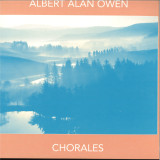
British composer Albert Alan Owen’s first widely available new work in many decades. Chorales is a meandering yet wonderful piano solo album recorded during the summer of 2020.
The album, through a series of beautifully simple piano pieces, features 20 ethereal compositions that are simply allowed to hang there in the air. Deeply emotional and spiritual, Albert Alan Owen’s Chorales ushers minimalism into the intimacy of aprofoundly elevating listening experience. Captivating.
Graham Lambkin (of Shadow Ring fame) returns with a long awaited epic double LP, Aphorisms, his first major solo outing since Community (Kye, 2016). Recorded mostly during the early winter months of 2022, in post-pandemic New York and post-Brexit London, Aphorisms assembles the sonic detritus of daily life into hauntingly intimate aural soundscapes. Made between Lambkin's residence in East London and Blank Forms in New York, Aphorisms superimposes the two spaces onto one another creating an imaginary stage where his musical dramas unfold. A transatlantic mediation on the rooms where Lambkin has lived and worked, Aphorisms summons up hallucinatory vistas by way of the composer’s collage technique, layering field recordings, piano, guitar, percussion, vocal fragments, and repurposed elements on top of one another in double, triple, and quadruple exposures. Like the Shadow Ring’s Lindus (Swill Radio, 2001) recorded between Folkestone and Miami Aphorisms ruminates on estrangement and displacement, catching Lambkin as he returns to London after two decades of living in the States, in his words, “leaving home to return home.” Aphorisms continues Lambkin’s synthetic-naturalist approach to sound-making, twisting disparate and unique elements together to create the sensation of a coherent sonic space. At the heart of his practice is the illusion of form, whereby Lambkin combines sonic elements, documenting the moment that they coalesce into music only to disintegrate back into incidental sound. The album is centered around two pianos, one in New York and one in London, sounding together as if through the ether, creating a spectral atmosphere that Lambkin fills with melodic snippets, fragments of songs, spoken-word musings, and guttural barks or “the animal purity of voice,” as he has it. The superimposition of the two spaces is maximized in the album's closing titular track, where, much like on earlier works such as Salmon Run (Kye, 2007) and Softly Softly Copy Copy (Kye, 2009) fragments of familiar melodies float through the mix as though being played from afar. Aphorisms is Lambkin at his best, extending methodologies only hinted at previously and taking his now-idiosyncratic mission statement to a new chapter.
Third in a trilogy of LPs of Library Music miniatures from composer and multi-instrumentalist Daniel O’Sullivan (Æthenor, Ulver, This is Not This Heat, etc) following 2020’s Electric Māyā and 2021’s Fourth Density. For heads, the term “Library Music” in 2021 might evoke dodgy Italian gray market LPs and crate diggers hunting for “funky breaks” - but London’s venerable KPM Music is working with groundbreakers like Daniel to open up new avenues for composers to experiment. The 15 tracks on “The Physic Garden” are fully-formed and orchestrated compositions, which would be highlights on anyone’s LP, never mind as incidental music. Of the music, Dan says: “The Physic Garden is an album of diverse instrumentals inspired by a swathe of verdant vistas from manicured gardens and follies to urban common land, overgrown and forgotten. Convalescent memories in the shape of psychedelic auditory botanics.”
Key tracks include the droning acoustic folk of the title song; the Canterbury-esque rolling horn and woodwind melody of “Return the Heart” (with expert drum kit from Frank Byng); The prog-ish odd meter interlude “Buttercup Tea”; The quiet ambience and delicate melody of “Dusty Feather:”; and the Eno-like drift of “Vapourer Larvae.”
“Library music. Akasha. Here you accept that music behaves like a thing to accentuate another thing, seemingly unrelated. A beautiful, shining blankness. Not passive. An opportunity to wade. A brief encounter with an open-ended destiny. As in, you never know who or what it will be partnered with. With library music the emphasis tends to be on functionality and less on sonic self-portraiture. So it compels you to be concise, like what is the function of this work? The distance is liberating. It’s less “What Am I? and more “What Is This?”. It compels you to be brief, each little cell is a world of its own in an assemblage of miniatures all vibrating in their collective identity. Then there is the occult nature of library music which is fetishized by many for its ability to induce time travel, often to send us back to some televisual memory. However, despite its broad-brush strokes, the library can be so profoundly alien, especially when experienced independently of the televisual realm; an unruly chimera of genre mutations, compositional curiosities and the deepest wallpaper you ever laid ears on. Perhaps the observances of library music can help unshackle us from our artistic insecurities and delusions, where one is drawn to the shape of music as a whole instrument unto itself; as a vehicle carrying our intention and consisting of everything we have to give at that moment; so things that are seemingly unrelated are ultimately connected.” – Daniel O’Sullivan
Far Out Recordings proudly presents Hermeto Pascoal’s remarkable self-titled debut album. Recorded in 1970 at A&R studios in New York, the album features certified North American titans including Ron Carter, Hubert Laws, Joe Farrel and Googie Coppola, and Brazilian stars Airto Moreira and Flora Purim (who also produced the album).
While it was Hermeto’s first album released under his own name, he had spent the decade or so prior making a name for himself in Brazil and internationally as a composer, arranger and instrumentalist with groups including Sambrassa Trio, Quarteto Novo and Brazilian Octopus, before going on to work with (amongst countless others) Edu Lobo, Antonio Carlos Jobim, Donald Byrd, Airto Moreira and Miles Davis, who allegedly called Hermeto “one of the most important musicians on the planet”.
With Hermeto’s otherworldly orchestral arrangements, ghostly vocal performances from Flora Purim and Googie Coppola, and the inimitable drumming and percussion stylings of Airto Moreira, Hermeto easily rivals some of the oft-celebrated MPB albums of the early 1970s, sitting somewhere between the string-heavy magic of Arthur Verocai’s 1972 debut and the unplacable early experimentalism of Pedro Santos’ 1968 album Krishnanda.
With his phenomenal natural musical genius and a ceaseless sense of creative freedom, Hermeto is widely known for using unconventional objects to make music. In the album’s sleeve notes, Airto highlights the track “Velório (Mourning)” explaining how Heremto filled 36 apple juice bottles with different amounts of water and tuned them to precise pitches in order to create the beguiling harmonies heard.
The reissue of Hermeto Pascoal’s Hermeto, follow’s Far Out’s recent unveiling of a previously unheard Hermeto Pascoal live concert Planetario da Gavea from 1981, and 2017’s release of Hermeto Pascoal’s lost 1976 studio album: Viajando Com O Som.
Hermeto will be available on vinyl LP and CD from the 20th May 2022 via Far Out Recordings.
Tchiss Lopes - ram name Narciso Lopes - lay down plenty of reggae and funana experiments all in inspired by the local rhythms of the island of Santiago on Stranger Ja Catem Traboi, his seminal debut LP from 1982. It has become a hard to find and expensive cult classic that now gets reissued on vinyl and CD courtesy of Arabusta. It is as energetic, rhythmic and melodic as music gets, with great politically and socially aware conscious male vocals sung in Portuguese. Singer, instrumental performer and composer Lopes release seven albums in all, but this one set the highest standards of his career.
Byard Lancaster was a composer/multi-instrumentalist born in Philadelphia in 1942. He started playing alto saxophone at an early age and later took up flute and bass clarinet. While attending Berklee College of Music, Lancaster and pianist Dave Burrell organized late-night jam sessions with fellow students and touring musicians. In 1965, he moved to New York and quickly became part of the city's burgeoning scene – playing with jazz luminaries such as Archie Shepp, Sunny Murray, Bill Dixon and Marzette Watts.
It's Not Up To Us, Lancaster's 1968 debut as a leader, was originally released on Vortex, a subsidiary of Atlantic responsible for first albums by Chick Corea, Keith Jarrett and Sonny Sharrock. Featuring guitarist Sharrock (another Berklee alum), It's Not Up To Us is true fire music – fusing elements of free jazz, soul/R&B and traditional folk song.
On the opening title track, Lancaster's luminous flute draws the listener in, while bassist Jerome Hunter grounds the tune with a simple descending theme over Keno Speller and Eric Gravatt's syncopated rhythms. "John's Children," a reference to the group's status as post-Coltrane players, showcases the modal strumming of Sharrock's steady drones as Lancaster cries into the void. After repeated listens, Lancaster's original compositions become visceral aural memories ingrained in the ear, while the standards ("Misty" and "Over The Rainbow") sound the most avant-garde pieces on the album.
This first-time vinyl reissue is recommended for fans of Albert Ayler, Don Cherry and Pharoah Sanders.
La Orquesta Miramar was founded in 1975 by Jaume Cristau i Brunet and Lluis Soriano i Sánchez in Figueres (Girona). The 4 songs in this EP are in the orchestral Funk style and they clearly show the musical talent of the composer Jaume Cristau and the excellent level of all musicians.
The original edition has become highly sought because it is currently almost impossible to get a copy internationally.
Official reissue rescued by Dr. Vinylove and Musicom for collectors, 500 numbered copies remastered, high-quality vinyl that includes an insert with information about the band and pics.
Repress!
‘Shapes,’ the third album from London-based multi-instrumentalist, Robohands, fuses elements of jazz, krautrock, hip hop and ambient music. For fans of Khruangbin, Yusef Dayes, CAN, Coltrane and 70s library music moods.
Shapes is the solo project of London based composer, instrumentalist and producer Andy Baxter. His debut LP Green was released on Village Live Records in 2018 and was received with much love and acclaim in the UK Jazz, hip hop and surrounding scenes.
His follow up full-length, 'Dusk’, dropped in 2019, combining soul, funk, Latin & experimental moods. It featured vocalists & musicians from around the world including legendary New York French horn player, John Clark, who has worked with Isaac Hayes, Gil Evans Orchestra, McCoy Tyner, Jaco Pastorius, Ornette Coleman and many more greats.
'Shapes' is inspired by 1970s library music and their legendary composers including Piero Umiliani, David Axelrod, Brian Bennett and co. The album builds on these influences and incorporates modern motifs, contemporary jazz/hip hop drumming styles with a nod to 1990s Mo Wax artists such as DJ Shadow. The theme for the record is future/nostalgia, mixing vintage & modern instruments and production techniques.
Much of ‘Shapes’ was recorded with JB Pilon at Buffalo Studios in Limehouse, London. Due to the COVID restrictions that changed everything in 2020, the remaining parts were recorded in Andy’s flat using a collection of old mixing desk preamps and instruments.
For the heads – ‘Shapes’ features an array of vintage snares, including a 1960's Ludwig Pioneer and a mono, overhead ribbon mic on the drum kit provided extra old school points! The kick drum was re-amped through a huge vintage bass amplifier on a couple of tracks to give it some real character: “My favourite guitar sound achieved on this LP project is a Sontronics Sigma ribbon microphone in front of a WEM Dominator amp, which you can hear on the track 'Odysea'. The bass sound for all the tracks is a 1973 Fender Precision into an old Altec valve preamp, the one used on most Motown recordings."
Debut album recorded for launch of new record label by award-winning mastering engineer Kevin Gray!
Recorded all-analogue/all-tube at Gray's new studio, Cohearent Recording, for Cohearent Records!
Shapes and Sound from jazz saxophonist Kirsten Edkins is the debut LP release from Cohearent Records — the new record label companion to famed mastering engineer Kevin Gray's latest enterprise, an all-valve (vacuum tube) recording studio (Cohearent Recording) adjoining his home-based mastering facility in California.
"It's the 'essence of an era' we are trying to recapture with today's musicians, not the sound of specific spaces, engineers or recordings," Gray told music reviewer Michael Fremer.
This album was produced all-analogue/all-tube at Gray's Cohearent Recording on December 10 and 11, 2021. Dave Connor produced, while Gray and Ryan Wirthlin co-engineered. Edkins on sax was joined by Gerald Clayton (courtesy of Blue Note) on piano, Ahmet Turkmenoglu on bass, Lemar Guillary on trombone and Chris Wabich on drums.
Edkins, a composer and saxophonist from Los Angeles, graduated from Eastman School of Music on scholarship. She studied composition and arranging with Bill Dobbins, as well as Walt Weiskopf and the legendary Ray Ricker. Before her time at Eastman she studied with Bob Sheppard, a jazz recording artist and woodwind specialist. Edkins is a sought-after improviser who has performed with Arturo Sandoval (Al "Tootie" Heath), Tim Hagans, Clay Jenkins, John Beasley, and Geoffrey Keezer.
She has performed with the Clare Fischer Big Band, Bill Holman Big Band, Bernie Dresel Big Band (The BBB), Sara Gazarek and others. She's appeard on television shows such as American Idol, Duets, Knight Rider, Glee, and Bones, plus The Tonight Show. She's also a music educator whose associations include Cal State Fullerton, Stanford Jazz Workshop, Saddleback College and Golden West College. She also direct the American Jazz Institute's community outreach program and teaches saxophone at Occidental College in Eagle Rock.
The album is an excellent showcase for Gray's new recording studio. Cohearent Recording was born from Gray's relentless passion to create the best sound recordings. It was that passion that has inspired Gray's long career cutting lacquers for such noted labels as Blue Note, Music Matters and Analogue Productions.
He spent 15 years building gear for the project. "I had a novel idea: In order to get the vintage sound we all love, (I'd) design and build an all-valve (vacuum tube) recording system from microphones through to the disc cutting head, NO transistors or IC's anywhere in the signal path. That took much longer than anticipated but it is finally complete."
Gray was inspired to use his own living room as the studio space when he realized it was similar in size and shape to legendary jazz recording engineer Rudy Van Gelder's Hackensack N.J. parents' home. Many classic jazz albums were recorded there by Gelder.
Some of the same microphones used on those earlier Gelder recordings are in use in Gray's setup. The custom vaccum tube electronics are different and for Shapes and Sound Gray used a tube-based Studer C37 rather than an Ampex.
Gelder's Hackensack recordings for both Blue Note and Prestige, Gray says, are "some of my favourite jazz records, and they are also exceptionally good sonically."
Greg Paulus joins forces with fellow Brooklynite Taylor Bense for a new Freerange EP showcasing their left field, raw house sounds across three original tracks plus a bonus Martinez Brothers edit.
With previous releases appearing on labels as diverse as Soul Clap, Let’s Play House, Ghostly International and Kompakt, the producer, DJ and trumpeter is perhaps best known for being one half of No Regular Play who have recorded LP’s and EP’s for Wolf & Lamb, Crew Love, and Let’s Play House. Never one to be confined to one genre, Greg takes influence from Jazz, Funk, Hip Hop and underground house to form a unique sound primed for discerning dance floors. Taylor Bense is an in-house composer and producer at the highly regarded Hyperballad Studios in Brooklyn, where he works and records a wide spectrum of music for everything from high end commercial work to EP’s for Wolf + Lamb and Soul Clap Records. The entire EP was recorded and produced at Hyperballad Studios over the past few years.
Title track Heat Make Sense wears its Prince inspiration on its sleeve with a hooky whistled tune, crunchy live bass fills and punchy, raw beats. Next up we have Switch which features Brooklyn MC’s Stimulus and Malik Work on vocal duties and Greg’s own trumpet adding top lines to the deep pads and rolling groove.
Marino takes us back to golden era jacking Chicago house of the 00’s but with Greg’s trumpet flourishes bringing a live, jazzy energy to the track. Fellow NYC mainstay Big $exy provides his trademark deep baritone vocal to give a little hip house flavour. Closing out the EP we have NYC’s Martinez Brothers providing an uptempo minimal edit of Do You Love Me, a track from Greg’s previous Freerange EP. The MB’s keep things rolling and stripped back for maximum club impact creating a useful DJ tool whilst allowing Greg’s musical and vocal parts to shine.