Reissue of Elizio De Buzios's "Tamanquiro". Remastered and pressed on 45 RPM!
Sitting a good 90-minute drive away from Rio de Janeiro’s crowded beaches and packed tourist hot-spots, Campo Grande is not a neighbourhood that attracts travellers from around the World. Traditionally it is home to the city’s lower middle-class, whose aspirations of moving up the social ladder were played out in a suburb that has always been solidly working-class.
Campo Grande is home to Elizio De Buzios, a Brazilian musician who started playing music in the late 1970s and early 1980s. De Buzios began as a drummer, before learning to play guitar and starting to compose and sing his own music. When he turned 18, De Buzios joined a local band formed by some of his friends and other like-minded local musicians: Sol da Terra. The band mostly played samba in neighbourhood bars and small venues around Camp Grande, but De Buzios was interested in more than just samba. While he naturally admired great samba composers such as Cartola and Beth Carvalho, his musical pass went far beyond Brazil’s national music. He also loved MPB and bossa-nova and at home he listed to Joäo Bosco, Milton Nascimento, Luis Melodia, Tom Jobim, and many bossa-nova singers.
In 1980 De Buzios was noticed by a local representative of international major label Polygram, who gave him the opportunity to record two songs. He was excited, so started searching for inspiration for the songs he would eventually lay down. He found that inspiration close to home while passing a neighbourhood shop which made and sold clogs. After noticing a display of then fashionable Portuguese clogs outside the store, De Buzios popped inside to talk to the owner. It turned out that he was a tamanqueiro – as clog-makers are traditionally called in his native Portugal – and was as passionate about music as he was about the footwear he made. Thus inspired, De Buzios returned home to work more on the lyrics and music.
The next day, he headed into the studio to record the song, with Vale Ribeiro, who later went on to produce tracks for Marcos Valle, behind the desk. With Ribeiro’s assistance, De Buzios managed to record two songs in one day: ‘Tamanqueiro’ and ‘Sou Um Louco’, a ballad with English lyrics blended into the mostly Portuguese text. From the start, it was clear that ‘Tamanqueiro’ would be the single’s A-side. Incredibly catchy and funky, with some subtle disco elements, the song remained distinctively Brazilian thanks to the use of the cuíca. Listening back all these years on, De Buzios’ lyrics seem almost spontaneous, carry the track forward, and make it almost impossible not to sing along. Its infectiousness and funkiness made it an instant hit with the first few people to hear it.
When it was released, responses to the song were enthusiastic, even if it never became the Brazil-wide smash it should have been. It resonated well in the local clubs and on the radio, but unfortunately the marketing was handled by an inexperienced Polygram employee who failed to adequately promote the track. As a result, the record sank without trace and De Buzios’ dreams of stardom evaporated. Having just started a family, he realized he could not live off the uncertainty of being a musician. Instead, he got a job at city hall as a civil servant, a role he continued until his retirement a few years ago. ‘Tamanqueiro’ and ‘Sou Um Louco’ remain the only two songs he ever recorded.
In the early 2000s, with the rise of diggers’ culture, ‘Tamanqueiro’ slowly surfaced again. It became a sought after, hard to find seven-inch single, finding its way onto the airwaves once more and into the ears of a new generation of listeners. Some started appreciating the song so much that it was referred to as the “best-Jorge-Ben-song-Jorge-Ben-never-recorded”. And they are right: ‘Tamanqueiro’ does have that Jorge Ben-straight-forwardness. It’s a completely honest song that’s almost impossible not to fall in love with. Thanks to this remastered reissue on Rush Hour, De Buzios may now get the props his sole record so richly deserves.
Now for the good news: De Buzios is still singing in local bars and clubs in and around Campo Grande. He is surprised, but also incredibly proud, that the record he had almost forgotten about is appreciated so much by a group of music lovers he didn’t even know existed. But above all, he is happy that more than 40 years after the recording session, the record lives on – not only on this re-release, but also in his weekend sets in the bars of Campo Grande.
quête:composer
The heat is rising with our 5th instalment coming from the volt of Meister Bert Ashra veteran from Berlin's 90s underground scene and active still in the city with his Mastering & Sound Design Studio and experimental audio production and studies.
The solo project B. Ashra has existed since 1993. B. Ashra is a live act, DJ, composer, sound designer and mastering engineer. The style is pretty cross-genre and ranges from ambient, experimental, soundscapes and trance techno to deep house and electronic jazz.
For his pure techno and house productions he uses the pseudonym Robert Templa and for the extremely experimental music, trash and gabba he calls himself Hackbert.
Furthermore, B. Ashra is active in several music projects and bands, including: Psychotikum, Cosmic Octave Orchestra, 70db, Morphon and Brain Entertainment Laboratory.
The collection is a double LP With a variety of sounds spacing between Ambient and Minimal - Techno vibes with deep bass-lines and layered melodic progressions written with special care to the evolution of the harmonies such to maintain those hypnotic feeling until the structure comes back together and releases a powerful groove.
A rich Album and a landmark in the growing of the label.
Mischa Blanos - acoustic piano, electric piano, synthesizers.
Khori Ander - bass clarinet, clarinet.
Cezar Lazăr - electronics and sound manipulation on track 7.
"The seven stories unfolded on this album, debugged by a
fabulous clarinet technique and a wonderful piano craft, narrate
about the Universe, about the Chaos and also about the miracle
of the musical sound.
These imaginative stories, made with talent by musicians
Mischa Blanos & Khori Ander, talk about a special attitude
towards a distinguished estate of mind, a unique colour of the
space around us, devoted to a spirit of meditation, introspection
on vast temporal surfaces, each piece representing facets of the
same unique and unrepeatable algorithm of an improvisational
euphonious Universe.
By developing ideas in the process Cezar Lazar engineering
craftsmanship reveals the outcome of a thoughtful recording
and duo's synergy, refining and defying predictable musical
territories."
Dr. Irina Hasnas
Composer, Musicologist , Journalist and Professor
Recorded, engineered, mixed and produced by Cezar Lazăr
Assistant engineer Stefan Mihăilescu
Vinyl & Digital master Cezar Lazăr
Lacquer Cut Mike Grinser @ Manmade Mastering, Berlin
Recorded in 2019 @ Understand Studios, Bucharest
Multicast Dynamics returns to Astral Industries for AI-26, this time collaborating with Sid Hille, the German born, Finland based instrumentalist and composer. ‘Metamorphosis’ transmutes both artists’ unique styles into a synergistic blend of transportive storytelling, a delicate dance of light and dark.
Divided into two parts, ’Metamorphosis’ originates from a live performance recorded at Temppeliaukio church in Helsinki on March 2nd, 2019. The material was then edited, where Hille’s soothing keyboard work and haunting passages on the theremin, combine with processed textures and desolate sonic backdrops from Dijk. In this voyage beyond space and time, the subtle dialogue reveals new and perhaps unexpected dimensions in their creative arsenal, finding fresh new boundaries and enriching the palette of both performers. Encounters of sweet fleeting moments of lyricism emerge amidst the chilling outback, in which we're given some final consolation between the long lines of cavernous rifts and deep space tundra.
Whiskey Disco returns with another brilliant EP by Australian producer Kayroy, known for creating new intersections between edits, reworks, and originals that the label is known for.
A driving, tension-heavy original A-side reminiscent of early Sound Stream, complimented by two wonderfully selected reworks - a smartly tightened up beautiful instrumental gem originally by Japanese guitarist & composer, Shigeru Suzuki, and an almost necessary revision of euro-disco genius Alec Costandinos’s opus "Romeo & Juliet".
A wide ranging and fantastic record all around.
Named "best kept secret of Canadian funk" by the Quebecois newspaper La Presse, The Brooks are a band of accomplished musicians, well-known in the soul/funk scene across the Atlantic. Expert instrumentalists led by Alexandre Lapointe create a dazzling combo with frontman Alan Prater— an incredibly energetic showman who has worked alongside some of the biggest names in the music industry. This passionate and experienced band fan the sacred fire every time they perform! Thanks to a solid realization, their musical message comes across beautifully. The Brooks go beyond mere interpretation and style exercises: they are a powerful groove machine and a driving force in their sector. 50 years of African American music are condensed in the band's aesthetic. In their live shows and in their records, you can hear James Brown's meticulousness, D'Angelo's delightfulness, Fela Kuti's radiance, Herbie Hancock's intergenerational openness, and J. Dilla's innovative spirit. These heroes of music didn't let rules and trends dictate their messages, and neither do The Brooks. Just like these history makers, they built their reputation with sweat and rigor, outside of conventional channels. The Brooks are incredibly hard workers united in a project where pleasure and complete artistic freedom are the only key words. After 8 years of existence, with an EP and two albums, they have already won many awards and nominations (GAMIQ, Independent Music Awards, ADISQ...) and built a solid reputation in the Quebec indie world.
Who are The Brooks? First, there's the icon, Alan Prater! This Florida-born musician can boast that he shared the stage with the Jacksons! Thanks to his many trips and experiences, he became a key member of Montreal jazz. He is the band's biggest asset: if The Brooks were a sports team, Alan Prater would be captain. Then, at the drums: Maxime Bellavance, one half of the Beat Market duo, whose "dancy and retro futurist" groove can be heard in several major and underground projects in Canada. Philippe Look aces guitar and vocals. His experience as a session musician working with famous bands for 20 years allowed him to take part in different projects: rock, downtempo, trip hop, electro… As one of the founding members of The Brooks, he also wrote many of the band's songs. Keyboardist Daniel Thouin is an integral part of the Montreal jazz scene. He is both an accomplished acoustic piano player and synthesizer player, well versed in writing as well as in improvising, in organic sounds as well as in the latest technologies. Thouin possesses a double vision, which allows him to both exalt and lead productions. Composer Sébastien Grenier wows us with his saxophone. Thanks to his theoretical knowledge and his 20 years of experience, acquired through continuous training all around the world, he is a true guiding force. French trumpetist Hichem Khalfa begun learning the instrument at 7 years old. He attended a musical conservatory before going to the Haute École de Musique and finally pursuing his studies at McGill University. He won prizes at Rimouski International Jazz Festival and received the François Marcaurelle prize at Montreal Off Festival. His successful jazz projects allowed him to work with famous musicians like Blitz the Ambassador, Nomadic Massive, Rhonda Ross and Kalmunity. Philippe Beaudin can be considered an apostle of Afro-Latin percussions, which he teaches and practices with great passion. Thanks to his participation in several projects, you can discover his talent both on stage and onscreen. The Brooks' philosophy is based on art in its rawest form, on perfectionism in musical practice. The choices they make and the directions they take are motivated mostly by instinctive feelings. This is how The Brooks recently crossed the path of Underdog Records during a trip in France. It was love at first sight for the two groups who share a passion for soul. Their chemistry allows them to be completely free in their creative process and natural as ever in their conception-creation-communication approach.
This music was composed for SKALAR, an audio-visual kinetic art installation by light artist Christopher Bauder & Kangding Ray SKALAR is a large-scale art installation that explores the complex impact of light and sound on human perception. Created by light artist Christopher Bauder and musician Kangding Ray, this monumental artwork is a reflection on the fundamental nature and essence of human emotions. By combining a vast array of kinetic mirrors and perfectly synchronized moving lights with a sophisticated multi-channel sound system, SKALAR offers an audio-visual narration of radiant light vector drawings and multi-dimensional sound in enormous pitch-dark spaces. SKALAR is an intense journey through the cycle of basic human emotions. Everchanging tonalities trigger the full spectrum of emotional experiences using light, sound, and motion. The feelings of awe, surprise, exhilaration, and anticipation of having one’s senses overwhelmed are created, explored, and repeated in cycles throughout the piece, providing a collective, yet highly individual emotional experience. Light and darkness as endless cycles of day and night define our perception of time and influence our emotions. SKALAR is a central piece within light artist Christopher Bauder’s body of work, reflecting his deep fascination with light. In this gigantic installation, light is treated as a solid material that can be dimensionally sculpted and shaped, evoking abstract emotional associations. Intertwined with the tireless exploration of textures, rhythm, and sound design by musician and composer Kangding Ray, the silence of darkness is filled with iridescent forms of spatial light and sound. The original composition is spatialised in 360° over a 12 channels sound system, this stereo version has been mixed and mastered to convey a similar sense of space. As of the release of this record, SKALAR has been presented in Berlin (Kraftwerk) in 2018, in Mexico City (Frontón) in 2019 & in Amsterdam (Gashouder) in 2020. Fore more information about the piece and its concept, please visit skalar.art
Caiphus Semenya, AKA Mr Letta Mbulu, is a South African legend and Streams Today… Rivers Tomorrow, his second solo LP, is perfect. A ten out-of ten album if ever we heard one. It’s also incredibly rare, especially in good condition, so Be With is delighted to present this reissue.
Now a revered composer, musician, and arranger, Caiphus left apartheid South Africa in the 60s for self-imposed exile in Southern California together with his wife, Letta Mbulu. Settling in Los Angeles he started working with the likes of Hugh Masekela and Miriam Makeba and other exiled and semi-exiled South african artists, as well as, of course, his wife Letta.
Caiphus also found himself working with and composing for a broad range of jazz and pop artists, including Lou Rawls, Nina Simone and Cannonball Adderley. His facility with both jazz and African forms served him well. His LA stay also the beginning of an ongoing collaboration with Quincy Jones, the fruits of which can be tasted in Caiphus’s African compositions for the scores to Roots and Spielberg’s adaptation of The Color Purple.
Originally released in 1984, Streams Today… Rivers Tomorrow is not just a musical masterpiece, it is also the soundtrack to the life of many South Africans - both then and now. Fusing the US-heavy sounds of boogie, disco and funk with Afrobeat and traditional African elements, it’s truly a spectacular listen. Jabu Nkosi handles keyboards on the album, with synths by Caiphus and Craig Harris. Sipho Gumede is on bass and Condry Ziqubu is on guitars.
The Afro-Cuban grooves of “Mamase” open the record. Continuing where Listen To The Wind left off, this is another horn-heavy call-and-response ode to a positive life. Life as an invitation to party, to take part, to “get involved”. But only if you’re willing to let in the transcendent power of music. “There’s gonna be a Mardi Gras, there’s gonna be a carnival; there’s gonna be a jamboree, there’s gonna be a bacchanal”. Who can resist that? Vibrations everywhere.
It’s followed by the joy of “Aida”. Gleeful, dayglow keys and synths *just* on the right side of mid-80s sleaze are accompanied by a killer bassline, slick, skipping drums and proud horns. Infectious funk.
The tempo is taken down a few notches for the powerful “Nomalanga” and the lamentations of a heartbroken man who must leave his wife Nomalanga and their children to join the fight against apartheid. It’s an emotional song, no question, but it doesn’t bring you down. The uplifting music and optimistic vocal delivery from Caiphus and his backing singers in the second half offer hope.
Breezy drums and contemplative keys act as a backdrop for the stunning backing vocal harmonies in the intro of “Moshanyana”. This gives way to stuttering beats, a bassline to die for and Caiphus giving it his all, over guitars, marimba and synth strings. Another slo-mo winner.
Side two opens with “Dial Your Number”, an uptempo English-language boogie-funk workout, complete with mid-song cutaway to a random telephone call. Whether or not this propels the song into “key track” status, we’ll let you decide.
What’s not up for debate is the brilliance of “Matswale”. This was a hit in South Africa in the mid-80s and you can still hear why. It might just be our favourite Caiphus hit. Wow. This is some damn fine breezy, beautiful, emotional pop. The restrained playing, the guitar licks and the gentle keys are out of this world. The beats? Thundering, direct and slick. The singing? It’ll give you goosebumps. As for the sentiment? This is Caiphus singing to his in-laws about their daughter’s adultery, begging them to intervene and help him save his marriage. Not your typical pop single story-telling!
The ferocious “Ndi-Kulindile” closes the set with a nod to the coming sound of the States. The hard-edged, electro-influenced drum patterns and bouncing, elastic bassline are something of a departure from the album’s predominant sound, yet one wonderful constant, Caiphus’s exceptional delivery and his sparring with his backing vocalists, is satisfyingly present and warmly deployed.
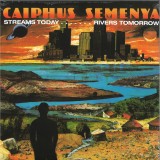
With Simon Francis handling the mastering of this Be With edition, you know it sounds as fantastic as ever. The stunning sleeve has been restored, with its painting of a dream-like cosmic vista, as a lone figure takes in a scene that’s part distant planet, part urban sprawl. One listen and you’ll be transported.
Caiphus Semenya, AKA Mr Letta Mbulu, is a South African legend and Streams Today… Rivers Tomorrow, his second solo LP, is perfect. A ten out-of ten album if ever we heard one. It’s also incredibly rare, especially in good condition, so Be With is delighted to present this reissue.
Originally released in 1984, Streams Today… Rivers Tomorrow is not just a musical masterpiece, it is also the soundtrack to the life of many South Africans - both then and now. Fusing the US-heavy sounds of boogie, disco and funk with Afrobeat and traditional African elements, it’s truly a spectacular listen. Jabu Nkosi handles keyboards on the album, with synths by Caiphus and Craig Harris. Sipho Gumede is on bass and Condry Ziqubu is on guitars.
One listen and you’ll be transported.
180g White Vinyl
* Following on from the hugely popular ‘Klavirni’ (Emika’s first solo piano album in 2015) her second installment of piano solos are a magical cluster of melodies, dreamy effects, obscure production mistakes with tape echo’s and other old analog gear.
* The pieces were recorded during the time she was pregnant with her first child Silvy, to whom she has dedicated this record ‘To Silvy who heard it first from the inside’.
* The collection of ‘Dilo’s’ which means moment in Czech, were recorded ‘in a state of ultra hyped up creativity combined with a massive fear about losing my identity or creativity as an artist once I would become a mother’ - says Emika about the album process.
* A truly personal affair and in keeping with the original style of the first Klavirni, all the Dilo’s were recorded improvisations by the composer on her home piano, this time in Berlin.
* Dilo 7 from the first album has been streamed more than 15 million times on Spotify and there will also be a ‘Red Edition’ repress of the album on vinyl.
* This release marks the 5 year anniversary of Emika Records, celebrating 5 years of independence since her days with Ninja Tune.
* Dilo Variations EP (not released previously before on vinyl) will come with the anniversary releases on a cute little 10’’ with updated artwork.
* This is also the final release in her Emika Records catalog before starting a new venture in 2020 with more details to follow later in the year.
* ‘Klavirni Temna’ which means dark piano in Czech, explores the relationship between dark and light, good and evil, death and rebirth.
* ‘Music is a powerful and sometimes unexplainable force.’ - Emika
It was in 1973, on the 14 of October, late in the afternoon; on a pretty Sunday under the Big Top in the heart of the “Parc de la Pépinière”, in Nancy; it was the “premiere”, the world
first hearing, and it has so far remained the only one commissioned by composer and trumpet player lvan Jullien, for the first international Nancy Jazz Pulsations festival. In order to complete this work of composition and orchestration, Ivan asked the great Eddie Louiss on organ, and chose to do without a double bassist who would have been drowned in a telluric outburst, for the best drummers in Europe and beyond had accepted out of sympathy to offer their contribution to such a festival. The only melodist with Louiss was the English John Surman (born in 1944) here on soprano saxophone, discharging torrents of incandescent lava.
Conversing with drums, cymbals, xylophones, kettledrums, vibraphones, tumbas, djembes and all other percussive things that you’ll like to imagine – a bunch of talents such as those
of the French André Ceccarelli, Daniel Humair or Bernard Lubat, the New Yorker Stu Martin, who reminds of Paul Motian in his “breaks”, South African Louis Mo-Holo, young Lamont Hampton, the great trombonist “Slide” Hampton’s son and the Malagasy Franck
Raholison, the Senegalese Lamine Konte. And we will scrupulously refrain from omitting the four musketeers, here representing
percussion in classical music, namely the Percussion Quartet of Paris under the leadership of Mr. Lucien Lemaire.
Since 2019 the collective of Parisian partygoers, Pardonnez-Nous, have decided to launch their own label. Just like their parties, their goal is to shine a light on dancing music.
Constantly looking for new tracks to enlighten the dancefloors, their outings are in line with the vision of deejaying defended by its founders. Finding forgotten pieces that are the geneses of dance music and mixing them with more contemporary sounds. Re-editions, edits, remixes or original productions the label doesn’t just stick to one style but aspires to represent all the music of partying!
Mexico, Peru, Surinam, and of course Sweden: in 1986, musicians from around the world responded to the Swedish composer, arranger and multi-instrumentalist Torbjörn Langborn’s invitation. His idea was to bring together the two groups he played with: a jazz quintet, and his salsa ensemble.
The cocktail was explosive: after several days recording at the Humlan studio in Stockholm, Torbjörn Langborn & the Feel Life Orchestra produced an eponymous album, combining, in Langborn’s words, “disco and funk with congas and Batá percussions.” The B side was a three-part gem nearly seven minutes long titled “Feel Life”, where he gives free rein to his talent as a jazz pianist. Thirty years later, we asked the famous remixer Dimitri from Paris to express is talent to produce a new version of this classic music track. "Pardonnez-nous", here it is.
Back in the day, French pianist, composer and all-round jazz superstar Jean-François Quiévreux, a.k.a. Jef Gilson, was up there alongside the likes of peers John Coltrane, Oscar Peterson, and Sun Ra. In a fitting homage to the decades worth of sublime music, and his sad passing away in 2012, French quarter Palm Unit have released a lively, honest tribute, upbeat and contemporary re-interpretative vision of his legacy.
.
Gilson has been noted for changing the face of bebop with free-jazz and afro. Along the way his big band featured the likes of Lloyd Miler, Bill Coleman, Michel Portal, and others. With his own recording studio and label Palm Records, Gilson released music from greats including Byard Lancaster, David S. Ware, François Jeanneau, and more. He also helped embed a more entho style to the world of jazz, inspired by his visits to Madagascar, which resulted in the famous Malagasy jazz albums.
Palm Unit are a wildly eclectic super-group of jazz greats includes uKanDanZ's saxophonist Lionel Martin, keyboardist Fred Escoffier from Le Sacre du Tympan, drummer Philippe 'Pipon' Garcia whose mostly known from his worth with the Erik Truffaz Quartet, and special guest Del Rabenja -- who played alongside Gilson in Malagasy -- on the Magascan valiha harp. Palm Unit plays Gilson's repertoire without any a priori, in a totally complex-free manner, reinventing it whilst preserving its original essence. The keyboards sound almost psychedelic (and often not that far from the style of Eddy Louiss on Jef Gilson's 60's albums), the sax scratches, mews and wails, whilst the drums make the whole thing swing. Even Del Rabenja was surprised to rediscover the songs still sounding so modern, decades after they were created.
After dropping several tracks and performing at select festivals throughout the years, Ólafur Arnalds and Janus Rasmussen dedicated the year 2014 to explore the area in-between Ólafur's more acoustic, piano-based solo work and Janus's synth-heavy electro pop, with their collaborative electronic project Kiasmos.
By focusing solely on their self-titled debut album, Ólafur and Janus have been able to combine and further develop their unique sound aesthetics to complete an album driven by their mutual love for electronic music. Made in Ólafur's newly build studio in Reykjavík, Iceland, a majority of the album was recorded using acoustic instruments next to a variety of synthesisers, drum machines and tape delays. It features a live drummer, string quartet and Ólafur performing on the grand piano, producing an ambient, textured sound, which makes it a perfect home listen and equally danceable record. If you listen closely, you can spot them record the thumb piano, finger snapping and even the sound of the metal grinder of a lighter slowly to replace the usual electronic hi-hat sounds, giving the album a far more intimate and unique atmosphere.
We decided to start almost completely over with this record, so most of the material is written this year with the idea of making a record that can stand as one piece rather than a collection of songs. I am very excited to get a proper record out exploring a different territory than I am used to. I touch a lot on electronic genres in my own music but never have the opportunity to go full out electronic like we do here.' - Ólafur Arnalds
The Kiasmos project has been around since 2007, but because of all our other projects we never really got the time to sit down and write all the tracks we always wanted to. So when we early this year finally found the time to sit down and make a full length album there was so much we wanted to try out. The result surprised us a bit, it's deeper and more emotional than we imagined it to be, but that's the beauty of being able to make an album.' - Janus Rasmussen
Long-term Erased Tapes graphics collaborator Torsten Posselt at Feld Studios in Berlin created the cover artwork. Feld Studios was a natural choice for Kiasmos, seeing he also designed the cover for their Thrown EP, released previously.
Kiasmos is made up of Icelandic BAFTA-winning composer Ólafur Arnalds, known for his unique blend of minimal piano and string compositions with electronic sounds, and Janus Rasmussen from the Faroe Islands, known as the mastermind of the electro-pop outfit Bloodgroup. Based in Reykjavík, Arnalds used to work as a sound engineer, often for Rasmussen's other projects, where the two musicians discovered their common love for minimal, experimental music. They eventually became best friends, often hanging out in their studio, exploring electronic sounds.
Mana is producer and composer Daniele Mana from Torino in Italy. His debut EP for Hyperdub, 'Creature', is also the first under his own surname. It's one of his most vivid, personal and confident releases to date. Since 2010, he has been releasing under the moniker Vaghe Stelle, with EPs and two full length albums on labels such as Gang of Ducks, Aisha Devi's Danse Noire, Astro:Dynamics and most recently, Nicolas Jaar's Other People records. He is also a member of One Circle with Lorenzo Senni and soundtracks composer Francesco Fantini. On 'Creature', over eight tracks, he ingests Shostakovitch, Drexciya, Darkthrone, Frank Ocean and Paul Lansky, and refashions them into an almost operatic record - a rich, melodrama of dark tension and excitable in-your-face synth melodies. In using his own name for the first time, he says he is confronting the unfiltered, brutal truth' of his self, compressing tension and anxiety' into a claustrophobic sense of emotional vacuum.' From the skulking clockwork of 'Crystaline,' the rich drifting ambience of 'Sei Nove', to the panicky, rushy rave stabs meets horror theme of 'Running Man', it's lucid, dynamic synth music which uses drums sparingly, but occasionally swirls into little sublime vortices of arpeggiated hyperrhythm. The melodies are bright and pitch bent, swollen by euphoric voltage surges and stuttering, soaring strings in 'Rabbia', plucking wide-screen, heart strings on 'Uno e Solo' and lulling down into the delicate, shimmering prisms of 'Wetlife' and 'Consolations'. While in its own lane, 'Creature' feels totally at home on Hyperdub.
RAWAX welcomes Maartenvan der Vleuten to the family!
We have the honour to present you some unreleased tracks from the 90'!
The Dutch producer, composer and recording artist born in Vught, The Netherlands in 1967.
From 1987 to 2007 he has used over two dozen aliases producing Detroit techno, electro, house, experimental and ambient tracks and remixes.
Early 2008 he announced to only use his real name (or his initials MVDV) for future releases.
During the 90's he recorded mainly dance/techno for R&S Records, Outrage Recordings, Apollo Records (Belgium), Djax-Up-Beats, See Saw, ESP and Klang Elektronik and several other labels. Since 1996 he is also releasing music on his own label Signum Recordings. The two sublabels of Signum; Passiflora and Glam, are now both defunct.
He is the founder of Signum Recordings, Passiflora Records and Glam Records.
Madame E. is a musical setting of Georges Bataille's 'Madame Edwarda', a short novel that interlaces themes of eroticism, religiosity and death, and was written under the pseudonym Pierre Angelique in 1941, during the occupation of Paris.
Composer Mirco Magnani wrote eleven electronic pieces and presented them to actor/singer Ernesto Tomasini. They turned them into songs by adding vocal melodies and together they produced a libretto based on Bataille's French text. The result of their dynamic interpretation is a hypnotically spellbinding performance where the audience is transported through worlds - ancient and new - and where Tomasini's haunting falsetto conveys the tormented emotions in Bataille's work and becomes the instrument that articulates the writer's famously obscure themes.
The experimental operatic performance captures the atmosphere of heightened human passion, reminiscent of opera seria and revisited through hazy and minimalistic lens. The resulting dark and twitchy mood amalgamates old vintage electronic devices, string piano and Stella Veloce´s touching violoncello. The stage becomes a space where Eros and Thanatos, real and virtual, analogue and digital, cluster and melody, spirituality and technology are intermixed and turned unidentifiable, hence collapsing the binary logic of dualism.
Written by Magnani/Tomasini and produced by Mirco Magnani, with lyrics taken from "Madame Edwarda" by Georges Bataille, Madame E. was developed between Berlin and London where Magnani and Tomasini are respectively based. Recorded in Berlin, mastered by Murcof and released by Magnani's label Undogmatisch, a collective that also includes Nicolas Defawe (Urban Spree) and Valentina Bardazzi, the painter responsible for the album artwork.
A hypnotic melodica-led instrumental from singer, composer and
multi-instrumentalist G.T. Moore who first recorded the track at Harry J's Studio in
Jamaica in 1980. This later cut was originally released under G.T's `The
Outsider' guise for Rej Forte's Jah Works label back in 1991 appearing on the
long-deleted album 'The Outsider Meets The Hi-Tech Roots Dynamics at Channel One UK'.
*Now appearing on 45 for the first time backed with a dub version from the deepest vaults..
After their stunning 2012 debut single "Wish" (FM X / Wish 001) and last year's "Diggin' On You" (D.O.C. 001), the incredibly gifted ELEKFANTZ return to the fore with what can only called a brilliant full-length premiere. The duo of Daniel and Leo first met 20 years ago, when they played together in a blues band. Leo continued his carreer as a professional musician while Daniel started to discover a new musical path.
The latter was born and bred at the electronic music temple in South America, later becoming a resident DJ and local hero, known as the right guy to prepare the dance floor and set up the right mood. He's one of the finest DJs of the Brazilian new wave of electronic aficionados. Leo is a professional drummer, singer and composer since the age of 15. He played and recorded with some of the greatest artists in Brazil.
Their debut album DARK TALES AND LOVE SONGS sports all the intimate melodies, lush harmonies and organic undertones that the duo has become know for and then some: from pop-infused songwriter house to highly emotive prime time anthems, you'll find lots to love about this expertly crafted collection of melodic gems. Engineered to perfection by label head GUI BORATTO, it's an exciting step for the imprint and the project alike - we can't wait hearing where they'll go next.
After the great success of 'Der Himmel uber Berlin', the second release on 'Envlp imprint' is signed by another South Italy's talent: Drum Communicate is a project of drummer and composer Francesco Varchetta.
The EP take the name from the first track, 'The Fast Line', which show all his talents as a musician, producing an 'Ambient' track with Detroit's influences.
Tuner is the second track, which has a marked groove and much more dancefloor, also remixed by Brendon Moeller in two versions, goes to conclude a release for true connoisseurs of the genre.
Musik Krause, the label with that special funk and the wide view releases the fourth album in their 10-year history. The circle is complete. In 2002 they started with Metaboman. Now there is the album. As a part of the record-spinning Krause Duo he's known a number of escapades having to do with the 'bash' or rather party culture. Inventively they go about things on a winding path. The have a developed a completely singular metaphoric like a Krauzy schroud and trashno effect. Even if on this long player there is a good deal of gravitation and disengaged handbrake, the beloved notorious krause-vibe swings in every beat, as Metaboman forges the iron. He wants to go further and let himself be taken away, and above all with the musicians he has won over with his live-project to massage the masses from the stage. Krause Duo remains. The album comes in this regard as a gesture providing the direction. Solo here is the conductor, the arranger and the composer in one. Various artists is the keyword, good ol' Metaboman. On all ten songs our friendly neighborhood sonic meister sets the notes and vibes between the skillful, grooving rhythms. In this way there is a bonafied club album in the room that understands rhythm-feeling. Music that in the club context brings an attribute that stands far above the plain acoustic shock and scream. Party But of course, yet still both feet in the game with not a little insubordination, depth, plumes of smoke and indulgence. Metaboman has always had his own vision, which plays out and mirrors his own authentic uniqueness. He doesn't find sounds. He finds shapes and forms and that is the progressive aspect, not the new sounds but rather the new forms. He 's not merely about the subteranean bassdrum, but rather telling his own story. He gives his pieces space and depth. The music itself is positioned somewhere within a sonic cosmos. The listener can functionally hear the record in a club. A freak and his freaks invite you and in your heart you know long before it is apparent that you belong. You can clearly hear that this dude and his folks want me to be there! This album encompasses the moment and keeps it safe for posterity. This music is the language of Metaboman and it is the understood. inkl. digital download code