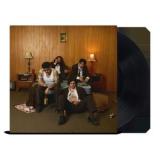
The Second Release Of Wataj Recordings Introduces For The First Time Mr. Tony Pianola. A Trip Inside His Conscious And Unconscious Mind During A Night In Which Dreams, Euphoria, Lost Loves And Desires Mixed All Together Give Life To luce Artificiale'. The Result Is A Pure italo-synth' Style Influenced By The Attraction For The Experimental Slow Disco Sensuality.
Suche:con amore
- 1: Monolith
- 2: Power
- 3: Out Of My Skin
- 4: Waiting To Know (Feat. Militarie Gun)
- 5: Drown
- 6: Am I A Drug To You?
- 7: Saints In The Panic Room
- 8: Off The Edge
- 9: Useless
- 10: Last Call
- 11: Pulling Teeth
- 12: Debt Collector
Los Angeles alt-punks Death Lens return with What"s Left Now?, an album that feels like a jolt of clarity after a year that never seemed to slow down. Fresh off touring with Militarie Gun, they dove into the studio with producer mixer Zach Tuch (Knocked Loose, Touché Amoré) to craft their first new music since 2024"s Cold World. The result is a set of songs that coil hooky guitar lines around lyrics about taking stock of what you have, what"s been taken from you, and confronting what remains without any sugar coating. Death Lens have always played with contrast: ferocity disguised by swagger, volatility wrapped in melody. Onstage, they transform that tension into something communal-cathartic enough to leave rooms wrecked, connective enough to leave people changed. Once a crew of partydriven garage punks, they"ve sharpened their voice into something broader and more urgent, speaking on life in heavily policed neighborhoods, immigration reform, and the responsibility to lift up the communities that raised them. What"s Left Now? pushes that vision forward, framing resilience not as a slogan but as a lived philosophy: one world, one community, one band refusing to stand still. Death Lens is comprised of Bryan Torres (vocals), Jhon Reyes (guitar, backing vocals), Tony Rangel (drums), and Ernie Gutierrez (guitar).
- 1: Bella Più Bella
- 2: Ghiaccio
- 3: Sempre Migliore
- 4: Un Giorno Da Regalare
- 5: Uovo
- 6: Primitiva
- 7: Primo
- 8: Una Notte Che Arriva
- 9: Che Giornata
YELLOW VINYL[29,20 €]
"Nitrito" is the new album by renowned Italian singer-songwriter Nada. The Italian word Nitrito refers both to the chemical compound and to the sound horses make to communicate, the album was released last June just in Italy and is now set to be released in other European countries such as Germany, Austria, Switzerland, France and in the UK. The album was recorded in Bristol in 2024, with Nada once again entrusting its production to John Parish (PJ Harvey, Eels, Aldous Harding, Tracy Chapman, Giant Sand, Sparklehorse), who also plays most of the instruments on the record. This continues the collaboration that began with "Tutto l"amore che mi manca" (All the Love I Miss) (2004), recently remastered and released for the first time on vinyl and in a new CD edition, and continued with "E un momento difficile tesoro" (It"s a Difficult Time, Darling) (2019) and "La paura va via da sé se i pensieri brillano" (Fear Goes Away on Its Own If Thoughts Shine) (2022). "Nitrito" received an excellent four star review from the influential British magazine Mojo.
Tim Maia’s self-titled 1973 album is one of those records that hits you from the very first groove and doesn’t let go. Originally released on Polydor Brazil, this was the fourth in a series of Tim’s self-titled albums and many fans and critics still consider it the crown jewel. Packed with irresistible hooks, lush arrangements, and that unmistakable Tim Maia swagger, the album captures the singer at the peak of his creative powers.If you’re new to Tim Maia, here’s the quick story: born in Rio de Janeiro, Tim was a larger-than-life icon whose music married American soul and funk with Brazilian samba and pop long before “fusion” was a buzzword. A true musical polymath, he absorbed everything from Curtis Mayfield to Motown and translated it into a sound entirely his own, gritty, passionate, and full of groove.
He didn’t just introduce soul to Brazil; he made it Brazilian.On this 1973 release, Tim pushes everything up a notch. The arrangements are bigger, slicker, and surprisingly majestic, without losing the raw spirit that earned him a devoted following. From the moment ‘Réu Confesso’ opens the album, you know you’re in for something special—smooth, funky, and heartfelt in all the right ways. The bittersweet ‘Gostava Tanto de Você’ remains one of his most beloved classics, while ‘O Balanço’ bursts with Brazilian flavor that practically dares you not to move. And with tracks like ‘Do Your Thing, Behave Yourself’ and ‘Over Again,’ Tim shows just how naturally the soul idiom fit him, even when he switched to English.This record has everything: deep grooves, soaring strings, magnetic vocals, and that unmistakable sense of joy that Tim Maia carried into every session. It’s a front-to-back winner—one of those albums that deserves a spot not just in Brazilian music history, but in any collection that celebrates great soul, funk, and timeless grooves.If you’re a longtime fan, it’s a reminder of why Tim Maia is legendary. If you’re discovering him for the first time, this is the perfect place to start. Either way: press play, turn it up, and let Tim do his thing.
- A1: Black Line - Myele
- A2: Mbamina - Nzoumba I-Robots 1975 Unreleased Edit-44100
- A3: Mbamina - Watchiwara
- B1: Oxid - Bright Heron
- B2: Oxid - Oxid Trail
- C1: Stratosferic Band - Nowhere - Reverberated Unreleased Version
- C3: The Boston Garden - Lady Pick-Up
- D1: Mbamina - Nzoumba Unreleased-44100
- D2: Oxid - Oxid Trail Unreleased Extended Version
Daniele Baldelli
"A pleasant surprise to find in this release various atmospheres and sounds that have always been part of my DJing. It even made me rediscover M’Bamina, whom I used to play back in 1974 at the Tabù Club in Cattolica.
There are afro vibes as well, with Black Line – Myele, which is featured on one of my Cosmic tapes, and Nowhere by the Stratosferic Band recalls a track I used to play at the Baia degli Angeli…
Excellent work!"
Voom Voom Music was an independent Italian record label based in Turin, founded and managed by record producer Ivo Lunardi (Turin, December 6, 1940 – December 9, 2010). A pivotal figure in the Piedmont music scene, Lunardi was active both as a DJ and as the owner of several disco clubs.
The label operated for several years in the latter half of the 1970s, releasing mainly productions connected to the Italian dance and pop scene.
Since 2016, the original master tapes from the Voom Voom Music catalog have been owned by Gianluca Pandullo (I-Robots), a close friend of Ivo and Luca Lunardi. Through his labels Opilec Music and Turin Dancefloor Express, Pandullo oversees their preservation and historical enhancement.
The artistic direction of Voom Voom Music was marked by a distinct sonic identity — eclectic yet visionary. The Turin-based label founded by Ivo Lunardi embraced a sound that blended disco, pop, and rock influences, interwoven with African American grooves in a pioneering, international perspective.
Voom Voom Music was among the first Italian labels to introduce this kind of musical language in the country. A prime example is the Italian edition of the debut album by B.T. Express, Do It ('Til You're Satisfied), released in LP, 8-Track Cartridge, cassette, and 7" single formats.
The label’s productions clearly reflected the influence of black and funk music, as evidenced by the references and inspirations running through its catalogue. The track “Lady Pick-Up”, for instance, includes direct nods to “Do It Good” by KC & The Sunshine Band and Manu Dibango’s iconic “Soul Makossa”, revealing a musically refined and contemporary sensibility.
Among the label’s most representative works is Splash (1977) by the Stratosferic Band, a project conceived by Luigi Venegoni — producer, songwriter, and guitarist of Arti e Mestieri. Venegoni’s artistic journey spanned from progressive rock to space and Italo disco. The album artwork was designed by Piero D’Amore (1944 - 2022), a charismatic and multifaceted figure of Turin’s art scene (one of his works was even acquired by the MoMA in New York).
The record includes a disco reinterpretation of Van Morrison’s classic “Gloria”, and “Splashdown”, a track fusing the disco-rock energy of Rockets and Space. In contrast, “Nowhere” revisits the 1975 single by Hokis Pokis, a soul/disco band from Nassau County (New York), transforming it into a vibrant disco-funk number.
Another significant expression of the label’s catalogue is the afro-rock sound of M’Bamina, an Italo-Congolese group whose rhythmic energy and dialogue between African percussion and Western funk evoke the style of international formations such as Osibisa — themselves linked to a rich artistic history in Italy.
- A1: Adouma
- A2: Nothing At All (Ft Musiq)
- A3: The Game Of Love (Ft Michelle Branch)
- A4: You Are My Kind (Ft Seal)
- B1: Amore (Sexo) (Ft Macy Gray)
- B2: Foo Foo
- B3: Victory Is Won
- B4: America (Ft P.o.d.)
- C1: Sideways (Ft Citizen Cope)
- C2: Why Don T You & I (Ft Chad Kroeger)
- C3: Feels Like Fire (Ft Dido)
- C4: Let Me Love You Tonight
- D1: Aye Aye Aye
- D2: Hoy Es Adios (Ft Alejandro Lerner)
- D3: One Of These Days (Ft Ozomatli)
- D4: Novus (Ft Placido Domingo)
"Carlos Santana’s nineteenth studio album Shaman was released in 2002 and debuted at #1 on the Billboard 200. Just like its predecessor Supernatural, Santana invited contemporary artists to collaborate with him across genres including neo-soul, pop, rock, metal, and opera. Artists such as Seal, P.O.D., Chad Kroeger, Dido, Michelle Branch, Macy Gray, Music, Citizen Cope, Alejandro Lerner, Plácido Domingos, and Ozomatli can be heard on the album. Four tracks were released as singles: “The Game Of Love”, “Nothing At All”, “Why Don’t You & I”, and “Feels Like Fire”. Shaman is being reissued for the first time since its original release. A limited edition is available of 2000 individually numbered copies on translucent purple coloured vinyl and includes an insert."
Shaman by Santana, released 3 May 2024, includes the following tracks: "The Game Of Love (ft. Michelle Branch)", "Amoré (Sexo) (ft. Macy Gray)", "Victory Is Won" and more.
This version of Shaman comes as a 2xLP. This release comes with (a) Insert(s).
The vinyl is pressed as a translucent, purple disc. Another vinyl is pressed as a translucent, purple disc.
After a first cosmic cruise through Mediterranean Space Disco by TORRE, Musiq Voyage returns with its second release — this time from one of its own founders, Arno E. Mathieu.
Known for his label collaborations with NYC legend Joe Claussell, for his acclaimed Circumstances Of Chaos LP, and many releases on iconic labels like Compost, Yoruba, Real Tone, Deeply Rooted and Africanism, Arno has spent over two decades jamming & crafting deep, balearic & psychedelic journeys across house and electronic realms.
With MV002, he comes home, channeling the spirit of his native Provence and the sun-drenched pulse of the Mediterranean.
Arno delivers two evocative tracks:
“Phoenix” – an 80’s-inspired electronic resurrection, rising from the ashes on waves of funky basslines, soaring synths, and cosmic guitars.
“L’Amoragie” – a cosmic disco odyssey blending “Amore” and “Hémorragie” into one passionate eruption of love and sound — powered by hypnotic drums, anthemic synths, and euphoric choirs.
Mediterranean soul, space disco energy, and emotional storytelling — Musiq Voyage continues its journey.
Enjoy the trip.
Influences and inspirations come from far and wide. Sometimes they can be household names or pioneers. Other times, they can be lesser-known outfits; less known, but no less influential. Futuro belong to the latter category for Italo Moderni.
Javier and Raúl are two Spanish synthesizer sorcerers who are steeped in the traditions of italo disco and the analogue sounds of the 1980s. While Italo Moderni was still in its infancy, Futuro were a shining light with a young upstart by the name of Adrian Marth even making videos for their tracks. From these beginnings, a mutual respect and friendship developed. Now, the circle is complete with the six tracks making their way onto Accidenti; an EP that marks Futuro’s debut on Italo Moderni.
The collection showcases the breadth of Futuro’s sound. With all instrumentation played through classic analogue machines, the six works journey through neon-streaked city nights, deep uncharted jungle and sun-kissed beaches. Drawing on the music of Rimini, silver screen soundtracks and arcade innocence, this is an EP that remembers and reimagines the 1980s. Intent is immediately set, with the tense and textured “L’assalto” delivering movie score synth stabs alongside crisp percussion. “Matador” is pure elegance, panpipe playfulness countered by glacial refrains and shimmering key shifts. “Iguazu” transports the listener to the wildlife and wilderness of the Amazon; cascading chords glisten as the canopy sings. Futuro takes to the skies with the sonorous swoops of “Il sogno dell’aviatore” before the lovelorn landing of “Fantasma d’amore”, a sumptuous synthesizer serenade of unrequited romance. To close, we’re firmly on the ground for “Sotto le stelle.” Under these sparkling stars, glimmering notes glow with warmth in a finale fitting for such an EP.
And, it is fitting to finally have Futuro on Italo Moderni. A group that has inspired and will continue to do so well into the future. An accidental discovery, mutual respect and a partnership rooted in a love of synthesizers has brought Accidenti into being.
- A1: Tous Les Garçons Et Les Filles
- A2: Ça A Raté
- A3: La Fille Avec Toi
- A4: Oh Oh Chéri
- A5: Le Temps De L'amour
- A6: Il Est Tout Pour Moi
- A7: Quelli Della Mia Età
- A8: L'età Dell'amore Side
- B1: On Se Plait
- B2: Ton Meilleur Ami
- B3: J'ai Jeté Mon Coeur
- B4: Il Est Parti Un Jour
- B5: J'suis D'accord
- B6: C'est A L'amour Auquel Je Pense
- B7: Ci Stó
- B8: E All'amore Che Penso
One of the most popular French TV extracts of all time is the black and white image of a young and extremely nervous-looking Françoise Hardy being given a firm dressing-down by Mireille Hartush (the famous music teacher who ran La Petite Conservatoire de la Chanson in the 1960s). Presented here is her debut studio album Françoise Hardy (issued as The Yeh-Yeh Girl from Paris! in the USA). It was released in France in December 1962 by Disques Vogue with the catalogue number LD 600-30. Originally issued with no title, except for her name on the cover, the album has therefore colloquially become known by the title of its most successful song, Tous les garçons et les filles, and later reissues added this title. This sensational album compiles the twelve original French versions from her first three EPs released by Vogue during 1962. Hardy would also record versions of songs from the album in Italian (1962, four tracks released on singles have been added here as a bonus), English (1964) and German (1965). The iconic LP combines rockabilly, folk, jazz and blues, and has been noted for its simplicity, featuring a minimalist jazz percussion, bass, and both acoustic and electric guitar. 180 GRAM - GATEFOLD COVER - LIMITED EDITION
- A1: Reise Der Schatten (Titles)
- A2: Sans Visages #1
- A3: The Wind Comes From The East #1
- A4: U?Berwacht #1
- A5: Pyrapulse
- A6: The Silver Tree #1
- A7: Tod Und Der Affe #1
- A8: The Wind Comes From The East #2
- A9: U?Berwacht #2
- A10: Candle With Wings #1
- A11: Tage Ohne Stunden #1
- A12: City Symphony
- B1: Candle With Wings #2
- B2: A Friend From The Deep #1
- B3: The Silver Tree #2
- B4: Paper Moon
- B5: Mechanocrab #1
- B6: Tage Ohne Stunden #2
- B7: Mechanocrab #2
- B8: Island Interlude
- B9: Mechanocrab #3
- B10: U?Berwacht #3
- B11: A Friend From The Deep #2
- B12: Mechanocrab #4
- B17: Tod Und Der Affe #2
- B13: Sans Visages #2
- B14: U?Berwacht #4
- B15: Assimilation
- B16: Sans Visages #3 (Credits)
»Reise der Schatten« (»Journey of Shadows«) is the soundtrack to the eponymous debut feature-length animation film by Swiss artist Yves Netzhammer. Composed by Anthony Pateras and released as a stand- alone album through Hallow Ground, the 29 pieces are based on »weird folk melodies ornamented with electro-acoustics to give the film a more fantastical, fairy-tale feeling,« as the composer puts it. His extensive international recording sessions with a slew of guest musicians results in a record imbued with a sense of mystical surrealism, otherworldly and haunting.
»Reise der Schatten« tells the abstracted story of a genderless being coming to terms with its identity and place in a world full of conflicts and systems of control. »The film was made with old animation software that only works on Mac OS 9. So already, we are in a very hermetic, unique space,« says Pateras. Having tried (and failed) to compose something »typically experimental,« he went for long walks in the Australian bushlands and came home with something else: the idea to create a soundtrack that would create »a kind of distance, or perceptual shift, but also a narrative drive and emotional context which is not always clear.«
While recording the album, the tētēma co-founder did not use digitally generated sound, instead workingwith live instrumentation whose sound palette was enriched by the use of feedback, tape delay, analogue synthesizers, and samples from vinyl records. Wanting to work primarily with acoustic instruments suchas the clarinet made Pateras embark on a complicated journey of his own. The initial recording sessions took place in Basel on metallophones that were designed by Domenico Melchiorre’s Lunason company and laid the foundation for everything that came after.
Pateras recorded with musicians such as guitarist Alexander Garsden, viola player Erkki Veltheim, clarinetist Aviva Endean, multi-instrumentalist Justin Marshall and Lizzy Welsh on the viola d’amore among other instruments. He recorded percussion and recorders with Rohan Rebeiro and Natasha Anderson in his hometown of Castlemaine, double bass with Benjamin Ward in Sydney, bass and flutes with Jon Heilbron and Rebecca Lane in Berlin, and electronics in Zürich with Netzhammer. »Reise der Schatten« was thus a literal journey, made with a »big, international electro-acoustic ensemble.«
As a stand-alone album, »Reise der Schatten« opens up a space of its own. Its stylistic diversity makes it atmospherically and emotionally multi-faceted. As its composer notes, »music for screen can be very virtuosic, sophisticated, and variegated!« His own work is a testament to that claim.
ele
His unmistakable mix of cold currents and warm melodies has made Martin Matiske a regular here at Bordello A Parigi.
Amore Galattico is the German artist’s third release with us, an intergalactic voyage with a synthesizer as a guide. The title piece is a bold, yet fragile, composition. Woven around slender drum patterns are flows and shifts, key changes and scaling notes where astral washes blend with romantic flourishes. Beats are bolstered and fortified by harmonic richness in “Cuore”, an analogue space opera of daring complexity and unsurpassable execution. Matiske’s twenty five years of experience are plain to hear in this quartet. His range and musical skill are coupled with an uncanny ability to balance contrasting tones. Glacial chords are buttressed by low juddering bass in “Heaven Knows”, the listener pulled ever skyward in this sublime work. The curtain fall maintains the cinematic and dramatic quality that underscores the EP. Striking synthlines shimmer before understated rhythms, a radiant finale on an EP that takes inspiration from the stars themselves.
Originally released in the mid 80's on UK cassette label Bite Back!, this nearly lost gem finds new life 30 years later on Cocktail D'Amore Music. Steve has cobbled together a superbly melancholic electronic concept album. Wistful melodies often evoke sentiments of a lost childhood and hazy English mornings.
Each song within remains untitled allowing full perceptive freedom as to what they all communicate, a language for the feelings that have no name.
Untitled A1 - A6 leads one along intimate soundscapes of pattering drums and tinkering piano, a sense of closeness and trust develops with the introduction of each new idea much like the beginning of a bed time story. Untitled B1 - B3 then begin to breathe more openly awash in angelic colours before abruptly turning downward on B4, a wall of booming drums and atmospheres from the furthest reaches of the galaxy before the last trio of songs settles gently back on Earth.
Cascading through kaleidoscopic stardust and forming in the outer reaches of the music universe, transcending time and distance, cosmonaut musicians Mo Morris & Zeben Jameson reconnect to write & record songs from opposite sides of their planet (Bali and London) written over the internet during the pandemic. Landing the much anticipated and eagerly awaited new A Mountain of One album "Stars planets dust me".
Welcome to the formative British psych electronic heroes A Mountain Of Ones 3rd studio album.
Mastered and reimagined and a full forthcoming album rework by electronic wizard, master selector & global superstar Ricardo Villalobos, featuring additional collaborations from 80s/90s Balearic legends "The Woodentops`s" front man "Rolo McGinty,”, Japan’s cult heroes ``Dip in the Pool" and "Unkle" and "Toy Drum`s" Pablo Clements.
UK Dub master "Dennis Bovell MBE" also makes an incredible appearance on the "Custards Last Stands" dub versions. Now available on a ltd Japanese 10". A beautiful artwork series generously loaded in by photography legend Dick Sweeney, and co-mixed by Dea Barandana in Indonesia. With its cosmic pop sound, soulful soaring, balearic sensibilities and feel good choruses it carries all the weight of a much needed revo- lution in psychedelic, conceptual ever popular music and sounds & feels like the infamous crossover album that promised to come from the heady days of the bands ascend last time round.
So here’s some back story, garnered from the hearsay, folk law, the myths and the legends, of 10 years ago, in case, like Mo & Zeb, if they'd remembered any of it, they probably weren’t there, after 2 much acclaimed albums and sellout shows vanishing in a cosmic cloud of dust the yin and yang brothers Mo Morris (ZSOU/Electric Stew) & Zeb Jameson (Oasis/Tricky/Pretenders) uncoupled and each em- barked on a pathfinder mission to equip themselves for their inevitable return... they just didn’t know it at the time... and as the global community ground to a halt 2 years ago they sought refuge from opposite sides of the planet in each other's company again.
The solace and rejuvenation it gave had them re-emerging as invigorated, inspired and wiser music creators, this has given rise to the evolution of their 3rd all important album‘s sound.
Zeb "our capacity as human beings is more phenomenal and limitless and way beyond the conventional thinking of society constructs but also in complete harmony with the intelligence and brilliance of advancing technologies".
Experiencing this energy together, as dedicated and devoted music pioneers, these great collaborative universal truths were revealed, imbed and steeped in their writing and recording experience as the music touched and resonated with all involved to create the fresh and fully formed A Mountain Of One 2.0.
The first resonant space Zosha Warpeha played in was the Emanuel Vigeland Museum in Oslo, Norway. Built as a mausoleum, its walls reach up into a gradual archway, creating an environment where sound expands and reverberates for twelve seconds before decaying into silence. Warpeha was greeted only by dim lights when she entered, and it wasn’t until she had spent several minutes listening that she was able to make out the frescoes that covered every inch of the room: graphic depictions of the cycle of life from conception through death. As the sound of her Hardanger d’amore encountered the walls and these slowly emerging scenes, they obscured its point of origin in both time and space, augmenting its own life cycle. The experience sat in the back of her mind over the next several years as she developed her own patient style of composition and performance, one that comes into full bloom on her new album I grow accustomed to the dark.
When Warpeha was selected as an artist in residence at Brooklyn’s ISSUE Project Room in 2025, she saw it as an opportunity to more intentionally explore how her music might fill a room with ample natural reverb. I grow accustomed to the dark documents two single-take solo performances for Hardanger d’amore and voice at IPR, with both pieces composed in a unique tuning system developed to interact with the space itself. Listeners can trace resonance from the contact of the bow on gut strings into the body of the instrument, its five sympathetic strings offering another layer of refraction, before the sound is thrown about the cavity of the room. The echoes emerge like a photographic double exposure, or wisps of smoke that linger in the air, creating ghostly harmonic convergences that blur the line between what is there and not-there. Sound begins to act like light, a synesthetic alchemy that transforms drones into beams and ornamental trills into flickers.
Both side-long compositions, “filament” and “visual purple,” exemplify a duality that animates Warpeha’s music: an expressive, individualistic style that draws on extensive knowledge of her instrument’s history in folk traditions, and an austere, devotional quality maintained by focus and precision. Though very different in character and structure, both pieces evolve slowly through numerous repetitive phrases, passages of stillness, and bursts of intensity. “filament” opens with a cycle of delicate melodic fragments played and sung around a drone before blossoming into an outpouring of swooping arpeggios, harmonics flying from the strings like sparks off a bonfire. The disorienting pulsation of harmonic beating forms the core of “visual purple,” the close-tone dissonance building to a swarm of open strings ringing boldly throughout the space. After the knotty tones reach their climax, the piece collapses into studied quietude, hushed, but without any drop in intensity.
When Warpeha first visited the Vigeland Museum in 2019, she was in Oslo to deepen her relationship to the Hardanger fiddle through the study of Norwegian traditional music, which is primarily passed down aurally. The experience of learning songs by ear, not only internalizing the tune but also absorbing the techniques and tonalities by listening, was a crucial step in her development as a composer. The years since have seen her sharpen those skills as a prolific member of the New York avant-garde and improvised music communities. Warpeha’s music encourages listeners to join her in this journey, to listen closely with each repeated phrase and through each dramatic shift. Like the frescoes on Vigeland’s walls, with time and intention, the depth of I grow accustomed to the dark comes on like a revelation.
- Cumbia Ma
- Cumbiambera
- Mi Sendero
- Amores Conmigo
- Cumbia De Valledupar
- Dame Un Besito Manuela
- Yolanda
- El Clarn De La Montaña
- Cumbia Pachanga
- Tiburn Con Pelo
- Cumbia Panormica
- La Tormenta
- Satans
- Leobigilda
- Suéltale La Trenza
- Cumbia Bogotana
- La Amanecedora
- El Indio Fiestero
- La Serrana
- Cumbia Que Me Alegras
- La Democracia
- Cumbia Marina
- Cuando Te Vayas
- Sal Con Limn
- El Mundo Se Va A Acaba
- Cumbia Casino
- La Palma
- Cumbia Continental
After digging deep into the overwhelming archives of Discos Fuentes, Codiscos and Discos MAG in our previous volumes, this fourth instalment in the series "Cumbia Cumbia Cumbia!!!" comprises 28 Colombian cumbia bangers for the dance floor from the deep vaults of Discos Tropical, all of them originally released between 1960 and 1984. The historical origins of cumbia are nebulous and imprecise. The mythology surrounding it suggests an ancient past when Amerindian, African and European musical sounds were mixed together. Discos Tropical was a Barranquilla-based label founded in the mid-1940s by Luis Emilio Fortou Pereira, a visionary who helped define Colombian dancing habits and tastes from the previous century. Until the late '50s, most cumbias were orchestral-based. However, even though formats and styles diversified from the following decade onward, these highly popular big bands spectacularly defined the sound of Discos Tropical and livened up the most cosmopolitan dances in the major coastal cities. After the mid-'60s, the big bands gradually fell into decline, but the popular demand for tropical music did not. Facing this situation, the major record companies created smaller-format groups with one particular feature: they mixed accordion music with brass bands. This new volume of "Cumbia Cumbia Cumbia!!!" combines well-known classics and rarities that are difficult to find in their original formats. An invitation to enjoy and be amazed, above and beyond ethnographic and academic concerns. Double Vinylalbum
- Refran Tradicional
- El Efecto Del Licor
- A Comer Merengue
- Ejemplo Boricua
- Con Que Corto Mi Caña
- Tres Amores
- Llevame En Tu Pico
- Me Quede Con Hambre
- Tiempos Que Se Fueron
- Quedate Con Tu Dinero
- Tu Ausencia
- La Belleza De Mi Prima
This is a reissue of the original 1963 album El Decano De Los Cantores 4. Chuíto el de Bayamón (Jesús Sánchez Erazo) was a legendary Puerto Rican troubadour and one of the earliest jíbaro singers to appear on the radio, also known as "el decano de los cantores" (the dean of the singers). Known for his witty décimas and lively improvisation, he helped popularize traditional Puerto Rican music. His work influenced generations, including salsa greats like Héctor Lavoe. In the 1940s, he became the lead-singer for cuatro player and composer Ladislao "Ladí" Martínez's Conjunto Típico Ladí, created in New York City. With Ladí, he recorded "Un jíbaro en Nueva York," a controversia with Ernestina Reyes "La Calandria." It was actually Ladí who baptized him as "Chuíto el de Bayamón". From 1949 to 1977 Chuíto collaborated with Abelardo Díaz Alfaro, the famous Puerto Rican author, in the radio program "La vida de Teyo Gracia y su mundo" aired in WIPR. In addition, Chuíto participated in the films "La trulla" (1951), "Preciosa" (1965), and "El otro camino" (1959). Throughout his career Chuíto recorded more than 40 LPs and performed in New York, Boston, Chicago, New Jersey, Hawai'i, Spain, Cuba and other Latin American cities. His repertoire is characterized by its witticism and sense of humor, and sophisticated musical arrangements. Along with Flor Morales Ramos "Ramito", Odilio González and Daniel Santos, he had a huge influence in the singing style of Puerto Rican salsa star Héctor Lavoe. In 1975 and 1976 he was recognized with the "Agüeybaná Gold Album" award. This is the forth edition of Ansonias Chuito reissue series.
Something most fitting in places like main floor Sunday night at Cocktail D’Amore. Well produced big room sound for DJ use, by DJ turned studio magician Jonathan Kussuma, who’s efforts need little convincing of how effective they might be on a dance floor. 4 masterful exercises in heavy percussive action interlaced with deep industrial sounds and hypontizing synth use, portraying a highly unique aesthetic from the well versed Indonesian producer/DJ.
Mod Mod Ranglin is a fusion of Ska and Caribbean instrumentals by Ernest Ranglin recorded in 1966 while Ska was changing towards Rocksteady. Although Ernest Ranglin recorded 8 solo albums at Federal Records, Mod Mod Ranglin was the only album with Ska instrumentals, interestingly. The album consists of classic Ska, Mento and Carribean songs of all times. From the start to the end, Ernie's guitar playing flutters like Caribbean breeze. The instrumental song entitled 'Felicia' is a perfect number for all Ska lovers.
---
Produced By:Richard Khouri
Recorded At:Federal Studio
Engineered By:Louis Davidson