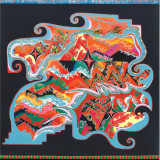
Graham Lambkin (of Shadow Ring fame) returns with a long awaited epic double LP, Aphorisms, his first major solo outing since Community (Kye, 2016). Recorded mostly during the early winter months of 2022, in post-pandemic New York and post-Brexit London, Aphorisms assembles the sonic detritus of daily life into hauntingly intimate aural soundscapes. Made between Lambkin's residence in East London and Blank Forms in New York, Aphorisms superimposes the two spaces onto one another creating an imaginary stage where his musical dramas unfold. A transatlantic mediation on the rooms where Lambkin has lived and worked, Aphorisms summons up hallucinatory vistas by way of the composer’s collage technique, layering field recordings, piano, guitar, percussion, vocal fragments, and repurposed elements on top of one another in double, triple, and quadruple exposures. Like the Shadow Ring’s Lindus (Swill Radio, 2001) recorded between Folkestone and Miami Aphorisms ruminates on estrangement and displacement, catching Lambkin as he returns to London after two decades of living in the States, in his words, “leaving home to return home.” Aphorisms continues Lambkin’s synthetic-naturalist approach to sound-making, twisting disparate and unique elements together to create the sensation of a coherent sonic space. At the heart of his practice is the illusion of form, whereby Lambkin combines sonic elements, documenting the moment that they coalesce into music only to disintegrate back into incidental sound. The album is centered around two pianos, one in New York and one in London, sounding together as if through the ether, creating a spectral atmosphere that Lambkin fills with melodic snippets, fragments of songs, spoken-word musings, and guttural barks or “the animal purity of voice,” as he has it. The superimposition of the two spaces is maximized in the album's closing titular track, where, much like on earlier works such as Salmon Run (Kye, 2007) and Softly Softly Copy Copy (Kye, 2009) fragments of familiar melodies float through the mix as though being played from afar. Aphorisms is Lambkin at his best, extending methodologies only hinted at previously and taking his now-idiosyncratic mission statement to a new chapter.
Buscar:con natural
One of Japan’s most riveting artists follows that KAKUHAN mindmelt from last year (our number 5 album, 2022) with an engrossing suite of wild field recordings and polymetric percussion featuring a whole raft of additional players weaving drums, wind and brass instruments, cello and electronics into a bewildering Acousmatic matrix. Highly recommended listening if you’re into Marginal Consort, Beatrice Dillon, Will Guthrie, Mark Fell, François Bayle.
Having made his mark on these pages over the last few years with appearances as part of Japan’s cult entities Goat and YPY, Koshiro Hino’s turn last year as KAKUHAN took things to a whole other level with an album that felt like some alchemical mix of elements borrowed from Autechre, Photek, Arthur Russell and Mica Levi - a complete stylistic futureshock that worked as well in the club as it did fuelling extended flights of the imagination.
For 2023, Hino takes us into a completely different headspace, assembling a cast of 11 players - the mighty Joe Talia and KAKUHAN’s other half Yuki Nakagawa among them - for a suite of untamed field recordings, clanging percussion, brass and synthesis that are about as far removed from the diaristic ambient de jour as you could possibly imagine. Instead, the ensemble conjure vibrant sound ecologies teeming with detail, mirroring the natural world and communal traditions to form shapeshifting, organismic soundworlds.
‘Geist II’ was written for 20 speakers, referencing François Bayle’s acousmatic music and David Tudor’s electro-acoustic environments. It paints a richly detailed scene of a nocturnal rainforest, replete with avian hoots and a skin-crawling patina of insectoid chatter that moves around the soundfield, stealthily growing in density with a more “musical” presence of super low end drone and drums converging form the peripheries to a ritualistic climax. In the second part, focus shifts to remarkably pure percussion-like tropical rain, invaded by swarms of scuttling and winged invertebrates that give way to a water music-like polymetric slosh, resolving to ringing tones and more mellifluous gestures that hark back to GRM’s most poetic, romantic urges.
It's a deeply psychedelic experience that harmonises tiny electronic fluctuations with bird calls and scraped, resonant drones that phase in-and-out of the mix. It's sound you can practically chew, and another crucial despatch from the contemporary Japanese avant-garde.
From Alehouse to Playhouse Bjarte Eike and his barnstorming Barokksolistene capture the vital spark of Restoration London’s entertainment scene with a captivating new recording for Rubicon Classics! The Playhouse Sessions will be released on 23 September 2022 to coincide with Barokksolistene’s concert double-bill at London’s Southbank Centre.
‘A smattering of Purcell, dances from Playford’s Dancing Master, shanties, reels and ballads succumb to a nine-piece ensemble drawing on Baroque, jazz and folk styles for a no holds barred hooley of riotous improvisatory give and take,’ (BBC Music Magazine review of The Alehouse Sessions, August 2019)
London’s musicians, pushed in the 1650s, to the margins of society by order of Oliver Cromwell, found room for new forms of entertainment in city-centre taverns and alehouses. They remained there long after the restoration of the monarchy, performing sets of dances, theatre songs and bawdy ballads to audiences glad to be free from Puritan constraints on pleasure.
Norwegian violinist Bjarte Eike and his Barokksolistene have restored the spirit and substance of those long-forgotten performances with their Alehouse Sessions, hailed by The Times as ‘irresistible’ and ‘fabulously unrestrained’ by The Guardian. Five years ago the Norwegian violinist and his band scored a best-selling album with The Alehouse Sessions on Rubicon Classics. They return to the label with another compelling collection of music and words of the kind on offer more than three centuries ago at Henry Purcell’s favourite Westminster watering holes. The Playhouse Sessions, set for release on Rubicon Classics on 23 September 2022, reflects the uplifting energy and engaging emotional contrasts of Barokksolistene’s Alehouse performances.
“The album contains a sort of inner narrative that runs through the recording,” says Bjarte Eike. “It has become like a play in its own right, with each track being a small tale within a larger story.” The recording’s tracklist includes Eike’s beguiling arrangements of music from Purcell’s semi-opera The Fairy Queen and his own original compositions on words from the play on which it is based, Shakespeare’s A Midsummer Night’s Dream; popular songs and ballads such as ‘The Irish Washerwoman’, ‘I often for my Jenny strove’ and ‘The Three Ravens’; tunes from Purcell’s welcome odes and stage shows, Come ye sons of art and Dido and Aeneas among them; the ‘Willow Song’ from Shakespeare’s Othello; Eike’s own voice in Puck’s monologue from Act 5 of A Midsummer Night’s Dream; and John Dowland’s sublime air ‘Can she excuse my wrongs’.
London’s theatres were closed at the start of the English Civil War in 1642 and remained shut until the Restoration. Alehouses offered redundant musicians, actors and dancers a place to scrape a precarious living and soon became their creative refuge. “Although a few surviving theatres reopened in 1660 with the return of Charles II, there was little money around to rebuild those that had been demolished,” observes Bjarte Eike. “And a generation of musicians had already found an audience in places like the Black Horse in Aldersgate Street. So popular were their alehouse sessions that Cromwell tried to abolish them! But they outlived him and became part of Restoration musical life.” The form of a Barokksolistene Alehouse, he adds, is like a creative room. “Within its framework I can frequently refurbish the show with new contents. The Playhouse project is likewise an extension of the ever-evolving Alehouse Sessions. Together they tell the story of music and theatre in London during Cromwell’s time and after the Restoration. Of course there’s an historical context to what we do. But there’s also the practical context – which is even more important to me – of connecting with a contemporary twenty-first century audience. An Alehouse / Playhouse performance is not something for the museum; it's about music made in the present moment, just as it was in the London alehouses of Purcell’s day -- with their playhouses annexed to the rear of the beer-drinking saloons. The encounter of musicians onstage and the audience in the hall is the real magic of it. We have to fuse the audience into the action of our performance!”
The Playhouse Sessions will be launched on Friday 23 September with a late-night concert at the Purcell Room and a post-concert Alehouse Session in the foyer of the Queen Elizabeth Hall. Soprano Mary Bevan is set to join Eike and his Alehouse Boys for the first half of their Southbank Centre double-bill, offering unique interpretations of songs from Purcell shows and other hits from the late seventeenth-century London stage. “The Southbank Centre is a direct descendant of concerts given in the 1650s in the alehouses of London,” notes Eike. “These alehouses after all staged some of the world’s first public concerts. Later, after the Restoration, it became common for promoters to advertise alehouse concerts in the press and offer subscription tickets. Purcell and his fellow musicians were thus just as at home performing there as they were in the chambers of the royal court or in London’s new theatres.”
Bjarte Eike launched his Alehouse Sessions in company with like-minded musicians 15 years ago. The ensemble comprises a core of regular performers, all of whom have committed to memory a huge setlist of up to four hours of music. Typically they meet a day or so before a concert tour to share a meal and make music together; then next day, re-grouping thirty minutes before the show, they discover Eike’s select-menu for the evening. “That ensures that every show is fresh,” he notes. “I make sure we never repeat the same programme twice. It’s therefore essential to work with people who share my outlook and dare to adventure. We’re into a high-risk sport, with lots of traps and places where the unexpected appears - for good or for ill. And so the audience knows we’re vulnerable. But our skill is seen in how we re-act on the hoof to the unpredictable. That’s authenticity and honesty - and above all it’s a performance that’s genuine.”
Armed with a classical training and a background in folk music and improvisation, Bjarte Eike was drawn naturally to Early Music in all its stylistic variety. “I never really felt at home with only one genre,” he recalls. “Early Music allowed me to study profound, complicated compositions, but performing it has also opened up the chance of rebellion and uproar! Early music offers wide, multi-faceted areas of musical exploration for me. You find, for instance, links to different types of music wherever you look in seventeenth-century English repertoire. And I am fascinated by all these connections. They offer a foundation for the Alehouse Sessions and for all Barokksolistene performance more generally. Every member of the group plays, sings, dances and improvises without limitation. We’re all interested in the many different fields of being a stage performer and pushing hard at the ‘normal’ boundaries of what it means to be a classical musician.”
Far Out Recordings proudly presents Hermeto Pascoal’s remarkable self-titled debut album. Recorded in 1970 at A&R studios in New York, the album features certified North American titans including Ron Carter, Hubert Laws, Joe Farrel and Googie Coppola, and Brazilian stars Airto Moreira and Flora Purim (who also produced the album).
While it was Hermeto’s first album released under his own name, he had spent the decade or so prior making a name for himself in Brazil and internationally as a composer, arranger and instrumentalist with groups including Sambrassa Trio, Quarteto Novo and Brazilian Octopus, before going on to work with (amongst countless others) Edu Lobo, Antonio Carlos Jobim, Donald Byrd, Airto Moreira and Miles Davis, who allegedly called Hermeto “one of the most important musicians on the planet”.
With Hermeto’s otherworldly orchestral arrangements, ghostly vocal performances from Flora Purim and Googie Coppola, and the inimitable drumming and percussion stylings of Airto Moreira, Hermeto easily rivals some of the oft-celebrated MPB albums of the early 1970s, sitting somewhere between the string-heavy magic of Arthur Verocai’s 1972 debut and the unplacable early experimentalism of Pedro Santos’ 1968 album Krishnanda.
With his phenomenal natural musical genius and a ceaseless sense of creative freedom, Hermeto is widely known for using unconventional objects to make music. In the album’s sleeve notes, Airto highlights the track “Velório (Mourning)” explaining how Heremto filled 36 apple juice bottles with different amounts of water and tuned them to precise pitches in order to create the beguiling harmonies heard.
The reissue of Hermeto Pascoal’s Hermeto, follow’s Far Out’s recent unveiling of a previously unheard Hermeto Pascoal live concert Planetario da Gavea from 1981, and 2017’s release of Hermeto Pascoal’s lost 1976 studio album: Viajando Com O Som.
Hermeto will be available on vinyl LP and CD from the 20th May 2022 via Far Out Recordings.
From Elvis in Memphis retains the distinction of being the most cohesive, passionate, mature, and emotionally invested record Elvis Presley ever made. Named one of the 500 Greatest Albums of All Time by Rolling Stone, the white-soul landmark features backing by "The "Memphis Boys" and teems with rhythm-heavy country, gospel, R&B, and blues. Lauded for its natural, open sonics, the 1969 set now comes across with remarkable clarity, presence, and warmth courtesy of a premium restoration befitting a king.
Mastered from the original master tapes, pressed on MoFi SuperVinyl at RTI, and strictly limited to 10,000 numbered copies, Mobile Fidelity's UltraDisc One-Step 180g 45RPM 2LP box set of From Elvis in Memphis unearths the ravishing inner detail, sticky rhythms, and brilliant arrangements of Chips Moman's inspired production. In short, this unparalleled reissue unlocks the spirit and gestalt of the recording and takes you inside American Sound Studio. It also brings you up close and personal with Presley's singing – widely considered by many to represent the finest of his career – located dead-centre amidst the instrumental hurricane. Equally impressive are the contributions of the aforementioned Boys, and how their Southern-brewed playing – a balance of leisure with swiftness, grandiosity with concision, freedom with control – dovetails with Presley's vernacular.
The lavish packaging and gorgeous presentation of the UD1S From Elvis in Memphis pressing befit its extremely select status. Housed in a deluxe box, it features special foil-stamped jackets and faithful-to-the-original graphics that illuminate the splendor of the recording. No expense has been spared. Aurally and visually, this UD1S reissue exists as a curatorial artifact meant to be preserved, pored over, touched, and examined. It is made for discerning listeners that prize sound quality and production, and who desire to fully immerse themselves in the art – and everything involved with the album, from the images to the finishes.
Sharing much in common with the full, rich, orchestrated Stax Records sound, From Elvis in Memphis oozes with choice nuances and distinctive flourishes that on this ultra-hi-fi edition not only arise with previously unheard transparency and sharpness, but complement and serve the whole. Take the specific tonalities and blending of violas, cellos, and horns that communicate mood and serve as counterpoints. Or lively performances of the backing quintet, and how the piano and Hammond organ trace the lines of the melodies and Presley's lead. Listen to the uplifting support provided by the cadre of backing vocalists (more than a dozen credited), unrivalled in Presley's canon and a precursor to the approach he'd soon adopt in Las Vegas.
Of course, From Elvis in Memphis precedes the icon's transition into his glitzy jumpsuit phase – and follows his merciful move away from the hoary soundtrack work that consumed nearly a decade of his creative life and prompted a rebirth that began in 1968. As the bridge between eras, the record seizes on Presley's rejuvenated attitude and commitment to quality, facets that drip from the fervency with which he delivers every word. For the same reasons, and for the fact it traces back to Presley's original roots and hip-shaking guise, the album further remains a cornerstone of American music history.
Writing about the work's 40th anniversary for Rolling Stone, James Hunter correctly observed: "From Elvis in Memphis represented the full-on immersion in the Memphis idea of Elvis Presley, the American singer second only to Frank Sinatra for the ability to conjure a particular sonic universe with his merest vocal utterance. And from the album's first song, in which a bluesy Elvis espies a woman 'Wearin' That Loved On Look,' to its last, in which a more straight-up-pop Elvis regrets the injustices of life 'In the Ghetto,' his fully engaged, newly energized voice finds its most logical album setting in years."
Incredibly, Presley and company completed more than two dozen cuts for From Elvis in Memphis. One, "Suspicious Minds," turned into the vocalist's final chart-topping single and lingers as one of his most beloved rock n' roll numbers. Even though it never formally appeared on the record, the non-album song is included here as a bonus track and attains newfound depth, energy, and swagger. Coupled with the other dozen tracks – including the sultry "Power of My Love," balladic take of Dallas Frazier's "True Love Travels on a Gravel Road," and driving cover of Hank Snow's I'm Moving On" – it makes for the finest Elvis listening experience available.
Clear LP[22,65 €]
Blue Lake is the musical moniker of American born, Copenhagen based multidisciplinary artist and musician Jason Dungan, who signs to the Tonal Union imprint for the release of his new longform album ‘Sun Arcs’. It follows 2022’s release ‘Stikling’, earning a nomination for ‘Album of the Year’ at the Danish Music Awards plus warm praise from The Hum blog and musicians and DJs alike including Jack Rollo (Time is Away/NTS) and Carla dal Forno. A self taught player, Dungan began freely experimenting with self-built multi-string instruments, preferring to build his own hybrid 48-string zither and working in the realms of left-field ambient music, off kilter folk and improvised acoustic minimalism.
The starting point of ‘Sun Arcs’ saw Jason travel for a week alone to Andersabo, a cabin set in the idyllic Swedish woods just outside of Unnaryd, known also as the music project, festival and residency space which has been run by Dungan since 2016, hosting artists like Sofie Birch, Johan Carøe and Ellen Arkbro. Whilst writing 1-2 pieces per day, a conscious decision was made to leave behind everyday distractions and shut out the outside world to instead focus on the natural passage of time as Dungan recalls: “My only sense of time came from these daily walks out in the woods with my dog, and an awareness of the sun’s path as it moved across the sky each day.”
The album’s immersive world unfolds with the opener ‘Dallas’, an ode to his home state and a musical synthesis of these two disparate spaces (Texas and Denmark), the touchstones of Dungan’s life. A folk-esque single acoustic builds to a flowing arrangement of clarinets, organ and cello drones coupled with percussion. ‘Green-Yellow Field’ chimes in as the first of two solo oriented zither recordings twinned with the dreamlike title track ‘Sun Arcs’, both densely rich as cascading and overlapping harmonic tones resound. ‘Bloom’ emerges with a krautrock psyche before an eruption of cello drones, slide guitar and free-ranging zither playing, ushering in the anticipation of spring. With half of the recordings conceived in Andersabo, Jason returned to Copenhagen to form the album's centre piece ‘Rain Cycle’ which features a tempered Roland drum machine alongside shifting zither improvisations. ‘Writing’ explores the shimmering harp-like qualities of sweeping playing figurations with Dungan mapping out adjusted tuning “zones” on the zither for unconventional but creatively liberating effects. ‘Fur’ captures the feeling of openness and the momentum of time, seeing Dungan perform waves of solo clarinet, often in one takes and embellished with textural drones, a zither solo, and layers of guitar. ‘Wavelength’ the album's closer is fondly inspired by the film works of Michael Snow and Don Cherry’s seminal live album ‘Blue Lake’ (1974), as it builds out from a drone-generated zither chord and features an alto recorder solo. Dungan found a deep connection to Cherry’s stripped back performance ethos, focusing on the core beauty of minimal instrumentation creating a genre-less meeting between folk and jazz. A dialogue is formed between the solo and the bandlike performances, interlinked in a geographical duality with all finding a sense of commonplace as musical sketches of visited landscapes. The bountiful instrumentation ebbs and flows as further layers emerge with Dungan constructing his material much like an artist would, recording and reviewing, adding and subtracting.
Musically it portrays a form of double life led by an American-identifying person living in Scandinavia, and a new found presence in Denmark, seeking out underdeveloped marshlands and barren stretches of beach adrift from other rhythms and distractions. Highlighting their individual and potent importance Dungan concludes: “Both places feel like “me”, I think on some level the music is always some kind of self-portrait.” ‘Sun Arcs’ depicts the intricate balance of nature’s cycles and the paths outlined by the seasons, from a winter dormancy to a warm sun drenched scene. The album scales new glorying heights and further defines Dungan’s musical narrative, inhabiting a unique space in left-field, improvised and experimental music, borning his most accomplished compositions to date. A singular and visionary expression, drawing on an array of instruments and sound worlds with a renewed sense of joy and discovery.
The album's rich tapestry was mixed by Jeff Zeigler (Laraaji, Mary Lattimore, Kurt Vile /Steve Gunn) and mastered by Stephan Mathieu (Kali Malone, KMRU, Félicia Atkinson).
I Shall Die Here / Earth Triumphant is an expanded edition of the fourth full-length album by The Body, first released to widespread acclaim, and terror, in 2014. Sharing their moribund vision with Bobby Krlic, aka The Haxan Cloak, the tried and true sound of The Body is shred to pieces on I Shall Die Here, mutilated by process and re-animated in a spectral state by the collaboration.
This double album set is expanded with the previously unreleased Earth Triumphant, a full-length companion album that would become I Shall Die Here, showcasing The Body's brutality in its most primal form. With both albums revisited by The Body and Seth Manchester at Machines With Magnets and remastered by Matt Colton at Metropolis Studios, this is the definitive edition of a shocking classic of unbridled bleakness and innovation. Formed by drummer Lee Buford and guitarist Chip King in Little Rock, Arkansas in 1999, The Body soon relocated to Providence, Rhode Island. The duo remained in Providence for a decade before moving west to their current home of Portland, Oregon. Their debut self-titled album (Moganano, 2003) and on the widely-acclaimed, classification curtailing of All the Waters of the Earth Turn to Blood (At A Loss, 2011) readied the band for even more experimentations. The employment of the Assembly of Light Choir's classical chorales on All the Waters, alongside more industrial music techniques such as vocal sampling and drum programming, prompted RVNG to inquire with King and Buford which darker corners of the electronic universe they were presumably interested in exploring.
The undertaking of I Shall Die Here was aided by Seth Manchester and Keith Souza, The Body's long standing engineer and creative collaborator, and noted producer Bobby Krlic. Krlic's own work as The Haxan Cloak struck a similarly despairing chord to The Body with the celebrated Excavation (Tri Angle, 2013), itself a minimalist evocation of the afterlife. I Shall Die Here shares similar nether space with the morbidly deviating darkness of Excavation, but remains sculpturally frozen in a sort of earthen purgatory.
The Body's musical approach, engraved by Buford's colossal beats and King's mad howl and bass-bladed guitar dirge, became something even more terrifying with Krlic's post-mortem ambiences serving as both baseline and outer limit. I Shall Die Here sonically serrates the remains of metal's already unidentifiable corpse and splays it amid tormented voices in shadow. This expanded edition gives us a window into the creation of a classic with the inclusion of its in utero twin, Earth Triumphant. Recorded as a nearly finished album by Buford and King before The Haxan Cloak's transformation, it stands as a raw statement of intent, the original DNA for what would soon mutate into something wholly new.
Fans of I Shall Die Here will find familiar sonic fragments in a more primitive state - like seeing an out-of-context photograph of a family member taken well before you knew them - but the album stands on its own in its minimalist brutality, a natural bridge to what The Body was soon to become. The Body's I Shall Die Here / Earth Triumphant will be released in digital and vinyl formats on June 30, 2023. On behalf of The Body, The Haxan Cloak, and RVNG Intl., a portion of the proceeds from this release will benefit Intransitive, an organization that works to advance the cause of Trans liberation in Arkansas through art, education, advocacy, organizing and culture in order to create effective systemic change and on-the-ground impact.
I Shall Die Here / Earth Triumphant is an expanded edition of the fourth full-length album by The Body, first released to widespread acclaim, and terror, in 2014. Sharing their moribund vision with Bobby Krlic, aka The Haxan Cloak, the tried and true sound of The Body is shred to pieces on I Shall Die Here, mutilated by process and re-animated in a spectral state by the collaboration.
This double album set is expanded with the previously unreleased Earth Triumphant, a full-length companion album that would become I Shall Die Here, showcasing The Body's brutality in its most primal form. With both albums revisited by The Body and Seth Manchester at Machines With Magnets and remastered by Matt Colton at Metropolis Studios, this is the definitive edition of a shocking classic of unbridled bleakness and innovation. Formed by drummer Lee Buford and guitarist Chip King in Little Rock, Arkansas in 1999, The Body soon relocated to Providence, Rhode Island. The duo remained in Providence for a decade before moving west to their current home of Portland, Oregon. Their debut self-titled album (Moganano, 2003) and on the widely-acclaimed, classification curtailing of All the Waters of the Earth Turn to Blood (At A Loss, 2011) readied the band for even more experimentations. The employment of the Assembly of Light Choir's classical chorales on All the Waters, alongside more industrial music techniques such as vocal sampling and drum programming, prompted RVNG to inquire with King and Buford which darker corners of the electronic universe they were presumably interested in exploring.
The undertaking of I Shall Die Here was aided by Seth Manchester and Keith Souza, The Body's long standing engineer and creative collaborator, and noted producer Bobby Krlic. Krlic's own work as The Haxan Cloak struck a similarly despairing chord to The Body with the celebrated Excavation (Tri Angle, 2013), itself a minimalist evocation of the afterlife. I Shall Die Here shares similar nether space with the morbidly deviating darkness of Excavation, but remains sculpturally frozen in a sort of earthen purgatory.
The Body's musical approach, engraved by Buford's colossal beats and King's mad howl and bass-bladed guitar dirge, became something even more terrifying with Krlic's post-mortem ambiences serving as both baseline and outer limit. I Shall Die Here sonically serrates the remains of metal's already unidentifiable corpse and splays it amid tormented voices in shadow. This expanded edition gives us a window into the creation of a classic with the inclusion of its in utero twin, Earth Triumphant. Recorded as a nearly finished album by Buford and King before The Haxan Cloak's transformation, it stands as a raw statement of intent, the original DNA for what would soon mutate into something wholly new.
Fans of I Shall Die Here will find familiar sonic fragments in a more primitive state - like seeing an out-of-context photograph of a family member taken well before you knew them - but the album stands on its own in its minimalist brutality, a natural bridge to what The Body was soon to become. The Body's I Shall Die Here / Earth Triumphant will be released in digital and vinyl formats on June 30, 2023. On behalf of The Body, The Haxan Cloak, and RVNG Intl., a portion of the proceeds from this release will benefit Intransitive, an organization that works to advance the cause of Trans liberation in Arkansas through art, education, advocacy, organizing and culture in order to create effective systemic change and on-the-ground impact.
- 1: This Is Mongol
- 2: Yut Hövende
- 3: Triangle
- 4: Teach Me
- 5: Upright Destined Mongol
- 6: Sell The World
- 7: Black Thunder
- 8: Mother Nature
- 9: Bii Biyelgee
- 10: Segee
- 11: Shihi Hutu
- 12: Tatar Warrior
- 13: This Is Mongol (Warrior Souls) (Feat. William Duvall Of Alice In Chains)
- 14: Black Thunder (Feat. Serge Tankian And Dl From Bad Wolves)
- 15: Mother Nature (Feat. Lp)
Solid White Vinyl[34,03 €]
Following the success of the initial standard version of this album, which connects the world to Mongolian culture and its unique core values of natural preservation and spiritual connection with the earth, The HU return with a deluxe version anchored by features from William DuVall of Alice in Chains, DL of Bad Wolves & Serj Tankian of System of A Down, plus LP. This 2xLP set includes vinyl exclusive acoustic audio tracks and has five colour variants in addition to a matte finish border with UV gloss patterns and a high gloss centre anchored by red foil stamp imagery. This new version will also see an accompanying coloured cassette and CD with poster insert and exclusive trading card for all eight band members. The HU continue to carry their core values throughout with the same deeply meaningful lyrics that are uplifting, while the band wishes for prosperity and peace among all.
- 1: This Is Mongol
- 2: Yut Hövende
- 3: Triangle
- 4: Teach Me
- 5: Upright Destined Mongol
- 6: Sell The World
- 7: Black Thunder
- 8: Mother Nature
- 9: Bii Biyelgee
- 10: Segee
- 11: Shihi Hutu
- 12: Tatar Warrior
- 13: This Is Mongol (Warrior Souls) (Feat. William Duvall Of Alice In Chains)
- 14: Black Thunder (Feat. Serge Tankian And Dl From Bad Wolves)
- 15: Mother Nature (Feat. Lp)
Black Vinyl[34,03 €]
Following the success of the initial standard version of this album, which connects the world to Mongolian culture and its unique core values of natural preservation and spiritual connection with the earth, The HU return with a deluxe version anchored by features from William DuVall of Alice in Chains, DL of Bad Wolves & Serj Tankian of System of A Down, plus LP. This 2xLP set includes vinyl exclusive acoustic audio tracks and has five colour variants in addition to a matte finish border with UV gloss patterns and a high gloss centre anchored by red foil stamp imagery. This new version will also see an accompanying coloured cassette and CD with poster insert and exclusive trading card for all eight band members. The HU continue to carry their core values throughout with the same deeply meaningful lyrics that are uplifting, while the band wishes for prosperity and peace among all.
- A1: Sleepwalking
- A2: Ashes Ft Rider Shafique
- A3: Freedom Of Speech Ft Prynce Mini
- A4: Skullz & Bonez Ft Gardna & Mādły
- A5: Cool & Deadly Ft Solo Banton
- A6: Dead! Ft Killa P & Jman
- B1: Weeper's Lament
- B2: In The Night Ft Charli Brix & Gardna
- B3: Tira Ft Nãnci Correia
- B4: Loving Cause Ft Catching Cairo
- B5: Living People Ft Joe Yorke
- B6: End (Operator)
“Solid foundations of polished drums and deep sub bass are coloured with moody, cinematic melodies and intricate effects” - begins to unearth the futuristic sounds of KREED.
Based in Bristol UK, his signature sound is commonly interpreted as contemporary sound system music, as first and foremost it fully delivers that essential low end needed to generate waves in the dance whilst making regular visits down some well trodden paths across a wide scope of genres. As we move forwards through KREED’s soundscape, we find that each track cleverly hooks you in with a combination of theatrical songwriting, dynamic arrangements, twisting melodies and naturally intricate production values. Imagine an orchestra playing Casio keyboards to a silent movie set in the Wild West but filmed in Bristol - or something like that. KREED dreams up a world for his music to exist in, with each track being complete with scenery, characters and a story to tell.
Birds Of Rhythm deliver Bird Island, marking the 20th release from their imprint Lips & Rhythm Records.
The album is a smooth glide between Balearic house, contemporary funk and indie disco, powered by FM synthesizers.
Bird Island is the debut album from Birds Of Rhythm and features waves of varying tempos & grooves. It's a timeless adventure album laced with saxophone, fit to be played in natural settings and clubs alike.
Seven warm tracks, forged between San Francisco and London, tell the melodic story of Birds Of Rhythm and their journey to Bird Island...
Remotely Together introduces new works by claire rousay & Morita Vargas, Maria Chavez & Valentina Magaletti, and KMRU, all commissioned through remote residencies for Rewire’s 2021 - online edition. In the midst of COVID-19 lockdowns, Rewire initiated these collaborations between disparate artists from all over the world, connecting them remotely to explore new creative practices both online and in isolation. The audiovisual results of these residencies were presented during the online edition of the 2021 festival. Newly edited versions of a selection of these performances have now been compiled for this release.
Featuring an enthralling mix of ambient, noise, field recording, and experimental sound art, the scene of Remotely Together is set by the crunching sounds of footsteps over a grassy environment on atmospheric opener Humo De Margatina Dulce, a collaborative song between North American percussionist and improviser claire rousay and Argentinian vocalist Morita Vargas. rousay’s textural mix of field recordings, everyday sounds, and deep electronics coalesce with Vargas’s ethereal vocals, paving the way for compelling music that gradually draws its listeners deeper into its mysterious soundworld.
Meanwhile, New York–based turntablist Maria Chavez and celebrated Italian percussionist Valentina Magaletti collaborate on Particle, featuring hypnotic textures and dreamlike percussion that seems to sonically propel itself forward, slowly expanding into a rich and layered work of stretched-out free jazz.
During his online residency, Kenyan sound artist KMRU teamed up with Dutch filmmaker Donna Verheijden. MicroVerse showcases his evocative mixing of field recordings, entrancing noise, and improvisation, resulting in a piece where the seemingly gentle sounds of the natural world begin to blend in with the artificial muck of droning noise.
Peruvian-born and Amsterdam-based graphic designer Jonathan Castro Alejos has designed the artwork of Remotely Together. It was thought of as a sculptural documentation of the unnoticed urban gestures between Amsterdam and Lima during the pandemic – further reinforcing the relationship between isolation and interconnectivity explored during the remote residencies of Rewire.
The next chapter of the Natural Information Society is here. Since Time Is Gravity, credited to Natural Information Society Community Ensemble with Ari Brown, presents a newly expanded manifestation of acclaimed composer & multi-instrumentalist Joshua Abrams nearly 15 year, 7 albums &-counting flagship ensemble. Joining the core NIS of Abrams (guimbri & bass), Lisa Alvarado (harmonium) Mikel Patrick Avery (drums) & Jason Stein (bass clarinet) are Hamid Drake (percussion), Josh Berman & Ben Lamar Gay (cornets), Nick Mazzarella & Mai Sugimoto (alto saxophones & flute), Kara Bershad (harp) & Chicago living legend of the tenor saxophone Ari Brown. Recorded live to tape at Electrical Audio & The Graham Foundation, cover painting Vibratory Cartography: Nepantla, by Lisa Alvarado. 2xLP on Eremite USA, 2xLP & CD on Aguirre/Eremite Europe. Out 14-04.
Since first developing Natural Information Society in 2010, Joshua Abrams has been gradually expanding the group’s conceptual underpinnings, its musical references & the sheer number of the group’s members. Its music is, in a sense, an expansive form of minimalism, based in repeated & overlaid rhythmic patterns, ostinatos & modality. Its roots, its scale & its meaning become clearer in time. If time is gravity, it also allows us to carry more. Having begun as fundamentally a rhythm section with Abrams’ guimbri at its core, the version here can stretch to a tentet, including six horns.
Abrams has been expanding his minimalism gradually, but he has long understood a key to minimalism’s potential: the breadth of its roots in the late 1950s & early 1960s, ranging from the dissatisfaction of young European-stream composers with the limitations of serialism to the simultaneous dissatisfaction of jazz musicians with the dense harmonic vocabulary of bop & hard bop. The former began exploring rhythmic complexity & narrow tonal palates in place of harmonic abstraction (Steve Reich’s Drumming, Philip Glass’ Music with Changing Parts; perhaps above all Terry Riley’s In C & his late ‘60s all-night organ & loop concerts); the later reduced dense chord changes to scales (signally with Miles Davis' Kind of Blue, but rapidly expanding with John Coltrane’s vast project). In the 1950s the LP record opened the world with documentation of Asian & African musics, key influences on both minimalists & jazz musicians. If John Coltrane’s soprano saxophone suggested the keening shehnai of Bismillah Khan, the instrument was rapidly taken up by two key minimalists, LaMonte Young & Riley, similarly appreciative of its flexible intonation, the same thing that kept it out of big bands.
If the guimbri, the North African hide-covered lute that Abrams plays with NIS, involves a rich tradition of hypnotic healing music associated with the Gnawa people, Abrams’ music also touches on other musics as well — other depths, memories & healings, different drones, rhythms & modes. As the group expands on Since Time Is Gravity, he has made certain jazz traditions in the same stream more explicit as well. If there is a mystical & elastic quality involved in the experience of time, both in direction & duration, you will catch it here. The parts for the choir of winds expand on the roles of Abrams’ guimbri, Mikel Patrick Avery & Hamid Drake’s percussion & Lisa Alvarado’s harmonium: at times, the winds are almost looping in the tentet version, each hitting a repeating note in turn, at once drone & distinct inflection on temporal sequence. The brilliance of the work resides in Abrams’ compositions, the NIS’ intuitive execution & in Ari Brown’s singular embodiment of the great tenor saxophone tradition, including the oracular genius of Eddie “Lockjaw” Davis, & Yusef Lateef. The three pieces by the expanded NIS featuring Brown —the opening “Moontide Chorus” & “Is” & the ultimate “Gravity”— have an immediate impact, & togther might be considered a kind of concerto for tenor saxophone. Here Brown presses almost indistinguishably from composed melody to improvised speech, getting so close to language that he might have a text. Everything here is a sign. Note the tap of the Rhythm Ace that links “Moontide Chorus” to “Is”, the attentive heart always present, even when signed by a machine. There’s a link here to the methodologies & meanings of dub music & the linear & vertical collage of beats, textures & tongues: treated with reverence, a sample of a beat-box can be as soulful, as hypnotic, as a mbira or a tamboura. If those pieces with Brown are heard as a suspended concerto, the three embrace & enfold the other works, like the sepals of a flower. That placement will also touch on the mysteries of our perception of time.
Particularly in “Is”, but elsewhere as well, a phenomenon of transcendence arises in which time appears to be tripartite, at once moving backwards & forwards & standing still. This is an act of technical brilliance certainly, but also an illumination of music’s ability to represent temporal consciousness through polymetrics. This particular listener has only heard it before in a few places, including the horn shouts & bowed basses of Coltrane’s Africa, in moments of Charles Mingus’ The Black Saint & the Sinner Lady, in certain pieces where tapes were literally running backwards, & earlier still in Dizzy Gillespie’s Cubana Be, Cubana Bop, in which the composer George Russell & conguero Chano Pozo found a music that spoke at once in the voices of Stravinsky’s Rite of Spring & the vestigial rites, rhythms & songs of the Yoruba language & Santeria religion of inland Cuba.
In Joshua Abrams’ compositions & the realization of them by the NIS, in the time of one’s close listening & memory thereof, distinctions between the “natural” & the “social”, the “quotidian” & the “transcendent” are erased, suspended or perhaps irrelevant. Consider two of the ensemble pieces, one named for nature, the other social science. In “Murmuration” the repeated wind figures of flute & alto saxophone combine with the interlocking patterns of harp, guimbri & frame drum (tar) to create a perfect moving stillness, not an imitation but a witness to the miracle of the starlings’ astonishing collective art, a surfeit of beauty that might be the ultimate defense tactic.
“Stigmergy” takes its name & concept from the Occupy movement’s Heather Marsh, who proposes a social system based on a cooperative rather than competitive models, one in which ideas are freely contributed & developed as ideas rather than an individual’s property. In its form, Abrams’ “Stigmergy” is the closes thing to traditional jazz, a series of accompanied solos by each of the wind players. However, the composed accompaniment is a radically collectivist notion: a repeated rhythmic figure, call it ostinato or riff, in which the different winds each play only a note or two of the figure, a concept both more collectivist & individualistic in its conception than any typical unison figure. It suggests another of the underlying recognitions that propel the Natural Information Society, the group as social organism, the teleology of hypnotic anarchy, all parts in place, functioning systematically, evolving & expressing itself, its nature & society, as a transformative organism.
George Lewis has described music as “a space for reflection on the human condition”. This suggests that, rather than a “distraction”, at least some music might serve as a distraction from distraction. It’s a focus, a clarity, a awareness, an external invitation to interiority, as if music itself is a model for form & contemplation, an organism contemplating for us or as us. If that is a possibility, & I am sure I have heard such musics, than this music is among them. How many of our rhythms, melodies & harmonies (cultural, historical, biological, psychic) might such music carry, translate & transform in the particulate ecstasy of our own murmuration? (Stuart Broomer, April 2022)

After the acclaimed ΠΟΛΙΣ, Subheim returns with RAEON; a collection of eight new tracks for lonely evenings and long night drives. With RAEON, Subheim continues to expand into the sonic territory he has steadily been exploring since 2015’s Foray, the album that marked the project’s shift towards moodier, highly textured, lofi compositions through the use of sampling and heavy audio manipulation. While this EP feels like a natural continuation of the producer’s most recent work, it is intentionally stripped of any percussive elements, with the focus being entirely placed on space and melody.
Each composition feels like a distant, fading memory that unfolds faster than you expect it to and dissolves into an echoing nothingness before you’re able to hold on to it for more than a few seconds. Much like a long-distance train passing by or perhaps like a song you might hear in your sleep.
Every piece serves as a different chapter of the same open-ended narrative; one where stillness, grief and hope simultaneously coexist in perfect harmony. Intentionally imperfect, naturally gritty, spacious as ever, this new record balances between fragility and conviction, and once more illustrates the deeply human side of its creator.
In contrast to some of the producer’s darker work, RAEON is filled with an undertone of bittersweet hopefulness and a strong desire for new life. With the juxtaposition of nostalgic, synthesized, analog sounds and neoclassical elements, Subheim strikes the perfect balance between past and future, between melancholy and hope. And while the closing track is almost ironically called “Forget”, its ending will leave you longing for more and wondering what else is there.
After a ten year pursuit, Efficient Space finally presents Late, Late Show, the last recordings of influential Sydney-via-Newcastle band pel mel. Taped in the mid-’80s, these charmingly unvarnished sessions pare the combo back to their core, producing blue-collar sophisti-pop to a danceable LinnDrum beat. From the funky disco-not-disco of ‘Mr President’ to the effortless pop perfection of ‘Fool’s House’, the six tracks reveal a creatively open and well-oiled pel mel before they inevitably disbanded.
Formed in early 1979 as a misfit sextet from steel and surf town Newcastle, pel mel were inspired by New York and UK’s post-punk imports. Cutting their teeth speeding through originals and Joy Division, Wire and The Buzzcocks covers every Friday night to a regular turnout of dole bludgers, students and the under-age, the band would also cross-pollinate with electronic-leaning support act The Limp. In 1980, they decamped to Sydney to join the city’s flourishing alternative music scene alongside the likes of Laughing Clowns, Tactics, The Reels, Wild West and the M Squared crew, making an indelible mark with two albums and several singles as the only domestic signee of Factory’s Australasian licensee GAP Records. Catchy and intelligently experimental without being noisy, their musicianship and enduring legacy continues to be lauded by peers.
Undoubtedly some of their strongest output, this previously unreleased demo suite documents pel mel free from the pressures of a commercial outcome, naturally elevating them to a class alongside Orange Juice, Antena and Young Marble Giants.
As the siren’s song echoes out of systems worldwide, perhaps we are (re)turning to the liquid age of dance; with natural ephemera such as moss, sentiments for ecology such as swamps, and mercurial aspects of water all absorbing the aesthetic forefront. A return to nature, a deep dive under the lily pads. Here Marijn with her debut EP guides our plunge, a trip previously taken via her podcasts on Kulture Lab, where you can also find her previously released music.
Whispers from the ethereal plane drift around the headspace, a rumble in the distance of sound traversing the water, voices to guide and to keep you from floating too far from the line. Audio hallucinations are aplenty when submerged, a serenity of space, yet distant growls assure that peace is not always 2 be found. The melancholia within the daydream, the pang of loss caught in reflections, internal and from the water, with the lily pads floating above as a guiding entity, an anchor, something to hold. Under the lily pads we rumble.
On the flip everyone’s fav casual breaks n rave hooligan Luca Lozano asks the recurring thought within dance music, a question we quest, yet rarely want the answer. Abstraction via squeaks and tweaks, you better bop your bleepin’ head to this 1.
‘Leave A Message’ leaves the tranquil waters disturbed and rippling to the outer edges, providing jumps for the lily pads to ride on the incoming tide, with the ebb and flow making way for a storm surge. Aka big beats are the best, a notion the directly honest final track ‘Made (Drums)’ follows, bringing a twisted jack attack logic to a deranged assembly of samples, a manic orchestra of tumbling drums who have conspired to freak out, albeit with cute bubbles underneath to revel in the allure of sonic mania.
Limited to 1000 copies on Sea Blue vinyl! There's freedom to be found in consistency. Until recently, Juan Wauters may not have agreed with this statement. As a touring musician and multinational citizen, transience had always come naturally to him. Circumstance, however, recently prompted him to reconsider the benefits of staying in one place. His most introspective work to date, Wauters' sixth solo album Wandering Rebel finds the artist taking stock of how he's changed, how the world sees him, and what he wants out of life. Written mostly during an extended break from touring, the songs on Wandering Rebel are candid reflections on subjects like career ("Wandering Rebel"), romantic commitment ("Amor Amor"), mental health ("Nube Negra") and the personal toll of touring ("Let Loose"). On "Modus Operandi," he voices his frustration with New York's fairweather residents, who fled the city at the onset of the COVID-19 lockdown. Vocal contributions from fellow New Yorker Greta Kline (Frankie Cosmos) add to the chorus of playful disapproval. On the singalong-worthy "Millionaire," he turns his eye to the west coast: "It's hard to get around Los Angeles / If you don't have a car / I'm staying in a privileged part of town / It's suspicious for me to be walking." The clarity with which Wauters approaches these subjects lyrically is reflected in the music as well. His trademark eclecticism is still present (fans of Real Life Situations' spirited hip-hop should look to track 6, "Bolero"), but it's more refined this time, anchored in his signature Latin-influenced indie folk. Wandering Rebel is peppered with delicate additions that add depth throughout: rain sounds and hand drums on "Nube Negra," a strings section on "Modus Operandi," a gentle vibraphone on "Amor, Amor." Some of these are classic Wauters touches, but others are owed to outside influences, like production from Brooklyn-based Carlos Hernandez (Ava Luna, Carlos Truly) and Brazilian indie artist Sessa, as well as vocal contributions from Kline, Luz Elena Mendoza (Y La Bamba), Zoe Gotusso, and Super Willy K. Throughout Wandering Rebel, Wauters attempts to reconcile the stability he's come to enjoy with the nomadic restlessness that's characterized his life thus far. In the end, though, it's the interplay of both of these elements that makes the album so strong.
Colin McCann didn't pick up a guitar for nearly ten years. The Northern-California-based songwriter, previously performing under Long Dog Bird, had been creating music with longtime friend and collaborator Brian Gossman for much of their adult lives with early-00s Baltimore-based band Wilderness. So what would cause such a stagnant period? And how could McCann find his way back to the joy that music had once so easily conjured? The answer was to go back to the very beginning, where the kinetic forces that urged McCann to make music in the first place could emerge once again. But first, he had to make space in his internal world; a kind of silence where he could hear the exhale of his past, and the blossoming of a new song. That blossoming would soon become the first songs for McCann's latest project Vulture Feather. The band's debut album Liminal Fields exists on an intangible plane: a crack in the concrete, a gauze between worlds. For as long as McCann can recall, he's been using music as a vehicle to try and connect with an underlying, indescribable nature that only the sonic world seems to be able to reach. "There's a feeling of ecstasy that comes when one merges with music," he says. "It's what calls us all back again and again to listen, to sing, and to play." McCann had been striving to reach this outlying environment throughout his career, often stretching in ways that eventually came to negatively impact his life, and his health. The wake up call came when McCann suffered a near-death experience, eerily predicted by a friend through a dream she had had almost a year earlier. Newly awoken to the beauty of being alive, McCann strove to slow down, to listen to the inherent nature in all living things, and to rediscover our mutual connectivity. He stopped playing and listening to music, and instead soaked himself in the cacophony of silence. Then without any epiphany or grand catalyst, something urged McCann to pick up a guitar again. Ideas flowed more naturally than ever, and he soon realized that the liminal space he had been searching for was there all along--he only had to listen. McCann tentatively reached out to Gossman to collaborate and the friends found themselves once again jamming together, in an off-grid quonset hut where they now practice. "It was like no time had passed," McCann says. "That feeling of ecstatic joy, of forgetting your own name, came flooding back." They were soon joined by another old friend, Eric Fiscus, who completed Vulture Feather on drums.
Returning after three years, the husband and wife duo of Alexi Erenkov and Alison Alderdiceaka. The Saxophones have announced the arrival of their third album, To Be A Cloud, for 2nd June 2023. Out today is the first single to be taken from it, Desert Flower, featuring a video directed by Rainbow Tunnel. "Alison wants me to try therapy, "says Alexi. “She’s a therapist herself, but I’ve never been to one. The idea of going makes me very uncomfortable. I don’t like being vulnerable in front of strangers. So, instead of confronting my discomfort, I look for an easier path. It’s never easier and it’s always unsatisfying or destructive. “Desert Flower” is about avoidance and fear impeding personal growth and the deepening of relationships. The album itself was recorded at Phil Elverum’s (The Microphones, Mount Eerie) Unknown Studio in Anacortes, WA last autumn. A former Catholic church where the pair lived during 24/7 recording sessions, time was no object as they experimented and developed the sound of the record. Its magical setting and ample space provided natural acoustics for Alexi’s arresting vocals which were recorded live to 24-track tape, suspending them in an ambiguous historical and chronological context between analogue and digital. Enhanced by Alison’s percussion alongside the bass and keys of Richard Laws, together they made the most of the studio’s many instruments which fill out and bookend their exploration of the billions of years of evolution that have led to this moment in time.