Evelyn spreads her wings and prepares to fly. This is her first offering for the ESP Institute. On side A, 'Tremors' slams together a plethora of seemingly disparate rhythms, organic percussion, field samples, hypnotic chants and a relentless low end punch, that when in full-swing, works some seriously deep sorcery. Contrasting her pounding kick and rolling sub combo are a softer grouping of melodies, soft mallets and muted tones that lay subtly beneath the aggression, skillfully playing with a sense of spatial depth and room size. Its the kind of track that draws you in with meditative bars, concentric cycles that sit ever so slightly off-axis, inducing the mind and body to obsess and regulating its timing, and then drops you into a very intentionally arranged soundstage giving expansive space to explore. On the flip, 'Pregunta' continues this approach of natural versus industrial instrumentation. The consistent machine kick has a powerful but playful tone, the negative space between each stroke evoking a mighty gesture as its note bends in the decay. Set in 3/4, a community of live percussion successively adds and subtracts, each player’s imperfect attack accumulating into a mechanically smeared and addictive loop that toys with peaks a handful of times yet restrains any unnecessary climax for the betterment of a driving groove. Near the end, as the kick and various players mute and the base of the track is given a moment to breathe, its apparent just how layered the production was in the moments prior, as we’re suddenly at home, smitten with the wobbly and lopsided innocence of the foundational percussion. These two songs will push you headfirst into the light.
Suche:contras
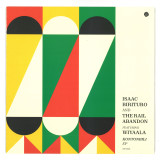
Following on from the successes of their first two LPs, "Kalba" and "Small Small", Isaac Birituro & The Rail Abandon return with the "Kontonbili EP". A collection of seven tracks that trace the traditional West African roots of their sound whilst adding their unique touch, largely courtesy of Isaac's xylophone, Sonny Johns' folky embellishments and the vocal prowess of powerful Ghanaian songstress Wiyaala.
The lead single "Hado Deeli" roughly translates to "My Rival" and is a vibrant discussion between two rivals, one of whom is always making a fuss about anything and everything, even when things are all good! "Gargar", with its collaboration of xylophone, whistles, Wiyaala's effervescent vocals and relentless groove represents, quite literally, the band's "joining together" for this EP. In contrast, "I Know" sees Sonny Johns takes over lead vocal duties to lament the breakdown of a relationship accompanied by muted horns and Wiyaala's soothing backing vocals. "Nimmbalia" continues in a mellow and reassuring tone before emerging as one of the most uplifting and simultaneously fierce cuts on the EP! The traditional version of "Bawa" - the original take of which can be found on last year's "Small Small" LP - strips things back a little, before culminating in a battle of xylophone, whistles and choir. "Yeri Villa" has a wonderfully laid back, sun drenched feel with some truly beautiful vocal refrains, and finally - only available on the digital version - comes the deeply percussive and trance inducing "Darpeny", rounding off a rather stunning EP from this cross continental outfit.
All tracks feature Ghanaian singer, song-writer, model and actor, Wiyaala. With a strong fanbase in Africa and beyond, "the lioness" made her mark on Wah Wah 45s and BBC 6 Music last year when she featured on the A-listed "Senye", described as "perfection" by Annie Mac and "pure joy!" by Tash LC.
e 05: Bawa (Traditional) feat. Wiyaala
Kinn turns the Post-Rock continuum inside out with his sophomore album, Dogtooth.
Shifting focus between his present self and his misled teenage years, 'Dogtooth' sees London born and raised sound art graduate Fred Lomas contemplate the vulnerability of youth, addiction and suicide as Kinn. Unabashed in their creative ambition, Kinn's tongue-in-cheek 'dread-voyeurism' is underpinned by a palpably sincere vulnerability that seeps through their dynamic and rewardingly dense records.
An insight into Fred's formative years can be unraveled from his nickname "Dread", originally given to him by his parents. Growing up in North London as a 'constantly out of the house' youth, Fred only had eyes on any counterculture he could find to defy the city's notorious empty capitalist centric mainstream culture, skateboarding, graffiti, and terrible punk bands which would only last 1-3 rehearsals (max). As a teenager he experienced the notorious 2011 Tottenham riots, which is often referenced in the artist's output and greatly informed their sensibilities. Barely an adult, he was confronted first hand with concepts of constant hostility and corruption which were seemingly welded to his surroundings, corruption formed by high rises and international political scandals taking place only a short journey away.
Even today, Dogtooth reflects on this contrast of community and anger and surmises it to be part and parcel of modern metropolitan life, looking to peel away the bad looking for meaning, comfort and ways of goofing off amidst oppressive forces, sirens and snake oil salesmen everywhere.
"We find ourselves venturing into the depths of a rugged terrain. In our hands, we hold stones and minerals, each possessing its own distinct texture, weight, and sonic potential. It is through the artistic touch and through the musical instruments that these earthly treasures, once dormant, are awaken to life." — Sara Oswald + Feldermelder
The 3rd collaboration of prolific cellist Sara Oswald and electronic musician Feldermelder evokes captivating sensations that oscillate between impending doom and hope. The albums' sonic journey is highly immersive, transporting the listener from one cerebral landscape to another. The transformative nature of metallic elements being integrated in sustained orchestral tones weaves the sonic tapestry, resulting in a captivating experience for the listeners. The organic sounding — reminiscent of minerals' timbres — brings a touch of brightness and a distinctive edge, while the orchestral harmonic structures lend a sense of grandeur and continuity. The origins of this music remain enigmatic, while the tracks of the album gradually unveil concealed aspects and the hidden truth.
One can step into a realm where melodies are reborn, as Sara Oswald's cello spins tales and emotions burst forth. Nature's eternal splendor intertwines with the essence of music, as she infuses harmonies with the soul of mountains. Vibrant hues come alive with delicate strokes, and cascading notes resonate with a select few. Feldermelder conjures profound echoes that swirl like ancient whispers of the earth's primordial past. He sculpts textures, from fragmented glitches to expansive atmospheres, that warp the fabric of reality. The two musicians merge together harmoniously, blending the acoustic and electronic worlds into a transcendent unity. This fusion of contrasting elements adds a unique and intriguing quality to the music. The cello's warmth merges with pulsating electronic beats, creating a symphony of contrasts and sonic upheaval. Each composition is woven in intricate layers, combining electroacoustic architecture with delicate precision. A subtle balance of chaos and control permeates the music as it meanders through the labyrinth of the mind. The soundscape unfolds like a grand tapestry, distant echoes murmuring like grains of sand.
Trained in baroque cello and advocating improvised music, Sara Oswald is the perfect match for sound artist and electronic musician Feldermelder. She plays solo, composes for film and theatre and collaborates with musicians like The Young Gods, Pascal Auberson, Sophie Hunger and Julian Sartorius. Feldermelder is a polymathic creative whose artistry spans composition, sound design, installation and code. He is co-founders of -OUS and part of Encor.studio, a collective of artists who specialise in creating immersive audio-visual installations. Through his work, he explores the idea of secrecy and its impact on our lives, using music and sound to create a thought-provoking and immersive experience for his audience.
Sonic chaotic, tender terror. On New Stone, Lithuanian producer Kamile Rimkute a.k.a. Caline with C dazes and uplifts us with her reflective post-modern electronics. This album is a personal long-term project in the making, one of auditive self-expression, treading across themes such as adventure, love, discovery and grounding.
The album is driven by Kamile's interest in futuristic boundary-crossing music and intersectional feminism, as well as her studies in Sonology. With an advanced skill for composition, sound synthesis and her knowledge on the totality of sound, she claimed the means of production, as New Stone is all produced, mixed and mastered by herself.
New Stone was recorded in a period of two years that started in 2020 and incorporates highlights of her landmark livesets ever since. New Stone is full of concocted emotion that sustains and releases through her trademark of stark contrasts - triplet-driven, jolted yet angelic atmospheres - resulting in a tangible, body-driven sound.
Interweaving her vocals near the final salvo, this album marks the end of a creative cycle and start of a next, allowing her personal touch to seep through her art more and more. Embarking from home ground, stepping on a new stone.
Legendary Memphis soul brothers William, Bertram and Randy Brown released an album under the group name TEN-63 entitled FACING THE MUSIC, it was published in 2009, but recorded sometime earlier. YOU AND ME was played out and initially covered up by Mike Ward circa 1989/90 receiving cult status.
YOU AND ME and our pick for the flip SAY WE’LL STAY are beautifully constructed songs with each of the Brown brothers serving up a solo part, it cannot be denied their contrasting vocal styles and harmonies are supreme in the extreme!
The Browns’ contribution to the Memphis music scene is etched in history. William, who sadly passed away in 2015 was a member of The Mad Lads. Randy and Bertram were members of The Newcomers, Bertram went on to be a part of soul funk group Kwick and of course Randy had a glittering solo career with LPs on Parachute, Chocolate City and Stax as well as numerous singles; he is regarded by many as being one of the finest vocalists of his genre.
- A1: Giniro No Tsubasa
- A2: Losangeles City
- A3: Silent Love
- A4: Seventy Cherrys
- A5: Space Flight
- B1: Prologue
- B2: Happy Turkey Days
- B3: Improvisation (Love) (Love)
- B4: None (Words By?) (Words By?)
- B5: How Short Our Life Are
- B6: Mad Love
- B7: God Truth Love
- B8: Telephone
- B9: Nothing Meaning Of Life!
- B10: Eraser Head
- B11: Evil Spirits
- B12: Crush!
Twin Cosmos is not only the name of the musical output of fraternal twins Morihito & Yasuhito Ito, but more philosophically, an album that encapsulates, “the universe of twins”.
The pair were born 1953 in Yokkaichi, Mie Prefecture. A port city 50 kilometres west of Nagoya, famous for its chemical plants. Despite their surroundings, they grew up in an environment that fostered learning and self-expression. From an early age, they began to carve out their own paths.
Morihito was fascinated with scientific endeavours, space travel and spirituality. His father, an electrician by trade - motivated him to build his own musical equipment. This led him to attend an acoustic engineering school in Tokyo from 1972-1974, after which, Morihito returned to Yokkaichi where he worked in the instrument and audio section of a department store. This helped him keep up to date with the latest equipment, while allowing him to simultaneously work on his own musical endeavours.
Morihito’s side of the ‘Double Action’ LP is a cohesive piece, which effortlessly drifts from one song to the next through samples of flowing water and rockets launching into space ,that were recorded while visiting his brother in the States. His music is carried by flowing vocal harmonies, guitar strums, and floating synths to create an eternal dreamlike ambiance.
In contrast, Yasuhito gravitated towards philosophy and the arts and in 1976 followed his Englsih teachers’ advice and moved to the ‘foreign world’ of the United States. It’s here that he further explored his interests in Christianity, sadomasochism and poetry. He was exposed to artists like John Cage and Sun Ra, as well as a variety of ‘Do It Yourself’ recording techniques that enabled him to record remotely.
Using samples, poetry, and an original approach to traditional folk & rock songs, he recorded his side of the LP. The outcome being provocative, dark and confronting realisations, which solely used English lyrics to represent his experiences in the ‘Western world’. In 1980, Yasuhito was wooed back to Japan by his brother and the prospect of a combined record release.
The self-released album ‘Double Action’, was completed at Victor studios in Japan. Without a distribution network, the release was sold mostly to family and friends and fell into obscurity. Despite not reaching commercial success, the pair have continued to make music over the past four decades, crediting it as their driving force in life. This 2022 release includes an insert with archival images & liner notes in both English & Japanese.
CALAMITA = KARKHANA members TONY ELIEH, SHARIF SEHNAOUI and Lebanese drummer MALEK RIZKALLAH join forces with the Egyptian singer AYA METWALLI - the result is the improbable meeting between free jazz / improv, punk rock & Oum Kalthoum!
CALAMITA is the "rock project" of SHARIF SEHNAOUI and TONY ELIEH, two of the most active musicians on the Lebanese experimental scene (among others projects, both are members of the "free Middle Eastern music" collective KARKHANA). SEHNAOUI comes from a jazz and improv music background, ELIEH is primarily a rock musician and founding member of the Lebanese post-punk band THE SCRAMBLED EGGS whose work in the last decade has covered many directions from pop-rock to plain experimental. They are joined by Lebanese drummer MALEK RIZKALLAH (WHO KILLED BRUCE LEE, ex THE SCRAMBLED EGGS). As trio they develop instrumental pieces that draw their inspiration from artists as diverse as Tony Conrad, Last Exit or Oum Kalthoum.
AYA METWALLI is an Egyptian singer/songwriter, composer and sound artist currently based in Beirut. Grown up in Cairo, her father would play non-stop Oum Kalthoum songs on road trips to the beach and Aya's mother; known to have the most beautiful voice in the family, she always sang at home and at family gatherings, so long before Aya was able to form her own music taste, immense amounts of Arabic classic songs and melodies already settled in her subconsciousness …
After her first EP "Beitak" in 2016, Metwalli (named "a musical enigma" by The Guardian) started to integrate more experimental and eerie sonic excursions into her avant-pop, so the collaboration with CALAMITA feels like a natural or logic step.
The roots for "Al Saher" ("stay awake") were laid when SEHNAOUI and METWALLI first worked together in "Night", a dance piece by ALI CHAHROUR which included a wide collection of Arabic songs and ancient poems, later Sehnaoui invited her to work with CALAMITA. The four met in a recording studio in Beirut, using songs by "The Voice of Egypt" Oum Kalthoum as starting point.Together they aim to fully revisit the song format and explore the possibilities of classical Tarab songs, extracted from their origins and reframed within the music of the twenty-first century. The result is a mix of various styles and influences that often seek to stretch the contrasts to towering extremes - animprobable blend between free jazz & improv, punk rock & Oum Kalthoum!
2023 Repress
Dax J returns to Monnom Black with an EP of uncompromising warehouse tracks, drifting through Acid, UK and Jungle influences to create an iconic onslaught of ominous Techno cuts.
Photo Credit - Lincoln Clarkes, 1996, Heroines
Original image captured by award-winning photographer, Lincoln Clarkes in Vancouver 1996, from the highly praised, hard-hitting photo-book series, "Heroines," portraying social injustice and the stark contrasting realities faced in the forgotten areas of modern day sub culture.
Since Interstellar Space, John Coltrane's posthumously released duo album with Rashied Ali, the combination of sax and drums has received an aura of sublime spiritual ambition. It is where tireless truth seekers come together to aim for something transcendental. Something too big for words. Of course, a lot has happened in the meantime.
The available options - philosophically, stylistically, temperamentally - are endless. Musicians are aware of those historical turning points, yet they also try to add their own twists and interpretations. Some of them succeed. One of reed player Mattias De Craene's many projects - MDC III - is a project involving drums and saxophone. A striking difference: De Craene invited two drummers (Simon Segers, Lennert Jacobs), that have been active in the worlds of jazz, pop, free improvisation and experimental music. They are the ideal foil for De Craene's vision, which seems to exclude no opposites. While the use of a recorder, electronics and percussion steers the music beyond the classic acoustic limitations, the result becomes strikingly rich with contrasts. What is abstract and introspective the first moment can switch - gradually or abruptly - to moments of fierce ecstasy the next.
The music feels free (free from limitations, free to choose its own logic), but also invites. Shifting moods and textures are combined with intricate rhythmical patterns, as the drummers lock together in dense, complex and/or ritualistic grooves. A minimal pulse, accompanied by murmuring hisses of brushes and a serenading sax is contrasted with moments of exuberance. The result is many things at once, but despite these wildly varying colors, sounds, textures, rhythms and moods, they are all linked, part of a generous, iridescent whole.
The trance-inducing trio MDCIII is back. And that equals yet another delicious load of modular drums, wildly processed saxophone sounds, improvisation & pulsating grooves.
After their first EP, MDCIII ft. Sylvie Kreusch, and their subsequent first (internationally) acclaimed album 'Dreamhatcher', the 'double drums' saxophone trio with Mattias De Craene, Simon Segers & Lennert Jacobs is all set to show what angle rock 'n roll can really come from. On their new album 'Drawn In Dusk' (release: end of September via W.E.R.F records) the trio delivers a whole new palette of sounds that are just as mystical, energetic and wild as 'Dreamhatcher'.
Guy J is one of the leading artists in the world of underground dance music. However, his artistic appetites are far more diverse. His Malta-based label is a platform for cutting-edge producers, but Guy J rarely releases his production on the label. He has released only one of his musical pieces on Armadillo, an opening track (Aurora AM Mix) on a V.A. Fields Vol.2, until now.
94 Blossom is his twelve-minute showpiece, revealing his skill in the context of the finest electronica. The material is a sonic expedition based on contrasts of a hypnotic arrangement taking a conceptual journey from darkness to light. Guy J fuses arpeggio soundscapes and electronic percussions with improvised elements enabling the balance of mathematical structure and freestyle. The most memorable part of the journey is the Balearic-influenced end theme, thoroughly sticking the landing. Will electronic music be the classical music of the future? J is one of the artists who could make that possibility come true.
- A1: Nandele & A-Tweed - Deserto 05 20
- A2: Nadia Struiwigh – Lovessong 04 38
- B1: E-Saggila - Pr1Nt 04 18
- B2: Nvst - Heatstress (Tunnel Edition) 05 36
- C1: Ryan James Ford - Totes (Bath Mix) 04 42
- C2: Viikatory – Cinema 03 56
- D1: Jean Redondo – Hypersonic 03 52
- D2: Significant Other - Cellar One 04 30
- D3: Willis Anne - Späti System 03 28
- E1: Dj Sotofett Meets Kavadi - Kandhan Karunai 05 10
- E2: Ireen Amnes – No Longer Human 05 12
- F1: Solid Blake – Hexaghost 05 33
- F2: Nit. - Cirrus Virga 06 00
yet is a slippery word in English. Amorphous, these three letters in dierent contexts can define contrast or emphasis, set a place in time, show an expectation that something will occur or, paradoxically, that it is likely to stop.
It is this mercurial nature that makes yet the perfect title for Tresor’s latest compilation: the label follows on from the more explorative sections of 2021’s landmark Tresor 30 boxed set with a compilation, featuring 13 artists making music that resists easy definition.
Every track hints at and borrows from the familiar yet none follow the expected path: halfway through Deserto, Nandele & A-Tweed dramatically reveal a very dierent sonic landscape that was initially suggested; DJ Sotofett collaborates with Sri Lankan artist Kavadi with results that are unlike anything in the Norwegian producer’s catalogue as yet.
Further invention can be found as Jean Redondo’s Hypersonic moves across spaces inhabited by digital hardcore and hyperpop before swerving o-road and into a futuristic hip-hop section; on No Longer Human, Ireen Amnes takes a dierent path at the crossroads melding hyperpop, trance, and sci-fi soundtrack atmospherics, Significant Other heads towards UK Bass and Dubstep, and France’s Willis Anne skims by the outskirts of footwork with a piece that is almost completely uncategorisable.
Yet more sonic experimentation comes from E-Saggila, Nadia Struiwigh, NVST, Solid Blake, and Viikatory who oer unique takes on the well-established electro blueprint, while Ryan James Ford, and Nit. both find ways to blend elements normally found in ambient pieces with those heard on a dancefloor.
The feel of the compilation is yet again reflected in the enigmatic artwork by Malik Arbab, where shapes and colours suggest animals and plants but in a world that appears to be transient and constantly evolving.
After the successful 7-inch release of Agip, Roman producer and composer Azzurro 80 is back on Four Flies with another triple-single that continues his love affair with dreamy synth-pop and Italian Eighties culture and society.
"Notte Inchiesta", on side A, could be the title music to an imaginary '80s investigative/true-crime program broadcast on late-night television. Clearly reminiscent in mood and texture of the soundtracks of late-70s/early-80s Italian detective-action films, it brings back the jazz-funk, post-prog and fusion overtones that characterized the music of those films. In short: a contemporary-retro sound nestled somewhere between Goblin's funk-oriented recordings, Azymuth's "Jazz Carnival", and electronic disco with a sprinkle of new wave.
Side B opens with "Equilibrio", which could serve as additional, more dynamic music for the same TV program mentioned above. The style is once againelectronic jazz-funk, but here we have abreak built upon a trail of notes chasing each other.
In contrast, "Sambuca", the single's closer, is deliberately nostalgic and melancholy. Perfectly suitable for visual narratives of an Italy that no longer exists, it sounds like one of those great Italian soundtrack themes that are able to convey tension and calm at the same time. The track is titled after the anise-flavoured liqueur that Italians often drink after their espresso, because "making references in my music to things that are part of our national popular culture is really important to me", as the artist has explained.
Angelo is an LP, named after a car, featuring nine songs Brijean have crafted and carried with them through a period of profound change, loss, and relocation. It finds percussionist/singer Brijean Murphy and multi-instrumentalist/producer Doug Stuart processing the impossible the only way they know how: through rhythm and movement. The months surrounding the acclaimed release of Feelings, their full-length Ghostly International debut in 2021 which celebrated tender self-reflection and new possibilities, rang bittersweet with the absence of touring and the sudden passing of Murphy’s father and both of Stuart’s parents. In a haze of heartache, the duo left the
Bay Area to be near family, resetting in four cities in under two years. Their to-go rig became their traveling studio and these tracks, along with Angelo, became their few constants. Whereas Feelings formed over collaborative jams with friends, Angelo’s sessions presented Murphy and Stuart a chance to record at their most intimate, “to get us out of our grief and into our bodies,” says Murphy. They explored new moods and styles, reaching for effervescent dance tempos and technicolor backdrops, vibrant hues in contrast to their more somber human experiences. Angelo beams with positivity and creative renewal — a resourceful, collective answer to “what happens now?”
Angelo the car is a 1981 Toyota Celica they got off Craigslist during their first stint in Los Angeles, where Murphy and Stuart have since settled. “Such a bro-y, ‘80s dude car, it’s been super fun to drive around in a new town,” Murphy says. “He’s older than us, he’s a classic, he’s got a story.” It is a spiritual vehicle with a cinematic appeal, first dropping them off in an alleyway for the scene-setting intro, “Which Way To The Club.” The question is quickly resolved by “Take A Trip” as a cruising bassline mingles with crowd sounds, hand-claps, cuíca hiccups, whip-cracks, even a horse neigh. Brijean have found some club on this cross-dimensional trip — the kind of
imagined space or chamber within one’s self capable of “shifting a fraction of who you are,” says Murphy. They wrote the track with the simple intention to be “as free as we could be,” adds Stuart, likening the flip on the B section to a realm unlocked: ”What if the world changed completely? You open the door to a new room.”
Next is “Shy Guy,” a motivational anthem for the wallflowers among us. Murphy sets up the daydream: “We are in junior high, we’re on the dance floor, what’s going down, who is dancing, who is not, how are we gonna make them dance?” The narrator, the MC, hypes up the room as conga-driven rhythms bounce between languid synth and guitar lines. “Show me how to move...I feel something...I know you feel it too,” Murphy sings sweetly, calling back to the opening lines of Feelings, and this time the audience chants it back. It is easy to picture Brijean performing this one — something they only got to do a handful of times until more recently, opening shows for Khruangbin and Washed Out, an experience they found informative. Murphy explains, “It was inspiring to be out there and let loose more. To see how people can expand their expression on stage gave me more liberty with how I viewed my musicianship. My role for so long was to be a backup percussionist, so why would I ever leave the drums, you know? But then after playing all these runs, you see these artists and realize you can, you have permission.”
“Angelo” and “Ooo La La” deliver the danciest stretch in Brijean’s catalog to date. The title track adopts a deep house pulse replete with strings, hi-hats, and kicks. The latter opts for a funkier groove that foregoes verses in favor of warbled hums and extended breakdowns. What follows is perhaps the duo’s dreamiest run, a comedown initiated with the honey-hued interlude “Colors” drifting into “Where Do We Go?”, a tropicália reverie where Murphy contemplates the passage of time and space.
It all culminates in “Caldwell’s Way,” a fond farewell to their Bay Area community — “a part of my life that I knew couldn’t come back,” says Murphy. Above shimmering organ sounds, lush strings, and the birdcall of their former neighborhood, she wistfully articulates the uncertainty of moving on by remembering the characters dear to them. There’s the wisdom of their neighbor, Santos, who refused payment when helping them move out: “I’d rather have 100 friends than 100 dollars.” And the song’s namesake, Benjamin Caldwell Brown, a friend and club night cohort for many years. “I’m only miles away, maybe I’m just feeling lonely,” the line resigns to warm nostalgia, and “Nostalgia” runs the closing credits to this healing and transportive collection.
One of techno's most joyous experimentators delivers two intriguing uptempo tracks. Instead of hitting hard and heavy 'In Aggregate' and 'Carob' float delicately, with explosive detail blooming freely and high above what feels rather like a bass-ladden undercurrent than a persistent kick drum foundation.
Both tracks expand on Stefan Goldmann's extensive polyrhythmic research and integrate tonal and metric functions within the same units of sound. Somewhat radically, the central sound of 'Carob' is all
in one: beat, bassline and single-note melody. By contrast, 'In Aggregate' unfolds lush layers of exuberant percussion, countered by rounded drops of bass and an occasional vocal snippet ricocheting off of claustrophobia-inducing walls of glass.
As future-forward as they are organic, these offerings come with appropriately idiosyncratic artwork by Jorinde Voigt.
- A1: Evol - The Dark Dreamquest (Intro)
- A2: Corvus Neblus - Forever I Shalt Dwell In Ravenloft
- A3: Asmorod - Fiat Abyssus (Second Chapter)
- A4: Vindalv - Swærþ Stimma (Excerpt)
- B1: Apeiron - Pan's Journey To The Cosmic Void
- B2: Secret Stairways - Lammas Tide
- C1: Dolch - Tumulus
- C2: Endoki Forest - Ii
- C3: Lunar Womb - Night Towers
- C4: Maelifell - La Dame Du Lac
- D1: Kadotus 609 - The Summoning Through Crimson
- D2: Neptune Towers - To Cold Void Desolation
In the early 1990s, a handful of black metal artists were enticed by the possibility of conjuring new fantastical worlds from the deep isolation of their home setups. Rather than the dense metal sound of their existing projects, this new direction would be centred around intimate synth soundscapes: forlorn organs and otherworldly MIDI theatrics.
The music on ASCEND is predominantly from self-produced, self-distributed releases, typically manufactured in small numbers. Though some artists producing this style of music, most notably Mortiis and Burzum, gained wider recognition outside underground circles, it is only in recent years that the sound and its influence has really been appreciated. This is particularly the case with the late Matthew Davis and his recently reappraised Secret Stairways project, whose song ‘Lammas Tide’ (from the 1997 Enchantment of the Ring album) appears on ASCEND. A simple home recording on a Yamaha KX-W392 manages to be both elegant and tortured, ambiguously devotional and recalling latter years Popol Vuh.
This battle between dark and light is a constant thread through ASCEND, with simple minimal synth lines that can be both delicate and menacing. Compilation opener ‘The Dark Dreamquest’ from Italian black metal group Evol is loaded with occult warning, and Finnish act Kadotus 609’s ‘The Summoning Through Crimson’ is languid, twisted and dark. In spite of the darkness, several pieces of the music on ASCEND have formal similarities with the sometimes saccharine new age music that rose to prominence in that era: but to a rougher, darker ends. The closing song from Darkthrone icon (and past NTS radio host) Fenriz, under his Neptune Towers pseudonym, pulls us further out, with ‘To Cold Void Desolation’ — an astral synth project, akin to ’70s kosmische muzik masters Harmonia.
The gentler side can often amplify an uncannily sinister edge, heard in German act Dolch’s ‘Tumulus’, where orc marching horns contrast against delicate rompler harps and softly whispered chanting. It hammers home a deep loneliness and detachment constant throughout ASCEND, made possible by these unusual contrasts, both unsettling and otherworldly.
In 1975, under the oppressive air of military dictatorship in Brazil, brothers Lelo and Zé Eduardo Nazario invited bassist Zeca Assumpção to join their musical experiments in a basement under Sao Paulo’s Teodoro Sampaio Street. As teenagers, the trio had already been playing together in Hermeto Pascoal’s Grupo, alongside guitarist Toninho Horta and saxophonist Nivaldo Ornelas, and it was while working together under Hermeto’s direction that the Paulista rhythm section (as they were then known) began to realise their own potential.
With many nightclubs and venues closed in the mid-70s and government censors dictating the output of radio, TV and art galleries, many Brazilian artists fled during the years of dictatorship. But underground, Grupo Um were fusing avant garde ideals with contemporary jazz and Afro Brazilian rhythm; making phenomenally free and expressive music - in stark contrast to the sterile, conservative conditions being imposed above ground.
Just like Hermeto Pascoal’s Viajando Com O Som from the following year, Starting Point was recorded over two days at Vice-Versa Studios, by revered engineer Renato Viola. The studio was one of the best in Sao Paulo and musicians communicated with engineers through cameras and a monitor, allowing the group complete immersion in the process. They also made use of the studio’s hemispherical tiled room, which served as an acoustic reverberation chamber.
The album begins with Zé Eduardo Nazario’s thunderous drum solo on “Porão da Teodoro”, before clearing the clouds with the lone Berimbau which opens “Onze Por Oito”. Built around a hypnotic electric bass line, heady Fender Rhodes improvisations, and more rip-roaring drums, it’s a rapturous, electrifying freak-jam in 11/8.
Like some invertebrate deep-sea curiosity, the free-form “Organica” is made up of Lelo Nazario’s playfully eerie prepared piano, with Zé Eduardo’s percussion flurries darting around Assumpçao’s double bass. The equally non-conformist, percussion-only piece “Jardim Candida” features many of Zé Eduardo’s home-made instruments, including a long saw blade played with vibraphone sticks and violin bow. While working with Hermeto, Zé Eduardo famously built his own all-in-one percussion set-up known as the “Barraca de Percussão” (Percussion Tent) - the first of its kind in Brazil, which he would also use on Hermeto Pascoal’s Viajando Com O Som and throughout his career.
“Suite Orquidea Negra'' (Black Orchid Suite) was written by Lelo Nazario as the score for an imaginary movie - the story of a rare, black orchid which produced a substance meant to cure all diseases, but which had mysteriously disappeared from the laboratory… “As a screenplay it’s not very good” reflects Lelo in jest, “but the music ended up being very interesting, the way its parts are chained to one another carries a little of the mystery I imagined for the movie.”
The album closes with the triumphant “Cortejo dos Reis Negros” (Procession of Black Kings) - a groovy variation on the Maracatu rhythm, with a two-note bassline underpinning piano improvisations, exultant wordless vocals, cuicas, slide-whistles and a very special guest appearance from Zé’s dog Bolinha.
Starting Point was to mark the inception of one of Brazil’s most daring instrumental groups. Their debut now sits in the lofty echelon of otherworldly 70s Brazilian music, alongside the likes of Marcos Resende & Index’s self-titled debut, Cesar Mariano & Cia’s Sao Paulo Brasil, Azymuth’s debut and indeed Hermeto Pascoal’s Viajando Com O Som. But just like all of those titles, which were either shelved or largely ignored at the time, Grupo Um - so radically ahead of their time - struggled to find a label to release their debut album. So Lelo kept the tapes safe in his archives, which is where they sat for almost half a century. Finally, almost fifty years later, this mesmerising piece of history is here, and it was only the beginning...
Grupo Um’s Starting Point will be released by Far Out Recordings, on vinyl LP, with an insert featuring unseen photos and liner notes by the Nazario brothers, as well as a CD on 17th February 2023.
Paul Hammock es el artista por todos conocido como Cignol, sin lugar a dudas uno de los genuinos revolucionarios dentro del sonido electro de la última década y media. Sus trabajos llevan surcando nuestros Technics desde 2008 a través de los sellos de vanguardia electrónica del nuevo milenio.
En su decimocuarta referencia en vinilo, el sello Valenciano HC Records, tras una imparable y ecléctica línea editorial, publica el nuevo trabajo del genio de Dublín titulado Binary Choices. Un maxi en el que nos domina un profundo sentimiento de melancolía cósmica a través de cuatro cortes que nos sumergen en una odisea espacial.
Adentrarse en cada corte del vinilo es como viajar hasta diferentes cuerpos celestes y dejarse sorprender por su atmósfera ensoñadora, y es que solo es necesario que transcurran 58 segundos de Binary Choices, primer corte de la cara A, para sentirnos arropados por un sentimiento de suma nostalgia, alegría y futurismo. Una inteligente combinación de pads, sintes y brillantes percusiones que nos adentran en un astro inexplorado repleto de extrañas vegetaciones, increíbles seres multicolores y horizontes infinitos que activan nuestra sinestesia.
Un emocionante, decidido y contundente ritmo 4x4 a baja velocidad nos traspasa el alma al surcar la superficie de Broken Circle. Un recuerdo olvidado en forma de aterciopelado sonido se crea frente a nuestros ojos en la consecución del compendio de melodías intimistas que componen sus 4:14 minutos, en los que encuentra sosiego nuestra mente y bálsamo nuestro alma.
La cara B del vinilo regresa al cristalino, eléctrico y veloz ritmo roto con Momentum Gateway, track en el que sus dominantes y ácidas cadenas de bajos se enrollan y juegan en sincronía perfecta con sus diferentes capas de teclados y su vibrante e iridiscente pad.
En el último planeta al que nos transporta Cignol, suena en cada uno de sus parajes Validity Movement, track con el que nos dejamos guiar por su grueso y áspero bajo principal, que contrasta con los delicados sintes y atmósferas que lo rodean. Una experiencia sónica tan delicada, íntima y eficiente que podría servir tanto como banda sonora en la creación de un nuevo universo como en la contemplación de su ocaso final.
Finalmente, por un lado, el trabajo de master del lanzamiento ha sido llevado a cabo por Steve Voidloss en Black Monolith Studios en Londres y, por otro, Dani Requeni completa esta obra con la dirección del arte gráfico de la misma.
Repressed & Recut
The title track "Ghost In The Shell" has a light and a dark side that fight with each other somewhere in 2077, and it's up to you to decide which one wins. “Ramayana” is an interpretation of the ancient Indian epic in the form of a meditative dub-techno-trance. "Wow!" dedication that occurred on August 15, 1977. A strong narrowband radio signal was detected by Dr. Jerry Eiman while working on the Big Ear radio telescope at Ohio State University. "Wow!" was the only signal in the history of mankind intercepted from the depths of space, which could not be deciphered, but the musicians tried. The EP closes with a slow track with an unearthly atmosphere, shimmering with contrasting electronic sound. "After Glow" - a neutrino of a thermonuclear sun, making its way through thunderclouds and bringing hope to the bright future of the present time. So Komponente & Kurilo made mystical EP with an unpredictable plot, which is a symbiosis of dub-techno and trance melodies.
Holly Lester’s Duality Trax Label has quickly become synonymous for its blend of future facing sonics and mind-warping melodies, served together with a healthy dose of nostalgia. A label just as focused on making dancefloor destroyers as it is exploring left-leaning, personal projects, it’s within this duality where the label has found its success, never afraid to shy away from b side oddities or tracks edging more towards good-old-fashioned-fun.
DUALITY5 steers towards the latter, with Manchester based DJ & producer Aiden Francis providing the serotonin on tap with three lively dancefloor cuts, including a huge remix from Italy’s Matisa. Aiden had a big 2022, releasing music on Magic Carpet, Gestalt and beloved music platform and label Houseum, solidifying himself as one to watch in the euphoric unity of house, trance and techno.
Title track ‘Plastic Fantasy’ is the star of the show, a suitably sassy roller that places everyone's favorite blonde icon front left of the speakers. Subtle old school strings contrast with alien electronics, providing familiarity in an otherwise unfamiliar world. A bubble-gum vocal then rolls in cheekily over a driving bassline and dynamic percussion - used in a way I’m not sure the original creators had in mind. ‘Future Proof’ meanwhile demonstrates Aidens’ knack for contemporary progressive house music. With warm pads, swirling sonic textures and moments of blissful euphoria, it’s energetic enough to move a dancefloor, but gentle enough for home listening too.
The record comes to a close with ‘Aquamarine’, with Aiden opting in favour of free flowing breakbeats and mind expanding synths, together radiating a feeling of warmth and hope for days to come. Italian DJ and producer Matisa is on hand to round the EP off with a bass-heavy rendition of ‘Plastic Fantasy’ a no-holds-barred speed garage licked stomper, with the power to lure smokers back inside the club with their feet firmly planted on the dancefloor.