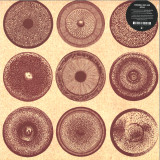
Limited Edition of 1000 Opaque Pink 180 Gram Vinyl LP. Kiss Each Other Clean, Iron & Wine's fourth full length record was originally released in 2011 and came three years after his biggest selling record up to that point, The Shepherd's Dog. The bands two earlier albums had been sparse, intimate solo affairs that offered no hint of the direction he would take with records three and four. Like The Shepherd's Dog, Kiss Each Other Clean is layered with textures, poly-rhythmic sounds and a more is more approach. His lyrics sprung to life in ways initially unimaginable to early fans and critics helping each song tell its story and build to climaxes thru various sounds and editing techniques. However what remained at the core of KEOC, and what fans of the band had come to love, was the song writing and singing of principle songwriter Sam Beam. Beam's ability to invite you in with his hushed singing tone and knack for a melody remained front and center even in his drive to replicate something in the vein of Waits' Swordfishtormbones Principle recording for KEOC was at home in Dripping Springs, Texas where Beam resided at the time. After laying down the bulk of the record Beam moved recording to Chicago to work with Brian Deck. A cast of musicians helped Beam find his sound and see his vision for KEOC including Joe Adamik (Califone), Jim Becker (Califone), Thomas Bartlett (Doveman), Stuart Bogie (Antibalas), Rob Burger (Tin Hat Trio), Benny Massarella (Red Red Meat/Califone), Chad Taylor (Chicago Underground Duo) and Matt Lux (Isotope 217). With KEOC Beam and company brought in soft rock smoothness, dub reggae textures, and instruments that hadn't been featured on previous records. The vintage synths on 'Monkeys Uptown', the Stevie Wonder funk on 'Big Burned Hand,', the strum and drang of 'Walking Far From Home' all give the otherwise very organic-sounding arrangements a welcome cheesy kick. The record also produced the biggest radio single of the bands career with the vintage AM friendly vibes of 'Tree by the River.' It was an adventurous period in the career in Iron & Wine and one in which Beam was defying categorization.
Поиск:core tex
Все
Shlomi Aber & Kashpitzky join forces once again to make their Blueprint Records debut with four formidable techno tracks on the "Sonic Underworld EP".
Barcelona-based Shlomi Aber brings over two decades of production and DJing experience to his music, drawing inspiration from Jazz, Funk, Acid and the old-school Detroit Techno scene. With releases on Cocoon, Ovum, R&S, Figure, CLR, Drumcode, BPitch, Renaissance and his own Be as One Imprint, along with his dynamic mixing technique, has gained him global success while headlining clubs, festivals and venues worldwide.
Growing up, Kashpitzky began his musical path playing guitar in a metal-core band, before trading amps for drum machines. After relocating to Berlin, he graduated from the SAE Institute. A DJ who's hard to pigeonhole, he has a track for every occasion. His definition of techno is best exemplified by his energetic, yet deep and groovy productions, often combining broken beats with organic textures via releases on the likes of MindTrip, Monnom Black and of course, Shlomi's Be As One.
Die brasilianische Thrash-/Crossover Band Possuído Pelo
Cão ist in ihrer Heimat eine Kultband, nicht nur aufgrund
einiger Mitglieder, die man auch als Violator, DxFxCx, Terror
Revolucionário und Innocent Kids kennt. Das erste Demo
„Semen Churches“, welches von Possessed Sänger Jeff
Becerra öffentlich gelobt wurde, erschien im Jahr 2006 und
wurde damals digital und nur in einer kleinen CD-Auflage
veröffentlicht. Eine Wiederveröffentlichung (CD only) auf
Golden Core erfolgte im Herbst 2024. Die politischen und
gesellschaftskritischen Texte sind typisch für das Genre, aber
selbstredend wird auch der Fun großgeschrieben. Das hört
man dem energetischen Debüt „Possessed In The Circle Pit“
auch durchgehend an. Die Spielfreude und die Energie sind
einfach ansteckend, auch auf Tonträger.
Seit 2010 gab es dieses 2008er Debüt nicht mehr auf Vinyl.
Der Zeitpunkt ist perfekt, denn die Band ist seit einigen
Monaten wieder aktiv und möchte nun auch endlich in Europa
fußfassen. Dabei hilft nun die Neuauflage der LP, erstmals
adäquat für Vinyl gemastert und im Gatefold, sowie die
kürzlich ebenso bei Golden Core erschienene EP von 2006
„Semen Churches“
On their seventh long player The Breaks - their second for Joyful Noise Recordings - SUUNS are lost in limbo. For some artists, being caught in flux may result in songs that are either naive, out of touch or both, simply as a consequence of being cut off from human civilization. But for SUUNS, a band who have grown more than comfortable in the oblique and the intermediate, it actually had the opposite effect. The Breaks marks the Montreal experimental rock outfit's most emotionally resonant and tonally rich collection of music to date. The trio of Ben Shemie, Joseph Yarmush and Liam O' Neill leans more zealously than ever into their pop instincts. Yet remarkably enough, with that same dauntless abandon, SUUNS have mined a more extreme sonic palette this time around, one that stretches far beyond their core fundamentals as a band. The Breaks finds Shemie, O'Neill and Yarmush gleefully experimenting with loops, synths, samples and MIDI-instruments like a post-millennial Tangerine Dream messing with downtempo triphop beats. O' Neill took point in the producer's chair for The Breaks, arranging, structuring and editing many of Shemie and Yarmush's ideas from sporadic rehearsal sessions into Pro Tools, reimagining the songs over and over during a two-year time frame. Forged between countless plane rides, road trips, van tours and text threads, The Breaks became a product of endurance and a lot of trial-and-error. It's a record forged in tight fissions of freedom, where spells of whispered intimacy - like on the stunning ballad "Doreen" - are allowed to branch out into the vast glacial dreamscapes of the album's majestic title track. It captures SUUNS at their most panoramic, curious and exuberant: a constant relay of being adrift and enlightened anew, geared up to eleven. And guess what: the wheels keep on spinning.
The world of ENDON is one of constant evolution and revolution. The Tokyo-based ensemble of Taichi Nagura, Koki Miyabe, and Taro Aiko have made a name for themselves with their relentless exploration of sonic extremes in the vein of artists such as the Boredoms and Merzbow. The resulting music is a powerful emotional release for both artist and listener. Their commitment to evolution and dystopian noise as a playground for exploration and pure expression carried them through the recent departure of their drummer Shin Yokota and the tragic death of brother and band member Etsuo Nagura in 2020. Where some might have tried to replace members, ENDON"s core pressed forward with an autobiographical work exploring these changes and the shifts in their lives. Honest and raw emotions delivered with uncompromising sonic intensity, Fall of Spring is a thrilling tidal wave of sound and raw emotions born of the psyche of three individuals musically congregating into one tumultuous voice. Fall of Spring captures the electricity and unpredictability of ENDON"s live performances in vivid detail. The album harnesses the power of their storied performances through unpredictable movements, deft arrangements and an exhilarating textural palette. By imbuing their sound with raw feeling at every edge of obliteration, the trio are able to create what they call "organic music with inorganic material." For ENDON, those moments of suspense and surprise are the core of their music. As with their shows, Fall of Spring is a vessel for band and audience to share moments, to suspend time and move through grief and pain, and to bask in catharsis and resilience. ENDON continues to be a mercurial force in the world of extreme music.
Kannon is an album which was composed in the aftershadow of SUNN O)))’s most recent successes in immersive collaboration (the group worked with Scott Walker on Soused, Ulver on Terrestrials in 2013 and 2014) and also from the broad and influential wake of their epitimous Monolith’s & Dimensions . Kannon emerged both independently as a conceptual entity and with roots in the legacies of those projects, yet was fully realised years later, in 2015. The album is 36 minutes in length and consists of three pieces of a triadic whole : Kannon 1, 2 and 3.
The album celebrates many SUNN O))) traditions ; Kannon was recorded and mixed with SUNN O)))’s close colleague and coproducer Randall Dunn in Seattle, in Studio Litho, Aleph and Avast! ; and the LP includes performances by long term allies and collaborators Attila Csihar, Oren Ambarchi, Rex Ritter, Steve Moore and others. And at the core the composition centers around the dynamic and intense guitar and bass interplay of SUNN O)))’s founders : Stephen O’Malley & Greg Anderson.
It’s possibly the most figurative album SUNN O))) has created, which is unusual as they usually dwell in layers of abstraction and subjectivity. On the other hand the album is the most outright “metal” in years, drawing personal associations and memories of cherished albums like Panzerfaust and Twilight of the Gods again to the forefront of consciousness. At the third time it is very close to the cyclical character of mantra which the band has evolved into as a living creature, the enormity of intense sensate detail and manifestation of the live in concert face of SUNN O))), the organism that has flourished, metamorphosed and transcended tremendously over the past ten years.
The literal representation of Kannon is as an aspect of Buddha : specifically “goddess of mercy” or “Perceiving the Sounds (or Cries) of the World”. She is also sometimes commonly known as the Guanyin Bodhisattva (Chinese: 觀音菩薩) amongst a plurality of other forms. There is a rich lineage behind this idea tracing back through many asian belief systems, with as many names and cultural personifications of the idea .
SUNN O))) commissioned critical theorist Aliza Shvartz to write a text / liner notes around these ideas and topics. She also explores the relations and perceptions to their approach to these ideas via the metonym of music and SUNN O)))’s place/approach within the framework of music and metal overall.
SUNN O))) also commissioned Swiss designer/artist Angela LaFont Bollinger to create the cover artwork, an abstracted sculpture of vision of Kannon, and the French photographer Estelle Hanania to capture portraits of the core trio (Csihar, Anderson, O’Malley) in the impressive and obscurant Emanuel Vingeland mausoleum in Oslo.
The LP is packaged in immaculate tip on gatefold sleeve by our long time comrades Stoughton Printing, and pressed at Cascade in Portland, Oregon. CD, download and coloured vinyl versions are also available
Huge TIPP!! :)
Timeless cuts to suit all intimate dance floors.
After some time we are very excited to announce our new EP by French pals Atomic Moog. With amazing releases on Lowless, Monument & Delsin we are huge fans of their music and their approach to production and feel they are a strong fit for what Appian is all about :).
On show here are warm, heavily textured cerebral journeys densely packed with analogue atmosphere and feeling - with Dub at its core. We think they have created something very special.
Hope you ENJOY : )
January 2023, Dorset. Snow is piled at the door, icy roads are closed, and Emily Cross is in a coffin. Not a setting typical for a rebirth. But for Loma, this is where they bring their band back from the brink. "It's like a demon enters the room, whenever we get together", writer, singer and instrumentalist Cross says of the struggle to bring new Loma music into the world. Following the release of their 2020 second album Don't Shy Away, Loma's three members were cast around the globe and the band-not for the first time-entered a deep sleep. Multi-instrumentalist and recording engineer Dan Duszynski remained in his studio in Don't Shy Away's central Texas heart, but Cross, a UK citizen, moved to Dorset, and writer and instrumentalist Jonathan Meiburg left the US for Germany to research a book. In the pandemic years, even being in the same room was impossible, and attempts to start a new record faltered. The following winter, in an attempt to salvage the record and the band, Cross suggested they regroup in the UK, in the tiny stone house-once a coffin-maker's workshop-where she works as an end-of-life doula. With minimal recording gear and few instruments, Loma turned two whitewashed rooms into a makeshift studio, using a padded coffin as a vocal booth. It was a turning point. They scrapped much of what they'd made, letting a new place set a new course. The one-lane roads, hedgerows and dark skies of Dorset gave the new songs an ineffable but unmistakable Englishness. The band used the ruin of a 12th-century chapel as a reverb chamber-surprising hillwalkers who peeked in to find them singing to no one-and the sounds of Cross's chilly workshop wormed their way into the recording: a leaky pipe, a drummer's brushes on a metal lampshade, the voices left on an ancient answering machine. What emerged was How Will I Live Without A Body?: a gorgeous, unique, and oddly comforting album about partnership, loss, regeneration, and fighting the feeling that we're all in this alone. Many of its songs have a feeling of restless motion; faceless characters drift through meetings and partings, tangling together and slipping away. "I Swallowed A Stone" is like a nightmare with a happy ending; "How It Starts" and "Broken Doorbell" reflect on the challenge (and necessity) of wrestling with agoraphobia. Though the record nods to the trio's separate lives- a German percussion ensemble, a pair of Texan owls, and the surf at Chesil Beach make guest appearances-the core of Loma's sound remains intact: earthy, organic and deeply human, anchored by Cross's cool, clear voice. Loma's previous album, Don't Shy Away, was galvanized by the unexpected encouragement and contributions of Brian Eno. This time, they found inspiration in another hero, Laurie Anderson, who offered a chance to work with an AI trained on her entire body of work. Meiburg sent her a photo from his book-in-progress about the once and future life of Antarctica; Anderson's AI responded with two haunting poems. "We used parts of them in a few songs," he says. "And then Dan noticed that one of its lines, 'How will I live without a body?' would be a perfect name for the album, since we nearly lost sight of each other in the recording process." In the end, Loma's efforts to reconnect with one another are the album's central focus: what do you owe a shared past, when everyone and everything has changed? "Making this record tested us all," says Duszynski. "I think that feeling was alchemized through the music." Alchemized, because How Will I Live Without A Body? is by no means a stressed-out record: an undercurrent of deep calm runs through it. But maybe 'relaxed' isn't the right word. It's more like a feeling of relief, of making it through a tough journey together.
Black Vinyl[50,38 €]
Repressed mint coloured vinyl for the 10th anniversary of the first Flenser pressing! Double Vinyl-LP including digital download code & comes with a 75-page zine. Layout by Niels Geybels (Agalloch, Planning for Burial), note new price on the mint edition. Long requested CD version back in print, note new price. For fans of Enemies List Home Recordings, Giles Corey, Black Wing, Planning For Burial. In 2008, Have A Nice Life released their now cult classic Deathconsciousness album to a whimper and critical non-interest. Six years after its release the band followed up with 2014's stunner The Unnatural World, and by then Deathconsciousness had become a force of influence and fanatic obsession. Seamlessly blending shoegaze, post punk, new wave, industrial and noise with unparalleled depth and weight, the album was originally released by Enemies List Home Recordings founded by HANL members Dan Barrett and Tim Macuga. The 75-page booklet accompanying the deluxe format of Deathconsciousness details the dark and forgotten history of the Antiochean cult. Blurring the lines between novella, liner notes, and academic text, the zine itself presents an engrossing narrative. The corresponding album is rhythmic, primal and expansive, and is a gloomy-post-punk masterpiece a mediation on death, loss and existence. It feels more fresh and engaging with every listen and has held up as a remarkable piece of art. Fans of Have A Nice Life exhibit both cultic thought and action for good reason it is perhaps a fanbase as dark and mysterious as the Antiochean's, which the album itself revolves around. Quotes : "Deathconsciousness is probably a perfect record" - Last Train To Cool // "A masterpiece of depression" - The Quietus // "85-minute powerhouse of a double-album" - The Needle Drop // "Have a Nice Life's Deathconsciousness could quite possibly move the Earth" - Sputnik Music (5/5 rating)".
2024 Very Limited Repress
Down Low Music returns with a catalog number reserved for over 20 years, dL-006. Circa 2002, after releasing music from artists such as Stinkworx, Plastic Sleeves, Convextion and Macho Cat Garage, the dL catalog skipped from dL-005 to dL-007. dL-006 was reserved for DFD aka Troy Anderson, a core part of the dL crew from Texas. Troy had previously released excellent records as Cityboy and Waverider (both recently re-issued on We're Going Back), and as DFD on the first Down Low Music compilation, 'Satellite Cities' in 2001.
But a full EP was never finalized, until now... Over time, multiple projects were lost in the void and time passed until Troy recently sent out some new works from his lab. Down Low loved the new tracks and decided this was the time to complete the missing piece. It's a wonderful glitch in time, four new DFD productions that fit easily in the early 00's sound of the label back then, while also a magnificent piece of machine music from the future. Proper electro with a touch of human feels which is something that seems to be essential for a classic Down Low Music release.
"The new avant-garde isn't about creating something that doesn't yet exist, it's about abandoning and confusing rigid genres. I want to open up, in order to both abolish and reconstruct the musical past." — Noémi Büchi
Noémi Büchi's album 'Does It Still Matter' completes a series of releases whose titles - 'Matière', 'Matter', and 'Does It Still Matter' - place the physicality of music in the center of attention. Büchi's specific sound structures and aesthetic choices question the state of materiality in a world that is becoming more and more fluid and intangible.
From 'Matière' to 'Matter', Büchi subtly transferred from a focus on substance to questioning the enigmatic core of
being, passing from a noun to a verb, and from a single word to an inquiry. 'Does It Still Matter' weighs in on the importance of questioning. Her pieces juxtapose multi-layered analog synthesizer textures, crystal clear sounds and almost brutalistic noises, while they unfold in compositional structures akin to pop songs. Driven by an orchestra of myriad parts, her music creates transcendent intonations that resonate deeply with the listeners' bodies. A daring blend of complexity and accessibility are molded into captivating sound sculptures that challenge and intrigue listeners alike.
Deviating from conventional time divisions, 'Does It Still Matter' immerses listeners in a discordant succession of elements, and guides them towards an eternal present that erases the past with each new revelation, while maintaining it through recurring themes that serve as intimate memories. Büchi's electronic maximalism questions our linear perception of time, offering a glimpse into a world where the past, present, and future converge into a singular moment. Her avant-garde approach rejects predictability, inviting listeners to immerse themselves fully in the present. Everything starts anew at any given instant. Each musical idea exists for one precise moment, rendering the future unpredictable.
'Does It Still Matter' unfolds against a backdrop of collective disaster and biocidal urgency, challenging the very essence of time. Büchi explains: "The world appears to have gone mad. It's all but impossible to reflect on the meaning of avant-garde in music, considering the future in this sepulchral kind of stability of the human condition." Her compositions resonate like an infernal machine, questioning the instantaneous dissipation of everything. Finally, echoes and fragments of sounds remain, haunting memories like ghostly companions.
'Does It Still Matter' is an immersive experience that invites listeners to contemplate the impermanence of our world and the enduring power of sound.
"In the core of the album’s creation, lies my fascination with unveiling the piano overtones by harnessing the properties of complex systems, which emerge when competing oscillations of strings interact with room acoustics, microphone placements, the piano's pedals, and its soundboard. Through long forms, incremental gestures, and nuanced timbral artifacts, the album aims to distort the perception of time and invite an introspective experience of multiple and expanded temporalities." - Zoe Efstathiou.
Zoe Efstathiou, pianist and electro-acoustic composer, originally from Greece, has lived in Sweden since 2015. Her interest shifts between the intricate relationships of the overtones of acoustic instruments, electro-acoustic textures, and the sonic potential of light installations. Her music interpolates the momentary with the ever-evolving, exploring ideas related to time, expectation and memory.
Kata No Wadachi is the latest album by Banetoriko, the solo noise project of Tamaki Ueda. Her first release both on An’archives and on vinyl, it follows several albums for the Neurec imprint – 2017’s Beside the Sluice and 2022’s Yorioto Hogiokuri – and several other cassettes and CD-Rs. With Kata No Wadachi, the Banetoriko world, inspired by the Yokai (“strange apparitions” – supernatural figures, ghosts, spirits) of Japanese folklore, is at its most resonant yet.
Recorded across 2022 and 2023, the three tracks on Kata No Wadachi have Ueda performing in a particularly elevated manner. Her sound is highly tactile and grittily sensuous, the better to capture the ritualistic repetitions, and hypnotic methodologies, core to Banetoriko. The scrape and scratch of Ueda’s self-made metal instrument, the Banetek, gives these improvisations a unique throb, even as their mood, of introverted focus and elaboration of minutiae, gestures towards broader histories of noise and abstract art. Kata No Wadachi evokes, to some degree, the urban ritual noise of the likes of The New Blockaders, Organum, or Ferial Confine; elsewhere, the abraded, rough-housing textures bring to mind the eighties tape works of Hands To and John Hudak.
Ueda embraces the dream evocation that’s possible when loops of blurred texture collide with the gnaw and groan of energised metal, while mantric, dissociated vocals, and the oppressive weight of deep breath, gather around these compositions like a ghost’s shroud. While she’s been making noise for some time, since the nineties, Banetoriko was formalised as a project in 2011, while Ueda lived in Los Angeles. Relocating to Osaka in 2021, she’s carved out an utterly unique space for herself in Japanese noise, and her music contains an absolutely elemental vibration. Framed beautifully with poetic liner notes by Aurélien Rossanino, Kata No Wadachi is an oppressive, yet quixotically blissful trip.
Deluxe 180g vinyl. Art Edition LP includes set of six 12”x12” art cards.
The follow-up to Kee Avil's acclaimed 2022 debut Crease: "A stunning debut" (The Quietus); "A whiplash style of uninhibited exploration" (The Wire); "Kee Avil's debut is a force" (Foxy Digitalis); "A work of Frankensteinian wonder" (Electronic Sound); "A tightly coiled, finely wrought vision of avant-pop" (Exclaim); "A debut of fiendish creativity" (Bandcamp Album Of The Day / Albums Of The Year) Kee Avil's music is both adventurous and intimate, intellectually challenging and emotionally resonant. The Montréal guitarist and producer's 2022 debut LP Crease garnered plaudits from outlets like The Wire, The Quietus, Mojo and Foxy Digitalis, picking up a Canadian Juno Award nomination and Bandcamp Album Of The Day and Albums Of The Year along the way. Its intricate construction, unnerving atmospheres, and knife-edge take on avant-pop prompted comparisons to early PJ Harvey, This Heat, and Gazelle Twin. A remix EP with work by claire rousay, Ami Dang, Cecile Believe, and Pelada brought collaborative perspectives to four Crease tracks, offering new pathways within those songs. With Spine, Kee Avil strips back her heavily textured compositions, opening up a much rawer sound. She calls it folk… and while traditionalists might scoff, this is urgent music that reflects the precarity of modern life, as well as the jarring mixture of electronic and real-world interactions that have become the fabric of our day-to-day experiences. There's a hypnotic post-punk somnambulance to it all, using the repetition and fracturing of melodic phrases interwoven with delicate electronics to create curious and persistent hooks. While not a concept album, themes of time's passage, remembrance, and decay crop up across multiple tracks. Each track intentionally only has four elements - guitar, electronics, and two other instruments, with Kee's voice and guitar pushed to the front. Within this minimalist framework, the juxtaposition of beauty and discomfort that is key to the Kee Avil sound stands out in skin-prickling relief. "We're shaped by many versions of ourselves," says Avil. "I was looking back at these versions of myself and what could have been, what didn't end up being and what did end up being, and going back like that through time. Seeing the future, the past." Spine was written in Kee Avil's home studio after a lapse in writing while touring Crease and working on other projects. She is a well-known and respected member of the Montréal experimental scene, and formerly ran Concrete Sound Studio with Zach Scholes, who continues to work with her as a producer on Spine. Compared to the three years that went into making her debut, Spine emerged in a matter of months - a process that may also be a factor in its intensity and sharpness: "This record was much harder, like it was really discovering everything from scratch." In her desire to not simply replicate or extend the sound of Crease, she felt she had to rip up the rule book, write in a different way, and pare back songs against her usual instincts. Sometimes, when we work against our ingrained habits, we get to the core of who we really are. Spine is an exercise in that process. Without over-intellectualizing or being didactic, it hits immediately and emotionally, especially if you are a person who has spent much time in the process of self-examination. Kee's voice hisses, whispers, and chants; her guitar bends and rings; electronics skitter and crackle; violin creaks like a door in the wind. There is something so evocative about the atmospheres she creates that it's easy to overlay one's own feelings onto her work, but to do that wholly would be to overlook one of the most important things about Spine: Kee Avil's clear and thoughtful vision. This isn't just the next step forward in her artistic trajectory; it's a stunner of a record that stands on its own, a bracing and thrilling listen that has much to reveal about the contradictions inherent in being human. - jj skolnik
Black Truffle is pleased to announce the first vinyl reissue of Trancedance, a wild slice of Swedish Afro-fusion from Christer Bothén, originally released in 1984. A major figure in Swedish jazz and improvised music since the 1970s, often heard on bass clarinet and tenor sax, Bothen studied doso n’koni (the large six-stringed ‘hunter’s harp’ of the Wasulu) in Mali in 1971-2 before turning to the guinbri (the three-stringed lute of the Gnawa/Gnauoua) in Marakesh later in the decade. In between, he performed extensively with Don Cherry during his Organic Music Society period and taught Cherry the doso n’koni. In the later 70s and 80s he worked with the most important figures in the distinctive Swedish jazz-rock-world fusion scene, joining Archimedes Badkar for their African-influenced Tre and participating in Bengt Berger’s legendary Bitter Funeral Beer Band. Many of the musicians who played on the Bitter Funeral Beer Band’s ECM LP (including Berger on drums, Anita Livstrand on voice and percussion and Tord Bengstsson on piano, violin and guitar) joined Bothén for one of the sessions that produced Trancedance, the first release under his own name, dedicated to his compositions. The other session introduced his seven-piece group Bolon Bata, heard on the second track of each side. The title track opens the album with the rubbery buzzing strings of the doso n’goni playing a hypnotic ten beat pattern, soon joined by bass and piano before the entire nine-piece group kicks in with a rollicking Afro-jazz workout, Berger’s drums driving an intricate, winding melodic line played by the horns with Mattias Helden’s cello throwing in pizzicato slides and smears. Bothén then takes centre stage on tenor sax, soloing with a wide, vibrating tone and moving seamlessly from soaring melodies to guttural stutters. After a return to the composed horn lines and a solo from Elsie Petrén on alto sax, the piece builds to an ecstatic conclusion of yelping voices and handclaps, gradually simmering down to return to the solo doso n’koni where it began.
The hypnotic sounds of the hunter’s harp carries over to ‘Mimouna’, where it is joined by Bothen’s overdubbed guinbri. The piece develops into a haunting whispered and sung invocation, gradually building momentum until the organic textures of strings, voices, and hand percussion are ruptured by Lennart Söderlund’s distorted guitar, which brings an unmistakable touch of 1984 to the otherwise timeless sound. Joined by chicken scratch guitar and increasingly dominated by the insistent clang of three of Bolon Bata’s members on karqab (a kind of cast-iron castanet), the grove develops frenetically.
The B side opens with the multi-part epic ‘9+10 Moving Pictures for the Ear’, at over 16 minutes the record’s longest piece. Though Bothen is heard only on horns on this piece, the hypnotic repeating bass line carries on the first side’s link to African musical traditions. Using an expanded 16-piece ensemble, the music balances untethered improvisation with carefully arranged passages of knotty ensemble playing that at points suggest Mingus, Moacir Santos or some of the ambitious post-free work being done in the same years by figures like David Murray or Henry Threadgill. The piece ends with a triumphant passage of looping unison melody reminiscent of the Scandinavian folk explorations of Arbete och Fritid (whose Kjell Westling is heard on bass clarinet and soprano sax here). The sound of Bjorn Lundqvist’s fretless bass introduces the odd left turn made by the record’s final track, a spaced-out expedition into bluesy horn lines and distant guitar atmospherics set to a semi-reggae beat, perfumed by the core Bolon Bata group and bearing the appropriate title of ‘The Horizon Stroller’. A must for fans of the Swedish scene around groups like Arbete och Fritid and Archimedes Badkar, as well as any listener who has been seduced by Louis Moholo’s Spirits Rejoice!, The Brotherhood of Breath, or, more recently, the guinbri grooves of Natural Information Society, Trancedance is a lost classic ripe for rediscovery.
Syncrophone Presents the Very First Vinyl Release From Aleqs Notal’s Label : Industrial Light. This Premiere Sees Notal Partnering Up With Long Time Friend and Fellow Producer Modern House Quintet. Throughout Four Tracks &Ndash; Two From Each Musician &Ndash; This Release Dives Into Several Sub-Genres of Electronic Music and Provides Four Compelling Songs. on the A1 Side, Message From the P Opens Up the Record With a Classical Notal’s Signature Sounds : Ron-Trent-Ish Pad and Organ Samples, Supported by Additional Snares and Several Lines of Hi-Hats. This Delicate House Track, With Its Acid Line Chord Core Is Perfect to Open Up a Set. A2 Drinking Workers Sees Notal Weave His Hi-Hats Patterns Around a Typical Detroit-House Bass Line. Architected and Thought Like Scratches (Due to His Hip-Hop Background), Hi-Hats Set the Tone and Enhance the Track as a Back-and-Forth Game With the Bass, Contributing to the Overall Depth of the Song. Once Again, Notal Shows His Creativity About Blending Different Sub-Genres Into a Single Track. on the Flip Side, Modern House Quintet Presents Two Very Different Tracks (Although Both Are Clearly Made for the Floors). B1 Nadrezacalenis Associates Several Layers of Shakers and Subtle Hi-Hats &Ndash; Combined With Percussion &Ndash; in Order to Emphasize the Lush Rhodes Chords And, Later, the Entrancing Vibraphone Notes. Last but Not Least, B2 Dioskouron Is Clearly a Track for a Peak Time Moment. With Its Detroit-Techno Atmosphere, Its Tr-909 Drums Pattern, Its Textures (The Discreet, Yet There, Pad) and Its Pace, DJs Can Rely on This Great Addition for an Ideal 3 Am Set to See Heads Nod and Bodies Swing. as for All the Previous I.l Releases, Artwork Is Made by Jn/wl. ...
Ollie Spalding and Jack Watts were friends first, and songwriting partners second, and this quality sets them apart. They're marked by that peculiar alchemy when two voices become one, a special sense of human connection wrought through harmony and emboldened with experience.
New album 'Redsetter' is their coming- of- age moment - gilded indie- folk with an optimistic sense of maturity, it dares to look towards the light. "We had literally no idea what was gonna happen!" Ollie gasps when looking back on the pair's self-titled debut album. Sculpted over the pandemic and released on Real Kind Records - the boutique Communion imprint chaired by Lucy Rose - the record displayed their core values. "The emotion has to be right," says Oliver.
"When we record songs, we want to stay true to the emotion - as though those songs had just been written seconds before they were recorded." The success of their debut brought fresh experiences - writing with Flyte, collaborating with everyone from Matthew & The Atlas and Victoria Canal to Talos and Olafur Arnalds - but also new challenges.
New LP 'Redsetter' takes them from their base in Brighton to a remote part of Texas (and back again); it's a record that's driven by a special kind of determination, dealing with intimate bonds, familial connections, and a quiet sense of renewal. Looking for perfect moments within our imperfect lives, Memorial have displayed extraordinary sense of character to drive themselves forwards. "We've let go of trying to make everything sound perfect," says Jack. "Being vulnerable in that way means that the end product is truer to you than it ever could be. There's a realness to it." Memorial have taken true ownership of their lives, pushing through enormous challenges to unlock new aspects of their artistry, and actualise their dreams.
Elevating, uplifting and beautifully arranged. Jasmine Myra's sophomore album Rising builds on the success of her
breakthrough album Horizons to deliver a major statement from one of UK Jazz's rising stars. Produced by Matthew Halsall and mixed by Greg Freeman (Hania Rani, Matthew Halsall, Portico Quartet), Rising delivers a confident and vibrant follow up that joins the musical dots between Myra’s influences Kenny Wheeler, Bonobo and Shabaka Hutchings while delivering something unique, beautiful and profound.
Rising is also the sound of a composer and performer growing in stature and adding extra layers of confidence and poise to both her playing and composing. Aided and abetted by Matthew Halsall who once again lends his production skills, Rising is fuller, richer and deeper as Myra develops her uniquely uplifting sound.
Much like my first album, Rising is a reflection of a period of my life. It is a continuation from Horizons, which was all about my experience during lockdown, and entailed overcoming my struggles with mental health. Following on from that experience, I set out to continue building my self-confidence. This album has an uplifting and spiritual sound, drawing influence from artists such as Makaya McCraven, Bonobo and Shabaka Hutchings.
Rising features the same core of musicians as Myra’s debut album Horizons (Gondwana records GOND052): guitarist Ben Haskins, drummer George Hall pianist Jasper Green, harpist Alice Roberts (who both also perform with Matthew Halsall) and bassist Sam Quintana who collectively bring a deft understating of the subtle textures of Myra’s music and perform with a collective empathy and drive that really pushes the music on a radiant journey. And a string quartet add gently elevating textures to Still Waters, Knowingness, From Embers and How Tall The Mountains.
Kee Avil's music is both adventurous and intimate, intellectually challenging and emotionally resonant. The Montréal guitarist and producer's 2022 debut LP Crease garnered plaudits from outlets like The Wire, The Quietus, Mojo and Foxy Digitalis, picking up a Canadian Juno Award nomination and Bandcamp Album Of The Day and Albums Of The Year along the way. Its intricate construction, unnerving atmospheres, and knife-edge take on avant-pop prompted comparisons to early PJ Harvey, This Heat, and Gazelle Twin. A remix EP with work by claire rousay, Ami Dang, Cecile Believe, and Pelada brought collaborative perspectives to four Crease tracks, offering new pathways within those songs. With Spine, Kee Avil strips back her heavily textured compositions, opening up a much rawer sound. She calls it folk—and while traditionalists might scoff, this is urgent music that reflects the precarity of modern life, as well as the jarring mixture of electronic and real-world interactions that have become the fabric of our day-to-day experiences. There's a hypnotic post-punk somnambulance to it all, using the repetition and fracturing of melodic phrases interwoven with delicate electronics to create curious and persistent hooks. While not a concept album, themes of time's passage, remembrance, and decay crop up across multiple tracks. Each track intentionally only has four elements—guitar, electronics, and two other instruments, with Kee's voice and guitar pushed to the front. Within this minimalist framework, the juxtaposition of beauty and discomfort that is key to the Kee Avil sound stands out in skin-prickling relief. "We're shaped by many versions of ourselves," says Avil. "I was looking back at these versions of myself and what could have been, what didn't end up being and what did end up being, and going back like that through time. Seeing the future, the past." Spine was written in Kee Avil's home studio after a lapse in writing while touring Crease and working on other projects. She is a well-known and respected member of the Montréal experimental scene, and formerly ran Concrete Sound Studio with Zach Scholes, who continues to work with her as a producer on Spine. Compared to the three years that went into making her debut, Spine emerged in a matter of months—a process that may also be a factor in its intensity and sharpness: "This record was much harder, like it was really discovering everything from scratch." In her desire to not simply replicate or extend the sound of Crease, she felt she had to rip up the rule book, write in a different way, and pare back songs against her usual instincts. Sometimes, when we work against our ingrained habits, we get to the core of who we really are. Spine is an exercise in that process. Without over-intellectualizing or being didactic, it hits immediately and emotionally, especially if you are a person who has spent much time in the process of self-examination. Kee's voice hisses, whispers, and chants; her guitar bends and rings; electronics skitter and crackle; violin creaks like a door in the wind. There is something so evocative about the atmospheres she creates that it's easy to overlay one's own feelings onto her work, but to do that wholly would be to overlook one of the most important things about Spine: Kee Avil's clear and thoughtful vision. This isn't just the next step forward in her artistic trajectory; it's a stunner of a record that stands on its own, a bracing and thrilling listen that has much to reveal about the contradictions inherent in being human. — jj skolnik.
Elevating, uplifting and beautifully arranged. Jasmine Myra's sophomore album Rising builds on the success of her
breakthrough album Horizons to deliver a major statement from one of UK Jazz's rising stars. Produced by Matthew Halsall and mixed by Greg Freeman (Hania Rani, Matthew Halsall, Portico Quartet), Rising delivers a confident and vibrant follow up that joins the musical dots between Myra’s influences Kenny Wheeler, Bonobo and Shabaka Hutchings while delivering something unique, beautiful and profound.
Rising is also the sound of a composer and performer growing in stature and adding extra layers of confidence and poise to both her playing and composing. Aided and abetted by Matthew Halsall who once again lends his production skills, Rising is fuller, richer and deeper as Myra develops her uniquely uplifting sound.
Much like my first album, Rising is a reflection of a period of my life. It is a continuation from Horizons, which was all about my experience during lockdown, and entailed overcoming my struggles with mental health. Following on from that experience, I set out to continue building my self-confidence. This album has an uplifting and spiritual sound, drawing influence from artists such as Makaya McCraven, Bonobo and Shabaka Hutchings.
Rising features the same core of musicians as Myra’s debut album Horizons (Gondwana records GOND052): guitarist Ben Haskins, drummer George Hall pianist Jasper Green, harpist Alice Roberts (who both also perform with Matthew Halsall) and bassist Sam Quintana who collectively bring a deft understating of the subtle textures of Myra’s music and perform with a collective empathy and drive that really pushes the music on a radiant journey. And a string quartet add gently elevating textures to Still Waters, Knowingness, From Embers and How Tall The Mountains.
Sonic Behavior by Driftmachine & Ammer is an album exploring the origins of sound, noise, and various music genres. Alongside lyrical declarations of love for noise ("Song To Noise"), the album delves into sonic reflections on how beauty and emotion emerge from mundane vibrations in the air ("The Siren Is A Simple Device"). For the first time, the analog sound researchers of Driftmachine (Andreas Gerth, Florian Zimmer) incorporate spoken language and noise into their sound research. They have collaborated with word and sound artist Andreas Ammer, renowned for his radio plays with Acid Pauli, aka Console ("Spaceman 85"), or FM Einheit ("Radio Inferno," "Symphony of Sirens").
In "The Siren Is A Simple Device," the words are spoken by 81-year-old musician and poet legend Ted Milton (Blurt, Loopspool). Despite its simplicity and obvious ability to produce high volumes, the siren has led a marginal existence as a musical instrument. Yet, it is capable of evoking the most intense emotional states in the listener in the shortest possible time, like almost no other sound-producing mechanism. "Sonic Behavior" capitalizes on this fact. The familiar hypnotic sounds of Driftmachine are accompanied by a siren organ inspired by the revolutionary Russian futurist Arsenij Avranov and built by Andreas Ammer, while the lyrics talk about the simple physical reasons behind the sound chaos that has just been unleashed: A siren ... chops the air into sound.
The core of the album is "Song To Noise," an electro-acoustic mini-symphony about the beauties of noise and all its producers, which is based on a poem by the British poet Deryn Rees-Jones and spoken by the poet herself and Alexander Hacke (Einstürzende Neubauten, Hackedepicciotto). Driftmachine & Ammer develop a soundtrack that is as powerful as it is loud and danceable (which is why the LP also includes a textless version of the composition).
"Sonic Sculpture" is the zenith of the work: a text/music track spoken by Ted Milton, which creates the possibility of a sound sculpture that encompasses the universe: What if one could imagine the infernal sound that encompasses all conceivable harmonies at the same time? A piano does when you throw it down an earthly staircase (the epitome of music is a piano falling down the stairs) through silent space to the next theoretically life-filled, Earth-like planet, Proxima Centauri B. The radio makes it possible. Driftmachine & Ammer tried it. The result will be heard there in 4.24 light-years. On planet Earth, the time has come on May 2, 2024. On this day, Sonic Behavior will be released, a conceptual album by Driftmachine & Ammer exploring sound, its creation, and its power.
A leading Norwegian bassist for over 30 years, ECM legend Arild Andersen forges promising relation-ships with two rising stars - Daniel Sommer (drums) and Rob Luft (guitar) in an expansive, playful exploration of song and collective improvisation. As Time Passes " is set to release on April 26th on April Records. Led by Sommer, the release signifies the first chapter of the drummers much much-anticipated Nordic trilogy on April Records, aiming to capture and document Nordic improvisation and composition across three carefully curated ensembles. Bassist Arild Andersens storied career stretches back to the 1970"s as one of ECM s first recording artists, collaborating with household names of the genre including Jan Garbarek, Don Cherry, Bill Frisell, John Taylor, Sonny Rollins, Chick Corea, and the list goes on. Welcoming the opportunity to work with and nurture younger artists, the ensemble was born when Daniel Sommer selected Andersen for a project during his studies at the Danish National Academy of Music. Later, impressed by Luft s performances in Ireland and Norway, Andersen suggested expanding the pair into a trio. A transcendent musical voyage, As Time Passes " blurs the lines of conventional trio roles, and celebrates the evolution of jazz as a fluid, versatile form of expression. By providing each musician the freedom of becoming a key contributor in the melodic discourse, the trio channels the spirit of jazz veterans such as the Bill Evans Trio and free free-jazz ensemble Air, while echoing the sounds and innovations of pan pan-European contemporary jazz. Mixing pensive rubato ambience with energetic grooves, instrumental dexterity, a modern ECM ECM-esque sound and folk undertones, the record s compositional clarity combined with the spontaneity of a live performance flows across and between genres, borders and generations alike. Luft s intricately over-dubbed layers of acoustic guitars, vast reverbs, and contrapuntal melodies expand the sound of the three piece into an immersive world of textures. Rendered in the stark beauty of Andersen"s bass lines, the nuanced strokes of Sommer"s drums, and capped with the lush, expansive timbres of Luft"s guitar, "As Time Passes" is a testament to enduring and ever ever-evolving wonder of Jazz.
On Gut Buster, Yosa Peit spawns fleshy sonic escapades, a swarm of vigorously processed vocals and soulful bass, set to a backdrop of visceral percussive structures. Full of roguish curiosity, the record is cast with an air of lo-fi experimentation, but with a platinum glint of pop sensibility. Peit's second album grapples with the destructive force of modern consumption, Gut Buster is an anti-capitalist battle cry that syntheses intimacy and hostility; a surrealist-punk affirmation and a testament to Peit's singular vision and unique approach. The free-ranging sound of Yosa Peit recalls the intense arrangements of a cyber-era Prince with the surrealist tones of Arthur Russell and early Björk. At the album's core, "World Eaters" unleashes scorching guitars in search of humankind's end, "I was born on a planet, I got hungry and I ate it." Even in the face of planetary doom and personal obstacles, Yosa evokes our propensity for mischief, humor and pleasure. "bb moon" processes sound solely from her bass into wicked oblivion. "CALL ME," a song about friendship, chews up it's anthemic melody into a gnarled strut worthy of an A$AP Rocky production, while "HAD3S" urges us to find balance, nodding to the mystical fuzz of Prince. Yosa's work has been called "personal, punk, poignant, deep" yet her genre-defying production, as textured as it is catchy, escapes definition. Gut Buster takes that collective playground for creation to planetary reaches, congregating friends from Berlin, Cologne, and New York's fuzzy musical underbelly: Employee, Funkycan, Gerry Franke, Glenn Astro, Nauker, Paingel, Tbz, and UCC Harlo. The record was mixed by Brainfeeder affiliate Benjamin Vukelic in Portland and Jan Brauer in Berlin. "Glitchy yet supple, the broken beats and warped abstractions are wholly unpredictable yet deliciously odd, like an esoteric mashup of Bjork, Aphex and Laurie Anderson" Electronic Sound Classic Black Vinyl, Gloss Laminated Sleeve, Printed inner "Gut" sleeve plus DL card.
Melbourne/Naarm-based musician and curator Rama Parwata, known for being the backbone drummer in bands such as Kilat, Whitehorse and Rinuwat, releases his second major solo album titled ‘Ceases’ on Cassauna/Important Records.
Parwata's gripping new electro-acoustic work is a sonic exploration within the realms of post-free-jazz and experimental electronics. At its core, ‘Ceases’ navigates the liminal spaces between rhythm and noise, structure and chaos. The album traverses a vast emotional and conceptual landscape, touching upon themes of impermanence, transformation, and the cyclical nature of existence.
At the forefront of the album is Parwata's emotive compositional and performative approach, which serves as both anchor and catalyst for the album's journey. The percussion performance is cymbal heavy accompanied by deeply meditative drones and slow moving melodies. The wash of sound touches on a spiritualism akin to Coltrane’s “A Love Supreme Part 4: Psalm”, albeit with a modern electronic vision á la Tim Hecker. With a keen sense of textural intricacy Parwata favours the emotional expression of electro-acoustic composition, weaving complex poly-textures that ebb and flow with hypnotic, prayer-like intensity. Each performative gesture creates a visceral immediacy that draws the listener deeper into the celestial, otherworldly sonic framework.
The diverse array of electronic elements, meticulously crafted and seamlessly integrated into the fabric of the album are a testament of Parwata’s capacity for acousmatic composition. From pulsating synthesizers to glitched-out samples, the electronic timbres in "Ceases" serve as both sonic embellishments and structural foundations, blurring the boundaries between organic and synthetic, acoustic and digital. Honing in on the electronics, a listener could be convinced they were hearing anything from spiritual-jazz, 90s rave, dungeon synth or doom. Through judicious composition, Parwata imbues each sound with a sense of transcendental allure and paints a soundworld that has a distinct ‘outerness’. At times the narrative is pointedly bleak but over a few passages the sonic language often bends toward rejuvenation; finding respite in cadence. The title itself suggests a sense of cessation, of endings and beginnings intertwined—a motif that reverberates throughout the album.
My art investigates the rich area of resonance and I engage in dialogue influenced by past works, current concerns and new directions. Works attempt to immerse the senses bringing to the fore natural phenomenon. I believe that sound can heal and that the conscious investigation of harmonic tunings, acoustic resonance as well as social relationships can yield powerful experiences. One of my objectives as an artist is to expose natural phenomena. I am interested in the physical aspects of sound and have developed a sensibility that focuses heavily on Resonance. Vibration is at the core of my experience of Resonance. I am moved by natural resonances that exist around us all. My own work strives to develop and nurture Resonances by negotiating sensitive relationships among a number of what I identify as critical ingredients for psychedelic phenomena: resonant bodies exciting harmonic energy creating diverse waves, beating and phase patterns diffused spatially with full dynamic range and a deep attention to the body and how it engages with the environment.
Teethe is a band from Texas. The members of Teethe met while attending the University of North Texas in Denton, TX, a small college town outside of Dallas with a fertile music scene. Before forming Teethe, its core members Boone Patrello, Grahm Robinson, Madeline Dowd, and Jordan Garrett all played in various other groups in Denton, releasing music under different pseudonyms. Patrello released solo music via his Dead Sullivan moniker, while Robinson released under MAH KEE OH. Patrello and Robinson linked up with Dowd to record an album for her project, Crisman, in 2019. They all eventually moved in together, leading the group to start recording more as a whole unit, and subsequently Teethe was born. Made over the course of 2020, Teethe's eponymous debut album is a collection of songs pieced together over time - a sonic collage of fragmented recordings and half finished tracks made whole in the midst of isolation. Initially self-released in November of 2020 with little fanfare, the album's warm, lo-fi aesthetic and slow, calming songs spread by word of mouth. Roughly one year later, at the top of 2022, the band returned with "Tag", a new single that caught the attention of slowcore fans and garnered shout outs from unlikely celebrities. Tours soon followed with Charlie Martin of Hovvdy, Momma, Milly, Waveform, and They Are Gutting A Body of Water. The band continued to record their own music, releasing another single, "Lucky," in the fall of 2022, and most recently partnered with Saddle Creek for their 7” series to release their newest single, "Moon," in October of 2023. Now spread between Dallas and Austin, the Texas band has recently signed with Winspear and will be re-issuing their self-titled debut LP this winter, along with a pressing of "Tag," "Lucky," and never before released b-side "Thanks" on 7” vinyl.
Felix Machtelinckx is a singer, composer, producer and lyricist from Belgium. Featuring an array of film scores, dance soundtracks, pop, folk and electronic music, Felix's music resonates with a familiar, almost nostalgic patina, applied with a distinctly crooked touch. Through artistic collaboration, coaching and production, Felix has cut a dash in the pop and indie cult scenes of Belgium, especially with his band Tin Fingers, who are feted as one of the most promising indie acts of the moment. Night Scenes, Felix’s solo debut is, in contrast to his other work, more humble and less traditional, roughly hewn from a series of ambient soundscapes, earthy textures and playful structures. Felix’s voice, normally the flagship of his music, becomes more of a distant memory, an indistinct emotion feathered throughout the music. Many lyrics are improvised, sometimes unintelligible, conjuring haunted, uncertain undertones. Similarly, the album is innately peripatetic to the core, being created, written and recorded in Lithuania, Belgium, France, mastered in the US, and finally released in the UK. In the first instance, some of the tracks were created for the contemporary dance piece Doggy Rugburn by Brandon Lagaert of Kaiho and Peeping Tom; others were created enigmatically for a film that never surfaced; while the remainder are the product of more personal work and research. As Felix began to collect and review these disparate parts, the concept of a unified album began to evolve. With 'night' featuring as a suitably dark leitmotif, or backdrop to a series of emotionally fraught 'scenes', each track depicts a form of trauma, locked within the confines of the mind. Felix observes: "Imagine yourself in a dusty old room unable to sleep. Emotions, fears and other demons haunt your mind. This in-between state makes your mind reach for other worlds. This is Night Scenes." For the most part, Night Scenes was created using a variety of old, and rare, analogue equipment. With almost no digital editing, the record was primarily mixed through a vintage cassette desk, giving it a nostalgic character with a noisy undertone. Felix fully embraced the synergy of his emotional themes and retrograde gear, enthusing: "A lot of textures were created on an old Soviet synthesizer that causes a blackout when you hit the lowest note on the keyboard. The dysfunctionality of the synths was often used to create rhythm and texture." This unnerving ability Night Scenes has to comfort and confound the listener is summed up by Jordan Hudson, House Of Media producer, and music podcaster, when he concludes: "Some songs on the album have this sort of fleeting comfort and tonality, which dissolves into a subtle rhythmic/structural or modulated disarray the moment I settle into them - this really fits with my experience of the night .. This record is a winner, and will be something I'll listen to a lot from here on
The second album by F.K. Raeithel, just after the operetta DIE WURLITZERORGEL DES GEISTES, explores the realms of interlocked rhythm sample and hold music. On 16 tracks different setups of self generating modular synthesizer patches are gathered on this release.
The concept of Dance With Uncertainty is deeply rooted in philosophical, artistic, and cultural traditions. The notion of embracing uncertainty and change has been explored in various forms throughout history, often symbolizing the human experience and the impermanence of life. In the context of music and sound, Dance With Uncertainty could be seen as a reflection of the constant ebb and flow of life‘s uncertainties, captured and conveyed through sonic textures and evolving compositions.
Interlocked Rhythm Sample & Hold Music, this approach to sound creation weaves a mesmerizing tapestry of rhythm, texture, and sonic exploration, captivating listeners and defying traditional musical boundaries. At its core, Interlocked Rhythm Sample & Hold Music is a synthesis of technology, creativity, and a deep understanding of rhythmic intricacies. The foundation lies in the Sample & Hold circuit, a device that captures and freezes incoming voltages, creating distinct musical snapshots that evolve over time or an Linear Feedback Shift Register (eg. Rungler), a circuit used in electronic music synthesis and sound manipulation to create unique and evolving musical textures. The Rungler was created by Rob Hordijk. A more sophisticated use of a 8 bit shift register and by combining this with a typical sequencer design is the Klee Sequencer developed by Scott Stites. A cheap version of this design is the Turing Machine. Another tool is the Analog Shift Register. In the context of creating arabesque melodies, an analog shift register (invented by Fukushi Kawakami and later adapted by Serge Tcherepnin) can be a fascinating tool to generate intricate and ornamented musical patterns. Yet, it‘s the interlocking of these snapshots that sets this genre apart, infusing the compositions with an intricate dance of patterns and pulses. A fourth device is a pendulum or random addressed sequencer, that in the first case moves in a drunken unpredictable manner. Each of these devices for uncertainty becomes a rhythmic sculptor, freezing the dynamic interplay of melodies, beats, and textures. These frozen moments are then interwoven, each snapshot forming a unique thread in a sound tableau that stretches and contracts, pulses and breathes. The result is an auditory experience that challenges preconceptions of rhythm and structure. The interlocked rhythms give rise to complex grooves that ebb and flow in unpredictable ways, evoking a sense of perpetual motion and transformation. The music becomes a living organism, its heartbeats synchronized yet untamed, its evolution both deliberate and free-spirited. The juxtaposition of staccato bursts and fluid flows, of machine-like precision and organic unpredictability. As listeners delve into the world of Interlocked Rhythmic Sample & Hold Music, they embark on a sonic odyssey. The music becomes a companion, guiding them through a labyrinth of rhythmic landscapes that simultaneously challenge and invite them to the dance with uncertainty.
- Chance Is Her Opera
- Heatwave Pavement
- Green Ray
- Orange Zero
- Late July
- Darkness-Blue Glow
- Mono Valley
- Coastal Lagoon
- Alkaline Eye
- 3: Am Walking Smoking Talking
- Three Fires
- Disc 2
- She Smiled Mandarine Like
- Under The 3000 Foot Red Ceiling
- Orange Zero (Single)
- Chance Is Her Opera (Demo)
- Late July (Demo)
- Alkaline Eyed (Demo)
- She Smiled Mandarine Like (Demo)
World Of Echo are proud to announce the long-awaited reissue, on 17th February, of the self-titled debut album by Bristol’s Movietone. Originally released in 1995 by Planet Records and reissued on CD in 2003 by The Pastels’ Geographic Music imprint, this is the first time Movietone has been reissued on vinyl. An expanded double-LP edition, it includes the extra tracks from the 2003 CD (their first two singles, and an unreleased demo of “Chance Is Her Opera”), and adds three more unearthed gems: demos of “Alkaline Eye” and “She Smiled Mandarine Like”, and an early take of “Late July”, recorded in a garden by Dave Pearce (Flying Saucer Attack) in 1993. Taken together, this is the definitive collection of music from the first phase of one of Bristol’s most remarkable groups.
Movietone was the cumulation of a series of events, explorations, and discoveries, starting at secondary school – the group’s core membership of Kate Wright, Rachel Brook, Matt Elliott and Matt Jones met at Cotham School in Bristol. As for many other groups, their early years were all about experimenting, and finding ways to ‘make do’, a DIY sensibility that would inform Movietone through their decade-long lifespan. From formative rehearsals in a shed in the garden of Brook’s family home, to recording early material to four-track in Redland Library, and on into the Whitehouse and Mr Grin’s studio sessions for their debut album, Movietone’s music fell together in a creatively unpredictable, yet conceptually rigorous manner.
By the time they released Movietone, they’d found a home with Bristol’s Planet, run by author Richard King and James Webster, who had both released their first two singles, “She Smiled Mandarine Like” and “Mono Valley”. There was other music happening around them in Bristol, too, from the Jones brothers’ avant-rock outfit Crescent (who were Movietone’s closest conspirators), through Elliott’s jungle/electronica project Third Eye Foundation, and Brook and Elliott’s membership of Flying Saucer Attack. A closely knit community, Movietone are the centre of this nestling architecture of groups.
The vision in the music, mostly, belongs to Wright, but Movietone ran in democratic creative consort. Listening back to Movietone, you can hear this democracy in action through the wildness of the music, which is balanced by the poetics of Wright’s lyrics and melodies. Full of half-captured memories and entangled abstractions, there’s an elliptical, ruminative quality to much of the writing here that shows the deep influence of the Beat Generation writers, along with a twilight environment captured in the songs that’s pure third-album Velvets, Galaxie 500, early Tindersticks, Codeine. Unpredictable interventions – the crashing glass in “Mono Valley”, the sudden explosions of “Orange Zero” – point towards the noise blowouts of My Bloody Valentine, the unpredictability of Sonic Youth; Wright’s understated vocal cadence suggest a deep, embodied understanding of John Cage’s Indeterminacy.
Movietone would go on to make three fantastic albums for Domino – Night & Day (1997), The Blossom Filled Streets (2000) and The Sand & The Stars (2003) – and their Peel Sessions were released early in 2022 by Textile. Still held in high regard by artists like Steven R. Smith, and The Pastels, whose Stephen McRobbie once described them as “one of the great unknown English groups,” it’s an absolute thrill to listen to Movietone anew – still inspired, still seductive, still magic, still mysterious.
German melodic extreme metal act FAR BEYOND mark their return with their third studio album, The End of My Road, on February 16 via their new label home Prosthetic Records. FAR BEYONDüs latest full-length is an ambitious and fastidiously curated amalgam of melodeath, symphonic and power metal, covering themes of courage and heart in the face of depression and hardship. Formed in the early 2000s, FAR BEYOND is the solo project of Eugen Dodenhoeft. Based in the Franconian Switzerland region of Germany, FAR BEYONDüs history to this point has been one of slow and steady artistic progression with 2005's An Angel's Requiem and 2016's A Frozen Flame Of Ice albums showcasing Dodenhoeftüs penchant for seamlessly alternating dynamics of gothic and death metal symphonia. Lusciously complex by design, FAR BEYOND's latest album shines in its songwriting structure. Across the eight tracks, Eugen compiled up to 30 layers of vocals, synthesisers and orchestral textures. Whilst a solo endeavour at its core, The End of My Road sees collaborative guitar solos from Nathram's Lukas Grasslin as well as additional synthesiser embellishments from Ari Ahrendt on Tempus Fugit and the title track. The End of My Road was then placed in the hands of Patrick Staudle of Glaswald Studios in The Black Forest, Germany. Furthering their quest to understand the complexities of the unknown and transcend beyond the unknown, The End of My Roadüs contemplative atmospherics and concentrated sonic extremities merge seamlessly with a deft poetic touch. With Eugen adding: üThe End of My Road is my invitation to get lost in the sonic realms of FAR BEYOND and find a moment of peace and inspiration. I look forward to sharing this album with the world and hope that it touches the hearts of listeners, providing them with an unforgettable soundtrack for their own journey.
Sun Yellow LP[21,22 €]
Clear Vinyl
Blue Lake is the musical moniker of American born, Copenhagen based multidisciplinary artist and musician Jason Dungan, who signs to the Tonal Union imprint for the release of his new longform album ‘Sun Arcs’. It follows 2022’s release ‘Stikling’, earning a nomination for ‘Album of the Year’ at the Danish Music Awards plus warm praise from The Hum blog and musicians and DJs alike including Jack Rollo (Time is Away/NTS) and Carla dal Forno. A self taught player, Dungan began freely experimenting with self-built multi-string instruments, preferring to build his own hybrid 48-string zither and working in the realms of left-field ambient music, off kilter folk and improvised acoustic minimalism.
The starting point of ‘Sun Arcs’ saw Jason travel for a week alone to Andersabo, a cabin set in the idyllic Swedish woods just outside of Unnaryd, known also as the music project, festival and residency space which has been run by Dungan since 2016, hosting artists like Sofie Birch, Johan Carøe and Ellen Arkbro. Whilst writing 1-2 pieces per day, a conscious decision was made to leave behind everyday distractions and shut out the outside world to instead focus on the natural passage of time as Dungan recalls: “My only sense of time came from these daily walks out in the woods with my dog, and an awareness of the sun’s path as it moved across the sky each day.”
The album’s immersive world unfolds with the opener ‘Dallas’, an ode to his home state and a musical synthesis of these two disparate spaces (Texas and Denmark), the touchstones of Dungan’s life. A folk-esque single acoustic builds to a flowing arrangement of clarinets, organ and cello drones coupled with percussion. ‘Green-Yellow Field’ chimes in as the first of two solo oriented zither recordings twinned with the dreamlike title track ‘Sun Arcs’, both densely rich as cascading and overlapping harmonic tones resound. ‘Bloom’ emerges with a krautrock psyche before an eruption of cello drones, slide guitar and free-ranging zither playing, ushering in the anticipation of spring. With half of the recordings conceived in Andersabo, Jason returned to Copenhagen to form the album's centre piece ‘Rain Cycle’ which features a tempered Roland drum machine alongside shifting zither improvisations. ‘Writing’ explores the shimmering harp-like qualities of sweeping playing figurations with Dungan mapping out adjusted tuning “zones” on the zither for unconventional but creatively liberating effects. ‘Fur’ captures the feeling of openness and the momentum of time, seeing Dungan perform waves of solo clarinet, often in one takes and embellished with textural drones, a zither solo, and layers of guitar. ‘Wavelength’ the album's closer is fondly inspired by the film works of Michael Snow and Don Cherry’s seminal live album ‘Blue Lake’ (1974), as it builds out from a drone-generated zither chord and features an alto recorder solo. Dungan found a deep connection to Cherry’s stripped back performance ethos, focusing on the core beauty of minimal instrumentation creating a genre-less meeting between folk and jazz. A dialogue is formed between the solo and the bandlike performances, interlinked in a geographical duality with all finding a sense of commonplace as musical sketches of visited landscapes. The bountiful instrumentation ebbs and flows as further layers emerge with Dungan constructing his material much like an artist would, recording and reviewing, adding and subtracting.
Musically it portrays a form of double life led by an American-identifying person living in Scandinavia, and a new found presence in Denmark, seeking out underdeveloped marshlands and barren stretches of beach adrift from other rhythms and distractions. Highlighting their individual and potent importance Dungan concludes: “Both places feel like “me”, I think on some level the music is always some kind of self-portrait.” ‘Sun Arcs’ depicts the intricate balance of nature’s cycles and the paths outlined by the seasons, from a winter dormancy to a warm sun drenched scene. The album scales new glorying heights and further defines Dungan’s musical narrative, inhabiting a unique space in left-field, improvised and experimental music, borning his most accomplished compositions to date. A singular and visionary expression, drawing on an array of instruments and sound worlds with a renewed sense of joy and discovery.
The album's rich tapestry was mixed by Jeff Zeigler (Laraaji, Mary Lattimore, Kurt Vile /Steve Gunn) and mastered by Stephan Mathieu (Kali Malone, KMRU, Félicia Atkinson).
FOLLOWING THEIR RECENT REUNION, THE DELGADOS REISSUE THEIR FOURTH STUDIO ALBUM HATE ON COLOURED VINYL AND CD TO MARK ITS 21st ANNIVERSARY
Ushering in a new era of emotionally vulnerable and cinematic songwriting for celebrated Glasgow group The Delgados, 2002’s Hate is the group’s most ambitious recorded statement to date. Recorded amidst a backdrop of personal change and international crisis, Hate’s internal alchemy transmogrifies darkness into light. It’s an enclosed universe full of tragedy and magic, a swirling galaxy of lush orchestration, misanthropy dealt with kindness and black humour. Above all it showed a band coming to terms with their fragility with a new power and grace.
In Hate, the band’s ambition saw them striving to reflect the breadth of human experience, both the joy and tragedy of living in tumultuous times. Initially commissioned by The Barbican in London to compose music for a film about artist Joe Coleman, the instrumental music that instigated Hate was laden with darkness from the outset. The Delgados’ worldview has always been informed by nuance, an oblique but incisive lyrical perspective but on Hate a new rawness is woven throughout the songs. Coleman’s original subject matter - portraits of troubled historical figures like Ed Gein, Mary Bell and Jayne Mansfield - influenced the tonality of the music but the songs were written against a backdrop of international tumult and personal life changes for the band members. Beginning writing sessions following a family bereavement in drummer Paul Savage’s family, Hate was then recorded while both Alun Woodward and co-singer/guitarist Emma Pollock were expecting new additions to their young families, the latter with drummer Paul Savage. In the background to the recording process were the attacks on the World Trade Center of September 2001 and their aftermath. In this context, it’s remarkable that an album was made at all, let alone one so grand and compassionate. It’s a masterclass in restraint and imagination.
Hate sounds like the world in all its ugly glory. Recorded in Glasgow and New York with Tony Doogan, Dave Fridmann and the band as producers and using over 20 additional musicians, Hate grabs the baton from the group’s breakthrough critical and commercial success The Great Eastern. Bolder, broader and more all-encompassing than anything the band had previously attempted, the album’s palette is furnished by a string section, brass and reed instrumentation, a choir and electronic elements augmenting the core group of Emma Pollock, Alun Woodward, Paul Savage and Stewart Henderson. Far from being over the top, the group’s skill is in attention to detail, in honing and refining each arrangement, allowing each element its space.
It’s a fine balancing act that pays massive dividends. Woodward’s new lyrical vulnerability is spotlighted on tracks like The Drowning Years, which throws elegiac string arrangements against the narrative of characters living in darkness, punctuated by couplets that bring a real-life documentary feel to the narrative. All Rise brings a black comedy to the idea of a confessional before a transcendent, choir-led refrain brings ecstatic resolution to Woodward’s vocal in its highest register. On the single All You Need Is Hate, Woodward’s trick of subverting the Beatles standard showcases the dark humour at the centre of Hate. Here The Delgados’ perversity is in full flow, nurturing a glowing light from darkness, the resolving melody and Fridmann production recalling contemporaries The Flaming Lips (whose Michael Ivins assisted in mixing) or Mercury Rev. The perversity is the surging serotonin induced by the group while singing the lines “Hate is everywhere, inside your mother’s heart and you will find it there. You ask me what you need? Hate is all you need.”
It’s a dark magic that pervades Hate, indeed it’s almost the driving force throughout the album. Flipping minor to major and back again, Favours is fuelled by fear and violence before blasting into the heavens with the gauche line “and you’re feeling fine,” operating in stark contrast to the verses’ tone. Album opener The Light Before We Land finds Emma Pollock in the aftermath of recent family trauma. Her vocal is effortless; a study in steady restraint against the massive, Fridmann-patented drum sound powering Savage’s playing and Henderson’s instantly recognisable melodic basslines. Coming In from the Cold is Pollock in full flight, lifted to the heavens by wide-screen, instrumental texture. Her presence on Hate highlights her knack for lyrical impressionism, the timbre of her voice lending itself to drama while always retaining a mystique. Never Look At The Sun, inspired by the Coleman painting The Big Bang Theory (itself an explosives-themed study), revels in paranoia, her performance ringing out in the eye of the storm conjured by the swirling arrangements. It reaches the peak of a redemptive arc while seemingly parodying the very idea of redemption.
Hate was the sound of The Delgados completely fulfilling their potential, a fully realised vision buoyed by the weight of coming through a darkness into light. For its 21st anniversary, the album is being reissued on the band’s own Chemikal Underground on coloured vinyl and CD. Hate is all you need
plastic death - the second album by glass beach - is a follow-up record almost five years in the making. The band's 2019 debut, aptly titled the first glass beach album , has over the years grown a cult fanbase for its unflinching depiction of queer life as mediated through social media, its oversized ambition, and its scrappy yet adventurous production. And while it took some time to arrive, plastic death sounds like the logical expansion of all the things that made their first album so special. Years and years of relentless writing, tinkering demos, cancelled tours and a few lockdowns only strengthen the chaotic core of what makes glass beach' s maximalist approach work so well. Frontperson and primary songwriter J McClendon is joined by lead guitarist Layne Smith, bassist Jonas Newhouse and drummer William White to create something adventurous on each song. Trumpet, trombone, violin, and even marimba dance and bloom alongside the band's own creative and dextrous instrumentation - a stunning, transformative creation that pulls from indie rock, jazz, prog, hardcore, metal, experimental, and beyond. Songs like lead single "the CIA," are examples of the band's ambitious writing. It's a dark, dancy, post-punk/jazz hybrid, a coordinated, breathless braid of synth and saturated guitar. Tension and confusion explode into a brutal modern metal climax to close the track, flickering with glitchy production zaps and razor-sharp stops. The artwork of plastic death is similarly rich with detail, resulting in a bioluminescent, fully-realized double album depicting sprawling scenes where moments of neon brightness shine momentarily in a dark undersea - a metaphor for the moments of optimism and catharsis glass beach provide on these songs. "This album is the Pacific garbage patch: cultural trash strewn together seemingly by accident, standing in stark juxtaposition to each other ," says McClendon. plastic death is a complete, uncompromising, playful work of art; every corner and crevice of the record's 13 tracks, each arrangement and timbre and texture, is alive with intention and possibility.
Aptly titled Two Worlds, Tigers Jaws sophomore full-length draws on the strengths of the band's raw, minimalist atmospheres and driving grunge-rock rhythms, funneling them into a catchy, brooding and brilliantly focused album. Sounding as confident as ever in abandoning dependence on traditional pop structures, songs ebb and flow naturally as the band explores fresh tones and textures. Firmly planted in their own niche of the 90 s-era Midwestern emo sound, Two Worlds probes Superchunk's indie-punk stylings, Weezer's discordant pop moments and the far edges of Kurt Cobain's brain while managing to sound almost nothing like those groups. Chimey clean guitars weave in and out of the mix, juxtaposing a gain guitar laden with thick grit. Standing alone, the tones create familiar Tigers Jaw moods, but when combined, the effect lays the foundation for swelling walls of sound. Pulsing bass fills the low end, locked with the drums in rhythmic unison, alternately tracing guitar lines and stepping forward to grab the listener s car. Similarly, the drumming style perfectly compliments the songwriting with steady beats and measured flash. Lush and resonant cymbal splashes constantly flourish, adding color and a new spaciousness. Keyboards swell in a wave of warmth creating the band s defining ambiance, in parts taking on more adventurous melodies and chord tones. At its core, Two Worlds is a Tigers Jaw album through and through. It evokes many moods the band is known for, but adds a depth that will leave listeners discovering new reasons to love them with each new listen.
repress
As EarToGround Records hits its seminal tenth release we have decided to go all out sonically and visually.
As you all know Dax has been a core member of EarToGround right from the beginning. It all began with his and Chris Stanford's jointly produced track 'Programm' on ETG001.
From then on in he has worked tirelessly at his East London studio, climbing through the ranks to become the very respected and some would say inspirational producer he is now. Over the last year he has very much honed in and developed his now unique sound and recently released on much respected, high quality labels such as Deeply Rooted.
You could say his own EP on ETG has been a long time coming but we like to think ETG010 is what he has been building up to, some of his best work to date. We will let you decide
3 new solid, hook heavy, DJ and dancefloor friendly tracks from Dax as well as 2 centralized locked grooves and additional, extremely slick remix work from ARTS label boss 'Emmanuel'...
Black vinyl. Internal textured black inner sleeve. External textured white outer sleeve. 2 ETG Invader Stickers. Again the artwork is Space related. The theme this time pays homage to what can arguably be called one of the best modern SYFY films ever made.
Celebrating a year of Hagan’s critically acclaimed debut, Python Syndicate releases a limited double vinyl edition of Textures - Textures is an homage to global sounds and influences, an expression of his journey of self-discovery and reflection on his British-Ghanaian heritage, and showcases his keen love for collaboration. Recorded between London and Accra, the project draws out a range of Afro-influenced sounds while listing the collaboration of emerging talents across the vibrant landscape of contemporary African music, Aymos, Bryte, Meron T, Ayeisha Raquel, Griffit Vigo and more. Speaking on the album, Hagan says, “Making this album has taken me on a journey of mixed feelings. I’ve spotted areas of development in my production process but also fine-tuned my strengths to produce a well-rounded Hagan sound. The development of the album opened my mind to previously untapped styles and pushed me out of my comfort zones. At its core, the ‘Textures’ LP is about being proud of retaining heritage and culture through music but also exploring dual identities through fusing sounds. Embracing the power of rhythm and collaboration, ‘Textures’ is a fine benchmark for the next.” With support from DJ Mag, Crack, TRENCH, Trippin, Mixmag, GRM Daily, Pan African Music, Rinse FM, BBC 6Music and around previous singles ‘My Love’, ‘Pray For Me’ and ‘Sise Ntweni’, Textures demonstrates exactly why Hagan is widely celebrated and renowned as a fusionist - perfectly blending elements of Amapiano, Afro-house, UK Funky, Jazz, Neo-Soul, Broken beat and all that's in between with ease on the record.
Changing Mindset is an EP developed around Tuber's title track,
This work is presented as a work of sonic craftsmanship, with a distinctive character that will make you delve towards the limits of electronic music. This sound fuses atmospheric, hypnotic and mental elements, creating a listening experience that goes beyond listening to become a total immersion into the cosmos.
-On the first remix, it denotes a special flavor thanks to the presence of Orbe, a true master in the creation of textures and enveloping sounds. Known for his skill in weaving complex sonic layers, he dives into the core of Tuber's main track, displaying an ability to transform and enrich every musical element.
-The second remix, created by HD Substance, promises to be an experience that will take listeners on a vibrant musical journey, inviting them to surrender to the beat with an infectious energy. The presence of HD Substance, backed by an extensive and outstanding trajectory in the music world, augurs a remix that goes beyond simply being listened to, it is a direct invitation to immerse oneself in the intensity of the sound and let oneself be carried away by the melody.
-The last remix, by Dinamite, adds a touch of elegance and forcefulness, completing the "Changing Mindset" EP. Dinamite, renowned for his ability to fuse musical sophistication with pulsating beats, brings with him an experience-laden perspective.
Seven Steps to Heaven arrived at a crucial junction in Miles Davis' career. Recorded at two separate locations in spring 1963, it served as Davis' first release in more than a year – a layoff that was then unprecedented for the jazz visionary who had issued at least one LP a year since debuting in the early '50s. Equally notable, Seven Steps to Heaven marks the point at which the core of Davis' Second Great Quintet started to assemble. The twice Grammy-nominated effort is also Davis' final studio record to blend standards with originals. And it happens to be one of the expressive, well-played albums in the jazz canon.
Sourced from the original master tapes, pressed at RTI, and housed in a Stoughton gatefold jacket, Mobile Fidelity's 180g SuperVinyl LP of Seven Steps to Heaven adds yet another step (or more) towards the bliss suggested by the album title. Playing with standout clarity, detail, tone, and balance, this audiophile reissue pulls back the curtain on the instrumentalists. Afforded the tremendous advantages of SuperVinyl – including a nearly inaudible noise floor, dead-quiet surfaces, and superb groove definition – this numbered-edition version presents Davis and Co. amid a wide, deep soundstage whose dimensions and solidity help bring the record's historical importance and musical merit into focus. Warm, organic, and present, the SuperVinyl LP of Seven Steps to Heaven is what great-sounding hi-fi is all about.
And there's nary a passage on this 1963 landmark that isn't great. That Davis manages to make it feel so cohesive and seamless is a testament to the inspired performances and engaging compositions. Davis didn't draw it up the way it unfolded. No matter. He held trump cards that stayed up his sleeve for the next three decades: A drive to be nothing less than superb, a refusal to settle for mediocrity, and standards to which nearly no other composer or player could match. "The toughest critic I got, and the only one I worry about, is myself," Davis wrote in the liner notes. "The music has to get past me."
Davis' demanding approach partly explains why he switched up his band between the first and second sessions – and underscores how fast his mind was racing with new ideas. Seven Steps to Heaven acts as the stable bridge between the transitional period that followed the dissolution of his First Great Quintet and formation of the Second; without it, Davis perhaps doesn't invite then-23-year-old Herbie Hancock and a still-teenage Tony Williams into the fold. The trumpeter not only got his men – he preserved in amber for the only time (well, magnetic tape anyway) the chemistry and vibe he achieved with pianist Victor Feldman, drummer Frank Butler, tenor saxophonist George Coleman, and bassist Ron Carter.
That line-up gels for half of the six songs on Seven Steps to Heaven. Captured in Los Angeles April '63, the quintet stretches out on a luxurious reading of the late '20s New Orleans staple "Basin Street Blues"; lays on the romance for a candlelit stroll through the '40s standard "I Fall in Love Too Easily"; and explores the rounded contours and melodic crevices of the early blues "Baby Won't You Please Come Home." The performances are refined, elegant, emotional; the band lets the feelings linger and gives the listener time to absorb the colours and textures.
A month later, Davis returned to New York City with Coleman and Carter, and partnered them with Hancock and Williams. Tellingly, the quintet tried its collective hand at the title track and "Joshua" – Feldman-penned songs already recorded in Los Angeles – as well as the yearning "So Near, So Far." Those are the tunes that comprise the other piece of Seven Steps to Heaven, with the revised quintet's liquid pulse, articulate dynamics, and timing shifts a harbinger of things to come.
It's also worth mentioning that the interpretations of the bounding "Seven Steps to Heaven" – a showcase for Davis' trumpet – and interlocking "Joshua" netted considerable radio airplay and attracted the attention of other contemporaries who covered the songs. Keeping Carter and Williams as the rhythmic engine, and Hancock as the anchor between solo flights and structural motifs, Davis would soon soon welcome Wayne Shorter into the family and transform jazz. Again. The aptly – and, in hindsight, perhaps prophetically titled Seven Steps to Heaven – is how he got there.
This music unites our common love for the essence of music, which contains harmonic structures and emotionality without borders." — Musique Infinie
Musique Infinie, the new duo consisting of Noémi Büchi and Feldermelder, is rooted in a shared desire to intertwine two composing veins, and to merge them into a new, massive core. While Büchi combined her background in classical and electro-acoustic music with a bold approach to composition on her highly acclaimed debut album 'Matter' (-OUS, 2022), multi-disciplinary musician and artist Feldermelder has been expanding his artistic practice into unexplored realms for over 20 years. Mutually, they've challenged themselves to fully engage on an artistic exploration aimed at making use of the elementary forces that unfold between them.
Their debut album, simply titled 'I', is a musical hybridization. The compositions make use of simple motives that are radically transformed by expanding them into intricate structures and fantastic layerings. The overcoming of genres with eclectic elements from classical music, jazz, film music and traditional music, combined with the vocabulary of experimental electronic music, complete the vertical plunge into this thickness. The emerging pieces lead into a paradoxical world, both disturbing and euphoric. Pieces that don't give in to calculations and expectations, but progress through ruptures and repetitions. The richness of the compositions and their analog, acoustic and orchestral character reflect the density of the world with its violence, its decadence, its fragility, but also its power, its ingenuity and its beauty.
Composer and sound artist Noémi Büchi creates electronic, symphonic maximalism. Her music is defined by a delicate synthesis of textural rhythms and electroacoustic-orchestral abstraction. She explores the potential of consonance and dissonance, contrasts rhythmic physicality with disruption and playfully emphasizes irregularities, creating an expansive listening experience marked by detail and elevation.
Feldermelder is a polymathic creative whose artistry spans composition, sound design, installation and code. He is co-founder of -OUS Records and an active member of Encor.studio, a collective specialising in creating immersive audio-visual installations. Through his work, he explores the idea of secrecy and its impact on our lives, using music and sound to create a thought-provoking and immersive experience for his audience.