Pelican and Thrill Jockey are proud to present a deluxe edition of the band"s acclaimed 2005 album The Fire In Our Throats Will Beckon The Thaw, newly remixed, remastered and featuring special bonus rarities including an early version of "Red Ran Amber," (previously only available on a split with MONO) and demos of "Autumn Into Summer," "Last Day of Winter" and "Sirius". The Fire In Our Throats established Pelican as indisputable masters of their craft. Pelican"s ability to alchemize their influences into a sound so wholly original and then expand on that sound into a work of captivating beauty remains a marvel. The album indelibly shifted the paradigm of heavy music and the ripples of that shift can be heard in the countless bands who have risen to prominence since its release. The genre-busting nature of the album"s melodicism and refined dynamics was a harbinger of things to come in a genre whose strict boundaries were rapidly being shattered; a fact recognized and cemented by the album"s critical reception, which engendered everything from an Album of the Year nod from Decibel, to pontifications about Pelican representing a rising wave of intellectualism in metal from the New York Times. Nearly two decades since the album"s release on Hydra Head Records, The Fire In Our Throats has stood as not just one of the band"s most celebrated releases, but as a watershed work of avant-metal. The album arrives with a fresh mix by its original engineer Greg Norman and mastering by Josh Bonati, imbibing the songs with a new ferocity while also granting increased clarity, highlighting the developing interplay between each member. The refreshed mix brings an additional punch to the rhythm section of bassist Bryan Herweg and drummer Larry Herweg, bolstering the brightened melodicism and interlocking riffing between guitarists Trevor Shelley de Brauw and Laurent Schroeder-Lebec. The more articulate presentation of the album showcases the power of each individual player while buttressing Pelican"s distinct sound as a unified force.
quête:count bass d
Pelican and Thrill Jockey are proud to present a deluxe edition of the band"s acclaimed 2005 album The Fire In Our Throats Will Beckon The Thaw, newly remixed, remastered and featuring special bonus rarities including an early version of "Red Ran Amber," (previously only available on a split with MONO) and demos of "Autumn Into Summer," "Last Day of Winter" and "Sirius". The Fire In Our Throats established Pelican as indisputable masters of their craft. Pelican"s ability to alchemize their influences into a sound so wholly original and then expand on that sound into a work of captivating beauty remains a marvel. The album indelibly shifted the paradigm of heavy music and the ripples of that shift can be heard in the countless bands who have risen to prominence since its release. The genre-busting nature of the album"s melodicism and refined dynamics was a harbinger of things to come in a genre whose strict boundaries were rapidly being shattered; a fact recognized and cemented by the album"s critical reception, which engendered everything from an Album of the Year nod from Decibel, to pontifications about Pelican representing a rising wave of intellectualism in metal from the New York Times. Nearly two decades since the album"s release on Hydra Head Records, The Fire In Our Throats has stood as not just one of the band"s most celebrated releases, but as a watershed work of avant-metal. The album arrives with a fresh mix by its original engineer Greg Norman and mastering by Josh Bonati, imbibing the songs with a new ferocity while also granting increased clarity, highlighting the developing interplay between each member. The refreshed mix brings an additional punch to the rhythm section of bassist Bryan Herweg and drummer Larry Herweg, bolstering the brightened melodicism and interlocking riffing between guitarists Trevor Shelley de Brauw and Laurent Schroeder-Lebec. The more articulate presentation of the album showcases the power of each individual player while buttressing Pelican"s distinct sound as a unified force.
- A1: Kimi Wo Nosete (Castle In The Sky)
- A2: Umi No Mieru Machi (Kiki's Delivery Service)
- A3: Yasashisa Ni Tsutsumaretanara (Kiki's Delivery Service)
- A4: Kaze No Torimichi (My Neighbor Totoro)
- A5: Tonari No Totoro (My Neighbor Totoro)
- A6: Jinsei No Merrygoround (Howl's Moving Castle)
- B1: County Road (Whisper Of The Heart)
- B2: The Princess Mononoke (The Princess Mononoke)
- B3: Nausicaa Of The Valley Of The Wind (Nausicaa Of The Valley Of The Wind)
- B4: Nausicaa Requiem (Nausicaa Of The Valley Of The Wind)
- B5: Tokiniwa Mukashino Hanashi Wo (Porco Rosso)
- B6: Gake No Ue No Ponyo (Ponyo)
You’d be forgiven for not knowing about these Studio Ghibli-commissioned jazz reworkings of much-loved classic soundtracks with the three-piece All That Jazz being one of Japan’s best kept secrets until now. Originally put together by the power-house animation studio for a series of jazzed-up covers, the group took off with their simple yet moving set-up of piano, bass and drums, and afterwards went on to do another record of anime classics. Sprinkled with complementary instruments, the project is tied together by the soothing vocals of Yukiko Kuwahara. On this first record you can find the hard-hitting main themes from My Neighbour Totoro, Princess Mononoke, Kiki’s Delivery Service and Nausicaa of the Valley of the Wind among other carefully curated tracks.
Indonesian City Sound: Panbers’ Psychedelic Rock and Funk 1971-1974
The Pandjaitan Brothers or Panbers came from the North Sumatra minority Christian group, the Bataks, whose ancestry traces back to an island at the center of Lake Toba. As a minority group within Indonesia's Muslim-dominated society, this ethnic minority has produced top military generals, celebrity lawyers, and a legion of pop and rock superstars.
Suffice to say, some of the biggest names in the country's pop history were Bataks. Panbers fit the bill perfectly.
The band's strong Christianity belief looms heavily in the music they produce. The prominent use of the Hammond organ in their early materials is evocative of church music the band members have been around in their whole life. Bandleader Benny Pandjaitan's fills his characteristic wail with existential dread, with many utterances of the word "mengapa" (why).
Guilt is another central theme Pandjaitan repeatedly comes back to in his lyrics. But they balance it with joy, on songs such as "Come on You Dance" "Let's Dance Together" or "Haai" (a play on the word high), where references to recreational substances are plentiful.
Although they modeled themselves after the era's rock bands Beatles and fellow countrymen Koes Plus, Panbers had a unique aversion to the electric guitar. In "Jakarta City Sound," a fiery three-note guitar solo is laid so far down in the mix that they are barely audible. In "Haai" they modify the guitar to sound like a jungle instrument playing traditional North Sumatran music. In "Rock and the Sea," arguably their most well-known song globally, they decided to ditch electric guitar altogether and replace it with a sitar.
In the absence of an electric guitar, Panbers had to rely on Doan's inventive bass playing and Asido's drum works to do the heavy lifting - and boy, do they deliver (Their 1971 debut "Volume 1" saw plenty of drum breaks). In this compilation, listeners will hear recordings from Panbers' fertile four-year period - a time that produced in some of the grooviest and hardest-sounding psychedelic music in Indonesia's rock history.
For those uninitiated on the glory Panbers, consider this compilation an introduction to some of earliest and heaviest rock sound to come out of Indonesia.
Five years after the release of ‘Luyando’, Zimbabwe’s most celebrated music export returns with their long-awaited follow-up album ‘Tusona: Tracings in the Sand’. The six musicians from Victoria Falls are refining their unique sound: infectious Afro grooves deeply connected to Zimbabwe’s cultural DNA. ‘Tusana’ is their most danceable album to date, a DIY production recorded in Zimbabwe. It features horns by Ghanaian highlife outfit Santrofi.
Every Sunday, there is a gathering in the sweltering heat on grounds of an old local beer hall in the Chinotimba township in Mosi-o-Tunya (Victoria Falls). Entertainment is provided by various traditional groups including the Luvale Makisi masquerade. It is a day full of singing, drumming, dancing and storytelling. Mokoomba’s lead vocalist Mathias Muzaza can often be found here singing with a voice both soaring and vulnerable. In the course of the afternoon the other band members - guitarist Trustworth Samende, bass player Abundance Mutori, keyboard player Phathisani Moyo, percussionist Miti Mugande and drummer Ndaba Coster Moyo - often join in with singing. The drum driven song “Bakalubale” featured on their new album invites you to this gathering.
Mokoomba recorded ‘Tusona: Tracings in the Sand’, the follow-up album to ‘Luyando’ (2017, Outhere), in Zimbabwe during the pandemic. Instead of working with outside producers like Manou Gallo or Steve Dyer as they have in the past, this album was entirely recorded in a DIY fashion by Mokoomba. The collective from Zimbabwe put in all the experiences made over the previous years and have forged their music into a unique Zimbabwean sound. On popular demand from their fans in Zimbabwe they have even re-recorded three songs from their last more acoustic album ‘Luyando’ turning them into dancehall bangers (featured on the CD and digital versions of the album). In short, this album is more Mokoomba than any of the ones before.
On the album Mokoomba are singing about love, loss, courage in a changing society. The first single “Nzara Hapana” means “no money” in Shona. The song talks about a man who wants to ensure the future of his wife and family and is trying to protect them against the greed of his relatives. The danceable up-tempo song “Nyansola” praises the goddess of harvest and asks her for rain. “Makisi” is sung in Luvale. It celebrates the beauty of the initiation ceremony for which the whole community comes together. “Manina” is a song about losing a loved one. It was written during the pandemic and features the young singer Ulethu from Harare. Mokoomba sing in many different local languages. Their songs are in Tonga, Luvale, Shona, Nyanja and even Lingala used in “Makolo” when they team up with Congolese singer Desolo B. (The album also features horns by Nobert Wonkyi Arthur (trumpet), Bernard Gyamfi (trombone) and Emmanuel Arthur (sax) from Ghanaian highlife outfit Santrofi.)
The title of the album is a nod towards their immense respect for tradition. ‘Tusona’ refers to an ancient system of signs and symbols, drawn in the sand and used for instruction during initiation ceremonies by the Luvale in Southern Africa. Another important part of the Mukanda initiation ceremony is the incredible Makisi masquerade. Since 2008 the Makisi dances are on the UNESCO list of intangible heritage. The Makisi are masked characters, representing the spirit of deceased ancestors. During the yearly initiation ceremony the Makisi return to the living world to teach the young children to become responsible adults among the Lubale people of Southern Africa. In the last decade the interest - especially among the young people – has faded and the Makisi dances have nearly died out.
“Our inspiration comes from these gatherings”, Trustworth Samende explains, “from listening to and playing pure traditional music with everyone in the township. We then add influences from music that we listened to in our homes growing up and the sounds we experience travelling around the world.” It is the connection with the cultures around them that gives Mokoomba’s music its spiritual power. When you hear Mathias Muzaza singing and you watch closely, you will see the music carrying him away to a different sphere, a place where he is singing with the ancestors. Only a split second later though Trust Samende’s sparkling guitar riffs kick in, blending Congolese influences from neighbouring Kasai with Zamrock and Mbira inspired Chimurenga music, making you want to hit the dancefloor. It is this unique blend of local musical styles with contemporary dance music that is at the heart of Mokoomba’s music. The strong reference to tradition is also reflected in the cover illustration by young Zimbabwean visual artist Lomedy Mhako.
It has been nearly 10 years since this young energetic band from Zimbabwe has exploded onto the international music scene. Since then they have shared their music with fans all over the world: Mokoomba have performed in over 40 countries, rocking audiences in places like Roskilde festival (Denmark), WOMAD festival (UK), Sziget festival (Hungary), SXSW (USA), Apollo Theatre (New York) to name but a few.
Like anywhere in the world Africa’s musical output has become more and more producer based. Mokoomba are the living proof that Africa’s great guitar band heritage is well alive and ready to set any dancefloor on fire. Most important though is that deep below the surface of Mokoomba’s sound - flowing like the Zambezi River - you can still hear the heartbeat and the rhythm of a community connected by its music. Like ‘Tusona’, it is a source of rejuvenation, resilience and strength in these changing times. May the tracings in the sand not fade.
In 1983 there came a sound from the depths of the Brazilian rainforest that was primal, ground-breaking, and completely ahead of its time. The roaring of amplifiers and the beating of drums was the sound of Max and Iggor Cavalera creating their debut cult-classics 'MORBID VISIONS' and 'BESTIAL DEVASTATION', and now it seems that after many years, the Cavalera brothers will be returning to their raw upstarts with a full re-recording of these beloved yet obscure albums.
When 'MORBID VISIONS' and 'BESTIAL DEVASTATION" were first spawned it was done in ramshackle conditions in Belo Horizonte, where the duo grew up. Max and Iggor were 14 and 13 years old during the original recording, and they had all the tenacity and energy of a pack of wild dogs. Only, their sound was not quite refined at that time, their adolescence bled through on those early records. It is well known that Max's guitars were completely out of tune on those sessions, and Iggor's drums often swung around tempos crazily. There's an air of youth and passion that could only be achieved by two teenagers that wanted to shock the world. Four decades later and it is plain to see that they certainly did gather the world's attention.
Despite the production being rough around the edges and the band still carving out their direction, there was a noticeable level of craftsmanship to the song structures and a clear indication that given their desire to thrash like maniacs, these kids from Brazil were going to tear the place up night after night. These albums still hold a dark, mystic and at times eerie quality to them that many have come to love over the years. For some, the music does not have to be delivered with perfect technical precision, the spastic live delivery is something to be cherished, and even with their guitars out of tune, they played like the gates of hell were opening. The crossroads of a shamanistic spiritual summoning at a back-alley metal show in downtown Belo Horizonte.
It is a task of heavy magnitude to try and cross the gap between the accomplished artists that they are today to the scrappy boys that they were when they first wrote these songs, but the duo have executed the performances flawlessly. The perfect bridge between the unbridled energy of the original sessions and the high-quality sound of a 21st century production. It is truly astounding to hear Max once again growl like a monster during "Troops Of Doom" and riff at insane speeds through "War" and "Crucifixion". Iggor's barbaric drumming on "Anti-Christ" is like the galloping hooves of a death-rider. Accompanied by bassist Igor Amadeus Cavalera (HEALING MAGIC, GO AHEAD AND DIE) and lead guitarist Daniel Gonzales (POSSESSED, GRUESOME) the quartet is a force to be reckoned with.
How this re-recording attained such a familiar tenacity is almost a mystery, like some spell that brought these albums back from the grave. Within the first few beats you can hear that the Cavalera’s have lost no momentum, attacking the songs at maximum speed and ferocity. In fact, it seems that the brothers have only empowered their connection through music over the decades. You can feel the spark that those two create, a dynamic sound rich with subtleties and ear-grabbing hooks. As Iggor counts in each song with his drumsticks, and Max's guitar feedbacks loudly as he approaches the microphone, there is palpable apprehension. It is apparent that when these two icons get together to play, they are going to electrify the room with their presence.
Few have had the incredible careers that Max and Iggor have achieved through their music. Even fewer had faith in the young boys that wrote 'MORBID VISIONS' and "BESTIAL DEVASTATION' all those years ago. Yet here they still stand ripping through their earliest works with decades of experience under their belts. For them, it is a breath of fresh air to finally give these songs the desired production that they deserve. They both feel that the fans also deserve a fresh look at these albums, a chance to appreciate them in a completely new light.
From start to finish 'MORBID VISIONS" and "BESTIAL DEVASTATION" are a torrential whirlwind of riffs, beats, and screams. A blast from the past that is sure to take every last listener back to the raucous live shows of the eighties.
Mysterious clouds form above an old cathedral, the summoning of dark magic is upon us, and the troops of doom march forth to announce the arrival of 'CAVALERA'!
Long time Leng recording artists 40 Thieves are back with one of their most notable singles to date – a surprise collaboration with two NYC disco originals, storied vocalist Cinnamon Jones and multiinstrumentalist/producer Gary Davis.
San Francisco outfit 40 Thieves has been serving up cosmic, dubbed-out and otherworldly contemporary disco treats since the mid 2000s, and have been part of the Leng family since 2011. The crew, headed up by Layne Fox, Jay Williams and Corey Black, have released countless killer cuts on the label, as well as an expansive
debut album, 2014’s The Sky Is Yours.
They’ve worked with other artists before, but nobody at the same legendary level as Cinnamon Jones and Gary
Davis. The latter cut his teeth as a musician working with iconic disco producers Patrick Adams and Peter Brown at their P&P Records stable, before becoming a producer and artist in his own right writing and arranging the disco classic ‘Got To Get Your Love’ performed by Clyde Alexander & Sanction.
Jones, meanwhile, has enjoyed a hugely successful career both in her native New York (as Joyce Jones, an original member of First Choice) and on the West Coast, where she not only became an in-demand performer, but also snagged a role in the Supremes biopic Dream Girls.
‘The Gift’ is one of Jones’ most cherished solo songs – a joyful celebration of a new day dawning that has long been popular in her live sets. With input and instrumentation from Davis and a fantastic delivery of her own lyrics by Jones, 40 Thieves has successfully re-framed the track as a sunrise-ready future Bay Area free party
favourite; a dubbed-out, suitably cosmic creation that’s presented in three potent versions.
Leading the charge, and stretched across side A of the vinyl version is the band’s ’Disco Mix’ which boasts a fully realised instrumental arrangement and extensive use of passages from Jones’ vocals. Not all the lyrics are present as the Bay Area band has chosen to focus on selected lines that most neatly fit their musical vision and
celebrate the joys of dancing at sunrise. There are more spaced-out keyboard solos, sharper guitars (smothered in effects in true 40 Thieves fashion) and sound design that’s as immersive as it is heady and intoxicated.
On the flip is the ‘Disco Dub’. A bona-fide dub disco chugger rich in relentless synth-bass, addictive guitar licks, echo-laden vocal snippets, sparkling nu-disco electronics, tactile, deep house style electric piano stabs and cosmic effects aplenty, it’s a track tailor-made for slowly shuffling while the sun peeps over the horizon.
To complete an inspired package, 40 Thieves have also included a killer DJ tool: a ‘Beats’ take that wraps energy packed percussion hits, trippy electronic noises, trailing dub delays and sparse melodies around a metronomic drum machine beat. It’s a wavy, groovy and pleasingly mind-altering way to conclude one of 40 Thieves’ most magical EPs to date.
»Outside of the world«, the second album by Japanese trio Usurabi, is a rare pleasure – a guitar pop album that’s deep with spirit, bristling with energy, melodically rich and precious: full of life. It’s even more thrilling than its predecessor, 2021’s Remains of the Light, also released by An’archives, its eight songs falling together just perfectly. If you’ve ever swooned to the sound of rattling, humming organs on countless ‘60s garage rock sides, the wistful beauty of David Roback and Kendra Smith’s music as Opal, the brittle immediacy of those 80s EPs from New Zealand acts like The Clean and The Chills, you’ll find plenty to love here.
The line-up’s still the same: the songs are written by Toshimitsu Akiko, previously a member of Doodles and Aminome; playing behind her is drummer Morohashi Shigeki and bass player Kawaguchi Masami, who’d previously played together in Kawaguchi’s legendary Broomdusters, where Kawaguchi really started to establish himself as one of Japan’s greatest rock guitarists. But Usurabi is very much Toshimitsu’s vehicle, a space for her to gift her gorgeous songs to the world, with Kawaguchi and Morohashi helping guide the songs into the light. Indeed, one thing that’s particularly noticeable about »Outside of the world« is the way all three musicians act in service to what the songs demand.
So »Meet again, outside of the worl«” opens the album with a beautiful 60s garage sway, all buzzing organs and Toshimitsu’s beautifully clear voice. »Even if it’s a lie« bristles with energy and tension, its driving rhythms recalling groups like The Feelies, but with Toshimitsu’s surf rock guitar riding the waves. »Pura« is pensive and melancholy, its graceful slow motion dissolving into a free-form section where Kawaguchi and Morohashi drill down into the earth, a fiercely responsive rhythm duo, while waves of coruscating noise guitar soar out into the ether; »Waves« is a stately closer, crushing guitars cossetting a slow, martial rhythm.
Recorded over 2021 and 2022, »Outside of the world« is a more than worthy follow-up to both »Remains of the Light «and the limited cassette, »Further closer«, released in 2022 on Kawaguchi’s Purifivia imprint. It has Usurabi stretching out, letting their songs breathe when they need, and tightening the screws on other songs so they become perfect pop statements. There’s plenty of joy and pleasure here, and a gentle but determined melancholy; inviting and beautifully sculpted, Outside of the world is a quiet masterpiece.
Edition of 400, comes in a 2 colors (gold & black) silkscreened on heavy jacket with obi (black or patterned light pink), with inserts and a postcard. Special A3 (fold out) full color & duotone insert by Andrew Chalk. Printed by Alan Sherry. Liner notes by Jon Dale.
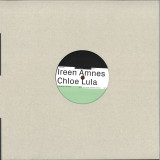
Tresor is proud to present the debut split 12" from Chloe Lula and Ireen Amnes. Meeting in the darker, harder-edged side of the Berlin techno scene in 2019, the pair have regularly collaborated and performed together, but Synergy marks the first time they've shared a record sleeve. Amnes describes Synergy as "the world we built while thinking about our journey as friends and the connection we share as people and artists," and while the record highlights their relationship and shared influences, it also showcases how each has grown into their respective lane.
Amnes' tracks lean into significantly more distorted territory, characterized by a dense fog of grainy pads punctured by sharp, expertly-programmed percussion. On "Our Bodies," these fragments are sculpted into driving hardware gear, replete with distant vocals and acidic squelches, where "Fragments of Desire" makes space for a more somber attitude, descending into murky, psychedelic electro.
In counterpoint to Amnes' deep atmospherics, Lula's contributions are driven by intricate sound design and a focus on dancefloor
impact. Taking cues from Regis and the Birmingham techno sound, she reins in the distortion of 2021's Errant Bodies for aufnahme + wiedergabe in favor of rolling techno and breakbeat-inspired rhythms that nod to her EBM influences. Making use of the extra space, she builds tension through heaving, textured basslines and crescendos of noise, and on EP closer "Event Horizon," she carves through the beat with her own metallic vocals.
Synergy includes a digital bonus track from each artist. Lula's sees her pushing deeper into finely-tooled techno territory, her drums at a swift, driving gallop, surrounded by ominous swaths of reverb. In contrast, Amnes crafts a gritty warehouse trip, sharpening the angles of her drums and detuning her synths until they sound bent and alien. Complete with the EP's physical cuts, these tracks are a testament to how the pair can simultaneously complement and contrast with each other, departing from their shared sonic origins and ending up in wildly dierent destinations.
"I cant believe its true" is a great uplifting Modern Soul tune produced, written and published by Gospel music veteran and Coconut record label owner Pastor Dr. Arris D. Wheaton from Dallas, Texas. He's now 77 years old, still kicking and licensing his stuff to respectful little labels like Stream Records. Counting on the vocals of Bobby Patterson’s of Pama and Jetstar labels fame, “I can’t believe it’s true” is a dancefloor destroyer of the highest order with perfect hooks and a production that still leaves you wondering why in the world these guys didn’t become acclaimed music stars as they sure deserved. Creators’ formation included Bobby Patterson (vocals), Andrew Jones (Guitar and background vocals), Timothy McNealy (Tambourine, Trombone, Organ and vocals), Ronnie Brewster (Drums), Robert (bobby) Simpson (Sax, Vocals and Band Leader), Billy ‘Sweet ‘Pea Thomas (Trumpet) and Michael Fugett (Bass and background vocals)
12” LP cut at 45 (for the first time) (color vinyl only) Pressed on a 12" for the first time and cut at 45 RPM so it's EXTRA loud. Jacket is an extra hefty 24pt board with printed inner sleeve full of rare never before seen photos When Acid King pressed up their self-titled debut EP on a tape and started handing them out at shows with business cards, it wasn’t an aesthetic choice. It was 1993. And while the world was still reeling in the aftermath of grunge breaking big on rock radio, this dirty-as-hell trio founded by guitarist/vocalist Lori S. were digging into even heavier vibes. Born out of Lori's shiftless days of wasted youth hanging around Chicago-area public parks, Acid King laughingly adopted the name from the book 'Say You Love Satan' and its subject Ricky Kasso, a local drug dealer who killed a friend over angel dust, thereby becoming the stuff of Satanic Panic local news broadcasts all over the country. Founded after a move to San Francisco, Acid King were outliers on punker bills in the tradition of West Coast rifflords like Saint Vitus and Sleep, and this four-song outing captures them at their rawest. Long before the career-defining roll of Busse Woods (1999) and the psychedelic mastery of their latest offering, Beyond Vision, this EP set in motion one of American heavy rock’s most landmark careers. Presented on reissued vinyl through RidingEasy Records – the original 10” was on Sympathy for the Record Industry – Acid King’s Acid King also established one of the most crucial partnerships in underground rock in that between Lori S. and producer/engineer Billy Anderson (see also: Neurosis, Sleep, Om, Amenra, Eight Bells, Cattle Decapitation and too many others to list). As Acid King went on to help define stoner rock in the mid and late ’90s with Zoroaster (1995), their Man’s Ruin Records split with Altamont (‘97) and Busse Woods, that creative relationship would flourish no less than the band’s sound, and here it is distilled to its meanest and most elemental self. Led as ever by Lori, Acid King at the time featured bassist/vocalist Peter Lucas and drummer Joey Osbourne – legend has it both had to read 'Say You Love Satan' before joining – and Melvins drummer Dale Crover had a hand in producing it as well as singing lead on “The Midway” after Lucas took a turn on “Drop.” A preface to the many majesties to come throughout Acid King’s many-storied career, behold the formative incarnation that started it all. A piece of heavy rock history AND killer riffs? You can’t possibly go wrong. - JJ Koczan, May 2023
- La Ballade Du Zwin
- Ein Kleiner Mann
- Ud
- Piume Al Vento
- Nelle
- Granvelle
- Sabina And First Variation
- Un Instant Sous La Hache
- Geuzenlied
- Sabina And Second
- Variation
- The Ff Boom
Part fantastical historic sonic biopic, part anthropologic
journey into the deep roots of Belgium’s monstrous
cosmic rock sound, this wholly individualistic concept
album combines the lead members of the mighty COS
(Daniel Schell and Pascale Son) with studio genius
Alain Pierre (Ô Sidarta / Des morts) and celebrated
Dutch progressive rock singer Dick Annegarn, for what
many consider to be both the overlooked hiding place
of Belgium’s deepest psychedelic moment and
European prog’s lost map to the ‘Franco-Flemish
Boom’.
Emerging from the wider musical family that counted
Marc Moulin, Placebo and Marc Hollander amongst its
creative kin, Daniel Schell’s most profound conceptual
project ambitiously combines the tale of the heroic
historical figure of Count Egmont (1522–1568), while
simultaneously tracing the evolution of the ud, or oud,
(‘the grandfather of the guitar’) in this multifarious
hallucinogenic epic.
Featuring key members of other collectable groups
such as drummer Felix Simtaine from Solis Lacus and
bass player Jean-Louis Baudoin from the mythical
Classroom (COS predecessor), this best-kept secret
vinyl release also harbours the voices of Dirk Bogaert
(of Belgian hard rockers Waterloo), as well as Catalan
singer Ilona Chale (Marc Hollander / Aksak Maboul)
before her later tenure as the COS front woman.
Initially released in 1978 via Zeuhl school distributors
Free Bird alongside French pressings of Don Cherry,
Jacques Thollot and CAN, it is plain to understand the
niche nature of this maligned ‘lost COS’ LP as it finally
blooms from between the cracked branches of
European jazz-rock-synth-psych-prog-pop history…
and beyond
Repress coming!
High Focus Records is proud to present 'Put That Soul On Me' a brand new 3 track offering from arguably one of the best voices to emerge from these shores in recent years : Rag N Bone Man.
Since having been introduced to the world via High Focus Records in early 2013, Rag N Bone Man's career has flourished in an incredible way and it has become a widely known fact that, as cliche as it may sound, he is the next big thing. From gathering attention from the likes of tastemakers Zane Lowe, Rob Da Bank, Mistajam & getting daytime radio play on BBC Radio 1 among others to working with Hip Hop legend DJ Premier and touring all over the country with chart toppers Bastille, it is a proven fact that Rag N Bone Man's voice has the power to touch the hearts of millions no matter what genre of music you are into. With such a universally recognised talent, its going to be hard for nay sayers to deny the infectious flute grooves of 'Put That Soul On Me' or the slow pounding bass of 'Across The Sky'.
Dirty Dike, normally known for his outlandish lyrics and larger than life provocative character takes the back seat on this release, allowing his signature crunchy production to do the talking. Dirty Dike's instrumentals provide the perfect back drop for the smooth rumblings of Rag N Bone Man, the pair complement each other perfectly as the beat and the voice are just as heavy as one another, both putting on a fantastic display of skill and raw talent which has been synonymous with all High Focus Releases.
The title track, 'Put That Soul On Me' is a catchy celebration song, a festive underground tune praising 'that neat sweet soul' whilst denigrating those 'wack ass drums and played out synths' over swirling flutes. Following the festivities we have 'Across The Sky', a bass heavy downtempo number which explores the side effects of different drugs, upon which our protagonist asks for a helping hand before the heart wrenching saxophone kicks in. High Focus Records fans will be pleased to see that the infamous Rag N Bone Man 'exclusive Bars' from the HFTV channel is finally seeing an official release. 'My Business', which set the internet on fire upon its release on the channel, getting retweeted by the likes of super producers DJ Premier and 9th Wonder, is the third track on this project and features a guest verse from Contact Play legend Ronnie Bosh. With these three unmissable tracks on one piece of wax, The 'Put That Soul On Me' 12'' is going to be the soundtrack to your summer.
International super group Bokanté, led by Grammy-winning Snarky Puppy founder Michael League, are set to release a brand-new studio album, History, via Real World Records consisting of nine tracks celebrating black history, global unity and the futility of war. The first single “Adjoni” is out today and you can watch the song’s official video below.
Consisting of members from five countries and four continents, different genders, races and generations working in harmony and celebrating individuality, Bokanté are united in the belief that music should be a voice for the voiceless. Recalling rhythms from West Africa as well as those of Guadeloupe’s drum-centric Gwo ka, lead single “Adjoni” is a story of a life on the spectrum and of brilliance in the margins; the lyrics of “Iliminé” speak to the protective properties of love, offer a mantra to keep us joyful regardless.
History finds them exploring further, dressing folkloric instruments including the Arabic oud, West African ngoni and North African guembri, the bass lute favored by Morocco’s Gnawa maalems, in western clothes. Interweaving layers of percussion with all the nuanced skill expected of four percussion maestros: André Ferrari of Swedish folk renegades Väsen. Ex-Berklee music professor Jamey Haddad (Sting, Paul Simon). Nagasaki-raised, New York-based Keita Ogawa (Cecile McLorin Salvant). Ghanaian-New Orleanian drum king Weedie Braimah (Christian Scott), a special guest on What Heat, a vital band member now.
WE ARE definitely not afraid to switch things up here at Neighbour Recordings. In fact it's part of our blueprint, our mission statement, our philosophy. And here's the proof; the Court Vision EP, our latest release from label co-owner Birke TM.
For this 'fresh as' four-tracker, Birke TM has penned a sonic love letter to the classic drum & bass that is dear to him and the originators who he has the deepest respect for. This is no pastiche though, rather a considered and meticulously-crafted take on and homage to D&B that is stamped with Birke TM's own deft touches, musical DNA and versatility.
From the hypnotic and up-tempo opening cut I Dream Of Jeannie through to the emotions-tugging Eden, the distinctly-soulful tones of Sanctuary and winding down with the meditative Never Lose Touch, there is a deep sensibility running through the entire EP that is the perfect counterbalance to the pacy yet sublime breakbeat.
The continuing growth of Maik Krahl as a melodic improviser, bandleader, and composer is distinctly evident in this new release. In-Between Flow, Krahl’s third outing as leader, is a portrait of a young artist who has gone through many years of dedicated hard work, study, experimentation, and refinement in order to achieve this level of instrumental and artistic progress. Krahl belongs to a new generation of improvisers who have acquired a breadth of technical and theoretical facility, while not losing the spontaneity and rawness of this music we call jazz. As a bandleader, he chooses his colleagues wisely and for this date is joined on a few tracks by the visionary guitarist Kurt Rosenwinkel, whose brilliant playing adds a cherry on top of this already delicious line up.
The title In-Between Flow refers to ever evolving progression of our human condition. As in nature, the human spirit can expand and unfold, maturing to a new state where it may settle for a while until some new impulses inspires another transition. These transitions, sometimes subtle, sometimes abrupt; as well as the times of contentedness and serenity are the inspirations for this music.
The record opens up with an ode to the town Krahl calls home. Cologne 4 AM, begins with a haunting melody by Krahl’s soft yet powerful horn before settling into a perfect vehicle to display his command of melodic and motivic story telling. There is something about the time of 4 AM that seems to permeate literature and music, and this track will add to the canon of artistic references to this magical time where the night meets the morning.
Mr. Rosenwinkel joins the band for Slosetta, which is a great example of Krahl’s ability to craft a tune. As is to be expected, Rosenwinkel weaves through the changes with grace and mastery, obviously enjoying the communication with the rhythm section, who are undeniably inspired by his harmonic, rhythmic and melodic ingenuity.
Jakob Kühnemann, a Bandleader and composer is his own right, has been an in demand bassist on the German and European scene for several years, and his contribution to this record is proof of why that is. Although Krahl takes the lead on Drizzle Counter, in a great display of technical virtuosity, it is Kühneman who stands out on this track. It is not only in his improvisation, but more so in his poly rhythmic pulses dancing up from the deep and the harmonic insinuations in his accompaniment of Krahl’s solo that demonstrate his musical mastery.
Rosenwinkel joins again for No Claim Claim, a composition so balanced that I would not be surprised to hear other artists recording or performing it in the future. After Krahl’s melodically inventive statement, Rosenwinkel shifts the band to the next gear building the intensity towards the out head.
Constantin Krahmer has been Krahl´s piano player since his debut record, Decidophobia. His patience, ingenuity, and big ears make him a perfect accomplice to Krahl, and his sensitive yet powerful approach and accompaniment on Reconstruction of a Dream as well as his harmonic and melodic inventiveness on Vinaceous Clouds (where he plays Fender Rhodes) make it clear why he is an integral part of this unit.
Ms Ludgate is a funky composition with angular melody that is another feather in the cap of the band leader. Kurt Rosenwinkel is back, and seems more than willing to engage in some rhythmic dialogue with the spectacular young drummer on the date, Fabian Rösch. Throughout this entire record Rösch is subtly but strongly guiding the band, playing his role as a supportive and interactive proponent to the music. We will surely be hearing much more from this young man with such a refined sound and clear rhythmic conception.
Flawless Sunday, a perfect closing statement for this record. The melody is another great example of Krahl’s growth as a composer. The whole rhythm section really shines on Krahmer’s choruses, where the three colleagues push and dare each other rhythmically as well as harmonically before Krahl enters and brings the record to a close with his beautiful rich tone and melodic playing.
It is a great pleasure to hear the growth of a young artist with such dedication and vision. Hearing how Krahl and his band mates navigate through the vicissitudes of this music is an inspiration that can be mirrored in everyday life. A lesson in accepting the ever changing flow from one state to another. Growing, learning, and evolving into a new state, until the process begins anew. In-Between Flow.
- A1: Uprocking Beats
- A2: Other Emcee's
- A3: B-Boys & Flygirls
- B1: Freestyler
- B2: Rocking, Just To Make Ya Move
- B3: Sky's The Limit (Feat Kartsy)
- C1: Stir Up The Bass
- C2: Fashion Styley (Feat Mr B From Bu Bu Man)
- C3: 1,2,3,4 (Feat Jak From The Cool Sheiks)
- C4: Rock, Rocking Tha Spot
- D1: In Stereo
- D2: Uprocking Beats (Js 16 Sound Design)
- D3: B-Boys & Flygirls (Dj Gismo Goes Funky Remix)
- D4: Spoken Word
In Stereo is the debut studio album by hip hop group Bomfunk MC's, released in 1999. The album reached No. 1 on that year's Finnish albums chart and remained in that chart for 69 consecutive weeks.
In the group's home country, Finland, the album received an Emma Award for Best New Band, Best Debut Album, Best Song ("Freestyler"), and Best Producer (JS16). In Stereo was certified double Platinum in 1999, with over 130 thousand copies sold; it is currently the 25th best-selling album of all time in Finland.
The album contains the hit singles "Uprocking Beats", "B-Boys & Flygirls" and "Freestyler", of which the latter became a chart-topping hit worldwide during the first half of 2000, reaching No. 1 in eleven countries.
In Stereo is available as a limited edition of 1000 individually numbered copies on translucent red & blue marbled vinyl, housed in a gatefold sleeve.
Long out-of-print release available digitally for the first time. Extensive notes by a local writer in English and French. Previously unpublished family photos. Urbanized traditional music at a dance-floor-friendly tempo. The very definition of an "Awesome Tape From Africa". Roger Bekono made a deep mark in the contemporary history of Cameroonian music through the four-on-the-floor, ribald intensity of bikutsi. The Ewondo-language dance-pop style that forms an undulating tapestry of interlocking triplet rhythmic interplay came to international prominence in the European "world music" scene as the 90s began. But the relentless sound of bikutsi developed in Yaoundé at the hands of Bekono and many others, as it developed from a village-based singing style performed mostly by women into a cosmopolitan music force that rivaled the popularity of established musics like Congolese rhumba, merengue and makossa. With his unique—some say suave—voice, Bekono contributed much over a period of more than 10 years as part of the evolution of this traditional rhythm-turned-urban dance movement. Bekono worked with legendary producer Mystic Jim, who had built a prolific home studio along with a crack team of musicians. They joined as part of the production of his self-titled album, which became known locally as "Jolie Poupée," the name of the album's lead single and most popular song. For "Jolie Poupée" Mystic Jim programmed the kick or bass drum, adding effects to have a heavier bass. Overall the album represented a new level of finesse and professionalism for his second release. In the middle of 1989, Jolie Poupée was released by the label Inter Diffusion System and aggressively hit the radio, discos and national television. The music video for the title track was on loop on TV. It felt like everyone was talking about it, even artists in adjacent music scenes like makossa. The album came out on vinyl and cassette and remains Bekono's best-selling recording to this day. With Jolie Poupée Bekono finally made an impact outside Cameroon as the record captured listeners in some Central African countries like Equatorial Guinea, Gabon, Republic of Congo and Sao Tome & Principe. In these countries, we find the Fang or Mfan people (also known as Ekang), Bantu-speaking ethnic groups that are also found in Cameroon. This umbrella language group includes the language in which bikutsi is mainly sung. Most of Bekono's songs are in French, Ewondo (of which Beti is a dialect) and Pidgin. The four songs on Jolie Poupée are all considered bikutsi classics. On September 15, 2016, Bekono died of a long illness at the age of 62. In the wake of his passing the media published a wave of tributes, thanking him for what he did for Cameroonian music. He was an admired musician, songwriter and guitarist, and some of his old colleagues and some of the new generation of performers showered Bekono with vibrant tributes via social media, many of which noting something to the effect of: "The artist dies but his works remain."
Brazilian soul, psych, bossa and jazz, reimagined from Berlin, via the Dead Sea, on Moriah Plaza’s dreamy first album for Batov Records.
Moriah Plaza co-founders Tamir Chen and Moosh Lahav first encountered and fell in love with the beautiful and hypnotic sounds of Brazilian bossa nova and samba as children in Tel Aviv in the nineties, via the many local bands and tribute groups that had sprung up since the first wave of bossa had hit swept across the world. Likewise
they developed a fascination with elevator muzak, film soundtracks, and even the hotel pianist performing day-by-day in the lobby of the Sheraton Moriah where Tamir’s mother worked, overlooking the Dead Sea.
Relocating years later to the vastly different environment of Berlin, capital of a country that enjoyed its own Brazilian moment, Tamir and Moosh’s shared passion for Brazilian music would encourage them to create their own songs inspired by the warm pulse of Brazil, albeit a world apart, through a vastly different lens.
Whilst the initial inspiration for Moriah Plaza can be traced back to Tel Aviv and the Dead Sea, the band itself was conceived by Tamir and Moosh in Solarium Studio, Berlin, from the broken fragments of their former shoegaze band, Soda Fabric, who had the honour of backing outsider legend Daniel Johnston. They would go on to write and record their debut album in close collaboration with two Brazilians and fellow Berlin residents,, poet and singer Cecília Erisman, and singer, songwriter, synth operator and Tropical Disco Club founder Flavia Annechini.
The album opens with “Desendereçada”. Dirty drum machine beats thud away under flutes and extraneous noises and a spoken word commentary. The oddness and allure of the intro is a perfect introduction to the world of Moriah Plaza.
The pace picks up on “Mais Amor”. A beautiful Brazilian soul jazz number with a sublime vocal from Flavia Annechini that will surely appeal to the global dancefloor jazz scene. “Te Peço” daws us in deeper with sweetest jazz vocal over an irresistible bassline and bossa drums that transforms halfway through into a modern soul rhythm crowned by flute and horns. A flute solo from Moosh Lahav leads us into the final uplifting refrain.
The Pharoah Sanders meets Ravi Shankar in Rio grooves of “Estelar”
have that fresh feeling that will certainly appeal to fans of modern favourites Rebecca Vasment and Ruby Rushton. Next up, the mysterious “Lagoon de Merim” is practically two songs in one, the first half an atmospheric string-topped number somewhere between Arthur Verocai and Cinematic Orchestra, before snappy drums beats and playful organ chords introduce a slow brassy samba that fills the whole sonic room.
“Teu Porto” is a must for all DJs, mixing calypso, highlife and house, lilting guitars and smooth vocals by Cecilia Erismann.. The deep samba house grooves of “Samba Moosh” close us out. The rich blend of sweet vocals, soaring flute and gritty synths carry us off into the sunset.
Moriah Plaza’s self-titled debut album is a major addition to the global soul and jazz scene. providing the perfect summer soundtrack for music lovers around the world.
Als Sänger mit einem außergewöhnlichen Stimmumfang (von Bassbariton bis Countertenor), der sich auf der Bühne mit einer New-Wave-Band oder bei einer Purcell-Arie wohlfühlt, mit dem Aussehen eines körperlosen Außerirdischen, der die Massen faszinierte, als Europäer, der aber in New York lebte, war Klaus Nomi ein komplexer und talentierter Künstler. 1979 hatte David Bowie, der damals gerade in seiner Berliner Zeit war, wie üblich vor fast allen anderen das aufkommende Phänomen wahrgenommen. Platin- und Goldplatten, ekstatische Konzertsäle, eine faszinierte Modewelt: Klaus erlebte zwischen '79 und '82 einen meteoritenhaften Aufstieg. Anlässlich des 40. Todestages von Klaus Nomi veröffentlicht Sony Music / Legacy seine gesamte offizielle Diskografie neu: Seine beiden Studioalben "Klaus Nomi" und "Simple Man" als Digipack-CD // Sein Album "In Concert" von 1986 zum ersten Mal als Digipack-CD // Sein Album "Encore" von 1986 zum ersten Mal als Digipack-CD. // Seine Kompilation "Encore: Nomi's Best" zum ersten Mal als CD Digipack und wieder auf Vinyl // zudem eine wunderschöne, limitierte 4LP Deluxe Box inkl. exklusive «In Concert-LP»