PURPLE VINYL
A Wednesday song is a quilt. A short story collection, a half-memory, a patchwork of portraits of the American south, disparate moments that somehow make sense as a whole. Karly Hartzman, the songwriter/ vocalist/guitarist at the helm of the project, is a story collector as much as she is a storyteller: a scholar of people and one-liners. Rat Saw God, the Asheville quintet's new and best record, is ekphrastic but autobiographical and above all, deeply empathetic. Across the album's ten tracks Hartzman, guitarist MJ Lenderman, bassist Margo Shultz, drummer Alan Miller, and lap/pedal steel player Xandy Chelmis build a shrine to minutiae. Half-funny, half-tragic dispatches from North Carolina unfurling somewhere between the wailing skuzz of Nineties shoegaze and classic country twang, that distorted lap steel and Hartzman's voice slicing through the din. Rat Saw God is an album about riding a bike down a suburban stretch in Greensboro while listening to My Bloody Valentine for the first time on an iPod Nano, past a creek that runs through the neighborhood riddled with broken glass bottles and condoms, a front yard filled with broken and rusted car parts, a lonely and dilapidated house reclaimed by kudzu. Four Lokos and rodeo clowns and a kid who burns down a corn field. Roadside monuments, church marquees, poppers and vodka in a plastic water bottle, the shit you get away with at Jewish summer camp, strange sentimental family heirlooms at the thrift stores. The way the South hums alive all night in the summers and into fall, the sound of high school football games, the halo effect from the lights polluting the darkness. It's not really bright enough to see in front of you, but in that stretch of inky void - somehow - you see everything. The songs on Rat Saw God don't recount epics, just the everyday. They're true, they're real life, blurry and chaotic and strange - which is in-line with Hartzman's own ethos: "Everyone's story is worthy," she says, plainly. "Literally every life story is worth writing down, because people are so fascinating." But the thing about Rat Saw God - and about any Wednesday song, really - is you don't necessarily even need all the references to get it, the weirdly specific elation of a song that really hits. Yeah, it's all in the details - how fucked up you got or get, how you break a heart, how you fall in love, how you make yourself and others feel seen - but it's mostly the way those tiny moments add up into a song or album or a person.
Поиск:count bass d
Все
LNS and DJ Sotofett return to Tresor Records with The Reformer EP. This new record moves forward with a crystal clear, direct and controlled output, leaving their debut album "Sputters" as an end-mark of a sonic era. Here they evolve into a topography full of contrasts, where harsh digital artefacts, scanner sounds, and vocoder voices cast melodic colors across cold landscapes of club-ready electro.
"Reform" plunges deep into an electro sound splintered by binary bits and submerged pads that beckon a serene melody, which echoes and loops to entangle with mutant voices, noises and buzzes. "Plexistorm" leads with synthesized strings and arpeggiated acidic bleeps until a thick bass emerges, sounding almost like a long-lost Analord record. Heavily shapeshifting with eects processing, it proves primitive movements in dubbing are the perfect counterpart to this precise electro sound.
With "Electric Terraforming", the duo uncover charged energy sources required for life on another planet, as broad synth pads
and memorable vocoder harmonies draw this earworm to a close. Mighty washes of dub rule on "909 The Controller" as a skipping beat invites a slow, rippling melody and percolating reverberated synths.
The vinyl record has significantly dierent sonics to the digital release, and, exclusively, each side ends in a locked groove produced by DJ Sotofett.
Spawning from the Manchester music scene in 2008 and now sucking in members from all over the UK, the Riot Jazz Brass Band is a nine-piece genre-mashing, foot stomping party behemoth bringing the love buzz to ears and feet all over the world
New album RIOT JAZZ MAKES PEOPLE HAPPY is the culmination of a 15- year mission to spread joy and get people moving. With three trumpets, three trombones, sousaphone and drums bringing the noise and MC Chunky conducting the chaos, the result is a gleeful cacophony encompassing jazz,hip hop, drum 'n' bass, trap, grime and more.
The intoxicating sound and spirit of the Riot Jazz Brass Band, as well as its deep commitment to exploring all sorts of musical genre, has seen it tapped to collaborate with a variety of top artists and play at festivals across Europe.
One of the most established festival bands on the circuit with appearances at Glastonbury (West Holt Stage), Womad (Big Top), Jazz Sous Les Pommier (France) to Soundwave (Croatia) and everything in between. Recent UK tour last April/May all across the country.
Tape
A Wednesday song is a quilt. A short story collection, a half-memory, a patchwork of portraits of the American south, disparate moments that somehow make sense as a whole. Karly Hartzman, the songwriter/ vocalist/guitarist at the helm of the project, is a story collector as much as she is a storyteller: a scholar of people and one-liners. Rat Saw God, the Asheville quintet's new and best record, is ekphrastic but autobiographical and above all, deeply empathetic. Across the album's ten tracks Hartzman, guitarist MJ Lenderman, bassist Margo Shultz, drummer Alan Miller, and lap/pedal steel player Xandy Chelmis build a shrine to minutiae. Half-funny, half-tragic dispatches from North Carolina unfurling somewhere between the wailing skuzz of Nineties shoegaze and classic country twang, that distorted lap steel and Hartzman's voice slicing through the din. Rat Saw God is an album about riding a bike down a suburban stretch in Greensboro while listening to My Bloody Valentine for the first time on an iPod Nano, past a creek that runs through the neighborhood riddled with broken glass bottles and condoms, a front yard filled with broken and rusted car parts, a lonely and dilapidated house reclaimed by kudzu. Four Lokos and rodeo clowns and a kid who burns down a corn field. Roadside monuments, church marquees, poppers and vodka in a plastic water bottle, the shit you get away with at Jewish summer camp, strange sentimental family heirlooms at the thrift stores. The way the South hums alive all night in the summers and into fall, the sound of high school football games, the halo effect from the lights polluting the darkness. It's not really bright enough to see in front of you, but in that stretch of inky void - somehow - you see everything. The songs on Rat Saw God don't recount epics, just the everyday. They're true, they're real life, blurry and chaotic and strange - which is in-line with Hartzman's own ethos: "Everyone's story is worthy," she says, plainly. "Literally every life story is worth writing down, because people are so fascinating." But the thing about Rat Saw God - and about any Wednesday song, really - is you don't necessarily even need all the references to get it, the weirdly specific elation of a song that really hits. Yeah, it's all in the details - how fucked up you got or get, how you break a heart, how you fall in love, how you make yourself and others feel seen - but it's mostly the way those tiny moments add up into a song or album or a person.
Following in the footsteps of "Mind Palace" and "Lost Spirits", respectively issued in 2018 and 2021, Hidden Empire return to Stil vor Talent with their eagerly anticipated third studio full-length, "Momentum". Going the same route that came to define their sound throughout the years, Branko Novakovic and Niklas Schäfers cook a savvy mix of deep electroid flavours and prog techno magnitude which flourishes in the long-playing format. Orbiting the frontier between proper no-nonsense, floor-focussed effectiveness and a trademark exploratory take on electronics, Hidden Empire here delivers one of their most accomplished slices to date, which not only spans the largest span of their many-faceted influences, from tribal anchorage to hypermodern escapology, but breathes a truly epic wind into it.
Draped in luscious, silken envelopes and easternmost ambiences, "Dawn" gets the ball rolling on a mystique-imbued note, halfway meditation-friendly material and square-shouldered club busting wares. Moving into Afro-infused house grounds, "Modesty" finds Branko and Niklas heading for the deeper end of the spectrum, as they pull out a clinically precise blender of rattling percussions, opaque incantations, lush synth swashes and verbed-out machine talk, tailored for nightly boogie rituals in the forest. "Avalanche" opts for a more brooding, deadlier approach. Cutting its path away from prying eyes, this one finds Hidden Empire pulling the stealth weaponry to absolute hypnotic effect - perfect for serious in-between peak time business with its thick, thriller-like tension, mist-shrouded atmosphere and surgical focus. Featuring Felix Raphael on vocals, "Who We Are", is a pop-influenced chugger that perhaps best defines Hidden Empire's ambivalent style, both hi-NRG and innervated with a melancholy that infuses down to the bass and most functional elements. Geared up for big-room traction with its seesawing synths and clinical drumwork, Raphael's moving timbre does more than offer a sensible counterpoint to the track's overall sturdy backbone, it takes it to a whole other dimension completely.
"Repeat The Good" ft. Wolfson balances out a fast-ticking groove with those subtle melodic lines Hidden Empire champion to astounding vibrancy, offering a particularly satisfying glimpse into their vortical imaginarium, whereas "Last Call" has us journeying to straight out Moroder-esque territories, flush with the aptly configured palette of fuzzy space disco bass, fast-paced Italo churn and vocodized talk for good measure. All in breaks and chopped-up euphoria, "Vivid" runs the hoodoo down in muscular fashion and with impressive levels of energy throughout, all set at cranking up the heat one notch further, while "Rebel" provides us with the kind of rough-around-the-edges EBM horsepower and neon-clad synth engineering that'll get the basement in a state of alert. Encompassing all of the pair's idiosyncratic merger of styles - from pop-laced Italo to spaced-out techno wares, through jagged motorik and heavily mecched-out jacking house, "Alright" shows off Hidden Empire's wide arsenal of pyrotechnics under the most compelling of lights. A more openly jagged and quirky weapon that hatches into a full-fledged solar number around the half, "Momentum" roars up the club's highway at full throttle, proving a formidable asset when it comes to plunging dancers into a state of weird, left-of-centre euphoria.
A stroboscopic eclipse is predicted as "Dark Sun" enters the room, deploying its obscure wingspan over the ravers, not quite a bad omen as it lets more light in with every bar, its brittle piano lines and heart-wrenching vocals cutting a path into the crowd's pulsating hearts. Graceful as Hidden Empire's music can be, a moment of utter exhilarating beauty. "Savasana" wraps up the voyage with a pure slab of cyphered 4x4 seduction, as an ASMR-like voice guides us across the soul-questioning haze that blankets our pathway onto a luminous finale. A piece of elusive nature, clearly designed for the club and yet telling a tale of off-piste initiation through twelve fascinating movements, "Momentum" will undoubtedly etch on the listeners' mind as one of the German pair's most strikingly powerful emanations.
Download:
1. Hidden Empire - Dawn Interlude
2. Hidden Empire - Modesty
3. Hidden Empire - Avalanche
4. Hidden Empire & Felix Raphael - Who We Are
5. Hidden Empire & Wolfson - Repeat the Good
6. Hidden Empire - Last Call
7. Hidden Empire - Vivid
8. Hidden Empire - Rebel
9. Hidden Empire - Alright
10. Hidden Empire - Momentum
11. Hidden Empire - Dark Sun
12. Hidden Empire - Savasana
13. Hidden Empire & Felix Raphael - Who We Are (Instrumental)
Frankfurt's celebrated producer, Philip Lauer returns to Especial, this time teaming up with Berlin based vocalist Dena for a special collaboration, covering Julie Stapleton's soulful House classic with a modern interpretation across a number of versions (vinyl and digital).
After the success of the Hotel Lauer EP on Especial way back in 2016, Lauer has continued his ascendency with albums for Permanent Vacation and Running Back, as well as releasing a string of sure-fire, dancefloor friendly EPs for the likes of Cin Cin, Futureboogie and Skatebard's Digitalo Enterprises.
Born and raised in Bulgaria, before making the move the music mecca of Berlin, Denitza Todorova has a carved a path with her electronic, dance pop stylings across releases for the likes of K7 and Kitsune Music. First appearing on Make It Stay from Lauer's last album, it jumped out as the perfect partnership to bring the raw, soulful and uplifting sounds of the cult V4 Visions label up to date. Founded by Alex Palmer, the label was part of the UK's early 90s club sound, releasing street soul, deep house and more, in Where's Your Love Gone, Palmer and 18-year-old writer/vocalist Julie Stapleton hit on the perfect marriage of Lovers Rock and Street Soul yearning with the haunting sounds of US House. Presented as a new take on the classic, but with utmost respect, the EP starts with the Club Mix, a Larry Heard bassline joins a marimba melody, lifting Dena's vocals of youth's lost love and pain. This is followed by the Demo Mix, a warm, beautiful string laden original take that Lauer and the label felt had to be included.
DJ Slyngshot is welcomed to provide a deep, tech remix. A name to watch via his releases on his YAPPIN label and recent EP for Workshop, his remix is an analogue twist of hypnotic, raw dub techno percussion and counter breaks builds as string and piano join. The EP ends in the Synthapella, as bongos, cowbell and whistle are added to create a drifting Balearic version for late summer nights and dawn that highlight Dena's vocals in a 'sunrise' light.
A Wednesday song is a quilt. A short story collection, a half-memory, a patchwork of portraits of the American south, disparate moments that somehow make sense as a whole. Karly Hartzman, the songwriter/ vocalist/guitarist at the helm of the project, is a story collector as much as she is a storyteller: a scholar of people and one-liners. Rat Saw God, the Asheville quintet's new and best record, is ekphrastic but autobiographical and above all, deeply empathetic. Across the album's ten tracks Hartzman, guitarist MJ Lenderman, bassist Margo Shultz, drummer Alan Miller, and lap/pedal steel player Xandy Chelmis build a shrine to minutiae. Half-funny, half-tragic dispatches from North Carolina unfurling somewhere between the wailing skuzz of Nineties shoegaze and classic country twang, that distorted lap steel and Hartzman's voice slicing through the din. Rat Saw God is an album about riding a bike down a suburban stretch in Greensboro while listening to My Bloody Valentine for the first time on an iPod Nano, past a creek that runs through the neighborhood riddled with broken glass bottles and condoms, a front yard filled with broken and rusted car parts, a lonely and dilapidated house reclaimed by kudzu. Four Lokos and rodeo clowns and a kid who burns down a corn field. Roadside monuments, church marquees, poppers and vodka in a plastic water bottle, the shit you get away with at Jewish summer camp, strange sentimental family heirlooms at the thrift stores. The way the South hums alive all night in the summers and into fall, the sound of high school football games, the halo effect from the lights polluting the darkness. It's not really bright enough to see in front of you, but in that stretch of inky void - somehow - you see everything. The songs on Rat Saw God don't recount epics, just the everyday. They're true, they're real life, blurry and chaotic and strange - which is in-line with Hartzman's own ethos: "Everyone's story is worthy," she says, plainly. "Literally every life story is worth writing down, because people are so fascinating." But the thing about Rat Saw God - and about any Wednesday song, really - is you don't necessarily even need all the references to get it, the weirdly specific elation of a song that really hits. Yeah, it's all in the details - how fucked up you got or get, how you break a heart, how you fall in love, how you make yourself and others feel seen - but it's mostly the way those tiny moments add up into a song or album or a person.
UK Garage legends Groove Chronicles (Noodles & Dubchild) are back with the 'Soul 'N Mind' 12" featuring their highly sought after Brokenstep edits.
These have been on heavy rotation by the likes of Gilles Peterson, Charlie Dark, Bradley Zero, IG Culture and more. Limited hand-stamped and stickered copies, be quick!
Groove Chronicles have releases dating back to 1997 and are legendary in the world of UKG. Founded by Noodles, who is now working with longtime associate, Dubchild. Noodles has been working in the music game for three decades, from spinning at raves in Paris when he was 17, to serving it up behind the record shop counter, to running his own label, DPR. Responsible for bonafide classics like 'Stone Cold', 'Myron' & 'Poor Man's Break', his work serves as a blueprint for many sounds across the UK bass spectrum.
Leicester legend, Dubchild, stems from a musical background of reggae, hip hop, house, garage & jungle. He's released an array of dubstep & instrumental grime records through various labels since the early noughties, including Caspa's Storming Productions & Heavy Artillery, amongst others.
The duo also combine under the moniker Nu-Agenda with their own hybrid house style, and have had collective support over the years from stations such as 1Xtra, NTS, Kiss, Reprezent & Rinse, DJs such as Annie Mac, Zane Lowe, Mary Anne Hobbs & Ras Kwame, IG culture, Charlie Dark, Gilles Peterson, Bradley Zero, Marcia Carr, Afronaught and publications like iD, Fact, DJ Mag & Crack Magazine, to name a few.
Magna Pia, a.k.a seasoned producer, DJ, and composer Hüseyin Evirgen, announces his second full-length album, ‘QUT’, arriving on Inland’s Counterchange label in March on double vinyl.
After 2 steamrolling EPs of club tracks on the label - now entering its tenth year of action - Magna Pia presents his most complete and advanced body of work to date, weaving a dense narrative of drone, figurative synthesis, bass-heavy electronica, and abstract techno.
Over eight tracks each referencing his rich cultural and musical background, we are treated to a unique overview of a producer at the crest of his art. The word ‘Qut’ is an ancient positive affirmation, in one short word encompassing all that is scared, pure and good. The Old Turkic term meaning not only ‘good fortune’ and ‘joy’, but in shamanic circles, the ‘wonder of the heavens’, permeates the roots of Evirgen’s multi-heritage history.
That Evirgen expresses his interpretation of this central theme through the marriage of bewitching melodies with atonal, experimental and rumbling electronics is a conscious comment on the distortions and mutations of our Modern Era. We now exist in the digital age of the Technosphere for better or worse, and must seek beauty where-ever possible.
The opening ‘Prologue’ invites the listener into a futuristic yet organic sound world, where lush stereo processing goes hand in hand with rumbling bass and subtly detuned drone languages. From the echoes of traditional Uyghur folk music, translated via synthesizers into a glistening slow-diving opus (‘Qizil’), to churning dub-techno adorned with a symphony of evolving sine-waves (‘Venus M’), Evirgen then deploys ‘X’ - a haunting experimental piece composed predominantly with his voice and electronic processing.
The interweaving synth lines of ‘Gudanna’ pierce the fog with a radiant and transcendent club-techno bounce before the ode to the ancient Bronze Age goddess ‘Astarte’ unfolds its snare-driven broken-beat formations. The title track ‘Qut’ embodies by far the heaviest club track of the album, in a deadly, stripped-back moment of future-techno hypnotism. Dancing flames of purple-tongued synthesis are held (just) in line by a wonderfully tough throb of drums.
With his ‘Epilogue’, Magna Pia allows the spectral ideas and concepts laid out across the LP to connect and travel full circle, confirming our suspicions that this could be one of the most coherent and exciting works to emerge in the brave new field of introspective, and sensitive techno-electronic language.
The endlessly prolific and unpredictable Richard Youngs returns to Black Truffle with Modern Sorrow. As any Youngs fan knows, one of the great pleasures of following his career comes from not being able to predict what the next entry in his inexhaustible string of releases will bring: Unaccompanied voice? Country songs? Shakuhachi? Guitar pieces played with his feet? Shredding fuzz bass over the top of hyper-speed distorted drum machine beats? Continuing in the grand Youngs tradition of exploring new techniques, instrumentation and approaches while bringing to all of them his idiosyncratic touch, Modern Sorrow serves up two sides of twistedly elegiac, radically stark takes on contemporary pop production. The side-long title track is built from a piano sample, synthetic bass notes and organ swells, and an iterative blurt that seems to have wandered out of a 90s jungle track. Eventually joined by a shuffling drum machine, the track moves very slowly through a series of chords, each delayed long enough that its arrival comes as a major event. Over the top, Youngs’ heavily pitch-corrected voice is heard. The processing paints his signature wandering melodic improvisations with shades of contemporary R&B; at the same time, it cuts the natural swoops and glides of Youngs’ melodies into rapid microtonal trills, giving his voice a quavering, middle eastern feel. Unfolding languorously over more than 17 minutes, the piece’s final minutes make room for an extended drumless coda, returning to the stark palette of its opening moments. On the second side, the two parts of ‘Benevolence’ push this minimalism ever further, its first half consisting of nothing more than a remarkably slow drum machine hit, bass-heavy chords and pitch-corrected voice, here so heavily processed that it starts to resemble a shawn solo. In its second part, the harmonic foundation drops out from under the piece while two more voices join; at some moments the voices pause, leaving nothing more than isolated, metronomic drum hits. Though Youngs has explored the sound worlds associated with dance music and contemporary pop in previous work, here these elements are radically reduced, foregrounding a meditative bed of silence with a boldness equal to any more academically inclined contemporary composer. Embracing the accessible digital tools of contemporary music production just as at another moment he would pick up a kazoo, like much of Youngs’ work Modern Sorrow uses simple DIY tools to generous ends, producing formally radical music that remains both free from pretension and deeply moving.
- A1: Sam And Delilah
- A2: But Not For Me
- A3: My One And Only
- A4: Let's Call The Whole Thing Off
- A5: (I've Got) Beginner's Luck
- B1: Oh, Lady Be Good!
- B2: Nice Work If You Can Get It
- B3: Things Are
- B4: Just Another Rhumba
- B5: How Long Has This Been Going On?
- C1: S'wonderful
- C2: The Man I Love
- C3: That Certain Feeling
- C4: By Strauss
- C5: Someone To Watch Over Me
- C6: The Real American Folk Song
- D1: Who Cares?
- D2: Looking For A Boy
- D3: They All Laughed
- D4: My Cousin In Milwaukee
- D5: Somebody From Somewhere
- E1: A Foggy Day
- E2: Clap Yo' Hands
- E3: For You, For Me, For Evermore
- E4: Stiff Upper Lip
- E5: Boy Wanted
- E6: Strike Up The Band
- F1: Soon
- F2: I've Got A Crush On You
- F3: Bidin' My Time
- F4: Aren't You Kind Of Glad We Did?
- F5: Of Thee I Sing (Baby)
- G1: The Half Of It, Dearie" Blues
- G2: I Was Doing All Right
- G3: He Loves And She Loves
- G4: Love Is Sweeping The Country
- G5: Treat Me Rough
- H1: Love Is Here To Stay
- H2: Slap That Bass
- H3: Isn't It A Pity?
- H4: Shall We Dance
- H5: Love Walked In
- H6: You've Got What Gets Me
- I1: They Can't Take That Away From Me
- I2: Embraceable You
- I3: I Can't Be Bothered Now
- I4: Boy! What Love Has Done To Me!
- I5: Fascinatin' Rhythm
- J1: Funny Face
- J2: Lorelei
- J3: Oh, So Nice
- J4: Let's Kiss And Make Up
- J5: I Got Rhythm
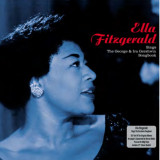
When Ella Fitzgerald began recording her series of albums devoted to the work of
America’s greatest song writers, she elevated the art of Jazz singing into a new
dimension while celebrating a unique musical heritage bequeathed to the world of
popular music. Norman Granz encouraged the bold decision to record five albums all
featuring the extraordinary output of songs composed by the brothers George and Ira
Gershwin during the Golden Age of popular song. Gershwin show tunes had long been
a staple diet for bandleaders, pop-vocalists and star-instrumentalists eager to perform
such exhilarating material as Strike Up The Band, Oh, Lady Be Good!, S’Wonderful and
I Got Rhythm. But there was also a gamut of ballads and romantic dance themes
needing to be interpreted with greater sensitivity. Ella was more than capable of
focusing on lyrics and caressing melodies of songs like Someone To Watch Over Me, A
Foggy Day and Embraceable You. They are among the 53 Gershwin classics she
recorded over an eight month period in 1959 and now featured in this superb collection.
Nearly five years on from their acclaimed debut, Bennett Wilson Poole reveal the follow up. It's been a long time coming, but...
That eponymous first album was only ever intended as a one-off collaborative project — a serendipitous series of events which began with a late evening session where the trio wrote ‘Hate Won't Win’. A response to the murder of MP Jo Cox, it was something of a fresh take on Crosby Stills Nash and Young’s classic protest song ‘Ohio’. The release saw Bennett Wilson Poole embraced by the Americana community, playing live on the Andrew Marr show and crowned as ‘UK Artist of the Year’ at the 2019 UK Americana Awards, in front of a watching crowd including Graham Nash himself.
The new album came together in similar fashion; Robin (Bennett) and Danny (Wilson) started writing new songs late into the night whilst on tour to promote the first record — a tour which unfolded from a three-night residency in a London pub into a year-long odyssey culminating in a headline show in Hall One at King’s Place — and before they knew it, there were enough songs to begin recording an unplanned second album.
Where the first record drank deep from 70s US west coast folk-rock, the second has been heavily spiked with 1960s British psychedelia, even featuring a cover by legendary counterculture artist John Hurford (whose credits include 60s artwork for Oz Magazine and International Times).*
Tony Poole’s meticulous and inspired production has spun Robin and Danny’s fresh batch of songs into a delicate web of musical delight. Fans of the ‘spot the reference’ game Tony started on the first record won’t be disappointed this time either, as there are plenty more to be found here.
As with the first album, the lyrics don’t shy away from current affairs – by the end of that year of touring, the band were already playing “I Wanna Love You (But I Can’t Right Now)”, reflecting on the state of US politics, yet optimistic that the problems are only temporary.
Many of the tracks on the new album feature live rhythm section Fin Kenny (drums) and Joe Bennett (bass) for the first time on a BWP record.
The title of the album comes from the lyrics of ‘Help Me See My Way’, the first single, a prayer for strength in difficult times, the trippy animated video for which was originally issued during lockdown. The dreamy positivity of the line "I saw a star behind your eyes" is tempered with the plea "don't let it die away", a message which feels as important as ever two years on.
All three collaborators have had critical acclaim in their own right. Danny Wilson’s credentials go back to his days in Grand Drive with brother Julian, and his consistent high calibre output with his Champions of the World led them to sweeping the board at the first UK Americana Awards with Album, Artist and Song of the year awards richly deserved; Tony Poole’s Starry Eyed and Laughing were hailed as “the English Byrds” on the back of their two CBS-released albums in the mid-seventies and he has since built an enviable reputation as producer and engineer; Robin Bennett has been relentlessly turning out timeless songs from his Oxfordshire base in bands from Goldrush to The Dreaming Spires
For over 30 years Richard Adams has been quietly documenting his own particular corner of the English countryside both with Hood, the post-rock band he formed with his brother in 1991, and since 2007 with The Declining Winter. Recorded over a five year period and inspired by rustic English alternatives such as Talk Talk and Robert Wyatt, The Declining Winter’s latest work ‘Really Early, Really Late’ is a collection of beautiful songs, immersed in a richer sonic spectrum incorporating strings, horns and lush electronic textures, alongside Adams’ own unique guitar tones and characteristic dubby bass. Though it retains the homespun scratchiness of previous The Declining Winter records, ‘Really Early, Really Late’ is also their most ornate. A remotely collaborative effort, the record is scattered with decorative embellishments from violinist Sarah Kemp (Brave Timbers), cellist Peter Hollo (Tangents), and guitarist Ben Holton (epic45), among many others. Adams’ distorted whisper of a voice has never been more exposed leading to a brutally emotive and intensely personal song-suite, both raw and beautiful in equal measure. The storybook curiosity of Mark Hollis’ work is a particular influence. Like Hollis, this music is imbued with magical realism: beholden to nature, it hints at the mysteries lurking in mundane local landscapes and the more remote Yorkshire moors and valleys. A record to hold close to your heart, ‘Really Early, Really Late’ sees Adams and his collaborators emerge from the shadows with their most complete work to date. Home Assembly are proud to present the album on lush crystal clear, double vinyl, bundled with a CD housed in an oversized vinyl-style sleeve.
Bizarro Records returns to its Australian roots for three functional tracks from Eora/Sydney local Eastern Distributor, alongside a remix from Montreal prodigy Maara. Drawing heavily from the psychedelic influences of our country’s bush doof scene, ‘State of Equilibrium’ alludes to trance and techno relics of the past whilst accelerating into a hybrid psy-tek sound.
‘Affinity’ delivers a functional, peak-time psychedelic motion, ebbing and flowing into dark resonant euphoria. ‘Balance’ sticks closer to the modern Australian scene; an upbeat, bubbling tech-house influenced track, presenting a futuristic psy take on a sound marking contemporary dance floors. The third track ‘Endorphin’ is a bouncing techno tool, infinitely ascending from powerful low-frequency buzz to progged-out elation. The EP comes to a close with a taste of Maara’s signature sound - characterizing her take on ‘Endorphin’ with an irresistible dancefloor oriented bassline, filled with the angelic pads that define her discography.
Orange Vinyl
Kero & Steph’s landmark collaboration Syndrome now sees a sumptuous release on vinyl and evocative music video, spinning data into densely layered visual treats.
Steph’s coolly ethereal voice and poignant writing drift in harmonies atop the sliced-up, glitched, hard-hitting precision of Kero’s productions. The unforgettable directness of her compositional sense is here, as her long resume of scores and placements would suggest. It finds an urban-technological counterpart in Kero’s frenetic sounds. The DU label boss is in full force straight from the chilling post-pop of the opening titular cut. “Walk in the park” is a production masterwork, punchy organic percussion against grinding bass. “Who am I to complain” is at once arresting and vulnerable with vocals, but still packs an emotional gut-punch in the accompanying instrumental. “Count down from 7” is more stripped down and urgent, melodic hooks propelled by lo-fi rhythmic mechanism’s menace.
For the remixes, Oberman Knocks unleashes utter digital destruction - computer memory banks dropped through a wormhole. That thoroughly deconstructs Mtch into composite textures -- and opens “Walk in the Park” to near-unrecognizable, yet somehow danceable mayhem.
The new physical and motion elements find a visual language for these sonic strata of imagination and digital construction. From designer Christoph Grünberger, known for his tome The Age of Data: Embracing Algorithms in Art & Design, we get the packed outer sleeve and 2D design. These enshroud a calm-looking Steph in a Shibuya Crossing-style trip inside Defasten’s geometries, opposite a catalog of branching visualizations and glyphs.
Defasten, known for his live AV work fusing virtual reality and performance, here explodes faceted 3D cubes, in the cover and further in the music video. These pulsing crystalline hyper-geometries delve into data as expressive medium, shifting and vibrating with the glowing tones and crisp percussive hits of Kero and Steph’s composition. It’s a rare music video that matches the music in intricacy and form - a world that can only exist in virtual space, but that feels as immersively dreamy as the sound score.
“Sugar coated fabric … in braided covers” and “silver linings” were never so tempting.
- A1: Nobody Knows You When You're Down & Out
- A2: Golden Ring
- A3: Black Magic Woman
- A4: Man Of The World
- A5: Kerry
- B1: After Midnight
- B2: Bell Bottom Blues
- B3: Key To The Highway
- B4: River Of Tears
- C1: Rock Me Baby
- C2: Believe In Life
- C3: Going Down Slow
- C4: Layla
- D1: Tears In Heaven
- D2: Long Distance Call
- D3: Bad Boy
- D4: Got My Mojo Working
Gold Vinyl[48,32 €]
Das Warten hat ein Ende: Der legendäre Eric Clapton meldet sich mit einer bemerkenswerten neuen Veröffentlichung, ”The Lady In The Balcony: Lockdown Sessions” am 12. November zurück.
Auf den 17 Songs spielen Clapton und seine langjährigen Bandkollegen Nathan East (Bass und Gesang), Steve Gadd (Schlagzeug) und Chris Stainton (Keyboards) akustische Interpretationen von Claptons Klassikern und eine Auswahl anderer Nummern, die Blues, Country und seltene Eigenkompositionen umfassen.
Das Projekt wurde ins Leben gerufen, nachdem Eric Clapton seine für Mai 2021 geplanten Konzerte in der Royal Albert Hall absagen musste. Auf der Suche nach einer Alternative zog er sich mit seiner Band in die englische Landschaft zurück und inszenierte ein Konzert, bei dem nur die Teilnehmer selbst anwesend waren, während die Kameras liefen. Das Ergebnis ist weit mehr als nur eine Aneinanderreihung
der größten Hits. Vielmehr handelt es sich um eine der intimsten und authentischsten Darbietungen von Claptons gesamter Karriere, ein Angebot, das einen echten Einblick in die Zusammensetzung seines atemberaubenden Katalogs gewährt.
„The Lady In The Balcony: Lockdown Sessions” ist als CD, DVD, Blu-Ray und LP verfügbar .
- A1: Nobody Knows You When You're Down & Out
- A2: Golden Ring
- A3: Black Magic Woman
- A4: Man Of The World
- A5: Kerry
- B1: After Midnight
- B2: Bell Bottom Blues
- B3: Key To The Highway
- B4: River Of Tears
- C1: Rock Me Baby
- C2: Believe In Life
- C3: Going Down Slow
- C4: Layla
- D1: Tears In Heaven
- D2: Long Distance Call
- D3: Bad Boy
- D4: Got My Mojo Working
Creamy White Vinyl[44,12 €]
Das Warten hat ein Ende: Der legendäre Eric Clapton meldet sich mit einer bemerkenswerten neuen Veröffentlichung, ”The Lady In The Balcony: Lockdown Sessions” am 12. November zurück.
Auf den 17 Songs spielen Clapton und seine langjährigen Bandkollegen Nathan East (Bass und Gesang), Steve Gadd (Schlagzeug) und Chris Stainton (Keyboards) akustische Interpretationen von Claptons Klassikern und eine Auswahl anderer Nummern, die Blues, Country und seltene Eigenkompositionen umfassen.
Das Projekt wurde ins Leben gerufen, nachdem Eric Clapton seine für Mai 2021 geplanten Konzerte in der Royal Albert Hall absagen musste. Auf der Suche nach einer Alternative zog er sich mit seiner Band in die englische Landschaft zurück und inszenierte ein Konzert, bei dem nur die Teilnehmer selbst anwesend waren, während die Kameras liefen. Das Ergebnis ist weit mehr als nur eine Aneinanderreihung
der größten Hits. Vielmehr handelt es sich um eine der intimsten und authentischsten Darbietungen von Claptons gesamter Karriere, ein Angebot, das einen echten Einblick in die Zusammensetzung seines atemberaubenden Katalogs gewährt.
„The Lady In The Balcony: Lockdown Sessions” ist als CD, DVD, Blu-Ray und LP verfügbar .
- A1: Teno Afrika & Diego Don - Ambassadors (Feat Stylo Musiq & Flame Darula)
- A2: Teno Afrika & Diego Don - Storytellers
- A3: Teno Afrika & Diego Don - 8 Ubers
- A4: Teno Afrika & Silvadropz - Conka (Feat Stylo Musiq & Flame Darula)
- B1: Teno Afrika & Silvadropz - Smooth Criminal (Main Mix)
- B2: Lerato La Bass
- B3: Trip To Vlakas (Main Mix)
- B4: Chants Of Africa
South Africa's reputation for expanding dance music again with Amapiano.
The past five years have seen amapiano, South Africa’s electronic music movement born in the townships of the country’s Gauteng province, evolve from an underground sound to a nationwide mainstream staple. Even with its commercial success though, amapiano’s DIY ethos has continued to disrupt music creation and distribution in the country. Most amapiano commercial successes today began their careers on cracked versions of production software like FL Studio, distributed their work through file sharing platforms like datafilehost and marketed it using social media pages they controlled and influenced. Amapiano Selections, the debut album by DJ and producer Teno Afrika, gives listeners outside the movement’s online release economy an insight into the high-burn nature of amapiano that has spawned a distinct typology under its larger umbrella. Twenty-one-year-old Lutendo Raduvha has spent the bulk of his life moving between different townships on the outskirts of Johannesburg and Pretoria in the Gauteng province. The palette of amapiano styles on the album reflect these influences.
But at first, South Africa’s youngest electronic music movement lived underground with a small, loyal following. “Amapiano is a genre that I chose because I have a passion for it,” says Teno “I started following amapiano in 2016 because I wanted to explore how it’s produced. It was not taken seriously in our country.” Interestingly, Teno Africa only gives vocals prominence on the closing track “Chants of Africa.” As a way of making their music recognizable and relatable for broadcast, amapiano producers have sometimes overly relied on vocals in the form of singing, catch-phrases and party refrains for the purpose. “It was my decision not to use vocals on this project,” says Teno “The reason is I wanted people to feel my instrumentals and style because this is my first album.” On his closing track the young producer gives a glimpse of the considered approach to music which buoys anticipation for greater things from his future releases.
Following on from 2020s acclaimed album Vodou Ale, Chouk Bwa turn up the heat for this exhilarating trip into their bush of ghosts by introducing a new stripped down line-up to fire up the dance floor, based exclusively on the drums and rhythms of the Haitian kongo rite and deep electronic dub expansions by their trusted Belgian counterparts The Ângströmers. As Afro-Caribbean polyrhythms meet bass-weight dub electronics, the two part EP has documented the group experimenting with a stripped back form which focuses on the dimension of trance. Opening with a cermonial chant and designed to enduce dancefloor delirium, the first track taken from the EP is the raw, high-octane, primordial techno of "Zemedo".
Creating an introverted version of restrained electronic music Berlin-based artist Constantijn Lange releases his second album 'Liquide' on Heimlich Musik. The album is based on sketches created in isolation during the second pandemic year. The compositions are characterized by self-reflection and an attempt to translate the abstract experience of listening to oneself into a concrete form. The sound of personal isolation, the necessary withdrawal from the world and the restriction of all social contacts is, therefore, less club oriented and focused on functionality than an expressive concept of ideas, rather oriented on Trip Hop, Breakbeat, Ambient and Jazz. The collective rediscovery of shared experience results in arrangements of melancholic but optimistic melodies recorded with vintage synthesizers, supported by complex drum patterns and diverse percussions that create a signature sound as a new liquid amalgam.
Constantijn Lange is an electronic music composer originally from Ostfriesland now based in Berlin. Besides several releases on Laut & Luise since the early days, his productions appear on labels like Get Physical, Traum Schallplatten, Sinnbus, Platon Records, Egoplanet
and many more.
His passion for thick layered synth melodies, jazzy and kraut – like vibes, atmosphere recordings, deep basslines and selfmade percussion designs give his music a recognizable vibe which can be heard on nearly every production he was involved in so far. He spends a lot of time in his studio in Berlin, working on new music, remixing other artists and also engineering for other sound projects in the art scene. On top of that, he performs as a liveact in clubs and on festivals all over the planet where his music can be described as very emotional and personal. Repeatedly this amazed people in countries like Germany, Russia, Poland, Switzerland, South Africa, Austria, Belgium, Mexico and
many more.
Constantijn’s ambition as an artist is to constantly evolve his productions and create music
which carries emotions and energies into the clubs, to festivals and living rooms alike.