In folklore, the witching hour or devil's hour is a time of night associated with supernatural events. Creatures such as witches, demons and ghosts are thought to appear and to be at their most powerful and magic is thought to be most effective at this time.
It is also the time when we are at Underground parties, this is considered the main time of the party before it tapers off into the ethereal realm of translucent soundscapes and marionette dance moves. This is when we feast on sound intoxication and our parallel daywalker skins are shed into ancient dances and rites of sacred drums.
The witching Hour takes our souls back to our ancient pagan rituals of music and dance till the cleansing of dawn, this is where revelations happen and where groups of like minded people form a coven of sorts and bond in non verbal communications thru the expression of movement.
This is a new label project from Jay Tripwire and TJ Mc Au, they will be presenting underground minimal sounds specifically designed for the dancefloor and for the DJ.
This EP features Creepshow and Klangtone. Creepshow is a dark bassy roller with an eerie underground atmosphere that holds the groove but it also designed for mixing and layering. Klangtone features a percussive groove, voices from the Tikuna rainforest tribe and a haunting modular flute line with a massive sub bass that is sure to rattle bassbins. This is classic Tripwire with modern production but still keeping the his roots of his trademark sound.
Buscar:creature
Known for a broad swath of genre-obliterating club tracks on crucial labels including Critical, Exit, and 50Weapons, Sam Binga approached us earlier this year with a radically different kind of project, a collaboration with Welfare, true junglist and label boss at D&B bastion Rua Sound. The result of their team-up is Conamara Fieldworks. Its unique inspiration and patient process are best described by the duo themselves:
"In early November 2016, we set off through the bleakness of an Irish November into the wilderness that is Conamara, County Galway, Ireland, with about half an idea of what we wanted to do. Our friend Laney had been kind enough to allow us the use of a 300 year old cottage overlooking the sea, itself belonging to her family through generations which she was bit by bit restoring to its former glory. The isolation was perfect - very little in the way of creature comforts, no network coverage, but plenty of turf for the stove and Guinness for the belly.
Our routine for the next few days consisted of trudging the length of the rugged coastline in search of interesting sounds we could potentially process into usable elements for some kind of dub/dub techno-inspired composition...This took us inside tidal caves and abandoned ruins, across sheep fields, up and down mountains and winding country lanes, in and out of the odd pub, under upturned boats and (carefully) across huge washes of seaweed-covered shoreline. Using our handheld recorder (shouts Danny Scrilla for the lend) we assembled a palette of varied noises, constantly battling with the peaking and distortion created by the incessant Atlantic gusts.
Each evening, following some intense huddling around the stove and vital Irish home cuisine and stout, we'd examine and dissect what we had collected that day, sometimes discovering the most interesting material firmly planted in the background of the soundscapes. A certain amount of (but not too much) processing later we had the bones of a few short loops of each sound which made some kind of musical sense when played alongside each other.
Binga suggested staying true to the craft and keeping the rawness to the foreground by attempting to develop the loops into full compositions via live desk mixing, arrangement and effects. We said our goodbyes to Conamara and a month or two later said our hellos to the Dubkasm shedio. Following a crash course from the dynamic duo, we set to work for the day, learning as we went along and enjoying to the full the unpredictability, intuition and sheer vibes a dubbing session can bring, particularly in a studio kitted out with some fine analogue gear which undoubtedly helped us to keep that damp, saturated feeling that Conamara had sown."
The resulting collection of music speaks for itself, and does so in its own language. It is meditative, deeply textural, and richly saturated, with awesome sound design, generous bass weight, and dubwise finesse. Referencing ambient, concrete, and dub techno while never letting any genre dictate its path, Conamara Fieldworks is a deeply rewarding and intensely involving listen. A restrained yet transporting remix from the one Ossia completes the set.
Cómeme delivers to you one of the freshest rhythms of 2018, recorded in Johannesburg, the new residency for the renegades of the beat. This is 'Rain' - starring Matias Aguayo and the actress, dj and singer Ayanda Seoka aka Mujaji The Rain. She's resident at the legendary Bar Kitchener's all femme 'Pussy Party', a space for feminist / queer action and dancefloor joy, right in the centre of Joburg.
Cómeme has been since some time in a serious and passionate relationship with that city. Radio Cómeme transmitted shows from there with electronica legend Felix Laband, Mpumelelo Mkatha from BLK JKS, the queer performance duo Faka, Gqom pioneers RudeBoyz and also Kwaito's legacy keeper Spleef McZaul. Matias Aguayo ventured into a beautiful collaboration with DJ Spoko, released two years ago on this label.
'Rain' is a deeply rhythmical track, inspired by the grooves that converged when Cómeme swing crossed the paths with the syncopations people in Joburg were dancing to. It has become quite clear in the recent years that elegantly shuffled triplets are marking a way to the future in dance music, especially in the southern hemisphere, no matter if you're in Durban, Rio or Santiago.
On top of this modern groove we can hear Mujaji the Rain enjoying how she gets wet under a dark and tropical sky. Laughter, joy and ecstasy is what she emanates while hypnotically involving you into this atmosphere of dense drumming and trance. (side note: Cómeme has been consequently evading the description hypnotical in press releases but this time it was unavoidable).
For further jacking fun we generously included a 'Club Mix', including more drum frenzy towards the second half of the track, and a 'Just Drums Mix' for the skilful DJ.
Side B features the jam 'Serious', which comes along with another killer beat, reminiscent of Michael Jackson or Cheri. A late-night track in which Mujaji The Rain turns into a sensual but slightly annoying creature that doesn't want to leave the dancefloor. and for sure doesn't want to go home.
We added an instrumental version to this complexly arranged tracks, which feature pianos, strings, and heavy synth bass stabs.
All tracks on this 12' are written in a 6/8 signature, which some normative DJs might shy away from, but be safe: both tracks are in 120 bpm and carry the seal of official Cómeme dancefloor approval by the label's highly respected DJs.
When I found myself on the main dance floor of ://about blank during Berlin's most beloved party, Buttons, I was immersed by the sounds of Shingo Suwa. He has honed his skills as a resident DJ and producer for many years. In this record, you will hear how his experiences have heavily influenced his productions. We are excited to release Shingo's debut album and the first album released by Acid Camp Records. The album includes a bonus remix from Mixmaster Eric Cloutier.
Composer, Synthesist And Producer Matt Robertson Is Set To Release His New Album 'entology' Via Tape Club Records On 16th November 2018. It Follows His Warmly Received 2016 Album 'in Echelon', Described By Mojo As "nils Frahm's Modern Classical Meets Jon Hopkins' Grainy Techno", "an Album Of Symphonic Electronica And Leftfield Techno Thats Cinematic In Scale" In Mixmag And "magnificent Wild Sound" By The Line Of Best Fit.
As Musical Director For Björk, Cinematic Orchestra And Anohni As Well As Working With Lamb, Emiliana Torrini And Bat For Lashes, Matt Has A Wealth Of Experience Collaborating With Some Of The Most Exciting Artists In The World. Working With A Collection Of Vintage, Modern And Diy Synths, And Combining Electronic Music Production With Classical Composition And Cinematic Soundscapes - Artists, Producers And Film Composers Alike Seek His Enveloping And Distinct Sound.
"i Love The Idea That Not So Very Long Ago, The Idea That A Species Could Become Extinct At All Was Laughed At. In The 17th Century, Fossils Were Believed To Be From Mythical Creatures Like Dragons. In 1796, George Cuvier Presented The Idea That A Species Could Have Existed And Now No Longer Existed, And He Was Laughed At By Scientists. Darwin Then Suggested That Evolution Did Not Need Catastrophic Events To Explain Extinction - More That It Was Due To Perpetual Competition In An Overcrowded World.
I'm Adopting The Word "entology" To Be An Awareness Of Our Current Period Of Geological Time Being An Extinction Period, Where An Extinction Period Is Defined As A Time When A Significant Proportion Of Species Die In A Geologically Insignificant Amount Of Time. I Was Trying To Imagine The Obvious Desolate Spaces Of A Post Apocalyptic World, But Also The Slightly More Opaque Vision Of The Fact That So Many Things Are Becoming Extinct Around Us Without Us Noticing, Or Even Being Aware Of Their Existence In The First Place.
The Idea Is Of Desolation But, Because Of The Awareness, Also Of Hope."
- Matt Robertson
Adam X returns to his imprint Sonic Groove with his first album in four years, a 56 minute excursion into EBM and Cyberdelic Industrial Techno titled RECON MISSION. The mission begins with beat driven hypnotic electronics that invoke paranormal illusions of Easter island mythology and Bermuda Triangle disappearances. Climbing forward the album crosses the line into harder industrial territories, conjuring visions of New York City's dystopian past and CIA shadow government experiments.
Adam's own voice adorns tracks such as "Never Ending Quest", "Modular Bodies" and the title track "Recon Mission", while manipulated dialogue samples take the stage on "Tales Of Mystery', 'Search & Retrieval' & 'Delusions Of Paranoia'. Subtle, whispered statements creep in and infect the listener's ear, guiding them deeper into mental oppression. This album is not for the faint of heart, and its meticulously detailed production stands as a testament to Adam X's enduring career in techno. Adam has survived the ups and downs of the industry while continually raising the bar for production value and sound design. RECON MISSION is a triumph, ahead of the curve of modern industrial techno. This is not a throwback, this is Future EBM.
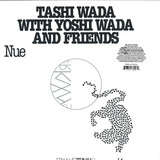
Composer Tashi Wada has performed for years with his father Yoshi Wada—artist, composer, and early member of the Fluxus movement. However, they have rarely appeared together in studio settings. Nue, the fourteenth entry in RVNG Intl.'s intergenerational FRKWYS series, finally brings Tashi and Yoshi, along with an eclectic group of close friends and extended family, together on tape.
Nue draws on aspects of Tashi's background for his widest vision to date—among them the minimalist bagpipe music of Yoshi, who co-composed three of the tracks, the psychoacoustic and perceptual explorations of his mentor, composer James Tenney, and reimagined forms of ancient and devotional music. The album, however, is not a tribute to the past or a recapitulation of familiar sounds. Instead, Nue is an intertwining of people and ideas as a means of growing, of looking inward to move outward, and of looking back to move forward.
To achieve this growth, Tashi assembled a core group of fellow travelers, including Yoshi, composer Julia Holter, producer Cole MGN, and percussionist Corey Fogel, to give life to this multifaceted suite. As an experience, Nue subtly navigates the interactions, intimacy and spaciousness of this group.
The album's title itself is a nod to Tashi's abiding interest in duality and the unknown: nue is a mythological Japanese chimera with the face of a monkey, the legs of a tiger, and a snake for a tail, a composite form, at once disturbing and otherworldly. But, as the composer points out, nue is also French for naked—stripped of complexity, bare and exposed, but also raw and essential.
From the doubling of tones—and the world of harmonic nuances such an action produces—to the rich interplay between individual musicians, all baring their own personalities and experiences through shared performance, Tashi's compositions allow space for these elements to join and grow. The multipartite creature that is an ensemble melds in the simplicity and purity of the music itself.
As explained by Tashi, each part was written with an individual in mind, not simply an instrument. And each individual performer makes their mark, from Holter's vocal performances on the cresting, oceanic 'Mutable Signs' and 'Ondine' with guest vocalists Simone Forti, Jessika Kenney and Laura Steenberge, to Fogel's resonant, precise percussion on 'Bottom of the Sky.' Producer Cole MGN, who has worked extensively with artists like Beck and Ariel Pink, helped to create a world of sound with minimal yet multi-dimensional materials. Like many of its influences, Nue uses deceivingly simple means to create complex, coherent worlds and narratives.
Tashi notes the influence of legendary Brazilian writer Clarice Lispector, whose work looked inward, investigating memory and emotion and dream, to understand the often overwhelming world outside the self. Like Lispector's classic novel Near to the Wild Heart, Nue cleaves these archetypal dualities—world/self, old/new, complex/simple—to create a work that allows them to coalesce into something singular.
As Tashi states in his liner notes: 'My desire was to create something both old and new sounding—ancient and futuristic—and ultimately something of its own world and other. Nue is a vision, an endless night of dreams, and a personal history of sorts, full of joys and demons.'
Donor, the Brooklyn-based artist, known for his releases on Stroboscopic Artefacts, Semantica and Prosthetic Pressings, steps up on Sublunar with a brand new EP. The record consists of three original cuts plus a remix from the key figure in the legendary 'No Way Back' parties and 'The Bunker NY' resident Patrick Russell.
'Identity Revealed' is the first track of the EP, a half-stepping creature clanking and booming like steelworks surrounded by a claustrophobic noise that increases in intensity during its development.
Patrick Russell, with his interpretation of 'Identity Revealed', raises the temperature level pushing even further the noisy elements of the track and its thick atmosphere while the bassline takes an unpredictable route becoming something sparse and syncopated.
On the B-side 'Lesser Forms' merges booming kick drums with finely sculpted industrial drones, everything is perfectly lined up until the last microscopic sonic detail.
'Forgotten' closes the EP, a tortuous path carved into glitches and twists where every broken beat hits with brute force and moves onward with a curious poly-rhythmic gait.
Portuguese multi-instrumentalist SAIR and American vocalist and boogie producer Adam Chini are known for their respected releases on the most go-to boogie labels of the moment, like Omega Supreme, Star Creature Universal and Hobo Camp.
They've now teamed up to deliver 2 stunning slices of modern Synthy Soul on Boogie Café's Neon sister label. With Adam's dope vocals on the A and the SAIRs jazzy instrumental on the flip... this is already getting early support from headz worldwide.
DJ Support:
Liquid Pegasus, Razor'n'Tape, Danny Spence / Austin Boogie Crew (ABC Records), Andrew Morgan (PPU Recordings / Ear Cave), Boogie80, Marcia Carr (Mi-Soul Radio), Dennis Probert (Ghetto Disco/ Liverpool Disco Festival), Natasha Kitty Katt Probert (Suncenbeat/Ghetto Disco/ Liverpool Disco Festival), E.Live (Elivity), Pepe Hausius (Born To Shine), Paul Conroy (Soul Train Radio), Mike Vitti (Mi-Soul Radio), Deli Gee (The Touch), Vex Kiddy (Royale Athlete, Germany), Yam Who (ISM/Midnight Riot), Gwizski (Omega Supreme Records), Dave Jarvis (Love Vinyl), Teddy Mike (Neon Finger), Feel The Real Soundsystem.
Mr 'Please Don't Send Me Away' Garfield Fleming returns to vinyl for the first time since the early 1980s with this 7" release on Cordial Recordings with the boogie bounce back of Ain't Nothing Too Good For My Woman coupled with the acoustic version of Hustlin'. Both songs are new productions with Devon based Ourra (Star Creatures) providing the magic of "Ain't Nothing Too Good For My Woman." which has received radio support from Gilles Peterson (BBC Radio 6) and Richard Searling (Solar Radio) amongst many others. New York based Ben Pirani producing the acoustic version of "Hustin'", which does not feature on our forthcoming mini album by Garfield Fleming.
Bangers and Ash is back. The rough & ready series of records that spawned the wider Styles Upon Styles imprint has always challenged artists (Clay Wilson, Certain Creatures, Best Available Technology to name a few) to work their sonics for both the club (Bangers) and the clouds (Ash), now welcoming Contakt to the family in 2018. A native of Michigan and a long-time resident of Brooklyn, Contakt cofounded the boundary-pushing club night TURRBOTAXr with previous releases on Argot, Icee Hot and "Second Shift" and "Detritus" feature on the Ash side with a spacious wash of atmospheric analog synth constructs, while "Shut Off Notice" and "NDO" are Bangers that divebomb deep into classic Detroit techno. Each record has been screen-printed, stamped and stickered by Contakt and SUS, with mixing by Phil Moffa and mastering by Josh Bonati."
Everyone is a moon and has a dark side which he never shows to anybody. Judas is back with one of the biggest collections of records since today, presenting more sides of his vision as an artist and as a conceptual persona, these are 4 cuts that brilliantly put you in the zone, right when the needle drops on the record. Judas present this project in 2 parts, both part of the same creature, and of the same concept, 'Unsaid' goes far beyond the usual aspect of the functionality, in this case, functionality is a pure tool, every single work shows you a path into his mind.
As a Dutch label, we're proud supporters of the homegrown sounds of guys like Nachtbraker, Frits Wentink and Fouk. Adding another Dutchie to our list of exquisite producers, we present you 'Pitto' with his debut on Heist Recordings. Pitto is a musically omnipotent creature, venturing into deep house with the underground hit 'Richklap' on Wolfskuil back in 2012 and dreamy electronic pop with his album 'Breaking up the Static' on Sonar Kollektiv and Virgin. He has also moved beyond producing his own music, running 'Studio Stekker'; a Dutch music festival that focused on freeform creative interactions between musicians where the artists performing on the festival locked themselves up a week in advance in Kytopia (Colin Benders' synth paradise) to make new music together. Through this, he's worked with people like Kyteman, Matthew Johnson, Sebastian Mullaert and Colin de la Plante, better known as 'The Mole', who is also present on Pitto's Heist debut with a remix.
The 'Late night studio moves' ep is one of varied styles, where Pitto's inspiration from African music, jazzy and soulful samples becomes evident. He finds his 'funk' in repetition, clever sample combinations and combining electronic and live elements in the most organic way.
'Late night studio moves' finds its basic groove in an African percussive loop. Over the 9:26 minutes, the track slowly adds elements, chopped African chants and piercing synth hits. It's all really dreamy and energetic at the same time, but it is when the bass and main keys kick in, that you really feel the euphoric vibe of the track. The Mole chose to remix this track and he turned it completely upside down, both in vibe and tempo. His version is an atmospheric and mesmerizing downtempo track, where the percussion works in an intoxicating way and bells, birds and chants move in and out of the spotlight.
Pitto's second original track on the ep is the mesmerizing 'Treat me like a fool'. 16th hi-hats, claps on the hats, and a chopped piano loop set the mood here, but it's the vocal that steals the show. A mantra like 'You love me' builds up and breaks down into 'you love me like an angel, but you treat me like a fool'. Each time, the track builds and builds, never quite giving in to a massive drop, but instead, focuses on the stripped back soul that is the heart of the track.
'Jazz kids' evolves around a jazzy bass loop and a set of quirky African percussive elements that you could imagine Henrik Schwarz making if he were in a more leftfield mood. A syncopated synth melody filters in and out throughout the track and a basic kick and hi-hat combo keeps the energy going strong on this on.
We're proud to bring you this deep, dreamy and provocative EP by Pitto and hope you'll enjoy it as much as we do.
- A1: Heron Dance
- A2: Twilight Song
- A3: Yes—Singing
- A4: Dragonfly Song
- A5: A Homesick Song
- A6: The Willows
- A7: Lullaby—Lahel
- B1: Long Singing
- B2: The Quail Song
- B3: A Teaching Poem
- B4: A River Song
- B5: Sun Dance Poem
- B6: A Music Of The Eighth House
Music and Poetry of the Kesh is the documentation of an invented Pacific Coast peoples from a far distant time, and the soundtrack of famed science fiction author, Ursula K. Le Guin's Always Coming Home In the novel, the story of Stone Telling, a young woman of the Kesh, is woven within a larger anthropological folklore and fantasy. The ways of the Kesh were originally presented in 1985 as a five hundred plus page book accompanied with illustrations of instruments and tools, maps, a glossary of terms, recipes, poems, an alphabet (Le Guin's conlang, so she could write non-English lyrics), and with early editions, a cassette of field recordings' and indigenous song. Le Guin wanted to hear the people she'd imagined, she embarked on an elaborate process with her friend Todd Barton to invoke their spirit and tradition.
For Music and Poetry of the Kesh, the words and lyrics are attributed to Le Guin as composed by Barton, an Oregon-based musician, composer and Buchla synthesist (the two worked together previously on public radio projects). But the cassette notes credit the sounds and voices to the world of the Kesh, making origins ambiguous. For instance, The River Song' description reads, The prominent rhythm instrument is the doubure binga, a set of nine brass bowls struck with cloth-covered wooden mallets, here played by Ready.' According to writer and long-time friend of LeGuin, Moe Bowstern (who pens the liners for the Freedom To Spend edition of Kesh), Barton built and then taught himself to play several instruments of Le Guin's design, among them the seven-foot horn known to the Kesh as the Houmbúta and the Wéosai Medoud Teyahi bone flute.' Barton's crafting of original instruments lends an other-worldly texture to the recordings of the Kesh, not unlike fellow builders Bobby Brown and Lonnie Holley. Bowstern notes, Other musician / makers have crafted their own Kesh instruments after encountering the earlier cassette recordings that accompanied some editions of the book.' Both Barton and Le Guin are sensitive to the sovereignty of indigenous Californians and were careful not to trample the traditions of the Tolowa people who lived in the valley long before the Kesh. You research deeply, and then you bring your own voice to the table,' said Barton. Within the Kesh culture, the numbers four and five shape the lives, society and rituals. Barton composed loosely around these numbers, patiently listening to the land of Napa Valley for signs and audio signals from the natural elements. Todd incorporated ambient sounds of the creek by Le Guin's house and a campfire they built together. The songs of Kesh are joyful, soothing and meditative, while the instrumental works drift far past the imaginary lands. Heron Dance' is an uplifting first track, featuring a Wéosai Medoud Teyahi (made from a deer or lamb thigh bone with a cattail reed) and the great Houmbúta (used for theatre and ceremony). A Music of the Eighth House' sends gossamer waves of the faintest sounds to float on the wind.' Like the languages invented in the vocal work of Anna Homler, Meredith Monk, and Elizabeth Fraser, the Kesh songs and poems play with the shape of voice.
The Music and Poetry of the Kesh cassette was meant to accompany and enhance the experience of reading Always Coming Home. Presented in this edition as a long-playing album, where only traces of the book linger (the jacket offers some of Le Guin's illustration, and a letterpressed bookmark featuring the the narrative modes of western civilization and the Kesh valley is included), the music alone breaking the silence of what might be. It can transport—offering a landscape for imagining a future homecoming. One in which we are balanced, peaceful, and tend to the earth and its creatures. A line from the Sun Dance poem reminds us, We are nothing much without one another.' Freedom To Spend gives new life to the recordings of the Kesh people in the first ever vinyl edition of Music and Poetry of the Kesh, out on LP, and digital formats on March 23, 2018. The LP will include a deluxe spot printed jacket with illustrations from Always Coming Home, a facsimile of the original lyric sheet, liner notes by Moe Bowstern, multi-format digital download code and a limited edition bookmark letter pressed by Stumptown Printers in Portland, OR.
This past Monday, January 22, Ursula passed from this realm to another leaving a life spent building and exploring other worlds while challenging social concepts of the real word she inhabited.
Freedom To Spend had been working under Ursula's enthusiastic endorsement and with Todd Barton, her musical collaborator on Kesh, to give the music that accompanied her 1985 epoch a new life. With the Le Guin family's encouragement to move forward with our planned release, we are humbled to play this small role in sharing Ursula's work.
As Pete Swanson, one third of Freedom To Spend, stated, Ursula's legacy is her work which transformed the world, and this is another piece of the universe that her imagination birthed becoming real.' Listen to A Teaching Poem / Heron Dance' below.
So Low is an occasional night in Glasgow run by Iona Fortune, JD Twitch, Katie Shambles and Becky Marshall. So Low is strictly for creatures of the night and plays music that could perhaps be described by the words Dark Waves / Cold Waves / Minimal Synthesis / Maximal Industrial / Lo-Nrg / Forgotten Flemish Goth Bands, Teutonic Apocalyptic Beats +++
It is now also a label, administered by Optimo Music.
The third release on So Low is a 5-track EP from Ian Hicks, formerly one half of Soft Metals. Ian also appeared on our 'Now & Then' compilation EP. Here he commands his own release and sets the synths to stun with 5 tracks of analogue waves ranging from the XTC bliss out of 'Character Collapse' and 'Depths Of Psyche' to the shockwave klang of 'Chemical Environments' and 'Specter', perhaps leaving the very best to last with the ultimate hypno, sex slug groove of 'Continuous'. Subliminal vocals. Wrecked drum boxes. Synths spiralling.
Full colour picture sleeve designed by So Low collective member and acclaimed Glasgow artist Katie Shannon.
The people at Antinote are always excited to introduce new names to its roster and Sign Libra, its latest addition, makes no exception to the rule.
.
Released under the moniker Sign Libra, Closer to the Equator is the work of Latvian artist and composer Agata Melnikova. Composed for a contemporary ballet at Latvian National Opera in Riga, the music on this record strongly relies on Melnikova's appreciation of BBC-produced nature documentaries. Projecting the life of each creature that inhabits the British TV-program into her very personal and highly synthetized world, Sign Libra lends these microscopic beings her own voice. Each song works like a musical tableau' in which the main protagonists - plants and animals - come on stage to play their part in a ballet carefully choreographed by the Latvian artist.
Sign Libra's mental and musical incarnations of the microcosm of the rainforest have something to do with Software's album populated by exotic insects and crawling plants, a Carnaval des Animaux' released on Sky by a MIDI-addicted Hector Berlioz. These microscopic beings incarnate themselves in resonated melodies that echo through a technicolour rainforest, while winds blow through holographic ferns, vines and palms.
Closer To The Equator synthesizes visions panning treetops as the sun's rays pierce through clouds nearby. Sign Libra takes you into a harmonic world that shines brightly wherever you stand, and offers a genuine synesthetic experience.
The next chapter in Shaw Cuts comes from Russian duo Poima, who celebrate their debut record 'Twin Blades of Doom' - a fierce revenge mission and hunt after the infamous Ghost gang.
The pursuit opens with 'Triglau', its linear machine groove levelling a fraction of the Ghost Gang. Heads roll on a crimson floor.
Teaming up with mysterious masked warrior Inland, 'Triglau' morphs into a hypnotic trip. Pushing drum rhythms and swirling pads combine with nasty noise elements, propelling the hunt.
The remaining enemy members are already hatching their next evil move. On the way to Lu He Village where the Ghost Gang plans its next assault, analogue break-beat punches and swinging percussions weave a menacing tapestry of sound, crushing the 'Bones' of rogue creatures in its path.
Serbian slayer Regen arrives in force for the final showdown at Qi Dou Town where the Ghost Gang plans a huge heist. Armed with atmospheric pads and a soaring drum crescendo, his interpretation of 'Bones' ends the Ghost Gang tyranny in one fatal sweep. And the saga goes on...
- A1: Introduction
- A2: C'était Il Y A Très Très Très Longtemps
- A3: Cosmogol 999 Carburant De La Fusée Gibi
- A4: Au Fond Du Cosmos
- A5: Le Lancinant Voyage Dans L'espace
- A6: Les Humeurs Géophysiques De La Planète Shadok
- A7: Le Devin Plombier Soigne Un Shadok Malade
- A8: La Machine À Pomper Dite Cosmopompe
- A9: Le Professeur Shadoko Parle De Son Invention
- A10: Shadok À Bicyclette Dans Une Route Et Sur Et Sous Et Dans Des Escaliers
- B1: Thème Gibi Classique
- B2: Air Gibi Hot
- B3: Air Gibi Sériel
- B4: Menuet Variation
- B5: Départ Solennel De La Shadokaravelle
- B6: Sérénade À Gégène
- B7: Faux Départ
- B8: Fête Gibi Et Errance Des Shadoks Dans L'espace
- B9: Fuite Dans L'espace
- B10: La Planète À Poissons
- B11: Guerre Musicale
- B12: Ambiance Nouilles
- B13: Difficile De Cuisiner Dans L'espace !
- A1: Bonus 7" Arrivée Des Shadoks Sur Terre
- B1: Bonus 7" Fuite Des Shadoks
Les Shadoks (50th Anniversary Edition) - Collector's VINYL Edition (LP + 7"): High glossy gatefold sleeve, French + English liner notes / poster inlay with Shadok drawing by Robert Cohen-Solal, hype sticker
- Les Shadoks soundtrack by Robert Cohen-Solal available for the first time ever in its entirety, cut and mastered from the original reels, made in cooperation with the artist.
- For fans of musique concrète, electro-acoustic, psychedelic, early electronics, experimental, soundtrack, library, oddities, cartoons, 60s and 70s music, Prospective 21ème Siècle series, Bernard Parmegiani, Jean-Jacques Perrey, Luc Ferrari, Pierre Schaeffer, Pierre Henry, Bruno Spoerri, Groupe de recherches musicales (GRM).
WRWTFWW Records is delighted to announce the release of the complete soundtrack of cult French animated TV series Les Shadoks (1968-1974) by Robert Cohen-Solal, available for the first time ever in its entirety. Right in time to celebrate the 50th anniversary of Jacques Rouxel and René Borg's legendary television cartoon, this collector's item comes in two versions: a limited edition 12" + 7" vinyl album housed in a high glossy gatefold and with an exclusive Shadok drawing by Robert Cohen-Solal, and a digipack CD. Both versions are cut and mastered from the original reels under the supervision of the artist, and contain liner notes in French and English.
Electro-acoustic pioneer and eminent member of the illustrious GRM (Groupe de recherches musicales, the French equivalent of the BBC Radiophonic Workshop), Robert Cohen-Solal has explored music and sound alongside luminaries such as Bernard Parmegiani, Pierre Henry, Luc Ferrari, and Iannis Xenakis, and is responsible for numerous projects in the field of applied music, soundtracks (documentaries, shorts etc.), and experimental recordings. His work on Les Shadoks is simply extraordinary - a fascinating and bizarre collage of wacky electro pop (à la Jean-Jacques Perrey), drones, musique concrète, classical, and dadaist sound experiments seamlessly mixing into a cohesive and cinematic listening experience. The ideal soundtrack for what will remain one of the weirdest animated TV series ever created!
A true literary, cultural and philosophical phenomenon in France, Les Shadoks caused a sensation while airing between 1968 and 1974. Its unique combination of Alfred Jarry-style surrealism, off-centered British humor, and US comic strip inspiration, all brought to life by illustrated bird-like creatures (reminiscent of Paul Klee's La machine à gazouiller), left a lasting mark, making the term Shadok an often-used satirical expression to describe policies and attitudes considered to be absurd.