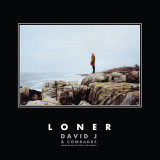
“…a surprisingly cohesive atmospheric soundtrack to a movie that does not yet exist.” LONER is the stunning album from cult auteur DAVID J (Bauhaus, Love & Rockets) featuring Mia Doi Todd and Tim Newman. U.K. Edition in orange vinyl with gatefold sleeve. Limited edition of 500. Former Bauhaus and current Love and Rockets bass man returns via Dakota Records with a series of deconstructions of an original twenty some year old demo. Originally streamed as part of his 2007 series of unreleased stash ‘Tracks from the Attic,’ a precursor to the now hugely successful platform: Patreon. David’s original demo titled ‘Albino Dog’ alongside singer/songwriter Mia Doi Todd’s sublime studio version both appeared via that platform in 2015; only the latter appears amongst this new series of arrangements. David’s premonition of Mia’s voice on this song is one to be applauded – perfectly suited creating a ghostly sepulchral aura. Here the Colonel is aided by a series of foot soldiers varying in rank. Veteran comrade Joyce Rooks adds texture with her trademark cello to Mia’s ‘Albino Dog’, whilst privates’ Nigel Gwennap (‘The Day that David Bowie Died’) and Whitehall Rec’s Joel Baldwin contribute electric guitar and drum programming respectively. But it’s the work of the captain that captivates this whole package. Tim Newman (Love is a Ghost), arranger, sound alchemist, mixer and lunatic. Tim’s work with David is best savoured via their ‘Analogue Excavations & Dream Excavations’ 2002 Glass Modern set. ‘Loner’ offers the listener a kaleidoscope of sounds best experienced with headphones, the journey from David’s simple ‘Albino Dog’ strummed acoustic demo to ‘Crescendo’ is quite staggering. Joel’s synth on ‘Cold, Cold, Cold’ and the glitch added to Mia’s vocal (‘Loner on the Range’) for example take the song into an altogether different direction. But it’s ‘Crescendo’ though that sits atop the apex. Building, as the title suggests, into a blistering array of guitars, bass and drums with a gorgeous, ethereal repeating low vocal motif from Mia wrapping itself around the cacophony.
Buscar:crescendo
Limitierte Edition: weisses Doppel-Vinyl im Klappcover! Leidenschaftlich, anglophil, anachronistisch, maximalistisch und barock, "La Vita Nuova" wurde als eine Elegie der Begierde geschrieben. Nach ihrer Fertigstellung wurde sie zu einer Beschwörung. Aufrichtig und leidenschaftlich hat Maria McKee ganz einfach ein seligmachendes Erwachen erlebt, und in einem Crescendo der Prosa erschließt ihr neues Album "La Vita Nuova" diese Geschichte und skizziert eine bedeutsame und transformative Zeit in ihrem Leben, die vor Jahrzehnten begann, als sie in ihrem Wohnzimmer vorm Kamin mit ihrem älteren Bruder, dem verstorbenen, großen musikalischen Erneuerer Bryan MacLean, Mitbegründer der bahnbrechenden LA-Band Love, sang. Auf dem Weg dorthin war sie Leadsängerin der bahnbrechenden Americana-Band Lone Justice, veröffentlichte eine Reihe stimmungsvoller und eklektischer Solo-Platten, schrieb Chart-Hits, die die Charts toppten, und inspirierte die Hingabe einer treuen kultischen Fangemeinde, bevor sie scheinbar verschwand. Ihr letztes Studioalbum "Late December" wurde 2007 veröffentlicht, seitdem sind dreizehn Jahre vergangen. "La Vita Nuova" ist eine Hommage an Dantes Werk über die unerwiderte Liebe. Obwohl der unbewusste Impuls für die Entstehung dieses Albums darin bestand, den Schock einer der bisher größten persönlichen Herausforderungen für McKee, der Auflösung und Neuerfindung ihrer Ehe, zu verarbeiten, sind die Lieder progressiv und lyrisch dicht. Die Produktion ist orchestral und opernhaft und orientiert sich an McKees Lexikon der Ikonen - John Cale, Scott Walker und David Bowie. Es handelt sich also um ein Werk, das ein hohes Maß an Konzentration erfordert. Man muss vielleicht mehr als einmal zuhören, um sich mit der konfessionellen Erzählung zu verbinden, die im Subtext gehalten wird, und um zu verstehen, dass die "Muse", oder "Beatrice" des Albums innerhalb der Prosazeilen auch ein herzzerreißendes Phantom von McKees jüngerem, idealistischem Selbst ist. Und eine Metapher für die Jugend im Allgemeinen. Das spiegelt sich in den eindringlichen, kaskadenartigen melodischen Klängen der Joni Mitchell, die "I Should Have Looked Away" andeuten, und in der ergreifenden, nostalgischen Wehmut des Titels "Effigy of Salt" wider. McKee ist inzwischen nach London umgezogen. Die Orchesterarrangements des Albums wurden von McKee komponiert und arrangiert, die keine formale klassische Ausbildung hat und keine einzige Note liest. Aber genau das ist die Natur der kreativen Katharsis, die im Allgemeinen mit einem eigenen Willen arbeitet.
Her tracks have been played and recommended by Iggy Pop, Mary Anne Hobbs and Nine Inch Nails. ZAMILSKA, one of the most original artists on the European electronic scene, announces a new album, "United Kingdom Of Anxiety" – out October 4.
Combining the rawness of techno and the trance-like nature of world music, industrial sound and a fine blend of trip-hop, the Polish producer created a dystopian, post-apocalyptic,
fascinating vision of a collapsing world. "United Kingdom Of Anxiety" begins with a sonic assault. The breaks and powerful bass in "Phantom" awaken from hypnotic slumber, numbness caused by the daily hustle, serve as a reminder that to survive in an unfriendly world, concentration, willpower and perseverance are essential. This is the beginning of a journey through "United Kingdom Of Anxiety" - the new album by Zamilska, a sensitive outsider.
"I’m here to ruin you again," announces a voice in "Mummy," while the crescendo of beats and noise in "Better Off" further amplifies the tension. It's hard to find peace when hell lurks just around the corner. Is it the horror of civilization or perhaps cosmic dread? The answer depends on the listener's sensitivity.
The much-needed balance and coolness are brought by huskie vocals - that is Ola Myszor - an incredibly talented young artist who appears in several tracks on the album. Besides huskie, there are other guests on "UKOA": Natalia Przybysz, who, with a robotic voice, delivers a manifesto of indomitable, proud solitude in "Persist" and Lukasz Pach, the charismatic frontman of the grindcore band Hostia. His growling is heard in the intense, uncompromising "No Gods," which was presented by Iggy Pop on his BBC6 Music radioshow.
The sonic spectrum is also filled with anonymous voices: echoes of quarrels, media messages, sounds of war clamor, monologues - looped, accelerated, manic, psychotic, but also a wistful singing coming from the depths, from afar. The metaphysical horror of Lovecraft on one hand, and the sober, no less gloomy diagnosis of George Orwell on the other, constantly correspond here.
This entire album is a story about society as a whole and the contemporary, dystopian world, which is inevitably heading towards war. The track "1984" clearly defines the inspiration for the artist's post-apocalyptic vision. A distorted radio signal, alarm siren and gabba/techno beats driving into the head like nails serve as an expression of the fear and anger born in a world of impending totalitarianism.
"A group of tried-and-true musicians got together and found the sort of camaraderie and kinship you typically only find once in a lifetime. They didn’t overthink it. They didn’t waste a second. They simply left their blood, sweat, and tears on tape—like they’ve always done. For as much as Better Lovers represents the union of former Every Time I Die members Jordan Buckley guitar,Steve Micciche [bass], and Clayton “Goose” Holyoak [drums] with The Dillinger Escape Plan and Killer Be Killed frontman Greg Puciato [vocals],and musician (Fit For An Autopsy/END) and GRAMMY® Award-winning producer, Will Putney [guitar], it really cements the bond of five friends around a shared vision. That vision is as uncompromising, unapologetic, and undeniable as anything they’ve individually done, yet it’s refined by experience and a commitment to a future together. They’re in it for the long haul... “To me, this band is refreshing,” exclaims Jordan. “Looking back, I’m so happy everything got me to where I am. The pandemic and the last few years made me hungrier and more grateful. This isn’t a hobby. This isn’t temporary. This is the next evolution for each of us. Greg and Will rejuvenated me and made me even more confident.
Now, everybody needs to know we’re a wild animal that just broke out of the zoo—there’s no trying to put it back in the cage.” “Better Lovers definitely feels like its own thing,” states Greg. “I’m in so many lanes right now, so it was important that one lane didn’t step on another. However, nothing I’m doing is this vicious. This is full-on scathing. It’s been really fun. I forgot how much I liked that.” As the story goes, Jordan ended up back in Buffalo, NY, jamming in a basement rehearsal spot with Steve and Goose during the winter of 2022. After working with Will on the last two Every Time I Die records, they shared a handful of early demos with him to produce. As the year progressed, Jordan caught Greg on the road with Jerry Cantrell in Las Vegas, mentioning the new music. Once ideas solidified, he shared them with the vocalist who replied at 3am one night in December. “The text said, ‘Let’s give these motherfuckers what they want’,”chuckles Jordan. “I went to bed smiling and laughing. There is no one like Greg on stage, off stage, or over text. Once I told Will, he was like, ‘Can I play?’ We said, ‘Of course!’ That’s how it was born.” “Once I pick up the scent, I’ll go for the kill,” smiles Greg. “We’ve all hung out, gotten to know each other, and it’s all fire now. Everyone has already been through shit. You know yourself better. Your ego isn’t as big as it used to be. You can share your opinions. It’s a cool dynamic.” Fittingly, they introduce this era with the single “30 Under 13.” A seasick guitar groove bleeds into an incisive riff punctuated by Greg’s vitriolic and venomous screams, “Hold onto me, try to let go of me, let go of what you’ll never be. ”This barrage unpredictably subsides on a haunting clean vocal, only to ramp back up into a pit-splitting thrash crescendo and rapid-fire solo played at warp speed. “We always try to up our game,” notes Jordan. “This is the next step for all of us. There’s just constant forward motion, and we don’t want to compromise that. We want to keep going. We’re doing a lot of shit we haven’t done before in Better Lovers. I’m not going to spoil it for you, but get ready.” “For some reason, this song got me,” recalls Greg. “Once that happens, you have the toe of the dinosaur skeleton in the dirt. You start brushing it away, and soon you have a fucking T-Rex.” The name might give you a hint of what’s coming—or it might not. So, what does the future hold for Better Lovers? Well, it’s entirely in their control. Expect a lot of touring. Expect more music. Expect these five guys to leave a trail of destruction in their wake—really would you want anything less? “We feel like we’re going to explode if we sit around any longer,” Jordan leaves off. “This is my life’s work. I learned all of my lessons, passed all of the tests, and took all of the right turns and the wrong turns. It turns out what I thought were wrong turns got me here, and that’s all that matters. I have no regrets. I know this is what I’m supposed to be doing.” “I just want you to view this on its own merits,” Greg concludes. “I hope it reaches some new people. For me, the enjoyment is making the music and putting it out. The second it’s released, I don’t look back. You drop the bomb and keep flying the plane. You don’t circle back to see how much destruction you cause. You keep moving, which is what we’re going to do.” "
DREAMLESS VEIL make their debut with the new album, Every Limb of the Flood. The band, featuring members of INTER ARMA, ARTIFICIAL BRAIN, and PSYCROPTIC manifest terrifying Blackened Extreme Metal and offer one of the year's most haunting releases. Every Limb of the Flood is a concept album. Through tracks such as "A Generation of Eyes", "Saturnism", and "Cyanide Mine" Vocalist Mike Paparo and co. task the listener to consider what it would be like for an individual to fully disappear. DREAMLESS VEIL delves into this murk through 8 tracks - dramatic swells, melodic crescendos, and abrasive blast-beat poundings make way to more introspective moments ultimately resulting in pure horror. Paparo explores the concept of corporeal disintegration with pained shrieks and disembodied bellows, resulting in one of the most unchained performances of his storied career. Lyrics for the record show, but don't tell. DREAMLESS VEIL's concept alludes to misery leading to grotesquery - The opener "Dim Golden Rave" throws the listener into an ambiguous time and place: "Grief, spiritless, collapses against the filth-ridden street". The second track, "A Generation of Eyes" follows this narrative by invoking Neil Young, quoting him to the extent of "rust never sleeps." What ensues is a grief so powerful it decomposes from within. The end result manifests in the album closer "Dreamless" - the body is now fully discarded, hinting at a possible enlightenment through a horrible, gruesome process. Sonically, Every Limb of the Flood is a caustic, corrosive journey. Critically acclaimed drummer David Haley flexes some of his most creative drum work to date, dragging the listener through wild tempo changes, breakneck speeds that come to sudden halts, while guitarist Dan Gargiulo (ARTIFICIAL BRAIN) interweaves disorienting guitar madness. Recorded by Brett Bamberger (REVOCATION) Every Limb of the Flood was mixed by Gargiulo and mastered by Colin Marston (Gorguts, Krallice, and more.)
REISSUED!!! Received an 8.1 rating from Pitchfork. "Sadly, many will hear Chris Corsano & Bill Orcutt's latest LP, Made Out of Sound, as 'not-jazz,' though it would be more aptly described as 'not-not-jazz.' In a better world, it would warrant above-the-fold reviews in Downbeat, or an appearance on David Sanborn's late-night show (if someone would only give it back to him). More likely, we can hope for a haiku review on Byron Coley's Twitter timeline to sufficiently connect the various improvised terrains trodden by this long-time duo—but if you've been able to listen past the overmodulated icepick fidelity of Harry Pussy, it should surprise you not an iota that Orcutt's style is rooted as much in the fractal melodies of Trane and Taylor as it is in Delta syrup or Tin Pan Alley glitz. As for Corsano, well, it may seem daft to call this particular record 'jazz' (because duh, it has a drummer), but to me Corsano is beyond jazz, almost beyond music, his ambidextrous, octopoid technique grappling many stylistic levers and spraying a torrent of light from every direction. Corsano's ferocity has elevated many 'mere' improv records to transcendence, but here he's crafted his polyrhythms within more narrative channels, bringing to mind his 'mannered' playing in the lamented Flower-Corsano duo. It's not 'groove' playing precisely, but it follows many grooves simultaneously, much like Orcutt's own melodic musings—which is why they're so naturally lock-in-key here. Which maybe makes it all the more surprising that Made Out of Sound was in fact recorded in different rooms on different coasts at different times, and stitched together by Orcutt on his desktop. Corsano recorded the drums in Ithaca, NY, and (as Orcutt states), 'I didn't edit them at all. I overdubbed two guitar tracks, panned left/right. I'd listen to the drums a couple times, pick a tuning, then improvise a part, thinking of the first track as backing and the second as the 'lead', though those are pretty fluid terms. I was watching the waveforms as I was recording, so I could see when a crescendo was coming or when to bring it down.' Fluidity ties the tracks together. With a little more groove and a little less around-the-beat maneuvering, one could almost hear the boiling harmonic layers as Miles-oid in 'Man Carrying Thing,' but with new-found Sharrockian modalities, Corsano accentuating the tumbling nature of the falling notes. The Sharrock vein continues with 'How to Cook a Wolf,' its Blind Willie-esque melodic simplicity and repetition extrapolated 360-style in a repetitive descending riff that falls into Cippolina-isms (by way of Verlaine ) until the end crashes upon the shore. Much like Orcutt's last solo album, Odds Against Tomorrow, there's a gentler, almost pastoral flow to some tracks ('Some Tennessee Jar,' 'A Port in Air,' 'Thirteen Ways of Looking') that calls to mind the mixolydian swamplands of Lonnie Liston Smith—but unlike Odds , other tracks ('The Thing Itself') smash that same lyricism into overdriven, multi-dimensional melodic clumps that push several vector envelopes at once in an Interstellar Space vein. With the help of Corsano, Orcutt has managed to slither even further out of the noise/improv pigeonhole lazy listeners/writers keep trying to shove him into. Looking at the back cover of Made Out of Sound , we should not see Orcutt hurling a guitar into the air with post-punk bravado, Corsano toiling behind him in the engine room—we should witness an instrument levitating from his hands, rising on invisible major-key tendrils of melody, fired by percussion, spiraling into an invisible event horizon..."—Tom Carter
WE ARE WINTER'S BLUE AND RADIANT CHILDREN (WAWBARC) is the new quartet of Mat Ball (BIG|BRAVE), Efrim Manuel Menuck (Godspeed You! Black Emperor, Thee Silver Mt. Zion), and Jonathan Downs and Patch (both Ada). On "NO MORE APOCALYPSE FATHER" they present six modal lullabies drenched in seared distortion, slathered across striding electronic pulses. Ball and Menuck began creating music in and for the bleakest moments of Montréal winters: "We're honoring that idea of winter, when you come inside and your house is warm, a place that only exists because of how cold it is outside," says Menuck. They later recruited Downs and Patch to flesh out their initial ideas. Menuck met them in 2015 when recording Ada's final album at Montréal's Hotel2Tango _ where they reconvened to make this record. "NO MORE APOCALYPSE FATHER" is an album about witnessing bleakness from a place of safety. Carrying newfound descriptive depth, thanks to the quartet's open-ended songs freeing him from writing in meter, Menuck likens his lyrics to photorealism. On opener `Rats and Roses' he sings of an unnamed city struck by an unknown cataclysm, but the details are local: specifically, his neighbors inadvertently poisoning birds when tackling a rat infestation. It's backed by blown out synths and guitars reaching a soaring crescendo. "Seeing things from a distance and not being able to intervene happens a lot on the record," Menuck explains. "If you're a feeling and thinking person, that's just part of the human condition. We watch horror unfolding from afar, unable to do anything concrete to change it." A powerless witness, able to describe but not intervene. `Dangling Blanket From A Balcony (White Phosphorous)' references Michael Jackson holding his child over a hotel balcony in 2002_the bizarre media spectacle still lodged in Menuck's psyche. This and the album's closing track also elegize white phosphorous, a technology of war designed to light up battlefields but capable of inflicting horrific burns on those it touches. Illumination and horror in one, here underpinning scenes picturesque and terrifying. "The last song `(Goodnight) White Phosphorous' is deliberately like a lullaby," says Menuck. "Written from the viewpoint of watching white phosphorous falling outside your window." Scorched and tarnished and laden with harrowing imagery, "NO MORE APOCALYPSE FATHER" is also a record bathed in light: the bewilderment of hopeful spirits witnessing despair, watching a blizzard of distress unfold outside from a place of relative shelter and comfort. You could call that emotional ambivalence, maybe numbness. But those words are too passive for the weight of conflicted feeling resonating through the album. "I never know how I feel on an overcast day when the sun is still bright despite the grayness and the light is very flat. The colours become more saturated, and you see a single flower, say a morning glory, whose colour is so vibrant beneath the gray, I don't know if that's a lovely sensation or a terrible sensation. It's both," says Menuck.
LTD COL. VINYL[33,40 €]
Returning from time apart to a world forever changed, dread-fuelled duo A SWARM OF THE SUN bring with them their fourth studio album, `An Empire'; its brooding, yet beautiful, melancholic narrative arc allows the band to dig ever deeper into desolation whilst a newfound lyrical focus adds a tenderness that is both harrowing and heartwarming at once. With the early bones of forthcoming `An Empire' tabled by events beyond their control in 2019, Erik and Jakob came together years later and scrapped them in favour of creating something entirely new; something distinctly different to break the cycle, defy categorisation and reflect the uncomfortable uncertainties of the times we now live in. The result is astounding; continuing the thread of narrative composition seen on `The Woods', `An Empire' is a six-track tale told in four distinct movements that are nothing short of devastating, from plaintive piano ballads to raw, full-band fury. For instance, taken from the album's third side, lead single `The Burning Wall' embodies this sprawling compositional feat perfectly, with the painfully frank opening couplet of "I know I fail you / I know that I run" establishing a gripping narrative trajectory backed by a simmering, impatient pulse that slowly and inevitably rises to an inescapable crescendo of cymbal chaos and wall-of-sound guitar drone. Elsewhere, 18-minute epic `The Pyre' represents Side B of `An Empire' with the confessional intimacy of a waltz-time ballad; the raw, wavering emotion of Jakob's words accompanied only by a haunting, lilting piano refrain before it too is consumed by the bittersweet might of post-rock euphoria to leave only embers of the apocalyptic lyrics in its wake_ `An Empire' marks a significant evolution of A Swarm of the Sun's already indelible post-metal sound. With increasingly bleak times forcing the band to reassess their relationship with creativity and suffering, this new body of work captures all the anthemic, intimate highs and crushing, debilitating lows of modern life on a knife edge.
Black Vinyl[30,04 €]
Returning from time apart to a world forever changed, dread-fuelled duo A SWARM OF THE SUN bring with them their fourth studio album, `An Empire'; its brooding, yet beautiful, melancholic narrative arc allows the band to dig ever deeper into desolation whilst a newfound lyrical focus adds a tenderness that is both harrowing and heartwarming at once. With the early bones of forthcoming `An Empire' tabled by events beyond their control in 2019, Erik and Jakob came together years later and scrapped them in favour of creating something entirely new; something distinctly different to break the cycle, defy categorisation and reflect the uncomfortable uncertainties of the times we now live in. The result is astounding; continuing the thread of narrative composition seen on `The Woods', `An Empire' is a six-track tale told in four distinct movements that are nothing short of devastating, from plaintive piano ballads to raw, full-band fury. For instance, taken from the album's third side, lead single `The Burning Wall' embodies this sprawling compositional feat perfectly, with the painfully frank opening couplet of "I know I fail you / I know that I run" establishing a gripping narrative trajectory backed by a simmering, impatient pulse that slowly and inevitably rises to an inescapable crescendo of cymbal chaos and wall-of-sound guitar drone. Elsewhere, 18-minute epic `The Pyre' represents Side B of `An Empire' with the confessional intimacy of a waltz-time ballad; the raw, wavering emotion of Jakob's words accompanied only by a haunting, lilting piano refrain before it too is consumed by the bittersweet might of post-rock euphoria to leave only embers of the apocalyptic lyrics in its wake_ `An Empire' marks a significant evolution of A Swarm of the Sun's already indelible post-metal sound. With increasingly bleak times forcing the band to reassess their relationship with creativity and suffering, this new body of work captures all the anthemic, intimate highs and crushing, debilitating lows of modern life on a knife edge.
Norwegian talent Meera makes her Crosstown Rebelsdebut with the atmospheric ‘Stikk’. Landing on 30th August, the EP sees the young artist flex her production prowess with remixes from Dennis Cruz and Tripolism.
Riding the success of her debut single ‘Music For Humans’ in 2023, Norway’s Meera was swiftly recruited by Damian Lazarus, joining him at his Hï Ibiza residency before heading to Rebellion for the release of the resonant ‘Teflon’. The sought-after artist has shown no signs of slowing, releasing a series of remixes this year amongst European shows, festival appearances, and Ibiza
pit stops. Continuing this momentum, she now makes her label debut on Lazarus’ renowned Crosstown Rebels with ‘Stikk’, with imprint regular Dennis Cruz joining on remix duties alongside melodic Danish trio and former collaborators Tripolism, who also make their first outing on Crosstown.
Landing in realms of afro-house, Meera’s production is cool, confident, and creative. With eclectic influences audible throughout her standout sound, her ‘Stikk’ EP proves why she first garnered the attention of artists such as Jimi Jules and John Digweed. The title track leads with minimal climbing percussion, introspective piano melodies and delicate, dreamlike vocals. In contrast, Tripolism’s remix turns up the intensity to a biting crescendo, adding sharp synths for a more dancefloor-focused feeling. ‘Sykkelkurv’ reaches for higher planes of emotion with its atmospheric soundscape, moody chords and driving drums, toeing the line between light and dark. Next, Dennis Cruz’s interpretation drives the track off the line and into deeper rhythms with chunky low-ends, picking up the pace for peak time. Digital purchasers are treated to a bonus track titled ‘Stikk Reprise’, a pulsating trip back into the lead single, with a heightened focus on the song's hypnotic vocals and raw emotive energy.
- A1: Peaks & Ferns
- A2: Sit In Your Discomfort
- A3: The People's Changes
- A4: The People's Shadow
- A5: To The Before Time
- A6: When We Could Dance Together
- A7: African Folk Song
- B1: Back In The Days
- B2: A Night In Berlin
- B3: Two Chords & The Truth
- B4: Quinnies For The Boys
- B5: Ancestral Mathematics
- B6: Crisis & Oppprtunity
Having gathered up praise from Mary Anne Hobbs, Cerys Matthews, Jamie Cullum, Gilles Peterson, Huey Morgan, The Guardian, Jazzwise and more, for his lauded ‘Crisis & Opportunity’, drummer and composer Myele Manzanza returns with the fourth instalment of his series, titled ‘Meditations’.
On ‘Meditations’, we see Myele revert to a purely acoustic line-up, channeling a focused and razor-sharp return to his Jazz roots. Showcasing an incredible level of musicianship between three musicians at the top of their game - including Matthew Sheens (Ross McHenry, John Patitucci) on piano and Matt Penman (Joshua Redman, Sfjazz Collective) on double bass - the trio exchange motifs over the length of 7 tracks.
Opening proceedings with frenetic rhythmic improvisation, complimented by melancholic and cinematic layers of sound, ‘Crayford’s Room’ is a tribute to Myele’s musical mentor back in New Zealand. Remembering his time as a student in Wellington, Myele shows his deep connection to his origins, manifesting itself as lament on ‘Winter’ and ‘Homesick’. Introducing hypnotic, contemplative melodies take centre stage on ‘Something Old Something New’ (the first single to be released from the project)’ It maintains a sense of tension and intrigue throughout, and intensity rises to a crescendo sending sonic particles sprawling into space.
Intuitive, darker and deeply contemplative, Myele shares his innermost thoughts on ‘Crisis and Opportunities Vol.4 - Meditations’. He divulges:
‘The personal angst and existential frustration I was going through across 2020 - 2022 I believe is well reflected here. The album is deeply informed by the musicianship and sound of my trio, Matthew Sheens on piano and Matt Penman on double bass. Knowing that musicians of their calibre were going to be involved gave me licence to go further in my writing, deploying odd time signatures, sharing the melody roles across the piano and the bass, and delving deeper into the nuances of what the acoustic piano / bass / drums trio can do. The compositions present a challenge even to the best musicians, and I knew that it was essential to have a team on this level to really move the music beyond an academic exercise and draw out the emotion and colour from the material.’
Luminice Blue Transparent Vinyl. Can you hear the war drums beating? Prepare for battle! Lost In Cult Records, Black Screen Records, Gaziter and Deadpan Games are proud to present Wildfrost: the Original Game Soundtrack. For the first time on vinyl, enjoy the complete and unabridged orchestral score from composer Paul Zimmermann. Rich with folk roots and powerful crescendos, it's the perfect soundscape for your journey through the cold. No Pengoons were harmed in the making of this vinyl. Composer Paul Zimmermann on working on this soundtrack and vinyl: "Writing the music for Wildfrost was a blast. I loved mixing a ton of different instruments from all around the world to bring to life the colourful and unique setting of the game. The gameplay can get very challenging, so I wanted to make sure the music felt playful and uplifting, while also providing those big and heroic moments for our boss fights. I'm super pleased to partner with Lost in Cult and Black Screen Records to bring this soundtrack to vinyl. Seeing the positive response from players has been amazing and I hope this vinyl, with its unique artwork by Nuri Durr and the additional extras, provides fans of the game and its music another great way to connect with the world of the eternal winter!"
Black Truffle is thrilled to announce a reissue of Chico Mello and Helinho Brandão’s self-titled release from 1984, the first return to vinyl of this classic of Brazilian experimental music with its original cover art and complete track listing. An under-recognised figure whose work inhabits a singular terrain where radical new music techniques and music theatre meet musica popular brasileira, Mello has lived and worked in Berlin since the late 1980s. A student of Dieter Schnebel, Mello played in the 90s iteration of Arnold Dreyblatt’s Orchestra of Excited Strings alongside compatriot Silvia Ocougne, with whom he produced a radical and hilarious deconstruction of MPB classics on Musica Brasileira De(s)composta (an early and rather atypical release on Edition Wandelweiser).
On this release, his only recording predating his move to Europe, Mello works with the alto saxophonist Helinho Brandão, who appears to be otherwise unknown outside Brazil. The record’s six tracks range from solo saxophone improvisation to densely layered ensemble works bridging minimalism, acoustic sound art and a plaintive melodic sensibility that calls up Edu Lobo or Milton Nascimento. Beginning with a dramatic, dissonant wind and string surge from which emerge ominously pounding piano chords, opener ‘Água’ slowly builds in intensity, a halo of clustered vocal harmonies gradually closing in on Brandão’s squealing sax until the piece opens up to reveal a gorgeous passage of melodic singing. The piano accompaniment reduces to tolling bass notes as the voice begins a repeated incantation, suggesting a ritualistic atmosphere reminiscent of parts of Xenakis’ setting of Oresteia. Dissonant, sawing tremolos on the strings climb to a crescendo before disappearing into the sounds of water being poured and splashed into metal vessels, presented not as a field recording but as a percussive element performed by the ensemble. A child’s voice then appears, singing to piano accompaniment the same melody heard earlier in the piece. After a brief solo alto improvisation from Brandão, working with the guttural pops and fleeting melodic gestures of Braxton or Roscoe Mitchell, the remainder of the first side is dedicated to the leisurely unfolding of ‘Baiando’ over the course of twelve minutes. A trio for Brandão on soprano saxophone, Mello on a very period-appropriate phased nylon string guitar and Edu Dequech on bongos, the performance eases its way hypnotically through subtle variations on a set of rhythmic and melodic patterns, almost derailed at points by Brandão’s wild forays into extended technique but held together by Mello’s droning guitar notes.
The second side opens with another multi-part epic for a larger ensemble, ‘Matraca’, which makes use of strings, electric guitars and a wide range of South American percussion instruments. Rasping violin harmonics hover as drum hits, repeated guitar notes and triangle accompany a slowly descending bass glissando. A sudden change in direction introduces a thrumming, incessantly repeated bowed bass tone, beginning a series of episodes of minimalist phasing and pattern variation, the combinations of electric guitars and orchestral instruments giving the ensemble an ad hoc charm like the early Penguin Café Orchestra but with more percussive drive. Eventually the piece is overrun by a cacophony of the titular matracas (a kind of ratchet/cog rattle). Following a lyrical trio improvisation by Mello, Brandão and Gerson Kornin on bass, the final ‘Danca’ focuses entirely on Mello’s layered acoustic guitars and vocals, using this restricted palette to build up a haunting piece of almost orchestral density, reminiscent of the 70s work of Egberto Gismonti in how it thickens a folkish ambience with harmonic sophistication.
Arriving in a starkly beautiful gatefold sleeve and sounding better than ever in its new remaster, one might call the stunning music contained on Chico Mello/Helinho Brandão ahead of its time. But what (other than some of Mello’s own work) produced in the years since its initial release has really touched the organic fusion of minimalism, free improvisation, radical instrumental technique and popular song achieved here? Forty years after its first release, Chico Mello/Helinho Brandão remains music of the future.
Scottish experimental/electronic musician Drew McDowall's lifelong interest in an elegiac solo bagpipe style called pibroch (ceòl mòr in Gaelic) has been an inspiration for much of his previous work (including Coil's legendary Time Machines). This form, often traditionally used for laments and for tributes to the dead, fuses modal drones with flickering dissonance and plaintive melody evoking an ancient, solemn mood. His latest work, A Thread, Silvered and Trembling, both incorporates and transforms these elements via exploratory electronic processing, weaving an electro-acoustic tapestry of strings, shudders, voids, and voices, alternately disembodied and displaced. Co-produced with engineer Randall Dunn at Circular Ruin Studios in Brooklyn, the collection's four pieces capture McDowall at his most elevated and elusive, in thrall to "the ineffable - that which refuses to be spoken." McDowall's palette here is unusually eclectic, sourced from a dynamic orchestral ensemble arranged by Brent Arnold and comprised of cello, viola, violin, harp (Marilu Donovan of LEYA), and french horn. Ebbing between shrouded electronics and enigmatic, sometimes spectralist orchestration, the album moves with a seething, simmering energy, surging into elegant, uneasy crescendos. The first two pieces are inspired by a liberatory hijacking and inversion of a grim biblical story (and by a cryptic and strange UK simple syrup branding). Opener "Out of Strength Comes Sweetness" shivers with short echo and resonant pads, before shifting into the album's centerpiece: the 14-minute saga "And Lions Will Sing with Joy." A murmuring electrical storm of keening strings and disorienting drones gradually grows darker and denser, until suddenly there's a crack in the clouds, revealing mutated choral voices and sparkling harp. McDowall describes the track as "an incantation to help usher in a break, and a new beginning." The record's latter half evokes a deep untamed animism shot through with spiraling radiance. "In Wound and Water" sways with harp, plucked strings and eerie cello undertows while lush layers of disorientated electronics hang in the dusk. There is no resolution, only a faint gradient of fragile dissipation, leading into the album's harrowing and climactic closer, "A Dream of a Cartographic Membrane Dissolves." Processed voices (credited on the liner notes to "The Ghosts Who Refuse to Rest") contort, whisper, and gather as the rest of the ensemble sharpens, poising to strike. Then it does - grand, tragic stabs of strings and horns lashing the sky, storming heaven by force. The fallout is poetic and inevitable, raining embers into a dark sea. But the journey and catharsis of A Thread linger long after it goes silent. Like so much of McDowall's multifaceted catalog, this is music of immanence and alchemy, attuned equally to the sacred and the profane, to the tile and the mosaic.
"Sun Racket" is the brand new album from legendary Boston trio Throwing Muses, consisting of Kristin Hersh, David Narcizo and Bernard Georges. The follow up to 2013's 'Purgatory/Paradise' is an outpouring of modal guitars, reverbed shapes, echoey drums and driving bass set behind Kristen Hersh's well-thumbed notebook of storylines. A ten-song opus of suitably wrought tales set against a wall of sound that's at once calm and ethereal before building into glorious cacophonous crescendos.
When Throwing Muses wrote their last album, they were shattered. Pieces were coming and going, elements repeating and charging the whole. "It sounded beautiful jumping around like that". Two-minute songs reappearing as twisted instrumentals or another song's bridge.
They mimicked the effect live which kept them on their toes. Whatever was happening was already over in other words. 'Sun Racket' is the opposite. It refused to do anything but sit still. It says, "sit here and deal". "All it asked of us was to comingle two completely disparate sonic vocabularies: one heavy noise, the other delicate music box.
Turns out we didn't have to do much. Sun Racket knew what it was doing and pushed us aside, which is always best. After thirty years of playing together, we trust each other implicitly but we trust the music more" - Kristin Hersh And so, they continue. Business unusual.
"A ground-breaking band who changed the face of alternative music rather than follow the rule book." MXDWN "Pioneers of the 80'/early 90's college rock sound" Pitchfork "One of America's finest guitar bands" - The Quietus.
Frail Body is a three piece band from Rockford, IL. "Artificial Bouquet" is an eleven song album by Frail Body. Produced, engineered, and recorded by Pete Grossmann at Bricktop Recording, and mastered by Jack Shirley at The Atomic Garden (Deafheaven, Joyce Manor, Loma Prieta). Opening track "Scaffolding" explodes out of the gate with dizzying speed before descending into a wash of discordant melody. "Berth" and "Critique Programme" then inject pulse-pounding tempo shifts and unorthodox heavy riffing into the fray. "Devotion" plays as a stunning ebb and flow epic that shows method to their musical chaos. "Monolith" and "Refrain" then blur the lines between post-hardcore and melodic black metal in their frantic approach. These lead to "No Resolution" and "Runaway"; two slow build numbers that showcase the otherworldly dynamics Frail Body possess. "Horizon Line" follows this path as it builds to bone-shaking crescendo. Lastly "Another Year Removed" serves as an instrumental bridge to closer "A Capsule In The Sediment". A song that empties the emotional tank for all to bear witness. All of it so raw and beautifully out of control. Without question, "Artificial Bouquet" establishes Frail Body as leaders within the modern "screamo" movement. A shining example that the once dormant sub-genre continues to evolve and thrive for all the world to see.
Gallegos, first name Oliver - deals in feelings rather than genres. The productions on his debut effort for RS INTL channel a 90’s rave euphoria. Luscious pads swirl amidst pitched down jungle drums, celestial strings and philosophical vocal snippets that evoke ecstatic joy.
It’s no mean feat to induce a feeling of elation without the means of a synthetic intervention - but Ollie seems to have cracked the code - taking us there with harmony, texture and rhythm alone - nothing synthetic here: this is alchemy at play... The EP - which in all honesty feels more like a mini album - is a real journey across 5 songs and 29 minutes. It’s about equally split between driving rhythmic compositions created with movement in mind, and pensive ambient detours that are more sonic meditations than anything else. The album reaches its most dizzying heights when these two elements come together in unison for the title track, “Memories You’ve Memorised'' - a widely road-tested future classic which blends scattered Juno chords, arpeggiated church organ and 80s vocal samples to a tear-jerking crescendo.
Memories You’ve Memorised elevates Oliver Gallegos to the top tier of modern electronic composition. There’s comparisons to be made to Primal Scream, Underworld and even Aphex Twin - but after all is said and done, we’re witnessing the coming of age of a future pioneer.
An exercise in control of auditory limitations and possibilities, GAEL redefines techno production with their comprehension of cold atmospherics and meticulous world building. Exemplified in their first solo EP ‘Frozen White Horse’ released on BITE Records, fervent, hurtling drums are underpinned by hopeful euphorics and circulating, breathy cybernetics. A culmination of sophisticated sonic dialects reared from the intersections of soundscaping and electronic music, the berlin-based DJ/Producer from Dagestan (by-way-of Kyiv and Odesa) commits their practice to the inclusivity of borderless, capricious and emotive dance- floor synergy. This energy was previously captured on BITE last year with their appearances on the Shedding Skin VA and The Soft Moon’s Exister Remixed. GAEL’s harmonic and organic approach to techno production echoes the heartbeat of dancefloor resistance,captivating audiences across venues from Berlin’s Berghain to Kyiv’s ∄ as a resident at the queer event series XITb. Delivering thunderous feeling through experimental sounds and masterful pacing, the 4-track-EP blurs the margins of moody techno exploration with remarkable attitude and a foreboding sense of uphill struggle. For the opening title track, a procession of stacked chords,synths and snares are met with a cyclone of galloping percussion building to maximum intensity until dispersing into echoey chimes. As the listener is able to catch their breath, the second track ‘prpttcxsstnc’ reignites - this time with trepidatious yet ethereal vibration, as the track continues to inject GAEL’s post-punk style of galvanised energy, rich layered drums maintain the undercurrent of resolute chaos into the following track ‘there is nothing left’. Sombre track titles are off-set by triumphant vigour for the third instalment, pushing through gale force drums and the clanging zaps and bleeps of electronic debris. Concluding with the final cacophony of collaged beats and drums, bellowing siren-like cold wails meld with GAEL’s calamity crescendo of crashing cymbals, the procession of rapturous drums slipping into a distant echo of warped hollow gleams.
In the process, the saxophonist presents some of his fiercest playing yet. The quartet's synergy is of a unique blend, with each player's distinct voice adding to an ensemble sound capable of conjuring both the quietest storm and the most passionate crescendo. Hershkovits's bountiful stylistic reach and fluent technique swirl around Oded's unmistakable tenor tone with Klampanis providing both backbone and melody, adaptable yet guiding - just like his rhythm- partner Almeid
Sechstes Album der norwegischen Prog-Rock-Meister um Multiinstrumentalist und Sänger Bjorn Riis.
Jeder Track zeigt die charakteristische Verschmelzung sanfter Selbstbeobachtung und dynamischer Energie, von den hypnotisierenden Tiefen von 'Dysphoria' bis zum eindringlichen Crescendo von 'Tyrants And Kings'. Die fünf Tracks bestechen durch unwiderstehliche Gesangseinlagen und virtuose Leadgitarrenarbeit, die zum Synonym für den Airbag-Sound geworden ist. Während sich das Album entfaltet, wird der Zuhörer auf eine Reise durch Selbstbeobachtung und Intensität mitgenommen, von der introspektiven Ballade 'Awakening' bis zu den erhabenen Tiefen der Single 'Erase'. Dieser Song weckt Anklänge an ihre gefeierte Arbeit auf dem Album 'Disconnected' und entwickelt sich von einer hypnotischen Basslinie zu einem Kraftpaket aus schweren Refrains, die den Grundstein für den epischen 15-minütigen Abschluss von 'Tear it Down' legen. Doch 'The Century of the Self' ist mehr als nur eine Klang-Odyssee - es ist ein Spiegelbild unseres modernen Zeitgeists. Das Album befasst sich mit Themen der Abbruchkultur sowie dem Umschreiben persönlicher Geschichten, und bietet einen ergreifenden Kommentar zu einer Welt voller Angst und Verurteilung.