For 20 years, Pierrick Pedron has been recognised by his peers and the media as one of the virtuosos of the alto saxophone and a beacon of the French jazz scene, attested by his multiple awards in 2021, including Artist of the Year, by Victoires du Jazz, Jazz Magazine, Jazz News, and other publications organizations This collaboration with Cuban pianist Gonzalo Rubalcaba was born out of a conversation between Pierrick Pedron and arranger Daniel Yvinec about longterm large ensemble projects that were in the early stages of planning, and that in the meantime, they should imagine an intimate saxophone/piano duo project. To approach the pianist Gonzalo Rubalcaba is to approach a legend. He is one of those immense jazz pianists whom nothing and nobody can resist. Inspired by both the Afro- Cuban and Western traditions, a gifted keyboardist and counterpoint player, he soon attracted international attention and began a fruitful collaboration with the legendary Blue Note label, with which he has recorded some fifteen albums. The result is record composed of great moments of bravura where the lines fly over the written scores with obvious mastery, touching on romantic, contemporary, and sometimes even noisy music. In this "art of the duo" session, Pierrick and Gonzalo challenge each other, provoke each other, test each other, have fun surprising each other, and even try to outdo each other. Pierrick Pedron: alto saxophone
Suche:cuba 2
Caribe, the third album by Cuban cellist and composer Ana Carla Maza, is a renewed declaration of love for Latin American music, already expressed in her previous work, Bahia Released in 2022, Bahia was followed by a tour of 150 concerts in 14 countries. At the crossroads of her travels, Ana Carla Maza has transformed the intimacy of the cello into a colorful, energetic and danceable Latin jazz sextet. Classically trained, Ana Carla takes her own liberties here in the Caribbean and beyond (Argentina, Brazil). The first of these is to impose her sensitivity and her voice as a woman. "I wrote Caribe while travelling the world. In a studio in Rome, on the shores of Lake Annecy, in a castle in Portugal, on a plane to Mexico... It was a kind of search for my identity, which started in Guanabacoa, the district of Havana where I grew up with my grandparents and which happens to be the epicenter of the "rumberos", the percussionists from the pure Afro- Caribbean tradition". Ana Carla Maza: cello & voice Arnaud Dolmen: drums Irving Acao: saxophone, flute Norman Peplow: piano & keyboards Luis Guerra: percussion Fidel Fourneyron: trombone Noe Clerc: accordion
Purple Color Vinyl
We are really proud to introduce a new release on Mawimbi Records: "Mawimbi, Vol. 2”. Its title is a nod to “Mawimbi, Vol. 1”, which was the inaugural release of our record label back in 2015. A new compilation, at last, after a decade of music activism and a handful of EPs and albums which have helped unearth some of today’s talents from the new global music scene (Onipa, Loya, Afriquoi, Raz & Afla). It stays true to the driving principles of our artistic direction: support upcoming artists, e ncourage the breaking down of musical frontiers, help make happen new encounters between electronic music and so-called “afro” music. While these encounters can now be witnessed anywhere in pop music’s current zeitgeist, from Beyoncé to South African’s vibrant amapiano scene, we think there’s still plenty to explore.
“Mawimbi, Vol. 2” truly feels like the culmination of a long path for our record label. Because it includes artists who have been actively contributing to the Mawimbi adventure over the years, and also because it’s another convincing testimony of the fruitfulness of this musical intuition we have so heartily been defending for the last decade. Indeed, the 8 tracks of “Mawimbi, Vol. 2” resist all the usual labels. They sound like they stem more from human encounters and artistic dialogues launched in the moment than attempts to be associated with any music scene in particular. Each of the 8 pieces of this compilation presents in a unique way the search for this cross-pollinating sound.
The compilation opens with a really engaging rework of James Stewart’s classic track “Cotonou” by Lyon-based tropical music enthusiasts Voilaaa, who took Peter Solo’s voodoo soul lines on a trip across the Black Atlantic beginning with a horn-heavy cuban cha-cha-cha before falling into a savory triple time dance. As tireless sonic adventurers, Amsterdam-based duo Umoja have brought back a handful of hits from their numerous trips to Kenya meeting with local benga musicians. “Avana Va” is one of their compelling tunes, featuring Kenyan musician and producer Sidney Simila. This urge to collaborate with musicians from across the African continent is also to be found in Village Cuts’ ever expanding discography. On “Sentima”, they showcase their trademark London funky sound, introducing us to the talents of Congolese guitarist and singer Kissangwa.
Afriquoi’s 2020 hit “Ndeko Solo” is presented in a brand new shape, sprinkled with some French Touch flavours. “Djansa”, by Toulouse-based producers Mr. Boom, rides a distinct South African-inspired groove, while inviting us to a nighttime dance by the Balearic sea. On “Silent Runner”, French producer and musician Ozferti moulds his own musical galaxy where East African scales meet cutting edge global club beats. With “Nabi Kumi”, Anglo-Ghanaian duo Raz & Afla delivers their deepest piece, once again inducing a state of trance with a triple-time beat and an hypnotic kora loop. Closing the compilation, “It's Holy” is a unique collaboration between Tom Excell (Onipa, Nubiyan Twist, David Walters) and Dizraeli, one of the most interesting voices in British rap, which by making connections between broken beat, jazz and african music, illustrates the precious mixture of musical aesthetics that make up the current UK musical landscape.
Enigma is the first studio album by the space age, glass-harp powered, tropicalia quartet Os Barbapapas. Understandably, those adjectives could invoke images of kitschiness in one’s mind; that concept is smashed by the ice cold shot of Brazilian jazz riffing in the album’s opener and first single, “Se Liga Na Sequência”.
Os Barbapapas trapeze the vast richness of Brazilian/South American music heritage and beyond, as a collective with members who have variously travelled to Morocco to master Gnawa; played in circuses, or were born in the heartland of samba – these experiences and much more inform the complex yet breezy instrumentals of Enigma.
It’s a joy to pick through the notable influences that resound over Enigma. Ethiopian Jazz bursts from "Caminho para Itiwawa", backed by an Afro-Latin swing, fostered by drummer Barbara Mucciollo. There’s tonalities from North African artists such as Omar Khorshidor West African artists such as Tinriwen and Ali Farka Touré, as well as rhythmic influence from Afro-Cuban and Afro-Brazilian music. The dynamite track “(L)Atitude(S)” contains the explorative excitement of Brazilian 60s luminaries like Pedro Santos, however none are as special as layered percussion of “Gaba Gaba”, connected to the very specific rhythms of Northeast Brazil. It's evident from listening to Enigma that Os Barbapapas are an exceptional live band. They have their sights set on Europe soon, with the Glass Harp packed away safely. Until then please enjoy this electrifying album of their work so far, understanding: this is an extremely exciting project, still in its auspicious infant years
Enigma is the first studio album by the space age, glass-harp powered, tropicalia quartet Os Barbapapas. Understandably, those adjectives could invoke images of kitschiness in one’s mind; that concept is smashed by the ice cold shot of Brazilian jazz riffing in the album’s opener and first single, “Se Liga Na Sequência”.
Os Barbapapas trapeze the vast richness of Brazilian/South American music heritage and beyond, as a collective with members who have variously travelled to Morocco to master Gnawa; played in circuses, or were born in the heartland of samba – these experiences and much more inform the complex yet breezy instrumentals of Enigma.
It’s a joy to pick through the notable influences that resound over Enigma. Ethiopian Jazz bursts from "Caminho para Itiwawa", backed by an Afro-Latin swing, fostered by drummer Barbara Mucciollo. There’s tonalities from North African artists such as Omar Khorshidor West African artists such as Tinriwen and Ali Farka Touré, as well as rhythmic influence from Afro-Cuban and Afro-Brazilian music. The dynamite track “(L)Atitude(S)” contains the explorative excitement of Brazilian 60s luminaries like Pedro Santos, however none are as special as layered percussion of “Gaba Gaba”, connected to the very specific rhythms of Northeast Brazil. It's evident from listening to Enigma that Os Barbapapas are an exceptional live band. They have their sights set on Europe soon, with the Glass Harp packed away safely. Until then please enjoy this electrifying album of their work so far, understanding: this is an extremely exciting project, still in its auspicious infant years
Some of the most unique Italian jungle exotica mambo music you'll hear!
You won't usually find those words together but because this record,
released in the late 50s only on reel to reel tape, was twice produced
layering cultural madness! This gem was originally designed to be a
Francis Bay album of Italian music and Cuban Mambo, until the masters
were sold to producer Kirby Allen who with the help of faux African
tribesman, Chaino, added African style percussion and animal sounds up
the wazoo!
If the much-bandied-about word exotica stands for anything, it stands for
disparate cultures playing well together with others, and Temptation: The
Exotic Sounds of Chaino is a case study in international relations that
could serve as a teacher's guide in how to set up a Model UN
If there's a more quintessential example of the African- Cuban- Italian- SpanishPolynesian- American Songbook as recorded by a Belgian combo, this author is
unaware of such an artifact. - Gaylord Fields (WFMU)
1963 album from the Cuban conguero Mongo Santamaria. Featuring his brilliant cover version of Herbie Hancock's classic title track, along with numerous compositions of his own, this is one of Mongo Santamaria's most famous and coveted albums. From the iconic cover to the brilliant grooves contained within, this album has the whole package. Excellent latin jazz and latin-soul groovers from a Cuban hero, and one of the most famous performers, full stop, of the middle 20th Century.
International ensemble Classico Latino are proud to present their new album 'Salsa Classics' featuring salsa legend Julio Ernesto Estrada aka 'Fruko and virtuoso violinist Omar Puente. Drawing on the familiar Bolero and Tango, as well as lesser-known rhythms such as the Pasillo and Joropo, Classico Latino's new album displays the amazingly varied stories and emotions of Latin America.
'Salsa Classics' features collaborations with Colombian multi-instrumentalist and salsa legend Julio Ernesto Estrada aka 'Fruko,' a behemoth of the international salsa scene and an awe inspiring musician, who adds much creativity and authenticity to the project. The recording also features Cuban born violinist Omar Puente, a highly skilled virtuoso with a plethora of achievements, including being first violin with the Cuban National Symphony Orchestra, touring with Buena Vista's Ruben Gonzales and performing with high profile figures across a truly diverse range of genres, including John Williams, Jools Holland, and Wynton Marsalis, to name just a few.
Blackfoxy is a jazz-funk group originating from Villeneuve La Garenne in the Parisian region. The group was formed in 2011 at the initiative of Kalid Bazi and Klaus Blasquiz (the singer of the legendary group Magma with Christian Vander, Jannick Top, etc.). They are notably known for the hits "Talk About Peace" (featuring Nina Attal, MB14, and Princess Erika), dedicated to the victims of the Bataclan attacks in 2015, as well as their performance on France 4 with 50 drummers on the Michael Jackson song "Don"t Stop" & "Til You Get Enough" One of their most notable features is their ability to innovate by skillfully and uniquely incorporating elements from "Blaxploitation" film music and African, Cuban, and Caribbean musical traditions into their funk, characterized by a high-quality brass section and arrangements borrowed from both 70s and 80s Funk. Blackfoxy"s music also stands out due to the complementarity of its two singers, Klaus Blasquiz (baritone and tenor, he sings over 5 octaves!) and Sista Wyndyz. Lastly, since the attacks of 2015, Blackfoxy has been involved in the movement (sponsored, among others, by Manu Katché) to promote the values of peace through music in popular neighborhoods and rural areas in France and elsewhere.
- A1: Saludo A Chango
- A2: Amor Gigante
- A3: Una Rosa De Francia
- A4: María En La Playa (Con Rey Guerra)
- A5: La Engañadora
- A6: Viejos Sones De Santiago (Feat. Dúo Evocación)
- B1: El Día Que Me Quieras
- B2: Morir De Amor (Feat. Charles Aznavour)
- B3: Lágrimas Negras
- B4: Balcón De Santiago (Con Dúo Evocación)
- B5: Chan Chan (99
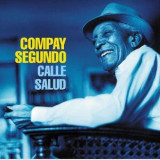
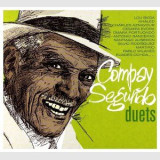
Compay Segundo war der Godfather der kubanischen Musik. Im Alter von 88 Jahren erlangte er internationalen Erfolg und war der größte Künstler des Buena Vista Social Club-Phänomens. Compays Musik ist in der Lage, einem ein Lächeln ins Gesicht zu zaubern, und einige seiner Lieder ("Chan Chan", "Sarandonga", "Yo vengo aquí") gehören zu den Klassikern des Son Cubano, des Genres, das er in der ganzen Welt verbreitet hat. Auch einige seiner Coverversionen klassischer kubanischer Lieder wie "Guantanamera", "La Negra Tomasa" oder "Lágrimas negras" gehören zu den besten der lateinamerikanischen Musik. Wir feiern sein Werk mit Vinyl-Veröffentlichungen im Jahr 2023, "Duets", "Las flores de la vida" und "Calle salud"
- A1: Saludo A Chango (Feat. Khaled)
- A2: Fidelidad (Feat. Silvio Rodríguez)
- A3: Lágrimas Negras (Feat. Cesária Evora)
- B1: Chan Chan (Feat. Eliades Ochoa)
- B2: Viejos Sones De Santiago (Feat. Dúo Evocación)
- B3: Virgen Del Pino (Feat. Santiago Auserón)
- B4: La Juma De Ayer (Feat. Pío Leyva)
- C1: Frutas Del Caney (Feat. Felix Valoy)
- C2: Morir De Amor (Feat. Charles Aznavour)
- C3: Linda Graciela (Feat. Basilio Repilado)
- C4: Macusa (Feat. Pablo Milanés)
- D1: La Pluma (Feat. Omara Portuondo)
- D2: Juliancito Tu Novia Te Botó (Feat. Martirio, Raimundo
- Amador)
- D3: Beautiful Maria Of My Soul (Bella Maria De Mi Alma)
- D4: Tente En Pie (Feat. Los Compadres)
Compay Segundo war der Godfather der kubanischen Musik. Im Alter von 88 Jahren erlangte er internationalen Erfolg und war der größte Künstler des Buena Vista Social Club-Phänomens.
Compays Musik ist in der Lage, einem ein Lächeln ins Gesicht zu zaubern, und einige seiner Lieder ("Chan Chan", "Sarandonga", "Yo vengo aquí") gehören zu den Klassikern des Son Cubano, des Genres, das er in der ganzen Welt verbreitet hat. Auch einige seiner Coverversionen klassischer kubanischer Lieder wie "Guantanamera", "La Negra Tomasa" oder "Lágrimas negras" gehören zu den besten der lateinamerikanischen Musik. Wir feiern sein Werk mit Vinyl-Veröffentlichungen im Jahr 2023, "Duets", "Las flores de la vida" und "Calle salud"
Compay Segundo war der Godfather der kubanischen Musik. Im Alter von 88 Jahren erlangte er internationalen Erfolg und war der größte Künstler des Buena Vista Social Club-Phänomens. Compays Musik ist in der Lage, einem ein Lächeln ins Gesicht zu zaubern, und einige seiner Lieder ("Chan Chan", "Sarandonga", "Yo vengo aquí") gehören zu den Klassikern des Son Cubano, des Genres, das er in der ganzen Welt verbreitet hat. Auch einige seiner Coverversionen klassischer kubanischer Lieder wie "Guantanamera", "La Negra Tomasa" oder "Lágrimas negras" gehören zu den besten der lateinamerikanischen Musik. Wir feiern sein Werk mit Vinyl-Veröffentlichungen im Jahr 2023, "Duets", "Las flores de la vida" und "Calle salud"
- A1: Ray Barretto Y Su Charanga Moderna – El Watusi
- A2: Willie Bobo – Bobo! Do That Thing
- A3: Willie Bobo – Be’s That Way
- A4: The Joe Cuba Sextet – El Pito (I’ll Never Go Back To Georgia)
- A5: The Joe Cuba Sextet – Bang! Bang!
- A6: Candido – Madrid
- A7: Ray Barretto – Babalu
- B1: Eddie Palmieri And Cal Tjader – Come An’ Get It (Boogaloo)
- B2: Tito Puente Y Su Orquestra – Fat Mama
- B3: The Joe Cuba Sextet – Oh Yeah!
- B4: The Joe Cuba Sextet – Sock It To Me
- B5: Tito Puente/La Lupe – Steak-O-Lean
- B6: Tito Puente’s Orchestra – Tp’s Shing-A-Ling
- B7: The Joe Cuba Sextet – Hey Joe, Hey Joe (Hey Girl, Hey Girl)
- C1: The Joe Cuba Sextet – Psychedelic Baby
- C2: Eddie Palmieri & His Orchestra – The African Twist
- C3: La Lupe – Fever
- C4: The Modern Sound Of Al Escobar – Tighten Up
- C5: The Modern Sound Of Al Escobar – The Horse
- C6: Celia Cruz/Tito Puente – Aquarius/Let The Sun Shine In
- D1: Gilberto Sextet – Yes I Will (Part 1)
- D2: Tito Puente & His Orchestra – Hit The Bongo
- D3: Tito Puente & His Orchestra – Oye Como Va
- D4: Jimmy Sabater – Times Are Changin’
- D5: The Joe Cuba Sextet – Do You Feel It?
- D6: Joe Panama And Company – My People
The first Latin soul collection featuring a mix of chart-topping hits and deeper cuts from the crown jewel of the mambo era Tico Records, celebrating the iconic imprint’s 75th Anniversary. The 2-LP set includes 26 tracks from trailblazers Tito Puente, Ray Barretto, Joe Cuba, Celia Cruz, Eddie Palmieri, La Lupe, Willie Bobo and more. New liner notes by DJ Dean Rudland that tell the story of the New York City label that launched the careers of some of the most revered names in Latin music.
- A1: The Connection Machine - Echoes From Tau Ceti
- A2: Direct Movement - Natural Chemistry
- A3: Paradise 3001 - Surfin The Cuban Waves
- B1: Exquisite Corpse - Strange Attractor
- B2: Orlando Voorn - Still
- B3: Nyx - Delphi (Rewaxed)
- C1: Stefan Robbers - Afridisiac (Jumpy Mix)
- C2: Fluxland - Fluxland
- C3: This Side Up - Glider
- D1: Georgio Schultz - Trance
- D2: Quazar - Cycle Drops
- D3: 2000 And One - Crystal
Vol.2[25,17 €]
Through 35 hedonistic highlights stretched across three volumes, Music For The Radical Xenomaniac delivers the first ever deep dive into The Netherlands’ colourful house sound of the 90s and the under-celebrated producers and record labels whose music soundtracked a countrywide cultural movement.
Plenty of books and documentaries have celebrated the riotous raves, legendary clubs, high profile DJs and promoters who shaped The Netherlands’ hedonistic house scene throughout the 90s. Music For The Radical Xenomaniac dares to challenge these narratives by shining a light, for the first time, on those who created the scene’s kaleidoscopic, game-changing and globally influential soundtrack.
Leading the charge were a disparate group of key creators who not only forged links with their counterparts in Detroit, Chicago, New York, Belgium, Germany and the United Kingdom, but also became celebrated figures on the worldwide electronic underground (Eric Nouhan, Aad De Mooy, Orlando Voorn, Stefan Robbers and Steve Rachmad). Alongside key underground imprints (Stealth Records, Basic Energy, ESP, Prime and Outland Records included) and lesser-known producers, these pioneers gave flavour to a radical musical movement via open-mindedness, unheard-of creativity and a genuinely futuristic ethos. All of these artists and labels are represented throughout the series.
So, what defined this hedonistic house sound from The Netherlands? Stylistically, it was varied – as the series so emphatically proves – but was defined by a set of distinctive sonic characteristics: emotive musical motifs, high-frequency synth sounds, mellow basslines, pulsating rhythms and more than a touch of hallucinatory intent.
Volume 3 is packed with in-demand tracks and hard-to-find gems, including a previously CD-only cut from Dutch techno originator Orlando Voorn (1999’s ‘Still’), a genuine rave classic from The Hague by hardcore DJ Charly Lownoise as Fluxland, and a killer cut from prolific producer – and genuinely influential pioneer – Aad De Mooy AKA D-Shake. He’s represented on this volume by Paradise 3001 cut ‘Surfin The Cuban Waves’, which first appeared on ESP Records in 1993.
Other highlights include Direct Movement’s ‘Natural Chemistry’, a sought-after slow house cut produced by Dennis Buné, who had an enormous impact on the Dutch house scene as Jaimy, and ‘Delphi (Rewaxed)’ by NYX, a highly regarded and hard to find single from former new wave and synth-pop producer Bart Barten, and occasional studio partner Hanz Meyer.
Packed full of forward-thinking 90s gems remastered for today’s dance floors by Alden Tyrell, Music For The Radical Xenomaniac Volume 3 is a life-affirming celebration of a distinctly Dutch musical movement, whose rich textures and melodies are still inspiring new generations of DJs and dancers today.
- Sally Go Round The Roses
- Angels Of Mercy
- Move Your Hand
- Latin Slide
- Who You Fooling
- The Ghetto
- Road Runner
- Soul Sauce
- Baila Mi Guaguancò
- Cocoa Leaf
Arriving from various points in Mexico, Panama, Cuba and Puerto Rico, this nine-man group led by Benny Velarde found each other and their music in San Francisco in the early 1970’s. They brought the music of their homes to the heavy sounds of San Francisco and merged the two, resulting in this soulful, joyful and unique 1973 recording. This Verve By Request title is pressed on 180-gram vinyl at Third Man in Detroit.
Los Caneyes was the first ever solo project from Cuban funk master Juan Pablo Torres and now Future Rootz - in collaboration with Canal Sounds and EGREM - is serving up a first-ever vinyl release of his early singles 'No Estabas No estabas Tu' and 'Oye Ven Y Baila Mi Son' on 7". These two superbly funky Afro-Cuban tracks were recorded in 1973 by this influential musical innovator. The first is a flame-hot and percussion-laden groove that is loose-limbed and sure to get those bones shaking and the second is similar - pure Latin heat for the floor.
Jaheim H. Hoagland, known professionally just as Jaheim, is best described as an R&B singer, but as all his releases are post millennium, the term has a different usage now to the style of the 50s/60s/70s that once used the genre. A resident of Hillsborough Township, New Jersey, and the grandson of 1960s soul singer Hoagy Lands which gives him Cuban, African and Native American blood, plus a fine musical heritage.
His recording career started with Divine Mill Records (a division of Warner Bros. Records) and his debut album “Ghetto Love” was released in 2001 to great acclaim. His follow-up album “Still Ghetto” (2002) spawned two hit singles, “Put That Woman First” and “Fabulous”, that both went platinum, and his third album “Ghetto Classics” (2006) topped the US Billboard chart selling over 153,000 copies in its first week. He then was signed to Atlantic Records in 2007 and his success continued with another three albums, and his final album to date, “Struggle Love” (2016) was released through BMG on his own label Julie’s Dream. To date he has received three Grammy nominations and sold over 5 million records worldwide.
The tracks selected for their 7” debuts are “Just In Case”, which was from the 20-track album “Ghetto Love” and did actually get released on a 12” being a massive favourite at the more progressive soul events, and “Diamond In Da Ruff” from “Still Ghetto”, which was also released on 12” vinyl.
- A1: Point Of No Return (7'' Version) - Expose
- A2: Don't Be Shy (Vocal/Radio Mix) - Janelle
- A3: Lover Girl - Meg
- A4: Two Of Hearts (12'' Version) - Stacey Q
- B1: Together Forever (Radio Edit) - Lisette Melendez
- B2: I Wonder If I Take You Home – Lisa Lisa & Cult Jam With Full Force
- B3: When I Hear Music - Debbie Deb
- B4: Let's Go (Radio Version) - Nocera
- C1: Funky Little Beat - Connie
- C2: Show Me - Cover Girls
- C3: Nightime - Pretty Poison
- C4: Fascinated (12'' Version) - Company B
- D1: Dreamin' - Will To Power
- D2: Baby Talk - Alisha
- D3: Take Me In Your Arms - Lil Suzy
- D4: Thief Of Heart - Cynthia
• Latin Freestyle was a dizzying, passionate, ultra-modern music. It was the aural equivalent of a can of thirst-quenching Quatro or a Spanish Harlem dance-off, and it became the electronically constructed bridge between disco and house.
• Freestyle grew out of the electro sound of the early 80s, combined clean staccato rhythms with morse code synth hooks, and topped them off with emotive, usually female, frequently Latina vocals. There was plenty more going on besides: proto-house piano lines, Cuban percussion, high emotion and synth hooks to die for.
• Put together and annotated by Bob Stanley (who also compiled the acclaimed “The Daisy Age” and “Fell From The Sun”), “Latin Freestyle” is the first compilation to cover the whole gamut of Freestyle from its early 80s breakthrough to its early 90s revival. So many classics… Lisa Lisa made the UK top ten with the 808 joy of ‘I Wonder If I Take You Home’. Stacey Q’s cosmically great ‘Two Of Hearts’ came out in 1986, while 1987 saw the likes of Company B’s ‘Fascinated’ and Exposé’s ‘Point Of No Return’ become huge UK club hits.
• Today, Freestyle is a scene with a solid collector’s market, and rarities like Janelle’s ‘Don’t Be Shy’ sell for hundreds of dollars. It’s a classic summer soundtrack, finally condensed in one Ace Records compilation – “Latin Freestyle”.
The party goes on! Here, in the second part of the historic Christmas salsa album Asalto Navideño, Willie Colón and vocalist Héctor Lavoe treat us to more of the special sounds that made Volume 1 of the collection one of the most popular Latin music albums of all time. In Volume 2, the team of bandleader/trombonist Willie Colón and inimitable singer Lavoe joins forces again with premier cuatro player Yomo Toro and legendary percussionists Milton Cardona and José Mangual Jr. to cook up New York salsa versions of typical Christmas songs familiar to Puerto Rican audiences of all ages. This típico sound of traditional country music, called música jíbara, is mixed and blended, salsa-style, with a range of other rhythms, starting with Cuban guaguancó and son montuno and African-American jazz.
- A1: Dejen Bailar Al Loco (2 42)
- A2: Ahorita Va Llove (2 34)
- A3: El Limoncito (2 48)
- A4: Libre De Pacado (2 54)
- A5: Pa' Goza Candela (2 20)
- A6: Dos Almas (2 39)
- B1: No Es Un Gato (3 28)
- B2: Carta De Mamita (3 21)
- B3: Quiero Casarme Contigo (2 19)
- B4: Los Goles De Pele (2 05)
- B5: Cobardia (2 36)
- B6: Trisagio Del Soltero (3 01)
Despite his popularity in Peru as a famous comedian, Melcochita devoted himself to music for many years and worked as in-house studio musician for the label Discos MAG, taking part in countless sessions. This album was recorded between 1967 and 1968, accompanied by the orchestras of Betico Salas, Joe di Roma, Nilo Espinoza, Carlos Muñoz and Tito Chicoma. The album comprises amazing guarachas, mainly international hits, and the hilarious bolero 'Cobardía' where Melcochita brings in his comedian talent. First time reissue! - Back in 1968, the year "Dejen bailar al loco" was released, Pablo was still known as Pacocha (the name of a popular brand of soap) and worked during the day as a session musician for the MAG label. At night, from eight to six in the morning, he used to play percussion in clubs. Then, at the weekends, he performed on the popular variety show La Peña Ferrando, which featured "Quality acting; very funny, simple sketches", impersonations and musical performancs. Most of the guarachas on the album are international hits, such as 'El limoncito' and 'Pa' gozá candela'. The track, 'Quiero casarme contigo' has Mexican origins, and it has been adapted to guaracha style by Betico Salas' orchestra. The humorous 'No es un gato' hails from Colombia, while 'Ahorita va a llové' and 'Carta de mamita' come from Cuba. 'Dejen bailar al loco' and 'Libre de pecado' are also from the Caribbean Island. 'Cobardía' and 'Dos almas' are classic boleros, which were already part of the repertoire of most singers back then and were also included on this album. The only way to perform them to the demanding audience at La Peña without being booed was to put a new spin on the songs, deconstruct them and reinvent the structure, as the Tito Chicoma and Joe di Roma orchestras did, and above all Melcochita, who sang them in a supernatural voice and a created Creole scat that must have wowed the audience, who would then burst into applause and laughter, going home happy after a great night out.