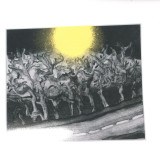
The seeds of composer Rafael Anton Irisarri’s latest LP were first planted during his 2016 tour in Italy, months before that Autumn’s unexpected presidential election. The linguistic glitch of an innocuous diner in Milan named “il Mito Americano” – meant as “The American Dream” but translated literally to English as “The American Myth” – sparked a series of ideas, both conceptual and musical.
Amid the chaos of 2020, while exploring the stark world of brutalist architecture and inspired by the false fronts of Potemkin villages, a vision started to take shape: FAÇADISMS. Composed over three years, it’s a late capitalist lament of simmering electric despondency.
Irisarri’s obsession with repeating motifs mirrors the cyclical nature of our tumultuous political history. The album’s eight tracks heave and storm like a tempest being drained of its rage. This is the sound of majestic dissipation, of morning afters, fashioned from a mournful haze with cavernous guitars and granular twilight. A euphony of a receding tide as one sifts through the remnants of what remains: dust, delusion, and memory.
Opening with the somber gauze of “Broken Intensification," FAÇADISMS moves fluidly between moments of absence and abandon. Ashen swaths of electronics billow above smoldering embers of melody, guitar, and scattered streaks of processed strings and voice, as on the rapturous doom of “Control Your Soul's Desire for Freedom,” featuring Julia Kent on cello and Hannah Elizabeth Cox on vocals. "The impoverished peoples of the Americas have known all along that 'freedom' is a cruel illusion crafted by the elites, akin to Potemkin's fake villages designed to impress Catherine the Great," Irisarri indicates. "FAÇADISMS illustrates a twisted inversion where the rulers deceive their subjects with illusions of safety, democracy, and free speech to create a grotesque mirage of control over their own lives.”
Elsewhere, Irisarri leans into passages of hushed oblivion (“Hollow,” “Dispersion of Belief”), while ragged drones rumble and disintegrate into wind-battered ambient wreckage. One has the sense that it’s all too late. The hour of fury has passed. The beauty has come and gone. Irisarri’s muse has become the crack in the façade of the unraveling myth.
The record closes with a climax of grand departure. Co-written with Kenyan sound artist KMRU, “Red Moon Tide” surges from flickering elegy to celestial disquiet, roiling waves of hymnal descent, and bristling noise. The effect is unsettling and unmooring: a soundtrack for the soul leaving the body, only to discover a void. It’s the sound of the center not holding, of shared illusions being dissolved in a tunnel of white light.
The cover photograph captures a profound sense of desolation. Taken in the historic shanty town of La Perla, Puerto Rico, where Irisarri spent his childhood, brutal colonial mysteries are lost to time. A skeletal concrete structure decays against an expansive blue horizon. Only the shadow of its shell ripples on the empty sea.
Has the American myth finally run its course?
Buscar:cy k
The Boysnoize Records catalogue contains more than a decade of milestones in the life of Angeleno DJ and producer PILO. His signatures—a focus on sound design, and a digital crunch evocative of hardware rather than software—are present from the very beginning, but the evolution of Pilo’s skill and sophistication is clear as he stretches from electro to experimental to techno and back again in a slowly oscillating gradient. Yet despite his dozen or so releases in just as many years, G.L.A.M. (dropping November 8th, 2024 from BNR) is Pilo’s first proper album. That the record embraces the cyclical nature of time is apropos; the artist’s journey towards self-actualized mastery always ends with a new beginning.
Over the eight tracks of G.L.A.M., Pilo reaches deep into the dream that first ignited the passion that has driven him since. For a chosen few internet-connected American teens in the aughts, the sounds of European electro (and electroclash) trickled down their ethernet cables and instilled a fantasy of exotic, sartorial, sexually-fluid hedonism that felt a world away from the hard-edged masculinity of the hip-hop and skate cultures dominant at home. Pilo opens G.L.A.M. expressing this idealized fantasy with the track “Superstar DJ,” channeling the tongue-in-cheek self-celebritizing of Miss Kitten and The Hacker’s seminal work. “I’m a superstar, come meet me at the bar,” hiss Pilo’s heavily effected vocals, over a bassline of chopped mentasm synths driven by a swift, club-ready rhythm. The fingerprint of 2000’s electro a la International Deejay Gigolo Records is recognizably present, yet Pilo is too adept, too confident in his studio abilities to let his tracks rely on the retro. A great joy of this album is the future-facing richness of its production, always nodding to its spiritual guide of the past, while constantly breaking new sonic ground.
G.L.A.M. continues with “Girls Rule The World,” its vicious, droning bassline and sticky, titular hook making it the perfect electroclash soundtrack for a revenge plot on an ex-boyfriend. “What you Want” offers an instrumental exercise in “synthesizers are the new guitars,” and Pilo’s FX chops really shine as he warps and distorts his sounds into an undiscovered dimension existing somewhere between both. “Loverboy” enters the more melodic, Legowelt-inspired realm of electro, pushing above and beyond the foundation of analogue minimalism with flourishes of impressive sound design to construct something both climactic and cathartic. Scopa lends her perfect coldwave sprechgesang to titular track “G.L.A.M.,” with Pilo’s vocal processing offering surprises throughout and his FX chains wielded as instruments unto themselves.
On the track “A Slow Thinning Halo,” Pilo might be conjuring the haunting vocal chops and chiptune simplicity of early Crystal Castles, but the whiplash snap of his drums and sizzling production are all his own. “Spend the Night” is G.L.A.M.’s least nostalgic—and most unashamedly pop—offering, with the mic being passed between Sana and DEEVIOUS (previously featured on Pilo and Boys Noize’s 2023 track “Pvssy.”) DEEVIOUS’ sultry singing rides atop the bassline as it hypnotically struts across the floor, while Pilo’s skillful arrangement, deft rhythm programming, and atmospheric control elevate the songcraft into full-spectrum worldbuilding.
As the penultimate track, the contemporaneity of “Spend the Night” serves as transition away from the album’s previous, past-leaning exercises, allowing Pilo to step fully into the future with “One Last Embrace.” The closing track still references aughts sounds, but it borrows so widely and prolifically that Pilo’s reassemblage can only be described as singular. Here, Pilo pushes his engineering into psychoacoustic territory, as the eerie, beautiful melancholy of “One Last Embrace” explodes into a thrashing bassline that warbles like a drowning memory, struggling against the sinking weight of time. Pilo allows it to survive for 16 electrifying, gut-wrenching bars before letting go. In G.L.A.M., as in Pilo’s career, as in life, every ending can only be a new beginning.
Mysterious, multifaceted collective i Häxa have unveiled their epic self-titled, full length debut; a ground-breaking conceptual double album shaped by a collision of ancient gods and bleeding-edge technology_ Released as four distinct Parts over the course of the year, `i Häxa' now comes together as a singular vision that weaves together genre-defiant soundscapes, abstract cinema and ancient meteorological mythologies from singer-songwriter and visual artist Rebecca Need-Menear (also of electronic alt-rock duo Anavae) and forward-thinking producer Peter Miles (Architects, Dodie, Fizz). i Häxa is a ritualistic dissection of the world as we know it, a forceful separation of the monotony of modernity from the rites and rituals that for centuries formed the foundations for who we are, how we came to be and where we claim to belong. Disjointed fragments of time collide. Two sides, one of logic and one of chaos, seeking unity and balance through an expression of freedom. This is i Häxa. Whilst the album is composed of four distinct movements, each consisting of four distinct tracks themselves; pulling them apart into easily digestible, standalone singles isn't an easy feat and, as is now clear from the project's sprawling cyclic nature, was never the intention. In an age of fast fun and instant gratification, the ties that bind these works together are intended to transcend tracklisting. With aural, visual and lyrical themes freely intertwining, i Häxa is something to be consumed whole; just as it will, in time, consume you. Charting an existential journey to the very depths of what makes us who we are, with every dark corner illuminated in glitched out, discordant glory; i Häxa is a project years in the making that draws simultaneously from rituals for old gods and the modern day deification of data. i Häxa is both heartwarming and horrifying; i Häxa is ancient history and hyper-real; i Häxa is everybody and no one at all. Check out if you like Radiohead, Julie Christmas, Agnes Obel, Bjork, Fever Ray, Massive Attack, Dead Can Dance, Emma Ruth Rundle, Jenny Hval, Cult of Luna, Eivor, Zola Jesus, Marissa Nadler, Soft Moon
This self-titled LP marks the fifth release of Scottish artist Murray Collier’s Dip Friso project, his longest running alias and the solitary vanguard of his own Real Landscape imprint. Across the six tracks he delivers another collection of warped percussive loops, heavily manipulated guitar work and psychedelic sound experiments that drift between popular music forms ('I’ll Get to Hiding') and whittled down takes on electric blues and shoegaze ('Another Country’). The former features the instantly recognisable croon of Still House Plants vocalist Jess HK embellishing a backdrop of tape loop alchemy, an inspired pairing given the shared history of Glasgow dwelling. ‘Thin Ayrshire’ (written with Hannan Jones) treads a similar path with Collier’s own beyond-unrecognisable voice featuring, broken suddenly by a brief flash of 12th Isle’s Loris S. Sarid & Innis Chonnel’s ‘Spalted Water Portal’ thanks to a recycled tape spool. ‘A Sorry Business’ takes on avant-jazz inspired puddle skronk, a stunted casio bleep propelling forward guitar dirge and cymbal crashes, whilst Australian minimal wave heroes The Systematics are paid homage via a farewell cover of their track ‘Midnight on Balancing Day’ (here ‘Midnight’).
All in, the album sees the project incorporating more instrumentation and a full use of vocalists, leaning less heavily on gauzy sample collage styles and providing a more introspective look at the hazy, dubwise world Collier has been building for the past half a decade.
Water ripples all around, and echoing sounds stretch out into a shady sub aquatic habitat. Its dark corners slowly burst into view as cresting noises reveal fresh caverns teeming with liquid life. This is Sueños acuáticos, the latest sonic exploration from Lamina, a musical project by French artist, Clarice Calvo-Pinsolle. Built from years of carefully gathered field recordings, the album constructs immersive, detailed soundscapes where watery environments, caves, and forests intertwine with digital manipulations.
Rooted in the myth of the ‘Lamina’, a creature from Basque folklore, the project blends this oral tradition with technology to build a geological myth. The Lamina’s world—a nocturnal ecosystem of water and stone—serves as the foundation for the album’s sound design. Lamina reshapes these natural recordings into something new: stretching, pitching, and layering them to build intricate sound environments that feel simultaneously organic and synthetic. “I transform these sounds much like I would sculpt in ceramics,” explains Calvo-Pinsolle, “by adding, removing material, and imagining landscapes.
Drawing from hydrofeminist and posthuman ideas, particularly those in Astrida Neimanis’ Bodies of Water, the album treats sound like water—shifting, flowing, connecting, and buoying life. Tracks flow into one another without clear boundaries, much like the natural currents they represent. The result is a continuous listening experience, inviting deep focus on texture above melody.
Lamina is exploring the potential of the field recording as a compositional tool. Natural sounds, like trickling water or wind through trees, are processed out of recognition—or cliché. A sense of weightless immersion takes hold as Lamins’a music unfolds, and listeners float freely and choose their own adventure in the Lamina’s home. Less a set of songs than its own evolving environment, Sueños acuáticos (‘Aquatic Dreams’ in English) is a meticulously constructed work in which we can freely float.
RADIAL
Acoustic Rhythm & Texture Sequencer
Available as C60 Limited Edition of 50 mirror dubs- (same on both sides) + Inserts
written and produced by
S.Gordon 2024.
additional percussion by Islay Spalding - TRK 7, recorded at SFS studios 2024
Synths & Radial - SDGordon.
The Radial instrument was designed to explore various material's acoustic characteristics in ways that could only be achieved through mechanical and electronic control.
It creates sporadic dense percussive sequences & sharp reciprocating sweeps or can focus in on tiny acute angles to produce deep shaking drones among a host of other planned and unplanned acoustic sounds.
Radial uses 5 voltage controlled motors and interchangeable textured cylinders captured via contact microphones positioned within the chassis. The cylinders can be synchronised or independent & the blades are interchangeable allowing the flex of certain materials to skew and augment the movements and sounds and sequences.
Playing the Radial instrument is a direct visceral experience. Its sequences sound unlike anything else i have used and the simple design by no means limits the scope of its rhythmical output. After feeling out the controls you arrive somewhere in-between the rubbery juddering fuzz or clockwork blasts of percussion and can step back allowing the physicality of the instrument itself to dictate how things proceed. Minor adjustments can have a butterfly effect on the entire tone inmate rewardingly unpredictable but controllable way.
On certain tracks there’s some synth work in a move away from the potential “instrument study” vibe of the release and Islay Spaldings blistering scrap metal percussion on Track 7 was incredible to watch.. Additional thanks to Stephan P Richter “SPR” for the advice and encouragement through the whole build.
Robert Glasper’s holiday album In December was released last year as an Apple Music exclusive. We’re now able offer it widely available to physical retail and all DSPs!
Is there anything to be done with carols like “God Rest Ye Merry Gentlemen” and “Joy to the World” that hasn’t been done in the past 300 years? If there is, Grammy-winning pianist, composer, and producer Robert Glasper is the kind of artist to do it. “I like covering songs that people know well,” Glasper tells Apple Music. “That’s what I’ve done throughout my whole career.” It’s true: As a jazz pianist, he’s obviously learned his way around making classics his own, whether they were written by Mongo Santamaría or Kurt Cobain. But, he says, “The biggest challenge in making a holiday album was trying to do it in a way that feels festive but at the same time feels real and not corny.”
He succeeds on both fronts on In December, his holiday album that mixes classic carols with a set of originals, and which was recorded in Spatial Audio. Part of what keeps it credible is the fact that Glasper’s hiphop/R&B/jazz fusion is done on a compositional level instead of just a cosmetic one (no collages of sampled sax solos and drum loops here). The covers reveal a lot about his musical worldview: Sung by Tony winner Cynthia Erivo (The Color Purple), “God Rest Ye Merry Gentlemen” is turned into dark, airy neo-soul, while “Joy to the World”—sung by Alex Isley—feels like a Stevie Wonder ballad. But the originals reveal even more. “The intention for this album was less about Christmas songs and more about songs that feel good during the holidays,” Glasper says. “I stayed away from thinking too much about Christmas and its traditional lingo, and concentrated on real things people go through during the holiday season.”
Rapping at the window / Crying through the lock / Bells and running water / Influence on dusk.
Re-release of Blue Chemise's debut LP, which originally appeared in 2017 as a limited private release of 105 copies. BAADM make this much sought-after record available again on both physical and digital format, with remastered sound by Christophe Albertijn and updated artwork, all true to the original intentions of, and in close collaboration with, the artist.
‘Influence On Dusk’ forms an idiosyncratic cycle of fourteen mysterious, sometimes uncanny electroacoustic compositions, a personal and subdued eruption of 'melancholy of the healthy kind’, suddenly here and suddenly gone…
This is the second release on B.A.A.D.M. by the Australian artist Mark Gomes, following his equally atmospheric but more romantic 'Flower Studies' from 2021.
"You're Under Arrest is a 1985 album recorded by Miles Davis, presenting a mixture of pop covers (including Cyndi Lauper's ""Time After Time"" and Michael Jackson's ""Human Nature""), and original material dealing with politics, racism, pollution and war. It is the first Davis album since On the Corner in 1972 to include electric guitarist John McLaughlin. This version comes as a limited edition of 1500 individually numbered copies on red & clear marbled vinyl."
Time It Was Always Time, the debut duo release from Berke Can Özcan & Jonah Parzen-Johnson on We Jazz Records, is a refreshing and full-throated expression of joy and curiosity. In a year when 76 countries hold national elections and we find ourselves in an existential battle against apathy and cynicism, this effortlessly authentic album offers an innocent reminder that the antidote to stagnation is curiosity and the fuel for change is the joy of building something transformative together.
Previously unreleased live recording from the Ranta archives. The creative duo of Michael Ranta and Takehisa Kosugi performed many times in the 1970’s and 1980’s. On this outstanding performance, recorded at the Japanese Culture Institute in Cologne in 1987, the application of an advanced multi delay system, independently utilized by both players, plays a central role. The smartly treated cyclic tapestry of the delay system (modulated, transformed, harmonized) injects additional dimensions to the highly coordinated improvisation with voice, percussion, violin and electronics, creating interactive ›composition-like‹ textures being »Multiple Musics«.
No stranger to the Spatial family following the release of his excellent Age of Awareness EP back in 2023, Eusebeia brings his eclectic breakbeat driven vibes to sister label
Curvature for an EP spanning a variety of energies with a free-spirited approach to drum patterns and atmosphere you wont want to miss.
A1 Set In Motion
Shimmering melodic keys and light hi hats quietly introduce Set In Motion, as Eusebeia takes a laid back opening approach to his Curvature debut. Clean, wandering breaks enter the mix and develop continually, as a subtly used, luscious female vocal greets the listener with a curiously soothing vibe. Following the breakdown, a deep, pounding bassline punctuates skillful synthwork riddled with intrigue and atmosphere to round off
a unique, eclectic track.
A2 In Perpetuum
Stepping things up with a doggedly breakbeat focus, In Perpetuum is an energetic piece with an opening backdrop akin to an aging printer being coaxed back to life,
before an echoed vocal welcomes hyperactive, rasping breaks, edited and chopped with the scintillating talent we have come to expect from Eusebeia. The latter half of the
track changes up the vibe slightly with inquisitive padwork gliding above the omnipresent edits.
B1 Flow State
Subtle cowbell style cymbals and gentle melodies introduce Flow State, before an inimitable duality of old school atmospheric breaks pass the baton repeatedly through the track in typically impactful style from Eusebeia. The melodies and an understated bassline wrapped around kickdrums continues through the various phrases before the beats depart, leaving the listener to reflect on a truly captivating track just as the title
suggests.
B2 The Cure For What Ails You Reverberating percussion and classic whale sounds instantly grasp your attention
before ominous 808 bass ushers in a thunderous helping of pure amen pleasure sent straight from the old school - edited and programmed to perfection by Eusebeia with a
finesse seldom seen in modern production. Dense kickdrums vibe perfectly with the highs and mids of a track destined to headline many an atmospheric junglists set.
. For Fans Of: The Weather Station, Weyes Blood, Adrianne Lenker, Phoebe Bridgers, Joan Shelley, Lana Del Rey, Cass McCombs, Angel Olsen & Neil Young. Camelot, the legendary seat of King Arthur’s court in Early Middle Ages Britain, was probably not a real place. A corruption of the name of a real Romano-Briton city, the word “Camelot” accumulated symbolic, mythic resonances over centuries, until achieving its present usage as a near-synonym of “utopia.” In the mid-20th century alone, Camelot inspired an explosion of representations and appropriations, among them the violent, affectless Arthurian court of Robert Bresson’s 1974 film Lancelot du Lac and the absurdist iteration of Monty Python’s 1975 Holy Grail, both of which feature armoured knights erupting into fountains of blood; the mystical Welsh world of novelist John Cowper Powys’s profoundly weird 1951 novel Porius, with its Roman cults, wizards and witches, and wanton giants; and the nationalist nostalgia of President John F. Kennedy’s White House. Unsurprisingly there are fewer Camelots in more recent memory. Camelot, Canadian songwriter Jennifer Castle’s extraordinary, moving 2024 chronicle of the artist in early middle age, charts a realer, more rooted, and more metaphorical place than the fabled Camelot of the Early Middle Ages (or its myriad depictions), but it too is a space more psychic than physical. In Castle’s Camelot, the fantastic interpenetrates the mundane, and the Grail, if there is one, distills everyday experience into art and art into faith, subliming terrestrial concerns into sublime celestial prayers to Mother Nature, and to the unfolding process of perfecting imperfection in one’s own nature. Co-produced by Jennifer and longtime collaborator Jeff McMurrich, her seventh record is at once her most monumental and unguarded to date, demonstrating a mastery of rendering her verse and melodies alike with crisply poignant economy. For all their pointedly plainspoken lyrical detail and exhilarating full-band musical flourishes, these songs sound inevitable, eternal as morning devotions. “Back in Camelot,” she sings on the lilting, vulnerable title track, “I really learned a lot / circles in the crops and / sky-high geometry.” The album opens with a candid admission of sleeping “in the unfinished basement,” an embarrassing joke that comes true. But the dreamer is redeemed by dreaming, setting sail in her airborne bed above “sirens and desert deities.” If she questions her own agency whether she is “wishing stones were standing” or just “pissing in the wind” it does not diminish the ineffable existential jolt of such signs and wonders. This abiding tension between belief and doubt, magic and pragmatism, self and other, sacred and profane, and even, arguably, paganism and monotheism, suffuses these ten songs, which limn an interior landscape shot through with sunstriped shadows of “multi-felt dimensions” both mystical and quotidian. The epic scale and transport of “Camelot,” with its swooning strings, gives way dramatically to “Some Friends,” an acoustic-guitar-and-vocals meditation in miniature on Janus-faced friends and the lunar and solar temperatures of their promises—“bright and beaming verses” versus hot curses which recalls her minimalist last album, 2020’s achingly intimate Monarch Season. (In a symmetrical sequencing gesture, the penultimate track, the incantatory “Earthsong,” bookends the central six with a similarly spare solo performance and coiled chord progression, this time an ambiguous appeal to … a wounded lover? a wounded saint? our wounded planet?). Those whom “Trust” accuses of treacherous oaths spit through “gilded and golden tooth” cynics, critics, hypocrites, gurus, scientists, doctors, lovers, government, the so-called entertainment industry sow uncertainty that can infect the artist, as in “Louis”: “What’s that dance / and can it be done? What’s that song / and can it be sung?” Answering affirmatively are “Lucky #8,” an irrepressible ode to dancing as a bulwark against the “tidal pools of pain” and the “theory of collapse,” and “Full Moon in Leo,” which finds the narrator dancing around the house with a broom, wearing nothing but her underwear and “big hair.” But the central question remains: who can we trust, and at what cost faith, in art or angels or otherwise? Castle’s confidence in her collaborators is the cornerstone of Camelot. Carl Didur (piano and keys), Evan Cartwright (drums and percussion), and steadfast sideman Mike Smith (bass) comprise a rhythm section of exquisite delicacy and depth. This fundamental trio anchors the airiness of regular backing vocalists Victoria Cheong and Isla Craig and frames the guitars of Castle, McMurrich, and Paul Mortimer (and on “Lucky #8,” special guest Cass McCombs). Reprising his decennial role on Castle’s beloved 2014 Pink City, Owen Pallett arranged the strings for Estonia’s FAMES Skopje Studio Orchestra. On the ravishing country-soul ballad “Blowing Kisses” Pallett’s crowning achievement here, which can be heard in its entirety in the penultimate episode of the third season of FX’s The Bear Jennifer contemplates time and presence, love and prayer and how songwriting and poetry both manifest and limit all four dimensions: “No words to fumble with / I’m not a beggar to language any longer.” Such rare moments of speechlessness “I’m so fucking honoured,” she bluntly proclaims suggest a state “only a god could come up with.” (If Camelot affirms Castle as one of the great song-poets of her generation, she is not immune to the despairing linguistic beggary that plagues all writers.) Camelot evinces a thoroughgoing faith not only in the natural world including human bodies, which can, miraculously, dance and swim and bleed and embrace and birth but also in our interpretations of and interventions in it: the “charts and diagrams” of “Lucky #8,” a daydreamt billboard on Fairfax Ave. in LA in “Full Moon in Leo,” the bloody invocations of the organ-stained “Mary Miracle,” and all manner of water worship, rivers in particular. (Notably, Jennifer has worked as a farmer and a doula.) The album ends with “Fractal Canyon”s repeated, exalted insistence that she’s “not alone here.” But where is here? The word “utopia” itself constitutes a pun, indicating in its ambiguous first syllable both the Greek “eutopia,” or “good-place” the facet most remembered today and “outopia,” or “no-place,” a negative, impossible geography of the mind. Utopia, like its metonym Camelot, is imaginary
Just under a year after their acclaimed self-titled debut, dreampop duo deary release a brand new six-track EP – Aurelia – via Sonic Cathedral on November 1. It includes the singles ‘The Moth’, ‘Selene’ and ‘The Drift’ and features Slowdive drummer Simon Scott playing on three songs. It will be available on three different vinyl variants, a CD with three bonus tracks and digitally. It’s a stunning record, which displays a new-found maturity in terms of production as well as musically and lyrically. The band – singer Rebecca ‘Dottie’ Cockram and guitarist/producer Ben Easton – have had to grow up in public since the release of their debut single at the start of 2023, supporting legends such as Slowdive and Cranes and TikTok sensations like Wisp along the way. An aurelian is a rare old term for a lepidopterist – someone who studies and collects moths – derived from the Latin aurelia, meaning chrysalis. The perfect title for an EP which is based around the theme of metamorphosis and change. “It leans on the natural world, the human body, the earth and sky as well as human emotion,” says Ben of how the EP represents physical and metaphysical growth. “Change can be daunting but equally exciting, which is something we’ve come to learn.” “While writing the EP, I found a letter I had written to myself when I was 22,” adds Dottie. “I was fresh out of university and had moved back in with my parents as Covid was in full force. I was uninspired and lost and reaching out to my future self for some hope. It was a physical representation of what can happen in a few years; how much can change and how you never know what’s coming next. “I found it interesting that – at the age of 26 – here I was looking back to my younger self for hope or just some comfort in the fact that things will and do move on. It was important to me to bring both of these versions of myself into the new songs.” “Personally, I had noticed a change in myself; a new level of social anxiety, a strange disassociation to things that once brought me joy as well as negative repetitions in my daily life,” reveals Ben. “I began the year sober which allowed me to finish the writing process as a letter of care to my own mental health. There are motifs throughout the EP – for example the riffs in ‘The Moth’ and ‘The Drift’ being reminiscent of each other – which are like musical reflections of these repeated cycles.” It’s musically where the change deary have undergone is most obvious. ‘The Moth’ mixes howling guitars atop a strident breakbeat making it more Curve than Cocteaus; ‘Selene’ is a slow-building wall of noise; ‘The Drift’ combines a perfect pop melody with an incredible sense of urgency. These three singles are balanced by the brief but beautiful ‘Where You Are’ which leads into the Portishead-style trip-hop of ‘Dream Of Me’. The title track has been a staple of their live sets for about a year as ‘Can’t Sleep Tonight’, but its mix of The Cure circa Disintegration and Mezzanine Massive Attack has grown and evolved so much that they renamed it ‘Aurelia’ as the embodiment of the change they have been through. “We’ve allowed deary to naturally grow over the past year, we didn’t want to force it to take a certain shape or sound,” explains Dottie of the duo’s slow and steady approach. “A lot of the last EP was written by sending ideas back and forth over WhatsApp, but this time we were able to sit in the same room and I think that really shows. We know each other a lot better now as we have experienced this journey together and that benefits the writing process as we are more open with each other and can be vulnerable.” “Aurelia definitely feels a lot more collaborative, more personal and more fully realised than the first EP,” concludes Ben. “It feels like a real document of what has been a very important time in both of our lives. Ironically, the band has changed and matured even more since the recording, so we’re both excited to document the next stage
Allt wurde 2020 gegründet und ist eine progressive Metalcore-Band aus Karlskoga, Schweden, die für ihr audiovisuelles Storytelling und ihre innovative Herangehensweise an Metalcore bekannt ist. Nach ihrer zweiten EP "The Seed Of Self-Destruction" aus dem Jahr 2022, die als genreübergreifende Metalcore-Veröffentlichung gefeiert wurde, sind Allt nun dabei, ihren charakteristischen Sound mit ihrem Debütalbum "From The New World" zu festigen. "From The New World" ist eine akribisch ausgearbeitete musikalische Reise der Selbstfindung nach der Zerstörung. Das Album ist inspiriert von den Spannungen und Ängsten in der Welt und erforscht Themen wie Zusammenbruch und Widerstandsfähigkeit in der Folge eines nuklearen Ereignisses und der emotionalen und philosophischen Landschaft, die darauffolgen würde. Um sich voll und ganz auf den kreativen Prozess und die Themen des Albums einzulassen, verbrachte die Band einige Zeit isoliert in einer Waldhütte. Jeder der 10 Tracks von FTNW erzählt eine einzigartige Geschichte von Verlust, Hoffnung und menschlichem Durchhaltevermögen, eingerahmt vom kosmischen Mysterium des Fermi-Paradoxons. Vom ersten Track, "A Flash of Light", bis zum letzten Track, "Cycles", geht es darum, sich durch das Chaos zu bewegen und in einer chaotischen Welt Sinn und menschliche Verbindung zu finden. "Über solche Themen zu schreiben, erlaubt es uns, unsere Gedanken und Gefühle zu verarbeiten, während wir unseren Zuhörern einen Raum bieten, ihre eigenen zu erkunden. Es geht darum, mit unserem Publikum auf einer zutiefst persönlichen und universell relevanten Ebene in Verbindung zu treten". Das Album vermischt mechanische und organische Klänge und beschwört sowohl die Trostlosigkeit als auch die stille Schönheit des Lebens inmitten der Nachwehen. Der Sound ist eine Mischung aus raumgreifenden Synthesizern, die alles von den unheimlichen Qualitäten von Radiowellen bis hin zu riesigen Maschinen mit immenser Rechenleistung nachahmen. Die dynamische Instrumentierung, der kraftvolle Gesang und die organischen Elemente verankern die Musik zusätzlich in einer greifbaren Realität. "Dieses Album ist eine Reise, und wir laden jeden ein, mitzukommen. Es geht darum, Empathie und Verbundenheit zu finden, selbst angesichts all dessen, was passiert ist. Es ist ein großer Schritt in unserer Entwicklung als Band, der zeigt, wo wir gewesen sind und wohin wir gehen. "From The New World" ist als CD Digipak, schwarzes Vinyl und digitale Version erhältlich.
PIFF Records welcome 4 in - demand artists to the label on their latest release, also available as a limited 500 press vinyl release. Home to forward-thinking house, trance, and techno, PIFF Records boasts a diverse yet united musical output. Cosmic, dub - driven techno, atmospheric house beats, and everything in between coalesces under the imprint’s distinctive output of thoughtful, club - ready sounds. All aspects of PIFF Records come together on this release as the featured artists balance the cerebral and visceral in their productions.
Cybernet kicks off the release with Resonant Shifter. Pumping kicks lay the foundation for captivating synth arpeggios and warped call and response basses in this ‘90s - inspired cut of contemporary progressive trance. The perfect soundtrack for any location from sunset on the Ibiza seafront to sunrise as the shutters open at a warehouse rave.
Goa elements are out in full force on Hoe Down, courtesy of Glen S. Squelchy 303s, low textures, and metallic arpeggios resonate above a pulsating bassline and weighty kicks, relentlessly pushing forward and ascending to a new sonic dimension - taking you along for the ride.
Body Clinic substitutes the progressive trance for progressive house on Love X, bringing down the tempo but keeping intensity intact. An infectious, syncopated plucked bassline dances around groove - rich drums, psychedelic effects and leads indebted to early ‘90s releases. A masterful blend of the past, present, and future together on one track.
Closing the EP with Empty Clip, Tom Jarmey disrupts the 4x4 rhythms of the preceding tracks w ith a genre - bending cut of electro - infused breaks. Two-step drums are matched with clinical sound design, deep basses, and mystical arpeggios. Sure to add depth to any set and turn heads in the process.
Rising multi-media artist Shaboozey intends to build his own world.
Determined to carve his own lane in the Alt-Country / Hip-Hop space; he crafts a sound that pays homage to a cast of traditional Western influences, such as Bob Dylan, Lead Belly, Johnny Cash, and Leonard Cohen, while looking into the future of what the two genres have yet to introduce.
Remaining true to his Virginia roots, Shaboozey hopes to continue the region’s long-standing tradition of producing some of the most prolific creatives of the new millennium. This time through elevating the scope of contemporary hip-hop and introducing a modern Americana culture to a global audience.
Fresh off of his inclusion in the groundbreaking Beyonce album, Cowboy Carter, of which he was the only featured artist to appear twice, Shaboozey is set to release his own album, Where I've Been, isn't Where I'm Going. An album that has been years in the making, it includes standout singles “Let It Burn,” “Vegas,” “Anabelle,” & the infectiously fun singalong anthem “A Bar Song (Tipsy).” Millions of streams later, and appearances on esteemed programs such as COLORS and The Late Show with Stephen Colbert, Shaboozey is set to become the new face of modern American country music.
Expected late October/early November
Scott Gilmore’s Volume 01, an Analog Synth Gem, Makes Its Vinyl Debut - Pressed at 45RPM for maximum fidelity.
Recorded on a vintage Tascam 388, the LP version of Gilmore’s alluring, easy-going instrumental electronic record arrives in the physical world via In Sheep’s Clothing Hi-Fi Records.
Los Angeles, CA — When the Los Angeles electronic musician and multi-instrumentalist Scott Gilmore recalls the creation of the songs on Volume 01, he describes specific moments of spontaneous inspiration. “I remember sitting at the tape deck, watching the leaves outside the window as they flittered in the sunlight—a moment of stillness that became intertwined with the melody I was recording,” Gilmore recalls, speaking of the track “Song For Cate.”
This sense of simplicity and presence is at the heart of Volume 01, which was recorded entirely on a Tascam 388 using a carefully curated selection of instruments.
Volume 01, an intimate, instinctual album that mixes lo-fi digital rhythms, strummed guitar, and melodic synth layers, is a collection of songs that captures Gilmore’s magnetic fluidity and the spontaneity of his process. Initially released digitally and as a limited edition cassette, Volume 01 is set to be issued on vinyl for the first time by In Sheep’s Clothing Hi-Fi.
The Tascam 388 is a classic mid-1980s analog machine that combines an 8-track reel-to-reel tape recorder with a built-in mixing console. Volume 01 exudes the kind of hazy, nostalgic warmth that only such recorders can provide. For the nine-song album, Gilmore harnessed analog synths including the Arp Odyssey, Yamaha CS-01, Korg DW-8000, Hohner Pianet T, Roland TR 606, and Roland SH 101, as well as bamboo alto saxophone, clarinet, electric guitar, and electric bass.
The album is awash in brief, propellant pieces. At just over four minutes, the relatively epic “Horizon Line” is driven by a three-note snare pattern, a two-note cymbal tap, with a humble bass-line serving as the rudder; Gilmore’s improvised keyboard runs move with an intuitive, conversational glee. The pensive "Shade" sounds like it could be a Penguin Cafe Orchestra demo. Closing track “D. Hareem” runs on a wobbly time signature but with an insistent, determined rhythm that belies genre descriptives. “I prefer to not know what I’m making as I compose,” Gilmore says. “It’s when I can’t clearly define what the music is that it’s then something that I want to put out into the world.”
In hindsight, Volume 01 was a portent. After its 2016 cassette release, Gilmore connected with International Feel, the Balearic imprint run by Marc Barrot, to release the sublime Subtle Vertigo. In 2019, Gilmore’s music caught the attention of Marc Hollander, the experimental composer and founding member of Aksak Maboul, which led to a signing with the Belgian label Crammed Discs. That deal enabled the creation of Gilmore’s solo album Two Roomed Motel and Doctor Fluorescent, a retro-futuristic, Vocoder-heavy 2020 collaboration with Eddie Ruscha V, a.k.a. Secret Circuit). Across these projects, Gilmore’s work has been mentioned in the same sentences as Stereolab, Arthur Russell, Woo, Air, R. Stevie Moore, and others, all of whom have combined synths and non-synths to memorable effect.
With the upcoming vinyl release, Volume 01 will set into wax an enduring set of works, offering listeners the chance to experience analog artistry in its most authentic, tangible form. In Sheep’s Clothing Records is honored to bring Gilmore’s work to vinyl.
Polishing Peanuts DELUXE's first EP (November 2011) opened the door & created a buzz about the band's future projects. The 3 first tracks that came out in spring, started to tease the audience's interest, especially Daniel the EP's title track (out on May 13th) & the crazy video who came along with it. The long awaited LP drops on September 16th 2013, and goes by the sweet name of The DELUXE Family show.
This first album reflects the maturity acquired by the band during the years, full of tracks as diverse & breathtaking as the fellows mustaches. The jazzy touch, trademark of the band's first discographic adventures can be found on tracks Extra Mile & Bleed On, Indisposed (feat. Cyph4) & Pretty Flaws are melancholic & dreamy ballads, whereas Family Show & Baby (feat ASM) are hip hop bangers. The LP travels through different styles, it also features several mc's (Tumi on Too Me, Taiwan Mc on Blocked) and surprises the ears by easily skipping from dub step fuelled rock & roll vibes, to sweet & sour ballads, and even funky disco sounds. With eclecticism, assumed diversity and an urge to tell a story, DELUXE invites his listeners to immerse in this first album's universe, grooving, moving, bouncing, a real musical melting pot with various horizons.