PowerSolo had a few decades of confrontational badassery behind them already when they descended on a barn in the Isle of Mön to record this, their 85th studio (OK, barn) album. The concept was clear: let's boil up a crazy stew with all the ingredients that the fanbase knows and loves. Kind of a return to the roots and the early albums in the mid 2000s It's Raceday... and Egg. Let a bunch of very diverse songs simmer together and create a beautiful dish that is both xtra spicy, surprising, complex yet super yummy. Like a Jambalaya: distinctly American fare, but not mainstream at all. We're talking Creole and Cajun food influenced by African as well as French cuisines and made by the ingredients at hand - some high end and some cheap and maybe even gone a bit stale. Seafood, chicken and smoked pork sausage combined in a vibrant, tasty and utterly unique mouthful. Yes, the metaphor promises a lot, but the album provides. Like the aforementioned LPs, as well as the breakthrough hit album The Real Sound from 2014, Jambalaya - Xtra Spicy was recorded, mixed and produced by Ulrik Petersen and Jesper Reginal (aka The Great Nalna and Yebo of The Tremolo Beer Gut infamy) at Dark Side of The Möön / Kondi Frost Studios. The musical crew consisted of main man Kim Kix as well as his right-hand man Anders "Peasoup" Pedersen. The drums were alternately manned by none other than former PowerSolo member JC Benz and live drummer Mike "ZACK" Sullivan. A pinch of South American spice was added by Flavia Couri of The Courettes on the duet "If I Could Fly" and every dish deserved a bit of French sugar. It was applied on "She's A Trucker" by none other than Phoebe Killdeer from Nouvelle Vague and Phoebe Killdeer & The Short Straws. Kix has previously produced and guest starred on these ladies' recordings, and they were both happy to take a seat at the table of this feast that is Jambalaya - Xtra Spicy
Cerca:d a v e the drumm
. It started in a cafe in Chico, California, with a flier, covered in glitter, wires, feathers, and assorted melted items, with a three-word advertisement: “Noise person wanted.” It wasn’t a sign. It was a sample. A tiny piece lifted from the visionary environment that the band XDS would continue building over the next couple of decades, hoarding an eclectic stockpile of collage materials/influences/approaches for assembling psychedelic dance-punk jams played with homemade instruments, blown-out samples, off-kilter drumming and dub baselines. Shoko Horikawa had come from Japan to (the small, music-crazy college town) Chico for school, and responded to Jesse Hall’s mysterious flier and a pitch to collaborate on making interesting sounds. The partnership would end up featuring her syncopated polyrhythmic drums alongside his vocals (through a duct tape-and-PVC-pipe mic) and custom-built Guitar-o-bass, plus synths/samplers and various noise-making devices. The two-piece Experimental Dental School eventually morphed into XDS as the duo moved the operation from Chico to Oakland to Portland and back to Chico, touring the world (playing alongside the likes of Deerhoof and other innovators) and releasing 11 recordings (on Cochon Records, German label TCWGA, etc.) as they went. On the new XDS album, Bicycle Ripper, the band’s genre-bending roots are as deep as ever, but the goal now is to be less “noise” people and more “fun” people. The songs are weird yet cohesive, with jittery grooves and inventive hooks. Throw a dart at the album and hit “Hot Panther, Cold Moon” for one random sample: an unrelenting fuzzed-out bass dances with a insistent drums; a sharp turn into sparse tin-can-guitar break; then a return to the dance floor with a bonus overdriven bass riff and full-throttle drums. The Panther stays hot whether she’s under the “hot hot sun” or the “cold cold moon.” It’s all very irresistible and, yes, really really fun
If you've seen David Lynch's classic film Mulholland Dr, you might
recognize the title of Paerish's third full-length, You're In Both Dreams
(And You're Scared) - It's a line spoken by one of the two men having a
conversation in that movie's incongruous diner scene - Paerish vocalist/
guitarist Mathias Court was watching the film for maybe the tenth time
last year, and, given the insecurity of being a musician during the COVID
pandemic, that line stood out to him like never before
Given that Paerish was formed when Court was at film school with bassist Martin
Dupraz, it's little surprise that the band--now completed by guitarist Frederic Wah
and drummer Loic Fouquet--would use a cinematic reference for its title. The first
two records were peppered with them, and many of their songs started with Court
fiddling with his guitar while watching something in the hopes that he'd capture
the emotion of whatever was onscreen. This time around, the title is the only
thing directly inspired by the moving image. Whereas on 2016's Semi Finalists
and 2021's Fixed It All, Court would utilize other people's art to draw parallels to
how he was feeling, this time it was his own internal wranglings that influenced
his songwriting.
By December 2021, Court had demoed the album. A year later, Paerish flew to
Philadelphia to record with Will Yip. The band's familiarity with Yip lends a natural
confidence to this album that disproves the very insecurities that inspired it. It
turned into the album Paerish have always wanted to make.
"When I listen to these songs," says Court, "I almost don't realize this is our album.
I feel like we got even closer to our final form. This is the one we've been wanting
since we were kids. I'm so proud of it.
Formed in 1999 by founder & chief songwriter Bruce Soord, The Pineapple Thief
have continued to evolve & refine their sound ever since. They're now seen by
many as one of the most interesting & innovative rock bands the UK have
produced in recent years. Over the last half-decade, bolstered by the involvement
of master drummer Gavin Harrison, the band has rapidly ascended to the upper
echelons of Europe's Alternative Rock scene.
The band's anthemic 2020 release 'Versions Of The Truth' garnered worldwide
acclaim, earning TPT their highest chart positions to date. Immediately affected
by lockdowns, the album eventually led to extensive European & American
headline tours.
Prior to working on a new studio album, 2023 has seen the band turn to revisiting
its vast & impressive catalogue, with this edition of '10 Stories Down' (originally
released in 2005 on the Cyclops label) the latest in a series of early classics
remixed & remastered for release on LP.
Adam Deitch, Grammy-nominated artist & world-renowned drummer of Lettuce and Break Science, has released his latest Producer album ‘TAKE YOUR TIME’ via his record label Golden Wolf Records. This is Adam’s third full-length Producer album, and showcases the multi-talented musician’s production prowess and beat-making abilities. The record offers a heavy dose of drumming (of course), but the tunes soar to new heights with dreamy electronic beats as the backdrop and genre-spanning undertones– hip-hop, soul, r&b, and funk to name a few. This release is sure to delight both fans of Adam’s multiple other projects and new electronic listeners alike
Attarazat Addahabia & Faradjallah's album came to us as quite a mystery. Our friends from Radio Martiko got access to the studio archive of the Boussiphone label and a reel labeled “Faradjallah” was among the items they had found there. After listening to the selection of reels they borrowed, Radio Martiko felt it was not a fit for their label and helped us licensing it from Mr. Boussiphone instead. We knew nothing about the band. We just had the reel with the music but very little information. What we knew was that the music was incredible and very unique. Gnawa sounds were combined with funky electronic guitars, very dense layers of percussions and female backing vocals more reminiscent of musical styles further south than Morocco. We started asking around whether anyone knew the band with no immediate success until we asked Tony Day, a musician from Morocco who helped us during our search for Fadoul’s family. His sharp memory came through once again, remembering all the names of the Attarazat Addahabia band members and even how to contact the bands singer and leader Abdelakabir Faradjallah. After visiting him at his home in Casablanca with our Moroccan colleague Sabrina multiple times, he shared his personal story. His father arrived in Casablanca from Aqqa at the age of six and his mother came from Essaouira. Abdelakabir was born in the neighbourhood of Benjdia in 1942. Abdelakabir Faradjallah studied fine arts in Casablanca, graduating in 1962. He also played soccer in the second team of "Jeunesse Societe One". His brother-in-law Ibrahim Sadr worked for one of the biggest football teams of the time in Morocco called "Moroco Sportive Union", which allowed him to travel to France occasionally. While Ibrahim was never part of the band he brought along a few instruments from trips.
Yet the majority of the instruments they could not afford to buy were build by Faradjallah and Abderrazak, Faradjallah's brother who passed away early. For instance they had built a Spanish guitar and a drum made of wood barrel and sheepskin by themselves.During the 1950s Faradjallah was booked as a singer for surprise parties with friends. He started to write his first songs including "L’gnawi" in 1967 and wanted to make people discover Gnawa culture, or maybe rather his take on the culture to be more exact. Faradjallah recalls his first interaction with the genre in the streets of the Dern neighbourhood, where he used to go to elementary school. Gnawa is one of the essential musical genres of Morocco. It combines ritual poetry with traditional dances and music linked with a spiritual foundation. Musically a lot of influences originated from West Africa as well as Sudan. Gnawa is usually played by a selection of specific instruments such as the qaraqab (large iron castanets centrally associated with the music), the hajhouj (a three string lute), guembri loudaâ (a three stringed bass instrument) and the tbel (large drums). People would put shells on their clothes and instruments and use incense at their parties. "Sidi darbo lalla - lala derbo khadem..." came from Gnawa verses Faradjallah used to sing when he was 14. The lyrics tackle a global (im)balance of power and the question of social status in this course. The band Attarazat Addahabia was formed in 1968. The original line-up included 14 members, all from the same family. They played their first small concerts here and there starting in 1969. Later in 1973 they performed bigger shows for instance at the Municipal Theatre followed by the "Al Massira Show" at Velodrome Stadium in downtown Casablanca. Their first album "Al Hadaoui" (the one you are listening to) was recorded at Boussiphone studios in 1972 and was never released before. Nobody seems to remember the exact reason why Boussiphone ended up deciding not to put the album out. The album's title track also served as the basis for Fadoul's "Maktoub Lah", who frequented the same circles as the band for some time.
Their shows sometimes could go as long as 12 hours, starting at 5pm in the afternoon, with an occasional break here and there. In the 1980s the band took a brief break. Faradjallah recalled the reason for that break like this: "Zaki, the bands drummer, had fallen in love with a young girl from Mohammedia. Soon after, he fell very ill. The group members were convinced that the girl had given him ‘s'hor’ (a kind of local Moroccan version of "black magic"). For four years, the whole group stopped playing. It was unthinkable to find another drummer to replace Zaki, even temporarily." So they waited four years for Zaki to "get back on his feet" before going back on stage. Apart from very few gigs here and there Faradjallah stopped playing music in the mid 1990s. Some members from the younger generations formed a new band and still play frequently to this day. Faradjallah runs a television repair shop coupled offerings beverages and snacks in the Belevedere /Ains Sbaa district of Casablanca. While Faradjallah was primarily a musician, he would work for the local cinema and paint their posters for new movies by hand and he designed all artworks and cover posters of the band.
And this eventually led to him participating actively in our first exhibition dealing with Habibi Funk’s work in Dubai 2018. He helped us by creating calligraphic complementations on large photo prints for that show.
Tullio De Piscopo is an Italian drummer, percussionist and singer- songwriter born in Naples, Italy. During his musical career he began working as a session drummer, playing with international artists, including Chet Baker, Gil Evans, Gato Barbieri, Eumir Deodato and many others.
His 6th solo album Acqua E Viento, released in 1983, includes the Italian #1 single “Stop Bajon (Primavera)” which also ranked to #58 in the UK Singles Chart of that same year. “Stop Bajon (Primavera)” was a favourite in Rimini (Italy) Discotheques, a Balearic Islands classic, a Chicago favourite during the early house days, and became an anthem of the Italo Disco movement. The album includes guest musicians Don Cherry on trumpet, percussionst Famoudou Don Moye and composer and songwriter Pino Daniele.
Amanaz were serious, and they made a serious stab at an album. They titled their album Africa, according to original band member Keith Kabwe, “because of how it was shared and how its inhabitants were butchered and enslaved, its resources stolen… all the atrocities slave drivers committed. “ Thus, their “Kale,” a blues sung in Nyanja, that traced the continent’s arc from slavery to Zambia’s independence closes the album. Kabwe and rhythm guitarist John Kanyepa have a winsome softness to their vocals, which sit politely aside the feral growl of drummer Watson Baldwin Lungu, bassist Jerry Mausala and bandleader/lead guitarist Isaac Mpofu. Africa’s vibe ranges from anxious (“Amanaz”) to escapist (“Easy Street”) to straight-up pissed-off. On the “History of Man,” his voice whiskeyburned, his distorted guitar buzzing like swarming hornets, Mpofu indicts his species.
There’s a darkness to Africa not found on any other Zamrock records, and a melancholy drifts throughout, specifically on Mpofu’s more restrained “Khala My Friend,” which stands as an effective, bleak situation for the Zambian everyman, the average citizen of a struggling, new nation, who might have had relatives in conflict-torn countries on the horizon, who might have been struggling to find his next meal, who might have seen a bleaker future than his president promised. Then there’s the clear Velvet Underground-influence on the nostalgic “Sunday Morning,” which, as Kabwe
recalls, was the first song written for the album, back in 1968, when Velvet Undergound and Nico was a new release - and the underground funk of “Making The Scene.” The album also tackles traditional Zambian music and early-‘60s rock – punctuated, of course by Kanyepa’s wah-wah and Mpofu’s fuzz guitars. But every time Amanaz get too deep, too violent, they come back with an accessible song and woo their listener back to the groove. “Green Apple” is a civil song, featuring Kanyepa’s sighing guitar. It is a perfectly arranged album, from the dichotomy of Mpofu’s and Kanyepa’s lead and rhythm guitars, to the vocal harmonies, to the rhythm section’s sense of space and time, which allows Africa’s funk to build. Inexplicably, Africa was given two separate mixes and two separate presses: one version is dry, with the vocals and drums mixed loud, the other slathered in reverb, with the vocals and drums disappearing into the mix, and with the guitar solos mixed much louder. We’ve presented them both here as they each have their appeal: it’s up to the listener to pick the one he or she prefers. This is a highpoint of the Zamrock scene and we hope that this can be seen as its definitive reissue.
Ivory colored vinyl, limited to 150 copies. "When did time start flying by so fast? It's getting harder to recall the past." The opening lines of As Friends Rust's upcoming album Any Joy are a fitting start for a band that has existed in one form or another for over 25 years (minus a hiatus from 2002-2008). Originally formed in the late `90s, As Friends Rust has been through a few iterations, but it is the core line-up of vocalist Damien Moyal, guitarist Joseph Simmons, guitarist James Glayat, and drummer Timothy Kirkpatrick that are creating thought-provoking melodic punk music for the modern age. With three EPs, two 7 inches, and a full-length in their history, As Friends Rust already have a lifetime of work in their pocket, but the seven songs on Any Joy might just be their most striking yet. Originating in Gainesville, Florida and now spread across the country, As Friends Rust wrote, recorded, and produced Any Joy mostly from the comfort of their own homes. Vocals in Ann Arbor, MI, guitars in Gainesville, FL and Brooklyn, NY, with the exception of the drums, which were recorded in a studio by John Howard in Gainesville. Not currently having a permanent bassist, the band called upon friend Andrew Seward (of Against Me!) to play bass on most of the record, with additional contributions from Simmons. Mixed by James Paul Wisner in Orlando, FL and mastered by Matthias Lohmöller in Germany, the creation of the album was truly a collaborative and international effort. Working in separate spaces allowed the band to experiment more as the songs came together, resulting in a familiar but fresh sound that has more bite than past releases. It's more focused, more direct, more confrontational, more catchy, while still staying true to the band's melodic punk and hardcore roots. Lyrics tackle everything from the emptiness of emoticons as a form of communication on "Positive Mental Platitude" to the need for political and social activism versus the occurrences of daily life on "??No Gods, Some Masters."
Margaret Glaspy’s third album Echo The Diamond emerged from a deliberate stripping-away of artifice to reveal life for all its harsh truths and ineffable beauty. Informed by profound loss, the album finds the New York-based musician sorting through that pain to piece together indelible fragments of wisdom. Produced by Glaspy with her partner, guitarist/composer Julian Lage, it expands on the frenetic vitality of her widely acclaimed debut Emotions and Math. On the new album, Glaspy recorded with bassist Chris Morrissey (Andrew Bird, Lucius, Ben Kweller) and drummer/percussionist David King of The Bad Plus.
The intrepid free jazz pianist Cecil Taylor made his Blue Note debut with the explosive 1966 album Unit Structures featuring trumpeter Eddie Gale, saxophonists Jimmy Lyons and Ken McIntyre, bassists Henry Grimes and Alan Silva, and drummer Andrew Cyrille. The four extended pieces performed here scale the pinnacle of the mid-1960s jazz avant-garde.
This Blue Note Classic Vinyl Edition is stereo, all-analog, mastered by Kevin Gray from the original master tapes, and pressed on 180g vinyl at Optimal
Drummer and composer Tony Williams’ adventurous 1965 album Spring—his second as a leader for Blue Note—found him convening a stellar line-up with saxophonists Wayne Shorter and Sam Rivers, pianist Herbie Hancock, and bassist Gary Peacock. The five Williams originals presented here offer the musicians spacious realms in which to go exploring.
This Blue Note Classic Vinyl Edition is stereo, all-analog, mastered by Kevin Gray from the original master tapes, and pressed on 180g vinyl at Optimal.
After the success of 2021’s Ursgal, Mongolian jazz singer Enji returns with her third album Ulaan. The line-up has grown in size with drummer Mariá Portugal and clarinettist Joana Queiroz from Brazil joining the band to create an invigorating blend of grounded Folk and brooding Jazz.
"For her 3rd Blue Note album Twenty One recorded in 1994, the brilliant pianist and composer Geri Allen joined forces with two masters—bassist Ron Carter and drummer Tony Williams—for a dynamic trio date.
Allen’s stunning lyricism, as well as her boundless harmonic and rhythmic creativity, shines on this 12-song set that presents originals like “Feed The Fire” alongside choice standards and pieces by Thelonious Monk.
This Blue Note Classic Vinyl Edition is mastered by Kevin Gray, and pressed on 180g vinyl at Optimal."
Produced alongside Aaron Dessner (The National, Sharon Van Etten, Taylor Swift), Collections From The Whiteout heralds the first time Ben has opened the door to production outside of he and his bands closer confines.
The foreboding darkness that coated Ben’s second record I Forget Where We Were and thinly veiled its follow up Noonday Dream, isn’t so evident on Collections.. These are songs written from headlines scanned, or news stories scrolled past. Ben has taken those snippets and let his curiosity take control, creating an aural scrapbook that reverberates with tape loops and guitar FXs.
There are sounds akin to Brian Eno, Durutti Column and Steve Reich in there, but also Neil Young and Townes Van Zandt. It’s a million miles away from Ben’s multi-platinum selling debut, but a path plotted from Ben’s then to his now isn’t so far removed.
The door was also left open to some new players too. Yussef Dayes, one of the UK’s most innovative young drummer/producer’ especially in the field of jazz features, as does Kate Stables from This Is The Kit, James Krivchenia from Big Thief, Kyle Keegan from Hiss Golden Messenger, and the aforementioned Aaron Dessner lent his hand too where needed. Long-term guitarist to Ben’s band, Mickey Smith, remains a reassuring presence. Rob Moose, a long-standing arranger of strings for Bon Iver and a collaborator to Laura Marling, Blake Mills, and Phoebe Bridgers is also present, peppering the mix.
Charlie Hunter’s 1995 Blue Note debut Bing Bing Bing! was a groove-heavy tour-de-force that announced the arrival of a virtuosic new guitarist on the scene. Hunter’s unique concept on his 8-string guitar allowed him to lay down a bass line and play chords as well as a melodic line at the same time, producing music that was at once impressive and irrepressible. With his powerful trio featuring tenor saxophonist Dave Ellis and drummer Jay Lane plus contributions from trombonist Jeff Cressman, Ben Goldberg, pedal steel guitarist David Phillips, and percussionist Scott Roberts, Hunter delivered a 10-song set of propulsive originals including “Greasy Granny” and “Fistful of Haggis” plus an unforgettable cover of Nirvana’s “Come As You Are.” Hunter would go on to record six more excellent albums for Blue Note, and also gain notice for playing on D’Angelo’s 2000 neo-soul masterpiece Voodoo.
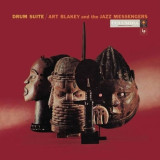
One of the inventors of the modern bebop style of drumming, Blakey is known as a powerful musician and a vital groover; his brand of bluesy, funky hard bop was and continues to be profoundly influential on mainstream jazz.
For more than 30 years his band, Art Blakey & The Jazz Messengers included many young musicians who went on to become prominent names in jazz. Recorded in 1956, Art Blakey's Drum Suite is a wonderful hybrid of African, Latin, and hard bop rhythms that prefigures the concept of Afro-beat by at least a decade. The sheer energy, not to mention its very special and fresh-sounding intimacy, make it especially astounding.
Even more amazing is that the three parts of the suite -- Blakey's "The Sacrifice," Ray Bryant's "Cubano Chant," and Oscar Pettiford's "Oscalypso" -- were recorded straight through live, and were only intended to be a pre-take run-through. As is obvious here, Blakey and company nailed the whole thing right out of the box.
Groundbreaking for its time, and still sounding vital, powerful, and visionary, the Drum Suite album is somewhat of a lost masterpiece that deserves a fresh audience.
"Art Blakey's first release for Columbia Records is essentially two records. Side one is a percussion ensemble playing what would, ten years later, be called Afro-Cuban drumming. Side two is the mid-fifties version of the Jazz Messengers featuring Jackie McLean on saxophone. Side one features Blakey, Jo Jones and Charles Wright on drums, Candido and Sabu on bongos, and Oscar Pettiford and bass and cello. The group plays three compositions, one by Blakey, one by Pettiford and one by Ray Bryant, fusing African, Cuban, and calypso percussion into a well-integrated suite.
"The group recorded a run through and it was so perfectly executed that they used the practice run for the release, unedited except to add some Swahili chants by the percussionists during a few passages. One cannot help but think of Olantunji's Drums of Passion, another Afro drumming landmark, here. Blakey's drum suite was recorded at Columbia's 30th Street studios in New York in 1957 and is in mono. The almost stereoscopic image is truly remarkable. Mastered by Kevin Gray and pressed at RTI, Drum Suite is a valuable record of one of the most important figures in jazz history. Recording: 9/10. Music 9/10." - Dennis Davis, Hifi+
"...The three-part suite was laid down in one take with no arrangements, and begins with a few tympani thwacks followed by an African chant. Soon the ensemble kicks in and the group takes off an a sweaty Afro-Cuban-bop journey that will leave you breathless, as the thing crackles with terrific energy. Side Two is more conventional hard bop, but given this group's mastery of if not invention of the style, these tracks are extremely satisfying. Kevin Gray's remastering is detailed and immediate, with plenty of bit and air, if not the widest dynamic range. For anyone interested in percussion of this genre, this is not to be missed." - Wayne Garcia, The Absolute Sound
Following the success of their first EP "Through Walls", Golden Mean are back with Oumuamua set to be released in May 2023 on London label Jazz Re:Freshed.
Powerhouse drummer Jamie Murray now joins the lineup of Tom Driessler (Yussef Kamaal), Luke Wynter (Nubiyan Twist, Joe Armon-Jones) and Lyle Barton (Emma-Jean Thackray).
Prepare to embark on a journey of soaring melodies, driving grooves, prog-rock choruses, retro synths and free-wheeling improvisation, inspired by the legends of jazz & rock from the 70's until today.'
Julian Cannonball Adderley's only Blue Note album, Somethin' Else, would likely forever be famous in music lore if just for the presence of Miles Davis. The iconic composer/trumpeter steps into the role of sideman on the 1958 set, one of just a handful of times he'd make such a move after the calendar passed the mid-1950s. Yet evaluating Somethin' Else strictly on Davis' involvement misses the big picture. Plain and simple, Adderley's jubilant work remains a jazz landmark due to the chemistry of its Hall of Fame personnel, enthusiasm of its participants, and sophistication of its arrangements – not to mention the reference-grade production and inclusion of the definitive renditions of two all-time jazz standards.
Limited to 6,000 numbered copies, pressed on dead-quiet MoFi SuperVinyl at RTI, and mastered from the original master tapes, Mobile Fidelity's ultra-hi-fi UltraDisc One-Step 180g 45RPM 2LP collector's edition pays tribute to the record's merit and includes the bonus track "Allison's Uncle." Offering reference-calibre sonics, this spectacular collector's version provides a clear, transparent, ultra-dynamic, and up-close view of a cornerstone effort that witnesses Adderley and Davis sharing horn duty alone for the only time in their fabled careers – an arrangement that occurred as a result of Adderley having joined Davis' majestic sextet a year prior.
The premium packaging and beautiful presentation of the UD1S Somethin' Else pressing befit its extremely select status. Housed in a deluxe slipcase, it features special foil-stamped jackets and faithful-to-the-original graphics that illuminate the splendour of the recording. No expense has been spared. Aurally and visually, this UD1S reissue exists as a curatorial artefact meant to be preserved, touched, and examined. It is made for discerning listeners that prize sound quality and production, and who desire to fully immerse themselves in the art – and everything involved with the album, from the iconic photos to the gorgeous finishes.
The vibrant potency reveals itself openly on an analogue set that provides full-range reproduction of an ensemble that also includes pianist Hank Jones, bassist Sam Jones, and drummer Art Blakey. Each and every snare hit, downbeat, and cymbal splash registered by the latter take on realistic proportions, blooming and decaying as they would right in front of you on a stage. Jones' foundational bass lines register with uncommon depth and palpability, the litheness of the strings and fullness of the instrument epitomizing the definition of rhythm. Stellar, too, are the surefooted 88s. Sublime in scale, tonality, and attack, with the delineation such you can practically separate the white and black keys in your mind. As for that liquid interplay between Adderley and Davis? Breathtakingly lifelike in timbre, naturalism, purity, and presence. This collector's version takes you there – there being Rudy Van Gelder's legendary New Jersey studio in March 1958 to witness it all unfold, again and again.
For reasons that extend far beyond the outstanding playing and flawless repertoire, Somethin' Else is without question a record you'll always want to watch and hear come together. As veteran critic Bob Blumenthal observed writing about the album four decades after its release, "The instant rapport achieved by the quintet is thus the product of much shared and common history, though the tensile strength that they create throughout created a totally unique feeling that can be attributed to the sensitive musicianship of all concerned, including the supposedly hard bopping leader and drummer." Such inimitable feeling, or emotion, courses throughout every passage, and no where more obviously than on "Autumn Leaves" and "Love for Sale."
Without question, the discreet interpretations of the Johnny Mercer and Cole Porter songs, respectively, found on Somethin' Else have long been considered part of jazz's alluring mystique. Adderley and Davis bring contrasting approaches to the table yet sound of a singular mind on "Autumn Leaves," with the latter's muted trumpet and the headliner's lush alto saxophone dovetailing into a performance that endures as a blueprint for expression, counterpoint, sophistication, fluidity, and linearity. Blues, melody, and romance pour from their horns. Their bandmates, picking up on the intimate vibe and calm mood here – as well as on the spry, head-over-heels spirit of "Love for Sale" – join in on the conversation with sharp economy and float-on-air roundedness.
Not to undersell the other three numbers, all deserving five-star status. Twelve measures in length, the title track offers a slow burn in swing. Written by Adderley's brother, Nat, the 12-bar "One for Daddy-O" transmits funk flavors. The closing "Dancing in the Dark" pops with lushness and temptation, its stream of bold colours and understated textures calling for a moonlight twirl, or at least fantasies suggestive of a memorable night. Somethin' else, indeed.
The concept of strict musical genre has arguably been dead for decades, and the latest offering from Danish powerhouses Gustaf Ljunggren and Emil de Waal once again reinforces this notion. Their third collaborative album "Stockholm Kobenhavn", a spacious, cinematic and boundaryless exploration of their shared musical connection is set to release on July 7th on April Records. Emil de Waal has been one of Denmark"s leading drummers for three decades. Gustaf Ljunggren initially studied the saxophone at the Rhythmic Conservatory of Copenhagen, where whispers spread throughout the school that he was the best saxophone player in town and yet never practiced. His career has seen him prove that he can bring grace, musicality and heart to any instrument he touches, from the pedal steel guitar, to the bass, piano, and more. In the words of Danish multi-instrumentalist Kresten Osgood, "Although an instrument may be new to him he is able to play it like he has had a lifetime of experience working with it. Over the years I think the only instrument I haven"t seen him play is the drums." "Stockholm Kobenhavn" has a vast array of influences including Jazz, Americana, Film Music and Electronica. It is full of space, coaxing the listener into a meditative state and inviting them to drift away with their own imagination. The record plays as a series of open-ended sketches or moods, absent of big defining melodies or familiar song-like structures. Each piece evolves over time, providing musical interest in the form of rhythmic ideas, rich harmony, texture, and repetitive melodic patterns from a guitar or rhodes. Imaginative electronic production techniques combine the warm sounds of acoustic instruments with a constantly developing palette of otherworldly textures and effects. Grounded by an unwavering pulse, the combination of programmed beats and acoustic drums provide the hypnotic foundation over which the pair explore and challenge their common musical ground. The album closes with an intimate recording from a performance at STUK in Belgium, with a comforting guitar-led Americana tune bringing the listener back into the room and sharing in the joy the duo have felt in playing together over the past twenty years.