2024 Repress
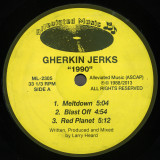
Recorded in 1989, this is one of the rare and sought after recordings by Larry Heard. Never been available since 1990 and a departure from his more familiar style that he released as Mr Fingers, Fingers Inc. and The It). Gherkin has been an outlet for his more experimental and techno-orientated productions. 6 tracks on this record, and everyone seems to have their own favorite... but worth mentioning are the dramatic opener ''Meltdown'', the cosmic ''Saturn V'' and the incredible extra terrestial ''Strange Creatures''. Tracks that are the foundation of the house we live in! - essential!
Suche:d mention
- A1: Hot With Fleas
- A2: Nation
- A3: Unleash Your Sword
- A4: Jetlag
- A5: Contempt
- B1: Bad Mood Guy
- B2: Dressed In Air
- B3: Rabbi Nardoo Flagoon
- B4: Heaven Is What Heaven Eats
- B5: Mad Dad Mangles A Strad
- C1: Bad Mood Guy (Day 1)
- C2: Unleash Your Sword (Day 1)
- C3: Canine (Day 1)
- C4: Nature 10 (Terse)
- C5: Contempt (Day 1)
- C6: I've Always Hated Severed Heads (Live)
- D1: Hot With Fleas (12" Remix)
- D2: Nation (Nyc Mix)
- D3: Canine (12" Remix)
Futurismo present a deluxe vinyl package of the never before reissued 1987 avant industrial album: Bad Mood Guy by Severed Heads.
With an oeuvre of electronic experimentation that dates back to 1979, Australia’s Severed Heads rawly garnered everything from the sources around them: the sounds of the city, tape loops, old machines, distortion.
Although essentially one man, chief noisemaker Tom Ellard, he was joined here by film maker/homebrew video synthesizer operator Stephen Jones, and effects producer Robert Racic: who had worked with New Order. The result is a punishing view of pop, all crunching rhythms and electronic juxtapose. By incorporating popular tropes such as consistent rhythms, melodic vocal lines and drum machines this was perhaps as near to alittle “boogie-oogie-oogie” as Severed Heads were likely to get, but the outcome is a striking hybrid of the avant-garde, EBM and Synth-pop, an industrial vortex in which the sounds of the 20th century are sucked in and spat out around a monstrous dance beat.
Never pandering to expectations, Ellard saw dance music as a benchmark area where exploration was still possible. Big ideas and big sounds, notto mention big headaches when the original CBS mixes were left in a taxi cab. Whilst many of their contemporaries persisted without dignity, Bad Mood Guy’s cool melancholy assured a fanbase in America and dance floor loyalty with ‘Hot With Fleas’, which dares to sit alongside classics like ‘Dead Eyes Opened’. The unique inventiveness inherent in Severed Heads work makes this release essential for fans of Throbbing Gristle, Kraftwerk, Skinny Puppy and Cabaret Voltaire.
This remastered version of the original CD contains lost original versions and remixes and comes with a fold-out artzine booklet with liners by Ellard.
.
At one time participating in ground-breaking medical scientific research, in another a relentless road-trip, hoovering up rare records and tapes, in the nooks and crannies of France, Algeria, or any country that he happens to land in. And then there’s his long standing show for Rinse France.
Following his slamming mix for the Japan Blues show on NTS last year, he kindly offered up a selection for Japan Blues’ first tape release. Algeria is the focus of this tape, taking a brief dip into Sameer’s broad collection, coinciding with his research for his documentary film about the social history of Rai music, "Rai is not Dead" for Arte.
Words from the Hadj: “The medehates are traditional vocal formations of women from western Algeria. Their main role is to give some compliments to the future wife during a wedding, and pray to all the saints through long songs which could last for hours, until reaching a sort of transcendental state amplified by looped percussions, traditional flute, and violon notes. Exclusively for women, no men (including young boys) admitted. This ceremonial tradition gave an intimate space for women to speak out about taboo topics like men-women relationships, love, sins like alcohol consumption etc. Since then, some of them started freely to mention all of that in this small circle and some of them have been recorded live for release on 7″. I picked up a few from my collection in order to make this mix. They represent one of the most powerful and wildest roots of the raw traditional form of rai which appeared in the 50/60s in Algeri
EASYGOING PORTRAIT OF DOWN-HOME SOUL SINGER COMING INTO HIS OWN AND ESTABLISHING AN INDELIBLE BOND BETWEEN PERFORMER AND AUDIENCE
1/4" / 15 IPS / Dolby A analogue master to DSD 64 to analogue console to lathe
On par with the most treasured concert albums of the 60s and 70s, Bill Withers' transformative Live at Carnegie Hall is a forgotten classic – an easygoing portrait of a down-home soul artist coming into his own in front of an audience eager to share every moment of his brilliance. Soothing with subtlety, charming with calmness, and healing with a vocal timbre as relaxing as his grooves, Withers uses the stage to expand the range of favorites and engage in dialog with the crowd. Distinguished with sonics that restore the performances' balance and improve the sound-staging, this reissue takes you inside the venue.
Moreover, aspects that really make this concert document unique – the energetic crowd, Withers and his band's willingness to extend arrangements, and the undeniable communicative bond between the performer and his fans – are brought into fuller relief. While most live albums give you the sense of what transpired, our reissue allows it to seem that what you're hearing and sensing is happening right now, in the moment. You are as much a participant as listener. For this reason and more, Live at Carnegie Hall ranks with James Brown's Live at the Apollo and B.B. King's Live at the Regal. No small claims, but the proof is in the grooves.
The antithesis of the sweaty R&B shouter that prowls the edge of stages, Withers deals in mellowness and vulnerability, qualities that come to fore. The songs here span soul, blues, and folk and often times, contain elements of all three styles. Live at Carnegie Hall also deals with serious subject matter with unflinching honesty and simple directness. Companionship, poverty, war, maturity, family, and love all crop up within Withers' tunes, yet the messages are never overly cumbersome or preachy. Credit goes to his easygoing style and relatable lyrics, not to mention a tight-as-a-vice band that on this night is simply "on."
"One more time?" Withers asks in response to a request for another stanza during "Use Me," and like the snap of fingers, his musicians are right back on cue, the crowd clapping along on every beat. This classic, as well as the instantly familiar "Ain't No Sunshine," poignant "Grandma's Hands," and all-time favorite "Lean On Me" are delivered with utmost soulfulness, passion, and electricity. Few, if any, live albums demonstrate such a bond between the crowd and artist as Live at Carnegie Hall. You'll definitely want to be there.
2023 Repress
New York, early 90's, the haydays of the New York and Jersey clubhouse! With labels such as NuGroove, Nervous, Freeze, Strictly Rhythm, Henry Street Music taking all the spot light, there is Jovonn working on a small but sensational catalogue of music that somehow gets overshadowed by the popular releases on the mentioned labels. The honest productions, jazzy melodies and playful vocals (rooted in gospel) were taking things into a more musical, more spiritual way, lacking gimmicks or dispensable samples. For the real diggers, the true lovers of House music Jovonn always was a name to watch, a producer of some of their favorite NY house tracks, tracks that have a raw edge combined with a sincere human touch and pure underground house vibes. People such as Rex resident Dj Deep was a huge fan, and also collaborated on couple later productions with Jovonn. Slowly he started getting recognition from europe which resulted in a handfull of records on European labels such as Distance, Coco Soul and Estereo. Now after almost 25 years since his first release the man's small discography on his own Goldtone label and Emotive records stand out with his unique musical personality. More then 20 years after their original release dates these tunes are still very relevant and stand for many things we love about house music! We are happy to offer this selection of his hard to find early works remastered by Alden Tyrell and pressed on fresh clean high quality vinyl.
Seven Steps to Heaven arrived at a crucial junction in Miles Davis' career. Recorded at two separate locations in spring 1963, it served as Davis' first release in more than a year – a layoff that was then unprecedented for the jazz visionary who had issued at least one LP a year since debuting in the early '50s. Equally notable, Seven Steps to Heaven marks the point at which the core of Davis' Second Great Quintet started to assemble. The twice Grammy-nominated effort is also Davis' final studio record to blend standards with originals. And it happens to be one of the expressive, well-played albums in the jazz canon.
Sourced from the original master tapes, pressed at RTI, and housed in a Stoughton gatefold jacket, Mobile Fidelity's 180g SuperVinyl LP of Seven Steps to Heaven adds yet another step (or more) towards the bliss suggested by the album title. Playing with standout clarity, detail, tone, and balance, this audiophile reissue pulls back the curtain on the instrumentalists. Afforded the tremendous advantages of SuperVinyl – including a nearly inaudible noise floor, dead-quiet surfaces, and superb groove definition – this numbered-edition version presents Davis and Co. amid a wide, deep soundstage whose dimensions and solidity help bring the record's historical importance and musical merit into focus. Warm, organic, and present, the SuperVinyl LP of Seven Steps to Heaven is what great-sounding hi-fi is all about.
And there's nary a passage on this 1963 landmark that isn't great. That Davis manages to make it feel so cohesive and seamless is a testament to the inspired performances and engaging compositions. Davis didn't draw it up the way it unfolded. No matter. He held trump cards that stayed up his sleeve for the next three decades: A drive to be nothing less than superb, a refusal to settle for mediocrity, and standards to which nearly no other composer or player could match. "The toughest critic I got, and the only one I worry about, is myself," Davis wrote in the liner notes. "The music has to get past me."
Davis' demanding approach partly explains why he switched up his band between the first and second sessions – and underscores how fast his mind was racing with new ideas. Seven Steps to Heaven acts as the stable bridge between the transitional period that followed the dissolution of his First Great Quintet and formation of the Second; without it, Davis perhaps doesn't invite then-23-year-old Herbie Hancock and a still-teenage Tony Williams into the fold. The trumpeter not only got his men – he preserved in amber for the only time (well, magnetic tape anyway) the chemistry and vibe he achieved with pianist Victor Feldman, drummer Frank Butler, tenor saxophonist George Coleman, and bassist Ron Carter.
That line-up gels for half of the six songs on Seven Steps to Heaven. Captured in Los Angeles April '63, the quintet stretches out on a luxurious reading of the late '20s New Orleans staple "Basin Street Blues"; lays on the romance for a candlelit stroll through the '40s standard "I Fall in Love Too Easily"; and explores the rounded contours and melodic crevices of the early blues "Baby Won't You Please Come Home." The performances are refined, elegant, emotional; the band lets the feelings linger and gives the listener time to absorb the colours and textures.
A month later, Davis returned to New York City with Coleman and Carter, and partnered them with Hancock and Williams. Tellingly, the quintet tried its collective hand at the title track and "Joshua" – Feldman-penned songs already recorded in Los Angeles – as well as the yearning "So Near, So Far." Those are the tunes that comprise the other piece of Seven Steps to Heaven, with the revised quintet's liquid pulse, articulate dynamics, and timing shifts a harbinger of things to come.
It's also worth mentioning that the interpretations of the bounding "Seven Steps to Heaven" – a showcase for Davis' trumpet – and interlocking "Joshua" netted considerable radio airplay and attracted the attention of other contemporaries who covered the songs. Keeping Carter and Williams as the rhythmic engine, and Hancock as the anchor between solo flights and structural motifs, Davis would soon soon welcome Wayne Shorter into the family and transform jazz. Again. The aptly – and, in hindsight, perhaps prophetically titled Seven Steps to Heaven – is how he got there.
- A1: When The World Is Feeling Blind (Feat Arya &Amp; Tahnee Rodriguez)
- A2: Cambio Di Stagione
- A3: Frastuono
- A4: Tipografia Miserere
- A5: Little Girl Ready For Big Dreams (Feat Mei &Amp; Tahnee Rodriguez)
- A6: Polibomber
- A7: Badanti
- A8: Bacigalupo
- A9: The Big White Shark
- A10: Dentro Fuori
- A11: Elena O Nadia Flashback
- B1: It`s Like Blanca
- B2: Epico Lirico
- B3: Carignano
- B4: Fatti Sentire
- B5: Nessun Dorma Da &Quot;Turandot&Quot; (Feat Francesca Biliotti)
- B6: Sampierdarena
- B7: Giostra
- B8: Sembra Ieri
- B9: Habibi Lullaby (Feat Rahma)
Calibro 35 unleash the new OST for the second season of TV series BLANCA, to be released on limited edition LP on December 1st 2023.
Italian cinematic cult outfit CALIBRO 35 announces the release of the ORIGINAL SOUNDTRACK of the second season of BLANCA, the TV series produced by Lux Vide in collaboration with Rai Fiction, broadcast in prime time on Rai 1 starting from Thursday, October 5th 2023 and directed byJan Maria Michelini and Michele Soavi. The soundtrack will be released worldwide on limited edition, crystal clear LP next December 1st via Milan based label Record Kicks.
The new thrilling episodes of Blanca Season 2 follows the success of the first season, that was aired worldwide on Netflix, M6 France and Telecinco Spain. Accompanying the journey is once again the original music of CALIBRO 35 the Italian "cult" cinematic combo active for over 15 years and with a fan base that includes superstars such as Dr.Dre, Jay-z and Damon Albarn. Made up of 20 tracks in total, the OST was entirely composed by CALIBRO 35 that created the sound universe of BLANCA: an impressive and choral work, which has engaged all the components of the band for a long time, giving the them the opportunity to develop a very vast soundscape.
"It's the first time that we deal with the creation of a 'season 2' and we discovered that the creative process can be very different" Calibro 35 says. "In the first season, we had to build from scratch a sound and musical world consistent with the idea that Jan had (Michielini, director and showrunner of the series); this time, however, we had to develop that already existing world further, in order to describe the new stories and new different characters of the second season. There had to be undiscovered musical territories, that forced us to step out of our comfort zone." The result is that on the 20 tracks of the ost, the heavy dose of Calibro's signature funk grooves of tracks such as "Badanti, "Carignano", "Cambio di Stagione" or "Sampierdarena" is mixed with more moody and soulful tunes, world music, opera and atmospheres à la John Carpenter. Amongst the album's highlights worth definitely a mention the Opening and End titles that feature the voices of Arya, MEI and Tahnee Rodriguez. Essential contribution to the recordings were made by Francesca Biliotti - mezzo soprano of the Monteverdi Choir, Valeria Sturba - exceptional multi-instrumentalist of the avant-garde music group OoopopoiooO, Rahma Hafsi and Elisa Zoot.
Described by Rolling Stone as "the most fascinating, retro-maniac and genuine thing that has happened to Italy in the past few years", Milan-based Calibro 35 enjoy a worldwide reputation as one of the coolest bands around. Active since 2007, during their long career they were sampled by Dr. Dre on Compton ("One Shot One Kill" feat. Snoop Dogg), Jay Z ("Picasso Baby"), The Child of Lov & Damon Albarn ("One Day") and Demigodz ("The Summer Of Sam"). They played major venues and festivals all over Europe and as unique musicians they collaborated with, amongst others, PJ Harvey, Mike Patton, John Parish, Stewart Copeland and Rokia Traoré. The BLANCA OST is the latest of many activities concerning cinema for CALIBRO 35: the band has been completely immersed in the world of soundtracks since the very beginning and they have recently worked on other productions as well, both as Calibro and individually. Last June, the band released their 8th studio album, NOUVELLES AVENTURES, recorded in Naples at Auditorium Novecento. With the new LP the group has made full use of their knowledge and resources, refined and enriched over the years, back to making "Calibro's music": a unique mix of funk, progressive rock, alternative jazz and wide-spectrum cinematic music the public has known them for in fifteen years of career.
Javier Jiménez Rolo surprises with Saint Malo, a project that explores the intersections of neoclassicism, folk, ambient and electronic textures.
That Saint-Malo is a town in Brittany is the least of it. Even the fact that it exists is unimportant. Javier has never been there. Similarly, his album takes us to remote or not so remote places without moving from where we are. Javier composed these twelve songs between 2019 and 2021 from his room: "One of the problems with recording at home rather than in a studio is that when you move, your recording space changes too. In the case of this album, I was involved in three moves during its whole process. Trying to see the positive side of this situation, I realised that, as well as a collection of songs, it was a testimonial to the different places where I had lived during those years and their respective views: 'Promenade' is an imagined walk from an interior flat; 'Picture In A Frame' is a sunny afternoon in a park in Ciudad Lineal, Madrid, and 'Bells Of Nowhere' is a stroll through the neighbourhood that was once my grandparents' and is now mine."
It's an eminently evocative album but also powerfully narrative, which moves through different emotional states. Along the way, references as heterogeneous as Javier's own tastes come up. From the inevitable Arvo Pärt, Max Richter and Steve Reich to the more unsuspected Thom Yorke, Burial, Caribou, Vulfpeck or even Dua Lipa. Stéphane Grappelli, Andrew Bird, Nils Frahm, Olafur Arnalds or Rene Aubry are other names Javier mentions when he talks about something similar to influences.
The journey, during which the songs miraculously fit with magical precision to the landscapes we are travelling through, begins with the promising 'Beware Of The Dogs' and 'Maltravieso'. It is followed by the obsessive arpeggios of 'Le Havre' that give way to the luminous 'Fields Of Gold', the emotion of 'Cais do Sodré' and the passionate 'Le pont roulant', reminiscent of a restrained Alexandre Desplat. Along the way, dogs will bark, rain will fall on the 'Promenade' and the sun will come out with the perfectly playful 'Dolce Far Niente' ("a mix between elevator music and a song announcing the arrival of summer" according to Javier) in which echoes of Isao Tomita and Raymond Scott resound.
The result of this captivating, unexpected and suggestive mixture is Saint Malo, Javier Jiménez's first album and the empirical demonstration that he does not have, despite his classical training, any red lines. "I've always flirted with jazz, with swing... Then I moved on to messing around with loops, to doing more ambient and experimental things. I also had my folkie phase with the klezmer group Barrunto Bellota Band..."
In Saint Malo the melodies grow, become small, return and intertwine with loops and improbable aromas, to form an album that describes a journey through emotions. From melancholy to joy and the surprise of first discoveries.
Javier Jiménez Rolo surprises with Saint Malo, a project that explores the intersections of neoclassicism, folk, ambient and electronic textures.
That Saint-Malo is a town in Brittany is the least of it. Even the fact that it exists is unimportant. Javier has never been there. Similarly, his album takes us to remote or not so remote places without moving from where we are. Javier composed these twelve songs between 2019 and 2021 from his room: "One of the problems with recording at home rather than in a studio is that when you move, your recording space changes too. In the case of this album, I was involved in three moves during its whole process. Trying to see the positive side of this situation, I realised that, as well as a collection of songs, it was a testimonial to the different places where I had lived during those years and their respective views: 'Promenade' is an imagined walk from an interior flat; 'Picture In A Frame' is a sunny afternoon in a park in Ciudad Lineal, Madrid, and 'Bells Of Nowhere' is a stroll through the neighbourhood that was once my grandparents' and is now mine."
It's an eminently evocative album but also powerfully narrative, which moves through different emotional states. Along the way, references as heterogeneous as Javier's own tastes come up. From the inevitable Arvo Pärt, Max Richter and Steve Reich to the more unsuspected Thom Yorke, Burial, Caribou, Vulfpeck or even Dua Lipa. Stéphane Grappelli, Andrew Bird, Nils Frahm, Olafur Arnalds or Rene Aubry are other names Javier mentions when he talks about something similar to influences.
The journey, during which the songs miraculously fit with magical precision to the landscapes we are travelling through, begins with the promising 'Beware Of The Dogs' and 'Maltravieso'. It is followed by the obsessive arpeggios of 'Le Havre' that give way to the luminous 'Fields Of Gold', the emotion of 'Cais do Sodré' and the passionate 'Le pont roulant', reminiscent of a restrained Alexandre Desplat. Along the way, dogs will bark, rain will fall on the 'Promenade' and the sun will come out with the perfectly playful 'Dolce Far Niente' ("a mix between elevator music and a song announcing the arrival of summer" according to Javier) in which echoes of Isao Tomita and Raymond Scott resound.
The result of this captivating, unexpected and suggestive mixture is Saint Malo, Javier Jiménez's first album and the empirical demonstration that he does not have, despite his classical training, any red lines. "I've always flirted with jazz, with swing... Then I moved on to messing around with loops, to doing more ambient and experimental things. I also had my folkie phase with the klezmer group Barrunto Bellota Band..."
In Saint Malo the melodies grow, become small, return and intertwine with loops and improbable aromas, to form an album that describes a journey through emotions. From melancholy to joy and the surprise of first discoveries.
It might be his debut album, yet Peacey’s “Play It By Ear” is a body of work crafted as though by a scholar. And where better for this work to emerge from than Derby, UK’s Atjazz Record Company, a label with a rich heritage and many strings to its bow?
This eclectic sonic journal catalogues the evolution of Peacey, documenting his interactions with, and influences from, some of dance music’s notable players. It’s an album that will attract discerning ears and open minds; minds attuned to a multitude of genres as it visits Hip Hop, R&B, House, Garage and Fusion.
'Culture Bandit' is the 2nd single taken from this colossal album, and gives us a great understanding that Peacey really knows where to hit it! It’s a deep banger of course, with a hint of tech-house, deep-house and even the more percussive side of afro-latin house, but with the electrifying vocals of Vanessa Hidary atop, this will go down in history as “One of those tunes”. To say this song has life is an understatement. So we’ve covered that, did we mention that Osunlade & Atjazz have also remixed this killer slice? Ah, well they have, and they join Peacey on this pristine release to give alternative angles on this wild, spoken and edgy outing.
First Word Records are very proud to bring you a new album from Don Leisure with Amanda Whiting. 'Beyond The Midnight Sun' expands upon ground first explored on Don Leisure's track 'All Praises Due', which also featured Amanda (with Angel Bat Dawid), and featured on his previous album 'Shaboo Strikes Back'.
This is a full-length project that these two formidable Welsh artists have collaborated on together. To bring you up to speed, Cardiff DJ and beat-maker Don Leisure has been twice nominated for the Welsh Music Prize, with the afore-mentioned album 'Shaboo Strikes Back', and a previous project, 'Steel Zakusi'.
As well as being 50% of Darkhouse Family with Earl Jeffers, he's released music under various monikers on labels such as Metalheadz, International Anthem, Fat City, Earnest Endeavours, Group BraCil and on Rough Trade with another regular collaborator, Gruff Rhys. Other collabs have included Charlotte Church, Om'Mas Keith, DJ Spinna and First Word label-mate Tyler Daley ...
Vecchio's Afro-Rock is one big horn-heavy, bass-blasting, Latin groove funk-rock party. Only now, you're all invited because this, ladies and gentleman, is officially...a grail no more. With copies currently starting at 400 Euros for an original, this beautifully presented reissue, part of Be With's fresh campaign with Music De Wolfe, is well overdue. A magnificent and somewhat obscure library set that's just a total, cohesive joy from start to finish, this here is the soundtrack to all your smokin' summer BBQs and communal cookouts.
Afro-Rock is the debut album by Argentine keyboardist Luis Vecchio. Recorded for the sound library label De Wolfe, the album is frequently mentioned in hushed reverence among the beat digger DJ collecting crowd. It features fiery brass charts, funky bass lines, fluttering flute, choppy organ and additional hand tribal percussion. The band let loose too and jam hard; yet there's a certain thread of solidity that runs throughout, the tracks just belong together, not disparate sound and rhythm experiments like some library records; this is just straight up, no messin', consistent funk-rock FIRE! Hips will sway, heads will nod to the steady vibes. It's insanely good.
The humid, building funk of the appropriately titled "Megaton" is a dramatic explosion of swirling, dazzling organ lines, ferocious beats and heavy horns throughout. It just don't stop. The tempo slows slightly for the deep and deeply addictive "Renegade". It's all heavy jazz horn refrains, always triumphant, coupled with devastating percussive breakdowns and killer guitar riffing. It's an insistent organ-led juggernaut. The frenetic "Facade", up next, is no less driving, horns high up in the mix over rattling percussion and brilliant organs lines. Just sensational. The bright "Chabati" is another glorious extension of the optimistic Vecchio sound, the organs wilder than ever before. The moody "Green Hell" is a real highlight and closes out the A-Side with some outrageously funky refrains - be it horns, organ or guitars - and is complimented by gorgeous flute work that galvanises the piece, elevating it to downright heavenly status.
Knowing full well that he's on to a surefire thing, Vecchio opens the flipside in much the same vein. Indeed, "Boss" is yet another uptempo highlight, a sensual orgy of proud horns, hand percussion and melodic flute playing over driving organ and guitars. It's followed by "Nsambei", which is rightly adored for its briefly open drum break, fantastically propulsive percussion breakdowns throughout and the jazzy, loose organ and guitar shreds. The bright "Waboco" ups the tempo and the pressure, hanging on one hell of a guitar hook and infectious horn refrain. Perhaps foreseeing how this album would come to be viewed, the aptly-titled "Cult" is possibly the finest song on the record. Which is saying something, because this record is insanely good. Riding a steady, confident organ groove straight out the gate, the kinda melancholic flute line over the top serves as a beautiful counterpoint which the horns often come in and imitate/riff off. Goddamn this is so so good, it needs to be played everywhere. The overwhelmingly mighty 7-minute jam "Ngoma-ku" rounds out this quite staggering record brilliantly in its heavy, mid-tempo blues with countless extended solos.
The audio for Afro Rock has been meticulously remastered by Be With regular Simon Francis, ensuring this release sounds better than ever. Cicely Balston's expert skills have made sure nothing is lost in the cut whilst the records have been pressed to the highest possible standard at Record Industry in Holland. The original, iconic sleeve has been restored here at Be With HQ as the finishing touch to this long overdue re-issue.
- A1: James & Bobby Purify – My Adorable One
- A2: Arthur Alexander – I Need You Baby
- A3: Walter Jackson – It´s Hard To Believe
- A4: Maxine Brown – Don´t Leave Me Baby
- A5: Shirley Brown – When You Really Love Somebody
- A6: Dream Machine – All My Love
- A7: Soul Children – Midnight Sunshine
- B1: The Isley Brothers – Here We Go Again
- B2: Johnnie Taylor – You´re The Best In The World
- B3: Gladys Knight & The Pips – More, More, More
- B4: Gil Scott-Heron – Your Daddy Loves You (For Gia Louise)
- B5: Aretha Franklin – The Wind
Whatever condition your condition is in, Soul4Real have huddled together a team of the finest soul physicians to make you feel good.
We scoured all the shelves in the soul pharmacy and discovered some potions that were only just through the trial stage. Just one listen to the brilliant Aretha, Gladys, Walter Jackson and the Purify’s tracks convinced us not to wait for FDA approval, so we took the plunge and shared them with the world on vinyl for the very first time.
Recorded in 1968, Arthur Alexander‘s magnificent “I Need You Baby” reached legendary status during the tape-swapping epidemic of the late 70s/early 80s. The first traces of Alexanderitus were linked back to a tape dispensed by a north London mod by the name of Randy Cozens, which went viral. Even today, the mere mention of the title to any of those C60-swap-survivors can cause severe heart palpitations.
Down in Memphis, they tend to practice the holistic approach to heartaches. Southern folk understand it’s about the voice and its natural healing powers, especially when it’s being administered by the likes of the Soul Children and Shirley Brown, who instinctively inject the perfect amount of ache, warmth and emotion to hit just the right spot. May we prescribe at least two listens a day, taken with or without food.
Helping with recovery we have included tracks by our care team Maxine, Gil Scott-Heron and the Isleys, whose gentle grooves will help nurse you back onto the dance floor in record time.
And finally, my personal favourite, Dr Johnnie Taylor. Frankly, it beats me how someone who delivers the lines "she don’t break no records when it comes to good looks” and “she burns up the food when she cooks" to his girlfriend manages to avoid a trip to A&E. We decided such foolish bravery should be rewarded by having his picture on the album cover.
12 tracks, all great examples of real soul music, a mix of well known classics, overlooked gems, and 4 original unreleased songs.
Repress!
Redolent with the spirit of such high priests of effects and delay as Loop, Spaceman 3, and My Bloody Valentine, not to mention a fair dollop of the Jesus and Mary Chain . Methodrone clearly is the sum of its influences. Thankfully BJM does a very solid job with them throughout the album's course of over 70 minutes.
Black Vinyl[21,13 €]
Bathed in a green haze, the crowd oozed to the mutant rock and roll roaring from the basement's dusty depths — everything and everyone was sweaty and sticky. But as Speedy Ortiz crammed into the back corner, their grins just inches away from ours, D.C.’s Dougout became a moshed-and-sloshed sauna of 20-somethings delirious on rock euphoria.
After spending much of the new millennium bored out of my skull by network soap indie, Speedy Ortiz — not to mention its pals in Pile, Ovlov, Grass is Green and the rest of New England’s burgeoning basement scene — was rock's wild howl. The songs were unpredictable, yet weirdly memorable, swaggering with a winky and wry sense of self. Riffs would twist with a topsy tenderness, then slam a ruptured discord. Sadie Dupuis' sphinxian-yet-sensitive lyrics were not only matched but accentuated by her coil-sprung vibrato. How could Speedy Ortiz not immediately become my new favorite band?
What began as a short-lived solo project recorded in Dupuis' off-hours as a rock camp counselor became a four-piece band in Northampton, Mass., by the end of 2011: Dupuis on guitar and vocals with drummer Mike Falcone, bassist Darl Ferm and guitarist Matt Robidoux. They made cool mixtapes, cracked inside jokes and gushed about teenagers that opened for them on tour. They freaked out (via LiveJournal) when they met the bassist from Polvo or Helium's Mary Timony, but also rolled their eyes at '90s indie-rock comparisons. The band's first single — the gender-bending got-laid grunge yowler "Taylor Swift'' — elicited that rare response of the simultaneous giggle and headbang. The Sports EP amped up the taut yet rubbery riffery.
Released July 9, 2013, Major Arcana is filled with wedding chapel exorcisms, oiled-down attractants and criminally twisted puny little villains — this is Dupuis' haunted lexicon as she scales the toxic Aggro Crag of a breakup. And while Dupuis wrote these songs, the band's convulsing arrangements and diverse influences sprawled the squigglier edges of feedbacked fuzz to mete out matters of the heart. Falcone — who, it's worth noting, has a knack for vocal harmony — swung as much as he smashed the drums. In easily tipoverable songs, Ferm's burly bass and percussive overdubs gave the unruly glee its momentum. Robidoux ripped skronky guitar solos and countered Dupuis' riffs with decorative splatter. Over a four-day marathon session at Sonelab in Easthampton, recording engineer Justin Pizzoferrato sparked the studio imagination of Speedy Ortiz — not only leaning into gritty tones but layer-caking dense dynamics that made these songs pop and pulverize.
For all her sweet-toothed seething, Dupuis was not easy on herself. Everyone's allowed the idiot growing pains of your 20s and the misery that follows, but I can only imagine the emotional exhaustion that playing these songs on the road, night after night, must have wrought. "But you left something on my lips: a mark so sick," she repeats over the doomy destruction that ends the album. Thinking back to the many Speedy Ortiz shows I caught in those early years, including an unofficial after-after party for my own wedding, "MKVI" often served as the noisy down-and-out closer — heads would bang in solidarity as the crowd became co-authors in the chaos, the biting phrase now a hex, Speedy Ortiz forever our coven. —Lars Gotrich
To celebrate the 10th Anniversary of Major Arcana, Speedy Ortiz release a remastered edition on Carpark Records.
Considered one of the most innovative groups on the Colombian musical circuit in 1973, Columna de Fuego forged its sound by creatively and organically mixing elements of heavy rock with rhythms rooted in the music of the Pacific and Caribbean coasts of the country. Columna de Fuego, the first Colombian rock band to tour outside South America, was the supporting act for Leonor González —La Negra Grande de Colombia— for months and featured members of Los Young Beats, Los Speakers and Siglo Cero. Their only LP, recorded in Spain and released in Colombia only in 1974, was a turning point in the history of Colombian rock, an album full of funk, soul, cumbia and currulao that maintains a fast pace from start to finish. After unsuccessful attempts to establish themselves in Europe, the group parted ways; some members returned to Colombia and others stayed in Europe as part of La Banda Salsa, a vibrant and little mentioned chapter in the history of Latin rock. Roberto Fiorilli, the stand-out drummer of Colombian rock, returned to his native Italy. Over the following five decades, the myth of Columna de Fuego, that wonderful Bogota rock band that dared to experiment with the music of the Colombian coastline, grew. The curiosity of musicians interested in the traditional music and folklore of the coasts since the late 80's, the consequent mixture of different musical genres (modern and roots) at the end of the 20th century and the almost impossible desire of collectors to find a copy of the album or one of the band’s singles, gave it the status it should always have had as a pioneer, milestone and beacon. After remaining unavailable for five decades, we are proud to now present the first-time reissue of this obscure gem with its original artwork, including an insert with notes and rare photos. Sleeve
‘Double Pink’ is the debut album by And Is Phi (Andrea Isabelle Phillips), a multidisciplinary artist from Norway and the Philippines now based in South East London. ‘Double Pink’ is a nuanced world that draws on colours and texture; with influences of Joni Mitchell and Frank Zappa, 90's R&B and Madlib’s ‘Shades Of Blue’ blending languidly to produce a base for uncovering layers of self, a deep release, and fragile new form.
Written by Andrea and co-produced with Fiona Roberts and Lorenz Okello over a nine month period; ‘Double Pink’ thematically explores the many movements of internal change, speaking from a deep inner voice inside the body. The title track is an invitation to be as unapologetically hungry as you please after a long absence of life giving passion and trust in oneself. ‘White Noise’ is a recovery song playing in your soul the first time you made it back out to the dance floor after a heart break so massive it laid rest to the person you used to be. Songs like ‘Working’ and ‘Staaar’ come from a candid and contemplative aspect. Stages of grief and resilience and wonder and wisdom are all touched upon.
“The album explores metamorphosis, liminal spaces, and the multiple faces of love”, says Andrea. “I mention love as a key ingredient, because anyone who has had to push and pull and hold and yield themselves through great loss and transformation knows it ain’t gonna happen without love. Tough times ask for double love, a stronger heart, something like a double pink”.
Andrea’s story dots between periods spent living in Norway, the Philippines and England - experiencing joy and beauty battling corruption and violence in Manila, DJing in Oslo, losing her sizable record collection in a warehouse fire before making friends and family in the jazz scene in London. Every story needs a scene, a landscape, an environment; all things Andrea visualises when writing songs.
“At my heart I am emotional and imaginative, searching for freedom for my spirit. What grounds it all is coming from a family of storytellers. My father played drums and percussion, he was a great dancer and a true collector and connoisseur of music from everywhere. My wise mother instilled in me a sense of faith and grace”.
Andrea is far from new to the scene, having performed with Steamdown, Emma Jean Thackray, Hector Plimmer, Scrimshire, William Florelle and many more as a valuable and inspiring creative force within the South London music scene. Andrea also created the album’s artwork and music videos: musicality and painting evolved from her initial creative languages of drawing and dance. All aspects are dialects of her common language: singing what can’t be painted and painting what can’t be sung.
Formed in 1987 in Umeå, Sweden, Meshuggah has been called "one of the ten most important hard and heavy bands" by Rolling Stone and enjoys the respect and admiration of fans and musicians alike. It is impossible to talk about experimental or avant-garde metal without mentioning this truly groundbreaking band: MESHUGGAH mix ultra-complicated rhythmic patterns with massive riffs and aggressive growls, combining death metal, mathcore, thrash and progressive metal to create their unique style. The year 2023 now marks the 25th anniversary of one of the band's first milestones, "Chaosphere".
Originally released on November 9, 1998, Meshuggah's third studio album shows the band toning down some of the thrashier sounds of earlier releases in favor of the more technical, polyrhythmic and groove-oriented sound they would explore on subsequent albums.
The album includes the songs "New Millennium Cyanide Christ", "Corridor of Chameleons" and "Neurotica", among others, which are some of the band's most streamed tracks.
Formed in 1987 in Umeå, Sweden, Meshuggah has been called "one of the ten most important hard and heavy bands" by Rolling Stone and enjoys the respect and admiration of fans and musicians alike. It is impossible to talk about experimental or avant-garde metal without mentioning this truly groundbreaking band: MESHUGGAH mix ultra-complicated rhythmic patterns with massive riffs and aggressive growls, combining death metal, mathcore, thrash and progressive metal to create their unique style. The year 2023 now marks the 25th anniversary of one of the band's first milestones, "Chaosphere".
Originally released on November 9, 1998, Meshuggah's third studio album shows the band toning down some of the thrashier sounds of earlier releases in favor of the more technical, polyrhythmic and groove-oriented sound they would explore on subsequent albums.
The album includes the songs "New Millennium Cyanide Christ", "Corridor of Chameleons" and "Neurotica", among others, which are some of the band's most streamed tracks.
Celebrating the 30 anniversary of this legendary cult band from Argentina, with more than 150 releases in labels from Japan, Europe, Oceania, Latin America and USA and shows played and their music presented all over the world. A nondescript, experimental, truly original band with a story to match their legacy. LP includes fold out insert. At last! A comprehensive compilation documenting the exciting career of the legendary experimental Argentinian cult band. A career overview through eight of their most mesmerizing compositions. The fact that their drummer and singer Miguel Tomasin has down syndrome not only makes them one of the longest-running and most notable inclusive rock bands of all time, but also allows us to appreciate the importance of Miguel's creative contribution, both for his singular way of singing and for his inimitable verbal inventions. For his work with the band, Miguel stands as one of the most relevant personalities with down's syndrome in the world and his name appears mentioned in diverse books of neuroscience and neurodiversity. Their long list of collaborators includes luminaries such as Lee Ranaldo (Sonic Youth), Pauline Oliveiros, Damo Suzuki (Can), The Nihilist Spasm Band, Michael Snow, N U Unruh (Einstürzende Neubauten), Alan Licht, Pajarito Zaguri, Acid Mothers Temple, John Oswald and many more.