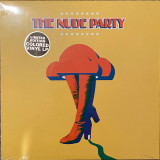
Senselessness 1/2 is the very first solo issue of the Swiss electronic composer Robin Félix, on his own label De l’Aube (Of Dawn), the occasion for him to prove that field recordings can be (or should be?) an integral part of the global matter, when so often they are just something hovering in the background because it’s “nice” or reminds the artist of a place he loves.
Throughout the length of these four tracks, they are litterally central; moreover, they are electronically transformed, manipulated, skewed and twisted in order to form some sort of framework, a backbone on to which sounds and genres intertwine. On Cluster, violins and cellos (recorded in the gardens of the Venice Biennale) are soon transmuted into the abrasions of the electroacoustic realm, until the pulse of a relentless bass introduces a pure and pristine electronic music that knows and uses the roots of dub, drum’n’bass and the meticulousness of Jan Jelinek’s Glitch aesthetics. A tad “housy”, Chi comes as a second pulse where a modified didgeridoo and African percussions (recorded in a Swiss forest) lead the listener to a sort of tribal mode, as suited to dancers than to those who prefer inner journeys; here, the spatial dub of King Tubby moves from background to foreground.
The more abstract Boiler verges on the IDM and the heady, elegant and spartan Detroit techno – headphones reveal its numerous minute and delicate details. Based on the recording of insects, of which one can hear the actual rubbing of elytras, the closing Swarm ends the record with and intricate blend of ambient, which in some way winks to the Aphex Twin and The Future Sound Of London. Overall Senselessness 1/2 is a mesmerising and concise update of the famous Deutsche elektronische musik of old, that gathered on its way the other genres that made Robin Félix tick. Since field recordings have hardly been that meaningful, one wonders where Senselessness 2/2 will lead us to
Buscar:d part
Krystal Klear returns to Running Back with another batch of purpose-built dance floor tracks. The name? Personal. It means something, but that bit stays off the press sheet.
Written during a particularly charged stretch of inspiration, these tracks aim to soundtrack every hour of the night: from the hopeful haze of doors open to the bitter-sweet buzz of lights on.
Crafted as quiet tributes to nights out and DJ booths in Germany, Scotland, and London, places where sweat meets sub, and the USB never quite ejects.
The formula? Unchanged and undefeated: heavy drums, melodic inflections, more ARPs than strictly necessary, and something emo stirred in for good measure. Dance music for dancers. Or at least for the idea of them.
- 1: Roberto Múkaro Borrero– Direcciones Taino
- 2: Nahko– 4Th Door, Featuring
- 3: Nahko– Lifeguard, Songwriter – Adam Korbesmeyer, Jerry "Jl" Lang Ii*, Nahko
- 4: Nahko– Slow Down, Songwriter – Nahko
- 5: Doug Good Feather– Healing Song (Interlude)
- 6: Nahko– Is What It Is (The Coyote Burial), Songwriter – Adam Korbesmeyer, Jerry "Jl" Lang Ii*, Nahko
- 7: Nahko– Give It All, Songwriter – Nahko
- 8: Nahko– Garden, Songwriter – Nahko
- 9: Dion Montero– Defend The Sacred (Ilocano Welcome Chant)
- 10: Nahko– Dear Brother, Featuring
- 11: Nahko– Part Problem, Songwriter – Nahko
- 12: Dianne Bell– Music Was His Medicine (Interlude)
- 13: Nahko– Twisted, Songwriter – Adam Korbesmeyer, Jerry "Jl" Lang Ii*, Max Ribner, Nahko
- 14: Nahko– Bend Like The Willow, Songwriter – Jose Patricio Zuniga Labarca, Justin Chittams, Max Ribner, Michael Joseph Hall Ii, Nahko, Tj Schaper, Timothy Michael Snider*
- 15: Nahko– Take Your Power Back, Songwriter – Jose Patricio Zuniga Labarca, Justin Chittams, Max Ribner, Michael Joseph Hall Ii, Nahko, Tj Schaper, Timothy Michael Snider*
- 16: Pua Case– Oli Kūkulu
- 17: Nahko– Honor The Earth, Songwriter – Adam Korbesmeyer, Jerry "Jl" Lang Ii*, Nahko
- 18: Nahko– Skin In The Game, Songwriter – Nahko
[b] 2 Nahko– 4th Door, Featuring [Feat] – Natalie Schepman, Songwriter – Jose Patricio Zuniga Labarca, Justin Chittams, Max Ribner, Michael Joseph Hall II, Nahko, Timothy Michael Snider*, Tj Schaper
[j] 10 Nahko– Dear Brother, Featuring [Feat] – Xiuhtezcatl, Songwriter – Jose Patricio Zuniga Labarca, Justin Chittams, Max Ribner, Michael Joseph Hall II, Nahko, TJ Schaper, Timothy Michael Snider*, Xiuhtezcatl
- A1: Mean Old World (2 42)
- A2: Blues With A Feeling (Part I) (2 23)
- A3: Blues With A Feeling (Part Ii) (3 17)
- A4: I Got My Eyes On You (3 06)
- A5: Still A Fool (3 39)
- A6: Checkin' Up On My Baby (3 18)
- B1: One Way Out (Part I) (2 15)
- B2: One Way Out (Part Ii) (2 17)
- B3: Talk To Me Baby (2 25)
- B4: Ain't Your Business (2 09)
- B5: Shake 'Em On Down (5 35)
- B6: Somebody Loves Me (2 49)
It has been almost seven years since the release of Alpestres, the impressive debut by Matthias Puech on Hands in the Dark. While that first experience took us on a mystical journey through fascinating fictional landscapes, 'Cabanes' lets its narrative unfold in a confined space: eight pieces each resembling small structures or makeshift shelters that, while enveloping and isolating the listener, remain open to their surroundings. These are not merely interiors; they are handcrafted spaces through which we gain insights into the world. Yet they allow the light from the outside to seep in, reminding us of reality.
According to Puech, each composition has a distinctive two-part story that are both clear and intriguingly interconnected. The first one often revolves around the anecdotal and tangible aspects of instrumental "play," showcasing a technical exploration with his tools, the discovery of sounds in a library, and the serendipitous encounters that inspired them. The second part, however, delves into the more elusive yet profound state of existence that the French artist experienced while engaging with these sounds, reflecting on the moments he listened and re-listened to them, ultimately deeming them worthy life companions. These two narratives, perhaps reshaped over time like distant memories, interact in ways that can either clash or complement each other, creating a lasting impact on the listening experience.
A significant aspect of the compositional process involves distancing oneself from these connections to creation, allowing for the rediscovery of a state of listening that is free from prior emotional influences—what one might call "pure" listening. This method enables the transformation of a sequence of events into a narrative that is independent of its original intent, resulting in a universal object. After spending considerable time with the attached pieces and attempting to induce a form of amnesia to reconstruct an artificial narrative, Matthias Puech has ultimately chosen to relinquish this pursuit. Thus, the album is aptly termed “Cabanes” (“Huts”): fragile structures whose design clearly reflects the intention behind their creation, showcasing all the signs of considerate craftsmanship.
- Geist
- Sorg Er Ddens Spade
- Livsblot
- Mennesket Er Dyret I Tale
- Fylgja
- Hamingja
- Hugr
- Hamr
Green vinyl, limited to 500 copies. Helheim, one of the founding pioneers of the Norwegian viking metal genre, are ready to release their 12th studio album "HrabnaR / Ad vesa". On this record, Helheim has made a split album with themselves. For the first time, the main songwriters V'gandr and H'grimnir have divided the album in two, where they solely take care of the vocals on the part they represent musically. This has resulted in two very different expressions - not uncommon for this band, but never as clearly as here. The first half, "Hrabnar", contains four stand-alone songs written by H'grimnir. The second part, "Ad vesa", is about the four components in Norse mythology that we know collectively as the human soul. In pre-Christian Norway, the concept of the soul was not a singular, unified entity, but a composite of many elements, of which the four key components were Fylgja, Hamr, Hugr, and Hamingja. Founded in 1992, Helheim are known and renowned all over the world for their authenticity and integrity when it comes to portraying their Norse heritage. Constantly growing and evolving, and staying clear of musical trends and fads, they've carved their own way for more than 30 years. This split album is no exception. Recorded in Duper and Solslottet Studio in 2024/2025, the album was engineered, produced, mixed and mastered by Iver Sandoy.
- A1: Snatcher, Featuring – Oliver Howlett
- A2: Downfall Part. A
- A3: Not Our War, Vocals – David Menke
- A4: Heritage
- B1: Bright Future
- B2: The Iron Lady
- B3: Master Plan, Featuring – Oliver Howlett
- B4: Don't Be A Traitor, Featuring – Oliver Howlett
- B5: Fuzzy Thatcher
- B6: She Had To Be Believed
- B7: War
- C1: Broken Dreams, Featuring – Oliver Howlett
- C2: Num Confrontation, Vocals – Marie Limiñana
- C3: Chaos
- C4: Business As Usual
- C5: Revolting
- D1: Tears Don't Lie, Vocals – David Menke, Marie Limiñana
- D2: Way Of Her Cross
- D3: Ambiguous Memories
- D4: Downfall Part. B
- A1: Six Figures Getting Sick (Six Times)
- A2: Absurd Encounter With Fear
- A3: The Alphabet
- A4: Theme From The Grandmother
- A5: Industrial Soundscape (Excerpt)
- A6: Absurda
- B1: Premonitions Following An Evil Deed
- B2: Dream #7 (Extended)
- B3: The 3 Rs Epilogue For The 3 Rs
- B4: Ballerina, Part 1
- B5: Ballerina, Part 2
Back to the future and northern velkommens to bro Morken. EPs for Prins 'Blud' Thomas' Full Pupp show early production chops, but it's his residency as part of Oslo's Jaeger crew where the range of styles is truly showcased.
Appearances on Trushmix series and his recent Road Trippin' cassette for L.I.E.S last year show depth(charge) DJ on a roll, but it's setting up the Moonlighting label where vibes came alive via some electro bass tribal sub bass wonder. Jungle dialects!
All and more over these 5 cuts >>> afro-bump-shuffle-rat-tat-hats-acid-stab-meets-storyville-dark-tom-toms-pads-relentless-hypnotic-down-down-electro-italo-endings-and-bass! Strange Thank f***.
Reissue of Don Cherry's 'Relativity Suite', recorded with the Jazz Composer's Orchestra in 1973. At this time, Cherry was becoming increasingly interested in Middle Eastern and traditional African and Indian music, having traveled extensively and studied with Indian musician Vasant Rai. This suite of songs was particularly influenced by the Indian karnatic singing tradition, as can be heard from the very opening moments of the album. Featuring Carla Bley on piano, Charlie Haden on bass, and Ed Blackwell on drums, as well as an extended horn and string section.
YES! Originally released in 2000, Mark de Clive-Lowe's Six Degrees captures the early essence of what would later be known as broken beat, club-jazz and future soul; bridging the sounds of 70s jazz-fusion, jungle, hip-hop, house and Afro-Cuban rhythms. With fender rhodes, synths and an MPC2000 at the core of his production, de Clive-Lowe blended live musicianship with beat-driven sensibilities in a way that was ahead of its time.
Originally released in New Zealand via Kog Transmissions, the album found its way onto the global stage when Universal Jazz UK picked it up. Now, 25 years later, Be With is proud to present a special anniversary vinyl reissue, celebrating a landmark album that laid the foundation for an international career spanning continents, collaborations, and countless musical evolutions. Limited to just 400 copies for the world, these are gonna fly.
In 1998, a 23-year-old Mark de Clive-Lowe set off on a year-long journey that would shape his career and musical identity. Fuelled by an insatiable curiosity and a grant from New Zealand supporting emerging artists, he traveled across the globe — digging through record stores in San Francisco, immersing himself in the rhythms of Havana, collaborating in London’s underground studios and experiencing the jazz legacy of New York. Along the way, he crossed paths with pioneers, mentors and kindred spirits who would deeply influence his sound.
Six Degrees is the sonic diary of that transformative year — a musical world tour distilled into one groundbreaking album. It's both a snapshot of a pivotal moment in de Clive-Lowe’s life and a timeless statement of creative exploration.
The jazzy jungle vibes of "Roundtrip" opens proceedings, inspired by de Clive-Lowe's deep love of drum & bass. It kicks off with a rhythm pattern picked up in Havana, combined with Lonnie Liston Smith-style Rhodes textures and a rolling jungle breakbeat. Sublime. Up next, "La Zorra" is a moving tribute to the folkloric 6/8 rhythms he was surrounded by in Cuba. Afro-Cuban music had a huge impact on his sound and this track reflects those deep grooves brilliantly. Hip-hop has also been a major influence since de Clive-Lowe's teenage years and Manuel Bundy’s scratches bring an essential turntable element to "Melodious Funk", giving it that raw boom-bap edge.
Underground favourite "El Día Perfecto" came about by de Clive-Lowe wanting to write something as catchy as Incognito’s "Colibri", combined with his deep love for Lonnie Liston Smith. Effortless as it sounds, it pretty much wrote itself, seemingly. "Cosmic Echoes" is a nod to house music, but on the chiller side. Named after Lonnie Liston Smith’s band, with bouncy bass, a steady 4/4 groove and chopped tabla percussion, the mood this track conjures up is special. The deeply soulful "Day By Day" became the biggest track from the album, partly thanks to DJ Spinna’s remix and Café del Mar featuring it on their compilation. Cherie Mathieson’s vocals shine here. The lyric came to de Clive-Lowe while hanging out at Cause Célèbre in Auckland: “Day by day, side by side, hand in hand, no turning back.”
"Restless" is a jazz-funk jam built on a classic drum break, heavily influenced by Roy Ayers and the Mizell Brothers. Named in homage to Phil Asher’s Restless Soul moniker, his impact on de Clive-Lowe's journey can’t be overstated. Following on, "Mindscape" is a darker, rawer drum & bass track. The chopped-up drum break and moody synths channel everything he loved about the deeper, more atmospheric side of the genre. "Control" continues the jungle influence — this one’s all about the heavy grooves and deep bass, inspired by nights out listening to Jumping Jack Frost and Grooverider in packed basement clubs.
"Por La Mañana" is a musical snapshot of walking the Malecón in Havana in the morning sun. The city had such a profound impact on de Clive-Lowe and this track captures some of that energy and movement. Penultimate gem "Motherland" is a nod to his Japanese heritage. The melody draws from Japanese scales, shifting between moody introspection and uplifting harmony. Built on a chopped live drum break he recorded in Tokyo years earlier. We end with "El Día Perfecto (Reprise)", a stripped-down reprise featuring percussion, vocoder, Rhodes and synths — leaving the listener with a warm, uplifting final moment.
Speaking to Be With, de Clive Lowe explained just how much celebrating the 25-year anniversary of this album means to him: "Since then, I’ve released so much more music, but Six Degrees still resonates — it captures a really special moment in my life. A turning point, a fork in the road that ultimately changed everything. It’s amazing to reflect on where this journey has taken me, and I’m incredibly grateful for it. I still remember the night I finished "El Día Perfecto". I took a minidisc of it to my friend Cian’s DJ set at Galatos in Auckland. He plugged it in, and I watched the dancefloor move to something I’d just created hours earlier — it was a magical moment.
When Six Degrees was first released, the internet was still in its early days. There was no YouTube, no streaming, no instant global access to new sounds. The album was my way of bringing together all the music and places I had experienced over that year, blending them into something uniquely mine. It introduced me to listeners around the world and opened the doors to a career that would take me to more countries, collaborations and experiences than I ever imagined.
25 years later, I’m so grateful for everything this record set in motion. It’s a document of a moment in time, but it still feels alive — and I’m thrilled to share it again in this special anniversary edition."
Mastering for this 25 year vinyl edition was overseen by Be With regular Simon Francis and it was cut by the esteemed Cicely Balston at Abbey Road Studios to be pressed in the Netherlands by Record Industry. The original artwork has been lovingly brought back to life by de Clive-Lowe himself, with updated liner notes written specially for this landmark reissue.
Kareem Ali, a rising star from a time marked by the pandemic, unveils Mawimbi, his debut EP with Noire & Blanche Records. With praise from Boiler Room, Rolling Stone, and Resident Advisor, the American artist has come a long way to master his craft. Part of the afrofuturist movement, and drawing on his love of jazz, he redefines the deep house scene with a unique and thoughtful approach. His work, supported by icons like Four Tet, Caribou, and Pete Tong, stands out for its striking fusion of the captivating rhythms of jazz, house, and afrobeat. Mawimbi is a sensory exploration through four purely sensual tracks, where afro, jazz, and hip-hop sounds blend to create a cosmic atmosphere. At the intersection of his Islamic faith and the struggle of African Americans, Kareem Ali has crafted a strong sonic identity, carried by synths that are both liberating and profound. An EP that transcends boundaries and positions the producer for posterity.
- Crystal Cave
- New New San Antonio
- The Cloud And The Snail
- Dark Pleasure Of Endless Doing
- Remember The Night
- Mustand Island
- The Gate
- Murmuration
- The Great Divide
- The Golden Hour
Mustang Island, the third album from Austin-based band Little Mazarn, is a gentle force. Waves of grief crest like surf on the Texas coast. Wild horses break through long-shuttered gates, only to come back around. Lead songwriter, vocalist, and multi-instrumentalist Lindsey Verrill (she/her) joins bandmates jeff Johnston (he/him) and Carolina Chauffe (they/thern), The tensong, collection continues work with Dear Life Records. A full-throated romp through the capabilities of community-minded songcraft, Mustang Island is both naturalistic and futuristic, completely recasting Little Mazarn's origins in primitive folk. Instead, the band reaches towards sonic experimentation and spacious expansion. Lindsey's heart-opening vocals and jeff's singing saw, both trademarks of the project, mix with unexpected bombastic drums, dissonant synthesizers, and a chorus of orchestral oddities. This mid-career ode dances confidently in the creative liberties granted by decades in the game - more dazzlingly lively, and honestly somber, than ever before. The band's crossroads branch across prominent Southern outsider music: On cello, Lindsey has recorded with Patty Griffin and Dana Falconberry. The longtime side player wouldn't write her first song until age 34, Jeff has played in Bill Callahan's band, as well as with LIl Capin Travis and Orange Mothers. Carolina is known for prolific solo project hemlock, Little Mazarn has also collaborated with Lomelda to release their last EP, Honey Island General store (2023), following past LPs Texas River Song (2022) and lo (2019). Alongside silliness and reverence, including covers from Kate Wolf and Bob Wills * His Texas Playboys, griet directs much of Mustang Island. Lindsey left her job of seventeen years teaching cello at a local school, Recording also aligned with the passing of Jeff's facher, a career educator in Jeff and Lindsey's hometown of Dallas. "Grief, and the avoidance of grief, is a big part of being human," says Lindsey. "You make a choice, and then you grieve for the other choice. Or you finish a meal and literally grieve that it was so good. If you really befriend griet, you re like, 'Oh, it's here, in this pancake, which I loved so much that I ate the whole thing, and now it's gone.**
- Never Again
- Next To You
- I Wonder If I'll Ever Forget This
- Never My Mind
- Carry My Home
- Tropical Storm
- From Way Down Here
- Feeling The Fall
- Enough
- Over It
Jess Kerber aus Nashville nahm im Alter von 12 Jahren erstmals eine Gitarre in die Hand, um mit ihren frühreifen Stimmungen und Zupfstilen zu experimentieren - beeinflusst von Gleichgesinnten wie Joni Mitchell und Susan Tedeschi. Dies führte zur Entwicklung einer einzigartigen Klangpalette und zu einem authentischen, persönlichen Zugang zum Songwriting. Inspiriert wurde sie gleichermaßen von ihrer Erziehung in Louisiana und dem Studium am Bostoner Berklee College of Music. Ihr Debütalbum "From Way Down Here" zeigt die Dynamik und Tiefe ihrer großartigen Stimme und ihrer nachdenklichen, humanistischen Texte, sowie die raffinierte Komplexität ihres Gitarrenspiels. Während der Entwicklung vieler dieser Kompositionen, bei frühen Live Auftritten in und um Boston und Cambridge, lernte Kerber den Songwriter Will Orchard kennen, der schnell zu einem Partner und Kollaborateur in der Entstehungsphase ihrer Aufnahmen wurde. Orchards Fähigkeiten als Produzent und Multiinstrumentalist heben Kerbers Arrangements auf eine neue Ebene, mit einer entwaffnenden Reinheit und Emotion in einer Dynamik, die derjenigen von Gillian Welch und David Rawlings angelehnt ist. Mit den Traditionen der Americana erschaffen Kerber und Orchard zusammen mit Mischtechniker Charlie Dahlke von The Brazen Youth ihr eigenes Subgenre, das gleichzeitig intim und und universell, tröstlich und rau ist. Über das gesamte Album hinweg erhält Kerbers reicher, samtener Tenor eine tiefe Zärtlichkeit und Wärme, während unterschiedliche Elemente wie Pedal Steel, Wurlitzer, Schlagzeug und Ambient-Gitarre für den schimmernden Background sorgen. Der Einfluss ihrer Erziehung - und und das, was sie liebevoll als ,Abgehobenheit vom Rest der Welt Gefühl" des tiefen Südens nennt - zeigt sich in den ehrlichen, geradlinigen und zeitlosen Qualität ihrer Kompositionen. "From Way Down Here" ist das seltene Debüt, das alle Merkmale einer erfahrenen Songwriterin aufweist. Sie konstruiert eine fesselnde Welt von rauer Schönheit und Wahrheit, deren Bann lange nach dem Verklingen der letzten Töne anhält.
- Osmium 0
- Osmium 1
- Osmium 2
- Osmium 3
- Osmium 4
- Osmium 5
- Osmium 6
- Osmium 7
Limited edition white vinyl (800 copies) The self-styled ritualistic electro-mechanical ensemble OSMIUM is a veritable supergroup. Made up of Oscar-winning composer and instrumentalist Hildur Gudnadóttir, veteran engineer and producer James Ginzburg, Senyawa's idiosyncratic vocalist Rully Shabara and Grammy-winning sound designer / producer Sam Slater, while each member brings along a laundry list of accolades, the project is far greater than the sum of its parts. Alloying burnished electroacoustic soundscapes with dense, metallic drones, barbed rhythms and buckled, bio-mechanical vocalizations, OSMIUM's eagerly awaited debut album doesn't try to cast a rigid future. Rather, it tempers a viscous flow of unorthodox speculations that smolders through the distant past, blazing a trail all the way to the frontier of fate. Absorbed by questions about the relationship between humans and technology, tradition and progression, the individual and the group, OSMIUM channel their experience and expertise into a set of forward-thinking sonic interrogations that skewer established cultural preconceptions. And although genre is acknowledged - the album draws from folk, doom metal, 20th century minimalism, industrial music and extreme noise - there's never a sense that it's riveted firmly in place. Widely known for her soundtrack work (including `Joker' and `Chernobyl') Gudnadóttir plays the halldorophone, a unique cello-like electroacoustic instrument designed by Halldór Ulfarsson that allows the performer to harness unstable feedback loops. Taking his cues from this process, Slater (who has worked alongside Jóhann Jóhannsson, Ben Frost and others) generates rhythms using a self-oscillating drum he designed with KOMA Elektronik and Subtext boss and Emptyset member Ginzburg responds in kind, producing booming tambura-like sonorities from a device he developed himself based on the monocord, an ancient single- stringed resonator. OSMIUM synchronize the three unique instruments using a custom system of robotics to generate basic rhythms that underpin their improvisations and experiments, and Shabara's alien tones supply the band with their conceptual fulcrum. The vocalist is one of South Asia's most recognizable underground artists, and the sounds he's able to create using exhaustively rehearsed extended techniques are so distinctive that he's been studied by scientists back home in Indonesia. Never weighed down by needless sound design or modish ornamentation, it's music that feels authentically experimental; OSMIUM have figured out an awkward symmetry between their discrete approaches, concentrating their gaze on the outcome rather than the process. The result is a work of science fiction that's driven by interaction, conversation and sensation.