1997 saw the release of The Aquabats! second studio album, an ultimately legendary addition to their
catalogue. The lineup produced an eclectic ska classic - most notably the mega-single "Super Rad!" A fan
favorite over the past 25 years, it's hard not to find unbridled joy in tracks like, "Red Sweater!," "Magic
Chicken!," "Martian Girl!," "My Skateboard!" and many more!
Suche:d saw
About 10 years ago I tried to contact Dutch artist and scientist Felix Hess, when he was still alive, but never got a reply. Years later, in 2022, I was talking to Frans de Waard, who told me he was administering the sound archive of the late Hess together with Mark Poysden. Together we started working on an album to celebrate his life and many accomplishments. It includes selections from all the highly collectible Frogs releases from the 80's and 90's, while the artwork is sourced from his Zenga collection, unifying his two greatest passions.
While in Australia conducting research for his PhD thesis on the aerodynamics and motion of returning boomerangs in 1975, Felix Hess heard frog choruses for the first time. The hills, close to Adelaide, generating amazing natural rhythms and waves of spatial sounds. He started traveling to the outback to record similar frog choruses, camping in quit places to enjoy these wonderful nightly concerts.
Mystified by how the waves and rhythms of frog choruses could emerge without a conductor or a score and by the physics of this method of communication, he started to research the phenomenon in 1982 by designing and building small electronic sound creatures that could respond to each other in a similar way. These creatures and his various other installations earned him international acclaim.
During the 1990s, Hess was invited to Japan many times to present his work and he became interested in Zen Buddhism. One summer evening in 2001 he visited a museum in Berlin and saw actual Zen art for the first time. Overwhelmed by the extraordinary power radiating from this and similar artworks he became addicted to Zenga and gradually built up one of the world's most representative collections of hanging Zen scrolls. A collection he named Kaeru-An (Frog Hut) to honor his original teachers, the frogs
Zum ersten Mal veröffentlichen No Doubt ihr Greatest Hits Album ”The Singles 1992-2003” auf Vinyl. Pünktlich zu ihrem Reunion Auftritt im April auf dem Coachella Festival wird die Best Of Sammlung neuem Gewand erscheinen. Von ”Just A Girl” über ”Don’t Speak” bis hin zu ”Hella Good” - diese und viele weitere Hits der legendäre Band gibt es drauf zu hören!
Lindstrøm remixes Radio Slave ft Cagedbaby ‘Amnesia’ The first remix package from Radio Slave’s ‘Venti’ LP features a remix and instrumental from the Norwegian artist.
A key single in the run-up to Radio Slave’s ‘Venti’ LP, the distinctly Balearic ‘Amnesia’ cut, which was the sound of Pikes in 2023, is remixed by Norwegian nu-disco pioneer Lindstrøm following the LP’s release in May. The original saw Matt Edwards team up with long-time collaborator Cagedbaby, aka Tom Gandey, for a blissful sunset track that won support from the likes of David Holmes, Sean Johnston, Jennifer Cardini, Peter Kruder and Perel.
On the ‘Amnesia’ remix package, Lindstrøm turns the downtempo breakbeat in Radio Slave and Cagedbaby’s original into a more upbeat groove with hints of 80s and 90s Euro-Dance in its piano breakdown and squelched-up acid-drenched guitar bass. The Norwegian artist, known for his frequent collabs with Prins Thomas and all-around superb nu-disco works, maintains the original’s sultry vocal, neatly scrubbed off in the instrumental mix for those looking for a party-staring club tool in this evoking ode to Ibiza.
ush's eighth studio album, Moving Pictures, was released in 1981 and features the Top 10 hits "Limelight" and "Tom Sawyer." 40th Anniversary Edition LP cut at half-speed on 180-gram vinyl and wrapped in a premium tip-on gatefold jacket with one of six hand-drawn lyric sheets by Neil Peart.
Released in 1981 at the dawn of the age of sequencing and synthesizers, Moving Pictures has one musical foot firmly in the 70's and the other stepping into the future of recording technology. This global smash includes the ultimate prog-instrumental, YYZ; the band's ode to live performance, Limelight; Witch Hunt, which explores socio-politics; and Tom Sawyer, which captures the feelings behind teenage alienation more succinctly than any song that has since followed, save Nirvana's Smells Like Teen Spirit. This recording is considered by many to be the absolute best Rush. - Jodi Lutz
BBE Music is thrilled to present J Jazz: Free and Modern Jazz From Japan 1954-1988, a
remarkable large-format book covering some of the deepest, rarest, and most innovative
jazz music released anywhere in the post-war era. Compiled by Tony Higgins and Mike
Peden, co-curators of BBE Music's acclaimed J Jazz Masterclass Series, the book also
features a foreword by Japanese jazz icon, Terumasa Hino.
This is the first time a book of this type has been published outside of Japan and the first
anywhere of this size and scale. It is a unique collection of over 500 albums of free and
modern jazz released in Japan during a period of radical transformation and constant
reinvention. An era that saw Japan return from the ravages of World War Two to become a
global economic power and emerge as both a technological leader and an international
cultural force.
Through a unique gallery of albums, J Jazz charts the development of jazz in Japan from the
first stirrings of the modern jazz scene in the mid to late 1950s and on through the hard bop
and modal jazz of the 1960s. It steers the reader into the radical directions of the 1970s when
free jazz, fusion, post-bop, and jazz-funk opened up a growing number of Japanese jazz
artists to a new global audience before consolidating in the mid to late 1980s with a musical
scene that laid the path for the contemporary jazz generation to follow.
Over 500 full-colour sleeves from many of the leading names in Japanese jazz sit alongside
rare and private pressings that tell a story of constant change and musical exploration. J
Jazz includes profiles of several leading record labels such as East Wind, Frasco, King
Records, and Nippon Columbia as well as critical independents such as Three Blind Mice,
ALM, and Aketa’s Disk.
J Jazz includes interviews with celebrated jazz photographer Tadayuki Naito, and pianist
Tohru Aizawa, bandleader on the totemic spiritual jazz album, Tachibana Vol 1, as well as
free-jazz record collector and jazz musician Mats Gustafsson.
The book also features a chapter on albums by non-Japanese artists that only received a
Japanese release, with collectible, rare, and obscure releases by figures such as Herbie
Hancock, Miles Davis, Mal Waldron, Steve Lacy, and Art Blakey. J Jazz includes Japanese
jazz charts from some of the world's leading jazz DJs including Gilles Peterson, Toshio
Matsuura, Paul Murphy, and Shuya and Yoshihiro Okino. Among the specialist content is a
feature on obi strips by record dealer and Japanese jazz expert, Yusuke Ogawa, plus a
special article on Japanese Blue Note albums.
Across its 300-plus pages, J Jazz includes a detailed introduction contextualising the music,
tracing the story of Japan's fascination with jazz back before the war. It also features
biographical information on many of the key artists involved in shaping the post-war
Japanese jazz scene including Sadao Watanabe, Toshiko Akiyoshi, Masabumi Kikuchi,
Masahiko Togashi, Terumasa Hino, Yosuke Yamashita, Fumio Itabashi, Masayuki
Takayanagi, Takeo Moriyama, Isao Suzuki, and many more
THE 1968 ALBUM ON WHICH JOHNNY CASH BECAME A LEGEND: AT FOLSOM PRISON AMONG THE MOST IMPORTANT AND POTENT STATEMENTS OF THE 20TH CENTURY
Johnny Cash already knew his way around Folsom Prison when he and his band stepped inside the institution’s forbidding walls on the morning of January 13, 1968 to record At Folsom Prison. He’d played there two years prior. But this time was different.
Cash took the stage that day for two shows amid a darkening sociopolitical atmosphere and a raging war in Vietnam, as well as the knowledge his career and health hung on by a thread. The Arkansas native shared many of the long odds and abject failures of the inmates for which he performed. The songs he chose, and the conviction with which he delivered them, say as much. The point at which Cash transformed from a country star into a legendary artist, and a bold statement about the American prison state and its commitment to rehabilitation, the triple-platinum At Folsom Prison remains one the most important, potent, and fabled records of the 20th century.
You can hear it echo off the walls of the room; pulse through the itchiness of the Tennessee Three’s acoustic-based boom-chick rhythms; crackle in the announcements conveyed over the intercom; ring in the comedy of the off-cuff remarks and pair of novelty tunes; sense it in palpable energy that wells up within Cash and his audience. And you can experience it like never before via Cash’s knockout singing. The bedrock foundation of all his music, the singer’s baritone resonates with profound degrees of depth, pliability, and passion that underscore how much this appearance meant to him — and the extent he was living the narratives.
Indeed, every song on At Folsom Prison serves a purpose and speaks to the conditions — mental, emotional, physical, geographical, legal, social — the inmates confronted on a daily basis. Beginning with the explicit messages of the opening “Folsom Prison Blues,” Cash makes it clear he understands and shares many of their plights. Not for nothing did the myth of Cash having done hard time persist for decades once this record hit the streets. That’s how real it is, and how dedicated Cash remains to conveying every note with the same truth he invests in the impromptu comments he makes between and amid songs.
Listen to the sorrow, regret, pity, and loneliness of Merle Travis’ “Dark as the Dungeon,” Cash pulling syllables til they threaten to break and inhabiting the mood of bleak phrases such as “pleasures are few” and “the sun never shines.” Witness the isolation, dejection, and sadness punctuating the walking-blues “I Still Miss Someone,” matched in gravity by a solemn reading of “The Long Black Veil” — a traditional dirge that involves murder, cheating, and deception. Cash cuts even deeper on a heartbreaking solo rendition of “Send a Picture of Mother” and plainspoken version of Harlan Howard’s “The Wall,” detailing a suicide disguised as jailbreak through cliched-jaw deliveries that softly curse the impossible situation.
In chronicling temptations, mistakes, mortality, punishment, and life “inside” — for better or worse, the stories of the disenfranchised, forgotten, written-off, and unrepentant — At Folsom Prison also has a blast playing the outlaw role. Cash captures wild-eyed craziness and out-of-control mayhem on a revved-up take of “Cocaine Blues,” taking extra satisfaction in its dastardly tales by way of voice that shifts into character for the sheriff and judge. The gallows humor and racing drama of “25 Minutes to Go”; quicksilver accents and resigned acceptance of “I Got Stripes”; train-whistle blare and twangy locomotion of “Folsom Prison Blues” — all fight the law only to see the law win.
Cash remains deeply committed at every moment, and inseparably connected with the tortured souls removed from the goings-on of the outside world. No wonder all but two songs here stem from the day’s first performance that saw Cash, Luther Perkins, Marshall Grant, and company give everything. As does the Man in Black’s soon-to-be-wife, June Carter. The couple’s fiery duet on “Jackson” scorches; their combination of surrender and fortitude “Give My Love to Rose” puts us in the dying protagonist’s shoes.
And with the closing “Greystone Chapel,” famously penned by convict Glen Sherley, who watched it all happen under the watchful eye of guards, Cash separates the corporeal from the spiritual, relaying lessons about salvation and survival. Heady themes to which he’d return for the remainder of his illustrious career.
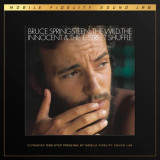
Released only eight months after his exhilarating debut, Bruce Springsteen's The Wild, the Innocent & the E Street Shuffle contains rousing dispatches from the boardwalk, the street, the beach, and the bedroom. It explodes with energy, dares to dream, teases with humour, crackles with tragedy, clings to hope, and overflows with discovery, youthfulness, and personality. It features an unforgettable cast of characters — corner boys, teenage hustlers, doomed lovers, jazz men, junk men, factory girls, fortune tellers, alley cats, pimps, escorts, and more — illuminated by vivid colour, breathtaking detail, and poetic action.
Musically, the heartfelt 1973 record is inhabited by sympathetic vignettes and cinematic arrangements steeped in rock 'n' roll, soul, jazz, and R&B. It finds the New Jersey native looking beyond the parameters of his preceding record and seeking to move on from environments he knows well (and chronicles here) by rushing headlong toward unknown territories, adventures, and people. Underpinned by the singer-guitarist's ambitious poetic enterprise and will to succeed, The Wild, the Innocent & the E Street Shuffle is the album on which Springsteen becomes the Boss.
Mastered on Mobile Fidelity's renowned mastering system, pressed at RTI on MoFi SuperVinyl, and strictly limited to 7,500 numbered copies, Mobile Fidelity's UltraDisc One-Step 180g 33RPM LP set is the definitive-sounding version of Springsteen's sophomore record. Benefitting from SuperVinyl’s nearly non-existent noise floor, superb groove definition, and dead-quiet surfaces, The Wild, the Innocent & the E Street Shuffle plays with a clarity, energy, presence, and openness that complement the expressiveness, dynamics, and scope of the seven restless songs that comprise a work Rolling Stone ranked the 345th Greatest Album of All Time.
Beyond the audiophile sonics that practically place you behind the console at 914 Sound Studios — listen to the separation between the instruments, natural decay of the notes, interplay within the widescreen soundstaging, and nothing-to-lose youthfulness of Springsteen’s voice — this reissue takes seriously this record’s influential merit by presenting it in packaging that underlines its status. Tucked in a beautiful slipcase, the LP is housed in a special foil-stamped jacket with faithful-to-the-original graphics. This reissue is made for listeners who prize sound quality and who want to engage themselves in everything involved with the invigorating set that busted Springsteen loose from the club circuit and landed him on the radio
Determined to liberate anyone within earshot and unafraid to come on strong, The Wild, the Innocent & the E Street Shuffle serves as the debut of the E Street Band — not only heard but seen for the first time by most of the public courtesy of the back-cover photograph. This is where saxophonist Clarence Clemons, organist-accordionist Danny Federici, and pianist David Sancious step out of the shadows — and drummer Vini Lopez and bassist Garry Tallent again stoke a fiery rhythmic engine that helps drive the untamed, reimagined big-band swing of “Kitty’s Back,” breathless R&B thrust of “Rosalita (Come Out Tonight),” and carefree dance steps of the funky “The E Street Shuffle.”
Of course, the main attraction remains a then-24-year-old visionary on the precipice of becoming a sensation and turning a then-bloated rock scene on its head. Recorded over three months while Springsteen and company were busy touring his debut LP, The Wild, the Innocent & the E Street Shuffle reflects the high-octane approach the vocalist embraced onstage and drifts away from the label-dictated acoustic-based frameworks of his debut. The set also witnesses Springsteen deepening his observational skills, with narratives such as the romantically tinged “4th of July, Asbury Park (Sandy)” and redemptive epic “Incident on 57th Street” mirroring changes taking place in the singer’s own life, small towns, and America at large.
A thrilling collision of memories, reflections, and composites — Sandy, Rosalita, and the latter’s parents are all based on actual people Springsteen knew, as is the community depicted in the opening track — the aptly titled The Wild, the Innocent & the E Street Shuffle resonates decades on due to its truths, authenticity, and spirit. Those characteristics — as well as the fact that many of its lengthy songs come on as the equivalent of sweaty, feverish soul revue that won’t stop until you’ve been exhausted — also explain how this now-iconic album triumphed over the reservations of industry “experts” that both demanded Springsteen re-record it and instructed deejays not to play it.
Yet there’d be no stopping a record that saw the past, present, and future, a band whose will would not be denied, and a phenomenon who was born to run. A never-ending invitation to act real cool and stay up all night, The Wild, the Innocent & the E Street Shuffle always feels alright.

An’archives presents the latest album by Japanese free saxophonist and vocalist Harutaka Mochizuki, Doppelgänger ga boku wo. Since the early 2000s, Harutaka has quietly, yet steadily, released a string of solo and collaborative releases that have allowed multiple perspectives on one of the most singular voices in modern music. In collaboration, he seems to prefer the duo format, and digging through his discography, you’ll find releases where he pairs with Tomoyuki Aoki (of Up-Tight), Michel Henritzi, and Hideaki Kondo. But Harutaka’s solo performances, with their lyricism and physicality, are where the magic truly happens.
If earlier albums, like Solo Document 2004 (Bishop, 2005) and Pas (no label, 2014), were raw documentations of solo alto saxophone performances, in recent years, Harutaka’s solo albums have become more complex, more mystifying. Most significantly, they’ve become more personal; there are few musicians extant whose albums feel quite so much like diaristic interventions, and Harutaka’s music now is deeply moving in its intimacy. Developing that thread of revelation, Doppelgänger ga boku wo offers a still richer exploration of many facets of Harutaka’s artistry.
The two double-tracked alto saxophone performances here feel consummate, with Harutaka shadowing himself, exploring the possibilities of the multiple self: Doppelgänger is me, indeed. The playing here is rich with affect, but still exploratory, voiced with rigour and intent. Two short pieces for keyboard and voice (about Giacometti and Genêt, respectively) are fragile miniatures, with clusters of chords, and passing phrases, wrapping around Harutaka’s untutored but lovely singing.
The ‘karaoke’ performance that closes the album, of “Woman ‘W no higeki’ yori”, speaks to the iterative aspects of Harutaka’s music. A cover of the Hiroki Yakushimaru song, the theme to Shinichirō Sawai’s 1984 film W’s Tragedy, he’s returned to this song several times, and here, his delivery perfectly captures the spirit of what Michel Henritzi, in his typically beautiful liner notes, evocatively details as “one of those sad love songs that accompany lonely sake drinkers in smoky night bars, sharing their spleen.”
Gorgeous, human, heartrending - Doppelgänger ga boku wo is Harutaka Mochizuki in element and in spirit.
- Satan Mamage
- The Mould
- Everything To Die For
- Donna Like Parasites
- The Rules Of What An Earthling Can Be
- Please Be Okay (Feat. Miss Grit)
- Telephone Congee Ii
- Speak Up, Sponge
- What's The Password Baby Bird?
- Hopefulness, Hopefulness
- Telephone Congee Ii
- Sparky (Feat. Lei, E)
- In The Dot (Feat. Pickle Darling)
- Cool As A Cucumber
- ?????
As mui zyu, Hong Kong British artist Eva Liu searches for a portal, wandering between nothing and everything in her pursuit of peace. On her second full-length album nothing or something to die for she looks outward, embracing the chaos with each tentative step. mui zyu's debut album Rotten Bun for an Eggless Century saw her explore her heritage, as she dived inward to find acceptance and healing. Now, instead of searching for answers from the inside, Liu raises her head to look at the world around her. As she attempts to understand the complexities and significance of human existence, she observes apathy alongside overwhelming chaos; the technological advancements of connection with the lack of meaningful bonds and the frustrations of upholding standards set by others. nothing or something to die for tries to decipher these juxtaposing truths, holding both the weight of those trying to destroy the world with the utter futility of it all. Working with co-producer and fellow Dama Scout band member Luciano Rossi, the sonic world of nothing or something to die for encapsulates both the fleeting tranquility of serenity and the dissonance in chasing it. After all, our reality can change in an instant. Like the psychedelic tones of Ryuichi Sakamoto's Thousand Knives, the urgent techno-pop of Miharu Koshis Parallelisme or the eerie wanderings of Angelo Badalamenti's work for Twin Peaks, nothing or something to die for expertly toes the line between disorder and clarity
"Negore" is the second album by the Kenya-based duo Odd Odokko. After their debut "Auma" saw percussionist Sven Kacirek work with pre-existing recordings of singer and instrument builder Olith Ratego, the two opted for a similar approach for the ten pieces to preserve the expressiveness of the latter"s performance. Further contributions by sound artist KMRU and Angel Bat Dawid on bass clarinet expand the duo"s sonic palette which draws on the dodo music of the Luo people and enriches it with percussive, melodic, and occasionally electronic means. The record"s title translates to "petroleum lamp," signifying the transition from day to night-when the time has come to dance. In this decidedly joyful spirit, "Negore" is dedicated to transitions and venturing into the future. Ratego"s interpretation of the folk tradition is expressly contemporary, while Kacirek uses a rich variety of avant-garde and advanced electronic music techniques to propel it even further.
R'n'Cs is the contraction of "Rem and the Courbarians". made up of Rem (drums - Vox) and the Courbarians brothers, Saïd (Guitar - Vox) and Gui (Bass Guitar - Vox). they were formed in the Orléans region at the dawn of the second millennium, combining Punk / Hard Core with overdriven Garage Punk'n'Roll. giving birth to a Rock'n'Roll speed all their own! The years go by. but the cadence remains the same. they are and remain definitively addicted to feedback and BPMs. Their Rock'n'Roll remains fast and furious. You'd think the teats they feasted on from an early age were loaded with nitroglycerine! And these R'n'R aficionados never tire of it! Class, delicacy and refinement have nothing to do with it. even if some music lovers will enjoy it! Their music isn't a poem, it's an ode to sex, drugs and rock'n'roll. all at breakneck speed! Hang on to the handlebars, because no one escapes this infernal spiral that grabs you and sends you straight to the devil's entrails! They became a national benchmark for speed rock'n'roll. and were repeatedly asked to play with bands such as Nashville Pussy, Supersuckers, Discharge, GBH, Unseen, Guitar Wolf, New Bomb Turks, The Cellophane Suckers, The Butchers, Burning Heads, Etc.. Over the years, R'n'Cs has always been backed, produced and supported by labels such as 442ème Rue, Beast Records, Guerilla Vinyl and of course Trauma Social. Their 7th Opus "Flytrap in the Murderhouse" released on Beast Records / Fly House Records (Trauma Social for the CD) saw the light of day in Spring 2024 and still remains in the tradition of Zeke, Peter Pan Speedrock, Mötorhead. This incendiary bomb will not differ from previous productions. Still in sweat, flames and Rock'n'Roll!!!! Hell Yeah!
Few recording artists have aligned the quantity and quality of their releases as well as New Zealand singer/guitarist Roy Montgomery has in 1995. Beginning with kranky's release of the soundtrack for an imaginary film That That Is...Is(Not) by Roy's duo Dissolve early in the year, a series of superb albums and singles have been issued by a variety of labels across the world. Each one of them is a must have. Most recently, the Drunken Fish label released a collection of pastoral drones entitled Scenes From The South Island, singles have appeared on the Roof Bolt and gyttja labels, and further singles are scheduled with Ajax, Siltbreeze and others.
Temple IV is the first solo recording by Roy Montgomery on kranky. The album was recorded by Roy on a 4 track tape deck and then thickened up with monophonic moog. The tracks on the album are thick with interwoven guitar lines and moog drone, inspired by the Guatemalan rain forests and the mysterious ruins of the temple and ruins Roy visited there.
Roy Montgomery spent the past year in New York, Chicago and London before returning to New Zealand. While in the UK he played live with Flying Saucer Attack and collaborated with spoken word performer Kirk Lake. A brief tour across the United States in September saw Roy performing before enraptured audiences in New York, Boston, Chicago, Detroit and Los Angeles.
The long overdue recognition of Roy Montgomery as a crucial figure in New Zealand's musical history as a member of The Pin Group, Shallows and Dadamah, is now augmented by his new recordings. Temple IV will serve to extend and deepen that appreciation.
- A1: Why Oh Why Dub
- A2: Dub Larking
- A3: Zion Dub
- A4: Dub Money
- A5: A True Dub
- A6: Dub Guidance
- B1: Dub Say Who
- B2: Dub On My Mind
- B3: Love Of A Dub Band
- B4: Use This Dub
- B5: Dub Letter
- B6: Dub Angel
Horace Andy a.k.a.Sleepy must process one of the sweetest and most distinctive voices in reggae music. 1951 in Kingston Jamaica. He cut his first track in 1966 for producer George ‘Phil’ Pratt, a tune called ‘Black Man’s Country’. But it was four years later his star really began to shine when he joined the stable of Clement ‘Coxsone’ Dodd’s Studio One. It was Coxsone Dodd who renamed him Andy after another of his leading artists Bob Andy, such was his belief in Horace’s writing talent and singing abilities. Still only twenty years of age Horace used his falsetto talent to the fore and cut some impressive tracks at 13 Brentford Road, Studio One’s headquarters. Such reggae standards as ’Skylarking’, ‘Just Say Who’, ‘Love of a Women’ and ‘Something on my Mind’ to name but a few. The early 1970’s saw Horace due to political reasons move on to work with producer Bunny Lee, a move that suited his talents and beliefs, Horace being an early advocate to the Rastafarian faith.The tracks which he cut with Bunny, which we concentrate on here gave his songs a rootsy feel. The rhythms often cut at Channel ONE and Randy’s Studio17 and finalised at King Tubby’s, provided a fine backbone for Horace to recut some of his earlier classics, along side his newer songs also to become reggae standards. Like ‘Money Money’, ‘Zion Gate’ the great ‘You are my Angel’ and a version of The Heptones ‘My Guiding Star’. The power of these recordings were such that the earlier tracks like ‘Skylarking’ became hits a second time around.Proving that the ‘you can’t keep a good tune down’ mantra was alive and kicking… …A golden time for Horace and Reggae music in general… Horace would go on to work with other producers like Everton Da Silva in 1977 creating the ‘In the Light’ album and the New York based Lloyd ‘Wackies’ Barnes in the 1980’s for his ‘Dancehall Style’ recordings. Most recently his work with Massive Attack has brought his majestic voice full circle and back into the arena once more. Those ‘Massive’ recordings and this dub collection here seem to fit side by side. Horace’s distinctive vocal riding over the rhythms adding a magic as only he can .....
RESPECT JAH FLOYD.
"Return Of The Super Ape" was the final revelation from Lee Perry’s Black Ark Studio, a psychedelicized dub journey into uncharted sonic territories. The longplayer is now state-of-the-art remastered by Pete Norman (Finyl Tweek) and restored with original press artwork complete with inner disco sleeve!
The album from 1978 is the final chapter in the trilogy of albums in the period from 1976 - 1978 following "Scratch The Super Ape" (aka "Super Ape") and "Roast Fish & Cornbread". Produced, mixed and arranged by Lee Perry at the Black Ark Studio featuring on all tracks the skills of The Upsetters and additional vocals by The Full Experience on "Dyon-Anasaw" and "Tell Me Something Good". The frontsleeve artwork image was created by Lloyd Robinson (also known as the singer of the Studio One classic "Cuss Cuss").
Reggae expert Jeremy Collingwood says: "The Return Of The Super Ape that surfaced later in the year 1978 saw Perry way off the mainstream with a set that owed much to jazz with its loose structure and horn breaks. The title track took an early production from Perry, U-Roy's " OK Corral", and reshaped it into another futuristic outing - just like the original that had been a decade earlier. At the time few knew what to make of it and over the years its lack of proper re issue had meant it's remained a hidden Perry gem. It also marked the end of a hugely creative period at the Black Ark."
Tracklisting / side-split
Side One
A1 Dyon-Anasaw
A2 Return Of The Super Ape
A3 Tell Me Something Good
A4 Bird In Hand
A5 Crab Yars
Side Two
B1 Jah Jah Ah Natty Dread
B2 Psyche & Trim
B3 The Lion
B4 Huzza A Hana
B5 High Rankin Sammy
• Follow-up to the highly acclaimed dub album Super Ape, the album like its predecessor, was produced by Lee ‘Scratch’ Perry. This was the last album recorded by The Upsetters before Perry closed down his Black Ark Studio.
• The remastered album showcases the production skills of undisputed dub master with insanely layered textures and technical wizardry. With musical backing The Upsetters – Boris Gardiner, Mikey Richards, Sly Dunbar, Benbow Creary, Earl ‘Chinna’ Smith, Winston Wright, and Keith Sterling.
• Remastered by Pete Norman at Finyl Tweek
• Coloured Inner Bag
Special Guests on the record include: Mark Cisneros, Joe Lally, Derrick Decker, Bob Berberich, Clint Walsh, Dave Grohl, Onam Emmett, John Goetchius, Jerry Busher, Amy Pickering, Ian MacKaye, Amanda MacKaye, Brian Baker, Randy Austin, Martha Hull, Michael Reidy, Nate Bergman, Bobby Madden.
Scream formed in 1979. Drummer Kent Stacks, bassist Skeeter Enoch Thompson and the brothers Pete and Franz Stahl attended school together in Bailey’s Crossroads, Virginia, when they began to discover the punk and new wave scene in DC and the provocative power of making music.
Like most of the punk bands in DC, they were influenced by the Bad Brains, but their rock and roll sensibilities set them apart. In 1982, they went into Inner Ear Studio with Ian MacKaye and Eddie Janney to record Dischord's first full length album, Still Screaming.
Scream followed this with a second full length album, This Side Up, in 1984. The band toured throughout the US and were one of the first US hardcore bands to tour Europe and the UK. In 1987, they released Banging the Drum, which was recorded at both Southern Studios in London and Inner Ear. In 1988, No More Censorship was released on reggae label RAS records. Scream returned to Dischord to release Fumble in 1993.
They made a few line-up changes along the way, including the addition of their friend Harley Davidson on second guitar, and, when Kent Stacks (RIP) left the band to start a family, they asked a young local drummer, Dave Grohl, to take over. After a number of years with "the Scream team," Dave went on to join Nirvana and form The Foo Fighters.
In 1996, at a Christmas reunion show, Kent Stacks returned as Scream’s drummer; the show was recorded and released as the CD “Live at the Black Cat.” Over the next few years, everyone branched out in different directions – Franz joined the Foos for a short period and Pete played with Goatsnake and earthlings? The band returned as a unit, with Clint Walsh on second guitar, in 2011 to record the Complete Control Sessions, which was released as an EP on Side One Dummy and was, until now, the band’s most recent release.
Scream’s newest album, DC Special, will be released in the fall of 2023 on Dischord Records. For this record, Scream invited their extensive music community to help create a unique project that weaves the history of music in Washington DC into the story of the band. Recorded by Don Zientara just weeks before his studio was evicted from its longtime location, the record is rich with both the sounds of Inner Ear and those of friends and musicians who influenced Scream and who shaped DC music over the past six decades. DC Special embodies the same sense of community and politics that inspired Scream from the start and is a truly special collection of new music that speaks to the present and also tells the story of DC music, Scream, and the influences that shaped them.
Bonus Download Tracks
Faces
Politics is Entertainment
Black and White
Lifeline Redux
Smile and Bleed
I Saw Ya (Wanna Be Like Captain)
After the Dead Boys, Bators embarked on a musical journey that saw him touch upon power pop during a brief solo career. Although included in our past release "I Wanna Be a Dead Boy" (1992), as a limited edition 7" boxset, this is the first time the single gets an official reissue in its original format. This is an essential power pop classic! As the frontman for the Dead Boys, Stiv Bators terrorized audiences with his snotty, in-your-face punk rock style. But after the Dead Boys, Bators embarked on a musical journey that saw him touch upon power pop during a brief solo career. Stiv moved to Los Angeles and signed with Bomp! Records, Greg Shaw's label that released many seminal 70s West Coast punk and power pop groups such as the Nerves, the Weirdos, the Zeros and the Germs. The first Bators single to emerge from Bomp!, 'It's Cold Outside' (originally by Ohio legends The Choir), is a song that the Dead Boys reportedly could not figure out how to play. It was released in May 1979. The B side 'The Last Year' is a Stiv/Jeff Jones (alter ego of Frank Secich) song dedicated to the recently deceased bassist of the Sex Pistols Sid Vicious and would later appear on the LP "Disconnected" (1980).
Die Londoner Band Home Counties veröffentlicht nach ersten EPs ihr Debütalbum 'Exactly As It Seems', produziert von Bandgitarrist Conor Kearney und gemischt von Andy Savors (Black Country New Road, Rina Sawayama, Sorry). Home Counties haben sich als eine der wichtigsten neuen Alternative-Bands Großbritanniens etabliert, die mit Shame, Psychedelic Porn Crumpets, FEET, Courting und bdrmm auftraten und von BBC Radio-DJs sowie Elton John (Apple 1) unterstützt werden. Der Band gelingt es, lyrische Offenheit über die besch******* Details des modernen Lebens und musikalischen Schwung mit Begeisterung in Einklang zu bringen. Nach dem treffenden Motto: 'Mein Leben ist ruiniert, weil ich mir die Miete nicht leisten kann, aber ich werde darüber tanzen.'
Halocline - a visible layer of water that forms between saltwater and freshwater when there is a rapid change in salinity; they are found in colder oceans, caves, fjords and estuaries.
Malin Lewis is a queer bagpiper, fiddler, instrument maker and award winning composer. One of Scotland's most exciting innovators, Malin melds west coast tradition with a newly invented, self-made bagpipe. Hair tingling, philosophical and dance inducing melodies inspired by European folk traditions, humans, queerness and the universe. Having played in Canada, Europe and across the UK, Malin will release their long awaited debut album Halocline on the 3rd May 2024 with Hudson Records. Halocline began as a New Voices commission for Celtic Connections and was premiered to a sold out Strathclyde Suite, Glasgow Royal Concert Hall in 2023.
"I saw my first Halocline aged fourteen whilst swimming in an estuary in the Isle of Skye. I didn't know what it was at the time but the image has stayed with me ever since. Appearing like a hazy layer of cloud under the water; it floats between two worlds and provides an environment which is home to a unique microbial ecosystem. As a trans person I live in a space in between; this beautiful space between a binary with its own colourful and unique culture."
Malin's unique sound is born from the deep connection that comes with making and composing for their own instrument. Alongside whistle and fiddle, Malin plays a newly invented two octave bagpipe that, when combined with guitar FX pedals, creates a whole new world of sound which is as lively, thought provoking and sensitive.
Halocline - a visible layer of water that forms between saltwater and freshwater when there is a rapid change in salinity; they are found in colder oceans, caves, fjords and estuaries.
Malin Lewis is a queer bagpiper, fiddler, instrument maker and award winning composer. One of Scotland's most exciting innovators, Malin melds west coast tradition with a newly invented, self-made bagpipe. Hair tingling, philosophical and dance inducing melodies inspired by European folk traditions, humans, queerness and the universe. Having played in Canada, Europe and across the UK, Malin will release their long awaited debut album Halocline on the 3rd May 2024 with Hudson Records. Halocline began as a New Voices commission for Celtic Connections and was premiered to a sold out Strathclyde Suite, Glasgow Royal Concert Hall in 2023.
"I saw my first Halocline aged fourteen whilst swimming in an estuary in the Isle of Skye. I didn't know what it was at the time but the image has stayed with me ever since. Appearing like a hazy layer of cloud under the water; it floats between two worlds and provides an environment which is home to a unique microbial ecosystem. As a trans person I live in a space in between; this beautiful space between a binary with its own colourful and unique culture."
Malin's unique sound is born from the deep connection that comes with making and composing for their own instrument. Alongside whistle and fiddle, Malin plays a newly invented two octave bagpipe that, when combined with guitar FX pedals, creates a whole new world of sound which is as lively, thought provoking and sensitive.