Two new tracks from this ongoing project featuring members of Coil, Wire and Tomaga. The flirtation with a head expanding motorik music as hinted at on their debut self-titled double album is given the space requiredto unfold on this new EP. Electric Blanket chugs along with perpetual percussion, blankets of feedback and state of the art electronics all embedded with a spectral melody that encircles proceedings as all sonic proceedings veer out further into more mystical ambient planes. On the flip Nice Setting places a strange short spoken narrative at the centre of a shifting sonic landscape of skittering electronic debris and a deep shifting sea of sound. A vibraphone holds proceedings together before once again we head out into the glorious cosmic ether. UUUU are an outfit unashamedly embracing the fantastic - audio as a tool for an unlimited imagination.
Поиск:d state
Все
Coasting into the nebula from parts unknown, Admiral takes the helm with a debut LP release coming on Panoram's Wandering Eye Imprint. Ommitting rhodes licks, cosmic lunar drones and warbled space-funk, it exists in an ameobic state between the past, future and present, distilling down ideas of genres and musical innovation once played in clubs across the 9th planet. Alien terms such as "jazz", "brazillian music", "boogie and "left-field pop" could be said to grace it's bows - past ideas and innovations that would be eventually lost to glacial shifts, pacific waste dumps and rise of industrialised states.
Coming 14th October, it's the last ride out, with the final destination The tumescent aural seascape of the inner mind
The spiritual and uplifting music of Clifford White is highlighted with two of his most sought after songs, taken from his 1989 album The Lifespring, and presented here in a special extended 12" for the first time. Starting in music production at just 15, White could be described as a protegee, however his take is that they were part of a music journey that continues today. With a centre found in electronic music and spirituality, his progress, from simple home use 4-track stereo to working in professional 16-tracks studios was swift, but matched by a deeper appreciation, greater confidence and wider palette of music styles. Utilising his love of early samplers, his first use of the Akai S612 to accompany and expand his keyboard recordings saw continued development from his debut album at just 17 with Ascension (1985), to the follow up Spring Fantasy (1987) and on to The Lifespring (1989). A small review in the local paper literally led to a knock at the door and offer of a deal from the Start (State Of The Art ) label to record his next album. With a subsequent advance, professional studio equipment was hired and out of these sessions his sound expanded to include ambient, orchestral, synth pop and even ballads. From this both Lifestream and Rain Trek emerged. With a love of Jean Michel Jarre's Oxygene in mind, Lifestream's smooth beginning soon gives way to the pulse of an arpeggio driven groove. Aiming for "relaxation with an edge", the track has become a secret play for the more Balearic minded DJ in the decades since and now sees the LP trade for dizzying sums. However, the original is achingly brief, gracefully fading as part of the album's journey. Here though, with DJs and collectors in mind, White returns to the song to craft a specially extended version that completes the song and will be appreciated at sunsets across the globe. Seeking to take the music and listener to another place, Rain Trek took White's interest in Sci-Fi and the mystic powers of water to a rightful conclusion. The healing nature of his music is apparent, the mystery, yearning and travelling, all emotions evident, but with a kick that will grace the more enlightened dance.
From the inheritor of John Coltrane's mouthpiece a re-integration of deep South African jazz roots with the Black Atlantic spiritual jazz continuum.
Celebration's release trumpeted the emerging dawn of South Africa's epochal changes. Sainted and blessed, Bheki Mseleku appeared as the herald of a new era, a prophet of rebirth and reconnection. This is a work signalling transition and change, and a sign of a South African music that was properly reconnected with global currents - a music that could journey far beyond the stifling combination of exile and oppression in which it had been bound.
Recognising Bheki as a kindred spirit to her late husband, Alice gave him the saxophone mouthpiece that John Coltrane had used during the recording of A Love Supreme. Coltrane was a permanent touchstone for the pianist, one of the few who Bheki felt had the same esoteric and spiritual focus as himself: 'the only musicians I know of who were deeply into this were Coltrane, and Pharoah and Sun Ra', he told an interviewer in 1992.
While the idioms of post-Coltrane spirit jazz are certainly to the fore on Celebration, they are energised by a swift and original musical vision, quite specific to Bheki's music, in which whole musical systems - the marabi and mbhaqanga jazz of the townships, American jazz, European classical, and more - are seamlessly mended together by the pianist's quicksilver musical sensibility and legendary technical ability.
Celebration was originally released on compact disc and cassette in the middle of 1992 by World Circuit. It was Bheki's first statement under his own name, and the first recorded presentation of his personal musical vision. This vision had been tempered across two decades which had combined intense professional playing with profound personal trials in both the spiritual and earthly domains, all set against the greater backdrop of South African political turmoil and exile in Europe.
The band brought together musicians hailing from three signally important points within the interconnected, communicating spaces of the Black Atlantic continuum - North America, post-colonial Britain, and southern Africa. With them, Mseleku created the first major South African-led musical statement to be produced after the sufferance of exile was ended. The ultimate and most egregious remnant of the centuries-long colonial era, apartheid, was finally being dismantled as they played. At this critical point, Mseleku's musical spirit work, channelled from a higher source, spoke of a time to come where all divisions might be transcended by a greater unity.
Repress!
Copenhagen's Terry Tester (Brownswood / BBE) merges his love for Midwest house and cosmic funk butter on four-tracker 'Space Million' for Creak Inc., journeying through dream state deep house, gritty MPC workouts and low-end boogie territory for an undeniably original take on four-to-the-floor rhythms.
Within Terry Tester's two-decade long career as a turntablist and beatmaker his eminent take on house, hiphop and soul has been commissioned by Gilles Petterson for his 'Bubblers' compilation series on Brownswood Recordings, Jahi featuring american neo-soul singer Dwele, and Marc Mac (4Hero, Visioneers, Nu Era) on BBE remixing alongside DJ Jazzy Jeff, as well as releasing two full-length solo albums 'Horses and Diamonds' and 'Short Suite'.
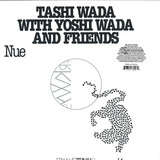
Composer Tashi Wada has performed for years with his father Yoshi Wada—artist, composer, and early member of the Fluxus movement. However, they have rarely appeared together in studio settings. Nue, the fourteenth entry in RVNG Intl.'s intergenerational FRKWYS series, finally brings Tashi and Yoshi, along with an eclectic group of close friends and extended family, together on tape.
Nue draws on aspects of Tashi's background for his widest vision to date—among them the minimalist bagpipe music of Yoshi, who co-composed three of the tracks, the psychoacoustic and perceptual explorations of his mentor, composer James Tenney, and reimagined forms of ancient and devotional music. The album, however, is not a tribute to the past or a recapitulation of familiar sounds. Instead, Nue is an intertwining of people and ideas as a means of growing, of looking inward to move outward, and of looking back to move forward.
To achieve this growth, Tashi assembled a core group of fellow travelers, including Yoshi, composer Julia Holter, producer Cole MGN, and percussionist Corey Fogel, to give life to this multifaceted suite. As an experience, Nue subtly navigates the interactions, intimacy and spaciousness of this group.
The album's title itself is a nod to Tashi's abiding interest in duality and the unknown: nue is a mythological Japanese chimera with the face of a monkey, the legs of a tiger, and a snake for a tail, a composite form, at once disturbing and otherworldly. But, as the composer points out, nue is also French for naked—stripped of complexity, bare and exposed, but also raw and essential.
From the doubling of tones—and the world of harmonic nuances such an action produces—to the rich interplay between individual musicians, all baring their own personalities and experiences through shared performance, Tashi's compositions allow space for these elements to join and grow. The multipartite creature that is an ensemble melds in the simplicity and purity of the music itself.
As explained by Tashi, each part was written with an individual in mind, not simply an instrument. And each individual performer makes their mark, from Holter's vocal performances on the cresting, oceanic 'Mutable Signs' and 'Ondine' with guest vocalists Simone Forti, Jessika Kenney and Laura Steenberge, to Fogel's resonant, precise percussion on 'Bottom of the Sky.' Producer Cole MGN, who has worked extensively with artists like Beck and Ariel Pink, helped to create a world of sound with minimal yet multi-dimensional materials. Like many of its influences, Nue uses deceivingly simple means to create complex, coherent worlds and narratives.
Tashi notes the influence of legendary Brazilian writer Clarice Lispector, whose work looked inward, investigating memory and emotion and dream, to understand the often overwhelming world outside the self. Like Lispector's classic novel Near to the Wild Heart, Nue cleaves these archetypal dualities—world/self, old/new, complex/simple—to create a work that allows them to coalesce into something singular.
As Tashi states in his liner notes: 'My desire was to create something both old and new sounding—ancient and futuristic—and ultimately something of its own world and other. Nue is a vision, an endless night of dreams, and a personal history of sorts, full of joys and demons.'
After a string of acclaimed EPs on Heist, Dirt Crew and Quartet Series, Amsterdam's Nachtbraker presents 'When You Find a Stranger in the Alps', his first longplayer on his own Quartet Series imprint. The good-humoured Dutchman - tongue always firmly in cheek - has always refused to stick to the 'sound du jour' and the industry's conventions, following his own path instead, continually willing to step out of his comfort zone. 'When You Find a Stranger in the Alps', a nod to his favourite Coen Brothers' movie, is testament to Nachtbraker's studio prowess and drive to explore new sonic pastures and styles. The album consists of thirteen tracks, made over the course of 2,5 years in his studio at Volkshotel Amsterdam. Constantly shifting through different settings and moods, the album feels like a deep dream, with vivid details, blurry edges and a warped sense of time. The word 'stranger' in the title references to this dream state in which you sometimes can be a stranger to yourself. Album opener 'The Dream Sequence' sets the mood with a lo-slung hip-house groove that relies heavily on field recordings, like the sound of one of the capital's trams. 'Flambo', a delectable slice of up-tempo French filtered house, is aimed straight at the dance floor. Nachtbraker dims the lights on 'NSFW', cleverly manipulating samples from adult oriented flicks, and turns in a hilarious skit with 'LOL'. Flip over for 'Randy', a quintessential Nac
Dancing With Fireflies From Sanderson's Second Long Player Urban Mosaic Gets The Treatment Courtesy Louis Haiman, Minimal States And Off Land. Louis Once Again Shows His Flare For Soulful Detroit Influenced Tech, Putting A Fwdthought Spin On Sanderson's Original Arrangement. Minimal States Leaves An Equally Strong Mark With His Rich Idm Techno Flavoured Rendition. Stasis Recordings Stalwart, Off Land, Reworks Just Beyond Into A Gorgeous Piece Of Chill Out Bliss.
Divine gospel modern soul boogie LP written, composed and produced by Jeffrey Roberson, first released in 1982 on Black Diamond Records.
Every once in a while, an exceptional talent impacts the gospel industry and leaves an incredible impression. The anointed and Grammy nominated Jeff Roberson is one of the those rapidly expanding gospel artist who have done just that.
Jeff Roberson was born and raised in Long Island, New York, the son of Pentecostal parents who had a compelling love for music. Actually, he is endowed by God with a melodic intrinsic distinctive rooted and grounded in the splendid tradition of the church. His keen interest and focus in music was so intense that his
parents encouraged him by purchasing a piano. During his teenage years, he was significantly blessed to be tutored by the late Rev. Timothy Wright, and the late Professor Benny Cummings and the Kings Temple Choir. It was during this season of his life that he continuously developed his skills as a keyboardist and songwriter.
Not only is he a skillful world-class vocalist, his talents transcend various creative art forms such as a skillful musician, innovative producer, accomplished pianist and organist. He simultaneously projects his uncompromising vocal talents and musical gifts to an unprecedented level of artistic achievement. Simply stated
he excels in the excellent - (Excerpt taken from Jeff Roberson's biography).
'Ever since I can remember, music has been to me, as a mother is to her child. Just as the sun enhances daylight, music is my life throb. Music puts life and joy in that sacred dimension. It fills the void of darkness and brings with it New Life.'
Jeffrey
'Garage bands suddenly obtain cult status and become the antithesis of their initial appeal'
Garage Class were a group of reluctant outliers who produced one of the finest contributions to the wave of UK DIY music that emerged during the late 70s and early to mid-80s.
Hailing from Alsager in North West England and comprised of Tim Shutt (vocals) Phil Murphy (lead guitar) Clive Williams (guitar) Lynne Sanders (bass) and Phil Bourne (drums / bass on studio recordings) Garage Class originally went by the name of The Pits before their then manager Steve Hurt imposed an alias which, though unpopular within their ranks, would nevertheless reflect the shambolic art they would eventually capture on their first and only single.
As The Pits the group offered a loutish inflection on glam-punk flamboyance, evoking Johnny Thunder hitting the north and remaining disowned yet undeterred in a dreary old boozer. But as Garage Class the group distilled a roughcast and homespun primitivism that felt quintessentially their own. In this they proved too unruly to be assimilated into any wider scene. Early gigs descended into acrimony and recognition proved elusive. Yet what they managed to make back then now sounds like an extraordinary article of underdog ambition.
Released in 1984, four years after it was originally recorded, the Terminal Tokyo single is an unlikely triumph of exceptional messthetic punk. Though raw and unpolished the songs here are precariously pop-minded and indisputably anthemic. The titular A-side reveals the dry and detached drawl of Shutt aka The Subliminal Kid, a sharp, jaded and poetic voice that has some of the most iconic lines never heard in punk. Accompanied by second-hand guitars, on-the-fly handclaps and a chorus like a terrace chant this is the cult hit that never was, a heroically artless masterpiece that has all the ragged character and misfit euphoria of Swell Maps and The Buzzcocks if they were more impulsive and boisterous, and left to their own devices in the remote margins of a Cheshire town. The original B-side is here substituted for I Got Standards, a track that, until now, has somehow remained unreleased. An ideal twin to Terminal Tokyo there's the same brusque and dog-eared quality to the band's delivery, as well as the same upfront emphasis on strong hooks and insistent momentum. Yet again, Shutt is on impeccable form, perfecting an inflated, adolescent antagonism that has all the sardonic, malcontented charm of similarly 'shirty' buggers like Dan Treacy (Television Personalities), Patrik Fitzgerald and Mark Perry (Alternative TV).
Although never accepted in their own time both tracks represent a brief but inspired moment of fervent imperfection, one that epitomized the best of a diffuse and autonomous underground movement spearheaded by The Desperate Bicycles and built upon by the likes of Amos & Sara, The Homosexuals, The Cleaners From Venus and Family Fodder. Like them Garage Class were situated at a point where punk, art, humour and a sense of stubborn independence all intersected.
In the years since Terminal Tokyo has accumulated a retrospective appeal among certain trusted circles, with Jon Dale celebrating the single in his exhaustive and essential Story of UK DIY for Fact Magazine, and original copies regularly changing hands for a foolish forty quid or so. With this inaugural release on the Outer Reaches label Terminal Tokyo is not only restored for the very first time but given a worthy expansion courtesy of JD Twitch (Optimo).
Continuing his own fascination with the fringe history of UK DIY - documented on his own outstanding compilation Cease & Desist: DIY! (Cult Classics From The Post Punk Era 1978-1982) and in his re-edits of Crass Records classics for an early release on RVNG INTL - Twitch reinterprets I Got Standards as an incisive, dubwise outing that pictures Jaki Liebezeit and Muslimgauze on a bender in England's provinces, tasked with remixing the raw product of local punks. A new slant on Garage Class' crude magnificence, built to play loud on contemporary soundsystems.
Although the latter part of 1980 spelled the end for Garage Class with members moving on to other projects (Bourne fell in with The Colours Out of Time, Murphy went on to front The Regular Guys and Shutt eventually left to form Happy Refugees) this reissue attempts to give their fleeting time together and the unique single statement they made the treatment it deserves. If this means Garage Class have obtained cult status, their initial appeal remains. Just listen for yourself.
Reform, the Tuscan techno duo, make a return to Etruria Beat to follow up the success of 2017's 'Checkmate' EP, remixed by Amelie Lens and their recent EP on Second State with a huge new offering - Unconventional Spaces.
Reform present three fresh originals, backed by a massive rework from Etruria boss Luca Agnelli.
Unconventional Spaces is a melodic and timeless work, perfect for a magic sunrise closing set. Luca delivers a heavier rework, creating a special atmosphere with powerful chords that drift back and forth.
Just This is characterised by a raw triple stab, a vocal laid down by the guys themselves and an emotional and mysterious break. Closing the EP is Span, which is composed of bouncing tom samples, straight hats and a moogy bass that develops throughout the arrangement, a perfect peaktime number and strong finalé.
Dark Entries reissue the 2nd full length from Carolyn Fok / CYRNAI, an Asian-American female solo artist from the Bay Area. Carolyn's adventures in sound began with recording stories on a tape recorder at age 9 in 1976. A short time later, exploring the scattering of musical instruments and effects units her father left lying around the family home. She became especially fascinated by his TEAC reel-to-reel recorder that set off a lifelong fascination with sound design. By the age of 16 Carolyn had become inspired by industrial electronic act Cabaret Voltaire, as well as anarcho-punks Crass. Creating the stage name CYRNAI, a rearranging alphabet of Carolyn Fok, she played in several Bay Area bands including Treason, A State Of Mind, Trial and Rhythm & Noise between 1983 and 1991.
In 1986 Carolyn moved into her family's building in downtown San Francisco providing a space to develop her own art and music for the next two decades. She was the only tenant of the five story building. The top floor had 36 abandoned rooms with building materials and holes between floors, staircases that created natural reverb. It was during this isolated time that Carolyn would start working on her second release, 'Parts of The Insomnic Wheel,' 60-minutes of ten untitled pieces that ran into each other. This was also the first release on cassette due time constraints of the LP. She spent many nights at the 24-hour diner across the street chatting metaphysics, parallel universes, the 5th dimension and astro-projections. Carolyn would sleep next to paper/pencil and report dream states, experimenting with mental techniques, investigating how far her mind could go. It was a journey to unravel the 'dark night of the soul'. Utilizing her industrial surroundings, Carolyn would bang on sheet metal and record percussion on found materials. Originally released by Ladd-Frith in 1986, this reissue adds 4 unreleased bonus tracks recorded during the same period. Each copy includes a 16-page zine with lyrics, photos and notes by Carolyn. All songs have been remastered by George Horn at Fantasy Studios.
Dark Entries reissue the 3rd full length from Carolyn Fok / CYRNAI, an Asian-American female solo artist from the Bay Area. Carolyn's adventures in sound began with recording stories on a tape recorder at age 9 in 1976. A short time later, exploring the scattering of musical instruments and effects units her father left lying around the family home. She became especially fascinated by his TEAC reel-to-reel recorder that set off a lifelong fascination with sound design. By the age of 16 Carolyn had become inspired by industrial electronic act Cabaret Voltaire, as well as anarcho-punks Crass. Creating the stage name CYRNAI, a rearranging alphabet of Carolyn Fok, she played in several Bay Area bands including Treason, A State Of Mind, Trial and Rhythm & Noise between 1983 and 1991.
In 1987, towards the end of art school, Carolyn won another award from the New York Society of Illustrators. During the trip to New York to accept the award, she met electronic/dulcimer musician, Dan Joseph. After writing some letters they decided to make a split cassette titled 'Hypno-Seizure'. CYRNAI contributed 30 minutes of music to Side A of the cassette, 10 untitled pieces that ran into each other. She had just bought a round-the-world ticket going from China to Europe via Eurails, to Egypt, where she liked to wander. She picked up instruments from several countries and recorded the sounds of her new surroundings. Technology was changing into early sampling and she used a Commodore 64 with large floppy disks to record loops. Originally self-released in 1988, this reissue adds 3 unreleased bonus tracks recorded during the same period. Each copy includes a double sided insert with lyrics, photos and notes by Carolyn. All songs have been remastered by George Horn at Fantasy Studios.
Universalist is the first album by ACT! Baroque, kaleidoscope electronics; material sound for a disembodied world. The energy is optimistic and posi - even naive - a statement of unity in the age of psychic dislocation.
10 Tracks of phosphorus midi and brittle digi textures feel indebted in spirit to the masters of psychic jazz as much as the physical euphoria of the club. Above all, this album belongs to the catalogue of Halocline Trance, yet subtle references connect it to a larger lineage of free sound. The empty, divine heaviness of songs like Ecstatica / On Patrol invokes Yusef Lateef's Little Symphony, while the computerized spontaneity of Lava Valley feels somehow connected to Yasuaki Shimizu's Music for Commercials. Non-musical sounds and evocative melodies sit side-by-side - new psychedelia for love and life in the digital jetstream.
ACT! is a project from Toronto-based musician David Psutka. Building on a diverse body of releases as Egyptrixx, Ceramic TL, Anamai and various other collaborations, ACT! denotes a new chapter of creative output from Psutka and the Halocline Trance label. Universalist follows a prolific string of releases in 2017 with Anamai - What Mountain; Ceramic TL + Ipek Gorgun - Perfect Lung; and Egyptrixx - Pure, Beyond Reproach, and synthesizes recurring themes of materiality and the unifying potential of sound.
In search of the sublime, contemporary electronic musician Steve Hauschildt has designed grids and panoramas of sound across multiple releases through the rise and dissolution of his former band, Emeralds, an American touchstone of 2000s home-recorded psychedelic noise music. Consistent with his solo work is Hauschildt's ability to coil his craft in precise, varied, and distinctly physical forms. Gently spinning arpeggios converse with post-industrial decay. Sonic bers sway like pendulums from static melancholy to motorik bliss. Dissolvi, the artist's rst full-length with Ghostly International, engages sublimation from an ontological perspective: by dissociating the self. Hauschildt steps out from the singular path, for the rst time in a traditional studio, to compose and arrange contributions from friends. As a result, his most collaborative work to date extends a vast, vibrating framework in which to consider the state of being.
The album's title — a reference to cupio dissolvi, the Latin phrase meaning "I wish to be dissolved" — needn't be taken one-dimensionally or as purely solipsistic. It does, however, serve an apt reference. Physiological phenomena are of interest to Hauschildt. These back-of-mind ruminations nd their way out. Songs are cerebral in orientation, but beyond explanation, the music is truly visceral.
Involuntary eye movement inspires the serene, sanguine-nearing-suspicious "Saccade." Hauschildt feathers soft percussion beneath the echoed refrains of Los Angeles musician Julianna Barwick, together shaping a svelte suggestion of the anxieties brought about by modern-day surveillance; if everyone is being watched constantly, there is no individual, no self, only a broadly monitored and clumsily cataloged populous. The work of Chicago poet Carl Sandburg comes to mind: 'I am the people—the mob—the crowd—the mass.' The individual dissolves into the taxonomic crowd.
Minimalist techno impulses provide a stylistic through-line for Dissolvi. Understated synth phrases and drum grooves take hold in selective moments, like synchronistic structures onto which nebulous mists, like the rapturous voice of Gabrielle Herbst aka GABI on "Syncope," cling to and cloud, producing a dazzling rift in consciousness. The 7-minute centerpiece "Alienself" reiterates this creative logic, burbling like an amorphous body of water on a low-gravity planet, on the verge of dissolving, but never fully dematerializing.
The album was constructed in Chicago (where Hauschildt now resides) and partially in New York. "Much of it was recorded in a windowless studio which removed elemental or seasonal references to time in the music," says Hauschildt. "The focus this time was on mixing the album and incorporating a broader set of instrumentation. I describe my compositional approach as being quasi-generative." Embracing new methods and philosophical curiosities, and in turn, expanding the range of his repertoire, Hauschildt proposes a fascinating and profoundly rich experience in listening, being, and deliquescing.
Mirror Box is the solo analog synth project of Dallas musician Sean Kirkpatrick. With an extensive resume that includes keyboard duties for Kill Rock Stars' 00s noise rock band The Paper Chase as well as his concurrent projects, dark post-punk-synth-rockers Nervous Curtains and darkwave duo Little Beards, Mirror Box is Kirkpatrick's first foray into the purely electronic realm. Blending together elements of Giallo moodiness, dub texture, techno propulsion, a passing nod to your favorite wave music, and a flare for the kosmiche, Mirror Box' debut release, Minimal Compliance EP, is a tour de force of the veteran musician's exploration of a wide range of influences and experience.
Released by Dallas-based Gavin Guthrie (TX Connect)'s TRU (Texas Recordings Underground), the 5-track EP kicks off with the immediately-gripping title track. A huge mid-tempo 808 beat drives the menacing Moog bass while cosmic synths explore the skies over gritty, urban terrain. 'The Body,' grounded by its stuttering and singular bass line, is an expansive reworking of a track from Little Beards' debut album which features Nan Kirkpatrick on the release's only vocal appearance. Side A closes with 'Destabilized Agent,' a retro-futurist dream that effortlessly voyages from Sagan's Cosmos to a melodic minimal wave refrain.
While the first side's lush synthesizers and sophisticated syncopation are somewhat of a departure for TRU, a label that has so far defined itself by bringing the electronic sounds of Texas' underground warehouse scene to dance floors across the sea, the flip side of the record is where the four hits the floor. 'Grifter React' opens with a hard kick and electro zaps, letting the rhythm take the lead until a distorted bass finally enters to provide the hook. Minimal Compliance EP finale, 'Critical Blitz,' weaves together all of Mirror Box' finer elements into a concise mission statement. Pulsing, hypnotic mono-synth, vintage mellotrons, classic hats and claps, sweeping production (courtesy of Alex Bhore at Dallas' Elmwood studios) and sparse synth melodies converge in dark analog pleasure that will guide you along like on a cool air-conditioned drive through a devilishly hot Texas night.:
Muse have announced that their eighth studio album, 'Simulation Theory'. The eleven-track record was produced by the band, along with several award-winning producers, including Rich Costey, Mike Elizondo, Shellback and Timbaland. Each of the album's songs will be accompanied by a video.
Recent singles, 'Something Human', 'Thought Contagion' and 'Dig Down', as well as brand new track 'The Dark Side', are all available immediately as a download when you pre-order the album. 'The Dark Side' is instantly recognisable as a classic Muse track, featuring Matt Bellamy's unmistakable soaring vocals and blistering guitars and the driving rhythm section of Chris Wolstenholme and Dominic Howard that have become a hallmark of Muse's stadium-filling sound.
'Simulation Theory' follows 'Drones', released in 2015. Since then the internationally acclaimed three piece have toured extensively, taking the ground breaking 'Drones World Tour' to fans across the globe. This concert was filmed and released in cinemas worldwide for 'One Night Only' in July 2018.
Muse is Matt Bellamy, Dominic Howard and Chris Wolstenholme. Their last studio album, Drones, was released in June 2015 and debuted at No. 1 in 21 countries around the world including their first No. 1 album in the United States. The album went on to win the Grammy Award, their second, for Best Rock Album in February 2016. Since forming in 1994, Muse have released seven studio albums selling in advance of 20 million albums worldwide.
Widely recognised as one of the best live bands in the world, Muse have won numerous music awards including two Grammy Awards, an American Music Award, five MTV Europe Music Awards, two Brit Awards, ten NME Awards and seven Q Awards, amongst others.
Patterns Of Consciousness is the powerful second full length from analog synth composer Caterina Barbieri. Highly recommended to fans of Alessandro Cortini and Eleh, Barbieri can be seen/heard/felt live at major electronic music events across Europe and beyond.Gorgeous high resolution analog textures and algorithmic melodies unfold under Barbieri's careful control, exploring the basic nature of sound and consciousness. These pieces are minimal in arrangement but maximal in presence asserting Barbieri as a unique voice in contemporary electronic music composition."Patterns Of Consciousness finds Caterina Barbieri at her best, elegantly moving between melodically pleasant yet twisted sequences and comforting, reassuring sonic spaces. Every piece, while given a singular identity, is part of the bigger picture: a work of art that will push you, pull you, and then eventually leave you with your back against the wall once you get to the last track. " Alessandro Cortini (Nine Inch Nails)"A pattern creates a certain state of consciousness. Once it is created, the pattern stands as an object exactly like the sound waves which generate it. We are at the same time inside and outside of the object. While being it, we observe it. Over time we become familiar with the inner structure of the pattern. We decode its gravitational centres, where our psychomotor attentionis attracted, where everything seems to be drawn. When a change in the pattern occurs it causes a perturbation of the previously established field of forces. This causes consciousness to fracture, potentially unfolding layers of perceptions we weren't aware of or simply suggesting that we access only a fraction of our psychic potential.The layered nature of consciousness and the relativity of perception are some of the biggest secrets we can experience through sound." Caterina Barbieri
Fresh from touring with Hugh Masekela ( The Boy's Doin' It'), Gboyega Adelaja goes into the lab to drop heavy keyboard science on his Moog and Fender Rhodes. Its Joe Sample meets the Afro Funk of BLO. With names like Jake Sollo on guitars, Mike Odumusu (BLO, Osibisa) on bass guitar and Gasper Lawal on percussion. This is a top quality, Afro-Funk, all-stars affair that shines from the inspired interventions, masterly arrangements to the sublime production.
.
Additional Notes:
I was already following Hugh Masekela when I met him, he was an outstanding musician and I knew of his collaboration with
Hedzoleh, that band brought him nearer to many of us, because he was playing authentic African melodies with the Hedzoleh
sound which was mostly percussion oriented. Yes I knew about Hugh's music before I met him. Infact when we started playing
together, he insisted that I stay with him in our three bedroom apartment, other members of the band had their own apartments,
but Hugh and myself shared the same 3 bedroom apartment'.
We were touring, under Casablanca owned by Neil Boggart, we toured as professional musicians, flying to our gigs. There was
a time when we were touring with George Clinton and Parliament Funkadelic we had two luxury buses deployed for our use.
We made many friends where ever we went to play, we met many big and popular musicians who came to watch our shows, the
Spinners came to see us in Detroit, we met Wayne Shorter of Weather Report, Freddie Hubbard, we played a gig with Herbie
Hancock at the Carnegie Hall New York City, we toured almost all the 50 States of the US.'
Brooklyn trio Forma's latest LP continues their mission to 'broaden the idea of what an electronic music ensemble can sound like.' Semblance emerged from exploratory sessions at The Schoolhouse, the Bushwick loft where members Mark Dwinell and John Also Bennett live, then was tracked at Gary's Electric studios, where their previous album Physicalist was also recorded.
Inspired by polyrhythmic composition, the human voice, and conceptual improvisation strategies, the songs are striking in their textural detail and emotional nuance, alternately synthetic and sentient, futuristic and intuitive. Incorporating flute, piano, guitar, saxophone, acoustic drums and cymbals alongside an array of synthesizers, the record persuasively demonstrates the group's unique playing abilities and fluid chemistry - attributes they credit to 'techniques we've developed to trick our electronic machines into mimicking the spontaneous character of live instruments.'
Members George and John Also Bennett also cite as an influence their recent stint in minimalist composer Jon Gibson's ensemble, performing his 1973 proto-ambient masterwork Visitations. The long- form modal piece requires restraint and deep listening to execute, qualities especially apparent in the more muted moments of Semblance, such as 'Rebreather' and 'New City.'
The group states the intent of the new album as 'to be more direct and exacting', which it is. Over half a decade spent writing and recording together has distilled Forma's hybrid electro-acoustic interplay into an attuned and astounding language, capable of articulating impossible symmetries and reflective states.
The stunning visuals of the artwork are by frequent collaborator of the group Peter Burr.