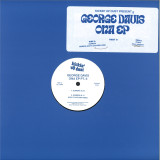
George Davis drops part 2 of his ‘Ona’ EP: heavenly house featuring a remix by the legendary Roy Davis Jr.
kickin’ up dust drops part 2 of the ‘Ona’ EP by George Davis. A jazzy bassline, snazzy piano keys and a rhythmical vocal send hips swinging and shoulders shaking in ‘Gomera’, a track which Chicagoan legend Roy Davis Jr. then remixes with a ‘Chitown Vibe’. Squelchy synths and organic percussion enter his version with a stylish swagger, maintaining the keys while moving the vocals to the back of the mix. Next up, ‘Bumpa’ is built for the dancefloor, an infectious groove forming the base for whimsical flute-like melodies, before ‘Soul Journey’ closes out the record with a gorgeous slow-burning vision of sunset shores and distant views.
Following on from his first ‘Ona’ EP which dropped on kickin’ up dust in March, and which won the support of artists like Honey Dijon, Nightmares On Wax, DJ Sneak and many more, George Davis now drops part two in the series. The german label, which initially started in 2021 as a party in the techno capital of Berlin, first turned heads hosting artists with a funkier edge to them such as Maurice Fulton, DJ Deep, and Louie Vega.
quête:d swing
Enigma is the first studio album by the space age, glass-harp powered, tropicalia quartet Os Barbapapas. Understandably, those adjectives could invoke images of kitschiness in one’s mind; that concept is smashed by the ice cold shot of Brazilian jazz riffing in the album’s opener and first single, “Se Liga Na Sequência”.
Os Barbapapas trapeze the vast richness of Brazilian/South American music heritage and beyond, as a collective with members who have variously travelled to Morocco to master Gnawa; played in circuses, or were born in the heartland of samba – these experiences and much more inform the complex yet breezy instrumentals of Enigma.
It’s a joy to pick through the notable influences that resound over Enigma. Ethiopian Jazz bursts from "Caminho para Itiwawa", backed by an Afro-Latin swing, fostered by drummer Barbara Mucciollo. There’s tonalities from North African artists such as Omar Khorshidor West African artists such as Tinriwen and Ali Farka Touré, as well as rhythmic influence from Afro-Cuban and Afro-Brazilian music. The dynamite track “(L)Atitude(S)” contains the explorative excitement of Brazilian 60s luminaries like Pedro Santos, however none are as special as layered percussion of “Gaba Gaba”, connected to the very specific rhythms of Northeast Brazil. It's evident from listening to Enigma that Os Barbapapas are an exceptional live band. They have their sights set on Europe soon, with the Glass Harp packed away safely. Until then please enjoy this electrifying album of their work so far, understanding: this is an extremely exciting project, still in its auspicious infant years
Enigma is the first studio album by the space age, glass-harp powered, tropicalia quartet Os Barbapapas. Understandably, those adjectives could invoke images of kitschiness in one’s mind; that concept is smashed by the ice cold shot of Brazilian jazz riffing in the album’s opener and first single, “Se Liga Na Sequência”.
Os Barbapapas trapeze the vast richness of Brazilian/South American music heritage and beyond, as a collective with members who have variously travelled to Morocco to master Gnawa; played in circuses, or were born in the heartland of samba – these experiences and much more inform the complex yet breezy instrumentals of Enigma.
It’s a joy to pick through the notable influences that resound over Enigma. Ethiopian Jazz bursts from "Caminho para Itiwawa", backed by an Afro-Latin swing, fostered by drummer Barbara Mucciollo. There’s tonalities from North African artists such as Omar Khorshidor West African artists such as Tinriwen and Ali Farka Touré, as well as rhythmic influence from Afro-Cuban and Afro-Brazilian music. The dynamite track “(L)Atitude(S)” contains the explorative excitement of Brazilian 60s luminaries like Pedro Santos, however none are as special as layered percussion of “Gaba Gaba”, connected to the very specific rhythms of Northeast Brazil. It's evident from listening to Enigma that Os Barbapapas are an exceptional live band. They have their sights set on Europe soon, with the Glass Harp packed away safely. Until then please enjoy this electrifying album of their work so far, understanding: this is an extremely exciting project, still in its auspicious infant years
Building on the styles showcased on the first “Beatbox Studios” LP, Hi-Tek was clearly developing his own personal style on the studio’s in-house Akai MPC 60II sampler. The drums were swinging more; the grooves were deeper; the bass thumped harder. Even when choosing familiar samples, he was chopping them in fresh and unexpected ways, which would eventually help shape his signature sound.
As his reputation was becoming cemented in the local Cincinnati scene, his relationship with the rap group Mood was helping to catalyze more regular visits to New York City. The beats collected for “Beatbox Studios 2” were the ones that would stick in the auto-reverse tape deck for those road trips, as were the demo tapes he crafted with Mood, which would eventually earn them a record deal with Blunt Records in 1996—the same label and year where he would land his first major placement on Royal Flush’s “Ghetto Millionaire” album. It was also on one of those 1996 journeys to NYC that he would meet a young Brooklyn emcee named Talib Kweli—with whom he would form one of the most iconic duos of the indie-rap boom of the late-nineties.
“Beatbox Studios 2 (1996 MPC 60II)” showcases Hi-Tek as a hungry young talent on the rise, and his continued elevation would lead him to a career as one of the few producers who can claim to have worked with such a broad range of legendary artists; from superstars like Dr. Dre, Snoop Dogg, 50 Cent, and Anderson .Paak, to underground heroes like Mos Def, Common, and J Dilla.
- Le Petit Géant
- Secoue Le Flipeur
- Flash-Back
- Bombés Fluo
- Aurora Day (Edit)
- Choc D'amour
- Le Composant Compositeur
- Le Grand Géant (Edit)
- Secoue Le Flipeur (Version Inédite) - Asociaux Associés
- Générique (Unrelased) - Crash
- Pile Ou Face (Unreleased) - Crash
- Sous Le Moi (Demo) - Asociaux Associés
- Pile Ou Face (Inaudible N°1 Version)
- Dans Le Dédale (Unreleased Live)
- Le Composant Compositeur (Alternative Version)
- Un Décomposant, Des Composants - (Unreleased) - Asociaux Associés
- Pile Ou Face (Version Ep) - Crash
- Bombé Fluo (Unreleased Version) - Asociaux Associés
“Nobody Move!”, so says Philippe Doray and his Asociaux Associés (the Antisocial Associates)! Having dynamited the end of the 70s with two radical albums – Ramasse-Miettes Nucléaires in 1976 & Nouveaux Modes Industriels in 1978, both reissued by Souffle Continu – Doray still hadn’t finished singing. Throughout the next decade he began his Composant compositeur which would document the “second period”, as he calls it, of his Asociaux Associés.
The record includes new schizo-electro songs which make the most of his association with Laurence Garcette, who also plays all sorts of keyboards. A prolongation of the first period of the Asociaux Associés, the duo updates Doray’s poetry: in reaction to the current overcast atmosphere, here are some hallucinatory fantasies to the rhythm of an infernal circle dance (« Le petit géant ») or an ecstatic waltz (“Bombés fluo”) or even coded messages stuffed into bottles and thrown into space (“Secoue le flipeur”, “Choc d’amour”).
On the bonus CD there are further iconoclastic examples: rare recordings (unpublished or even “inaudible”) of the Asociaux Associés but also by Crash, a duo that Doray formed with Thierry Müller (Ilitch, Ruth). At the controls of their experiment- bending machine the musicians multiply the possibilities: peripheral rock, arias in orbit, broken swing, industrial mantras and other joyful falsities. Enough to make you lose your mind? No... as Philippe Doray promised: it is the “jackpot qui frissonne” (the shivering jackpot) which is there to excite
Recorded Live in Italy in October 1985 and mastered directly from the old dusty cassette, here's a previously unheard Steve Lacy recording from a rare duo appearance with pianist Martin Joseph, a little known yet fascinating British musician who had worked with Harry Beckett, John Surman, Ian Carr, Tubby Hayes among others, and who later became a regular presence on the Rome mid 70's creative Jazz scene. This recording gives us an opportunity to listen to the soprano sax giant in a repertoire not frequently found on his other duo recordings with pianists. The set list includes some of Lacy's finest compositions like "Prospectus", "Flakes" and "Coastline", plus Thelonious Monk’s classic "Bemsha Swing" a tribute to Monk's visionary mastery where Joseph’s contrapuntal response to Lacy's angular lines leads the music towards a multidimensional space, a quality to be found throughout the whole album, This is a wonderful discovery! and a significant addition to Lacy's discography and legacy.
Contains printed inner sleeve with archival photos and extensive liner notes by two Italian soprano saxophone specialists Roberto Ottaviano and Eugenio Colombo, and pianist Martin Joseph himself.
Repress!
Released on Riverside records in 1962, "Letter from Home" was the debut album of Jazz vocalist Eddie Jefferson. Often credited as the founder of vocalese, Jefferson wrote memorable lyrics to classic jazz standards including "Parker's Mood.", "Lady Be Good," "So What," "Freedom Jazz Dance,"... Eddie Jefferson is backed here by a bunch of Jazz heavyweights, all at the top of their game. Among them: tenor sax masters Johnny Griffin and James Moody, trumpeter Clark Terry, pianists, Winton Kelly, and Joe Zawinul, bassist Sam Jones, and two hyper swinging drummers, Louis Hayes and Osie Johnson. This is an often underrated vocal Jazz album, a hidden gem ready to be unearthed. Don't miss it !!!
Lipphead is a production duo consisting of veteran producers Blockhead (Ninjatune, Future Archive Recordings) and Eliot Lipp (Alpha Pup) creating eclectic instrumental hip hop that dances effortlessly between Blockhead's sample-based hip hop beats and Lipp's evolving synth-laden swing. Illustrated by artist Maddison Chaffer, the titular character serves as the group's mascot and as a tongue-in-cheek personification of the artist’s fused styles. In 2022, the pair released their debut LP ‘In the Nude’ via Michigan label Young Heavy Souls to critical acclaim.
Building on that success, Lipphead is back with 10 new tracks and a fresh selection of singles to introduce the forthcoming record entitled ‘From the Back’. Kicking off with the irresistible disco soul of ‘Midnight Brain to Georgia,’ the duo hits the ground running. The second single effortlessly guides the listener through a showcase of fluttering flute samples, jittery synthesizer flourishes, and a bassline that is sure to please even the most selective funk enthusiasts. Throughout ‘From The Back’, fans can expect an even groovier spin on their genre-blending mix of downtempo, hip-hop, and electro-funk, along with a healthy dose of the duo’s trademark sense of humor.
Reflecting on the album, Lipp states that “Lipphead really starts to perfect their stylistic fusion on this record. Plenty of oddball beats and goofy samples, but this time there’s an upbeat funk vibe throughout. ‘From The Back’ is basically a window to what goes on in Lipphead’s wild-ass brain.”
New for 2023! Kitty, Daisy & Lewis' iconic debut album reissued on Half Black and White vinyl. Originally released in 2008 when the band were still only teenagers, their self titled debut catapulted them into rock n' roll favourites and the album has since been regarded as a cult classic. With a sound deep rooted in the past, the sibling trio pay homage to those who inspired them from Charlie Rich to Muddy waters and released an album truly like no other.
The trend for spaced-out electronic house sounds knows no bounds at the moment. Nolga is the latest to start into a starship and head for the cosmos on this new EP for Aesthetic. 'Voltage' is a real fist pumper with great swing and glide and smeared pads with pipettes of acid.
'Delusion' then gets all bouncy and playful with bubbling synth phrases and energetic keys. There's a hint of darkness to the bass in 'Resurgence' while '435D' has a more metallic tech edge. All in all, a high-class EP of forward-thinking grooves.
Social Limbo is the new album by OPEZ. A collection of eleven dreamy, rough, abundant instrumental songs which have the guts to subsist and survive the fluidity of our times. With his melodies Massi Amadori tells the nostalgia and melancholy of a lived, loved and consumed Italy.
In the Limbo of a rebirth. With the desire to imagine himself female, sensitive, sexy. With a swinging mood. The dreamlike suggestion in “Male Nostrum”, the mysterious love in “Venice”, the social raids in “Social Roll”, the dust and the silence in “Limbo” are just some of the tracks that represent the meeting in a place between dark and light, between east and west, with the heart in the south. And as always in that Limbo between life and death. The eleven tracks represent a shared work with musicians and producers of the caliber of Andrea Benini (Mop Mop), Francesco Giampaoli (Sacri Cuori, Hugo Race) and Manuel Volpe (Rhabdomantic Orchestra).
Recorded between Turin and Ravenna in the hot summer months from 2020 to 2023. Once again the images and graphics are curated by the Umbrian artist Aimone Marziali. Mastered by Kelly Hibbert at Almachrome. produced by Andrea Benini.
CUT THE ENGINES is the third album by All Structures Align, following the critically acclaimed Details And Drawings and Distance And Departure (both released on Wrong Speed Records in 2022). All Structures Align began as a studio project reuniting brothers Tim and Adam Ineson of 90s underground rock heroes Nub. Their debut album Details And Drawings took everyone by surprise.
Rather than sounding like a tentative bedroom project, it arrived fully formed and with its own identity. It was an album of unhurried patience, of mounting tension (and eventual release) and it possessed a depth that rewarded repeated listens as irresistible hooks revealed themselves almost casually to the listener.
It also felt slightly out of time: no rush to the chorus, no gimmicks, no desire to pack out every second of space with sound. Lots of people agreed and the limited vinyl pressing sold out almost instantly. The follow-up came within the same year with the brothers recruiting drummer extraordinaire Neil Turpin (Objections, Bilge Pump, Polaris) to bring swing and pulse to their songs.
Distance And Departure was the result and widened their audience and acclaim further. So much so that the brothers decided to venture out and play live. To do so they brought in Oli Heffernan (Ivan The Tolerable, King Champion Sounds) on bass and Andrew Pollard (Polaris) on guitar and additional vocals.
If you’ve been lucky enough to see All Structures Align live over the last year, you’ll know this expanded band bring the songs to life beyond simple recitation. Those dynamic shifts in the music are now larger than life and fully multi-dimensional. Cut The Engines is the first All Structures Align release to capture the five-piece live band in the studio. Eight songs as spacious and measured as their previous work but with an increased directness and drama that seems to come from the interplay between people in a room.
Whilst never getting down to Ramones levels of brevity, the songs are compact and sharper than before, as though the addition of extra personnel has allowed their musical language to become more concise and effective. The songs still feel like rich novels condensed into short stories, but the band format has brought a confidence and ease to the telling that increases their impact. The resulting record is their most accessible yet, a slow-core indie-rock masterpiece that will intrigue and delight existing fans and newcomers alike for decades to come.
Leatherette’s 2022 debut album Fiesta offered an intense, inspired and individualist take on post-punk, their caustic riffs, fevered saxophone blasts and impassioned vocals revealing the five-piece skilled purveyors of the form.
The group's second album Small Talk, however, is clearly the work of a group ready to take flight in a new direction all their own. As they toured Fiesta across Italy and Europe, Leatherette grew tired of the genre's constrictions and yearned to spread their wings. Small Talk transcends all the group have done before and coins a voice uniquely their own, driven by the same furies that propelled Fiesta, but finding fresh new forms for expression.
The album boasts some of Leatherette's most unabashed pop-songs to date – albeit pop that's deftly twisted, pointedly perverse and ready to explode when you least expect it.
It also contains some of the group's most challenging and uncompromising noise yet, the violent swinging back-and-forth between ugly din and nagging tunefulness a (molotov) cocktail that grows only more addictive with each listen. Where Fiesta saw the group enter the studio with a batch of anthems they'd honed on the road, their approach for Small Talk was very different, leaving the sessions open to moments of on-the-fly invention and sparks of mad genius. The interplay between the five musicians is so much stronger this time around, the group say, a result of the months of touring the band put in following the release of Fiesta.
Living out of rucksacks and spending hours on the motorway in a tour van might not be everyone's idea of a good time, but that's what Leatherette credit with sharpening their intra-group bond, their almost telepathic feel for the sounds that will complement what their bandmates are playing. “We were more free to play and to rearrange, because we knew each other better now,” says guitarist Andrea Gerardi, “and the interplay is more focused on this album as a result.” The sessions for Fiesta were frustrating, Andrea says, because “we were playing the same songs over and over”.
Their approach was radically different for Small Talk, however, which saw the group file into Bronson, a local club where they've often played before, and record the album on the premises. After the sessions, the album was mixed in Bristol by Chris Fullard (Idles) and mastered in Portland at the legendary Telegraph Audio Mastering by Adam Gonsalves. "We recorded live, all playing together at the same time, rather than overdubbing the instruments," says Michele. The process, he says, "made us more coherent, and the songs more spontaneous." "Our strength is live performance," adds Andrea, "so we tried to capture that interplay. Sometimes we made errors, but we didn't care, because it sounded great. This music is our lives - it doesn't need correction. We were free for the two weeks we recorded the album, and the ideas soared in the most amazing way." Indeed they did. The album's see-saw between angular noise and pop coherence is very much its strength, and very much the sonic identity of this singular group
Swingrowers (pronounced Swing Growers) released their second album REMOTE on 14th August 2014. Since then, it has been streamed over 13 million times on Spotify, while the official music videos for the two main singles have notched up over 10 million YouTube views. Now the album is being released on wax for the first time as we approach its 10th anniversary.
This is a highly desirable LIMITED EDITION pressing on WHITE VINYL with a free download card enclosed.
REMOTE itself is a revelation. It stood the test of time because it's one of very few complete and fully-realised Electro Swing albums that seamlessly blend 20's and 30's influences (violin, gypsy jazz guitar, saxophones, swing music) with polished contemporary production. Here superb musicianship meets great song-writing meets a unique modern sound. Plus jazz-inflected vocals.
It's the sound of a young band (and indeed an up-start young genre) maturing rapidly and would pave the way for the brilliant albums that followed and indeed for the on-going popularity of the genre.
It will be a sought-after release for fans who have bought the more recent two albums on vinyl, and by fans of other vintage influenced swing artists like Caravan Palace or Parov Stelar.
Reissue number seven for Heels & Souls Recordings sees them look back to the sounds of South Africa’s townships in 1991, cherry picking four of Tashif Kente’s finest cuts from his sought after album A Boy And A Dream, giving them space to breathe on a 12" pressing.
Clearly influenced by the flavours bubbling over from the UK and US in the late ‘80s and early ‘90s, from R&B through to boogie, proto house to new jack swing, Tashif’s productions are a melting pot of ideas and influences, laced with a distinctive South African flavour.
Born in Soweto, Mzwandile ‘Tashif’ Kente, cut his teeth with Harari for a brief period, a group that birthed greats like Condry Ziqubu, Sipho Mabuse and Alec Khaoli, before going solo in 1984 and releasing just one album as Tashif Kente, 1991’s ‘A Boy And A Dream’. An album that speaks of love, lust and longing, produced by Kente and Selwyn Shandel with Marc Rantseli also joining the fold, it has that signature South African synth bass, drum machine and killer keyboard combo of the Bubblegum and Kwaito scenes, topped with Kente’s buttery vocals.
Heels & Souls Recordings take four favourites from the LP and press them loud on either side of a 12”. On the A, the audacious new jack, dancefloor bubbler ‘Tell Him I Became Your Lover’ leads into the lovestruck, boogie-tinged grooves of ‘Somebody’s Got My Love’. Flip it over to find a jealousy jam of the highest order with the synthy soul number ‘Who’s That Boy’, before ‘I Like The Way You Love Me’, a lights down low, R&B flavoured lovesong rounds off the EP.
Licensed from Gallo, who transferred the original ¼ inch tapes for their archives, Heels & Souls have enlisted the expertise of Justin Drake to remaster these South African beauties for a new generation of listeners.
Minimal don Kepler strikes a balance between dancefloor utility and introspection on his latest record, and debut for X-Kalay. Big house and techno incursions straight out of Yorkshire – Leeds, to be precise. It’s a strong testament to the region’s long standing reputation as a hotbed for late-night minimalism.
Subtle flourishes and details stand out across all four tracks. Uncovering relics from ancient futures, ‘Lowlife’ stimulates the pineal gland with a mescaline-strength take on classic ‘90s tech house. While it dials the trippier elements down just a tad, ‘Control’, like its predecessor, recalls golden era Wiggle or Asad Rizvi under his Silverlining moniker.
No half measures on the next one. Bringing heft in spades, ‘Stranded’ comes hurtling in with swinging, jacking 4 AM NRG. It’s some serious gear, which makes the EP closer such an unexpected left-turn. ‘Need’ offers proper heads-down introspection, complete with widescreen, nebulous chords that ripple out into the vastness of space.
Much has been written about Young Marble Giants' small, perfect catalogue, which contained roughly two-dozen songs, nearly each one a perfect gem. Less is known about his long wilderness years after the break-up of his first professional band. His next project, The Gist, chopped YMG's minimalism into a new sound. This Is Love, Public Girls and Fool For A Valentine showed his songs to be razor-sharp, but the album's fragmented pieces were a step too far for some, though even the strangest, Carnival Headache, when cast in sunlight by Alison Statton's combo Weekend, was as fine a song as any he'd written - and Love At First Sight became a million-seller when covered by Etienne Daho. Then Stuart disappeared. A rmid-90s resurgence led to fine albums done on low budgets, before more silence followed. The Gist's 2018's release Holding Pattern - unexpected and then quickly followed by YMG singer Alison Statton's first new album with her accompanist Spike in two decades, adding fuel to public interest. The Devil Laughs, recorded a few years back, is a compelling addition to the canon of the 21st century songwriting. Stuart's generally unadorned musical presentation does not hinder his appreciation for the skills of Louis Philippe, whose iconic arrangements across an array of Él label albums inspire the fierce devotion of aficionados around the world. Nor does the unvarnished solidity of Stuart's arrangements deter Louis from hearing possibilities for their presentation in styles which take inspiration from the perfection of 1960's studio technology that led to the rise of Brian Wilson, Burt Bacharach, along with less-recognised names such as Bones Howe and Roy Halee. Tidy Away is Young Marble Giants redux, though the backing vocals hint at maturity which band didn't live to see. Fighting To Lose, written with producer Ken Brake, would pass as a worthy b-side to Bridge Over Troubled Water, and although the songs are otherwise Stuart's, Louis fans will delight at several, like Love Hangover and Sky Over Water, which display his style and production genius as succinctly as anything on his own albums. The Devil Laughs is as out of its time as Colossal Youth was - its subtle but immediate beauty, devoid of "rock", is a recording best understood in the light of those obscure groundbreakers who inspired it - the faux barbershop vocals of Smile-era Beach Boys, the studio lustre of Tom Wilson's work with Simon & Garfunkel, a dash of The Swingle Sisters and French chanson - along with enough hints of Young Marble Giant's modernist folk abstraction to satisfy longtime fans. The Devil Laughs is a small masterpiece of pure expression.
4LP is four black vinyl discs in two gatefold jackets + two 18 x 24 folded posters in a side-load slipcase + a printed insert for full album download. This is strictly for Indies only. 2CD is two discs in a six panel wallet + a 28 page booklet + printed insert. Misfits & Mistakes: Singles, B-sides & Strays 2007–2023 is Superchunk’s fourth singles compilation, a massive, 4-LP (or 2-CD) collection covering their triumphant return from hiatus. The amount of ground covered within its gorgeous packaging is staggering: 50 songs, 16 of which are on physical media for the first time, sourced from out-of-print releases, digital singles, compilations, and more, a vital piece of the Superchunk canon. Featuring extensive liner notes by Mac McCaughan (with additional notes from Laura Ballance), Misfits & Mistakes tells the story of each release, from why they chose to cover songs by The Misfits, The Cure, Destiny’s Child, and Bananarama, to working with collaborators like Katie Crutchfield (Waxahatchee), Jane Wiedlin (The Go-Go’s), Eleanor Friedberger, Damian Abraham (Fucked Up), Norman Blake and Raymond McGinley (Teenage Fanclub), and more! Mac writes: Who knew it would take a cartoon hamburger to kick off a new period of activity for Superchunk? When we recorded “Misfits and Mistakes” for the Aqua Teen Hunger Force soundtrack at Overdub Lane in Durham, we also recorded the first version of “Learned to Surf” which gave us an on-ramp for making new music after 8 years of playing sporadic gigs. It also reminded us what we liked about playing Superchunk songs, whether they’re our own or written by our musical heroes. This collection covers a lot of ground, from heavy touring years to a pandemic where we made singles and an album at home. One difference between this comp and our first three is that this time span completely falls in the digital age; the distance from a final mix to everyone hearing it is shorter than ever. I’ve always liked artists that were prolific—throwing out singles in between albums when you least expect it. A surprise release from your favorite band is one of the few things that can still bring a little excitement to what can seem like an endless deluge of “content” (puke). Hopefully the wild swings between lo & hi fi and originals and covers on this comp still allow for some coherence and, more
importantly, convey what’s FUN about this punk rock thing.
Vocal Shades And Tones is a miraculous leftfield library classic from the genius mind of celebrated UK composer/singer/vocal arranger Barbara Moore. It's a heavenly groove-based blend of jazz, Latin, soft-psych, folk-funk and gospel soul. Recorded for the legendary Music De Wolfe in 1972, it's an audacious start-to-finish listen, as dizzying as it is dazzling. It's a perfect snapshot of a musical era, supported by Moore's glorious vocal arrangements. Widely regarded among collectors, DJs, and lounge/easy-listening acolytes as an absolute essential it is viewed as the holy grail by many production music heads, rarely appearing for sale and disappearing in a flash when it does. Indeed, originals now go for over £300 and it's easy to see why. Just one of the reasons why this fresh Be With reissue, part of a wider De Wolfe reissue campaign, is so utterly crucial.
Racing out the gate, the driving "Hot Heels" is a bright, sophisticated scat groove which sounds Brazilian, richly produced as if coming by the hand of Arthur Verocai. Yes, *that* good. It's followed by "It's Gospel" which is, er, a wonderfully slow and deeply soulful gospel treasure. The appropriately monikered "Steam Heat" is a darker, breathy gem, one for salacious crates and one of the record's most infamous tracks. "Fly Away" is pastoral West Coast soft rock, very much in conversation with John Cameron and Keith Mansfield's epochal KPM recording, Voices In Harmony. "His Name Was" is a stop-you-dead-in-your-tracks Beach Boys accapella church-organ stunner, whilst "Swing Over" is another carefree, richly produced sun-dappled smasher. The gentle Bossa and sunshine soul of the aptly-titled "Touch Of Warmth" closes out a virtually perfect A-Side.
The B-Side opens with the easy grace and dramatic build of "Voice Force Nine". The jaunty "Very Fine Fellow" may be the only track to slightly grate so we advise heading to the slower, moody "Shades-Tones", eminently more compelling with sparkling, hypnotic piano throughout, underpinning the gorgeous wordless vocals. Just beautiful. It was sampled by Redman for his Method Man-featuring "Do What Ya Feel" on the great Muddy Waters. We're back in Brazilian territory with the cool, uptempo "I'm Feather" before swooning to the warm, relaxed "Drifting", another total highlight which was famously sampled by Koushik on his legendary remix of Madvillain's "America's Most Blunted (Doom's Verse)". The penultimate track, "Take Off" is a bright, organ lounge groove before this remarkable set is rounded out by the beaty "Fly Paradise". It's so so good, it sounds like Rotary Connection fronted by The Mamas & the Papas. As noted in a recent Guardian article on Moore's life, "there is a plushness and electricity in the tight vocal harmonies that spring out, sung with the precision of cathedral choristers decades before Auto-Tune." Amen.
In the 1960s, Barbara Moore was a member of Top of the Pops’ resident vocal-harmony group, The Ladybirds and sang backing vocals for Dusty Springfield’s TV show. Her own outfit, the Barbara Moore Singers, were regulars on TOTP, singing with Jimi Hendrix when he performed "Hey Joe" live in Lime Grove Studios. An important detail for Moore was the shepherd’s pie she bought Hendrix when she found him alone, looking emaciated, near the BBC canteen. By 1970, she was working as a session singer for De Wolfe and, by 1972, was composing her own tracks for De Wolfe and working within their tight creative strictures. Each short track had to evoke an obvious mood and theme, with no significant key or tempo changes. Her response, this very album, managed to stay between the lines while cohering as an overarching artistic masterpiece.
The audio for Vocal Shades And Tones has been carefully remastered by Be With regular Simon Francis, ensuring this release sounds better than ever. Cicely Balston's expert skills have made sure nothing is lost in the cut whilst the records have been pressed to the highest possible standard at Record Industry in Holland. The original, iconic sleeve has been restored here at Be With HQ as the finishing touch to this long overdue re-issue.
The Roger Webb Sound's Moonshade is one of the coolest records ever. Originally appearing via the legendary De Wolfe library in 1971, it's a sumptuous jazz-soul-funk instrumental set. Full of melodic, melancholic yet sun-drenched songs, rich with colour and contrast, it was composed by self-taught jazz pianist Roger Webb and features vocal performances by Barbara Moore. That's right; *the* powerhouse library music duo! It makes Moonshade the perfect precursor and accompaniment to Barbara Moore's eternal classic Vocal Shades And Tones. It will come as no surprise that original copies, if you can ever find them, will set you back north of 200 notes.
Moonshade is a phenomenal showcase of Brit maestro Webb's own roots in jazz. Those roots are served up here with a plethora of fast-stepping rhythms that truly give flight to the vocals of Barbara Moore, as they soar in wonderful ways. Moore sings wordlessly throughout, allowing her voice to act like another instrument in concert with the horns and keyboards elevating the fine arrangements. This is a deeply beautiful record.
The album opens with the ornate Baroque pop splendour of the sun-dappled melancholia of "Sunshine". Strings, piano and wordless female vocals combine to create this brief beauty of unimaginable grace. The cool "Gentle Eyes" features haunting and beautiful vocals, smooth jazz piano and horns and a general easy vibe without being easy listening, if you know what we mean. You do. Just listen. The pounding "Heavy Lace" is one for the beat-heads, funky open drums (!) with muted organ, bassy piano chords and ace horns. Sampled by Quakers for their great debut album on Stones Throw. The nostalgic "Yesterday" is wistful and beautifully melodic instrumental soul music with gorgeous acoustic guitar and flutes. It's followed by the light, lilting "Petal Soft" which features more Baroque styles, overflowing with flutes and harps. The bright, bouncing "Coaster" is an easy-going piano-led, guitar-driven swinger whilst "Grey Sigh" is another classic. A real highlight, with more fantastic propulsive drums and percussion and plaintive wordless vocals courtesy of Barbara. Speaking of which, the soft, sweet Rhodes jazz of the lilting "Sweet Thing" is another staggering showcase of the brilliance of Barbara. Just astounding.
Head straight past the honky-tonk-by-numbers piano jaunt "Cough Drop" and luxuriate in the soft, delicate beauty of the album's melodic, cyclical title track, "Moon Shade". Fragile flutes and acoustic guitar float across judicious bass notes before giving way to slightly ominous piano and, again, those beguiling wordless vocals. And then round again to the flute refrain of the intro. This time with the vocals to see us out. Majestic drama jazz at its finest. The cello-and-flute adorned "Sapphire" is a fluid orchestral beauty whilst "Interweave" rides with more urgency in its string and bass stabs. When the warm keys enter, it's a bonafide mellifluous wonder. The softer "Musette" begins in beautifully gentle fashion before pivoting for a driving yet elegant piano middle section. It reverts back to the mellow intro, for its outro. Understood? The melodic organ and prominent rhythm section running through "Reminiscence" makes for a delightfully understated folk-funk instrumental whilst the cool, rolling piano feels of "7.30 For 8.00" seem to perfectly suit the phrase "dinner jazz". It's no bad thing, c'mon. This classy, memorable set is rounded out by the half-minute mince of the Barbara-blessed "Sparky". It's just over too soon!
The audio for Moonshade has been brilliantly remastered by Be With regular Simon Francis, ensuring this release sounds better than ever. Cicely Balston's expert skills have made sure nothing is lost in the cut whilst the records have been pressed to the highest possible standard at Record Industry in Holland. The original, iconic sleeve has been restored here at Be With HQ as the finishing touch to this long overdue re-issue.





