Villa Åbo in the alternative solo project of Swedish musician and Villa Åbo in the alternative solo project of Swedish musician and producer Jan Svensson, who has been making electronic music for the better part of 30 years as the artist behind such aliases as Frak, Studio SS and Alvars Orkestra. Svensson also runs legendary Swedish dance and experimental music label Börft, the product of a mutual appreciation for Severed Heads and Terse Tapes. As Villa Åbo he released two records in 1997 on Börft and remained inactive for 17 years until the Dutch label Bio Rhythm coaxed him into revisiting the project and released a double 12 in 2014. Jan has since followed with a steady stream of 12' singles for Kontra-Musik, Noise In My Head and Radio Lundberg. 'Magnetic Moves' is Villa Åbo's debut album, originally released inan limited edition of 65 hand-numbered cassettes by Funeral Fog in 2016. Clocking in at over 46 minutes, this first-ever vinyl edition spreads the 8 ragged techno tracks across four sides for maximum loudness. Some songs are aggressively potent, with cyclical synth riffs and razor-sharp acid lines riding a heavy, funk-fuelled techno groove. Others tracks are more fluid, vintage Underground Resistance or Derrick May with killer drum machine workouts that come in handy as DJ tools. All songs have been remastered by George Horn at Fantasy Studios in Berkeley. The record is housed in a custom made jacket designed by Eloise Leigh, featuring a photograph of Jan's mother's house, the meaning behind 'Villa Åbo'. Each copy includes a double-sided postcard with notes.producer Jan Svensson, who has been making electronic music for the better part of 30 years as the artist behind such aliases as Frak, Studio SS and Alvars Orkestra. Svensson also runs legendary Swedish dance and experimental music label Börft, the product of a mutual appreciation for Severed Heads and Terse Tapes. As Villa Åbo he released two records in 1997 on Börft and remained inactive for 17 years until the Dutch label Bio Rhythm coaxed him into revisiting the project and released a double 12 in 2014. Jan has since followed with a steady stream of 12' singles for Kontra-Musik, Noise In My Head and Radio Lundberg.'Magnetic Moves' is Villa Åbo's debut album, originally released in an limited edition of 65 hand-numbered cassettes by Funeral Fog in 2016. Clocking in atover 46 minutes, this first-ever vinyl edition spreads the 8 rgged techno tracks across four sides for maximum loudness. Soe songs are aggressively potent, with cyclical synth riffs and razor-harp acid lines riding a heavy, funk-fuelled techno groove. Others tracks are more fluid, vintage Underground Resistance or Derrick May with killer drum machine workouts that come in handy as DJ tools. All songs have been remastered by George Horn at Fantasy Studios in Berkeley. The record is housed in a custom made jacket designed by Eloise Leigh, featuring a photograph of Jan's mother's house, the meaning behind 'Villa Åbo'. Each copy includes a double-sided postcard with notes.
Cerca:da move
IMA (Intense Molecular Activity) is the duo of Don Hunerberg (synthesizers) and Andy Blinx (drums and percussion). Based in New York City and active between 1979 and 1982. Don, a studio Sound / music engineer and musician, Andy an electronic clothing designer, drummer and sound reinforcement engineer at downtown clubs like Max's Kansas City, Mudd Club and CBGB. In between doing sessions at Radio City Music Hall Studios for groups such as Ramones, Richard Hell, Sonic Youth, Liquid Liquid, John Zorn, Glenn Branca and many others, IMA took advantage of off hours to create their own music. As far as influences go, Don's background was in electronic music and Andy's in prog rock. To produce the songs, Don used his own method of creating patterns from 2-track tape loops and then edited them together on to a 24-track recorder adding more tracks of overdubs, In a very similar way that sequencers are used today. By 1980 the duo honed their own unique sound and version of Post Punk and No-Wave with the tools of the trade of the early 80s. Situated above the proscenium of the Radio City Music Hall stage, the studio was outfitted with a variety of orchestral instruments (timpani, bells, xylophone, etc). They self-released a 4-song EP titled 'IMA' on an 8' flexi-disc which was distributed by Ed Bahlman of 99 Records. The music bridges the wild psychedelic-rock of the 60s, the synth-punk of the late-70s and the elaborate constructions of progressive-rock. There are nods to the freak-outs of Chrome and the super neurosis of Suicide, but IMA takes a more clinical approach which also takes notice of Hawkwind and Pink Floyd's interstellar overdrive. We've added 4 bonus tracks recorded during the same studio sessions and included them here for the first time on vinyl. DJ Hell lifted elements of IMA's song "Blurb" virtually intact and uncredited for his electroclash club hit "Keep On Waiting" 20 years later. All songs have been remastered by George Horn at Fantasy Studios in Berkeley. The record is housed in an exact replica of the original jacket featuring a spray painted IMA tag a top a red dashed 'Do Not Enter' sign. Each copy includes a double-sided postcard with notes. This Album Is dedicated to the memory of Andy (Blinx) George.
Early 80s. Christiane F and Tron meet over a brutalist landscape. Clock is ticking. Electronic pioneers bang up post punks. Dirty hits. Take more. Time is running out. Northern European sub-cultural appropriation to destroy the dance. Still, it sounds good. And it looks nice. Nice sleeve art. Move along. Move along.
There were several groups within the Detroit music scene that shared the name of 'The Holidays'. From the 1950's through to the late 1960's our version of The Holidays who took their name from a group members car, a 1954 Oldsmobile 'Holiday', would record for the Star-x, Markie, Master and Holiday record Labels. Founding member James Holiday would also briefly pursue a solo career with releases on the Markie, Syco and Blue Rock labels respectively.
In 1969 James joined by his brother Jack, a baritone saxophonist and the former leader of the band within influential Detroit DJ 'Frantic' Ernie Durham's legendary Gold Room at the 20 Grand Theatre. The brothers together, with Maurice White and former Contours member Joe Billingslea formed 'The New Holidays' who recorded the 'Popcorn' Wylie produced song Maybe So, Maybe No' (Soul Hawk 1008). This current in demand 45 featured If I Only Knew' on the flipside, an excellent cover version of a previous Jimmy (Soul) Clark recording If I Only Knew Then (What I Know Now)' This was recorded at a later session to Maybe So, Maybe No' and featured a slightly different line up with Joe Billingslea making way for a youthful Elliot Smith.
By 1972 The Holidays found themselves without a label, so they formed their own, Marathon Records. Their initial release was the excellent double sider I'm So Glad (That I Met You)/Too Many Times' (Marathon 257). Both songs were written by James Holland and Sylvester Potts another former member of the Motown group 'The Contours' and were recorded under the artist name of 'The Fabulous Holidays.
Into 1973 and their next release was the soulful ballad Getting Kind Of Serious' (Marathon 18475) a Fritz Hale and Fredrick Charles Hawkins composition backed with an instrumental version. Followed by Ego Tripping' (Marathon 18475) an upbeat funky little mover backed with the ballad Lazy Day' written by James Holland, Anthony Hawkins and Fritz Hale.'
During 1975 The Holidays resumed their acquaintance with former record store owner Ronald Holmes a collaboration which led to the release of another excellent double sider This Is Love b/w The Love We Share' on the Rob-Ron (RR-75) label. The Love We Share' was recorded twice. Firstly as the issued 45 version under the shortened title of The Love We Share' and as an unissued longer version under the title of (Been Together Too Long) The Love We Share' with slightly different lyrics. During 1976 a further Holland/Holmes collaboration saw the release of the message song Procrastinate (Why Do We)' (Ron-Hol 76). After this release Ronald Holmes and the Holidays parted company.
During late 1976 into 1977 the Holland brothers wrote and produced two further songs which they recorded with Charles Hawkins (a founding member of the Psychedelic Rock and Funk Band, 'Black Merda') The up tempo dance track You Make Me Weak' and the less frenetic Lost Love' although never issued at the time both songs can be found on the recently released Soul Junction cd album Getting Kind Of Soulful' (SJCD5012). A later discovery of a alternative take of You Make Me Weak' (Take 2) is now available on vinyl for the first time backed with their uptempo dancer I'm So Glad (That I Met You)' The Motorcity continues to yield its long lost legacy.
OMEN Recordings is off running to the industrial techno races againand this third release has already been gaining traction around the globe with high anticipation and support from many respected producers and DJs alike. The Puppetskin EP written and produced by German and French artists RENDERED with remixes by American producers BLACK ASTEROID and AXKAN is off to a great start. RENDERED starts off strong with the title track Puppetskin" (A1), with strong breakbeat kicks, thrashing snares and rich synth lines that are melodic and spacey. The dancefloor will surely love the Charles Manson samples. Nightmoves' (A2) also heads the pack with shuffling kicks while rich, minor-tuned pads take you on a persistent journey. About half way through, you will be moved by a 4/4 pattern that sneaks in and will be a favorite for the dancers. BLACK ASTEROID's remix of Puppetskin' (B2) does not disappoint as signature Black Asteroid textures and rhythms come alive in this rendition. Although it has rounded, full soundscapes that sound perfect for a large venue, its pumping, hypnotizing bass lines and screeching sirens keep you pulled into the darkness. AXKAN stays in the pack with his earthshattering remix of Puppetskin' (B1) by starting slow with a profound intro to then push the audio boundaries with his powerful kick and bassline, to gain more and more strength with vocal samples, distorted drums and FX. AXKAN uses every stem of the original in such a creative way to help win the race. This EP, soon to be available on vinyl and digital formats, exceeds the expectations of sound design and techno together. No matter what time of night it is, these tracks can be played in a versatile way. While still employing darker textures, a breath of light creeps its way in. Listening to this EP start to finish is definitely worthwhile.
This special collector's edition electronically reproduced stereo 7' single (only 200 copies), comes in two fantastic coloured vinyl options (100 x red vinyl and 100 x purple vinyl). A refreshingly new take on mono to stereo conversion. Elvis fans growing up in the 1960's and 1970's unwittingly listened to his 1950's catalogue in electronically reprocessed stereo, love it or loathe, it was pretty much all there was back then unless you could afford to track down expensive mono copies. To better understand where the electronically reprocessed stereo versions originate from, we need to go back to 1961, at which point RCA had begun the process of taking Elvis' 1950's mono masters and converting them into a stereo sounding effect. By 1960 when Elvis returned from the army, he was recording in true stereo and as far as RCA were concerned, mono was a thing of the past. You just need to listen to the sound quality of the 1960 'Living Stereo' version of the 'Elvis Is Back' album, to appreciate just how much the recording industry had moved on in just two years. Such was the demand for stereo records in the early 1960's most major labels had created their own process for converting mono into stereo or 'fake' stereo as it became known, with some labels producing better results than others. Opinions on Elvis' 1960's electronically reprocessed stereo versions are mixed, with some recordings making the transition from mono to stereo effect better than others. Some DJ's actually preferred playing the electronically reprocessed stereo versions, believing they gave a wider fuller sound on the dancefloor. By late 1970's, RCA had once again begun to re-issue original mono masters, giving many fans their first opportunity to hear how these tracks were originally issued. By the time compact discs had arrived on the scene in the 1980's, electronically reprocessed stereo was well and truly dead and buried. Very few electronically reprocessed stereo recordings ever made it onto a digital format and the few that did are now highly collectible. Recorded at RCA Studio 1, New York on the 30th of January 1956, My Baby Left Me is a driving powerhouse rockabilly masterpiece with a real Sun Records vibe to it (produced by Steve Scholes with Elvis on vocals and acoustic guitar, Scotty Moore on electric guitar, Bill Black on bass and D.J. Fontana on drums). Our flip side Blue Moon Of Kentucky is another rockabilly classic which first appeared as the opposite side to That's All Right (Sun 209) in 1955 (Elvis' first single). Blue Moon Of Kentucky was recorded on the 7th of July 1954 at Sun Records (produced by Sam Phillips with Elvis on vocals and acoustic guitar, Scotty Moore on electric guitar and Bill Black on bass). Both tracks have been painstakingly re-engineered to create a stereo effect sound. The result is a bigger, sharper sound that jumps straight outta the grooves at ya! One reviewer described the process as - it's as if a veil has been lifted off the tracks'. Both tracks are taken from the forthcoming album titled 'Elvis Presley - The 50's In Stereo' (mono to stereo re-visited). For best results play this killer double-sider very loud!!!
Cryovac Recordings seeks out characters that give depth to the soundscape of Detroit's Underground. Cryovac individuals believe in their path and stand for their art. Ray7 is a multifaceted musical being surviving an ever evolving technosphere. He is an unknown hero that holds his own sonicly on any side of the planet. Ray7 provides the power needed for the Cryovac machine to hatch a new plot. Cryovac exists due to the efforts of craftsmen and artists that work together to make something unique
Side A starts with an ancient Zulu chant that provides protection as well as a funky sort of techno break pop. The next track grinds in to a ruff and gritty narration of ghetto mind-set under the influence of classic electro. A constant roll moves the last track into addition and subtraction inside of a spartan groove that breaks and turns with strength.
Side B opens with a busy 4/4 be-bop lackadaisically drifting with dreamy synth over the chatter of voice, hi-hats, and reverb broken down by a 303 buzzing. Track two is a dark and sloppy incomprehensible subliminal sing-a-long building and ebbing around a stark kick and clap.
Tachyon Audio is a new vinyl label that's focused on forward-thinking sounds in the techno realm targeting sweaty, dark places, with large, high-quality sound systems.
Inhabitants make a strong offering with their first EP as a duo, IGC. These two primates are often found inhabiting dark spaces, forging ahead on complex math equations. Their distinct, driving, mathematical, and drumming techno is a result. Expect more solid work from these two mysterious beings on Tachyon Audio as the label continues its progression.
Tachyon Audio is coming out of the gates strong with a diverse EP that touches on three techno sounds that are helping to lead the march forward into the future of sound production. The first Tachyon release comes from the mysterious dark studio of Inhabitants, who's inaugural release as a collaboration is sure to move feet on a diversity of dance floors. The A-side track, Mut14 (sc8.18 Mix) (A1) is a futuristic pounder that weaves its way into a frenzy with subtle yet penetrating synths that sweep through the soundscape. The simple and sound drumline will keep even the pickiest selectors satisfied. Side A ends with two separate open-source NASA space samples. The first, Iota_20_0.998_h (A2), is the repeating sound of two orbiting neutron stars. The second sample (A3) is two 50 solar mass black holes spiraling into an inevitable collapse, eventually becoming one. These samples are poised for reuse in production and make for good intro and looping material for performances.
The second side of the EP starts with the dark broken beat track, Mut7 (B1), that starts with a solid groove and works its way into a breakdown that captures the mind with a chopped and effected late 1990's Frankie Bones vocal. By the end of the track you'll be left wanting it to forge on, as it can flow well with a wide range of techno sub-genres, especially the dark, more broken beat tip. Inhabitants then continue to make their impression with Mut10 (B2), a track molded around an originally crafted 303 line that morphs and builds throughout and creates an atmosphere that separates itself from the remainder of the EP with a lighter, yet heady feel.
M=100 (2 - 50 Solar Mass Black Holes)
Monstrous repress action from Chicago's Dance Mania - The source of the ghetto house movement, the rawness!
Club Style is the pseudonym used by 2 all-time Chicago legends, a truly all-star line up on this record, that's right, the pairing of Paul Johnson and Robert Armani. Say no more really. 'Crazy Wild' is a 4 tracker of infectious, grooved out, jacking and tough house jams, both producers fingerprints are all over this one. Narcotic, driving drum machines, phased out loops, armour piercing claps and basement trembling basslines are all over this EP, originally released in 1994. This one's a bit of a cult release from DM, collectors and freaks rating it highly. As usual it's a tough one to try and track down, changing hands for some hard earned cash too. This is the first time "Crazy Wild" has ever been reissued in full, just as it was originally released in 1994, complete with original Dance Mania label artwork. 100% legit, reissued in conjunction with Dance Mania records, Chicago IL and Parris Mitchell. Don't sleep.
"I'm going to try not to gush too much about the fact that 'Me Me Me' has Raj Pannu's first ever record, but you have to understand that he's DJ royalty to someone from where I come from.
From his residencies in Newcastle in the Early 90s, touring all over Europe, playing with the likes of Gilles Peterson, Jazzanova and James Lavelle to his move into turntablism in the late 90s playing one on one with DJ Craze, A-Trak and Q-Bert.
All the way up to the last decade and his time spent touring the world for 5 years as part of Coldcut, working with institutions like the BBC and Ninja Tune, and just generally being an absolutely mind bending DJ playing with people from all over the spectrum, such as Richie Hawtin, DJ Kentaro, Jamie Lidell, Kode9 and more....
and now he's decided to release his first record... With Us!
As you can imagine for someone with such a varied musical background, FSOP is hard to pin down. I played it to a friend and they said it sounded like Photek covering Pink Floyd, which is the closest approximation I've heard of it, I guess.
It's techno, but steppy, and super musical, and dark, but uplifting. Above all, it's just really special.I couldn't not give the record a full side to itself, and for the remix we've found the perfect pairing with an interpretation from Cosmin TRG (who I met at a festival, and who I instantly hit it off with after finding our shared love of Guiness and Sarcasm).
Cosmin chokes out all of the light with a cut of raw, skittering Paranoid Techno. Providing the ideal balance for both sides of the record.
Raj has also provided us with a Dub Mix which we're releasing as a digital exclusive.
The dub narrows the dancefloor focus, without losing the drama of the OG.
Reading this, you can probably tell how excited I am about this record."
Solar Phenomena welcomes singular rhythm master STL for a new EP that offers four fantastic tracks of dubby house. It is the label's fourth release and finds the Something label boss in a typically inventive mood.
First track 'Spy vs Spy' opens things with shuffling drum loops and eerie synth details that hypnotises over seven minutes. 'Atomsmasha' has wooden hits and rough shakers peppering a soft, imperfect groove as awkward chords bring an unhinged edge to the mix. On the flip, 'Summer Breeze & Brotherhood' has loose keys doing an off kilter dance over STL's trademark low-key drums where 'Freebird' zones you out with long held chords and detuned keys as cloudy, dusty kicks bring a barely-there groove deep down low. You know what to get from STL by now, but at the same time you can never get enough.
It moves, it sings. ...but does it swing Anyway, it represents the soundtrack of my life, my musical influences: some San Francisco psychedelia, some London underground, some Berlin school (old & new). Krautrock from Cologne & New York minimalism. A shot of Detroit grit, a bit of Moscow dust, a splash of Paris charm Who knows. Its about daily grind, the passing of time, the change of seasons & relations. Reality & fiction & perception. Biography - back & forth
Masaki messaged Blueberry Records Soundcloud and signed an EP within a week. I guess sending demos is still a thing.
The concept of the EP is to demonstrate all the colors in Masaki's rainbow. A truly gifted studio engineer, there are many styles in which he moves across the mixing board.
Ark and Blessing are pure sound design ticklers. As if he decided to make an updated Blue-Ray instructional soundtrack. Soaring melodies and sub bass anchors the listener is literally pinned done by the pressure and beaten with an ugly beauty unique to Masakis style.
Dolci and Ilah both radiate on the dance floor like lost dark rollers from an updated mid 90's
Estelia and Fraewnuil demonstrate the beautiful thoughtfulness Masaki also possesses. Like a hidden runout groove, Masaki leaves the listener pensive and wrapped in a warm embrace.
D x
Berlin based Japanese industrial synth duo group A make their debut on Mannequin Records with a killer 3-tracks self titled EP.
.
Tommi Tokyo (synth, drum machine, vocals) and Sayaka Botanic (violin, tapes and sampler) released 2 studio albums and 1 live album in Tokyo, before to move in Berlin in 2016. With their mixture of dark minimal synth, avant-noise, striking visuals and performance art, the duo still carries on the very breath of early industrial pioneers such as Throbbing Gristle, Die Form, Klinik, Cabaret Voltaire.
The EP was recorded in Tommi's bedroom and later mixed together with Mannequin Records head Alessandro Adriani in his own studio in Berlin. The first two tracks of the EP, 'T.O.P.' and 'Ketabali' represents the duo personal reaction against the current economy, an up yours to capitalism, news and politics, all permeated by industrial rhytmic-noises and words with no meaning.
The B2 'Alibi' instead was inspired by an autobiography of Hi-Red Centre(Japanese avant-grade art group in the 60-70's) written by one of the members, Genpei Akasegawa. Tommi found the word "Alibi" in the book and she just started singing about the group. As she never wrote lyrics for that, during their live performances they are always improvised, so changing and mutating every time.
MW present two classic Minimal Wave tracks which have been on heavy rotation for years now, Computer Bank' and Like I Am, Comme Je Suis' remixed by The Floor (Veronica Vasicka & Karl O'Connor).
Five Times Of Dust was formed in Bristol, U.K. in 1981 by Mark Phillips and Rob Lawrence. Mark had answered an advert that Rob had placed in a local record shop and later that year they went on to record and release their first tape, The Dadacomputer. A standout track from that tape, Computer Bank' is a seminal, proto-techno banger'. The Floor remixed it a while ago to DJ it out and since then have been receiving many requests about where it could be purchased.
The flip side features Unovidual & Tara Cross' Like I Am Comme Je Suis'. It appeared on our first compilation entitled V/A The Lost Tapes LP, in 2006. Unovidual was a Belgian producer involved with the Micrart Group (Autumn, Linear Movement, Twilight Ritual) and Tara Cross, a long lost girl from Brooklyn' who used to play in small NYC downlown clubs alongside Madonna during the early 1980s when she was still an unknown. Unovidual and Tara collaborated on several tracks through the mail during this time as well as in the studio. Like I Am Comme Je Suis' was recorded in a studio in Ghent, Belgium in 1985.
We find both of these tracks prime examples of innovative and pioneering synth wave tracks that work on and off the dance floor. And through these mixes, The Floor aim to stay true to the artists' original intentions whilst making the songs more dance floor oriented.
Featured alongside these remixes, are two unreleased tracks. Rob Lawrence's Armoured Car' which at one point was released on a compilation CD as Robert (not to be confused with Rob Doran from Hard Corps) and Unovidual's Imponative', a beautiful minimal synth track which has remained unreleased to this day.
The Five Times of Dust / Unovidual & Tara Cross EP is pressed on standard weight royal blue clear vinyl and housed in a hand stamped disco sleeve. Limited to 600 numbered copies.
What attracts us to Chilean-born artist Ricardo Tobar is the notion of intersection, and although fusion is nothing new, as a concept it will always pull our heartstrings. Applying influence is amateur, we see this over and over again as we endure trend-driven appropriation of cultures the world over, but the epiphany when an artist finds true synergy between heritage and influence is a pivotal moment that the inspired will seek, even though it may take the length of one's career to behold. As pretentious as that may sound, it is precisely the hybrid born from that place of intersection that
excites us at the ESP Institute, the 'A plus B that equals 3'. We hear this in Ricardo's music — the Latin American instinct in his drums and percussion, sometimes tightly aligned with body movements and other times hauntingly mis-aligned and chaotic, intersects with his rock influence of ethereal (micro) melodies that slowly layer and layer until we're climbing a glorious (macro) wall of sound — but most importantly we hear where these different parts of his life come together to further create one unique voice. On both sides of his ESP Institute debut Liturgia, Tobar couples one pulsing dance-driven track with another atmospheric and immersive track, requiring we educate ourselves in the polarity of this language he's building, one that will expand to tell a broader story later this year with his debut album. We welcome Ricardo Tobar, another forward-thinking artist, to the ESP Institute, and are proud to support any direction his compass points from here, as we believe he'll never follow but will always lead.
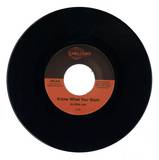
Melodies International proudly moves forward with an elusive piece of mid-tempo Chicago soul originally performed by Gloria J. Jennings in 1977.
Gloria was signed to Stage Productions as a gospel singer with pure and raw talent she had developed in the choir of her father's Southern Baptist Church. She was 16 years old at the time. To tutor her for R&B vocals, Willie C. Nance of Stage Productions spent 3 months taking the artist back and forth for vocal training 25 miles each way, 3 days per week.
At the time, Mr. Nance had made plans to work with singer and songwriter Theresa Eagins to record Know What You Want'. However, two days before the recording was set to begin, Ms. Eagins refused to move forward with the recording as she chose to take her religious faith more seriously and forgo the singing of secular music. Hence, Stage Productions turned to Gloria Jay to perform a song that would go on to move people thousands of miles away, many years later.
One of them was Patrick Forge: Back around 1990 I had a residency upstairs at the Wag Club on a Friday night alongside Paul Martin (he was Gilles P's A&R right hand man at Talkin Loud), the night was called Respect and we played mainly Soul, Boogie and Jazz-Funk. Many years later I bumped into Paul at a record shop and he quizzed me about a tune I used to play at the end of the night at Respect. Hhe described it as being an independent Soul seven inch on a red label, slow to mid tempo... and more to the point a bullet of a record. It piqued my curiosity so much I burrowed through my seven inches and even made Paul a compilation of likely contenders, his response was lovely selection, but it's not on there!'. Damn, a mystery! Many moons later whilst I was living in Japan, my tenant in my London flat said she'd found an old mixtape I'd done for her way back when and was desperate to know the identity of something she was calling the choo choo song'. Eventually when I was back in London she played the mixtape and I quickly identified her tune as Fabrica' by Cesar Mariano, however letting the tape play some time later a familiar descending chord sequence catapulted me back to those Friday nights at The Wag, and Gloria Jay's plaintive vocals reminded me of a record that had been absent from my life for far too long. I've no idea what happened to my original copy, I hunted another one down straight away, and I've kept it close ever since. Know What You Want' is a song that goes deep in such a simple, unaffected, almost naive way, Gloria's voice is both sweet and raw, it's built on simple chords and obvious instrumentation, but it's so much greater than the sum of its parts.
Know What You Want' is soul music, pure and unadulterated, there's nothing getting in the way of the feeling, it's straight from the heart.' Carefully re-mastered from the tapes, MEL008 comes forth in its original 7' format with a 14'x14' poster.
After collaborations with Merzbow and Daniel Avery, Alessandro Cortini (Modwheelmood, Nine Inch Nails) moves to The Point Of Departure for his third solo full length album. Alessandro Cortini today announces his third solo LP, AVANTI, due for release on 6 October via The Point of Departure Recording Co. Speaking about 'Perdonare', the first single to be taken from AVANTI, Cortini says: Perdonare embodies the often strenuous search for strength to forgive someone for their behaviour, when it becomes apparent that such behaviour is not conscious nor wanted, but merely a by-product of one's upbringing.There are few more potent examples of the power that music holds over our memories than hearing a song and being instantly transported back to a specific time or place. But what if we could change the soundtrack retrospectively If the scenes from our life played out on a big screen, how would we choose to score them It's an idea that Italian multi-instrumentalist Alessandro Cortini found himself preoccupied with on his latest album AVANTI.
Prior to making the record, Cortini rediscovered an archive of home videos made by his grandfather, who passed away a few years previously. Among the cache were several Super 8 films of family gatherings as well as hours of dinner-time conversations recorded on cassette for posterity. It was as if Cortini had unearthed a perfect fossil of his childhood. The films, however, were missing one crucial element - the sound. So Cortini decided he would restore the miss-ing audio in his own way, by composing a musical accompaniment to the footage.
As it turned out, Cortini had a few blanks to fill in himself. The films exposed some inconsistencies in his memories, moments that he romanticised or misremembered. But what surprised him the most was that the recordings appeared to be almost as fallible as his recollections - both showed signs of degradation. I really like that about memory and music, both from an instrumentation and playback point of view, I like imperfection,' he says.
AVANTI is rich in anomalies and irregularities - much like our memories - which Cortini let creep into his compositions by recording live on a single synthesiser, the EMS Synthi AKS, without overdubs. Just like the films, there are errors and mistakes in the music, some of which became the theme and some which are peculiar things that happen once or twice,' he says.
Tact Recordings launch their new vinyl only sub-label 'Tactics' this November, with the first EP coming courtesy of Yard One, who deliver three excellently programmed cuts in the shape of 'Tactics Vol.2'.
Launched by Yard One, aka Jordan Bruce and Larry Jones, and Richard Fletcher (who produces under numerous guises including Adventures In Daydreams and Fletcher), Tactics is set to become the labels latest project with a focus on solely vinyl releases. Inspired by the 2012 Various Artists release 'Tactics Volume 1' on Tact Recordings, which featured productions from Isherwood (Sharingtones/Imprints/Lize Records), journalist Per Boisen-Moller, and label regular Luke Black, the sub-label is set to showcase a more stripped back and minimal side to the Tact Recordings family with releases coming courtesy of Yard One, Fletcher, Luke Black and their close friends only.
The EP opens up with 'Avenoir', a raw and hypnotic production that utilises a multitude of lasers, glitches and pops at the forefront to keep listeners firmly on their toes, whilst a delicate and captivating melody floats fluently amongst ever-evolving percussion shots and twisting bass licks below.
On the flip, 'Granular Movements' snakes its way through swinging drums and hazy, jazzy melodies to reveal an effortless rolling groove, before 'Hexad' keeps the focus on percussive elements strong, whilst a moody bassline goes to work under layers of meditative pads and subtle background nuances to punctuate an excellent debut offering from the label. (Vinyl Only).