For its tenth year as a label, 4Weed Records proudly presents Zion Kingdom, a special EP we've been working on since long time. A feature between historical sound system Dread Lion Hi Fi, also active as producer and promoter, and Mr Biska, this release is enhanced by legendary Henry Tenyue's trombone melody, aka Matic Horns, and it is mixed, dubbed and mastered by Steve Vibronics.
Over the years Matic Horns has been collaborating in studios and live performances with the best Jamaican and English talents such as Gregory Isaacs, Freddie McGregor, John Holt, Luciano, Aswad, UB40, Horace Andy, just to name a few. Dread Lion Hi Fi crew is a historical Italian sound system, that has been a reference point for the reggae vibez in Italy, promoter of historical events such as the Milano Dub Club and the Dubwise Festival, where the best producers, singers and selectas of the international scene have been hosted. The combination with master Steve Vibronics was born far away in time, from a consolidated relationship over the years that brought about this collaboration.
The track opens with a magical trombone melody by Matic Horns that perforates the pad carpet laying down the whole tune while indicating the path, a victorious march to Zion. The guitar riff, which perfectly fits to the trombone melody, introduces the drop of a deep overwhelming rhythm that transmits the desire of moving and dancing, and at the same time a spiritual mantra for high meditation. The production is enriched by three different dubs, mixed and made unique by Steve Vibronics' technique, reverbs, filters and delay, a very guaranty for the lovers of Uk Dub in roots and culture style.
Search:dan march
Out-ER sub-label Pregnant Void is proud to announce the release of hi.mo's debut album Urtiis. Landing on double vinyl in June 2018, it is a fantastically absorbing showcase of the Italian's weird and wonderful fusion of various strains of sound from jazz to hip hop to classical. "The alteration of conventional musical patterns thrills me," says the artist who is classically trained in piano and uses that knowledge to play with rules, structures and forms. Influenced by IDM, African drums, jazz and the interplay of chords, rhythm and harmony, hi.mo infuses his electro-acoustic productions with found sound samples and analogue and digital tools. This is a spelling-binding and intimate album that is filled with invention, but never at the expense of the overall experience, which is beautiful and beguiling throughout.
Tachyon Audio is a vinyl label that's focused on sounds in the techno realm targeting sweaty, dark dance floors, with large, high-quality sound systems.
Inhabitants come back strong in Mutations Volume II, Tachyon Audio's second offering. These two primates are often found inhabiting dark spaces, forging ahead on complex math equations. Their distinct, driving, mathematical, and drumming techno is a result. Expect more solid work and performances from these two mysterious beings on Tachyon Audio as the label continues its progression.
Tachyon Audio's second release follows a similar format to the first, in that, TAC002 is a diverse EP that touches on techno sounds that are helping to lead the march forward into the future of sound production and style. The second Tachyon Audio release also comes from the mysterious dark studio of Inhabitants, who build off their first, and display their precise, technical forms of production.
The A-side track, Mut11 (A1) is a sci-fi exploration that pleases the ear with thick sub and low basses, along with a pitch-twisted melodic element, and the Inhabitants distinct sound effects and automation. The track has a strong impact immediately, as you can feel the intensity of elements being added, manipulated, and combined, and a sturdy, grimy feel pervades the piece with an interesting driving rhythmic percussion.
Side A ends with two separate open-source NASA samples. The first, Sounds of Enceladus - Radar Echoes from Titan's Surface (A2), is a locked groove and according to NASA, 'was produced by converting into audible sounds some of the radar echoes received by Huygens during the last few kilometers of its descent onto Saturn's moon, Titan. As the probe approaches the ground, both the pitch and intensity increase. Scientists will use intensity of the echoes to speculate about the nature of the surface.'
The second sample, Cassini - Saturn Radio Emissions #2 (A3), is another locked groove. The sound as described by NASA, 'Saturn is a source of intense radio emissions, which were monitored by our Cassini spacecraft. The radio waves are closely related to the auroras near the poles of the planet. These auroras are similar to Earth's northern and southern lights. This is an audio file of radio emissions from Saturn.' These samples are poised for reuse in production and make for good intro and looping material during performances.
The second side of the EP starts with Mut1 (B1), a track that is well-rounded percussively, with a strong kick drum driving the track forward. A simple looping and effected tom drum also helps keep a good movement to the track. An ominously melodic pad that evolves subtly throughout the track helps to keep the Inhabitants err present throughout the track.
Mut8 (B2), is another acidic venture with solid percussion. The looping and other melodic elements provide a solid stricture, with the more adventurous sounds being placed and effected incrementally with distinct Inhabitants flare throughout the track.
- A1: Heron Dance
- A2: Twilight Song
- A3: Yes—Singing
- A4: Dragonfly Song
- A5: A Homesick Song
- A6: The Willows
- A7: Lullaby—Lahel
- B1: Long Singing
- B2: The Quail Song
- B3: A Teaching Poem
- B4: A River Song
- B5: Sun Dance Poem
- B6: A Music Of The Eighth House
Music and Poetry of the Kesh is the documentation of an invented Pacific Coast peoples from a far distant time, and the soundtrack of famed science fiction author, Ursula K. Le Guin's Always Coming Home In the novel, the story of Stone Telling, a young woman of the Kesh, is woven within a larger anthropological folklore and fantasy. The ways of the Kesh were originally presented in 1985 as a five hundred plus page book accompanied with illustrations of instruments and tools, maps, a glossary of terms, recipes, poems, an alphabet (Le Guin's conlang, so she could write non-English lyrics), and with early editions, a cassette of field recordings' and indigenous song. Le Guin wanted to hear the people she'd imagined, she embarked on an elaborate process with her friend Todd Barton to invoke their spirit and tradition.
For Music and Poetry of the Kesh, the words and lyrics are attributed to Le Guin as composed by Barton, an Oregon-based musician, composer and Buchla synthesist (the two worked together previously on public radio projects). But the cassette notes credit the sounds and voices to the world of the Kesh, making origins ambiguous. For instance, The River Song' description reads, The prominent rhythm instrument is the doubure binga, a set of nine brass bowls struck with cloth-covered wooden mallets, here played by Ready.' According to writer and long-time friend of LeGuin, Moe Bowstern (who pens the liners for the Freedom To Spend edition of Kesh), Barton built and then taught himself to play several instruments of Le Guin's design, among them the seven-foot horn known to the Kesh as the Houmbúta and the Wéosai Medoud Teyahi bone flute.' Barton's crafting of original instruments lends an other-worldly texture to the recordings of the Kesh, not unlike fellow builders Bobby Brown and Lonnie Holley. Bowstern notes, Other musician / makers have crafted their own Kesh instruments after encountering the earlier cassette recordings that accompanied some editions of the book.' Both Barton and Le Guin are sensitive to the sovereignty of indigenous Californians and were careful not to trample the traditions of the Tolowa people who lived in the valley long before the Kesh. You research deeply, and then you bring your own voice to the table,' said Barton. Within the Kesh culture, the numbers four and five shape the lives, society and rituals. Barton composed loosely around these numbers, patiently listening to the land of Napa Valley for signs and audio signals from the natural elements. Todd incorporated ambient sounds of the creek by Le Guin's house and a campfire they built together. The songs of Kesh are joyful, soothing and meditative, while the instrumental works drift far past the imaginary lands. Heron Dance' is an uplifting first track, featuring a Wéosai Medoud Teyahi (made from a deer or lamb thigh bone with a cattail reed) and the great Houmbúta (used for theatre and ceremony). A Music of the Eighth House' sends gossamer waves of the faintest sounds to float on the wind.' Like the languages invented in the vocal work of Anna Homler, Meredith Monk, and Elizabeth Fraser, the Kesh songs and poems play with the shape of voice.
The Music and Poetry of the Kesh cassette was meant to accompany and enhance the experience of reading Always Coming Home. Presented in this edition as a long-playing album, where only traces of the book linger (the jacket offers some of Le Guin's illustration, and a letterpressed bookmark featuring the the narrative modes of western civilization and the Kesh valley is included), the music alone breaking the silence of what might be. It can transport—offering a landscape for imagining a future homecoming. One in which we are balanced, peaceful, and tend to the earth and its creatures. A line from the Sun Dance poem reminds us, We are nothing much without one another.' Freedom To Spend gives new life to the recordings of the Kesh people in the first ever vinyl edition of Music and Poetry of the Kesh, out on LP, and digital formats on March 23, 2018. The LP will include a deluxe spot printed jacket with illustrations from Always Coming Home, a facsimile of the original lyric sheet, liner notes by Moe Bowstern, multi-format digital download code and a limited edition bookmark letter pressed by Stumptown Printers in Portland, OR.
This past Monday, January 22, Ursula passed from this realm to another leaving a life spent building and exploring other worlds while challenging social concepts of the real word she inhabited.
Freedom To Spend had been working under Ursula's enthusiastic endorsement and with Todd Barton, her musical collaborator on Kesh, to give the music that accompanied her 1985 epoch a new life. With the Le Guin family's encouragement to move forward with our planned release, we are humbled to play this small role in sharing Ursula's work.
As Pete Swanson, one third of Freedom To Spend, stated, Ursula's legacy is her work which transformed the world, and this is another piece of the universe that her imagination birthed becoming real.' Listen to A Teaching Poem / Heron Dance' below.
Presenting 'Envelope'. Album written, produced & mixed by Milan W. and pressed on 180g vinyl, by Ekster. Coming out on the 6th of June 2018, with foil-stamped cover-drawing by Gerard Herman. Mastered & cut by Helmut Erler at Dubplates & Mastering.
.
Milan W (AKA Milan Warmoeskerken) is an Antwerp-based musician. In 2015 he released the Slo Mo cassette, on local label JJ Funhouse. The Intact LP a year later. Compositions constructed from gentle, yet persistent, rhythms. Intricately textured downtempo echoes. Brain-dancing, rather than four-to-the-floor raving. 2017`s split with Ekolalis, for The Hague`s BAKK, made clear the direction Milan`s headed in. His contribution being a seventeen minute float. The kick largely removed. The textures cut-up, expanded and magnified. Envelope, for Ekster, builds on this work.
The harlequin turns the handle. The contraption sucks in air, and breathes. Blows out tone poems. Wordless ballads that soundtrack enchanted scenarios. Issues forth magic. A sorcerer`s apprentice casting its spell. Animating the inanimate. To everything a life. Sets the frozen fluttering. Pirouetting in red shoes. Illuminates what was dark. Astma sings a Gamelan lullaby. Summons comforting angels to a post-Industrial landscape. Glaasjes has Jazz ghosts inhabit an empty bar room. Spirits stealing excuse-me`s under its deserted spot. In Limbo amplifies their whispers. Lead soldiers court jewellery-box ballerinas behind shuttered shop fronts. On Heraldic Snippets, a tin infantry marches. Ten thousand men up to the top, and back down again. Keys make-believing that they are massed brass and fife.
The bellows pump, and the pipes all the while wheezing. An automaton philharmonic at the bidding of a steam-punk master. Analogue and digital. Clockwork and glitch. Malady finds sounds isolated, extrapolated, mutated. Orchestral`s organ-grinder moves with urgency, and alchemy. Spinning straw into gold. Snare rolls become bubbling mercury. Metallic, yet fluid. Racing at the speed of flight and escape. Slope is the music of water chasing through crystal caves. Slow Runner, a funeral crawl. Shoved into motion by a drama of strings remembered.
Like the charismatic Rat-Catcher of Hamelin, the harlequin turns the handle, and we bang the cup.
Raga Abhogi
1) Alap
2) Jod
3) Jhala
Raga Vardhani
4) Alap
5) Jod
6) Jhala
Zia Mohiuddin Dagar : rudra veena
Annie Penta : tanpura
Concert recorded at the home of Shantha and Niranjan B. Benegal, Seattle, Washington 9 March 1986.
Recorded by Niranjan Benegal. Files obtained from Jeff Lewis.
Mastered & Cut by Rashad Becker at Dubplates & Mastering 1117 & 0318.
Liner notes by Renaud Brizard, edited by Stephen O'Malley & Ian Christe.
Front and back cover photos by unknown.
Interior photography by Niranjan B. Benegal, Dan Neuman & unknown, Seattle 1978-1980. .
Around ten years ago, deep into a cozy and hazy night following a concert with my sound brothers Daniel O'Sullivan and Kristoffer Rygg in London (as Æthenor), they graciously introduced me to a recording of rudra veena (a kind of noble deeper bass relative to the sitar, in a way) as performed by dhrupad master Zia Mohiuddin Dagar.
Dhrupad, for those who do not know, is a branch of Hindustani classical music said to "show the raga in its clearest and purest form". It's pacing concentrates heavily on the slow, contemplative alap section and works with specific microtonal gestures and deep characteristics of resonance ... in short I was hooked on this new (to me) and ancient form of music from the first listen, and feel that a more or less continual listening & reviewing of Zia Mohiuddin Dagar's recordings in the years that followed have influenced my own approach to music quite heavily (if, albeit, indirectly).
In early 2015 I was able to make contact with Zia Mohiuddin Dagar's son Bahauddin and some of his American students/disciples, primarily Jeff Lewis. Over time we developed a friendly and educational exchange, access a massive archive of recordings and developed these two paired titles for my label. It's been a long path to arrive at actually releasing them but also probably in many ways one of the most significant releases I've worked on. And I'm proud to be able to reveal these to date unreleased archival recordings of one of the masters of dhrupad, Z. M. Dagar, to the public for the first time.
Zia Mohiuddin Dagar was the nineteenth generation in a family tradition known as Dagar gharana, a rich lineage which continued and performed the musical form of dhrupad (Bahauddin Dagar continues the lineage as a master rudra veena dhrupad player of note today). Initially, dhrupad was a rigorous, austere, devotional genre that was sung in Hindu temples. But between the 16th and the 18th centuries, it became the preeminent genre in royal courts in North and Central India, and the Dagar gharana developed and continued publicly following the eventual loss of court patronage for dhrupad in the 19th century. The French ethnomusicologist Renaud Brizard covers the story of Zia Mohiuddin Dagar's life and teaching (a long story also in Seattle, my hometown!), the Dagar family and gharana, the rudra veena and more topics in an extensive set of liner notes in this release.
Ragas Abhogi & Vardhani were recorded in a private house concert in Seattle at the home of the Benegals in March 1986 (the week before the accompanying release SOMA029 Raga Yaman was recorded). The Benegals were friends (& Shantha Benegal was also a student) of Dagarsahib who sometimes hosted Hindustani music concerts in their home. It's a rare glimpse of a more intimate, personal and perhaps different kind of performance considering the form of dhrupad.
-Stephen O'Malley, March 2018, Paris, France
Stephen O'Malley would like to especially thank Bahauddin Dagar, Jeff Lewis & Jody Stecher for their enthusiasm, cooperation, patience, insight & advice toward developing these editions. Thank you also to Laurel Sercombe & John Vallier from the University of Washington Ethnomusicology Archives, Shantha Benegal, Philippe Bruguière, Dan Neuman, Ira Landgarten, Renaud Brizard, Ian Christe, Peter Rehberg, Rashad Becker, Daniel O'Sullivan & Kristoffer Rygg, all for their direct or indirect cooperation, assistance & patience.
Raga Yaman
1) Alap
2) Jod
3) Jhala
4) Gat (Composition in Chautal)
Zia Mohiuddin Dagar : rudra veena
Manik Munde : pakhawaj
Gayathri Rajapur & Annie Penta : tanpuras
Recorded by unknown at the University of Washington, HUB Auditorium, Seattle, Washington 15 March 1986 , concert co-sponsored by the UW Ethnomusicology Division and Ragamala.
Original digitally processed audio recording made with Panasonic PV-9000 VCR, Sony PCM-F1, PZM mics. Mastered & Cut by Rashad Becker at Dubplates & Mastering 1117 & 0318.
Liner notes by Renaud Brizard, Stephen O'Malley & Ian Christe.
Front and back cover photos by Niranjan B. Benegal, Seattle Center Folklife Festival 1979. Elizabeth Reeke & Annie Penta on tanpuras.
Inner gatefold photography by Niranjan B. Benegal & Ira Landgarten.
Around ten years ago, deep into a cozy and hazy night following a concert with my sound brothers Daniel O'Sullivan and Kristoffer Rygg in London (as Æthenor), they graciously introduced me to a recording of rudra veena (a kind of noble deeper bass relative to the sitar, in a way) as performed by dhrupad master Zia Mohiuddin Dagar.
Dhrupad, for those who do not know, is a branch of Hindustani classical music said to "show the raga in its clearest and purest form". It's pacing concentrates heavily on the slow, contemplative alap section and works with specific microtonal gestures and deep characteristics of resonance ... in short I was hooked on this new (to me) and ancient form of music from the first listen, and feel that a more or less continual listening & reviewing of Zia Mohiuddin Dagar's recordings in the years that followed have influenced my own approach to music quite heavily (if, albeit, indirectly).
In early 2015 I was able to make contact with Zia Mohiuddin Dagar's son Bahauddin and some of his American students/disciples, primarily Jeff Lewis. Over time we developed a friendly and educational exchange, access a massive archive of recordings and developed these two paired titles for my label. It's been a long path to arrive at actually releasing them but also probably in many ways one of the most significant releases I've worked on. And I'm proud to be able to reveal these to date unreleased archival recordings of one of the masters of dhrupad, Z. M. Dagar, to the public for the first time.
Zia Mohiuddin Dagar was the nineteenth generation in a family tradition known as Dagar gharana, a rich lineage which continued and performed the musical form of dhrupad (Bahauddin Dagar continues the lineage as a master rudra veena dhrupad player of note today). Initially, dhrupad was a rigorous, austere, devotional genre that was sung in Hindu temples. But between the 16th and the 18th centuries, it became the preeminent genre in royal courts in North and Central India, and the Dagar gharana developed and continued publicly following the eventual loss of court patronage for dhrupad in the 19th century. The French ethnomusicologist Renaud Brizard covers the story of Zia Mohiuddin Dagar's life and teaching (a long story also in Seattle, my hometown!), the Dagar family and gharana, the rudra veena and more topics in an extensive set of liner notes in this release.
Raga Yaman was recorded at a public concert in Seattle at the HUB Ballroom at the University of Washington in March 1986 (the week after the accompanying release SOMA028 Ragas Abhogi & Vardhani was recorded) at the end of his last tour of the United States. Yaman was a special raga for Zia Mohiuddin Dagar, one of his signature raags. For centuries, Yaman has been considered as one of the most fundamental ragas in Hindustani music and is one of the first ragas which is taught to students. A deep knowledge of Yaman gives a key for understanding many other ragas. It's filled with tranquility, contemplation, pathos and spiritual yearning. .
-Stephen O'Malley, March 2018, Paris, France
Nubian Quadrant EP sees Dutch producer Philou reaching for that sweet spot between Afro and Electro to produce three pulsing new tracks for Byrd Out. As Philou says, "All good music ultimately comes from Africa", and true to his African roots, the EP was part recorded in Malawi. With his tracks being picked up by the likes of Erol Alkan and Eats Everything, this EP is sure to provide the rhythmic backdrop to the summer. If you imagine the driving force of Fela Kuti matched with the acid sqwelch of Phuture, you're part of the way there. It's dancefloor sunshine on vinyl. Mastered by the legendary Noel Summerville, artwork by G.S-L Studio.
Biog: Philou Louzolo, a vibrant human being showcasing a diverse sound: born and raised in between the forests and the salty ocean breeze of Southern Zeeland (The Netherlands). Blessed with deeply rooted ties to the townships of Sierra Leone, the jungle surrounding the Congo river and Nigeria - where the birth of Fela Kuti's Afrobeat took place - his music sounds like Pan-African propaganda packed with sounds from urbanized cities, the Sahara and Africa's many jungles. He's been making waves with a Mixtape for the Feel My Bicep guys (it's #84), and getting airtime on BBC Radio 6 with Erol Alkan, and on BBC Radio 1 with Eats Everything, and playing Resident Advisor's GAIN stage at DGTL in Amsterdam in March, and playing at Morocco's boundary-pushing Altas Electronic festival later this year.
South African Mbaqanga And Bubblegum Instrumentals For The Dance-floor. First Time Available Outside South Africa. Cult Favorite Among Collectors. Follows The Successful Reissue Of bafana Bafana' Last Year. Professor Rhythm's 1991 Recording Professor 3 Is A Vivid Reflection Of Urban South Africa As Apartheid Was Ending. Thami Mdluli's Production Project Had Young And Old Dancing To A Sound That Sought To Unite Blacks Within Southern Africa. our Music Gave Hope To The Hopeless,' He Says. Mdluli's Third Instrumental Album (which Contains Some Background Vocals, To Be Exact), Portrays The Moment When The Dominant Mbaqanga And American R&b-based Bubblegum Sounds Being Produced In Johannesburg And Other Urban Centers Were Transforming Into House And Hip-hop-inspired Kwaito. The Pop Of The 80's And All That Went With It—from The Models Of Synths And Drum Machines To The Lyrical Style—gave Way To A Changing Melodic Emphasis And New, Much Slower Tempi Using A Completely Different Rhythmic Skeleton. Upbeat, Chipper Bubblegum, Often With Double-time Breakdowns And Upstroke Syncopations, Faded And The Sounds Began To More Closely Resemble Those Of Contemporary Black America—where Hip-hop Was Slowing Down And The Bass-lines And Melodies Were Getting Moodier, Darker In General. At The Same Time House Music Had Briefly Reached Mainstream Acceptance In The States And That Popularity Continued To Feed Into Awareness Overseas. These Two Influences Blended With The Burgeoning House Music Scenes In Johannesburg And Pretoria As Professor Rhythm 3 Was Being Produced In March 1991 (the Same Year Apartheid Ended). Mdluli Explains, we Were Influenced By Foreign Bands And So People Updated Their Sound.' According To Mdluli, The Evolving Sound Was Bolstered By Widening Availability Of House And Rap Records From Abroad While, Most Importantly, An Increasing Sense That Apartheid Might Soon Be Finished Was Met With A New Positivity Vibe Society. 1991, '92, '93... Mandela Was Released. People Were Upbeat, They Were Happy, The Music Was Good.' Professor 3 Came Out On Vinyl As The Lp Business Was Dying In South Africa And Sold Around 20,000 Copies. It Was Mainly Distributed On Tape, Which Sold Closer To 100,000. With The Help Of Engineer Fab Rosso, The Recording Features Backing Vocalists From Mango Groove. After Making A Half-dozen Records As Professor Rhythm, Mdluli Once Again Shifted His Focus Musically. By The Mid-90's He Had Veered Off Gospel Music— And Left Playing In Bands And Started Making His Own Solo Recordings. His Enormous Success In The Gospel Realm In The Years Since Is A Remarkable Story In Its Own Right, But For Now We Are Only Dancing.
Japanese vocal performer Hatis Noit will release her enigmatic EP Illogical Dance via Erased Tapes worldwide on 23rd March 2018.
The arresting 4-track record creates unique song-worlds with transcendent vocal interpretations that at once deconstruct and recombine Western Classical, Japanese folk and nature's own ambience atmosphere. Illogical Dance also features Björk-collaborators Matmos, who were so impressed with Hatis Noit's recordings, they volunteered to edit the lead track Illogical Lullaby.
Hailing from the distant Shiretoko, a small town in Hokkaido, which is the largest island in north Japan, Hatis Noit's accomplished range is astonishingly self-taught, inspired by everything she could find from Gagaku — Japanese classical music — and operatic styles, Bulgarian and Gregorian chanting, to avant-garde and pop vocalists. The sounds she created on Illogical Dance, co-produced by Haruhisa Tanaka and Matmos, bring to mind the experimental vocal patterns of Meredith Monk with the attentive production of Holly Herndon.
It was at the age of 16, during a trek in Nepal to the Buddha's birthplace, when she realised singing was her calling. While staying at a women's temple in Lumbini, one morning on a walk Hatis Noit heard someone singing. On further investigation it was a female monk singing Buddhist chants, alone. The sound moved her so intensely she was instantly aware of the visceral power of the human voice, a primal and instinctive instrument that connects us to the very essence of humanity, nature and our universe.
The name Hatis Noit itself is taken from Japanese folklore, meaning the stem of the lotus flower. The lotus represents the living world, while its root the spirit world, therefore Hatis Noit is what connects the two. For Hatis Noit, music represents the same netherworld with its ability to move and transport us to the other side, the past, a memory, our subconscious. It is the same for Illogical Dance, a set of transformative songs that taps into our most primal instincts.
The human voice is our oldest, most primal yet most powerful instrument. I use it to describe nature's many sounds, a language that isn't logical. Yet it forms a beautiful conversation that isn't restricted to words like the human language is. I want my music to remind us of that.' — Hatis Noit
Wanting to interpret and mimic the sounds Hatis Noit hears in nature, Illogical Dance is as unpredictable, beautiful and mysterious as the world around us. Each track is made up from multi layers of vocals, all improvised and without words, before being carefully pieced together. Astonishingly no samples are used throughout, even the sound of crushing leaves came from Hatis Noit's own vocal chords.
The result is a stunning array of sound sculptures that see her switching between multiple styles with great ease. From the sweet operatics on Illogical Lullaby, the manipulated vocal loops duplicating electronic production on Anagram c.i.y. to the primordial chanting call to arms of Angelus Novus, a 10-minute odyssey that features whispering and leaves crunching, it showcases Hatis Noit's full range and introduces a truly original artist.
Previously only available in Japan, Illogical Dance will receive a worldwide release on 23rd March 2018 including a first edition on 12' vinyl. After participating in a ceremony for memorial and appreciation tailored to the withdrawal of the evacuation area in Fukushima on 31st March 2017, Hatis Noit collaborated with renowned visual artist Nobumichi Asai on a project titled INORI (prayer) which they premiered live as part of an Erased Tapes showcase at Mutek Japan in Tokyo.
Having recently moved to London and performed a first string of UK shows, followed by a special live performance at the Milan Fashion Week and Mutek Japan appearance, Peter Broderick has invited Hatis Noit to support him at the Jazz Cafe on April 15th. She's also been announced as part of this year's Sea Change Festival line-up, and asked to participate in a workshop with the London Contemporary Orchestra.
Sanskrit scriptures mention the term vimana as flying vehicles or temples. Consequently, the sound of this ancient UFO has been captured into the grooves of this vinyl record. The soundscapes of Rukma Vimana dig deep into the dirty history of raw and hypnotic industrial techno. Nobody said that spiritual journeys are a clean endeavour. A1 marches forward into the dark lands of dirty drums and urges you to follow it, as it's your duty to dance hard in this life. Flip the vinyl and the needle will tickle your subconsciousness. Excavating deep tantalizing melodies and dusty basslines, one should not get lost in the palace of this unknown god. Closing with a meditative sketch, B2 leaves us puzzled about the vortex of energy we've just been through.
The Lucid Dream return in April with the release of new single 'SX1000', the first taster from the recently completed 4th album.
Driven by fans raising £10,000 to hell replace all equipment robbed after a Paris show in early 2017, a new album became the instant focus for The Lucid Dream in the summer of 2017.
The track is a slice of pure acid house, and will again see them acknowledged for venturing into pastures new, setting themselves apart from 'genres', 'scenes' or what any other band are currently doing.
'SX1000', as with the whole album, was penned over the summer by Mark Emmerson (vocals/guitar/synths), using only the classic Roland 303/808 synths, bass and vocals as tools for writing.
Inspiration for the writing was formed via continuous listening to the Chicago to UK acid house works of 1986-1992, the focus predominantly on the groove. 5 months on from those writing sessions and The Lucid Dream have competed their 4th album in 5 years, this track a perfect indicator as to what awaits. A record made for the dancefloor.
The Lucid Dream formed in Carlisle, Cumbria, in 2008. A string of sold-out 7s was followed by the debut longer player, 'Songs Of Lies and Deceit', in August 2013. The album gained critical acclaim from the likes of Uncut, Q, Rocksound, Clash, The Quietus, and leading French culture magazine, 'Les Inrocks', to name a few. The initial vinyl pressing of the debut album (500 copies) sold out within 2 days, and was backed by a main stage slot at Kendal Calling, and supports to Death In Vegas and A Place To Bury Strangers (full UK tour).
The bands 2nd album ('The Lucid Dream') was released in March 2015 to further acclaim. This included 2 BBC 6 Music sessions, and press from Uncut, The Skinny, Louder Than War, and Drowned In Sound, who named the album #7 UK album of 2015. Further supports to Clinic and A Place To Bury Strangers coincided.
3rd album, 'Compulsion Songs' was released in September 2016, on Holy Are You Recordings. The vinyl pressing of the album sold-out within a day, prompting an immediate 2nd press, with pre-sales of the album topping 1,000 before release. The album was backed by a headline UK tour, and a main slot at Liverpool International Festival of Psychedelia (for which they were singled out for major plaudits from The Quietus, The Skinny and Drowned In Sound). The album again received acclaim from the likes of Mojo, Uncut, Classic Rock Magazine, BBC Radio 2 (Huey Morgan) and across the board on BBC 6 Music (Lauren Laverne, Marc Riley, Tom Ravenscroft, Gideon Coe, Stuart Maconie).
Molten Moods releases another finely curated various artists record with tracks by Skee Mask, Kessel Vale, Jonas Yamer and Konrad Wehrmeister. Kessel Vales opening track Voguing Geisha' is an unconventional breakbeat masterpiece following his sense of harmony and rhythm already shown through previous releases on Tanstaafl Records and Rhythm Nation. As the track unfolds it reveals musical storytelling by integrating a technoid polyrhythmic loop structure into melodic synth figures, slowly deconstructing in the end. Skee Mask collaborated with Molten Moods labelhead and Carl Gari member Jonas Yamer on Fanta Ocean', it being the first release ever outside of his Ilian Tape homebase. The outcome is a moody IDM piece with cinematic qualities, complex but soothing. The B-Side begins with Xenomorph' by Konrad Wehrmeister, who is known by his releases on Public Possession and SVS Records. This trancy yet distorted and detailed electro banger surely takes on the role of the records dancefloor highlight. The closing track Insgeheim' is delivered by Molten Moods head honcho Jonas Yamer. Here groovy kicks, distorted chords and a psychedelic pad are woven into one compelling 10 am techno track. The common thread of Molten Moods 4 is four young Munich artists going on a joint trip into idiosyncratic electronic music. The resulting tracks intertwine as one modern and diverse techno record. Out on 12 vinyl and wav by the end of March 2018. In the tradition of Molten Moods' cost-conscious design strategies by Paul Bernhard, the record comes with a xeroxed low budget sticker set.
Mastered by Manmade.
2019 Re-Issue
2017's Once & Future Band' landed upon our brains like the birth of a starchild - fully formed, otherworldly, yet comfortingly familiar in its contours...Floyd, ELO, Queen, Steely Dan, and Beach Boys rearranged into an unapologetically poignant pop moment, underpinned by 4 guys that could play their way out of a Faustian bargain. While we await whatever warlock's potion they are brewing up next, they've pulled a maxi-EP Brain from the vaults for a moment in the sun. All of the mastery you've come to expect is at play here, enough chops to make a vegetarian's mouth sweat, songs that tug at the heart while they play tricks on your mind, and with the steady hand of a of studio wizard sprinkling stardust around the edges just so. It's out on Castle Face Records March 9th.
* To celebrate the second anniversary of Khemia Records we are pleased to welcome back In Aeternam Vale, the legendary French artist who inaugurated the imprint on a split Ep with Bronze Teeth in March 2016.
* This is the first single-artist Ep produced by the label, initiating a new series that will run parallel to the V/A editions.
* The tracks 'Dave' and 'Circles' form an elliptical conundrum composed of various references including Kubrick's alchemical allegory 2001 A Space Odyssey, (sampled in French) with it's existential narrative of a schizophrenic artificial intelligence lurking in the shadows. The Deus ex Machina wondering if mankind is still useful to machines, or perhaps even dangerous to them The infamous Seveso chemical disaster at the pharmaceutical laboratory ICMESA caused by human error, the glowing blood-red sphere of HAL 9000, the all-seeing eye of the sentient super-computer and the circular composition of the toxic compound 2,3,7,8 Tetrachlorodibenzo-p-dioxin (TCDD), released into the atmosphere at Seveso. With this cryptic feedback loop, Laurent Prot is suggesting that the new technologies we are developing now, for use in our near future could result in catastrophe when human control is lost to the self-learning of AI. The homicidal consequences of a machine take-over find visual form in the bleak, dystopian aesthetic of Evelyn Bencicova's cover artwork.
Techno Album of the month March 2018 in Mixmag UK!
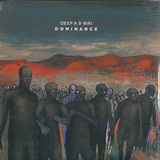
Central to the Israeli club scene, Deep'a & Biri have long been defying expectations even within a community they helped construct. Serving as resident DJs, activists and bookers for Tel Aviv's legendary Barzilay Club, the pair helped build a transcendent club scene. Hugely influential artists such as Robert Hood, Derrick May, Rødhad, Ben Klock and Moritz Von Oswald passed through the club, enjoying legendary crowds and what they could surely sense was a genuine air of anarchy, rebellion and unadulterated rave pleasure.
As the duo held down dozens of parties with dozens of DJs, there was no 'eureka' moment for their emerging sound; just a steady stream of brilliant, inspiring electronic music, much of which left an indelible imprint on the pair. Now based in Berlin, for Deep'a & Biri, things are much the same, even if the landscape and the city is different. Always rooted in the fertile ground between machines and emotion, on their second full-length LP, 'Dominance', the duo demonstrate their unique grasp of the sensitive, unfolding relationship between man and machine. Steadfast in their insistence never to remain in one lane in terms of their sound, 'Dominance' flawlessly segues between forcefulness and weightlessness. From beginning to end, this is not a record afraid to show its teeth with an uncompromising, instantly recognisable techno palette that kicks the foundations of any sound system with menace, anger and determination, particularly on tracks such as the dense 'Voltage' and pulsing throughout the more industrial flourishes of 'Ecole De Nancy' and 'Seeking Solace'.
Beyond these grittier, although never mindless, moments of authority, a sense of escapism and curiosity imbues the album. 'Alpha Cephei' offers the first hint of Deep'a & Biri's more wistful concepts, producing a smoke trail of twinkling electronics out of a smudged but distinctive bassline. That understated sense of emotional catharsis carries throughout, to be found between the complex-yet-familiar bells that drive 'Flow Diverter's' rhythm to a Detroit-indebted landscape that will surely instantly elasticate any keen dancers, while 'False Memories' offers big-room techno fulfillment with none of the character or sincerity removed for cheap thrills. Saving the most remarkable moments for last, the pair sign off 'Dominance' with the poignant and purifying 'Astral Trails', fusing an ethereal, ambient landscape with the more pronounced rhythms of their hardware.
The album's distinctive artwork comes from the studio of Jewish orthodox artist Avraham Guy Barchil, who forged a powerful connection with Deep'a, both was immediately drawn to 'weird atmosphere, amazing technique and emotions involved with his work'. Perhaps one of the most interesting painters from Israel, Avraham is known for his unique perspective, taking his inspiration from the Zohar - the foundational work in the literature of Jewish mystical thought known as Kabbalah. The ambiguous figures represent mystical aspects of the Torah (the five books of Moses), as well as material on mysticism and mythical cosmogony.
Ensuring their natural, conscious touch always remains at the forefront of this unapologetically machine-driven music, Deep'a & Biri have produced an album in the lineage of their heroes and greatest influences. Cerebral yet satisfying, deep yet always engaging, 'Dominance' both reasserts and evolves Deep'a & Biri's forward facing and singular sound.
more talking all that jazz, more high aiming music by fumio itabashi: mule musiq is ready to release another record by the legendary japanese jazz pianist, born in ashikaga, tochigi in the year 1949.
this time his first solo record ever: the heavy jazzing 'nature', which has never been reissued on vinyl since its birth in 1979. it has been recorded at nippon columbia 1st studio, tokyo from march 13 to 15 in the year of its release.
it features itabashi making feverish love with the piano and sharing the studio with the great bass players hideaki mochizuki and koichi yamazaki, drummers kenichi kameyama and ryojiro furusawa, soprano saxophonist yoshio otomo and vibraphone wizard hiroshi hatsuyama.
they all joined him to perform his very own songs, composed by itabashi himself and produced by ryonosuke honmura, who also produced japanese jazz heroes like saxophonist keizo inoue during his career.
but enough background information. what counts is sound. it is fresh, propulsive, twitchy and melodi-ous from the first to the last tone. sometimes the instrumentalists play a classic solo in an overall deep modal jazz atmosphere that seems to be made for cats that love the good old stars and inventors - from john coltrane to mile davis, from thelonious monk to art blakey.
'nature' also shows how deep itabashi studied the history of the genre, while keeping his very own vision of jazz alive. the man that made his professional debut as a member of the sadao watanabe quintet in 1971 and that also was a member of the elvin jones jazz machine world tour from 1985 to 1987, plays the piano in all tempos: nervous high-flying quick, deeply blue blues style slow.
besides the traditional jazz flavours, you get a feeling of mind-expanding spiritual jazz, that grand mas-ters like pharaoh sanders or gary bartz turned into a sacred music genre. a master-class record in ravishing big city jazz music, adventurous, sometimes meditative, sometimes faster than the speed of light, always grooving with a bright, pure-toned sensibility and deeply soulful melodic imaginations.
it extends the jazz history with a fine balance between tradition and innovation. and it stays infectious all the time while sounding surprisingly fresh due to a lot of thrilling musical spontaneity that touches profoundly even though all notes have been written down by fumio itabashi before he and his combat-ants entered the studio.
and maybe that's the mystery of these timeless five at times epic recordings: all notes been written on paper but each musician had the freedom to dance with them in his very own unique way. so, turn the volume loud and get ready to be steamrolled by fumio itabashi's 'nature', an inebriant album that is talking all that jazz deeply!
It's the big 5! Berlin - Frankfurt based label House Is OK is celebrating its five-year long presence and has decided to mark that period with something special Label's story started with a sticker Homeboy printed in his former hometown, Zagreb, saying House Is OK'. Catchy, right It became an underground slogan of the local scene. It didn't take long for people to embrace the idea stating that it's OK to be into melodic, fresh, groovy yet, at times, a bit awkward dance music.
Just around the same time Homeboy's Frankfurt based bro's Oliver Achatz and Janis played with the idea of starting a record label. Guess what the logical choice for the name was
Ten records, dozens of original songs and remixes later House is OK continues to grow.
Literally. What was once a platform for the original three founders is now an international family affair supporting the talented artists from Frankfurt, Stockholm, Alexandria and Orlando. Nurturing the friendly approach this musical family continues to grow.
Looking back at the first five years, not only at the music that connected them all but at the bonds that deepened through the production process, House is OK crew wanted to take
create a proper reminder and thank the ones supporting them throughout the years. A double 12' pack titled Gemišt' seemed like a proper way to do that.
- Gemišt will be released as two separate EPs featuring the original music from Kornél Kovacs, Roman Flügel, Gavri & McQueen, TCB, House Of Life and the label makers themselves. Oliver and Janis deliver tracks under their known names, while Homeboy
introduces his new project with fellow Wilde Renate resident The Swift, called Longhair.
Croatian artist Ugruv Smek marks his yearlong collaboration with the label delivering yet another smashing artwork.
Mark the upcoming February when Gemišt part I' is to be released and while you're at it, move on to March just so you don't miss the Gemišt part II' release. And yeah, in case you're wondering - of course it's both 12' EP release and in digital format. House is OK's got you covered.
The third chapter in the vinyl installments on Gaze ill's Danish Cue Line Records is written by Belgian artist Zygos, Georgio Roumans. An unforgettable piece formed by 3 distinct original tracks plus an outstanding remix by Italy's most wanted, DPRTNDRP (D- Operation Drop).
The EP opens with the toxic symphony of 'Laicism'. By chest pressuring hits right from the beginning, we're pushed into another world where everything is moving though it feels like time stands still for a moment. Mellow melodies formed in layers of feedback alike sounds and endless reverberated stabs generate a persistent tension held tight by the static, marching drums. The title track 'Sudd' forms part 2 of the journey through Georgio Roumans' explorative universe. To think everything can move this fast yet keeping a minimal expression is beyond reality. From 8th to 16th to 24th notes - variations through the bass, percussion, and melody sections - a discreetly conducted progression is reached throughout the track. Accompanied by weird background soundscapes the sub bass takes the lead on the tight Halfstep- package of 'Tapered'. The drums are simple and hard, which is just what's needed to tame and control the strong movements from the sub. Super minimal for the sound system. Italian DPRTNDRP brings new life to 'Sudd', which awakens in a completely different light than the tempo- filled original. Strange sounds and rhythms, raw and dirty. DPRTNDRP makes the remix a must hear.
The vibe is intense from start to end, and the EP hits perfection due to Georgio's naturally alive style, and the clever remix from the ever boundary pushing DPRTNDRP. Signature sound, deluxe on 180 grams heavyweight vinyl!
Cut by CGB at Dubplates & Mastering, Berlin, June 2017
Digital Transfer: Jonathan Fitoussi
Translations: Valérie Vivancos
Layout: Stephen O'Malley
Coordination GRM: Daniel Teruggi & François Bonnet
Executive Production: Peter Rehberg
Tremblement de terre très doux (1978), 28'14
climate 1 / transit 1 / landscape 1 / climat 2 / landscape 2 / transit 2 / landscape 3 (walking - jumping - sliding - flying) / climate 3 / landscape 4 / climate 4 - transit 3 / landscape 4, end.
The familiar generates the strange.
These rolls, these hums, these sudden rushes, this song, these peaceful circlings, these sudden outbursts, these returns to quiescence - what do they remind us of
This piece's trajectory could also be a representation of the dramatic unfolding of a day - of a life - from sunrise (climate 1) to night-time (landscape 4) via restless encounters, transitions (1 to 3) that announce the drama climaxing in landscape 3, before reaching its denouement in climate 4... A whole concrete 'story'.
The subterranean properties inherent to listening gently shift our ideas...
François Bayle
First performance: 19 March 1979 - Grand Auditorium of Radio-France,
Ina-GRM's Cycle Acousmatique. .
Toupie dans le ciel (1979), 21'
A wave is swaying on two minors thirds. This constantly uniform yet constantly varied swaying revolves in a swarm of sharp designs that blink on and off in a layer of growing density and mobility.
Distance, speed, pressure, density, temperature, colour, intensity, are the "themes" of the 27 short interconnected cells flowing together though this seemingly unified movement.
Occasionally, a breach in the texture reveals skyes dotted with little comets. In the centre, a slow gliding picks up the distant harmonics of a basic chord. Toward the end, this gliding returns with a fiery burst.
Fine lines and whirs are generated from the song of a spinning antique top.
To end on a lighter note the title Toupie dans le ciel - Spinning Top in the Sky reminds us of Lucy in the Sky with Diamonds by The Beatles as well as Lucy, the oldest Australopithecine (3 million years), our African grandmother in the Erosphere...
The overall title Erosphere alludes to the desire inherent to the listening experience, and to the very primitive cues that sustain the auditory attention and are the basis of all musical pleasure.
François Bayle
First performance: 21 January 1980 - Grand Auditorium of Radio-France,
Ina-GRM's Cycle Acousmatique.