Lucas Chantre, aka WORLD BRAIN, last graced us with a solo release half a decade ago, with 2019’s Peer 2 Peer. As its name suggests, that album explored the promise and perils of universal connectivity via quirked-up songwriting and instrumental psychedelia. His new release, Open Source, deepens this internal and external journey. Bursting beyond the four walls of ‘bedroom pop’ and reflecting a move from Berlin to Paris—where much of the album was recorded—and on to Brussels, the album has a jazzy, cinematic scope (as on the Brubeck-inspired march “Fromage collatéral,”) enveloping the listener in a cosmic-pastoral audiosphere.
There are still many tones that evoke the software sounds of decades past (the exemplar here is “cAPTCHA,” whose virtual marimba and vocalese suggest a breathless, Exotica-inspired introduction .mov for the information superhighway) but the palette has become richer and more organic, lead by the woodwinds which play a major role throughout, with flute provided by labelmate Martha Rose. (On the aforementioned “cAPTCHA” one also hears the world-class whistling talents of the incomparable Molly Lewis.)
Yet the single most noticeable new element may be the use of Chantre’s native French, sung by his sister on “Ville fleurie” and the gorgeous, fluttering “Minute papillion” (the title an idiomatic injunction to slow down!) Chantre initially wrote these lyrics in English, but felt something wasn’t quite right, only realizing what was off when he heard them sung in another language. That spirit of discovery – of finding a new spark in returning home – suffuses Open Source. It invites us to play, beckons us to relax, reminds us to find serenity amidst the churn of the present: minute papillon, dans le tourbillon.
Buscar:dan march
Berlin techno talent Regent channels his signature depth and drive into a new outing for MALoR Records. With each release since his inception in 2020, he demonstrates the versatility of his sound and his ability to convey profound narratives across a spectrum of techno sub styles.
After contributing a standout track to the label's Purveyors Of The Groove Vol. 3 compilation in 2023, he now returns with a highly cerebral yet anthemic and dance floor-destined 5-tracker EP: Cratea.
The A-side kicks off with the EP's standout cut, 'Refiction', a sinister, forward-marching piece laced with spooky, psychedelic vocals and dripping in LFOs and mind-boggling soundscapes.
It's followed by the title track 'Cratea', shaped by steady bleeps and an evolving, echo-drenched synth that bounces erratically from start to finish, driven forward by thick claps and floaty rides.
On the flip, 'Origins' delivers a steady, hypnotic tool built on organic bass sounds, gnarly percussion, and wet vocal chops, peaking with four-to-the-floor claps that are sure to lock in a busy dance floor.
'Null Model' follows with a signature Regent groove, fusing driving 909 drums with a clever interplay of short synth stabs and warped-out voices, resulting in a deeply trippy, almost paranoid atmosphere.
Closing the record is 'Stealthless', a stripped-back yet uplifting techno tool, offering moments of synth euphoria and harmony while remaining deliberately restrained and minimal by design.
A versatile release made for different moments in the night, designed to guide dance floors through profound, body-moving journeys.
Best served on powerful sound-systems.
Limited 180g black vinyl (500 copies worldwide)
“Marcel Wave combine sharp-eyed Northern lyricism with DIY guitar-janglers rooted in a retro C86 aesthetic. Epic finale ‘Linoleum Floor’...is a gloriously bleak rumination on the horrors of enforced late-night hedonism worthy of prime Pulp” UNCUT
Marcel Wave write eulogies for tragic actresses, ancient riverbeds and concrete obscenity. Their inaugural sonic instalment ‘Something Looming’ is part trades club symphony, part itchy serenade, and part wistful lament. As their heady concoction of ‘Meades meets Pat-E-Smith meets Kirklees Borough Council’ gets prepped to be formally baptised on a dank stage near you, Upset the Rhythm and Feel It Records have dutifully stepped in to deliver its songbook to the masses on both sides of the pond.
Formed when Lindsay Corstorphine and Christopher Murphy of Sauna Youth and brethren Oliver and Patrick Fisher of Cold Pumas were summoned by northern ink-slinger Maike Hale-Jones, Marcel Wave’s debut offering is a walk through a smoke-filled pub with yellowing wallpaper and all eyes on you. It’s a chronicle of the death of the docklands, the decline of industry, of the high street, of civic pride, of civilisations, of hopes and dreams. As Hale-Jones delivers the bad news in her low, West Yorkshire brogue, Corstorphine adds the bells and whistles via the frantic pulsations of a wheezing Hohner organ in tandem with Fisher O’s rasping guitar. MW are completed by the throbbing basslines of Murphy and Fisher P’s fervent rhythms.
The title itself sets the tone for the listener. There’s a sense of foreboding in Hale-Jones’ lyrics which sit at the quintet’s core—elegiac, sardonic and piquant in equal measure. A mixture of narrative epilogues and inward paeans, her words weave tales across a broad thematic church. Crooked tales of urban renewal and the voices left behind are probed in ‘Barrow Boys’ and ‘Stop/Continue’ and are at the fore in ‘Where There’s Muck There’s Brass’ with its refrain lamenting ‘Concrete and slate shine in the rain, cities destroyed, nothing to gain’. In these lyrics, tower blocks loom over terraced houses with the same shadows that the Hollywood sign casts over Peg Entwistle before she takes her tragic leap. ‘Peg’ and ‘Elsie’ are both meditations on two different actresses with different fates crushed by the cut-throat trappings of showbusiness: ‘The mad hopes break, fragile as glass. She traded it all, for the cutting room floor.’ A snaking, existential dread also runs through the album, stated more obliquely in the otherwise poppier interludes of the title track ‘Something Looming’ and album opener ‘Bent Out of Shape’, and present too on the comparatively ramshackle ‘Discount Centre’, where Hale-Jones reports ‘On a mini bus on the outskirts of Enfield, I’m losing all of my spark’. On the album closing weeper ‘Linoleum Floor’, it is laid barer still—a keyboard-led reflection on the deflating nights out of our early-twenties.
Marcel Wave invites the listener to dance to society’s decline, and then to later weep into its lukewarm pint.
Still Forms in Air is the debut album by Italian composer Francesca Marongiu under her own name. It draws inspiration from mid-1980s Japanese ambient music — Hiroshi Yoshimura, Satoshi Ashikawa, Takashi Kokubo — and, more subtly, from Italian experimental echoes rooted in both personal and cultural memory.
The album unfolds like suspended time, like architecture that quietly bears witness to the shifts that have shaped our cities and the ways we live in them. These tracks reflect an emotional and urban landscape, shaped by a gaze cast upon the mid-1980s and early ’90s — a time of subtle yet lasting changes in the form and meaning of shared space. That period marked a delicate turning point, later described as les années d’hiver: the slow onset of fragmentation beneath a surface of creative openness.
Still Forms in Air doesn’t dwell in nostalgia (though it draws from it), but reimagines that duality through a contemporary lens. Its sound blends memory and presence, layering ambient textures with a refined spatial sensitivity. It is a dialogue across decades — clear-eyed, affectionate, and quietly luminous.
Written, arranged and recorded by Francesca Marongiu in Rome and Pistoia between May 2024 and March 2025.
Francesca Marongiu: electronics, synthesizers, vocals, sound objects.
Antonio Gallucci: wind arrangements on track 1 and 4, bass and sound objects on track 3, drums on track 3 and 4.
Mixed by Francesca Marongiu and Antonio Gallucci. Mastered by Antonio Gallucci at Mercurial Mastering in Pistoia. Artist photo by Elisabetta Scarpini. Artwork by Daniel Castrejón.
The discovery of Doris Dennison's score represents a genuine musicological breakthrough—what once would have been "a tree falling in the woods" thirty years ago now holds the potential to render "a thunderous clap in our minds." While researching Anna Halprin's lesser-known collaborators, scholar Tom Welsh uncovered the archives of AA Leath, one of Halprin's principal dancers. Buried within these materials was Dennison's handwritten score for Earth Interval, dated May 1956. Born in Saskatchewan, Canada, in 1908, and raised near Seattle, Dennison (1908-2009) encountered John Cage while teaching Dalcroze eurythmics at the Cornish College of the Arts. She joined Cage's earliest percussion quartet—alongside Margaret Jansen, the composer and his wife Xenia—in the group widely regarded as having performed the first complete concert of percussion music in the United States. This historic December 1938 concert was followed by tours and the landmark May 1941 performance at the California Club, comprising Cage and Lou Harrison's Double Music, the premiere of Cage's Third Construction, and Harrison's 13th Simfony.
As Bradford Bailey observes in his extensive liner notes, Earth Interval demonstrates "an extraordinary balance of elements that imbues the piece with a sense of clarity, directness, and constraint that is both distinct and ahead of its time." The work's most remarkable innovation lies in its approach to extended techniques, particularly Dennison's notation for the central movement: "In 2nd movement, 1st player lowers + raises a gong into a tub of water while beating." This technique, absorbed from Cage's experimental vocabulary, generates what Bailey describes as "fields of acoustic abstraction that bend and warp time through sustained resonances, beat, and space." The temporal sophistication of these manipulations anticipated Karlheinz Stockhausen's Mikrophonie I (1964) and Annea Lockwood's water-based sound investigations by over a decade. After joining Mills College as dance accompanist, Dennison maintained crucial connections to the Bay Area's experimental scene, collaborating with figures like Merce Cunningham and programming Cage's music throughout the 1950s.
Comprising three movements—Land Form, Air Tide, and Earth Play—Earth Interval is scored for recorder, drums, gongs, maracas, muted gongs, and bowl gongs. In total, the piece is just under eight minutes: "a fleeting glimmer of moment in time, a life spent at the cutting edge, and a singular creative vision that packs a powerful punch." When viewed in historical context, placed in contrast to roughly contemporaneous avant-garde percussion works by Cage, Harrison, Louis Thomas Hardin (Moondog), and Harry Partch, or important precursors like Edgard Varèse's Ionisation (1931) and Henry Cowell's Ostinato Pianissimo (1934), it's clear that Dennison was following her own path. Earth Interval is not derivative. It is a precursor to what was yet to come, alluding to developments of avant-garde and experimental music that wouldn't begin to appear on the cultural landscape until the 1970s and '80s, with the emergence of Post-Minimalism and more idiosyncratic artists and ensembles like Midori Takada, Ros Bandt, Peter Giger, Frank Perry, Christopher Tree, Michael Ranta, Gamelan Son of Lion, and Niagara.
This recording by Chicago's Third Coast Percussion, captured in March 2022, represents the first complete documentation of this pioneering work. The ensemble's interpretation reveals the piece's remarkable contemporaneity while maintaining its historical specificity. Where Cage, Harrison, and Partch employed "self-consciously off-kilter polyrhythms," Dennison's rhythmic sensibility anticipates minimalist developments by nearly a decade, yet integrates "forceful rests, as well as sharp shifts in sonic character, tempo, and meter, that break the momentum and breathe a sense of life into the piece's structure." This positions her work closer to Post-Minimalism decades before its emergence. The architectural approach demonstrates Dennison's understanding that "the composer almost entirely disappears" in favor of phenomenological listening experience, creating what might be called an egoless music that places its realities and meaning entirely in the ear of the beholder. The present recording, realized by Chicago's distinguished Third Coast Percussion ensemble, represents a significant achievement in experimental music scholarship and performance practice. As specialists in the Cage tradition and contemporary percussion repertoire, Third Coast Percussion approached Earth Interval with the historical sensitivity and technical precision required to illuminate Dennison's subtle compositional innovations. The March 2022 recording sessions, engineered by Colin Campbell, capture both the work's intimate chamber music qualities and its bold exploration of extended techniques. The ensemble's interpretation reveals the piece's remarkable contemporaneity—its ability to speak directly to current musical concerns while maintaining its historical specificity.
This recording serves multiple scholarly functions: it provides the first complete documentation of Dennison's compositional voice, offers insight into the broader network of experimental music practitioners surrounding Cage and Harrison, and demonstrates the sophisticated level of compositional thinking that was occurring within the Bay Area's dance-music collaborations of the 1950s. The work's emphasis on phenomenological listening—what might be called an "egoless" approach to musical experience—places it within a lineage of American experimental music that prioritizes perceptual process over compositional personality. The work's original obscurity—limited to AA Leath's performances at venues like the 1957 Pacific Coast Arts Festival at Reed College—paradoxically allowed it to remain "entirely on its own terms," free from the constraints of historical categorization. Drawing on Jacques Derrida's Archive Fever, the argument emerges that "the archive can acknowledge, celebrate, and resurrect" overlooked voices, transforming our understanding of experimental music history. The present Blume edition, featuring Third Coast Percussion's authoritative interpretation, includes a lavishly illustrated 16-page booklet designed by Bruno Stucchi / dinamomilano, containing complete scholarly apparatus, historical photographs, and detailed production notes. This recording enables "cross-temporal intersectionality," allowing Dennison to "belong to a newly formed and more dynamic understanding of the present and past," demonstrating how forgotten voices can reshape entire historical narratives when given proper scholarly attention and performance advocacy.
The Populists—the alias of Yan Wagner—are about to unleash their latest assault on the dancefloor with the hotly anticipated EP, Extrême Intensité. This drops on Deadbeat Records in July and comes equipped with a dark, dusty, electro-infused remix from Mr. Ho.
When these demos landed in our inbox, we instantly knew that we needed to release it. This couldn’t be more Deadbeat if it tried; ravey, playful, banging. Expect this to be on heavy rotation throughout summer.
Produced in the vibrant heart of Marseilles, France, Extrême Intensité is a raw, unapologetic salute to UK rave, early dubstep, electro, and acid - the sounds that make your head spin and your jaw shake. Yan describes the project as “probably the most heavy and ‘brainless’ (in the best way) bunch of tracks I’ve ever created; the most UK sounding too.”
This new EP was produced in Yan’s home studio in Marseilles in March 2025, amidst a fierce USBJ digging craze and emerged as a most welcome breath of fresh air as he was immersed in the production process of another, more sombre, project. It’s packing hallmark breakbeats, gritty samples, and vintage Roland synths, all wrapped up in a playful, confident package designed to obliterate the dancefloor.
And to cap things off, Mr Ho, one of the current scene’s biggest producers and close friend of the label, has delivered a dark and warehousey remix that’s guaranteed to keep dance floors ablaze. As a big fan of his, we’re buzzing to finally land him on Deadbeat.
c B1. Extrême Intensité vinyl only
This new "Experimental Chapter" by DJ Narciso comes as no surprise, really. Autonomous in the motorization of his music, pushing for progress within the framework of an undeniable (inescapable?) heritage. Twisting and bending sound every step of the way, Narciso definitely keeps in touch with the dancefloor, offering the always much needed transcendence through distinctive, non-linear melodies and patterns. The artist pursues a direct link with bodies in motion but seldom in the expected, institutionalized way club culture is being largely promoted.
This is challenging dance music, proud statements of difference. Narciso's previous record was named "Diferenciado". Now we get "Dificuldades", a track that simultaneously carries the weight of being somewhat odd and the difficulties of life. Check how the piano is venting, freestyle, communicating a feeling, and then lets itself get stuck in a loop, but that's exactly when the groove really starts flowing. And then another layer. It's like direct speech.
A common assertion of pride is found in the origin of the artists. The ghetto as a place where any transformation projects more power precisely because of... inherent difficulties. As others (including himself) did in more or less obvious ways, Narciso clearly states "I come from the ghetto" ( "Não Sabes" ). Twice the value. At least. Almost every segment of music in this album ends up sounding heavily emotional, reaffirming what may be - perversely - a well-known characteristic of Portuguese music: melancholy.
"Não Quero" begins side B as a march maybe more significant than a thousand words, such is the ominous tone of its texture. Next track is another lunar tarraxo, pulling down the shades. Then, "Dor de Barriga" lets things loose again, steering clearly off road, shouting this way and that until a peaceful resolution comes. In "Livra-me Desta", vocal snippets blend into synth snippets, disembodied voices abandon all traces of humanity and finally mutate into different entities that, towards the end, again sound vaguely human but now we find ourselves doubting. Closer "Bob" is a rather classic percussion track with plenty of echo, reverb and an unconscious nod to dodecaphonic music. Unlikely? No, the structural ADN of this music is made up of elements western and eastern, southern and northern. To say all-over-the-place is usually not flattering but in this case the expression translates as wonder, surprise, The Unexpected, and reveals Narciso perfectly at ease inside the nucleus of creation.
GASTEROPODES KILLERS présente Poison Ideas son nouvel album aux sonorités punk-rock-ska. Nos Escargots Tueurs se sont formés il y a 33 ans en Seine St Denis, avant de ramper, lentement mais sûre-ment, jusqu’en Charente sans bave ni lé-zard !
Amateurs de punk-rock, de hardcore et de ska, ils revendiquent haut et fort leurs influences : Clash, Parabellum, Mano Negra, Bérurier Noir, Garçons Bouchers, Wampas, La Souris Déglinguée, Madness, Bad Manners, Specials, Total Chaos, Exploited, Agnostic Front et autres Poison Idea.
Ces Assassins à Coquille se composent de Nath (chant & basse), de Droopy (chant & guitare), de Drunk (choeurs & guitare) et de Boul (batterie & chant). Chacun puise dans l’actualité, son quotidien, ses expériences personnelles ou dans le cinéma pour produire chansons et musiques tranchantes. Et puis, si le dessinateur Chester assure la pochette, alors l’humour est aussi de mise.
Attention, nos Colimaçons Criminels n’en sont pas à leur première sortie discographique et connaissent le « Do It Yourself » sur le bout de la langue. Maîtres dans l’art de la reptation et en totale indépendance, les GASTEROPODES KILLERS ont enregistré et mixé ce neuvième album dans leur studio La Coquille 2.
C’est le retour des Mollusques Terrestres Meurtriers, il est temps de relever vos antennes et de prendre la coquille en marche !!!
- A1: Dosojin No Uta
- A2: Extra Freedom
- B1: Still In Love
KYOTO JAZZ SEXTET's new work is a folk song cover!
KYOTO JAZZ SEXTET, which will celebrate its 10th anniversary in 2025, has released an emergency 12-inch. It is a cover of "DOSOJIN NO UTA",
a folk song handed down in Nozawa Onsen Village, Nagano Prefecture, with a spiritual and danceable jazz arrangement.
In 2022, the demo version was used for the video distribution of the Dosojin Festival and secretly attracted attention, and was completed in 2025
with new recordings of drums and bass.
It was also selected as the commercial song for "THE GIN SODA", which uses gin from Nozawa Onsen Village Distillery and will be released at Lawson stores
nationwide in March 2025, and has attracted a lot of attention.
The coupling is Extra Freedom, which has been played more than 1 million times on Spotify and became KYOTO JAZZ SEXTET's biggest hit. In addition, the album includes a new jazz version of Still In Love, a cover of Shuya Okino's global anthem, featuring Navasha Daya and Tomoki Sanders.
This is a supreme album that breaks new ground for KYOTO JAZZ SEXTET and features their strongest songs.
This is also the first release from KJCC (Kyoto Jazzy Creative Council), a voluntary organization that Shuya Okino founded with Yukari BB (Jazz Sport Kyoto) and Masaki Tamura (DoitJAZZ!). Shuya Okino himself wrote the Japanese title on the front cover.
Never Sleep charity tape series heads for Etruria with a late 90s mix from one of the masters.
Gaetani sophist Claudio Coccolutto quantifies joy with a blend of Balearic, House and Prog. A frivo- lous journey through the golden spectrum of dance music and hosted by ??.
Showcasing a smoother than buttered muffuletta mix style, deep grooved sequential ecstatica and layered love for the summertime balcony terpsi-chorean. Utilising Pioneer 800 sound design filter elements, slowly simmered percussion and magne-tised around the good time driving force of House music. Coccolutto brings the positivity, uplifting vocal tenderness and cavorting XTC for a master-class in slow burning velocity.
Claudio Cocculutto passed away in March 2021 and is well known for his community work, politics and love of dance music.
- Ete
- Kharita
- Baynana
- Mudun
- Haigazian (October 22)
- Burj Al Murr (October 25 To 27)
- Markaz Azraq (December 6)
- Markaz Ahmar (December 6 Suite)
- Al Hisar (December 8)
- Holiday Inn (January To March)
- Holiday Inn (March 21 To 29)
- Al Irth
Mayssa Jallad is a Beirut-based bilingual singer-songwriter, architectural researcher and teacher. Her work deals with the highly personal as well as the political, as with her first solo album "Marjaa: The Battle of the Hotels", which explores the histories of urban battles that occurred before she was born, during the Lebanese Civil War, through a collaborative musical and architectural lens. "(Marjaa) is, as one might expect, a sombre affair largely comprised of Jallad's delicate vocals backed by acoustic guitar and ethereal synthesizer. Elsewhere, co-composer and producer Fadi Tabbal adds the crackle of distant artillery and a ghostly wind between the high-rise blocks." - Daniel Spicer, Songlines, April 2023 "Historical trauma, strings, drones, metallophones and buzuks wrap around powerful stories and gossamer vocals on Lebanese singer's tender, intimate debut. With shades of Nico, Jarboe and Elizabeth Fraser, '80s' 4AD fans will rejoice." - Andy Cowan, MOJO `Marjaa_' (tr. `reference') combined Mayssa Jallad's two main vocations: music and urban research/architectural history. The album was co-written with Fadi Tabbal and based on Mayssa's Historic Preservation master's thesis (`Beirut's Civil War Hotel District: Preserving the World's First High-Rise Urban Battlefield'). The thesis examined a 5-month conflict that took place within Beirut's skyscraper-laden luxury hotel district of Minet El Husn near the start of the Lebanese Civil War. Addressing a post-war generation who have never been taught this difficult history, `Marjaa_' was an attempt to process trauma, and "a call to protest for the renewal, rather than the recycling of the political class that once destroyed the country and holds us, to this day, hostage of its violence". In 2013, Mayssa founded indie-pop band Safar with guitarist Elie Abdelnour, releasing debut album In Transit with Lebanese indie label Ruptured in 2017, and follow-up EP Studies of an Unknown Lover in 2019. Both albums were produced by Lebanese producer Fadi Tabbal at Tunefork Studios in Beirut. Mayssa's most recent multi-genre collaborations include "Madina min Baeed" (2022) with electronic musician/producer Khaled Allaf; "Bi Kheir" and "Fil Aatma" (2022) with indie supergroup Baada Ab (Dani Shukri, Ezra Tenenbaum and Omaya Malaeb), released by Thawra records and Found Sound Nation. Next is the Versions version of Marjaa, which sees Civilistjävel! (aka Swedish producer Tomas Bodén) apply a stripped, dub methodology to Mayssa's original rich stems, refracting the Arabic source through the hazy prism of Northern European electronica. 140gsm vinyl, jacket printed on 20pt board with aqueous gloss coating, with a 3.5mm spine and a black paper inner dust sleeve.
New entry in the legendary fabric presents mix series, home to standout releases from SHERELLE, Overmono, Saoirse, Kode9, and more.
- Curated and mixed by Pretty Girl – rising star producer/DJ/vocalist known for emotionally rich dance music and a global touring presence including Coachella, DC10, Lost Village, Glastonbury, and more.
- Mix includes exclusive unreleased material, the brand-new single “Innadream”, and hand-selected tracks from Australian and UK scenes.
- A journey through melancholic club textures, groove-heavy house, UK garage, and lo-fi rhythms – all tied together with Pretty Girl’s signature melodic flair.
- Backed by recent remix work for Romy and George Fitzgerald, and the acclaimed EP Get Back To Me.
- Launch party at fabric London (June 6)
o Resident Advisor: “A star in the making”
o Dazed: “Crafting nocturnal soundscapes for the party, the after-party, and the morning train ride home”
o The Sunday Times: “Succession of brilliant tracks”
Pretty Girl is the alias of Melbourne-born, London-based producer, vocalist, and DJ who’s rapidly emerging as a defining voice in emotive club music. Fusing dreamy textures with deep house, UKG, and lo-fi rhythms, her sound bridges dancefloor euphoria with introspective detail. A regular at global festivals like Coachella, Glastonbury, and DC10, she’s earned acclaim for both her immersive live sets and expressive studio work. Recent highlights include her Get Back To Me EP, remixes for Romy and George Fitzgerald, and now her most expansive statement to date: a mix for the revered fabric presents series.
The first and most independent of all independent producers, Joe Meek needs little introduction. He was the first to chart in both the UK and the USA with an independently produced song -which was actually recorded in his home’s kitchen- when The Tornados' Telstar took the world in 1962. Meek was, of course, one of the most in vogue producers of the first half of the 1960s, providing the soundtrack to the evolution of UK Rock’n'Roll to Swinging London, scoring hits with actors like John Leyton (Johnny Remember Me), showmen like Screaming Lord Sutch and bands like The Outlaws and The Tornados. He also produced a wide stream of R&B and freakbeat 45s that are nowadays hardly sought after by the collectors with the biggest bank accounts.
Joe Meek experimented with all kinds of recording techniques in his home studio, his tricks and gimmicks won his productions chart placement and critical and public acclaim, but none of his projects was so advanced and way out as the avantgarde experimentation showed in his I Hear a New World electronic symphony from 1960. Aided by The Blue Men formed by Rod Freeman (group leader, guitar, vocals), Ken Harvey (tenor sax, vocals), Roger Fiola (Hawaiian Guitar), Chris White (guitar), Doug Collins (bass), Dave Golding (drums) -also known as Rodd-Ken and The Cavaliers- who provided a tight base to his electronically produced sounds, Meek came up with what he envisioned as the soundtrack of the future, the sounds he envisioned were to be heard in outer space. It was too way out for its time, certainly. To the point that of all the opus, only four tracks saw the light of day on a 7" EP released on Triumph, Meeks very own label. It wouldn’t be until 1991 that the whole recordings from the I Hear a New World sessions would see the light of day on a CD issued by the RPM label.
Wah Wah offers a new reissue of this now classic early electronics masterpiece, housed in a beautiful front-laminated back-flapped sleeve and offered as a limited 400 copies only black vinyl version and an ultra-limited 100 copies only transparent purple vinyl. Get yours before they fly!
RIYL : Delia Derbyshire and The BBC Radiophonic Workshop, Louis and Bebe Barron’s soundtrack to Forbidden Planet, Raymond Scott, Tom Dissevelt & Kid Baltan, Morton Subotnick…
The first and most independent of all independent producers, Joe Meek needs little introduction. He was the first to chart in both the UK and the USA with an independently produced song -which was actually recorded in his home’s kitchen- when The Tornados' Telstar took the world in 1962. Meek was, of course, one of the most in vogue producers of the first half of the 1960s, providing the soundtrack to the evolution of UK Rock’n'Roll to Swinging London, scoring hits with actors like John Leyton (Johnny Remember Me), showmen like Screaming Lord Sutch and bands like The Outlaws and The Tornados. He also produced a wide stream of R&B and freakbeat 45s that are nowadays hardly sought after by the collectors with the biggest bank accounts.
Joe Meek experimented with all kinds of recording techniques in his home studio, his tricks and gimmicks won his productions chart placement and critical and public acclaim, but none of his projects was so advanced and way out as the avantgarde experimentation showed in his I Hear a New World electronic symphony from 1960. Aided by The Blue Men formed by Rod Freeman (group leader, guitar, vocals), Ken Harvey (tenor sax, vocals), Roger Fiola (Hawaiian Guitar), Chris White (guitar), Doug Collins (bass), Dave Golding (drums) -also known as Rodd-Ken and The Cavaliers- who provided a tight base to his electronically produced sounds, Meek came up with what he envisioned as the soundtrack of the future, the sounds he envisioned were to be heard in outer space. It was too way out for its time, certainly. To the point that of all the opus, only four tracks saw the light of day on a 7" EP released on Triumph, Meeks very own label. It wouldn’t be until 1991 that the whole recordings from the I Hear a New World sessions would see the light of day on a CD issued by the RPM label.
Wah Wah offers a new reissue of this now classic early electronics masterpiece, housed in a beautiful front-laminated back-flapped sleeve and offered as a limited 400 copies only black vinyl version and an ultra-limited 100 copies only transparent purple vinyl. Get yours before they fly!
RIYL : Delia Derbyshire and The BBC Radiophonic Workshop, Louis and Bebe Barron’s soundtrack to Forbidden Planet, Raymond Scott, Tom Dissevelt & Kid Baltan, Morton Subotnick…
This Project is really a two in one offering. Combining the three tracks from Ringer’s 2021 release, the “Meta Music EP” and his darker more aggressive moniker, Black Sued’s offering the “Rogue EP”. The EP is sort of a yin and yang. Monotone is a deep chordal track with uplifting vocals and a pulsing almost distorted bassline. This track is complimented with minimal drums and a simple yet beautiful synth riffs that bring it all together. New Plan is a fast paced cut that insights the listener to move. The drums and chords wrestle in a rhythmic dance while Ringer’s voice projects the essence of this side of the 12”. Positivity and persistence, the energy is alive in this track. YIA, an acronym that stands for Yes I Am, is meditative and filled with affirmations for the listener. Deep solemn chords, and the sounds of a thunder storm take the listener into a inner place of self reflection. The affirmations are for the listener to embody, a solid thought provoking end to this side of the 12”.
Rogue, the title track of this side of the record, is an intelligent, dark and jazz filled groove, that takes the listener on a journey. The groove is easy to catch, and wraps the listener into an almost mysterious landscape of rhythm and melody. Keeping the tone of this side of the 12” is Maze. The chords and rhythm walk in tandem to a beat that almost favors a marching band. A higher energy feel arrives as the 16th high hats meet a long defining chord that take this track to the next level. Deep Dirt reminds me of a drum machine tweaking or malfunctioning. The ominous chords paired with the distorted synth and bass lines that carry the listener through the filth that is this track.
Unreleased electronic / jazz / madness from two titans of jazz and experimentation: JOHN SURMAN and KARIN KROG.
I could now write a load of blown up puffery about how amazing this is, but everyone does that, and a lot of the time it’s all a load of bollocks. But basically this was sent to me by Karin / John when I asked if they had anything hanging about that had not been released. This came through and blew my tiny mind. Like something from prime Annette Peacock “Pony” period. Here is what John Surman said…
John Surman writes:
Back in 2012/13 there had been some talk about a big futuristic open air urban dance/theatre production for about 80/100 actors/dancers with lasers and all kinds of lighting effects on different stages. I was invited to get involved and, together with Ben and Karin, we eventually decided to get to work on some ideas. I think that the original plan was that in performance there would be a mixture of live music and electronica.
Not altogether surprisingly, bearing in mind the complexity of the project, it never moved forward and developed into anything more than an interesting idea. It was probably over ambitious & I guess the funding never came through.
The only information I that I can find relating to the production refers to two silent movies made in 1927/1928 by the filmmaker Eugene Deslaw, entitled `La Marche Des Machines´ and `Les Nuits Électriques.These were clearly intended to act as inspiration for the project.
After months turned into years it became obvious that the project was going nowhere, and so the recorded music laid around gathering dust until Johnny Trunk asked Karin if she had any interesting music that he might be interested in releasing. One thing led to another and so, finally, Electric Element found a home!
For anyone interested in the equipment used this will have to be an approximation since the memory might be playing tricks. Karin was probably using a Yamaha Rex50 f/x unit, a Roland VT-3 Voice Transformer and an Oberheim Ring Modulator. I was playing Bass Clarinet and Contrabass Clarinet through various f/x units together with a Yamaha WX5 wind synth. All the instruments and voice were also processed through Ben´s equipment. After writing this I asked Ben for his recollections and he came up with the following:
John, Karin and I created this music in 2 or 3 days in the winter of 2013 at their studio in Oslo, Norway. I followed up with another 2 or 3 days of mixing, editing and post-processing . We kept a collaborative, improvisational and free-form approach to the sessions. I grew up immersed in music such as Cloudline Blue, the 1979 duo album of Krog/Surman, and this felt like a similar approach. I have mixed sound for many of their live duo concerts and I would use effects and electronics as an
accompaniment and counterpoint to the performed music. The relation of organic and artificial sound sources in music has always fascinated. In this case, I used some contemporary digital signal processing to introduce my own aesthetic into the conversation, in particular using granular synthesis to recombine small 'clouds' of sound into alternate forms. Some of the software tools I used included Ableton Live, Max/MSP and Reaktor.
- A1: Lost At Seaflower Cove
- A2: Bedroom Eyes, Double Bass
- A3: The Ballad Of John Vogelin, Vocals, Electric Guitar – Danny Barnes
- A4: Song My Friends Taught Me
- A5: Cannon Fodder, Electric Bass – Fred Chalenor
- B6: Tom Skookum Road
- B7: Tiger Tatoos, Resonator Guitar
- B8: A Shining Lamp
- B9: Ohio Clouds, Electric Guitar – Bill Frisell
- B10: Devil's Hootenanny, Alto Saxophone, Clarinet – Amy Denio, Banjo – Danny Barnes, Double Bass
- B11: Midnight Singer, Electric Guitar – Bill Frisell
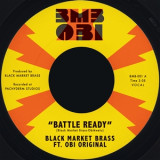
- Battle Ready
- What You Make It
'BMB x OBI' marks a new venture for the long-time instrumental powerhouse Black Market Brass. Teaming up with Obi Original, the young and visionary Minneapolis talent with a mission to share the heart of African music with the world, Black Market Brass delivers both proverbial and prophetic messages for the year to come - 'You've got to be Battle Ready!'. Inspired by the raw energy and messages of Fela Kuti and indebted to Orchestre Poly-Rythmo de Cotonou for their heavy fusion of voodoo-infused Afro-beat, Black Market Brass points in both directions towards the resurgent history of West African funk and the future of where a younger generation can lead us. These tracks are bursting at the seams with energy and force the listener to wise up and march along as soon as the drums thunder and the horns blare their first notes. The A-side, 'Battle Ready,' is what it claims: a band armed and ready to take on whatever may come. Strapped to the hilt with three drummers, this infectiously rhythmic track simmers, if not boils, under Obi's demands to mount up. The energy is high, edgy, and proves that getting nine musicians in the same room to track live captures a passion that bulldozes through anything placed in its way. The B-side, 'What You Make It,' encapsulates a musical quality that Black Market Brass has refined over its many years together, with polyrhythmic ideas you don't have to understand to know it feels good. Infused with elements of ethno-funk and classic highlife, this Ebo Taylor & Pat Thomas inspired work approaches the listener with a simple message amongst a danceable cacophony of sounds - 'Life is what you make it.' Move in 4, dance in 3, or sway in 6. Whichever you choose, choose it deliberately; the music will be there to support you.
- A1: Kristin Chenoweth, Sean Mccourt, Cristy Candler, Jan Neuberger, Citizens Of Oz– No One Mourns The Wicked
- A2: Students– Dear Old Shiz
- A3: Carole Shelley, Idina Menzel– The Wizard And I
- A4: Kristin Chenoweth, Idina Menzel, Students– What Is This Feeling?
- A5: William Youmans, Idina Menzel, Students– Something Bad
- B1: Norbert Leo Butz, Kristin Chenoweth, Christopher Fitzgerald, Michelle Federer, Idina Menzel, Students– Dancing Through Life
- B2: Kristin Chenoweth– Popular
- B3: Idina Menzel– I'm Not That Girl
- B4: Kristin Chenoweth, Idina Menzel, Denizens Of The Emerald City– One Short Day
- B5: Joel Grey– A Sentimental Man
- C1: Kristin Chenoweth, Idina Menzel, Guards Of Oz, Citizens Of Oz– Defying Gravity
- C2: Kristin Chenoweth, Carole Shelley, Citizens Of Oz– Thank Goodness
- C3: Joel Grey, Idina Menzel– Wonderful
- D1: Kristin Chenoweth– I'm Not That Girl (Reprise)
- D2: Idina Menzel, Norbert Leo Butz– As Long As You're Mine
- D3: Idina Menzel– No Good Deed
- D4: Christopher Fitzgerald, Citizens Of Oz– March Of The Witch Hunters
- D5: Idina Menzel, Kristin Chenoweth– For Good
- D6: Kristin Chenoweth, Idina Menzel, Citizens Of Oz– Finale
- A1: Spacemen's March
- A2: Space Attack "Q
- A3: Waltz 3
- A4: Ppu Dance
- A5: Fairy Wings
- A6: Improvised Song "Sweet Tea " (1981)
- A7: Long Time Ago Demo
- A8: More Deep Demo (1980S)
- A9: Small Gift
- B1: Love Me
- B2: M45
- B3: Echoes Of Unspoken Love Demo (1980S)
- B4: 大樹となかまたち Demo (1999)
- B5: プール Demo (1980S)
- B6: Improvised Song "To You" (2005)
- B7: Song Pop B Demo (1998)