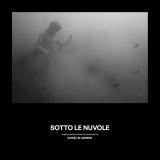
In Gianfranco Rosi’s portrait of Naples, Sotto le Nuvole, the ground shakes periodically. Between Mount Vesuvius and the Tyrrhenian Sea, the fumaroles of the Phlegraean Fields hiss volcanic gas and steam. Below the sleeping volcano, modern day Naples emerges in black and white and fills with voices, with lives. From the traces of history and the concerns of the present, Rosi documents a city immersed in its continuous past, with Daniel Blumberg’s minimal soundscape hovering in a sonic space between liquid and air.
Tasked with creating a soundscape that would suspend space within Rosi’s film, Blumberg called upon the extended technique of saxophonists Seymour Wright and John Butcher to create a gossamer fabric of traces and sounds abstracted from their instruments. Having transitioned from theoretical physics to the saxophone, John Butcher has always deeply considered space in the context of his playing. His concerns are with flow, density and how the saxophone is situated in the living world. Zeroing in on the core sonic properties of the mechanical and acoustic components of the saxophone, Seymour Wright has integrated its every breath, reed vibration, keypad clatter and hissed microtone of his alto into his own, unique improvisational language. In his work with these two seminal players, Blumberg makes his most concentrated soundtrack to date - reinforcing the film's sense of overlapping time and space, and pushing at the limits of experimentation.
Initially recorded in Daniel’s flat in London, Butcher and Wright centre themselves around long, consistent tones, so soft that it seems breath is being gently pulled from the saxophone's bell by an invisible hand. Blumberg himself adds haunting bass harmonica, and recordings of Wright’s launeddas - a traditional and ancient triple pipe polyphonic reed instrument from Sardinia, Italy. Blumberg then travelled to the volcanic region of Baia, next to Pompeii. Once a flourishing classical Roman city loved by Nero, Baia slowly sank under hydrothermal pressure, leaving the city in a kind of geological purgatory. Using specialised geophones and hydrophones, Blumberg took those initial recordings and amplified them underwater, sending them calling out across the ruins of Baia’s mosaics, Nymphaeum statues and villas.
“It was important to me that the music was whispered in the same landscape that Gianfranco has worked for the past three years, so that you can hear the volcanic air gulping, the lapping of the waves, the steam and bubbles popping against John and Seymour’s saxophone breaths – an echo from a suspended time.”
What emerges is deeply melancholic, tender, subtle and right at the edges of audio technology. Submerged in an aquarian mausoleum, the mysterious vibrations of the saxophone and its bell become an echo of an echo, wading from the future into the past. ‘Sotto le Nuvole’ is less a soundtrack than a process of aeration - a sonic puncture in the material of the film which allows its central message to breathe, and a remarkable experiment at the limits of the saxophone’s possibility.
Third time’s a charm, or possibly an anomaly. Johannes Volk returns to Running Back for another five exercises in perception, memory and dance-floor physics.
Following Extra Dimensions and Lightweave, this third instalment finds Volk continuing his particular way of making machine music feel strangely human and vice versa.
Shining Force starts somewhere above ground. Gliding across an unfamiliar planetary surface, optical illusions and physical anomalies slowly interfere with the senses. Unknown landscapes,
peculiar vegetation, nature behaving unnaturally: techno as field research. Switching From Bicycle to Spaceship does exactly what it says on the tin, more or less: trading pedal power for propulsion as a deceptively simple groove gathers speed, sheds gravity and quietly leaves the atmosphere behind.
Hidden In Dark belongs to a more immediate kind of archaeology: fog, strobes, bodies and those inexplicably intense emotions that only seem to exist on a dance floor at the right (or wrong) hour.
Back Alley Dancers turns the telescope around and looks backwards. Vocal fragments, pitched, delayed, reversed and removed from their original meaning trigger half-memories of youth, and of
encountering music and culture before you quite understood what any of it meant. Familiar feelings in unfamiliar shapes.
Finally, Drumatury dispenses with introspection and gets down to elementary forces. Morphing bass drums meet a Chicago jacking snare-roll massacre. Drama becomes drumaturgy. Or the other way around.
Five tracks, several states of consciousness, one Johannes Volk. No protective equipment supplied.
Six tracks. Six undeniable hits. Science can't explain it.
Four dazzling pdqb originals: pop-infused disco house transmissions where retro dreams collide with absurdly modern groove technology and hyper-modern circuitry. Hooks everywhere. Basslines that flirt shamelessly with eternity. Rhythms that know exactly what they're doing.
And then Roman Flügel arrives at the party. With two remixes of such dubby, technoid magnificence that they bend the laws of physics wherever they're played.
The cover? Pure gold. A radiant golden surface punctured by bullet marks - courtesy of world-renowned artist Maurizio Cattelan. When the music hits this hard, the artwork should too.
And the vinyl itself is no less extravagant: it reveals a dramatic close-up of the Direct Hit - a colossal crater surrounded by smoky burn marks, gleaming like a tiny golden monument to impeccable taste.
A small but undeniable upgrade to the cultural history of planet Earth. Play loud. Repeat often. History will thank you.
P.S. Real-world violence is neither glamorous nor welcome - this record stands firmly for peace, joy, and the radical idea that the only explosions worth having happen on dancefloors.
Official reissue of a German under-the-radar disco tune. The original from 1979 is a bubbling dancefloor stomper with freewheeling synth lines. For the flipside of this 7" Korkut Elbay created a spaced out balearic dub rework. Picture sleeve with a funky painting by Holger Kurt Jäger that picks up on the original.
The melody of 'Butterfly Dance' came to Dieter Bührig's mind as a butterfly floated through the recording studio during a session break. The resulting track landed on a compilation with mostly cover versions of disco hits. Now, more than 45 years later, the tune found its well-deserved single release on funkscapes.
Korkut Elbay is a fixture of Cologne's electronic music scene for over 20 years. He's part of the Cómeme camp and with remixes and edits for labels like Permanent Vacation or funkscapes he prooves his sensitive feel for the dancefloor. So does he on this rework, giving the orginal space to breathe and calm down without leaving the dancefloor.
Dieter Bührig studied electrical engineering and sound recording in Berlin. Afterwards he worked several years as a sound engineer for the music industry and as a producer. Later on he worked as a teacher for physics and music, trained trainee teachers for secondary schools and wrote articles and publications on musical education, choir and band arrangements. Nowadays he's writing, among other things, musical crime stories.
Fetter’s Body of Noise erupts at the threshold between ravey hypnosis and avant-pop experiment, slithering through the hinterlands of unconscious desire. Nine shape-shifting tracks conjure haunted landscapes where beauty refuses clarity and dancefloor logic warps underfoot. Vocals swoon, drift, and demand—stacking into fragments that multiply and weave through saturated pulses and shimmering, snarling synths.
Opening track "Like a Rose" traces a dreamer’s transition into the unstable physics of a perplexing but familiar dream world, where they gradually become lucid. “Beast” follows up humming with shadowed urgency, threading a path through self-sabotage and metamorphosis. “Spathiphyllums” drifts a while in a lush lostness, aching for something new before fracturing into wild, cathartic collapse. Side B’s “Do I Exist? (D.I.E)” and “The Longing” spiral into existential wonder, searching for a human origin story—both personal and collective—against a backdrop of uncertainty, while “Headache” thrusts forward as an absurd and insistent manifesto to stay the course and harness one’s own power within the madness.
Body of Noise is crafted not only for sweating bodies in motion, but for distorting time and opening psychic portals, where surrender becomes strategy and uncertainty transforms into ecstatic navigation. Rooted in all-hardware improvised production and shaped by Fetter’s years of boundary-blurring visual and performance art, their debut LP feels alive and in flux. Reminiscent of a spectral pop chorus trapped in a loop of broken machinery, or a lost broadcast from a dancefloor in a parallel realm, Body of Noise is a journey into chaos, transformation, and a bold refusal to be contained.
About Fetter:
Fetter makes clubby self-destructing noise pop to dance and weep to. Oscillating between ethereal and pounding, their all-hardware, largely improvised live sets take listeners through a foggy wilderness of saturated rhythms and menacing synth lines, a golden voice guiding the way through. Fetter is the stage moniker of multimedia artist Jess Tucker. Their performances take place in clubs as well as galleries, often incorporating video, installation, and interactive performance art elements to create other-worldly surrounds of mesmerizingly unhinged bodies and faces.
Serenda is a London-based DJ and producer of Guyanese and Greek heritage, known for her rich, eclectic sound rooted in house but never confined by it. Her sets fold between soulful depth and experimental edge, always delivered with a bold, contemporary vision.
Her sets are grounded in rhythm and instinct, built less around genre than sensation. She blends percussive house, warped club music, and raw, organic textures; crafting dancefloors that feel immersive and visceral and emotioanlly charged . There’s a physicality to her sound that edges toward the primal. For Serenda, DJing is a form of play - fluid, responsive, and deeply connected.
She deconstructs and distorts house music with intent, letting in pressure, dissonance, and emotional rupture. Her sets draw on the “timeless mindless states” of Mancuso’s The Loft, unfolding as rituals that don’t smooth over the chaos, they work with it.
Following the release of her debut EP The Prophecy on Josh Caffe’s Love Child label, she made her mark with a headline show in Fabric’s Room 2 and a Rinse FM residency. A regular in London’s queer underground, Serenda is also shaped by New York’s experimental club scene, where experimental sound and unfiltered expression mirror her own ethos.
Afro-diasporic and South American ritual in tension with city life, instinctive rhythm against digital overstimulation. Her fascination with world-building and quantum physics runs through everything she creates, fusing sonic design and sensory experience into one evolving landscape
The album’s title deftly gestures to the sheer vastness of astronomical dimensions, while simultaneously capturing the musical breadth within, where the eight planets are imagined as the eight notes of an octave. The work draws inspiration not only from earlier compositions —most notably Gustav Holst’s The Planets—but also from the rich astronomical and cultural contexts surrounding these celestial bodies. Here, the focus transcends direct citation of melodic motifs, instead embracing an intriguing conceptual approach on a meta level, unfolding in a series of vividly contrasting soundscapes. These contrasts shape a sweeping sonic journey, one that fully embraces the album format with both arms, inviting the listener to venture into realms both strange and wondrous, feeling the immensity of the interstellar space that lies between them. Contrast, after all, is the brushstroke that enriches our world.
Embarking on an auditory voyage, "Astral Guide" establishes the sonic framework that propels us into the boundless expanses of the cosmos. Its ethereal tones evoke the vastness of space, crafting a mood ripe for exploration within the realms of sci-fi. The subsequent tracks unfold like constellations, weaving a rich tapestry of sound that seamlessly marries cinematic soundscapes with pulsating, club-oriented rhythms. This album invites listeners to traverse its immersive landscapes, whether nestled in the comfort of home or dancing under the starlit sky, each note a guide through the transcendent experience of a nocturnal journey.
"Solar Flares" draws its inspiration from the awe-inspiring expanse of solar phenomena, capturing the majestic power of the sun as it reaches into the cosmos. This track resonates with the idea that energy, while vital, can also be a force of destruction when unleashed with overwhelming intensity. The composition beautifully mirrors the sun’s duality, where brilliance and devastation coexist, inviting listeners to reflect on the delicate balance between creation and annihilation. Through its rich textures and dynamic shifts, "Solar Flares" serves as both a homage to the celestial and a poignant reminder of nature's formidable power.
"Mercury – The Winged Messenger" embodies a meticulously crafted soundscape where artistry meets astronomy. The tempo of 173.6 BPM, derived from precise astronomical data, propels the composition into a vibrant realm that resonates with cosmic energy. Synthwave sound design intertwines seamlessly with the fluid rhythms of Drum’n’Bass, imbuing the piece with an uplifting dynamism that evokes the ethereal grace of Mercury itself. In this sonic exploration, listeners are invited to ascend on wings of sound, navigating the celestial tapestry of the universe with each invigorating beat.
"Venus, The Bringer of Peace" strikes a decidedly cozy note, presenting a poignant contrast to the more tempestuous themes often found in cosmic narratives. This composition evokes a nostalgic vision of an optimistic era, one in which humanity transcended borders and embraced the infinite possibilities of space exploration, where no destination felt too distant. The dense, languid atmosphere envelops the listener, creating a tangible sense of serenity that unfolds gradually, allowing for a meditative journey through sound. Each note serves as an invitation to linger in this tranquil embrace, reflecting on the harmonious potential of our collective aspirations and the beauty of connection in a vast universe.
The central theme of „Gaia, The Bringer of Life“ —originally not part of the planetary cycle— is the profound enabler of life on Earth. The arrangement delicately mirrors the slow, tentative unfolding of this potential, marked by an initially sparse orchestration that gradually builds in momentum. This progression crescendos, embodying the explosive dynamism of the Cambrian burst of life, ultimately culminating in a euphoric fanfare—a triumphant, celebratory flourish echoing life’s victorious emergence.
"Blue Moon" unfolds as a contemplative reverie on the tranquil clarity of a night sky, now seldom glimpsed in its natural purity, unclouded by the relentless haze of urban light. The listener is drawn into the vast embrace of the star-strewn firmament, a journey that sways between euphoric awe at nature’s sublime beauty and a profound melancholy for its fragile and imperiled state. Musically, this duality finds expression in the delicate interplay of modal mixtures, while an ever-shifting triplet groove, poised at the intersection of Outrun and melodic house, lends a pulse that is both nostalgic and forward-looking—echoing the beauty and transience of a world on the brink.
Rather than replicating the original composition of „Mars, The Bringer of War“, this interpretation seeks to evoke its profound, foreboding atmosphere. Cyberpunk emerges here as an ideal genre, channeling the dark, relentless march synonymous with Mars, the ancient god of war. The piece reverberates with intensity, as distorted vocalizations rise, embodying the anguish and visceral torment that shadow war’s violent crescendo. This auditory descent into conflict captures the relentless pulse of warfare, where sound itself becomes an embodiment of suffering and fury.
Majestically, "Jupiter, the Bringer of Jollity" emerges on the celestial stage, sweeping away the somber tones with its radiant vigor. Drawing inspiration from the triumphant strains of the original, and borrowing a melodic motif in the refrain, the piece expresses joy and buoyancy through a shift to a major key and the lilting sway of a danceable 12/8 meter. Spirited and exuberant, it leaps boldly from major to minor and back again, playfully shifting time signatures to capture a mood of unbridled festivity and jollity.
Here, a more conciliatory concept is chosen than in the original inspiration. „Saturn“ aligns with the number six, being the sixth planet from the Sun and bearing the iconic hexagonal pattern at its northern pole. What, then, could be more fitting than to render this piece in a 6/8 time signature? The arrangement unfolds with a multifaceted richness, mirroring the countless stones and ice fragments that form the foundations of Saturn’s majestic rings.
„Uranus“ adopts the theme of a light-footed, dancing instrumentation, giving the impression of perpetual motion, never quite settling. This musical choice harmonizes with the planet’s own orbit, as it spins with breathtaking velocity, teetering and swaying, seemingly unable to attain rest or stability.
The chill and vastness of the cosmos find expression in „Neptune, The Mystic“. At its core, an electronic soundscape envelops a classical arrangement, its unreachability intensified by an ethereal, otherworldly choir. Hovering at the outermost boundaries of the solar system, where warmth is but a distant memory, the composition lingers in a slow, contemplative tempo, evoking a realm where space for speculation stretches wide and silence reigns supreme.
Though Pluto may have lost its planetary status, and its companion Charon never achieved one, this shift in classification subtly aligns with the cosmic scale invoked here—one that mirrors the musical tradition of an eight-note sequence. Fittingly, the album closes with „Kuiper Belt“, a composition emblematic of the turbulence and vitality of countless smaller
celestial bodies that, though diminutive, find their rightful place within the vast architecture of the solar system.
They say nature is the greatest composer, shaping the universe with a symphony of chaos and order, beauty and danger. It is this duality that fuels the artistic vision of Edictum—a producer who, armed with a doctorate in chemistry, delves as deeply into the mysteries of molecules as he does into the depths of sound. In the tension between the vastness of the cosmos and the microscopic processes that dictate life’s rhythm, Edictum creates sonic landscapes that dissolve the boundaries between science and art.
His music is a story of contrasts—a sonic tale where the raw forces of nature clash with the intricate structures of human culture. Opposites intertwine to form a harmonious whole: the primal rhythms of the earth meet the celestial melodies of the cosmos, the rigid laws of physics blend with the boundless freedom of art. Edictum explores these polarities with meticulous devotion, each composition an expedition into uncharted soundscapes—a quest to give voice to the unfathomable.
With over 20 years immersed in the realms of electronic music, Edictum has honed a keen sense for rhythm and movement. His driving beats compel both body and mind into a hypnotic flow. Yet beyond the pulse of dance lies a complex framework of conceptual thought. Today, his creative focus revolves around holistic album projects—self-contained worlds with overarching narratives that embrace contrast and complexity. Each track stands alone as a fragment of the whole, but together, they weave a cohesive tapestry, much like the chapters of a novel that guide the listener on an emotional and sonic journey.
Edictum’s distinctive musical signature has earned him international recognition. With over 150 releases, many on prestigious platforms like the iconic *NewRetroWave* label, and collaborations with artists such as Jan Johnston, Azumi Inoue, Powernerd, and Turbo Knight, he has solidified his place in the global electronic music scene. His latest work, *A Cosmic Scale*, marks his seventh vinyl album and is released under his own label, *Echoes of Expanse*. The label’s name is no coincidence—it captures the essence of his art: echoes of infinity, the vibrations of the universe distilled into a singular sonic experience that carries the listener ever further into the boundless expanse of sound and space.
Köhncke rides again with another 12“ having 2 sides that couldn‘t be more different: the A-Side, „Timecode“, is a clock-ticking electronic disco tease promising a joyous release by building up tremendous expectations over its course of 8 minutes – and of course not delivering the final dance floor orgasm since the night has to continue in mutual happiness and expectations on the floor. But well, surely lots of „pre-cum“ spreaded...
The „flip“, „The Answer Is Yes“, displays Köhncke‘s love with The Beatles or Prefab Sprout and the likes, in a masterly programmed digital simulation of the „played“ sound of the likes (Köhncke cannot play any „real instruments“ except for a bit of Barré-Punk-Guitar). It‘s a love metaphor about 2 photons in „entanglement“, which is a proven very psychedelic effect in quantum physics. The photons are „entangled“ and „know“ each other‘s „spin“ in immediacy, thus not bent to the speed of light, even if they are 100000 light years from each other - a theory that even Einstein considered absurd when the pioneers of quantum physics came up with this in the 1930s. So Justus put his fascination with quantum physics into a pop love song metaphor – how much more do you want?
Köhncke kommt zurück mit einer 12“ - 2 Seiten, wie sie unterschiedlicher nicht sein könnten: Die A-Seite, „Timecode“, ist eine tickende elektronische Disco-Versuchungs-Zeitbombe, die über ihre Laufzeit von über 8 Minuten extreme Erlösungsversprechen macht, sie aber selbstverständlich nicht in einem endfinalen Floor-Orgasmus auflöst, denn die Nacht soll ja weitergehen in gemeinsamer Glücklichkeit und Erwartung auf der Tanzfläche. Allerdings, eine Menge „pre-cum“ wird schon versprüht in dieser unwiderstehlichen Spannungserzeugung von Track.
Die „flipside“, „The Answer Is Yes“, stellt Köhnckes Liebe zu den Beatles oder Prefab Sprout etc. ins Licht, in einer meisterhaft programmierten digitalen Simulation des „gespielten“ Sounds der Großmeister (Köhncke kann keine „echten Instrumente“ spielen außer ein bißchen Baréegriff-Punk-Rhythmusgitarre, sein Instrument ist der Sequenzer). Es ist eine Liebesmetapher über zwei Photonen im Zustand der „Verschränkung“, was ein heute wissenschaftlich nachgewiesenes extrem psychedelisches Phänomen aus der Welt der Quantenmechanik ist: die Photonen sind „verschränkt“ und „kennen“ ihren aktuellen „Spin“ (Rotationsrichtung des Teilchens) unmittelbar, also nicht gebunden an die Lichtgeschwindigkeit. Auch wenn sie 100000 Lichtjahre voneneinander entfernt sind – eine Theorie, die sogar Einstein absurd fand („Spukhafte Fernwirkung“), als die Pioniere der Quantenphysik sie in den 1930er Jahren postulierten. Köhncke verewigt seine Faszination für Quantenphysik hier also in Form eine Retro-Pop-Lovesong-Methapher – was will man mehr?
Downloads
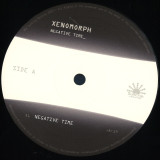
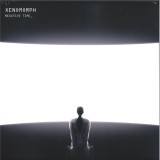
Negative Time! The new 12" vinyl EP of Xenomorph has a name that suits our global crisis. The best way to face these dark times is through the therapeutic powers of music. This 3-track 12" EP is the harbinger for the upcoming album "Netherverse" in early 2024. Fans of Mark Petrick know what to expect for sure. Goa-trance with a darker twist, but still filled with powerful melodies, unique kicks and psychedelic effects
The opening track, Negative Time, is a musical interpretation of zero point energy creation and quantum physics. Cutting, yet melodic goa-riffs take the listener on a journey backward in time through a mix of darkness leading to a positively melodic final. Danger on the High Seas is a deeper, more straightforward technoish track where light and dark are doing a wonderful mating dance between the crests of the high waves. The song was inspired by the mysterious vanishing of flight-19 in the bermuda triangle. The last track, Lost In An Old Junkyard, is known to the people that bought the Carpe Noctem compilation on Suntrip. But now it is available on vinyl as well as a different mix: the Tow Hook Mix! This track is the most classic Xenomorph track. Alienated tearing effects, mixed with exalted melodies.
For the 11th installment of our ongoing Breaking New Soil series, we have an all-star compilation for you! First up is Patrick Siech, a core member of the BNS family from the beginning: „Basscamp“ has it all - it´s one of those late-night jams that locks the dancers into its irresistible groove after seconds and won´t ever let them go - we think it´s a timeless piece of classic, yet modern Techno. Next up is Petar Dundov, who really needs no introduction: „Feed“ is unmistakeably a classic Dundov production, yet it is more dark and hypnotizing than you would expect from the melody wizard. Oliver Deutschmann, who just remixed one of our recent releases, handed in "Physics", a relentless piece of raw Techno showcasing his signature production style! Next up, we have our friend Marco Effe returning to Break New Soil with a massive Warehouse Techno anthem! Then, P-Ben from France, one of our favorite artists of the moment, who continuously delivers one killer track after the other: We are more than happy to have his debut for BNS: „Wookit“! Enjoy „Breaking New Soil Vol. 11“!
Almost Starlight is the extraordinary new album by Jem Finer (hurdy-gurdy) and John Matthias (violin). Produced by Jay Auborn and recorded in a Medieval Church, deep in the Devon countryside, in the Summer of 2025, the music is suffused with light, heat and the natural acoustics of the space.
The album defies categorisation; forced to pigeon hole it the nearest approximation would be ‘modern-classical’ but this ignores its myriad influences and explorations which encompass inspiration from Arvo Pärt through Terry Riley to Can via Delius, Alice Coltrane and a subtle reimagining of electronic music played purely with acoustic instruments, bending and shaping their possibilities in surprising and unexpected directions.
Jay Auborn plays cello on a number of the compositions and his production opens up and expands the music through a skilled and imaginative use of space, paying homage to the atmosphere of the church; ‘the sound evolved… chasing the imagined acoustics of that church in my mind; a place for worshipping light with sound.’
Almost Starlight will be released on the 4th September by Touch, available as CD, vinyl, cassette and on streaming platforms.
BIOS OF THE ARTISTS
Jem Finer
Since studying computer science in the 1970s, Jem Finer has worked in various fields, including photography, film, experimental and popular music, sound recording, sculpture and installation.
Much of his work relates to systems, extended processes and extremes of scale and includes Longplayer, a musical composition repeating once every 1000 years, and the Gurdy and Hurdy stones, ancient rocks set upright in fields in East Sussex and Gloucestershire with Jimmy Cauty. Their work together includes a band, The Standing Stones, whose most recent release is Twa Sisters, featuring Iona Zajac and Daragh Lynch.
He was a founder member of The Pogues, with whom he has played, written and recorded since 1981.
Recent music revolves around a fascination with the hurdy-gurdy and includes hrdy-grdy, a cassette released by Benedict Drew’s Thanet Tape Centre. His latest collaboration, with John Matthias, Almost Starlight, will be released by Touch in September 2026.
John Matthias
Since studying Theoretical Physics in the late 1980s and 1990s, John has created music and sound in many forms, including for installation, popular music, music for film, for dance and orchestra.
Much of John’s work plays with the physics of complex systems but he is also greatly influenced by stories and song. John has collaborated with Matthew Herbert, Stanley Donwood, Jay Auborn, Radiohead, Thom Yorke, Nick Ryan and many others to create music with a variety of textures and sonorities. He is particularly interested in simplicity and form and how context informs the way music sounds.
His latest collaboration, with Jem Finer, Almost Starlight, will be released by Touch in September 2026.
Scottish musician Kay Logan (aka Helena Celle) self-released the prescient collection of oddball aleatoric bangers "Copy Music" in 2021, before pulling it from circulation. With the help of London imprint SWIMS, this cult album is now remastered and available on vinyl for the first time, under the new name "Endless Waltz". This will be the final Helena Celle album.
Raised on a diet of industrial queer pioneers Coil and Throbbing Gristle, occultish physics (John Dee, Aleister Crowley) and Frank Zappa, Kay's work has toyed and probed at the fringes of outsider art and technology for over ten years. Her 2016 album "If I Can't Handle Me At My Best..." established Celle's unique sonic language of unrepeatably gnarled techno, coaxed from a bewildering array of disintegrating midi controllers, Markov chains, and whatever else came to hand.
"Endless Waltz" pursues this formula to its bizarre conclusion: 18 fever loops of algorithmically crumpled dance music, pulled through a cheese cloth of obscure '90s computer game palettes and pop froth wordplay. Some of these delirious vignettes evoke a rudimentary AI regurgitating Captain Beefheart scores. Others, as one fan put it, are "sort of like if 'Commercial Album'-era Residents did an album on Rephlex". Enjoy the trip.
Recommended if you like Rezzett, Beau Wanzer, Hype Williams...
Following one of 2025’s standout EPs, the CEO of the National Centre for Mark Fell Studies fires from the hip in brilliant, club-troubling motion. In step with 30 years of prism-pushing work — and particularly the »Nite Closures« EP, which signalled a concerted return to the dancefloor — Fell pulls aspects of hypermodern dance and electronic music from Chicago, Tanzania, and Japan into his own peculiar agenda.
The hugely distinctive results pull the body into thrillingly unusual, typically ascetic arrangements, activating every pointillist drum hit with attack and decay in a soberly ludic play of rhythmelodic tension and release, executed to delirious ends; 40 minutes of computer music.
As an artist who witnessed first-hand the explosion of electronic music in early ’80s Sheffield, and its interplay with house and rave as it refracted into wild new styles during the ’90s, Mark Fell is uniquely positioned to pursue his passion for the dynamics of electronic dance music to the nth degree. »Servitude In Context« continues to develop ideas around music for movement in the mid-2020s, placing decades of keen observation — from the macro and historical to the niche and hypermodern — at the service of flexing bodies in new directions.
Long-held notions of multistability manifest in what feels like two machines playing chess on the dancefloor, attempting to adapt to each other’s playing styles and patterns in real time, anticipating and zigzagging around the next move. The result is a plethora of options for limber dancers and those who only bust a move inside their heads.
The slow-fast play of accelerating and decelerating strikes, alongside monotonic chatter in »Actuations #1 (Extended)«, acclimatises the body to a uniquely sensual physics. This develops into the rudely screwed, asymmetric angularity of »Time-Slur« and the shatterproof elasticity of »Taut Manifold«, which feels like an LLM trained on Autechre.
»Low Energy Mantra« offers the EP’s closest resemblance to melodic structure, like gamelan and footwork refracted through lab-grown diamonds. Then »Anode« flashes its teeth with a rudeness recalling the latter stages of Fell’s Pat Thomas jams, before »3 Lost Contours (Pts 1–5)« tilts into 12 minutes of proper quicksilver madness, balancing the sexiness of his Sensate Focus work with an updated, clean-hoofed step and parry.
Almost Starlight is the extraordinary new album by Jem Finer (hurdy-gurdy) and John Matthias (violin). Produced by Jay Auborn and recorded in a Medieval Church, deep in the Devon countryside, in the Summer of 2025, the music is suffused with light, heat and the natural acoustics of the space.
The album defies categorisation; forced to pigeon hole it the nearest approximation would be ‘modern-classical’ but this ignores its myriad influences and explorations which encompass inspiration from Arvo Pärt through Terry Riley to Can via Delius, Alice Coltrane and a subtle reimagining of electronic music played purely with acoustic instruments, bending and shaping their possibilities in surprising and unexpected directions.
Jay Auborn plays cello on a number of the compositions and his production opens up and expands the music through a skilled and imaginative use of space, paying homage to the atmosphere of the church; ‘the sound evolved… chasing the imagined acoustics of that church in my mind; a place for worshipping light with sound.’
Almost Starlight will be released on the 4th September by Touch, available as CD, vinyl, cassette and on streaming platforms.
BIOS OF THE ARTISTS
Jem Finer
Since studying computer science in the 1970s, Jem Finer has worked in various fields, including photography, film, experimental and popular music, sound recording, sculpture and installation.
Much of his work relates to systems, extended processes and extremes of scale and includes Longplayer, a musical composition repeating once every 1000 years, and the Gurdy and Hurdy stones, ancient rocks set upright in fields in East Sussex and Gloucestershire with Jimmy Cauty. Their work together includes a band, The Standing Stones, whose most recent release is Twa Sisters, featuring Iona Zajac and Daragh Lynch.
He was a founder member of The Pogues, with whom he has played, written and recorded since 1981.
Recent music revolves around a fascination with the hurdy-gurdy and includes hrdy-grdy, a cassette released by Benedict Drew’s Thanet Tape Centre. His latest collaboration, with John Matthias, Almost Starlight, will be released by Touch in September 2026.
John Matthias
Since studying Theoretical Physics in the late 1980s and 1990s, John has created music and sound in many forms, including for installation, popular music, music for film, for dance and orchestra.
Much of John’s work plays with the physics of complex systems but he is also greatly influenced by stories and song. John has collaborated with Matthew Herbert, Stanley Donwood, Jay Auborn, Radiohead, Thom Yorke, Nick Ryan and many others to create music with a variety of textures and sonorities. He is particularly interested in simplicity and form and how context informs the way music sounds.
His latest collaboration, with Jem Finer, Almost Starlight, will be released by Touch in September 2026.
out of Stock
Last delivered 30 days ago available to reorder, subject to availability
Scotland's incomparable and influential Arab Strap are back with their ninth studio album Half-Told Tales, due for release via Rock Action Records on 4th September 2026: almost exactly 30 years since the beloved duo’s first ever single, The First Big Weekend, was released. The follow-up to 2024's acclaimed I'm totally fine with it (y) don't give a fuck anymore (y) , Half-Told Tales is rich with Aidan Moffat and Malcolm Middleton’s trademark wit and dark humour, whilst creating moments from quiet brooding to a self-described “disco-metal incantation that might make you dance” . Including the single You You You, the album was recorded with long-time collaborator Paul Savage (Mogwai, Belle and Sebastian, Franz Ferdinand) . Vinyl is released as a double LP in a gatefold sleeve.
Scotland's incomparable and influential Arab Strap are back with their ninth studio album Half-Told Tales, due for release via Rock Action Records on 4th September 2026: almost exactly 30 years since the beloved duo’s first ever single, The First Big Weekend, was released. The follow-up to 2024's acclaimed I'm totally fine with it (y) don't give a fuck anymore (y) , Half-Told Tales is rich with Aidan Moffat and Malcolm Middleton’s trademark wit and dark humour, whilst creating moments from quiet brooding to a self-described “disco-metal incantation that might make you dance” . Including the single You You You, the album was recorded with long-time collaborator Paul Savage (Mogwai, Belle and Sebastian, Franz Ferdinand) . Vinyl is released as a double LP in a gatefold sleeve.
‘Workaround’ is the lucidly playful and ambitious solo debut album by rhythm-obsessive musician and DJ, Beatrice Dillon for PAN. It combines her love of UK club music’s syncopated suss and Afro-Caribbean influences with a gamely experimental approach to modern composition and stylistic fusion, using inventive sampling and luminous mixing techniques adapted from modern pop to express fresh ideas about groove-driven music and perpetuate its form with timeless, future-proofed clarity. Recorded over 2017-19 between studios in London, Berlin and New York, ‘Workaround’ renders a hypnotic series of polymetric permutations at a fixed 150bpm tempo.
Mixing meticulous FM synthesis and harmonics with crisply edited acoustic samples from a wide range of guests including UK Bhangra pioneer Kuljit Bhamra (tabla); Pharoah Sanders Band’s Jonny Lam (pedal steel guitar); techno innovators Laurel Halo (synth/vocal) and Batu (samples); Senegalese Griot Kadialy Kouyaté (Kora), Hemlock’s Untold and new music specialist Lucy Railton (cello); amongst others, Dillon deftly absorbs their distinct instrumental colours and melody into 14 bright and spacious computerised frameworks that suggest immersive, nuanced options for dancers, DJs and domestic play. ‘Workaround’ evolves Dillon’s notions in a coolly unfolding manner that speaks directly to the album’s literary and visual inspirations, ranging from James P. Carse’s book ‘Finite And Infinite Games’ to the abstract drawings of Tomma Abts or Jorinde Voigt as well as painter Bridget Riley’s essays on grids and colour. Operating inside this rooted but mutable theoretical wireframe, Dillon’s ideas come to life as interrelated, efficient patterns in a self-sufficient system.
With a naturally fractal-not-fractional logic, Dillon’s rhythms unfold between unresolved 5/4 tresillo patterns, complex tabla strokes and spark-jumping tics in a fluid, tactile dance of dynamic contrasts between strong/light, sudden/restrained, and bound/free made in reference to the notational instructions of choreographer Rudolf Laban. Working in and around the beat and philosophy, the album’s freehand physics contract and expand between the lissom rolls of Bhamra’s tabla in the first, to a harmonious balance of hard drum angles and swooping FM synth cadence featuring additional synth and vocal from Laurel Halo in ‘Workaround Two’, while the extruded strings of Lucy Railton create a sublime tension at the album’s palatecleansing denouement, triggering a scintillating run of technoid pieces that riff on the kind of swung physics found in Artwork’s seminal ‘Basic G’, or Rian Treanor’s disruptive flux with a singularly tight yet loose motion and infectious joy. Crucially, the album sees Dillon focus on dub music’s pliable emptiness, rather than the moody dematerialisation of reverb and echo. The substance of her music is rematerialised in supple, concise emotional curves
and soberly freed to enact its ideas in balletic plies, rugged parries and sweeping, capoeira-like floor action. Applying deeply canny insight drawn from her years of practice as sound designer, musician and hugely knowledgable/intuitive DJ, ‘Workaround’ can be heard as Dillon’s ingenious solution or key to unlocking to perceptions of stiffness, darkness or grid-locked rigidity in electronic music. And as such it speaks to an ideal of rhythm-based and experimental music ranging from the hypnotic senegalese mbalax of Mark Ernestus’ Ndagga Rhythm Force, through SND and, more currently, the hard drum torque of DJ Plead; to adroitly exert the sensation of weightlessness and freedom in the dance and personal headspace.
Fetter’s Body of Noise erupts at the threshold between ravey hypnosis and avant-pop experiment, slithering through the hinterlands of unconscious desire. Nine shape-shifting tracks conjure haunted landscapes where beauty refuses clarity and dancefloor logic warps underfoot. Vocals swoon, drift, and demand—stacking into fragments that multiply and weave through saturated pulses and shimmering, snarling synths.
Opening track "Like a Rose" traces a dreamer’s transition into the unstable physics of a perplexing but familiar dream world, where they gradually become lucid. “Beast” follows up humming with shadowed urgency, threading a path through self-sabotage and metamorphosis. “Spathiphyllums” drifts a while in a lush lostness, aching for something new before fracturing into wild, cathartic collapse. Side B’s “Do I Exist? (D.I.E)” and “The Longing” spiral into existential wonder, searching for a human origin story—both personal and collective—against a backdrop of uncertainty, while “Headache” thrusts forward as an absurd and insistent manifesto to stay the course and harness one’s own power within the madness.
Body of Noise is crafted not only for sweating bodies in motion, but for distorting time and opening psychic portals, where surrender becomes strategy and uncertainty transforms into ecstatic navigation. Rooted in all-hardware improvised production and shaped by Fetter’s years of boundary-blurring visual and performance art, their debut LP feels alive and in flux. Reminiscent of a spectral pop chorus trapped in a loop of broken machinery, or a lost broadcast from a dancefloor in a parallel realm, Body of Noise is a journey into chaos, transformation, and a bold refusal to be contained.
About Fetter:
Fetter makes clubby self-destructing noise pop to dance and weep to. Oscillating between ethereal and pounding, their all-hardware, largely improvised live sets take listeners through a foggy wilderness of saturated rhythms and menacing synth lines, a golden voice guiding the way through. Fetter is the stage moniker of multimedia artist Jess Tucker. Their performances take place in clubs as well as galleries, often incorporating video, installation, and interactive performance art elements to create other-worldly surrounds of mesmerizingly unhinged bodies and faces.
X or Size deftly frays and soothes the ‘floor with a 3rd LP of craftily textured ambient house scuzz for Good Morning Tapes in a vein shared by Huerco S, NWAQ, Actress, Michael J.Blood and Madteo, but pushed farther into groggy and loosey-goose limbed abstraction.
Formerly known as part of ambient drone duo The Geese with Recital’s Sean McCann, and member of psychedelic mutators Regal Degal; Josiah Wolfson has, in recent years, come into his own as X Or Size, whilst retaining the trippy sense of play and experiment that coloured and defined earlier works. His 3rd outing as X Or Size continues a tradition of punning titles and subtly psyched-out, edge-of-the-‘floor dance music with six bits of submersed trippiness idealised for bobbing bodies with eyelids at halfmast, on a slow arc to other dimensions.
Blessed with the finest grasp of heady equilibrium, X Or Size pull strings like a gently psychoactive puppeteer on the 10-minute opener of dreamlike physics, and aching psych-soul downstroke of ‘Anonymous AD'. ’B O M H’ follows with thee gauziest breeze of filtered vox and harmonised textures rolled out in sun-dazed motion that makes us hanker for warmer times, and ‘Ceremonism’ sustains that flow with sloshing beatdown drums paced like an offcut of NWAQ’s ‘The Dead Bears’ marinaded with special ingredients by Madteo.
With minds/bodies well massaged and acclimated to his vibe, ‘oSSo’ screws off into even trippier zones with a nervy offbeat swing and parry spangled by wettest spring reverb, before bringing up for air in the 11 minute title piece of astral planing bliss, ready to roll another one or go head first into the pillow.
out of Stock
Last delivered 19 months ago available to reorder, subject to availability
Breaking new ground at The Third Room, we are introducing our first full EP by a guest artist, setting the stage for more to come.
Since quantum mechanics arose from classical physics' failure to explain microscopic phenomena, Berlin's exceptional creative mind Arthur Robert pays tribute to the interaction of little entities that can result in the release of colossal power and provide answers for questions older than the universe itself with his Particle Accelerator EP on The Third Room.
Genuine, dynamic techno that defines itself through crisp sound design, memorable textures, and highly compressed, sometimes distorted drum arrangements makes this piece of music a profoundly soundscaped lecture in four classes that gets its final, emotional touch from either melodic compositions or disruptive beeps. Creating those fascinating pieces within fast-paced and hard-hitting club sounds is one of Robert's trademarks, making him a hugely exciting producer.
Out from September 6th and available on all platforms and always remember - the whole is more than the accumulation of its units.
2024 The Third Room
Mastering by Ahmet Sisman (The Third Room Studios)
Artwork by Daniel Bornmann & Lennard Makosch (STUEDIO.XYZ)
out of Stock
Last delivered 14 days ago available to reorder, subject to availability
Danielle Boutet’s P »Pièces« is a mysterious artifact of Quebecois marginalia, self-released in 1985. Moving from languid ennui to high drama, »Pièces« is a dreamy gestalt, an album that borders Chanson, spoken-word, jazz noir, and minimalism, conjured from the chasm between acoustic and electronic realms. »Pièces« allows us a window into the highly intimate songcraft and compositional skill of an artist who longed to linger not in the public eye, but in relation with others and the world around her.
Born in Quebec City, Boutet studied music at the University of Montreal, where she focused on composition and percussion, before becoming involved in Montreal’s feminist and lesbian art scene. Primarily written, performed, and recorded by Boutet, with voice, guitar work, and technical assistance by Sylvie Gagnon, Pièces was created during a paradigm shift in home recording. Originally composed for the piano, Boutet and Gagnon utilized a consumer-friendly Tascam 4-track Portastudio and versatile Yamaha DX-7, alongside guitar, bass, marimba, and the human voice, to expand and contemporize the original composition’s scope.
Inspired by prog rock and British poet and musician Anne Clark, »Pièces« translates Boutet’s influence by moving between sunny, wistful fairytale and dark, wintry dirge. Filled with longing marimba, vertiginous, startling synth pads, and folk guitar, each track on Pièces offers a wholly unique proposition. Some are modal and rife with the ethereal psychological tension of a sci-fi soundtrack, while others are more like entering a smoke-laced lounge, the entertainer embodying seduction.
With the sprechgesang of artists like Serge Gainsbourg, there is an intense intimacy to Boutet’s delivery, sometimes as if she is performing for an audience of one. As one lyric goes, translated to English from French: “Like holograms/ Images from a world/ That inhales souls/ And exudes drama.” Another song contains an excerpt from The Tao of Physics: “The eastern sages specify clearly that they do not identify an ordinary void, but rather, a void having an infinite creative potential.”
To English-language audiences, the album’s title, »Pièces«, might seem to simply refer to the eleven different pieces. The title can also, of course, refer to parts of a larger whole, but Boutet is keen to point out that there is also another meaning: In French, a pièce is a room. On the cover of the original cassette, Boutet is seen sitting on a chair, alone in an empty apartment, a cable snaking at her feet. Listening to »Pièces« is like entering eleven different rooms: whether a study encased in shadow, a greenhouse left to wither in an eternal frost, or a divine nave.
Boutet sold a few dozen copies around Montreal, a scene mostly occupied by the new wave explosion de rigueur, but the inclusion of Pièces in the 1987 issue of Ladyslipper—the North Carolina-based mail order catalog that championed women musicians of all calibers and careers—led to more exposure throughout North America. “In the catalog,” Boutet says, “they included it in the New Age section, but I was, and still am, aware that this album is relatively unclassifiable.”
Boutet would release one more album, titled Musiques Urbaines, before getting pulled in the direction of interdisciplinary art and theory. “Although I never stopped making music, I lost all interest in public diffusion or performance,” Boutet says. Despite her departure from performance and publicly releasing music, she left behind a strange and enthralling document of Montreal’s 1980s feminist fringe, an aural document of the historic moment when self-recorded music and its practical potential became a prismatic reality.
Danielle Boutet’s Pièces arrives February 16, 2024 as part of uncommon¢ (“uncommon sense”), an open-ended, serialized endeavor from Freedom to Spend that provides new meaning for rarefied recordings from music’s outermost fringe.
Negative Time! The new 12" vinyl EP of Xenomorph has a name that suits our global crisis. The best way to face these dark times is through the therapeutic powers of music. This 3-track 12" EP is the harbinger for the upcoming album "Netherverse" in early 2024. Fans of Mark Petrick know what to expect for sure. Goa-trance with a darker twist, but still filled with powerful melodies, unique kicks and psychedelic effects
The opening track, Negative Time, is a musical interpretation of zero point energy creation and quantum physics. Cutting, yet melodic goa-riffs take the listener on a journey backward in time through a mix of darkness leading to a positively melodic final. Danger on the High Seas is a deeper, more straightforward technoish track where light and dark are doing a wonderful mating dance between the crests of the high waves. The song was inspired by the mysterious vanishing of flight-19 in the bermuda triangle. The last track, Lost In An Old Junkyard, is known to the people that bought the Carpe Noctem compilation on Suntrip. But now it is available on vinyl as well as a different mix: the Tow Hook Mix! This track is the most classic Xenomorph track. Alienated tearing effects, mixed with exalted melodies.
out of Stock
Last delivered 8 months ago available to reorder, subject to availability
DOUBLE BLACK LP : 2 x 140 G Black Vinyl , Sleeve & 2 x Heavy Weight Printed Inner with UV Gloss Finish
Legendary electronic music duo Orbital return Early 2023 with new album “Optical Delusion”, the Hartnoll brothers first studio album since 2018’s Monster’s Exist. Recorded in Orbital’s Brighton studio, “Optical Delusion” includes contributions from Sleaford Mods, Penelope Isles, Anna B Savage, The Little Pest, Dina Ipavic, Coppe, and perhaps most surprisingly, The Medieval Baebes.
Earlier this year, Orbital celebrated their storied history with “30 Something” which, unlike other Best Of’s, contains reworks, remakes, remixes and re-imaginings of landmark Orbital tracks including “Chime”, “Belfast”, “Halcyon”, “Satan”, and “The Box”
SHORT BIOG:
“A human being experiences himself, his thoughts and feelings as something separate from the rest of humanity – a kind of optical delusion of his consciousness. This delusion is a kind of prison for us, restricting us to our personal desires and to affection for a few persons nearest to us. Our task must be to free ourselves from this prison…”
You many have seen this quote attributed to Albert Einstein on social media, the archetypal Smartest Guy Ever apparently having an out-of-character religious epiphany. It certainly leapt out at Paul Hartnoll of Orbital who spotted it in Michael Pollan’s 2018 book How to Change Your Mind: What the New Science of Psychedelics Teaches Us About Consciousness, Dying, Addiction, Depression and Transcendence.
“As soon as I saw ‘optical delusion’ I thought Oh hey, that’s the album title,” says Paul. “It just seemed to say so much about how people construct their own realities, how we see patterns that aren’t there, how we see what we want to see.
“But it’s actually a misquote. He never quite said that. In the German original what he’s really saying is that human experience is as relative as physics. Wouldn’t it be good if we could accept that, and find a kind of universal theory of everything for the human race? Then you look at everything from history to art to your Twitter feed and you think yeah, that’s what we’re all trying to do all of the time…”
Hence ‘Optical Delusion’, the tenth original Orbital album and the latest in a burst of renewed post-pandemic creativity for two brothers who’ve stayed at the top of their game longer than anyone from the post-1988 Class of Acid House.
Now with ‘Optical Delusion’ the Hartnolls dig deeper into the unquiet psyche of our increasingly surreal and disordered world. Sketched out partly during lockdown but fully recorded in the uncertain After Times, the album summons up conflicting emotions and sometimes beguiling images from years when the science fiction doomsdays that the Hartnolls watched on TV as kids finally came true. There are mesmeric tracks with names like ‘The New Abnormal’ and ‘Requiem For The Pre-Apocalypse’ and ‘Day One’. But there are also straight-up bangers and ethereal cosmic dreams, abstract sound wars and deeply human songs of separation and loss.
And it all starts with a bang. Lead single ‘Dirty Rat’, an outright Fall-meets-Front-242 class rant with vocals by Sleaford Mods mob orator Jason Williamson, harks right back to the Hartnolls’ days of politicised anarcho-squatpunk. It began as a remix swap (Orbital did the Sleafords’ ‘I Don’t Rate You’) and morphed into a comic, brutal, bass-driven harangue not so much against our rulers but at the petty, mean-spirited, frightened, Mail-reading voters who put them there: the people who are “blaming everyone in hospital/blaming everyone at the bottom of the English Channel/blaming everyone who doesn’t look like a fried animal.”
Also key to the album is opening track ‘Ringa Ringa (The Old Pandemic Folk Song)’ which returns to an Orbital truism, that time always becomes a loop. This chugging, cyclical Orbital groove gives way to an unnerving past-meets-present timeslip fit for ‘Sapphire And Steel’ as goth maenads The Mediaeval Baebes materialise to sing ‘Ring O’Roses’ – the innocent nursery rhyme whose roots are in the Black Death.
“I’ve always liked folk music and mediaeval sounds,” says Paul, himself an occasional Morris dancer. “I had the basis of that track and I wanted to spin it off somehow.” Trawling his archives he stumbled on The Mediaeval Baebes’ version of ‘Ring O’Roses’ “and my hackles just went up. I was like, my God, this is the original pandemic folk song.”
?his being Orbital, there are collaborations galore on the album, the roles once played by Alison Goldfrapp, Lady Leshurr or David Gray now filled by new talents. London singer-songwriter Anna B Savage contributes a compellingly fragile, Anohni-like vocal to ‘Home’, in which nature reclaims the scorched and vacant mega-cities. ‘Day One’ is a pulsing techno track featuring the singer Dina Ipavic. Paul got in touch with her after working on a score for a sculpture show of giant robotic installations by his friend Giles Walker during the pandemic. First Paul cut up his own score and Ipavic’s vocals on the track The Crane, which appears on the deluxe version of the album. Then he thought, Why not work with her for real? The result is school of ‘Belfast’, a bassy dreamscape with vocalised clouds billowing above.
The pensive ‘Are You ?live?’ adds to the Orbital product range of existential questions (‘Are We Here?’, ‘Where Is It Going?’) in collaboration Bella Union signings Penelope Isles, AKA brother and sister act Lily and Jack Wolter. “They’re our studio mates, they work upstairs!” says Paul happily. “And they’ve both got amazing voices.”
But Orbital are Orbital and never far from the dancefloor. “Eventually the more abrasive bits came back into the fold…” ‘You Are The Frequency’, first of two tracks to feature mysterious vocalist The Little Pest, surrounds the listener with warped voices ordering you to the dancefloor (Phil: “we wanted the idea that the music is kind of absorbing you”). And the second, the sinister ‘What A Surprise’, traps you in a paranoid electronic hall of mirrors.
In another nod to Orbital’s resurgent past the cover artwork once again comes from fine art painter John Greenwood, creator of fantastical grotesques for the covers of ‘Snivilisation’, ‘In Sides’ and Orbital’s most recent album, 2018’s ‘Monsters Exist’. Orbital had just had a slick Mark Farrow cover for ‘30 Something’ – this is a return to the overripe and bulbous techno-organic constructions that somehow express Orbital’s own uncontrollably fertile sound.
There are gaps in the future that Orbital are desperate to fill too; there will be tours and festivals and rooms and fields full of people. Those long paralysed months when we had little to look forward to but a Zoom DJ set made Paul and Phil appreciate the things that make life worth living.
out of Stock
Last delivered 3 years ago available to reorder, subject to availability
2 x Solid White LP, 5mm spine Sleeve UV Gloss Finish, 2x Heavy Weight Printed Inner Sleeve UV Gloss finish, marketing sticker.
Legendary electronic music duo Orbital return Early 2023 with new album “Optical Delusion”, the Hartnoll brothers first studio album since 2018’s Monster’s Exist. Recorded in Orbital’s Brighton studio, “Optical Delusion” includes contributions from Sleaford Mods, Penelope Isles, Anna B Savage, The Little Pest, Dina Ipavic, Coppe, and perhaps most surprisingly, The Medieval Baebes.
Earlier this year, Orbital celebrated their storied history with “30 Something” which, unlike other Best Of’s, contains reworks, remakes, remixes and re-imaginings of landmark Orbital tracks including “Chime”, “Belfast”, “Halcyon”, “Satan”, and “The Box”
SHORT BIOG:
“A human being experiences himself, his thoughts and feelings as something separate from the rest of humanity – a kind of optical delusion of his consciousness. This delusion is a kind of prison for us, restricting us to our personal desires and to affection for a few persons nearest to us. Our task must be to free ourselves from this prison…”
You many have seen this quote attributed to Albert Einstein on social media, the archetypal Smartest Guy Ever apparently having an out-of-character religious epiphany. It certainly leapt out at Paul Hartnoll of Orbital who spotted it in Michael Pollan’s 2018 book How to Change Your Mind: What the New Science of Psychedelics Teaches Us About Consciousness, Dying, Addiction, Depression and Transcendence.
“As soon as I saw ‘optical delusion’ I thought Oh hey, that’s the album title,” says Paul. “It just seemed to say so much about how people construct their own realities, how we see patterns that aren’t there, how we see what we want to see.
“But it’s actually a misquote. He never quite said that. In the German original what he’s really saying is that human experience is as relative as physics. Wouldn’t it be good if we could accept that, and find a kind of universal theory of everything for the human race? Then you look at everything from history to art to your Twitter feed and you think yeah, that’s what we’re all trying to do all of the time…”
Hence ‘Optical Delusion’, the tenth original Orbital album and the latest in a burst of renewed post-pandemic creativity for two brothers who’ve stayed at the top of their game longer than anyone from the post-1988 Class of Acid House.
Now with ‘Optical Delusion’ the Hartnolls dig deeper into the unquiet psyche of our increasingly surreal and disordered world. Sketched out partly during lockdown but fully recorded in the uncertain After Times, the album summons up conflicting emotions and sometimes beguiling images from years when the science fiction doomsdays that the Hartnolls watched on TV as kids finally came true. There are mesmeric tracks with names like ‘The New Abnormal’ and ‘Requiem For The Pre-Apocalypse’ and ‘Day One’. But there are also straight-up bangers and ethereal cosmic dreams, abstract sound wars and deeply human songs of separation and loss.
And it all starts with a bang. Lead single ‘Dirty Rat’, an outright Fall-meets-Front-242 class rant with vocals by Sleaford Mods mob orator Jason Williamson, harks right back to the Hartnolls’ days of politicised anarcho-squatpunk. It began as a remix swap (Orbital did the Sleafords’ ‘I Don’t Rate You’) and morphed into a comic, brutal, bass-driven harangue not so much against our rulers but at the petty, mean-spirited, frightened, Mail-reading voters who put them there: the people who are “blaming everyone in hospital/blaming everyone at the bottom of the English Channel/blaming everyone who doesn’t look like a fried animal.”
Also key to the album is opening track ‘Ringa Ringa (The Old Pandemic Folk Song)’ which returns to an Orbital truism, that time always becomes a loop. This chugging, cyclical Orbital groove gives way to an unnerving past-meets-present timeslip fit for ‘Sapphire And Steel’ as goth maenads The Mediaeval Baebes materialise to sing ‘Ring O’Roses’ – the innocent nursery rhyme whose roots are in the Black Death.
“I’ve always liked folk music and mediaeval sounds,” says Paul, himself an occasional Morris dancer. “I had the basis of that track and I wanted to spin it off somehow.” Trawling his archives he stumbled on The Mediaeval Baebes’ version of ‘Ring O’Roses’ “and my hackles just went up. I was like, my God, this is the original pandemic folk song.”
?his being Orbital, there are collaborations galore on the album, the roles once played by Alison Goldfrapp, Lady Leshurr or David Gray now filled by new talents. London singer-songwriter Anna B Savage contributes a compellingly fragile, Anohni-like vocal to ‘Home’, in which nature reclaims the scorched and vacant mega-cities. ‘Day One’ is a pulsing techno track featuring the singer Dina Ipavic. Paul got in touch with her after working on a score for a sculpture show of giant robotic installations by his friend Giles Walker during the pandemic. First Paul cut up his own score and Ipavic’s vocals on the track The Crane, which appears on the deluxe version of the album. Then he thought, Why not work with her for real? The result is school of ‘Belfast’, a bassy dreamscape with vocalised clouds billowing above.
The pensive ‘Are You ?live?’ adds to the Orbital product range of existential questions (‘Are We Here?’, ‘Where Is It Going?’) in collaboration Bella Union signings Penelope Isles, AKA brother and sister act Lily and Jack Wolter. “They’re our studio mates, they work upstairs!” says Paul happily. “And they’ve both got amazing voices.”
But Orbital are Orbital and never far from the dancefloor. “Eventually the more abrasive bits came back into the fold…” ‘You Are The Frequency’, first of two tracks to feature mysterious vocalist The Little Pest, surrounds the listener with warped voices ordering you to the dancefloor (Phil: “we wanted the idea that the music is kind of absorbing you”). And the second, the sinister ‘What A Surprise’, traps you in a paranoid electronic hall of mirrors.
In another nod to Orbital’s resurgent past the cover artwork once again comes from fine art painter John Greenwood, creator of fantastical grotesques for the covers of ‘Snivilisation’, ‘In Sides’ and Orbital’s most recent album, 2018’s ‘Monsters Exist’. Orbital had just had a slick Mark Farrow cover for ‘30 Something’ – this is a return to the overripe and bulbous techno-organic constructions that somehow express Orbital’s own uncontrollably fertile sound.
There are gaps in the future that Orbital are desperate to fill too; there will be tours and festivals and rooms and fields full of people. Those long paralysed months when we had little to look forward to but a Zoom DJ set made Paul and Phil appreciate the things that make life worth living.
out of Stock
Last delivered 3 years ago available to reorder, subject to availability
Yet again, Helena Hauff's Return To Disorder label brings us a new talent from the world of electro production, this time in the shape of India's Investigations of a Dog. The four tracks here contain a lively, energetic feel sure to tempt the reticent onto the dancefloor, matched with a dreamy optimism that gives them an ultra pleasurable head-in-the-clouds celestial feel. 'Heliocentrism' has echoes of classic LFO's naive melodicism, '11 July' is sunny and gently bubbling in the same vein as Aphex's first 'Ambient Works' LP, and the rest is generally infectious and loveable yet employed with a touch of subtle restraint. We look forward to further Investigations
out of Stock
Last delivered 5 months ago available to reorder, subject to availability
Einstürzende Neubauten producer Boris Wilsdorf, Karl O’Connor aka Regis and MY DISCO's Liam Andrews assemble as EROS, bottling no-wave/industrial lightning with a tight set of pulverized, widescreen torched-songs that rasp, grate and throb somewhere between This Heat, The Cure, Cabaret Voltaire, Alva Noto x Pan Sonic.
An industrial fantasy of flesh and steel, ‘A Southern Code’ is the stunning continuation of the trio’s work at Wilsdorf’s pivotal Anderesbaustelle studio on Regis’ watershed album, ‘Hidden In This Is The Light That You Miss’. Rejoined by another key muse, Anni Hogan, and Einstürzende Neubauten’s Jochen Arbeit, they effectively galvanised a new band, EROS, during long days and nights in the studio across 2020 and into 2021. The sound they make is fiercely lean, shaped by Wilsdorf’s manacled mixing and anchored in the frankly sexy as f#ck swerve of Regis vocals and his snake-hipped rhythm section.
The first songs issued from those sessions form a lustrous new high point of contemporary industrial and dance music, one porous to Kurdish dabke as much as archetypal goth, pulsing with a metallic bloodlust and spatialized by Wilsdorf’s genre-forming tekkerz in a way that seriously rewards with proper amplification. Judged on its immediate merits, it’s the sort of record that could have feasibly come out at any point between the ‘80s and now, but closer inspection reveals a discreet framework of sculpted subbass and sleekly rolling traction that betrays the modernity of minimalist D&B physics and up-to-the-second sound design that places ‘A Southern Code’ in a timeless echelon.
Registering the venomous drums and over-the-shoulder whispers of its title track, plus the incendiary middle eastern horns of ‘The Crawling Man’ - a real parallel dimension take on The Cure’s ‘The Top’ - to the post-apocalyptic lounge lizard styles of ‘In This Place’, and the unheimlich creep to ‘Nature Unborn (From Sun to Sun)’, the band’s first album plants a vital stake in the ground for industrial musick at the crest of a new decade.
out of Stock
Last delivered 3 years ago available to reorder, subject to availability
Giorgia Angiuli’s 13 track album ‘Quantum Love’ on her UNITED label combines and contrasts fast, insistent dance beats with her signature melodic synths and dreamy lyrics; ‘an eclectic work including piano downtempo tracks and techno melodic tracks with ethereal vocals’ (Angiuli).
The multi-talented live artist/DJ/producer/vocalist/lyricist and studio-building tech wizard used lockdown as a creative nexus. Einstein’s ‘Imagination is more important than knowledge’ led her to explore quantum physics, while her first India tour inspired ongoing interest in sound meditation and philosophy, culminating in the LP.
‘Quantum Love’ has many moods and speeds; physics and philosophy, contemplative and full-on fast, sweet vocals, meaningful lyrics or purely instrumental, it’s all there. ‘’Quantum Love’ is my inner soundtrack to my recent transformation, summarized in the following sentences: we are made of energy, everything is vibration. We are each our own placebo, happiness can be a choice, we have all the elements inside us for the right path. Nature can teach us everything.’ (Giorgia Angiuli)
Press:
DJ Mag Feature
Flow Music Interview
DJ Mag Post
Four Four Magazine News Piece
DJ Feedback:
Sasha (Last Night On Earth) - solid!
Guy Mantzur (Kompakt, Bedrock, Lost & Found, Sudbeat) - love them all
Anthony Pappa (Selador) - The Timo Maas Remix is excellent.
Valentina Goncharova's fundamental conceptual musical work released in full uncut form as part of Hidden Harmony Lost Tapes series (HHLTS01). Restored and mastered from the original 6.3 mm analog tapes. A large-scale work comprising eleven parts of varied, brooding, mystical reflection in which the author alters the instrumentation to fit both programmatic and musical character of each section.
Includes a 12-page booklet, which detailly explains the album's conceptual basis, background and creation context, and provides insights into unique sound recording and technical solutions adapted during the album recording in 1988. Created and written with direct involvement of V. Goncharova and I. Zubkov.
From the Liner notes:
"My task is to allow the listener to penetrate deeper into the music. The music is wholly improvisational. It has no concept in the rational sense of the word. It’s concept is purely intuitive. It presumes The Law of Analogies: “As above so below. Man is the same as the Universe. The Universe is the same as Man.” ("Emerald Tablet” by Hermes Trismegistus"). This intuition is a kind of rephrased logic which uses many more symbols which contain not only philosophical but also imaginative meanings/ visionary interpretations.
This music is a stream of consciousness in its purest form: not an imitation of a stream, as in the ‘suggestive poetry’ of the 20th century, but a stream where one flow is superimposed on another (a multilateral passage of recording). And, if we think this flow of music will be better understood under the influence of a verbal flow, then the verbal flow should also be more intuitive and associative, as objective for this short write-up you are currently reading.
Ocean did not appear within the coordinate system of logical scientific thinking of the last four centuries. It can be said that it is based on an intuitive concept of representations of the world which are captured in music figuratively. Similar to how myths were created in time immemorial with only partial support from verbal associations. Ocean is an experience of passing the Human Soul and Mind through the different states of the material world: birth, development, and achievement of perfection, transformation at the points of The Way and Silence, the manifestation of the harmony of the world (Om), which until then had remained in a latent state. It is averse to both mainstream contemporary physics and fringe scientific research. It exists outside their explanatory power.
Ocean is the source of all forms that can receive their life within time and space. Here it is. It has everything: beautiful and terrible, good and evil, self-sacrifice and betrayal. Boundless love and inspired creativity. But contact does not happen immediately. The memory of a bygone civilization is still fresh, and of the dearest things left with it."
Written, performed and produced by Valentina Goncharova
Composition A1 to C4 recorded in Kose subdistrict, Tallinn, Estonia (Recording period August-October 1988)
Composition D1 recorded in artist´s home studio in Lasnamäe subdistrict, Tallinn, Estonia (Recording period May 2021)
TANGERINE DREAM'S 'MALA KUNIA' IS BACK AVAILABLE ON VINYL -
'Mala Kunia', the mini-album & roughly Tangerine Dream's 140th release
was originally released in tangent with the bands' 2014 Australian
concerts - The album features seven new compositions including two of
which were co-composed by new band member Ulrich Schnauss together
with Edgar Froese
With this release, a new Tangerine Dream era began, "The Quantum Years", which
focused on a more back to basics approach to composition influenced by
quantum physics. The album itself is named after two Aboriginal tribes, which,
according to Aboriginal mythology, living a long time ago around Uluru, also
known as Ayers Rock. The Mala tribe lived on the sunny side & the Kunia on the
shady side of the rock.
Tangerine Dream have been a fundamental influence on electronic music since
Edgar Froese founded the band in West Berlin, 1967. Providing the groundwork
for multiple electronic music genres including ambient & electronica, inspiring
musicians & other art forms.
The group have also received seven Grammy nominations, written over 100
studio albums & were led by Froese, who developed an instantly recognisable
synth-based instrumental music based on a meditative musical experience that
came to prominence in the 70's & 80's.
Although Edgar Froese passed away in 2015 with a new phase in the bands
history only just beginning, he left direct orders to remaining members: "Carry on
& make my vision for the Quantum Years phase of the band happen!"
'MALA KUNIA' WILL BE ISSUED VIA KSCOPE ON GATEFOLD DOUBLE LP
Houndstooth present ‘S.L.F. Versions’, a set of cutting-edge radical reworks from Aïsha Devi’s widely-praised EP ‘S.L.F.’.
Hotly-tipped Chinese scene stalwart 33EMYBW delivers a thunderous percussion-heavy take on ‘Two Serpents’ and rising Indonesian duo Gabber Modus Operandi overhaul ‘Uupar Theory’ with pummelling kick drums encircling frenzied, swirling synths.
Nordic maverick Varg adds jungle breaks and pitched- down crunch to Devi’s pitched-up ethereal voice, whilst lauded JA collective Equiknoxx Music‘s vibey avant-dancehall version gives shout-outs to Devi from vocalists Gavsborg and Shanique Marie.
In addition to acclaim gained for ’S.L.F.’, over the summer Devi toured extensively, performing at some of the world’s most prestigious and forward-thinking events. At Dark Mofo x Atonal in Hobart, Australia she premiered her new AV show ‘∞E=TRv’, an innovative collaboration with visual artist MFO using light in space and reflective surfaces. Centred around Devi’s transcendence/continuum energy formula and inspired by Planck’s Constant in physics, these special shows have wowed and inspired, as have AV events staged with Emile Barret and Devi’s solo shows, where audio takes centre stage.
out of Stock
Last delivered 6 years ago available to reorder, subject to availability
It’s been a busy eight months since Dampé’s debut on Dirt Crew Recordings. That time has seen the producer hold down monthly slots on Rinse FM, contribute a downtempo electronica/jazz edit to the S3A ‘Pages Remixes” EP as well as open big rooms for the likes of Surgeon and Blawan.
The intervening months have also seen the producer set up camp in the Rhythm Section studio in South East London, and the result of new access to studio gear can be heard all across ‘Garden’. Compared to the debut ‘Peach Shuffle’ this is a far more machine-led and darker listening experience. Snatches of acoustic instruments and space remain, but it’s never long before the disembodied vocals and oversaturated classic drum kits return reminding you this is music best enjoyed in the club.
‘A Basement, 10 Years Ago’ started just there. A bass line dimly recalled from a long-lost 6am jam is sequenced on a weighty analogue keyboard, while syrupy R&B vocals dance around mbira and gangsa, all slowly building and building together. ‘727 and Arp Breaks’ is a love letter to two of the producer’s favourite instruments from the studio. A TR-727 and an Arp Odyssey collide across dubbed out stabs to form some very rolling breaks.
Sunday Night Machines’ sees Dampé tame the box-of-physics that is the Arp Odyssey again with a sprawling meditation on two repeating arpeggios.
‘Garden’ is the one for the dancers. Four variations play with the same melodic theme in distinct sections, with the second variation being the deepest and most floor-ready the whole record gets. ‘France’ is a warped dub-come-hip hop beat that manages to conjure both Lil Jon and Yusef Lateef. We approached Liverpool’s finest ASOK (Lobster Theremin, M>O>S Delsin) for remix duties and to close out the record with a twisted bang. He turned in a propelling weapon that brings a whole new texture to the track listing. It’s very 90’s, very ravey and very raw, in a true IDM style.
With this eclectic mix of sounds we are entering another chapter of the Dirt Crew story and we hope you dig it as much as we do!
out of Stock
Last delivered 5 years ago available to reorder, subject to availability
Extracting a rich sense of emotion from an evolving analogue set-up, Hammer follows up his previous FMB outings Dahlia and C-Space with a similar tone and sound palette as he lays out a new EP with 3 tracks that capture the Feel My Bicep sound perfectly, striking the balance between delicate melody and power with aplomb. This EP follows what has been a heavy 2019 gig schedule, with stand out sets at many top festivals and clubs such as Glastonbury, Panorama Bar and Parklife, along with both an Australian and Indian tour under his belt. The lead track ‘Parabola’ manifested as a slow burning percussive experiment that, as Hammer explains, ‘quickly got fired up by an extra 10bpm for the dance floor effect, turning itself into an acid led epic’ and as a consequence accidentally becoming the A1 at the same time. ‘Parabola’ is followed by ‘Panoptic’ and ‘Entropy’; all three track names inspired by his recent love for physics podcasts. He describes how ‘they are based around types of curvatures and levels of order that, in my head, are the visualisation of the 3 tracks inside workings; the engine room of the time machine.’ All three tracks were created with Hammer’s much loved Yamaha CS1-X, ‘a spaceship in its own right’, he explains. ‘A Xoxbox and a Roland SH-2 did the rest of the hard work. Time to enter the twilight zone with this one’! Bicep continue to add substance to what has now become a distinctive and singular label with this new 12" courtesy of their long term friend and blog contributor Hammer. With their previous offering from James Shinra still in many roving record bags and with a release catalogue full until the end of the year, the development of the label has reached a certain zenith and here - as head strong and highly effective as ever - Hammer makes a welcome return to the label with another batch of machine-driven dance tracks.After 12 years of promoting parties in Glasgow, The Hammer Hits goes on tour inviting guests such as Sally C, Jennifer Cardini and fellow FMB signee Cromby across the UK, Ireland and Berlin.
out of Stock
Last delivered 3 years ago available to reorder, subject to availability
This third release of Black Lotus on Florian Meindl's FLASH Recordings enqueues in her reflection on space and physics and hypnotizes the listener in her usual kind.
According to ancient and medieval science, Aether is the material that fills the region of the universe above the terrestrial sphere.
In mythology it is seen as the personification of the heaven - the soul of the world and element of all life. An undetectable substance.
The invisible material thought to permeate all the empty space in the universe. The pure air that the gods breathe in the heavens.
Kicking off with the opening theme, with its wild synth hook and sweeping ride, ÔAetherÕ induces a solid trip on the dancefloor.
The second track explores deeper territories with its dynamic cymbals, spacey 303 textures and monotonous dark mood.
Distant Signal is a supernatural story about incessant galactic bleeps, accompanied by heavy kicks and a highly energetic percussion.
Safe trip!
out of Stock
Last delivered 5 years ago available to reorder, subject to availability
Inner8 is Daniele Antezza, a multi-faceted thinker and electronic music producer, member of Dadub duo, co-founder of Artefacts Mastering Studio, Dadub Studio owner and Holotone label manager, whose regular invocation of the term praxis begins to hint at his creative aims: a primary synthesis of contemplation and action that, in turn, encourages a secondary and entirely unpredictable set of syntheses dependent upon the listener's unique interpretation. Though the Inner8 moniker has been in existence for several years as a private nickname for, as Antezza puts it, his 'experimental anarchist sounds,' his recent releases are just now surfacing which will reveal just how much this project has to communicate.
Like many transplants to Berlin's pulsating sonic underground (Antezza moved there from Italy in 2009), his past work seems to communicate traces of the ecstatic with the argot of technical precision and / or scientific rigour. However, Antezza is not what one would call a 'Berlin artist' despite sharing these traits in common with the city's most visionary producers: his work gives off an impression of restless nomadism that has little to do with representing a localized scene. Rather than carrying on the territorial / parochial projects of reinforcing an arts scene's geographic boundaries (or even redefining the boundaries of a musical genre), Inner8 is more concerned with a holistic 'deconstructive approach' through which 'it's possible to reveal the paradoxes of the dominant thought, the paradoxes behind the status quo.' His fascination with concepts as diverse as asymptotes and particle physics, though often trendy among those looking for a seat at the table of the avant-garde, is a heartfelt fascination - moreover, these interests merge perfectly with his relentless theoretical questing.
Antezza's relationship with that city's Stroboscopic Artefacts techno label has been a particularly fruitful one, to the point where his sound work prior to Inner8 is almost synonymous with SA's own development. As one half of the psychonaut duo Dadub along with Marco Donnarumma, Antezza has sculpted deep and immense tracks that mesmerize with their harmonious interplay of force and ambiguity. After having co-founded and managed for years Artefacts Mastering Studio, he recently launched his brand new audio postproduction Studio (Dadub Studio), where Antezza lends his sonic signature to an eclectic variety of electronic recordings. That signature can be identified by its hyperreal sense of presence and immediacy, qualities that have become crucial to the presentation of a music that generally relies on only a few sonic elements per track to communicate its message.
Antezza also takes pride in the ritualistic quality of Inner8's live sets; a mobile laboratory of dynamic tension in which his theories manifest as massive physical vibrations (here we can also see / hear / feel just how well Daniele has absorbed the lessons of the dub 'sound system' aesthetic).
Prolific Seattle producer Jon McMillion returns to Nuearth Kitchen with another crucial chapter in his epic tale of haunted house-music subversions. This EP offers four variations on a bizarre and engrossing theme. Don't It Make You (edit 1)' is a work of extremes: By some miracle of aural physics, it's at once one of McMillion's strangest tracks and one of his most accessible. He sets into motion a staunch, relentless house rhythm bolstered with congas, massed claps, synth-bass raspberries, and a badass male singer intoning, Don't it make you feel good, if you wanna get down/Just say it, say it again,' over which a miasma of enigmatic tones bubbles and swirls. Like Bohannon's disco-funk classics from the '70s, Don't It Make You' seems like a tease, even at 10 minutes duration, you wish it would roll on for at least 30. On Don't It Make You (edit 2),' McMillion strips things down to dance-floor essentials and erases some of the free-floating background weirdness.
The two remixes are revelatory. New York house icon Fred P. (aka Black Jazz Consortium) slides the track into a tighter pair of pants, but that just makes it swivel harder and slyer. He emphasizes Don't It Make You''s mysterious drones and then loops a female vocalist singing He keeps me' while dropping in some echoed male chatter to gently disorient. What a dreamy, soulful trip Fred P. conjures here. And rising German wunderkind Orson Wells layers and pitches up the original's cascades of bleeps, which becomes the dominant motif, and then subtly modulates said bleeps over the tune's seven minutes, while keeping that irrepressible rhythm strutting. McMillion's raw materials prove to be fertile ground for these two maverick remixers to flaunt their own fascinating quirks while maintaining the original cut's club-darkening and ass-moving functionality.