Originally released in 1986 ‘Power’ was the work of Philly producer Derrick Graves and vocalist Terrance T. The machine lead production on ‘Power’ was part of an emerging wave of post disco producers embracing a dub aesthetic that proved to be the precursor to the emergence of house music. The vocal harmonies from Terrance were influenced by Cameo and Prince and combined with the powerful production results in a dancefloor bomb in the Larry Levan style, stripped back and dubby with a strong song at its core. This level of musicality and production was no fluke, Derrick was a seasoned session musician who worked extensively with the likes of Sister Sledge, Dexter Wansel & Donny Hathaway. Derrick had a clear understanding of emerging studio trends “Music production was evolving into a new phase where home studios were developing and it was becoming more possible for real recordings to be made! From there, I eventually enhanced my production skills by learning how to compose using sequencers, computer software (DAWs), and midi instrument implementation in the 80's and 90's. I went from a 4-track to eventually a 24-Track 2" tape machine setup!”.
The fully remastered 12” includes the essential Instrumental mix.
quête:dance style
MIHN records proudly presents the new EP ‘Apollo’ by the duo from Washington DC, Rush Plus. The title track offers up heady, cerebral, celestial techno. Ready to kick up dust and initialise the dance floor. French producer Amor Satyr provides a rambunctious, bass heavy twist to ‘Apollo’. Flip it around and turn it you get ‘Flexibility’, a track that at first builds a minimal thread of tension between rhythm and sound that widens and relaxes to open up a projection of night skies eager to part so daylight can break. ‘Orange Turbo (feat. Bordon)’ injects charged, syncopated static into bodies to accentuate an angular degree of posture to move the collective’s sensations toward a euphoric climax. The tracks all combined exerts focus and mindfulness for the dancefloor. Apollo is a summoning of forces ready to conjure an electrifying, ecstatic experience. For devotees at the altar of atmospheric techno, inquire within. Style: Techno + Electro
finally repressed !
ARCHIELONG LP album consists of 8 intensely rolled tracks dating between 2012-2020. The release unfolds on 4 discs of 180gr, with gatefold covers, coated in Sani Stranskiʼs artwork.
Throughout ARCHIELONG LP, we are absorbed by what typically characterizes his narrative: a peculiar style of story in constant development. Structure and flow are a hallmark feature of his selections, adding one more trippy, eerie minimal style on top of the other, creating a rich and quirky haunted sphere.
A – The opening track, I HEAR VOICES THROUGH THE PIPE sets the scene for whatʼs to come, stirring the imagination with its dreamy, cinematic, organic sounds in disguise. The track provides a guidebook to distilling story, emotion and image into sonic form.
B – EXCESS ALL AREAS – hypnotizes the dancers with endless, reverberating grooves and a punchy 4/4 beat, introducing the audience to his gloomy world of emotions.
C – LA MANIA – lights up some dark pitched atmosphere around you and makes you feel like you are on the mythical La Mania club dancefloor in complete harmony, surrounded by strange and beautiful trippers. The song is like a painting, with frames that evoke flashbacks.
D – NEW LIFE – is a perfect minimalist setup of a percussion loop, throbbing chords and a sinewy walking bass, and itʼs almost intimidatingly heady. Its militant kick and incessant hi-hats propel the beat – definitely a dancefloor highlight.
E – MELODROM – percolates with Latin percussion and shuffling snares, which commingle with an array of voices and whispers that come from every corner of the song. From toolish to melodic, itʼs the diversity that creates the magic.
F – SING AND RUN – is one of those tracks that gives you nostalgia and reminds us of early mornings at the end of the party when the sun would be coming in through the windows and the dancefloor was in total harmony. Could easily cast a spell with the right audience.
G –RUMBLING DREAM – is a ritualistic-sounding slice, crossing towards the kind of slow-burning, atmospheric cuts that doubtless inspire his intricate studio productions. The vocals are unusually illustrative and make a lasting impression.
H – KLAUS DID IT – is an intriguing interplay between dark functionality and high velocity grooves — the type of deep, trippy, IDM-tipped tunes. Its warped tones are forming dank, lurching rhythms that trap you like a spiderweb, venturing into a bizarre, rewarding territory. The conclusion? You can spend a decade honing a very particular personal vision and not run short of inspiration. Mihigh is a world-builder: everything he does is about further extending and reinforcing that world.
ARCHIELONG LP is capturing the beauty at the intersection of experiment and perpetual learning
Bristol royalty YOKEL lands on AM with four unique sketches that have serious attitude!
Accidental Meetings continue their stellar year with YOKEL debuting on the label with a slice of wax, an artist who has quietly been putting out fantastic record after fantastic record over the last few years. This EP follows his stand out releases on Avon Terror Corps, Bokeh Versions & the Noods Radio's imprint.
4 A.M sees four headsy skits, teetering between the dance floor and home listening abyss. It's a diverse selection of tracks that all stand out in their own right with YOKEL's trademark G style at the forefront throughout.
Poly Dance Theatre presents its new show: Warning: killer track! Let's start with side A: an international adventure. Backstage, we meet up with rico OBF, who has recorded MC Waraba, the Malian singer and pioneer of the "Balani show" for his forthcoming album on Blanc Manioc Records, at the dubquake studio. Still backstage, we come across androo, the little pictureditor hanging around, who offers to do a re-interpretation by re-creating a riddim from the vocal.
So here's poet rapper MC Waraba, singing in Bambara and French, telling us a story about a girl's difficult choices over a riddim made in androo.
The result is a strange, solid, bewitching and melancholy blend of dub, wave and drill trap music. The references are many and scattered, as always with androo (just take a look at his bedroom). After the pop-epic poem, dub mix versions unfold, from dub vocal, with reminiscence of the delay-cut poem, to deep, robust instrumental straight.
B side: Warning: killer track again! Warning: another kind of Wave-dub-trap. Warning: Identity is theft. Warning: Sound system style: 4 parts! Here, starting with a badly cut sample (against American transparency! long live Brecht!), we wander through a heavy chorus-stepper-weird-club-dub, ranging from the most pop to the most ruff, via the most experimental to the deepest. 4 episodes. One season. To see again and again. To play again and again (if need be).
4 episodes (Warning again: Sound system style: 4 parts!)
A series of versions in which the dub mix experiments and pushes the track to its limits.
Translated with deepl
After the release of the first volume of music selected by Klinkhamer Record shop owner Michel Veenstra in 2022, the anticipation and expectation amongst the heads for a follow up compilation has been building. Now BBE Music can announce that Klinkhamer Volume 2's
collection of music from the 70's and 80's is ready to add to the series.
An eclectic selection of tracks which crosses genres and styles, Michel has once again curated a compilation album of music that will appeal to the heads, the collectors and the lovers of the groove. A melange of folk, Jazz and funk for the headphones and the dancefloor, Klinkhamer juxtaposes instrumentals with vocal tracks in English, Swedish and French over a double vinyl release and a track order that creates as much a journey as a flow.
Michel, alongside his brother Stephen, is the owner of the Klinkhamer Record shop in Groningen and a regular trader at the globally known Utrecht Record Fair since the 1990s. It is this wealth of experience, a nose for a gem and an ear for a tune that that has fed into a compilation that has music lover stamped throughout its eight tracks, all remastered from original vinyl.
Coming as a double vinyl and digital release, Klinkhamer Volume 2 is a Godfather II level of follow-up to the previous compilation in the series and really is a must for all true music collectors, vinyl junkies and lovers of tunes curated for the mind, the heart and the feet.
French producer Panthera steps up to Melodize with a pair of Italo inspired cuts that come remixed by the legendary Lauer and Endrik Schroeder.
Panthera prefers to remain secretive about his identity, but his music has plenty of people talking. It has come out on labels such as Bordello A Parigi, Polaris and Correspondant so far and contains a distinct, synth-heavy, euphoric sound.
This is evident from the beginning with ‘Hustle’, a colourful and cosmic cut with rich melodies, occasional vocal touches and shimmering arps. They bring sugary rushes of joy to the mid-tempo nu-disco drums and will douse dance floors in subtle euphoria. Remixing this one is the underground stalwart Lauer, who always brings his retro style to his disco and house on labels such as Permanent Vacation and Running Back. His version is faster and more direct, though still packed with starry melodies and subtle synth motifs that bring it to life.
Panthera’s ‘Western Union’ then brings more raw percussion and slapping drums but again takes flight through the cosmos on sleek synth lines with hints of 80s nostalgia. It’s a track that is always on the rise and full of bright, irresistible melodic suspense. Remixer Endrik Schroeder also hails from France and is a fast-rising talent with credits on the taste-making Bordello A Parigi, Ritmo Fatale, and Roam Recordings. He flips the original into a more propulsive and urgent nu-disco weapon with crashing drums and synth loops spiralling around the track as extra melodies fall like stardust to light up the groove.
There is real quality as well as plenty of feel-good energy to these four shiny, synth-heavy tracks.
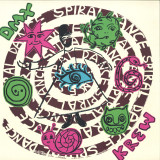
DMX Krew returns to Hypercolour with a new long player. ‘Spiral Dance’ comes stuffed with wonky and futuristic synth jams.
Having honed a style that has endured over an illustrious career, DMX Krew continues to immerse his productions in luscious analogue electronica, touching on the many bases of electro, Detroit techno, synthpop and dreamwave.
With previous albums for Rephlex, Permanent Vacation and Balkan Vinyl, amongst others, ‘Spiral Dance’ becomes the fifth album for Hypercolour, following on from 2021’s ‘Loose Gears’.
- A1: Hand In Hand Through Wonderland
- A2: I Can Remember It So Vividly
- A3: Love Reigns
- B1: Understand (Feat Brendan Yates)
- B2: Patience (Feat Nia Archives)
- B3: Without The Sun
- B4: Spirit Wave
- C1: Breathing
- C2: Intercity Relations
- C3: Time Change (Feat Novelist & D Double E)
- D1: Distant Conversation
- D2: Metaphysical
- D3: Lost In Harajuku
Black Vinyl[28,36 €]
What I Breathe is the debut album from Mall Grab AKA Jordon Alexander. The Australia-born London-based powerhouse reaches within to create the most comprehensive demonstration of his style to date – loudly defining the raw energy that has become synonymous with the moniker.
“This album is deeply personal and an exploration of all influences, sounds and sides of the Mall Grab project. It follows my journey of the last 6 years from a university dropout in Newcastle (Australia), making music as a source of happiness and expression.”
While glances of what Jordon gravitates towards in dance music can be heard in the record label imprints he steers—Looking For Trouble and Steel City Dance Discs—it's with What I Breathe that he elaborates on and articulates his diverse ear for music. Through collaborations with Brendan Yates of Turnstile, Novelist, D Double E and Nia Archives, the Mall Grab repertoire of emotive electronics is used to traverse his love of hard-to-define energies that exist between genres like Hardcore, Hip-Hop and Soul.
“I have been lucky enough to work with some of my favourite artists which have really been the glue that keeps the project coherent. There are a lot of familiar sounds on this album that my listeners and followers have become accustomed to and joined me in the deep dive. Elements of emotional but hard and pumping club music are intertwined with House, Jungle, Rave and Grime. My adopted home city of London has been a huge inspiration to how my music has evolved and progressed, and on What I Breathe I wanted to create a body of work which not only had something for everyone who has been with me the past 6 years, but also those who aren’t yet aware of what I’m about or the music I make.”
Jordon’s long-standing penchant for all things DIY blossoms in tracks like Lost In Harajuku and Without The Sun which feature his own original lyrics and vocals. As the album twists and weaves from one song to the next, gleaming melodies flare up into club-ready anthems such as Metaphysical and Breathing. The kinetic flow of the music as a whole can be attributed to the many years of cutting his teeth as a DJ, a skill that can be testified by anyone who has witnessed a Mall Grab set.
“As I was a DJ for many years before I delved into producing electronic music, I had a wide appreciation and love for all types of music, predominantly gravitating towards ‘band' music when creating my own projects, before evolving into a fully-fledged electronic producer – however always retaining the influence and love for all things live and genre-fluid.”
Even with a stack of very well-received projects already under his belt, What I Breathe can be seen as the first deep breath in and a fierce declaration of what’s to come for Mall Grab.
“I’m grateful for everything and everyone in my life, those I love and those who support my music, through all the ups and downs. I live and breathe this shit. I cannot do anything else. I will continue until there is nothing left for me to say.”
- A1: I Am Missing You
- A2: Kahān Gayelavā Shyām Saloné
- A3: Supané Mé Āyé Preetam Sainyā
- A4: I Am Missing You (Reprise)
- A5: Jaya Jagadish Haré
- B1: Overture
- B2: Festivity & Joy
- B3: Love - Dance Ecstasy
- B4: Lust (Rāga Chandrakauns)
- B5: Dispute & Violence
- B6: Disillusionment & Frustration
- B7: Despair & Sorrow (Rāga Marwā)
- B8: Awakening
- B9: Peace & Hope (Rāga Bhatiyār)
Purple Vinyl[27,52 €]
Out of print as a stand-alone release for decades since its original 1974 issue. Produced by George Harrison, Shankar Family & Friends is an almost-forgotten masterwork – an emotional and sonic pact between two like-minded souls to both advance their spiritually minded bond and unite musical styles, cultures, and sounds in wondrous fashion Contributions from Ringo Starr, David Bromberg, Billy Preston, Nicky Hopkins, Jim Keltner, Klaus Voorman, and a host of virtuosic Indian musicians add to a diverse album that melds Eastern and Western traditions; encompasses jazz, funk, bhajan, Indian, and pop; and represents the spirit and breadth of Harrison's Dark Horse Records imprint.
Memorable contributions from an A-list of American and English musicians — Ringo Starr (drums), David Bromberg (electric guitar), Billy Preston (organ), Nicky Hopkins (piano), Jim Keltner (drums), Klaus Voorman (bass), Robert Margouleff (Moog), Malcolm Cecil (Moog), Tom Scott (saxophone) included — add to the richness of a set that melds Eastern and Western traditions. These “names” mesh with a host of Indian virtuosos — Alla Rakha, Ashish Khan, Kamala Chakravarty, Hariprasad Chaurasia included — who turn Shankar Family & Friends into a journey laced with percussive, string, and vocal components that aren’t soon forgotten.
Throughout, Shankar Family & Friends remains true to its title — a mesmerizing record named to reflect the group participation approach of its creators. The idea started when Shankar told Harrison about a ballet he wrote. The Beatle, who first met Shankar in June 1966 — roughly a year after Harrison became interested in Indian music after overhearing it in a restaurant while filming Help! — immediately was convinced they needed to record it. Harrison’s staunch admiration of Shankar and serious approach to Eastern styles are reflected throughout the album.
Indeed, for Harrison, Shankar Family & Friends marks the culmination of a years-long effort to master the sitar, study Hinduism, and incorporate elements such as drones, unusual chords, and expressive picking into his own songs. The seeds of this unique collaboration can be heard in Beatles works such as “Norwegian Wood,” “Love to You,” and “Within You Without You.” Both musicians were also fresh from performing at the 1971 Concert for Bangladesh shows. Yet Shankar Family & Friends remains entirely unique in each visionary artist’s history — and ultimately, led to a collaborative tour Harrison and Shankar staged across North America.
Encompassing jazz, funk, bhajan, Indian, and pop, Shankar Family & Friends is thematically split into halves. Side One reveals Shankar’s uncanny ear for melody — even when applied to Western forms. The lead-off “I Am Missing You,” the first single ever released by Dark Horse Records and reportedly the first pop composition Shankar completed, underscores his skills as a composer and global ambassador. Beautifully sung across three octaves by his sister-in-law, Lakshmi Shankar, the devotional song features multiple drummers and production that mirrors Phil Spector’s Wall of Sound approach. Harrison plays autoharp and guitar; Starr sits in on drums; Scott handles flute and soprano saxophone. It’s the inviting start of a musical adventure teeming with color, majesty, and mysticism.
A second version of the track — designated with a “(Reprise)” tag — appears minutes later. Unfolding in different ways, it follows a folk ballad structure stitched together with Indian instrumentation. Here, according to Shankar, the musicians “attempted to convey the sounds and atmosphere of Vrindavan, the ancient holy place where Krishna grew up.” Both renditions speak to the cross-continental fusion that came so naturally to Harrison and Shankar, whose oversight on the side’s other vocal tracks ensures listeners familiar with Western methods gain easy access to the hypnotic allure of his native country’s music.
Nowhere is this more evident than on Dream, Nightmare & Dawn (Music for a Ballet), the side-long piece that served as the genesis for Shankar Family & Friends. Launched with an airy overture and unfolding across three movements, the mostly wordless suite features everything from call-and-response interplay and classical lyricism to uptempo dance figures, stacked rhythms, and intoxicating grooves. Blurring the lines between contemporary and traditional, and Western and Eastern, the inspirational work is the exclamation point on a record that defined “world music” well before the term became co-opted as a catch-all genre.
Mesmerizing and exuberant Argentinian La Yegros, probably the most magnetic artist on the South American continent, is back with a new album!
The undisputed Queen of "Nu Cumbia" has not rested on her laurels. Surrounded by the same accomplices who have supported her for the last ten years, but eager to renew herself, she has set about recording her fourth album, which stands out from her discography. Although her personal folklore is still rooted in South American folklore, La Yegros is now absorbing contemporary, global music, while tackling intimate, often melancholy and even painful subjects, which she overcomes with the same resilience that drives her in concert. Nothing stands in the way of this Argentinian whirlwind, all the more fascinating for the fact that personal considerations are now surfacing beneath the veneer of the party atmosphere she sets alight.
La Yegros returned to the stage in 2022 to celebrate the 10th anniversary of Viene de Mí, her single hit from the self-titled album, released in 2012 in Argentina and then worldwide in 2013, which catapulted her to international fame. We then discovered a singer who had grown up in the traditions of her country. Her parents come from Misiones, a province bordering Brazil and Paraguay, where balls are filled with the sounds of chamamé (a mix of polka and Guaraní music), Carnavalito (Andean folklore) and Colombian Cumbia. But she herself is a native of Buenos Aires, whose nights are enlivened by the bass of Dancehall and electronic music.
These influences have merged in two further successful albums, Magnetismo (2016) and Suelta (2019), followed by high voltage tours during which La Yegros has been able to display her generous nature, inexhaustible energy, exuberant personality and infectious enthusiasm.
To record her new album entitled 'HAZ', La Yegros has put her faith in the same team that has worked with her since Viene de Mí. On one hand, producer Gaby Kerpel (also known as King Coya), a pioneer of synthetic experimentation applied to traditional music, who has remained her faithful accomplice for over twenty years. On the other hand, composer Daniel Martín, who knows how to come up with melodies to dream about and hymns to sing along to. Inseparable and complementary, the trio continues to concoct this mesmerizing mixture where acoustic instruments meet samples and the rolling of machines. But the new productions don't rely on a tried and tested formula. Generally co-produced between France and Argentina, they break away from over-defined genres. La Yegros knits together new rhythms and incorporates sounds that are unheard of in her country, derived from the latest urban trends, as well as echoes of reggae and funk. As for the lyrics, signed alternately by the trio, they are embodied by La Yegros whose charismatic voice questions a period of her life tossed by waves of love and lovelessness, joy and sorrow, euphoria and anguish, indulgence and resentment.
The album is open to a wealth of musical styles. You'll hear funk guitar and Andean flutes, melancholy accordion and rolling drums, Tuareg blues enhanced by brass, house and electro Cumbia loops, and the bassoons of a chamber orchestra. The folklore 2.0 of La Yegros, nourished by its colorful inspiration, at times tender or exalted, has been imagined as a hymn to love and the contradictory feelings that come with it. As always, it has also been conceived with the stage in mind. Hatching in a storm of overturned emotions, the album is all the more explosive for the strength of the live show that accompanies it. In addition to the usual line-up of guitar, accordion and percussion, a musician handles synthesizers and machines to boost the electronic turboshaft. In any case, you can count on the singer to assert her increasingly clear-cut character with each new project. And, above all, she won't give up. L.a Yegros is back and her batteries are fully charged.
DRIFT. Is British-Italian producer Nathalia Bruno, releasing music under the guise since 2015. Her 'techno-pop' EPs 'Black Devotion' and 'Genderland' released with Avant! records were the first explorations in finding the sound of DRIFT. but as the name suggests, is in constant flux. In 2020 'Symbiosis' the debut record was released on Hamburg's Tapete Records, an assemblage of lo-fi futurism reflecting on the breakdown of communication and interaction Nathalia felt was increasing around her. Channelling classic industrial electronica, haunting melodies, using samples, field recordings and curated sound as a 'canvas to rewire the vision of the future as colourful and old, ceremonial and rust beaten. A shrine like ornament and clinical machine language plaited together.'. In 2022 DRIFT. Self released 'The nature of things', a 30 minute piece entitled 'CTRL/ Algorhythm of love' written and produced for designer Mona Cordes' 'Cellusion' show for London fashion week. "_a journey into the dark heart of the dancefloor. The glimmering bass-heavy trance of its opening section could be classic Underworld, while its ambient center is genuinely Eno-esque. And then it all kicks off again as a Berlin school style banger. It's terrific" says Electronic Sound Magazine. This year, 2023 will give birth to DRIFT.'s second album released with God Unknown records '11 points In Time' written for and based on disappeared artist Rosi Crucci, compiled of sounds/field recordings recorded onto cassettes found in the attic of the home she last lived at, interpreted into song using some of her poetry and journal entries of what was happening in the world around her, attempting to finally give Rosi a voice. PRESS Louder Than War album review 'Symbiosis' (2020) "...blends passion with precision to create a tapestry of machine-made sounds that are bursting with ideas and filled with emotion. "We live in times where nothing means nothing," she sings on Visualise The Invisible. "And nothing is true." Never more so than now...Over the course of its ten tracks, Symbiosis draws from pretty much every strand of electronic music throughout its 50-year history" Shindig Magazine review 'Symbiosis' 2020 "A brilliant, fascinating album" Post Punk Magazine review 'Symbiosis' 2020 "is an exercise in disjointed meditation, a trip through the doors of the spirit lodge and inner workings of the human psyche." Pop Matters Review 'Symbiosis' 2020 "...One track in particular, "In Orbit", speaks to this new disturbing unknown we are creating. A distorted, three-note death knell drives it as repeated knocking seems to come from a dank tunnel. If it sounds bleak, it's likely also to be therapeutic and finds common ground with the entrancing industrial thud of Throbbing Gristle or Third Eye Foundation..."
LKEMY is a legendary Italo house producer from the Adriatic Riviera. Active since 1991 when his first 12″ was released, in the 1990s composed and produced several dozen tracks that are now cult favorites among young DJs and collectors of the genre. Now he returns to produce in the same style of the time two tracks that impressed two well-known Italian DJs, one of the old school and one of the new, who wanted to make their own versions. Dj Ralf, one of the most historical, notorious and active DJs in Italy, has remixed “Cloud” for his warm and intense Dj sets around Italy. In “Cloud Detox”, GNMR (Gianmaria Coccoluto) doesn’t approach as just a remixer; rather, he doesn’t distort or eliminate/replace the important parts of the track but transports and renews them in a new musical realm of his own. Where ethnic elements, live-played drums, and intentionally unquantized rhythms give birth to a unique body under the moon of Goa in India. Mysticisms, transcendental worlds, lengthy dances free from others’ judgment, and closer to supernatural contact make Detox a journey towards purification.
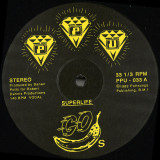
Peoples Potential Unlimited's most anticipated release to date. Originally recorded in Detroit, 1982 by the late Danan Potts a.k.a. Superlife. At that time Danan was hanging around the Recording Institute of Detroit where Juan Atkins was training in production. Danan was interested in Atkin's style of dance music and quickly recorded "Go Bananas".
Bananas was released locally on Southern Sun Records in hyper limited quantity, it is today one of the most sought after underground detroit techno recordings of all time. DOUBLE VINYL featuring the original (1982) versions and new versions by Max D, Legowelt, Peanut Butter Wolf, Steve Summers. Color Jacket.
FRN Dancehall might have emerged in Jamaica, but over the last few decades the popular genre's tendrils have stretched out across the globe. In Kampala, Ratigan Era is adding a distinct Ugandan twist to dancehall, fusing it with East African humor and hyper-melodic afrobeats elements imported from Ghana and Nigeria. The versatile MC grew up listening to Jamaican music like Vybz Kartel, Busy Signal and Mavado - in his hometown of Kawempe there was almost no way to avoid it - and it blurred into the background, blending with local church music, US hip-hop and radio pop. He developed this diverse range of influences into a completely unique Afro-dancehall flow that simmers between Luganda, patois, Spanish and English, reflecting the melting pot of cultures and dialects that characterizes contemporary Africa. Ratigan broke out with a memorable feature on Pallaso's Ugandan hit 'Nsaba', a track that echoed throughout the country booming from nightclubs, motorcycle loudspeakers or from convenience stores. Now he's assembled his first album "Era", a furiously inventive interweaving of rubbery vocals and memorable chants backed by futuristic beats from Hakuna Kulala's most boundary-pushing producers. Congolese producer Chrisman takes the reins on 'Gorilla Attack', providing a downtempo groove that echoes recent Jamaican chop deployments from breakthrough artists like Skillibeng and Skeng. For his part, Ratigan ducks and dives between Chrisman's gqom-inspired low end womps and corrosive synths, commanding attention with his smart, dextrous flow and tongue-twisting lyrics.The Modern Institute and Golden Teacher's Richard McMaster handles 'Top Strike Force' leaving space in his wiry, minimal beats for Ratigan to flit between anthemic repetitions and ice-cold AutoTuned wails. On stand-out track 'Badman Style', Ratigan's guttural patois is measured against a dizzy trap-dancehall hybrid beat from HHY & The Kampala Unit's Jonathan Uliel Saldanha, aka Lithium Beats, while on the surreal 'Drop it Down', Japanese mad scientist Scotch Rolex brings out Ratigan's cheeky sense of humor with toytown bleeps and laser zaps. MC Yallah collaborator Debmaster appears on 'Gan Dem', meeting Ratigan's double-time raps with soundsystem destroying rolling subs, and veteran US noisemaker Kush Aurora sprinkles magic dust on 'Cool and Deadly', galvanizing the link between global bass mutations, Jamaica and East Africa.And despite the grab-bag of producers and inspirations, "Ratigan" is a strikingly coherent listening experience that accurately snapshots Kampala's colorful froth of sounds and phrases. Ratigan's outsized personality is welcoming and captivating, providing the sights, sounds and smells of the city with a frenetic rhythm that's as intimate and local as it is far-reaching. It might just be the future we so desperately need.
Toki Fuko – Hues Of Movement After his notable debut on
Submersive’s VA Osmotic Particles in 2021, Toki Fuko makes a
captivating return with his first solo release on the label. ‘Hues of
Movement’ comprises three original tracks and two remixes by Anthony Linell and Artefakt, embodying Submersive’s ethos of a deep, hypnotic journey into organic yet dancefloor-ready Techno. In the three original tracks, Toki Fuko once again mesmerizes with his evolving soundscapes. Electrical pulses are enhanced with expansive reverbs and woven into groovy drum sequences. The tracks gradually evolve, reminiscent of a drop of ink dispersing in water, inviting listeners to immerse themselves in the sound and lose control as they become one with the music. Anthony Linell, who performed at Submersive’s inaugural party in Paris in 2017, offers a Train remix that seamlessly bridges his signature style with Toki Fuko’s sound. The track emerges like a living entity, combining dub-influenced meditative atmospheres with ecstatic elements, growing into a full-length auditory experience.
Artefakt rounds off the release with their ‘Warble’ remix, taking listeners into depths where light cannot penetrate. The Dutch duo presents a darker take, subtly manipulating elements and maintaining high tension, keeping the end of this sonic adventure tantalizingly out of sight. Accompanying the EP is artwork by Swiss-Moroccan artist Zineb Mezzour, offering a fresh interpretation of the concepts of surface and water that Submersive explores in each release. Known for her intricate work on paper and ceramics that evoke a microscopic, organic, and spiritual world, Zineb has performed a unique visual for this vinyl. She began by drawing invisible shapes in water, then brought them to life by adding ink that transformed into unpredictable fractal shapes. This artistic process was captured to create both the cover and the video teaser for the EP.
Perc Trax hits 100 releases with Perc returning with his first album in seven years. 'The Cut Off' is Perc's fourth album following 'Wicker & Steel' (2011), 'The Power & The Glory' (2014) and Perc Trax's best ever selling release 'Bitter Music' (2017).
'The Cut Off' see's Perc deliver his most dance floor focused album to date, serving up enough energy to keep contemporary dance floors moving, whilst avoiding both the cliched 90's throwback hard techno formula that is dominant right now and the stuckist 'real techno' blueprints that are still endlessly regurgitated having been established over 30 years ago.
Across the album Perc's well established industrial credentials collide with giant sized synth riffs, driving acid lines (a first for a Perc album) and all manner of drones, choral performances, urban textures and even a dentist's drill (on 'Static'). Gliding arpeggios and slow moving melodic lines feature more on this album than ever before without dulling the sharp edges of Perc's music.
'The Cut Off' more than any previous Perc long player is an album that focuses on the club, the dancer and the dance floor. Yes, there are moments of respite between the classic Perc percussive workouts, but they are far outnumbered by the varied collection of club tracks that come at the listener from every angle.
Collaborations include Sissel Wincent, a regular collaborator with Peder Mannerfelt. Perc remixed Peder & Sissel's 'Sissel &Bass' track to great effect in 2019 and now Sissel returns the favour appearing on 'Static', the album's only full vocal track. Also collaborating with Perc is EAS, one of America's fastest rising techno artists who delivers the raw acid lines that power album highlight 'Cold Snap'. Finally London based metal vocalist Leandro Bastos adds his abrasive vocal tones to 'Imperial Leather', the first single to be taken from 'The Cut Off'.
The 'Cut Off' was recorded in Perc's own studio and mixed by Perc at Map Studios in London. The album was mastered by Matt Colton at Metropolis Studios. Album design was handled by Lucas Grassmay, who previously worked on I Hate Models' debut album on Perc Trax in 2019. The album will be supported a run of dates around the world where Perc will be performing a special live set based around the album as well as his infamous DJ sets.
- A1: Hiroshi Kamayatsu - Have You Smoked Gauloise
- A2: Happy End - Haruyo Koi Come Spring
- A3: Yoshiko Sai - Aoi Galasu Dama Blue Glass Ball
- A4: Tadashi Goino Group - Jikan Wo Koero Go Beyond Time
- B1: Jun Fukamachi - Omae You
- B2: Momotaro Pink With Original Pinks - Hachigatsu No Inshow Augusts Impression
- B3: Vol 1 Chap.100 - Heya No Naka In The Room
Nippon Psychedelic Soul 1970-1979 is Time Capsule’s continuation of the deep dive into Japan’s rich history of folk and psychedelic soul music.
Vinyl LP with 4 page insert, original artwork and photos
The kaleidoscopic psychedelia of 1970s Japan captured a fragile and fertile moment as the country sought its future in funk grooves, heavy reverb and lyrical hallucinations.
The follow-up compilation to Time Capsule’s Nippon Acid Folk, Nippon Psychedelic Soul takes myriad pathways into the tripped-out undergrowth of 1970s Japan. Finding their feet at home and looking for inspiration abroad, the musicians featured here were engaged in the communal soul-searching that followed the breakdown of the 1960s protest movements. Some made it big, others drifted into oblivion. The music they left behind shimmers with intensity.
At the core was Happy End, the first project of YMO’s Haroumi Hosono, whose distortion-heavy guitar and crisp back-beat laid the foundations for Japanese lyrics that flipped the paradigm of Japanese rock music on its head. With it came a new found sonic ambition, such as in the bold Philly-soul style arrangements of producer Yuji Ohno, whose work with occult wandered Yoshiko Sai shares some of the bittersweet grandeur of Rotary Connection or David Axelrod.
Then there was Jun Fukamachi, a pioneer of Japanese synthesis, whose debut album was a carnival of orchestral funk, euphoric horn lines and rich production, complete with soaring guitar solos, psychedelic organ and a truly cinematic finale. The first and only time Fukamachi would sing on record, ‘Omae’ rips like the ultimate end-of-nighter.
Influenced by giants of the US soul scene, maverick composer Hiroshi “Monsieur” Kamayatsu (otherwise known as ‘the Brian Wilson of Japan’) went one step further, enlisting Tower of Power to play on ‘Have You Smoked Gauloises?’ The B-side to Monsieur’s biggest-selling single, it coasts with sophisticated cool - a liquid bassline and suave keys comping under a roaring trademark ToP sax solo. No surprise it found favour once more on the Acid Jazz dance floors of ‘90s London.
Such was the spirit of experimentation that big studio productions and private press releases sat side-by-side, with the likes of Momotaro Pink and Kazushi Inamura, taking their hopes of success into their own hands with the resources available to them. More reflective but no less robust, theirs was a heavy, fat-backed drum sound, soaked in dramatic, soulful psychedelia.
If some were dreamers and others space cadets, none were further out than sci-fi writer, musician, activist and self-made scientist Tadashi Goino, who transformed his own fantasy novel Messenger from the Seventh Dimension into an operatic prog odyssey with few discernible musical reference points – a majestic and completely bonkers outlier even among company as strange and brilliant as that which is collected here.
Less a compilation of a scene, as a compilation of a sentiment, Nippon Psychedelic Soul is a wild ride from start to finish, shattering the narratives of the Japanese folk and rock tradition into a million tiny pieces.
- A1: Walter Rizzati - L`unica Chance
- A2: Chrisma - Amore
- A3: I Robots - Tabù Tubà (Part 1)
- B1: Luca D`ammonio - Oh Caron
- B2: Ramasandiran Somusundaram - Contrabbando Di Fagioli
- B3: Jean Paul & Angelique - Africa Sound
- C1: Weyman Corporation - Kumbayero
- C2: African Revival - Soul Makossa
- C3: Lara Saint Paul - The Voodoo Lady
- D1: Beryl Cunningham - Why O
- D2: Augusto Martelli & The Real Mccoy - Calories
- D3: Prognosi Riservata - M A.a.g.o
Africamore: The Afro-Funk Side of Italy (1973-1978)
Continuing Four Flies' dedication to delving into lesser-explored periods of Italian music, Africamore takes us on a captivating journey into the intersection of Afro-funk and the Italian soundscape during the six years between 1973 and 1978 - a time when disco was looming on the horizon and the nightclub market was rapidly expanding.
Before reaching Italian shores, the infectious sound originating from African and Afro-Caribbean roots traversed both the Mediterranean and the Atlantic, landing on New York dancefloors, where DJ Dave Mancuso discovered "Soul Makossa" by Manu Dibango. In 1973, from Mancuso's Loft parties, the song's hypnotic groove spread to the rest of the globe, including in Italy, where it sparked a wave of imitations and variations.
Tribal influences thus found their way into Italian soul-funk and early-disco productions released between 1973 and 1978 – from psychedelic-tinged tunes like Jean Paul & Angelique's "Africa Sound" to the Afrobeat-inspired club banger "Kumbayero" by composer/producer Albert Verrecchia (aka Weyman Corporation); and from groundbreaking Afro-cosmic songs like Chrisma's "Amore", co-written by Vangelis and featuring the rhythms of Ghanaian-British Afro-rock band Osibisa, to mind-blowing floor-fillers like Beryl Cunningham's "Why O", a re-write of Nat King Cole's "Calypso Blues" arranged by Paolo Ormi, with percussion breaks that sound pretty much like what would later become known as techno.
Combining feel-good vibes with driving rhythms, world-style percussion, and even synths, all these productions pushed the boundaries of dance music at a time when disco had not yet taken over. In doing so, they sowed many of the seeds of the later Italian cosmic scene and its unique mixture of African elements, disco-funk and electronic music.
This was a brief but nuanced period in Italian music history, one that deserves to be rediscovered, with love.
Africamore is due out on March 22nd and will be available as a gatefold 2LP and digipak CD. Both formats come with stunning artwork by Kathrin Remest and liner notes by Pierpaolo De Sanctis and Elena Miraglia.
Rock & Roll, indeed. Ruth Brown’s sizzling full-length debut — also known by its eponymous title — symbolizes what was exciting, fresh, invigorating, and raw about the burgeoning style in its halcyon days. Originally released in 1957, and reissued here in audiophile quality for the first time in partnership with Atlantic Records’ 75th anniversary, the set remains a testament to one of the most pioneering and talented vocalists to ever command a stage.
Mastered on Mobile Fidelity Sound Lab's renowned mastering system in California, pressed at RTI, housed in a Stoughton jacket, and strictly limited to 2,000 numbered copies, Mobile Fidelity’s 180g mono LP of Rock & Roll plays with an immediacy, vibrancy, and fullness that showcase the reach, power, and emotionalism of Brown’s voice. The sound of her support musicians — brassy horns, swinging rhythm combos, echoing backing vocalists, rollicking pianists, jaunty guitarists — is made clear and vivid, helping the upbeat fare to jump, juke, and jive with newfound energy and exuberance. In a related manner, Brown’s slower, more understated material crackles with an intimacy and passion that let you know you're in the presence of a woman who has lived what she sings. The longtime Rock and Roll Hall of Fame member deserves nothing less.
In an era dominated by big-throated vocalists, few — if any — came grander than Brown. The singer, whose repeat million-selling ‘50s success with Atlantic Records led many to call the then-indie label “The House That Ruth Built,” charted two dozen R&B hits in the span of a decade for the fledgling imprint. Rightly coined “Miss Rhythm,” the extroverted Brown put Atlantic on the national map, became the best-selling female musician of the ‘50s, and established a precedent that would ultimately lead to Grammy and Tony Awards. Her early works have lost none of their fire or flair.
Akin to many full-length LPs of its era, Rock & Roll doubles as a collection. Its 14 tracks comprise some of the more famous sides Brown recorded for Atlantic, beginning in 1949 with the all-time-great rendition of the ballad “So Long,” and continuing through 1956. After the song caught the public’s ear, the Virginia native briefly became known for her smoldering style with lovelorn material and torch songs, approaching them (see “Oh What a Dream,” “Old Man River”) with a combination of pained sadness and hardened resilience that had no contemporary equal. Encouraged to pursue the style by Atlantic Records co-founder Ahmt Ertegun, her R&B-driven material soon made her a constant chart presence.
Demonstrating what fellow legend Bonnie Raitt deemed “sex with class and dignity,” Brown merges blues and jazz, swing and gospel in electrifying fashion. She dares you not to move, dance, and get on your feet. A majority of Rock & Roll explodes with uptempo runs and jaunty readings of hot-blooded R&B numbers. Sweaty and sultry, bawdy and bold, Brown eclipses the anthemic blare of the saxophones and joyful clatter of the 88s, singing with a slight catch in her voice and hurricane-gale force that threatens to blow the roof off whatever room her voice occupies.
Evidence abounds. Listen to her prod the band and encourage the band members to blow a fuse on a sizzling “Hello Little Boy,” complete with cries and wails; stretch her phrasing to the heavens on the swaying “Wild Wild Young Men,” laden with romp-and-stomp beats; plead and persuade on the snaking “5-10-15 Hours,” which flips the script on the age’s notions of dominance; use her raspy tones, high notes, and breath control to mesmerizing effect on the smash “Mama He Treats Your Daughter Mean,” recorded with a group led by Ray Charles; survey the scene and take charge on the steaming “As Long as I’m Moving”; and tap a classy albeit flirtatious vein on “Lucky Lips,” which dented the pop charts as her first crossover hit.
Throughout Rock & Roll, Brown knows the lyrical connotations and spirited architecture of the songs inside-out. Her assertive voice — never harsh, strident, or false — is the epitome of the passionate desires and sonic strains that turned into nascent rock ’n’ roll. Brown played a pivotal role in helping the style develop, the record a timeless reminder of a lasting legacy that will never be forgotten.