Features all-analogue mastering from the original tapes by legendary engineer Bernie Grundman (himself a former employee of the label), as well as unsurpassed audiophile pressing on 180-gram vinyl at Quality Record Pressings, presented in a Stoughton Printing old-style tip-on jacket.
The series highlights gems from Contemporary's extraordinary catalogue and features artists who both defined and expanded the sound of West Coast jazz.
1957's The Poll Winners was the first of five all-star trio sessions featuring the dazzling interplay of guitarist Barney Kessel, drummer Shelly Manne and bassist Ray Brown. For The Poll Winners, Kessel, Manne, and Brown did not record together simply because they all happened to have won first place on their respective instruments in the Down Beat, Playboy, and Metronome polls.
Their collaboration was due to mutual respect, and their sensitivity to one another's musical requirements. Here, in a set composed mainly of pop and jazz standards, they represent the ultimate in their fields, constituting a rhythm section that also provides brilliant solo interludes by all three members. Collectively, Kessel, Manne, and Brown won dozens of polls over the years; this record eloquently tells you why.
Cerca:dazz
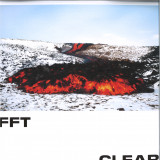
Numbers will release ‘Clear’, the debut album by FFT, on 24th June 2022.The result of three years of focused writing and programming by the London-based producer, ‘Clear’ is deeply psychedelic, defined by a mature sense of melody and structures crafted at a monumental scale.
Though FFT has previously released a handful of tracks under various names, it wasn’t until 2017’s ‘FFT1’ EP on theUncertainty Principle label that his production talents began to fuse into a distinct and personal style, especially evident in FFT’s‘Regional/Loss’ EP on The Trilogy Tapes in 2019, multiple releases on Bruk Records and2021’s ‘Disturb Roqe,’also released on Numbers.Through it all, FFT has mastered a complex sense of mood catalyzed by sound itself: He builds patches and presets from scratch, and feels these synths and software have their own objectives and reactions, creating a kind of compositional feedback loop.The result is an album that brings to mind a collision of electronic pioneers like Delia Derbyshire and Bernard Parmegiani, 2000’s braindance, the Max-imized wares of an OPN or Objekt and the rough rhythmatics of SND or Mika Vainio
The layering of sonic elements and intentions is starkly audible across these nine tracks.They can be seismically concussive and grandiose, but granular and fluid - echoing the Icelandic volcanic eruption that features in the artwork photography byGeorge Cowan. ‘Clear (Eight-Circuit Mix)’sets a euphoric tone immediately accelerated by the jagged sounds and vocal textures of ‘Redeemer’. ‘3 Sided’ channels hyper-urbanity from its almost entirely analogue palette, and by contrast ‘Disturb Roqe 2’is bracingly digital, gyrating in random cycles between clustered percussion, metallic splinters of audio and artificial vocal tics.
Opening side two, ‘You’ve Changed’ adheres to a more abrasive core, while ‘Heal’ and ‘Heal (Alt Mix)’evolved out of linked pieces in FFT’s live sets that grew into complete tracks in the months before Covid-19.The significant intensity of ‘Heal’ in particular was refined during strobe-heavy live performances and is the album at its most turbulent, the claustrophobia interrupted by dazzling arpeggios.The overall impact of 'Clear' is cinematic and precise, marking the arrival of an impressive electronic musician who is not new but has come into his own as a fully developed artist
• Revised reissue of the acclaimed first-ever book-length investigation into French Touch.
• Back in print for the first time since 2004.
• Updated version features previously unpublished interviews with Daft Punk, Laurent Garnier, Cerrone, Jean Jacques Perrey, Motorbass, Chris Le Friant (aka Bob Sinclar), Air, Etienne de Crecy, La Funk Mob, Cassius, The Micronauts, Stardust, Benjamin Diamond, Modjo, DJ GilbR, i-Cube, DJ Cam and many more...
During the second half of the 1990s, Paris experienced a dance music revolution thanks to groundbreaking artists like Daft Punk, Air, Super Discount, Motorbass, Cassius, Dimitri from Paris, Bob Sinclar and many, many more. It was a scene that became known as French Touch and was heralded throughout the world as the epitome of dance music cool, forever placing Paris on the dance culture map.
Journalist and author Martin James was there right from the start, documenting the scene from its inspirations to its earliest moments and onto its global breakthrough. In the process, he inadvertently provided the French Touch moniker that became adopted throughout the world.
Drawing on a dazzling array of exclusive interviews with the biggest names in French electronic music history, French Connections explores France’s significant contribution to dance music culture that paved the way for the French Touch explosion.
“Endlessly informative and thoroughly enjoyable, James manages to bring even the most boring artists (Air) to vibrant life with his energetic prose and rich imagery.” Bob Stanley, Mojo
“(James) has a rare, imagistic talent for evoking the unearthly sounds of modern dance music.” The Guardian
“Viva Monsieur James! Essential reading for all fans of Gallic grooves.” DJ Mag
“If ever a book was overdue then it’s this one, which charts the influence of French electronica on the world outside the hexagon over the past decade or so… tres bien.” Select
Rarely do two types of music meet on a level where they threaten to cancel each other out - let alone create something even more meaningful in their mutual vanishing. But the music created within the seminal Murder Ballads (Drift) by Martyn Bates (Eyeless in Gaza, & parallel solo career) and Mick Harris (Napalm Death, Lull, Painkiller, Scorn) creates just such a world. Murder Ballads (Drift) evolves Martyn Bates vocalisations / storytelling song-voices, by turns expressed as labyrinthine layers, calls and responses, muted and distant echoes, sung whispers and counter-melodies, ultimately resulting in a mesmeric conversation of musical inferences and correspondences. Murder Ballads (Drift) created the post-isolationist frame of reference, innovating and extemporising into a truly original dazzlingly unique form.
Mick Harris traffics in the isolationist ambience of Lull, while Martyn Bates is the emotive voice of literate cult-pop duo Eyeless in Gaza. The unlikely pair - one given to terminally frigid drone, the other to impassioned, bittersweet voicings - finds common ground in folk music's most macabre tradition, the murder ballad. These ghoulish parables are awash in blood and tears, the strands of love, hate, birth, death, sin, and salvation entwined within like the roots of an ancient tree. Mothers callously kill their children; suitors slay their maidens without remorse; and fate exacts its cruel price from all.
The archaic murder ballads that leak from Bates' vocal cords are intensely sad and carnal. They tend to leap off cliffs of hollow effects or drone darkly, offering neither a robust delivery nor an element of irony to take the edge off. The archetypal characters that live and die in them give life's full tragedy back to Harris' electronically numbed "post-isolationist" dreaming.
Drift (originally released in 1994) plays out an unbreakable and timeless cycle of bloody folklore (people) and hypnotic soundscapes (the god who watches). The effect is chilling yet engrossing. Where most ambient music has barely enough courage to ring the doorbell and run, Murder Ballads slips through the cracks of the unconscious and does its work with remarkable ease.
All the more reason to listen thoughtfully.
In 2021 - re-emerging nearly twenty years after its initial inception, and first time on vinyl - somewhat surprisingly, Murder Ballads (Drift) still remains/exists in an area overlooked by other artists, an area that truly still remains the sole province of M.J. Harris / Martyn Bates.
Rarely do two types of music meet on a level where they threaten to cancel each other out - let alone create something even more meaningful in their mutual vanishing. But the music created within the seminal Murder Ballads (Drift) by Martyn Bates (Eyeless in Gaza, & parallel solo career) and Mick Harris (Napalm Death, Lull, Painkiller, Scorn) creates just such a world. Murder Ballads (Drift) evolves Martyn Bates vocalisations / storytelling song-voices, by turns expressed as labyrinthine layers, calls and responses, muted and distant echoes, sung whispers and counter-melodies, ultimately resulting in a mesmeric conversation of musical inferences and correspondences. Murder Ballads (Drift) created the post-isolationist frame of reference, innovating and extemporising into a truly original dazzlingly unique form.
Mick Harris traffics in the isolationist ambience of Lull, while Martyn Bates is the emotive voice of literate cult-pop duo Eyeless in Gaza. The unlikely pair - one given to terminally frigid drone, the other to impassioned, bittersweet voicings - finds common ground in folk music's most macabre tradition, the murder ballad. These ghoulish parables are awash in blood and tears, the strands of love, hate, birth, death, sin, and salvation entwined within like the roots of an ancient tree. Mothers callously kill their children; suitors slay their maidens without remorse; and fate exacts its cruel price from all.
The archaic murder ballads that leak from Bates' vocal cords are intensely sad and carnal. They tend to leap off cliffs of hollow effects or drone darkly, offering neither a robust delivery nor an element of irony to take the edge off. The archetypal characters that live and die in them give life's full tragedy back to Harris' electronically numbed "post-isolationist" dreaming.
Passages (originally released in 1997) plays out an unbreakable and timeless cycle of bloody folklore (people) and hypnotic soundscapes (the god who watches). The effect is chilling yet engrossing. Where most ambient music has barely enough courage to ring the doorbell and run, Murder Ballads slips through the cracks of the unconscious and does its work with remarkable ease.
- 1: The Rain Drops
- 2: Another Time
- 3: Melted Car (Feat. Karina Gill)
- 4: Deep In Squalor (Feat. Griffin Jones)
- 5: Hey There Flower
- 6: Cliché (Feat. Kati Mashikian)
- 7: Say It Now (By Françoise Hardy)
- 8: Uneasy
- 9: Ode To Little Bird (Feat. Alexis Harper)
- 10: September Skies (Feat. Karina Gill)
- 11: The Portal
- 12: The Word
- 13: Unled Lives (Feat. Hannah Lew)
- 14: Saint Matthew
Solo bedroom-pop project of Michael Ramos (Flowertown, April Magazine, Hectorine). Mostly recorded between last Christmas and New Year's during a window of isolation at home, “Hey There Flower” preserves Tony Jay’s prowess at making beautifully eerie lo-fi pop; like a hazy memory where your favorite Sixties girl-group melody is perpetually slowed down. Without a band to practice with, Tony Jay recorded the music alone, but recruited a slew of friends to remotely record backing vocals: Karina Gill (Cindy), Griffin Jones (Galore), Kati Mashikian (Mister Baby), Alexis Harper (Al Harper), & Hannah Lew (Cold Beat). "Hey There Flower", the most recent release from the prolific and mysterious Tony Jay delivers real melodies -- both lacey with vocal harmonies and dusty with layered guitars -- as fans have come to expect. This release also carries forward and elaborates on Tony Jay's tradition of songs that express a kind of naked honesty about things we all know -- love and loneliness and all that -- while communicating at the same time a wry edge of skepticism, so that the songs are like coins spinning on edge before landing heads, tails, or lost under the couch. Tony Jay brings us into a nostalgia where we recognize moods from music of the past -- Marc Boland definitely comes to mind, as well as Velvet Underground of the Nico era, and Tony Jay even covers Francoise Hardy on this collection -- but the songs create a three dimensional space with what feels like a thousand layers so that instead of being thrown back in time, it's like stepping into a little world with its own laws of nature, of which the listener gets just a few hints. - Karina Gill, Cindy/Flowertown. “Hey There Flower” is introduced by thudding snare beats eliciting reverb-stained tattered noisy guitar scrapes, to weave abrasive shimmery emotive vibrations, imbued with shattered nostalgic dreams, lit by brittle yet dazzling forsaken keyboard flows, over submerged and distorted male vocal’s whispery deluge of obsessive longing, lonely melancholy, and dark desire to exude a hazy gritty concoction of awkward sadness and brooding unrest.” White Light // White Heat // “What Tony sketches are concise commentaries on love, loneliness and a few things in between. His mode of expression is sparse, intense, and captivating. The arrangements are invariably lo-fi and slow tempo, blanketed with a fuzzy hiss. And it only took one listen to decide that it is a very special album. It has a '60s feel, albeit washed in an eerie slowcore machine. An ace example is "September Skies", which could be the 1965 'last dance' at the prom for the introverted students.” - When You Motor Away
"The dazzling symphonic album he always threatened to produce" UNCUT 5/5
"A soulful symphonic masterpiece" ROLLING STONE
Originally released in Japan only on CD in 2002, Plush's Fed lives up to the cult-like adulation it has garnered ever since. A stunning symphony of Bacharach-inspired pop, Toussaint-swing andMelody Nelson-era-Gainsbourg, it's an album bound together by Liam Hayes' maverick genius, an uncompromising Brian Wilson-esque quest for sonic perfection. Positively indulgent in every way, this sumptuous record has long deserved to be treated to a deluxe vinyl edition. Lovingly overseen by Hayes and recent collaborator Pat Sansone (Wilco/The Autumn Defense), it will finally be available on the format it should've always been, this Record Store Day 2018. Remastered and presented as a double LP - cut specially at 45rpm - it comes housed in a beautiful gatefold jacket with expanded artwork throughout.
Its expansive, singular vision infamously took years to realise, involving Earth Wind & Fire's horn arranger (the legendary Tom Tom MMLXXXIV) amongst other elite personnel. Recorded with five different engineers (including Steve Albini and John McEntire), Hayes meticulously extracted every ounce of pop from each note. A long list of renowned studio ringers (including soul drummer Morris Jennings) and Chicago regulars (McEntire, Rizzo, Parker) among many others provide playing of demonstrably professional precision. As such, Hayes' complex, meandering melodies are rendered far more coherent and satisfying than they otherwise might have appeared, bringing his epic, anguished pop to a rarely seen level of perfection and depth. This unstinting dedication to the overarching vision was rewarded handsomely - artistically, at least.
However, as might have been expected, his deluxe approach resulted in a bill too steep for any American or European label to ultimately support. It has since seemed unlikely that it would see the light of day on either side of the Atlantic. Yet we were determined not to allow Hayes' lifetime achievement to go unnoticed or let music fans across the world miss out on one of the finest albums of this century.
A wide-eyed opus of stunning intensity, Fed oozes Hayes' impeccable influences without ever becoming overwhelmed by them. Incredibly, it touches upon Blaxploitation soul, Boz Scaggs-soft-rock, hints of jazz and blues, timeless baroque and skewed pop. In one long minute, the stabbing, soulful "So Blind" moves through five different melodic segments, horns shift easily from haunting backdrop to explosive forefront, smoothly giving way to strings as Hayes' voice casts its bewitching spell. The ambitious soul of "Having It All" has been described as the diffident cousin of Marvin Gaye's "Save The Children" whilst the breezy "Greyhound Bus Station" is pure 70s AM Gold, evoking the easy warmth of Jimmy Webb's beloved Land's End period. The sublime resignation of "No Education", a beautifully slow number that begins, "Never read a book in my life/ But I feel just fine" is post-rock ballad heaven. Arriving towards the end, the title track arrives as a majestic suite, moving from a horn-and-guitar-led instrumental via shifting melodies to Hayes' compelling vocal bursts.
An album of such brilliance, Fed can comfortably sit alongside such staggering statement pieces as David Bowie's Young Americans, Randy Newman's 12 Songs or Harry Nilsson's Nilsson Schmilsson. Indeed, for all the sprawling elements that went in - lengthy guitar builds, exploding horn sections, solemn strings, female backup chorus - it is a deeply personal and original record. Employing a distinct "more is more" aesthetic, he demonstrates remarkable restraint in producing an album of such intimacy. "My creation has drowned me," he memorably sings on languid opener "Whose Blues", yet he navigates the shifting styles and ideas with enviable ease.
Bernie Worrell was a keyboardist and composer best known as a founding member of Parliament-Funkadelic and for his work with Talking Heads. He is a member of the Rock and Roll Hall of Fame, inducted in 1997 with fifteen other members of Parliament-Funkadelic. Worrell broke genres, not only within funk, but also hip hop and rock. Critics described him as one of the most widly innovative and technically dazzling musicians in pop music history.
In 1978 he released his solo debut album All The Woo In The World, which was produced by George Clinton, who was another mastermind behind Parliament-Funkadelic. The album features several guest performances by P-Funk alumni, including Junie Morrison, Garry Shider, Bootsy Collins and Eddie Hazel.
All The Woo In The World is available as a limited edition of 1500 individually numbered copies on translucent red coloured vinyl.
Released in 1961, My Favorite Things made John Coltrane a star with box-office pulling power previously preserved for the likes of Dave Brubeck, Stan Getz, the MJQ, and Miles Davis. The dazzling quartet treatment of the Richard Rodgers hit song, features Coltrane on soprano saxophone for the first time on record, exercised a hypnotic effect on all sorts of music lovers and trend-spotters. The title track was a hit single, and the album became a major commercial success. In 1998, the album received the Grammy Hall of Fame award. It attained gold record status in 2018, having sold 500,000 copies. The mono version of this album, believed lost, was recently found, and is included in this deluxe package, as well as the stereo version, both mastered from the original tapes.
The packaging includes liner notes by award-winning writer Ben Ratliff, as well as photos and Atlantic Records ephemera.
A new 6-track mini album from a musician with a long list of credits including South African trumpet legend Hugh Masekela, afrobeat co-creator Tony Allen and Ethiopian jazz originator Mulatu Astatke as well as many Brit-jazz and international roots artists. "It's Time" blends spiritual Afro-jazz groove with free improv, spoken poetry and other-worldly atmosphere, with lyrics and titles hinting at unorthodox takes on reality and the times we live in.
Phil Dawson is a top London guitarist who has worked and schooled himself extensively in many different African, Latin and Brazilian music traditions together with styles that more typically cross the radar of someone with a similar British background: roots reggae, punk rock, blues, soul, R'n'B, jazz and funk. As a sideman, he's played with a host of living legends of Afro-fusion music including South African jazz trumpet giant Hugh Masekela, Nigerian afrobeat co-creator Tony Allen, Ethiojazz pioneer Mulatu Astatke, the Algerian "king of rai" Khaled, and London based Ghanaian afro-rock dons Osibisa. Heavy company for sure.
Now he's releasing a new mini 6 track album of original compositions under his own name and band - Phil Dawson ٤-tet - and he's joined by a stellar cast of London's finest players who include Rowland Sutherland (flutes - Airto Moreira, David Murray, Carla Bley), Khadijatou Doyneh (spoken word - The Heliocentrics, Danny Keane), Gaspar Sena (drums - Alfa Mist, Maria Chiara Argiro), Marius Rodrigues (drums - Oriole, Hermeto Hermeto Hermeto), Lekan Babalola (percussion - Cassandra Wilson, Ali Farka Toure) and Matheus Nova (bass - Antonio Forcione, Ed Motta, Jazzinho). Phil himself features on guitars, Fender Rhodes and piano.
'This is great' - Gilles Peterson, BBC Radio 6 (on 'It's Time)
'Beautiful' - Kassin (producer Caetano Veloso, Sonzeira etc) (on 'It's
Time')
'Rapid-fire guitar work with variety and energy' – The Guardian, UK
'A great guitarist' – Tony Allen
'An absolute killer - irresistible' - Snowboy (on 'Gnostic Hilife')
'Phil Dawson and his (quintet) are really smoking at the mo. No wonder the London jazz young guns are ripping it up with bands
like this leading the way. Miss them at your peril' – Russ Jones (Future World Funk)
Jazzwise Review
The British guitarist Phil Dawson is a fixture of a plethora of Brit-jazz bands and international roots outfits; his nuanced stylings have graced the work of A-listers from Ethio-jazz guru Mulatu Astatke to such late African greats as Tony Allen and Hugh Masekela. Like any an in-demand session player worth his chops Dawson also fronts his own trio/quartet/quintet, all of which allow him to stretch out and do his own thing, which – with his quintet - he does to pleasing effect here.
Buoyed by flute, bass and percussion, It's Time is a six-track brew combining free improv and spoken word with Afro-spiritual groove and a far-out esotericism befitting these strangest of times. Opener 'It's Time (Radio Edit)' is a psychedelic romp through a beneficent cosmos where ringing chords and woodwind trills underpin Khaditjatou Doyneh's pathos-laden musings on love and the universe and one of three variations on a theme. Over three minutes longer at 9:34, 'It's Time (aka Ougama)' is a freewheeling instrumental made dazzling by Dawson's silver-fingered guitar work; Doyneh resumes her pronouncing on the more dissonant but equally mind expanding 'It's Time (Fully Spoken)'. Then there's 'Gnostic Hilife', whose three interpretations each juxtapose the structures of this West African lingua franca in ways tight, spacious and inventive
Black Vinyl, DL card. CD Capacity wallet. A reawakening for the Swedish visionaries, Sincere solidifies their impressive trajectory in a fuzzed out haze of dark and arresting shoegaze pop. An expansive trip through noisier, bittersweet pop realms that recalls My Bloody Valentine, Slowdive and Deerhunter. Underpinning everything there’s a continuing sense of drama throughout; richly textured crescendos, chiming guitars and delicate melodies are guided by Caroline Landahl’s tender yet sharpened vocals. Sincere is joyously effervescent, but with a dark underbelly where fury manifests in a swirl of entrancing and propulsive percussion. A gorgeous and dazzling piece of aching romanticism, destined to feature on a thousand mixtapes. Recorded last year in Malmö, Hater welcomed two new band members and those early day sparks saw them quickly turning demos into fully-formed new songs that appear on the record. Sincere was produced by long-time collaborator Joakim Lindberg and was mixed and mastered by John Cornfield, whose credits include Ride, The Stone Roses and Robert Plant. // “One of the best bands in the world” Gorilla vs Bear // “Your next Scandinavian indie pop obsession.” Flood // “Stunning” Stereogum
The remastered, repackaged set Music From Grizzly Man contains all of the out of print material Thompson recorded for the acclaimed documentary. Richard Thompson's score for “Grizzly Man” Werner Herzog's 2005 documentary film of real life and death in the Alaskan wilderness is one of the best-kept secrets in the British guitarist's epic canon: an instrumental masterpiece disguised as a movie soundtrack. Recorded over two days as Thompson played live in the studio to Herzog's footage – mostly alone, at times in chamber settings with cello, piano and percussion – these tenderly detailed melodies and quietly visceral improvisations are cinema in their own right, rendered with pictorial instinct and the dazzling technique forged in Thompson's lifelong passage through traditional folk, psychedelia, North African modes and intensely personal songwriting. Here is Thompson at his natural best – finger-picking dance; snake-curl twang and singing-wire harmonics – in a solo clarity that runs from jig-like joy to deep-note meditation, the "Main Title" blues march with its echoes of Fairport Convention's "Sloth" to the long night of "Treadwell No More," a harrowing darkness in slicing treble and tremolo shiver. Produced by guitarist Henry Kaiser, Grizzly Man is a record of powerful solitude as bold and majestic as the land in Herzog's film; as intimate as prayer and essential Richard Thompson.
Submit to the beauty and sorrow, the poetry and power, of the sitar — that plucked string instrument with the long neck, pear-shaped gourd and origins in the courts of the Maharajahs of medieval India. Marvel at the astonishing prowess of Jasdeep Singh Degun, a sitarist who is steeped in the North Indian classical tradition — indeed, in the musical traditions of the Indian subcontinent — and proudly born, raised and based in Leeds, north of England. In May 2022, Jasdeep Singh Degun releases his debut album Anomaly on Real World Records — a project showcasing an almost preternatural musicality, a way with technique, improvisation, composition and collaboration that will dazzle purists and newcomers alike. Its twelve tracks range from inspired sitar solos and duelling sitar and guitar to all stops out cinematic journeying. Music rooted in the ancient repertoire of raags, the frameworks used in the improvised performances of Indian classical music, and delivered with contemporary flair
Now reduced to half price. The Moles is a fitting incognito pseudonym synonym nom de guerre pen name make believe disguise cloak for most of the musical ideas I get. The album has accumulated over many years. I recorded in Boston, New York, and Western Massachusetts when ideas and opportunities came along. It is almost like a journal covering 15 years,” explains legendary tunesmith Richard Davies (Cardinal, solo). Recorded with like-minded cohorts such as Boston veterans Bob Fay (Sebadoh) and Malcolm Travis (Sugar), as well as New York City fresh faces Dion Nania (Free Time) and Jarvis Taveniere (Woods), the collected songs continue his streak of dazzling and unique psych pop. The record follows on the heels of the 2014 comprehensive reissue of their past discography; “Flashbacks and Dream Sequences: The Story Of The Moles” as well as a triumphant show at Glastonbury. Quotes - “The greatest differentiator between the work of the Moles and that of their contemporaries, though, is Davies himself. As a presence, there is something deeply and beguilingly inscrutable about him, a purposeful blankness that betrays an enormous amount of weight and depth behind it, and oozes both vulnerability and vitriol when it breaks and cracks.” – PITCHFORK // “Classic sparkling Oceania indie-pop.” – STEREOGUM.
Kate Bollinger's songs tend to linger well beyond their run times, filling the negative space of ordinary days with charming melodies and smart phrasings. She writes them at home in Richmond, Virginia, letting her subconscious lead, an open-ended process she likens to dreaming. From a chord progression appears a line, maybe a syllable will start to stick, enough to pursue, but she says sometimes the words don't feel likeher own, more like shapes that form in the mind's sky. Bollinger's musical universe is relaxed, tender, and unassuming; within lives a timeless sensibility, a songwriter's knack for noticing the little things and their counterpoints. Darkness and light, pain and pleasure, reality and escape. Her new EP, Look at it in the Light, her first project on Ghostly International, is collaborative; she shoots music videos with her friends and colors each of her folk-pop songs with musicians in her community. The title Look at it in the Light is a reference to the aspects of Bollinger's life that she knows need examining. For one, there's her persistent resistance to change _ she chooses to ignore it on the title track ("I try not to notice / I deny my fate"), as wiry strums sync with crisp drums. She surrenders to comfort on "Who Am I But Someone," a light and softly psychedelic number. "Yards / Gardens" finds Bollinger in full swing, skipping verses of uncertainty above a bright and nimble bassline and kick. Guitar riffs unravel across the bridge, trailing her lines like ellipses. The string-backed "Lady in the Darkest Hour" is the set's most luxuriant statement, recorded during a session at Matthew E. White's Spacebomb Studios with in-house arranger Trey Pollard (Natalie Prass, Helado Negro). Here her lines ring bittersweet yet reassuring, uplifted by swells of golden-hued instrumentation. From the hushed abstractions of "I Found Out" to the biting suspicions of closer "Connecting Dots," Kate Bollinger uses every inch of this dazzling EP to find her footing amidst the ever-present sways of life.
With its saturated sounds, clipped beats and spacey pads, Walk Again opens a portal to a place full of mystery and promise.
Across 11 tracks, John Lord Fonda confirms that he is not only capable of writing techno bombs like We Can’t Breathe and Race For Nothing, but also breakbeat-tinged gems like Little Jazz.
The soaring melodies of Antarctica and Creme bring a dreamlike intensity to the project, while new-wave wannabee Together Again (featuring vocals by Gabriel Afathi of The George Kaplan Conspiracy) enlarges the musical horizon, planting its flag as an evolved piece of techno not afraid to mix genres.
Calmer moments such as Walk Again and A Descent Melody continue our journey into the richest of techno landscapes, where intriguing, fascinating tracks like They Will Fight For You.
Dazzling and cold, brutal and soft, the album marries a fluid, coherent mix of cerebral techno and poetic melodies, both calm and calming.
Walk Again, dance again, live again.
Dimensions Recordings present an all-new dancefloor-ready remix package of tracks from Charles Webster's 'Decision Time' LP.
The release of Charles Webster's highly-acclaimed 'Decision Time' in late 2020 marked his first album project in almost 20 years.
An undeniable master of his craft, Webster delivered a body of work that was well worthy of the wait and saw support from the likes of Mary Anne Hobbs, Gilles Peterson, Joe Muggs and Tom Ravenscroft. With collaborators ranging from Shara Nelson (formerly of Massive Attack), to Ingrid Chavez (Prince muse & Madonna songwriter) and of course the infamous Burial, the British DJ/producer demonstrated that his ability to draw the right partners to exactly the right projects and execute them perfectly, has only improved with time.
In this vinyl remix package, Webster once more demonstrates his draw, drafting in an impressive cast of remixers to deliver a varied set of fresh takes on his original works.
Tokyo duo Dazzle Drums, South Africa's Jazzuelle, UK stalwart Mark E and the global trotting DJ Luciano present their unique takes on three cuts from Webster's incredible full length release.
Another essential piece of wax for your crates, this one drops on vinyl & digital via Dimensions Recordings on April 1st 2022.
Secret Night Gang are poised for greatness, beaming out of Manchester with a dazzlingly sunny jazz funk sound which is right at home on Brownswood. Fronted by Kemani Anderson, this supremely talented band have all the chops you could wish for, melting buttery Rhodes, honey-coated sax, slinky bass and liquid guitar lines into the pot and laying it on smooth. From upbeat party pieces to cosy, baby-making fodder, this debut album rightly places them in the cut and thrust of the contemporary jazz scene, and they brim with more than enough talent to take themselves very far indeed.
Very limited new repress coming, note new price. It’s unusual for an act to hit its peak after four decades. Yet here it is. The band’s climb to become Britain’s most dazzling live band - shows are played at full energy without the breaks lesser combos need to breathe, drink or chatter – was unexpected, and public awakening to their humour, skill and brilliance demands revision of post-punk history. The Nightingales emerge as the industrious ant to their peers’ workshy grasshopper personae, appearing victoriously at the finish line to puzzled realisations that they’d ever even been in the race. The Nightingales have notoriously had a new label for each new album, a fact which might reasonably call for consumer caution, but they don’t fit in with anything like a scene, they speak their own musical language, and while they bust out slogans about being “slightly superior to others of their ilk” . . . the truth is, they have no ilk. Faust’s Hans-Joachim Irmler adds keyboards and The Lovely Eggs’ Holly Blackwell’s languid voice features on one song, but the album’s real shock is that the band has now gelled to an unspoken, nearly psychic interplay. Captain Beefheart, one of Robert Lloyd’s musical heroes, is best known for the difficult-but-classic Trout Mask Replica, and like that album, this one contains nary a ‘hit’, yet here every song sticks in the brain and grooves . . . outclassing Beefheart’s masterpiece with its effortless charm. John Peel noted, “Their performances will serve to confirm their excellence when we are far enough distanced from the 1980s to look at the period rationally and other, infinitely better known, bands stand revealed as charlatans". It’s doubtful he would have bothered with such a pre-emptive defence if he’d been able to witness the explosive growth of the band during their second incarnation. Perish The Thought will be promoted by a far-flung tour, from Scotland to Serbia, with some dates already sold out. Guest supports include Stewart Lee, The Wolfhounds and Near Jazz Experience. Several videos for songs from the album were made.


![Mick Harris / Martyn Bates - Murder Ballads [Drift] 2x12"](https://www.deejay.de/images/l/3/1/978331.jpg)
![Mick Harris / Martyn Bates: - Murder Ballads [Passages]](https://www.deejay.de/images/l/0/0/999100.jpg)