European - Indie retail first - limited edition: Black Ice / Red Split with Splatter Vinyl Deluxe LP! All-New Debut Solo Album from JERRY ONLY (bassist/singer) of the Legendary MISFITS! CD/LP packaged in Glow-in-the-Dark ink and spot UV finish. For fans of the Misfits, Halloween, Horror Punk... Features guest appearances by Dave Lombardo (Slayer, Mr. Bungle), Rob Caggiano (Anthrax, Volbeat) and more. All vinyl editions are cut at 45 RPM for maximum sound ferocity!
Buscar:dead ro
- A1: Love Will Tear Us Apart
- A2: Ian Curtis Interview
- A3: Leaders Of Men
- A4: Steve Morris & Ian Curtis Interview
- A5: Failures
- A6: Ian Curtis Interview
- A7: Novelty
- A8: Martin Hannet Interview
- B1: New Dawn Fades
- B2: Ian Curtis Interview
- B3: Ice Age
- B4: Steve Morris & Ian Curtis Interview
- B5: Shadowplay
- B6: Ian Curtis Interview
- B7: Passover
- B8: Martin Hannet Interview
- C1: Transmission
- C2: Steve Morris & Ian Curtis Interview
- C3: At A Later Date
- C4: Digital
- C5: Bernard Sumner Interview
- C6: Colony
- D1: Ian Curtis Interview
- D2: Auto Suggestion
- D3: Dead Souls
New pressing on cream vinyl, 1000 copies only. Gatefold sleeve, and 2x180gm LPs. Originally put together by a couple of Belgian Joy Division experts to celebrate the 25th anniversary of the sadly missed Ian Curtis-and the year that the Ian Curtis Movie began to be made. Now the movie is out to much critical acclaim. This album contains extremely rare audio interviews with all members of Joy Division - some of which have never seen the light of day before plus spoken word contribution on one number from Martin Hannett and a rare Martin Hannett interview. The interview sections are interspersed with superb live performances from various venues through the career of the band including rarities from Dutch and Belgian concert performances and a couple of rare alternative studio outtakes. The gatefold sleeve contains lots of Joy Division images and a detailed biographical article on the band. Track sources: 01. Pennine studio version January 8th 1980 02. Ian Curtis interview excerpt - Castle Pub '79 03. RCA session May 1978 04. Ian Curtis / Steven Morris interview excerpt - Rock On, Radio 1 '79 05. RCA session May 1978 06. Ian Curtis interview excerpt - Castle Pub '79 07. RCA session May 1978 08. Martin Hannett interview excerpt - Rock On, Radio 1 '79 09. Warsaw demo July 18th 1977 10. Ian Curtis interview excerpt - Castle Pub '79 11. RCA session May 1978 12. Ian Curtis / Steven Morris interview excerpt - Rock On, Radio 1 '79 13. RCA session May 1978 14. Ian Curtis interview excerpt - Radio Blackburn '80 15. Live Amsterdam, Paradiso 11th January 1980 16. Martin Hannett interview excerpt, Rock On, Radio 1 '79 17. RCA session May 1978 18. Ian Curtis / Steven Morris interview excerpt - Rock On, Radio 1 '79 19. Live Amsterdam, Paradiso 11th January 1980 20. Ian Curtis interview excerpt - Radio Blackburn '80 21. Live Eindhoven, Effenaar 18th January 1980 22. Bernard Sumner comment about Martin Hannett - presumably an excerpt from a radio or TV documentary 23. Live Eindhoven, Effenaar 18th January 1980 24. Ian Curtis interview - Radio Blackburn '80 25. Live Eindhoven, Effenaar 18th January 1980 26. Live Eindhoven, Effenaar 18th January 1980
High Roller Records, ULTIMATE EDITION, 3rd pressing, black vinyl, ltd 250, 425gsm heavy cardboard cover (revised) , lyric insert, poster (revised), black vinyl bonus 7" in picture sleeve, restored & mastered by Patrick W. Engel at Temple of Disharmony
A gorgeous and gripping portrait of Fenne's last two years, Big Picture was pieced together in an effort to self-soothe. Tracked live in co-producer Brad Cook's North Carolina studio, the album delineates the phases of love and becomes a map of comfort vs claustrophobia. Though its creation took place amid personal and global turmoil, the ruminative yet candid Big Picture is Fenne's most cohesive, resolute work to date, both lyrically and sonically. "This isn't a sad album _ it's about as uplifting as my way of doing things will allow," she says. "These songs explore worry and doubt and letting go, but those themes are framed brightly." With confidence and quiet strength, each track provides an insight into Fenne's ever-changing view of love and, ultimately, its redefinition _ love as a process, not something to be lost and found. While the album was written alone in Fenne's Bristol flat - a fact intentionally reflected in its compact sonic quality - Big Picture was transformed from a solitary venture into a unifying collaboration during the recording process when she was joined by her touring band, Melina Dutere of Jay Som (mixing), Christian Lee Hutson (guitar and co production), and Katy Kirby (vocals). Notably, these 10 songs are Fenne's first and only to have been written over the course of a relationship; 2018's On Hold and 2020's BREACH both confront the pain of retrospection, saying goodbye to a love that's gone. Big Picture does the exact opposite _ rooted firmly in the present, it traces the narrative of two people trying their hardest not to implode, together. "This album is an observation of the way I think about love, the selfexamination that comes with closeness and the responsibilities involved in being a big part of someone else's small(er) world," summarizes Fenne. "It was written in a place of relative emotional stability - stability that felt unstable because of its newness, but also because of the global context. 2020 was the year of letting go, but we'd all already let go of so much and nothing felt like mine anymore. Writing always did, though, so that's what I chose to do."
ULTRAMARINE VINYL
A gorgeous and gripping portrait of Fenne's last two years, Big Picture was pieced together in an effort to self-soothe. Tracked live in co-producer Brad Cook's North Carolina studio, the album delineates the phases of love and becomes a map of comfort vs claustrophobia. Though its creation took place amid personal and global turmoil, the ruminative yet candid Big Picture is Fenne's most cohesive, resolute work to date, both lyrically and sonically. "This isn't a sad album _ it's about as uplifting as my way of doing things will allow," she says. "These songs explore worry and doubt and letting go, but those themes are framed brightly." With confidence and quiet strength, each track provides an insight into Fenne's ever-changing view of love and, ultimately, its redefinition _ love as a process, not something to be lost and found. While the album was written alone in Fenne's Bristol flat - a fact intentionally reflected in its compact sonic quality - Big Picture was transformed from a solitary venture into a unifying collaboration during the recording process when she was joined by her touring band, Melina Dutere of Jay Som (mixing), Christian Lee Hutson (guitar and co production), and Katy Kirby (vocals). Notably, these 10 songs are Fenne's first and only to have been written over the course of a relationship; 2018's On Hold and 2020's BREACH both confront the pain of retrospection, saying goodbye to a love that's gone. Big Picture does the exact opposite _ rooted firmly in the present, it traces the narrative of two people trying their hardest not to implode, together. "This album is an observation of the way I think about love, the selfexamination that comes with closeness and the responsibilities involved in being a big part of someone else's small(er) world," summarizes Fenne. "It was written in a place of relative emotional stability - stability that felt unstable because of its newness, but also because of the global context. 2020 was the year of letting go, but we'd all already let go of so much and nothing felt like mine anymore. Writing always did, though, so that's what I chose to do."
Tape
A gorgeous and gripping portrait of Fenne's last two years, Big Picture was pieced together in an effort to self-soothe. Tracked live in co-producer Brad Cook's North Carolina studio, the album delineates the phases of love and becomes a map of comfort vs claustrophobia. Though its creation took place amid personal and global turmoil, the ruminative yet candid Big Picture is Fenne's most cohesive, resolute work to date, both lyrically and sonically. "This isn't a sad album _ it's about as uplifting as my way of doing things will allow," she says. "These songs explore worry and doubt and letting go, but those themes are framed brightly." With confidence and quiet strength, each track provides an insight into Fenne's ever-changing view of love and, ultimately, its redefinition _ love as a process, not something to be lost and found. While the album was written alone in Fenne's Bristol flat - a fact intentionally reflected in its compact sonic quality - Big Picture was transformed from a solitary venture into a unifying collaboration during the recording process when she was joined by her touring band, Melina Dutere of Jay Som (mixing), Christian Lee Hutson (guitar and co production), and Katy Kirby (vocals). Notably, these 10 songs are Fenne's first and only to have been written over the course of a relationship; 2018's On Hold and 2020's BREACH both confront the pain of retrospection, saying goodbye to a love that's gone. Big Picture does the exact opposite _ rooted firmly in the present, it traces the narrative of two people trying their hardest not to implode, together. "This album is an observation of the way I think about love, the selfexamination that comes with closeness and the responsibilities involved in being a big part of someone else's small(er) world," summarizes Fenne. "It was written in a place of relative emotional stability - stability that felt unstable because of its newness, but also because of the global context. 2020 was the year of letting go, but we'd all already let go of so much and nothing felt like mine anymore. Writing always did, though, so that's what I chose to do."
PURPLE VINYL
A Wednesday song is a quilt. A short story collection, a half-memory, a patchwork of portraits of the American south, disparate moments that somehow make sense as a whole. Karly Hartzman, the songwriter/ vocalist/guitarist at the helm of the project, is a story collector as much as she is a storyteller: a scholar of people and one-liners. Rat Saw God, the Asheville quintet's new and best record, is ekphrastic but autobiographical and above all, deeply empathetic. Across the album's ten tracks Hartzman, guitarist MJ Lenderman, bassist Margo Shultz, drummer Alan Miller, and lap/pedal steel player Xandy Chelmis build a shrine to minutiae. Half-funny, half-tragic dispatches from North Carolina unfurling somewhere between the wailing skuzz of Nineties shoegaze and classic country twang, that distorted lap steel and Hartzman's voice slicing through the din. Rat Saw God is an album about riding a bike down a suburban stretch in Greensboro while listening to My Bloody Valentine for the first time on an iPod Nano, past a creek that runs through the neighborhood riddled with broken glass bottles and condoms, a front yard filled with broken and rusted car parts, a lonely and dilapidated house reclaimed by kudzu. Four Lokos and rodeo clowns and a kid who burns down a corn field. Roadside monuments, church marquees, poppers and vodka in a plastic water bottle, the shit you get away with at Jewish summer camp, strange sentimental family heirlooms at the thrift stores. The way the South hums alive all night in the summers and into fall, the sound of high school football games, the halo effect from the lights polluting the darkness. It's not really bright enough to see in front of you, but in that stretch of inky void - somehow - you see everything. The songs on Rat Saw God don't recount epics, just the everyday. They're true, they're real life, blurry and chaotic and strange - which is in-line with Hartzman's own ethos: "Everyone's story is worthy," she says, plainly. "Literally every life story is worth writing down, because people are so fascinating." But the thing about Rat Saw God - and about any Wednesday song, really - is you don't necessarily even need all the references to get it, the weirdly specific elation of a song that really hits. Yeah, it's all in the details - how fucked up you got or get, how you break a heart, how you fall in love, how you make yourself and others feel seen - but it's mostly the way those tiny moments add up into a song or album or a person.
Kristian Matsson has never remained in one place for very long. Having spent much of the last decade touring around the world as The Tallest Man on Earth, Matsson has captivated audiences using, as The New York Times describes, “every inch of his long guitar cord to
roam the stage: darting around, crouching, stretching, hip-twitching, perching briefly and jittering away…Mr. Matsson is a guitar-slinger rooted in folk, and his songs are troubadour ballads at heart.”
Now, Matsson returns as The Tallest Man on Earth with Henry St., his sixth studio album following 2012’s There’s No Leaving Now, full of “vivid imagery, clever turns-of-phrase, and devastating, world-weary observations” (Under The Radar) and 2015’s Dark Bird Is A
Home, his “most personal record… surreal and dreamlike” (Pitchfork). Henry St. notably marks the first time he recorded an album in a band setting. “My entire career I’ve been a DIY person––mostly fueled by the feeling that I didn’t know what I was doing, so I’d just do everything myself.”
But now, longing for the energy that’s only released when creating
together with others, Matsson invited his friends to come and play.
Nick Sanborn (of Sylvan Esso) produced Henry St., which includes contributions from Ryan Gustafson (of The Dead Tongues) on guitar, lap steel and ukulele, TJ Maiani on drums, CJ Camerieri (of Bon Iver) on trumpet and French horn, Phil Cook on piano and organ, Rob
Moose (of Bon Iver, yMusic) on strings and Adam Schatz on saxophone.
In his South London flat, James Howard gestures apologetically at the mess of books, lined A4 paper and stationary at his desk. “I butcher poetry for a living,” he explains, “It isn’t a pretty job, but someone has to do it.” This being 2022, every emerging musician needs a side-hustle to keep the house warm. In the daytime, our host writes study guides to help teachers teach poetry to pupils who would rather be elsewhere. “I make sure the poems are clinically dead by the time they reach the schools.”
An explanation punctuated by a mildly contrite shrug makes you want to lean forward and remind Howard about some of the stuff other people are doing for a living. And, more to the point, aren’t doing. Which brings us to the real matter at hand. For Howard, foregrounding his own songs hasn’t always come naturally. An enthusiastic collaborator, he made two well-received albums with his previous band Blue House and played with the likes of Rozi Plain, Alabaster dePlume and his wife Dana Gavanski, as well as running his own music night with Sam Tyler in London, Incredible Society. It’s important to mention these creative hook-ups because Howard feels that, in one way or another, they all helped to give form and shape to the lilting lunar lullabies that would ultimately comprise his ravishing solo debut Peek-A-Boo.
180g bone coloured vinyl, standard outer sleeve, printed inner sleeve, hand-numbered /500 download card included. Adelaide, Australia-based outfit Los Palms. The nine-track collection serves up an infectious and hedonistic cocktail of jangly surf-rock, 1960s garage and 13th-floor psychedelia. Los Palms described their sound as "Desert Jangle", with influences all the way from 60s Peruvian bands like Los Saicos, Los Destellos & Los Holy's to modern Californian sweethearts Allah-Las & LA dirt shredders Night Beats. Whilst taking a trip through Los Palms' 'Skeleton Ranch', listeners can expect songs drenched in heartbreak, love and mystery: "These are neo-psych ghost stories that create a detailed musical landscape by mixing feedback, fuzz, eerie organs and reverb-soaked guitar and vocals."
- A1: The Time We Faced Doom (Skit)
- A2: Doomsday
- A3: Rhymes Like Dimes (Feat Dj Cucumber Slice)
- A4: The Finest (Feat Tommy Gunn)
- A5: Back In The Days (Skit)
- B1: Go With The Flow
- B2: Tick, Tick (Feat Mf Grimm)
- B3: Red & Gold (Feat King Ghidra)
- B4: The Hands Of Doom (Skit)
- B5: Who You Think I Am? (Feat X-Ray, Rodan, Megalon, Kd, King Ghidra & Kong)
- C1: Doom, Are You Awake? (Skit)
- C2: Hey!
- C3: Operation Greenbacks (Feat Megalon)
- C4: The Mic
- C5: The Mystery Of Doom (Skit)
- D1: Dead Bent
- D2: Gas Drawls
- D3: ? (Feat Kurious)
- D4: Hero Vs Villain (Epilogue - Feat E Mason)
Underneath his mysterious metal mask, MF DOOM hides the cachet underground legends are made of. After his first group KMD’s sophomore album Black Bastards was shelved by Elektra in 1994, and his blood brother Subroc — one half of the sibling rap duo — passed away, surviving frontman Zev Love X slowly mutated into the supervillain MC known as MF DOOM, and the rap world is better for it.
The 1999 release of Operation: Doomsday marked MF DOOM’s official debut, reintroducing a mysterious figure who would soon become one of underground rap’s greatest voices. Within its 19 tracks, Operation: Doomsday reveals the confluence of DOOM’s tragic past, personal interests and daring creativity. His clever rhymes and remarkable schemes stood out against the landscape, and every sound he touched — from cartoon theme songs, to ‘80s soul, to rap classics and more — got reinterpreted into something brand new and surreal.
Decades later, MF DOOM is still celebrated for all facets of his work and influence. In the face of tragedy, DOOM re-infiltrated the rap game on his own terms, and crafted an instant cult classic. Operation: Doomsday stands as a testament to the power of betting on yourself against all odds.
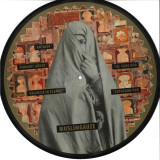
Brilliantly remastered (picture) LP/CD with new stunning artwork!
Lo-Fi India Abuse was recorded in 1998, some tracks are “pure” Muslimgauze and some are re-mixs of tracks from Systemwide’s “Sirius” CD (see also Systemwide meets Muslimgauze “at the City of the Dead” 12″). Nearly all of the tracks have hand percussion in varying tempos and intensities and at least 1/2 make use of electronic noise surges. The sound is very crisp and clean, extremely well produced, recorded and nicely varied throughout the length of the disc. Some track by track comments: “Antalya” is obviously from the same sessions as “Fakir Sind” seeing as it shares the same hand percussion sound, whistles, vocal wailing, cut-ups and delays. “Valencia Flames” sounds like a Systemwide remix. A dub bass line, hi-hat and background vocal of some sort are all obliterated by numerous delays, starts, stops and re-starts with an unpredictable nature in these cut-up tracks. “Al Souk Dub” injects background voices, market sounds and drones into the cut-up mix of slow hand percussion playing. “Catacomb Dub” and the final two tracks make use of twinkling synth waves, presumably a Systemwide sound source. “Dust of Saqqara” has a heavy pulsating electronic sound wave over an old beat box rhythm. “Android Cleaver” is brutal (as is “Nommos’ Afterburn”) hand percussion, jabs of noise and an oft repeated, unintelligible vocal sample. Yes, Lo-Fi India Abuse is yet another great Muslimgauze release, grab it!
All tracks recorded by Muslimgauze 1998
Some tracks are re-mixes from Systemwide’s “Sirius” album
Re-mastered by Višeslav Laboš
Sleeve by Oleg Galay
Originally released in 1999 via BSI Records (BSI 1999-3).
Kristian Matsson has never remained in one place for very long. Having spent much of the last decade touring around the world as The Tallest Man on Earth, Matsson has captivated audiences using, as The New York Times describes, “every inch of his long guitar cord to
roam the stage: darting around, crouching, stretching, hip-twitching, perching briefly and jittering away…Mr. Matsson is a guitar-slinger rooted in folk, and his songs are troubadour ballads at heart.”
Now, Matsson returns as The Tallest Man on Earth with Henry St., his sixth studio album following 2012’s There’s No Leaving Now, full of “vivid imagery, clever turns-of-phrase, and devastating, world-weary observations” (Under The Radar) and 2015’s Dark Bird Is A
Home, his “most personal record… surreal and dreamlike” (Pitchfork). Henry St. notably marks the first time he recorded an album in a band setting. “My entire career I’ve been a DIY person––mostly fueled by the feeling that I didn’t know what I was doing, so I’d just do everything myself.”
But now, longing for the energy that’s only released when creating
together with others, Matsson invited his friends to come and play.
Nick Sanborn (of Sylvan Esso) produced Henry St., which includes contributions from Ryan Gustafson (of The Dead Tongues) on guitar, lap steel and ukulele, TJ Maiani on drums, CJ Camerieri (of Bon Iver) on trumpet and French horn, Phil Cook on piano and organ, Rob
Moose (of Bon Iver, yMusic) on strings and Adam Schatz on saxophone.
Tape
A Wednesday song is a quilt. A short story collection, a half-memory, a patchwork of portraits of the American south, disparate moments that somehow make sense as a whole. Karly Hartzman, the songwriter/ vocalist/guitarist at the helm of the project, is a story collector as much as she is a storyteller: a scholar of people and one-liners. Rat Saw God, the Asheville quintet's new and best record, is ekphrastic but autobiographical and above all, deeply empathetic. Across the album's ten tracks Hartzman, guitarist MJ Lenderman, bassist Margo Shultz, drummer Alan Miller, and lap/pedal steel player Xandy Chelmis build a shrine to minutiae. Half-funny, half-tragic dispatches from North Carolina unfurling somewhere between the wailing skuzz of Nineties shoegaze and classic country twang, that distorted lap steel and Hartzman's voice slicing through the din. Rat Saw God is an album about riding a bike down a suburban stretch in Greensboro while listening to My Bloody Valentine for the first time on an iPod Nano, past a creek that runs through the neighborhood riddled with broken glass bottles and condoms, a front yard filled with broken and rusted car parts, a lonely and dilapidated house reclaimed by kudzu. Four Lokos and rodeo clowns and a kid who burns down a corn field. Roadside monuments, church marquees, poppers and vodka in a plastic water bottle, the shit you get away with at Jewish summer camp, strange sentimental family heirlooms at the thrift stores. The way the South hums alive all night in the summers and into fall, the sound of high school football games, the halo effect from the lights polluting the darkness. It's not really bright enough to see in front of you, but in that stretch of inky void - somehow - you see everything. The songs on Rat Saw God don't recount epics, just the everyday. They're true, they're real life, blurry and chaotic and strange - which is in-line with Hartzman's own ethos: "Everyone's story is worthy," she says, plainly. "Literally every life story is worth writing down, because people are so fascinating." But the thing about Rat Saw God - and about any Wednesday song, really - is you don't necessarily even need all the references to get it, the weirdly specific elation of a song that really hits. Yeah, it's all in the details - how fucked up you got or get, how you break a heart, how you fall in love, how you make yourself and others feel seen - but it's mostly the way those tiny moments add up into a song or album or a person.
On Labyrinth, Heather Woods Broderick serves as our reflective host, subverting expectations of conventional songcraft with impressionistic language and quietly relentless explorations of the human experience that's at once light and dark, more circular and less linear. "Many of us yearn for stillness and peace, as an escape from the movement all around us," she explains when asked about the themes of the album. "Yet movement is perpetual, happening all the time on some level. It's as wild as the wind, yet eternally predictable in its inevitability. It is linear in part, but infinite in its circuitry. Our lives just punctuate it." Broderick began crafting Labyrinth in March 2020, when most forms of move- ment were brought to a screeching halt. The Maine-born, Los Angeles-based songwriter _ who, in addition to her work as a solo musician, built a life playing and touring with acts such as Sharon Van Etten, Beth Orton, Damien Jurado, and Efterklang _ was suddenly forced off the road for the first time in her career. She used this disruption as an opportunity to pare down her creation process and construct the scaffolding for Labyrinth in her apartment. Employing only the most crucial tools at her disposal, Broderick found herself opening different artistic doors as she focused on sharpening her recording skills, capturing the majority of the album on her own before finishing the remainder with co-producer D. James Goodwin. For all of Broderick's sage lyricism and vocal authority, Labyrinth never provides the listener with any easy answers. If the image of the labyrinth represents the enormity of modern life and the difficulty of navigating it, Heather Woods Broder- ick provides a guide to its endless kinetic wonders _ of being present, aware, and connected despite its disconnects. She describes the texture of its walls, its indifferent rhythms, and the inherent poeticism of feeling lost amid the dead-ends and unexpected turns. At this point in our history, perhaps that's all we need to keep moving.
Grey Vinyl
On Labyrinth, Heather Woods Broderick serves as our reflective host, subverting expectations of conventional songcraft with impressionistic language and quietly relentless explorations of the human experience that's at once light and dark, more circular and less linear. "Many of us yearn for stillness and peace, as an escape from the movement all around us," she explains when asked about the themes of the album. "Yet movement is perpetual, happening all the time on some level. It's as wild as the wind, yet eternally predictable in its inevitability. It is linear in part, but infinite in its circuitry. Our lives just punctuate it." Broderick began crafting Labyrinth in March 2020, when most forms of move- ment were brought to a screeching halt. The Maine-born, Los Angeles-based songwriter _ who, in addition to her work as a solo musician, built a life playing and touring with acts such as Sharon Van Etten, Beth Orton, Damien Jurado, and Efterklang _ was suddenly forced off the road for the first time in her career. She used this disruption as an opportunity to pare down her creation process and construct the scaffolding for Labyrinth in her apartment. Employing only the most crucial tools at her disposal, Broderick found herself opening different artistic doors as she focused on sharpening her recording skills, capturing the majority of the album on her own before finishing the remainder with co-producer D. James Goodwin. For all of Broderick's sage lyricism and vocal authority, Labyrinth never provides the listener with any easy answers. If the image of the labyrinth represents the enormity of modern life and the difficulty of navigating it, Heather Woods Broder- ick provides a guide to its endless kinetic wonders _ of being present, aware, and connected despite its disconnects. She describes the texture of its walls, its indifferent rhythms, and the inherent poeticism of feeling lost amid the dead-ends and unexpected turns. At this point in our history, perhaps that's all we need to keep moving.
- Lifeless (Instrumental)
- Without Sin
- Devoured Fears
- Dying Remains
- Useless To Mankind
- Rotting Ways
- Withering Seclusion
- Hatred Creation
- Scarred
- Consuming Existence
- Presumed Dead
Following in the footsteps of "Mind Palace" and "Lost Spirits", respectively issued in 2018 and 2021, Hidden Empire return to Stil vor Talent with their eagerly anticipated third studio full-length, "Momentum". Going the same route that came to define their sound throughout the years, Branko Novakovic and Niklas Schäfers cook a savvy mix of deep electroid flavours and prog techno magnitude which flourishes in the long-playing format. Orbiting the frontier between proper no-nonsense, floor-focussed effectiveness and a trademark exploratory take on electronics, Hidden Empire here delivers one of their most accomplished slices to date, which not only spans the largest span of their many-faceted influences, from tribal anchorage to hypermodern escapology, but breathes a truly epic wind into it.
Draped in luscious, silken envelopes and easternmost ambiences, "Dawn" gets the ball rolling on a mystique-imbued note, halfway meditation-friendly material and square-shouldered club busting wares. Moving into Afro-infused house grounds, "Modesty" finds Branko and Niklas heading for the deeper end of the spectrum, as they pull out a clinically precise blender of rattling percussions, opaque incantations, lush synth swashes and verbed-out machine talk, tailored for nightly boogie rituals in the forest. "Avalanche" opts for a more brooding, deadlier approach. Cutting its path away from prying eyes, this one finds Hidden Empire pulling the stealth weaponry to absolute hypnotic effect - perfect for serious in-between peak time business with its thick, thriller-like tension, mist-shrouded atmosphere and surgical focus. Featuring Felix Raphael on vocals, "Who We Are", is a pop-influenced chugger that perhaps best defines Hidden Empire's ambivalent style, both hi-NRG and innervated with a melancholy that infuses down to the bass and most functional elements. Geared up for big-room traction with its seesawing synths and clinical drumwork, Raphael's moving timbre does more than offer a sensible counterpoint to the track's overall sturdy backbone, it takes it to a whole other dimension completely.
"Repeat The Good" ft. Wolfson balances out a fast-ticking groove with those subtle melodic lines Hidden Empire champion to astounding vibrancy, offering a particularly satisfying glimpse into their vortical imaginarium, whereas "Last Call" has us journeying to straight out Moroder-esque territories, flush with the aptly configured palette of fuzzy space disco bass, fast-paced Italo churn and vocodized talk for good measure. All in breaks and chopped-up euphoria, "Vivid" runs the hoodoo down in muscular fashion and with impressive levels of energy throughout, all set at cranking up the heat one notch further, while "Rebel" provides us with the kind of rough-around-the-edges EBM horsepower and neon-clad synth engineering that'll get the basement in a state of alert. Encompassing all of the pair's idiosyncratic merger of styles - from pop-laced Italo to spaced-out techno wares, through jagged motorik and heavily mecched-out jacking house, "Alright" shows off Hidden Empire's wide arsenal of pyrotechnics under the most compelling of lights. A more openly jagged and quirky weapon that hatches into a full-fledged solar number around the half, "Momentum" roars up the club's highway at full throttle, proving a formidable asset when it comes to plunging dancers into a state of weird, left-of-centre euphoria.
A stroboscopic eclipse is predicted as "Dark Sun" enters the room, deploying its obscure wingspan over the ravers, not quite a bad omen as it lets more light in with every bar, its brittle piano lines and heart-wrenching vocals cutting a path into the crowd's pulsating hearts. Graceful as Hidden Empire's music can be, a moment of utter exhilarating beauty. "Savasana" wraps up the voyage with a pure slab of cyphered 4x4 seduction, as an ASMR-like voice guides us across the soul-questioning haze that blankets our pathway onto a luminous finale. A piece of elusive nature, clearly designed for the club and yet telling a tale of off-piste initiation through twelve fascinating movements, "Momentum" will undoubtedly etch on the listeners' mind as one of the German pair's most strikingly powerful emanations.
Download:
1. Hidden Empire - Dawn Interlude
2. Hidden Empire - Modesty
3. Hidden Empire - Avalanche
4. Hidden Empire & Felix Raphael - Who We Are
5. Hidden Empire & Wolfson - Repeat the Good
6. Hidden Empire - Last Call
7. Hidden Empire - Vivid
8. Hidden Empire - Rebel
9. Hidden Empire - Alright
10. Hidden Empire - Momentum
11. Hidden Empire - Dark Sun
12. Hidden Empire - Savasana
13. Hidden Empire & Felix Raphael - Who We Are (Instrumental)
A Wednesday song is a quilt. A short story collection, a half-memory, a patchwork of portraits of the American south, disparate moments that somehow make sense as a whole. Karly Hartzman, the songwriter/ vocalist/guitarist at the helm of the project, is a story collector as much as she is a storyteller: a scholar of people and one-liners. Rat Saw God, the Asheville quintet's new and best record, is ekphrastic but autobiographical and above all, deeply empathetic. Across the album's ten tracks Hartzman, guitarist MJ Lenderman, bassist Margo Shultz, drummer Alan Miller, and lap/pedal steel player Xandy Chelmis build a shrine to minutiae. Half-funny, half-tragic dispatches from North Carolina unfurling somewhere between the wailing skuzz of Nineties shoegaze and classic country twang, that distorted lap steel and Hartzman's voice slicing through the din. Rat Saw God is an album about riding a bike down a suburban stretch in Greensboro while listening to My Bloody Valentine for the first time on an iPod Nano, past a creek that runs through the neighborhood riddled with broken glass bottles and condoms, a front yard filled with broken and rusted car parts, a lonely and dilapidated house reclaimed by kudzu. Four Lokos and rodeo clowns and a kid who burns down a corn field. Roadside monuments, church marquees, poppers and vodka in a plastic water bottle, the shit you get away with at Jewish summer camp, strange sentimental family heirlooms at the thrift stores. The way the South hums alive all night in the summers and into fall, the sound of high school football games, the halo effect from the lights polluting the darkness. It's not really bright enough to see in front of you, but in that stretch of inky void - somehow - you see everything. The songs on Rat Saw God don't recount epics, just the everyday. They're true, they're real life, blurry and chaotic and strange - which is in-line with Hartzman's own ethos: "Everyone's story is worthy," she says, plainly. "Literally every life story is worth writing down, because people are so fascinating." But the thing about Rat Saw God - and about any Wednesday song, really - is you don't necessarily even need all the references to get it, the weirdly specific elation of a song that really hits. Yeah, it's all in the details - how fucked up you got or get, how you break a heart, how you fall in love, how you make yourself and others feel seen - but it's mostly the way those tiny moments add up into a song or album or a person.