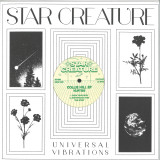
Gregory T.S. Walker’s Minstrels & Minimoogs was self-published by a young, nomadic composer and virtuoso in 1988 to accompany an immersive multimedia performance at the University of Colorado Boulder’s Fiske Planetarium. Created with this outer, and other, world setting in mind, the four tracks find Walker stretching toward an ancient-to-future vision where Egyptian myths and Hieronymus Bosch-ian tableaus are rendered in a screaming three dimensional circuitry of electronic drums, synth guitars, and, of course, Minimoog. Given the musical terrains and outmoded topics traversed, and that this entirely DIY effort was originally released as a micro one-sided 12” edition, Minstrels & Minimoogs is as perplexing and euphoric a document lost-to-time as it is now found.
Born in 1961 into an intensely musical family spanning four generations, Gregory’s mother Helen Walker-Hill was a noted musicologist specializing in the rediscovery and work of historical Black female composers, while his father, George Walker, was the first African American composer to win the Pulitzer Prize for music. Both parents studied with the famed (and famously strict) Nadia Boulanger in Paris in the 1950s, and held to lofty aesthetic standards in their home life. Walker began studying the violin as a child, but when a burgeoning interest in the electric guitar and rock music as a teen manifested, it was largely verboten in the household. The rule was that the music played in the home was to be acoustic and classical. Although the elder Walkers eventually relented and allowed Gregory’s guitar to be plugged in for a brief interval on the weekends, the remaining days he settled for strumming it sans amplification.
Gregory, conditioned and eager for a life in music but looking to get out from under the influence and yoke of his famous composer father, ultimately chose to study computer music at the University of California at San Diego, where he earned a Master of Arts. This was followed by another MA in electronic music composition at that hotbed of West Coast experimental music, Mills College. Intermedia and multimedia in the arts was the rage in the 1980s, and Mills was one of the centers for it; audacious spectacle meeting visionary performance, such as one of the realizations for Anthony Braxton’s music for multiple orchestras a young Gregory performed in with his violin.
After a series of solo synthesizer concerts around California, Gregory followed a girlfriend on a mid-country move to Boulder, Colorado. After picking up yet another composition degree at University of Colorado Boulder, his life as a composer really started, writing a piece for extended technique for guitar, a passacaglia for vocoder and orchestra, as well as Minstrels & Minimoogs.
Envisioned as a multimedia performance such as the kind he’d experienced at Mills (which was all but unknown in Boulder at the time), Gregory roped in a number of college going or aged friends of varying skill levels and musical sympathies to accompany him with distorted sax or oblique spoken interludes. Confronted with a lack of finances, but driven to get his ideas captured in a complete musical package, the album was recorded in his brother’s apartment. If not every player assembled was on Gregory’s virtuosic level, so be it; it was more about capturing the spirit of his intentions and embracing the serendipity of mistakes.
An inspired attempt at world building, Minstrels & Minimoogs draws on the deep well of musical knowledge Gregory gathered from his parents and teachers, but all the while subverting that historical basis by incorporating mutant strains of prog and pop music. The work accumulated is not unlike the playful 1980s work of Gregorio Paniagua, where medieval estampies and rondeaus are wrenched into an anachronistic present where Hildegard Von Bingen and Kate Bush are contemporaries. Ars nova, new art, a 20th century minimalist jester and troubadour.
A one sided LP was the cheapest option Gregory found to have Minstrels & Minimoogs memorialized on vinyl, so somewhere between 50 to 100 copies were pressed. There was no distribution, outside of copies that were handed out to friends or sold at the performances at the planetarium. Gregory T.S. Walker’s cosmic-futuristic forays into oblique pop and baroque subversion could forever reside perfectly in both the domed simulacrum of our universe for which it was composed, in the formats it is being reintoduced now, and our own biblical firmament. For in the words of Gregory, straight from the original liner notes: “God Is A Minimoog”
Gregory T.S. Walker’s Minstrels & Minimoogs arrives again August 23, 2024 on vinyl and digitally as part of uncommon¢ (“uncommon sense”), an open-ended, serialized endeavor from Freedom to Spend that provides new meaning for rarefied recordings from music's outermost fringe.
quête:deep spirit
Following a string of releases on a who’s who of top labels such as Planet Euphorique, Salt Mines, Haws and Craigie Knowes, prog-trance pioneer Lisene drops a full-length LP on his On Rotation imprint. With 8 hyper-detailed tracks ranging from club-focused techno, progressive and electro to slo-mo downtempo, Lisene brings his A-game to an album sure to cement his place as one of the most exciting producers and DJs in the UK’s underground music scene.
Created over several years with a perfectionist’s attention to detail, “Science Friction” flits between moods and sonic environments with ease while retaining the cohesion of Lisene’s inimitable production style. Despite being an album, this is still very much a record for the DJs, featuring heads-down club tracks and bass-heavy electro crafted with precision and a cinematic sense of scale. For the home listeners, expansive slo-mo soundscapes and cerebral synth odysseys float high above the clouds, with widescreen details revealing themselves ever further with each re-play.
“This album has been 15 years in the making and represents a culmination of everything I’ve worked towards in defining my own sound and style without letting myself be pigeonholed. I’m immensely proud of each track - it really reflects where I was at musically while making this, while giving a glimpse into my future sound. This is a record that deserves to be played on the finest sound systems and hi-fis, and I couldn’t be more happy with how it’s turned out. Dive in and enjoy!”
Combining influences from across the spectrum of dance music with a cinematic sense of psychedelia and his own inimitable production skills, “Science Friction” is sure to see a lot of airtime across the festivals, after-parties and living rooms of the world this summer and beyond.
On Rotation is a Leeds based label, event & mix series run by Chris I’Anson, Lisene & Adam Pits. Artwork illustrated and designed by Patch D Keyes.
Dive into the soulful world of Little Beaver with the long-awaited reissue of his 1972 debut album, Joey. Released on Cat Records, this album showcases the unmistakable talent of a musician who not only crafted the unforgettable guitar riff in Betty Wright's "Clean Up Woman" but also delivered the #2 R&B hit "Party Down."
Joey stands out as a masterful blend of Rhythm & Blues, Soul, and a touch of Funk & Blues, enriched by lush orchestrations that elevate each track. The album features the enchanting title track "Joey," which was produced by Betty Wright, "I'm Losin' the Feelin'," later covered by Gwen McRae, and the deeply evocative "Katie Pearl," adding layers of soulful resonance that speak directly to the heart.
Before his solo breakthrough, Little Beaver was a revered figure in the Miami Soul scene, known for his work as a bassist and guitarist since his early teens and as an arranger who brought magic to the music he touched. This release not only showcases his formidable skills as a guitarist but also highlights his deep, intuitive sense of songwriting that draws listeners into the emotional landscapes of his songs.
This reissue isn't just a return to the shelves; it's a celebration of a profound musical legacy that continues to resonate. Whether you're a long-time fan or new to his music, Joey by Little Beaver is an essential addition to your collection, offering a timeless journey through the depths of soul music. Don't miss the chance to experience this seminal album, beautifully remastered to capture the original warmth and spirit of Little Beaver's early work.
Comes with insert and download coupon.
Imagine a Latin remake of Back to the Future. The mad scientist is Arsenio Rodriguez (the godfather of salsa) and the young student who travels through time with him is Eblis Alvarez (Meridian Brothers). This album can only be described as the perfect soundtrack for that movie that never was.
After the massive buzz generated by his first solo album, Mentallogenic, Alex Figueira got back in the studio to work in a more collective fashion this time, carefully assembling the second album of his largest project to date, Conjunto Papa Upa; a team of 6 musicians, spanning 3 generations of some of the best talent in the Latin and avant-garde scenes.
In an era where tropical music is dominated by purely electronic and rhythmically uniform sounds, the ten songs encompassed in “Fruta Madura” (“Ripe Fruit”) wander through the most diverse tempos, rhythms, and motifs effortlessly. A real breath of fresh air that gracefully incorporates soul, funk, jazz, psychedelia, and electronics into a solid tropical, irresistibly polyrhythmic foundation, without ever succumbing to the many genre clichés.
The distinctive production and catchy songwriting of Figueira shine in a very distinctive light on this second full-length. Living up to his reputation (Miles Cleret, founder of Soundway Records, called him “one of the scene's truly authentic and eccentric producers”), he takes the opportunity to show he’s not afraid to keep walking his own path.
Taking the band for a wild ride through the traditions of Africa, America, and the Caribbean; contrasting them with a ridiculously wide plethora of vintage, contemporary, and futuristic sounds, and pivoting on the exuberant musicality displayed by his musicians; the result leaves no doubt: this album is destined to be considered a future classic of the exciting tropical psychedelic music of the 21st century.
Addressing the most diverse themes in this new collection of songs, things take on a much more mature tone, as the title clearly suggests.
The opening track “El segundo es más sabroso” (“The second one is tastier”) sets the tone in the most assertive way imaginable, with the band boldly declaring, through multiple metaphorical references (laid upon a crazy mix of Dominican merengue, Detroit techno, classic and free jazz, dub, and electro), that the bar will be set higher with this second album.
The remaining compositions touch upon the most diverse subjects, with a fair dose of humor, sarcasm, and postmodern “magic realism”. “El Algoritmo” (The Algorithm) is a parranda-cumbia hybrid (for lack of a specific term) about the omnipresence of technology in our lives. The sophisticated Latin soul of the titling track “Fruta Madura” makes a case for the beauty of the maturity process. Some key philosophical teachings of Marcus Aurelius (the role of causality, the impositions of “the logos” and the importance of self-control) get a twisted cumbia treatment on “Reos del Deseo” (Prisoners of Desire). “No le pongas Coca-Cola” (“Don’t put Coca Cola in it”) shows us the most satirical side of the band, accusing those who mix Coca Cola with Rum of committing "sacrilege", on a powerful base of Dem Bow (the grandfather of Reggaeton), intertwined with touches of soul, salsa, and Cuban comparsa.
"Háblame Claro" (“Talk to me clearly”) is a story of heartbreak that evokes in its first part the spirit of the erotic salsa of the 80s (a subgenre deeply despised by purists), and after an unexpected samba interlude, leads to the hardest salsa of the 70s (a subgenre adored by purists), to end up in the surprising form of pure Afro-Cuban ceremonial music.
“Tu mamá tenía razón” ("Your Mom Was Right") is an attempt to exalt the spirit of the Latin American soap opera in the key of “acid bachata”, to recount a real-life case, witnessed by the band on countless occasions: the partying woman who arrives at the show accompanied by her bitter husband, who obviously does not like to dance. A very cheeky song to talk about the very serious and pertinent topic of female empowerment.
“La misma vaina” (“The same thing”) with its indescribable blend of bantú, candomblé, and Mozambique rhythms with abstract synthesizers, is an ode to adventure in favor of the aversion to taking risks and seeking predictability.
“Amigas picadas” (“Salty friends”) is another humorous song recounting another real-life case witnessed by the band on countless occasions: a love encounter sabotaged by the girlfriend's friends, who all happen to fancy the same guy. A jazzy take on the ancient Dominican rhythm of pambiche (grandfather of merengue), with generous psychedelic touches, resembling the classy late 60s releases of Guadeloupe's legendary producer / label owner Henri Debs.
“Vinimos a hablar” (“We came to talk”) takes sarcasm to the highest level, to ridicule the absurdity (also experienced by the band firsthand) seen in live music venues where people pay a ticket to go and have conversations that could be carried out much better on any bar, where no band is playing. The music alternates between a delicate melody with loose, sparse percussion and a full-on, pumping Angolan semba, with a techno kick drum included; bringing things to an apotheotic grooving finale, where the peculiar swing of Venezuelan calypso from the Callao region is thrown on top of all the precedent elements; closing the album in the most uplifting, “end of the carnival parade” feel.
The artwork is a delicate and impactful oil painting by Colombian artist Kevin Simón Mancera, who has collaborated many times with the label before (“Maracas, tambourines and other hellish things” tape and the Lola’s Dice LP).
What the experts are saying:
“Alex (Figueira) dove into this work with a brutal cohesion between lyrics and synths. Timbre poetry, sound poetry (you name it). And that, superimposed on his always impeccable percussive base, confirms the title of “avant-garde visionary of our beautiful Latin music”".
EBLIS ALVAREZ (MERIDIAN BROTHERS)
“Papa Upa's infectious quirkiness is a balm against boredom. A mature album, but without an expiration date”.
GLADYS PALMERA
“Here there is a lot of strength, drum, cadence and psychedelia, lost dance rhythms, united in an intercontinental Latin/African/and Caribbean journey, a unique winning combination that we could consider the new “Ritmo Figueira”.
DISCODELIC
Conjunto Papa Upa are:
Alex Figueira - Timbales, percussion, vocals.
Gerardo Rosales - Congas, percussion, vocals.
Ramón Mendeville - Bongos, percussion, vocals.
Randy Winterdal - Bass.
Andrew Moreno - Guitar.
Nico Chientarolli - Organ, piano, synths.
All songs written by Alex Figueira.
Arranged and performed by Conjunto Papa Upa.
Recorded, produced, mixed and mastered by Alex Figueira at Heat Too Hot, Amsterdam.
Asmaa Hamzaoui stands out as a pioneering female figure in the traditionally male-dominated realm of Gnawa music. With her group, Bnat Timbouktou, she brings a dynamic and spiritual dimension to the genre, infusing it with the vibrant energy of desert blues. Despite the essential role women have played in Gnawa rituals, female musicians have historically been underrepresented. Hamzaoui, however, is at the forefront of changing this trend. Born into a family deeply entrenched in Gnawa traditions in Casablanca, Hamzaoui was immersed in this musical heritage from a young age. Her father, a master musician, and her mother, a dancer, provided a rich environment for her early education in music. She learned to play the guembri, a three-stringed lute central to Gnawa music, and began performing with her father's band on the qraqeb, metal castanets used in Gnawa music, and in the choir. Encouraged by her father, she eventually formed her own group, Bnat Timbouktou. The group's debut album, "Oulad Lghaba," recorded in collaboration with the Swedish label ajabu! Records, was critically acclaimed and nominated for a Songlines Music Award. This album, along with their upcoming release "L'bnat," showcases Hamzaoui's commitment to preserving and revitalizing Gnawa music. "L'bnat," will emphasize the female traditions and spiritual aspects of Gnawa culture. Hamzaoui's performances are characterized by her powerful voice and the rhythmic, percussive playing of the guembri. Her music not only pays homage to the spiritual and healing qualities of Gnawa but also aims to keep the tradition alive by introducing it to new audiences worldwide.
- A1: Meat Loaf - I'll Do Anything For Love (But I Won't Do That) (But I Won't Do That)
- A2: D Ream - Things Can Only Get Better
- A3: Wet Wet Wet - Love Is All Around (From "Four Weddings & A Funeral" Soundtrack)
- A4: All-4-One - I Swear
- A5: The Pretenders - I'll Stand By You
- A6: Youssou N'dour - 7 Seconds (Feat Neneh Cherry)
- A7: East 17 - Stay Another Day
- B1: Livin' Joy - Dreamer
- B2: Coolio/L.v. - Gangsta's Paradise
- B3: Radiohead - Street Spirit (Fade Out) (Fade Out)
- B4: Oasis - Don't Look Back In Anger
- B5: Saint Etienne - He's On The Phone
- B6: Mark Morrison - Return Of The Mack
- B7: Spice Girls - Wannabe
- C1: George Michael - Fastlove
- C2: Deep Blue Something - Breakfast At Tiffany's
- C3: The Prodigy - Breathe
- C4: Eternal - I Wanna Be The Only One (Feat Bebe Winans)
- C5: Hanson - Mmmbop
- C6: Chumbawamba - Tubthumping
- C7: All Saints - Never Ever
- D1: Robbie Williams - Angels
- D2: Natalie Imbruglia - Torn
- D3: Aqua - Barbie Girl
- E1: Britney Spears - Baby One More Time
- E2: Steps - Tragedy
- E3: Gabrielle - Rise
- E4: Sonique - It Feels So Good
- E5: Craig David - 7 Days
- E6: Atomic Kitten - Whole Again
- E7: S Club - Don't Stop Movin
- F1: Kylie Minogue - Can't Get You Out Of My Head
- F2: Mary J Blige - Family Affair
- F3: Sophie Ellis-Bextor - Murder On The Dancefloor
- F4: Liberty X - Just A Little
- F5: Las Ketchup - The Ketchup Song (Asereje) (Asereje)
- F6: Girls Aloud - Sound Of The Underground
- F7: Nelly/Kelly Rowland - Dilemna
- D4: The Tamperer - Feel It (Feat Maya)
- D5: Boyzone - No Matter What
- D6: Cher - Believe
- D7: Atb - 9Pm (Till I Come) (Till I Come)
In November 2023 we celebrated NOW’s 40th anniversary with a collection of massive Pop hits – but with 40 years of hits to choose from we had to leave out so many fantastic tracks – so it’s time to continue that celebration with NOW That’s What I Call 40 Years - Part 2 – again honouring the legacy with a stellar selection from the past four decades of NOW. Embark on a musical journey from 1983 right up to the present day. Released on a triple vinyl set pressed on Green, Clear Transparent, and Pink LPs with 43 essential hit tracks. and 100 essential hit tracks across the 5 CD set
forgive too slow, Avant Garde artist julia-sophie’s deeply personal debut album is testament to her ability to transform adversity into raw beauty, combining her traditional songwriting roots with her own take on experimental electronica. It features her intimate voice backed by warm and precise electronic sounds whose free spirited explorations give body to the carefully written personal songs julia-sophie comes off the drama of her 2010s rock band, Little Fish, which was signed to a major label. The surreal experiences (like being flown to Las Vegas in helicopters with a bag of slot machine money or given limousines for the day to go shopping), along with having to work in environments where she felt unsafe, drove her decision to leave the fame game. She turned down the offer to emigrate to America and engage with the machinations of the system as it did not feel “true or congruent with who I was”. Instead, she focused her attention on her hometown (Oxford, UK). She started recording lo-fi pop in her garage, using an old laptop, wonky microphones and hitting whatever was around for beats. Candy Says grew to be more of a collective than a band, and eventually co-wrote a film score for indie film Burn Burn Burn and recorded a cover of Running Up That Hill for the Netflix film Close (starring Noomi Rapace). Julia-Sophie soon started recording songs with her friend B, who had a studio stacked from wall-to-wall with analogue recording gear, vintage synths and drum machines. She decided to self-release and the music reached audiences beyond her expectations, including support from BBC Radio 6 and a feature in The Quietus. forgive too slow is Julia-Sophie’s debut solo album, and concerns relationships and the struggles we go through when we “forgive too slow” and can’t break out of patterns from the past. The songs narrate her story of self-destruction (“numb”), love (“falling”), and loss (“telephone”). By the end, embers are still burning and there is no telling if Julia-Sophie has found peace, but we do get a sense that she has gotten closer to the core of her being and is finally living authentically.
Air is the central element in Antonina Nowacka's third solo album Sylphine Soporifera. The title names an imaginary species and the land they inhabit, inspired by the unreal desert landscape of Paracas and the undulating tree-less hills of the Outer Hebrides, and comes from the writings of Rudolf Steiner, who describes creatures called Sylphs as the spirits of the air, and the Latin word sopor which means deep sleep.
As with all her releases, Nowacka's other-worldly vocals coming as if from beyond the veil, at once haunting, alien and utterly entrancing. "The voice is the most beautiful and resonating instrument,” she says. “When I sing I feel I create a field in between myself and the air in front of me," she explains. "It is not just that I'm singing – something in the space in front of me is happening, and I merge with this sphere.”
She conjures and is inspired by open environments and infinite landscapes: places full of light and air, manifested here in the sound of ocarinas from Budrio in Italy, whistles from Mexico, simple bamboo flutes from Nepal, alongside tremulous zithers, synthetic Hawaiian sounds from a vintage organ and the uncanny wind instrument presets from a 90s synth.
Nowacka’s first album was informed by vocal sketches made in caves in Indonesia, later recorded at a fortress in Poland; she studied Hindustani music in India with vocalist Shashwati Mandal, fell in love with early Cumbia in Mexico and Peru, and has more recently found inspiration in the landscapes of Italy. Hers is a new New Age soundworld that finds its origins everywhere and nowhere. Sylphine Soporifera gathers these sounds, visions and experiences into an album permeated with a sense of hope and fulfilment, that feels like sitting in an enlivening white beam of afternoon sunlight, as dustmotes swirl in the stillness.
This is the memorable debut album by Wendell Harrison, the founder of TRIBE, under his solo name, and is also known as the first version of "Message From The Tribe", which was released the previous year as the iconic masterpiece "TRIBE". The first version of "Message From The Tribe" (a.k.a. "Cliff Jacket"), which was released the previous year, is an updated version of the A-side that Wendell Harrison steered! The opening "Mary Had An Abortion" (M1) and "Consciousness" (M5), which quickly builds tension with its poetry reading and freaky sound that conveys a strong message in a deep voice, and the ferocious "Soulful Soul" by a young Wendell Harrison. The soulful "Vol II Angry Young Man Part I - Part II" (M3-4) is overwhelmed by the blows of the young Wendell Harrison, "Rebirth" (M6) is shaken by the heart-string-tugging horns against a tranquil soundscape, and "Mellow & Spiritual" (M7) is a mellow and spiritual masterpiece. Where Am I" (M2), a mellow and spiritual song loved by many DJs and diggers! All tracks have been newly mastered and reissued in the original 1st pressing jacket with full-size printed visuals!
Released in July 1963, "Impressions" is a compilation of recordings from various sessions between 1961 and 1963 of John Coltrane. The album showcases the range of Coltrane's musical interests, from modal jazz and hard bop to ballads, reflecting his evolving style during the early 1960s and received positive reviews for its adventurous spirit and technical brilliance. Critics and fans alike praise the album for capturing a pivotal moment in Coltrane's career as he moved towards more experimental and spiritual jazz. The early 1960s were a period of significant evolution for Coltrane. Having recently left Miles Davis's sextet, Coltrane was delving deeper into modal jazz, a style that focuses on scales (or modes) rather than traditional chord progressions. This period saw Coltrane pushing the boundaries of jazz with extended solos, complex improvisations, and a deeper spiritual search, which would later culminate in his iconic album "A Love Supreme."
Following a few recent wax droppings on MUTUAL INTENTIONS & DEEP FRIED MUSIC, KURTISS comes correct with a solid 6 tracker dj fusion bordering between disco edits, club tools & anthemic full-on originals. Part Detroit, Part Chicago with a touch of Squelchy Boogie Synths & Gospel vocals.
At the latest with the release of the albums "Zauberberg" and "Königsforst", in the mid-1990s, one associates GAS, Wolfgang Voigt's very own artistic cross-linking of the spirit of Romanticism and the forest as an artistic fantasy projection surface, with intoxicatingly blurred boundaries of post-ambient infatuation and the impenetrable thicket of abstract atonality. The distant, iconic straight bass drum marching through highly condensed, abstract sounds taken from classical music by the sampler or modulated accordingly, and the enraptured gaze through pop art glasses into the hypnotic thicket of an imaginary forest, manifested over the years this unique connection of audio and visual, which to understand fully, then as now, would be neither possible nor desirable.
Quite the opposite. The album GAS - DER LANGE MARSCH once again invites us to follow the deep sounding bass drum, to give in to its irresistible pull into a psychedelic world of 1000 promises. In the process, the journey leads us past stations of memories sounding from afar, from "Zauberberg" to "Königsforst" and "Pop", from "Oktember" to "Narkopop" and "Rausch", back and forth, now and forever.
Way. Destination. Loop. - Forest loop.
No beginning. No end.
Spätestens mit der Veröffentlichung der Alben „Zauberberg“ und „Königsforst“, Mitte der 1990er Jahre verbindet man mit GAS, Wolfgang Voigts ganz eigene künstlerische Vernetzung mit dem Geist der Romantik und dem Wald als künstlerische Fantasie-Projektionsfläche, rauschhaft verschwimmender Grenzen von post-ambienter Betörung und dem undurchdringlichen Dickicht abstrakter Atonalität. Die entfernt, durch stark verdichtete, abstrakte, der Klassik durch den Sampler entnommene oder entsprechend modulierte Klänge marschierende, ikonische gerade Bassdrum, der entrückte Blick durch die Pop-Art Brille hinein in das hypnotische Dickicht eines imaginären Waldes, manifestierten über die Jahre diese einzigartige Verbindung von Audio und Visuellem, die ganz verstehen zu können, damals wie heute, weder möglich noch wünschenswert wäre.
Ganz im Gegenteil. Das Album GAS - DER LANGE MARSCH lädt uns einmal mehr ein, der tief tönenden Bassdrum zu folgen, ihrem unwiderstehlichen Sog hinein in eine psychedelische Welt der 1000 Verheißungen nachzugeben. Dabei führt die Reise vorbei an aus der Ferne klingende Stationen der Erinnerungen von “Zauberberg” bis “Königsforst” und “Pop”, von “Oktember” bis “Narkopop” und “Rausch”, vor und zurück, in alle Ewigkeit.
Weg. Ziel. Loop. - Waldloop.
Kein Anfang. Kein Ende.
Unknown spiritual jazz gem recorded in Argentina in the 80s, under the influence of Pharoah Sanders, Don Cherry, Archie Shepp_, and originally released on Litto Nebbia's label Melopea. Already supported by Gilles Peterson on his radio show, this mind-blowing album combines ethno-free jazz passages and deep progressive compositions led by saxophonist Marcelo Peralta resulting a very impressive ode to the legacy of Coltrane. First time reissue. Includes extensive notes and many previously unpublished photos. 180g vinyl. DESCRIPTION Unknown spiritual jazz gem recorded in Argentina in the late 80s, under the influence of Pharoah Sanders, Don Cherry, Archie Shepp_, and originally released on Litto Nebbia's label Melopea. This is the first and only album ever released by this band, Grupo de Improvisación Tercer Mundo (Third World Improvisation Group), formed by a quartet of young musicians based in Buenos Aires accompanied by drummer Norberto Minchillo (López Fürst, Fernando Gelbard, Jorge Navarro_) and Litto Nebbia himself during the recording sessions. They would also organize weekly jam sessions in public spaces in Buenos Aires, getting visual artists, poets and even passersby involved in these communal actions that aimed to promote self-expression in an environment of total freedom. After the gigs they'd gather again for intense listening sessions of deep jazz for hours_ Already supported by Gilles Peterson on his radio show, this mind-blowing album combines ethno-free jazz passages and deep progressive compositions led by saxophonist Marcelo Peralta resulting a very impressive ode to the legacy of Coltrane and a very accomplished work of jazz improvisation. 'Almas Liberadas' and 'Un Hilo de Luz' sound as a clear tribute to Pharoah Sanders, as the subtitle of the latter openly states. First time reissue. Includes extensive notes and many previously unpublished photos.
Habibi Funk is thrilled to share a second collection of deep grooves and unreleased songs from Algeria's Ahmed Malek, often compared to Italian heavyweight Ennio Morricone. Malek’s music effortlessly switches between thematic jazz, funk, reggae and Algerian folk – creating indelible soundscapes that intersect the musical innovations made in African jazz by Mulatu Astatke, Bembeya Jazz National along with some of Europe’s finest experimental composers like Piero Piccioni and Janko Nilovic. “Musique Originale de Films, Volume Deux” is out June 28th, 2024 via Habibi Funk.
Whenever an interview asks about a “memorable moment” in Habibi Funk label history, one we always reference is how we got in touch Ahmed Malek’s (22K Spotify Followers, 285K Spotify Monthly Listeners) music and subsequently his family. It all started with us coming across Ahmed Malek’s music on YouTube in 2012. We were mesmerized by how effortlessly the music would switch between jazz, funk and Algerian folk while counterweighting it with an undertone of melancholia. Musical perception is different for every person, but there is a chance that his music will touch you in one way or another. At the time, we had just started the Habibi Funk label and we felt Ahmed’s music might be a good fit for the sound we were trying to highlight. Fast forward three years: we had become captivated with the idea of reissuing some of Ahmed Malek’s music. We knew some people had tried to locate his family but, but with no success. In the end it was an incredible amount of luck that made it possible for you to read these words and listen to Ahmed’s music. We were on a DJ gig in Beirut playing old Arabic records and we mentioned our passion for Ahmed Malek’s music to a friend. She said she knew one person in Algier, and as much as it would be a shot in the dark, she could ask her if she had an idea of how to find Malek’s family. Two weeks went by before we heard back, and what we got was incredibly good news - her Algerian friend was the neighbor of Ahmed Malek’s daughter! We’re not spiritual people, but it felt like the universe wanted to see the release happen. We started to speak with Henya, Ahmed Malek’s daughter and she was more than happy with our idea. She assured us that her father would have loved the plan as well. She provided us with tons of awesome material, from great photos, to unseen video footage and unreleased tracks. Eventually we visited Henya in Algeria and we licensed some of her father’s music, first for one (Habibi 003), then for another (Habibi 005), then we eventually organized an exhibition in June/July 2019 – Planète Malek – Une Rétrospective – at the Musée Public National D’Art Moderne & Contemporain in Algiers, focusing on Ahmed Malek’s artistic life. We also produced a small movie about him that our friend Paloma Colombe shot and directed. “Musique Originale de Films, Volume Deux” is a deep collection of unreleased songs and stemmed grooves from the Algerian master, from jazz, funk, psych to reggae rhythms and Latin flavors, all under the sonic umbrella of “Planète Malek;” and to quote the maestro, “I didn’t choose music, music chose me.” Lead single is the subtlety funky “Thème Rythme Léger,” out May 3rd along with LP Pre-Order (coincided with Bandcamp Friday for a larger impact) a delicate sonic dance between flute, piano and Spanish guitar with a Bossainfluenced groove. The steady, swingin’ drum groove is cloudlike - definitely toe-tapping friendly so just grab a partner to feel the Rhythme Léger. Second single out May 17th is the reggae-infused “L’Empire Des Rêves” – a sultry sax melody weaves through a prismatic rocksteady thematic groove. 3rd and final single “Thème Djalti feat. Aïda Guéchoud” – is a true Western-inspired ode to his Italian counterpart Ennio Morricone. “Thème Djalti” features the haunting vocals of Aïda Guéchoud, and combines elements of baroque and Bossa-jazz in a timelessly thematic way that seems grandiose yet remains uniquely personal to your ears. Swelling strings, trumpet, fem vox, flute, and plucked guitar expertly arranged, feels like you’re riding a horse into the sunset. Focus track “La La La” is fiery afro-arab-funk of the highest order! Put on your dancing shoes as Ahmed cuts the rug and gets us grooving along. Sonically the cut sounds like if Ahmed ran into The JB’s and Fela Kuti at a Cymande concert. Driving guitar and organ solos vie over pulsating bass riffs and afro-funk drumming that’ll have you out on the dance floor in no time. As always, both vinyl and CD come with an extensive booklet featuring background and interviews with Ahmed compiled through found newspaper clippings and newsreels, also including unseen photos, scans and more. “Ahmed Malek: Musique Originale de Films, Volume Deux” will be out everywhere June 28th.
Having been ‘discovered’ working in Liverpool’s Probe
Records during the punk rock explosion of the late 1970s,
Pete Burns found himself fronting his own band,
Nightmares In Wax who mutated into the more familiar
Dead Or Alive, eventually bringing Pete into the UK pop
mainstream, and a star was born.
Bringing together two-self-released 1982 singles and a collection
of early versions of Hi-NRG tracks which would eventually find
their way onto the band’s debut album, ‘Let Them Drag My Soul
Away’ showcases the blossoming of one of the 80s pop scene’s
most colourful characters. Unapologetic, unfiltered, loud and
proud – Pete Burns singularly brought a punk rock mindset to the
pop paradigm, providing a much needed antidote to the sexless
Thatcherite stars beginning to dominate the UK pop charts
during the middle of the decade – this collection of recordings
captures something of that spirit and the energy of the driving
force behind it.
Pressed on deep red vinyl and housed in a cover photograph by
Dead Or Alive’s then manager Francesco Mellina, ‘Let Them
Drag My Soul Away’ presents a last glimpse at a pre-stardom
Pete, and a long overdue back story accompaniment for fans and
collectors alike.
These days it seems as if at every turn, week in week out, the Reggae fraternity grieves the loss of another journey man singer, unassuming session musician or foundational sound man.
The power of remembrance, of tribute, of deeply honouring the historical legacy of so many singers & players has been, from its very inception, central to the mission of Ital Counselor Records. The arrival of IC008 carries forth this tradition in the form of an epic tribute to two of our most cherished influences who have recently passed on – The ever-spirited drummer Angus “Drummie Zeb” Gaye of Aswad fame and the indomitable UK sound man, the Mighty Zulu Warrior Jah Shaka.
This release brings together some of the usual Ital Counselor collaborators Chris Lane (AKA the Dub Organiser, Fashion Records), Soothsayer Horns, Inyaki BDF, along with new IC collaborator Gil Cang (Riz Records, Tuff Scout Records).
Collectively known as the IC All Stars, their mission was to rebuild a mythic dubplate made legendary by Shaka in the early 1980s. Known on the scene as Rasta Serenade, this horns driven instrumental dubplate was a never released version of Aswad’s vocal cut “Just a Little Herb” only ever played on Shaka’s sound.
To achieve maximum effect, the Dub Organiser dug back into the Fashion records vaults to unearth an unused loop of ‘Drummie’ marching out a militant beat. Inyaki BDF was recruited to lay down the bassline. Soothsayers horns hit harder still. Chris and Gil put the final guitar, keys, and mix touches to make this 4-cut maxi 12” a sound system killer; a set of big people dubs for the young and old. Meditative and marching; Weighted and spritely IC008 must mash up sound system dance north, south, east and west. Take a listen and you will hear.
Drummie Zeb of the Tribe of Zebulon.
Jah Shaka of the Tribe of Simeon.
This is a tribute. This is a remembrance.
This is also a pushing forward of a tradition
In a new Direction
A movement Forward
Ital Counselor Style.
"Fear Life For A Lifetime’ is the eagerly anticipated debut album from Stone that demands attention. The songs unfold as a coming-of-age narrative, delving into the turbulent experiences of young adulthood. Produced by Rich Costey the album explores the alternative genre spectrum, blending post-punk fervour, indie anthems & hip-hop influence with a sharp edge. The album tackles a range of topics love, ambition, self-doubt, confidence, or a sense of belonging, this album resonates deeply, offering a sense of community embodying the spirit of Liverpool at its core.
The album features x 11 tracks, including the single ‘My Thoughts Go’."
Fellwarden was a concept forged by The Watcher (Fen, De Arma) back in 2014 to give voice to an epic, exultant form of black metal that nonetheless carries with it echoes of deep lamentation and remembrance. The Watcher’s goal was simple – to tell tales of sacrifice, of long-forgotten heroism and the rearing timelessness of the storm-forged landscape against a backdrop of windswept extreme metal. Fellwarden’s sound is steeped passionate vocals, subtle waves of keyboards, acoustic guitars, booming choirs and powerful riffs, underpinned by a cavernous percussive battery courtesy of Havenless (also of Fen).
After two years of careful crafting, the debut album of Fellwarden ‘Oathbearer’ is now ready to be proudly unleashed by Eisenwald – six stirring hymns of strident ambience and powerfully emotive songwriting. A heavily layered, textured release, ‘Oathbearer’ at once convokes the essence of contemporary acts such as Drudkh and Negura Bunget whilst simultaneously channelling the spirit of the old masters – Summoning, Bathory, Abigor, (early) Emperor and (early) Ulver.
Canada's famously vibrant funk scene has given rise to many gems over the years and now one of them is getting a reissue on P-Vine complete with an obi-strip. The Sidewinders' much-coveted album, Flatfoot Hustlin' is a real gem that emanates the spirit of deep-rooted funk. Famously it was recorded in the same studio as Professor Lett and Study's Love Serenade which further details about it have long been unknown and mysterious. That has only added to its allure and appeal amongst the rare groove community but of course, the music itself is the real draw. Featured tracks like 'I Like To Dance' and 'Flat Foot Hustli'' cannot fail to ignite dancefloors, while 'Time For Loving' is a more smooth groove and 'Gift to the Sun' gets nice and heavy making this an essential cop for funk aficionados.