A simple idea in an over complicated moment. Strip away aesthetics and be artist centric, sharing and explore collisions, sounds and genres. Step out of comfort zones to release a series of EPs of broad, challenging and deep music.
Starting with The Proposal by A Strange Wedding, this Lyon based producer from the Worst label, builds on their "modern style" slow trance to create a label anthem, a template. Stretched Arp, hypnotic bass and searing melody, underpinned by ocean wide kick. Merci for the perfect beginning.
Datasal are next, as this Gothenburg's trio's debut arrives. Acoustics (Miyazawa flute / Fender bass) and electronics (Roland RS-09 / Korg Mono) collide; prog rock meets post punk meets dance; outside organised compositions to improvise to the beat.
Side two leads back to the origin. 84PC, the dormant Tel Aviv collective that developed out of the city's Michatronix Crew (featuring Katzele, Naduve, Asaf and Yovav), return with a previously unreleased remix from Khidja. Their "Welcome To The Pleasuredome" moment is peak time perfection.
To close Barcelona's Iro Aka arrive with another debut. Having dispatched edits on Hard Fist and 44,100Hz Social Club, their bubbling 303 is a tender dreamtime finale that points ahead.
Cerca:deep zone
- 1: Scroll
- 2: Montana (Main Theme)
- 3: Noise Destroys Something
- 4: Wonderful
- 5: Pesticides
- 6: Revenge
- 7: Comtech
- 8: Greyhound
- 9: Second Test
- 10: Desecration
- 11: Tell Me Your Heart
- 12: Dark Materials
- 13: Becky's Theme
- 14: Blue Tunnel
- 15: Manifesto
- 16: Ranger Gary
- 17: At Peace - Freedom Club
- 18: Prophecy
- 19: Skidders
- 20: Montana (Reprise)
Ted K. Kaczynski is notorious for both tragically murdering three people (and wounding an additional 23) via bombs sent in the mail and for his numerous writings on the evils of technology he composed during his primitive residency in the woods of Montana. Film director Tony Stone's choice to have the renowned electronic artist Blanck Mass score the film is somewhat ironic and creates an obvious tension perfect for the controversial and complex subject matter. 2020 saw the first Blanck Mass movie score, for the soundtrack to Nick Rowland's acclaimed cinematic debut Calm with Horses. This expansion into new areas of melodic composition and textural exploration won Blanck Mass many new fans, with the BBC's acknowledged number one film buff Mark Kermode proclaiming the work the soundtrack of the year. In 2021, Blanck Mass won the prestigious Ivor Novello Award for Best Original Film Score and has firmly established himself at the forefront of the latest wave of experimental soundscape wizards. Recording during lockdown at his studio in Edinburgh, Scotland, Blanck Mass's Ben Power was in the perfect setting for a musical piece intended to capture the isolation central to Kaczynski's story. Power was also working with a director in a time zone 10 hours behind and thus many sessions required working in the middle of the night, which added a fitting intensity to the composition process. He said of the project "I wanted it to feel like an `epic'" and drew on the legends Sergio Leone and Ennio Morricone for inspiration in encapsulating the energy of the perceived good vs. evil. The gentle madness of sound achieved is exquisite and slowly builds in intensity and desperation as the score moves along. Power is able to perfectly capture the complexity, the terror and the deep emotionality of the film while presenting an often breathtakingly beautiful and always masterful album that stands on its own as a work of art. For Fans of Tim Hecker, Oneohtrix Point Never, DJ Shadow, Coil, Arca, Andy Stott, Fuck Buttons.
- A1: Scroll
- A2: Montana (Main Theme)
- A3: Noise Destroys Something
- A4: Wonderful
- A5: Pesticides
- A6: Revenge
- A7: Comtech
- A8: Greyhound
- A9: Second Test
- A10: Desecration
- B1: Tell Me Your Heart
- B2: Dark Materials
- B3: Becky's Theme
- B4: Blue Tunnel
- B5: Manifesto
- B6: Ranger Gary
- B7: At Peace - Freedom Club
- B8: Prophecy
- B9: Skidders
- B10: Montana (Reprise)
Ted K. Kaczynski is notorious for both tragically murdering three people (and wounding an additional 23) via bombs sent in the mail and for his numerous writings on the evils of technology he composed during his primitive residency in the woods of Montana. Film director Tony Stone's choice to have the renowned electronic artist Blanck Mass score the film is somewhat ironic and creates an obvious tension perfect for the controversial and complex subject matter. 2020 saw the first Blanck Mass movie score, for the soundtrack to Nick Rowland's acclaimed cinematic debut Calm with Horses. This expansion into new areas of melodic composition and textural exploration won Blanck Mass many new fans, with the BBC's acknowledged number one film buff Mark Kermode proclaiming the work the soundtrack of the year. In 2021, Blanck Mass won the prestigious Ivor Novello Award for Best Original Film Score and has firmly established himself at the forefront of the latest wave of experimental soundscape wizards. Recording during lockdown at his studio in Edinburgh, Scotland, Blanck Mass's Ben Power was in the perfect setting for a musical piece intended to capture the isolation central to Kaczynski's story. Power was also working with a director in a time zone 10 hours behind and thus many sessions required working in the middle of the night, which added a fitting intensity to the composition process. He said of the project "I wanted it to feel like an `epic'" and drew on the legends Sergio Leone and Ennio Morricone for inspiration in encapsulating the energy of the perceived good vs. evil. The gentle madness of sound achieved is exquisite and slowly builds in intensity and desperation as the score moves along. Power is able to perfectly capture the complexity, the terror and the deep emotionality of the film while presenting an often breathtakingly beautiful and always masterful album that stands on its own as a work of art. For Fans of Tim Hecker, Oneohtrix Point Never, DJ Shadow, Coil, Arca, Andy Stott, Fuck Buttons.
180g vinyl pressing.
During the late 2010s, music lovers around the world began obsessively listening to increasingly esoteric albums on Youtube. More often than not, they’d leave the browser on autoplay. This was how Facundo Arena, the composer and producer behind The Kyoto Connection, discovered the technonaturalistic pleasures of Kankyō Ongaku (environmental music), a distinctly Japanese interpretation of European, British and American minimalist composition and ambient music. “It was a kind of algorithmic magic,” he says.
Upload by upload, the utopian music of Hiroshi Yoshimura and his 80s Japanese contemporaries transported Facundo back to his childhood. When he was five, his father placed him in karate lessons and began watching martial arts movies with him. From those early experiences, Facundo became fascinated Japanese history, tradition, and culture, particularly that of Kyoto - the cultural capital of Japan. Kankyō Ongaku reminded him of hearing the sounds of Japanese folkloric instruments as a young boy, and suddenly, the way the influence of Japan had manifested in his music made sense. “I had the sensation that for many years, I’d been doing something similar to the style,” he explains.
Inspired, Facundo used an iPad and an old Akai cassette deck to record Postcards, his homage to Japanese minimalism and Kankyō Ongaku. By this stage, he was twelve years deep with The Kyoto Connection, the musical project he launched in 2005 in his hometown of Buenos Aires, Argentina. Over that late 2000s and 2010s, Facundo, later on joined by collaborators Rodrigo Trado (drums), Jesica Rubino (violin) and Marian Benitez (vocals, now his wife), released numerous D.I.Y albums. Project by project, they followed the threads between 80s synth-pop, ambient, new age, house, techno and acoustic composition.
Postcards introduced The Kyoto Connection to listeners around the world and brought Facundo into our orbit. During Argentina’s covid lockdown, Facundo received a set of soundscapes recorded in Kyoto by the Japanese musician and sound designer Masafumi Komatsu. Over several insular months, he decorated them with synthesisers, samples and subtle rhythms, creating The Kyoto Connection’s next album, The Flower, The Bird and the Mountain to be released via Isle Of Jura offshoot Temples Of Jura.
Ostensibly made up of twelve distinct tracks, listening to The Flower, The Bird and the Mountain feels more akin to spending calm, meditative time in twelve specific environments. Although the foundations they rest on are recordings made in geographic locations around Kyoto, Facundo has yet to visit Japan. As a result, the landscapes he paints sit somewhere between fiction and fact, richly pictorial sonic imagination juxtaposed with echoes of reality. Regardless, as his bubbling melodies and glistening synthesisers glide against Masafumi Komatsu's recordings, Facundo guides us into a blissful zone of tranquillity well worth spending time within.
"In Waves is a new sister label of Lee Burridge's All Day I Dream. Its third release comes from Zone+ and is a superb 13 track collection that sinks you deep into the artist's rich house sounds.
A Balloon In The Wind (Ambient) opens top with dreamy pads and spring day sounds, then supple grooves arrive like Hello to take you away into a hypnotic world. Shinobi has bumpier drums and elastic bass, Bohemian brings worldly percussive sounds and Mandalorian layers up smooth drums with soft pads and angelic vocals.
This most heady and cuddly of albums plays out through the clipped house and subtly funky kicks of What's Going On, the bubbly sounds and Middle Eastern vocals of The Musician and widescreen melancholic chords of Luna. Electric Dreams is a fine collab with Usif and the album closes on the tightly woven late night deep house of Uncommon.
This is a masterful album of smartly layered grooves, emotional pads and escapist vibes."
The latest offering from French shape-shifter Maxime Primault (High Wolf, Black Zone Myth Chant, etc.) is both a distillation and deepening of psychedelic soundsystem strategies honed across a decade plus of production and performance, in crisscrossing trenches of vibrational exploration. The four cuts comprising IN D EV IL were born of bass and syrup, designed as anthems for baser desires: “I just wanted to make bangers really.” Alien squelches and insectoid chatter pulse above thick swells of low end, intercut with sirens, screwed voices, and seasick wobble, alternately pummeling and prismatic. Masterfully disorienting, flickering with FX, drops, and narcotic murmuring, at the threshold of dissociative and dubstep.
Recent years spent performing in clubs influenced Primault’s listening habits, both in taste and production methods, skewing towards a starker contrast of highs and lows. IN D EV IL encapsulates this evolution, hallucinatory but urgent, like DJ tools for an underworld afterhours: tight, tripped, and lightless. The EP’s tracks vary in energy and density but share Primault’s premise of “tunes that sound fat and heavy.” Club music as dimensional gateway, booming and liminal, rippling with tremors, texture, and undertow. Whether deployed in public or private, these designs manifest vividly altered states, testament to their creator’s omnivorous vision of rhythm and sound.
If you’re looking for a raw, sugary blast of distorted pop, look no further than
‘Weird Nightmare’. The debut album from METZ guitarist and vocalist Alex
Edkins contains all of his main band’s bite with an unexpected, yet totally
satisfying, sweetness. Imagine The Amps covering Big Star, or the gloriously
hissy miniature epics of classic-era Guided by Voices combined with the
bombast of ‘Copper Blue’- era Sugar - just tons of red-line distortion cut with the
type of tunecraft that thrills the moment it hits your ears.
These ten songs showcase a new side of Edkins’ already-established
songwriting, but even though the bulk of ‘Weird Nightmare’ was recorded during
the COVID-19 pandemic, some of its tunes date back to 2013 in demo form.
“Hooks and melody have always been a big part of my writing, but they really
became the main focus this time” he explains. “It was about doing what felt
natural.”
To be clear: Weird Nightmare is not a ‘pandemic album’, but an album - some of
which had been gestating for quite a while - that just so happened to be recorded
during the pandemic. “I had always planned on finishing these songs, but being
unable to tour with METZ, and forced to lock down, really gave me a push.” After
days spent homeschooling his son, Edkins would drive to the METZ rehearsal
room and tinker deep into the night on these songs’ deceptively simple structures
and rich, static-laden textures. “It was a godsend for me,” he states about the
creative process. “The hours would disappear and I would get lost in the music
and record. It was a beautiful escape.”
‘Weird Nightmare’ is, in its own way, a study in extremes: Edkins’ melodic
instincts and penchant for dissonance are both turned up to the max throughout,
the latter reflecting not only the barn-burning tendencies of METZ, but Alex’s own
sonic predilections. “It doesn’t sound right to my ears until it’s pushed over the
edge.” He also cites other artists who are masterful at mixing the sublime and the
punishing - Kim Deal and Scout Niblett among them - as influences on his own
songwriting. “My favorite songs are the simple ones,” he explains. “I’ve never
been attracted to virtuosity or technicality. Certain songs have the power to lift
your spirits like nothing else can. I wanted to create that type of song.”
A few guests pitch in on Weird Nightmare: Canadian alt-pop genius Chad
VanGaalen adds his unmistakable touch to the ever-escalating ‘Oh No’, while
Alicia Bognanno of Bully lends her distinctive pipes to the thrashing ‘Wrecked’, a
collaboration that effectively saved the song. “I almost didn’t put it on the album
because I thought it was missing something,” Edkins explains. “I sent it to Alicia
and she lifted it way up.”
And taking risks and reaching out of Edkins’ comfort zone was the name of the
game when it came to making ‘Weird Nightmare’. “I found myself doing new
things I didn’t have the guts to do before, recording everything by myself and
trusting all of my musical instincts,” he states. “I think when music manifests
quickly, a certain amount of honesty automatically comes along with it. When it is
a purely instinctual creation, there is no opportunity to obscure the truth.”
Loser Edition LP pressed on Coke Bottle Green transparent vinyl.
If you’re looking for a raw, sugary blast of distorted pop, look no further than
‘Weird Nightmare’. The debut album from METZ guitarist and vocalist Alex
Edkins contains all of his main band’s bite with an unexpected, yet totally
satisfying, sweetness. Imagine The Amps covering Big Star, or the gloriously
hissy miniature epics of classic-era Guided by Voices combined with the
bombast of ‘Copper Blue’- era Sugar - just tons of red-line distortion cut with the
type of tunecraft that thrills the moment it hits your ears.
These ten songs showcase a new side of Edkins’ already-established
songwriting, but even though the bulk of ‘Weird Nightmare’ was recorded during
the COVID-19 pandemic, some of its tunes date back to 2013 in demo form.
“Hooks and melody have always been a big part of my writing, but they really
became the main focus this time” he explains. “It was about doing what felt
natural.”
To be clear: Weird Nightmare is not a ‘pandemic album’, but an album - some of
which had been gestating for quite a while - that just so happened to be recorded
during the pandemic. “I had always planned on finishing these songs, but being
unable to tour with METZ, and forced to lock down, really gave me a push.” After
days spent homeschooling his son, Edkins would drive to the METZ rehearsal
room and tinker deep into the night on these songs’ deceptively simple structures
and rich, static-laden textures. “It was a godsend for me,” he states about the
creative process. “The hours would disappear and I would get lost in the music
and record. It was a beautiful escape.”
‘Weird Nightmare’ is, in its own way, a study in extremes: Edkins’ melodic
instincts and penchant for dissonance are both turned up to the max throughout,
the latter reflecting not only the barn-burning tendencies of METZ, but Alex’s own
sonic predilections. “It doesn’t sound right to my ears until it’s pushed over the
edge.” He also cites other artists who are masterful at mixing the sublime and the
punishing - Kim Deal and Scout Niblett among them - as influences on his own
songwriting. “My favorite songs are the simple ones,” he explains. “I’ve never
been attracted to virtuosity or technicality. Certain songs have the power to lift
your spirits like nothing else can. I wanted to create that type of song.”
A few guests pitch in on Weird Nightmare: Canadian alt-pop genius Chad
VanGaalen adds his unmistakable touch to the ever-escalating ‘Oh No’, while
Alicia Bognanno of Bully lends her distinctive pipes to the thrashing ‘Wrecked’, a
collaboration that effectively saved the song. “I almost didn’t put it on the album
because I thought it was missing something,” Edkins explains. “I sent it to Alicia
and she lifted it way up.”
And taking risks and reaching out of Edkins’ comfort zone was the name of the
game when it came to making ‘Weird Nightmare’. “I found myself doing new
things I didn’t have the guts to do before, recording everything by myself and
trusting all of my musical instincts,” he states. “I think when music manifests
quickly, a certain amount of honesty automatically comes along with it. When it is
a purely instinctual creation, there is no opportunity to obscure the truth.”
Loser Edition LP pressed on Coke Bottle Green transparent vinyl.
T. Gowdy has kept up a productive albeit mostly virtual pace since the release of Therapy With Colour (his third full-length album and first for Constellation) which dropped just as things were locking down back in spring 2020: performances at numerous festivals including MUTEK Montréal, Node Festival and NEW NOW; audiovisual pieces exhibited at various European galleries and events; a track and video for Constellation's Corona Borealis Longplay Singles Series; sound design for the documentary Atalaya by filmmaker Emma Roufs. Gowdy now returns with Miracles, his second full-length for Constellation, which draws on source materials originally performed in 2018 for an unreleased audio/visual project based around surveillance footage_a precursor to videocapped, monitor-based horizons that soon took on new meanings. Re-immersing himself in those recordings, Gowdy disassembles and deploys them as raw source material for new experiments with vactrols, noise gates and analog-to-digital triggering and aliasing, the original recordings juxtaposed anew amidst their successive textural and rhythmic treatments. Gowdy keeps this re-composition process stripped down, elemental and purposive, guided by an ascetic Aufhebung: synthesis as sublation_subjecting a temporal material/theme to analysis and transformation, reintegrating to form a whole that overcomes what it preserves without erasure, reshaping and intrinsically carrying its origins forward. Where Therapy With Colour was strictly and rigorously a set of stereo live performances, Miracles fuses iterative_though still spartan_layers of performance. "Therapy With Colour was about healing through self-hypnosis; Miracles is about forging a future with memory through subjection to trigger mechanisms" notes Gowdy. The result is a captivating collection of minimal IDM and oscillated electronics from the Montréal/Berlin producer, working primarily in a 120-140 BPM zone of tonal percussion and corrugated pulse. Gowdy's sensibility and sound palette gets deeper and dirtier, summoning new pathways of alluvial flicker and abraded euphoria. As the album progresses, low-pass gate vactrols coalesce into a clear and vital theme, conveying immanence through woody timbres at times reminiscent of the Shinrin-yoku aesthetic (Japanese `forest bathing'), though always with a grainy transcendence rather than invoking any clean pure sheen. Gowdy consistently heats and heightens the presence of each component in the mix, balancing different elements in democratic compression/distortion, attaining an unornamental and earnest form of mantric-industrial majesty. Miracles is live, corporeal, activated electronic music of the highest caliber, deployed with monastic and meditative focus.
On their third album »Constant Connection«, West Australian-based Erasers create hypnotic compositions of synth, guitar and voice, evoking the vast expanse of their native landscape and the shrouded emotions behind the senses. Comprising of vocalist, synth player Rebecca Orchard and Rupert Thomas on guitar and synths, Erasers have developed their earthly kosmische music into an open language based on drone, variation in repetition and minimal song structures. Based in Perth, regarded one of the most isolated cities in the world, Orchard and Thomas’s music has brewed in the city’s vibrant DIY/Outsider community and evolved into a meditation on landscape, power, the shadow-world of human emotions and stream of consciousness. »Constant Connection«, with its waves of sound and chant-like vocals evokes a trance that suggests an infinity just beyond the senses.
At the heart of each Erasers composition is the interplay between the instrumentation, played with stoic restraint and recorded directly with minimal effects and the transcendental states induced in the listener. It’s a magic that is performed in plain sight and all the more powerful for it. The recognisable vibrato of Fender Rhodes keyboards and simple drum machine loops, the subtle strands of analog synth melodies that snake in and out of the ear, above all the towering encantations of Rebecca Orchard’s undeniably Australian-accented hymns; all of this is presented with minimal ostentation and yet it instantly engenders a dream state, hints at an infinity beyond the material.
Shades of John Cale’s 70s work with Nico, early 70s German synthesists Kluster and even fellow Australians Fabulous Diamonds can be seen as stylistic touchstones for Constant Connection. Where Nico hinted at the macabre and gothic, Rebecca Orchard’s similarly gliding vocal is more zoned in to a kind of oceanic openness, with words becoming chants and spells that suggested themselves to the singer during recording sessions. It’s this hidden hand of improvisatory, automatic writing that lends a sense of expanse to the music. On opener I Understand, while the lyrics might hint at discontent the emotional spectrum it opens up is far more rich and complex, as layered as the waves of droning chords that are the bedrock of each Erasers track. The title track talks of flow, continuum and balance, the protagonist in the song seemingly weightless, gently pulled through a walking reality that borders on dream. In Erasers’ world, it seems, the borders between reality and dream, consciousness and sub-consciousness are blurred and eroded.
On Constant Connection, Erasers’ music might be deeply evocative of landscape but it’s never clear which one. The vast, open terrain that surrounds Perth is dusty, burned by the sun into desert and Constant Connection feels like the product of the heat and relative isolation, the altered states these elements can create. But it’s these altered states of mind that appear to be the real landscape described by Erasers. It’s a landscape that’s hazy, in-and-out of focus, with emotional undertows pushing and pulling you into a weightlessness. On album closer Easy To See the band dispense with percussion all together, field recordings of the water at the edge of their native city ushering in two duetting synths. Orchard’s vocal undulates with the flow, viewing both the geographical and psychological landscape from the perspective of a consciousness not bound by bodies and from a timescale measured in millennia. The album ends as it begins, with field recordings of the real world that the music seeps out from, temporarily, before regressing back into the other realm it feels like it belongs to.
Between these two recorded hints of reality, Erasers manifest a deeply sensual dreamscape that constantly feels like it’s dissolving at its seams. A desert psychedelia emanating from a real world that might not be that real in the first place.
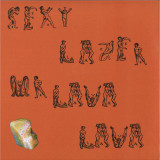
All you need is Lava. Lava is all you need…
Disco’s most erotic walking, talking light show Sexy Lazer makes his debut on Riotvan with three delightfully cosmic oddities and odysseys. At points sleazy, at other points sparkling, forever loaded and coded with space, each of the three originals promises full immersion and escapism.
Zone out to the woodwind wonderment of ‘Fluting In Space’, freak out to the synth-powered bliss of ‘Future’ and totally trip out to the much darker and pensive Black Strobe-like ‘Jing Jang’. Meanwhile on the remix front label co-boss Panthera Krause gets his prowl on with the swampy, sweaty tropical twist on ‘Future’ while Axel Boman gets his dub on with his take on ‘Fluting In Space’.
Three stellar originals, two star-gazing versions, one beautiful trip into the deep unknown. Show some lava!
Growing up in the Californian sprawl and the vast suburbs of Phoenix, Arizona, Caleb Dailey largely dismissed the country and western music that surrounded him. Instead, he was drawn to independent rock, experimental zones, and other genre-defying forms, which led him to create skewed rock music with Bear State and establish the “minimal art label” Moone Records with his brother Micah Dailey in 2013. But in the early half of the 2010s, Dailey began to hear things differently. Drawn into the left-of-center works of artists like Gram Parsons and Blaze Foley, a more idiosyncratic take on country, folk, and roots music began to swirl in his imagination.
Wandering into the form’s cowboy chords and lonesome scenes, Dailey found himself wondering what his own country album might sound like. The result is his debut solo album, a collection of covers called Warm Evenings, Pale Mornings; Beside You Then. Produced by John Dieterich of Deerhoof, Keiko Beers, and Dailey himself, it’s a melancholy charmer, rooted in traditional ideas but free roaming in its scope. Laced with synths, pedal steel, acoustic guitars, and commanded by Dailey’s full and woozy voice, it owes as much to the busted waltzes of Lambchop and the homespun lo-fi folk of Little Wings (whose Kyle Field appears on the album via a spoken intermission) as it does to the songwriters and performers who provide its source material, which include Parsons, Foley, Elvis Presley associate Chips Moman, steel guitarist Buddy Emmons, and others.
“The subversive nature of country music isn’t as much at the surface as some other genres,” Dailey says. “But the deeper down the ‘country hole’ I went, the more I wanted to be part of it. It is truly a strange world.”
The hands of Dailey and his collaborators, which includes a wide roster of DIY experimentalists like James Fella of art punks Soft Shoulder, Jay Hufman (Gene Tripp), Lonna Kelley of Giant Sand, Japanese DIY hero’s Koji Shibuya and Tori Kudo, Nicholas Krgovich, Markus Acher of The Notwist, and more, that strangeness is accentuated. Dailey doesn't aspire to retro Nashville fetishism or sanctioned notions of “realness” so much as a genuine outsider authenticity. Take his version of Gordon Lightfoot’s “If You Could Read My Mind” for example: a highlight of the record, it pairs familiar genre signifiers like pedal steel and guitar strums with warbled synths. Then there’s his read of “Dreaming My Dreams,” originally made famous by Waylon Jennings (who also did time in the Arizona desert), which morphs from a mournful ballad into a wash of far-off sonic noise.
The attention here is on the songcraft itself, with Dailey inhabiting these songs and turning them inside out to reveal unexpected tenderness and playfulness.
Recorded at home with an acoustic guitar and 4-track, Dailey began open correspondences with his collaborators, who fleshed out ideas and added touches, often working with skeletal frames before Dieterich and Dailey shaped it into a cohesive whole. “John is the reason this album exists,” Dailey says. “He sculpted all these parts together in such an otherworldly way. He is truly a magician.” Deeply allergic to insincerity, Dailey avoids any trace of irony. He’s created a cohesive gem out of disparate parts, uniting Americana songcraft with experimental disassemblage. From this bric-à-brac, he’s made something touching and beautifully strange.
Interior sounds from Madalyn in an album that flits between eerie ambience, environment, and hermetic logic. The music’s timing and sequencing feels distant, the elegant constructions conjured and organised semi-consciously, drawing the listener deeper into the dream and towards a zone where watch hands tick forward accurately and their perception of time unspools. Here each neatly tuned conversation and clockwork assemblage harmonises, spinning tantalisingly just out of range and understanding.
“Puzzle Music is the desire to create images out of diverse pieces of sound. To collect timbral colours in a gradient procession and connect them until they create reason. Principally not knowing how the image will turn out, or what the picture even is. It is the act of placing sound shapes next to one another in the hope that clarity will gradually be revealed.
When grouping the songs together I was thinking of them as mechanisms in a timepiece. I have something of an obsession with Swiss watchmaking, although I think this stems from a desire for creative mastery and the design of an energy source independent of electronic needs. Hopefully the songs all serve a purpose towards the end goal of the album... but also, the way the Oberheim Xpander pans sounds is in a very clear circular pattern, which makes me think of gears turning.”
Vinyl Edition of 300 copies
Aesthetical in collaboration with Sync presents "Detect" by Marco Monfardini.
Originally developed as an audio/video live performance, Marco Monfardini based his research for Detect on the decoding of inaudible sounds, sound generated by electromagnetic emissions left from electronic devices and inaudible to the human ear. By using various electro-smog detectors Marco Monfardini creates a sort of detection mapping where electromagnetic emissions are the starting point for the sonorous development of each single composition.
A path that creates a parallel with our lives by questioning how much these emissions affect unconsciously our choices, tastes and perceptions, seeking a relationship between the massive use of technology in everyday life and our emotional state.
The album Detect is developed in 15 tracks in continuous play, an imperfect, faulty mosaic inhabited by invisible beings manifesting themselves in the form of sound streams, mutable entities that find a definitive form in the pattern of the compositional structure.
The album opens with “aR1 detection", sounds of pure detection place themselves in the sound space giving the initial coordinates for the exploration of unconscious parallel areas. The boundaries transform and gradually expand until they flow into the structure of "kernel variations", a growing rhythmic pattern decodes the impulses projecting a perspective that dissolves in the unstable and fluctuating electromagnetic emissions of the subsequent "[a]3020t detection", "binary defect "and "core[2] ". “[A.box]emission” confronts the use of sound downloaded random from internet sample banks and the emissions generated during the download itself, micro sound fragments arrange themselves in an organized and regular pattern, shaping a rhythmic structure. The first part ends with the short “[sa]6030” and “[det]x1a”, absence and presence provide an alternation of movements, inaudible and elusive signals all trying to establish a contact with our perception. “det : scan” opens the second part of Detect, a sort of scanning, leaving EMF (electromagnetic field) textures, a static multilayer that progressively expands until it dissolves into the rhythmic emissions of a common smartphone “[4s]detection”.The track “[rs]zone” " is pushing itself deeper, two minutes of sound speleology that reveal the existence of sound artifacts that seem to vanish getting in contact with the light accented by the bass drum of "[det] 0100+" a constant, rhythmic pumping, a luminous pulsation that reveals an apparent void, which seems to subside entering in the winding and waving atmosphere of "conductive [area]" and "[s3] microfunktion". Detect comes to the end with “[emf]terminal” a mirror of the unarrestable technological acceleration intercepting the flow of data that feeds the system of communication , digital micro waste suffocates the living space by centering up the invisible in an unconscious map.
[a] A1
[c] A3
[e] A5 core[2]
[f] A6 [A.box]emission (2)
[g] A7
[i] B2 [4s]detection
[j] B3
[k] B4 [det]0100+
[l] B5 conductive[area]
[m] B6 [s3]microfunktion
[n] B7 [emf]terminal
Following up to their acclaimed "Hold" EP from last year, German duo Alma reemerge on Definition with their new transmission, "Mother". Through four cuts dropping anchor down the most remote nooks of our dance-friendly galaxy, Alma move the cursor from proper floor-focused 4x4 grooves to kosmische-informed pop excursions with dextrous style and seamless elegance. Crafting their own blend of emotionally whelming club music, it's material primed for extended use whether you are sitting on some high-rise, towering rooftops at sunrise or enjoying a freeze-dried cocktail on Alpha Centauri. Presented in both original version and remix form courtesy of label head Definition himself, title-track "Mother" is the epitome of a slo-burner, rolling at low speed but gaining tension, weight and impactfulness as it runs. Circuits sizzling and piano stabs blazing, Alma dish out a compelling sample of their cross-dimensional wares, sure to take any dancefloor in the zone without further ado. Definition's Remix revamp trades the original's steady swing for a further syncopated, newbeat-infected swagger, laying further emphasis on the synth leads and lashing drumwork as poetic, bleached-out pads keep painting the sky all shades of pastel. A more Italo-inflected affair at first, the tear-jerking "Lost In The Stars" has us gliding in a parallel universe of its own, where epic-sized synth combers and muscular bass onslaughts avalanche over brittle lines of soft-tongued vocals. As concretely submerging as it is designed to trigger off deep emotional response from the ravers, this one is tailored to weave instant communion between the jockey and his audience. Flinging in the breaks and cross-cutting delays, Kiel outfit Avidus shift the angle of approach towards harder, faster EBM firepower, binding their rowdy, FX-soaked chords with the chorus to create a wholly distinct dancing and listening experience.
Soft piano notes kiss trippy electronic tones: “Kossaiko”, the only collaborative record that japanese piano player Saiko Tsukamoto and globally known electronic producer Kuniyuki Takahashi ever produced, is an unmissable profound soft classic music burner.
Together they composed and produced an eight-chapter strong deeply absorbing narrative, whose enthralling story arc dives profound into authentic drama zones, that sound like they jumped right out of a Claude Sautet movie.
Originally released in 2007 as cd only, the perfectly put together longplayer now enters the world for the first time in a vinyl edition that is tragically hip. deeply starry-eyed composi-tions full of minimalistic piano melodies that creep, twist, and dance around unobtrusive electronic notes who never call the tune, but always elevate the spectacle into higher elec-tronic spheres.
In the center of each between five- and nine-minutes long composition is the piano play of Saiko, gently hitting the keys, giving space to each note to vibrate in an endless “Pauline Oli-Veros” way, drifting until the very last sound vanish. around them, Kuniyuki plays his charming electronic tricks, opening the space for tones that sometimes pulsate, sometimes flow the ambient way.
Furthermore, occasionally a guitar notes pop up or accordion melodies cover the sorcery with a severely romantic veil.
Modern classical music, that has no fear of electronic meltdowns, that embraces digital tones while staying organic in its very inner circle.
A wise man once said: when words leave off, music begins. Those who fall for the eight poems of Saikoss will lose their speech and in return get pleased all agitations of their soul.
Repressed !
Hear & Now's Story Is One Of Friendship And A Shared Passion For Music. It Began With A Chance Meeting On The Dancefoor At Red Zone In Perugia, One Of Italy's Most Legendary Clubs
Of The 1990s. Nearly Three Decades On, These Glassy-eyed Clubbers Have Joined Forces To Deliver One Of The Most Magical And Sun-kissed Albums That Claremont 56 Has Ever Released. By The Time Ricky L And Marcoradi Frst Joined Forces In The Studio In 2016, Both Had Become Established Producers Within Italy's Vibrant Deep House Scene. Between Them, They'd Released Records And Remixes On Such Labels As Ibadan, Uomo, Reincarnation, Top Tracks, Restricted
Tracks And Vega. Keen To Step Away From The Dancefoor, They Decided To Simply Create Beautiful Music For Bleary-eyed After-hours Sofa Sessions, Lazy Summer Afternoons And Early
Mornings Spent Blinking At The Rising Sun.
Aurora Baleare, Their Debut Album, Follows On From A Fantastic Double A-side 12' For Claremont 56 In February 2017. Those Two Tracks Take Pride Of Place Amongst An Eight-track Selection Simply Brimming With Evocative Workouts, Gentle Soundscapes And Noon-bright Sonic Bliss. While You'll Fnd Luscious Instrumental Cuts Designed To Inspire Baggy, Glassy-eyed Shuffing - See The Mid-tempo, Spine-tingling Brilliance Of salsedine', Mind-massaging hirundo' And Dreamy Slow-house Treat sabbia Magica' - It's The Effortless Brilliance Of Marcoradi's Improvised Guitar Playing And The Duo's tmospheric Approach That Really Catches The Ear.
Check, For Example, The Heady Horizontal Shuffe Of trasimeno', Where Poignant Ambient Chords, Jazzy Electric Guitar Solos And Deep Space Electronics Tumble Down Over Shuffing Beats And A Squeezable Synthesizer Bassline, And The Sun-down Adriatic Wonder Of stella Dei Venti', A Track So Effortlessly Loved-up And Blissful That You Might Be Overcome By Emotion (it Certainly Had Us Daydreaming Of Days Spent Exploring The Intense Natural Beauty Of Italy's Adriatic Coast).
Moments Like This, Where The Duo's Dreamy Electronics And Smile-inducing Melodies Seemingly Shimmer Across The Sound Spectrum, Can Be Found Dotted Throughout Aurora Baleare. There's The Darting Digital Synthesizer Motifs, Sparse Hand Percussion And Ricocheting Solos Of airone', The Italo-disco-inspired Chugging Positivity Of la Marsa' And The Title Track's Humid Beachside Breeze, Where Intertwined Electronic And Acoustic Lead Lines Seemingly Glimmer Like Rays Of Sunshine Bouncing Off The Surface Of A Becalmed, Crystal Clear Ocean. Their Roots May Be On The Dancefoor, But Hear & Now Are Fast Becoming Down Tempo Masters. You Can Dance If You Want To, But You May Just Want To Hug A Stranger Instead.
"Lloyd Stellar X The Droid - Rise of theAMachines is an exciting debut collaboration between Erik Griffioen & Ben Evans.AAn impressive maxi EP, loaded with cutting edge electro brimmingAwith musicality, sound design and expert production.A
Kicking off the release comes theAtitle track 'Rise Of The Machines', this quirky yet nuanced excursion sets the pace, allowing it's nifty ricocheting sequences, slick 808s, and tripped out ear candy to hit the clubs. 'Prisoners features a wiggly bass led jam, plastered with synths and finished with a dash of vocoded vocals. TheAduos ability to illustrate a dense sonic picture is evident once again on 'Cell Block' as intricate razor sharp drum programming holds the ship steady while ominous synths let the head wander before rich melancholic pads blast a sense of perspective and emotive depth.A
A
Onto the flip side - 'Room And Pillar'Agrabs the bull by the horns with a tough and aggressive bass line driven banger. Shrieking, twisted synth lines and FX are shattered across the track, keeping tension levels peaking, while TR808 rhythms cut through with military precision. Contrasting A'The Neutral Zone' sucks us into a deep atmospheric orbit of blissful yet inquisitive FM synthesis, distant emotive pads, fortified by warm stately bass tones. ARounding off the EP 'Coming Home' exhibits electro minimalism at its finest. An entangled, ever evolving musical conversation between bass and upper register synths leads, filled with a sense of hope and optimism, assisted by meticulous programmed electro drums, reminiscent of the best of Schatraxx.A