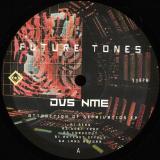
DVS NME is a Colorado-based Electro producer and DJ originally from Southern California. Active since 1999, he crafts stark, machine-driven music rooted in analog hardware and recorded live in single takes. Influenced by Drexciya, AUX88, and Anthony Rother, his sound blends dystopian textures with precise rhythm programming. He’s released music on respected underground labels like Solar One Music, Transient Force, and Ukonx Recordings, and now Future Tones Rcoeds. A key advocate for the genre, he also curates the long-running Dark Science Electro podcast, supporting global Electro since 2010.
1. Beam
A slow-burning opener built around a TR-606 groove, chopped vocal fragments, and delicate string flourishes. At 116 BPM, it's the most restrained cut on the EP—staccato and skeletal, but quietly emotional.
2. Carveout
Driven by a classic four-on-the-floor pulse, "Carveout" rides a surging bassline and tightly layered synths. Functional on the surface, but subtle shifts in tone give it depth beneath the structure.
3. Debt Trap
The most club-oriented track on the record. With a jerky low-end and nimble 606 programming, "Debt Trap" combines dancefloor impact with off-kilter synth work that refuses to settle.
4. Ratchet Effect
A standout cut that channels DVS NME's signature sound—sharp, modular arpeggios, machine-funk rhythms, and intricate modulation. At once clinical and soulful, it’s the EP’s most complex and defining moment.
5. Land Reform
TB-303 acid lines coil around melodic string pads and skittering hi-hats in this mid-tempo closer. "Land Reform" balances raw rhythmic motion with introspective synth textures, ending the record on a reflective note.
Buscar:del close
Black VInyl[13,03 €]
Based in the small but rather cool northern UK town of Todmorden, Tea Breaks is making a big name for itself, much like the local hotspot The Golden Lion, which has long been booking top-tier DJs and throwing proper good parties. Now the label delivers another standout release that collides legendary hip-hop with global rhythms. Opener 'Breathe & Stop' fuses Bollywood vocals with classic East Coast bars while 'Tea & Beer' drifts on woozy rhythms, world percussion and smooth female bars. 'Broad Nod Factor' brings golden-era goodness and sunny flutes, and 'Ms Fat Booty' closes with dark soul swagger that defined NYC in the mid-90s. These are, once more, four inventive mash-ups that bridge cultures and eras with effective style.
classic East Coast bars, 'Tea & Beer' has drunken rhythms and world percussion with silky female rap tones, 'Broad Nod Factor' rolls deep with a golden-era edge and sunny flutes and 'Ms Fat Booty' shuts down with dark soul swagger. Four great mash-ups.
We Release JAZZ is honored to announce the release Shoals, a magnificent full-length album from Earth and Bones, the duo consisting of Liran Donin and Idris Rahman of acclaimed jazz outfit Ill Considered. Their majestic offering is available in an ultra limited edition 180g vinyl LP housed in a heavyweight sleeve with an original artwork by Dutch artist Vincent de Boer.
Carried by Liran Donin on double bass and shakers, and Idris Rahman on bass clarinet, tenor sax, shell, and Tibetan singing bowl, the 5-track album is a deeply entrancing meditative-shamanistic-ambient-jazz journey. The members of Earth and Bones poured their heart and beliefs into the project:
"From shamanic cultures and forgotten traditions, we delved deeper searching our ancient healers, exploring who they heal, what they heal, and how they do it. We wanted to focus on the poisonous human attributes that affect our animal kingdom, as well as how we can heal ourselves by balancing darkness and light. We express our forever gratitude to our community, tribe and animal kingdom.
Despite how governments and multinational corporations try to isolate us from one another, we can't make it alone without our shoal. To truly have a shoal, we need to accept each other for what we are."
Their friend, Vincent de Boer, delivers the visual side of Shoals:
"The living world and all its particular (eco)systems s increasingly a source of inspiration for my art process. When Idris and Liran showed me the new recording and the thoughts behind it, it immediately fell onto good grounds. A school of fish is eminently a metaphor for collective improvisation, something we are all engaged in on an artistic level. The group decisions go beyond causality, the energies provide a simultaneous awareness for choices of direction. The space between the entities thus form a new entity. Non-matter becomes matter and vice versa: an area where music and visual art meet.
I drew a school of fish and tried to make it look like a fixed entity, so that multiple lives become one collective. As a bird and perhaps as a rock or cave: outside becomes inside becomes outside: so that all domains of the living world are linked: the swimming, the crawling, the flying and the playing. The spiritual connection with the music of Idris and Liran is grand, the places it takes me are at once very distant and extremely close. From otherworldly to within the body: the opposites as well as the harmonies are of shamanistic proportions."
Points of interests
For fans of ambient-jazz, meditative music, shamanistic rituals, improvisational process, deep vibes, Ill Considered, Vincent de Boer, heartful connections, healers and healing, the body, the otherworld, life within and outside.
.Super limited edition vinyl of Earth and Bones' debut !
Backspin's new release comes from Obscure Shape, delivering a deep and versatile techno EP that lives up to its title: 'Zwei Gesichter' (German for 'Two Faces'). Across five tracks, the EP explores the tension between raw force and emotional depth, marrying the label's Hardgroove roots with a more introspective edge.
The A-side presents Obscure Shape's first face: It opens with 'Zwei Seiten', a no-frills banger that hits with immediacy and drive. 'Im Angesicht Der Zeit', the single, leans into groove and movement, offering a more fluid, time-aware flow. 'Die Haut In Der Ich Wohne' pares things back into a minimalistic, loopinghypnosis, evoking the idea of inhabiting one's own skin. On the B-side, presenting the producer's second face, 'Spuren Des Werdens' features producer AMIYE and introduces more melody and saw synths, a reflection on growth and transformation. The closer, 'Von Hoffnung Getragen' - also a collaboration with AMIYE - lifts off with ethereal vocals and a bouncing rhythm, embodying the hope that carries us forward.
With the 'Zwei Gesichter' EP, Obscure Shape crafts a powerful narrative through groove, form and feeling, perfectly aligned with Backspin's evolving reinterpretation of early 2000s techno.
Balearic sounds and Mediterranean warmth are the inspirations for Bruno Belissimo’s Bordello A Parigi debut. Drawing on disco, house and funk, Ottimo! is a four tracker of electronic exuberance with Belissimo’s musical ability and range immediately spilling from the speakers. Guitar strings curve around synthlines in the title piece, percussive textures giving way to the mantra-like refrain of “Ottimo!” Thick bass echoes into beaming keys for “Meduse.” Bright notes cascade, grooves melting with vocoder lyrics as classic disco tones are reimagined in this modern mirrorball medley. Organic rhythms introduce the flip. “Mirage” opens to ripples of bongos and toms as a loose structure takes hold. Hedonistic chants rise to a shimmering chord, kicks and snares funnelling the building energy as bold blasts and samples shriek with delight. “Las Piramides De Ibiza” brings the quartet to a close. Clean drum patterns support joyous notes, a machine dipped voice calling time.
Muzik & Friendz Records is absolutely thrilled to announce a momentous milestone: we are celebrating our 10th anniversary! To mark a full decade of music, community, and friendship, we are incredibly proud to present a special various artists vinyl compilation.
This celebratory record sees us reunite with some of our closest friends and talented artists who have been integral to the Muzik & Friendz journey. We are so happy to come back with this new release featuring captivating contributions from JR From Dallas, Pat Lezizmo, Rawdio, Franksen, and an exciting, previously secret collaboration project known as Padeera. Each track has been carefully selected to deliver genuinely groovy, infectious, and compelling house cuts that embody the sound and spirit of the label.
Join us in celebrating ten years of passion for music with this essential vinyl release, packed with fresh tracks from the family.
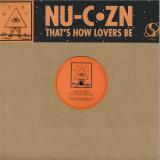
Mysticisms returns, looking to the source, Detroit City, with the beautiful house music of Soiree Records International and their 1995 deep vocal bomb, That's How Lovers Be.
Established in 1990 by Derrick Thompson, Soiree has long focused on the deeper side of house, late night rhythms across over 70 releases. Never making a shout out about it, the label might not of garnered the kudos it deserves while laying down a tight standard of cosmic sonic delight.
Featuring in the main Thompson's own Drivetrain releases, his production skills are deployed on this one time project. Written and sung by Montaze Armstrong, alongside the smooth accompaniment of Merchon Bower, the production is ubiquitous Drivetrain. His main mix sets the scene; hats proffering swing and impetus while bass and chords underpin the vocal interplay to skyward perfection.
Once again the label conjoins a latter day contemporary and admired producer to offer their own retake and who better than the essential producer of all things deep, Nail. A huge influence on the label during the formative years of (free party) house music's ascent, his recent return has been widely welcomed. His 'mix' is full of respect and perfect pitch, adding his distinctive low-end rumble, hypnotic hats, skips, loop and shake.
To close, it's all about the legend that is Scott Grooves. Nothing more needs be said, his 9-minute ride show jazz roots worn firmly. Rhodes, claps, piano and vocal are all that's needed. Loose, funky and soulful from a true master.
Love the Mystery.
Prolific duo Years of Denial return to Veyl with another genre bending, dance floor ready EP titled Love Cuts.
Acting as a transit between 2023’s Suicide Disco 2 and the forthcoming Suicide Disco 3, Love Cuts explores the various angles of love - ranging from the digital to the forbidden, toxic to erotic and beyond. A blend of death rock, future goth, EBM and rave, we once again find the project’s poetic, powerful lyrics fusing with motorized beats and 4x4 rhythms.
Kicking things off is the shadowy, death rock inspired, "Devil In a Skirt", an infectious ballad about a temptress that may not be what she seems. Next up, "Affaire de Coeur" delivers body fuelled stabs which elegantly bleeds into "Hide & Sick", a more high energy cut, set to scorch the floor. "We Are The Party" keeps the pulse pounding with your next EBM anthem while "In Your Bed" shatters sonic boundaries and leaves things drenched in acid rave. "AI Lover" closes things out with more future goth rave energy which acts as both a warning and a desire for more.
Love Cuts builds on Years of Denial’s previous work while setting the stage for what’s to come. Commanding vocals and dominating beats transmit a powerful message of both the dystopian and euphoric. Remaining uncategorizable, the project continues to evolve their unique sound while burning a path toward the future.
Butterfly Records is proud to release a vinyl reissue of Radio Babilonia, the fourth electrifying studio album by Uruguayan alternative band Traidores. The album was originally released on CD and cassette in 1995 and it stands as one of the most representative works of their career. In Radio Babilonia voices of Juan Casanova and Víctor Nattero converge into a symphony of intense emotions and profound reflections. Each note resonates with their musical legacy, rising as a testament to the reality that surrounded them, where pain and beauty intertwine in a powerful auditory experience. With a style that defies convention, their lyrics transport us to a world of poetic chronicles, inviting us to explore the catastrophes of the present and future through their vibrant and critical lens. This album from 1995 is a masterpiece for those who seek an authentic and moving sound - a sonic journey that reflects its time and makes a bold statement. Released in August 1995, Radio Babilonia opens with its title track- a sonic storm that sets the tone with poetic urgency and avant-garde defiance. Songs like "Máquina" and "Crónica del Sur" explore inner turmoil and fracture realities, wrapped in melodic brilliance and sharp arrangements. Nattero's guitar work shines, especially in tracks like "Ella sabe bien" and "Pasajero de un tren," where a sense of déjà vu echoes through the lyrics. Side A closes with the haunting waltz "Como una plegaria," evoking blood-stained devotion. Side B deepens the album's mystique, offering lucid hope through punk anthems like "Enemigo del mundo" and "Fragmentos de mí." It culminates in the defiant "Canción rebelde": "There is no worse evil than chaining oneself to pain." Traidores channel poetic rage into a powerful, redemptive soundtrack for a disenchanted era.
- A1: She's Getting Married In August
- A2: Evenin' Rain
- A3: Les Papillons
- A4: Zeena
- A5: Virgin Morn
- A6: Seeds
- B1: Crystal Blue
- B2: Lady Carole
- B3: Lotus Child
- B4: Last Prayer
- B5: Hymn For Today
- C1: Boston
- C2: Blackbird Charlie
- C3: My Sun
- C4: Closer To The Truth
- C5: Strange News
- D1: Moonchild
- D2: Red Shoe Truckin
- D3: Beautiful
- D4: Opal Blue Sunday
First time vinyl reissue, expanded and deluxe double gatefold 140g double vinyl, remastered audio with restored artwork and fresh liners written by Paul Hillery (Folk Funk & Trippy Troubadours)
Alan James Eastwood's glorious Seeds is a certified folk-funk lost-classic.
But who was Alan James Eastwood? He had never hit the big time and commercial success eluded him. By the mid-1970s, his musical career was pretty much over and he was almost unknown except among deep heads, amongst whom he would gain cult status.
Original copies of the 1971 vinyl release of Seeds exchange hands for high sums, if you can find one. This expanded 2LP contains an extra record, collecting 9 rare non-album singles and is presented in a gatefold sleeve complete with freshly commissioned liner notes courtesy of Paul Hillery (Folk Funk & Trippy Troubadours).
With the long overdue deluxe reissue of this prized artefact, we hope to finally shine a light on the unheralded genius of Alan James Eastwood. RIYL Nick Drake, Rodriguez, Richie Havens.
Alan James ‘Bugsy’ Eastwood was a renowned musician and singer who came to prominence in the late 1960s with The Exception, an unsung but excellent band from Birmingham. The Exception released many singles, the first featuring friend Robert Plant on tambourine, before an album, The Exceptional Exception. However, by this time, Bugsy was feeling constrained and restless; he left the band within weeks of the release.
Having vanished from the scene, he was honing a deeper, introspective edge to his songwriting. His demos found their way to the sound engineer and producer Mike Cooper at Pan Music Studios in Denmark Street. Loving what he heard, Eastwood soon entered a recording session with Cooper. The session was just Alan, his guitar and harmonica and - by all accounts - it was remarkable. With the songs, the voice and such an exceptional talent, it was hard to go wrong. Says Mike: "We had John Hawkins do the big string arrangements and Richard Hewson arranged the string quartet. We overdubbed the orchestrations on Alan's original session recordings, adding Chris Karan on tabla and various percussion. We considered re-recording the vocals but found that the magic on that original session was so exceptional overdubbing would not be as good as the atmospheric 'live' performance."
Mike and Alan viewed each track as a different entity, giving the album a diverse sonic palette. Assessing each song individually, they decided which would be suitable for each arranger. Top-flight session musicians were added to the roster to complete the sound, with Byron Lye Fook (father of musician Omar) on drums, bassist Mike Ward, Brian Pickles on marimba and jazz drummer Chris Karan on tabla and percussion. Recorded in a matter of days in Pan's small 8-track studio, they carefully added overdubs, rhythm sections and four string sessions arranged by Hawkins, with Hewson's arrangements recorded at Trident Studios.
Seeds was Alan James Eastwood's debut solo album – indeed, his only solo album - and was originally issued on President in 1971. It melded Eastwood’s impressive rock sensibilities with a folk thread to superb effect. His arresting voice - its deep, rough-hewn soulfulness - coupled with gorgeous string-drenched backing, make this a phenomenal listen. It really is a great 70s singer-songwriter record - with touches of acid-folk and folk-funk throughout.
It opens with "She's Getting Married In August", a mellow tune with Richard Hewson's strings arranged around Alan's straightforward guitar structure. Up next, the joyous, sun-dappled guitar and strings workout "Evenin' Rain" glides by before the fragile, accordion-enhanced "Les Papillons" breezes out of the speakers. The bluesy "Zeena" follows, featuring vocals and acoustic guitar and showcasing Eastwood's effortless harmonica. Starting out as a ballad, "Virgin Morn" builds with soaring strings and gospel-tinged backing vocals from Marilyn Powell and jazz singer Josephine Stahl. The A-side closes with the title track, "Seeds". With a chugging mid-tempo beat, soulful vocals and a beautiful Bacharach-esque string arrangement, it truly is stop-you-in-your-tracks spectacular.
Side B opens with "Crystal Blue", gilded by Lye Fook's marimba, lush gospel-esque backing vocals and handclaps. Eastwood's acoustic guitar begins "Lady Carole", which starts as a bluesy ballad and builds with more string arrangement, lifting the track to another height. A towering highlight of epic proportions, "Lotus Child" is a true masterpiece of arrangement. It opens with simple yet stunning do-do-dah vocal harmonies blended with John Hawkins's strings, bass lines and rhythmic beats, forming a vibe very much in conversation with the sounds coming from LA's Laurel Canyon. Next up, the heartwarming "Last Prayer", dedicated to Alan's first and last love, contains a melancholic vocal with a wistful string-drenched arrangement that would sit comfortably in a Federico Fellini score. Bringing the album to a close, "Hymn For Today" is a melodic raga with tabla, strings and a soft-psych feel. Eastwood's prophetic whisper - "I am real. At last, I am real" - profoundly hits home.
Kicking off the extra disc is the sparsely funky and country-tinged "Boston", released as the flip to the astonishing "Seeds". Next up are the two tracks that comprised Alan’s debut solo 7" single from 1968. The laconic, Bobby Charles-esque "Blackbird Charlie" evidences a real depth and charm in Eastwood's songwriting whilst the starkly brilliant flip, "My Sun", was a horizontal, atmospheric folk-tinged soundtracky precursor to his later work on Seeds.
In 1972, two further standalone singles followed. The first was the evergreen flute-driven folk-funk bomb, "Closer To The Truth", backed by the funky blues of "Strange News". The second, a deeply moving Havens-inspired "Moonchild" - rightly fawned over to this day - was flipped with "Red Shoe Truckin'", a groove-infused track. Eastwood also paired up with Marilyn Powell for a single produced by Powell's partner, Mike Cooper. Under the name Eastwood & Powell, they released their staggering rendition of "Beautiful", a rock-blues-pop song arranged by Ivor Raymonde and written by Carole King. Over on the flip, a funky Eastwood original "Opal Blue Sunday" lurked. This is not to be overlooked.
Over the years, Alan remained active on the music scene, but problems with alcohol and health complications from diabetes severely impacted his career. He spent his latter years living in London until his untimely death from heart failure on 25 October 2007, just one day before his 62nd birthday and without his music having received the real acclaim it so dearly deserved.
This deluxe reissue, spellbinding from beginning to end, should hopefully go some way to rectifying this tragic fact. Mastering for this special double vinyl edition was overseen by Be With regular Simon Francis and it was cut by the esteemed Cicely Balston at Abbey Road Studios to be pressed in the Netherlands by Record Industry. The original artwork has been lovingly brought back to life at Be With HQ, with the addition of passionately written liner notes specially for this landmark reissue by none other than Paul Hillery.
“BIR004 – Ultranoise – Circuit Breaker” is a bold and exhilarating five-track statement from Believe In Records, placing Ultranoise firmly at the forefront of forward-thinking electro. Fusing raw textures, heavy low-end pressure, and meticulous programming, the release channels the spirit of industrial and grunge aesthetics—reimagined through a sleek, modern electronic lens.
A1. “Thread Execution Failed” kicks off with urgent glitch-laced detail, instantly gripping the listener.
A2. “Operator Activated” follows with tight, kinetic rhythms and metallic flourishes, blending mechanical precision with creative unpredictability.
A3. “Rebel Code Injection” delivers a concentrated blast of sonic attitude—disruptive in all the right ways.
The B-side expands the scope.
B1. “Transmission Line Corrupted” plunges into a darker, immersive landscape, balancing tension and groove with finesse.
B2. “db Unit Assembly” closes the EP on a richly layered, atmospheric note—anchored in rhythm but open to abstraction.
Energetic, suspenseful, and sharply crafted, Circuit Breaker is more than a genre exercise—it’s a high-impact, high-integrity release for adventurous selectors and deep listeners alike. Each track carves out its own moment, built to move both the floor and the mind.
Believe In Records is a division of MixCult Records
Limited edition
raum…musik welcomes Italian producer Santos for his debut on the label with Human Factor EP — a versatile four-tracker blending tech house, deep house, minimal, and acid, crafted with the finesse of someone two decades deep in the game.
The EP opens with “Some We Are,” a deep acid house track driven by a steady groove, bubbling 303s, and teasing vocal snippets. Atmospheric pads and warm chords emerge as the track evolves, balancing dancefloor function with rich detail.
“Paragonal” shifts gears with sampled breaks and emotional synth stabs layered over a 4x4 pulse. Hazy vocals and spacey effects give it a bright, euphoric edge while keeping it floor-ready.
On the B-side, “Done Everyday” leans into swing-heavy deep house territory. Shuffled hats, micro-programmed percussion, and a solid sub-bass glue everything together — minimal house with punch and precision.
“Kink In Me” closes the record with a more experimental mood. Sparse and hypnotic at first, it patiently unfolds into a deep, quirky, and rhythmically rich groover of jazzy chords and dubby textures.
With Human Factor EP, Santos delivers a polished and dynamic record that speaks to seasoned diggers and fast-moving dance floors alike. raum…musik continues its tradition of top-shelf, club-focused curation with this timeless release.
Subtil welcomes back French producer VENDi for its 29th release, Zndya EP - a three-track collaboration featuring BH2M and T.N.O.
Built on tight grooves, layered textures and spacious atmospheres, the EP blends minimal foundations with genre-fluid ideas and detailed sound design.
The title track Zndya, produced with T.N.O., opens with a fusion of stripped-back minimal and cosmic synth work, drawing influence from Nordic space disco. Arpeggiated leads and a steady, motorik groove stretch the track into wide, cinematic territory — functional and trippy in equal measure.
Session Height, co-produced with BH2M, shifts into peak-time mode with a rolling groove of syncopated basslines, cascading synth delays and chopped vocal fragments.
On the flip, Session Four, also in cooperation with BH2M, closes the EP on a jazzier note. Its full-spectrum sound design — from tight percussion to scattered melodic elements — plays out like organized chaos, balancing deep grooves with intricate detail.
With Zndya EP, VENDi delivers a focused and versatile record that fits naturally into the Subtil catalog — refined, functional and full of character, equally suited for peak-time tension or late-night introspection.
Radio City EP marks the vinyl debut on DOTS. Music, showcasing three distinctive cuts from Dutch producer Pascal Benjamin, along with a standout remix by Argentinian artist Alexis Cabrera. Built around tight grooves, warm analog textures, and playful percussive details, the EP captures a rhythmic, dynamic, and dancefloor-ready energy.
Opening the A-side, Radio City blends sexy chord stabs with Rhodes keys and tiny vocal fragments that lock effortlessly into the groove. Cabrera’s remix flips the original into funkier territory, adding a gliding bassline, electric guitar riffs, and an irresistibly rolling swing that complements the original’s flow while offering a fresh twist.
On the flip, Rewind explores a more underground dimension with sharp drum programming, subtle acid touches, and chopped vocals. A groovy, short-note bassline drives the rhythm forward, while deep chords make the track equally effective in afterhours sessions or peak-time club sets.
Flat Sprite closes the EP with a forward-driving acid hook riding over rolling snares and synths — a functional groove weapon with hypnotic momentum.
With Radio City, Pascal Benjamin delivers a tightly curated selection that merges minimalistic sound design with groove-driven charm — a confident debut that balances functionality with character on the dancefloor.
Breidenbach returns with its third vinyl release, a four-track V.A. titled Nothing Can Go Wrong — a confident outing from the Heidelberg-based imprint, built around minimal house aesthetics, dub accents, and deeply hypnotic cuts. Uniting artists from Japan, Germany, and Sweden, the EP brings together three distinct voices aligned by a shared sense of groove, texture, and restraint.
On the A-side, Sasaki Hiroaki opens with "Groove Keep Practice", a warm, rolling Deep House track laced with sensual female vocal snippets and dubby pads. Subtle delays, spaced-out beats, and a fluid rhythm create the perfect recipe for dancefloor hypnosis. FilOu follows with two cuts: "Stampede" on A2 is crisp and crunchy, driven by a syncopated, funk-leaning bassline and surrounded by micro-glitches, sampled stabs, and airy textures that keep things moving. On the flip, "Astral" expands the palette with similar percussive tightness, but the basslines hit deeper, growling through the arrangement with attitude — hypnotic, consistent, and built for long blends. Chris Llopis closes the V.A. with "Aetherial Haze", a bright and melodic entry full of FM-style synths, scattered vocal snippets, and dubby echoes. It’s the most playful moment of the EP, but still rooted in the heady minimalism that runs through the entire release.
With Nothing Can Go Wrong, Breidenbach continues to define its space — thoughtful, functional records built for DJs who know that less is often more.
Bogotá duo Rush City — aka Jonahlo and Joint4Nine, and heads of the Ritmo Terco label dig deep into their crates for this second vinyl outing, delivering four razor-sharp reworks that balance nostalgia with dancefloor punch. Spanning boogie, Italo disco, electro, and deep house, each track is reimagined with a tasteful blend of analog grit, acid textures, and precise drum programming.
Opener “When Your Ex Wants You Back” breathes new life into Surface’s 1984 boogie anthem, fusing its soulful acapella with 808 rhythms, acid basslines, and shimmering synths for a raw electro-funk twist. Following “Brown Sugar”, lifted from a rare 80s adult film soundtrack, becomes a dubbed-out, indie-leaning acid disco tool — weird, seductive, and undeniably effective.
On the B-side, Dream 2 Science’s deep house classic “My Love Turns To Liquid” is transformed into a hypnotic acid roller, stripping things back while keeping the soul intact. Closer “Don Quichotte” rebuilds Magazine 60’s Italo gem from the ground up — with re-recorded vocals and fresh synth work, it’s a full-throttle electro bomb.
A versatile and expertly crafted four-tracker, this is crate-digger gold with serious club utility.
FIRST-EVER VINYL RELEASE OF CULT 1980 CASSETTE-ONLY ALBUM BY EGYPTIAN SINGER NAGAT EL SAGHIRA, CURATED AND ANNOTATED BY DISCO ARABESQUO. INCLUDES PRODUCTION BY EGYPTIAN FUNK LEGEND HANY SHENOUDA
Following the highly-acclaimed "Sharayet El Disco" compilation, Wewantsounds is delighted to team up with Disco Arabesquo for the reissue of Nagat El Seghira's cult 1980 album "Eyoun El Alb"
Originally released only on cassette on the Egyptian label Soutelphan, the album has since become a sought-after classic on the Arabic groove scene and this is the first time it is released on vinyl. Consisting of four tracks, the album features two tracks produced by Hany Shenouda whose group Al Massrieen is a reference on the Arabic disco funk scene.
Remastered for vinyl by Colorsound Studio in Paris, the album features the original cassette artwork plus a two page colour insert featuring liner notes by Disco Arabesquo.
When it comes to Arabic Divas, Oum Kalthoum, Fairuz and Warda usually take the lead in the poll list. But in her native Egypt, singer Nagat Al Saghira comes very close to this triumvirate. Born in Cairo in 1938, Nagat began singing when she was still a child gaining her stage name "El-Saghira" ("the young one") at this occasion as she started giving concerts at the age of seven, pushed by her father, the famed calligrapher Muhamad Hosny (Nagat's half-sister is the renowned actress Soad Hosny).
Nagat quickly rose to fame in the late forties and became an essential part of classic period of Arabic music, interpreting songs by such titans as Mohamed Abdel Wahab, Baligh Hamdy and Kamal Al Taweel. She also sang the works of Syrian poet Nizar Qabbani whom she introduced to a mainstream audience. Nagat started singing shorter songs but then upgraded to longer ones, often performing/recording them live as it was the trend in the 60s and 70s.
One such song is "Eyoun El Alb" ("Eyes of the Heart") which makes up the whole of Side 1 of the original cassette. Written by Mohamed El Mougy and Abd al-Rahman al-Abdouni, Eyoun El Alb is a love song made up of several distinct sections enhancing Nagat's hypnotic singing, accompanied by a percussion-heavy, traditional Egyptian orchestra.
Side 2 is the "diggers" groovier side featuring two floaters,"Bahlam Ma'ak" ("I Dream with You") and "Ana Basha El Bahr" ("I Adore The Sea") produced by cult Egyptian musician and producer Hany Shenouda, whose albums with his group Al Massrieen are highly sought after on the Arabic funk and Disco scene. One Al Massrieen track features on the "Sharayet el Disco" set compiled by Disco Arabesquo who notes that "Hany Shenouda had made waves with his new musical style that weaved in western funk and disco sounds into Egyptian music"
Both tracks feature an infectious slow-burning groove and incorporate funk influences with fat bass and lines of synth and clavinet that adds a funky tone to Nagat's soft singing. The third track "Fakra" ("Do You Remember") brings the best of both world with a syncopated rhythm and arrangements that are slightly more traditional than the Shenouda-produced tracks.
Originally released in Egypt on Cassette in 1980 on the venerable Soutlephan label, the album is now making its vinyl debut on Wewantsounds annotated by Disco Arabesquo and remastered for vinyl by Colorsound Studio in Paris for the joy of Arabic funk and Global beats worldwide.
The writer Max Sebald often pondered over the nature of human memory, specifically, how our thoughts and desires - and their results - overlap and mutate over time. In A Place in the Country, he writes of the significance of what see as “similarities, overlaps and coincidences”. Are they the “delusions” of the self and senses, or manifestations of “an order underlying the chaos of human relationships, ... which lies beyond our comprehension”?
Song of the Night Mists, the new album by post-classical composer Stefan Wesołowski, often feels it draws on Sebald’s premise.
On a simpler plane, the one where the market dictates the neatly ordered information we consume, Song of the Night Mists can be described thus: recorded in the main by Stefan Wesołowski in Gdańsk, both in his studio and in Saint Nicholas' Basilica, the album incorporates acoustic instruments - piano, violin, double bass - and classic synthesizers such as the Roland Jupiter-8, the Soviet Polivoks. A Roland Space Echo RE-150 tape delay was also pressed into service as an instrument. We also hear the basillica’s organ and field recordings from the Tatra Mountains. Other musicians were Maja Miro, who played the flute parts on ‘Glacial Troughs’ and brother Piotr Wesołowski, who played the organ on ‘Wilhelm Tombeau’. Sound engineer was Marcin Nenko, who was also on hand to record the basilica organ parts. The album was mixed in New York by Al Carlson (Oneohtrix Point Never, Jessica Pratt, Zola Jesus, Lady Gaga, and Liturgy) and Rafael Anton Irisarri handled the mastering.
Ostensibly, Song of the Night Mists is the last in a trilogy, following on from albums Liebestod (2013) and Rite of the End (2017). All three deal with existential matters such as love, death, decay and “an ultimate end”; apocalyptic and Promethean in spirit, and betraying very human conceits. The Sebaldian nature of the new record starts to make itself felt when Wesołowski talks of how he used sampling. One element is unexpected, that of sampling himself: “I go back to dozens of my own unused sketches and recordings, treating them as raw material to cut, slow down, reverse, and transform in every possible way.” Memory as sound, to be reemployed by the listener through their own imaginings.
Another set of samples made by Wesołowski plays another role. These are field recordings, originally created for an audio illustration of the formation of the Tatra Mountains, and used in a film by sound designer Michał Fojcik. Wesołowski: “You can hear cracking ice, streams, footsteps in the snow and the wind, and a real avalanche, recorded from the inside.” The “Tatra connection” on the album is also found in samples referencing composer Karol Szymanowski. The album’s title alludes to a poem about the mountains by Polish poet, Kazimierz Przerwa-Tetmajer.
Wesołowski’s Tatra recordings are “about a world without humans - about the fact that the world existed, was beautiful, and had meaning long before people arrived, and for the vast majority of its history, it was a place without us.” Wesołowski, using one iteration of the natural world, plays out in sound Sebald’s idea of another order, underlying the chaos of human relationships lying beyond human comprehension.
These feelings play themselves out on the five album tracks. Sonorous and rich, they illustrate tectonic shifts we have no control over. Wesołowski hints that the overall sound is a “meditation on the metaphysics of the non-human set against the spirituality that human presence has brought into it.” In that light, the opening number, ‘Core’, with its slow build, and crackling and straining sound effects, create an effect of the earth groaning into life in a creation myth. Once the piano part raps out a simple melody and modulated tonguing trumpet samples add to the overall atmosphere, the listener can certainly find a cue in the “spiritual”, or “human” side of the story. Human versus nature: from the strains and harmonic muscle stretches of the second number, ‘Glacial Troughs’, through to the powerful and filmic ‘Stalagmite’ and heart-on-sleeve romance expressed in closer, ‘Wilhelm Tombeau’, we listeners are cast as Friedrich’s wanderer, looking out over a landscape that will appear only if we engage with it.
Formations of melody appear incrementally, almost appearing by chance - like hidden footings in the rock shelves to give us something to grasp onto. Rhythms are used sparsely: the prolonged percussive taps on ‘Glacial Troughs’ are an anomaly and maybe there to give pace to the album to come; essentially to keep the listener strapped in. Elsewhere, percussion is used as an aid to mood, the two thudding, timpani-style passages on ‘Peak’ there to offset the short, beautiful, kosmische passage that splits them.
Elements of the borderline religious spirit that drove German electronic music in the late 1960s and 1970s also find a place on Song of the Night Mists. The swells and recessions of the organ find their emotional climax on ‘Wilhelm Tombeau’, a track which summons up echoes of the “mountain magic” vistas created by Popol Vuh or Tangerine Dream, especially with the slightly atonal wobble of the Mellotron that counters it.
This is a dramatic album, but it does feel a strangely short, or curtailed listen on ending, evoking the feeling one gets when waking from a dream, and, for all its incipient grandeur, a track like ‘Stalagmite’, for instance, ends on a minor note. Wesołowski admits that Song of the Night Mists is born of the all too human process of temptation, doubt and recalibration - Sebaldian overlaps and coincidences forming something that must live another life, away from its creator. In Wesołowski’s words, the album is “a newborn foal must stand up and walk right after birth.” Now it is yours to ponder.
In the previous episode, the Vibracid technique was discovered as a way to deactivate memories imposed by technocratic elites.
Now, with VIBRACID 2, its real deployment begins: a series of sonic attacks targeting control systems through rave vibrations.
Each track is a weapon. Each producer, a node of resistance. “Vibracid Advent,” the single that launched the assault, opens the mini album with acidic force — delivering the first sonic strike that breaks through imposed control. From the acidic and powerful aggression of Calagad 13 (Spain), through the modular precision and acid techno of C.C.O (Contra Communem Opinionem, Switzerland), to the dark, industrial electro of Mokotron (New Zealand). Atix brings the French 90s rave energy; Wicked Wes, from Florida (USA), builds grooves with bifasic rhythms and glitch textures; and Romphea (Greece) closes with distorted breaks exploring chaos and sonic escape.
Careful sound and mastering, and exceptional design for a limited edition of 150 copies on solid red vinyl.
Portuguese based Nørbak returns to Soma with his second single for the label, the Myelination EP. Nørbak is quickly making a name for himself in the global scene and has just completed his debut album to much critical acclaim. The young producer has built a wealth of knowledge on sound design and is clearly represented in his music which is deep and rich in sonic experiments whilst retaining dancefloor focus. This latest EP has Spanish techno maestro Oscar Mulero & fellow Portuguese talent Lewis Fautzi, deliver two fantastic remixes that perfectly compliment the originals.
Nørbak's "Myelination" starts the EP with driving percussive elements that propel the track from the opening. Swamped with light & ethereal FX, dark and droning sounds take the track down a ominous path. Lewis Fautzi steps up next with his remix of Myelination. With a more minimalistic interpretation he manages to continue the dark and direct momentum of the original. On the flip, Mirante rattle hards with steady and precise percussion, bolted together with heavy rolling kicks and sub and a perfectly muted rhythm throughout. Techno don Oscar Mulero closes the EP with his version of Mirante. He immediately ups the ante with driving 909 beats and huge atmospheric FX that guide the rhythms. Mulero always on point with his signature sound design and techno aesthetic.
Mastered By Conor Dalton @ Glowcast Mastering.