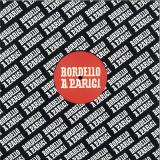
NPVR is the avant garde duo made up of the late Peter Rehberg and Nik Void. Editions Mego is proud to present their second and final release. No this is not some kind of Beatles synthetic AI that raises the dead reconstructed recordings but rather a new album made by the humans and their machines.
The initial meeting of Rehberg and Void was in London in 2016 and despite or due to their mutual awkwardness found solace and compatibility in the fact that they both had a similar electronic modular set up, along with matching cases to transport all. The idea to collaborate was an obvious and organic process as a means to connect their individual gear together and observe the outcome. The fruits of these initial experiments, recorded in London, resulted in the playful experimentation of their acclaimed 2017 release 33 33 (eMego 251).
Now in 2024 Editions Mego presents the logically titled follow up, 33 34. These sessions were recorded six months after the initial recordings at Peter’s home in Vienna. This was planned out as a mirror city release to the original London recordings. With Peter having access to his full studio set up this time around we encounter a rich audio landscape which organically folds together a variety of musical genres blurring any distinction between these forms so the resulting music hovers as a new cloud of sound. Any musical form, be it industrial, electro-acoustic, ambient, drone and techno all coexist and melt into the other as the ensuing result unveils a hypnotic swarm of divergent sounds (music). When active there were no lines or contexts with NPVR, either between sound or genre within these recordings or live where NPVR were at home playing at a techno club one night and an avant garde venue the next.
The initial session of these recordings was edited by Rehberg and sent to Void to further develop. Over time the final versions were agreed on and then shelved as other outside projects took over. The awkwardness had been surmounted and the two had become close friends. NPVR performed at a range of venues such as Tresor, Sutton House, Corsica, Blitz, Paris GRM #Focus2, LEV Festival and Rigas Skanumezs Festival. Following Rehberg’s untimely passing Void had difficulty listening back to the sessions but eventually thought it fit to complete and release this album, of which even the artwork (like 33 33, an image from Zurich photographer, Georg Gatsas) had been decided upon prior to Rehberg parting ways.
There is an unmistakable joy to these recordings. One encounters an enthralling exploration of their chosen machines which conveys the excitement of what can be randomly conjured when people speak through such devices. There is no grand statement or argument here, just the sheer thrill of creation and the recorded results of random encounters. The art of collaboration was always a mainstay of Rehberg’s practice from the advent of the MEGO adventure. Rehberg & Bauer was an initial collaboration with former business partner Ramon Bauer. Even at this stage one can hear a relaxed sense of delight in the sheer discovery of sound.
A mix made for the Wire magazine following the release of 33 33 hints at the freedom that comes with endless urge for exploration and discovery. Abstract tracks from Z'EV. Jérôme Noetinger and Jung An Tagen are included alongside British stalwarts The Fall and New Order. There were no lines between pop / academic / underground or mainstream in Rehberg’s world. All of it sat at the same table. It is just matter in the atmosphere, like the diverse exploration found in these recordings that comprise 33 34.
Towards the end of his life Rehberg was obsessing over the immense output of the German ambient musician Pete Namlook. An artist renowned for not only his sprawling catalogue of ambient masterpieces but one who often said his main inspiration was nature. This is apt with regards to the work of NPVR which also aligns with such thought as the intertwining of the two individual artists and their machines results in a natural symbiotic flow, as it happens, just like in the world around us.
Поиск:del close
Все
Swan Song
The vinyl LP at the heart of this éthiopiques 31 tracks 2 to 11 was one of the very last vinyl records ever released in Ethiopia. But above all it represents, we felt, the absolute masterpiece of the Ethiopian Groove – the Swan Song of Swinging Addis. The album leaves a clear idea for posterity of the level of sophistication and mastery that modern Ethiopian music had achieved, before being crushed under the Stalino-military heel of the Derg – as the bloody revolution that was unfolding came to be called.
Ethiopia1976.
The Revolution that broke out in February 1974 rolled on in a ruthless march. The whole of Ethiopian society was utterly stunned. The bouquets of flowers handed joyfully to the first tanks of the coup d'état were to wilt very rapidly. From September 1976 to February 1978, 18 months of Red Terror (the name given by the junta itself) spilled blood throughout the country. This fratricidal conflict took its heaviest toll among students and youth. The shift from feudalism to a cruel and primitive Stalinism left the country's citizens deeply traumatised, and snuffed out any pretence of activism, whatever the sector of society. This ice age was to last for seventeen long years.
ሙሉቀን፡መለሰ Mulukèn Mellèssè Muluqän Mälläsä
It was three tracks by Muluken that served as the opener for éthiopiques-1 more than 25 years ago. Seven more tracks appeared on éthiopiques-3 and 13, all accompanied by The Equators, which was soon to become the Dahlak Band.
The first track, Hédètch alu, also the very first piece that Muluken ever recorded, left audiences both unsettled and amazed. Reflecting the singer's extremely young age (he was just 17 at the time), this angelic voice mystified many, who thought they were in fact listening to a feminine voice. He was not yet 22 when he released his last vinyl record in 1976 with Kaifa Records (KF 39LP), one of the very last to be issued in Ethiopia, before the cassette tape became the dominant medium for music distribution – and before the new revolutionary regime put a stop to all independent musical life, via an unspeakable barrage of prohibitions and other persecutions.
Mulu qèn, literally, “A well filled day”. This tender maternal intention wasn't enough to ward off the cruelty of fate. His mother's premature death drove Muluken to leave his native Godjam, in northeast Ethiopia, to live with an uncle in Addis Ababa. Born Muluken Tamer, he took his uncle's last name – Mèllèssè.
The spelling Muluken appeared in his administrative records. Transcription of Amharic to the Latin alphabet, both in Ethiopia and for scholars, gives rise to controversies and quibbles that can never be neatly settled. French allows for a closer approximation of the original pronunciation, thanks to its battery of accent marks, confusing as they may be to anglophones.
Between rather accommodating administrative record-keepers and the various versions that pop up in interviews given by the artist, Muluken's year of birth oscillates between 1953 and 1955…
1954? One thing is certain: the artist's talent made itself known very early indeed, because he got his start in 1966-67, at the age of 13 or 14. Photos from the period attest to his extreme youth. It's a strange sort of initiation for a very young teenager to become a sensation in the heart of Addis's nightlife at the time, Woubé Bèrèha – the Wilds of Woubé. And what's more, in the club of the Queen of the Night, the Godjamé Assègèdètch Alamrèw herself, the very same that was portrayed by Sebhat Guèbrè-Egziabhér in his novel-memoir Les Nuits d’Addis Abeba2… The legendary female club owner who is remembered to this day by the capital's ageing boomers.
Muluken first tried his hand at the drums, before he grabbed the microphone. He emigrated briefly to the Zula Club, across the street from the old Addis Post Office, one of the ground-breaking bars of the burgeoning musical scene, before joining the Second Police Band in 1968, for around three years. He spent a few months with the short-lived Blue Nile Band founded by saxophonist Besrat Tammènè. As the musical scene grew increasingly successful, and pulled slowly but decisively away from its institutional ties, Muluken released his first 45rpm single in February 1972 (Amha Records AE 440). It was included in two LP Ethiopian Hit Parade compilation albums in September of the same year. All in all, Muluken released eight two-track 45s and the same number of original cassette tapes between February 1972 and 1984, the year that he departed for permanent exile in the USA. After converting to Pentecostalism in 1980, Muluken gradually abandoned all secular musical activity. In 1985, at the end of a concert in Philadelphia, he decided to quit concerts and recording for good. Mèlakè Gèbré, the historic bass player from the Walias band who was playing with him that night, recalls that everything appeared so irredeemably diabolical in Muluken's eyes, that it was to be the end of his contribution to Ethiopian Groove.
The end of the story, the beginning of a legend.
Dahlak Band, forgotten by History
Aside from his personal history and vocal talents, it must be remembered that Muluken Mèllèssè was one of the biggest names in the musical innovations that marked the end of the imperial period. These éthiopiques aim to convince those who are just discovering this hidden gem... As for Ethiopians themselves, they are to this day captivated by this singular and atypical figure in the Abyssinian pop landscape – even though he withdrew from public life some 40 years ago. Incorrigible devotees of poetic twists, of more or less hidden meanings, Ethiopians appreciate above all the care Muluken took in choosing his lyrics and the writers who penned them, such as Feqerte Haylou, Alemtsehay Wodajo and, here, Shewalul Mengistu (1944-1977). Love songs, written by women, a far cry from the conventional drivel that pleases sappy sentimentalists.
Muluken is equally acclaimed for his perfectionism when it came to music, the opposite of the overly casual approach that is all too common. He remained a faithful partner of musicians who came from a lineage that borrowed from several inventive and pioneering bands (Venus, Equators, Dahlak). Amongst them were certain artists who began their musical lives with Nersès Nalbandian at the Haile Sellassie Theatre and who come of age in around 1973 – at just the wrong time, you might say. Among them were the pillars Shimèlis Bèyènè (trumpet), Dawit Yifru (keyboards) and Tilayé Gèbrè (sax & flute). Most notably Tilayé Gèbrè, certainly one of the most important musicians, composers and arrangers of his generation, of the end of the imperial era, and of the early years of the Derg.
It was only in 1981 that a miraculous opportunity arose for Tilayé to escape the Stalinist paradise of the dictator Menguistou Haylè-Maryam. Once again it was Amha Eshèté (1946-2021) who provided a solution. The spirited and courageous producer, who had been in exile in Washington since 1975, succeeded, thanks to his incredible perseverence, in bringing the Walias Band to the USA. It was, in fact an extended Walias Band comprising ten musicians3, six of whom chose to slip away after a few concerts and the recording of an LP (The Best of Walias, WRS 100). Tilayé Gèbrè was one of these. He has been living in the USA ever since. There he joined the then-nascent Ethiopian diaspora, which lived largely unto itself, and was making only very modest headway in the American musical market. It seems unfair that Tilayé Gèbrè and the Dahlak Band were not able to benefit earlier from the public recognition that they do deserve.
A similar draining away of the top-rate talents would lead to the reorganization of the major groups of the “Derg Time”. The remaining artists spread themselves around between Ibex Band (renamed Roha Band), Ethio Star Band and a remodeled Walias Band. That spelled the end of the Dahlak Band.
With this record, produced by the essential Ali Abdella Kaifa a.k.a. Ali Tango, we can appreciate everything that the Derg not only destroyed, but also prevented from flourishing. This gem of Ethiopian-style afrobeat came out in 1976 (and, by way of a parenthesis, before the FESTAC 1977 in Lagos, which was attended by an impressive delegation of Ethiopian musicians — although Fela was already personna non grata in his own country). Despite everything that might distinguish this ethio-groove from Fela’s music – no colonial axe to grind, no question of political confrontation with the authorities, no claims to negritude or Africanism for the Ethiopian musicians, and less extrovertion! –, this LP fits beautifully into the saga of intense and electrified soul of the new “African” groove that Fela and Manu Dibango embodied so well from that point onwards.
In restoring this record to its place in the afrobeat epic, it can be seen that, if nothing else, the timeline bestows a legitimate pedigree and a historical primacy to works that had no international impact when they were originally released.
Warning! Masterpiece!
For the first time, Endrik Schroeder and The Hacker have joined forces. Their unique sounds and styles have combined seamlessly to produce a 12” that draws on their own musical histories. The title track pulls the listener into a darkened sweaty basement, a space where neon lights leer and quivering speakers vibrate. Melting elements of new beat and rave revelry, the track is bawdy and bold. Robotic samples cut through siren blasts, clean snare rolls skidding in thick basslines and creamy breaks.
Two remixes follow, both care of fellow French producer: Back From The Wave. First up is the “Breaky Remix”. Adhering to the club origins of the source material, this remake sends melodies ever higher as drums lift elated lines to the stern refrain of “Emergency”. The “Indie Remix” closes. The glowsticks are sheathed in this version, instead it is the soaring keys that are given the limelight with beats bolstered for extra bite. Three tracks set to delight and ignite dancefloors.
- 1: Guitar Song
- 2: Fruit & Iceburgs
- 3: Between Time
- 4: Fruit & Iceburgs (Conclusion)
- 5: Blue My Mind
- 6: Keeper Of My Flame
“Godzilla just walked into the room. People just stood there with their eyes and mouths wide open.” To hear Randy Holden describe the audience’s reaction in 1969 to his solo debut performing with a teeth-rattling phalanx of 16 (sixteen!) 200 watt Sunn amps is about as close as one will get to truly experience the moment heavy metal music morphed into existence. However, at last Riding Easy have unearthed the proper fossil record. Population II, the now legendary, extremely rare album by guitarist / vocalist Holden and drummer / keyboardist Chris Lockheed is considered to be one of the earliest examples of doom metal.
Though its original release was a very limited in number and distribution, like all great records, its impact over time has continued to grow. In 1969, Holden, fresh off his tenure with proto-metal pioneers Blue Cheer (appearing on one side of the New! Improved! Blue Cheer album and touring for the better part of a year in the group), aimed for more control over his band. Thus, Randy Holden - Population II was born, the duo naming itself after the astronomical term for a particular star cluster with heavy metals present. “I wanted to do something that hadn’t been done before,” Holden explains. “I was interested in discordant sounds that could be melodic but gigantically huge. I rented an Opera house for rehearsal, set up with 16 Sunn amps. That’s what I was going for, way over the top.” And over the top it is. The six-song album delves into leaden sludge, lumbering doom and epic soaring riffs that sound free from all constraints of the era. It’s incredibly heavy, but infused with a melodic, albeit mechanistic, sensibility.
Troubles with the album’s release bankrupted Holden, who subsequently left music for over two decades. It was bootlegged several times over the years, but until now hasn’t seen a proper remaster and has yet to be available on digital platforms. “The original mastering just destroyed the dynamics of it,” Holden says. “They flattened it out. Now we got a really nice remaster that should be the closest thing to the original recording.”
Final LP of a productive year for Feral Child is an absolute cracker. The latest of a long line of superb full lengths from Stephen James Buckley's incendiary Polypores project. This one is arguably his most adventurous outing to date, the undeniably psychedelic “Hungry Vortex”. Four extended pieces exploring polyrhythmic fixations and cosmic jazz-prog freak-outs. Percussion-heavy opener ‘The Body Is The Spaceship’ is a fine example of the sort of seamless organic growth we tend to see in Polypores’ music, with slewed synth blips and rolling polyrhythms gradually twisting into unrecognisable strands of melody and unconventional groove before your very ears.
The prog-heavy ‘Wizards!’ sees Buckley’s trademarked playful use of time-signature changes, providing such a wealth of emotional and stylistic variance and immeasurable enjoyment without changing key once (honestly, who needs keys). It’s brilliantly evocative too and could indeed perfectly soundtrack a mushroom-trip wizard march. As we flip the record over, the flutey flourishes and minimalist clicks of the title track draw the listener into a trancelike state, repeated movements spiralling like myriad creatures crawling over a candy-coloured horizon, echoing forth into an inviting sonic oblivion. It’s ostensibly electronic, yet somehow more natural organism than machine, with little concern for the grid, or indeed, the rules. Finally, we end on something a little more subdued - the reassuring classicism of the beautiful ‘Void High’, with washes of warm noise and wobbly delay lines whirring and twinkling away, closing the record with an experience that is undeniably emotional, spiritual and as always, uniquely Polypores. This is a wonderful record with which to close the year out, it comes in a magnificent, spot varnished Jake Blanchard sleeve. A superb record released as a one time only vinyl pressing.
- 1: Intro
- 2: Simple Things
- 3: Forever
- 4: Road To Braemar
- 5: Before & After
- 6: Mirrors
- 7: Days Of Lily
- 8: Stepping Stones
- 9: Hope
- 10: Bravery
- 11: Chances
- 12: Stepping Out
Drawing from her constant searching for her own unique sound she filters her love of rhythm and groove through her Nordic sensibility to create an accessible, compelling blend of excitement and introspection. Growing up on the island of Saaremaa in her native Estonia, Britta Virves was a keen piano student playing a strictly classical repertoire. A chance encounter introduced her to jazz: "I wanted to learn guitar. So I went to my teacher Tit Paulus, and he told me to stay with piano, and introduced me to Keith Jarrett, Herbie Hancock, Bill Evans - my mind was blown - a new world opened up." Britta immersed herself in the music and her talent soon attracted attention.
Moving to Sweden to further her studies, she was soon touring Europe with the acclaimed Norrbotten Big Band, under the direction of Joakim Milder, working closely with featured guest vocalist Genevieve Artadi and accompanying Artadi on a duo tour opening for Louis Cole. Each tune on the album draws inspiration from an aspect of Britta's own life. "Simple Things" has the directness of a pop song married to the depth of jazz, as Genevieve Artadi's ethereal vocals float over an insistent backbeat that supports limpid depths of harmony.Other tracks include "Bravery", whoch showcases the subtlety and dynamic control of the rhythm team and is one of Britta's favorite tracks on the album - "I feel it's like a big waterfall that's rushing down and making its path just by flowing naturally." By contrast, "Chances" plays with a neatly delivered set of accents that tie the roots effortlessly
Activity FM returns with AFM002, a high-impact VA exploring the outer edges of electro and breaks. On the A-side, two US heavyweights lead the charge: Detroit’s AMX kicks off with Out My Mind, a sleek and soulful cut with razor-sharp bass and icy vocals, followed by Florida’s Exzakt, a true legend, who drops Fvck That Sh1t - a no-holds-barred club weapon full of pressure and punch.
On the flip, Venezuelan pioneers step in: ARA-U (London-based), head of No Static / Automatic, delivers Feels Like Dancing, a gritty analog heater dripping with machine funk, while Barcelona’s Phran, co-founder of ACA and Vimana, closes with Archivo Criminal, a playful yet driving track built for deep, late-night moments.
Dimelow label boss Bony Fly steps forward with a seven-track cassette + digital release for Equiknoxx Music, marking a heavyweight link-up that’s been years in the making. No stranger to the Equiknoxx universe, Bony Fly has long been part of the extended family—hosting the crew in Geneva and premiering “Rivers Odyssey” on the collective’s NTS show back in April 2020. Since then, plans for a larger project have been quietly taking shape.
Now, in 2025, the vision arrives fully formed: seven Dancehall-meets-Reggaeton scorchers, built for sound systems, clubs, and global dance floors. Bony Fly’s long-time undisputed sparring partner Androo steps in on Dancehall Science to close off the project with style and elegance. A true cross-continental connection—Guatemala City meets Kingston City in fine style, delivered through Bony Fly’s unmistakable global-club energy.
Xexa is still undefined, gliding over her origins, influences, and points of reference. Her music is informed by uploads from all that, processing heritage and future in much the same democratic way, sure of its (her!) path. Synthetic as it may sound, »Kissom« contains the very human element of Xexa's presence, not only through her instantly recognizable ethereal vocals but also manifest in the web of grooves stopping short of »dance«. »Kizomba 003« is the closest she comes to the dancefloor, a reduced take on the popular style of kizomba, a low-key interpretation but with the vocals atypically high in the mix. A brief breath of nostalgia. »Kissom« (title track) prolongs the slow pace, almost as an extended mix of »Kizomba 003«, stretching the sexy bounce for close to 4 extra-delightful minutes.
Everything seems to dissolve into space, as if every track gently expires only to be reconfigured somewhere else, molecule by molecule, perhaps in a different location within our mind. The artist somehow corroborates the feeling, particularly regarding »Será«, »Xtinti«, and »Txe«, which she says »finish exactly where I wanted. They all end with an EQ that mutes the frequencies until they cease to exist«. Here, there, sparse beats, successive waves of ambience, half-machine lips singing close to our ears, a blend of classic 4AD and a metallic environment warmly wrapping around the music. Extra-long, »Quem és tu?« poses the question – Who are we? Who is she? And the title »Kissom« stems from another question Xexa often hears from people, »Ki som é este?« (What is this music?). The answer might well be the artist's own paste of the words »kiss« and »som«. Lovely.
- 1: Vigolais
- 2: Il Volo Del Colibri
- 3: Fra I Petali Del Girasole
- 4: La Notte Dei Cristalli
- 5: Il Fiume
- 6: Free Palestina
- 7: Lava La Pioggia
- 8: Questo Tempo Insieme
- 9: Hasta Siempre
- 10: Rosabianca
- 11: Piccola Canzone Per Noi
The former conscientious objector has long used his music to denounce the abuse of power and advocate for humanity and peace. Now, at a time when war has once again become part of our daily lives - at least in the news - the successful singer-songwriter dedicates an entire album to the subject: Fra guerra e pace (Between War And Peace). " War is a dimension from which humanity has never truly freed itself. A place where destruction and annihilation intersect with other aspects of life - love, birth, hunger, or thirst," writes the artist in the foreword to the album booklet. With this musically and thematically rich album, Pippo Pollina brings us closer to the people behind the headlines, giving life to what we only hear in the news. We are confronted with fear, pain, and grief - but also with hope, love, and poetry
Introversion delivers a powerful five-tracker on FJAAK's CROWD with 'Ghost Rockets', pushing his signature blend of gritty textures, stripped-down rhythms and emotional weight even further. Known for fusing 90s-rooted techno with contemporary clarity, Introversion opens the EP with 'Lights', a track that rides a relentless hardgroove rhythm before lifting off into an epic, melodic climax made for big rooms and peak-time moments. The title track 'Ghost Rockets' follows with the unmistakable CROWD signature: rolling, minimalistic grooves anchored by Detroit-inspired synth stabs and tense, driving percussion. On the B-side, 'Visitors' starts deep and atmospheric, slowly morphing into a propulsive, forward-pushing roller that balances subtlety and pressure. On 'Hessdalen' things take a darker turn: A menacing groove emerges, led by evil synth stabs that march with precision through a hypnotic, unrelenting beat. The EP closes with 'Wow-Signal', a digital-only track that begins with a long robotic intro, building tension before unfolding into a groovy, nerdy banger loaded with synthetic detail and energy. Introversion's 'Ghost Rockets' EP is a high-impact release that balances floor power with intricate design, being a perfect fit for both deep club nights and peak festival moments. The Berliner will present the release as part of the CROWD Showcase along with label-heads FJAAK on November 29th at Gew?lbe in Cologne - make sure to be there in the first row!
- Mobali Nakobala (Nico – Ngoma J 5127, © Sukisa) Rumba Lingala
- Nalingi Yo Na Motema (Nico, Chantal – Ngoma J 5130 © Sukisa) Kiri-Kiri
- Mokili Makambo (Nico – Sukisa 93) Kiri-Kiri
- Ata Osali (Chantal – Ngoma Dnj 5214, © Sukisa) Rumba Lingala
- 1: Er Boeing (Kwamy – Air Congo) Merengue
- Hommage A Lumumba Patrice (Sukisa 44) Mabanga
- Bougie Ya Motema (Nico – Sukisa 47) Rumba Lingala
- Okosambuisa Ngai (Mizele – Sukisa 66) Rumba Lingala
- Sule (Nico – Sukisa 50) Rumba Lingala
- Okosuka Wapi ? (Josky – Sukisa 110) Danse Kono
- Kamungaziko (Lessa Lassan – Sukisa 114) Danse Kono
- Mokili Matata (Nico – Tcheza 10.001; © Sukisa) Rumba-Kono Lingala
- Baoulé (Lassan – Sukisa 99) Kiri-Kiri
- Beauté (Nico – Sukisa 101) Rumba Lingala
- Mansanga (Nico – Sukisa 131) Rumba Lingala
- Souzi (Sangana – Sukisa 117) Rumba Lingala
- Naboyi Koswana (Sangana – Sukisa 120) Rumba Cha Cha
- July (Julie – Sukisa 120) Madre Rumba
- Runeme Mama (Nico – Sukisa 47) Cha Cha Cha
- A Morow (Arr. Nico – Sukisa 66) Cha Cha Cha
- Apôtre Del Si Boney (Apôtre – Sukisa 73) Charanga
- A La Savana (Arr. Nico – Sukisa 62) Pachanga
- Alto Songo (Arr. Nico – Ngoma J5126, © Sukisa) Rumba Espagnol
- Para Bailar (Nico – Sukisa 50) Pachanga
- Meta Fua Mudia (Kaba – Sukisa 118) Rumba Lingala
- Exhibition Show (Nico – Sukisa 135) Instrumental
- Exhibition Dechaud (Dechaud – Sukisa 71) Instrumental
- Bolala - Ayando (Nico – Sukisa 132) Extrait Show Kasanda
- Excitation - Makwandungu - Ngombele (Nico – Sukisa 132) Extrait Show Kasanda
- Kamulangu
'In collaboration with the children of Nico Kasanda, better known as Docteur Nico, Planet Ilunga proudly presents an anthology dedicated to African Fiesta Sukisa, available as a 3LP set and a digital release with bonus songs. This release is the result of many years of preparations and was realized in close partnership with Liliane Kasanda, Nico’s eldest daughter. Marking forty years since his passing, we felt that the year 2025 was the right time to honor Docteur Nico’s legacy with this original collection.
'Almost all of the African Fiesta Sukisa songs were released on Nico’s Sukisa label which translates in Lingala for “the final accomplishment”. The music on Sukisa, crafted by Nico and legendary vocalists such as Chantal, Sangana, Apôtre, Mizele, Lessa Lassan and Josky, embodies the essence of that powerful phrase with genius, class and depth. The label ran between 1966 and 1975 and released approximately 280 songs. Ngoma also issued the group between 1967 and 1971 and, in addition, reissued material from the Sukisa label. Many of these songs have become part of the collective memory of Congolese society and are still heard, discussed, and analyzed daily across digital platforms worldwide, as well as on numerous Congolese radio and TV stations.
'The album we put together features some of Nico’s signature songs alongside never before reissued tracks from the Sukisa catalog. It furthermore contains a large booklet with song commentary, testimonial interviews from well-known musicians, journalists, fans and Nico’s entourage, besides never before published photography about his personal and musical life.
'Alastair Johnston, author of the book ‘A Discography of Docteur Nico’ and longstanding Planet Ilunga collaborator, designed a stylish booklet and cover using all our collected material. Audifax Bemba, longtime admirer, compiler and connoisseur of Nico’s music, and the author of most of the song commentary in our accompanying booklet, offers his portrait of Docteur Nico:
“After displaying technical virtuosity with African Jazz, expert and accomplished guitar with African Fiesta, which musicologist Sylvain Bemba described as a dream guitar, Nico Kasanda was consecrated ‘dieu de la guitare’ by the public in the late sixties. With his band African Fiesta Sukisa, Docteur Nico displays his wide palette of unusual sounds. While exploring the Hawaiian guitar with its clear, airy, plangent, psychedelic effluvia, he continues to replicate the piano comping technique, and adds two missing strings to his bow: a simulation of the sanza (likembé or thumb piano), whose sounds he reproduces right down to the noisemakers of the tiny tin rings, on the one hand, and the sounds of the Luba balafon on the other. The right note, in the right place, at the right time, is the triptych on which Nico Kasanda’s playing is based, a note dressed in the perfect sound. A guitar of pure emotion. With African Fiesta Sukisa, his playing takes a ‘Chopin-esque’ turn, sending out more notes in a sublime adagio. The true artist is the one who simplifies everything. Docteur Nico is a genius of our time, whose style makes him the supreme exponent of the most important guitar school in Congolese music. He is recognized by his peers as the greatest African solo guitarist of all time. Sculpting sound in a tireless quest for beauty, Nico Kasanda has sublimated the guitar throughout his career.”
[xd] Kamulangu [Outro] (Dr. Kasanda – Sukisa 135) Folklore Baluba
- A1: I Am The Stars
- B1: My Blue Heart
Featuring the otherworldly vocals of the legendary jazz singer Norma Winstone whose vocals were recently sampled in Drake's 2023 chart topping single IDGAF (feat. Yeat) and Leo Taylor (Floating Points, Hot Chip, Joy Crookes) on drums, the EP is the amalgamation of Barrott's long term fascination with sunset music, and the ways the change of seasons impact the way we co-exist with the sun. As winter draws closer and we move on from the Autumn equinox to Winter solstice, Barrott's latest release captures the transformative yet paradoxical feeling of melancholy over the end of Summer and the start of winter while creating an eerie sensation of serenity.
The EP follows from the release of Barrott's critically acclaimed and deeply personal 2024 album Everything Changes, Nothing Ends.
The new EP sees Barrott return to his beloved sunset music, as he continues his eternal quest to find new ways to soundtrack this sacred Ibiza moment.
Crowned as the"master of sunset music"by Pitchfork, Barrott's new EP is filled with celestial grandeur that stops you in your tracks. A profound musical meditation and an homage to the sunsets of the Autumn months, the EP captures the sonic poetry of the changing skies and the seasons.
The haunting combination of Barrott's production & arrangement skills, Taylor's jazz drums and Winstone's endlessly ethereal vocals soar in a harmonious union across the title track of the EP while the openerI Am The Starssummons you in for a brief respite from the cacophony of the modern world. The wistful second trackMy Blue Heartlingers with you with its melancholic jazz horns swelling side by side with Winstone's vocals while the closing trackI Am The Airfloats through your ears with its sublime contemplativeness. I Am The Sun, You Are The Moonsees Barrott returning to his sonic ruminations on sunsets, however they are more profound and life affirming than ever.
"At the end of the summer, on a clear bright starry night I climbed to the top of a mountain in Ibiza with a pair of headphones and listened to these tracks and lost myself in the vastness of the night sky and the endlessness of Norma's voice. At that moment everything made sense in my world for the first time in a long while and it just felt right",Mark Barrott says.
"I was surprised and delighted to be asked to participate in this very musical project and to be given such a free hand. Trying to integrate the voice into what were already beautifully formed pieces was creatively very interesting", Norma Winstone says
- 1: Signed, Sealed And Delivered
- 2: Along The Coast
- 3: Two Brothers (As One)
- 4: Close Call
- 5: Donkey
- 6: In Good Hands
- 7: Exactly Like You
- 8: Say It Again
- 9: Cruisin
- 10: Leaving Paradise
- 11: On A Roll
- 12: Quite Logical
- 13: All That Matters
- 14: Watching The River Flow
It was in Studio 4 of WDR in January 2022 when Simon Oslender first met Steve Gadd during the recording session for the album 'Centerstage'. Guitarist Bruno Muller was also there. The chemistry between the musicians was right from the very first time they played together. At the end of the session, Steve Gadd said to Simon and Bruno: "We'll do more together." And that's exactly what happened! Simon Oslender's highly successful studio album 'All That Matters' was recorded at the end of 2023.
Will Lee was also there on bass, who together with Steve Gadd has been one of the most famous rhythm sections in pop and jazz history for almost 40 years. At the end of the recording session, it was clear to everyone involved: this band had to go on tour to present this music to fans live. In December 2024, the time had come. The band, joined here and there by guests Jakob Manz on alto saxophone and Nils Landgren on trombone, went on tour. All concerts were sold out; the atmosphere in the respective venues was magnificent; thunderous applause and encores in every club or concert hall. Every concert was recorded. Now the result is here. An album full of joy, musicality, spontaneity, creativity, and incredible grooves! 'On A Roll - Live', a concert to take home with you. It doesn't get any better than this!
Texan deep house don Rami invites you into an evocative world here that is part soothing late night charmers, part avant-garde electronic experiments and part cruising late night grooves. 'First' is a deliciously drowsy sound to get you on side, then 'Popsumn' shakes things up with bleeping synths, fragmented vocals and warped pulses. There is a moment to pause amidst lush ambient on 'After You', daydream in the cuddly kicks and far-sighted pads of 'I Like This' and gaze off into the distance on the far-sighted 'Bedtime'. 'Sex! Closes with a steamy late-night pulse that could well get you in the mood.
- 1: Bound
- 2: A Love That Hurts
- 3: Breathe
- 4: Feeling Lucky
- 5: Flickering Light
- 6: I Know
- 7: Blackout
- 8: Stalemate
- 9: Hang On
- 10: One Of Us Cannot Be Wrong
Sugaring a Strawberry, the sophomore record from Julia, Julia, is a study in coming undone—on purpose. Recorded at COMA, Julia Kugel's home studio, and mixed through a custom Flickenger clone, the album drifts in and out of clarity like memory itself. It's emotionally retrospective, creatively unvarnished, and deeply human. You can hear it in the hiss, the warmth, in the vocals so raw they're like an open window. These songs weren't engineered for perfection. They were built to breathe. Her long-time collaborator and husband, Scott Montoya, mixes it all so loosely that you can hear the air between tracks— a space that makes the music feel inhabited rather than recorded.
"Bound" opens the album like a secret passed between sisters, solemn and unspeakably close. It begins with the softest of touches: hushed guitar, a near- whispered delivery that carries the intimacy of someone singing only for one other person. It's a love song, but not romantic, more ancestral in the way long bonds can be. All glow and undercurrent, "I Know," is like hearing someone hum through a wound. The track arrives as if it had been waiting, coiled and complete, to be sung. Its pulse is slow but insistent, anchored on a hypnotic loop and a vocal that's half-incantation, half-confession. One of the most outward-facing songs on the record, "Feeling Lucky," opens like a cigarette flicked in the dark– smoky and a little bit slick. Built on a skeletal beat and a nearly detached vocal, it leans into a sarcastic swagger that barely masks the ache beneath. The delivery is droll and glazed, the instrumentation is sparse and a little woozy, leaving space for her voice to sway—a shrug of a song, stylish in its sadness. "A Love That Hurts" drifts in on soft, fingerpicked guitar and a dry, close-mic vocal that feels both haunted and immediate. The mix is stripped down and analog-warm, letting tape hum and silence frame the emotion. Julia sings like she's remembering something she doesn't want to, each line a slight unraveling. Like the rest of the album, "A Love That Hurts" doesn't push toward resolution. It sits in the ache, sifts through it, makes it beautiful.
Sugaring a Strawberry doesn't seek catharsis so much as stumbles into it. There's a quiet volatility to these songs like they might fall apart if you press too hard. It moves in shadow and softness, asking questions it doesn't answer. It doesn’t end with closure. It ends with truth.
- A1: Pilgrim (Live In Warsaw 2014
- A2: Resurgam (Live In Den Haag 2017)
- B1: Looking Too Closely (Live In Berlin 2014)
- B2: Shakespeare (Live In Vienna 2017)
- B3: Truth Begins (Live In Amsterdam 2014)
- C1: We Watch The Stars (Live In Berlin 2019)
- C2: Hard Believer (Live In Berlin 2014)
- D1: Bloom Innocent (Live In Antwerp 2019)
- D2: Not Everything Was Better In The Past (Live In London 2017)
- D3: This Isn’t A Mistake (Live In Paris 2017)
Der zweite Teil von "Wheels Turn Beneath My Feet" enthält über ein Jahrzehnt von Finks weltweiten Live-Auftritten, von Berlin über London und Amsterdam bis Antwerpen, Paris und Warschau. Beide Formate erscheinen als limitierte Deluxe-Editionen. Die CD im Hardcover mit 24-seitigem Booklet, die 2xLP im Gatefold mit 32-seitigem Booklet, beide Formate mit Glanzmotiv. Fink veröffentlichte 2024 sein hochgelobtes Studioalbum "Beauty In Your Wake" und tourte anschließend ausgiebig um den Globus.
- 1: Intro
- 2: The Wonders At Your Feet
- 3: The Treason Wall
- 4: Hedon
- 5: White Noise
- 6: Black Silence
- 7: Haven
- 8: Punish My Heaven
- 9: Monochromatic Stains
- 10: Undo Control
- 11: Indifferent Suns
- 12: Format C: For Cortex
- 13: Insanity's Crescendo
- 14: Hours Passed In Exile
- 15: The Sun Fired Blanks
- 16: Damage Done
- 17: Lethe
- 18: Not Built To Last
- 19: Therein
- 20: Zodijackyl Light
- 21: Final Resistance
- 22: Outro - Ex Nihilo
Black Vinyl[35,08 €]
It's taken over two decades, but at last, the wait is over: Sevan Mater has unleashed the first- ever vinyl pressing of Live Damage , the iconic live performance by DARK TRANQUILLITY, captured during their "Damage Done" era. Pressed on Gold and Black swirl vinyl, limited to just 500 copies, and housed in a stunning gatefold cover, this reissue is nothing short of melodic death metal heaven. Originally released in 2003 as a DVD, Live Damage immortalized one of DT 's most intense and electric live shows - recorded in Krakow, Poland. Now, for the first time ever, that raw energy, that iconic Swedish aggression, and that perfectly balanced blend of melody and brutality has been etched into vinyl grooves for audiophiles and collectors alike. From the soaring leads of The Treason Wall to the punishing drive of Final Resistance, every track explodes with clarity and presence on wax.
The vinyl mastering brings new warmth and immediacy to the performance, giving fans the closest thing to being there, without the sweat and flying beer. And the packaging? Absolutely elite. Sevan Mater delivers a luxurious gatefold, featuring rare tour photos, liner notes, and an aesthetic drenched in cold, melancholic elegance. If you're a fan of At The Gates, In Flames, or if Damage Done was the soundtrack to your early 2000s fury, this release is a must-own. More than just a live album - it's a time capsule of melodic death metal at its peak.
- 1: Before It's Too Late
- 2: Here We Go Again
- 3: Watercolor
- 4: Tara
- 5: The Sunrise
- 6: Wants To Break Through
- 7: Stopped At A Green Light
- 8: Alternate Route
With ten original compositions (and one well-chosen cover) to record and a schedule window of just one day in New York City to record them, there was no margin for error. For the frontline Kerry picked a pair of legends - Kurt Rosenwinkel on guitar and Jaleel Shaw on alto and soprano sax. In the rhythm section she selected NYC's busiest bassist Alex Claffy and, keeping it close to home, her partner George Colligan on drums. And in the face of delayed flights and traffic hold- ups, the album Alternate Route was created, hitting the highest standards of performance with the depth and warmth of Kerry's challenging but engaging compositions. It's a set of tough and tender tunes that combine sophisticated harmony with intricate but accessible melodies to inspire some fierce blowing from everyone, all delivered with a concise, timely precision.
The empathy and good feeling flowing between the players are audible from the first notes: "Kurt, Jaleel and Alex all have Philly roots so there's a really strong relationship there. Alex is incredibly gifted, and Jaleel is such a beautiful player with such a huge, recognizable sound. And it was such a thrill to have Kurt on the album - he's one of my favorite composers and I've been a fan for such a long time." Each player has a powerful personality and Kerry allows them free rein, yet such is the strength of her compositions, and her calmly stated but immensely powerful presence on piano, that no one player dominates the music: everyone finds their own alternate route to excellence.
Sonetos del Amor Oscuro is an ode performed by four enchanted souls who have intertwined their hearts and conjured harmonies and rhythms that wander endlessly among the spellbinding words of a poet from Granada... Federico García Lorca;
He wrung, pushed and vibrated words like tectonic plates, transforming plains into poetic mountain landscapes. He then covered them with a Moorish carpet of snow crystals and had them reflected by the dark locks of hair of a gypsy girl from Albaicín who, with a voice forged in gold and silver, sings her little sister to sleep with a soothing lullaby.
Helena Casella – vocals
Myrddin De Cauter – flamenco guitar
Stijn Kuppens – cello
Stefan Bracaval – flute, bass flute
Helena Casella, the Belgian-Brazilian vocalist with a deep, soft and warm voice, translates her multicultural background and personal thoughts into music in a passionate, soulful and refined way. With her roots in an exceptionally musical family, her music exudes this unique heritage. She effortlessly interweaves genres such as R&B, soul, hip hop and modern jazz, while remaining true to the vibrant sounds of Brazil, an essential part of her roots.
Her debut album was released earlier this year on W.E.R.F. records.
Myrddin De Cauter's music is deeply moving, complex, passionately rhythmic and deeply emotional. He has mastered the compás of flamenco, which gives him the freedom to converse with elements from jazz or classical music. His speed sometimes seems otherworldly, but those who take the time to listen closely to his music will quickly discover an immense world of pure emotion, beauty and tranquillity. After six albums and countless concerts, Myrddin proves that great virtuosos do not necessarily have to come from Spain. At the tender age of eleven, his father taught him to play the clarinet in jazz and gypsy swing style; he became part of the family orchestra and gained his first experiences on stage. A classical melody composed on the guitar prompted him to ask his father to teach him the basics of flamenco guitar. Soon after, Myrddin seemed ready for the real thing and went to Andalusia to learn from Manolo Sanlucar and Gerardo Núñez. This inspired him to compose in his own unique language, deeply rooted in the pure flamenco tradition but enriched by boundless creativity.
Stijn Kuppens is a cellist, composer and producer. In his own genre, which he describes as non-classical cello, he uses the cello in his own unique way. His profound knowledge of the complex history and techniques of the style is clearly audible: Kuppens' mastery of classical music is evident in every note he plays, whether he is performing solo or collaborating with other musicians. His skill as a musician and ambition to explore the boundaries of conventional classical music is evident in his ability to seamlessly blend different genres.
Stefan Bracaval is a classically trained flutist who graduated from the Royal Conservatory of Antwerp. His fascination with the expressive potential of improvisation led him to jazz, where he became a self-taught jazz flutist. Bracaval has collaborated on projects with prominent jazz figures such as Charles Loos, Bert Joris and the Brussels Jazz Orchestra. In addition, he worked as a soloist and arranger with the VRT Radio Choir in 2016. Bracaval leads the Stefan Bracaval QU4RTET, which emphasises the flute as a central jazz instrument and brings new repertoire rooted in jazz traditions.
Live
31/10/2025 – Café Silverio, Gent (BE)
15/01/2026 – Kloosterkapel Diepenbeek (BE)
16/01/2026 – ‘t Ey, Belsele (BE)
17/01/2026 – Sint-Luciakerk (kerkconcerten Merode), Engsbergen (BE)
23/01/2026 – Muziekcentrum Dranouter (BE)