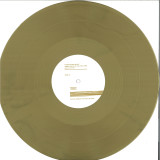
Gold Vinyl
Since 2008, "438Hz As It Is, As You Are" is "only" the third solo release from Tomoyoshi Date. The last one dates from 2011. Less is more.
In parallel, from 2013 to 2021, he has recorded some releases in collaborations with Toshimaru Nakamura, Ken Ikeda, Stijn Hüwels, Asuna and Federico Durand.
"This record was recorded on Diapason's upright piano made in the 1950s at the house of his maternal grandmother's sister (*). The piano has moved and tuned many times, and now it has arrived at my living room. It was a pre-mass production piano with a thick board and good sound, but I couldn't tune it without replacing the screws and the weakened base. After consulting with the tuner, I decided to tune the whole tune to the sound of the strings wound around the loosest and most inseparable screws. "As it is"
*Mikiko Yamada: A performer who formed a Japanese music group of contemporary Japanese music in 1964 and made Biwa the first five-line score. She also had a samisen, so I called her "Aunt Pen Pen". Her husband was a shakuhachi player, so she was "Uncle Boo Boo".
When I tuned in the summer, I tried to tune at 442kHz, but I changed the tune in the winter to 438kHz. From now on, the pitch of this piano will decrease year by year as the material ages. I will play the decaying piano and continue to record music that can only be done at that time.
When you drop a needle on a record, a sound is produced on the spot, and the sound constantly changes depending on the air, temperature, and humidity around the needle. The sound also affects all of the listener's life, affecting the frequency of the person's body and mind. The effect of the sound once generated will last forever.
This work was created with the intention of having the listener adjust the pitch at the desired speed according to the mood and frequency of the listener at that time. With a little faster 45 turns, you can listen to this dilapidated piano at 440kHz or 442kHz. You can slow it down, or adjust the number of rotations as you like, whether it is 33 rotations early or late. I really like the stretched sound of the recorded piano. When you want to relax, use slow music to adjust the pitch of the space around you, the creatures, and your own body and mind. "As You Are"
Tomoyoshi Date
Buscar:dep
180 g, Side D etched, matte UV Poster, Trifold Jacket, red foil debossed "D"&"M", Poster
"Memento Mori" stellt Depeche Modes insgesamt 15. Studioalbum dar, während Gahan und Gore nach dem tragischen Tod von Bandmitgründer Andrew "Fletch" Fletcher im Jahr 2022 den ersten Longplayer in zweiköpfiger Besetzung vorlegen. Produziert von James Ford mit Unterstützung von Marta Salogni reifte "Memento Mori" während der Frühphase der weltweiten Covid-Pandemie heran; eine Periode, die auch einen thematischen Einfluss auf die Songs hatte. Die 12 Albumtracks schlagen die Brücke zwischen einer Vielzahl von Stimmungen und musikalischen Texturen - angefangen beim bedrohlichen Opener bis zur Auflösung am Schluss spannt sich das Gefühlsspektrum von Paranoia und Besessenheit bis hin zu psychischer Befreiung und Freude sowie zahllosen emotionalen Zwischentönen. Mit der Single "Ghosts Again" geht der Albumveröffentlichung von "Memento Mori" ein eindrucksvoller Vorbote voraus. Der Song stellt schon jetzt nicht weniger als einen lupenreinen Depeche Mode-Klassiker dar: Dave Gahans bilderstarke Lyrics wie "wasted feelings, broken meanings... a place to hide the tears we cry" verbinden sich über einem erhebenden, optimistischen Groove mit einer hypnotischen Gitarrenfigur von Martin Gore. "Für mich fängt `Ghosts Again` das perfekte Gleichgewicht zwischen Melancholie und Freude ein", so Gahan. "Es kommt nicht allzu oft vor, dass wir einen Song aufnehmen, den ich mir nicht nur immer und immer wieder anhören kann - ich freue mich auch riesig, ihn mit der Welt teilen zu dürfen", ergänzt Gore.
- A1: Time
- A2: No Limit Of Stars
- A3: Undertow
- A4: Bullfighter (Hand Of God) (Hand Of God)
- B1: The World Of Invisible Things
- B2: Epoch
- B3: Diamonds & Coal
- B4: Rings Of Saturn
- C1: Made From Love With Far To Go
- C2: The Pearl (Part Ii)
- C3: Someday My Love Will Come
- C4: The Day I Meet My Murderer
- D1: Between The Ocean & The Storm
- D2: I've Been Waiting
- D3: Cradle Song
It’s been seven strange years since The Veils’ last studio album Total Depravity, and Finn Andrews has a new double LP to show for it. "...And Out Of The Void Came Love" is the result of this tumultuous period of injury, isolation and new life...
Following the release of Total Depravity, Andrews released a solo album and began a worldwide tour. One night, while lashing out at a particularly intense moment on piano, he broke his wrist on stage. “It sounds wild and Jerry Lee Lewis-esque, but it was an absolute fucking nightmare,” Andrews says. He played on and finished the rest of the tour, but it wasn’t until he got it examined much later that he realized what a bad move that was. “The scaphoid bone in my wrist had died, which I didn’t know was possible. My sister said that at least it was a really ‘on brand’ injury for me.”
Finn’s convalescence meant a lengthy hiatus from touring, so he did what he does best and stayed at home and wrote songs. “I was in a cast and couldn’t use my right hand. I sang the melody lines, then recorded the right hand piano part, then the left hand part. It might have been an interesting, avant-garde process if it wasn’t also just profoundly annoying.”
Just when his hand had healed sufficiently for him to play again, The Veils found themselves in need of a new record label but Finn set about starting to make a new record regardless. Producer Tom Healy invited Finn to his small studio underneath the old Crystal Palace ballroom in Mount Eden, and they listened through the legions of songs he had amassed throughout the previous year.
“Tom was incredibly patient, it was a really laborious process - I brought a lot of junk down there and we had to sift through it all to try and find the parts worth saving.”
Following another two years of intermittent recording between lockdowns, Finn’s wife became pregnant, and yet more songs started coming.
By the time the songs had been recorded, it was clear that arranging the album into two halves best suited such varied material - but the meaning of the songs as a whole still eluded Andrews. “Then my daughter was born, and suddenly the whole record made sense to me,” he says. The music was telling a story, and somewhat strangely for The Veils, it seemed to have a happy ending.
The result of all these years of questioning, confinement and precarious uncertainty is the magnificent new double album from The Veils … And Out Of The Void Came Love. It is an album intended to be listened to in two sittings with a short break in the middle, or as Andrews instructs: “Make a coffee or smoke a cigarette – but don’t mow the lawn or go to the movies or something, that takes too long.”
Composer Victoria Kelly’s soaring string arrangements play an integral role in bringing the songs to life, as do musicians Cass Basil (bass), Dan Raishbrook (lap steel, guitar), Liam Gerrard (piano), Joseph McCallum (drums) the NZTrio and special guests the Smoke Fairies on backing vocals.
“Refreshingly passionate… Andrews rages with a Herculean intensity.” The Guardian
“Horse-whipped, lightning-crash clamor… magnetic.” Pitchfork
“One of the finest songwriters of his generation.” Drowned in Sound
- 1: Sea Breeze
- 2: Hercules
- 3: Heat Haze
- 4: Bicycle Ballet
- 5: The Downs
- 6: Ramblers' Dance
- 7: Greyfriars
- 8: Blackfriars
- 9: St Nicholas
- 10: St Katherine
- 11: St Leonard
Oliver Cherer is back with a new Gilroy Mere record which follows on from his other much lauded Clay Pipe releases (The Green Line, Adlestrop and last year’s D Rothon collaboration, Estuary English).
Over the last two decades Ollie has released numerous collections of music in an ever shifting array of modes, from folktronic, singer-songwriter styles through psychogeographic electronica to jazz-tinged, confessional ghost-pop and most recently, the “guitar tainted machine rock disco” of Aircooled.
Gilden Gate is an album of two halves. Side 1 ‘Rising’ celebrates the sun-drenched beaches, pastures and heaths of rural Suffolk, whereas Side 2 ‘Falling’ explores the underwater world of the lost city of Dunwich and its five church spires.
Oliver says:-
“A few years ago I discovered the lost city of Dunwich. I’d made a trip to Suffolk to shoot a short film about Sizewell Nuclear Power Stations and stayed in the old Coastguard’s Cottage on Dunwich Beach within sight of Minsmere Nature Reserve and the power plants. It’s a wild, sleepy place of pines and heath and North Sea winds and a strangely mysterious air – Sutton Hoo is nearby and Eno’s reference to the very beach that I was staying on made perfect sense. In the small museum at Dunwich I learned that this tiny hamlet had once been a major medieval city of international trade. It seemed unlikely and even now, knowing Dunwich as a small village, I find putting what I know about the place into perspective as a city a certain kind of impossible.
It seems that over a period under the influence of the weather, natural erosion and market rivalry the thriving harbour port was inundated by the North Sea and eventually slipped into and under it. The city of churches was lost and all the spires engulfed and toppled. What remains are the few houses, and the ruin of Greyfriars crumbling inexorably down the cliff and exposing the bones of buried monks as the graveyard follows the building’s stones into the sea.
There are local legends surrounding the site including stories of fishermen hearing the bells of lost churches and seeing the ghostly, lighted city beneath their boats as they return to the shore.
Gilden Gate is named for one of the entrances to the old city and is a musical meditation on Dunwich past and present. Frances Castle’s beautiful sleeve art depicts the surface and the sub-marine, the warm and the cold, the past and the present. The glass rises and the glass falls and in the background there are sirens, fog horns, church bells and Eno, and on the sea bed there are the scattered remains of a once great city.”
Last year BABYMETAL concluded their 10-year journey culminating in the celebration of the formation of the revered Japanese metal band with the vinyl release of their retrospective album 10 BABYMETAL Years. Later they released a cryptic video that announced BABYMETAL will be "sealed" from the world until further notice. Today, BABYMETAL break the seal, making their return to Earth. Their official website has revealed a LEGEND MAP depicting all of BABYMETAL"s future activities, including the news that BABYMETAL"s first concept album THE OTHER ONE will be released worldwide on Friday, March 24th, 2023. The concept album reveals the other side of the BABYMETAL story that until now remains untold. A total of 10 songs have been discovered within THE OTHER ONE restoration project, with each song representing a unique theme based on 10 separate parallel worlds that they have discovered. Full length audio of each of the 10 songs will finally be revealed when fans get their hands on the album next March. Leading up to the concept album"s release, five pre-release digital singles will be available worldwide for download and streaming, each respectively scheduled to release in October 22, November 22, January, February 23, and March 23.
Building on the themes of her most recent album, `Medieval Femme', Fatima Al Qadiri's newest release sees her pairing up with fellow Kuwaiti vocalist Gumar. The EP - also titled `Gumar', Arabic for "moon" - is an homage to a style of lamentation singing that both Fatima and Gumar grew up with and were heavily influenced by, and for which the latter received formal training as a teenager. On these four short songs, Fatima provides a minimal counterpoint to Gumar's elegant vocals, a coalescence that powerfully and sympathetically complements and extends with cosmic, almost elemental depth. Serious and mournful in tone, the record ruminates on the subject of unrequited love, arguably the most common theme in Arabic music past and present. The cover is an original artwork by Kuwaiti artist Khalid al Gharaballi, Fatima's bestie and long-time collaborator.
- A1: Arkansas Coal (Suite)
- A2: Big Red Balloon
- A3: Friendship Train
- A4: Paris Summer
- A5: Congratulations
- A6: Down From Dover
- B1: Did You Ever?
- B2: Tippy Toes
- B3: Back On The Road
- B4: Got It Together
- B5: Machine Gun Kelly (Bonus Track, First Time On Vinyl)
- B6: Think I'm Coming Down (Bonus Track, Previously Unreleased)
Big Red Balloon Swirl Edition! Light in the Attic Records is proud to present the next installment of the Nancy Sinatra Archival Series with the first ever reissue of the classic 1972 album Nancy & Lee Again. Recorded during a 1972 reunion between Nancy and the enigmatic Hazlewood, the album contains some of the pair's most enduring and ambitious duets including the epic "Arkansas Coal (Suite)," the sensual "Paris Summer" and the incredibly powerful Dolly Parton-penned "Down From Dover." Equal parts daring, psychedelic, cinematic, and sweet, Nancy & Lee Again reveals with each track a timeless, natural chemistry between two artists who would remain influential for generations to come. Nancy & Lee Again is available in a variety of formats, including vinyl and CD. The vinyl LP is presented in an expanded gatefold jacket and is accompanied by a 20-page booklet, featuring an array of photos from the legendary singer, actress, and activist's personal collection, as well as in-depth Q&A with Nancy Sinatra, conducted by the reissue's GRAMMYr-nominated co-producer, Hunter Lea (also available in the CD package). All formats have been beautifully designed by Darryl Norsen of D. Norsen Design, and include two bonus tracks, "Machine Gun Kelly" (first time on vinyl) and the previously unreleased "Think I'm Coming Down." Nancy, the eldest daughter of Frank Sinatra, had been working with the Oklahoma-born songwriter since 1965, when she topped the pop charts with "These Boots Are Made For Walkin'." Over the next five years, the two artists forged a prolific relationship in the studio, with Hazlewood writing and producing many of Nancy's solo hits. Soon, the duo found success with a series of duets, including "Sand," "Summer Wine," and "Some Velvet Morning" - all of which appeared on their highly-influential 1968 debut. Not long after the critical acclaim and chart success of Nancy & Lee died down, however, Hazlewood unexpectedly relocated to Sweden, leaving his musical partner in the proverbial dust. America, meanwhile, was in the midst of a cultural shift, as the Vietnam War waged on. By the turn of the decade, the musical landscape had changed significantly. "Trivial music and not profound music became unimportant," recalls Nancy, speaking to Hunter Lea. "It was a tough time." And yet, despite the circumstances, the stars somehow aligned for the duo to record some of their most magnificent music together. Returning to Los Angeles for the project, Hazlewood - who reprised his role as producer - chose to take a new direction with the duo's sophomore album. Nancy recalls, "It was more dramatic; it was more fun to do, more challenging to do_. It was more grandiose." Nancy & Lee Again remains a creative high point in the careers of Sinatra and Hazlewood and, upon its release, garnered rave reviews from Billboard, Record World, and Cash Box, among others. Yet, Nancy & Lee Again never received the spotlight it so utterly deserved. "We didn't have label support at all in those days," recalls Nancy. "Without the strength of a label, records die. We were old. We were old-fashioned. We were just not what was happening. It's a very ageist kind of business." Nevertheless, she adds, "I think it's a very good album. I think it's timeless." Now, after years of being a sought-after rarity, this gem in the Sinatra-Hazlewood canon can finally get its due.
The electronic music producer and DJ whose catalogue of collaborations namechecks acts as diverse as Agoria, Green Velvet, Roman Flugel to Nitzer Ebb, Depeche Mode and David Holmes is set to release his 6th studio album The Strand Cinema on the 24th March on his own label PKR.
The last five years have seen an evolutionary shift for the electronic musician, undertaking more soundtrack work, including for film (Nightride on Netflix, Rough), radio (The Northern Bank Job BBC R4) and theatre (East Belfast Boy).
The Strand Cinema album is a tribute to the art deco cinema building , The Strand, where Phil’s recording studio is. A stirring and beautiful record, it seamlessly traverses the worlds of contemporary classical to beautifully elevated dance music with a recognisably cinematic influence. Managing to sound both grand and expansive, as well as minimal and introspective – it’s a record that explores the macro and the micro.
The opening track “Strand Cinema”, begins with a steady, gentle, looping pulse, almost recalling the kosmische ripples of Cluster, before sweeping and enveloping strings enter, resulting in a track that manages to sound both grandiose and tender in one fell swoop.
Lead single “Atlantic” perhaps most perfectly encapsulates the various sonic worlds that Kieran is operating in, merging a bordering on euphoric dance beat layered with infectious melodies, while remaining anchored to organic sounds, as strings and percussion collide with the driving and hypnotic groove of the track.
“Strike the Match” showcases Kieran’s talents for detail, in a track that feels almost palpably textural and rich in complexity but without feeling overly busy or superfluous; while “Elephant in Castle” utilises intense, almost gargling electronics, that drone with a foreboding and ominous tone, but also produces fractured moments of light, beauty and poignancy.
Created during Covid Kieran’s method was “To literally be like a tuning fork and ask: What's in my chest? If I were to describe what's inside me, and what's going on in the outside world, If I had to score that in a film, what would it sound like right now? I guess I sort of soundtracked my own life”
“One positive side of lockdowns was that we spent more time in natural surroundings where I’d make field recordings. I’d also record acoustic sounds: cello, violin, percussion, guitar etc and then create my own sample bank from all these single one-note sounds. So, creating your own loops and drones. The album was created from organic sounds manipulated by machines; melted, mangled and hacked with computers but machines only sound as good as the human spirit put into them.
The idea of nature and humans versus technology is the concept behind the album’s A/V show which debuts in Belfast in March before touring. Featuring works by 11 artists from across the worlds of film, animation, advertising, architecture, computer science and dance such as Scottish BAFTA nominated Simone Smith, LA based director Frederico Marzio Vitetta who is famous for skateboarding films like ‘Wet Dream’ with Spike Jonze, to futuristic CGI from BAFTA nominated Kris Kelly and a video from contemporary dancer Oona Doherty. onscreen visualisations that explores The visuals explore nature and technology along a timeline from past, present to future with cinema as a loose reference point with varying degrees of utopian versus dystopian moods.
- A1: Island Theory 02 04 Min
- A2: These Were The Times 03 01 Min
- A3: April 5Th 03 53 Min
- A4: In The Forest 03 01 Min
- A5: Insecure 03 32 Min
- A6: When Everything Dissolves 03 44 Min
- B1: When Trees Cry 03 35 Min
- B2: Always Humming 03 12 Min
- B3: Monte Clerigo 04 44 Min
- B4: When We Imitate Our Friends 03 39 Min
- B5: Curfews 03 33 Min
- B6: Last 02 56 Min
On his debut LP 'Impromptu', Julian Klaas presents a stunning work of sonic ambivalence inspired by the beauty and potential of the Wurlitzer piano. "I didn't attempt to pursue grand feelings like ultimate happiness or deep sadness, I'm much more fascinated in the in-between: the moments you might not otherwise write down, and that you might have forgotten if you hadn't recorded them." With 'Impromptu' Klaas has found a way to honour these moments, revealing the depth and richness that underpins the present.
After the "curfew" (cf. album Out Past Curfew) and the "strange time" of adaptation following the health crisis (cf. EP Stranger Times), comes the relief and the open up to the world until now confined: the Salvation. Third artistic collaboration for Youthstar & Miscellaneous, the album Salvation is a 13 tracks journey with strong and optimistic subjects such as motivation, the quest for happiness, mixed with more melancholic themes such as addictions or dependency but always through incredible percussive flows and chorus with heady gimmicks that make you want to headbang! Faithful to the rap/hip-hop that forged the duo, this album also borrows the codes of electro, trap, bass music or even reggae. We find on this album a whole crew of top notch beatmakers such as Tha Trickaz, La Fine Equipe, as well as renowned artists & MCs like Biga*Ranx, Dope D.O.D, FP from ASM... Ltd. col. LP (splatter)!
The incongruous, yet glorious, creative partnership between Nancy Sinatra and Lee Hazlewood was well underway when the two singular artists reunited to record 1972’s Nancy & Lee Again, a follow-up to their bestselling duet debut, Nancy & Lee. Nancy, the eldest daughter of Frank Sinatra, had been working with the Oklahoma-born songwriter since 1965, when she topped the pop charts with “These Boots Are Made For Walkin’.” Over the next five years, the two artists forged a prolific relationship in the studio, with Hazlewood writing and producing many of Nancy’s solo hits. Soon, the duo found success with a series of duets, including “Sand,” “Summer Wine,” and “Some Velvet Morning” – all of which appeared on their highly-influential 1968 debut.
Not long after the critical acclaim and chart success of Nancy & Lee died down, however, Hazlewood unexpectedly relocated to Sweden, leaving his musical partner in the proverbial dust. America, meanwhile, was in the midst of a cultural shift, as the Vietnam War waged on. By the turn of the decade, the musical landscape had changed significantly. “Trivial music and not profound music became unimportant,” recalls Nancy, speaking to Hunter Lea. “It was a tough time.” And yet, despite the circumstances, the stars somehow aligned for the duo to record some of their most magnificent music together.
Returning to Los Angeles for the project, Hazlewood – who reprised his role as producer – chose to take a new direction with the duo’s sophomore album. Nancy recalls, “It was more dramatic; it was more fun to do, more challenging to do…. It was more grandiose.” For the lush, orchestral arrangements, they collaborated with Larry Muhoberac (an original member of Elvis Presley’s TCB band, whose early ‘70s credits also included Barbra Streisand, Neil Diamond, and Lalo Schifrin) and Clark Gassman, who had worked on Hazlewood’s 1970 LP, Cowboy in Sweden. Backing vocals from brothers John and Tom Bahler, who remain two of the most recorded singers in history, added additional texture to several songs.
The big sound that Nancy describes above is exemplified in the album’s cinematic opener, “Arkansas Coal (Suite).” Clocking in at nearly six minutes long, the dynamic overture tells the tale of an ill-fated coal miner (sung by Hazlewood), while Nancy adjusts her vocals to sing as both the miner’s daughter and his wife. Hazlewood’s knack for vivid, nuanced storytelling shines throughout Nancy & Lee Again, particularly in “Paris Summer,” which details the conflict that a married woman faces, as she engages in a passionate affair. Another highlight is the country-inspired hit, “Did You Ever,” which was released as the album’s lead single. After it landed at No.2 on the U.K. pop charts, the song served as an alternate title track in several countries, including LP pressings in the U.K., Germany, and Canada.
One of the most emotionally-charged moments on Nancy & Lee Again is a cover of Dolly Parton’s “Down From Dover.” The heartbreaking tune tells the tale of a pregnant teenager, who has been abandoned by her lover and her family and ultimately gives birth to a stillborn baby. While Parton’s 1970 version was sung from the teenager’s point of view, Hazlewood and Sinatra transformed the country song into a duet. Hazlewood, who offers the man’s side of the story, sings in a notably deeper octave than his signature baritone.
Another poignant selection is “Congratulations,” which describes a soldier coming home from Vietnam. “His face has grown old and his eyes have grown cold/And they tell you of where he has been/Congratulations, you sure made a man out of him,” Hazlewood sings, pointedly. Nancy, who performs as the vet’s wife, argues that the song had a deeper meaning for her duet partner. “Lee started out a hawk, he was an army guy, so he was all for the war in the beginning. We didn’t talk about it, but at some point, he changed radically. ‘Congratulations’ was almost like an apology from him. I don’t want to put words in his mouth, but it was as though he was saying ‘I’m really sorry.’”
The song “Friendship Train” could also be interpreted as an apology of sorts – this time to Nancy. “You’ve been hurt and I’ve been hurt/Now we’re living pain,” the tune opens. When Hazlewood moved to Sweden without telling his longtime musical partner, Sinatra was understandably upset. “I felt pretty betrayed. I mean, who does that? Who just up and disappears like that? I’ll never understand it,” she reveals. But the uplifting duet – a slice of ‘70s pop perfection – offers reaffirming words of love between friends. “Lee felt things very deeply and tended to express his feelings in song instead of in real life,” explains Nancy.
The 10-track album closes with the stripped-down “Got It Together.” Backed by an acoustic guitar, the song is equal parts playful and candid, as the duo has an impromptu, spoken-word conversation about their lives. “I wish that we’d quit getting so old,” laments Nancy, who later shares her wish to have children (she would do so in the next few years). Hazlewood, meanwhile, attempts to remedy his past wrongdoings – this time asking his partner, “Can I go back to Sweden?” With that, Nancy gives her blessing.
This definitive reissue of Nancy & Lee Again also includes two bonus tracks. Both are stylistic departures for the duo – but fit right in with the psychedelic pop of the era. The first one, “Think I’m Coming Down,” is a harmony-filled reflection on a toxic relationship. “I think that was one of [Lee’s] drug things. I don’t mean that he used drugs; I mean that he was trying to be part of that culture. Trying to be hip,” explains Nancy, who delivers an emotive vocal performance on the solo track. Also included is “Machine Gun Kelly,” penned by a staple of the 70s singer-songwriter movement, Danny Kortchmar (James Taylor, Carole King, Linda Ronstadt). Recorded several months after the release of the album, the song found Nancy reuniting with Billy Strange, who arranged many of her solo albums, as well as Nancy & Lee. Sinatra and Hazlewood first performed “Machine Gun Kelly” during their residency at Las Vegas’ Riviera Hotel in February 1972 (later released as a concert documentary on Swedish television). While the recording has long remained a career favorite of Nancy’s, it would be decades before it was officially released.
Nancy & Lee Again remains a creative high point in the careers of Sinatra and Hazlewood and, upon its release, garnered rave reviews from Billboard, Record World, and Cash Box, among others. Yet, Nancy & Lee Again never received the spotlight it so utterly deserved. “We didn’t have label support at all in those days,” recalls Nancy. “Without the strength of a label, records die. We were old. We were old-fashioned. We were just not what was happening. It’s a very ageist kind of business.” Nevertheless, she adds, “I think it’s a very good album. I think it’s timeless.” Now, after years of being a sought-after rarity, this gem in the Sinatra-Hazlewood canon can finally get its due.
Five decades later, Nancy’s legacy only continues to grow, as new generations discover her impressive catalog (which boasts nearly 20 studio albums – her duets with Hazlewood among them – and dozens of charting singles, including the theme song to the 1967 James Bond film, You Only Live Twice). In 2020, Sinatra was recognized by her peers when “These Boots Are Made For Walkin’” was inducted into the GRAMMY® Hall of Fame. That same year, Sinatra partnered with Light in the Attic for Nancy Sinatra: Start Walkin’ 1965-1976, a definitive survey of her most prolific period. LITA has also reissued Sinatra’s classic debut, Boots, and her iconic, 1968 album with Lee Hazlewood, Nancy & Lee. The label looks forward to celebrating Nancy over the coming years with a variety of special releases, exclusive merchandise, and more.
The incongruous, yet glorious, creative partnership between Nancy Sinatra and Lee Hazlewood was well underway when the two singular artists reunited to record 1972’s Nancy & Lee Again, a follow-up to their bestselling duet debut, Nancy & Lee. Nancy, the eldest daughter of Frank Sinatra, had been working with the Oklahoma-born songwriter since 1965, when she topped the pop charts with “These Boots Are Made For Walkin’.” Over the next five years, the two artists forged a prolific relationship in the studio, with Hazlewood writing and producing many of Nancy’s solo hits. Soon, the duo found success with a series of duets, including “Sand,” “Summer Wine,” and “Some Velvet Morning” – all of which appeared on their highly-influential 1968 debut.
Not long after the critical acclaim and chart success of Nancy & Lee died down, however, Hazlewood unexpectedly relocated to Sweden, leaving his musical partner in the proverbial dust. America, meanwhile, was in the midst of a cultural shift, as the Vietnam War waged on. By the turn of the decade, the musical landscape had changed significantly. “Trivial music and not profound music became unimportant,” recalls Nancy, speaking to Hunter Lea. “It was a tough time.” And yet, despite the circumstances, the stars somehow aligned for the duo to record some of their most magnificent music together.
Returning to Los Angeles for the project, Hazlewood – who reprised his role as producer – chose to take a new direction with the duo’s sophomore album. Nancy recalls, “It was more dramatic; it was more fun to do, more challenging to do…. It was more grandiose.” For the lush, orchestral arrangements, they collaborated with Larry Muhoberac (an original member of Elvis Presley’s TCB band, whose early ‘70s credits also included Barbra Streisand, Neil Diamond, and Lalo Schifrin) and Clark Gassman, who had worked on Hazlewood’s 1970 LP, Cowboy in Sweden. Backing vocals from brothers John and Tom Bahler, who remain two of the most recorded singers in history, added additional texture to several songs.
The big sound that Nancy describes above is exemplified in the album’s cinematic opener, “Arkansas Coal (Suite).” Clocking in at nearly six minutes long, the dynamic overture tells the tale of an ill-fated coal miner (sung by Hazlewood), while Nancy adjusts her vocals to sing as both the miner’s daughter and his wife. Hazlewood’s knack for vivid, nuanced storytelling shines throughout Nancy & Lee Again, particularly in “Paris Summer,” which details the conflict that a married woman faces, as she engages in a passionate affair. Another highlight is the country-inspired hit, “Did You Ever,” which was released as the album’s lead single. After it landed at No.2 on the U.K. pop charts, the song served as an alternate title track in several countries, including LP pressings in the U.K., Germany, and Canada.
One of the most emotionally-charged moments on Nancy & Lee Again is a cover of Dolly Parton’s “Down From Dover.” The heartbreaking tune tells the tale of a pregnant teenager, who has been abandoned by her lover and her family and ultimately gives birth to a stillborn baby. While Parton’s 1970 version was sung from the teenager’s point of view, Hazlewood and Sinatra transformed the country song into a duet. Hazlewood, who offers the man’s side of the story, sings in a notably deeper octave than his signature baritone.
Another poignant selection is “Congratulations,” which describes a soldier coming home from Vietnam. “His face has grown old and his eyes have grown cold/And they tell you of where he has been/Congratulations, you sure made a man out of him,” Hazlewood sings, pointedly. Nancy, who performs as the vet’s wife, argues that the song had a deeper meaning for her duet partner. “Lee started out a hawk, he was an army guy, so he was all for the war in the beginning. We didn’t talk about it, but at some point, he changed radically. ‘Congratulations’ was almost like an apology from him. I don’t want to put words in his mouth, but it was as though he was saying ‘I’m really sorry.’”
The song “Friendship Train” could also be interpreted as an apology of sorts – this time to Nancy. “You’ve been hurt and I’ve been hurt/Now we’re living pain,” the tune opens. When Hazlewood moved to Sweden without telling his longtime musical partner, Sinatra was understandably upset. “I felt pretty betrayed. I mean, who does that? Who just up and disappears like that? I’ll never understand it,” she reveals. But the uplifting duet – a slice of ‘70s pop perfection – offers reaffirming words of love between friends. “Lee felt things very deeply and tended to express his feelings in song instead of in real life,” explains Nancy.
The 10-track album closes with the stripped-down “Got It Together.” Backed by an acoustic guitar, the song is equal parts playful and candid, as the duo has an impromptu, spoken-word conversation about their lives. “I wish that we’d quit getting so old,” laments Nancy, who later shares her wish to have children (she would do so in the next few years). Hazlewood, meanwhile, attempts to remedy his past wrongdoings – this time asking his partner, “Can I go back to Sweden?” With that, Nancy gives her blessing.
This definitive reissue of Nancy & Lee Again also includes two bonus tracks. Both are stylistic departures for the duo – but fit right in with the psychedelic pop of the era. The first one, “Think I’m Coming Down,” is a harmony-filled reflection on a toxic relationship. “I think that was one of Lee’s drug things. I don’t mean that he used drugs; I mean that he was trying to be part of that culture. Trying to be hip,” explains Nancy, who delivers an emotive vocal performance on the solo track. Also included is “Machine Gun Kelly,” penned by a staple of the 70s singer-songwriter movement, Danny Kortchmar (James Taylor, Carole King, Linda Ronstadt). Recorded several months after the release of the album, the song found Nancy reuniting with Billy Strange, who arranged many of her solo albums, as well as Nancy & Lee. Sinatra and Hazlewood first performed “Machine Gun Kelly” during their residency at Las Vegas’ Riviera Hotel in February 1972 (later released as a concert documentary on Swedish television). While the recording has long remained a career favorite of Nancy’s, it would be decades before it was officially released.
Nancy & Lee Again remains a creative high point in the careers of Sinatra and Hazlewood and, upon its release, garnered rave reviews from Billboard, Record World, and Cash Box, among others. Yet, Nancy & Lee Again never received the spotlight it so utterly deserved. “We didn’t have label support at all in those days,” recalls Nancy. “Without the strength of a label, records die. We were old. We were old-fashioned. We were just not what was happening. It’s a very ageist kind of business.” Nevertheless, she adds, “I think it’s a very good album. I think it’s timeless.” Now, after years of being a sought-after rarity, this gem in the Sinatra-Hazlewood canon can finally get its due.
Five decades later, Nancy’s legacy only continues to grow, as new generations discover her impressive catalog (which boasts nearly 20 studio albums – her duets with Hazlewood among them – and dozens of charting singles, including the theme song to the 1967 James Bond film, You Only Live Twice). In 2020, Sinatra was recognized by her peers when “These Boots Are Made For Walkin’” was inducted into the GRAMMY® Hall of Fame. That same year, Sinatra partnered with Light in the Attic for Nancy Sinatra: Start Walkin’ 1965-1976, a definitive survey of her most prolific period. LITA has also reissued Sinatra’s classic debut, Boots, and her iconic, 1968 album with Lee Hazlewood, Nancy & Lee. The label looks forward to celebrating Nancy over the coming years with a variety of special releases, exclusive merchandise, and more.
Drawing inspiration from the depths of late 70’s
NYC proto-rap disco instrumentals, Nigerian boogie,
Jamaican dub and modern jazzy house - The
Lahaar is a Trans-Tasman collaboration between
Julien Dyne, Horatio Luna and Surprise Chef’s
Lachlan Stuckey, featuring Mara TK and Toby Laing on vocals.
The EP embarks on a 5-track rollercoaster - kicking
off with “Doin’ It”, fast-paced jazz-funk peppered
with marimba and organ riffs, balanced out by the
siren vocals of Mara TK.
“Step 2” suddenly brakes and swerves into cruise
mode, repurposing the trumpets and dub echoes
- picking up tempo in the soulful melancholia of
“Work Work Work”. In the last two tracks the organs
and guitars make a frenetic comeback by way of
disco-house, ending with a nod to 70s cop movie
funk.
Fusion Sequence is a new offshoot from the Mellophonia label that kicks off with a heavyweight release both literally - its 180g vinyl - and metaphorically. It features seven different artists offering up one track each on what is a widescreen exploration of fresh deep house. They are A Vision of Panorama, Eternal Love, Pool Boy, Wolfey, Laseech, Larry Quest and Jay Sound and between them everything from cuddly depths to more moody late-night deepness is covered on an EP that brings plenty of new perspectives. A fine inaugural 12", then.
Right Diagonal' kicks off with the title track which presents a potent wall of sound that undulates across a pensive current. Distant vocals, frazzled signals and stuttering drum patterns work together to build a fantastically unheimlich vibe. The Crosser version then projects sound into a spacious, chilly warehouse as reverberated flashes of sound depict futuristic machines at work.
'Conjugated In Boring Crimes' then follows up with a dense, shuddering recording. Growls and whispers swell beneath more dystopian sonics before 'Safe Resist' rolls out as a jagged Techno experiment. A steady kick propels a rich, metallic sound palette before 'One Man Clearing' renders another scene of murky futurism.
'Farewell Seesaw' then follows up with a subtle Electro track peppered with hypnotic vocals and a distant, snappy snare. The 'Clubmix' version then delivers what it promises as urgent drums whip up a menacing, heady dance floor vibe.
'Night Voodoo' then brings things to a close as cinematic sweeps suffuse a sawtooth sequence and thick, bubbling bass tones. Frazzled hats bleed through in giving the track a certain live feeling which brings the record to a close.
Portland is a project born of instant connection, yet it’s also one
that has survived some of the darkest life can throw at them.
Dreamy songwriting bathed in beauty, the Belgian two-piece
thrive on pure expression, infusing their beatific, ethereal work
with incredible honesty. New album, ‘Departures’, pushes them
to the brink, forcing them to open up as never before, and in the
process discover themselves all over again.
The story starts almost a decade ago. Sarah Pepels was new in
town, a music student attempting to make some roots. Hearing
music coming from down the corridor in her student home, she
knocked, and met Jente Pironet for the first time. One
conversation led to the next, and within hours they were writing
together, playing each other their ideas and sharing some
profound secrets. “We shared the same passions,” she reflects.
“We became best friends, soul mates… and the band emerged
from that.”
The two won the prestigious De Nieuwe Lichting prize - one of
Belgium’s top honours for young songwriters - before releasing
their precocious debut album ‘Your Colours Will Stain’ in 2019.
Word quickly spread on their hazy dream pop - reminiscent of
Beach House or School Of Seven Bells - but the pandemic
pulled the shutters down on their burgeoning careers. As Jente
puts it: “We went through some difficult times, I guess. The
pandemic was very isolating for us both, and as a result the
music took on board those emotions.”
‘Departures’ was born of this. Put simply, it’s magnificent - all
the promise of their earlier work realized, it drifts between the
grace of Slowdive and a sense of classic songwriting that
recalls everyone from Fleetwood Mac, say, to Angus and Julia
Stone. Sonically beautifully and emotionally gripping, it’s a
profound song cycle, the work of musicians digging deeper than
ever before.
For fans of Beach House, Angus & Julia Stone, Mazzy Star,
Ben Howard.
Portland is a project born of instant connection, yet it’s also one
that has survived some of the darkest life can throw at them.
Dreamy songwriting bathed in beauty, the Belgian two-piece
thrive on pure expression, infusing their beatific, ethereal work
with incredible honesty. New album, ‘Departures’, pushes them
to the brink, forcing them to open up as never before, and in the
process discover themselves all over again.
The story starts almost a decade ago. Sarah Pepels was new in
town, a music student attempting to make some roots. Hearing
music coming from down the corridor in her student home, she
knocked, and met Jente Pironet for the first time. One
conversation led to the next, and within hours they were writing
together, playing each other their ideas and sharing some
profound secrets. “We shared the same passions,” she reflects.
“We became best friends, soul mates… and the band emerged
from that.”
The two won the prestigious De Nieuwe Lichting prize - one of
Belgium’s top honours for young songwriters - before releasing
their precocious debut album ‘Your Colours Will Stain’ in 2019.
Word quickly spread on their hazy dream pop - reminiscent of
Beach House or School Of Seven Bells - but the pandemic
pulled the shutters down on their burgeoning careers. As Jente
puts it: “We went through some difficult times, I guess. The
pandemic was very isolating for us both, and as a result the
music took on board those emotions.”
‘Departures’ was born of this. Put simply, it’s magnificent - all
the promise of their earlier work realized, it drifts between the
grace of Slowdive and a sense of classic songwriting that
recalls everyone from Fleetwood Mac, say, to Angus and Julia
Stone. Sonically beautifully and emotionally gripping, it’s a
profound song cycle, the work of musicians digging deeper than
ever before.
For fans of Beach House, Angus & Julia Stone, Mazzy Star,
Ben Howard.



