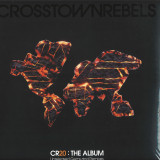
“20 years ago, I dreamed a dream of creating a family of like-minded, crazy individuals from all corners of the planet. That dream was Crosstown Rebels. Over these years, I have forged beautiful friendships, discovered very talented artists and tried my best to help, advise and support some of the most colourful characters in dance music. It’s been 20 years of madness, magic and music. Now it’s been distilled into our own book to mark this milestone. I’m honestly surprised at how much I remembered!” - Damian Lazarus
For 20 years Crosstown Rebels has forged a path as one of the world’s leading electronic music labels.
Established in 2003, Damian Lazarus’ label manifesto has not changed. Discovering and nurturing new talent has always been the beating heart of the label, with a mission to soundtrack the future of the dancefloor and beyond. Introducing the world to the likes of Jamie Jones, Seth Troxler, Maceo Plex and Art Department was just the beginning. Today the roster is gloriously international, showcasing the truly global scene that Crosstown has shaped over the years.
Of course, there’s the parties too. The early Slash & Burn and Rebel Rave parties paved the way for Damian to create two of the world’s most cherished experiences, Get Lost and Day Zero, and in turn setting a benchmark for electronic music events worldwide.
Now the Crosstown Rebels story is told in a new 240 page book. 20 years of madness, magic and music. Starting right back before the beginning and taking us through to the present day, acclaimed electronic music writer Joe Muggs dives into the label’s history, interviewing Damian at length and revealing Crosstown’s story as never told before. The book brings together countless unseen photographs and artwork taken from the last two decades. It tells the story of how the dance underground battled and triumphed. This is a unique publication, not only for fans of Crosstown Rebels and Damian Lazarus, but also for anyone with an interest in independent label culture and the evolution of dance music over the last 20 years.
- Deluxe 240 page book
- Limited edition with only 400 copies on public sale
- De-bossed hardback cover, printed on FSC® certified papers, with alternating paper stocks, book ribbon and G.F. Smith endpapers
- Foreword by Pete Tong MBE
- Comprehensive label discography
- Printed in the UK by PurePrint, the first CarbonNeutral® printer in the world
Buscar:department of dance
In 1978 Iasos has returned with a new album consist of 2 long peaceful compositions “The Angels of Comfort “ and “Angel Play”. These pieces are extremely soothing, heavenly, loving, and peaceful, and it captures the energies of love – on a galactic scale. It functions as a universal healing comforting presence. This genre of music could be termed “classical New Age music”. The philosopher Alan Watts has said, “Iasos is doing the classical music of the New Age.” This album is a “vibrational environment” of soothing loving angelic feelings – very nurturing and comforting. The music can be used for creating a sacred space, for meditating, body-work, visualization, hospice work, emotional healing, and for tuning into angels. It is well suited for relaxing the mind, body and spirit. When Iasos first released this album, it immediately became an underground classic, due to its universal appeal. It was the one of first albums that created a new music genre now known as “New Age” music. In addition, it still is one of the most cherished pieces of music worldwide. The Psychology Department at Plymouth State College had this music receive the highest rating, by quite a margin, for being “most like the heavenly music” heard by people who had had a near-death experience. “Angelic Music” was released on vinyl only once in 1989 on Brazilian label Estúdio Eldorado. This is a first LP reissue and additional CD reissue. Comes with original artwork – Painting “Star Dancer” by Gilbert Williams.
- A1: Damian Lazarus X Jem Cooke - Into The Sun (Major League Djz Remix)
- A2: Jamie Jones - Paradise 2011 (Art Department Remix)
- B1: Pier Bucci - Hey Consuelo (Dennis Cruz Remix)
- B2: Audiojack X Jem Cooke - Feels Good (Michael Mayer Remix)
- C1: Made By Pete X Zoe Kypri - Horizons (Black Coffee Remix)
- C2: Adam Ten & Yamagucci - The K Dance
- D1: Maceo Plex - Together (2011 Mix)
- D2: Guti & Dubshape - Every Cow Has A Bird (Tibi Dabo Remix)
Damian Lazarus celebrates 20 Years of his world-renowned Crosstown Rebels imprint with a special album project of unreleased cuts and fresh remixes, featuring material from Black Coffee, Maceo Plex, Art Department, Dennis Cruz and many more.
Undeniably one of the most influential record labels within underground dance music, releasing material from Laurent Garnier, Krust and Mathew Jonson to Rósìn Murphy, Deniz Kurtel, Francesca Lombardo and Jennifer Cardini while playing a pivotal part in the careers of artists like Maceo Plex, Jamie Jones, Art Department and Seth Troxler, Crosstown Rebels stands today as a hub and platform for flourishing projects across the electronic spectrum, including via sub-label Rebellion and across a long list of showcases across the globe. More than just your everyday label, the Crosstown Rebels legacy has grown alongside its founder in equal measure, with head honcho Damian Lazarus continually showcasing, championing and spotlighting artists from across the globe who share his radiant, experimental vision for house music and beyond. Ringing in a major milestone in style, 2023 will see the biggest twelve months to date as Lazarus and Crosstown mark the 20th Anniversary of the label with a series of projects set to be unveiled in the lead-up to summer, with ‘CR20 The Album’ set for release on 12th May 2023.
“20 years ago, I dreamed a dream of creating a family of like-minded, crazy individuals from all corners of the planet - releasing music to the world and making people dance. That dream was Crosstown Rebels, and this year we are 20. Over these years, I have forged beautiful friendships, discovered very talented artists and tried my best to help, advise and support some of the most colourful characters in dance music. Crosstown Rebels is more than a record label, it is family.
So 2023 will mark the label’s 20th Anniversary. This is an opportunity for the Crosstown Rebels family, a global community of artists, DJs and creatives, and the label’s myriad of followers to celebrate this momentous milestone. There will be parties and events around the world. A killer compilation of exclusives and special remixes, a beautiful coffee table book, a short film, and a special launch event are planned to bring together the sights and sounds of the label’s unique and influential history. There’s lots to share, announce and reminisce. 20 years young.” - Damian Lazarus.
Comprised of six stellar, high-profile remixes of releases from the label’s catalogue, alongside two previously unreleased original gems, the eight-track package is a rich and exemplary showcase of the far-reaching corners of the Crosstown Rebels sound and also its globally connected family of artists and close friends.
Opening the package, Lazarus’ own 2020 collaboration ‘Into The Sun’ with regular Crosstown vocalist Jem Cooke is given a cosmic rework by Johannesburg’s Major League DJz, while Jamie Jones’ slick ‘Paradise 2011’ is stripped back and given a new lease of life by the hypnotic and heady sounds of Art Department. Opening the B-Side, Dennis Cruz brings his percussive Latin-infused signature sound palette to Chilean musician and producer Pier Bucci’s ‘Hay Consuelo’, before Audiojack’s ‘Feel Good’, another standout collaboration alongside Cooke, is taken into synth-led territories as Michael Mayer reaches for an evolving bed of captivating tones.
The second half of the project brings more excellently remixed material, both new and old, with GRAMMY-winning DJ/producer Black Coffee turning his hand to the label’s first release of 2023 in Made By Pete and Zoe Kypri’s emotive ‘Horizon Red’, unveiling reworked melodies and sparkling keys as he delivers an interpretation of a track which has featured as a staple in his sets. Next, the project welcomes Adam Ten & Yamagucci’s playful yet off-kilter and wonky ‘The K Dance’ which unveils itself as a production perfect for those late night hours and early afters, before Ellum boss Maceo Plex’s ‘Together (2011 Mix)’ brings another lost production to the mix with a driving and zipping ride through sugary synths and soaring leads. To close, Tibi Dabo turns his attention to Guti & Dubshape’s absorbing ‘Every Cow Has A Bird’, delivering a nimble minimal-led trip through lush pads and crisp percussion to round things out in style.
Alongside the album, the 20 Year celebrations will also welcome a 192-page hardback book, ’20 Years Of Magic, Madness and Music’, with words from renowned journalist and key underground music player Joe Muggs, and a feature-length documentary directed by acclaimed director David Terranova.
Crosstown has become known globally for throwing some of the world’s best parties, from the wondrous cultural journey of Day Zero Tulum to longstanding Music Week marathon Get Lost Miami. This ethos of creating magical dancefloor moments spills into the label’s 20 year celebration with its worldwide Get Lost tour, launched with Get Lost Miami, and followed by Bali, Tokyo, Ibiza, Dubai, Istanbul, Rome, Paris, London, Berlin and more, plus a special to-be-announced London showcase.
Faitiche presents the album Exq I by Berlin underground techno legends Muellie Messiah & Punk not Punk, mainly known under their 100Records moniker. Weighing in at 36 minutes, the track was recorded in 2010, effortlessly intermingling dub, drone and collage, a blend achieved thanks to the duo’s jazz-inspired approach to improvisation.
_
100records is one of the last undiscovered treasures of the Berlin underground of the 1990s and 2000s. Like Elektro Music Department, 100records is unthinkable without techno and the club scene, but with a few exceptions the duo’s tracks are not aimed at the dancefloor. With a claim to universality and a broader frame of reference, 100records developed a more extensive understanding of sound that rests on three pillars: the understated analogue drums of the Roland TR-808, a blurred, dubby sound, and improvisation.
On first hearing, Exq I has little in common with the groovy, detailed, variation-rich sound usually associated with 100records. Recorded at the end of a highly productive decade, it is an echo speaking of exhaustion in which dub, drone and collage converge to form something whose jazz sensibility makes it readily identifiable as the work of 100records.
100records was founded in 1994 by Muellie Messiah (Dirk Budde) and Ekki 808 (Ekkehard Rau), who were joined in 1999 by Punk not Punk (Martin Osti). Around 2002, Ekki departed, leaving Budde and Osti to continue as a duo. Since then, their relationship has shaped 100records: Budde is the driven lone genius doggedly pursuing sounds, Osti the pragmatist who turns ideas into music.
As well as making music, Budde is also a musicologist. In 1997 he published his PhD thesis entitled Take Three Chords... Punk Rock and the Development to American Hardcore. As well as being his specialization, punk is also part of his identity: in the 1980s he sang and played keyboards in various punk bands in Kassel, the best known being Haunted Henschel.
After the fall of the Wall, attracted by the freedom of the newly reunited Berlin, Budde packed his bags and drove to the formerly divided city, having already become acquainted with techno at Kassel’s influential Stammheim club.
Vinyl[16,77 €]
Tape
You can’t keep a good thing down: 99 marks the triumphant and long overdue return of Matthew Edwards’ Rekid project. More than just Radio Slave records slowed down, his alter ego preferably ploughs the field between ambient excursions, downtempo hypnotism, sample sculptures and the general space in between raves.
Since its first appearance with the Lost Star EP for Classic in 2004 and the still breathtaking follow up Made In Menorca opus on Soul Jazz Records, Edwards firmly established himself as a producer of many, if not all trades. Thought of, produced and conceived during the first lockdown of 2020, 99 is conceptual (with the tempo firmly set at that tempo), concise (34 minutes and 34 seconds long) and content with exploring the possibilities of limitation (one track a day, live takes, no editing).
Without departing the original Rekid ethos of glacial music, it presents a modernized and contemporary version of IDM tropes, chill out topics and a capturing sound of mesmerizing materiality.
After a while, it all made sense to Edwards as one piece, was presented to Running Back, where the A& R department thought the same and is now available as a continuous cassette mix and a separated vinyl single album as well as for streaming and downloads.
Jeep music for ballet dancers.
You can’t keep a good thing down: 99 marks the triumphant and long overdue return of Matthew Edwards’ Rekid project. More than just Radio Slave records slowed down, his alter ego preferably ploughs the field between ambient excursions, downtempo hypnotism, sample sculptures and the general space in between raves.
Since its first appearance with the Lost Star EP for Classic in 2004 and the still breathtaking follow up Made In Menorca opus on Soul Jazz Records, Edwards firmly established himself as a producer of many, if not all trades. Thought of, produced and conceived during the first lockdown of 2020, 99 is conceptual (with the tempo firmly set at that tempo), concise (34 minutes and 34 seconds long) and content with exploring the possibilities of limitation (one track a day, live takes, no editing).
Without departing the original Rekid ethos of glacial music, it presents a modernized and contemporary version of IDM tropes, chill out topics and a capturing sound of mesmerizing materiality.
After a while, it all made sense to Edwards as one piece, was presented to Running Back, where the A& R department thought the same and is now available as a continuous cassette mix and a separated vinyl single album as well as for streaming and downloads.
Jeep music for ballet dancers.
Equal parts Sheffield bleep, fractal IDM and interstellar ambience, Hyper Nu Age Tekno sees Taro Nohara (aka Yakenohara) plotting a star map on a faded rave flyer. Let the billionaires blast into orbit while you explore your inner space with Growing Bin.
From the LP's earliest moments, the whomping subs and crystalline chimes of "Space Debris", it's clear that we're a long way from Hamburg. Taro pilots this craft on a deep space exploration way beyond the run out groove, to a place where heartening chords herald a twin sunrise and any broadcasts are lost in translation. The polyrhythmic pulse of "Ill Ell" follows, its concentric chimes and rapid fire kicks summoning the teknoguild to a watery altar in the engineering department. Sticking with interstellar mysticism but taking a turn for the transcendent, "Baker Baker Paradox" spins Reich-ian repetition into a graphene gossamer embellished with chrome, crystal and shoegaze shimmer.
The B-side begins on the observation deck, bathing in the beauty of "Celestial Harmonia"'s sci-fi exotica, before the entheogenic "Use Your Head" prompts a delirious dash to the holodeck. Laying serene pads over a techy 4/4, Taro turns out the most danceable and dreamy track on the LP. As ambient chords ring out into the aether and rhythmic pulses shift out of phase, "Airplane Without People" is the loading screen for your virtual fantasy, soon rendered through the woody percussion and spheric bass of "Music For Psychic Liberation". Leave your body behind as you pick mushrooms in a CGI forest.
Once in a while a record causes such a wave of excitement, it brings new vitality to dancefloors and generates fresh enthusiasm for the underground scene. ‘Without You’ is one such record, brought to life by the great talents of Art Department, a duo causing deep tremors due to their pioneering use of quivering bass, haunting vocals and fiery kickdrums.
The A side features the vocals of techno’s wonderchild, Seth Troxler, as well as Kenny Glasgow (one half of Art Department), his voice a major element of what makes their records so special. ‘Vampire Night Club’ layers the duo’s trademark synth sounds with an eerie and skin-pinching atmosphere. A truly mesmerizing record that gives the perfect introduction to the Art Dept sound on Crosstown Rebels, pre-empting their debut full length album on the label next year.
The double A and title track ‘Without You’ combines that unforgettable seductive bassline with a lingering vocal call. This record could have been made in the future as much as the past, its simplicity and depth the key to its appeal. Calls for its release have been heard for months and now have been answered with an extended 12” mix.
Art Department is the brainchild of Canadian duo Jonny White and Kenny Glasgow. With musical credentials dating back two decades, together they have constructed their own take on contemporary house music that has caught the attention of some of the leading figures of the current movement. With an album slated on Crosstown Rebels next year, this single is the first in a long line of raw futuristic bullets destined to cause a storm with an international audience.
Kapingbdi came together in Liberia, West Africa, during the late 1970’s and had their own unique style. This six to seven-piece band played original compositions in a vibrant mix of African Rhythms, Soul, Spiritual Jazz, Funk and Rock. Led by Kojo Samuels on sax, flute and vocals “Born in The Night” presents the essential tracks from their rare studio LPs produced between 1978-1981. The work has been carefully edited and remastered in 2019 for vinyl LP and a 6-Page Digipack CD, which includes two additional recordings. Kapingbdi toured through Europe and the U.S. and were the only Afro funk band to ever come out of Liberia.
Kapingbdi hail from Liberia, West Africa and have their own imitable style. They effortlessly combine traditional African music in a modern mix of Jazz, Funk, Soul and Rock. The band is a fusion of the old and the new.
The word "Kapingbdi" is taken from the Sierra Leone language Mende and means "born in the night". Kojo Samuels was given the name by his Latin teacher whilst attending high school in Freetown, They often meet and debate at night in the city and soon after Kojo is called Kapingbdi. The name serves as a description of his origin. Born In Lagos, Nigeria in 1943. The son of slave children. His mother from Nigeria and father from Sierra Leone who moved the family to Liberia, during the 1950’s.
Kojo has played music for as long as he can remember. He starts with the harmonica and later becomes a drummer and percussionist in his first band at school. During his art studies 1965-1972, he tours Germany and works as an art teacher in the USA. His band Kapingbdi is reorganized five times and consists of up to seven musicians. In a VW-Bulli he drives the group from concert to concert and if the drummer fails, he jumps in himself. Between 1978 and 1981 three Kapingbdi LPs are produced for the independent label Trikont, recorded in Hamburg and Munich. During this creative period, the band plays at festivals in Africa and Europe. In 1984, the band tours the United States and shortly after, they came to an end.
At their best, Kapingbdi would rouse the audience with original compositions like "Human Rights", justice for all, especially for South Africans, and "You Go Go You Go Come". The officials and employees in the government departments have no time for the common man, for any questions such as job search, scholarship or similar, he receives the answer "go, come back tomorrow" and the same thing the following day. Or "Now Is The Time For Cry For Love." Now it is time to scream for love and finally, time for humanity and justice. Despite immense difficulties, the musicians consciously live and work in Africa and are at home in Liberia.
On April 12, 1980, ordinary soldiers and non-commissioned officers organize a coup against the government. This is an attempt to put an end to a policy of exploitation of the Liberian people. Whilst efforts to eradicate poverty, lawlessness and illiteracy are obvious throughout the country, Liberia is still Americanized to a high degree. This is evident, as the radio programs of that time almost exclusively played American disco music. Under these conditions, the people seek a reconnection to their folk music, and Kapingbdi were aware of this. Kojo tried many times to come together with traditional Liberian musicians. This passion takes him north of the country. Meeting and playing with the old hornblowers and playing music on traditional instruments, such as the elephant tusk.
Kapingbdi make high quality tape copies of their own vinyl LPs and patiently try to displace all unauthorized tapes from the domestic "market". Nevertheless, it is hard to make a living through music in Liberia. Kapingbdi, is now celebrated. The radio plays are in abundance, but royalties are not forthcoming. Their musical link is the feeling of Afrobeat and Highlife, which is found in each of the many Kapingbdi pieces. They embody Jazz, which is understood to be the most refined example of black music outside of Africa. In Liberia, Jazz is virtually impossible to hear. Bright shining names such as John Coltrane, Charlie Parker or Miles Davis were widely unknown. Thus, the Black Jazz, including its Back-To-Africa movement of the 60’s and 70‘s, passes by without leaving a trace in Africa itself.
Kojo's claim at the time, was to make African music with the depth, sensitivity and the freedom of the technical level of Jazz. This makes Kapingbdi the torchbeares. The underpaid prophets in small Liberia. It is the passion with which the founder of the band continues to work on their music for years. Tirelessly, stimulating and encouraging his fellow musicians. This is ultimately responsible for the success of Kapingbdi in Liberia itself. The local audience seems to listen to the band in fascinated astonishment. One wonders about the ability to develop as demonstrated by Kapingbdi on the basis of their music. It is African and unusually jazzy, danceable and better than the American disco music heard on the radio.
Rather than chase the money and the job opportunities in Europe, Kapingbdi are firmly rooted in Africa. The musicians live in Monrovia, the capital of Liberia, at the Kabingbdi workshop, located in the Congotown area on the eastern edge of the sprawling city. Kojo works here as a sculptor, painter, batik artist and musician. The sales revenue that his activities generate, gives him the opportunity to support the development of African Jazz music. The highest percentage of funds are from Germany and Kojo’s work ethic is “to work on your own thing“. The stance taken aims to support the welfare of Liberians and Africans. The other musicians of the group live in a second house that is nearby.
For the sake of consistency, Kapingbdi is a full-time band. However, the revenue, from all of the sources, could not keep them afloat. Equally, as important to the group are Kojos's knowledge of traditional African music and his sculpting skills. His knowledge is shared with others at the afternoon workshops. It is here that they discuss new lyrics, engage in political debate and the self-imposed task of improving conditions in Africa. At times the debate became heated, especially during rehearsals. This was regarded as good and integrative, sowing the seeds of innitiative to keep the band together.
From 1980 to 1985 Kojo also opened and ran the club "Panjebota", located on the grounds of the U.S. Consulate in Monrovia. Almost every evening Kapingbdi perform the song "Wrong Curfew Walk", whose lyrics lament the killing of citizens during the curfew imposed by the Liberian government. When the head of state Samuel Doe hears the song, he behaves agressively and forces Kojo to close the "Panjebota". Kojo had already moved on. Soonafter he meets Fela Kuti at the Africa-Festival and plays concerts in Germany with Cecil Taylor's workshop band.
Kapingbdi is for thinking, dreaming, dancing. What they sing about is what they have experienced. Kojo Samuels is 76 years old today and still follows his vocation as a critical musician, artist and activist.
Ekkehart Fleischhammer / Sonorama 2019 (with the help of original press sheets and the memories of Kojo Samuels)
We used to enjoy presenting Chapelier Fou's work using the idea of music in the form of a treasure hunt. However, while the phrase in itself it still just as relevant today, we would never have imagined that it would become such an integral part of one of his albums. Or two of his albums to be perfectly exact - Méridiens and Parallèles. Two records with twelve songs each which answer each other back in the form of anagrams. They are like the two sides of the same planet - similar but simultaneously so different. They need to be discovered one after the other taking the time necessary to travel through the sound territories produced by his imagination. The starting point is a sombre night in Uqbar… Chapelier Fou's opening reference to Borgès was obviously not made by chance. He subsequently confided in us the objective of his diptych, namely to combine reality with fiction to question certainties and our relationships with the imaginary sphere. He has continued with his traditional classical-contemporary electronic approach which, although now known to a wide audience, has the advantage of opening up a whole range of possibilities right up to the infinite scale. Moving away from an "État Nain" (Dwarf State) to take refuge on an asteroid...Throughout Méridiens, each composition can be seen as a universe in itself or a specific landscape with its own temporality. Proof of this is the introduction to the chamber music format composed for and performed by only strings which can only be given the date we want to give it. This is "État Nain" in which violins are played like guitars. In some parts we find the spirit of the Penguin Cafe Orchestra and the idea of cheering up classical instruments and not taking everything too seriously. In other parts, we find something close to a mischievous and childish unplugged grunge anthem that could be from the French series Les Shadoks. This mischievous view of things is shown to full effect in Am Scharchtensee. The introduction shows Chapelier Fou's whole classical universe and mastery of orchestration in which "modular" electronics provide a subtle and discreet backdrop. Then, the record suddenly switches to a surrealist dialogue between these classical sounds and modular synthesizers with the flavour of the German pioneers Kluster/Harmonia to name but one example. Timelessness and imaginary places. La vie de cocagne confirms this choice of total freedom. It's traditional music with old sounds, a kind of forgotten bourrée (old French dance) in which electronic sounds disturb the established order and thus reach another musical dimension. Le méridien du Péricarde followed by Désert de Sonora push this idea of a trompe l'oreille and a hall of mirrors even further. The latter track ends almost like a catchy 80s melody and we can no longer find any logical meaning. We let ourselves be carried away by this profusion of madness and are a little amazed by this mastery of sound, composition and space. It sometimes all seems like a succession of conjuring tricks. Chapelier Fou takes not being serious very seriously indeed. The end song Everest trail is the perfect conclusion, a deadpan track in which the primary aspect of a totally classical melody in all its straightness is underpinned by a permanent exchange of electronic tweets which mocks the main musical posture. This impertinence harks back to Pierre Schaeffer who directed the ORTF's very serious experimental department in another era and allowed the development of Jacques Rouxel's series Les Shadoks thus introducing the general public to the notion of concrete music. This is also perhaps why Louis Warynski's stage name is French – because he has opted to use his French musical heritage. Thus the first singles selected from this album, Constantinople with its groovy and jazzy allure and Le Triangle des Bermudes evoke composers like Michel Magne or Michel Colombier both of whom have totally open minds and consider all music to have the same importance, namely that of sound. In absolutely all the tracks that make up Méridiens, you will find at least one detail - a pattern, melody, sometimes a simple sound - that will draw you back to explore it a little more. And the words are carefully weighed for sure. It's quite simple. This is undoubtedly his most hypnotizing and catchy album. Chapelier Fou has become a complete master of his own universe. He draws the start and finish lines himself and no one can follow him in a field that now belongs to him alone. Composed imaginary spheres, illustrated territories...Music is just as meaningful as the more visual arts. Therefore the artwork of Méridiens had to project each of the twelve tracks considered individually and not just the whole album as such. Chapelier Fou therefore asked his old friend the contemporary artist Corentin Grossman to create twelve windows to represent glimpses of the twelve worlds composed for the record. Windows or mirrors when it comes to that? You can never be sure of anything...Space OK. But what about time? The years go by and sometimes we forget that fact. But a simple glance back is often enough to gently touch the time that has passed. It is over 10 years since his first official record and he has been composing, recording and sharing his music for almost 20 years. 20 years is a long time. It makes some people look old while others fall into reassuring but sterile nostalgia. Chapelier Fou, on the other hand, has released his most ambitious project and tried to take a higher view of his discography that was itself nevertheless irreproachable. Although the journey is over we can see Parallèles universes on the horizon. Chapelier Fou has announced 12 additional tracks which are like echoes of the compositions on Méridiens' and will be released on the album Parallèles next spring. They are neither twins nor opposites – they are instead totally original new compositions which go further in exploring a universe which is already richly abundant.
Token celebrates its 100th release with Luke Slater, a legend of the genre, releasing under one of his most iconic aliases: Planetary Assault Systems. For over 25 years, Slater has delivered unparalleled quality in his music - a formative figure in Techno and instrumental in defining the sound globally, few can touch the Brit for depth, urgency and hit rate.
Exhibiting near enough perfect renditions of classic dance-floor moods, the four track EP is a wrought iron rollercoaster through some of the artist's most exacting work. Booming opener Bang Wap chugs unrelentingly while a lithe FX line does the bulk of the movement in the high mid range - building tension before a satisfying release in the last quarter. A2 Bolt is classic Planetary Assault Systems - hypnotic and driving with a single sequence dipping in and out of view. On the flip, Say It Loud could be an idiosyncratic hit waiting to happen - dry and tight in the drum department for maximum effect, and featuring a recurring vocal sample chopped and skewed for tension. Closer Shine takes a deeper, more psychedelic route with shades of the classic, jacking Detroit sound in the pitch bent lead line, but maintains the energy throughout with stylish delay sends upping the ante where required, all in all delivering a neat finish to the EP.
Schmer brought these two together to battle it out for Schmer019: Snazelle vs Loveland : Get this special 6 track maxi EP of pure techno and YOU will be the winner.
Brooklyn based techno producer and Snazzy Fx boss. Much of the hardware Dan uses in his productions and live sets was designed and built by him. His focus as an artist is on electronic music as a vehicle for achieving transcendent states. This comes out in his sets as a respect for both the funky and hypnotic aspects of dance music. As a DJ and live act, Dan has performed throughout Europe and is a regular fixture in NYC.
2018 saw Dan release the "Exposure to a Steady Stream Ep" on Jacktone records. Fact Magazine included the track " Broken Saucers" in their best of September round-up.
In early 2019 Nina Kraviz and Dan released their collaboration "u ludei est pravo"on the trip compilation "Happy New Year! We Wish You Happiness".
In August, Schmer released his newest EP, "Swarm Draze".
Jasen Loveland is a mercurial force about whom little is known with any certainty. Much of Loveland’s life and exploits are shrouded in an opaque and often contradictory mythology that includes many other characters who may or may not be Loveland himself. Born sometime around 1950, Loveland seems to have been operational within the dance music community for decades, allegedly interning for Giorgio Moroder in Munich after finishing a medical degree in the 1970s. It is rumored he was the individual who did the actual synth programming on “I Feel Love”, however this was never confirmed. Documentation of Loveland’s past was further obscured by a “studio fire” while operating out of Chicago in the mid-1990s that destroyed all of Loveland’s memorabilia from the past, except for a handful of lo-resolution, poorly-scanned photographs Loveland (an early user of Hyperreal.org and the #mw.raves listserv) had emailed to a friend. Fortunately, Loveland was able to save his two favorite synthesizers, a battered Roland TB-303 and it’s demented sibbling, the MC-202, but the rest of Loveland’s equipment, and the documentation of his past, was lost in the blaze, leaving Loveland homeless for several months. Regardless of the veracity of his tales, Loveland’s music speaks for itself; the intense, maniacial vibes that pervade the ouvre are undeniably suited for the most far-out, dancefloor head trips, thus making it only a matter of time before he joined the Interdimensional Transmissions family.
Most recently, Loveland has been presenting DJ-style musical performances under the name “Loveland & Friends”, which has become an umbrella term for all projects related to his work, including JL-303, DJ Curtis Chipp, Chip Curtis, MIDI Master, Remote Perception, The Limit, Acid Musik Department, The Gaze, Ace of Fades, East German Chemistry, The Universal Vision, Clonus, Gamma Polaris, R.O.M. and DJ Kline, and Da House Band. Many of these, such as the DJ Kline project (with Prof. Dr. Alice B. Kline, a self-described “unremarkable scientist” and researcher at CERN), seem to be collaborations or ghost productions, although even this is not clear. In fact, the only confirmed Loveland collaborations are LW Productions (with Clay Wilson) and Pervocet (with Patrick Russell), the latter presented as a 12” by Interdimensional Transmissions, Detroit.
NEP was a loose multimedia collective formed in 1982 Zagreb, ex-Yugoslavia. The founder Dejan Krsic collaborated with various artists in a quest of re-thinking the stale concepts of art history, position of the author and the barriers between pop and elitist high culture. Heavily influenced by Walter Benjamin and Andy Warhol in theory and Brian Eno and Kraftwerk in music, Krsic created NEP as an umbrella term (meaning Nova Evropa or New Europe) of diverse rule-breaking activities, covering graphic design, music, photography, video, news-media and theoretical work. Musically NEP focused on experiments in ambient and tape-music, self-released and hard to find compilation tapes like "The Cassette Played Poptones" (1988). Deeply immersed in pop-culture, politics and art theory Krsic's search for perfect pop music with cutting critical edge peaked in 1989, the year 'Decadance' track was conceived in studio. Fox & His Friends published the single in 2017 with Snuffo Remix on B-side. It received rave reviews in music press like MixMag and DJ Mag and it is still played on dance-floors around the world. But the story around the NEP is musically (as well as artistically) much wider: for the first time Fox & His Friends team compiles best cuts from unreleased and rare NEP tapes, covering the period from 1985 to 1989 on POP NOT POP abum. Dejan Krsic is now famous graphic designer and art historian in Croatia. Other collaborators include Laibach and Borghesia photographer Jane Stravs, artist and TV director Gordana Brzovic, Jovan Culibrk, now Bishop at The Serbian Orthodox Church and Anja Rupel, singer of cult Yugoslavian synth-pop group Videosex as well as the other members of Videosex, Iztok Turk and Janez Krizaj who produced some of the tracks. Other collaborators were talented producers Robert Logozar and Davor Daga Devcic, singers Linda Cooper, Natalija, Alexx Kovacs... The list of collaborations is long. Some of the memorable moments on POP NOT POP album are early demo version of Decadance 'How Do I Dance To This Music?' with blue movies samples and drum machine experiments like early Cabaret Voltaire, then Krsic's reinterpretation of legendary Kraftwerk's Trans Europe Express anthem as 'Transcendance', or 'Radical Chic', where Dejan himself and Anja Rupel from Videosex make lovely couple of dandy-esque fashionistas, singing chart-friendly radio synthpop tune that contrasts the A-side (The 'NOT POP' side) - full of experiments, dark wave and industrial nods to Test Department and Cabs. B-side is 'THE POP' side that will surprise most of the NEP followers from their early experimental cassette days. Sunny, danceable, joyfull pop that reveals the many faces of NEP. As Kraftwerk today is more of a concept than a band, NEP does the same by re-writing its products (musical, graphical, theoretical, activist) and constantly puts them in permanent state of change or re-mix. In the future, only NEP logo will be enough to consider something an art piece, and NEP will be everybody who wants to, as their Art Manifest claims. Until that day comes, 'POP NOT POP' is a document of how the vivid and creative were art-scenes in socialist Yugoslavia. Some of the graphic work, cut-ups from theory and Manifesto are also included on this LP, designed by Dejan Krsic aka NEP himself. This release is made from the original master tapes and published for the first time on vinyl.
Faze Action return with the 3rd instalment of their 4 part series featuring Zeke Manyika. "Sununguka", sung in Zeke's native Shona, is literally translated to mean, "To unravel oneself and unlock yourself".
It's set over an infectious reggae, boogie rhythm, with an early proto house feel. Featuring backing vocals from Sharon Manyika and heavenly keyboard solos from Rob Lee, this EP is set to take us into summer and beyond.
The package comes with a stunning remix from Alan Dixon who has been lighting up dance floors with his releases on Running Back and more. Here he turns the original into an Italo/electronic Aend of night classics, managing to seamlessly Amerge Zeke's African vocals with a serious bass line, ahead of the curve, contempory production whilst placing the release firmly in the credible main room department.
On "A2" we have Rwendo where Zeke really stretches his songwriting skills as the whole track manages to fuse a variety of rhythms together to create a beautiful downtempo masterpiece.
Finishing off we have the "Special Extended Dub Mix" which strips back the original and turns it into a balearic house gem made for the summer ahead.
Philippe Cam is the Thomas Pynchon of the electronic music world. Little is known about him and only a couple of pictures have been put online since he emerged on this planet to write his first and only album18 years ago. We know he worked as a sailor and that’s it. If you dig deeper you might find out that he worked as a DJ in the beginning of the 90ies in Brussels and began to study electronic music there and also began to write music for theaters and ballets.
The American distributor Forced Exposure once wrote that about him: „Philipe Cam is a star in his own field. He is among the few people who have succeeded to write hypnotic dance music without a conventional beat still conveying a thrilling, dramatic feel. Cam has developed an accurate, intense and complex formula of modulation-techno. Starting with music similar to Pan Sonic in 1996, his music turned towards a more elegant form of minimal music. Abstract soundtracks lead to an organic form of music, which was equally influenced by modern techno as Wolfgang Voigt's Studio 1/Gas or Basic Channel/Maurizio. Cam's music corresponds heavily to the Cologne scene, where his music is appreciated and played throughout the clubs by the likes of Michael Mayer, Tobias Thomas and various other DJs as well as experimental djs from the A-musik corner.“
So what’s new with his music? Basically the art of filtering is still his passion. Maybe he can be less associated with techno and the themes of his new tracks emerge in a more distinctive pattern? Well that’s hard to say, we would comment the energy of his early techno days in Brussels have returned here in a fierce way with some oft he tracks. The rhythmic movements are classy and stick with you. Whereas other tracks look for a distinctive relaxation of some kind.
We are releasing the album as a double clear vinyl with cover art by Yvette Klein who also designed the cover for his Philippe Cam’s album 18 years ago. Graphics for "Rotterdam" come from Cologne designer Daniela Thiel. We also would like to thank the cultural department of Cologne for supporting us to finance the album and to see the artistic value in this piece of minimalism.
The album kicks off with the mellow and soothing "Cocoa Beach". A Gentle beat that moves like bodies swaying in the hot summer sun. The clock moves a step forward and then a step backward as evolution takes a rest.
"Manga" feels like an acceleration to the moon, the contemplative moments come in spurts and hide in the intervals of the chords which are on the loose. Philippe Cam is the most energetic person in the world when it comes to core activity, this is head banging stuff for the ambient lounge.
"Short Summer" is a heavy and violent recognition. As intensive as it is it knows when to stop and disappear. In the ear and brain of the listeners it leaves an indisputable echo which lingers on for minutes. We suggest not to make a pause but jump directly into "Vermillions Sands".
What can be said about into "Vermillions Sands"? Be prepared some Terry Riley might lure around the corner to offer you some oranges on a silver plate, but don’t eat them. This is luring and beautiful at the same time. Maybe the best ambient track ever written and yet who can ever venture to say that without making a fool of himself. "Vermillions Sands" comes in waves and they could be longer we think.
"Rotterdam" the home of Philippe Cam for a long time but not anymore. He moved away. So that changes the perspective. But when was the track written? "Rotterdam" seems mechanical and rusty and spooky and divided. This arrangement is very different to all the other tracks so far and is almost dub in style but way more fractured. A steady stop and go emerges. But the longer it runs the better it gets. At minute 6 the brain resets itself and tries to grasp what has happened so far, reconstruction as a result of its own phantasmic imagination and hardly true at all, wonderful. Applause included!
Here comes "Bis", a short episode of a track and before we can comment on it, it is already over.
"The Game" is a mule of a track. It has a quiet stubborn sequence that bites and kicks you in the back without any change in near sight. We can hear a voice whispering, which sounds like a miniature vocoder featuring the voice of a child calling out - never stopping. This is treadmill to some extend but starts to breathe towards the middle of the track and slowly changes perspective. In fact there are some changes taking place here which go beyond a sound design that works heavily on the stereo image. Stick with it and the experience will be a great one.
"Ultimate Fly For Halloway" somehow orchestrates how you might feel after you climbed a 8000 meter high mountain and reached the top. A rejoicing off a special kind. Lava for the ears. No cheerleader murder plot sorry.
"Last Track" is a perfect example of a true minimalistic pice of music that manages to make contact with other genres and does this with elegance, determination and a lot of soul.
key selling points: The key selling point is the fact that Philippe Cam once was referred to as one of the main protagonists of the minimal music scene along with Wolfgang Voigt's Studio 1/Gas and Basic Channel/Maurizio. A true artist with a vision which is very rare.
Philippe Cam has picked up the sound he was famous for but has developed it further without selling out to any genre and expectation that rules our daily business.
Exactly this is the strength of the album to create a vivid world of impressions by using instruments in a whole different way than all software developers would suggest.
"Rotterdam" is a piece of art that can set off a firework when you listen to it and it owes nothing to anyone.
Stefan Smith has channeled an elevated reverence for process, texture and synth-extrapolation with the forthcoming release of his self-titled LP on the Sapiens imprint. A relative new-comer to the land of rapid fire releases and dance floor formulae, Smith is deeply steeped in the art of music creation, performance and theory.
As a graduate of Mills College's revered music department, Smith's prosaic understanding of music partially explains his migration to Sapiens, a label headquartered in Paris, France, which, under the direction of techno luminary, Agoria, has been expanding the realm of possibility for what a techno label can become. Collaborating with musicians, visual artists, film directors, shamans and sound designers, the young Sapiens platform releases may include political speeches, radio hits, dance floor tunes, sensorial or cognitive music or a gentle computer
virus'. Smith's LP contribution will definitely fall on the more delicious end of this spectrum, having woven a synth-lovers dream tapestry.
The nine tracks composing the album, Stefan Smith', draw the listener in on a river of oscillators, which push just past the banks of perceptible sound with with flawless production and loving sound treatment. The idea behind the album is very raw and organic. Stefan Smith focuses on atmosphere, mood, tones, and frequencies, rather than melodies. His productions are a response to the subliminal, and about feeling.
This album came together from a natural flow of working with computers and synthesisers, and also from the musical connection fostered Sebastien Devaud (Agoria). His approach to the album's production was to edit as little as possible, keeping the original feeling of chance and temporality intact. We can sense here Smith's intuition as sound designer, a role which has enabled him to work with artist Nicolas Becker and through this association further contribute work to the Philippe Parreno 'Anywhen' exhibition in Tate Modern Turbine Hall. The feedback
generated by studio experimentation gives birth to new ideas for aural shapes and textures. If one were only to lie back and identify the various wave forms, like butterflies and birds flittering through dappled sunlight, in each track's canopy of bountiful synth elements the mind's eye would dance with the steady intervals of Smith's real-time probe of his machinery, however, deep tracts of emotion and effortless grooves won't allow for a purely sensory listen. In the spirit of exploration, enjoy the ride.
Lost Futures is a new label that explores experimental and often radical approaches to dance music from the past. In a musical landscape that increasingly claims to seek and reward new forms and ideas, Lost Futures delves into the recent past to revisit forward-thinking, optimistic projects that, owing to the social, musical or outright political climate, perhaps struggled to find an audience. Allowing only time to re-contextualise these leftfield, sometimes misunderstood and ultimately human bodies of work, Lost Futures taps into the inherent idealism of rave.
LF001 trips back until the early nineties to revisit the alternative scene emerging from the Dutch city of Utrecht. Here, three young men - DJ Zero One (Sander Friedeman), TJ Tape TV (Arno Peeters) and DJ White Delight (Richard van der Giessen) - joined forces to form 'The Awax Foundation'. Inspired by the transcendent and revolutionary electronic music arriving on their shores imported from Chicago and Detroit, combining their knowledge, gear and ever-expanding vinyl collection allowed additional freedom in paying sincere tribute to these intoxicating sounds, while also developing their tastes in a more personal, eclectic direction.
The musical flavours of Awax initially leaned toward acid house and the roots of techno. However, with three different mindsets in the mix, their tastes were rarely fixed. One thing each shared in common was a devotion to collecting rare sounds, specifically more adventurous and international samples than those emanating from the increasingly-hard, masculine dance music emerging from the Netherlands during the period. Inspired by the cross-over global sound of bands like Suns of Arqa, or 'World Music', as it was perhaps patronisingly termed at the time, the trio became interested in the idea of making techno with 'ethnic instruments'.
Of course, this being 1992, none of The Awax Foundation had access to such instruments, instead, they had a vast, collective library of samples from all over the world. There were no collaborations and no clear plan. Instead, they set to work using a Yamaha TX16W sampler, the legendary Atari 1040ST computer, a cheap mixing desk and a couple of low-end synths and FX machines. When Richard mentioned the project to his friend, Akin Fernandez, the London DJ and owner of cult label Irdial Discs, Fernandez was intrigued enough to invite the trio to record a one-hour show for his 'Monster Music Radio' series on London's then-burgeoning Kiss FM.
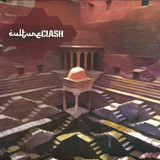
Forced to come up with a name, 'CultureClash' seemed like the obvious choice, even if the members of Awax were only creatively sparring among themselves. Along with the term 'ethno-techno', slightly dubious to a hopefully more conscious Western audience in 2017, these were the only guiding principles to the quietly ambitious project that soon combined cutting-edge machine rhythms with samples sourced from everywhere from Bolivia to Togo, and inspired by everything from Ravi Shankar's epic soundtrack to the Oscar-winning movie Ghandi, to the technical limits of their own setup requiring a dazzling degree of cut-and-paste work. Some tracks even emerged out of academic studies within the ethnomusicology department at The University of Amsterdam.
The show aired on October 2nd, 1992, recorded in one blistering take and without any rehearsals, traversing a huge variety of tempos and styles. If the performance wasn't seamless, it was undeniably thrilling, fresh and ambitious. As such, several labels, including Fernandez's aforementioned Irdial Discs expressed an interesting in commercially releasing CultureClash, while another imprint proposed a series of twelve-inches and an album. But the sheer complexity of the project meant that it never saw the light of day, while the trio embarked on different journeys ahead, both creative and personal.
Twenty five years later, and the original CultureClash lineup and founding members of The Awax Foundation provide the sound of the first release from Lost Futures. An otherworldly, ambitious and optimistic compilation, accompanied by extensive sleeve notes from the trio, CultureClash is a timeless ode to experimentation in dance music's ever-overlapping culture.
- A1: Mahy - Antilles Méchant Bateau
- A2: Guy Conquete - Ban Moin Clé A Titine
- A3: Dolor - A Dardonnel
- A4: Joseph Lacides - Yo Ka Biguiné Joseph
- A5: Tino Saint-Val Mam\'Zelle Cancan
- A6: Dolor - Ki Vino
- A7: Dolor - Socié Cabrite
- B1: Gaby Siarras - Moana
- B2: Joseph Lacides - Citation Créole
- B3: Casimir Letang - Ménage Chalviré
- B4: Manuela Pioche - Pas Ban Moin Coup
- B5: Gerard Valton - Bel Mè A Présent
- B6: Beaujour - Ti Té Ya
- B7: Josianne Saint-Louis - Jeines Gaçons
- B8: Dolor - Vini Sauvé Moin
Fifteen track completion of deep biguines and Gwo Ka from the '60s French West Indies. The vinyl edition included a 4 page booklet + download code.
Biguine is a rhythmic style of music that originated in Guadeloupe and Martinique in the 19th century, which fuses 19th-century French ballroom
dance steps with African rhythms. Gwo Ka is found among all ethnic and religious groups of Guadeloupean society.
It combines responsorial singing in Guadeloupean Creole, rhythms played on the Ka drums and dancing. Gwo Ka is the musical and cultural product of the
region's African ancestry, forcibly brought to the Caribbean through slavery. Gwo Ka exists only in Guadeloupe, which is a very different island from much of
the Caribbean, in that it remains a 'department' of its original colonial master, France. Here the currency is the Euro and the baker sells croissants and café
au lait. This constant 'European-ising' of the island means that Gwo Ka plays a fundamental and important role in the defining of Guadeloupean identity.
'Antilles' Méchant Bateau', a low-tempo number with a bolero feel, indeed a pure case of the blues, and a terrific saxophone solo. What else would you
expect to set the tone for this selection, in which beguine regains its original colours, in the darkness of the Gwo Ka drums. This 45 by André Mahy, released
under the Aux Ondes sublabel, was recorded in the 1960s at Célini's, one of Guadeloupe's two main houses. Through its drum rolls and harrowing chant, it
recalled how, long before the mid-1960s, the Antilles' history was written in an ocean of teardrops - namely the Black Atlantic.
- A1: Get Wid It Feat. Tyna (Visioneers Version)
- A2: Happy Days Feat. Bagi & Sarah Ann (Peter Kruder Remix)
- A3: Code Of The Snake Feat. Blabbwona (Pulsinger & Irl Codeine Shake Dub)
- A4: Why We Feat. Ward 21 (Jstar Remix)
- B1: Holdin´ Back Feat. Wordsworth (Flip Remix)
- B2: Concussion Feat. Blurum13 (Trishes Remix)
- B3: Get Wid It Feat. Tyna (Visioneers Version Instrumental)
- B4: Holdin´ Back Feat. Wordsworth (Flip Remix Instrumental)
- B5: Concussion Feat. Blurum13 (Trishes Remix Instrumental)
Die zweite Runde von Remixen zu dem selbst betitelten Album von Urbs ist eine fesselnde Zusammenstellung von zeitlosen HipHop sowie Downtempo Nummern.
Marc Mac: Gibt es zu dieser Person etwa noch was zu sagen Als Teil des UK Duos 4Hero hat er Musikgeschichte geschrieben und sein Visioneers Projekt setzte neue Standards in Sachen organischem HipHop. Sein Remix zu - Get Wid It featuring Tyna aus Neuseeland, besitzt alles, was man sich von diesem Musikgenie erwartet. Ein souliges, harmonisches Meisterwerk, welches auch auf einem seiner legendären Visioneers Alben hätte veröffentlicht werden können.
Peter Kruder hat als Teil von Kruder & Dorfmeister sowie mit seinem Projekt Peace Orchestra Musikgeschichte geschrieben. Sein Remix zu - Happy Days feat. Bagi und Sarah Ann ist eine Reise zurück zu seinen musikalischen Wurzeln, welche ihn berühmt gemacht haben - eine relaxte Downtempo-Nummer. Der Remix weckt Erinnerungen an die Zeit, als seine Musik Millionen von Menschen berührte.
Patrick Pulsinger ist der dritte im Bunde aus der Riege der Helden der 90s. Gemeinsam mit Sam Irl, seinem derzeitigen Komplizen, zeigen die beiden was herauskommen kann, wenn ein Studio-Zauberer mit Techno Wurzeln auf ein Musikgenie mit HipHop Wurzeln trifft. Ihr Remix zu - Code Of The Snake feat. Blabbwona ist eine trippige HipHop-Tech-Dub Nummer mit viel Bass und als solches absolut einzigartig.
Jstar aus London hat sich bereits einen Namen gemacht als Produzent von unzähligen Remixen und Edits auf seinem eigenem Label Jstar. Seine Spezialität sind Dub und Reggae Remixe von HipHop Classics. Er ist ein Großmeister des Digital Dancehall und transformierte den Golden Era Sound von - Why We feat Ward 21 (aus Kingston Jamaica) in etwas absolut Futuristisches.
Flip: Rapveteran von Texta aus Linz, der zuletzt durch sein Soloalbum auf dem New Yorker Raplabel Ill Adrenaline Records aufgefallen ist, bringt einen Remix zu - Holdin' Back feat Wordsworth. Mit einem genialem Chuck D Sample und einem funky Beat setzt dieser Remix Tanzflächen von Alaska bis Auckland in brannt.
Trishes: Last but not least: Moderator der legendären HipHop Radioshow Tribe Vibes auf FM4 und integraler Bestandteil der Wiener HipHop Szene. Für seinen Remix zu - Concussion feat BluRum13 von Oneself, setzte er auf einen heftigen Groove mit lauten Becken um einen Underwater-Funk-Beat zu kreieren und somit einen neuen Hintergrund für diese echt verrückte Geschichte zu gestalten.
Über das Album 'Urbs':
Ganze elf Jahre sind seit - Toujours Le Meme Film', dem letzten Album von Urbs vergangen. Auf Kruder & Dorfmeisters G-Stone Label lieferte der Wiener Musiker, DJ und Producer damals den Soundtrack zu einem fiktiven Film Noir, zog sich aber nach einer Europa-Tournee fast gänzlich aus der Öffentlichkeit zurück. Er sieht sein Schaffen nicht als Karriere, sondern als Teil seines Lebens, welches in den seltensten Fällen einer konkreten Planung unterliegt, und deshalb hat Urbs sich auch bewusst viel Zeit gelassen für sein aktuelles -unbetiteltes - Album.
Urbs: - Der Vorgänger "Toujours Le Meme Film" kam bei sehr vielen Leuten extrem gut an, und über die Jahre habe ich mitbekommen, daß es manchen Leuten richtig viel bedeutet. Das war eine gewisse Belastung, weil man diese Leute natürlich nicht enttäuschen will. Mittlerweile denke ich, daß genug Wasser die Donau runtergeflossen ist, um vielleicht den einen oder anderen mit etwas ganz Neuem zu überraschen. Die Leute, die mich kennen, wissen ja, daß ich im Grunde immer dopen HipHop produziert habe.'
Konsequenterweise handelt es sich diesmal nicht um ein Instrumental-Album sondern um eine Sammlung von 12 souligen HipHop Nummern, die mit handverlesenen Vokalisten der internationalen Rap-, Dancehall- und Soul-Szene aufwarten. Neben den New Yorkern Wordsworth von EMC sowie R.A. The Rugged Man, finden sich unter anderem Ward 21 aus Kingston, Jamaica, Voice Monet aus New Orleans, Blu Rum 13 von One Self aus Washington DC, als auch alte Weggefährten wie dem Wiener Skero oder dem Wahl-Münchner Blabbwona von Abstract Art auf dem Album.
Auf die Frage, wie es sich anfühlt, nach mehreren Instrumental-LPs erstmals ein Album mit Vokalisten aufzunehmen, erwidert Urbs mit einem Augenzwingern: - Generell war es für mich schwierig die Songs loszulassen und mich den MCs auszuliefern. Man verbringt viel Zeit mit einem Stück und baut eine gewisse Beziehung auf. Die Musik erzeugt Bilder im Kopf und hat oft eine schwer fassbare Bedeutung für den Producer. Dann geht ein MC drüber und es ist ein bisschen als würden die brutalen Freunde deines älteren Bruders dein Kinderzimmer verwüsten- in deiner Anwesenheit.'
Wieso das Album keinen Titel trägt, ist auch schnell beantwortet: - Dieses Album ist nun sozusagen meine Leistungsschau auf diesem Gebiet und durch den unendlich langen Reifeprozess, ist es auch schön intensiv eingekocht und auf dem Punkt. Deshalb auch keine Intros, keine Interludes, kein Titel, no Gimmicks, einfach 12 gute Songs - Punkt.'
Neben dem Album werden auch zwei EPs mit Remixes von Retrogott, Brenk Sinatra, Visoneers (Marc Mac von 4 Hero), Peter Kruder, Cookin' Soul, J*Star, Flip (Texta) und anderen veröffentlicht. Für das Artwork zeichnet DJ DSL verantwortlich.
The enigmatic label from Berlin, Schakal Recordings is back with its fifth release and young DJ Lorenz Lepus is next in line. The Lepus project has gone through many guises, finally Lorenz settled on making music as a solo artist under the Lorenz Lepus alias in 2014. While still studying at school Lorenz became a resident at Chalet's Tuesday sound Department parties, cutting his teeth in the cities clubs he has played in venues including Hoppetosse, Sisyphos, Arena and many more. This dedication to his music was not without some confusion, being aware of the melan- cholic minimal tendencies of his productions he has always been loathe to pin himself to a particular genre.What with the success of his career so far.. perhaps this isn't a bad thing.
'Feral Child' is made up of two original tracks and two remixes.The title track's melody swells until it breaks down into a pulsing and rolling rhythm. 'Lost' is more immediate in its dance-floor compatibly, maintaining the rolling style Lorenz imbues his take on deep house with an emotional poignancy rarely heard. Floyd Lavine steps up for the first remix on the EP, Floyd is a resident at the legendary RISE par- ties at Watergate, with one foot in Berlin and the other in his native Cape Town Floyd delivers a beauti- fully loopy and oddball twist on 'Feral Child' adding crunching static sounds. Providing a harder take on 'Feral Child', Italies VII Circle change the rolling melody into a slow techno heater.