Connecting Wasulu hunter music, griot praises, pastoral Senufo dances, Fula and Mandingo repertoire with western psychedelia, blues, and Nigerian afro-beat, Zani Diabaté's Super Djata Band was among Mali's top orchestras. Tracked live inside Radio Mali's cozy environs in January 1982, En Super Forme was briefly available via Côte d'Ivoire's Musique Mondiale imprint. The album centers around Diabaté and his electric guitar's pyrotechnics, a relentless shredder that stands shoulder to shoulder with Mali's fingerstyle gods Ali Farka Touré and Djelimady Tounkara.
Search:dia
Connecting Wasulu hunter music, griot praises, pastoral Senufo dances, Fula and Mandingo repertoire with western psychedelia, blues, and Nigerian afro-beat, Zani Diabaté's Super Djata Band was among Mali's top orchestras. Tracked live inside Radio Mali's cozy environs in January 1982, En Super Forme was briefly available via Côte d'Ivoire's Musique Mondiale imprint. The album centers around Diabaté and his electric guitar's pyrotechnics, a relentless shredder that stands shoulder to shoulder with Mali's fingerstyle gods Ali Farka Touré and Djelimady Tounkara.
- Etran De L'air - Tarha Ebouse Dighe Mane
- Oumou Diabate And Kara Show - Wara
- Jeich Ould Badu - Elyn
- Alkibar Jr - Adouna
- Amaria Hamadalher - Tarhanine
- Luka Productions And Kandiafa - Ne Be Massa Wofo
- Andal Sukabe - Hey Malale
- Hama - Alhoria
- Veyrouz Mint Seymali - Saghmi Yessri
- Bounaly - Takamba
- Oyiwane - Fatima
In 2020, Sahel Sounds hosted a project called Music from Saharan WhatsApp. This series consisted of ephemeral digital EPs, documenting live performances by some of the most exciting acts in the Sahel playing music, including Nigerién techno, wedding rock, Woodabe guitar, WZN, traditional music, Mandingue music, and more.
Responding to an open call from our network of artists, musicians recorded a handful of tracks on their cellphone and sent them over the popular mobile app WhatsApp. Each session was hosted for a month on Bandcamp and sold on a sliding scale, with all profits wired directly to the musicians. After a month, the EP would disappear, replaced by another one.
Now, some of the label's favorite tracks from this series are collected for the first time outside of Bandcamp as the Music from Saharan WhatsApp compilation LP. This LP features tracks by established Sahel Sounds artists such as Etran de L'Aïr, Hama, Alkibar Jr, Amaria Hamadaler (of Les Filles de Illighadad), and artists new to the label like Bounaly and Andal Sukabe.
EALZ! Records & brand new label A.D.S team up to pay tribute to the mysterious bluesman and producer : Cleo Page.
Born in Louisiana, this L.A.-based musician worked with the great Johnny Otis, hang out on Central Avenue’s clubs and possibly jammed with top West Coast bluesmen like Jessie Allen, Pete “guitar” Lewis, Jimmy Nolen, Lafayette Thomas.
Curley Page for some, Sly Williams for others, difficult to follow his career and in definitive, little is known about him despite his “big deal” recently approved by blues specialists : Cleo Page IS the man who wrote and recorded the original Boot Hill, a blues classic covered many times up until now.
Cleo Page who lived in California since 14 years-old has been crossing Blues, Rhythm & Blues and proto-Rock'n'Roll in a personal way. He will run his own labels in the heart of Watts just after the 1965 riots. Those tragic events deeply influenced his laid-back groovy sounds, powerful guitar playing, organ-driven garage Blues with strong political and social messages. Somewhere between the first electric recordings of Howlin' Wolf and… Black Diamond Heavies!
You're about to discover 12 rare tracks probably recorded between late ‘60s and early ‘70s. This brand new release includes the ultra-rare track "Black Man part. 1 & 2".
Material reissued here for the first time in an arty/artisanal trifold Vinyl LP and a bonus Vinyl 7inch
- A1: Boa Dona, Chacona De Negros Y Gitanos (Chacona) (Chacona)
- A10: Solea Sola (Solea De La Serneta) (Solea De La Serneta)
- A11: Bulerias De La Base (Bulerias) (Bulerias)
- A2: Tres Golpes (Fandango Callejero) (Fandango Callejero)
- A3: Yo Soy La Locura (Folia) (Folia)
- A4: Si Algun Dia (Seguiriyas Del Nitri, La Cherna Y Jose De Paula) (Seguiriyas Del Nitri, La Cherna Y Jose De Paula)
- A5: Noche Oscura (Tona De Jacinto Almaden) (Tona De Jacinto Almaden)
- A6: Arde La Casa De Cupido (Seguidillas Mitologicas De Alosno) (Seguidillas Mitologicas De Alosno)
- A7: Melisenda Insomne (Romance Carolingio De Tradicion Sefardi) (Romance Carolingio De Tradicion Sefardi)
- A8: Los Fonemas (Karawane)
- A9: No Hay Que Decir El Primor (Jacara) (Jacara)
It's the first album in many years by cantaor Tomas de Perrate, known as PERRATE, and it's titled Tres golpes
Tres golpes comes from a radical view on flamenco that is not just radical because of the extreme form of its artistic proposal, but because it is the embodiment of its own roots.
It's radical and pure. It's well defined, raw, familiar, and alongside producer Refree, Perrate manages to give another twist to the screw of modern flamenco, making it as incisive and visceral as possible.
[h] A8 . Los Fonemas (Karawane) [tonas] (Karawane)
Mit "Zeitlang" legen die bayrischen Schwarzmetaller GRÀB ihr lang erwartetes, harsches Debütalbum vor. Der ehemalige DARK FORTRESS Sänger und Bandgründer Grant hat sämtliche Texte dieses Konzeptwerks in einem lokalen Dialekt von Deutschlands südlichstem Bundesland am Rand der Alpen verfasst. Musikalisch greifen GRÀB den Faden der frühen GEHENNA, ULVER und DARKTHRONE auf, lassen sich aber auch hörbar von den deutschen NAGELFAR und LUNAR AURORA inspirieren. Dennoch bleiben die Bayern stets ihrem Thema treu und beziehen traditionelle lokale Elemente mit ein, was beispielsweise instrumental durch den im Metal ungewöhnlichen Einsatz von Hackbrett, Zither und Alphorn zum Ausdruck gebracht wird.
Gatefold-2LP (transparent blaues Vinyl, 180g) mitgefütterten Innenhüllen, bedrucktem Einleger und Schutzhülle
- A1: Trepa No Coqueiro - Ari Kerner Veiga De Castro ; Ari Kerner Veiga De Castro
- A2: Uma Casa Portuguesa - Reinaldo Ferreira, Matos Sequeira ; Artur Fonseca
- A3: Fado Madragoa - José Galhardo ; Raul Ferrão
- A4: Sem Razão - Fernando Farinha ; Alberto Correia
- A5: Sempre Que Lisboa Canta - Aníbal Nazaré ; Carlos Rochat
- A6: Lerele - Francisco Muñoz Currito ; Genaro Monreal Lacosta
- A7: Si Si Si - José Pérez Moradiellos
- A8: No Me Tires Indiré - Ramón Parelló ; Genaro Monreal Lacosta
- A9: Lisboa Antiga - José Galhardo ; Raul Portela
- B1: Quem O Fado Calunia - Aníbal Nazaré ; Raul Ferrão
- B2: Lisboa À Noite - Fernando Santos ; Carlos Dias
- B3: Marujo Português - Linhares Barbosa ; Artur Ribeiro
- B4: Fado Gingão - Lamberto Braz ; Moniz Trindade (Egas Moniz Félix Trindade)
- B5: Mi Florero - Luis Gómez Gutiérrez-Otero
- B6: Aïe Mourir Pour Toi - Charles Aznavour
- B7: Marcha Do Centenário - Norberto De Araújo ; Raul Ferrão
- B8: Verde Limão
Amália Rodrigues, international star, nicknamed "the Queen of Fado", had a special relationship with France and Paris in particular. From the end of the 1950s, she met with success and became a popular artist, filling the Parisian halls. This record recounts this through three performances at the ABC, the Alhambra and the Bobino, preceded by a recording in the French radio studios.
Mondo, in partnership with Back Lot Music Wright, are proud to present the premiere physical release of Steven Price's electrifying score to LAST NIGHT IN SOHO, the latest film by Edgar Wright.
Edgar Wright wanted a score to soundtrack the two eras of Last Night in Soho and tie together the stories of these two very different young women. To achieve this, Wright turned once again to his now-regular composer, Academy Award® winner Steven Price, who successfully scored both Baby Driver and The World’s End.
While Price’s influences for the score included contemporary film music by the likes of Ennio Morricone and John Barry, a “’60s session band” sound with echoing fragments of dialogue add a different and sometimes subliminally sinister edge to the score. The sounds of ‘60s Soho blend into the present-day London scenes as Eloise is sucked further into the past. “The idea is that Sandie’s voice becomes part of the film, so you hear her siren song from the ‘60s coming through, and Anya became an intrinsic part of it… I was pleased that the lead actress is also the lead singer in the film score; the whole thing knitted together.”
The album also features songs performed by Anya Taylor-Joy, including the lead single from the film "Downtown (Downtempo Version)"
Soul / Electro / jazz / trip hop. It was in 2019 that Matteo (one of the 3 members of the band Chinese Man and co-founder of the label CMR) met the first musicians who would be part of the project "Matteo & Bro". Starting with guitarist Karim Addadi and bassist Christophe Lincontang (with whom he collaborates on a film score), Matteo then surrounded himself with drummer Hugo Pollon and saxophonist, flutist and Duduk (Armenian flute) player Lamine Diagne. A real desire to launch a project where the musicians are at the heart of the creative process progressively grew as the meetings went on. The artists gather in Bron (near Lyon) for the composition of the eponymous opening track. On this album we also find the voices of two female artists, Isadora (Belgium) on "Sweet Shadows" and Tania Saleh (Lebanon) on "Sakakeen", as well as General Elektriks with its keyboards and its sublime groove on several tracks ("Bina" & "Prumirim"). Between programming & electronic production, arrangements and composition, the demos take shape, the groove and the universe between soul, funk, trip hop and world music extend the desire and the production of an album. Due to the health crisis, the album is finally recorded in late 2021 with the help of Sodi, sound engineer and producer of many albums (Fela & Femi Kuti, Saul Williams, Deluxe, IAM ...). For the orchestration of the tracks "Path" and "Sakakeen", Matteo also called on Franck Lebon (film music composer) to add a cinematic dimension to these two tracks. Tracklist : 01 – Bron / 02 - Prumirim ft. General Elektriks / 03 - Sweet Shadows ft. Isadora / 04 - With S / 05 - Path ft. Franck Lebon / 06 - Sakakeen ft. Tania Saleh / 07 - Bina ft. General Elektriks / 08 – Playa
Having initially met more than a decade ago at a local community radio station, sometimes doing guest slots on each other’s live, improvised noise shows, Cormac Culkeen and Dave Grenon knew they had a mutual interest in working with sonic textures. They listened to each other’s bands for a handful of years, and in 2017, “made good on a threat” that they’d been making for quite a long time: to start a band. At Cormac’s gentle but clear urging—declaring that they’d gone ahead and booked a space in which to record a video—the two wrote their first song, “Sebaldus,” an ambitious 12-minute trip, which also serves as the fireworks finale to their self-titled debut album. With surges of pathos that smooth out into something more soothing in turn, Cormac goes: “The hunter, you’ve seen him / The archer, his arrows are strong / And hunger, you’ve known her / I know the winter is long.” The track is as much about enduring a Canadian winter as it is about the eponymous 8th century hermit, shot through with sublimated desire. As Cormac put it, Joyful Joyful’s songs are “a little bit outside of time.” But while the lyrics beg close, oblique reading unto themselves, there’s also a distinct sense that they’re only one of many more ways that the duo shapes sound. Cormac, whose voice is like a sea with irregular tides, lights up about an idea in traditional sean-nós Irish music that songs already exist and are out there; it’s up to the singer to become the conduit. This belief in music as something to be channelled, and something more than sound, resonates with the singer’s fundamentalist religious past. To paraphrase: lots of group singing, harmonies, no instrumentation, totally unmediated, no priest, congregational—not choral, not a performance, not about talent, the spirit moves through people. “Of course that informs how I think about singing,” Cormac says. So, when they were exiled from the church because of their queerness, they took the music with them, dislocating it from its dogmatic bounds but not from its transcendent potential. This record might be thought of, then, as a kind of queering of sacred, devotional traditions—or at the very least, a space where all of these things can be held at once. Perhaps perceivable by some as contradictions, these intersecting influences create the conditions for an incredibly singular sound. Dave is steady and exploratory in his handling of this multiplicity, arranging sounds as they’re revealed, corralling them, coaxing them into form. “Because Dave is there,” Cormac says, “I get to sing three times higher, and three times lower, and faster, and backwards, and all of these sounds! That are there. They’re all there.” When asked about early musical memories, Cormac recalled an immediate fascination with harmony: from demanding that the first person they ever heard singing it explain what they were doing, to always (still, to this day) singing in harmony with their twin sister around the house, to being part of a children’s choir that sang soprano in Handel’s Messiah—not realizing until they entered the room with all the other ranges that their learned melody was but one part of the whole. Just as tellingly, Dave reflects on his early attraction to “abstraction and becoming abstract,” describing childhood afternoons messing with microphone and speaker feedback loops, producing long, enduring sounds with almost undetectable variations. In a way unique to the coalescing of these two listeners, notions of harmony are central to their output. Dave samples field recordings, old keyboards and synths, and vocal drones, running the live singing through four or five parallel effects chains, sampling and treating everything again in the moment. “Another way to put it is that Cormac’s voice comes into the board and then comes back out shifted, delayed, and shattered; Cormac and I hear it, live with it, and respond,” Dave says. This work is contingent not only on a deep intuition (neither of them read sheet music) of polyphony and due proportion (something St Thomas Aquinas famously listed as an attribute of beauty) but also on their connection to each other and ability to read subtle cues. Dave says they’d hold each other’s hands while performing if it was more convenient to do so, riffing on something else Cormac mentioned about traditional Irish singing: that someone would always hold the singer’s hand, for fear that without a tether to the ground they might find themselves utterly lost, unsure how to return. Joyful Joyful doesn’t shy away from offering such experiences of departure; they’re willing to unsettle their audiences because they themselves are unsettled. Their shared penchant for spooky, heavy music, and self-described “omnivorous” listening practices equip them with an array of sonic concepts that support this effort; Diamanda Galás, The Rankin Family, Pan Sonic, Pauline Oliveros, Keith Fullerton Whitman, Yma Sumac, and Catholic hymnody were just a few that came up. Observing their audience gives them insight about the effect of each song—something they considered while arranging the album. Its arc is marked by soft, sometimes sudden oscillations between cacophony and euphony, day and night (listen for insects), and from sexual, visceral entanglements to more ephemeral, celestial ones. Front to back, it arouses expansion, unraveling. Of lightning, Vicki Kirby writes: “quite curious initiation rites precede these electrical encounters. An intriguing communication, a sort of stuttering chatter between the ground and the sky, appears to anticipate the actual stroke.” By all accounts, something similar seems to happen at Joyful Joyful shows, between those on the stage and those off it, between what’s earthly and what’s beyond. “A lightning bolt is not a straightforward resolution of the buildup of a charge difference between the earth and a cloud … there is, as it were, some kind of nonlocal communication effected between the two,” writes Karen Barad, extrapolating on Kirby’s thought. Cormac acknowledges that while they and Dave play a role in this mysterious charge that comes about, they’re not solely responsible. However ineffable it may be, it’s undoubtedly a form of communion—and a sensuously shocking one at that
FBK has been pumping out releases since 1994 as a staple in the midwest. Under aliases The Sleep Engineer (Xplor) and Powerhouse on The Acid Junkies' the Acid Life, he has been a shapeshifter with a steady stream of minimal, pure motorik pulsations that embody that Midwest Freak power. Measured yet transcendently driving - a mind-bending wormhole that weaves dark introspective turns into the unknown, Think For Yourself covers a diaspora of modes for the floor - all while encapsulating the energy of his live sets that we know and love. Topped off with a subterranean remix by undeniable icon Marcel Dettmann - a huge honor to have his name grace this release.
Kavinsky is a zombie who came back from the dead after his Testarossa crashed in 1986.
His first song, "Testarossa Autodrive", was an instant success, and was followed by two singles. In 2007, he was chosen by Daft Punk to open their now legendary "Alive" tour.
In 2011, his track "Nightcall", produced with Guy-Manuel de Homem-Christo, became the theme song for the film "Drive", and consequently a worldwide success.
Kavinsky's first album, "Outrun", was released in 2013, followed by a collaboration with The Weeknd on the song "Odd Look".
In 2022, Kavinsky is back with "Reborn", his second album recorded at the famous Motorbass studio in Paris, due March 25th. While recording it, Kavinsky had this special project to record a sequel to his hit song "Nightcall", which after all sounded almost like a movie scene. This sequel would be called "Zenith".
Therefore, like in the original, he composed a duet between a girl and a man, but reversed:
the verse is sung by the woman, the chorus by the man.
Prudence (formerly from the successful duet The Dø) is the female vocalist, Morgan Phalen (who sung with Justice and is the vocalist of the band Diamond Nights) plays the male character along with a special guest: the saxophone.
"Zenith" showcases Kavinsky's romantic side on a muted and futuristic sound.
„Watertown“ - das vergessene Sinatra-Meisterwerk!
Auf seinem mutigen Album aus dem Jahr 1970 war Frank Sinatra einmal nicht mit Swing oder Balladen aus dem American Songbook zu hören. Stattdessen schlüpfte er mit zehn Pop-Songs in die ungewöhnliche Rolle eines einfachen Mannes mit Kindern, dessen Frau ihn und die Kleinstadt Watertown verlassen hat.
Als „Watertown“ veröffentlicht wurde, waren weder die Fans noch die Kritiker auf diesen Richtungswechsel vorbereitet, das Album ging unter. Aber mit der Zeit hat es einen immer besseren Ruf gewonnen. 2007 beschrieb The Guardian es als „eines von seinen größten Meisterwerken“. Auf „Watertown“ bewegt sich Sinatra im Pop-Territorium von Kollegen wie Glen Campell oder Neil Diamond. Geschrieben und produziert wurde das Album von Bob Gaudio, einem der vier Mitglieder der legendären Pop-Band The Four Seasons.
Jetzt erscheint „Watertown“ als neu gemischte und remasterte Ausgabe, auf Vinyl in der Original-Albumsequenz und auf CD & digital mit fünf Bonustracks aus der Albumsession, zwei Radiospots sowie dem Titel „Lady Day“, der ursprünglich nicht Teil des „Watertown“-Konzepts war. Ein ausführliches Booklet mit Erinnerungen vieler Beteiligter und seltenen Fotos rundet die Veröffentlichung ab.
"Worthy re-issue of obscure Trouble in Side, which is a one-off studio project entirely written, sung and arranged by Luigi Della Ragione. "Zulu Rap" represented a surprising alternative to the typical Italo-Disco sound perceived in Naples and around in the early 80s. This little-known production has some interesting arrangements, mostly in the short version, where the drum work out raised below, reminiscent of "Love Hangover" by Diana Ross. Actually at that time the Dance Music Report, in its 'Import' column wrote that the "intro" of the 'Alcoholic Version' was reminiscent of Madonna's "Holiday". while the 'Chinese Version' was inspired by a song from the Tears For Fears. Some of this news may pique the curiosity of DJs and collectors and provide enough motivation for the current reissue which faithfully reproduces the three 1984 versions as well as the original noteworthy cover artwork. If that wasn't enough: the B side of the original record had an extra track not listed, with the hand drums on a slower and unrelated "Zulu Rap" drum beat which is around 120 BPM, while the drums of the bonus track is about 113 BPM. A little more inside info... the beautiful Maria Chiara Perugini (aka Clio) is part of the choir vocals. She was part of the Airport label for the recording of her first solo song "Eyes". A historical re-release"
"Combining steppy dance music, lush detail and a diaristic tone, Jack Chrysalis’ debut album dials between music that is destined to catch the ear of the club-goer and the heart of the dreamer, his signature propulsive mutations of organic techno and UK garage sounding strongly in tracks like Another Year and Coldharbour.
Between these, Chrysalis threads in more introspective moments. Tracks formed by running a hand along piano keys in improvisation, or made in recollection of Koji Kondo’s clear bright musical palette for Zelda. They lend a sense of atmosphere and a deeper running mood to the album’s overworld, heightening endorphin hits from the garage swing and affording a little more bittersweetness to its textures and secrets.
Whether in rush or retreat, each track on this album emerges with its own emotional resonance. There’s a sense of seasons turning, or a twilight quality that’s hard to fully pin down. “Owl music” became shorthand for Jack’s tunes, a way for Mana to capture a prescient, nocturnal flight within their environment."
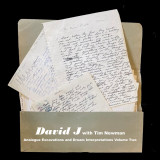
While Bauhaus have been waiting to continue their reunion shows, founding member David J has been trawling through his archive of tapes and diaries from the early 80s in coll;aboration with sound sculptor Tim Newman to present two volumes of unique spoken word and songs, including a vocal contribution from Black Francis of The Pixies and guitar overdubs by Warren Defever of His Name Is Alive and Adrian Utley of Portishead. Sleeve notes by Andrew Brroksbank of the Bauhaus Archive.
While Bauhaus have been waiting to continue their reunion shows, founding member David J has been trawling through his archive of tapes and diaries from the early 80s in coll;aboration with sound sculptor Tim Newman to present two volumes of unique spoken word and songs, including a vocal contribution from Black Francis of The Pixies and guitar overdubs by Warren Defever of His Name Is Alive and Adrian Utley of Portishead. Sleeve notes by Andrew Brroksbank of the Bauhaus Archive
Ty Segall meets a new non-rock challenge head-on; soundtrack music for
Matt Yoka’s compelling documentary film ‘Whirlybird’. A variety of synth
sounds, electric keyboards, drums, percussion and saxophone (and yeah, a
few guitars) form a shifting impressionist counterpart, instrumental music that
dialogues with and serves to frame the film’s compulsive themes and
images.
Released to great acclaim in Summer 2021, ‘Whirlybird’ tells the story of
Zoey Tur and Marika Gerrard, former partners and founders of the Los
Angeles News Service, and deftly tracks their extraordinary and oftenreckless pursuit of breaking news throughout the 80s and 90s - a time in
which they pioneered the use of a helicopter to report on Los Angeles at its
most chaotic, capturing historical moments like the 1992 riots and the OJ
Simpson slow speed pursuit.
Through striking interviews and one-of-a-kind archival footage, Yoka’s
documentary expertly tells the story of Zoey and Marika’s unravelling
marriage as they singlehandedly changed broadcast news forever. These
two arcs intertwine to create an electric view of the encroaching intensities of
that era, when the 24-hour news cycle first rose to dominate our national
consciousness.
Ty Segall has previously scored scenes and interstitial bits for film and video
things here and there - but this is his first full-on feature film score, a work
done in collaboration with the director, whose friendship and creative
partnership with Ty has grown over a decade-plus of music videos and other
projects. Working off notes and feels from Matt and responding to the images
and story on screen, Ty crafted some of his most creative arrangements to
date, using synth, drum machine, Wurlitzer keyboard, guitars, drums and
percussion (plus saxes played by Mikal Cronin, who also cowrote the title
track with Ty) to articulate a multitude of tones running through the film.
For a shape-shifter like Ty, this apex of tone colour is no mean feat, an
achievement further highlighted by the full set of pieces. Rather than simply
throw a bunch of songs-with-singing at the project, Ty’s score perfectly
epitomizes the film’s ethos, providing an instrumental counterpart that
dialogues with and helps frame the film’s provocative themes and images.
As both Matt and Ty are natives to the Southern Californian milieu,
particularly the era ‘Whirlybird’ depicts, their collaboration involved a journey
through their past. In realizing the music, they revisited their own Los
Angeles awakenings, adding another personal layer to the deeply felt
meditations and elegies sighted by the remarkable ‘Whirlybird’ - now an
equally thrilling counterpart to be experienced through the original
soundtrack.
"It's now time for Prince Dadju's return. Several months after the phenomenal success of ""Mon soleil"", Dadju unveiled his new single, ""KING"", the first single from the new album ""CULLINAN"". In barely 5 years, In France Dadju has accumulated 2 CERTIFIED DIAMOND ALBUMS (+ than 1.5Million albums sold) and more than 66 certified singles (10 of Diamond, 16 Platinum and 40 Gold). Reviews and Ads R2 and London Macadam
“Cullinan” released on very limited LP "
We’ve come to expect big things from Liam Gallagher, but today he reveals plans for 2022 that are biblical even by his colossal standards. He is set to release his new album ‘C’MON YOU KNOW’ on May 27th as he looks to score a fourth consecutive #1 UK record. He also celebrates the 25th anniversary of Oasis’ era-defining gigs at Knebworth Park with the news that he’ll return there to play the biggest show of his solo career to date on June 4th.
‘C’MON YOU KNOW’ follows the huge success of Liam’s previous studio albums ‘As You Were’ (2017) and ‘Why Me? Why Not.’ (2019), which established his iconic status for a whole new generation. His ‘MTV Unplugged’ also went straight to #1 on the Official Album Chart. Between his triumphs as a solo artist and his phenomenal success with Oasis, Liam has spent a combined total of almost six months at #1 across eleven chart-topping albums. More details regarding ‘C’MON YOU KNOW’ will follow.
The Knebworth Park show will see Liam return to the site where Oasis famously played two unforgettable nights there in 1996. The 25th anniversary of the shows was marked with the release of the feature-length documentary ‘Oasis Knebworth 1996’, which NME described as “an era-defining gig that will live forever.” The Knebworth Park gig will be the biggest show of Liam’s solo career to date. It follows his triumphant return to touring this summer with headline sets at Reading, Leeds and TRNSMT alongside a free gig for NHS staff at The O2.
Liam says, "I'm absolutely buzzing to announce that on 4th June 2022 I'll be playing Knebworth Park. It's gonna be biblical. C'mon You Know. LG x"