* Abyss is a new artist for Kniteforce, and he brings a distinctly different flavor to the label. Having had a few tracks featured on anthologies within the label such as the Death To Digital EPs and the Vinyl is Better albums, he now brings forth his first full EP. His sound is jungle and dark for the majority, from that early era of D'n'B, at the birth of the almost hypnotic sound, with strings and dark spoken word samples, and the omnipresent and heavy amens. The result is something that sounds like it was build in 1994, and has only just resurfaced....
Club / DJ Support
Billy Bunter, the Fat Controller, Glowkid, Slipmatt, Dj Jedi, Dj Luna-C, Dj Brisk, Clayfighter, Jimni Cricket, Bustin, Sc@r, Doughboy, Saiyan, Dave Skywalker, Ponder and many others
Search:digital era
The long awaited new LP from Hunter Complex features 10 tracks of supreme synth goodness that are at the same time retro and yet totally futuristic. It's musically rich in ideas; melodies intertwine with soaring synths and '80s style drum machines, but it never once feels like pastiche or a carbon copy of a bygone era. The hooks on this record are incredible; it's mix of warm analog and bright digital synths feature a layer of complexity that most records in this genre can't hope to achieve.
Parisian label Chuwanaga is really proud to present In The Red Vol. 2 (A Britfunk Selection by Saint-James), almost a year and a half after the first compilation being released. This second volume still focus on the Britfunk genre - or British Jazz Funk - mainly produced in London between the end of the seventies and the
eighties. It defines a unique mix of Jazz-Funk & Disco including Reggae & Dub techniques from Afro-Caribbean communities who were at the heart of the movement. Parisian DJ, activist and producer Saint-James has again selected the most
exciting, rare and powerful tracks from that era (1981-1988). Included in this compilation are Stikki Stuff, Cruzial, Potion, The Breakfast Band, Yeow Band and Scratch (better known as Gonzalez). Expect powerful synth solos, crazy slap
bass grooves and lovely vocals on the top when the horn section is not busy doing its funky thing. Back in the days, these young musicians gave their music a unique British flavor and
raw energy pushing the needle "In The Red". Almost four decades later on these powerful tracks are again ready to burn up dancefloors. The compilation features an
insert with pictures and a few more words about the selection. The compilation is also available as digital download and CD along with Volume 1.
WRWTFWW Records is immensely happy to announce the reissue of impossible-to-find cult album Lady Maid by Japanese outfit Normal Brain, available on vinyl, digipack CD (for the first time ever), cassette, and digital, with liner notes by acclaimed sound artist and mastermind behind the project, Yukio Fujimoto.
Originally released in 1981 as a limited vinyl pressing of 300 copies on Agi Yuzurus fabled experimental label Vanity Records (R.N.A. Organism, Dada, Sympathy Nervous, Tolerance), Lady Maid is a testament to the creativity of the early 80s Japanese electronic and experimental scene, encapsulating a prolific era when audio gear became affordable for musicians to explore sounds in the comfort of their home, free from studio time pressure and major label rules.
Entirely imagined and brought to life by an inspired Yukio Fujimoto, the 6-track opus was conceived with a Korg MS-20, a Korg SQ-10, a Boss Dr. Rhythm DR-55, anda Texas Instruments Speak & Spell! Its elegantly minimalist, honest and witty, very playful, cleverly pop, and downright fascinating. The a-side captures the fun side of avant-garde electronica, lo-fi wave, proto-glitch, and IDM, a joyful ride beautifully interrupted by the cinematic mood switch of the b-side - a 20 minute ambient piece flirting with sci-fi, melancholy, and hints of metallic darkness. Unclassifiable and marvelous!
- D2: Johnny Clarke - Time Will Tell
- D3: The Aggrovators - Drums Of Africa
- D4: Dillinger & King Tubby - Jah Jah Dub
- E1: Winston Wright - Marvelous Rocker
- E2: The Mighty Diamonds - You Should Be Thankful
- E3: King Tubby, Prince Jammy & The Aggrovators - A Thankful Version
- E4: Dillinger - Check Sister Jane
- F1: Prince Jazzbo - The Wormer
- F2: The Uniques - You Don't Care For Me
- F3: Shorty The President - Natty Dread Have Ambition
- F4: King Tubby & The Aggrovators - This A The Hardest Version
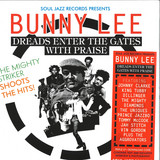
Johnny Clarke & King Tubby & Dillinger & Prince Jazzbo feat. Tommy McCook & The legendary Aggrovators & The Mighty Diamonds - Soul Jazz Records presents Bunny Lee: Dreads Enter the Gates with Praise - The Mighty Striker Shoots the Hits!
Soul Jazz Records presents this new collection featuring the heavy 70s roots reggae of Bunny
Lee - a living legend, one of the last of the great Jamaican record producers who helped shape
and define reggae music in the 1970s from a small island sound into an internationally
successful musical genre.
From teenage fan to young record plugger for Duke Reid, Sir Coxsone and other early
pioneering Jamaican musical entrepreneurs, Lee has spent his whole professional life inside the
Kingston music industry. In the 1970s he rose up to become one of the major record producers
in Jamaica alongside Lee 'Scratch' Perry and the other 'small axe' producers who broke the
dominance of the 'big tree' producers that had ruled Jamaican music in the 1960s.
Featuring some of the heaviest Jamaican artists, including Johnny Clarke, King Tubby, Dillinger,
Prince Jazzbo, Tommy McCook, The legendary Aggrovators (featuring Sly and Robbie), The
Mighty Diamonds and more, the album is a rollercoaster ride of rare, deep and classic 1970s
roots, dub and DJ sounds.
During this era, 'flying cymbals', crashing reverbs, dark echoing thunderclap gunshots and
other 'implements of sound' filled his record productions as Bunny Lee explored the outer limits
of dub with his friend King Tubby in the mix on wild versions that accompanied any 45. A
Bunny Lee record provides a creative and mysterious hidden guide to reggae music itself, a
double-sided three-minute intangible history lesson etched in wax.
Bunny Lee was one of the first Jamaican producers to travel to England in the late 1960s, at
the beginning of the nascent British reggae music industry as record companies such as
Trojan, Pama and others began licensing Jamaican music in the UK to supply the expanding
West Indian communities living up and down England. Lee encouraged other Jamaican
producers to do the same, including Lee Perry, Harry J and Niney The Observer and also
became a conduit between the British music industry and numerous younger Island-based
producers - a frequent flyer reggae ambassador, a musical courier exchanging tapes for
royalties.
Bunny Lee's first recordings in the late 1960s were mainly rock steady but as the 70s
approached the music soon began to mutate and slow down into 'reggae' as the sound became
heavier, more rootsy and the sound itself began to change with the explosion of dub.
Lee was at the forefront to this dramatic musical shift into roots reggae and by this time had
become a major producer, capable of working with whoever he chose as world-famous singers,
DJs and musicians lined up to work with the charismatic man. Lee also employed a fluid but
stable set of crack session musicians who he named The Aggrovators.
Most of the recordings featured here come from the mid 70s, a time when Bunny Lee was
definitely in the zone, releasing heavyweight singles at an almost unstoppable rate. Bunny
Lee's career stretches over five decades and he has upwards of 2,000 production credits on
vinyl.
This album comes with extensive sleevenotes, an interview with Bunny Lee and exclusive
photography. The album is available as a CD pack with 24-page booklet, massive triple LP vinyl
with digital download code, house inner and full notes, as well as digital album.
Guadeloupe 1986. The football World Cup has all the Islanders' eyes riveted to their TV sets. At every half time breaks, local TV channel RFO broadcasts a music video on repeat: ''Tou't Jou Pa Min'm". Max Rambhojan, the local singer responsible for this monster tune, has arrived.
In the video, he effortlessly sings and kickstarts a joyous street party with his band, Show Man, his dancers, kids, friends, family and what seems like the whole neighbourhood. The song will gain cult status from then on, cementing the power of the 'Zouk Chiré' sound, a high tempo version of Zouk, highly influenced by Guadeloupe's Carnival mass drum bands. Max self-releases his first solo album on vinyl in 1985, enrolling some of the best musicians the scene has to offer: his band leader King Klero, Guy Jacquet of les Vikings de la Guadeloupe fame on production duties, Ramon Pyrmée on synths, Claude Vamur, Meliza... In 1992 a new solo album follows. By then the artists have familiarized themselves with computers and the sound has gone full-on digital. In that album Max records an updated version of his 'Tou't Jou Pa Min'm' anthem to great effect.
Reducing Max Rambhojan to a zouk artist would be a mistake. He's first and foremost a master of Gwo-Ka, a musical practice born during the transatlantic slave trade and performed by all ethnic and religious groups of Guadeloupe. It has never ceased to exist and has become a major part of the Island folk music culture. Max Rambhojan was schooled as a kid by Gwo-Ka pioneer Guy Conquette, and quickly joined the backing band of another legend, Ti-Sélès. That sound is the root of his particular style, especially vibrant on two tracks in his repertoire: 'Cecilia' and 'On Jou Matin', both featured on this release's b-side. A touch of Spiritual Jazz is also palpable, allowing a magical vibe to spread, giving birth to some of the deepest music from this era.
In 2019, Max still performs Gwo-Ka every week-end in Guadeloupe and also hosts a show on local radio Media Tropical, 88.1FM. Secousse and Hot Mule are proud to present those 4 lost gems on wax and digital, carefully restored and remastered.
- A1: Chapter D (Dark Main)
- A2: Chapter M (Driving)
- A3: Chapter M (Karenina)
- A4: Chapter D (Swing)
- A5: Chapter M (Light)
- A6: Chapter M (Mellow)
- A7: Chapter D (Sparkling)
- A8: Chapter M (Charming)
- B1: Chapter M (Karenina 2)
- B2: Chapter D (Main)
- B3: Chapter M (Cosmic)
- B4: Chapter D (Strumm)
- B5: Chapter M (Reduction)
- B6: Chapter D (Dark)
- B7: Chapter M (Cosmic 2)
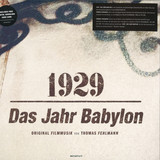
'1929 - Das Jahr Babylon" marks Thomas Fehlmann's third full length release of 2018 and presents what appears to be a creative peak in his career that spans beyond his solo career to his early days in Palais Schaumburg, collaborating with Moritz von Oswald as 3MB to his long time work with The Orb. Having left The Orb in late 2017 has set free unforeseen energies in Fehlmann's studio.
A departure from his recent dance floor-friendly album "Los Lagos" (KOM388, KOMCD148) released in September on Kompakt, Thomas Fehlmann's '1929 - Das Jahr Babylon" is a film soundtrack from the documentary that aired on ARD network on September 30, 2018 and is now available as a podcast series.
To compliment the internationally lauded TV series "Berlin Babylon", German director Volker Heise has created a documentary about 1929, the fateful year during Germany's "Weimarer Republik" in which "Berlin Babylon" is settled. Heise's stirring documentary portrays Germany's sizzling capital that is faced with radical changes by the dark forces whom are about to toss the world into the abyss we know as World War II.
This marks the second time that Fehlmann is partnering up with Volker Heise after 2010's marathon documentary "24 Stunden Berlin" which was released as "Gute Luft" (KOM211, KOMCD81) in the same year. Fehlmann's composition for "1929" consists of sample material taken from the era and thwarts the exaggerated lust for life with threatening undertones that anticipate the dawn of mankind's darkest chapter so far. Although all the sounds breathe yesterday's atmosphere this soundtrack bursts with modernity. Fehlmann accomplished the daring feat to musically render the unsettling resemblance between the political situation 90 years ago and our current time.
We at KOMPAKT feel that Fehlmann's score has turned out spectacular enough to give it proper release on limited vinyl and CD as well as on all digital platforms.
Mit '1929 - Das Jahr Babylon" legt Thomas Fehlmann schon seinen zweiter Longplayer innerhalb eines halben Jahres vor und dokumentiert damit eine kreative Hochphase seiner überaus stattlichen Musikerkarriere. Die Trennung von The Orb scheint bei ihm ungeahnte Energien freizusetzen.
Anders als auf dem cluborientierten "Los Lagos" tritt Thomas Fehlmann auf "1929" musikalisch einen Schritt zur Seite. Und das aus gutem Grund: Analog zur international gefeierten Fernsehserie "Babylon Berlin" entstand unter der Regie von Volker Heise der Dokumentarfilm "1929 - Das Jahr Babylon" - ein ergreifendes Sittengemäde Berlins während des Schicksalsjahrs der Weimarer Republik. Wie schon zu Volker Heises vorangegangener Berlin-Doku "24 Stunden Berlin" (2010 erschienen als das Album "Gute Luft" auf KOMPAKT) hat Thomas Fehlmann auch diesmal den kongenialen Soundtrack beigesteuert. Basierend auf Klangmaterial des Jahres 1929 hat Fehlmann eine beeindruckende Musik geschaffen, in der manchmal die übertriebene Lebensfreude und Dekandenz jener Zeit aufflackert. Eine Musik, deren Stimmung jedoch unterwandert ist von den bedrohlichen Strömungen, die Deutschland kurz darauf in seine dunkelste Epoche stossen werden.
Thomas Fehlmann ist damit ein wahres Kunststück gelungen. So sehr die Produktion den Geist einer vergangenen Zeit atmet, so modern mutet sie an. "1929 - Original Filmmusik" klingt somit wie die zu Musik geronnene Erkenntnis, dass sich Gestern und Heute auf erschreckende Weise ähneln.
Wir bei Kompakt sind der Ansicht, dass Thomas Fehlmanns Filmmusik zu "1929 - Das Jahr Babylon' so spektakulär geraten ist, dass wir sie nun als limitierte CD und Vinyl-Auflage, sowie auf allen digitalen Plattformen verfügbar machen.
* The third of the Death To Digital EPs drops hard. This one, like the first two, aims to provide a selection of distinct and varied old skool tunes, from producers with very different approaches and sounds, but very similar attitudes. Wislov just gets better with every release, and his track The Time Is Out is certain to put a smile on your face. Meanwhile, KF label stalwart Dj Deluxe FINALLY gets his KF Radio anthem 'Glorious' released, and what a wicked tune it is. Apparently the sample has something to do with wrestling, but dont let that put you off, its glorious all the same! Recent KF signee Abyss displays his rare talent for touching that sweet spot between drum and bass and jungle, that era of The Invisible Man and LTJ Bukem, when the atmosphere, bass and breaks were where it was at. Many attempt this style, but Abyss has it perfected, and Falling is like a 95 classic you have never heard until now. And of course, Shoreman, hot off his Deep Waters EP, shines super strong with Growing Stronger.
The new album from Danish electronic trio System is a special kind of collaborative effort with piano magician Nils Frahm. His purpose-built improvisations on synth, organ and piano served as source material for the members of System (Thomas Knak, Anders Remmer & Jesper Skaaning), who merged his warm acoustic tones with their minimalist digitalism and set out to translate their distinctive clicks 'n' cuts electronics into vivid soundscapes. Over two years in the making, the resulting nine tracks are as sonically intriguing as they are touching. Ranging from the mellow bliss of the title track to echoes of 90's and 2000's electronica and ambient sequences frequented by mesmerizing movements and sounds. The blending of piano and digital tones and noises into emotive pieces might instantly recall the work of Alva Noto and Ryuichi Sakamoto, though System and Frahm come to quite different results.
Thomas Knak met Nils Frahm at one of his concerts in Copenhagen. They stayed in touch, exchanging thoughts and ideas. Two years later, Anders Remmer was also introduced to Nils. From then serious ideas for a collaboration formed. As Nils was a fan of System's self-titled debut album (released in 2002 via Pole's Scape label) their talks centred around Dub and minimalism, elements that constitute most of System's music as well as their side and solo projects. This in mind, System began producing sketches and brought them to Nils´ Durton Studio in Berlin in December 2015, where they recorded ten hours of him playing keys and effects to their drafts. Back in Copenhagen, they decided to change direction. - As Nils had told us about his fascination with our debut album, we tried to rediscover this minimal clicks 'n' cuts era. But hearing Nils playing to our rhythmic beds, we felt the need to scrap those beats and instead head in a more cinematic direction.'
So they started building new pieces from the Durton recordings, maintaining some of the minimal and static quality while new layers of synth sounds and noises created a richer and more organic quality compared to older System albums. The solo projects of Thomas (Opiate), Anders (Dub Tractor) and Jesper (Acustic) always relied on steady beats or rhythmic material, so the productions of 'Plus' with their focus on acoustic and melodic elements, ambient layers and cinematic moods, sees them pushing forward into new areas.
This way, the trio avoided copying what they had already done years ago, when they built a reputation as Denmark's prime originators within electronic music in the 90's and 2000's. 'Plus' is a triumphant example of collaborative experimentation and may be the dawn of a new era for System: - For us it was really satisfying to focus more on actual sound rather than rhythmic aspects. There is a lot of potential in this field, so it would only be natural for us to pursue this, maybe as a series of collaborations with other people who's music we admire.'
DFA release Crooked Man's new album, 'Crooked House'.
Speaking about the album's lead track, 'Take It All Away',
Crooked Man says: 'It's about not being suffocated under the
mountains of useless crap that Mammon shits into every
crevice of modern life... quite possibly the world's only anti
consumerist disco song.'
The elusive Crooked Man returns to DFA with 'Crooked House'
LP, a maximalist take on electronic and house music that picks
up where 2016's self-titled album left off. Teaming up again
with Michael Somerset Ward (Clock DVA) and David Lewin
(Bleep & Booster) in the studio, Richard Barratt crafts a
comprehensive journey of hi-fi house belters with more sinister
electro-pop mixed in for good measure.
The album is influenced by two historic epicentres of electronic
music: Sheffield UK, where Richard has had an illustrious
career in a mix of legendary groups like Funky Worm, Sweet
Exorcist and The All Seeing I; and the NYC Loft-era disco
sound, where extended grooves were layered with peaktime
choruses.
Richard's diverse collaborations and intensely prolific
discography have now led him to records as lush and
sophisticated as 'Crooked House'. Considering the rarity of a
live Crooked Man performance or DJ set, it's a testament to his
hyper-creativity that these tracks are able to reach new heights
in a club setting. With support from disco historian Bill Brewster
and NTS resident Ross Allen, it's clear that 'Crooked House'
brings a timeless vitality to the current landscape of dance
music and continues an exciting new chapter in Crooked Man's
career.
LP format includes digital download code.
- A1: There's A Break In The Road
- A2: 12 Red Roses
- A3: Mean Man
- A4: I'm Gonna Git Ya
- B1: Ride Your Pony
- B2: Show It
- B3: I Don't Wanna Hear It
- B4: Bad Luck
- C1: Hook, Line 'N' Sinker
- C2: Lonely Hearts
- C3: What A Sad Feeling
- C4: What'd I Do Wrong
- D1: Trouble With My Lover
- D2: Sometime
- D3: I'm Evil Tonight
- D4: Nearer To You
- D5: All I Want Is You
Betty Harris' The Lost Queen of New Orleans Soul collects together the steady stream of amazing soul and funk singles issued by Betty Harris from 1964 to 1969, under the musical guidance of legendary composer, musician and producer extraordinaire Allen Toussaint, a collection which truly captures the heart and soul of the city of New Orleans during this era.
Betty Harris's powerful, fiery soulful vocals found a perfect accompaniment with the New Orleans' players that Toussaint put together to back her, which by the time of her funk classic 'There's A Break In The Road' were the legendary super-tight, super-funk New Orleans group The Meters.
With the extraordinary song-writing skills of Allen Toussaint alongside the powerful, soaring, confident and emotive singer and the groove of The Meters, you have an unbeatable combination. That Harris never in fact lived in New Orleans (she flew in from Florida for all her sessions with Toussaint's local in-house players) seems almost an irrelevance, a geographical aside to the defining New Orleans sound captured on the recordings featured here.
All of these singles featured here were released on Allen Toussaint and his business partner Marshal Sehorn's local New Orleans label Sansu, widely distributed in the southern city but in only limited quantities elsewhere. As a consequence, Betty Harris' music failed to achieve the commercial success of other New Orleans artists such as Lee Dorsey (who she recorded with) and The Meters (who backed her). And so at the end of the decade she stopped recording, retired from the music business to raise her family in Florida.
This is no reflection of the stunning musical quality of all these songs which encompass everything from southern soul, heavy funk, deep soul ballads and northern soul. Betty Harris has been a cornerstone of Soul Jazz Records' New Orleans Funk and New Orleans Soul compilations. Always soulful and always funky, Betty Harris' music contains the essence of New Orleans music. She is the Lost Soul Queen of New Orleans.
This collection is released on CD, heavyweight gatefold double LP vinyl (+ download code) and digital and comes complete with full biography, original label artwork.
Over the past few years orchestral instrumental music from outside the classical establishment has become huge, and Neil Leiter and Margaret Hermant of the Belgian Echo Collective have witnessed the evolution and extraordinary rise of this movement right up close. They've worked with some of the most important players, including Stars Of The Lid, Dustin O'Halloran and Adam Wiltze's A Winged Victory For The Sullen and O'Halloran's solo projects, as well as Jóhann Jóhannsson. And though the Echo Collective members themselves very much do come from within the classical music establishment, they don't care which side of the fence they are seen to be on. It was this which grabbed the attention of German music hub !K7's new sub-label 7K! - who have signed them for a two album deal: first to release the Amnesiac reinterpretation, then for a record of Echo Collective's own compositions. Not only that but they have been signed for publishing by Mutesong, which led to a hook-up with Mute mainstays Erasure, re-arranging and re-recording their latest album World Be Gone with classical instrumentation backing Andy Bell's vocals. This ability to flow easily from black metal to Radiohead, from Erasure to Stars Of The Lid shows exactly what kind of musicians Echo Collective are. The album, which features artwork by the renowned photographer and artist Roger Ballen, will be released on 30 March on CD, 2LP and digital platforms.
- New album by belgian band Echo Collective covering Radiohead's classic Amnesiac'.
- Perfect balance between classical, neoclassical & indie.
- Past and ongoing collaborations include Erasure, A Winged Victory for the Sullen, Stars of the Lid, Johann Johannsson and Dustin O'Halloran.
- Echo Collective have produced, arranged and performed on Erasure's upcoming album due to release early March on Mute.
- Artwork by renowned photographer / artist Roger Balle.
It was chance that brought about the release of One/Three, Dabrye's debut album. Early demos were tucked on the B side of a cassette Tadd Mullinix passed to Sam Valenti in 2000 while working at the Dubplate Pressure record shop in Ann Arbor. Mullinix had spent the late '90s producing jungle, techno, house, hip-hop and more using the All Sound Tracker software as a primary instrument. Each style pulled from a similar sound palette as Mullinix used limitations to define the contours of di-erent musical personalities. Dabrye was his hip-hop wildstyle, a captivating collage of sparse instrumentals inspired by the laid back vibes of midwestern hip-hop and east coast boom bap, the futuristic funk of Umma-era Jay Dee, and the calculated subtlety of Detroit dance music. Released in 2001 as the first in an intended trilogy, One/Three announced Dabrye's arrival with an unavoidable contribution to Detroit hip-hop. Ghostly International is reissuing the album in 2017 for the first time, including a long overdue vinyl edition.
On its release One/Three was the rare album that appealed to both fans of Slum Village's smooth yet rugged hip-hop and enthusiasts of the distinct American IDM released by labels like Schematic. Over the following decade, the inadvertent demo submission turned into a body of work that placed Dabrye alongside innovators such as Prefuse 73 amid the cannon of a new generation of producers. Today, One/Three remains a concise and intriguing study in instrumental hip-hop that helps join the dots between J Dilla and Flying Lotus.
One/Three is a record that says much with little. There are no obvious hip-hop tropes. Instead Mullinix captures the ingenious minimalism of '90s hip-hop instrumentals to build tracks both supple and hard, joyous and melancholy, full of sharply angled rhythms and warm rubbery basslines: 'The Lish' throws a sickly sweet saxophone against digitally fragmented melodies, 'How Many Times (with this)' draws you in with an irresistible, clipped guitar groove, the rhythmic stutter of 'Smoking The Edge' makes your head spin with pleasure. Playing with his inspirations, Mullinix injects omitted downbeats for imagined rhymes and repurposes the intricacy of ragga jungle for breakdowns.
But what really defines One/Three is the rhythmic sensibility and metric modulation of Detroit's school of hip-hop production, which Mullinix was a fervent student of. The beats feel like they're constantly escaping a rigid tempo grid even though they are, in fact, pretty tight. A lot of it is nuance,' Mullinix explains. I've been known to say that I'm not impressed by spectacle. I think that nuance is what really captivates people.'
If you like your beats with a dash of class, do not miss this. An essential purchase of the highest order.' -BBC
- First time all tracks from the original 2001 release appear on vinyl.
- Remastered by Daddy Kev
- Standard weight black vinyl is inserted in to 3.5mm matte finish vinyl jacket.
- Download card includes free download of the Payback EP
Off the back of Rudeboyz follow up EP entitled Gqomwave, Goon Club Allstars are back with an EP from UK Funky producer KG. In 2007 Karen Nyame, otherwise known as KG, was at the Nottingham Trent University producing beats on Fruity Loops. Slightly isolated in Nottingham - away from the UK Funky scene's London epicentre - KG posted her tunes on popular UK Funky message boards and Facebook pages, but never had an opportunity to properly stake her claim as one of the scene's heavy hitters. 808 and Midnight (Flute Riddim) are two lost anthems from that era, although receiving support from the likes of Marcus Nasty and others, they were largely forgotten amongst the numerous stand out tracks of the era, appearing rarely in mixes of those lucky enough to have digital copies. 808 is the party anthem, it's joyous, quivering melodies ascend above the thumping kick drum, while relentless crashing snares and carnival whistles rain down - guaranteed to heat up the coldest of dancefloors. Midnight (Flute Riddim) on the flip side is the softer, slinkier bubbler. Built for smouldering club action and hot sunny days. BSNYEA is a new addition to Goon Club Allstars' burgeoning family of artists. Hailing from the Bronx he is a veteran of the Borough's Litefeet genre that soundtracks the performances of subway dancers cross New York City's transit system. On his remix of 808 he focusses on the whistles and gutter synth lines adding in booming bass drums and lock inducing chants. Hitmakerchinx comes fresh from his anthemic Night Slugs compilation. Bringing his signature FDM energy he drops the tempo and builds on the light, airiness, letting the flutes play out softly underneath the thumping drums.
- A1: Get Wid It Feat. Tyna (Visioneers Version)
- A2: Happy Days Feat. Bagi & Sarah Ann (Peter Kruder Remix)
- A3: Code Of The Snake Feat. Blabbwona (Pulsinger & Irl Codeine Shake Dub)
- A4: Why We Feat. Ward 21 (Jstar Remix)
- B1: Holdin´ Back Feat. Wordsworth (Flip Remix)
- B2: Concussion Feat. Blurum13 (Trishes Remix)
- B3: Get Wid It Feat. Tyna (Visioneers Version Instrumental)
- B4: Holdin´ Back Feat. Wordsworth (Flip Remix Instrumental)
- B5: Concussion Feat. Blurum13 (Trishes Remix Instrumental)
Die zweite Runde von Remixen zu dem selbst betitelten Album von Urbs ist eine fesselnde Zusammenstellung von zeitlosen HipHop sowie Downtempo Nummern.
Marc Mac: Gibt es zu dieser Person etwa noch was zu sagen Als Teil des UK Duos 4Hero hat er Musikgeschichte geschrieben und sein Visioneers Projekt setzte neue Standards in Sachen organischem HipHop. Sein Remix zu - Get Wid It featuring Tyna aus Neuseeland, besitzt alles, was man sich von diesem Musikgenie erwartet. Ein souliges, harmonisches Meisterwerk, welches auch auf einem seiner legendären Visioneers Alben hätte veröffentlicht werden können.
Peter Kruder hat als Teil von Kruder & Dorfmeister sowie mit seinem Projekt Peace Orchestra Musikgeschichte geschrieben. Sein Remix zu - Happy Days feat. Bagi und Sarah Ann ist eine Reise zurück zu seinen musikalischen Wurzeln, welche ihn berühmt gemacht haben - eine relaxte Downtempo-Nummer. Der Remix weckt Erinnerungen an die Zeit, als seine Musik Millionen von Menschen berührte.
Patrick Pulsinger ist der dritte im Bunde aus der Riege der Helden der 90s. Gemeinsam mit Sam Irl, seinem derzeitigen Komplizen, zeigen die beiden was herauskommen kann, wenn ein Studio-Zauberer mit Techno Wurzeln auf ein Musikgenie mit HipHop Wurzeln trifft. Ihr Remix zu - Code Of The Snake feat. Blabbwona ist eine trippige HipHop-Tech-Dub Nummer mit viel Bass und als solches absolut einzigartig.
Jstar aus London hat sich bereits einen Namen gemacht als Produzent von unzähligen Remixen und Edits auf seinem eigenem Label Jstar. Seine Spezialität sind Dub und Reggae Remixe von HipHop Classics. Er ist ein Großmeister des Digital Dancehall und transformierte den Golden Era Sound von - Why We feat Ward 21 (aus Kingston Jamaica) in etwas absolut Futuristisches.
Flip: Rapveteran von Texta aus Linz, der zuletzt durch sein Soloalbum auf dem New Yorker Raplabel Ill Adrenaline Records aufgefallen ist, bringt einen Remix zu - Holdin' Back feat Wordsworth. Mit einem genialem Chuck D Sample und einem funky Beat setzt dieser Remix Tanzflächen von Alaska bis Auckland in brannt.
Trishes: Last but not least: Moderator der legendären HipHop Radioshow Tribe Vibes auf FM4 und integraler Bestandteil der Wiener HipHop Szene. Für seinen Remix zu - Concussion feat BluRum13 von Oneself, setzte er auf einen heftigen Groove mit lauten Becken um einen Underwater-Funk-Beat zu kreieren und somit einen neuen Hintergrund für diese echt verrückte Geschichte zu gestalten.
Über das Album 'Urbs':
Ganze elf Jahre sind seit - Toujours Le Meme Film', dem letzten Album von Urbs vergangen. Auf Kruder & Dorfmeisters G-Stone Label lieferte der Wiener Musiker, DJ und Producer damals den Soundtrack zu einem fiktiven Film Noir, zog sich aber nach einer Europa-Tournee fast gänzlich aus der Öffentlichkeit zurück. Er sieht sein Schaffen nicht als Karriere, sondern als Teil seines Lebens, welches in den seltensten Fällen einer konkreten Planung unterliegt, und deshalb hat Urbs sich auch bewusst viel Zeit gelassen für sein aktuelles -unbetiteltes - Album.
Urbs: - Der Vorgänger "Toujours Le Meme Film" kam bei sehr vielen Leuten extrem gut an, und über die Jahre habe ich mitbekommen, daß es manchen Leuten richtig viel bedeutet. Das war eine gewisse Belastung, weil man diese Leute natürlich nicht enttäuschen will. Mittlerweile denke ich, daß genug Wasser die Donau runtergeflossen ist, um vielleicht den einen oder anderen mit etwas ganz Neuem zu überraschen. Die Leute, die mich kennen, wissen ja, daß ich im Grunde immer dopen HipHop produziert habe.'
Konsequenterweise handelt es sich diesmal nicht um ein Instrumental-Album sondern um eine Sammlung von 12 souligen HipHop Nummern, die mit handverlesenen Vokalisten der internationalen Rap-, Dancehall- und Soul-Szene aufwarten. Neben den New Yorkern Wordsworth von EMC sowie R.A. The Rugged Man, finden sich unter anderem Ward 21 aus Kingston, Jamaica, Voice Monet aus New Orleans, Blu Rum 13 von One Self aus Washington DC, als auch alte Weggefährten wie dem Wiener Skero oder dem Wahl-Münchner Blabbwona von Abstract Art auf dem Album.
Auf die Frage, wie es sich anfühlt, nach mehreren Instrumental-LPs erstmals ein Album mit Vokalisten aufzunehmen, erwidert Urbs mit einem Augenzwingern: - Generell war es für mich schwierig die Songs loszulassen und mich den MCs auszuliefern. Man verbringt viel Zeit mit einem Stück und baut eine gewisse Beziehung auf. Die Musik erzeugt Bilder im Kopf und hat oft eine schwer fassbare Bedeutung für den Producer. Dann geht ein MC drüber und es ist ein bisschen als würden die brutalen Freunde deines älteren Bruders dein Kinderzimmer verwüsten- in deiner Anwesenheit.'
Wieso das Album keinen Titel trägt, ist auch schnell beantwortet: - Dieses Album ist nun sozusagen meine Leistungsschau auf diesem Gebiet und durch den unendlich langen Reifeprozess, ist es auch schön intensiv eingekocht und auf dem Punkt. Deshalb auch keine Intros, keine Interludes, kein Titel, no Gimmicks, einfach 12 gute Songs - Punkt.'
Neben dem Album werden auch zwei EPs mit Remixes von Retrogott, Brenk Sinatra, Visoneers (Marc Mac von 4 Hero), Peter Kruder, Cookin' Soul, J*Star, Flip (Texta) und anderen veröffentlicht. Für das Artwork zeichnet DJ DSL verantwortlich.
Southern Italian sociologist, DJ and electronic music producer Simone Gatto is about to release his second album, 'Heaven Inside Your Frequencies', in November 2017.
Gatto's second album represents a complete excursus of his personal and professional paths, into which he combines music, words, studies, researches and experiments. Along with the album, split in two parts and to be released on both his labels Out-ER and Pregnant Void, the artist is also releasing his first essay, named as the album; the latter offers a theoretical and practical analysis on the use of sounds and frequencies in diverse areas of interest, dedicating space to music therapy and primordial techniques as well as their application in the current digital and virtual era.
Both the album and the essay result from Gatto's personal experiences as well as his ten-year's artistic career: the love of his motherland and his parents, the first approach to clubs, the studies about the potentiality of frequencies, the electroacoustic experimentation and last but not least, the aesthetic sonorous research.
The the first part of the album showcases Gatto's experimental inclination for electronic and electroacoustic music; as such, the upcoming on his label Pregnant Void, has been created to enhance the sounds of the environment and personal panoramas by agglomerating artists, projects and publications. The second part definitely focusses on Gatto's dance personality and club vision, even so, it stays strongly connected to its first part as complementary for the artist's objective.
Ranging in between his favourite club niches, and collaborating with producers with whom he has shared embryonic projects, DJ booths or vinyl releases, Gatto prepares the audience for a complete journey into his idea of club music and grooves, featuring wide aesthetics and emotional resonance. It goes from the gentle tidiness of ambient and deep techno - 'No Te Olvides De Acordarte', 'Today Will Be Tomorrow ft. Kaelan', 'When I Was With You' and 'Limbo' to the intrinsic vitality of break beat, dub and funk tracks 'Caronte' and 'Holographic Drama' continuing with the dynamism of a typical Detroit techno brand of sound reinterpreted in a modern context, like in 'Forbidden Area' and 'Amazonia ft. Aubrey', and finishing with the joyful wildness of distorted sounds, in 'Jamming On The Couch ft. The Analogue Cops, OL047' in collaboration with long-time friends OL047 and The Analogue Cops; the last track, 'Il Canto Dell'Anima', is a partial excursion into the electroacoustic sound, articulated by ethereal soundscapes and piano arpeggios. The whole work is enriched by samples, field recordings and filtered vocals, sound elements which have been deeply explored in the first part of the album, confirming Gatto's aesthetical aptitude as for the club's universe as for the aesthetic sonorous research dimension.
'Heaven Inside Your Frequencies', recorded and produced between his motherland and other significant spaces and cities - the Ionian coast and natural parks of Lecce, his second home Berlin, the Whitney Museum in New York City and other significant places - 'Heaven Inside Your Frequencies' combines Gatto's theoretical background with personal and artistic maturity, achieved in the last decade. Simone Gatto's life, culture and emotions translate into a sonorous and written project, among sounds, frequencies and attempts to achieve empathetic communication with people. Specifically, the second part of the album in meant to increase the sensibility about potential interaction between performer and audience as for club contexts. The album listening and the essay reading are therefore complementary and equally functional to the achievement of the artist's goal: the empathetic communication through sounds.
- A1: Escape-Ism:- (Return To The) Iron Curtain
- B1: Light Beams:- Desiring Creatures
A split single featuring Washington, D.C.'s Escape-Ism and Light Beams. The digital
download in- cludes an extra track by each band.
Escape-ism is called "the found-sound-dream-drama," "the grieving widow of rock 'n' roll" , the "press play and run away group", the strrrripped down sound machine starring Ian Svenonius, star of Chain & the Gang, singer in The Make Up, author of 'Supernatural Strategies for Making a Rock 'n' Roll Group.' Its a single occupancy combo, a one banana bunch, the gestural rock 'n' roll provocation which combines cave person poetry with beats and melody translated incorrectly from hieroglyphs found in arch-pharaoh Cheops' triangle shaped record collection. Escape-ism is a bid at inciting long- ing for a past behind an IRON CURTAIN, and hope for a future in flames. Escape-ism -- hear it, fear it, cheer it.'
Light Beams began in 2015 when Justin Moyer (Puff Pieces) -- influenced by 80s-era freestyle music and Sheila E. -- started playing sampler and timbales with Sam Lavine, the longtime drummer of D.C. hip-hop mainstays the Cornel West Theory. With the addition of bassist Arthur Noll the result- ing polyrhythmic melange, sometimes called "zap-tone" or "block rock," reinvents late-20th century dance-pop using the tools of the 21st.
Dark Entries and Serendip Lab have teamed up to release 'Prototech', the first vinyl retrospective by German electronic trio Hypnobeat, recorded 1984-86. James Dean Brown and Pietro Insipido formed Hypnobeat in 1983, but it was the addition of Victor Sol only a few months later that found the project reaching, as Brown puts it, "the desired level of technical sophistication." In time, Tobias Freund also lent his talents (and equipment) to this loose-fit sonic scheme, where the protagonists sought a new, electronic manifestation of mankind's tribal music roots. Two cassette releases surfaced - 1985's "Huggables", and "Specials/Spatials" the following year. By this point the Frankfurt-based group had already explored fiercely mechanical creative expression through various configurations of hardware and personnel, revolving around core ingredients such as the TR-808, TB-303 and MC-202. The project lived on in spirit as Brown activated Narcotic Syntax in the 90s. While a more modern, digital concern, rooted in the Perlon label family, NS still channeled the Hypnobeat concept of a "new tribalism", not least on their "Provocative Percussion" double 12" released in 2006. For all the punky veneer, there are instances where these tracks reach staggering levels of sophistication, not least on "Slash! Buffalo Eats Brass" with its intricately programmed 303 lines and nimble beats that sound a far cry from most machine music made in 1986. Prescient "Can God Rewind" is also dazzling in the complexity of its percussion and the richness of its synth lines in C as they throb out a bastardised version of acidic Disco straight out of the rhythm collider. Elsewhere, some tracks are more primal in their execution. Visceral opening track "The Arumbaya Fetish" was a cathartic venting of Brown's least favourite sound on the 808, the iconic cowbell, while the astounding proto-Acid miniature "Moon Jump" places limber 303 lead lines in a hail of thunderstruck patterns. "Kilian" has a stripped down quality that speaks more to the industrial era that Hypnobeat was conceived in, and "Mission In Congo" is a raw, reverb-soaked drum workout that captures the percussive-obsessive nature of Hypnobeat perfectly. Six of the seven tracks selected on this collection were primarily powered by two 808s. "I am amazed that the release sounds like we really had a plan back then..." states Brown, but this accidental magic is in fact the raison d'etre of Hypnobeat. They weren't the only ones prefiguring the next big revolutions in electronic music in the mid 80s, but there certainly weren't many artists stumbling across modes of expression that sound so relevant today.
All songs are remastered for vinyl by George Horn at Fantasy Studios in Berkeley. Housed in a jacket featuring cave engravings by Pietro Insipido of an archer and animal printed in a wallpaper pattern style designed by Eloise Leigh. Each copy includes an transparent insert of an x-ray photograph from 1984 of Romulus Cœurque holding the circuit board of a BOSS DR-55 rhythm machine.
- A1: Hortense Ellis - Sitting In The Park
- A2: The Termites - Rub Up Push Up
- A3: Carlton & The Shoes - Never Let Go
- A4: Alton Ellis - I'm Still In Love With You
- A5: Owen Gray - Give Me A Little Sign
- B1: The Bassies - Big Mistake
- B2: Alton & Hortense Ellis - Breaking Up Is Hard To Do
- B3: Slim Smith - Born To Love
- B4: Cannon & The Soul Vendors - Bad Treatment
- B5: John Holt - Strange Things
- C1: The Actions - Giddy Up
- C2: Larry Marshall - It Makes Me Feel
- C3: The Paragons - Change Your Style
- C4: Jerry Jones - Trying Times
- D1: The Heptones - I Shall Be Released
- D2: The Gaylads - The Soul Beat
- D3: Delroy Wilson - Run Run
- D4: The Soul Two - Puppy Love
- D5: Delroy Wilson - Riding For A Fall
'Soul Jazz Records' new journey into the mighty vaults of Clement Dodd's Studio One steps once more into the fertile musical environment of Jamaican music in the late 1960's and early 1970's, from the sweet harmony vocals of seminal 1960s Rocksteady right up to the nascent birth of Reggae and Roots music at the start of the 1970's. Sleevenotes to this album are by Steve Barrow, author of 'Rough Guide to Reggae' as well as Soul Jazz Records' own 'Reggae Soundsystem Cover Art' books.
While Ska at the start of the 1960's had taken American Rhythm and Blues as its main influence, Rocksteady focused on the emergence of American Soul music - with Jamaican vocal harmony groups such as The Gaylads, John Holt & The Paragons, Carlton & The Shoes showing a particular fascination with the close harmonies of Curtis Mayfield and The Impressions and other US Soul acts. Here The Heptones even feature with a cover of Bob Dylan's 'I Shall Be Released'.
The influence of Soul music on Jamaican Rocksteady and Reggae is almost palpable, so much so that one wonders how much more successful singers like Delroy Wilson, Alton Ellis, Slim Smith and John Holt would have been had they been born in Chicago, Detroit or Memphis. Artists such as Alton Ellis, Delroy Wilson and Owen Gray defined the era - a slowed down beat as Jamaican political and social heat slowly increased when the 1960's progressed into the start of the 1970's - and the music evolved further from Rocksteady into Roots Reggae. This album is released on heavyweight gatefold sleeve double vinyl (plus download code), CD with slipcase and digital album (ex-North America).
In the years since the release of Adrian Younge's Something About April, he has been coined America's black genius: the evocation of analog vestige in a digital era. His majestic music has garnered him reverence, likened to Ennio Morricone's best work and the Beatles' tenacity to create new sounds. Fortuitously, Something About April has made an indelible impression on modern vinyl heads and producers alike, being sampled by DJ Premier, Jay-Z, Common, 50 Cent and more. The Something About April brand is an axiom to the modern 'Breakbeat' and Linear Labs is happy to announce its successor: Something About April II. Recorded with Younge's collection of rare instruments, Something About April II advances his musical paradigm with enterprising concepts and grander compositions — it synthesizes the boundaries between dark American soul and classic European cinema. With effervescent conviction, Younge executes with an array of entrancing vocalists: Laetitia Sadier (Stereolab) and Bilal perform duets on 'Step Beyond' and 'La Ballade,' reminiscent of Serge Gainsborg and Jane Birkin; Raphael Saadiq blends 'Black Jazz' vocals with psychedelic soul on 'Magic Music;' Israeli star, Karolina, delivers haunting chants over concertos like 'Hear my love' and 'Winter is Here;' Loren Oden croons as if the apparent ghost of Donnie Hathaway created one last love song, 'Sandrine.' Younge is the experimental spirit of the modernist vanguard, looking at the past to create the future. What this album extrapolates, from vinyl culture, will become further magnified by its sampling down the line. Something About April II will replace the former as a holy grail for producers and collectors alike.