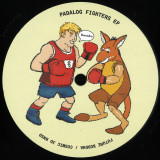
Dago Sondervan uploads his code-driven debut to the Censor mainframe. Known for live-coding using Sonic-Pi and TidalCycles, Dago transports you straight into front-left of the Algorave. The EP includes a dimension changing remix from Annie Hall, and a further set of twisted electro remixes from CYRK and F.R.B. (an alias of Alex Jann). This is one for the replicants, bots and cyborgs.
Suche:dimension 6
With his debut EP Mo Wrights delivers a jazz-focused and narrative-driven record navigating the inner dialogue of a creative struggle of inferiority, abstraction and commitment. The story finds him enlisting some friends along the way to advance from one act to the other.
With the title track - ‘things2proof’ - Mo tries to combine his myriad of influences in a 6-minute record that weaves together elements of jazz, broken beat, acid jazz, fusion, hip-hop and hints of rock. The coherence comes from his poignant narrative, which resembles a four-act structure, telling the story of alienation and his internal experience of inferiority, creative frustration, and his eventual recognition of a solution, concluding by finally permitting himself to simply ‘be’. And for that we thank him!
The b-side ‘proof of concept’ follows the title track, Mo embraces a more laid-back approach, sitting sonically closer to his beloved broken beat sound. Amsterdam-based pianist Misto Kay delivers a long soul-felt piano solo that carries the track into untold dimensions of groove. With this offering the soul feels both heard and yearned for. It’s as if desire and satisfaction are in conversation with one another. You can’t help but be gripped, pay attention, and listen.
As a co-founder of the Amsterdam-based music platform Steppin’ Into Tomorrow, whose ethos is anchored in the principle of collaboration and unification of the Dutch scene is a deeply felt sentiment throughout Mo’s EP. He enlists a slew of emergent local legends, such as QUANZA, drummer Jamie Peet, flutist Han Litz, bass player kotokid and pianist Misto Kay to embellish and remix his creation. The remixes also illuminate other bright creatives the local scene has to offer, with remixes by the likes of - Kofi the Unknown, LYMA, Misto Kay and Jazz n Dance.
The UDG DIGI Headphone Bag is a premium headphone carrying bag made from Ballistic Nylon that is designed to protect headphone, USB drives, SD cards, Ext. hard-drive, mobile phone, cables, business cards, credit cards and accessories in one padded carry bag that includes a handgrip, detachable and adjustable shoulder strap. The UDG DIGI Headphone Bag the one bag a DJ need to carry around today’s digital media
SPECIFICATION
Specification
Weight 0,35 kg / 0.77 lbs
EAN 8718969213226
Color Black Camo/ Orange Inside
Outer Dimensions (W x H x D) cm: 22 x 22 x 9 | inch: 8.7 x 8.7 x 3.5
Inner Dimensions (W x H x D) cm: 21 x 21 x 8 | inch: 8.3 x 8.3 x 3.1
Material Water resistant Ballistic Nylon 1680D
Protection Foam padded interior
Extra's Detachable and adjustable shoulder strap. Holds USB drives, SD cards, hard drive, mobile phone, cables, business cards, credit cards and accessories
Fits Most foldable DJ Headphones.
Mattias El Mansouri's second outing on Aniara further expands his undulating minimalism after last year's Tja, Hej, Salam. Sonic waves ripple throughout the atmospheric groover Time Dilation In Ultraviolet on the A-side, while on the flip side a 13 minute trip awaits; a deep, introspective dive into the self and out of the body.
Following 2021’s Cape Cod Cottage — Eder’s concept album under the guise of Edward Blankman, a retired dentist who wrote elegant jazz in the1970s — on Therapy, Eder drops the alter ego and the drumset (almost entirely) and explores more reverberant sounds with his ensemble of woodwinds. The result is a distinctive take on new-age ambient music subtly interwoven with Eder’s affinity for 20th century classical and jazz. The quest for Therapy came during a period of deep spiritual curiosity. Eder was avidly watching testimonies of near death experience survivors (NDEs), pouring over books of Theosophical artwork and philosophy, and processing experiences of grief, uncertainty and spirituality. Eder wanted to explore the threshold between the spiritual and physical dimensions, and create music that could evoke its shape and texture — a theme further illustrated in the original album artwork and single covers by Adam Rabinowitz. Eder felt he must be on to something when, on a whim, he looked up the tempo of a piece he was calling “137 Riddle.” Turned out to be “the most important number in the world” in theoretical physics, as well as a provocative number in Jewish mysticism. Maintaining his track record of recording the best musicians Eder can find, Therapy features special guests Nailah Hunter (harp), Henry Solomon (saxophone), and Ethan Haman on The Newberry Memorial Organ at Yale University.
Introducing BinarySound's 8th vinyl release, a sonic journey into the dimension of analog machines mastery.
On the A side, Future Buddha, the latest alter ego of the renowned Italian artist Riccardo, now weaving sonic tales from the mystical landscapes of India.
On the B side, hailing from the vibrant Canadian scene, Cosmic JD brings his soundscapes, steeped in the raw essence of analog synthesis, promising an interstellar voyage for the listener.
LEGENDO is a work of sonic weird fiction. A pulp fantasy. A descent through the cracks in reality, punctuated by bizarre encounters and freaky transformations. It oozes an odd mixture of wonder and fear, a fascination with whatever might be lurking around the next unlit corner, met with relentless excitement and leading towards ghastly discoveries. Like a vision of a new mythological age, one that aims more at subverting and making fun of itself than educating towards any kind of morality. Or a self-conscious fantasy RPG turning into a full-on immersive experience. The author, Lubomir Grzelak AKA Lutto Lento, arranged this eccentric narrative as a follow up to his previous LP, the ominous Dark Secret world, while also settling out to subvert the atmosphere of that record. In his Haunter debut he embraces his own quirkier side, delving further into eerie derision and surreal trickery. He achieves that by remodeling his penchant for heavy bass and gloomy dub into a kind of otherworldly folk music, drawing in deterritorialized string instruments, cheeky digital sound design, Coil-ian horror synths, and drums that remind as much of heavy metal as of Hollywood neo-classicism. It is by pushing the envelope on the most contradictory elements that LEGENDO ascends to a form of mocking poetry. Many weird characters are encountered through the narrative: from the various musicians that contributed to the music (such as vocalist John Glacier, guitarist Adam Repucha and koto player Katarzyna Karpińska), but also many fringe fascinations that hail from Grzelak’s native Poland: from the 1897 painting ‘Skarby Sezamu' by Stanislaw Wyspiański that inspired the track of the same name, to the delirious paganism of outsider artist Stanislaw Skukalski, to the lullaby referenced in ‘Iskiereczka’. These entities all dwell inside LEGENDO and conduct its chapters, rendering the liminal dimension of its sound as real as it is in its creator’s mind.
At just 21 years old Peter Frampton had already played with The Herd and co-formed and left Humble Pie. So he struck out on his own with the appropriately named, “Wind of Change.” Freed from Humble Pie’s narrower focus on hard-rock boogie, Frampton’s debut solo album reveals an artist exploring more dimensional, delicate and nuanced songwriting and guitar playing … Frampton showed his own brand of rocking hard with tunes like “It’s a Plain Shame,” “All I Wanna Be (is by your side)” and even made a Stones song his own with “Jumping Jack Flash,” which became a staple of Frampton’s live shows. But these tunes and even the hook-laden “The Lodger” are balanced with intricate, beautiful tunes like the elegiac “Fig Tree Bay” and the title track “Wind of Change.”
Miles Davis' boundlessly influential On the Corner was so far ahead of its time upon release in 1972, the jazz cognoscenti rejected its groundbreaking concoction as middling in nature. Yet time has a way of righting wrongs and shifting views by adding needed context and perspective to visionary ideas, music, and approaches — the likes of which fill Davis' boldest and most controversial — undertaking. Designed to bring the focus back on the groove and bottom-end frequencies, the funk-loaded On the Corner revolutionized jazz. It also set new standards for record production, presaging remixing and electronica by more than a decade. And the work has never sounded more thrilling thanks to this very special pressing.
Sourced from the original master tapes and pressed on MoFi SuperVinyl, Mobile Fidelity's numbered-edition 180g 33RPM SuperVinyl LP of On the Corner exposes the internal mechanisms, free-associated playing, and then-unmatched studio techniques in vivid fashion. The low end, crucial to every composition here, is both heard and felt, with locked-in bass lines and low-range percussion conveyed as taut, solid, and visceral passages. You can discern the multiple layers of rhythm Davis employed on complex tracks such as "Black Satin," as On the Corner stands as his first effort to use overdubbing and multiple tape machines. As a pioneer, Davis likely would’ve loved MoFi’s groundbreaking SuperVinyl profile that features the lowest-possible analogue noise floor as well as pristine transparency, dead-quiet surfaces, and superb groove definition.
New degrees of spaciousness and airiness — equally important to the musique concrete arrangements — give the impression Davis and Co.'s creations float in space. Instruments are portrayed in three-dimensional manners, rhythmic loops retain tonal purity, and horn solos skitter across an extra-wide soundstage that takes listeners into Columbia's Studio E. Mobile Fidelity's SuperVinyl LP captures Teo Macero's innovative production — and the trumpeter's cutting-edge aural collages — in definitive fashion.
Heavily inspired by Sly and the Family Stone, On the Corner portrays street vibes and remains Davis' Blackest-sounding record. The conscious attempt to connect with youthful audiences tapped into rock and funk is evident not only on the colorful cartoon cover art depicting hot-pants and zoot-suit revelers, but in the music's emphasis of recurring drum and bass grooves. Distinct from Davis' earlier fusion experiments, the record's long-misunderstood set dials back improvisation in favor of beats, loops, and atmospherics that generate trance-like effects. While Davis utilizes his band for core duties — Chick Corea and Herbie Hancock prominently figure — he also relies on an all-star cast of side-men for concentrated soloing and additional support.
With rhythm providing the basic foundation, other notes fall into place, with their positioning steered by Macero and Davis' editing-room techniques. Looking to the manipulation-based work of Karlheinze Stockhausen and teaming with Stockhausen disciple Paul Buckmaster, Davis re-imagines what grooves constituted and could accomplish throughout On the Corner. The shapes of the songs become completely transformed as they progress. Faint melodies, spacey chords, chunky riffs, wah-wah fills, and repeated motifs bounce in and out of a sonic funhouse that wouldn't be out of place at a Harlem block party.
Exotic, intrepid, and filled with Davis' "jungle sound," On the Corner remains daringly hip more than four decades later.
- A1: Let The Trials Begin
- A2: Forget The Past
- A3: Triage
- A4: Clean Slate
- A5: Too Many Cooks
- A6: A Night At The Theatre
- A7: Meet Dr. Futterman
- A8: Grind Your Problems Away
- A9: The Weight Of Memories
- A10: I Love It Here
- A11: Permanent Record
- B1: Let Go Of The Past
- B2: Burden Of Skeletons
- B3: Every Last Bastard
- B4: My Little Piece Of Heaven
- B5: You Don’t Have To Do This
- B6: We Got Laws Around Here
- B7: The Promise Of A Dark Room
- B8: Snitch
- B9: Well Done
- C1: A Place So Wonderful
- C2: No Rules At The Fair
- C3: Come To The Fair
- C4: Killjoys Aren't Allowed Here
- C7: Brush Your Teeth
- D1: High And Dry
- D2: Punish Them, Daddy
- D3: Covent Garden Nuns
- D4: Little Angels
- D5: Can't Get It Out Of Your Head
- D6: A Cross To Bear
- D7: Motherless Children
- D8: We're All Getting Better Together
- C5: The Root Canal
- C6: Dental Hygiene Time
Tom Saltas (Deathloop, PUBG, Halo) zutiefst beunruhigender Soundtrack zum Horror-Survival-Spiel 'The Outlast Trials' (Red Barrels Games, 2023) wurde komplett (35 Tracks) für 180g Heavyweight-Doppelvinyl gemastert und erscheint samt Linernotes-Einlage. 'The Outlast Trials' bietet einen abwechslungsreichen Horror-OST mit gruseliger Audioproduktion und ungewöhnlichen Orchester- und Musique-Concrète-Techniken, ergänzt durch einen nervtötenden falschen Mid-Century-Jingle, jazzige Fahrstuhlmusik und Honky-Tonk-Klavier. Salta nutzt geschickt die Sprache der Musik, um die Menschen in eine alptraumhafte emotionale Dimension eintauchen zu lassen und die grausamen Erlebnisse zu unterstützen, denen die Spieler begegnen werden.
Nachdem das Alternative Rock Trio LOST ZONE aus Norditalien mit ihrem Debütalbum „Reslilience“ & der Deluxe Version „Resilience – Full Circle“ schon einen ersten kleinen Achtungserfolg landen konnte, kommt mit "Ordinary Misery" ein ein neuer Longplayer, dass sich mit seinen Elementen aus Moder-Metal & Alternative-Rock, nahtlos an die Vorgänger anschließt.
"Ordinary Misery" ist mehr als nur Musik; LOST ZONE fassen die „alltäglichen Bad News“ mit denen sich jeder von uns leider oft kommentarlos auseinandersetzt und einfach hinnimmt, zusammen und nehmen den Zuhörer mit in diese Stimmungen und Gedanken. Von aggressiven Shouts und Moshparts, bis hin zu ruhigeren Klängen zeigen LOST ZONE, wie moderne Rockmusik klingen kann!
Darüber hinaus verleihen die einzigartigen Gastfeatures dem Album eine zusätzliche Dimension, die es von anderen abhebt. Ob mit dem Berliner Crossover Act BLUTHUND oder Philip Wilhelm von Post-Hardcore Act FROM FALL TO SPRING.
"Ordinary Misery" ist erhältlich als CD, limitierte Vinyl für Sammler und natürlich als digitales Erlebnis für unterwegs.
Das Album "Hip Walk" von Peter Herbolzheimer Rhythm Combination & Brass und Inga Rumpf wurde im Original 1971 auf Vinyl veröffentlicht. Es ist eine Mischung aus Jazz, Funk und Soul und präsentiert eine dynamische Kombination aus Bläsern und Rhythmusinstrumenten. Die Vocals von Inga Rumpf verleihen dem Album eine zusätzliche Dimension. "Hip Walk" ist ein energiegeladenes und mitreißendes Album, das die Vielseitigkeit und das Talent der beteiligten Musiker zeigt. Es ist ein Klassiker des Jazz-Funk-Genres und hat einen festen Platz in der Geschichte der Musik.
Cookin’ is the first of four albums derived from the Miles Davis Quintet’s fabled extended recording session on Octobre 26, 1956; the concept being that the band
would document its vast live-performance catalogue in a studio environment, rather than preparing all new tracks for its upcoming long-player. The bounty of material in the band’s live sets –
as well as the overwhelming conviction in the quintet’s studio sides – would produce the lion’s share of the Cookin’, Relaxin’, Workin’ and Steamin’ albums.
As these recordings demonstrate, there is an undeniable telepathic cohesion that allows this band – consisting of Miles Davis (trumpet), John Coltrane (tenor saxophone), Red Garland (piano),
Paul Chambers (bass) and Philly Joe Jones (drums) – to work so efficiently both on the stage and the studio. This same unifying force is also undoubtedly responsible for the extrasensory dimensions
scattered throughout these recordings. The immediate yet somewhat understated ability of each musician to react with ingenuity and precision is expressed in the consistency and singularity of each
solo as it is maintained from one musician to the next without the slightest deviation. « Blues by Five » reveals the exceptional symmetry between Davis and Coltrane that allows them to complete each others’ thoughts musically.
Cookin’ features the pairing of « Tune Up / When the Lights Are Low » which is, without a doubt, a highlight no only of this mammoth session, but also the entire tenure of Miles Davis mid-‘50’s quintet.
All the éléments converge upon this fundamentally swinging medley. Davis’s pure-toned soloes and the conversational banter that occurs with Coltrane, and later Garland during
« When the Lights Are Low », resound as some of these musicians’ finest moments.
"Rationalizing our place amongst the Stars is a referendum. A mandate in the scale of a space-time continuum, which is a task that might seem infinitely cavernous to most, but a lifelong mandate to others. As nature's allowance of time just isn't favorable to an average human lifespan of a 100 years, this task must be inherited and handed down in the method of an acoustical trust. Rhythm considered as a safe depository.
Neo Tantric Parts is about high premium thought processes about simplicity and oneness. Diagnostic in the way it blends time, rhythm and harmony together as a proposal to consider placement in this moment of time". - Millsart
Footnote translations:
"Rationalizing our place amongst the Stars is a referendum".
The human lineage only diverged from our most recent common ancestor about 5 million years ago; less than half of 1% of that time, and modern Homo sapiens is only between 200,000 and 50,000 years old, depending on your definition. Such vast spans of time are hard for us to comprehend.
"A mandate in the scale of a space-time continuum, which is a task that might seem infinitely cavernous to most,but a lifelong mandate to others".
The singularity had no dimensions and space and so it stands to reason that it had no dimension in time. In other words, there was no time so there was no such thing as "before". By that reasoning, time itself is the same age as the universe, which is about 13.8 billion years
"As nature's allowance of time just isn't favorable to an average human lifespan of a 85 years"
The world average age of death is a few years lower at 68.9 years for men and 73.9 years for women. Within the European Union, these are 77.7 and 83.3 years respectively.
"This task must be inherited and handed down in the method of an acoustical trust. Rhythm considered as a safe depository".
A legal arrangement or understanding by which a person or organization looks after money or property for somebody else until that person is old enough to control it.
2024 Repress
After Space Dimension Controller the Clone Royal Oak series is coming with another young talent. This time its Swedish Genius Of Time, known for their debut release on Aniara records. Three takes on classic house music done by young producers in their unique almost serene style that reveal their nordic roots. Genius Of Time shows that house music can still sound fresh.
Much like the North Carolina wilds it reflects, Needlefall waxes and wanes from mysterious and unsettling to ecstatic and awe-inspiring, capturing the sacred dimensions of the natural world. Magic Tuber Stringband draw on a host of fellow travelers to realize Needlefall"s intricate arrangements, exemplifying the diversity of contemporary folk movements, placing their work in the tradition of modern innovators like Moondog, Harry Partch, Pauline Oliveros, and labelmate Sally Anne Morgan. The vast forests and mountains that inspire the band as a metaphor for living music traditions - ever-changing and yet still standing, shaped over time by human hands while equally shaping the human experience. Magic Tuber Stringband, from North Carolina, are Courtney Werner and Evan Morgan, accompanied by their regular bassist Mike DeVito. Morgan is an organizer within the local music community, and Werner is a dedicated naturalist involved in local land stewardship. Needlefall answers the question "what does a modern string band sound like?" with powerful new arrangements of traditional songs and transcendent originals. The album is teeming with life, translating abundant ecosystems into arcing melodies and shimmering, mystic drones. The band explains: "If you spend enough time out in the woods you inevitably see or hear things that are hard to explain. I"ve been in caves where it"s total darkness and you"re enveloped by the disorienting sound of dripping water. The natural sights and sounds in these places are often repetitive, percussive, expressive, sometimes unsettling - the way that water carves patterns into rock or tree trunks appear in endless rows."
- A1: Thank You
- A2: Hello, Lakisha
- A3: Distractions I: The Opposite Sex
- A4: Age + Self Esteem: A Funhouse Mirror
- A5: Distraction Ii: The Dilemma Of Cool
- A6: Self Importance
- B1: Collected Views From Dinner
- B2: Fulfillment?
- B3: Taking Responsibility
- B4: Intermission
- C1: The Fears Of A Dilettante
- C2: Obsessing
- C3: Life, The Cruel Interlude (On God)
- C4: Frustrations + Solutions
- D1: Humans + Ants In Proportion
- D2: Existential Crisis Hour!
- D3: On The Mend
- D4: Relief!
- D5: Poem A
- D6: Outpatient Mentality
- D7: Memory Lane (Bonus)
Kilo Kish has always been in a league of her own. Constructing herself from the ground up, Kish’s career in music began over a decade ago, when she was relatively well-known for providing breathy, uninhibited guest appearances on songs with Childish Gambino, Vince Staples, and more.
Since then, she’s been equipped with creating her own multi-dimensional worlds. On her conceptually progressive 2014 EP Across, Kish took it one step further, taking a cross-country drive over dreamy, experimental soundscapes from producer Caleb Stone. Upon returning to New York City, Kish felt restricted by the environment that shaped her and looked to Los Angeles. Enter Reflections in Real Time, Kish’s debut album that acts as a sonic mood board where she is alone in her thoughts, whether probing her social media curiosities or meditating on her life’s purpose.
- A1: Hiroshi Kamayatsu - Have You Smoked Gauloise
- A2: Happy End - Haruyo Koi Come Spring
- A3: Yoshiko Sai - Aoi Galasu Dama Blue Glass Ball
- A4: Tadashi Goino Group - Jikan Wo Koero Go Beyond Time
- B1: Jun Fukamachi - Omae You
- B2: Momotaro Pink With Original Pinks - Hachigatsu No Inshow Augusts Impression
- B3: Vol 1 Chap.100 - Heya No Naka In The Room
Nippon Psychedelic Soul 1970-1979 is Time Capsule’s continuation of the deep dive into Japan’s rich history of folk and psychedelic soul music.
Vinyl LP with 4 page insert, original artwork and photos
The kaleidoscopic psychedelia of 1970s Japan captured a fragile and fertile moment as the country sought its future in funk grooves, heavy reverb and lyrical hallucinations.
The follow-up compilation to Time Capsule’s Nippon Acid Folk, Nippon Psychedelic Soul takes myriad pathways into the tripped-out undergrowth of 1970s Japan. Finding their feet at home and looking for inspiration abroad, the musicians featured here were engaged in the communal soul-searching that followed the breakdown of the 1960s protest movements. Some made it big, others drifted into oblivion. The music they left behind shimmers with intensity.
At the core was Happy End, the first project of YMO’s Haroumi Hosono, whose distortion-heavy guitar and crisp back-beat laid the foundations for Japanese lyrics that flipped the paradigm of Japanese rock music on its head. With it came a new found sonic ambition, such as in the bold Philly-soul style arrangements of producer Yuji Ohno, whose work with occult wandered Yoshiko Sai shares some of the bittersweet grandeur of Rotary Connection or David Axelrod.
Then there was Jun Fukamachi, a pioneer of Japanese synthesis, whose debut album was a carnival of orchestral funk, euphoric horn lines and rich production, complete with soaring guitar solos, psychedelic organ and a truly cinematic finale. The first and only time Fukamachi would sing on record, ‘Omae’ rips like the ultimate end-of-nighter.
Influenced by giants of the US soul scene, maverick composer Hiroshi “Monsieur” Kamayatsu (otherwise known as ‘the Brian Wilson of Japan’) went one step further, enlisting Tower of Power to play on ‘Have You Smoked Gauloises?’ The B-side to Monsieur’s biggest-selling single, it coasts with sophisticated cool - a liquid bassline and suave keys comping under a roaring trademark ToP sax solo. No surprise it found favour once more on the Acid Jazz dance floors of ‘90s London.
Such was the spirit of experimentation that big studio productions and private press releases sat side-by-side, with the likes of Momotaro Pink and Kazushi Inamura, taking their hopes of success into their own hands with the resources available to them. More reflective but no less robust, theirs was a heavy, fat-backed drum sound, soaked in dramatic, soulful psychedelia.
If some were dreamers and others space cadets, none were further out than sci-fi writer, musician, activist and self-made scientist Tadashi Goino, who transformed his own fantasy novel Messenger from the Seventh Dimension into an operatic prog odyssey with few discernible musical reference points – a majestic and completely bonkers outlier even among company as strange and brilliant as that which is collected here.
Less a compilation of a scene, as a compilation of a sentiment, Nippon Psychedelic Soul is a wild ride from start to finish, shattering the narratives of the Japanese folk and rock tradition into a million tiny pieces.
Back In Stock!
Ajo Se Po is the third album by alto-saxophonist and percussionist Kevin Haynes, released with his band Grupo Elegua. The album integrates musical elements with references to his deepening spiritual understanding. Haynes has created a modal harmonic language incorporating Afro-Cuban melodies and classical kora playing - his alto-sax, infusing the album with a personal 'voice'.
Yoruba spirituality is at the heart of Haynes' musical thinking which also includes both Nigerian and Cuban dimensions. This is especially reflected by the use of recitation and Cuban bata drumming being employed on all tracks, with each piece growing out of a particular bata rhythm. Each such rhythm is dedicated to a particular Orisha, or divinity.
As well as influences from Afro-Cuban, Native Nigerian and folkloric Bata, Haynes' music is a fusion of contemporary jazz incorporating Mandinga folk and praise songs and hard bop.
Kevin Haynes and Grupo Elegua have performed at renowned jazz festivals including Havana Jazz Festival, Cuba and Salamanca Jazz Festival, Spain. Haynes has also featured on Moses Boyd's hit album Displaced Diaspora.
Previously available on digital only, Ajo Se Po is now released on vinyl.