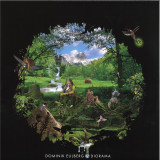
A new duo and record label based in Madrid lands on the underground techno scene, led by Mike Gómez and José Castillo, the latter known for his aliases Milford and UHF, and also the owner of the electro label Gladio Operations.
Diorama is born with the intention of recovering the soul and essence lost in electronic music, which for some time has become practically homogeneous and predictable. With a timeless, fresh, and warm sound, Diorama produce rhythms close to dub and Detroit techno, mainly influenced by Juan Atkins, UR, and Basic Channel, among others.
This EP, titled Pacific Trak, begins with a nod to the old Scottish school, where they revive a forgotten track by British producer Anthony Scott, adding its imposing main chord to a true sea of melodic textures, bathed in exquisite acid. Spanish techno master Tadeo gives us his vision of Pacific Trak, exploring dub territories that remind us of past pieces released under the incomparable Maurizio label.
The B-side opens with Soul Memories, a manifesto of resistance that vibrates with detuned harmonies and raw bass lines, recalling the origins of Detroit’s primitive sound. The package closes with Polymorphic, a progression of relentless aquatic chords, set among careful and precise minimalist rhythms that oscillate between high-dynamics tech and dub.
Cerca:diorama
- 1
- Achievements
- Isolated
- No Complications
- Million Dollar Smile
- Kunstblut
- Ruling My World
- More Gold
- On A Journey
- The Same Ghost
- Losing Your Coordinates
- Weird Physics
Leuchtende Pop-Hymnen aus der diorama-Dunkelkammer. a substitute for light kreist um das Motiv des Lichts - als Verheißung, Orientierung und Täuschung. Es flackert in Monitoren, spiegelt sich in Oberflächen und lässt Erinnerungen im Schatten verschwimmen. Zwischen ausrangierter Liebe und digitaler Erstarrung suchen die Songs nach einem echten Funken - geboren aus Bewusstsein, nicht aus Strom. Auf ihrem elften Studioalbum zeigen diorama, dass weniger mehr sein kann: klare Arrangements, prägnante Melodien und Vocals mit ordentlich Punch. Zwischen clubtauglicher Wucht, hypnotischen Balladen und schwebender Melancholie entsteht ein Sound, der sofort zündet - und lange nachhallt. Trost in der Dunkelheit. Ein Ersatz für Licht.
2025 Repress
Nach seiner "Heimischen Gefilde" CD vor zwei Jahren auf TRAUM, die den Preis der deutschen
Schallplatten Kritik gewann und als erste CD mit Moderation in die Techno-Geschichte einging, hat Eulberg
jetzt mit klarem Ziel vor Augen ein Album geschrieben, bei dem er alle Facetten elektronischer Musik ins
Visier genommen hat.
"Diorma" ist somit wieder etwas völlig eigenständiges und neues, eine Rückführung in den Urzustand
Eulbergscher Klangkunst und das mit höchstem Anspruch und zeitgemäßem Sound-Kolorit
Played by... Monika Kruse, Sebastien Leger, Gregor Tresher, DJ Sasha, Mauro Picotto, Alexi Delano, Ryan Davis, Marc Marzenit, Max Cooper, Morris Cowan, Steve Lawler, Fra Soler, Mihalis Safras, Igor Tchkotoua (pig and dan), Paco Osuna, Sebbo Suckfuell, Ekkohaus, Deepgroove, Tom Wax, Alland Byallo,
Grünbox, Scott Byrne, Axel Bartsch, SQL, Taster Peter, Goldfish & Der Dulz, Intu:itiv, Beatamines, Freska, Zidan, Sebastian Russell
Diorama is the fourth studio album by Australian alternative rock band Silverchair. The album won an ARIA Music Award for Best Rock Album in 2002. With the release of Diorama they were growing more into their own sound, with a fine mix of orchestral pop and rock. Their alternative rock sound has changed to a more melodic one. With the sounds of the harpsichord, organ and orchestra they created their own rock opera. Leadsinger Daniel Johns is bringing the best of rock and opera together in his high and impressive vocal parts. But there's still a tough of their alternative rock sound in songs like 'Without You' and 'Too Much Is Not Enough'. All in all, Silverchair released an ambitious and gorgeously produced album.
Silverchair were an Australian rock band formed in 1992 and have sold over 9 millions albums worldwide. Their sounds evolved during the years from the grunge and alternative rock to pop and art rock. In 2011 they announced their 'indefinite hibernation' and it is still unknown to date if they ever going to return on stage.
Diorama is available as a limited edition of 2.000 individually numbered copies on solid yellow & transparent green mixed vinyl.
Aarhus (DK) based MØL blend swirling guitars and hissing vocals with the dreamy ambience of shoegaze to form a unique blend of soundscapes and crushing passages. Inspired by bands like My Bloody Valentine, Slowdive, Drop Nineteens, Lantlôs and Alcest, MØL released their self-titled debut EP back in 2014. A year later, the band had perfected their sound on their second EP "II", produced by Jacob Bredahl and released in 2015. Both EPs were very well received and drove them on to do some empathic live shows, which were praised by press and helped establishing a dedicated audience. In 2018, MØL made an international breakthrough signing with Holy Roar Records (UK) who released their debut album “JORD” to critical acclaim. Recorded at Grapehouse Studios and mixed and mastered by Chris Kreutzfeldt, “JORD” gained massive media acclaim turning MØL into one of the most talked about Danish metal newcomers in recent years. The album was also released as an instrumental version and in 2019, the band re-released their two first EPs, remastered for CD and vinyl. On November 5th, 2021, MØL now return with their second studio album, “DIORAMA”, the group’s first for Nuclear Blast Records. Recorded and mixed by Tue Madsen (Gojira, Meshuggah, Heaven Shall Burn), the band has successfully developed its captivating, aggressive sound even further. Brace yourself for a ferocious yet melodic blackgaze monument! Praise for ‘JORD’: “It’s epic and stirring stuff. Absolutely crushing” - Daniel P. Carter , BBC Radio1 Rock Show “JORD is one of the exhilarating blackgaze albums to drop in a long time” - Metal Hammer “JORD has received unanimous praise and has immediately seen them heralded as one of the greatest examples of the blackgaze movement” - The Independent UK “By far one of the genre’s most accomplished records” - KillYourStereo
Lists and nomations for “JORD” Metal Hammer - #12 on “The 50 Best Albums of 2018” Loudwire - #19 on “The 30 Best Metal Albums of 2018 Kerrang! - #17 on “The 50 Albums that Shook 2018” Kerrang! - Music video for Bruma on “The 12 Best Music Videos of 2018” The 405 - #20 on Top 50 Albums of 2018 Distorted Sound Magazine - #2 on “Top 20 Albums of the Year” WhatCulture - “10 Best New Heavy Metal of 2018” GAFFA Awards 2019 – Nominated for “Best Metal Album of the Year”
ISAN’s Robin Saville reveals an ambient album, which merges the Electronica aesthetics of his main project with field recordings, drones and acoustic instrumentation.
A lot of things have been written about what happens to the mind when the body starts moving. Instead of reciting poems of the inevitable self-help books, let’s get straight to the point: For many, taking walks on a regular basis is both liberating and empowering. It is not necessarily so much about the exercise, but rather finding one’s own rhythm in life. Robin Saville – of ISAN fame – is such an ambler His walks inspired him to base his third solo album – his first one for Morr Music – on the out of the way places he came to see and experience while being out and about.
Clocking in at just under 40 minutes in total, "Build A Diorama" is both a subtle culmination and a poignant antipode to what Saville has achieved together with Antony Ryan as ISAN. While the aesthetics might seem similar in places, Saville opts for a decisively different pace when it comes to writing and producing. Progress is steady, and change, however, is slow – like looking at a diorama for a long period of time in the ever so slightly changing light or as a flaneur focussing on one particular spot, a found object so-to-speak, waiting for the mind to orchestrate it appropriately, giving it sense and meaning.
Built around quiet field recordings, Saville’s six compositions transform this highly personal and, therefore, difficult-to-convey experience into a comprehensible exploration of beauty. Where ISAN almost exclusively uses electronics, Saville deliberately expands this well-established palette with acoustic instruments like bass guitar, chimes and glockenspiel, aiming for an even more suitable musical manifestation of what the walker sees and feels once he fully engages in his passion. Ranging from blissfully pulsing pads allowing for complete associative freedom ("The Deepdale Halophyte Economy") to the playful minimalism of an orchestra dominated by busy bells ("Bosky"), Saville’s "Build A Diorama" is not just a valuable addition to his musical output, but an essential audio guide for those striving to explore, learn and understand.
- 1: My Ouija Board Spelt S-C-A-M
- 2: Dreams Of A Dead Dreamer
- 3: Malignantly Useless
- 4: We Sleep In The Self
- 5: Serpent House
- 6: Paramasturbatory Delusions
- 7: The Cosmic Vulva Vs The Post-Enlightened Tongue
- 8: Nothin' Wounded Goes Uphill
- 9: Blu-Ray Séances And Weather App Prophesies
- 10: My Little Pony Apocalypse Diorama Playset
To decay is also to transform. Rusting metal is the visible traces of passing time, as the oxidation process accumulates dampness in our atmosphere and imprints it as unpredictable patterns onto hard iron and steel. Working in construction for a year now, Kensho Nakamura sees rust all the time, clambering up ageing chunks of material. Normally discarded as waste, Nakamura began discerning beauty in the phenomenon, organically spiralling around and consuming some of the very hardest of manufacturing stuffs into unique new forms.
‘Electric Rust’ continues the conceptual electronic composition mode of Nakamura’s previous works with a series of fractured musical dioramas. These scurrying notes, sparse hums, and quivering bleeps explore the topics of rust and the accumulation of time. The music ticks like a clock, drips like a tap, and manifests unknowable inorganic shapes. Recognisable musical snippets of bells, pianos, or murmured voices are buried inside counterintuitive synthetic rhythms and tension.
On ‘wet air’ piano notes tinkle and pipes gargle, digital detritus tap dances and arpeggios stumble. On ‘unique faces’, idle marimbas and malfunctioning animalistic squeaks flounder. This is music from the promethean space between being forgotten and being conceived. ‘Electric Rust’ is a topography of a world of rust, where corroding structures evolve into new — and beautiful — patterns of life.
Tina Records presents the apocalyptic visions of Nokuit. Constructing a hellish diorama across six tracks of industrial electronics, Gates of Horn and Ivory uses biblical allegory to map out our current End Times. With sleeve notes by Andy Sharp a.k.a The English Heretic.
Eurosleaze film composer by day, Nokuit has developed a distinctive cosmology over a mutating series of releases on underground labels including wannamarchi club and NKT. Alongside Cut Hands (William Bennett of Whitehouse), he remixed Roberto Musci on the inaugural Tina Records release, as well as having been remixed himself by schuttle, Kinn and Sonae. He has performed internationally, including at Cafe OTO alongside Mun Sing as part of a lineup curated by Flora Yin-Wong and has received radio support from Ad93's Nik Tasker and Ana Quiroga of Editions Mego's LCC, amongst others.
English Heretic is an autonomous creative research project helmed by writer, occultist and multimedia artist, Andy Sharp. Having released over a dozen albums and booklets since it's inception in 2003, the project culminated with the publication of The English Heretic Collection in 2020 by Repeater Books. Friend and collaborator of the late Mark Fischer, Andy has talked at academic conferences and counter-cultural events on a wide range of subjects drawn from his research.
This is the second release from Tina Records, following Cargo Cult by Roberto Musci. Featuring remixes from Cut Hands and Nokuit, that record received airplay from the likes of Surgeon and Not Waving on stations such as NTS, Noods, Resonance and Intergalactic FM. It was also named one of the best releases of 2024 by Bleep. Tina Records is based in London and Rome.
- A1: Zoom!
- A2: Atomik Lust
- A3: The Horn A4) Ohio Heat
- B1: Walk You Home
- B2: Lazer Beam
- B3: Frequency
- B4: Oi Frango
- C1: Psyclone!
- C2: Back On A Roll
- C3: Cloudberries
- C4: Cabin Fever
- D1: *Surprise*
Originally released on Mon 22 August 2005, the Furries’ third and final album to be recorded by Epic Records, Love Kraft is to be reissued on double vinyl, 2CDs, including the 22-track bonus CD, Kiss Me With Apocalypse and digital formats on Fri 24 October 2025 via the Cardiff-based independent label, Strangetown Records. Four previously unheard tracks are drawn from the vaults, including the squidgy ELO-stomp of drummer, Daf Ieuan-led Rock ‘N’ Roll Flu, plus the distorted space-jam of Cae Marw, the band’s deep-bass sketch of Palo Alto and ghostly, percussive morsel of Bedw Arian.
The album followed six previous albums by the band, including their statement debut album, Fuzzy Logic in 1996, melding an attention-demanding mix of literary, narcotic and musical influences. Maintaining a shape that was ill-fitting in the jigsaw of other 90’s guitar bands, their follow-up, UK Top Ten album, Radiator brought the hooky squelch of the bona fide indie dancefloor classic, The International Language of Screaming. The next decade saw the release of the first Top 20-charting, Welsh language album, Mwng (2000), followed by further experimentation and commercial success with Rings Around The World (2001) and Phantom Power (2003).
Love Kraft’s sense of cohesion, collaboration and free-flow of rich harmony has been credited to the five-piece escaping Wales to record in the shimmering heat of Figueres, Catalunya. Bringing famed Beastie Boys producer, Mario Caldato Jr along with them for the ride, the travelling band’s stay in the Catalonian hometown of Salvador Dali included found sounds, boozy petrol stations, gastronomic revelations and, finally, a rich album of strings, synths and opulent vocal harmonies.
While eventually finding their way to Baha, near to Rio di Janeiro to mix the album Love Kraft’s story began in Wales and Pleasure Foxxx Studios, where the band began to craft the album’s songs. Embracing the landmark of a seventh album, notably coming after the 2004 release of their first ‘best of…’ package, Songbook: The Singles, Vol. 1, Super Furry Animals pooled ideas and affected further democracy in their songwriting, taking a load off traditional lead-writer and front man, Gruff Rhys, and sharing in lead vocal duties (aside from the microphone-averse bassist, Guto Pryce).
Love Kraft was the first Super Furry Animals album recorded to hard disc instead of multi-track tape, and found the band typically explorative and open to happenstance. Zoom’s opening splash into the recording studio’s swimming pool is accompanied by the on-location, pool table samples found elsewhere on the album.
Updated packaging features the original, meticulously built diorama design by long-time collaborator Pete Fowler. Constructed by hand in his studio, complete with bulb-lit illumination, then photographed, the sleeve’s depiction of a monolith-rich desert landscape reflects the sense of other space and time depicted by Love Kraft’s woozy songs. The final sleeve design again comes courtesy of Mark James.
KILN return with an opulent new display of hue and swing on Lemon Borealis , a sumptuous
gallery of dazzling motifs that display a finely hewn concoction of visual tones and vital pulse.
Across its 12 cuts, this collection utilizes a fresh process of condensing immersive sprawl into compact, punchy and colorful sound.
Using aspects of live performance, beatmaking and waveform sculpting, the troika of Kevin Hayes, Kirk Marrison and Clark Rehberg III create
evocative and invigorating dioramas, continuing to surprise and enchant listeners after over thirty years into their collaboration.
Deep in waves of Hi-meets-Lo Fi, KILN delivers a panchromatic daymark arranged to biochemically align and stimulate your personal syntax, forging
a tapestry of sonic reveries ranging from the aquarium-on-fire radiance of DrnkGrlfrnd, a garden groove of field-recorded percussion in
Maplefunk Diptych, to the sizzling guit-noise whiteout of Deacon Rayhand.
Their eighth album, and first for A Strangely Isolated Place, on Lemon Borealis, KILN expands upon the long-explored themes of mosaic
texture, subtle melancholy, eroded consonance, and vivid cadence to reveal yet another aperture to their unique magnetic universe.
Lemon Borealis will be available on 12” Transparent Ochre Smoke vinyl and digital on July
18th. Mastered and cut by Andreas Lupo Lubich, and featuring artwork by KILN.
- In Der Stadt
- Havarie
- Brut
- Diorama
- Urlaub
- Jammertal
- Sensitiv
- Heute Nacht
- Melatonin
- Katamaran
Timbeau bezeichnet seine Musik schlicht als Pop - und meint damit seinen ganz eigenen Mix aus Synthpop, Neuer Deutscher Welle und Indie-Postpunk mit Discoeinflüssen. Als Multiinstrumentalist erschafft er intime und authentische Songs, die sich auf humorvolle und zugängliche Weise mit schweren Themen wie mentaler Gesundheit oder kritischer Männlichkeit auseinandersetzen. Seine Texte sind auf deutsch, wobei er es darauf anlegt, das Cringe-Gefühl der deutschen Sprache zu zelebrieren. Timbeau ist ein Grenzgänger, der großen Wert auf das Visuelle legt. Seinen Musikvideos ist das in der Liebe zum Detail deutlich anzumerken. Nach erster EP `Wundersam' in 2020 mauserte sich das Projekt Timbeau vom DIY-Bedroompop zur versierten Studioarbeit mit Bandintervention. Das Debutalbum `Sensitiv' ist nun da! In Der Stadt Havarie Brut Diorama Urlaub Jammertal Sensitiv Heute Nacht Melatonin Katamaran
Fraufraulein, the San Francisco duo of Billy Gomberg and Andy Guthrie, are master world builders. Their work is immersive — it wraps around you like a warm coat, guiding you deep into a trance-like state. Time moves in slow circles, folds in on itself, and unspools like caught fishing line. It’s tempting to say Guthrie and Gomberg construct a new reality with their work, but I think they’re revealing the contours of familiar territory, gluing together a complicated mirror more than constructing a quotidian diorama. Their music reflects a truth that we all share in some way. It’s the pauses between thoughts, the little observations that color a day, the beauty of how others’ lives imbricate for brief moments before pulling apart completely. Fraufraulein’s music feels beamed from inner space, the soft parts of our consciousness that glow like a flashlight beneath fingertips.
It’s also tempting to call Greater Honeyguide, the duo’s new record — and first in four years — a tool for fostering presence. Each composition can serve as a meditative space, and observing the quietly unfurling layers of sound — a footfall and a quiet breath, scraps of overlapping melodies sung like notes to self, synthesizers droning lightly in the distance — can be a very calming, grounding experience. But I also love to let these pieces guide me through the sulci of my brain like a slot canyon, emerging at some long-forgotten memory or idea. Think of it as a passively-active experience, like looking out of a train window, watching the scenery blur together. At the end of the album’s 37 minutes, I feel transformed. Not necessarily different, just in tune with something else. Something beyond. Something within.
"Atria" is an exceptionally deep, easy-to-play-on-repeat work from Denver-based FOANS, a continuity of heartbreaking melodic interludes and nostalgic, otherworldly softness. Originally self-released in 2014, "Atria", comprised of 9 tracks simply titled "Diorama", is a plunge into dubby textures, meditative rhythmic cadence, lamenting chords, and shimmering neon pads. While growing to become a household name, especially for fans of 100% SILK and the now sadly defunct Danish label Speaker Footage, FOANS has offered numerous beloved releases over the last decade, showing listeners who stumble across his artistic microcosm that he has his own trademark sound, one that is often very recognizable even in a crowded space; a remnant from his early years as a bedroom producer, Atria shows us that FOANS’ sound has always shimmered, has always moved through heavy emotions and uneasy silliness. It will likely continue to do so for years to come.
Perfect Location Records is honored to commit this stunning work to vinyl for the first time, with a digital remaster for digital collectors as well. The record will be packaged in a black die-cut jacket and include a download code along with a small matte print of the acrylic-on-canvas cover art by painter Andrea Willems.
Limited run of 200 physical copies.
Ginger Root ist das Projekt von Cameron Lew aus Südkalifornien. Seit seiner ersten Veröffentlichung 2017 vermischt der Multi-Instrumentalist, Produzent, Songwriter und visuelle Künstler handgemachten, aber makellos polierten Synth-Pop, Alt-Disco, Boogie und Soul zu einem Sound, den er selbst als "aggressiven Fahrstuhl-Soul" beschreibt. Durch seine Linse als asiatischer Amerikaner, der mit der Musik der 1970er und 80er Jahre aufgewachsen ist, nimmt eine Musik Gestalt an, die insbesondere den kreativen und kulturellen Dialog zwischen japanischem City Pop und seinen westlichen Gegenstücken von French Pop über Philly Soul bis hin zu McCartney der Ram-Ära hervorhebt. SHINBANGUMI ist seine dritte LP und die erste für sein neues Label Ghostly International. Lew zeigt sich auf SHINBANGUMI gelassener, eigenwilliger und bewusster denn je und bringt genau das zum Vorschein, wonach sich Ginger Root anhören und anfühlen sollte. Die Leadsingle "No Problems" fungiert mit singbaren Basslines, schwungvollen Gitarrenriffs und cleveren Keyboard-Hooks als Eröffnungssequenz und als Brücke zu neuem Terrain. Für Fans von L'Imperatrice, Toro y Moi, Unknown Mortal Orchestra, Thundercat, Crumb, Khruangbin. ENGStep inside the world of Ginger Root. Cameron Lew makes it easy to do so; every considered detail is his own manifestation, written, designed, and executed as an all-encompassing diorama of sound and sight. A multi-instrumentalist, producer, songwriter, and visual artist from Southern California, Lew has crafted his project steadily since 2017, inviting a fervent and growing legion of fans into storylines drawn across mediums: captivating albums with accompanying films and globe-spanning tours. The Ginger Root sound _ handmade yet immaculately polished synth-pop, alt-disco, boogie, and soul _ takes shape through Lew's lens as an Asian-American growing up enamored by 1970s and '80s music, specifically the creative and cultural dialogue between Japanese City Pop and its Western counterparts from French Pop to Philly Soul to Ram-era McCartney. He spins his retro-minded influences and proliferates savvily in the present, synthesizing a songwriter's wit, an editor's eye, and a producer's resource into something singular and modern. SHINBANGUMI, his long-awaited third LP, and Ghostly International debut set for physical release in 2024 with a visual album component, translates roughly to a new season of a show. It finds Lew more poised, idiosyncratic, and intentional than ever in a new chapter of life, unlocking "exactly what Ginger Root should sound and feel like," he says. "In terms of instrumentation and musicality, it's the first time that I felt very confident and comfortable with what everything should be comprised of. On the more personal side, I'm coming out of the last four years of writing, touring, and living as a different person; SHINBANGUMI is a platform to showcase my new self."
Step inside the world of Ginger Root. Cameron Lew makes it easy to do so; every considered detail is his own manifestation, written, designed, and executed as an all-encompassing diorama of sound and sight. A multi-instrumentalist, producer, songwriter, and visual artist from Southern California, Lew has crafted his project steadily since 2017, inviting a fervent and growing legion of fans into storylines drawn across mediums: captivating albums with accompanying films and globe-spanning tours. The Ginger Root sound _ handmade yet immaculately polished synth-pop, alt-disco, boogie, and soul _ takes shape through Lew's lens as an Asian-American growing up enamored by 1970s and '80s music, specifically the creative and cultural dialogue between Japanese City Pop and its Western counterparts from French Pop to Philly Soul to Ram-era McCartney. He spins his retro-minded influences and proliferates savvily in the present, synthesizing a songwriter's wit, an editor's eye, and a producer's resource into something singular and modern. SHINBANGUMI, his long-awaited third LP, and Ghostly International debut set for physical release in 2024 with a visual album component, translates roughly to a new season of a show. It finds Lew more poised, idiosyncratic, and intentional than ever in a new chapter of life, unlocking "exactly what Ginger Root should sound and feel like," he says. "In terms of instrumentation and musicality, it's the first time that I felt very confident and comfortable with what everything should be comprised of. On the more personal side, I'm coming out of the last four years of writing, touring, and living as a different person; SHINBANGUMI is a platform to showcase my new self."
More than two years after the release of 'Impressões de Outra Ilha', Discrepant's head honcho returns home under his birth name with the appropriately titled 'Exotic Immensity'. Conjured from the seeds of an exhibition of dioramas at Le Bon Accueil in Rennes, this double LP feels quietly epic in scope, a sprawling travelogue through imagined scenarios and what if possibilities. Discarding the more rough around the edges collages of previous works under a myriad of aliases - Discogs it, if you will -, Cardoso's approach here is more meticulously composed, with seamless transitions within his own personal soundworld giving way to this hallucinated landscape of field recordings, subtle electronic tweaks, cascading patterns, queasy ambiences and kösmiche-like synth harmonies.
Perfectly embodied in Evan Crankshaw's cut up poem, filled with occult and sci-fi references such as Agrippa's Book of the Occult, William Blake's Book of Urizen, Dr. Moreau or 50's pop-science books, the music on 'Exotic Immensity' transverses time and cartography in a deeply personal matter, from the cricket-like textures and reverse loops of 'Réplica(s)' until the closing moments with the touching chord progression and mangled voices of 'Pó Nuno'. In-between, the foghorn meets bass clarinet melody of 'Ossos' recalls the unassuming but essential harmonic patterns of Laurence Crane, surrounded by an almost percussive sheet of field recordings that drift into the gliding synth tones of 'Desumanização (I & II)' until tape orchestral swells carry us into the aether. 'Aquário Novo Mundo' brims in an undisplaced cartography, from electronic marimba stabs to synth choirs, the call of the loom to labyrinthine keyboard harmonies and underwater radiance. Are we still here? Somewhere? The muffled looped rhythmic sequence of 'Imagem/Miragem', cut by the glow of cascading synths doesn't offer a reply. Nor does it need to.
'Exotic Immensity' exists on the perpetual outside. Blessed be Cardoso for showing us a way in.
Straight out of the action-packed “Sabotage” music video comes Super7’s Beastie Boys ReAction Figure set! The tough-as-nails crime-fighting trio of Nathan Wind (Cochise), Alasandro Alegre (The Chief), and Vic Colfari (Bobby, “The Rookie”) are reuniting for one last mission to save you from the crime of having a lame collection! This 3-pack of 3.75” scale, articulated ReAction Figures come packaged in a dramatic-big-explosion-walkaway diorama box and includes a 18”x24” movie-style “Sabotage” poster. Don't’ miss your chance to add this iconic trio of figures to your collection of hip-hop legends!
It is a powerful set that finds his skills as a songwriter and his strength as a singer undiminished...Doctor Moan finds Peter Case in outstanding mature form.
A grade!" - THE VINYL DISTRICT.
"Doctor Moan is filled with personal reflections on a long, storied career, but it's never maudlin or dispirited. In fact, Case's varied musical palette commands the listener to lean in close to view musical dioramas of scenes gone by, from the barroom blues of "Ancient Sunrise" to the Memphis appeal of "The Flying Crow."
Even the lovely two-minute "4D," Case's first recorded instrumental, lends further emotion and shadow to a three-dimensional listen." -- NO DEPRESSION.
"The cinematic and evocative single and album opener, "Have You Ever Been in Trouble" sets the tone for Peter Case's Doctor Moan album." - THE BIG TAKEOVER
Michael Mayer’s IMARA imprint is proud to announce a reissue of German electronica maestro Schlammpeitziger’s second album, Freundlichbaracudamelodieliedgut. Originally released in 1996 by Köln’s A-Musik label, it was the first Schlammpeitziger release to signal to a much wider audience that there was something very special going on in the music of Jo Zimmermann, the mastermind behind Schlammpeitziger. And while he’s subsequently gone on to release a further eight albums for labels like Sonig, Pingipung, and Bureau B, Freundlichbaracudamelodieliedgut is where it really all started for this most singular musician, illustrator and performance artist. Named after the ‘Schlammpeitzger’ or Weather Loach, a fish that breathes through its intestines, moves through substrate, and is surprisingly sensitive to changes in barometric pressure – hence its name – Schlammpeitziger is a similarly remarkable, singular creature.
Like all Schlammpeitziger’s music, Freundlichbaracudamelodieliedgut is overflowing with melody. Using the simplest of set-ups – much of his early music was made with Casio keyboards – Zimmermann magics entire worlds of joy and melancholy. The nine songs here are both rich tributes to the joys of the everyday, and surreal fantasias. “Cosmic Fick” sails out to sea on clouds of taffy and spindrift; “Winterschlafsüßbärentraum” slips and slides around a dream aviary of the mind; the closing “Mango und Papaja auf Tobago” is a diorama spun from springs and Slinkys. Sometimes there are echoes of more peaceable Kosmische music – think Cluster circa Sowiesoso – and both the pacing and the amorphous, tactile textures sometimes recall Chris & Cosey. But Zimmermann’s unique signature is everywhere on Freundlichbaracudamelodieliedgut – simply put, no one else makes music quite as lovely and incandescent as this.
The album’s initial release coincided with an explosion of interest in the music coming out of Köln. This was a unique moment – one where pop, techno, house, ambience, avant-gardism, musique concrete, heavy DSP, and all kinds of other creative phenomena got muddied up in the ‘general jelly’ of Köln’s fast-moving, spirited musical communities. Zimmermann was closely aligned with the music coming out of the A-Musik and Sonig labels – a tightly-knit collection of artists centred around the A-Musik record store, making all kinds of weird and wonderful music, from the electronica of Mouse On Mars to the compositions of Marcus Schmickler, from the electro-acoustics of C-Schulz and Hajsch to the digitalia of FX Randomiz. Zimmermann himself would collaborate with the latter on an album under the name Holosud; friends such as Mouse On Mars and Kompakt’s Reinhard Voigt turned up on Freundlichbaracudamelodieliedgut’s remix EP.
Here, then, is one of the loveliest albums of its era, a pop-electronics album of serious play, one as moistly melancholy as it is melodically riveting. Freundlichbaracudamelodieliedgut is rare beauty indeed.
Michael Mayers Label IMARA ist stolz darauf, eine Neuauflage des zweiten Albums des deutschen Electronica-Maestros Schlammpeitziger, “Freundlichbaracudamelodieliedgut”, bekannt zu geben. Ursprünglich 1996 vom Kölner Label A-Musik veröffentlicht, war es die erste Veröffentlichung von Schlammpeitziger, die einem viel breiteren Publikum signalisierte, dass in der Musik von Jo Zimmermann, dem Mastermind hinter Schlammpeitziger, etwas ganz Besonderes vor sich ging. Obwohl er seitdem weitere acht Alben für Labels wie Sonig, Pingipung und Bureau B veröffentlicht hat, ist “Freundlichbaracudamelodieliedgut” der Ort, an dem alles für diesen einzigartigen Musiker, Illustrator und Performance-Künstler begann. Schlammpeitziger, benannt nach dem “Schlammpeitzger” oder Wetterbarsch, einem Fisch, der durch seine Därme atmet, sich durch den Untergrund bewegt und erstaunlich empfindlich auf Veränderungen im Luftdruck reagiert – daher der Name – ist ebenfalls eine bemerkenswerte, einzigartige Kreatur.
Wie alle Musik von Schlammpeitziger ist auch “Freundlichbaracudamelodieliedgut” voller Melodien. Mit einfachsten Mitteln – ein Großteil seiner frühen Musik wurde mit Casio-Keyboards gemacht – zaubert Zimmermann ganze Welten voller Freude und Melancholie. Die neun Songs hier sind sowohl reiche Hommagen an die Freuden des Alltags als auch surreale Fantasien. “Cosmic Fick” segelt auf Wolken aus Karamell und Gischt hinaus aufs Meer; “Winterschlafsüßbärentraum” schlittert und gleitet durch einen Traum-Vogelkäfig im Geist; das abschließende “Mango und Papaja auf Tobago” ist ein Diorama aus Federn und Slinkys. Manchmal gibt es Echos von friedlicherer Kosmischer Musik – denke an Cluster circa “Sowiesoso” – und sowohl das Tempo als auch die amorphen, taktilen Texturen erinnern manchmal an Chris & Cosey. Aber Zimmermanns einzigartige Signatur ist überall auf “Freundlichbaracudamelodieliedgut” zu hören – ganz einfach, niemand sonst macht Musik so lieblich und leuchtend wie er.
Die ursprüngliche Veröffentlichung des Albums fiel mit einem Aufschwung des Interesses an der Musik aus Köln zusammen. Dies war ein einzigartiger Moment – einer, in dem Pop, Techno, House, Ambient, Avantgardismus, Musique Concrete, Heavy DSP und allerlei andere kreative Phänomene sich in der “Allgemeinen Gelee” der schnelllebigen, lebendigen musikalischen Gemeinschaften von Köln vermischten. Zimmermann stand in enger Verbindung mit der Musik der Labels A-Musik und Sonig – eine eng verbundene Gruppe von Künstlern rund um das A-Musik-Plattengeschäft, die alle möglichen seltsamen und wundervollen Musikrichtungen produzierten, von der Electronica von Mouse On Mars bis zu den Kompositionen von Marcus Schmickler, von der Elektroakustik von C-Schulz und Hajsch bis zur Digitalia von FX Randomiz. Zimmermann selbst würde mit letzterem an einem Album unter dem Namen Holosud zusammenarbeiten; Freunde wie Mouse On Mars und Reinhard Voigt von Kompakt tauchten in der Remix-EP von “Freundlichbaracudamelodieliedgut” auf.
Hier also eines der schönsten Alben seiner Zeit, ein Pop-Electronics-Album voller ernsthaftem Spiel, so feucht melancholisch wie melodisch fesselnd. “Freundlichbaracudamelodieliedgut” ist wahrlich eine seltene Schönheit.
Over the past eight years Teenage Wrist have continually evolved their sound, a process that"s peaking with their third full-length, STILL LOVE. Reaching new heights in both scope and execution, the album sees the duo-Marshall Gallagher (vocalist, guitarist, bassist) and Anthony Salazar (drums, vocalist, percussion)-producing the album themselves to handcraft their most expansive collection of songs to date from the ground up. ? e result is a self-realized collection of songs that saw the band borrowing vintage gear, bringing in friends in the form of members from 311 vocalist/turntablist Doug "SA" Martinez and Softcult and incorporating tasteful pop sensibilities to craft a collection of songs that rede? nes the band"s sound while staying true to their guitar-driven roots. From the atmospheric, fuzzed out opener "Sunshine" (which Gallagher says is "the coolest ri? he"s ever written") to the midtempo rocker "Dark Sky"" (the latter of which features the aforementioned cameo from 311 vocalist/turntablist Doug "SA" Martinez), the album will undoubtedly please fans who favor distorted guitars and crunchy chords. However, that"s only one aspect of the album and Teenage Wrist aren"t ashamed to admit that there"s a strong pop sensibility on the album that shows how much they"ve grown as songwriters since 2021"s Earth is a Black Hole. From the brain-invading ballad "Something Good" to the downbeat electronic vibe of "Diorama," the album is teeming with unexpected moments that are reminiscent of Radiohead"s ? air for experimentation. ? e powerful bond between these two collaborators lies at the core of Teenage Wrist"s music and, more than any other factor, that"s evident on every moment of STILL LOVE. "? ere was a certain feeling that music gave me as a kid and this is honestly the ? rst time on any record I feel like we kind of came close to achieving that," Gallagher says of the end result. "We just shot from the gut on this record and tried not to overanalyze things... and I think the record speaks for itself."
Borrowed Tongue is the debut solo album by Korean singer-songwriter Minhwi Lee. It’s a mysterious, strangely compelling thing, an album of rare poetry, and remarkably self-assured. Originally released in November 2016, the album made waves, winning best folk album of 2016 at the 14th Korean Music Awards. Its eight songs, written and predominantly arranged by Lee, don’t reveal their secrets easily, or at first blush; rather, they take their time slowly to unfurl in her listeners’ worlds. There are hints of other music here, from time to time: the intimacy of Stina Nordenstam, perhaps; the gauzy haze of Hope Sandoval, on the blissed-out pop of “Broken Mirror”; there are touches of acid-folk, and ECM jazz, and a slyly filmic approach to songwriting and arrangement that makes every song fit perfectly into the album’s arc.
Lee arrived at her solo music through a complex, circuitous route. After studying musicology in Seoul, she learned her trade, film scoring, in New York and Paris. She also studied classical music, blowing off steam in a wild punk duo, Mukimukimanmansu, who released one album, 2012, on Korean indie label Beatball. Subsequently, Lee has been refining her music, focusing both on her solo songs, and on writing for television series and films; she’s written scores for films by such directors as Sangmoon Lee, Jeongwon Kam, and Wanmin Lee. She also plays in the jazz outfit Cubed, and recently joined doom metal group Gawthrop on bass.
Since its release in 2016, Borrowed Tongue has slowly bewitched listeners with its idiosyncratic arrangements and evocative songwriting. It’s an album that hints at plenty, but refuses to make grand statements, something Lee seems intent to pursue: in correspondence, she’s very clear that she wants these songs to enact a kind of transmutation, to be adopted into the listeners’ lives and exist within their own imaginings. She does, however, offer a few hints to what propels these mercurial songs, explaining, “this album is about a person who again opens their mouth, which was once shut. The album deals with what it means to speak: things that are known but not said, things that should be said but are not, things that cannot be said but nonetheless are.”
This may well explain the curious mood of Borrowed Tongue, the multiple ‘voices’ that inhabit the album; Lee’s singing voice is pliable and mutable, approaching each song as its own diorama and ensuring the song is sung with just the right tone. The arrangements Lee conjures for her songs are all in service to narrative and melody; they appear to her alongside the composition, which is surely why everything here fits together so beautifully. From there, Lee approaches her songs carefully, in deference to their ‘need to be sung’ a certain way. There isn’t a moment wasted: everything on Borrowed Tongue is as it needs to be, whether a melancholy folk song taking to the air, or a psychedelic reverie dreamed into being. It’s a beautiful, poised and confident debut.
Robin Saville - one half of the influential duo ISAN - returns to Morr Music with »Lore«, his fourth solo album to date. After 2020’s »Build A Diorama«, the British musician takes his love for field recordings, whirring pads, hovering bells and subtle electronics further, adding extra depth to both his sonic palette and his storytelling, focussing on biological diversity and its implications for human life.
For many years now, ›look and listen‹ has been Robin Saville's motto on his regular environmental explorations. The avid ambler does not just enjoy being out and about in nature; it is an important inspiration for his creative work as well. Sounds, smells, colours and even soil properties add to the experience. Equipped with a microphone and a recording device, Saville documents his strolls, using these recordings as a base for his compositions. »The field recordings on the album were made very locally this time, for obvious reasons,« he says. Welcome to the sonic landscape of the UK's East Anglia.
»Judith Avenue«, the opening track, is a great example of how Saville evolved his perspective on the sounds of nature: »It is a residential street, fading into a scrubby, wild landscape. There, I made a recording of nightingales at dusk. Such romantic birds! The males fly here from Africa a couple of weeks ahead of the females. They find a good territory, and at dusk, when all the other birds are going quiet, they start to sing to tempt the females down from their migratory flight paths. This has happened for thousands of years. However, the patch of ground where I made the recordings is earmarked for development and I don't suppose it'll happen there again. The recordings therefore become part of the history of that place, the lore.«
Recording the sounds of nature and enriching them with electronic sorcery, Saville is not only a documenting preservationist; he also translates these recordings into meaningful musical miniatures. Building on the soundscapes that marked his previous LP »Build A Diorama«, »Lore« is dominated by both open-hearted melancholy and more upbeat rhythms. But even when the music sounds quirky and loose, there is always deeper meaning. The album is characterised by an ever present melancholy about the threatening loss of living spaces, and a celebration of their beauty. This simultaneity turns the tracks into existential meditations about our human habitat. Saville enriches our lives musically by addressing the very issues we often ignore. At the same time, he becomes an agent of hope and change. Moving between light and dark, »Lore« is a musical allegory of where we stand today.
»The album is a document of places and times and while it is certainly a celebration of those things, it is also a record of things we are losing. That's how interaction with nature feels to me nowadays: something precious and amazing, but with an underlying sadness about the destructive relationship that humanity seems inevitably to have with the world around it.«
Let's not lose any more things.
The Dutch duo formed by Robin Koek and Nick Lapien return to Semantica with a brand new Mini LP. 'Floodplain' explores new registers in between techno and electronica, showcasing a perfect balance on physical aspects of the music; an intricate sound design and the experimentation.
All Tracks Written and Produced by Robin Koek & Nick Lapien.
Mastered by Giuseppe Tillieci at Enisslab Studio, Rome.
Original Photography by Nick Lapien.
Sacramento, CA duo Blank Gloss’s third album, Cornered, is an exquisite statement of pop ambient starkness, an album that oscillates between lush beauty and spare melancholy. It follows from their 2021 debut for Kompakt, Melt, an album that saw Morgan Fox (piano, synths) and Patrick Hills (guitar) aligned, loosely, with the cosmic pastorale of the ‘ambient Americana’ movement. Cornered feels like a significant step forward, though – by peeling back the layers of their music, they’ve revealed both its restful core and its solemn gravitas. It is unendingly lovely, but with something disquieting at its centre.
Cornered was recorded quickly, over two days in December 2020. There’s nothing rushed or haphazard about the album, though; everything has its place, with each sonic element contributing profoundly to these nine miniature dioramas. It signals change, quietly but perceptibly, through the way the duo sculpts their material, building out of loose improvisations that morphed into songs. While there was no plan in mind when Blank Gloss settled into the studio, Fox recalls that “right away we realised that things were sounding and feeling a bit different than any of the sessions we had previously.”
That difference can be heard in the increased amount of space Blank Gloss gift to their sound sources. Some of the most moving moments on Cornered come when Fox and Hills strip everything back – see, for example, “Crossing”, which sets pensive piano across a shyly humming drone and quiet arcs of guitar, recalling the driftworks of Roger Eno. Curiously, the album’s distinctive shape and mood develops, at least in part, from a change in instrumentation, with Hills using a MIDI pick-up on his guitar. “This resulted in making things happen a lot quicker,” Fox says. “It also helped create what I think is a bit more sombre, dark feeling to some of the songs.”
Elsewhere, on songs like “Salt”, the piano tussles with flecks of guitar, single tones sent out to mingle with the stars, like Morricone at 16 RPM, while Cornered’s centrepiece, the eleven-minute “No Appetite”, lets long arcs of electronic texture breathe and sigh, tangling together in a cat’s cradle of bliss. Throughout, it feels as though the music is blossoming as you hear it, like watching time-lapse footage of flora in bloom. But perhaps the most seductive thing about Cornered is the sense you get, listening, that the music was something unexpected, a visitation. “It almost felt like we weren’t dictating where the music went and how it sounded,” Fox agrees. “We were just there in a room together in December and these sounds were happening, and we were lucky enough to be recording the process.”
Cornered, das dritte Album des kalifornischen Duos Blank Gloss aus Sacramento, ist ein exquisites Statement von pop ambienter Krassheit, ein Album, das zwischen üppiger Schönheit und sparsamer Melancholie oszilliert. Es folgt ihrem 2021er Debüt für Kompakt, Melt, einem Album, auf dem sich Morgan Fox (Klavier, Synthesizer) und Patrick Hills (Gitarre) locker an der kosmischen Pastorale der „Ambient Americana“-Bewegung ausrichteten. Cornered fühlt sich jedoch wie ein bedeutender Schritt nach vorne an – indem sie die Schichten ihrer Musik abschälen, haben sie sowohl ihren ruhigen Kern als auch ihre feierliche Schwere offenbart. Es ist unendlich schön, aber mit etwas Beunruhigendem in seiner Mitte.
Cornered wurde relativ schnell aufgenommen, über zwei Tage im Dezember 2020. Es klingt jedoch nichts überstürzt oder willkürlich an diesem Album; alles hat seinen Platz, wobei jedes Klangelement einen wesentlichen Beitrag zu diesen neun Miniaturdioramen leistet. Es signalisiert Veränderung, leise, aber wahrnehmbar, durch die Art und Weise, wie das Duo sein Material formt und aus losen Improvisationen aufbaut, die sich in Songs verwandeln. Als Blank Gloss sich im Studio niederließen, gab es zwar keinen Plan, aber Fox erinnert sich: „Uns war sofort klar, dass sich die Dinge etwas anders anhörten und anfühlten als bei allen vorherigen Sessions.“
Dieser Unterschied ist in der größeren Menge an Raum zu hören, die Blank Gloss ihren Klangquellen bietet. Einige der bewegendsten Momente auf Cornered kommen, wenn Fox und Hills alles zurücknehmen – siehe zum Beispiel „Crossing“, wo ein nachdenkliches Klavier über einen schüchtern summenden Drone und leise Gitarrenloops setzt und an die Driftworks von Roger Eno erinnert. Seltsamerweise entwickelt sich die unverwechselbare Form und Stimmung des Albums zumindest teilweise aus einer Änderung der Instrumentierung, bei der Hills einen MIDI-Tonabnehmer an seiner Gitarre verwendet. „Dies führte dazu, dass die Dinge viel schneller abliefen“, sagt Fox. „Es hat auch dazu beigetragen, einigen der Songs ein etwas düstereres, dunkleres Gefühl zu verleihen.“ An anderer Stelle, bei Songs wie „Salt“, spielt das Klavier mit Gitarrenfetzen, einzelne Töne werden ausgesandt, um sich mit den Sternen zu vermischen, wie Morricone bei 16 U/min, während Cornereds Herzstück, das elfminütige „No Appetite“, lange Bögen schlägt, elektronische Texturen atmet und seufzt, um sich in einem Katzenkörbchen der Glückseligkeit zu verheddern. Während des Hörens fühlt es sich an, als ob die Musik blüht, als würde man sich Zeitrafferaufnahmen von blühenden Pflanzen ansehen. Aber das Verführerischste an Cornered ist vielleicht das Gefühl, das man beim Zuhören bekommt, dass die Musik etwas Unerwartetes war, eine Heimsuchung. „Es fühlte sich fast so an, als hätten WIR nicht diktiert, wohin die Musik geht und wie sie klingt“, stimmt Fox zu. „Wir waren just im Dezember zusammen in einem Raum, als diese Geräusche passierten, und wir hatten das Glück, dass die Aufnahme mitlief.”
Night Palace is a shocking alchemy: achingly intense nostalgia meets
frothy anticipation of what's beyond the garden wall - It's hard to believe Night Palace's first album Diving Rings is not a soundtrack to a different world - You find yourself picturing it: a moonlit-gilded diorama of frontwoman Avery Draut's dreams and memories
The album was recorded by engineer-producer Drew Vandenberg (Faye Webster, of Montreal), with additional engineering from Andy LeMaster (Better Oblivion Community Center, Azure Ray). The result is a unique brand of atmospheric pop, evoking artists like Broadcast, Alvvays, Vashti Bunyan & Mort Garson.
- A1: Part 1 - Welcome To Coral Island
- A2: Lover Undiscovered
- A3: Change Your Mind
- A4: Mist On The River
- A5: Pavillions Of The Mind
- A6: Vacancy
- B1: My Best Friend
- B2: Arcade Hallucinations
- B3: The Game She Plays
- B4: Autumn Has Come
- B5: End Of The Pier
- C1: The Ghost Of Coral Island
- C2: Golden Age
- C3: Faceless Angel
- C4: The Great Lafayette
- C5: Strange Illusions
- C6: Take Me Back To The Summertime
- D1: Telepathic Waltz
- D2: Old Photographs
- D3: Watch You Disappear
- D4: Late Night At The Borders
- D5: Land Of The Lost
- D6: The Calico Girl
- D7: The Last Entertainer
The wheels rattle into the thrilling unknown on The Coral’s first new music since 2018, finding the unsurpassed, metamorphic gonzo-pop five-piece in the company of crooks, sell-by-date candyfloss and plastic skeletons as they release Faceless Angel. Of misplaced memories from a place and time that might never have been, the track precedes a new and vividly evocative body of work from the legendary Merseyside band in the form of their TENTH and first, ever double-album: Coral Island.
Squinting into the neon-lit penny arcades and draining an after hours glass with the displaced and dispossessed once the power is pulled, The Coral’s latest caper concerns listeners with the light, shade, thrills and profound melancholy of coastal palaces packed with fun and fright. Both now and then, or perhaps never as fiction encroaches on reality, the feverous anticipation of a night amongst the screams, fights and romance of the fair become part of life on the newly-built Coral Island.
Welcoming travellers one trepidous step at a time, Faceless Angel sits amongst a series of promised audio visual portraits of and inspired by the Island’s inhabitants. Conceived and created by artist, Edwin Burdis, the single’s video was filmed ‘on’ Coral Island itself, a sprawling diorama purpose-built inside a deserted Chinese restaurant in Cardiff. It’s the band and fans’ first venture onto the surreal land mass, populated by surreal sculptural forms, charity shop-finds, looming mountains and gathering storm clouds. Filmed in debt to the traditional model-based filmmaking methods of greats like George Lucas or Ray Harryhausen, Burdis navigated Coral Island at waist-height and via camera-friendly pathways to gather 360 degree footage from inside and outside his and The Coral’s fascinating, fabricated world. The expansive and ambitious installation also provides the album artwork for Coral Island as well as designs for Faceless Angel and future singles.
Indebted in part to the classic pre-Beatles rock and roll era of Duane Eddy and Chuck Berry alongside the clattering of a weary ghost train’s rusted wheels on worn steel, Faceless Angel’s title evokes DC Comics ominous occult detective series, Hellblazer and the broken character of the strip’s protagonist, John Constantine.
- A1: Part 1 - Welcome To Coral Island
- A2: Lover Undiscovered
- A3: Change Your Mind
- A4: Mist On The River
- A5: Pavillions Of The Mind
- A6: Vacancy
- B1: My Best Friend
- B2: Arcade Hallucinations
- B3: The Game She Plays
- B4: Autumn Has Come
- B5: End Of The Pier
- C1: The Ghost Of Coral Island
- C2: Golden Age
- C3: Faceless Angel
- C4: The Great Lafayette
- C5: Strange Illusions
- C6: Take Me Back To The Summertime
- D1: Telepathic Waltz
- D2: Old Photographs
- D3: Watch You Disappear
- D4: Late Night At The Borders
- D5: Land Of The Lost
- D6: The Calico Girl
- D7: The Last Entertainer
The wheels rattle into the thrilling unknown on The Coral’s first new music since 2018, finding the unsurpassed, metamorphic gonzo-pop five-piece in the company of crooks, sell-by-date candyfloss and plastic skeletons as they release Faceless Angel. Of misplaced memories from a place and time that might never have been, the track precedes a new and vividly evocative body of work from the legendary Merseyside band in the form of their TENTH and first, ever double-album: Coral Island.
Squinting into the neon-lit penny arcades and draining an after hours glass with the displaced and dispossessed once the power is pulled, The Coral’s latest caper concerns listeners with the light, shade, thrills and profound melancholy of coastal palaces packed with fun and fright. Both now and then, or perhaps never as fiction encroaches on reality, the feverous anticipation of a night amongst the screams, fights and romance of the fair become part of life on the newly-built Coral Island.
Welcoming travellers one trepidous step at a time, Faceless Angel sits amongst a series of promised audio visual portraits of and inspired by the Island’s inhabitants. Conceived and created by artist, Edwin Burdis, the single’s video was filmed ‘on’ Coral Island itself, a sprawling diorama purpose-built inside a deserted Chinese restaurant in Cardiff. It’s the band and fans’ first venture onto the surreal land mass, populated by surreal sculptural forms, charity shop-finds, looming mountains and gathering storm clouds. Filmed in debt to the traditional model-based filmmaking methods of greats like George Lucas or Ray Harryhausen, Burdis navigated Coral Island at waist-height and via camera-friendly pathways to gather 360 degree footage from inside and outside his and The Coral’s fascinating, fabricated world. The expansive and ambitious installation also provides the album artwork for Coral Island as well as designs for Faceless Angel and future singles.
Indebted in part to the classic pre-Beatles rock and roll era of Duane Eddy and Chuck Berry alongside the clattering of a weary ghost train’s rusted wheels on worn steel, Faceless Angel’s title evokes DC Comics ominous occult detective series, Hellblazer and the broken character of the strip’s protagonist, John Constantine.
NNA Tapes is thrilled to present brand new music from percussionist and
composer Booker Stardrum.
Over the past decade, the Los Angeles and New York-based musician has built
a language of sounds as a solo artist, frequent collaborator, and improviser.
‘CRATER’ is the artist’s third full-length album on NNA, beginning with 2015”s
‘Dance And’ cassette, and followed up by the 2018 limited edition vinyl release
‘Temporary etc.’
The worlds of electronic music and free jazz firmly root Stardrum’s unique
musical syntax; as ‘CRATER’ unfolds, a torrent of microscopic, staccato musical
gestures collide and coalesce into a singular whole, while jagged and angular
sounds coexist harmoniously with their smooth, polished counterparts, creating an auditory balance and swaying symmetry.
Katy Kirby is a Texas-based songwriter and indie rock practitioner with an affinity for unspoken rules, misunderstanding and boredom. She was born, raised and homeschooled by two ex-cheerleaders in small-town Texas and started singing in church, amidst the pasteurised-pop choruses of evangelical worship. Like many bible belt late-millennials, Katy grew up on a strict diet of this dependably uncool genre and accordingly, Cool Dry Place finds her dismantling it. "I can hear myself fighting that deeply internalized impulse to make things that are super pleasant or approachable," she says. Though Katy hasn't fully overcome the itch to please, it's to a listener's benefit. Instead of eradicating the pop sensibilities of her past, she warps them, lacing sugary hooks with sneaky rage, twisting affectionate tones into matter-of-fact reproach, and planting seemingly serene melodies with sonic jabs. The fun is in the clash. The nine tracks that make up Cool Dry Place are miscellaneous in subject (motherhood, late capitalism, disintegrating relationships) but unified by the angle from which they're told: from a person re-learning to process life with intense attention. Each song is a catalogue of fragments, the number of segments in an orange or the cut of an obsessively-worn shirt, distilled into meditations on the bizarre and microscopic exchanges that make up modern life - a relationship splintering, an uncomfortable pause, an understanding finally found. These emotional dioramas are moderated by the angular storytelling that unites Gillian Welch and Phoebe Bridgers, a favour for the conventions of short fiction over confession.
► One half of duo Lumisokea and persistent sonic explorer ANDREA TAEGGI (Opal Tapes, SM-LL, Type, Präsens Editionen) debuts on OOH-sounds with a new solo album under-the-influence of mushrooms.
► Recorded at Willem-Twee synthesis studios in Holland, Mycorrhiza is a lucid excursion into a new form of 'ritual-computer-music' — gamelan from the future.
►Master + Cut by Helmut Erler, D&M Berlin. Limited Edition of 200, 12" black vinyl housed in gold cardboard sleeve with 'ad-hoc' fluo sticker.
Of course this is not the first album born under-the-influence of mushrooms, but apparentlyTaeggi doesn't take them here as he rather observes the cognitive and intelligent behavior of mycorrhizal fungal roots—one of the great mysteries inhabiting the forest soil, and from which a network of beneficial underground relationships with plants sprouts. Known as Mycelium, this fascinating wood-wide-web very much resembles the intricacy of the human neural system—transporting carbon, water and nutrients from one tree to another. A mutualistic symbiosis that Taeggi similarly establishes with the rather rare arsenal of sound machineries he had access to at Willem-Twee synthesis studios in Holland—a center for experimentation inspired by Berio and Maderna's Studio di Fonologia RAI in 1950s Milan.
In the process of tweaking and feeding electric impulses and sound signals into instruments of the likes of the iconic ARP 2500/2600 and a number of testing/measuring units from the 50/60s—originallynot conceived as musical instruments—Taeggi engages into an exchange of nutrients and information, while abruptly sabotaging un-welcome elements, hence accelerating the sound superhighway towards spectral psychedelic tension—a process he seems to be extremely in control of. Taking a step aside from his usual minimal approach to address more complex structures and augmented mind-sets, Mycorrhiza sounds at times like gamelan from the future: a lucid excursion into a form of "ritual-computer-music" with a conspicuous penchant for detail,alluding to a continuitybetween pseudo-cerimonial and laboratory-like computer music, steering clear from any reference to a specific creed or religion—imagine Stockhausen drinking the Amazonian sacred brew Ayahuasca..
The swarming micro-movements of "Cuttleburrs" multiply in a series of crescendos marked by sudden falls, saturated drums incursions and tense sonic clusters, introducing the more explicit gamelan percussive tones and compositional forms of "Kodama" and "Icaro". Recorded on the ARP 2500, "Mycorrhiza" uses white noise generators, resonant bass and spring reverb to conjure up a magical fungal diorama, which expands into the spooky shadows of skeletons and demons of "Phantasmagoria" and the spectral mystics of "Oculus Cordis"—the Eye of the Spirit — in which Taeggi grapples with the same sine-wave generators that Stockhausen used in his seminal "Studie I" and "Studie II".
"For the final part of SchleiBen 5 - 8, Emotional Response welcomes two Scottish based artists to close out the series. In Jon Keliehor you have a world and music traveler with history from psychedelic rock to fourth world exposure, alongside one of the best electronic producers of the last decade, Lord Of The Isles. As the drummer of West Coast folk rock / psychedelic band The Daily Flash, Keleihor spent much of the mid-60 based in and out of Seattle and Los Angles, playing alongside the likes of Jefferson Airplane, Cream and The Doors, before an increasing interest in meditation and philosophies outside of the 'rock' realm led him to England in the early 70s where he become involved in dance theatre. Teaching Advanced Rhythmic Music Studies at the London Contemporary Dance School, his music composition style became influenced by his studies of world music. Finally settling in Glasgow for over 20 years, while running the Luminous Music label and Gamelan Naga Mas, his earlier recordings for labels like Indipop, Touch and Bruton have seen a recent revival, with music appearing recently on contemporaries Optimo Music and Invisible Inc. The wonderful recordings included here span over 3 decades, from sessions at the Luminous Studio at The Diorama Theatre, London in the early 80s, through to recent field-work based recordings in the Cairngorms. Reconfigured and updated, a common thread appears through the pieces - a sense of longing and appreciation - as Jon's knowledge of outer-national instrumentation alongside equally extensive travels around the globe gives the recordings a seamless blend of organic craft. The tonal consonances within unlikely combinations of instruments, with tuned glasses (tarang), tabla, jaw harps, clay flutes and ocarinas, Chinese instruments that include Xiao-Bo and Xiao-Ping, large Noah bells, small and larges gongs all employed, the recordings have been reconstructed, edited and updated via sampling and digital processing. Featuring the playing of John "Jhalib" Millar - the extraordinarily gifted musician and tabla player - who has appeared with an EP on sister label, Emotional Rescue (ERC029), sadly recently deceased, the contribution acts as a tribute and more. To close, the music of Lord Of The Isles is an excellent companion to Jon's work. Neil McDonald's list of club-based releases on labels CockTail D'Amor, Ene, Firecracker, Permanent Vacation, ESP Institute and Phonica is comprehensive and exemplary, however within his productions has often been an other-worldly element, a space between the beats and occasional fully ambient pieces. Approached originally for series one of SchleiBen, the 7 pieces included were worth the wait, a journey in themselves and the perfect completion. Spanning almost 5 years, the majority were written during an extended exile in the Cairngorms. The lifting, ethereal, but melodic nature of the music fits that aesthetic. Blue skies, snow, long walks, space to think, but with a longing and appreciation of family and friends. The solitary nature found in SchleiBen 8 and the geographical incidence of both artist's recordings including sessions in the Scottish Highlands fits the series ideals and is a nice closure. Enjoy and listen. "
Atte Elias Kantonen is a composer and sound designer based in Helsinki, Finland. “a path with a name” follows well-received releases on Mappa and Active Listeners Club, and finds Kantonen expanding the scope of his dynamic and idiosyncratic practice. Here, he places his listeners within an auditive diorama, affording them myriad views of the microscopic landscapes contained there within. An oneiric narrative is established from the opening track, in which a heavily treated voice proposes a dialogue and introduces us to the wonders of the soundscape. This speaker appears at various points throughout the record, functioning as guide, confidant, and friend. Those familiar with Kantonen’s prior output will immediately recognize the shapeshifting, 3D timbral constructions presented here, arrangements that are positively overflowing with glimmering, delicate, polyphonic detail. This is a record that invites and welcomes speculation about the nature of the quest that it sets its listeners out upon, with Kantonen offering up trail markings to provide (dis)orientation before turning them loose to explore the soil, moss, and tide pools.
- 1