Limited Edition Clear Vinyl
Includes 12' Vinyl and Deluxe CD album, 30 page hard back book
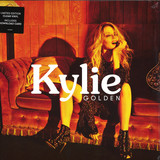
Now that I've been to Nashville,' Kylie Minogue says with audible affection, I understand. It's like some sort of musical ley-line...'
Golden, Kylie's fourteenth studio album, is the result of an intensive working trip to the home of Country music, a city whose influence lingered on long after the pop legend and her team returned to London to finish the record: We definitely brought a bit of Nashville back with us,' she states. The album is a vibrant hybrid, blending Kylie's familiar pop-dance sound with an unmistakeable Tennessee twang. It was Jamie Nelson, Kylie's long-serving A&R man, who first came up with the concept of incorporating a Country element' into Kylie's tried-and-trusted style. That idea sat there for a little while, with Minogue and her team initially unsure about how to bring it to life. Then, when Grammy-winning songwriter Amy Wadge's publisher suggested Kylie should come over to collaborate in Nashville, a city Kylie had previously never visited, something clicked. You know when you're so excited about something,' she recalls, that you repeat it an octave higher and double the decibels I was like that. 'Nashville! Yes! Of course I would!'. I hoped it would help the album to reveal itself. I thought 'If I don't get it in Nashville, I'm not going to get it anywhere.''
Kylie's Nashville trip involved working alongside two key writers, both with homes in the city. One was British-born songwriter Steve McEwan (whose credits include huge Country hits for Keith Urban, Kenny Chesney and Carrie Underwood), and the other was the aforementioned Amy Wadge, another Brit (best known for her mega-selling work with Ed Sheeran). It was then a truly international project: Golden was mainly created with African-German producer Sky Adams and a list of contributors including Jesse Frasure, Eg White, Jon Green, Biff Stannard, Samuel Dixon, Danny Shah and Lindsay Rimes, and there's a duet with English singer Jack Savoretti.
However, the album's agenda-setting lead single Dancing was, significantly, first demoed with Nathan Chapman, the man who guided Taylor Swift's transition from Country starlet to Pop megastar. If anyone knows how to mix those two genres, Chapman does. Nathan was the only actual Nashvillean I worked with. He's got a huge studio in his house, which is probably due to his success with Taylor... there's plenty of platinum discs of her, and others on his walls.' There's something of the spirit of Peggy Lee's Is That All There Is, of Dylan Thomas' Do Not Go Gentle Into That Good Night, even of Liza Minnelli's Cabaret about Dancing, a song which not only opens the album but sets out its stall, providing a microcosm of what is to come. You've got the lyrical edge, that Country feel, mixed with some sampling of the voice and electronic elements, so it does what it says on the label. And I love that it's called 'Dancing', it's immediately accessible and seemingly so obvious, but there's depth within the song.'
The experience of simply being in Nashville was an overwhelming one, before Kylie had even arrived. Once I knew I was going to Nashville, people talked about the place with such enthusiasm. They said without doubt I would love it and, I would come back with songs. They were sending lists of restaurants, coffee shops and bars. It really was a beautiful and genuine response and it felt like I was about to have a life changing experience and in a way, I did.' The reality came as something of a surprise, when she found a far more modern metropolis than the vintage one she'd envisaged. I thought it would be like New Orleans: little houses and bars, with music spilling out onto the street. It reminded me more of Melbourne: apartment blocks going up everywhere! The main strip, Broadway, where the honky tonk bars are, that's where the street was filled with music and it was just amazing.' Mainly, Minogue remembers the heat and humidity. It was 100 degrees. It was like it was raining with no rain.' She also relished the chance to wander around unrecognised, visit a few venerable music bars and soak in the atmosphere. I didn't get to the Grand Ole Opry or the music museums but I managed to go to a couple of the institutions there like The Bluebird Cafe and The Listening Room, and just by being there, through some kind of osmosis, you get this rejuvenated respect for The Song, and the writing of The Song. There's no hoo-hah around it. There's a singer-songwriter there, talking about the song and singing the song, to an audience who are there to listen. Although, I have to confess I was guilty of starting to clap too soon during a long pause at the end of one of the songs. The guy made a bit of a joke out of it and got a laugh from it, but I thought 'Of all people in the audience, no...''
It's probably no coincidence, therefore, that every track on Golden is a Kylie co-write, making it arguably her most personal album to date. The end of 2016 was not a good time for me,' she says, referring to well-documented personal upheavals, so when I started working on the album in 2017, it was, in many ways, a great escape. Making this album was a kind of saviour. I'd been through some turmoil and was quite fragile when I started work on it, but being able to express myself in the studio made quick work of regaining my sense of self. Writing about various aspects of my life, the highs and lows, with a real sense of knowing and of truth. And irony. And joy!'
The songwriting process allowed Kylie to get a few things out of her system. Initially, she admits, it was cathartic, but it also wasn't very good. I think I was writing too literally. But I reached a point where I was writing about the bigger-picture, and that was a breakthrough. It made way for songs like Stop Me From Falling and One Last Kiss. It also meant I had enough distance to write an autobiographical song, like A Lifetime To Repair, with a certain amount of humour. The countdown in that song: 'Six-five-four-three, too many times...'. I don't know if that will be a single, but I can just imagine a girl with framed pictures of past boyfriends, and kind of going 'Oh god, when am I going to get this right'' When she listens back to Golden, Kylie can vividly hear the Nashville in it. It is, she'll agree, probably the first time that a Kylie album has sounded like the place it was made. You wouldn't normally relate my songs to the cities. Can't Get You Out Of My Head sounds more like Outer Space than London. But Shelby '68, for example, was written in London but it was done with Nashville in mind. It's about my Dad's car, and my brother recorded Dad driving it! I don't think I'd have written a number of the songs, including Shelby '68 and Radio On without having had that Nashville experience.'
The latter, she says, is about music being the one to save you.' Throwing herself into the making of the record, she says, crystallised that idea. If there's one love that will always be there for you, it's music. Well, it is for me, anyway.' That song, in particular, carries nostalgic echoes of the golden age of Country, as heard through Medium Wave transistors and tinny home stereos in the distant past. Like any child of the Seventies, Kylie had a basic grounding in Country music, mainly absorbed from older family members. My Step-Grandfather was born in Kentucky and though he lived most of his adult life in Australia, he never stopped listening to his beloved Country artists.' If there's any classic Country singer whose imprint can be heard on Golden, it's Dolly Parton.
Kylie saw Dolly live for the first time at the end of 2016, at the Hollywood Bowl. It was like seeing the light,' she beams. It was incredible. Everyone, whether they know it or not, is a Dolly Parton fan. When I was in Nashville, I did pick up a T-shirt that said 'What Would Dolly Do' Maybe that should be my mantra.' And, whether consciously or otherwise, there's a timbre and trill to Kylie's vocals on Radio On that is distinctly Parton-esque. My delivery is quite different on this album,' she says. A lot of things are 'sung' less. The first time I did that was with Where The Wild Roses Grow. On the day I met Nick Cave, when I recorded my vocals, he said 'Just sing it less. Talk it through, tell the story.' This album wasn't quite to that extreme, but a lot of the songs were done in fewer takes, to just capture the moment and keep imperfections that add to the song. I remember on my last album, a lot of producers were trying to take out literally every vibrato they heard. And that's not natural to my voice. I mean, I can make myself sound like a robot, but it's nice to sound like a human!' Working within the Country genre also gave Kylie permission to write in the Nashville vernacular. Because we were going there, I wasn't afraid to have lines like 'When he's fallen off the wagon we'd still dance to our favourite slow song', 'Ten sheets to the wind, I was all confused', 'I'll take the ride if it's your rodeo'. The challenge of bringing a Country element to the album made the process feel very fresh to me, kind of like starting over. I started to look at writing a different way, singing a different way.'
If ever Kylie lost confidence in the Country-Pop concept, and found herself pondering This is great, but back in the real world - my real world - how will this work', Jamie Nelson was there to badger her into sticking to the path. We found a way to make it a hybrid with what we'll call my 'usual' sound. It had to stay 'pop' enough to stay authentic to me, but country enough to be a new sound for this album. The closer we zoomed in, and the more we honed it, I knew Jamie was right. We sacrificed good songs that weren't right for this album, because we wanted it to be as cohesive as possible. The songs that were hitting the mark were these ones, so we decided to be strong, and that's how we wrapped up the album. What he said, that stuck with me, was that 'I'd hate to get to the end of this and really wish we'd gone for it.'' Having worked with Kylie for so long, Nelson was able to put this latest shift of direction into perspective. He said 'You've traditionally done it throughout your career. You had your PWL time, then you did a complete turn when you went to deConstruction, then another complete turn with Spinning Around, and R&B dance-pop, and then another turn with Can't Get You Out Of My Head, icy synth-pop, and this is another one.' He was right. It felt like the right time to have a change sonically. New label, new stories to tell, and a new decade almost upon me.'
Kylie Minogue will, it's scarcely believable, turn 50 this year. This looming milestone is partly behind the album's title, and title track. I had this line that I wanted to use: 'We're not young, we're not old, we're golden' because I'm asked so often about being my age in this industry. This year, I'll be 50. And I get it, I get the interest, but I don't know how to answer it. And that line, for my personal satisfaction, says it as succinctly as possible. We can't be anyone else, we can't be younger or older than we are, we can only be ourselves. We're golden. And the album title, Golden, reflects all of this. I liked the idea of everyone being golden, shining in their own way. The sun shines in daylight, the moon shines in darkness. Wherever we are in life, we are still golden.' One of the album's shiniest moments is Raining Glitter, an exuberant banger which ventures closest to Kylie's traditional dance-pop comfort zone. Eg White, who is one of the producers and writers and a great character, was talking about disco one day. I said 'I love disco, but you know the brief.' We needed to be going down the Country lane, so to speak. But we managed to bring them both together. When I wrote it, I was thinking about the Jacksons video for Can You Feel It where they're sprinkling glitter over everyone. And I think there's a Donna Summer record that's got that feel to it. I think that's my job: I basically leave a trail of glitter after every show I do anyway.'
Kylie is looking forward to the challenge of incorporating the Golden material into her live shows. Mixing these songs in with my existing catalogue is going to be fun. And it could be fun to do some of those songs with just a guitar. It'll make my acoustic set interesting...'Her incredibly loyal fans - to whom one Golden song, Sincerely Yours, is intended as a love letter' - will, she believes, have no problem with her latest stylistic shift. My audience have been with me on the journey, so I shouldn't be afraid that they won't come with me on this part. I've had fun with it, and I'm sure they will too.'
The time spent making Golden has, Kylie says, been a time of creative and personal renewal. I've met some amazing people, truly inspiring writers and musicians. My passion for music has never gone away, but it's got bigger and stronger.' And if there's an overriding theme to the record, it is one of acceptance. We're all human and it's OK to make mistakes, get it wrong, to want to run, to want to belong, to love, to dream. To be ourselves.'
I was able to both lose and find myself whilst making this album.'
Cerca:direct hits
Born in London, 1945, Labi Siffre's recording career has spanned over 30 years and produced a body of work that has attained anthemic status across the world. He has had two number one hits (directly and indirectly) and is considered by those in the know to be one of Britain's most important musicians of the past fifty years. So it's a strange modern quirk that his actual voice is rarely heard, as it is from covers and samples of his work that he is best known. You may recognise his genius being sampled by Eminen for 'My Name Is' or the Madness cover of his song 'It Must Be Love' that was a huge pop hit across the world.
For his release on Mr Bongo we have gone back to the original source - his classic 1975 release 'Remember My Song'. This is his fifth album and features 'The Vulture', 'Sadie and the Devil' and 'I Got The', sampled by Eminem, Jay-Z, Wu-tang Clan, Atmosphere, The Beatnuts and Frankenstein, amongst others. Co-produced by Derek Lawrence and Big Jim Sullivan - a prolific session musician, artist and producer - who also worked with artists such as David Bowie, Serge Gainsbourg (on 'Histoire De Melody Nelson') and Frank Zappa. Brian Bennett of The Shadows, Chas Hodges and Dave Peacock aka Chas 'n' Dave also feature on this funk masterpiece from 1975.
This LP is reissued in new and improved sleeves (made in Japan) and features label designs as per the original 1975 release.
Does the world needs more acid Yes it does! the R-A-G trio aka Dutch producers Ma Spaventi, G-String & Aroy Dee deliver three raw acid-jams with Aroy on the couch working the mic. The lyrics of Dreadfully Nervous are based on a Edgar Allan Poe story.
'Dreadfully Nervous (Aryd's Acid Mix)' is a gurgling brew of squelchy acid with dark vocals and pinging cowbells pulling you in all directions. Coarse claps and ever more wild synths encourage you to cut loose and make for another timeless cut. 'Dreadfully Stoned' is more stripped back, with a rubbery arpeggiated synth the main hook over subtle, supple drums. Those dark spoken word vocals are back again and the whole thing is freaky and unsettling as a result. Last of all is the bright and glistening 'No Soul' with metal hits and claps and prickly acid all bursting out of dusty Chicago drums. It's raw and sure to fire the synapses just like R-A-G productions always do.
Label co-founder Vercetti Technicolor returns to Giallo Disco after the Black September LP with the soundtrack to the psychedelic neon-soaked slasher short HARD PILL. Directed by writer-director Daniel Freedman, Vercetti Technicolor's Fulci meets Digweed score takes you from Mainetti to Martinez. Drugged out club hits and tense shadowed corridor atmospherics. No one is safe... not even you. Art by Eric A. Lee
It is summer time in Nang land which means the dials are being set to Balearic. Step forward our all-around good chap, friend and producer buddy Pete Herbert. He has teamed up with Bali based musician and keyboard player Martin Denev to deliver an album of the finest Bali-inspired Balearic House. Hot and balmy evenings here we come.
Recorded on the tropical island of Bali, the album swings from Balearic grooves, to sun-filled terrace house, seaside electronic and swimming-pool funk. We open up with "Batu Karang", summery key stabs, lazy drum machine set the album tone hot, low-slung and swimming in positivity. Things take a more electronic turn with "Time" with its twisting synth-lines and locked on sun-drenched groove.
House music royalty Robert Owens swings by the cabana for a very special guest vocal appearance on "Pass Me By" next. His smooth and powerful soulful vocal compliment the pool terrace house grooves and sneaky thumb piano. As ever, Robert does not disappoint. To close off Side A the title track "Made In The Shade" gives us a slice of Nu Disco summer swing with funky strat and more cowbell of course in for good measure.
The flip side of the album opens up with a hands in the air terrace anthem. House pianos, punchy synth hits and beach disco groove all the way. "Sun Fish" takes things again in an electronic direction. Meandering lead synth lines, walking synth bass giving the perfect back drop to this island hopping anthem. Recent single "Night Boat" is next. Darting firefly arpeggios and lush keyboard layers prevail here. We end on a high with the up-tempo Gamalan inspired "Ruby Star" sending us out on a ocean deep wave..
Welcome to Nang Balearic airlines. Your pilots Pete and Martin hope you enjoy your flight.
There was a time when to die was something slightly different from what it is today. Back in the last days of the middle age, some hidden monk was concerned about how to die properly, according to the catholic standarts of that era, so he wrote a book that was a cornerstone in that period.
This has been the leitmotiv and ispiration in the concept that drives this album, the Ars Moriendi book from 1415, a book that gave some clues about how to die properly, avoiding lack of faith, despair, impatience, avarice or spiritual pride, all those actually track titles in this compendium.
Album starts with Impatience a short atmospheric drone sets the path to post industrial mayhem, based on a continuous and obsessive metallic sequence that drives the angst over a dirty rhythm workout until the textures go on top after several bars.
Rules of behaviour breaks the beat into metallic hits as starting point, then more percussive layers add to the main beat until the dark pads take over mixing hate with beauty on a grey canvas.
Despair return to adrenaline, icreasing the tempo, running unstoppable on a relentless sequence with skeleton beats as a driver.
Speculum acts as a sequel from the first track, same sequence different rhythm, extending the anxiety feeling but with a cleaner groove, again a few elements make everything run smoothly no fillers, just tension.
Lack of faith keeps on with the beat as fundamental component, based on a cemented kick and breathing components that grow during the running time.
Avarice returns to harsh kicks and martial sincopation having distortion as the main element until Fm percussions shine on top.
Spiritual Pride is the adrenaline shot in this album, obessive dry sequences, harsh kicks and razor hats in a direct floor burner.
Closing the travel, The search for identity goes underwater: cavernous landscapes and absence of brightness with a pulsating sub frequency doing the low end, while drones and obscure sound design make the rest.
After sending out these tracks last summer and getting great reactions from DJs and dancers alike, Hell Yeah is pleased to finally officially release virtuoso musician Verdo's Little Blue EP, complete with a remix from Lauer. Fully remastered for vinyl, the likes of Lexx, Chris Coco, Soft Rocks, Leo Mas and many more have all be playing these tunes with great results.
The talented Verdo runs the famous Gratis Club in Senigallia on the Italian east coast. It is a place he calls home, and that has really allowed him to hone and sharpen his DJ skills so that now he is a slick, unpredictable and singular DJ with many tricks up his sleeve. Bjorn Torske, DJ Fettburger, Prins Thomas, Kenji Takimi, Glenn Underground and more have all played there in the last decade and Verdo himself is a skilled pianist who has played for Zero7 singer Mozez in the past. He has worked with Hell Yeah before now, as well as releasing on Danny Was A Drag King, and here serves up his biggest bit of dance floor dynamite to date, including his previously digital only cut 'Big Fish' (mixed by DJ Rocca).
Opener 'Little Blue' is a perfectly sunny track with hip swinging claps, bobbling bass and boat party vibes that soothe your soul. Rich with instrumentals and golden synth lines, it's a perfect beat that gets followed up by the retro disco pump of 'Sazerac', another tropical cut with loose drums and rubbery bass to get you up on your toes.
The massive 'Big Fish' then hits hard with its tin pot percussion and wild synths all making you flail your arms like you just don't care. Jumbled jungle vibes and big chords all swell your heart as your feet skip about down low.
Closing out the package is Phillip Lauer (Tuff City Kids), one of the most in demand stars of the day, and his version is a direct house jam with percolating and rugged synths and slapping hits, all demanding you ditch your cocktail and get up and groove.
"all good stuff here! OG for early / mornings and Lauer for peak. really nice release! " Piers - Soft Rocks
"Big fan of Verdo! great tunes here as expected. Sezarac fav at first listen." - Dream Chimney
"Little blue is super nice!!" - Phil South (Golf Channel)
"Yes, some great stuff here. Sezerac and the Lauer mix are really great, perfect sunshine session material." - Chris Coco
"I love Big Fish's keyboards! strong!!! Arigato!!!" - Chida
"Little Blue and Big Fish are fun for sure, def will play em on a rooftop sooooon" - Jacques Renault
"Yeah, feeling Little Blue, heavy rotation this Summer! " - Jason Boardman (Aficionado)
"Little Blue, i like." - Lexx
"This is tremendous. Driving peak time track that you can imagine Joe Claussell really working the dancefloor with." - Andrew Pirie
"killer ep guys!!!" - Discodromo
The next COSMOS release comes from Salomon Dunkan, a mysterious and unknown producer who serves up two tantalising tracks...
.
'Android (Adamantium Mix)' is a slow and percolating house track with a rugged acid line and sharp percussive knives cutting up the rubbery kick drums below. Swirling pads add a cosmic atmosphere and there whole hits slowly but surely builds to a raging and intense peak of bristling hits and gurgling synths. It's controlled chaos and then 'Tacchi A Spillo' treads a more direct path. Again the high hats are bright and sharp, the mood is very sci-fi and the bass lines rumbled down low. Like a deep space odyssey this one travels far and wide and grows ever more physical and jacking as it goes on.
'I take my guitar and strum and sing some tings and blow people's mind. But I ain't trying to do anybody's music. I'm doing what I feel' - Shadow
When it came out in 1984 the far-out album Sweet Sweet Dreams by Trinidad & Tobago's Shadow (aka Winston Bailey) was described as 'way ahead of its time'. Undeservedly it was panned by critics and, unable to reach markets, disappeared into the dusty record collections of a few music aficionados. Now, more than three decades later that cosmic dance-floor UFO is about to take off again, change all that and set the record straight. Remastered and cut by Frank Meritt at The Carvery the album is truly a masterpiece.
But who is this Shadow behind Sweet Sweet Dreams Shadow is a man of understated magnitude. A truly enigmatic artist, he first emerged in Trinidad and Tobago during the 1970s, becoming a part of the tapestry of Caribbean music and reinvigorating calypso at the time. Calypso, the indigenous folk music of Trinidad and Tobago, has roots in West African kaiso rhythms, French Creole influences, and the hardships endured by the African slaves brought to Trinbago, whose descendants still use it as a tool for satire, self-expression, and social commentary. Calypso has also given birth to several other music genres, including soca, with its uptempo beats and festival context. Shadow effortlessly moves between both.
Shadow came from a humble but musical family and started writing songs as a youth while tending cattle in the fields. To his family's initial chagrin he chose calypso over church music but his talent and drive were undeniable. In the early days of his career Shadow's style was cramped when working with some of the more conservative music arrangers who felt that calypso and soca should fit a mould. But after a while Shadow teamed up with more innovative arrangers, including Arthur 'Art'de Coteau, who followed their and Shadow's intuitions resulting in a long line of hits.
'The first time we met for me to arrange his music we had a heated argument on the arrangement for one of his songs, I was theoretically correct but Shadow was musically right. Shadow broke all the traditional musical rules and made his own and that made him a musical giant. He changed the face of Calypso music in 1974 with the release of "Bassman" a tune in which Bass and magnificent horn line took central stage changing Soca music for ever. What Shadow did with his music was to put calypso on the International Dance circuit, giving it a totally different groove. You could take his music and swing it in any direction, Disco, Pop, Calypso, you name it. His music was different from anything that existed before'. - Carl "Beaver" Henderson, one of Trinidad's veteran producers.
This inert creativeness culminated in Sweet Sweet Dreams which was arranged by Shadow and deals with burning and ever-relevant themes like love and the ups and downs of relationships. a surprising fact for someone mainly known for his satirical and political lyrics. It prompted his manager to wonder if Shadow had written the lyrics while in a state of 'tabanca' (a word used in Trinidad and Tobago to describe lovesickness).
Sweet Sweet Dreams was recorded at the legendary SHARC studios, located on a hill in Chaguaramas (near Port of Spain) and despite a fantastic sound and monster Soca-boogie tunes like 'Lets get it together', 'Lets Make it Up' and 'Way, Way Out' the album was a commercial flop, probably due to the fact that it didn't sound like anything else coming out of Trinidad & Tobago at the time: It fused a range of different rhythms and new sounds, primarily heavy synth riffs.
Shadow took the album's lack of success in his stride with usual aplomb:
'When I did Sweet Dreams I expect something could happen. But nothing big happen because I have no big market and no distribution and all this thing now. So I just cool myself and move on to another song. I wasn't doing just one song. I used to always have plenty songs at the one time. And be writing music'.
What Shadow didn't realise back then was that the proto-electronic cocktail he had mixed in 1984 would only find the recognition it deserved three decades later. Life has swung full circle: Sweet Sweet Dreams has come true and been elevated to holy grail status becoming one of the most sought-after Caribbean disco records in existence.
For this re-release we carried out extensive interviews with Shadow and the musicians and have included as bonuses exclusive photos from Shadow's personal collection and the dancefloor filler tune 'D'Hardest' was added as a bonus track.
Moonshine Recordings continues to coordinate dub into all sorts of directions with its steady throughput of vinyl releases. This time around, it's the Spanish-based Bukkha to uplift all followers with two up-tempo rollers that take part in his crucial 'Ruling Sound' EP. His name has been all over the news inside bass culture lately, as the American released highly noted physical music on critical labels like Killa Sound and Dub-Stuy Records. He's been working his way to the top and the only thing the Moonshine Recordings imprint can do is support his efforts in pushing dub music to the masses at any given moment of the day.
On top of this wicked news, Portland's dub producer and engineer 'Skelli Skel' joins this session to frame the taste of the 'PDX Mandem' collective from back home. His love for complex rhythms and heavy bass lines fuel his adventure inside dub culture, something you'll hear when listening to 'MS028'. And with the familiar voice from don Junior Dread, who jumps in on the hype by illuminating the dub with carefully selected freedom of speech, it's the collaboration that speaks for itself. To top it all, TMSV is added to the release roster, a producer whose been dealing some serious damage with his inventive music repertoire. Whether it's music on the darker tip, or the more laidback sound, both Bukkha and TMSV know how to uplift and please their followers with bass-heavy, eardrums-teasing bass music.
Bukkha's 'Ruling Sound' leads his way through musicality by portraying the right balance of instruments and not to mention the gigantic bassline that disperses vibrantly through the lower bottom of the mix. The reigning vocal support from Junior Dread and dub techniques from PDX Mandem family Skelli Skell work out fantastically, as it makes this record come to life. Listen to the instrumental part that propagates in the exact sense of 'dub music', regardless of spinning on a higher beats per minute. The version 'Ruling Dub' by Bukkha himself plays a more meditative part inside your headspace; a clipping where basslines and effects will act up in a blurred version. It's the real attention to detail the American producer shares with remix boss TMSV, who hits fans with a darker joint that pays homage to Drum & Bass. It's aggressive stance forms the pinnacle of 'the right' B-side of a Moonshine Recordings plate. Just make sure you experience the second drop of this absolutely mammoth interpretation, as TMSV shuts down the place!
Following a summer of fifth birthday celebrations, Tom Trago's Voyage Direct label returns to action with a brand new 12' from Amsterdam scene stalwart Simon Weiss.
Although a new member of the Voyage Direct family, Weiss is no newcomer to the scene. He's previously delivered high grade EPs for Rush Hour, Deepermotions and Home Taping Is Killing Music, and his contribution to First Mission, Voyage Direct's fifth anniversary compilation, was one of the undoubted highlights of that set.
It's that track - the gloriously positive 'Tele-Vision', and it's cyber-house fusion of darting synthesizer arpeggios, Detroit-influenced percussion, and thrusting acid bass - that heads up Weiss' first EP for Voyage Direct.
Dutch veteran and longtime friend of the family Dexter turns in a stunning remix, putting a well-placed boot up the backside of 'Tele-Vision' via speaker-shaking sub bass, kaleidoscopic electrofunk motifs and thumping techno rhythms. It's a stunning re-make, and one that takes Weiss' fine original to even greater heights.
Flip the record for two previously unheard Weiss productions. First up is 'Ghost', a supernatural house shuffler full of alien synths, wayward melodies, intergalactic electronics and crunchy drum machine hits. Weiss flips the script slightly on 'Super Sub', pairing his now trademark vintage synthesizer refrains and tumbling electronics with a heavyweight, bassline-driven groove. It's a sweet and evocative track, but critically also packs a punch.
- A1: Interview - Salut Des Salauds
- A2: Philippe Krootchey - Qu'est Ce Qu'il A (D'plus Que Moi Ce Négro-Là)
- A3: Gérard Vincent - Gérard Vincent Pas Gérard Vincent
- A4: Style - Playboy En Détresse
- B1: Pierre-Edouard - A Mon Age Déjà Fatigué
- B2: Casino - Pât Impérial
- B3: Bianca - La Fourmi
- B4: Trigo & Friends - La Dégaine
- B5: Hugues Hamilton - Je M'laisse Aller
- C1: Pascal Davoz - Cinéma
- C2: Anisette - Scratch Au Standard
- C3: Pilou - Ça Va
- C4: Henriette Coulouvrat - Miam Miam Goody
- D1: New Paradise - Easy Life
- D2: Gérard Vincent - Tas Qu'à Fermer Ta Gueule
- D3: Ich - Ma Vie Dans Un Bocal
- D4: Attaché Case - Les Crabes
- D5: Yannick Chevalier - Ecoute Le Son Du Soleilv
This is France in the Mitterrand years: fashions fleet as fast as governments. In the early eighties, the happy-go-lucky gather the nectar of each and every new release.
Believing in a bright future for videotex, and loosened up by the sexy talks broadcasted on the budding pirate radios, the new generation dreams of dance floors and holiday clubs. French Boogie, which preserves the spirit of these years of boodle and bunkum, is the ideal soundtrack to their dreams.
What the web now refers to as French Boogie is some synthetic funk reflecting the spirit of those days when nothing was impossible, or so it seemed. Its syncopated flow heralded the dawning of French rap. Often considered as some kind of post-disco, inspired as much by black music as by new wave, this carefree pop music with bawdy lyrics indulged in simple pleasures: holidays, swank and sun were recurrent themes. Totally in tune with its time, it incidentally glorified luxury, success, and a certain consumerism embodied, for instance, in Bernard Tapie.
In popular clubs such as La Main Bleue in Montreuil, or L'Echappatoire in Clichy-sous-Bois - where Micky Milan could be seen behind the decks - an enthusiastic audience discovered this new sonic wave, influenced as much by French pop as by Sugar Hill Gang or Kurtis Blow. The artists who first launched the movement engaged in it wholeheartedly, but as often the case with new music trends in France, humour and casualness quickly became a decoy to impose a new style. This explosive mixture, in which startling and typically Frenchy French lyrics go along New-York-style tunes, is sometimes reminiscent of the kinky comedies directed by Max Pécas or Claude Zidi. On this prolific scene, partly originating from the Jewish community, everybody was looking for success, trying to hit the jackpot with what was to hand. Famous media personalities, one-hit wonders or John Does in quest of fame, all had a go at French Boogie - more or less successfully. Apart from « Vacances j'oublie tout » by Elégance, « Un fait divers et rien de plus » by Le Club, or « Chacun fait ce qui lui plaît » by Chagrin d'amour (produced by Patrick Bruel), very few songs became hits: the story of funk in France is that of a half-baked robbery.
In this myriad of new musicians, the very young François Feldman and Phil Barney pioneered a fresh and hybrid style. Other well-known artists like Gérard Blanc from Martin Circus (Attaché Case), Richard de Bordeaux (Ich), or Jean-Pierre Massiera (Anisette, Pirate Scratch Band, Mandrake, Scratch Man...) added an eccentric touch to this sound-wave, making it often entertaining, and sometimes showy.
Capture d'écran 2015-10-26 à 12.55.43Singers like Agathe (the author of 'La Fourmi' and of the hit song 'Je ne veux pas rentrer chez moi seule') were far more than just window dressing. They even tried to give an ironic and subversive twist to this rather harmless genre. The very vindictive rebel Gérard Vincent shared in this spirit, but as a whole, French Boogie became associated with nonchalance and sauciness. Thus, Stéphane Collaro, Gérard Jugnot, Alain Gillot Pétré and other TV clowns would clumsily contribute to this French variation on funky sounds. In a few but intense years, French Boogie gave all the tips to party with style.
If some hits made it possible for the happy few to get a real house under truly exotic palm trees, the wave actually ebbed away very quickly, leaving quite a few musicians stranded on the shore. Whether they were sincerely motivated, or simply opportunistic, they had failed. In 1984, French Boogie was already breathless, and got merged with other genres: on the one hand, rap and breakdance adapted its flow to a more urban world, especially with Sydney's show, H.I.P.H.O.P, and Dee Nasty's broadcasts on Radio Nova; on the other, italo, new beat and house began to rule over dance floors, even more strongly asserting the will to develop music for clubs.
Squeezed in between the age of disco and that of modern electronic music, French Boogie was a transitional phase, but it remains an amazingly refreshing testimony to the intermingling of pop and underground cultures. The genre was hastily categorized as anecdotal in spite of its pioneering synthetic groove and matchless bass lines. An attentive ear will discover the poetry of the ephemeral beyond the eccentricities of the genre, as well as a certain unexpected avant-gardism. At the origin of major music trends, always cheerful and catchy, French Boogie is what you need to party.
Sao Paulo born Toni Tornado was considered the Brazilian James Brown by many.
His career began as 'Tony Checker', lip syncing to rock 'n' roll hits and touring extensively outside of Brazil. Whilst in New York he met Tim Maia and became involved in the 'Black Rio' movement. Toni also worked with Ed Lincoln and Antonio Adolfo amongst many others. He had a successful acting career and starred in many soap opera's.
'O Journaleiro' is a tearing funk track with tough drums and big vocals. Taken from his hard to find and expensive to acquire debut LP, 'BR-3', released by Odeon Brazil in 1971.
This track has never been released on 7".
Som Tres was a jazz ensemble formed by legendary Brazilian musician César Camargo Mariano, who also formed Sambalanço Trio.
Cesar's collaborations with many of Brazil's most important singers, notably Wilson Simonal and Elis Regina, have brought him worldwide acclaim; the historic 1973 album Elis and Tom, made with Antonio Carlos Jobim, features Cesar as arranger, pianist and musical director.
Som Tres recorded eight albums between 1966 and 1971. 'Homenagem a Mongo' is taken from the sought after 'Som 3' LP from 1969 on Odeon Brazil. It has never been released on a 7".
This next release demonstrates exactly what can happen when you merge a formidable heavyweight with one of the genre's most promising talents. Jaguar Skills needs little introduction; he's infamous for his ninja-like DJing skills with years stacked behind the decks.
As a result, it was no surprise the artist tried his hands at production alongside Chord's impressive musicality. Already unstoppable from its conception, 'Lust' could only be released on an imprint known for its high quality. And RAM Records is proud to unleash this toe-tapping, catchy piece of sonic artwork on the dnb community...One that's already taken the radio airwaves by storm.
Opening with a rhythm that curls itself around your aural senses, prepare to be pulled into 'Lust' by its funky groove and well-chiselled hooks. The vocal delight of Matti Roots really brings light to the seasonal feel this track creates; an arpeggio of notes underpins each high-hitting voice crescendo. Bright but not without substance, Chords' production style is instantly recognisable. This debut from Jaguar Skills serves as a perfect platform for the high standards this mix-maker is about to set, as well as the benchmark which Chords has already carved.
On the flipside, Break holds onto the A-side's sunny disposition, yet throws down a riddim that hits as heavy as a freight train. The foundations laid by the producer are slightly different, as it rattles forward with clinking percussion, alluding to the kind of drop Break is renowned for. With his distinctive, boundary-pushing drum rolls and bouncy, booming and concise hits, there's no mistaking a sound which adds another dimension to the remixes' original.
You're also served up with another dish which is vastly different from house-guru Monstro. like the previous edit, the record's humanism winds up within the first thirty seconds, however the seismic impact of its drop rolls out into a house-bassline that thumps with every bar. A genre transition which doesn't fall short of the original's production prowess, prepare to hold onto your seats because this serves as the optimal way to wrap up two striking remixes of an already impressive track list.
Dominating playlists for years to come, this release from RAM is yet again taking the genre to another level. But considering the parties involved, there was no other direction for this record to take.
JUSTUS KÖHNCKE & THE WONDERFUL FREQUENCY BAND - his first major release in five years after SAFE AND SOUND
JUSTUS KÖHNCKE & THE WONDERFUL FREQUENCY BAND - his first major release in five years after SAFE AND SOUND (Kompakt CD 63) - is JUSTUS KÖHNCKE's long-awaited return to the full-length format: neatly coinciding with Kompakt's exuberant 20th anniversary activities, the leftfield house virtuoso, former Whirlpool Productions member (see "From: Disco To: Disco") and producer of seminal cuts such as "Was Ist Musik", "2 After 909" or "Timecode" hits the floors with an entirely new set of future classics, remedying desolate crowds in dire need of a party to remember.
Back in stock!
Some friends think that Shihab the man owes the balance of his soul to his beautiful Danish wife. They may be right; for Eros is the very essence of what Shihab plays.Yet Eros is a god with many a face. A tale of tender mournings Shihab's flute is telling in MAUVE - a piece that translates its title into delicately changing colors of sound. In UMA FITA DE TRES CORES he has his instrument wooing with the proud self-reliance of Latin grandezza. Calmly, softly, almost blandishly Shihab blows the solo flute in the Jimmy Woode composition MY KINDA WORLD. Serene and somewhat playful his own title ANOTHER SAMBA comes along - a most uncommon composition by the way: lasting for sixty bars as if growing independent out of itself, with solos that appear to be additional spinnings rather than improvised choruses; and yet; a perfect, self sustaining melody no element of which is superfluous. In the last of the pieces for flute, in Klook Clarke's THE WILD MAN, which is based on a flourish of trumpets, Shihab for the first time reminds of the sombre, the demon-like face of God Eros. He contrasts flawlessly intoned passages with challenging phrases, phrases raucously sung into the flute - really, he is a 'wild man' who is playing like that. This raucous challenging sound prevails throughout the four baritone-titles ('Shihab never withholds long to caress', Campi says). Shihab blows the instrument the same way he speaks: without any delay, directly coming to the point. And he treats it like a voice, not aiming at an artificially homogeneous sound in all the registers, but at their different modes of expression. In the high pitches the horn gains a brilliant tenor-like quality - for instance in PETER'S WALTZ, dedicated to Shihab's son Peter, and in Kenny Clarke's simple drum fills comprising theme JAY-JAY. In the deep register Shihab produces snotty sounds filling lady's ears with horrors like Pan - thus in JAY-JAY and in the boppy blues SET UP . Shihab's sense of a scurrilous humor breaks through in SEEDS (which reminds of the West-African heritage of jazz with its multiple rhythms and its renunciation of harmonious development - only the eight bars of the bridge base on a progression of chords): not only does he omit the notorious bombastic chord by the ensemble after his own final cadenza, he even ends with a minor second above the keynote. Seems as if Shihab now unrestrictedly conveys to his music all the experiences and emotions he formerly did not deal with in a musical way. Shihab the man need not be disturbed so that Shihab the musician may improvise passionate choruses. It would be unjust, however, to forget the choruses of the four other musicians for those by the 'born leader'. Francy Boland, taciturn and always introverted: he plays an extrovert, a masculine piano. Even with spare single note lines he produces a piercing and ringing sound that hitherto nobody except him has discovered, a bluesy sound bespeaking the very element of frustration that lies within the title of the trio number WHO'LL BUY MY DREAM. The unfailing feeling for rhythm the musicians of the CBBB praise with the arranger Boland, becomes manifest in the piano solo on SET UP. Francy's improvisation is rhythmically styled in a Monk-like manner, and yet no accent could be set differently. Maybe this is the secret of the Shihab-Combo. 'Rhythm is our business', this credo of Jimmy Lunceford could be the one of the five musicians as well. Sadi hits his vibes as dryly as if wanting to bring its ancestors to memory, the wooden chimes of West Africa's coastal tribes. To reach the fullest poignancy possible, he intentionally calms down even the resonance in MY KINDA WORLD. In UMA FITA DE TRES CORES Jimmy Woode bears out the crispy jazz beat against Sadi's Bongos and Klook's Latin-American percussion all by himself. Moreover - and that, too, is connected with the school of the Duke who was the first in the history of jazz to discover the instrument's potential as a melody instrument - Woode rips a marvelous counterpoint to the inventions of the other melody instruments, take for example PETER'S WALTZ. And then there is Kenny Clarke. Klook. On the entire record he only uses his brushes. Means by which different drummers only know to bring forward impressionistically blending noises: He drums a vigorous beat with them, fanciful fills, a solo, melodious and at once skillfully playing with cross rhythms in JAY-JAY. The 'born leader', the 'outstanding baritone saxophonist of modern jazz' (Joachim-Ernst Berendt), he could not wish himself different sidemen for this record overdue since some years.
Born to Die" follows Lana's first single "Video Games" which began its life online in July accompanied by a video created by Lana. Since then "Video Games" has amassed over 8 million hits and on release has hit i-tunes #1 position in 9 countries including the UK, Australia, Holland and France and is currently #1 in Germany. Also a massive critical smash, it has recently been hailed as the #2 track of the year by Q Magazine, with Q Magazine also awarding her the "Best New Thing" award at the Q Awards.
"Born to Die" is a suitably noir follow up to "Video Games" and is coming with an incredible video conceived by Lana and Directed by Woodkid. A Remix EP will also be released, including mixes from Damon Albarn, Woodkid and Clams Casino.
"Born to Die" the album is a collection of tracks about which Lana says "The songs I've written are an homage to true love and a tribute to living life on the wild side." Album tracks include "Million Dollar Man", "Off to The Races", "Blue Jeans" and "Carmen".