Tom Dicicco returns under his newly launched Veyg moniker with four mesmerising house cuts entitled 'My Sweet Soul' arriving on his eponymous vinyl only label Veyg Times.
Run Out Run founder Tom Dicicco's output includes ppearances on labels like Juju & Jordash's Off Minor, John Osborn's Dred Records, Anthony Parasole's The Corner and renowned Dutch techno staple Delsin. The British producer started producing under his Veyg alias earlier this year as a means of exploring more adventurous productions spanning house, techno, disco, and beyond. His second outing once again demonstrates how
versatile he is as a producer.
Suche:disco soul
As we enter the Summer months, Excursions welcomes back The Showfa, with A Gospel Excursion Volume Two. Four more dishes of hot spiritual gumbo for your mind, body & soul.
Once again The Showfa has expertly cut together a concoction of gospel, soul, disco, latin, jazz, funk, and spiritual rhythm & blues. The glorious disco rework of a track called 'Amazing' sets the tone with an infectious piano riff and powerfully uplifting vocal. 'Surely Surely' follows, with a more vigorous strut, a short, sweet slice of disco funk, no messing about. 'Praising' keeps the groove and tempo solidly in a delicious eighties boogie formation, slap bass and sax in tow. The set closes out with beautiful latin-jazz tinged vibrations sauntering through 'I'll Show You The Way', before switching to the sweetest sweet soul you ever did hear. Soul food of the highest calibre.
The previous volume was shown love last year by an assortment of selectors and tastemakers, including Tony Humphries, Horse Meat Disco, Gilles Peterson, Craig Charles, BBC 6Music, Mi-Soul, Rinse FM and Mixmag, and also saw The Showfa spinning on the airwaves on NTS with Charlie Bones, and for Wax Poetics.
Another joyously ethereal platter, and another one that will never leave the box.
- A1: A Min We Vo Nou We - Les Sympathics De Porto Novo
- A2: Asaw Fofor - Ignace De Souza & The Melody Aces
- A3: Dja Dja Dja - Stanislas Tohon
- B1: L´enfance - Elias Akadiri & Sunny Black´s Band
- B2: Mé Adomina - Picoby Band D´abomey
- B3: Nounignon Ma Klon Midji - Antoine Dougbé
- B4: Moulon Devia - Orch. Poly-Rythmo De Cotonou
- C1: Paulina - Black Santiago
- C2: Glenon Ho Akue - Lokonon André Et Les Volcans
- C3: Sadé - Sebastien Pynasco And L´orchestre Black Santiago
- C4: Baba L´oke Ba´wagbe - Super Borgou De Parakou
- D1: Gangnidodo - Cornaire Salifou Michel Et L´orchestre El Rego & Ses Commandos
- D2: How Much Love Naturally Cost - Gnonnas Pedro And His Dadjes Band
- D3: Idavi - Orchestre Poly-Rythmo De Cotonou
African Scream Contest 2
A great compilation can open the gate to another world. Who knew that some of the most exciting Afro-funk records of all time were actually made in the small West African country of Benin Once Analog Africa released the first African Scream Contest in 2008, the proof was there for all to hear, gut-busting yelps, lethally well- drilled horn sections and irresistibly insistent rhythms added up to a record that took you into its own space with the same electrifying sureness as any favourite blues or soul or funk or punk sampler you might care to mention.
Ten years on, intrepid crate-digger Samy Ben Redjeb unveils a new treasure- trove of Vodoun-inspired Afrobeat heavy funk crossover greatness. Right from the laceratingly raw guitar fanfare which kicks o Les Sympathics' pile-driving opener, it's clear that African Scream Contest II is going to be every bit as joyous a voyage of discovery as its predecessor. And just as you're trying to get o the canvas after this one-punch knock out, an irresistible Afro-ska romp with a more than subliminal echo of the Batman theme puts you right back there. Ignace De Souza and the Melody Aces' Asaw Fofor" would've been a killer instrumental but once you've factored in the improbably-rich-to-the-point-of-being-Nat-King-Cole-influenced lead vocal, it's a total revelation.
The screaming does not stop there, in fact it's only just beginning. But the
strange thing about African Scream Contest II's celebration of unfettered Beninese creativity is that it would not have been possible without the assistance of a musician who had been trained by the Russian secret services to "search and destroy" enemies of the country's (then) Marxist-Leninist president Mathieu Kerekou.
Already familiar to fans of the first African Scream Contest as a mainstay of ruthlessly disciplined military band Les Volcans de la Capitale, Lokonon André vanished in a cloud of dust at Ben Redjeb's behest with a list of names and some petrol money, only to return a few days later having miraculously tracked down every single name he'd been given. The source of this Afrobeat bounty-hunter's impressive people-finding skills - his training with the KGB - highlights the tension between encroaching authoritarian politics and fearless expressions of personal creative freedom which is the back-story of so much great African music of the 60s and 70s. Happily, in this instance, Lokonon was tracking the artists down to oer them licensing deals, rather than to arrest them.
Where some purveyors of vintage African sounds seem to be strip-mining the
continent's musical heritage with no less rapacious intent than the mining companies and colonial authorities who previously extracted its mineral wealth, Samy Ben Redjeb's determination to track this amazing music to its human sources pays huge karmic dividends.
Like every other Analog Africa release, African Scream Contest II is illuminated by meticulously researched text and eortlessly fashion-forward photography supplied by the artists themselves. Looming large - alongside Lokonon André - in the cast of biopic-worthy characters to emerge from this seductive tropical miasma is visionary space-nerd Bernard Dohounso, who laid the foundations for Benin's vinyl predominance by importing and assembling the turntables that would play the products of his Bond villain-acronymed pressing plant SATEL, a factory that would revolutionise the music industry in the whole region.
The scene documented here couldn't have been born anywhere else but in the Benin Republic , and the prime reason for that is Vodoun. It's one of the world's most complex religions, involving the worship of some 250 divinities, where each divinity has its own specific set of rhythms, and the bands introduced on the African Scream Contest series and other compilations from that country were no less diverse than that army of dierent Gods. At once restless pioneers and masters of the art of modernising their own folklore, the mystic sound of Vodoun was their prime source of inspiration.
One especially irascible Vodoun-adept was Antoine Dougbe, who styled himself The devil's prime minister' while turning ancestral rhythms into satanically alluring modern beats. As Orchestre Poly-Rythmo songwriter Pynasco has observed sagely, Evil is not elsewhere, evil extends into the house'. And African Scream Contest II is a gloriously cinematic road-trip through an undiscovered realm of music lore whose familiarity is every bit as thrilling as its otherness.
Written by Ben Thomson, March 2018
- 1: We Can Make It If We Try
- 2: Through The Love In My Heart
- 3: Handle It
- 4: I'll Never Let You Go
- 5: Cry Of A Dreamer
- 6: Stay Away From Me
- 7: I Don't Need To Prove Myself
- 8: Let It Be Me
- 9: Love Me, Love Me Not
- 10: I Remember
- 11: Yesterday
A true funk-soul masterpiece. Sampled by Madlib, Homeboy Sandman, Ghostface Killah, Black Milk, Roc Marciano, 9th Wonder, and more.
Beautiful, golden-era soul written by Leon Sylvers III, produced by Jerry Butler and Keg Johnson.
The Sylvers were a family from Los Angeles who were very successful during the 70's and into the early 80's, with chart hits - deep into pop-disco territory - including 'Boogie Fever', 'Hot Line' and 'High School Dance'. This is the group's second album, from 1973, and is one of their strongest.
Opening with the awesome mid-tempo 'We Can Make It If We Try' the record moves through funk, boogie and deep soul moods, finishing on a hazy, acapella version of The Beatles 'Yesterday'.
Official reissue in replica of original artwork.
- A1: Odonata
- A2: Shaping The Mud
- A3: Nymphs Dance
- B1: Pond Mood
- B2: Standing/Crumbling
With this new work Maurizio Abate recovers the discourse started with Loneliness, Desire and Revenge (2016) but with a different narrative sensitivity. The symbolic air that you breathe suggests a personal and universal experience in which thoughts and perceptions remain as enveloped in an eternal cosmic wheel. It's a condition that flows sincerely into an emphatic introspection and identification between the stasis of an inner soul and the flowing vitality of stagnant aquatic landscapes. In this direction the music of Abate always condenses multiple ranges of different emotional spectra evoked by profound naturalistic references. The airy openings of the strings, the distant whispers of the harmonica, cascades of phrasings more calm or more torrential can lead into the magnificent climax of the Nostalgia. The string arrangement for violin and cello by Lucia Gasti introduces in a dimension of idyll, in elegiac passages of touching poetry almost of chamber music but at the same time wet by the pastoral and bucolic moods of autumn landscapes, they are paintings imbued with different flavors and colours that recall the light and the candor of the Venetian tonalisms or the moving paintings full of meaning of Tarkoski. In the darkest and saddest moments the open chords are like suspensions of unresolved questions and torments, but the cathartic finale with a free and minimalist piano prelude to possible future glares, almost to perceiving that even where there's stasis the sun can still shine the hope for the new on the clearing of the pond. Remains the feeling with that stylistic "freedom of expression" dear to the visionaries Fahey and Basho, but also a clear interpretation of the expressive possibility of the lead guitar, absolutely lyrical and contemporary for refinement of the crystalline sound, which places this work in parallel with the basic acoustic tests of others great like Jim O'Rourke, Jack Rose or James Blackshaw.
Recorded in Philadelphia in 1969, The Deirdre Wilson Tabac's sole album is a beautiful blend of funk, jazz and soulful pop. Possessing the complex grooves, thrilling breaks and ethereal weirdness that The Rotary Connection pedalled so brilliantly, the LP failed to connect with audiences upon its original release.
In the decades since, it has deservedly attracted a considerable cult following. However, almost inevitably, it has become increasingly tricky to pick up a copy in good condition for anything less than eye-watering sums. As such, we're delighted to present the first officially licensed vinyl reissue of this undoubted masterpiece of freaky funk-rock, limited to just 500 copies.
The Tabac were, in fact, a trio. Discovered, managed and produced by Svengali Sonny Casella (who'd earlier managed garage band The Magic Mushrooms), they comprised Deirdre Wilson, Stu Freeman (formerly of said Mushrooms) and Barbara Payne (formerly with the James Brown Revue). They were backed by session players including jazz guitarist Chuck Anderson, bassist Hugh McDonald and keyboardist Roy Bittan (who went on to be a long-term Bruce Springsteen sideman).
Their first single coupled two fine Casella compositions, each featuring powerhouse vocal workouts, the supremely funk-fuelled blues beat of "The Other Side Of Life" and the psychedelic-flavoured "Look In My Face" - both of which are featured here. This 7" picked enough up airplay to merit an album, which duly appeared early the following year, but, as is often the way with these lost classics, it received barely any press. Correspondingly, sales where low and the trio didn't last long.
And herein lies the real tragedy. The rest of the LP deserves to be heard from start-to-finish - it's that good. A beguiling mix of funky folk and rocky jazz tracks, with some deep, string-drenched harmony soul ballads and a handful of remarkable covers elegantly presented througout. Indeed, they put some sauntered head-nod funk into The Beatles' "Get Back" whilst tearing through a version of "Sittin' On The Dock Of The Bay" which gives Otis' original a real run for its money.
But the real standout cut for most - with its soulful, haunting vocals, swinging hammond organ and stabbing horns, is the incredible 6/8 time jazz dancer "I Can't Keep From Cryin' Sometimes." Staggering.
Discover Le Deltaplane, fifth album by Andre Solomko, and third produced on Favorite Recordings, pursuing a collaboration that started more than 5 years ago.
Born in Ukraine in 1965 and now based in Finland, Andre Solomko is primarily a rich and engaging personality, but above all, a brilliant saxophonist, composer and engineer, whose contagious passion cannot leave anyone indifferent. After beginning a meteoric career in USSR, fate led him to Finland, where he started the adventure Vinyl Jam, a label / studio / group. It resulted in two self-produced albums that will capture the attention of some international collectors, including Pascal Rioux (founder of Favorite Recordings). Between 2012 and 2014, they released 2 albums together, Où es-tu maintenant and Le Polaroid, hailed by many tastemakers and meeting notable success in Japan.
Following Le Premier Disco Sans Toi, an acclaimed single released earlier this year and unveiling two new compositions with Disco flavors, Andre Solomko and Favorite Recordings also proudly present Le Deltaplane. Fully composed and arranged by Andre Solomko, the 6 tracks of the album are deeply infused with his longtime passion for Jazz-Funk and Movie-Soundtracks, this time also injecting more influences from WestCoast and Modern-Soul music.
Andre's backed again by a team of great musicians, recording and producing the album in analog like he always did. As for vocals and lyrics, he teams up with Charlotta Kerbs, a young emerging and talented singer from Helsinki.
Andre Solomko, an artist who spreads love like in the good old days!
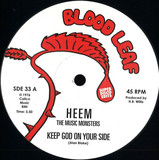
coming out of Philadelphia heem the music monsters were produced and handle by long time philly producer and writer Hubert willis. The group had small success circa 1976 with their psych funk 45 "wake up people"/piece of the rock" they recorded a few more tracks from those sessions and what lay on the reels for all these years is probably their best yet...Its just right for now. "Keep god on your side" is modern soul disco of the highest order, over 5 mins long it leads you onto the dancefloor and never lets go! Flip it over and you have one hell of a funk disco instrumental entitled " going down (incognito)". We have maintained the Blood Leaf label with a slightly new design
Oddball space disco/fnk tracks, composed between 1970 and 1985. Big tip!
.
A master of the mixing board, from the late 60s until the 90s Bernard Estardy was the wizard of French musical recordings. As head of CBE studios, he shaped everything from Gérard Manset's concept albums to Claude François' hit singles, Françoise Hardy's delicate tear-jerkers and Michel Sardou's soul-stirrers. This giant' had his hand in the whole range of mainstream French music by making his studio a veritable playground for experimentation. His legendary album La Formule du Baron,' released in 1969, and the eight LPs of production music he made between 1974 and 1978 for Tele Music are vivid proof. In the CBE studio, which she runs today, his daughter Julie Estardy discussed his singular career.
Everyone loves "Why Can't We Live Together" by Timmy Thomas: how could one resist such a strong music vibe coming with a message more relevant today than ever! It has been covered by the most creative artists more than a few times...
Recorded in Paris and Kingston, the Soul Sugar crew & Leonardo Carmichael make it their own with a sultry reggae groove. Jahno on drums and syndrums, Thomas Naim on guitar, and Guillaume "Gee" Metenier on keyboards and production duties, are delivering the classic hit in all its majesty, in the superior categories of both extended Discomix, and Dub version under the spell of Dubmaster extraordinaire Dennis Bovell!
What to say about the breathtaking interpretation of Leonardo Carmichael Growing up in Jamaica, Leonardo learnt many a song from his father Glendon Joseph McFarlane, who would sing to his mother Geraldine, who sang in a choir. Leonardo grew up as a drummer and a singer in churches. Through a mutual friend, he met Nastassja Hammond, daughter of Beres Hammond, with whom he started writing and releasing music for various artists including Courtney John and Kreesha Turner. Leonardo has a wide appreciation for diverse genres but keep an International Reggae and Dancehall feel at the core of his music. It can be said Leonardo has faith & soul to the bone...
On "down In 1150" Vienna Based Crate Digger, Producer, Dj And Secret Crunch Head Honcho Roman Rauch Pushes His Distinctive Style Of House Music Forward. The Ep Eatures 5 Tracks Of Pure Funky Vibes, Rugged Beats And Catchy Vocal Sampling. Check "don't Tell" On A-side For An Euphoric Soulful Opener, Or "bumble Beat" For A Slower, Groovy Disco House-pleasure. Catchy "don't Know" Gets An An Exzellent Remix Done By The One And Only Intr0beatz From Island. In The End "down To Love You" Features A Funky Bassline Zapp & Roger Would Be Proud Of.
- A1: Ajl Band - This Is No Horse
- A2: The Reflection - Take It To The Bossman
- A3: Charing Carpio - Swearin' To God
- A4: Deanie - Unknown
- A5: Tracy - Hurt So Bad
- B1: Julie Sue - Day's Dreamin
- B2: Oscar & His Orchestra - Make Me Believe In You
- B3: The New Topnotes - Gotta Be The One
- B4: Louie Castro - You're The Love
- B5: Rita Kwong - Lovin' You
Wan Chai Records is a Hong-Kong based label, specialized in rare Asian records and quality reissues.
After a few years of hard diggin' in Asia, meeting the artists and many local figures of the 60's, 70's and 80's Scene in Hong Kong, Singapore, and Taiwan, they wanted to share their best finds and put them together on vinyl with the best productions ever made in Soul-Jazz, Disco, Funk, Modern-Soul, and AOR.
The result is a selection of 10 totally unknown gems sung mostly in English and Cantonese with amazing covers of classics like Lovin' You', Make Me Believe In You', or Hurt So Bad' in a nice Artwork Gatefold LP.
Omaggio brings the heat once again with the reissue of Prana People, self titled LP originally released in 1977 on Prelude. The Aleem brothers Taharqa and Tunde Ra (or Albert and Arthur) are Prana People and brought a perfect treasure of disco/funk/soul to make you want to dance from the funked up "Is Your Life A Party" to that slow, head nodding sexy groove of "Wishful Thinking" to proper hands in the air feel good disco of "Angels Say Flee" to the perfect strings and flawless soul of "All Around My World". The combination of the tracks and strong production make for an endlessly playable album, and with the legendary brothers, who since the 60's have their place in music history, this is an instant buy if not already owned to add to The Aleems discography of your collection.
Far Out Monster Disco Orchestra returns with Black Sun, its second full-length album of 100% original, unadulterated disco sophistication, featuring all three original members of pioneering Brazilian jazz-funk trio Azymuth, a full orchestra with arrangements split between Arthur Verocai and Azymuth's late maestro Jose Roberto Bertrami, plus members of the legendary Rio funk group Banda Black Rio.Since its critically acclaimed self-titled debut album in 2014, the FOMDO imprint has released a string of remixes by some all-time greats of dance music, including John Morales, Theo Parrish, Mark Pritchard, Marcellus Pittman, Andres, Dego, Volcov, Kirk Degiorgio and Al Kent. To huge effect in clubs and festivals around the globe, some of the more recent remixes teased the new album material, which for the first time, is presented in its original, soul-heavy incarnation, alongside instrumental versions highlighting the album's stunning arrangements and compositional brilliance.Far from a throw-back - with disco music firmly entrenched in the modern club vernacular - Black Sun is ecstatic dance music at its finest.
Two of the most powerful cuts from Aura's self-titled 1979 LP, now available on 7-inch. Aloha Got Soul's first release of 2018 accomplishes two-fold: it aims to tide fans over while the label wraps up new music projects with young artists from Hawaii (more news to come).Secondly, it gives DJs the chance to bring a much more portable version of these top tunes from the band's now sold-out LP reissue, which enjoyed play from the likes of Theo Parrish, DJ Muro, Gilles Peterson, and Red Greg.Most will head straight to the B-side for the non-stop funk/disco fire of 'No Beginning, No End' (we do!).Fans of DJ Muro and DJ Nori's Captain Vinyl label will know that the A-side's 'Let Me Say Dis About Dat' received a 7-inch treatment in 2017 with a limited, Japan-only run of 500 copies.A solid addition to the AGS catalog, and a welcome contender in the ever-flowing stream of funk 45s that constantly begs the attention of DJs worth their salt.The natural evolution of Aloha Got Soul from a funk- soul reissue label into a fully-fledged representative and curator of progressiv music from Hawaii continues with this throwback 45 preceding the label's upcoming drop of new music from emerging artists in 2018.
"The kind of melancholia I'm talking about, by contrast, consists not in giving up on desire, but in refusing to yield. It consists, that is to say, in a refusal to adjust to what current conditions call 'reality' - even if the cost of that refusal is that you feel like an outcast in your own time." (Mark Fisher, Ghosts Of My Life, Zero Books 2014, p. 24) In Ghosts of My Life: Writings on Depression, Hauntology and Lost Futures', the author Mark Fisher outlines - to put it in a big way - a resistant melancholy. This stands in contrast to leftist melancholy resignation', as well as something which Fisher does not talk about: its common masculine counterpart, habitual post-left cynicism - as in seen it all before'. Fisher calls this hauntological melancholy. Haunting, spooks, ghosts and apparitions are an almost constant presence on I Started Wearing Black', the second album by the Cologne-based artist Sonae (pronounced so-nah'). The term hauntology shares a fate with retro-futurism when it comes to inflationary overuse and abuse. It's a conceptual container that looks good and can hold a lot, indeed, too much. Furthermore, hauntology has its peak season behind it, a term on the threshold of its expiration date. Nevertheless, I would like to rehabilitate hauntology and use it properly to characterize I Started Wearing Black', because the term is rarely as compelling to describe music as is the case here. The most recent other example could be Asiatisch' by Fatma Al Qadiri, but with a completely different frame of reference. What are the ghosts of this music It rustles, crackles, ruffles, crunches, rattles, scrapes, sometimes a beat emerges from the constant noise, sometimes an obscure voice mumbles incomprehensibly, sometimes a melancholy piano figure is prevented by this noise from coming too much to the foreground. It definitely is eerie - to bring into play another term used by Fisher in the title of his latest book, The Weird and the Eerie'. In British pop-jargon, eerie first occurred to me more often when referring to particularly leftfield, spooky and... well... ghostly dub, a bass-heavy, echoing noise, from Augustus Pablo to Creation Rebel to Burial. Unlike the Wald & Wagner records by Wolfgang Voigt, Sonae is not a kind of neo-romantic veiling with a tendency for escapist nebula. It is more a noise of latency. The noise signals a latent - not necessarily acute - threat, a latent uneasiness about... yes... about what About a System Immanent Value Defect' That's the name of a track on I Started Wearing Black' where something that sounds like a French Horn (or a foghorn) battles for attention through or against the background noise. An email from Sonae: The piece 'System Immanent Value Defect' should actually be called 'I See Turkey'. I wrote it for my fellow student Elif - she is a pianist and Gezi Park activist from Istanbul. Through her I witnessed the inner conflict and agitation that political circumstances can create: her feelings of guilt when there was an attack, with her safe in Germany as a student, watching the events from afar. It was horrible. When her mother begged her not to come home because she feared for her safety, I felt a cold shiver run down my spine. I started with the piece from this mood, beginning with the piano, then the noise (modulated sinusoidal curves), which reminded me of waves and the then heatedly discussed Mediterranean sea: atmospheric, melancholy motifs. In contrast is the anger, the pressure, represented in corresponding sounds - hopefully audible! - During this time I started to think about world views as they can be found around the globe, in how far they held by societies and their political representation. I realized that I know of no political system that is actually about the people and what would do them good. It's always about positions, power, money. I thought that was a lot more frightening on a global scale than merely viewing Turkey in isolation. That's why the piece is called "System Immanent Value Defect", because our world suffers from precisely that. Everywhere, it's all about the wrong things.' Between the wrong things there are happy moments. In the title track, after 184 seconds of rattling and hissing, a beat is unleashed, like an arrow released from a spanned bow, a beatific relief, if there is such a thing. White Trash Rouge Noir' first meanders along spookily, then after 144 seconds it transforms itself into a distant cousin of Einstu¨rzende Neubauten's Yu¨ Gung', but there is no Big Male Ego to be fed here, and the black in the album title is a completely different type of black from that of the Neubauten. Furthermore, I Started Wearing Black' was finished long before the black dresses were worn at the Golden Globes as a sign of protest against sexual violence. Sonae writes that she herself started wearing black some time ago. Her reasons are so-called personal ones: ... resulting from an individual situation (lovesickness), I started to wear black (gaining weight and feeling ugly).' The political dimension of gaining weight, feeling ugly and therefore dressing in black in I Started Wearing Black' lurks within the noise and never becomes explicit and only rarely manifest - or a manifesto. Sonae writes about the track We Are Here': A piece for minorities... in this case, considering the current pop-feminist discourse, explicitly for women. Female artists have long been saying loud and clear that 'we are here' and 'electronic music is not a boys club!' But this pop-feminist moment should only be seen as one part of the dedication of the piece. It is for minorities, for the oppressed, who didn't belong enough.'
Klaus Walter
Do you like Love songs After spending a lifetime spent avoiding this subject in song, Joel Sarakula finally admits that he does. On his new album "Love Club" Sarakula relives the golden age of Soulful and Romantic Pop music and connects it with a modern aesthetic. While a deeper message of love and peace flows through the record, Joel Sarakula is no old fashioned hippie: ",Love Club' is about connecting to reality and re-framing the idea of romantic love and loss in the present, loveless age ". Featuring eleven songs touching all genres from disco to blues, from soul to soft-rock, Joel Sarakula's "Love Club" is a profound pop statement.
Joel Sarakula has travelled the world in search of his muse, experiencing everything from being a victim of Caribbean carjackings to performing in the remote fishing villages of Norway, via the dive bars of Europe and the US. It was the hodge-podge musical tapestry of England's capital that finally drew him to a settling point, in the wake of seemingly never ending run of shows. With personal tastes that span from the more avant-garde to soul and pop greats like Sly Stone, Todd Rundgren and Hall & Oates, there are clear nods to contemporaries like Unkown Mortal Orchestra, Erlend Oye and Toro Y Moi in terms of ambition and style.
With his last two albums "The Golden Age" and "The Imposter" collecting strong radio plays at BBC Radio 2, BBC 6, BBC London, XFM Joel Sarakula has been play-listed nationally in Europe including Flux FM, WDR 5, Radioeins, Bayern 2, Deutschlandfunk and Deutschland Kultur Radio in Germany as well as in Benelux and Italy and Spain. He is a regular fixture on the live festival and club circuit in the UK, Europe and internationally including appearances at SXSW, Primavera Sound, Glastonbury, The Great Escape, Liverpool Sound City, Scala London, Tallinn Music Week, V-ROX (Vladivostok) and Reeperbahnfestival Hamburg.
"Love Club" is Sarakula's bold and unashamedly emotional next step. In essence the album is a homage to the soulful singer & songwriter artistry of the Seventies filtered through a darker contemporary lens - fitting for these uncertain times. "I always shied away from generic love songs," the Sydney, Australia born songwriter admits, "but on this record I embraced the subject wholeheartedly... and intellectually, looking at themes of love, lust, loneliness and everything in-between." Take the first single "In Trouble", co-written with Michele Stodart of The Magic Numbers, as the best example for Joel Sarakula's unique, and honest approach to making music. "We Used To Connect" questions the changing nature of relationships in our social-media addicted world: 'We used to connect in the real world too, now the touch of your hand is a digital cue'.
"Coldharbour Man", on the other hand, examines the identity of the song's narrator and the artist vs. fan dynamic all wrapped up in a disco love song: "There's a lot going on in this particular track. I feel my writing has grown emotionally...", explains Joel Sarakula. "Just best to listen yourself and make up your own interpretation!: 'We met in a song come to life like some fantasy cliché, though I'm known for my moves in the dark you flooded sunshine on my day'. Then there's "Baltic Jam", capturing romantic love and loss in authentic 70s confessional singer & songwriter style and of course "Dead Heat", a song about how there is struggle in the most perfect relationship pairings as the match is so even: "I recall an ex-girlfriend of mine... when we first met, we thought we hated each other but we eventually flipped that emotion and realised we had a deep passion and love for each other, there just was a lot of underlying sexual tension!" : 'It's a battle we could only win, if we lose. We'd be stronger if these lonely ones became two'.
More than a year in the making, Joel Sarakula recorded "Love Club" in various studios around London and Berlin capturing soulful performances from his many musical comrades on vintage analogue equipment. "This record has truly been a labour of love. Recording and privately sharing these performances amongst my collaborators started to feel like a bit like a club - I guess that lead to the album title! I was surprised how much I actually enjoyed the 'love-making process' and I look so much forward to playing these new songs on stage with my band." We can't wait, Joel Sarakula.
Samosa Records return with De Gama's new 'Funktastic' EP, a disco and funk groove machine of an EP. Ever since his game changing 'Afrika' release back in 2010, De Gama has been turning heads and this new EP shows why he continues to do so. Not only is it filled with fantastic music but it is only the fourth release on his own label, Samosa Records. Continuing his own form, it is also shows a continuing commitment to great music from the new label and is sure to keep everyone watching to see what they do in the future.
The EP opens with 'Son Of A Slave', a deeply grooving and moving throwback to heyday's of funk. The multi-layered groove will call to mind the heights of dirty groove typical of the Ohio disco-funk bands in the second half of the 70's, reimagined in a way thoroughly suited to the modern dancefloor. '1972' follows, a nod to the same era. It opens in a far murkier manner than 'Son Of A Slave' and exudes a far more modern feeling than the opener. Before long, the irresistible Afro-carribean grooves join in and get your head and shoulders swaying and bobbing, the kind of sound which characterized the Cosmic Wave era. Keys join in and plant a firm smile on your face. This is the other side of soul music.
De Gama closes off the EP with 'Star-Buk' and some handheld percussion. Funky guitar follows in before the big synth and kick join in. Where can the groove go next The bassline answers this question by taking it into outer space. 'Funktastic', it does what it says on the tin.
SMBD aka Simbad is back with his third seasonal EP on GAMM.
After a long and dark winter SMBD thought we all could need some uplifting and soulful spring music...church style!
These three gospel boogie/disco jams have been his personal DJ weapons over recent years but now they're given a sweet edit twist for your dancing pleasure. It doesn't really get more uplifting than this!
- Latest ambient work from Fred Welton Warmsley III, formely known as Lee Bannon (hip hop producer and collaborator with Joey Bada$$, Souls Of Mischief, Hieroglyphics, and others)
- Former albums on labels such as Hospital Productions, Ninja Tune, NON
- Has received praise from Pitchfork, NPR, Boomkat
- Northern California electronic producer Fred Welton Warmsley III's solo work as Dedekind Cut
(pronounced dead-da-ken cut') has evolved from fractured industrial design into increasingly subdued and sublime ambient meditations across two years of dedicated activity. His second full-length collection, Tahoe—so named after the mountain lake town he now calls home—swells with widescreen grandeur, evoking vistas both inner and outer. There are echoes of his earlier, more tempestuous mode in tracks like MMXIX' and Spiral' but overall the album skews panoramic and pensive, muted synthetic mists contoured with choral melody, field recordings, and radiant drone. His compositional instincts feel alternately classical, contemporary, and conflicted, befitting an artist whose discography spans labels as divergent as Hospital Productions, Ninja Tune, and NON.
- Warmsley characterizes Tahoe as a time peace,' sifting through the past, the present, future, and fantasy.' Recorded primarily in New York, with additional sessions sourced from Berlin, Cambridge, and Placer County, California.