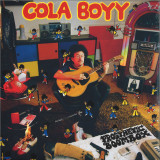
There’s liberation on the dance floor in the songs of Matthew Urango – glimpses of revolution that glimmer beneath the disco ball. “I want my music to bring people together,” says the Californian pop innovator, best known as Cola Boyy. “Because standing together is our best chance at fighting this shit show.” The shit show in question is a broken, brutal system the acclaimed multi-instrumentalist has witnessed up-close. Urango was born with spina bifida and scoliosis in Oxnard, California: a town in which almost 30,000 are estimated to live in poverty. Prosthetic Boombox, his eagerly awaited debut album, might at first glance seem a joyous confetti-burst of pop eclecticism, engineered to sound like “scanning between stations on a car radio, landing on all these different sounds and styles” as Urango puts it. Dig deeper, though, and you’ll discover a simmering sense of rebellion. “The working class are injured, struggling to pay rent and struggling to put food on the table,” he says. “I want to represent that.” Prosthetic Boombox
achieves that goal in a thrilling flurry of inventive indie, funk and soul: take Urango’s car radio analogy, place it in a time-travelling Delorean with Prince in the passenger seat, and you’re half-way there.
Look no closer than Prosthetic Boombox’s euphoric opener, the Avalanches-assisted ‘Don’t Forget Your Neighbourhood.’ The track – which Urango says mixes “the Beach Boys, French disco, house keys and ragtime piano, kinda like the Cheers soundtrack!” – ends with lyrics urging listeners to “fight for your town with your fist closed, strike it and make it more than just a memory.” It’s a reminder that the working classes need to “turn our fists against our oppressors instead of each other,” he explains. After that emphatic introduction comes a horn-laced funk wig-out titled ‘Mailbox’ – a song that gives Dua Lipa’s Future Nostalgia a run for its Studio 54-themed money, featuring rising Londoner JGrrey. Elsewhere, ‘Song for the Mister’ ventures into smooth R&B territory, before ‘Roses’ – a collaboration with Myd of Ed Banger fame – offers a bouquet of bustling disco guitars and infinite bisous of Connan Mockasin’s band drops in on the immaculate ‘Go the Mile’. Urango saves his most introspective moment for the album’s starry closer. ‘Kid Born in Space’, a cosmic collaboration with MGMT frontman Andrew VanWyngarden, sees the artist reflect on what he once had to overcome as a disabled person of colour. “I see them looking down on my dreams of being,” he sings tenderly. “I hear them making fun of my voice, but I keep on moving forward, I refuse to live in anyone else’s shadow.” Prosthetic Boombox, on this subject, is more than an album title – it’s a statement of intent.
“The message of my music is that our class is exploited, oppressed and murdered on the daily. That’s not right, and the system that enables that deserves to be wiped off the face of the earth,” he says. “The only way that happens is if we’re united. That’s the point of my music – to relate to people and unite them.” And what unites more than raucous, irresistibly danceable pop? Prosthetic Boombox is a riot of joyous grooves and catchy hooks for good reason. “I want to reach and spread my message to as many people as possible. You can’t do that if you’re some obscure motherfucker, you know?” he laughs. Don’t bet on him being an “obscure motherfucker” for long.
Suche:discover me
- 1: Seriously
- 2: Dysfunction
- 3: Motivated By Fear
- 4: Interdependency
- 5: Ultimate Violations
- 6: The Threat
- 7: Sexism Impressed
- 8: In Your Face
- 9: Violent Tongue
- 10: True Self
- 11: Word Problem
- 12: Touch
- 13: Right
- 14: In Tradition
- 15: Isolation Burns
- 16: Removal
- 17: Moral Casualty
- 18: Fences
- 19: Blue
- 20: You & Me & The Art Of Being A Woman
- 21: What Are Little Girls Made Of?
- 22: Emaciation
- 23: Unknown
- 24: Wizened
- 25: 6 Feet Down
- 26: All Grown Up
“They were one of those bands that were a prequel to what the future was becoming. Feminism, human rights, animal rights, environmental
protection, gender issues... Spitboy was singing about these issues
30 fucking years ago.
I’m so grateful to have witnessed it.” - Billie Joe Armstrong “Spitboy are one of the most
important punk bands to have ever existed. To me, an angry 20-year-old in London, discovering them felt like the first time I truly identified with a band’s politics and agenda.
One of my all-time favourite albums (then and now) was Penis Envy by Crass. No lyrics
had ever touched me the way this album had--until Spitboy entered my life. My people. My radical feminists. My punk scene. Where I have lived and belonged for over 30
years.” -Vique Simba
Iggy Pop ‘Rain’s Break’ tonight 25th June with shout out
BBC6 Music
“Magical miniature sonic worlds that modestly await discovery.”
Music OMH – interview + review now live
"Assured and promising"
The Vinyl District – 5* review
Birthday Cake For Breakfast – review
Concrete Islands – review
The Line Of Best Fit - “An incredibly exciting artist”
"Emotional Rescue and HMV Record Shop (Japan) present the 2nd DISCO REGGAE LOVERS with the music of Haile Maskel and his 101 Band and their cult Jamaica meets America reggae disco bomb Crazy Kind Of Feeling, in it's super rare 7" Mix.
Heralding from the furtive 60's Trenchtown, Jamaica, Michael Ashley aka Haile Maskel grew up around music, recording his first sessions with friend Bob Marley, alongside the likes of Peter Tosh, Robbie Shakespeare and Carlton Barrett.
Working with Lee Perry, he joined Light Of Saba, while touring with Dennis Brown and Sugar Minott led him overseas, settling in Los Angeles in 1983 and soon launching his Opulence (Sound) label.
The label's in house project, Maskel's 101 Band mixed a conscious message in love song, crafted around a boogie discodub. Coming as 7" and 12" (ERC101) releases, here the single is presented alongside the true dub version.
Dub Take 2 was discovered when the original master tapes were recently unearthed and while the recent 12" reissue featured an "instrumental alternative mix", Dub Take 1, this 7" includes a real dub version, cutting and dropping back and forth between drums, bass, key, vocals and horns in a cool excursion for the heads."
During 2019, Blondie was invited to perform in Havana, Cuba as part of a cultural exchange through the Cuban Ministry of Culture. This was a 40 year ambition come especially for songwriter & guitarist Chris Stein, who had longed to visit Cuba for most of his life. Artist and director Rob Roth documented this special moment and career highlight by shooting a short film titled “BLONDIE: VIVIR EN LA HABANA”.
The film is broken up into 3 parts — Water, Fire and Air — and present a meditation on the experience as well as highlights from the two-night live musical performances with special guests Alain Perez, David Torrens and Cuban Fusion Pioneers Sintesís at Havana’s famous Teatro Mella.
With narration from Blondie founding members Debbie Harry, Chris Stein, and Clem Burke, providing a glimpse into the passion and beauty they discovered in Havana and the magic moments of performing alongside incredible Cuban artists. “BLONDIE: VIVIR EN LA HABANA” goes beyond the atypical short form film and live music documentary by presenting a portrait of the legendary band’s first experience in Havana and of the magical exchange between musicians from the two cities each call home and their intertwined influences.
The sound track for the film features Cuban musicians Carlos Alfonso, Ele Valdés, María del Carmen Ávila, Alejandro Delgado, Juan Carlos Marin, Jamil Schery, Degnis Bofill, Adel González
Released in July on limited edition pale blue vinyl to accompany the film which will feature throughout 2021 in many prominent Film Festivals inc the Tribeca Film Festival.
COS might not be the first genre defying progressive music group you’ve heard who share both wordless onomatopoeic vocals and a snappy three letter title (complete with philosophical leanings and alchemic penchants) but on listening to this first ever custom Cos compendium you might have just discovered a new favourite!
Perhaps it’s no coincidence that COS share close spiritual, stylistic or social connections to the aforementioned bands, as one of the few long-withstanding single-syllable ensembles to remain utterly idiosyncratic and incomparable within their hyper-focussed and impenetrable creative bubble. But as a 1970s group that effortlessly MIX head-nod prog, synth-driven jazz, cinematic sound-designs, dislocated disco, arkestral operatics and high-brow conceptual anti-pop grooves, it’s easier to remember the name COS than thumb the vast amount of genre-dividers in your local record shop which COS COULD occupy. With the crème de la crème of Belgian jazz/prog/psych/funk within their ranks, their combined idea-to-ability ratio litters the Cos-ography with concepts that aficionados, future fans, collaborators and critics still haven’t began to unravel.
With their earliest roots in the compact jazz group Brussels Art Quintet the group spent their sapling years creating art-school prog under the name Classroom, this flourishing collective, cultivated by multi-instrumentalist mainstay Daniel Schell, would soon shed its leaves, dropping band-members and typographics reducing its moniker to simply COS (a multi-purpose, globally recognised word, with links to Alchemy and philosophy, with a hard phonetic delivery to suit the groups heavier rhythmic approach). In it’s new skin COS also shed all forms of orthodox language to find its true exclusive voice. Fronted, in the conventional sense, by the daughter of author and part-time jazz player Jean De Trazegnies, the bands wordless singer changed her name to Pascale SON, to accentuate the French word for “sound”. Drawing comparisons with sound poets like Polish jazz legend Urszula Dudziak or Hungarian Katalin Ladik, but retaining the crystalline femininity (and funk) of Flora Purim, while effectively sharing an imaginary lyric book of non-words with Damo Suzuki, Magma or a future Liz Fraser... To use the word “unique” would, by COS academic standards, be lazy journalism.
7" of this funk classic re-issued for the first time from recently discovered Master Tapes.
Funky Soul (originally titled "Going To See The Man") was a routine crowd pleaser during live shows that even had its own dance "rock the ship." This was the part two of the song. It was part one that was created in the studio as a riff off of part two. The raw energy of this song when performed live created hysteria and drove spectators into a frenzy. It didn't take long for word to get around and catch the attention of the famous WYLD DJ Larry McKinley. McKinley wanted to capture this magic onto record and helped arrange the session at Cosimo Matassa's studio. He drove Isaac Hayes down from Memphis to New Orleans in 1968 and organized Issac Hayes to arrange the horn section on this record while he was working with the Okeh label and developing an emerging artist named Margie Joseph. It was during this time that Margie recorded two singles Why Does A Man Have To Lie/See (Okeh, 4-7304) and Show Me/A Matter Of Life Or Death (Okeh, 4-7313).
David Batiste & The Gladiators were a band David Batiste and several of his brothers formed while they were in High School in New Orleans back in 1961. The band won a talent show in 1965 at Harlem's famous Apollo Theater and are the pioneers of what is now known as "Funk." David Batiste & The Gladiators were legendary mainstays of every bar in New Orleans that every band was hustling trying to get booked at.
It's no wonder that this song was famously complied on BBE Records and Ubiquity in the 1990's, rediscovered and performed by Miles Tackett & The Breakestra in the early 2000's. Those compilations contained audio sourced only from the vinyl record originally pressed up twice in the early 1970s and sought after by collectors and DJs for years and years. This version is from a direct master tape transfer from recently discovered NOLA tapes. But wait… The party's just started. An entire album's worth of 1960s previously unreleased David Batiste & The Gladiators material from recently discovered master tapes is in the works and forthcoming on Family Groove Records.
Etruria Beat founder Luca Agnelli unveils his long-awaited debut album, ‘Source Drops’ – presenting a ten-track journey through techno and beyond.
A name at the centre of Italy’s rich house and techno scene for over a decade, Etruria Beat head-honcho Luca Agnelli continues to showcase his talent as a leading DJ, producer and label boss on the international stage. With releases via a host of globally renowned labels, plus standout remixes including Moby’s iconic ‘Porcelain’, the Tuscany native’s reputation has seen him become of the genre’s leading artists when combining energetic, entrancing productions throughout his powerful DJ sets. Yet, the core of his work has always found a perfect home on his own Etruria Beat imprint, with July now welcoming the arrival of his highly-anticipated debut album ‘Source Drops’ – an in-depth musical story presenting growth, development, self-reflection and raw emotions via a collection of ten tracks ranging from powerful peak-time anthems through to EBM influenced cuts and slower, hypnotic productions.
“This is the journey that traces my musical evolution of the last 20 years, discovering more conceptual, deeper musical territories; taking inspiration from what influenced me in my career as a DJ and from my continuous research without musical barriers. A journey always in equilibrium, at times dark and sharp, solar and fluid, that develops a different creative vision in each track trying to convey my most intimate and strongest emotions". – Luca Agnelli
Opening via the slow-blooming builds and atmospheric and waves of ‘Black Mirror’, before diving into the heady and menacing tones of ‘Mutant Circle’, the ten-track project quickly showcases a wide-reaching range of influences and nuances central to Agnelli’s development as an artist over his career. Productions such as ‘Balance’ and ‘Oxigen’ contrast with one another whilst bringing space to proceedings, guided by breaks-influenced percussion, minimal arrangements and warping leads, whilst the driving ‘Resistance’ harnesses classic techno tendencies to provide an energetic and lively, snaking journey through rich soundscapes.
Title cut ‘Source Drops’ brings that trademark Luca Agnelli energy to the heart of the project, merging scintillating melodies, acid-tinged stabs and icy hats to unveil a high-octane ride into the peak-time, whilst ‘Raw Surface’ keeps the tempo high with sweeping leads, oscillating basslines and resonant lasers. Next, ‘Omega’ spirals into an off- kilter ride through glitchy echoed vocals, crunchy percussion and rumbling low-ends, with the epic ‘Losing Control’ welcoming an infectious lead melody at its core guided by punchy kicks and slick drum licks. To close, the package veers to an eerie yet ethereal close as hazy, celestial vocal chants meet panning sirens and swooping electronics – punctuating an expansive and diverse offering from the Italian favourite and shaping up an impressive debut LP in the process.
- A1: Take You Out (Feel Good) 04:10
- A2: Meet Me On The Dancefloor 05:49
- A3: And Then We Kiss 03:58
- A4: Move With Me 04:14
- A5: Feels Like Ooh 03:58
- A6: Kiss Me 04:57
- B1: Back To Love 03:37
- B2: Adored 03:51
- B3: I'll Be Good To You 04:15
- B4: Trulove 03:42
- B5: 1000 Nights 04:10
- B6: Where I Wanna Be Tonight 04:45
• With more than 60 MILLION STREAMS across his catalogue listened to by fans all around the world, ‘…TO BE CONTINUED’
is the best ‘greatest hits’ album that you’ve never heard!
• This 12-track Limited Edition Vinyl LP collection, with a brand new floorfiller, features his most popular tracks and fans’
favourites, and this is his first Physical release album to celebrate, LE FLEX has signed 500 prints for this Limited Edition.
• Although LE FLEX clearly states that “I just make Pop music”, his 6 EPs and 6 Studio albums are nothing short of serious and
brilliantly creative blends of nudisco, poolside vibes and slow-jams but retaining the essence of his familiar ‘80s
synthpop/dance-based infusions. The accompanying videos are purely tongue-in-cheek, with more than a smattering of
self-deprecation, as you will see on his dedicated YouTube channel.
• Judging by the comments from long-established fans and music lovers from South America to Australia, via the UK, through
Europe and the Far East, discovering LE FLEX for the first time, they are quick to state that his vocal inflections share more
than a passing resemblance to George Michael, an icon about whom LE FLEX modestly says, “I’m not fit to shine his shoes”.
• LE FLEX is a renowned Producer with his popularity rising, having worked with Jaki Graham, Lemar and Ben Macklin and
was commissioned to produce new Donna Summer remixes in 2020.
• Released on heavyweight 180g Clear Vinyl, if you fancy summery escapism, there aren’t many better ways than doing so
than with LE FLEX
- A1: Sonny Knight & The Lakers - Sugar Man
- A2: Gloria Ann Taylor - Jolene
- A3: Don Julian & The Larks - Shorty The Pimp
- A4: Foster Sylvers - Misdemeanor
- A5: Florence Miller - The Groove I'm In
- A6: Mac Rebennack & The Soul Orchestra - The Point
- A7: Clarence Reid - The Best Part Of A Man
- A8: Doris Duke - Woman Of The Ghetto
- A9: Gwen Mccrae 90% Of Me Is You
- A10: Helene Smith - Help Me To Keep What I've Got
- A11: Teddy Reynolds - Ain't That Soul
- A12: Miss Lavelle - Stop These Teardrops
- B1: Millie Jackson - I Cry
- B2: The Whatnauts - Why Can't People Be Colors Too?
- B3: George & Gwen Mccrae - Mechanical Body
- B4: Gino Washington - Puppet On A String
- B5: Chet "Poison" Ivey & His Fabulous Avengers - Soul Is M
- B6: Betty Padgett - Sugar Daddy Pt 1
- B7: Brother To Brother - In The Bottle
- B8: Class - Get Your Chic Together
- B9: Latimore - Let's Straighten It Out
- B10: C B. & Ten Others With Axes - Rosie
- A1: Africa Is My Root - Osayomore Joseph And The Creative Seven
- A2: Ta Gha Hunsimwen - Akaba Man The Nigie Rokets
- A3: Popular Side - Akaba Man And The African Pride
- B1: Iranm Iran - Victor Uwaifo And His Titibitis
- B2: Sakpaide No 2 - Victor Uwaifo And His Titibitis
- B3: Ta Ghi Rare - Akaba Man The Nigie Rokets
- C1: My Name Is Money - Osayomore Joseph
- C2: Ogbov Omwan - Akaba Man The Nigie Rokets
- C3: Aibalegbe - Victor Uwaifo And His Titibitis
- D1: Who Know Man - Osayomore Joseph And The Ulele Power Sound
- D2: Obviemama - Victor Uwaifo And His Titibitis
- D3: Ororo No De Fade - Osayomore Joseph And The Ulele Power Sound
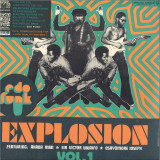
Analog Africa Presents Edo Funk Explosion Vol. 1, available on
2xLP/Gatefold LP with 20-page booklet / CD with 36-page booklet. It was
in Benin City, in the heart of Nigeria, that a new hybrid of intoxicating
highlife music known as Edo Funk was born.
It first emerged in the late 1970s when a group of musicians began to experiment with different ways of integrating elements from their native Edo culture
and fusing them with new sound effects coming from West Africa s night-clubs.
Unlike the rather polished 1980 s Nigerian disco productions coming out of the
international metropolis of Lagos Edo Funk was raw and reduced to its bare
minimum.
Someone was needed to channel this energy into a distinctive sound and Sir
Victor Uwaifo appeared like a mad professor with his Joromi studio. Uwaifo
took the skeletal structure of Edo music and relentless began fusing them with
synthesizers, electric guitars and 80 s effect racks which resulted in some of the
most outstanding Edo recordings ever made. An explosive spiced up brew with
an odd psychedelic note known as Edo Funk.
That’s the sound you’ll be discovering in the first volume of the Edo Funk Explosion series which focusses on the genre’s greatest originators; Osayomore
Joseph, Akaba Man, and Sir Victor Uwaifo: Osayomore Joseph was one of the
first musicians to bring the sound of the flute into the horn-dominated world
of highlife, and his skills as a performer made him a fixture on the Lagos scene.
When he returned to settle in Benin City in the mid 1970s - at the invitation of
the royal family - he devoted himself to the modernisation and electrification
of Edo music, using funk and Afro-beat as the building blocks for songs that
weren’t afraid to call out government corruption or confront the dark legacy of
Nigeria’s colonial past.
Akaba Man was the philosopher king of Edo funk. Less overtly political than Osayomore Joseph and less psychedelic than Victor Uwaifo, he found the perfect
medium for his message in the trance-like grooves of Edo funk. With pulsating
rhythms awash in cosmic synth-fields and lyrics that express a deep personal
vision, he found great success at the dawn of the 1980s as one of Benin City’s
most persuasive ambassadors of funky highlife.
Victor Uwaifo was already a star in Nigeria when he built the legendary Joromi
studios in his hometown of Benin City in 1978. Using his unique guitar style as
the mediating force between West-African highlife and the traditional rhythms
and melodies of Edo music, he had scored several hits in the early seventies,
but once he had his own sixteen-track facility he was able to pursue his obsession with the synesthetic possibilities of pure sound, adding squelchy synths,
swirling organs and studio effects to hypnotic basslines and raw grooves. Between his own records and his production for other musicians, he quickly established himself as the godfather of Edo funk.
What unites these diverse musicians is their ability to strip funk down to its
primal essence and use it as the foundation for their own excursions inward to
the heart of Edo culture and outward to the furthest limits of sonic alchemy.
The twelve tracks on Edo Funk Explosion Volume 1 pulse with raw inspiration,
mixing highlife horns, driving rhythms, day-glo keyboards and tripped-out guitars into a funk experience unlike any other.
Blue Vinyl
Lynch protégé and Twin Peaks sound designer Dean Hurley coaxes an incredible puzzlebox of atmospheres and mood pieces on this killer contribution to our Documenting Sound series, now remastered and pressed on vinyl for what is, perhaps unsurprisingly, the most cinematic and neon-lit instalment in the series. Like a
smudged and overdubbed copy of the BoC Maxima tape, with added iridescence.
Across almost 40 minutes we transition from aerosolised synths to romantic chromatics, thru to Nurse WIth Wound-style severed rhythms and fading glimmers of hope, ‘Concrete Feather’ epitomises Dean Hurley’s prized knack for nuanced instrumental story-telling in the finest and most engrossing style we could imagine. Against the backdrop of the Hollywood film industry that has primed us for as long as we can all remember, the music spans a panorama of lush, mirage-like choral pads and starry flickers thru to gloaming
nightmare sequences and screwed drums, while touching on some of the dankest synth tones this side of his ‘Anthology Resource’ volumes or indeed his soundtrack work for Twin Peaks: The Return. It’s full of dread and a slowly unfolding sense of tragedy.
“Having a regular practice of recording is probably the single most important element to my craft. It’s a way of dropping indiscriminate mile markers while constantly moving forward in time without ability to pause.
Over the years, working for David Lynch taught me a great deal about this and the concept and importance of experimentation. I’ve found myself clinging to those lessons during this time and using them as tools for both productivity and balance. His notion of experimentation is a simple one, yet incredibly profound. It was one of the very first words I heard him say during our initial meeting, and I never stopped hearing the term daily over the subsequent 13 years working together. An ‘experiment’ can provide a legitimate mental back-entrance into the act of creation. It can position an approach toward discovery as opposed to effort, and eliminate the thought that one needs to ‘will’ something into existence. It also aids in calming the judgmental
side of a brain from stepping on/interfering with expression…after all, experiments are not about success or failure, they’re simply about learning. In the Lynch school of thought, multiple experiments then become firewood…and with firewood, one can not only build but actually sustain a fire…even turn it into a multipleacre blaze or more.
Dean Hurley
I first discovered khroniky – Ukranian folk songs – in the Highlands of Scotland. I was watching a screening of Bajka, a mesmerising documentary made by the filmmaker Lucia Nimcová and sound artist Sholto Dobie. I knew nothing about these ballads beforehand, but I was fascinated by these odd, beautiful songs, especially the easy way in which they mixed misery and levity, where gentle melodies blend with tales of dark violence. The folk songs describe hardship, murder, torture, death in gulags, heavy drinking, outsmarting men, love affairs. But they’re often very funny too – many of the songs make fun of marriage, and there’s an amazing subcategory of khroniky songs called potka (vagina) songs.
The khroniky have never been properly documented because they were considered too crude, or contained lyrics that were problematic, politically. When Ukrainian folk songs have been archived in the past, it’s normally a sanitised, more polite version of the ones that Lucia remembers from her childhood. Lucia grew up on the other side of the Ukrainian border in Slovakia. She is part of the Rusyn (Ruthenian) minority ethnic group found in the borderlands of Slovakia, Hungary, Romania, Ukraine and Poland. Rusyn is a centuries-old Slavic language, looked down upon as a poor, uneducated dialect by the neighbouring Ukraine and Slovakia. It was forbidden to talk about Rusyn culture at Nimcova’s primary school, but the khroniky stayed in her memories.
“I remember weddings when I was young,” says Lucia, who now lives in Addis Abeba, Ethiopia. “At the end of the night, when everyone was drunk and the young couple would go around their guests, people would sing in Rusyn. There was singing and dancing, and songs about being in prison or falling in love. I picked up the lyrics and sometimes my mum would make my sister and I sing them for people we met on the train. I was about five or six but the lyrics still come back when I sing to my kids.”
Determined that these rich, nuanced, unique songs shouldn’t be forgotten, she decided to record them. Over two years, Lucia, joined by experimental musician Sholto Dobie, visited Rusyn villages high in the Carpathian mountains to rediscover the songs and make the documentary. It was at the beginning of war breaking out in Ukraine in 2014.
“The Rusyn community is a very closed one,” explains Lucia. “Sometimes we’d have to wait several days to hear someone sing; we had to earn their trust before they shared something very personal to them. We’d stay up ‘til 5am at a wedding, then go straight to a morning baptism, or collect haystacks with the villagers, hoping they’d sing while they were working.”
DILO is named after an important independent Ukrainian daily newspaper that was shut down when the Red Army entered Lviv in 1939. The four long tracks on DILO blur field recordings with song; an unpolished, privileged glimpse into a private world. We hear dogs barking and insects buzzing in the summer heat, then a blast of hurdy gurdy or violin will drift in, or a plaintive song soars softly over the rural background noise, with casually harrowing lyrics about a cuckoo, “lifeless in a world of misery”, as translated in the album’s booklet.
For both Lucia and Sholto, it was important not to tamper too much with what they heard. “When you think about ethnography,” Lucia explains, “you have to have a lot of time, love and respect to document it with sensitivity.”
“The songs all have their own atmosphere and intimacy from the spaces they were recorded in and it was important to maintain these particularities and move with them,” adds Sholto, who now lives in Vilnius, Lithuania. “They guide and sometimes interrupt a journey between interiors – domestic spaces; in kitchens, by the fire – and exteriors; marketplaces, cow sheds. We used contact microphones to record metal bridges and fences, and we spent one afternoon recording a wool processing machine, the details of the rattling and tuning wheels are the ground layer for the third track.”
Lucia took rough notes and diary entries during the recording process, which are now shared in the booklet alongside a selection of lyrics, loosely translated, but revealing the depth and astonishing beauty that sometimes lies in the language of these folk songs.
The feel of the album is intimate, flipping between laughter, where a woman sings about selling her pussy to buy a cow in one track, then shifts to a raw, painful truth; an adult son asks his mother why his dad won’t be back for dinner, as he’s gone to war.
Since Lucia and Sholto began working together in 2014, they have shared the audio recordings on radio and film and shown photos in gallery spaces, making sure these special, smutty, poignant songs don’t get lost. This new record and booklet joins that same continuum, another glorious fruit from the same rare tree.
Antoine Tato Garcia,Juan Luis Curbon « Patela »,Steeve Laffont,Ramon Del Pichon,Nas Heredia,Fra
Mediterranean Gypsies Roads - The sounds of guitars
- A1: Caroline (Antoine Tato Garcia) 2'51
- A2: El Rencuentro (Juan Luis Curbon « Patela ») 4'04
- A3: El Ratinho (Steeve Laffont) 4'35
- A4: Suspiro (Ramon Del Pichon) 4'21
- A5: Cositas Del Maestro (Nas Heredia) 2'56
- B1: Gipsy Melancolie (Steeve Laffont Et William Brunard) 4'36
- B2: Raphael (Antoine Tato Garcia) 4'38
- B3: Miro Djiben (Fraïda) 5'58
- B4: Bossa Gitana (Djelito Soles) 3'26
I attended a trade fair in Rio de Janeiro, Brazil. In this show, we met producers, label and festival managers. It is a privileged moment when it is possible to learn about new trends, new musical forms, emerging groups. The timing of the meal is undoubtedly the most important. We take the time to introduce ourselves and discover each other. When my turn arrived, I took out my little map to locate the town of Sète on the map of France. There, an American promoter exclaimed "Yeah! You live in this beautiful city. Where there is this incredible music. ” I admit that at the time I didn’t quite understand what he meant but flattered by his remark I told him yes. Later, I realized that he was talking about gypsy music that made the whole world dream.
When my friend shared this anecdote to me, it resonated deeply with me. Indeed, for us, people of the south of France, this was nothing exceptional. Indeed, every day you could meet in the street a gypsy musician performing a rumba, another declaiming a fandango or another who liked to paraphrase the maestro Django. It is part of our daily environment, but it is indeed a peculiarity of this region. The territory of the Mediterranean arc, from Arles to Perpignan, is indeed the cradle of gypsy music in France. In addition, we must underline the major influence of the Gypsy artists of Catalonia in the development of these different artistic forms. Through weddings and family reunions, the repertoires have shifted to be reinterpreted according to the identities specific to each and the territories of residence.
With this new collection, we wanted to show, to hear all the musical richness of Gypsy and Manouche artists populating the territory. From appropriation to recreation, they never stop bringing this music to life, re-enchanting it and offering it a resolutely modern reading, open to the world. In this first opus, devoted to the guitar, we will take the routes of latin music, flamenco or jazz alongside renowned artists and young talents. With "The sound of guitars", it is a first door open to the gypsy music of the Mediterranean Arc, that we will discover gradually through the "Mediteranean Gypsies roads" collection.
678 records are proud to present an historical concert recording of the legendary ethnic kraut-jazz formation Pork Pie. It is difficult to define the music of Pork Pie. It ranges from rhythmic Jazz-rock and meditative Indian sounds to Brazilian songs, and from acoustic improvisations to electric “space” sounds. Paris, December 1973: Pork Pie was founded by piano player Jasper van 't Hof (then 27 years old) and guitarist Philip Catherine (then 31 years old). They had met up with Charlie Mariano, who was 51 years old then, and whom they knew from his playing with Charles Mingus in the fifties and sixties. He had left America, lived in India for some years and founded his new home in Europe. Jasper and Philip were nervous to ask him if he would like to start a band with them but he immediately accepted the invitation. After some concerts in Holland, Germany and France the group recorded their debut album Transitory in May 1974 in the studio of the legendary engineer Conny Plank for MPS-BASF. It became an immediate success and Pork Pie were subsequently booked for many European jazz festivals. Their legendary concert on the first of November 1974 in the Berliner Philharmonie during the Berliner Jazztage was a milestone in the bands existence. The concert hall was packed to the rafters with 2500 over enthusiastic people who were totally overwhelmed by the amazing live sound of Pork Pie in which each of the five individual musicians took his own part, but never once lost the unique togetherness.
In the past 44 years Jasper van 't Hof always retained fond memories about this special concert. Fortunately, in his personal archive (which was for a while stored under a tarpaulin in his garden!) a master tape was discovered & had survived intact. P-Dog & Zembie (a.k.a. Sander Huibers & Frank Jochemsen) dug it up, played it on a tape machine, were totally blown away by the music and initiated this limited vinyl only release. It comes in a hand silkscreened cover designed by Piet Schreuders.
line up
- A1: Good Times
- A2: Fabulous Ping Pong
- A3: Jean Sefunk
- A4: Nvr
- A5: My Left Foot
- A6: The Bump
- A7: Jam On It
- A8: Lookout Rhythm
- A9: Play That Sing
- A10: Torrid Drums
- A11: Got That Boing
- B1: The New Beat
- B2: The People Groove
- B3: Say You
- B4: Lost It
- B5: Bread & Jam
- B6: Larry Lenore
- B7: Party Party
- B8: High
- B9: Wellness & Bad
- B10: You Can't Hide Your Love
- B11: Plays Higher
- B12: We Are The Freaks
For his third full-length album, Jacques Renault explores his craft through the format of the classic late-night radio megamix. It's a tour de force that finds him blending his quick-cutting DJ sensibilities with his crate-digging, drum-chopping disco-chemist bonafides into one wham-bam party of pastiche. This is Renault as we know him—but at hyperspeed, tearing through twenty- three tracks in under half an hour. And while it's a head rush of his trademark funky drums, sassy horns, playful synths, it's arranged as an album, with songwriting and structure at the fore. Imagine it as a flip on the script for Renault's most loved club 12-inches of the past, which luxuriate in long-form, stretched-out grooves that burn for hours, fills that ride for days. Instead of on pulling a thread for six, seven minutes, he romps around in a bouncy ball pit, plucking out whatever captures his imagination for a moment, then diving back in to discover another buried
nugget. It's Jacques Renault as we've always known him, but this time through a suite of bite-size vignettes instead of slow-burn grooves.
In 2018, way before we established our quirky little label & our ears were still young and unspent, in the deep sound forrest that is soundcloud we discovered an unpolished gem of a track, courtesy of Rebecca B, upcoming scottish born and berlin based banger producer.
Some years and life changing times later we are holding in our hand Rebecca’s first vinyl, dubbed „Murphy’s Law“, in accordance with the previously mentioned times.
Step right in with the A1 „Militant Margaret“ which rolls you off straight into Rebecca’s world, followed by A2 „Bionic Butterfly“, that certain gem we talked about earlier. On the B side you can follow Rebecca on a journey back to her roots. B1 „Odd World“ is a downtempo anthem with an infamous influence and B2 „Old Rapper“ its upbeat twin sibling. Welcome, Rebecca
I Be Trying might be the title of the new record from two-time GRAMMY nominee Cedric Burnside, but it's also a mission statement in an era when plenty of us have discovered what "the blues" really means. Recorded over three days at Royal Studios in Memphis (the home studio of Al Green and Hi Records in the 60s and 70s), this album is the ultimate statement of purpose for a critically acclaimed artist who has proudly carried the mantle of Mississippi Hill Country blues around the world. Over thirteen tracks, Burnside delivers his bruised but unfettered truth over blistering guitar and deep pocket drums-a sound birthed in his soul but developed and perfected on the road. But no matter how far he travels, the righteous sound he makes could only come from one place. I Be Trying is the sound of modern Mississippi. Produced by second-generation Memphis soul trailblazer Boo Mitchell ("Uptown Funk") and featuring guest appearances from Luther Dickinson (North Mississippi Allstars) and Zac Cockrell (Brittany Howard), I Be Trying takes the sound that Burnside learned from his grandfather, blues legend R.L. Burnside, and reinterprets it into a modern, bold Black American sound that expands the sonic landscape while respecting and honoring its roots.
- A1: Laurie Spiegel - Fly By
- A10: Kelman Duran - Dead Cat
- A11: Lafawndah - The Super Lady From Nameless-Town
- A2: Pedro Vian & Pierre Bastien - Memory
- A3: Lyra Pramuk - Cage
- A4: Chassol - Ya!
- A5: Nicolas Godin & Pierre Rousseau - Page Turner
- A6: Pascal Comelade - Segons Com
- A7: Visible Cloaks - Lifeworld
- A8: Raul Refree - Vid2020
- A9: Lucrecia Dalt - Cosa
- B1: Ryuichi Sakamoto - Silence
Ltd White Vinyl Gatefold edition + 32 Page Booklet + Download Code
The LP contains original compositions by Ryuichi Sakamoto, Pascal Comelade, Laurie Spiegel, Lyra Pramuk, Chassol, Nicolas Godin and Pierre Rousseau, Pedro Vian and Pierre Bastien, Visible Cloaks, Kelman Duran, Raul Refree, Lucrecia Dalt, Lafawndah.
+ a booklet with writings by contemporary thinkers like Shumon Basar, François J. Bonnet, and pictures by, Araki, Juergen Teller, Elizaveta Porodina, Dani Pujalte, P Jack Davison, Zhong Lin, Alessandra Sanguinetti, Adrià Cañameras, Javier Tles among others. Lacquer cut by Josh Bonati & Mastered by Rashad Becker
'PRSNT' is a unique global artistic project combining the input of artists across the worlds of music, video and written word which acts as a statement on how we, as consumers, engage with music in the 21st century. Vital electronic musicians including Ryuichi Sakamoto, Lafawndah, Lyra Pramuk, Lucrecia Dalt and Visible Cloaks have each contributed tracks, which are approximately 32 seconds long.
The concept was devised by Created By Us and the Barcelona-based label Modern Obscure Music. They read a study which identified that the overwhelming volume of instantly accessible information online is shortening attention spans and altering how audiences engage with music digitally. Their curiosity about the state of online consumption developed further on discovering that around a third of all listeners using digital platforms skip to the next track, within the first 30 seconds of playing.
Each musician was given a fascinating challenge to create engaging compositions with real artistic merit, inside the confines of this shortened span. Akin to Brian Eno's famous Windows 95 start-up music, the time constraints are crucial, and the compositions are deceptively complex and more substantial than expectations of their nano nature would suggest.
'PRSNT' acts as a critique of flighty feed culture, but is simultaneously constructive, providing something which is either proposed solution, or "if you can't beat 'em join 'em" resignation. Every artist has interpreted the brief differently, resulting in an intriguing blueprint for the potential future of digital music. Could abbreviated micro compositions satisfy, inspire and nourish like their longer counterparts? They certainly take up much less of listeners' busy lives, which are often spent tackling ever-increasing workloads.